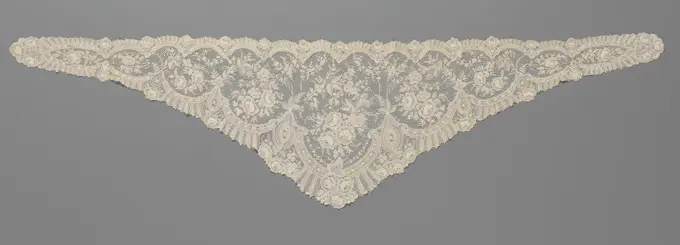
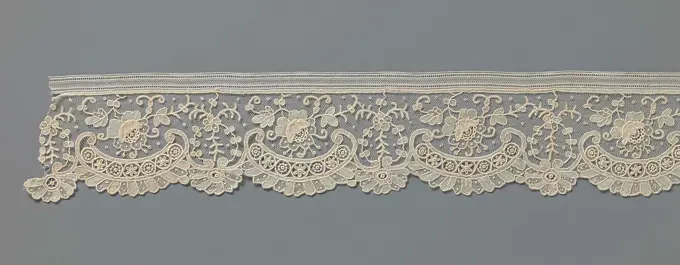
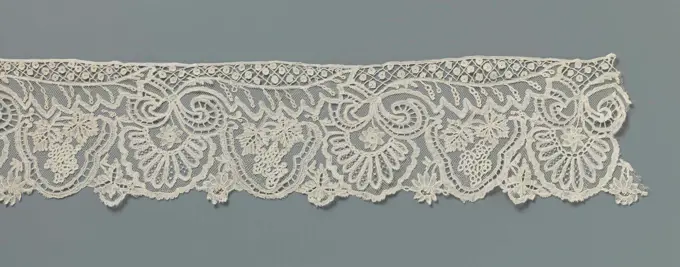
Elegant Lace Trimmings

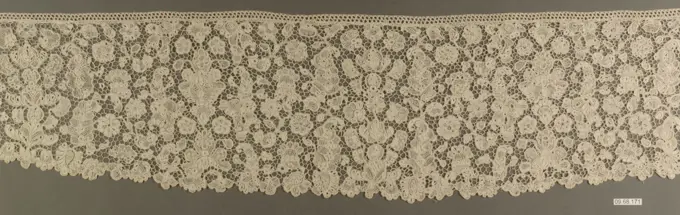
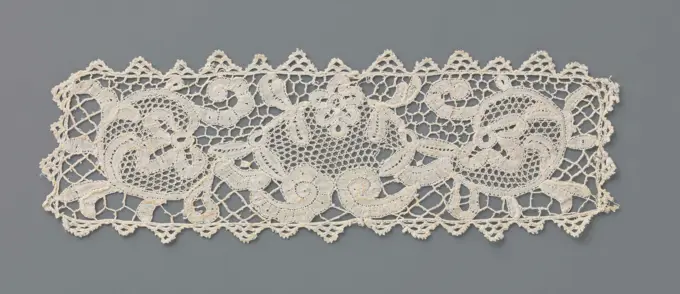
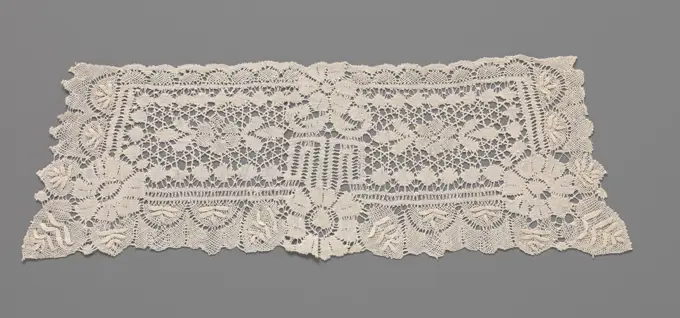
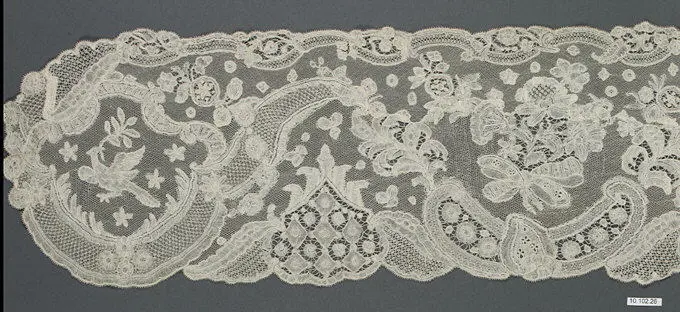
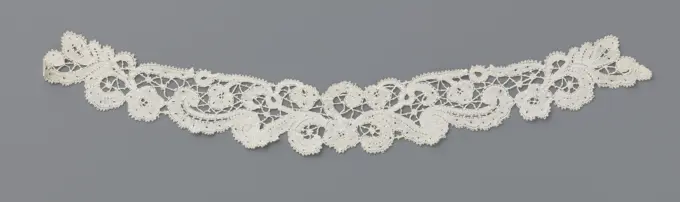
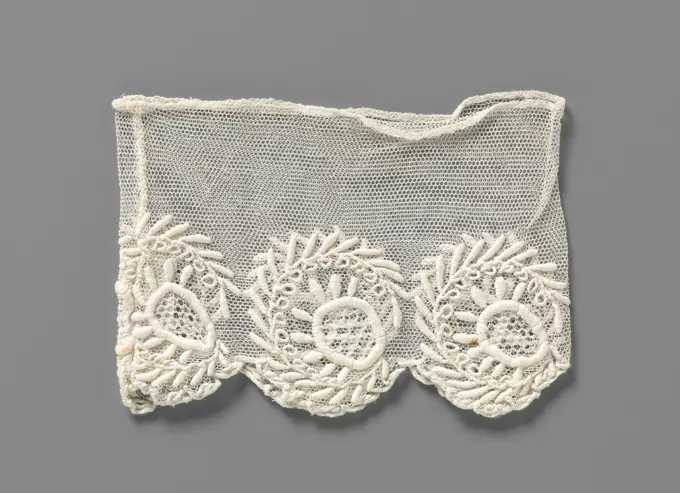
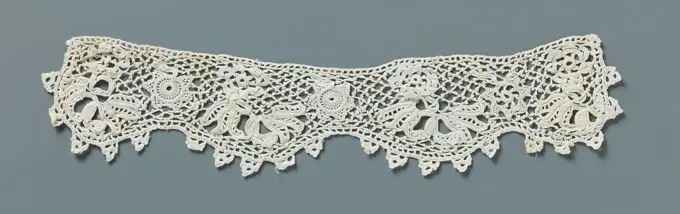
A variety of delicate lace strips with floral and geometric patterns. Features natural tones and fine craftsmanship, highlighting historical textile designs.

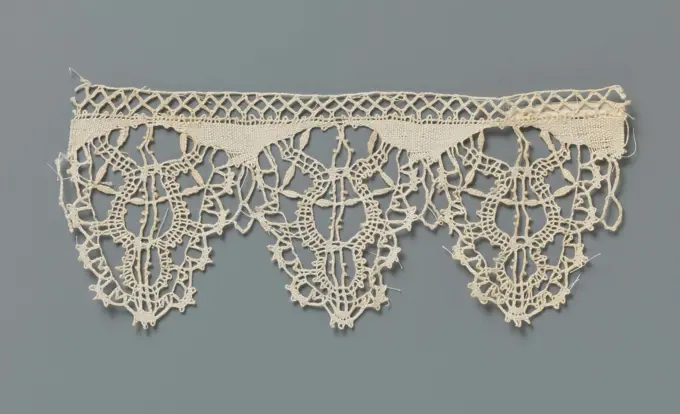
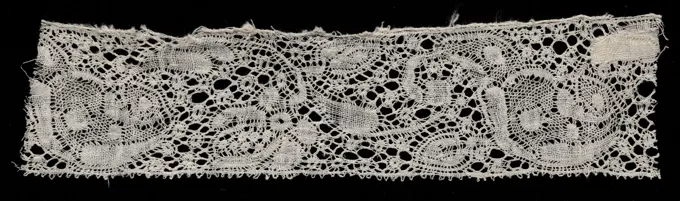
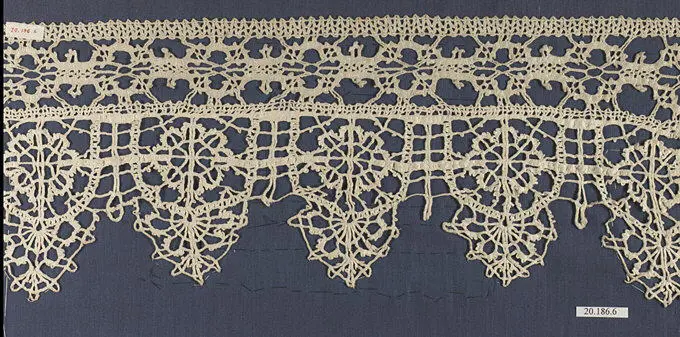
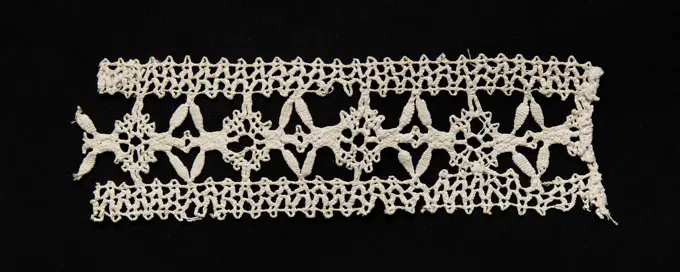
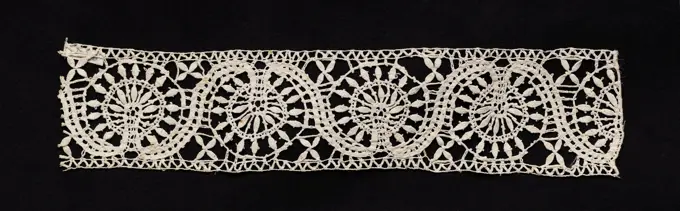
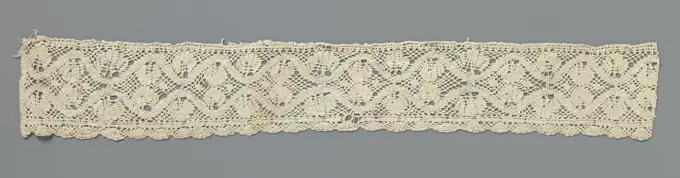
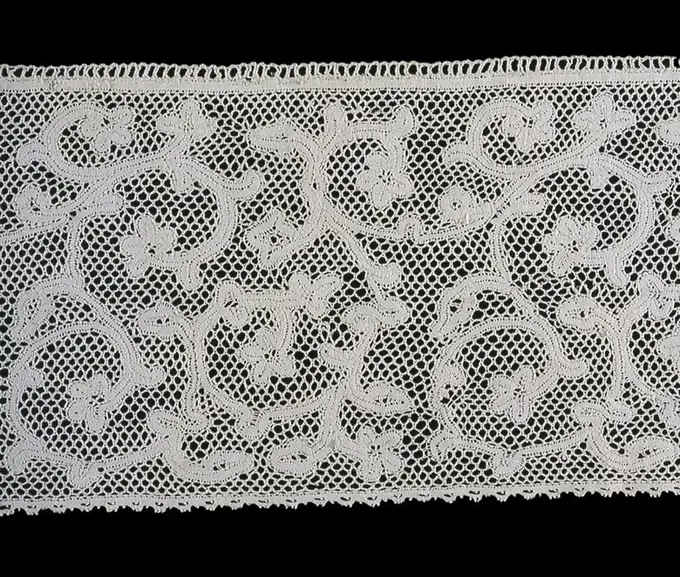
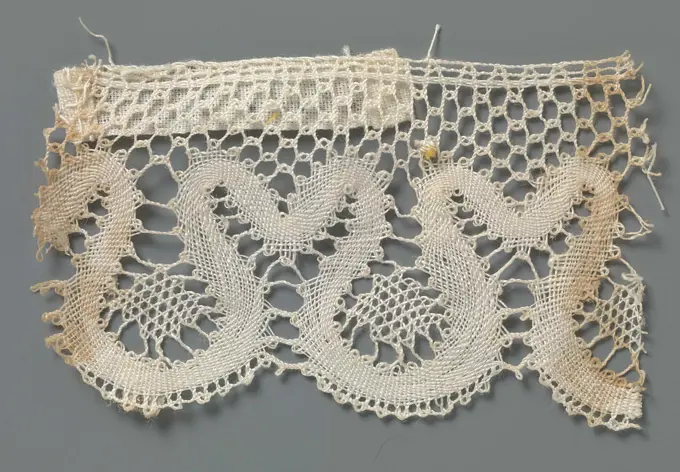
Strip bobbin with wheels and five -lobe sculptes, anonymous, c. 1620 - c. 1630 Strip of natural -colored bobbin: Old Flemish side. In the semicircular scallops there is a repeating and symmetrical motif of two wheels placed one above each other, surrounded by five lobes along the bottom. The pattern is made up of a winding strap in linen and braids. Southern Netherlands (possibly) linen (material) bobbin lace / tape lace (bobbin lace) / old Flemish lace Strip of natural -colored bobbin: Old Flemish side. In the semicircular scallops there is a repeating and symmetrical motif of two wheels placed one above each other, surrounded by five lobes along the bottom. The pattern is made up of a winding strap in linen and braids. Southern Netherlands (possibly) linen (material) bobbin lace / tape lace (bobbin lace) / old Flemish lace
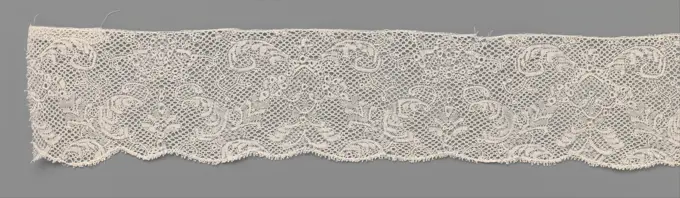
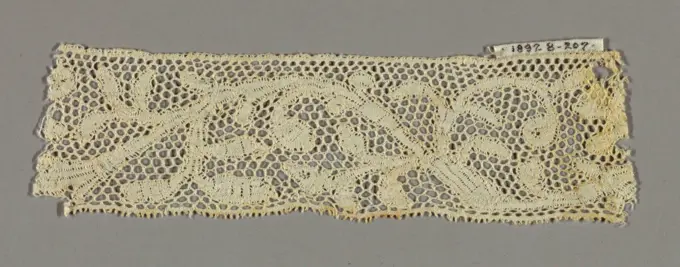
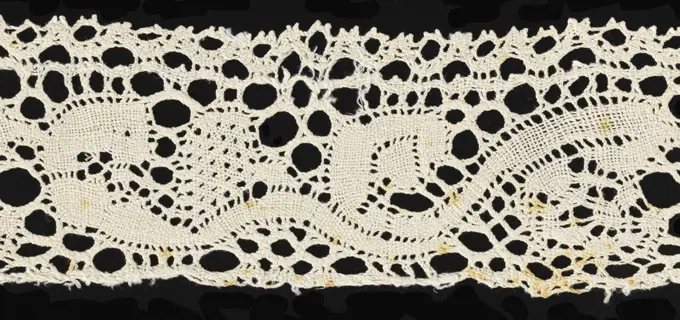
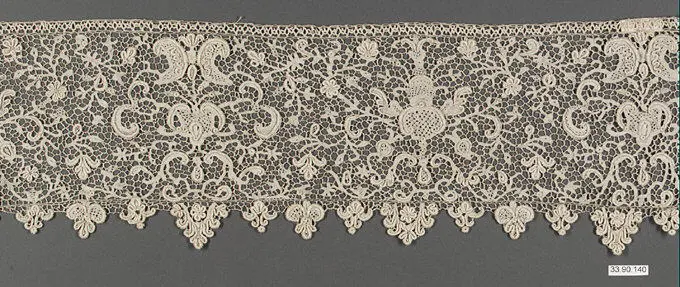
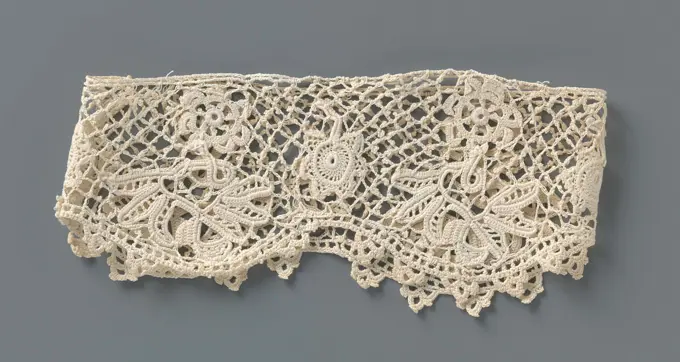
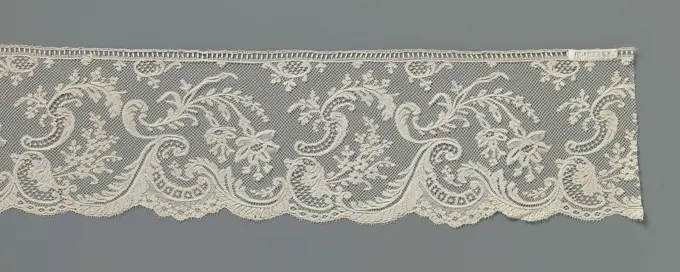
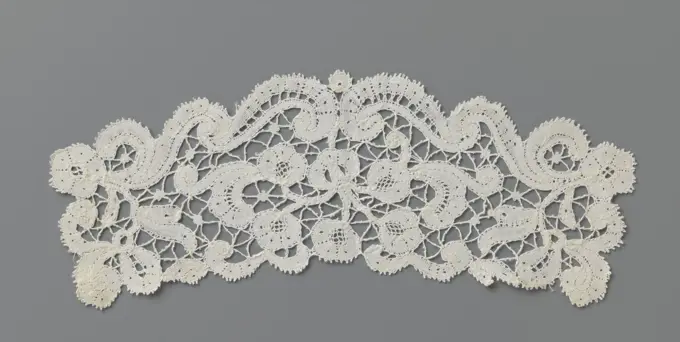
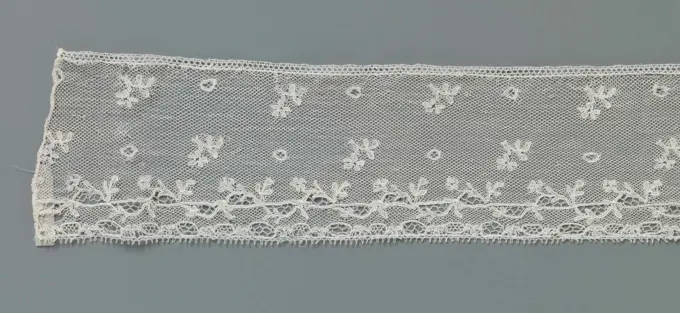
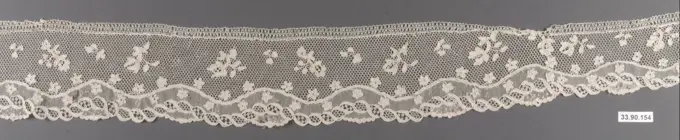
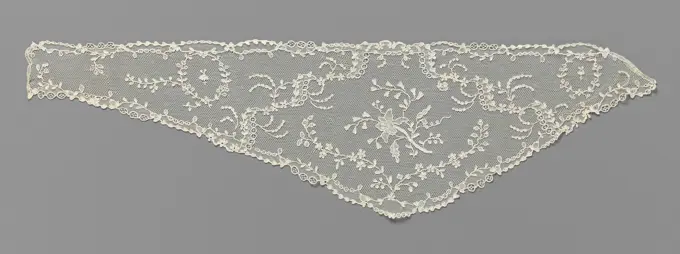
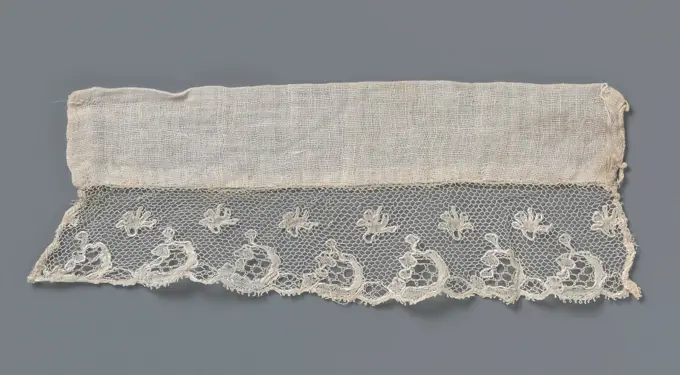
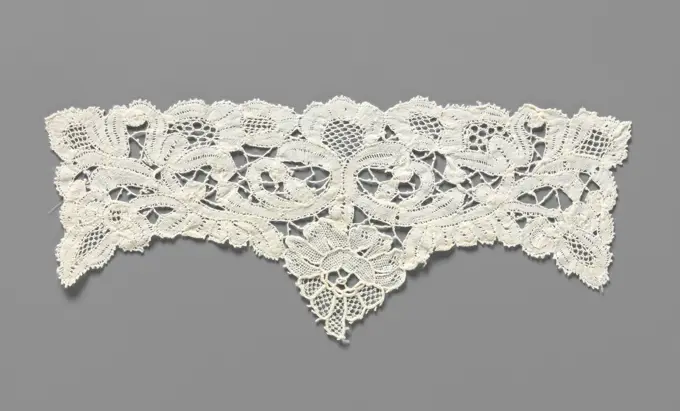
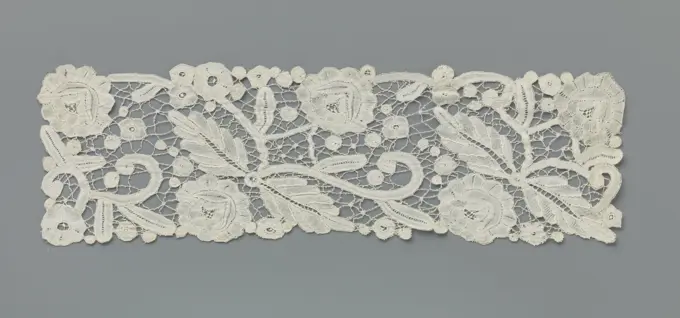
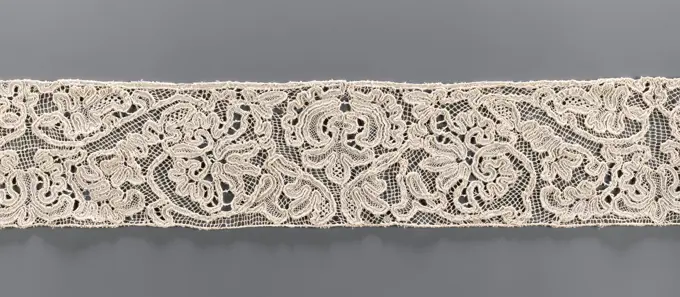
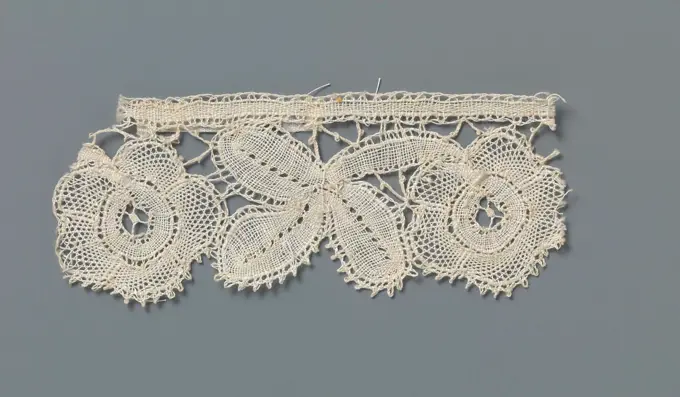
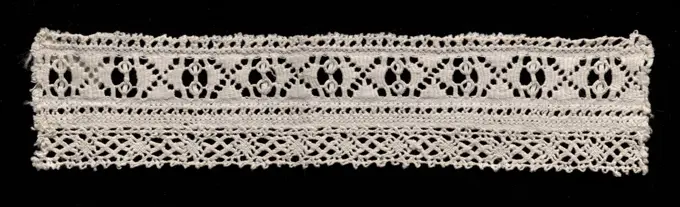
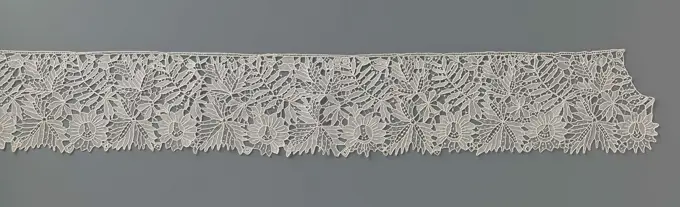
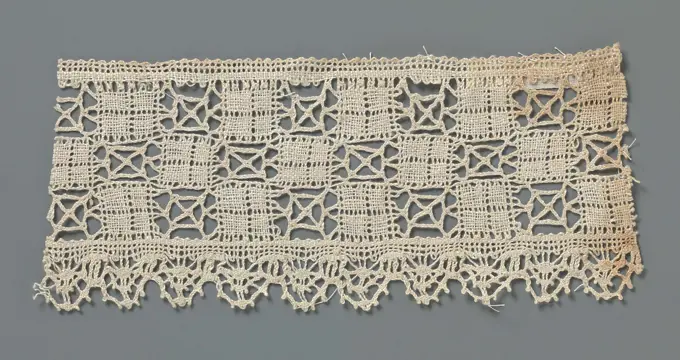
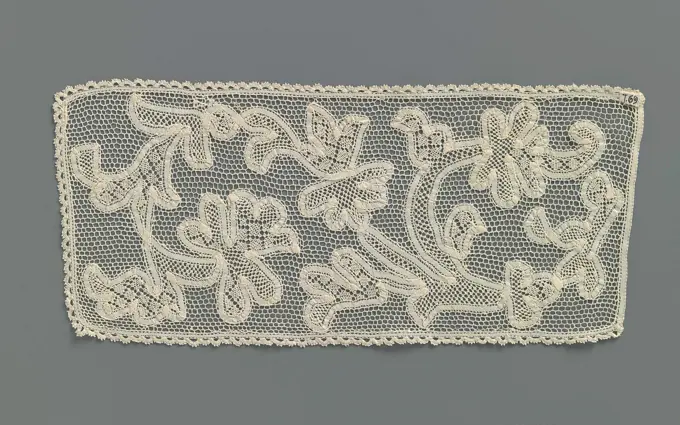
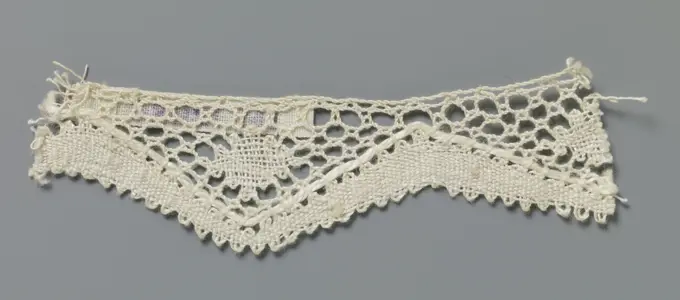
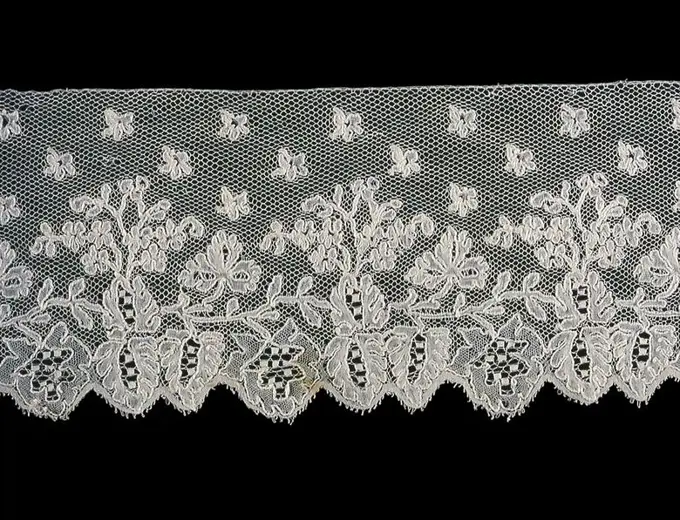
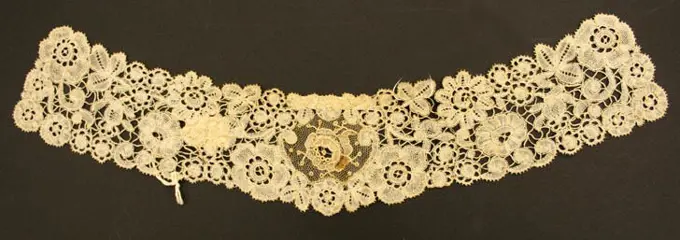
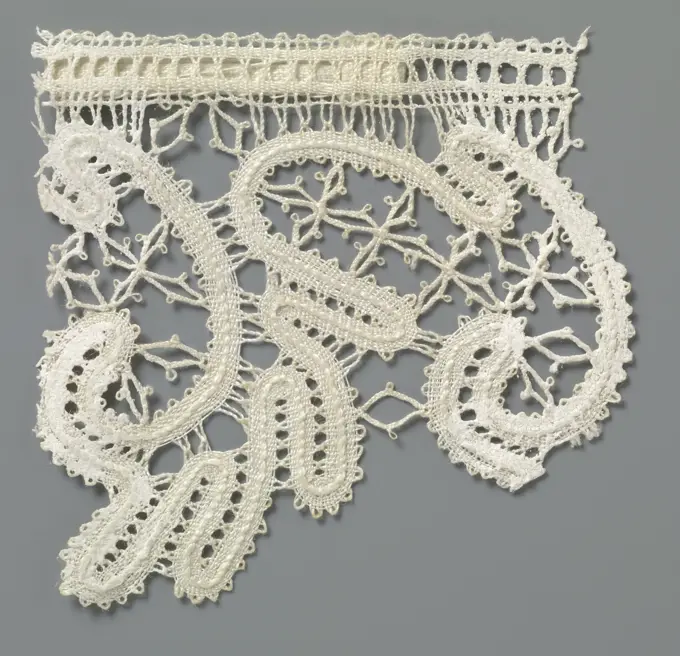
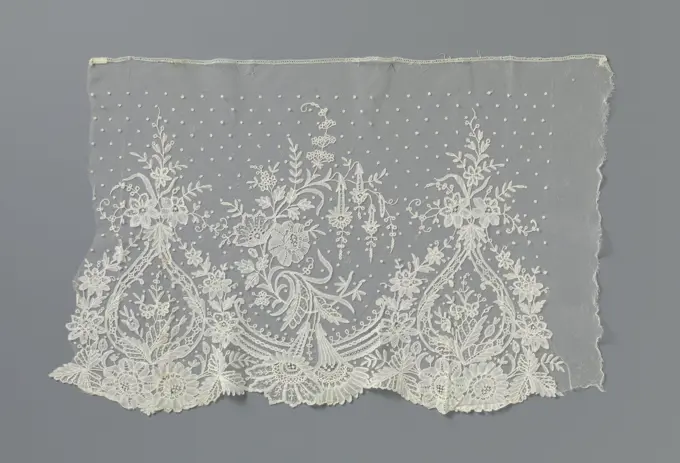
Strook applicatiekant met druiventrossen en gehalveerde bladeren.Strip natural colored application side, climbing side applicated on machine tulle. A narrow part, along the inside, exhibits a running pattern of halved, lobed leaves, which accompanies an equally halved medallion with a raster filling. On a wide part with a substrate of tulle, symmetrical, deep slot, which are in turn are filled with a grinding tray and a fan plant.Sleeve trimming (Engageantes) 18th century Italian, Venice. Sleeve trimming (Engageantes) 218114Strip bobbin with connected C-shaped motifs and bows, anonymous, c. 1900 - c. 1924  Strip of natural -colored bobbin. Above the center line of the strip is a row of butterflies or leaves. The pattern below consists of a succession of lying C-shaped motifs, which are alternately facing the open side up and down. A kind of bow hangs under the C-shaped motifs with the opening down, creating an oval space. The motives are connected by a two different mesh grounds: above the Cs with a Paris soil and below by a round Valenciennes ground. The motifs are made in linen and mains, partly equipped with thicker and shiny contour threads. A rose soil has been applied as a decorative land. The top and bottom of the strip are straight finished, with the bottom with picots.  linen (material) bobbin laceStrip bobbin with wheels and five -lobe sculptes, anonymous, c. 1620 - c. 1630 Strip of natural -colored bobbin: Old Flemish side. In the semicircular scallops there is a repeating and symmetrical motif of two wheels placed one above each other, surrounded by five lobes along the bottom. The pattern is made up of a winding strap in linen and braids. Southern Netherlands (possibly) linen (material) bobbin lace / tape lace (bobbin lace) / old Flemish lace Strip of natural -colored bobbin: Old Flemish side. In the semicircular scallops there is a repeating and symmetrical motif of two wheels placed one above each other, surrounded by five lobes along the bottom. The pattern is made up of a winding strap in linen and braids. Southern Netherlands (possibly) linen (material) bobbin lace / tape lace (bobbin lace) / old Flemish laceBelegstuk van kloskant met voluten.Insignment of natural colosside, possibly Flemish guipure. Symmetrical pattern with volutes to which three, four and five-leaf flowers spring. Around the motifs a braided barrier ground with picots. Within the motifs a honeycomb ground. Finish on all sides with triangles built from arcs.Kloskant cuff with symmetrical pattern with three large and three smaller rosette flowers, anonymous, c. 1910 - c. 1930 Cuff made of natural-colored bobbin: Cluny side. Trapezoidal model. Symmetrical pattern with large rosette flowers at the bottom of the trapezoidal field, one on each corner point and one in the middle at the bottom. There are two smaller rosette flowers in the field filled with a star -shaped braid with picots, each between three leaves. In the center of the field is a rectangular motif, possibly a flowerpot, crowned by volutes and another rosette flower. Around the field a sculpy edge of fan-shaped scumples and rushed leaves, both decorated with 'relief-grant' made in form. The sculpts are held in mains, the rosette flowers and other motifs in linen battle. Le Puy (possibly) cotton (textile) bobbin lace / Cluny lace Cuff made of natural-colored bobbin: Cluny side. Trapezoidal model. Symmetrical pattern with large rosette flowers at the bottom of the trapezoidal fielStrip bobbin with a symmetrical pattern around continuous scalloped decorative frame under the center line of the strip, anonymous, c. 1800 - c. 1849 Strip of natural -colored bobbin, Flanders side. The pattern on the upper half of the strip consists of two rows of loose motifs, always twice a configuration of four circles, interspersed with a flower with four Spitsovale petals. Well under the center line of the strip, it consists of a continuous scalloped decorative frame, which forms a continuous scalloped frame, which forms a kind of cartouches along the underside of the strip with the connected stylized leaves and flowers. There is a loose rosette flower around the two cartouches. The motifs are connected to each other above the decorative frame by a traly land, a five -part ground. Decorative lands have been used under the decorative frame. The motifs are made in linen battle with recesses and thicker and shiny contour threads. The top of the strip is finished with a separate straStrook naaldkant met ruit en rozet in vierkanten.Strip natural needle side, reticella. A repeating pattern of a square, alternating with a diamond or rosette, made up of 4x4 small squares. Along the bottom edge under each large square a semicircular shell with varying filling between two bell-shaped, hanging flowers. The top is trimmed with a woven edge.Barbe early 18th century Flemish. Barbe 218776Fragment, Medium: linen Technique: needle lace, Fragment of Alençon lace with a powdered design of alternating circles and minute leaves. Small scallops on bottom edge., France, late 18th century, lace, FragmentKloskant investment piece with volutes, anonymous, c. 1910 - c. 1930 Investor of natural -colored bobbin, possibly Flemish guipure. Symmetrical pattern with volutes of which three, four and five-leaf flowers spring. A braided bar with picots around the motifs. A honeycomb land within the motives. Finishing on all sides with triangles built from arches. Belgium  bobbin lace / Flemish guipure lace Investor of natural -colored bobbin, possibly Flemish guipure. Symmetrical pattern with volutes of which three, four and five-leaf flowers spring. A braided bar with picots around the motifs. A honeycomb land within the motives. Finishing on all sides with triangles built from arches. Belgium  bobbin lace / Flemish guipure laceStrip bobbin with two triangular compositions, anonymous, c. 1690 - c. 1710 Strip of natural-colored bobbin, binche side. The repeating and thin pattern consists of two different compositions, both symmetrical and triangular. The sloping lines of one composition consist of v-shaped leaves put together. An inverted heart forms the top of the triangle, which is crowned by two large feathered volute leaves. In the other composition, such volute leaves provide the oblique lines of the triangle, which is crowned by a not clearly defined, composed motif. There is a Kandelaber motif in both triangular fields. The motifs are made in linen battle with openwork edges and in netslag. They are connected to each other by a traly land, a five -part ground. Different decorative lands have been applied, in the heart, among other things, in one of the Kandelaber motifs and under C-Voluten. The top of the strip is straight finished. The faintly scalloped underside is finished with picots. The sculptes sStrip Machine with regular wavy slender with small leaves, anonymous, c. 1880 Strip of natural-colored machine side: machine Argentan side. The pattern consists of a regularly wavy slender with small leaves. A loose twig hangs above each golf valley. Along the underside, the pattern consists of two wavy tendrils with small leaves that together form a succession of circular cartouches and at the same time the outskirts of scales. Every third cartouche touches the regular wave line above it, whereby the point is cut by a rosette flower. The motifs are provided with contour threads and decorative land has been used in the cartouches. The motifs are connected by a mechanical Argentan ground, with meshes that seem to have been feasted by the machine as is done with the handmade Argentan side. The top of the strip is straight finished. Due to the loose hanging threads from the mechanical decorative grounds, the scrap edge appears to be finished with picots. Europe cotton (textile) Strip of nStrip bobbin with three rows of squares and edge edge, anonymous, c. 1875 - c. 1899  Strip of natural -colored bobbin. The pattern consists of three rows of squares. In each row, the squares are made alternately in linen battle with recesses that make a horizontal and vertical line and with braids that make a grid of a square with a cross through it. The top is straight finished, with a picot edge. Along the underside, half -shaped sculptes are made with braids around a large snowflake, with picots. Bohemia linen (material) bobbin laceFragment; linen; 1897-8-207Fragment, Medium: linen Technique: bobbin lace, Binche with no ground, 18th-19th century, lace, FragmentEdging early 18th century French. Edging 222827Flounce. Northern Italy, possibly Milan. Date: 1701-1725. Dimensions: 25.8 x 356 cm (10 1/8 x 140 1/8 in.)Width repeat: 70-71 cm (27 1/2-28 in.). Linen, bobbin part lace. Origin: Italy. Museum: The Chicago Art Institute, Chicago, USA.Engageante van kloskant met verschillende bloemtakken.Engagante of natural colosside: Brussels climbing side. The pattern consists of various flower branches between which spreader flowers. The motifs are connected by a grille, a drachelland. The Engagante has a bland scaffolding edge of connected cartouches that are more or less oval in shape and filled with coarser graves than in the pattern above and some ornamental soils.Engageante van Kloskant with different flower branches, anonymous, c. 1750 Engageante of natural -colored bobbin: Brussels bobbin. The pattern consists of different flower branches between which sprinkling flowers. The motifs are connected by a grid, a drachel soil. The Engageante has a faintly scalloped edge of connected cartouches that are more or less oval in shape and filled with coarser rays than in the pattern above and a few decorative grounds. Brussels linen (material) bobbin lace / Brussels bobbin lace Engageante of natural -colored bobbin: Brussels bobbin. The pattern consists of different flower branches between which sprinkling flowers. The motifs are connected by a grid, a drachel soil. The Engageante has a faintly scalloped edge of connected cartouches that are more or less oval in shape and filled with coarser rays than in the pattern above and a few decorative grounds. Brussels linen (material) bobbin lace / Brussels bobbin laceEdging French, Lille 19th centuryStrip bobbin with reserves and daddy and flowers, anonymous, c. 1750 - c. 1770 Strip of natural -colored bobbin: Mechelse side. The repeating pattern consists of a reserve, which is cut by a branch with papaverbollen and poppish flowers. Along the underside are two reserves against each other, with different fillings and framed by connected leaves and spare pals. In the middle between the two reserves, a branch with three flowers, each with six oval petals. The motifs are connected by a fine Maas soil. In the reserves, decorative lands have been used with coarser meshes. The motifs are made in linen battle with few recesses and with thick contour threads. The faintly scalloped underside is finished with picots. A strip of tulle is sewn along the straight top. Southern Netherlands linen (material) bobbin lace / Mechlin (lace) Strip of natural -colored bobbin: Mechelse side. The repeating pattern consists of a reserve, which is cut by a branch with papaverbollen and poppish flowers. AlonManchet van gehaakte kant met getorst takje en stervormige bloem.Cuff of natural colored Irish crochet side. Pattern where a source of flour with a rosette flower and several elongated leaves are interspersed by a hanging star-shaped flower on a short stem without leaf. Crochet diamond-shaped Maas soil with picots. The top is finished with a straight edge. The wavy lower edge is deposited with picoted three-part arcs.Strook kloskant met fuchsias boven overslaande golven.Natural collate strip, Valenciennes side. The repeating pattern consists of two fuchsia flowers, which hang down on a slightly curved stalk on the center line of the strip. The flowers almost hit the golf valley, between the high skipping waves along the bottom of the strip. The waves are made of pierced leaves and acanthus leaves set against each other, in the form of C and S volutes. Between the fuchsia branches, a bouquet with rosette flowers rises to a C-voltage, awarded by an openworks of leaves and twigs. The motifs are connected by a mesh soil, a diamond-shaped valenciennes ground. The full work is largely made in linen battle with cut-outs and open editors and partly in a cut-off. As ornamental ground, snowflakes and loose snowflakes have been applied, among other things. The top of the strip is finished with a separate splitting strap. The shelters along the underside are finished with picots.Strook kloskant met drie opgestapelde ronde vormen in diepe schulp.Stretch natural-colored genuese clamping side. The pattern was made to seventeenth-century example. The repeating pattern consists of a border along the top with a row of diamonds made with braids, including the same-like triangles that are made in linen stroke. Openwork semi-oval shapes hang between the consecutive triangles. Nine lovers have been made along each scallop with picoted braids. Three round shapes have been realized with a continuous cut-off strap. The shapes are piled from bottom to top of the scallop, run over and take in large ones. Except with braids, connections are also made with leaves in shape stroke. The top of the strip is straight finished.Kloskant intermediate mate with a windscreen pattern, anonymous, c. 1900  Intermediate facial of natural -colored bobbin, Russian side. The repeating pattern consists of a concatenation of openwork windows, with a rush -in -ahead in the center of each window. There are two smaller, placed windows with openwork edges between successive windows. Top and bottom of the strip are straight. Russia linen (material) bobbin lace / Russian laceKloskant cuff with hanging bunch in symmetrical frame, Leon Sacré, c. 1907 Cuff made of natural -colored bobbin: Flemish Guipure. In a symmetrical frame of S-Voluten, rosettes and C-Voluten, an asymmetrical trice with round-shaped fruits or flowers hangs. Braid soil. Finishing on all sides with unequal sculptures that arise from the pattern. The cuff is rectangular with a raised center. Brussels linen (material) bobbin lace / Flemish guipure lace Cuff made of natural -colored bobbin: Flemish Guipure. In a symmetrical frame of S-Voluten, rosettes and C-Voluten, an asymmetrical trice with round-shaped fruits or flowers hangs. Braid soil. Finishing on all sides with unequal sculptures that arise from the pattern. The cuff is rectangular with a raised center. Brussels linen (material) bobbin lace / Flemish guipure laceBobbin Lace Edging, 18th century. Spain, 18th century. Lace, bobbin; average: 6.7 x 17.8 cm (2 5/8 x 7 in.).Strook kloskant met sterren tussen j-vormige lintjes.Strip natural colosside, Russian side. The pattern is formed a two rows lying J-shaped ribbons, with the J -s in the lower row being mirrored with respect to the Js in the row above it. A star-shaped motif connects the ribbons. The ribbon is made in poetry linen, with open edges and a worked center. The stars are made with picoted braids. The top is straight finished with a strap with square meshes. The shelters along the underside are formed by the points of the stars and the shape of the ribbons.Fragment; linen; 1933-1-110Strip of needle side with hanging hearts, anonymous, c. 1880 Strip of natural needle side: Brussels mesh side. The repeating pattern consists of large semicircular sculptes formed by hiding C-Voluten. Above each volute is one loose rose with a jet wreath of short branches with berries. The switching points between the volutes are formed by oval medallions, which are decorated with a leaf crown. From the leaf crown a fine pendulum rises that runs over the rose to the next medallion. The scrap edge is formed by hanging heart -shaped leaves under the volutes interspersed by always three hanging daisies under the medallions. The motifs are made up of feston stitches and equipped with relief contours. The roses have relief leaves. The motifs are connected to each other by a fine Maas soil, a mesh side, on which a few mushes have been applied. Decorative stitches have been used in the roses and medallions. The top of the strip is straight finished. Brussels linen (material) Brussels Gaze PoiStrook kloskant met fijne slinger om rechte lijn onder strooipatroon.Strip natural colosside: Mechelen side. The upper part of the strip consists of two rows of alternating a cut-away round and a hanging star-shaped flower with three leaves on a split up stalk. Along the lower part of the strip a straight line runs through a rank around with fine flowers and leaves. Immediately below the underside of the strip lies a succession of oval, always with one triple leaf in between. The motifs are made in linen stroke, with thicker and shiny contour wires. The motifs are connected by a fine Maas soil, a Mechelen soil. The top of the strip is finished with a separate splitting strap. The bottom of the strip is straight finished and equipped with picots. The short sides are finished with a soil.Fragment (France); linenEdging mid-18th century French. Edging 222841Engageante van naaldkant met een a-symmetrische bloemtak in een symmetrische lijst.ENGINEANTE OF NATURAL CONNECTION: Argentan side. The pattern consists of an A-symmetrical flower branch in a symmetrical table. Under the flower branch two long branches that form a V. On either side of the list is an oval medallion with a flower in the center. With the exception of one larger flower in the central flower branch, the other motifs consist of thin with picots occupied branches, with small leaves, flowers, berries berries and 'cords' of openwork and picotted circles. The motifs are made up of feston stitches and equipped with relief contours. The motifs are connected by a soil with meshes that are close to feston stitches, an Argentan ground. Ornamental soils and decorative stitches are applied in different leaves, circles and in the flower leaves of the central flower. Along the edges, elongated fields are filled with a finer maas soil, the fields are defined by leaf packs, heart-shaped leBorder (Bas de rochet) early 18th century () Italian, Genoa. Border (Bas de rochet) 213352Edging and insertion 17th century Italian, Genoa. Edging and insertion 220816Piece 18th century Dutch. Piece 214757Border 18th century French. Border 214598Kloskant cuff decorated with three -lobe fan flowers, Martha Berkers, c. 1915 Cuff of natural-colored bobbin, Duchesse side. The cuff is formed as a circles segment. A very fine symmetrical design is on a stock of bars. A large chalice and a star -shaped five -leaf alternate with a large fan -shaped flower, which is made up of a chalice with a semicircle as a heart and three radiating lobes. Small grit from chalices, rosettes and sequins serves as a filling. Almost tight outsides, consisting of fine flowers. Lock linen (material) bobbin lace Cuff of natural-colored bobbin, Duchesse side. The cuff is formed as a circles segment. A very fine symmetrical design is on a stock of bars. A large chalice and a star -shaped five -leaf alternate with a large fan -shaped flower, which is made up of a chalice with a semicircle as a heart and three radiating lobes. Small grit from chalices, rosettes and sequins serves as a filling. Almost tight outsides, consisting of fine flowers. Lock linen (mateBorder, Technique: bobbin lace, Bobbin lace pillow sample, floral scrolls; mid-18th century Flemish, mid-18th century, lace, BorderBobbin Lace (Rose Lace) Edging with Bell Points, late 17th century. Italy, Genoa, late 17th century. Lace, bobbin; average: 5.8 x 22.9 cm (2 5/16 x 9 in.).Flounce early 17th century Italian, Veniec. Flounce 221786Strook gehaakte kant met reticella motieven.Strip natural-colored Irish crochet side. Pattern with squares, in which two different diamond motifs alternate. Border Sculpt. Sewn to circle shape.Manchet van katoen met kloskant en c-vormig motief.Cuttle of cotton with a strip of natural colosside: Lille side. The repeating pattern consists of a C-shaped motif along the underside of the strip, wherein the open side is closed by a sloping line of four connected molds. The successive C-shaped motifs are connected at the bottom by a spindle-shaped field. On the center line a row is erratic shaped motifs. The motifs are connected by a fine grille, a tulet. The energy-saving fireworks is made in linen stroke, with thicker and shiny contour wires. Two types of ornamental grounds have been applied, alternately in the C-shaped motif and in the Spitsoval field. The top is straight finished and put to the cuff. The slight scalloped underside is finished with picots.Manchet van gemengde kant met een roos en twee liggende gespiegelde c-vormige stengels met kelkbloemen.Cuff from natural colosside - Brugse lace - in coin. With one motif of coniferous lace. Narrow rectangular model with a point in the middle on a long side and pointed corners on the two sides. The side has a symmetrical pattern in which the tip is formed in the middle by a rose of needle side. The rose is made with feston stitches with embossed contours and some recesses in the petals and petals filled with an ornamental ground. In the openwork flower heart is a festive circle. The rest of the cuff is made of dick edge: above the rose two lying c-shaped stems, crowned in the middle by a chalis flour and with dock flowers to each other at the ends, which also form the shelters along the top of the cuff. The points on the underside are each formed by a hanging chali flower, a fuchsia-like flower. The dick side is made in linen stroke with openwork edges and recesses. Different (ornamentLength of Lace. England, 18th century. Textiles; textile lengths. Linen bobbin laceStrip bobbin with double row of flowers with eight petals, anonymous, c. 1850 - c. 1899 Strip of natural-colored bobbin, cluny side. The repeating pattern consists of a double row of flowers with eight petals made in shape. The flowers are in a network of long and shorter potented braids, which form more or less diamond -shaped fields, with one flower in each field. Along the underside of the strip runs a regular wavy decorative band, which also forms the sculpy edge. Each shell consists of smaller lobes that are alternately formed by an arc in netslag, an arc made with a braid work and an arc in netslag with an open worked center. The top of the strip is straight finished. Belgium (possibly) linen (material) bobbin lace / Cluny lace Strip of natural-colored bobbin, cluny side. The repeating pattern consists of a double row of flowers with eight petals made in shape. The flowers are in a network of long and shorter potented braids, which form more or less diamond -shaped fields, with oStrip needle side with rose above lying C-volute, anonymous, c. 1880 - c. 1899 Strip of natural needle side: Alençon side. The repeating pattern consists of a horizontal C-Volut with a rose in the middle of the field above. The rose hangs on a branch that rises and bends on the left next to the C-Volut. Another branch that also originates to the left next to the volute sticks diagonally over the previous C volute and bends almost at the top of the strip over the rose in that field. The scrap edge consists alternately of five leaves that hang down under each volute and a rose hanging between the volutes. The motifs are made up of feston stitches and are equipped with relief contours. The motifs are connected by a fine Maas soil, an alençon soil littered with mosjes. In the flower hearts and in the five circles that lie on the C-Voluten, decorative stitches have been used. The top is straight finished with a messing strap. The scrap edge is finished with picots. Alençon linen (material) Siercraft for an evening mantle of mixed side with rose hedge, Martha Berkers, 1915 Sierstuk (cuff) for an evening mantle of mixed side - bobbin in combination with needle side - Brussels Duchesse. There are roses on a wide -spread braid that usually support on two leaves. An intermediate ornament consists of single and double volutes and many small flowers. Lock linen (material) mixed lace / mixed Brussels Sierstuk (cuff) for an evening mantle of mixed side - bobbin in combination with needle side - Brussels Duchesse. There are roses on a wide -spread braid that usually support on two leaves. An intermediate ornament consists of single and double volutes and many small flowers. Lock linen (material) mixed lace / mixed BrusselsFragment, Medium: linen Technique: needle lace, Band fragment with a dense floral scroll and raised three-dimensional details., Italy, 1650-1700, lace, FragmentFragment of the lace;  2. PO. 19th century (1851-00-00-1900-00-00);Bobbin Lace (Needlepoint Design) Insertion, second half of 16th century. Italy, Genoa, second half of 16th century. Lace, bobbin; average: 8.3 x 19.4 cm (3 1/4 x 7 5/8 in.).Strip of needle side with flour or leaf on curly handle, anonymous, c. 1850 - c. 1899 Strip of natural -colored Venetian needle side. Repetitive motif of a flower or a three -part leaf on a curly handle on an irregular bar with picots. Feston stitches with recesses along a single leaf grain and a few surfaces are filled with a decorative land. Festunned contour threads. The top is finished with a straight edge. The edges of the motifs are finished with picots on the bottom. unknown cotton (textile) Venetian needlepoint Strip of natural -colored Venetian needle side. Repetitive motif of a flower or a three -part leaf on a curly handle on an irregular bar with picots. Feston stitches with recesses along a single leaf grain and a few surfaces are filled with a decorative land. Festunned contour threads. The top is finished with a straight edge. The edges of the motifs are finished with picots on the bottom. unknown cotton (textile) Venetian needlepointFragment 18th century German, Saxony. Fragment 214716Lace, 1700s, Mechelen, maker unknown. Gift of Mrs G. Acland Allen, 1955.Cap mid-19th century American. Cap 100167Fragment, Medium: linen Technique: bobbin lace (Brussels style), Fragment showing small floral sprays and portion of a border. Vrai droschel ground., Belgium, late 18th-early 19th century, lace, FragmentNeedlepoint (Punto in aria) Lace Edging, late 16th century. Italy, 17th century. Lace, needlepoint: linen; average: 7 x 31.2 cm (2 3/4 x 12 5/16 in.).Strip bobbin with a symmetrical pattern with three stylized tulips, anonymous, c. 1650 Strip of natural -colored bobbin: Old Flemish side. The repeating and symmetrical pattern consists of a straight -hanging stem with a chalice or stylized tulip at the bottom. The central handle is flanked by wavy stems (S-shaped), with a smaller chalice-shaped flour at each end and a small rosette flower at the base. The motifs are made in linen battle with openwork edges. There is hardly any soil, but the piece shows a first impetus towards the development of traly rounds. The top of the strip is straight finished. The very flat scrap edge along the underside of the strip is finished with picots. Southern Netherlands linen (material) bobbin lace / old Flemish lace Strip of natural -colored bobbin: Old Flemish side. The repeating and symmetrical pattern consists of a straight -hanging stem with a chalice or stylized tulip at the bottom. The central handle is flanked by wavy stems (S-shaped), with a sFragment of Lace. Possibly Switzerland, late 19th century. Textiles; fragments. Mercerized cotton () machine-made lace embroideryStrook kloskant met drielobbig blad tussen twee rozetbloemen.Strip natural colosside: fine bridges flower work. The pattern consists of a triple leaf between two rosette flowers. The motifs are on a straight red strap along the top and connected by some advised braids. The straight strap and the triple leaf are made in linen stroke, with contour wires within the open edges and with recesses such as leaf growers. The petals of the rosette flowers are made in crossblank with contour wires and the flower hearts are made in linen stroke, with one block made in shape stroke in each open work center. The top of the strip is straight finished. The flowers and leaves form the slip edge along the bottom, which is finished with picots.Needlepoint (Drawnwork) Lace Insertion and Bobbin Lace Edging, 16th century. Italy, 16th century. Lace, needlepoint and bobbin: linen; average: 4.5 x 20.4 cm (1 3/4 x 8 1/16 in.).Strook naaldkant met ingesneden blad.Running pattern of incised leaves above a rose and a three-leaf, which together form the sharply toothed outside line. Cross-shaped bars with button (soil of long X-shaped bars with a spider). The REMPLIS consists of buttonhole stitches and a Fond Gazé. German side: 'Carlsbead points'.Fragment (Border) Made 1850-1900 France. Linen, needle lace of a type known as Point D'Alencon .Shawl Fragment. India. Date: 1810-1820. Dimensions: 53.4 x 104.1 cm (21 x 41 in.)Repeat: 15.3 x 13.6 cm (6 x 5 3/8 in.). Wool, double interlocking 2:2 'S' twill tapestry weave; warp fringe. Origin: India. Museum: The Chicago Art Institute, Chicago, USA.Strook kloskant met configuraties van twee ruiten en twee harten.Strip natural colosside. With coarse thread, the strip is part of a collection of twenty-six pieces of lace that is intended as a study material. In a coarse grille, a Paris soil, a repeating pattern made in linen stroke of two side-side windows and two hearts placed above each other, which are together like a rosette. Narrow paths along the top and bottom of the strip are made in slurbase, this is also the finish of the long sides. The short sides have been cut.Cuff made of crocheted side with relief stations such as Schulpenrand, W. de Jong, c. 1910 - c. 1920 Cuff made of natural Irish crocheted side. Rectangular model. Along three sides, a sculpy edge of connected relief senes runs. There is a row of diamond -shaped leaves on one long side. Two horizontal stems with three -part leaves in the narrow midfield. The motifs are connected by a diamond -shaped network with picots. Along the roses, a continuous bow edge runs along the outside, which turns into a picot edge above the diamond -shaped leaves. Nijmegen cotton (textile) Cuff made of natural Irish crocheted side. Rectangular model. Along three sides, a sculpy edge of connected relief senes runs. There is a row of diamond -shaped leaves on one long side. Two horizontal stems with three -part leaves in the narrow midfield. The motifs are connected by a diamond -shaped network with picots. Along the roses, a continuous bow edge runs along the outside, which turns into a picot edge above theBorder; linenStrook naaldkant met schuingestelde vazen.Strip natural-colored coniferous lace - Reticella - with a strip of a strip at the bottom with point shellars. Needle side: The repeating pattern consists of squares in which a shaking vase, turn turned to the left and to the right. The vase is connected to small dogs and bowes on the sides of the square and at the top and bottom through a list of stuffed squares. The motifs are made with feston stitches, decorated with recesses and with closed picots. The motifs are connected to each other by reflected bars and bars with feston stitches. The horizontal continuous lines are made with a lace band. Along the underside of the Reticella strip is a sloping edge sewn from doll edge with a pattern of rectangles and windows with the elongated triangular shelter that are finished with open picots.Bobbin Lace (Needlepoint Design) Insertion, 17th century. Italy, Genoa, 17th century. Lace, bobbin; average: 6.4 x 31.2 cm (2 1/2 x 12 5/16 in.).Strook kloskant met drie rijen vierkantjes en schulpenrand.Strip natural colosside. The pattern consists of three rows of squares. The squares are alternately made in each row in linen stroke with recesses that make a horizontal and vertical line and with braids that make a grid of a square with a cross. The top is straight finished, with a picro sand. Along the bottom, braids are made with braids around a large snowflake, with picots.EdgingStrook gemengde kant met brede spiraalrank.Strip natural-colored mixed side - Mezzo Punto - with a splitting or woven ribbon and a needle lace ground. On a Maas soil (needle side) is a pattern that consists of wide curly stems with exotic flowers. The contours of the flowers and stems consist of closted or woven ribbons. Different ornamental grounds (needle side) have been applied within the contours. A splitting bow border serves as a finish along the outer sides, with the exception of one short side that is finished with a straight splitting strap.Strip bobbin with window in Zigzag debts, anonymous, c. 1800 - c. 1899 Strip of natural -colored bobbin, nozzle. The repeating pattern consists of a loose window in Zigzag sculptes. The window is made in Linnenlag, in a mesh ground, a closed pin stroke ground. Along the zigzagging underside, a tire runs in linen battle, with a thick contour thread at the top and equipped with picots on the bottom. The top of the strip is straight finished. Buckingham cotton (textile) Bobbi lace / lace cloth Strip of natural -colored bobbin, nozzle. The repeating pattern consists of a loose window in Zigzag sculptes. The window is made in Linnenlag, in a mesh ground, a closed pin stroke ground. Along the zigzagging underside, a tire runs in linen battle, with a thick contour thread at the top and equipped with picots on the bottom. The top of the strip is straight finished. Buckingham cotton (textile) Bobbi lace / lace clothBorder. Belgium, Flanders, Mechlin. Date: 1810-1830. Dimensions: 8.2 × 94.8 cm (3 1/4 × 37 3/8 in.). Cotton and linen, bobbin straight lace of a type known as "Mechlin" with a Mechlin mesh ground. Origin: Flanders. Museum: The Chicago Art Institute, Chicago, USA.Bobbin Lace Edging, 18th century. France, Valenciennes or Flanders, 18th century. Lace, bobbin: linen; average: 5.1 x 16.5 cm (2 x 6 1/2 in.).Kloskant collar with attached Jabot, Anonymous, c. 1900 - c. 1924  Collar with attached jabot of natural -colored Venetian bobbin. Strip -shaped model under which a heart -shaped jabot hangs. The predominantly symmetrical pattern consists of a wavy slender with five strongly curling side branches with a three or five-lobe flower at each end. The heart -shaped Jabot is formed by three of such curling tendrils with ditto flower at each end. Around the heart, on the curling of tenders, several short side branches that all curl in the same direction. The motifs are largely made in linen battle with openwork edges here and there. A different stroke is used for a few (flower) leaves. The motifs are connected by braids. The top of the whole is straight finished. The curling of tendrils and side branches form a scrap edge along the other edges. Belgium linen (material) bobbin laceStrip bobbin with regular wavy slender with peonies, anonymous, c. 1750 - c. 1760 Strip of natural-colored bobbin: Valenciennes side. The repeating and continuous pattern consists of a regularly wavy slender with peonies. One peony always rises from an emerging wave and bends back towards Golf Valley. The other peony waves just after every wave top in the direction of the rank. There are also branches with three smaller flowers, berries and flower buds on the slank. The motifs are made in linen battle with openwork edges and recesses. They are connected by a fine Maas soil, a round Valenciennes ground. The scrap edge is formed flat around the pattern and is finished with picots. The top of the strip is straight finished. Valenciennes linen (material). Bobbi Lace / Valenciennes Lace Strip of natural-colored bobbin: Valenciennes side. The repeating and continuous pattern consists of a regularly wavy slender with peonies. One peony always rises from an emerging wave and bends back towardsStrip bobbin with fan -shaped leaves between wavy lines, anonymous, c. 1850 - c. 1899 Strip of natural -colored bobbin. The repeating and continuous pattern consists of two wavy lines, which together form rounded diamond -shaped fields. There is a fan -shaped leaf in every wave top and in every golf valley. The motifs are connected by a diamond -shaped Maas soil. The motives are made in linen battle with recesses. Along the underside of the strip, under a straight edge in a linen stroke, a sculpy edge of connected fan patterns runs. The top is finished with a simple straight decorative edge. One of the short sides is finished with a zoompje. Germany (possibly) linen (material) bobbin lace Strip of natural -colored bobbin. The repeating and continuous pattern consists of two wavy lines, which together form rounded diamond -shaped fields. There is a fan -shaped leaf in every wave top and in every golf valley. The motifs are connected by a diamond -shaped Maas soil. The motives are made iFragment (USA); Manufactured by A .G. Jennings & Sons; cottonStrip bobbin with flour surrounded by leaves and composite leaf -shaped motif, anonymous, c. 1740 - c. 1760 Strip of natural -colored bobbin: Mechelse side. The repeating pattern consists of a flower surrounded largely by a large leaf -shaped motif that is composed of a border of crooked squares and a one -sided border with a circle in each lob. The motifs are connected by a fine Maas soil. The motifs are made in linen battle with recesses and mains, with thicker and shiny contour threads. A decorative land has been applied in and between different motifs, a snowflake land. The very faintly scalloped underside is finished with picots. The top is straight. The strip consists of three pieces sewn together with coarse seams. With one short piece on the left, followed by two more or less equal pieces with an axis of symmetry in the middle. Mechelen linen (material) bobbin lace / Mechlin (lace) Strip of natural -colored bobbin: Mechelse side. The repeating pattern consists of a flower surroBorder (From a Cover). Northern Italy. Date: 1701-1750. Dimensions: 15.6 x 63.2 cm (6 1/8 x 24 5/8 in.). Linen, bobbin part lace (continuous clothwork tapes). Origin: Italy. Museum: The Chicago Art Institute, Chicago, USA.Length of Lace. Belgium, Brussels, 1725-1750. Textiles; textile lengths. Linen Brussels bobbin laceCollar 1700-1939 American. Collar 119130Fragment. Date/Period: 1650-1700. Fragment. Medium: linen. Technique: bobbin lace of discontinuous tape; six bobbins used for connecting bars. Author: UNKNOWN.Strip bobbin with swinging ribbon in large bends and narrow lobben, anonymous, c. 1900  Strip of natural -colored bobbin, Russian side. The pattern is formed a swinging ribbon, which alternately forms large turns and deep narrow lobes. The ribbon is made in closed linen battle, with openwork edges. Relief contours are formed by a braid that runs across the center of the ribbon. The pattern is kept in shape by a decorative soil and consists of four -pointed stars and windows, made with potented braids. The top is straight finished and equipped with picots. The scums along the bottom are also finished with picots. Russia linen (material) bobbin lace / Russian laceFragment 16th century Italian, Venice. Fragment 220964Strook naaldkant versierd met een rank met bloemen.Strip needle side, consisting of a smooth and a scalloped edge. The straight strip is decorated with a wavy rank with flowers. Lace type: Punto in Aria.Sleeve of application side with the peer -shaped medallions, anonymous, c. 1840 - c. 1849 Sleeve of a natural application side, bobbin and needle side applied on mechanical tulle. Against a background, which is widely littered with moesjes, closed -worked Schulpen in turn filled with a pear -shaped medallion with violets and a circle arch with a flower branch. The pear shape is surrounded by a flower wreath with a flower branch in the top. The branch above the circle arc is C-shaped and shows two large hanging chalice, a dune rose and an anemone (both of the needle side) and hanging bells. Brussels Sleeve of a natural application side, bobbin and needle side applied on mechanical tulle. Against a background, which is widely littered with moesjes, closed -worked Schulpen in turn filled with a pear -shaped medallion with violets and a circle arch with a flower branch. The pear shape is surrounded by a flower wreath with a flower branch in the top. The branch above the circle arc is C-shaGuimpe van Kloskant with symmetrical volute pattern, Leon Sacré, c. 1907 Guimpe of natural -colored bobbin: Flemish Guipure. Symmetrical pattern of S-Voluten and C-Voluten between which a total of three round-shaped flowers or fruits and three rosette flowers. Braid soil. Finishing on all sides with unequal sculptures that arise from the pattern. The guy is faintly curved rectangular. Brussels linen (material) bobbin lace / Flemish guipure lace Guimpe of natural -colored bobbin: Flemish Guipure. Symmetrical pattern of S-Voluten and C-Voluten between which a total of three round-shaped flowers or fruits and three rosette flowers. Braid soil. Finishing on all sides with unequal sculptures that arise from the pattern. The guy is faintly curved rectangular. Brussels linen (material) bobbin lace / Flemish guipure laceStrip of a climbing side with ribbon that forms hearts and drip-shaped slot. Strip natural colosside, Russian side. The repeating and continuous pattern is formed by a ribbon that varies alternately a heart and drip-shaped glule. Along the top the pattern is connected to a maas basis. The ribbon is made in linen stroke and a diamond-shaped motif is made in the drip-shaped shell. The top is just finished. The scalloped underside is finished with picots.Manchet van kantborduurwerk met sikkelvormige gevederde tak die een cirkel omvat met stralen aan één zijde.Cuff of natural-colored edge embroidery: embroidery on machine tulle. Rectangular model. The repeating pattern consists of a sickle-shaped feathered branch that includes a circle with rays on one side. Different mechanical landscapes have been set in the circles behind which the tulle has been removed or not. The sloping edge along the underside forms semi-circular shelters around the successive sickle-shaped leaves.Border 16th-17th century Southern German. Border 217948Strook kloskant met parel- en rozetlijst.On the ground soil, a mechelen soil (also known as ice soil), with some sprinkled four-pastor moes is a running pattern. Along the inside are small hanging rosette branches, a dune rose in the middle of a dune rose to larger voluntaries, which shown at the same flour that forms the closing piece of pure circle arc shut. The tubes consist of a pearl and rosette list, which enclose a center barrier with grid work. Mechelen side.Strook gehaakte kant met getorst takje en stervormige bloem.Strip natural-colored Irish crochet side, possibly a part of a collar. Pattern where a source of flour with a rosette flower and several elongated leaves are interspersed by a hanging star-shaped flower on a short stem without leaf. Crochet diamond-shaped Maas soil with picots. The top is finished with a straight edge. The wavy lower edge is deposited with picoted three-part arcs.Edge, Medium: linen Technique: bobbin lace, Eastern Europe, 19th century, lace, EdgeNeedle's scarf with peer -shaped medallions, anonymous, c. 1850 - c. 1860 Scarf of natural -colored needle side: Brussels mesh side. Triangular model. Large sculptures with c shapes laid in C-shapes and with radiating oak leaves have pear-shaped medallions as switches that decrease in the ends and the inner edge to the size of earrings. Filling with rose branches hanging in large spirals. The soil is littered with moesjes. Brussels linen (material) Brussels Gaze Point Scarf of natural -colored needle side: Brussels mesh side. Triangular model. Large sculptures with c shapes laid in C-shapes and with radiating oak leaves have pear-shaped medallions as switches that decrease in the ends and the inner edge to the size of earrings. Filling with rose branches hanging in large spirals. The soil is littered with moesjes. Brussels linen (material) Brussels Gaze PointStrook naaldkant met liggende c-voluten met daarboven een roos.Strip natural-colored coniferous lace, point the gaze the bruxelles. Repetitive motif of a landscape C-volt out which a rose interspersed with a leaf wreath awarded a rosette flower. Fine soil with single twisted meshes, strewn with moes. Full work with various ornamental grounds, with nuances in density where the denser filling is made with dust stitches. Relief of widespread wire bundles (Cordonnets). Schulps along the bottom edge. The top edge is trimmed with a splitting strap.Band, Medium: linen Technique: bobbin lace (continuous braid-like), Three and a half repeats of geometric design in bobbin technique. No mesh., Italy, late 16th century, lace, Band