Elegant Lace Trimmings

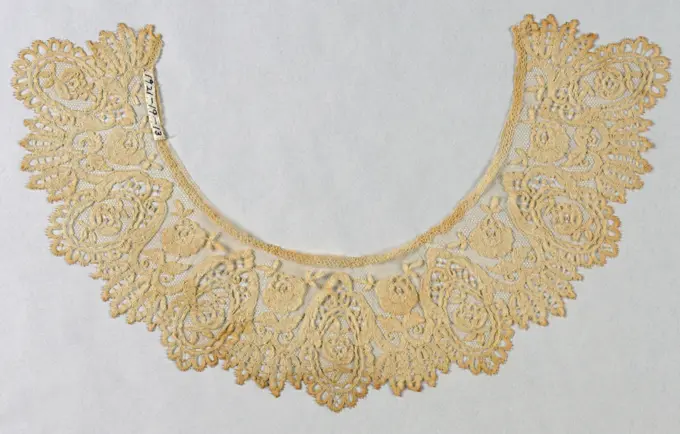
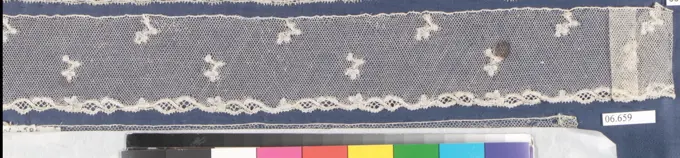
A variety of delicate lace strips with floral and geometric patterns. Features natural tones and fine craftsmanship, highlighting historical textile designs.

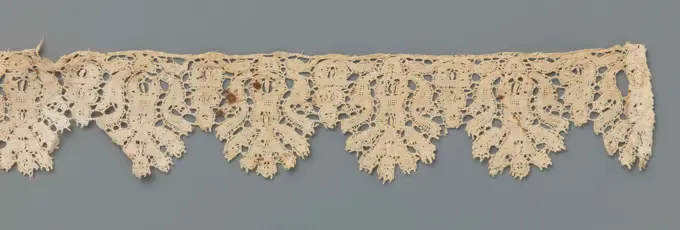
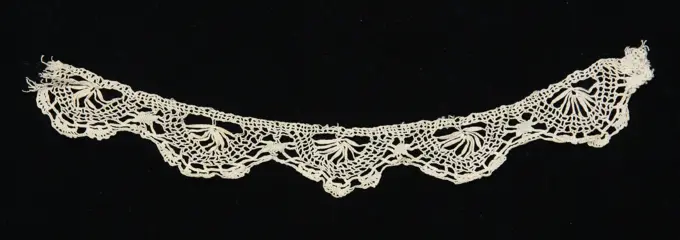
Strip bobbin with wheels and five -lobe sculptes, anonymous, c. 1620 - c. 1630 Strip of natural -colored bobbin: Old Flemish side. In the semicircular scallops there is a repeating and symmetrical motif of two wheels placed one above each other, surrounded by five lobes along the bottom. The pattern is made up of a winding strap in linen and braids. Southern Netherlands (possibly) linen (material) bobbin lace / tape lace (bobbin lace) / old Flemish lace Strip of natural -colored bobbin: Old Flemish side. In the semicircular scallops there is a repeating and symmetrical motif of two wheels placed one above each other, surrounded by five lobes along the bottom. The pattern is made up of a winding strap in linen and braids. Southern Netherlands (possibly) linen (material) bobbin lace / tape lace (bobbin lace) / old Flemish lace
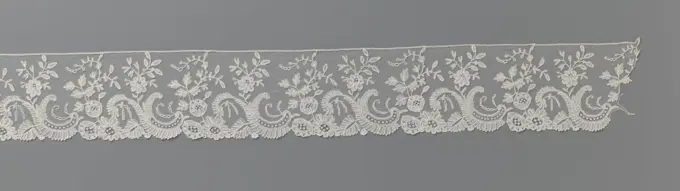
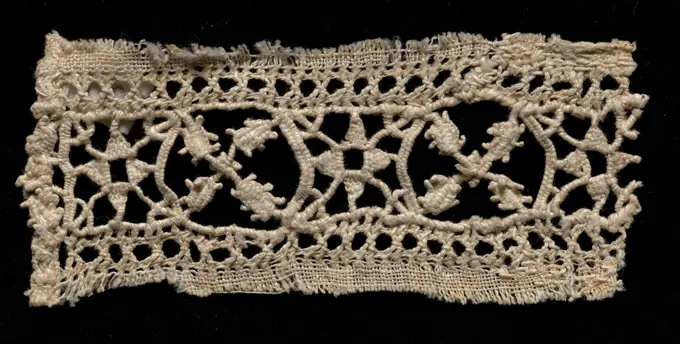
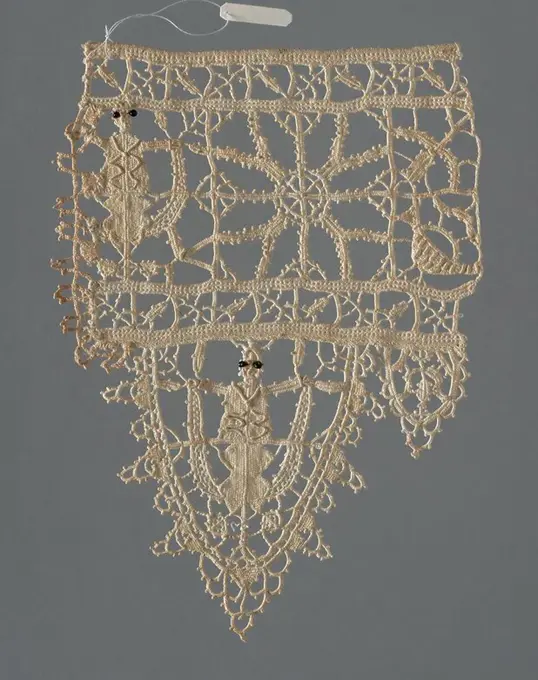
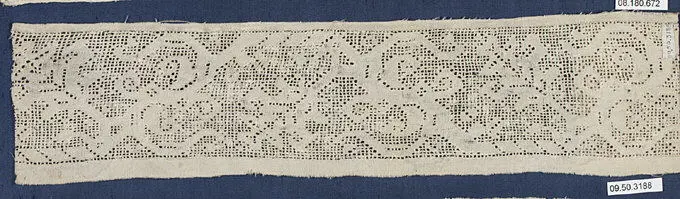
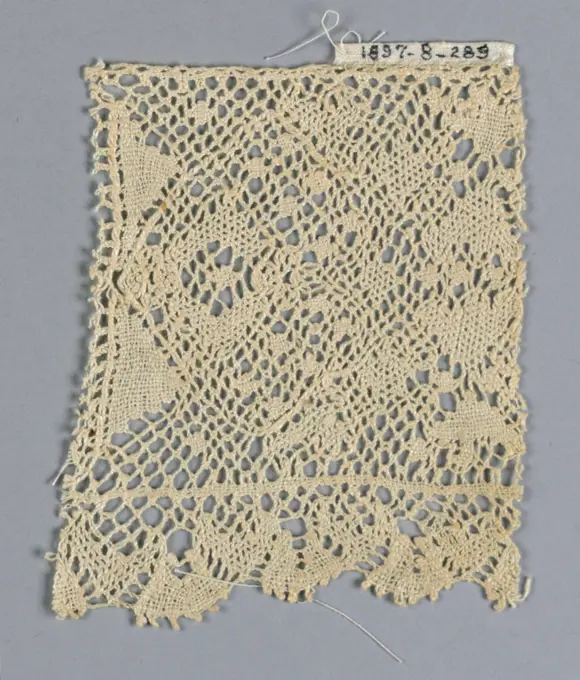
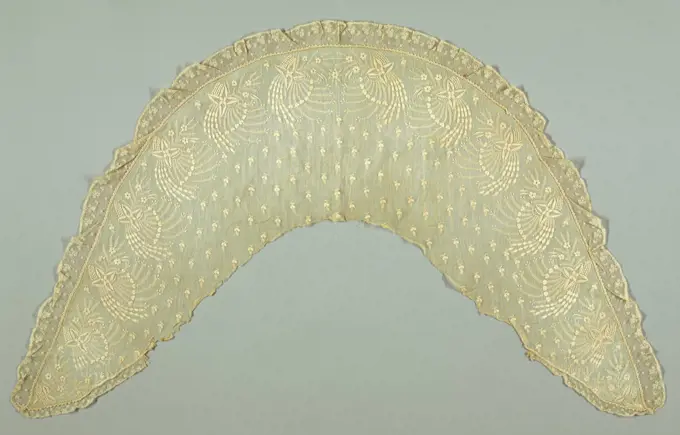
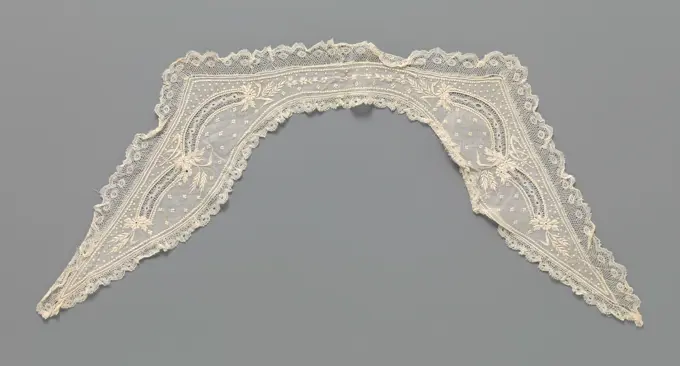
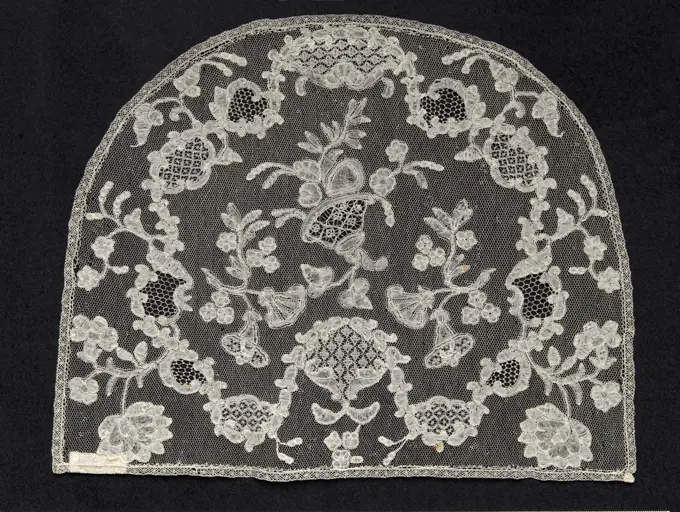
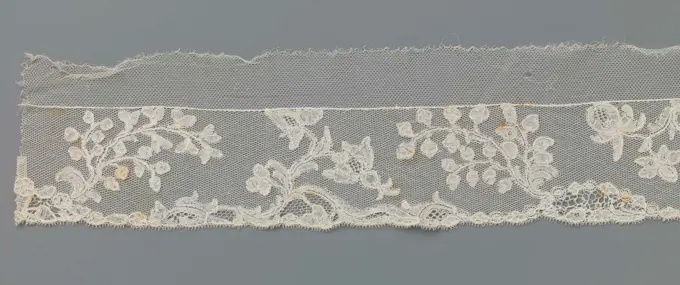
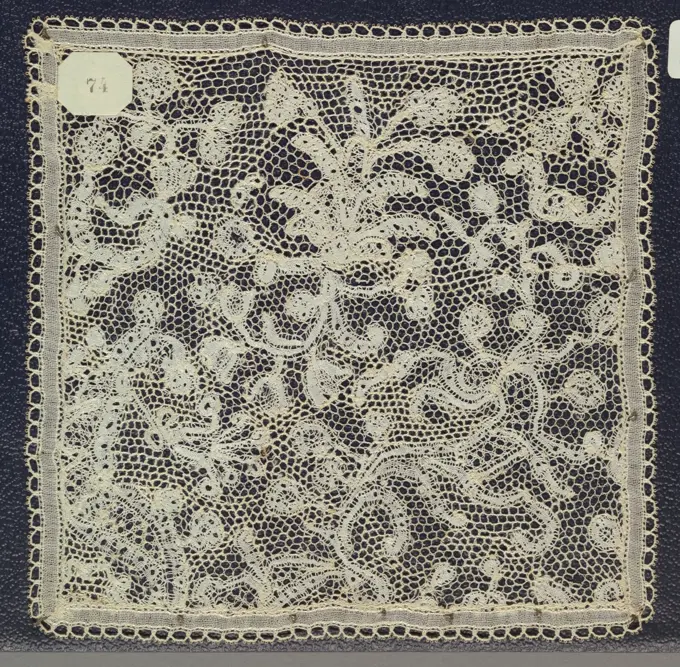
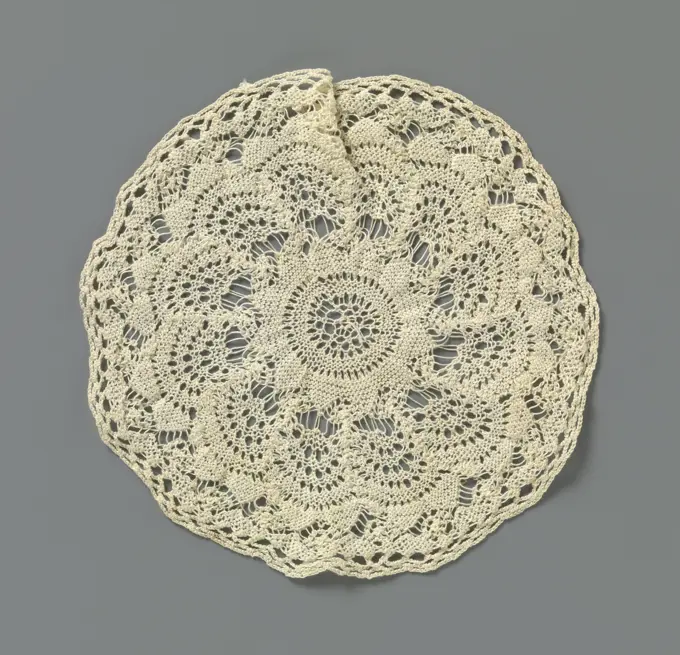
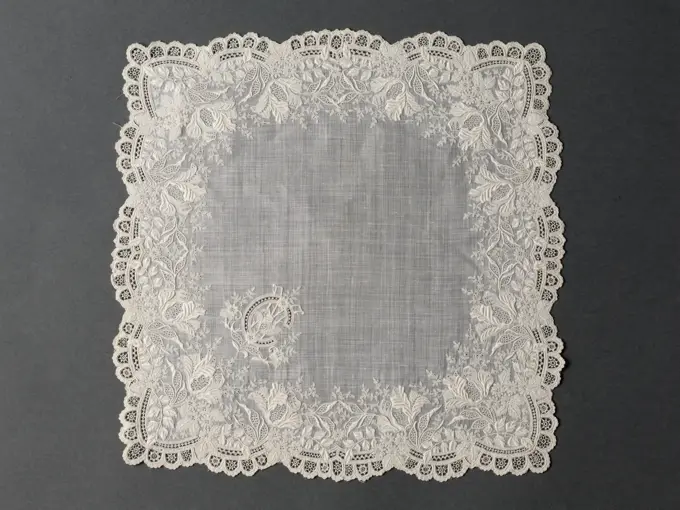
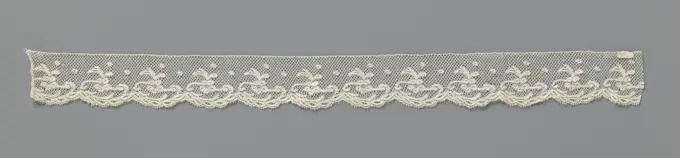
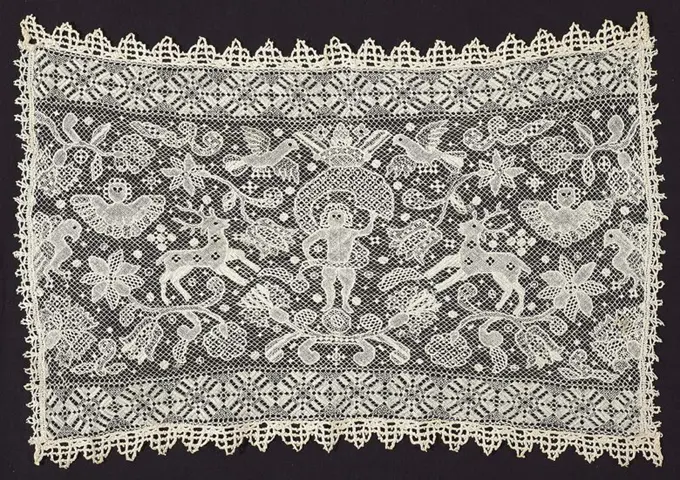
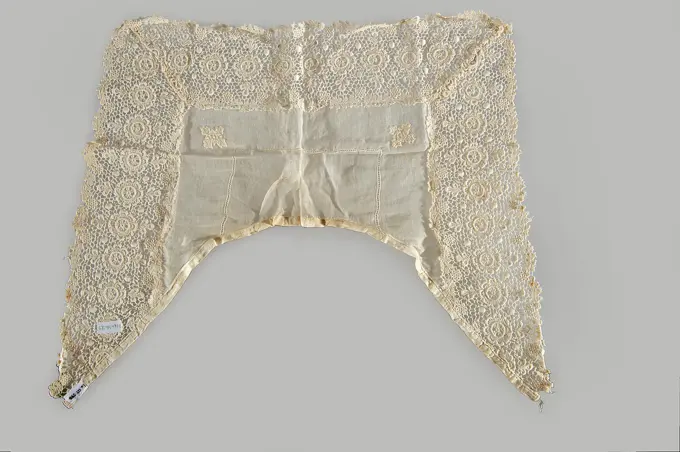
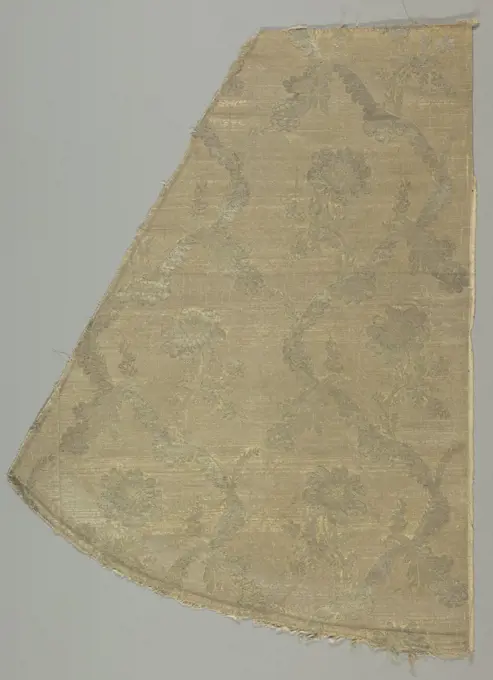
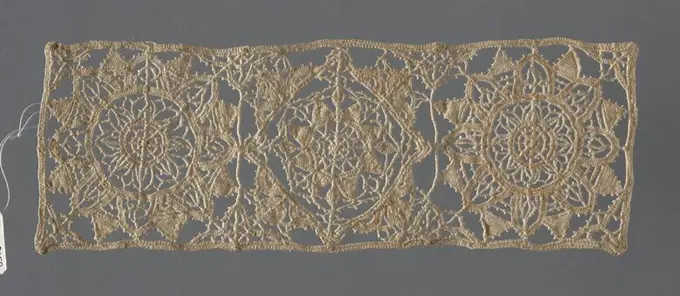
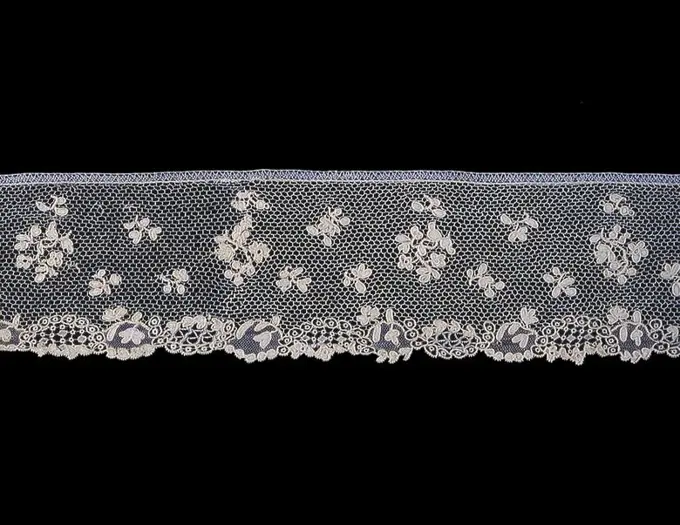
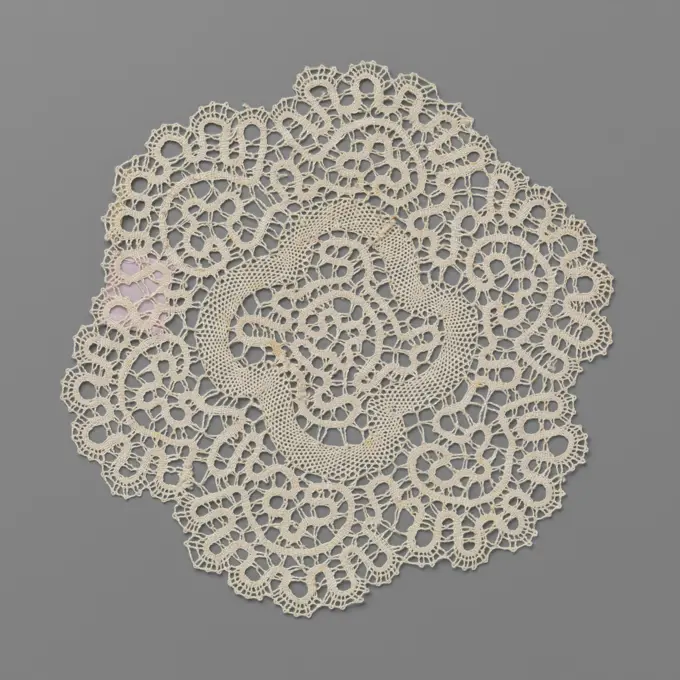
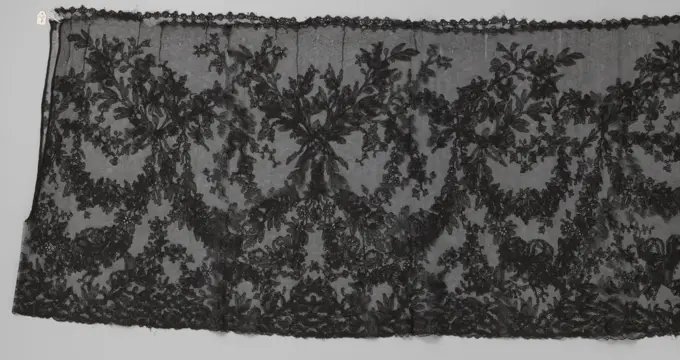
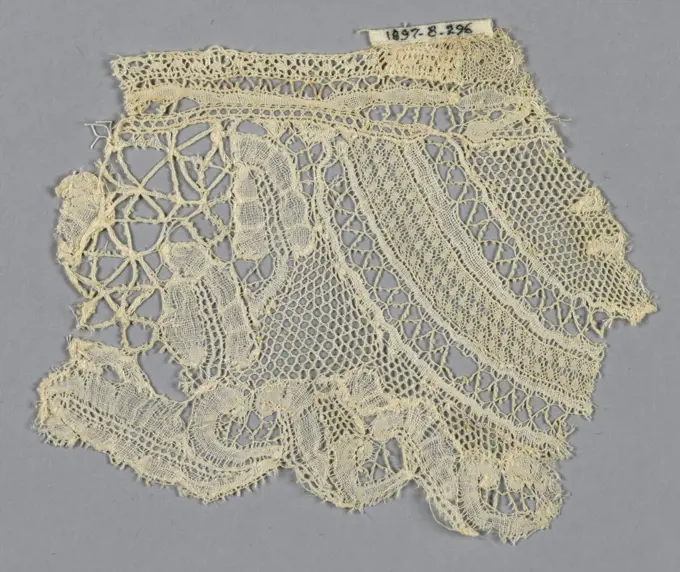
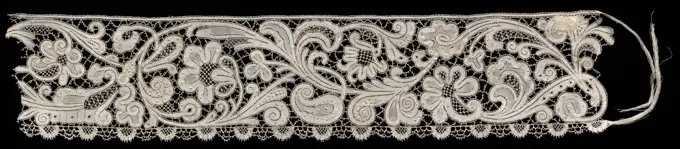
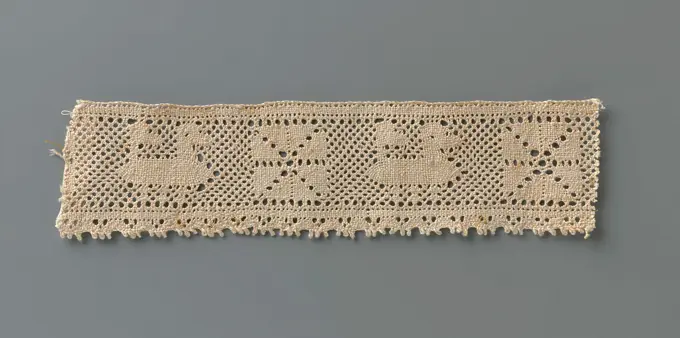
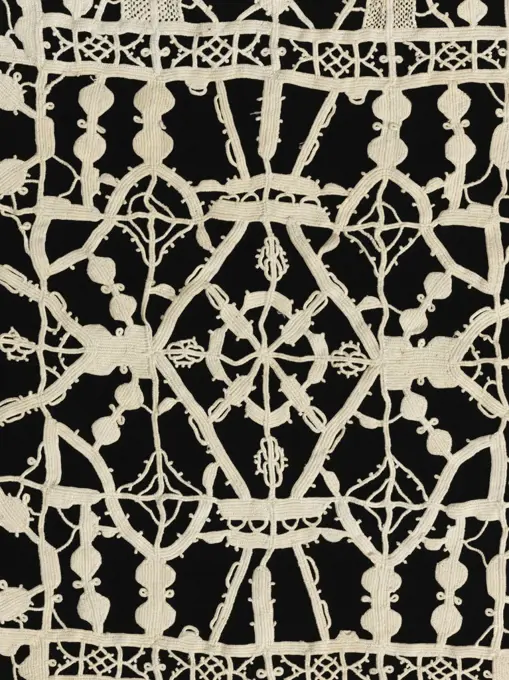
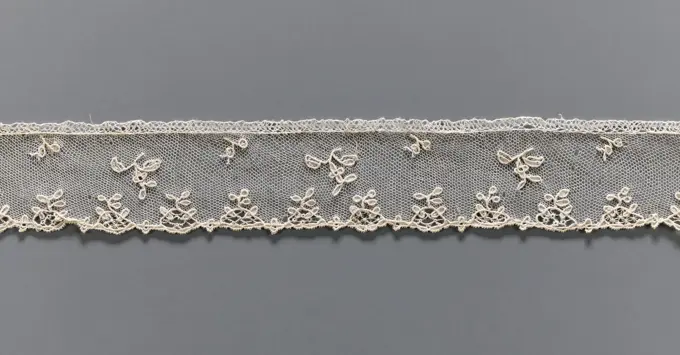
Insertion 17th century Italian. Insertion 220929Strook kloskant met distel in bloempot.Natural collate strip, old lace. The schulls from which the strip is constructed are hemisphere with erraticly shaped edges. De Schulpen creates from a repeating symmetrical motif of a flowerpot with thistle. The flowerpot hangs on the head compared to the straight upper edge. The motifs are made in linen stroke with openwork edges. In the recesses, spindle-shaped leaves are made in different places in shape stroke.Fragment Of Border (Belgium); linen; Bequest of Marian Hague; 1971-50-430Maniple end, medium: silk, metallic Technique: woven, Flower design in metallic on pink silk, 17th century, woven textiles, Maniple endStrip bobbin with Drieblad, Anonymous, c. 1875 - c. 1899 Strip of natural-colored bobbin: Duchesse side. On an open braid soil there is an ongoing pattern that is more closed along the scalloped outside than along the inside. A thin wavy slender is in the middle and is decorated, among other things, with three rush -hour leaves and with an imposed interior leaves. Together with three blossoms and an anemone, two leaves form the unequal shells. Brussels linen (material) bobbin lace Strip of natural-colored bobbin: Duchesse side. On an open braid soil there is an ongoing pattern that is more closed along the scalloped outside than along the inside. A thin wavy slender is in the middle and is decorated, among other things, with three rush -hour leaves and with an imposed interior leaves. Together with three blossoms and an anemone, two leaves form the unequal shells. Brussels linen (material) bobbin laceStrip mixed side with S-Voluten, Anonymous, c. 1875 - c. 1899 Strip of natural -colored mixed side: Brussels bobbin side in combination with a needle -seal, a fine mesh side. This type of lace is also known under the name: Point d'Angleterre. The running pattern is thinning of drawing and consists of suitable C and S-Voluten. Large roses, and face and and profil, form deep scumples with a leaf and a C-Volute. Fine leaf branches have turned to the inside. Brussels linen (material) mixed lace / Brussels bobbin lace Strip of natural -colored mixed side: Brussels bobbin side in combination with a needle -seal, a fine mesh side. This type of lace is also known under the name: Point d'Angleterre. The running pattern is thinning of drawing and consists of suitable C and S-Voluten. Large roses, and face and and profil, form deep scumples with a leaf and a C-Volute. Fine leaf branches have turned to the inside. Brussels linen (material) mixed lace / Brussels bobbin laceCravat (one of a pair) 18th century French. Cravat (one of a pair) 223015Needlepoint (Reticella) Lace Insertion, 17th century. Italy, 17th century. Lace, needlepoint: linen; average: 3.2 x 7.7 cm (1 1/4 x 3 1/16 in.).Japon strip of application side with pear-shaped medallions. Japon strip of natural colored application side, dick edge and needle side applicated on machine tulle. Against a background, which is widowed with mates, closed worked slopes are filled with a pear-shaped medallion with violets and a circle arc with a flower branch. The pear shape is surrounded by a flower wreath with a flower branch in the top. The branch above the circle arc is c-shaped and has two large dependent sodes, a dune rose and an anemone (both of needle lace) and hanging bells.Border. Belgium, Flanders. Date: 1650-1675. Dimensions: 9 × 86.6 cm (3 1/2 × 34 1/8 in.)Width repeat: 26.7 cm 26.7 cm (10 1/2 in.). Linen, bobbin straight lace. Origin: Flanders. Museum: The Chicago Art Institute, Chicago, USA.Fragment (Border). Italy. Date: 1501-1600. Dimensions: 19.7 x 14.3 cm (7 3/4 x 5 5/8 in.). Linen, needle lace work on a plain weave cut and drawn threadgrid; glass beads; embroidered in double hem and overcast stitches. Origin: Italy. Museum: The Chicago Art Institute, Chicago, USA.Cravat End. Belgium, Flanders, Brussels. Date: 1730-1749. Dimensions: 32.2 × 33.7 cm (12 3/4 × 13 1/4 in.). Linen, bobbin part lace of a type known as "Brussels" with a Droschel mesh ground. Origin: Flanders. Museum: The Chicago Art Institute, Chicago, USA.Strip bobbin with V-shaped flowers, anonymous, c. 1805 - c. 1825 Strip of natural-colored bobbin, Valenciennes side. The repeating pattern consists of a row of loose leaves or twigs along the upper half of the strip. Under the center line is a row of V-shaped leaves with an oval flower, interspersed with one muse. A thin continuous pendulum with a flower on the tops and leaves in the valleys runs under the V-shaped leaves. And along the bottom edge, a stylized straight slender with stylized leaves and flowers, which occasionally come up. The motifs are connected by a Maas soil, a diamond-shaped Valenciennes ground. The motifs are made in linen battle with openwork edges. A separate stretched strap has been sewn over the unfinished top and short sides. The bottom is finished with picots. Southern Netherlands cotton (textile) Bobbi Lace / Valenciennes Lace Strip of natural-colored bobbin, Valenciennes side. The repeating pattern consists of a row of loose leaves or twigs along the upper Border Made 1601-1750 Italy. Linen, bobbin straight lace .Band 17th-18th century possibly German. Band 217779Fragment early 17th century Italian Punto in arialiterally, "stitches in the air"is one of the earliest styles of needle lace, which is itself developed from cutwork of primarily geometric design. When lacemakers transitioned to using a foundation of threads laid out according to a pattern drawn on parchment, they were able to incorporate more fluid lines and curves into their designs.. Fragment 212354Strip with two barbes from Brussels bobbin, Anonymous, c. 1740 - c. 1750 Strip with two barbes from Brussels bobbin. The strip has a scalloped outer edge with picots. The other edge is straight. The barbes have scalloped edges with picots, the ends are round. The pattern is formed by leaves, flowers, flower branches and C-shaped volutes and has an exceptional hourglassmaas. Brussels . Brussels bobbin lace Strip with two barbes from Brussels bobbin. The strip has a scalloped outer edge with picots. The other edge is straight. The barbes have scalloped edges with picots, the ends are round. The pattern is formed by leaves, flowers, flower branches and C-shaped volutes and has an exceptional hourglassmaas. Brussels . Brussels bobbin laceCap Crown (France); linenFragment (France); linenStrook naaldkant met halve maantjes.On a coarse maasing ground there is a spreading pattern of Moesjes, who are grouped to half tubes, quadrilles and daisies. A narrow straight edge with fine mesh soil closes the outside and is bounded by pearl lists. Alençon side.Insertion 16th century Italian, Venice. Insertion 221059Hemenbol van Kloskant with flower vase, anonymous, c. 1730 - c. 1740 Hat of natural -colored Brussels bobbin. Symmetrical pattern. In a large lobed cartouche there is a large flower vase, on a base and filled with flower branches, large leaves and a middle rosette. The Cartouche shows an open zigzag contour, which enters in a fine flower drink. On the outside there are three fan -shaped cartouches that are decorated with very rich grid, as well as a very large holder in the middle. Snowflake grounds have been used as decorative land, among other things. Upstairs two pumpkins hang in the cartouche, there are two in the corners on blossom branches that sprout in the cartouche. Brussels linen (material) bobbin lace / Brussels bobbin lace Hat of natural -colored Brussels bobbin. Symmetrical pattern. In a large lobed cartouche there is a large flower vase, on a base and filled with flower branches, large leaves and a middle rosette. The Cartouche shows an open zigzag contour, which enters iThree lace borders, 18th century, ; bobbin lace, England, 18th centuryCollar, Medium: cotton Technique: embroidered on plain weave; bobbin lace, Sheer white collar with white embroidery in a field pattern of small floral sprigs and a side border of repeating delicate floral forms. Outer edge trimmed with bobbin lace., France, 19th century, embroidery & stitching, CollarLength of Lace. Probably England, late 19th century. Textiles; textile lengths. Linen point de Paris-type bobbin laceSjaalkraag van batist met borduurwerk met korenaren en incrustaties van machinale kant in de vorm van twee vlakke bogen in elke punt.Scarf collar of natural-colored embroidered batist, finished around with strips machining: machining valenciennes-side. Smal trapezoidal model with pointed points. From the straight bottom direction the points have been applied to two incangations, on each side two flat arches connected to each other. At the node and the ends of the arches, embroidery - white work with plethus - with two ears of corn, one or two rosette flowers and knocked blades of grass. The batist is strewn on the inside with flowers and faded on the outside fuller with moes. The edge strips have a sloping edge of arcs with an oval oval above any scallop.Bobbin Lace (Point d'Angleterre) Cap Crown, first half of 18th century. Belgium, Brussels, first half 18th century. Lace, bobbin; average: 21.6 x 26.4 cm (8 1/2 x 10 3/8 in.).Edging first half 16th century Italian, Venice. Edging 220999Length of Lace. France, mid-19th century. Textiles; textile lengths. Cotton machine-made laceInsertion 16th century Italian, Venice. Insertion 220892Lace, 1800s, maker unknown.Strip crocheted side with fan -shaped reticella sculptes, anonymous, c. 1890 - c. 1909 Strip of natural -colored Irish crocheted side, inspired by reticella. Crochet wire or line with fan -shaped potented sculptes, made up of loops and arches. Ireland cotton (textile) Strip of natural -colored Irish crocheted side, inspired by reticella. Crochet wire or line with fan -shaped potented sculptes, made up of loops and arches. Ireland cotton (textile)Band, Medium: cotton Technique: needle lace, ground of loop & twist with twist return, Part of a border from with a design of a scrolling stem with leaves, flowers and fillings., Burano, Italy, late 19th-early 20th century, lace, BandStrook kloskant met gebogen takken en granaatappels.Strip natural colored Brussels climbing side. The pattern consists of curved branches with leaves, flowers and / or berries. The branches bend randomly one or the other side and are interspersed by branches with grantatoes and other larger flowers. The bottom edge consists of a concatenation of small motifs that form different cartouches. The motifs are connected by a fine Maas soil, a slighten ground. The motifs are made in linen stroke with openwork edges and largely equipped with clost relief contours. As ornamental ground, advocated braids and a snowflakes soil are applied. The top is finished with a straight edge to which a strip of tulle is sewn. The very bland and irregular scalloped underside comes from the edge pattern and is finished with picots.Oplegstuk van gehaakte kant met roosje en klaverblaadjes.Triangular design of natural-colored Irish crochet side. Central to the triangle a layered rose with a scattering pattern with a cloverleaf and dots around it. Crochet soil with picoted diamond shaped mesh. Along all sides finished with picoted three-piece arcs.Needlepoint (Burano Point) Lace Flounce, 20th century. Italy, Burano, 20th century. Lace, needlepoint: linen; average: 141 x 19.1 cm (55 1/2 x 7 1/2 in.).Square (France  (1937 cat. card)); linenFragment of the lace;  End of the 18th century (1791-00-00-1800-00-00);Application side with round cartouches, anonymous, c. 1850  Cuff of natural -colored application side: Batist applied on mechanical tulle. The repeating pattern consists of two C-volutes along the lower edge that form a more or less around cartouche. There is a three -litter motif in every cartouche. The cartouches are interconnected by one pair of swingers of openwork circles. Above is a spreading pattern of moesjes and small flowers or leaves. The top is finished with a zoompje. The scrap edge on the bottom runs in both short sides is finished with picots. The cuff can be closed by means of two brackets. Netherlands cotton (textile). batisteStrook Clashing with Spitsovalen, Anonymous, c. 1800 - c. 1899 Strip of natural -colored bobbin: tie. The repeating pattern consists of a pointed soil surrounded by a traly -founded, a tidal grid, which at the top turns quickly into the open network of braids. Just below the consecutive rush -hourly, a straight strap runs in a linen battle with a silly outskirts of scales. The scrap edge is formed by a decorative band of arches in linen battle, which are connected to each other with fields in a litter. The top of the strip is straight finished, with a strap in linen stroke from the braid. Italy linen (material) Bobbi lace / lace cloth Strip of natural -colored bobbin: tie. The repeating pattern consists of a pointed soil surrounded by a traly -founded, a tidal grid, which at the top turns quickly into the open network of braids. Just below the consecutive rush -hourly, a straight strap runs in a linen battle with a silly outskirts of scales. The scrap edge is formed by a decorative banFragments, Bobbin Lace 2; Made for Cooper Union Museum; Italy; linenStrip bobbin with oval cartouche in the middle and insect above hollow sculpted cartouches, anonymous, c. 1735 - c. 1750 Strip of natural -colored Brussels bobbin. The strip is bent in shape. The symmetrical pattern consists of an oval cartouche in the middle with a hanging flower branch with a carnation and rosette flowers, a hollow scalloped cartouche and a hanging flower branch with a rosette flower with eight pointed petals. An insect flies above the scalloped cartouches. The motifs are connected by a fine Maas soil, a drachel soil. The fullwork is largely made in linen battle with openwork edges, some recesses and with mains fillings. Most of the motifs have bursts of relief contours. Different decorative lands have been applied, including snowflake grounds and picoted braids. The top is straight. The scalloped underside is finished with picots. The short sides are finished with a zoompje. Brussels linen (material) bobbin lace / Brussels bobbin lace Strip of natural -colored BrussSquareStrip with corner ca. 1600 Italian. Strip with corner 212313Fragment, Medium: linen Technique: bobbin lace, Binche style with snowflake and snowball ground, Fragment with floral vine., Belgium, 18th century, lace, FragmentRound dressed knitted side with concentric rosettes, anonymous, c. 1900 - c. 1949 Round dress of natural -colored knitted side. Pattern with concentric rosettes. Faint scalloped edge along the circumference. Netherlands cotton (textile) Round dress of natural -colored knitted side. Pattern with concentric rosettes. Faint scalloped edge along the circumference. Netherlands cotton (textile)Band; linen; 1933-1-150Border Made 1801-1900 Italy. Cotton and linen, bobbin part lace .Fragments, Medium: linen Technique: Brussels-style bobbin lace, 19th century, lace, FragmentsPiece 17th century Italian, Venice. Piece 218047Band with border mid-17th century Italian. Band with border 212833Married -embroidered handkerchief. Lawn. Around 1850. Galliera, fashion museum of the city of Paris. Flowers and leaves. Linon, married, embroidery handkerchiefStrip bobbin with rosette flower crowned by leaves, anonymous, c. 1850 - c. 1899 Strip of natural-colored bobbin: Valenciennes side. The repeating pattern consists of sculptes in which a more or less oval shape is caused by curved twigs and a rosette flower crowned by leaves. Above is a spreading motif of two mushes diagonally above the leaves. A succession of elongated ovals runs along the scrap edge. The motifs are made in linen battle with openwork edges and are connected by a square Valenciennes ground. The top is finished with a straight edge. Belgium linen (material) Bobbi Lace / Valenciennes Lace Strip of natural-colored bobbin: Valenciennes side. The repeating pattern consists of sculptes in which a more or less oval shape is caused by curved twigs and a rosette flower crowned by leaves. Above is a spreading motif of two mushes diagonally above the leaves. A succession of elongated ovals runs along the scrap edge. The motifs are made in linen battle with openwork edges and are Panel. Germany, Hamburg. Date: 1601-1700. Dimensions: 40 x 57 cm (15 3/4 x 22 7/16 in.). Linen, knotted netting; embroidered with linen in cloth, interlocking lace, and buttonhole stitches and woven wheels (lacis construction); edged on all sides with attached bobbin lace. Origin: Germany. Museum: The Chicago Art Institute, Chicago, USA.Collar;  the twenties of the 20th century (1920-00-00-1929-00-00);Magdalena, Witwińska, Dar (provenance)Intermediate base of cream -white machine side with pattern of connected flowers, c. 1925 Intermediate base of cream -white machine side with pattern of connected flowers. Nijmegen cardboard Intermediate base of cream -white machine side with pattern of connected flowers. Nijmegen cardboardTowel End (USA); linen, cottonBand; linen; Bequest of Marian Hague; 1971-50-391Fragment; linen; 1897-8-209Textile, Medium: silk, metallic Technique: plain weave with discontinuous supplementary wefts (brocading), Curving festoons and flowers in pink and silver., 18th century, woven textiles, TextileHandkerchief with a rim of needle side with four palms and four checks, anonymous, c. 1880 Handkerchief with a border of natural -colored needle side, Brussels mesh side. A wide lace strip runs around a batist center in the form of a Malteser cross. Four palms and four checks are along the inner edge, connected by fine swingers. The corners are formed by deep sculptures with a smooth V-shaped volute, which is cut over by a C-shaped branch with a rose and aster and an inward-facing snowball. There are three hanging lilies in the middle of the sides. The outdoor circumference is quite right. Brussels linen (material) Brussels Gaze Point Handkerchief with a border of natural -colored needle side, Brussels mesh side. A wide lace strip runs around a batist center in the form of a Malteser cross. Four palms and four checks are along the inner edge, connected by fine swingers. The corners are formed by deep sculptures with a smooth V-shaped volute, which is cut over by a C-shaped branch with Strip 18th century possibly German. Strip 217787Strip of a climbing side with lobby oval shull with star or flower in it. Strip natural colosside, Russian side. The pattern consists of a openwork oval glule with nine lobes all around. The motifs are made in linen stroke, the lobes with curved straps with square meshes. In the center of the shell is a flower or star made with triangles made with braids and surrounding triangles made in shape stroke. The top of the strip is straight finished. The lobes around the sculpt are finished with picots.Insertion (For a Cover). Italy. Date: 1601-1625. Dimensions: 7.2 x 20.1 cm (2 7/8 x 7 7/8 in.). Linen, needle lace worked on a laid thread grid, Reticello pattern. Origin: Italy. Museum: The Chicago Art Institute, Chicago, USA.Border. France. Date: 1775-1800. Dimensions: 7.3 × 340.2 cm (2 7/8 × 134 in.)Width repeat: 25.6 cm 25.4 cm (10 in.). Linen, needle lace of a type known as "Point d'Argentan" with buttonholed mesh ground. Origin: France. Museum: The Chicago Art Institute, Chicago, USA.Oplegstuk van gehaakte kant met roosje en klaverblaadjes.Triangular design of natural-colored Irish crochet side. Central to the triangle a layered rose with a scattering pattern with a cloverleaf and dots around it. Crochet soil with picoted diamond shaped mesh. Along all sides finished with picoted three-piece arcs.Lace, 1750-1850, Mechelen, maker unknown. Gift of Mrs G. Acland Allen, 1955.Band 16th century Italian. Band 212304Fragment 16th-17th century German. Fragment 215419Rond kleedje van kloskant met slingerende banden en vierlobbig centrum.Round dress of natural colosside. The pattern consists of narrow swinging tires in linen stroke, which are connected to each other by crossing pairs. Around the winding tires in the center runs a wider band made in slot base, which forms a picture frame with four lobes. Therefore, a continuous narrow winding band always forms a triple-bubble shape with six semi-relief lobes along the outer edge. This pattern with the Drielobige Schormpje repeats itself six times and forms a sloping edge of six lobes with six lovers.Kloskant dress strip with thin flowerguirlande, anonymous, c. 1820 - c. 1830 Black bobbin jelly strip: Chantilly side. On a coarse mesh stock there is a pattern with a thin flowerguirle. Geraardsbergen (Possible) silk bobbin lace Black bobbin jelly strip: Chantilly side. On a coarse mesh stock there is a pattern with a thin flowerguirle. Geraardsbergen (Possible) silk bobbin laceCover 17th century Spanish. Cover 215129Fragment of the lace;  XVII/18th century (1690-00-00-1710-00-00);Piotr -Klblicki, Alfred (1861-) - collections, Taczanowska, Maria (Flow. Ca 1950) - collection, flower ornaments, purchase (provenance)Fragment, Medium: linen Technique: bobbin lace (Lille style with heavy outlining thread), Fragment of Lille style lace with Lille ground, 19th century, lace, FragmentFragment, Medium: linen Technique: bobbin lace (Brussels-style), Fragment of a border has a design of flowers and leaves with curving bands of openwork and star-shaped mesh., Belgium, 19th century, lace, FragmentEdging 17th century Italian, Genoa. Edging 220879Bobbin Lace Edging, 20th century. Unassigned, 20th century. Lace, bobbin: linen; average: 8 x 38.1 cm (3 1/8 x 15 in.).Passementerie late 18th century French. Passementerie. French. late 18th century. Silk and metal thread. Textiles-TrimmingsFragment, Medium: linen Technique: bobbin lace, continuous braid-like, Single tab with a wheel-like circle above a geometric form with rounded corners., Italy or Belgium, late 16th century, lace, FragmentStrook kloskant met eend en vierkant.Strip natural-colored Italian dick edge. The repeating pattern exists alternately and duck and a square. The motifs are made in linen stroke and they are connected by a grille, a fat gland barrier. The square is divided into eight plates made by straight and diagonal lines made with recesses. Upper and bottom of the strip are directly finished in which the underside is equipped with picots.Pelerine ca. 1830 American. Pelerine 98119Border (Italy); linenCutslip from Mechelse side, Anonymous, c. 1745 - c. 1755 Hapslip van Kloskant, which consists of two hat slips sewn together. The pattern has flower and leaf shelves on which berries, and volutes and rocailles with a grid filling. The scalloped edge is trimmed with picots. Southern Netherlands linen (material). Mechlin (lace) Hapslip van Kloskant, which consists of two hat slips sewn together. The pattern has flower and leaf shelves on which berries, and volutes and rocailles with a grid filling. The scalloped edge is trimmed with picots. Southern Netherlands linen (material). Mechlin (lace)Pelerine collar, only the upper layer, of lace pledger on mechanical tulle with flower branches between wavy fed lines, anonymous, c. 1835 Collar of a pelerine of natural -colored lace -ups on mechanical tulle: tuledoor stop work. It only concerns the top layer of a pelerine. Trapezoidal model with highly rounded corners. A wide embroidered list of two continuous and slightly wavy feathered lines runs around an empty midfield. There is a rosette flower in every golf valley and under every golf top. Between the feathered lines there are flower branches with similar rosette flowers between a stray pattern of mushes in groups of three. Along the sloping sides and continuously along the underside, a sculpy edge of triangular shells runs. A woven ribbon is sewn along the top. Europe linen (material). embroidering Collar of a pelerine of natural -colored lace -ups on mechanical tulle: tuledoor stop work. It only concerns the top layer of a pelerine. Trapezoidal model with highly rounded cornBorder 16th century Italian. Border 214806Remnant of a pillowcase with bobbin sinks with a row of four -lobe rosettes between half pointed dovals, anonymous, c. 1600 - c. 1649 Timenses of natural -colored bobbin side in remnants of a linen pillowcase. The repeating pattern consists of a center line of connected four -lobe rosette flowers. There is a succession of half pointed soils along the top and bottom edge. The motifs are connected by braids, which form the start of a mesh ground. The motifs are made in linen battle with openwork edges. Along the lace intermediate edge, an openwork edges have been made in the linen, work with pulled threads together. Southern Netherlands linen (material) bobbin lace Timenses of natural -colored bobbin side in remnants of a linen pillowcase. The repeating pattern consists of a center line of connected four -lobe rosette flowers. There is a succession of half pointed soils along the top and bottom edge. The motifs are connected by braids, which form the start of a mesh ground. The motifs arBorder (France); linenFragment; linenTowel end, Medium: linen Technigue: braiding, Originally from a towel that was woven and then the ends were braided to form a fringe. The fringe has since been trimmed off the towel. It has a pattern of crosses and quatrefoils., Germany, 19th century, lace, Towel endBand (Italy); linen; Repeat H: 43.2 cm (17 in.)Band, Medium: linen Technique: grid of withdrawn element work with needle lace, reticella style, Rectangular band with an open grid of symmetrical crossing lines., Italy, 16th-17th century, lace, BandEmbroidered Collar, late 19th century. Madeira , late 19th century. Linen embroidery on cotton ground; overall: 17 x 32 cm (6 11/16 x 12 5/8 in.).Undersleeves ca. 1860 French. Undersleeves 120050Fragment of the lace;  18th century (1701-00-00-1800-00-00);Fragment, Medium: linen Technique: bobbin lace (Lille-style with heavy outlining thread), Fragment of Lille type bobbin lace, 19th century, lace, FragmentPanel, 20th century, Linen; bobbin lace, Sweden, 20th centuryNeedlepoint (Burano Point) Lace Cuff, late 18th century. Italy, Burano, late 18th century. Lace, needlepoint: linen; average: 9 x 25.4 cm (3 9/16 x 10 in.).Strip bobbin with wavy decorative belt and slanted oval flowers in the golf valleys, anonymous, c. 1830 Strip of natural -colored bobbin: blonde. The upper half of the strip has no pattern. The repeating and continuous pattern along the bottom half of the strip consists of a regularly wavy triple decorative band that forms semi -rounds. A large oval flower rises from a thin horizontal stalk from each wave top. The flower is placed slanted and fills each golf valley, where it also stands out for half. The motifs are made in linen and mains and are accentuated by very thick and shiny contour threads. The motifs are connected by a fine grid, a tuler land. A decorative land has been used in the Bloemhart, a rose ground. The top of the strip is straight finished. The scrap edge is finished with picots. Belgium silk bobbin lace / blonde (lace) Strip of natural -colored bobbin: blonde. The upper half of the strip has no pattern. The repeating and continuous pattern along the bottom half of thCollar (Belgium); linenPiece early 19th century French, possibly Lille, Arras or Dieppe. Piece 212876