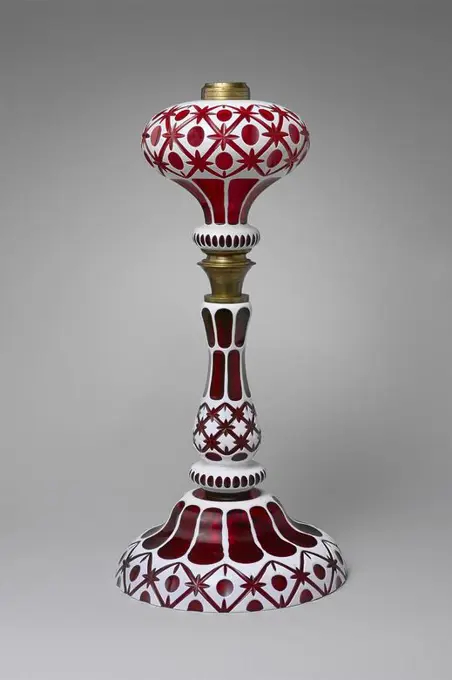
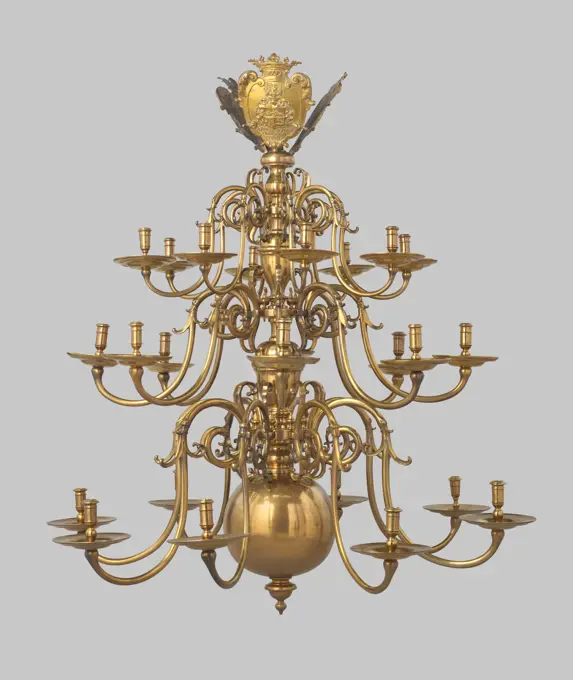
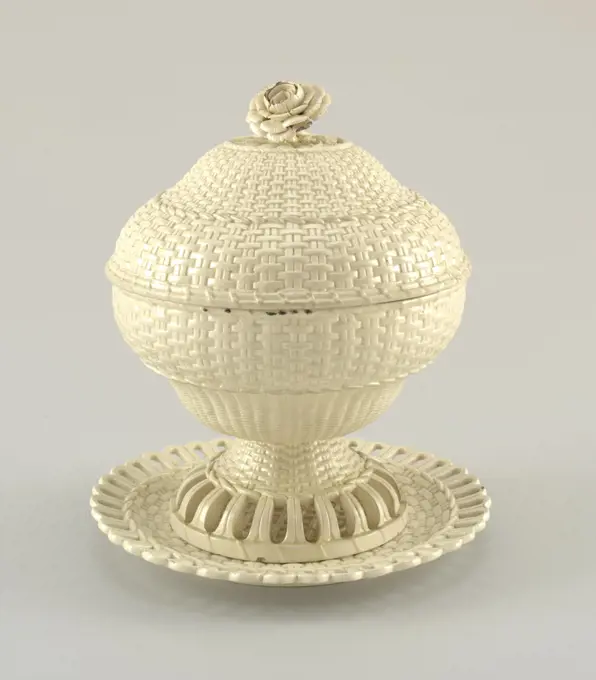
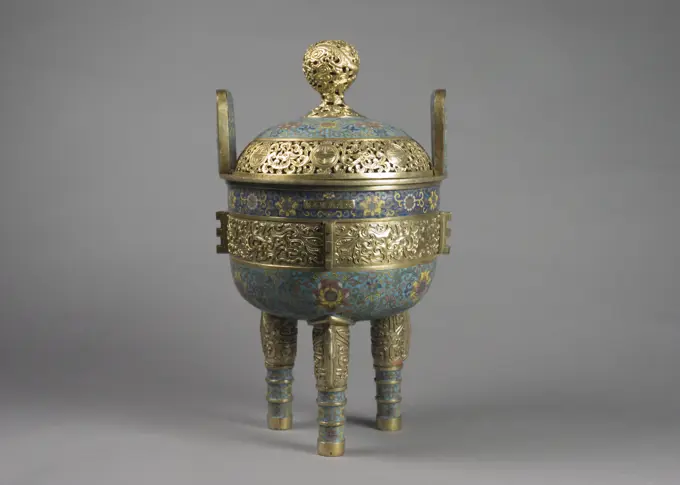
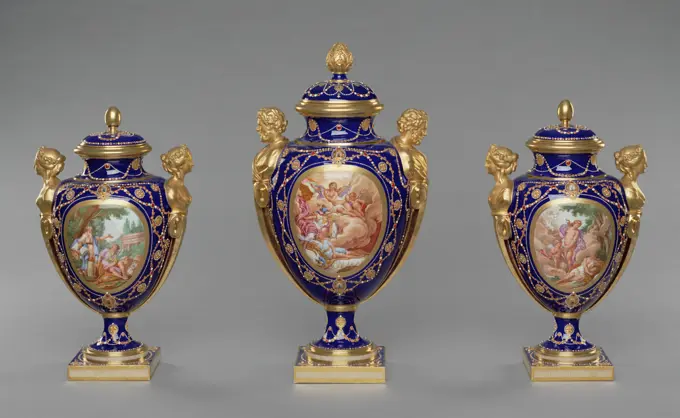
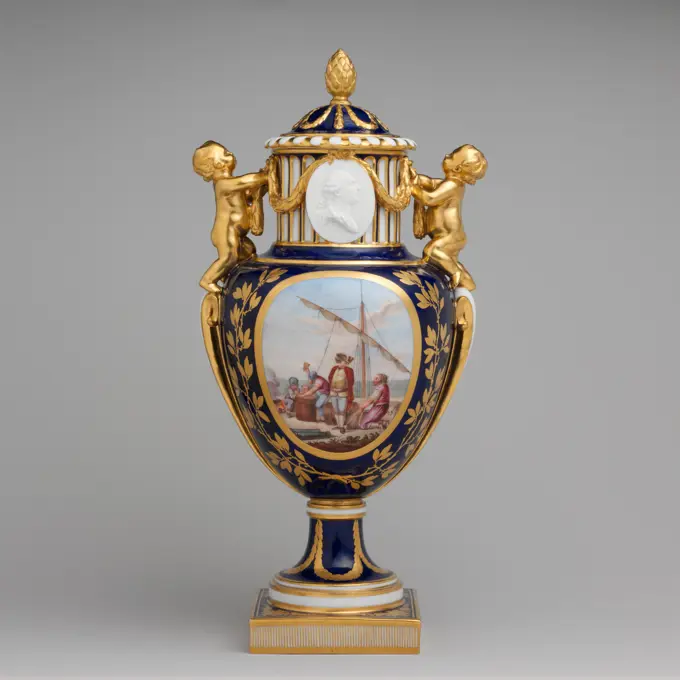
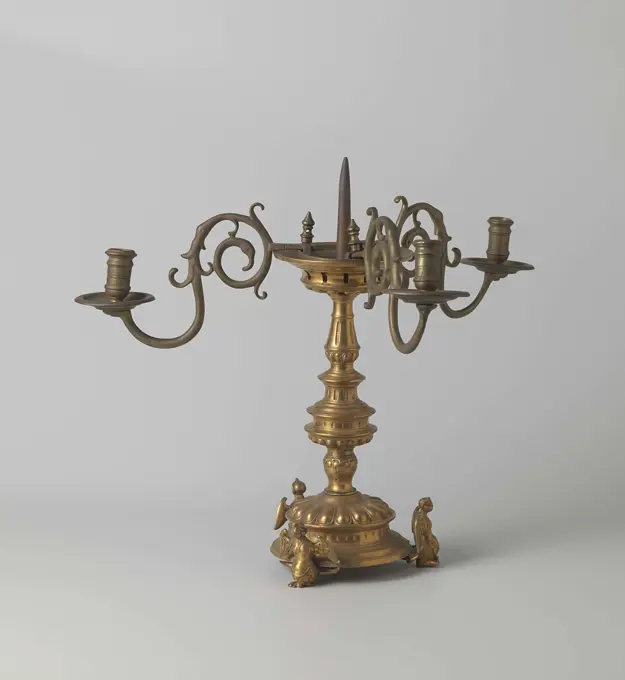
Elegant Silverware and Glassware

Exquisite pieces of silver and glassware including sugar bowls and candlesticks, highlighting intricate craftsmanship and historical details.

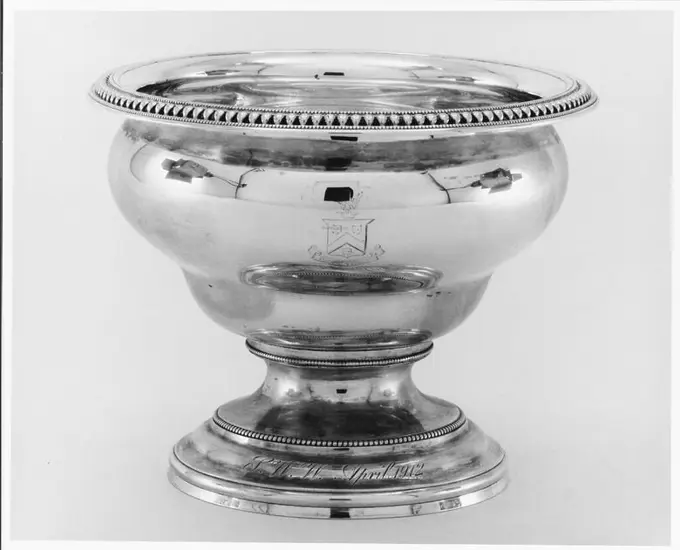
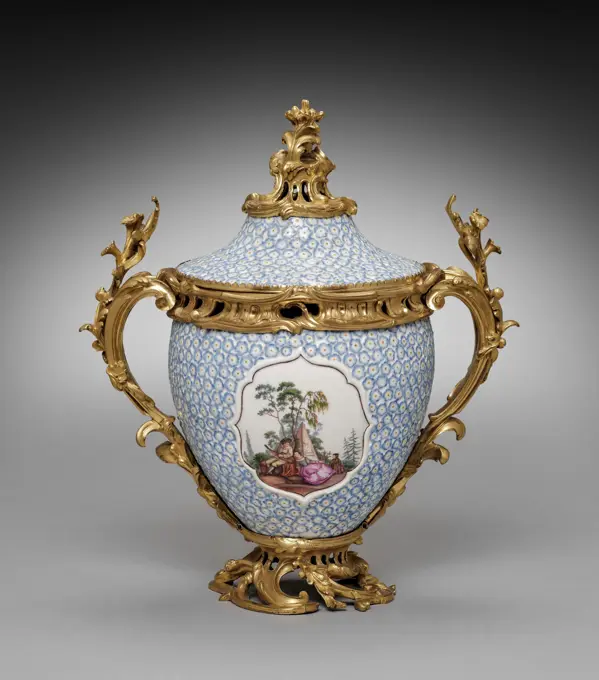
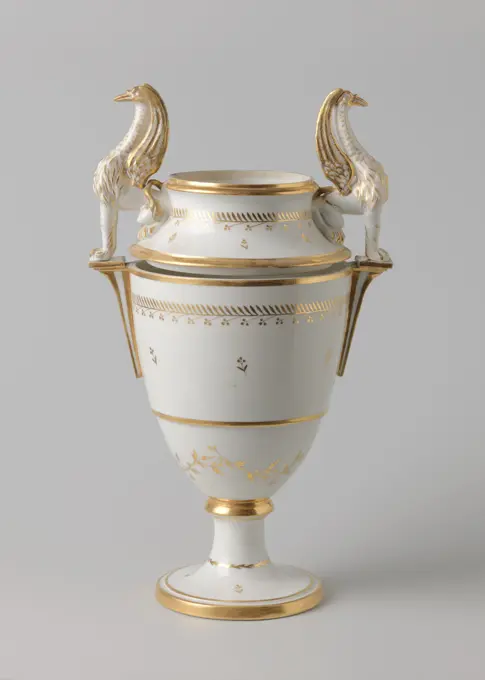
Kastanjevaas with gilded silver inner wall, visible by the openwork parts, Francois Marcus Simons, 1804 Round chestnut cheese with loose lid. In the interior of the vase there is a gilt silver inner wall, which is visible through the openwork parts. Marked and dated. The Hague silver (metal) casting Round chestnut cheese with loose lid. In the interior of the vase there is a gilt silver inner wall, which is visible through the openwork parts. Marked and dated. The Hague silver (metal) casting
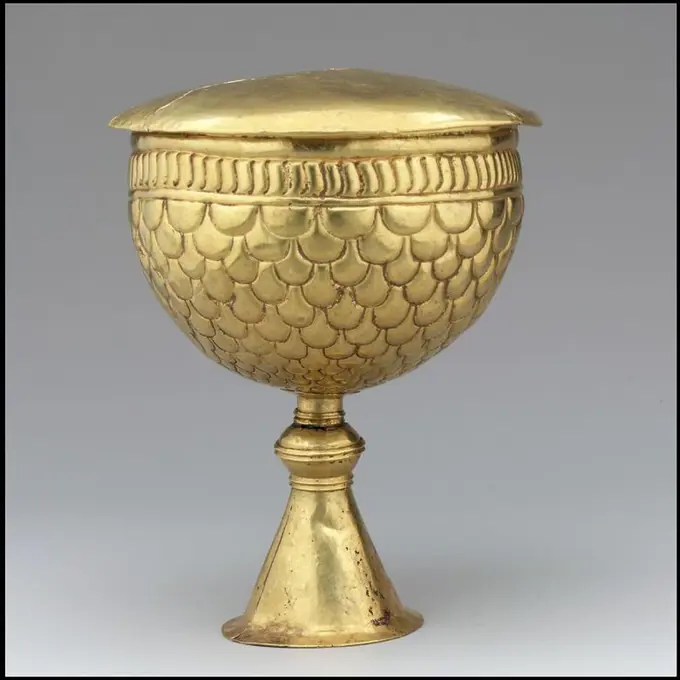
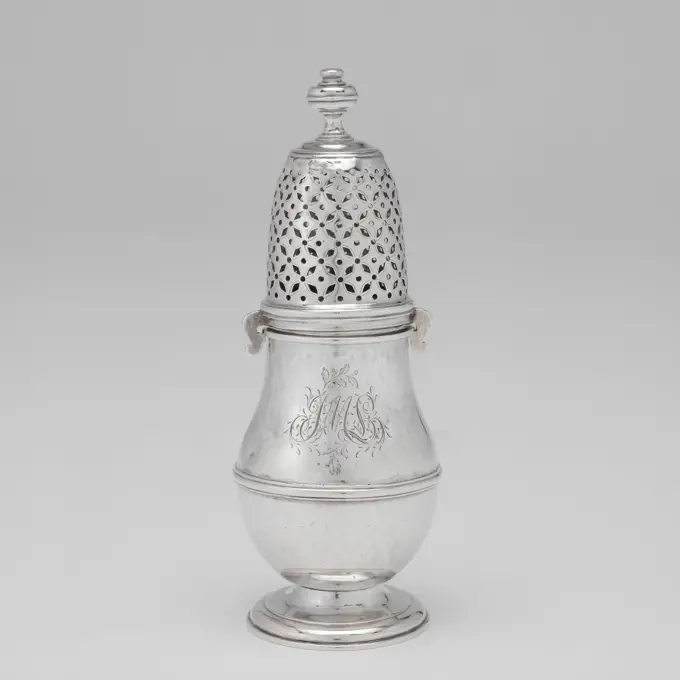
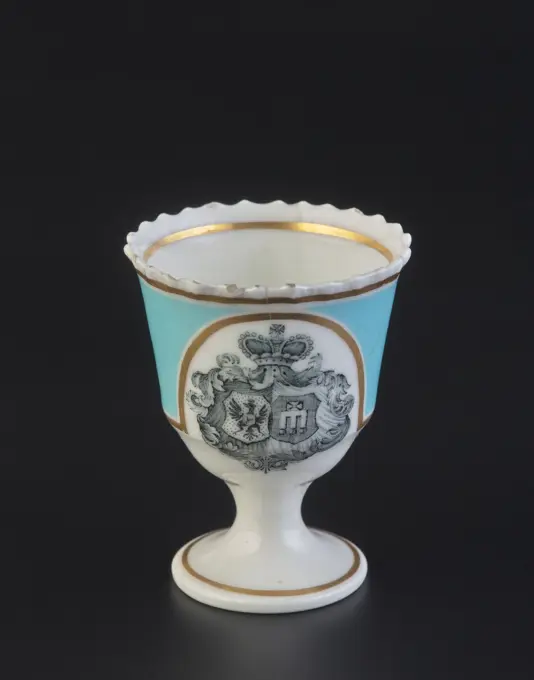
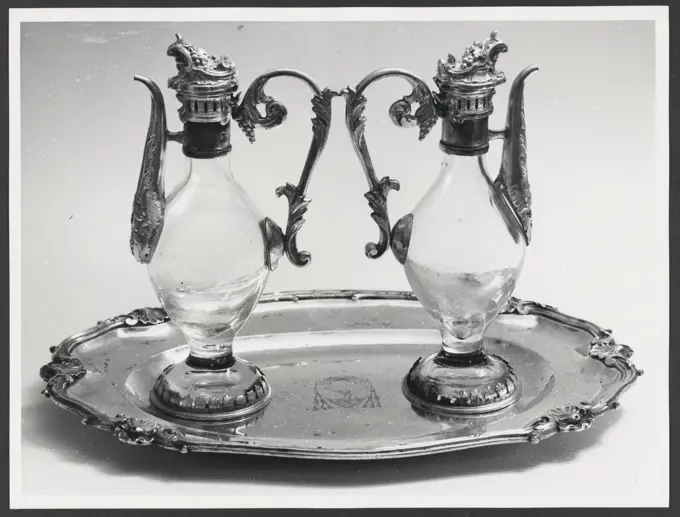
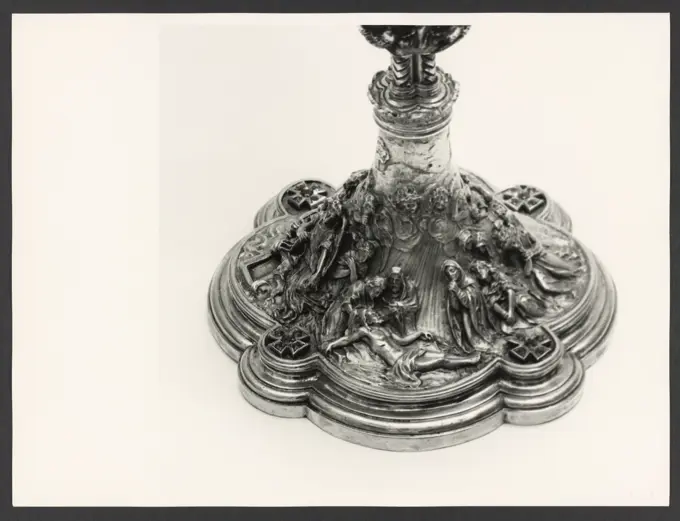
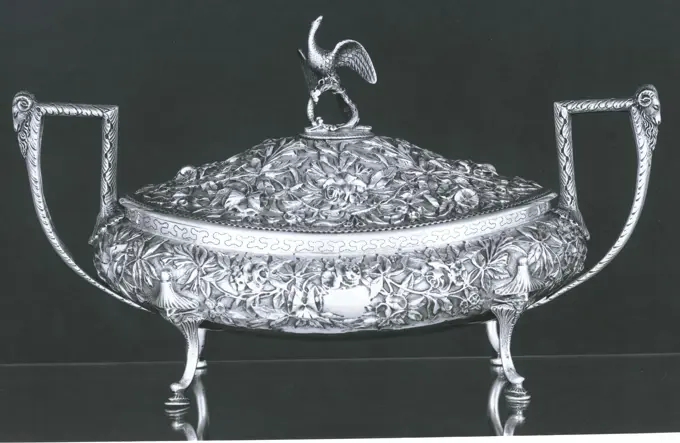
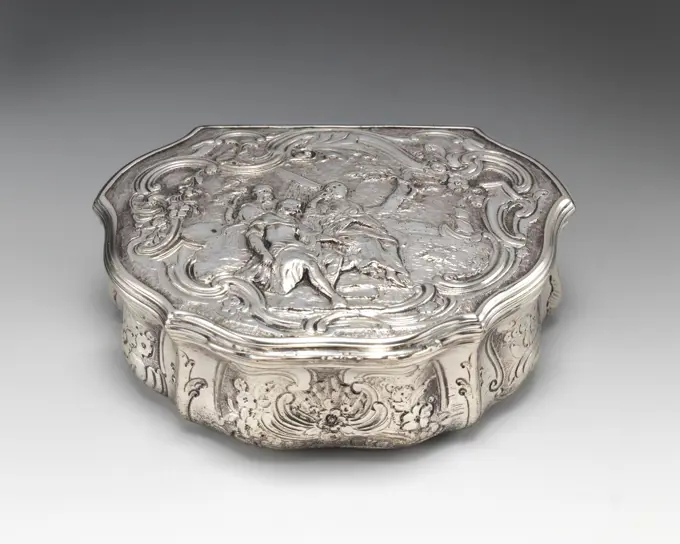
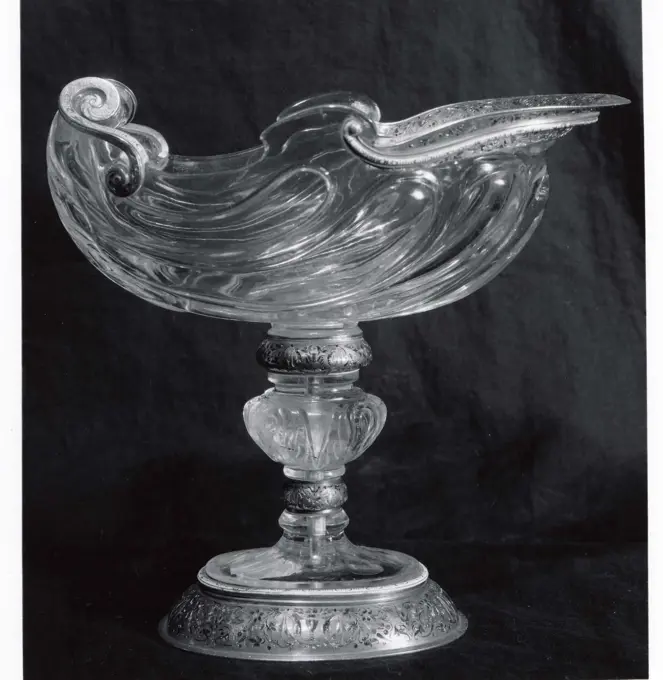
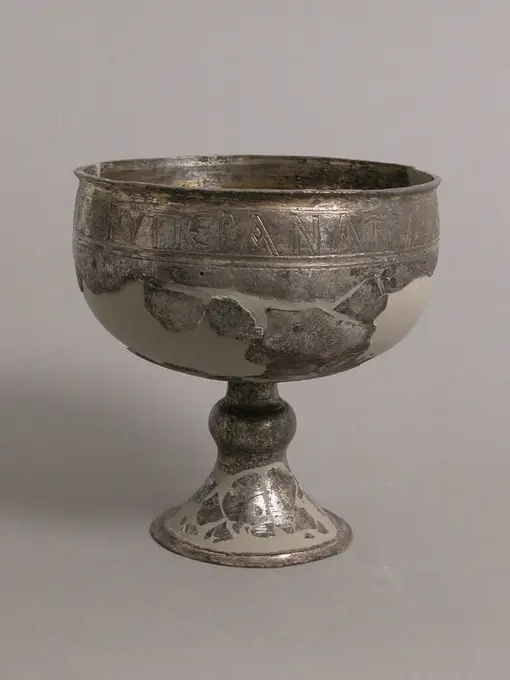
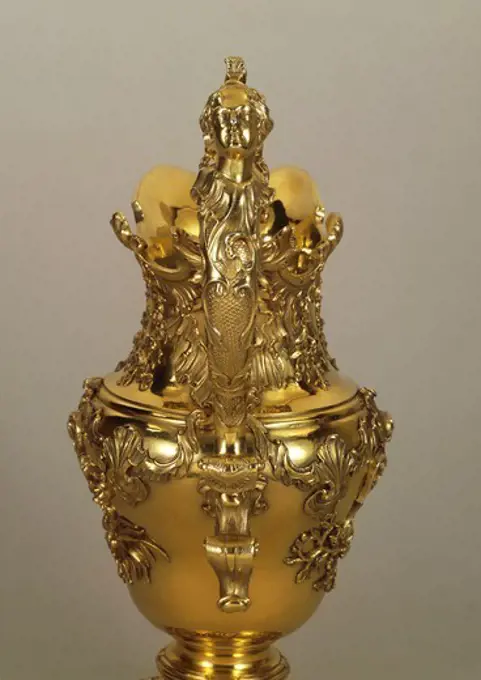
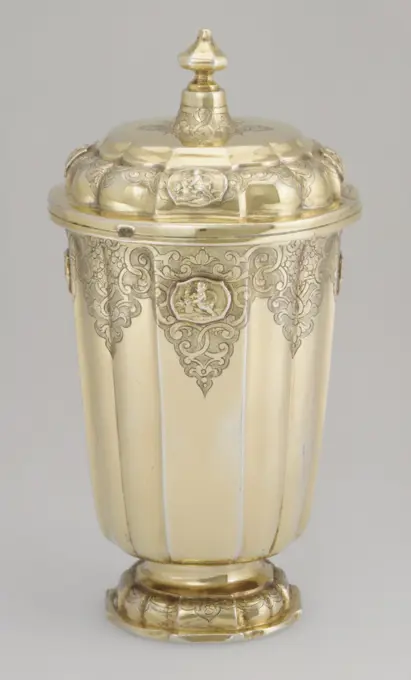
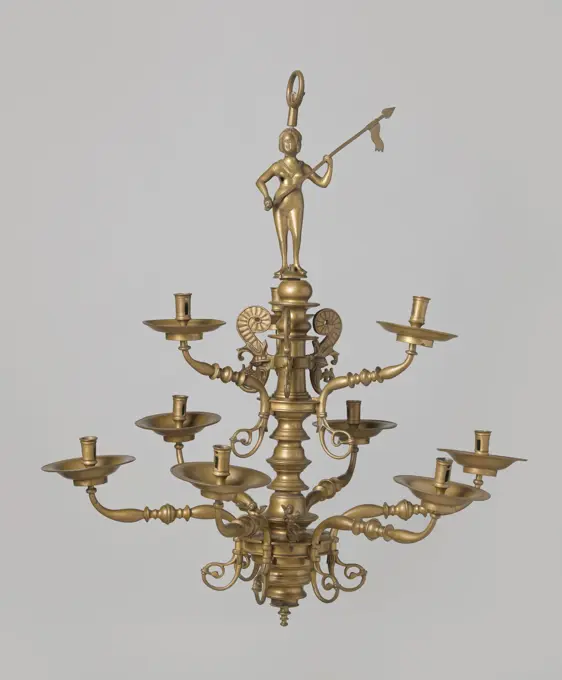
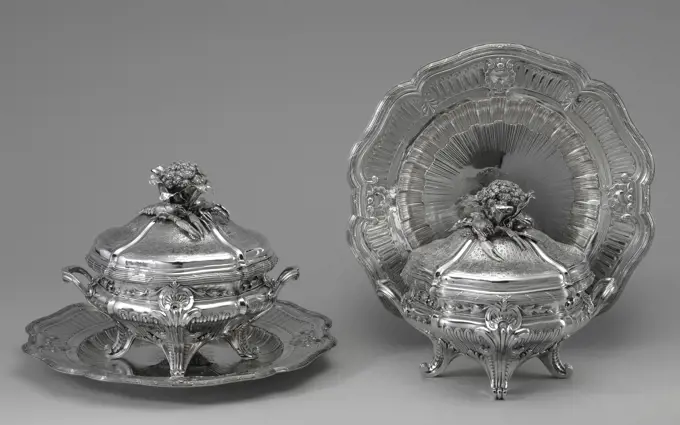
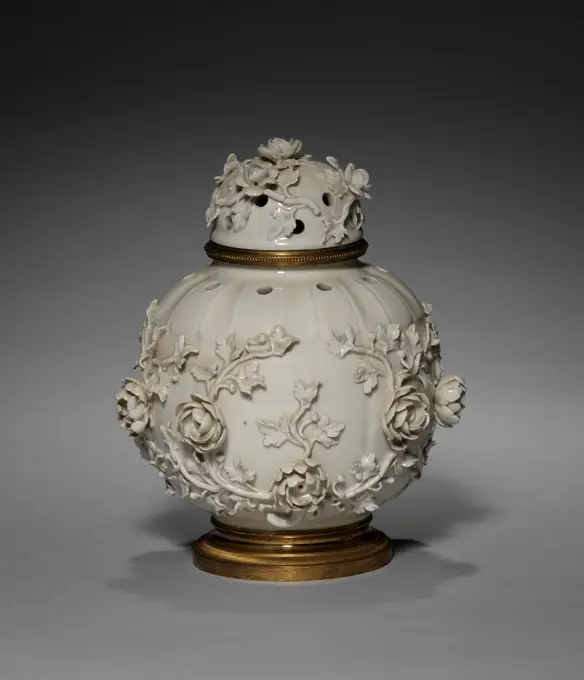
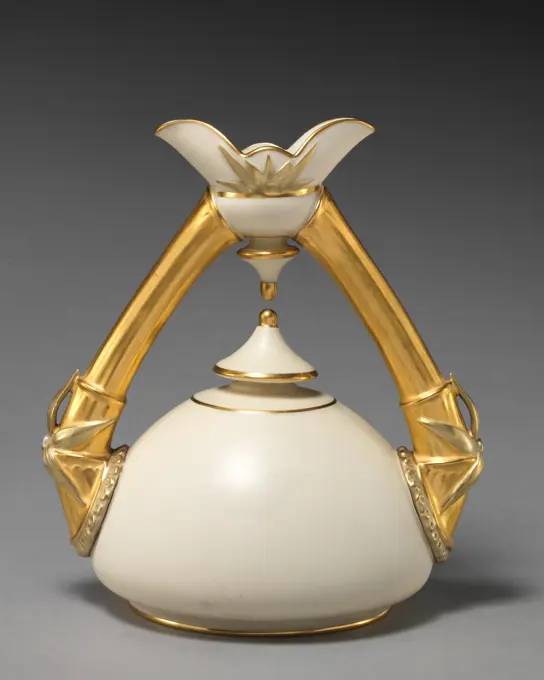
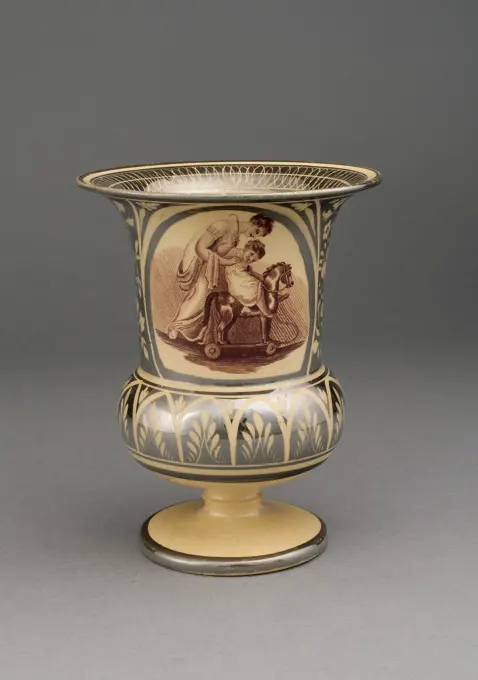
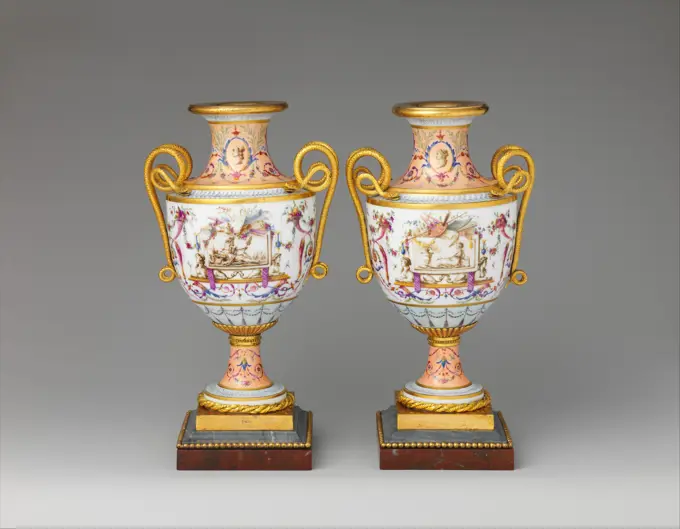
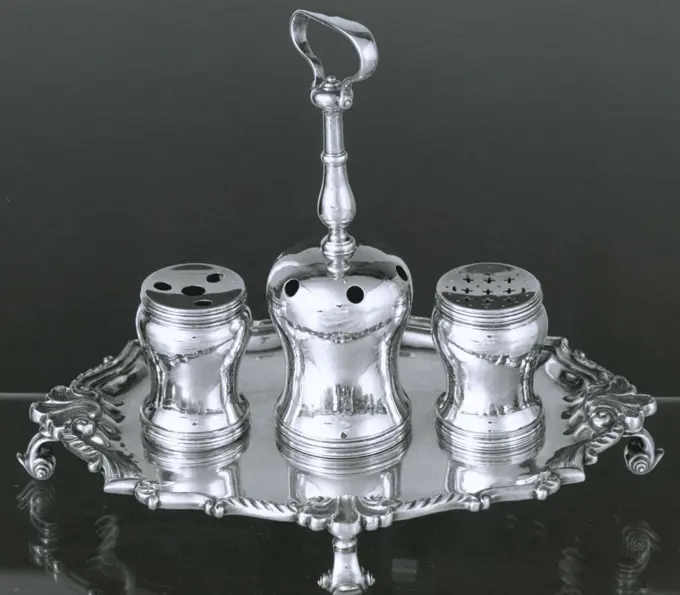
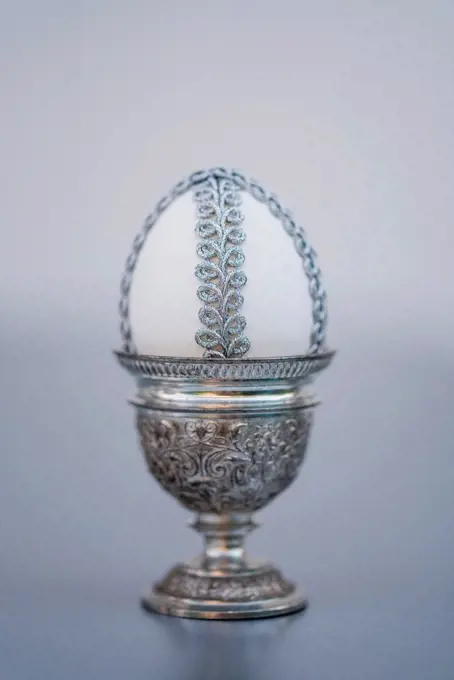
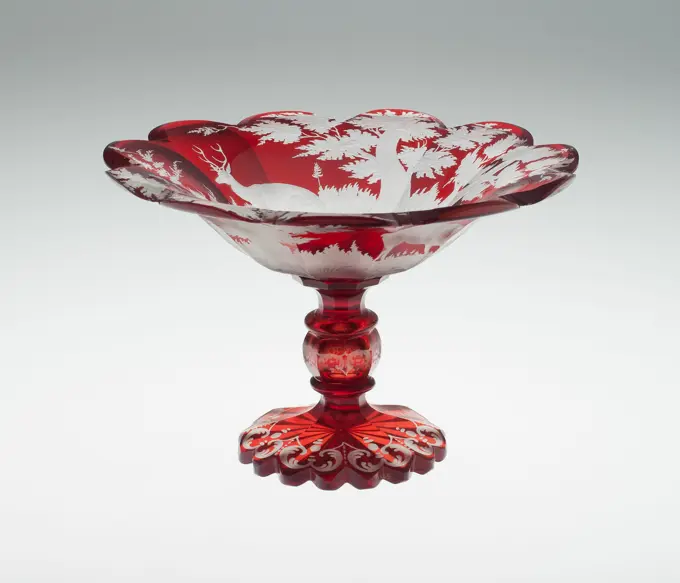
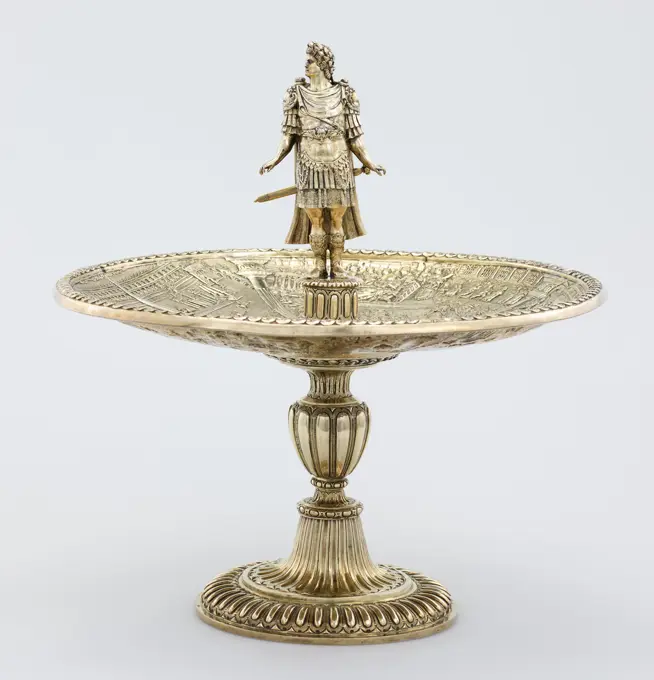
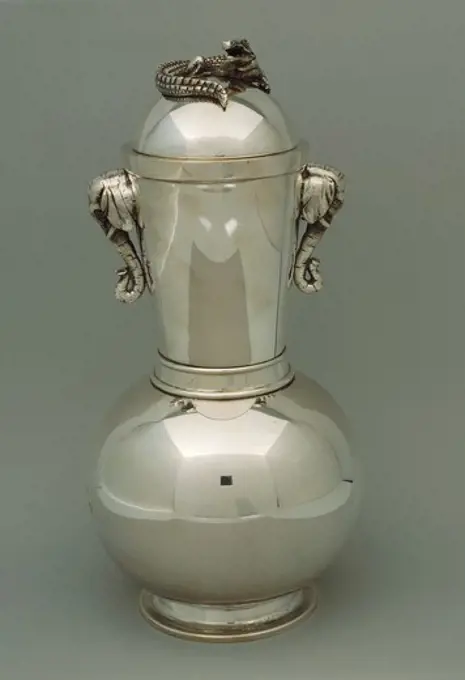
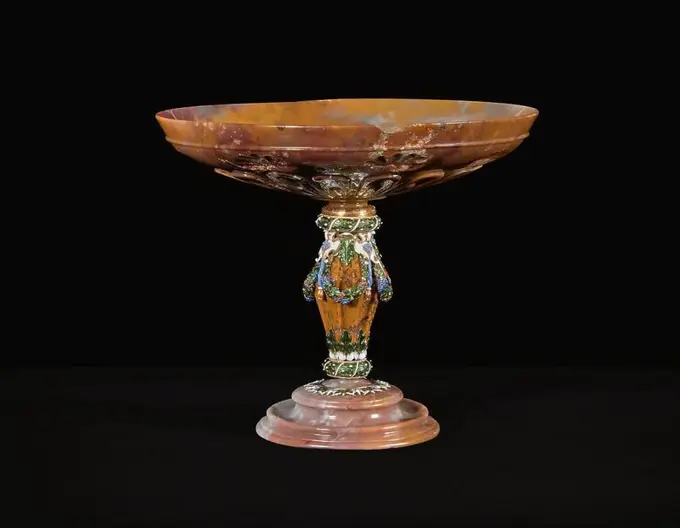
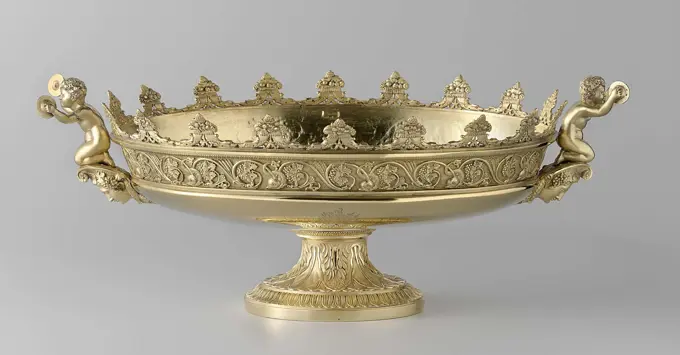
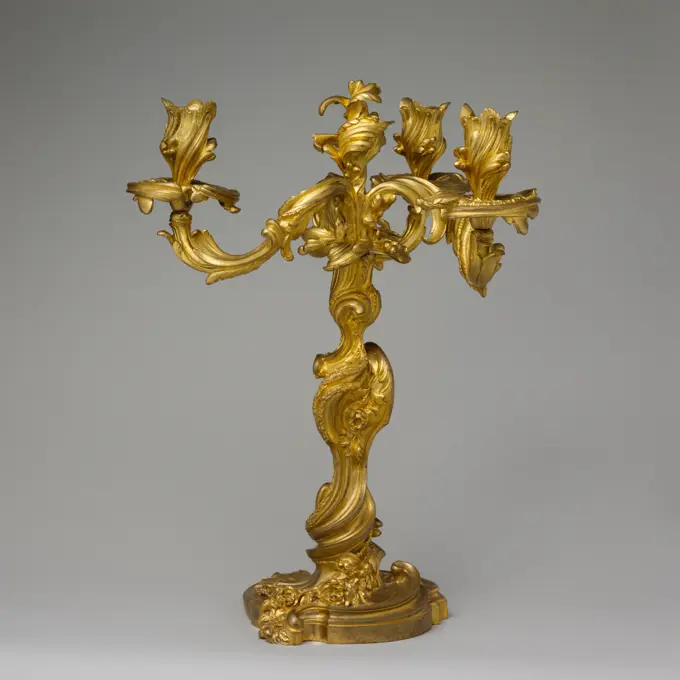
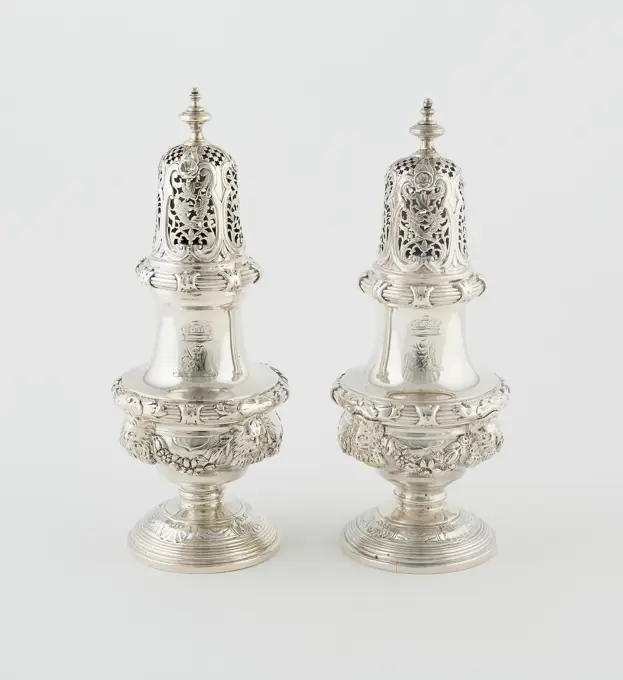
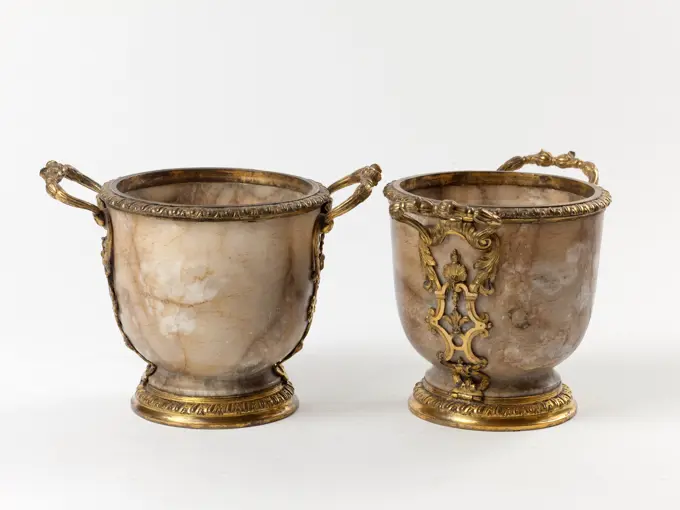
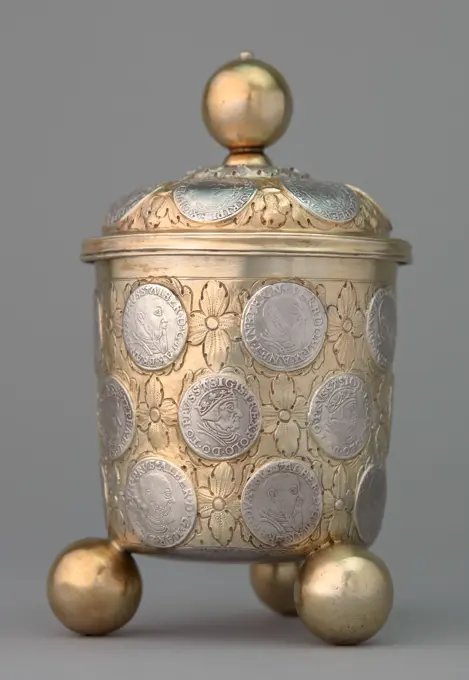
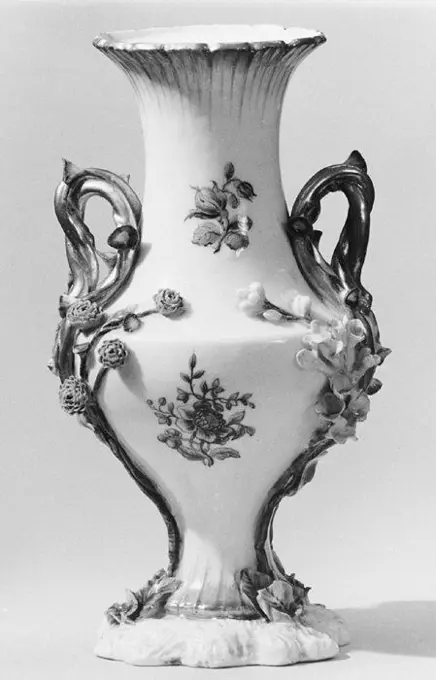
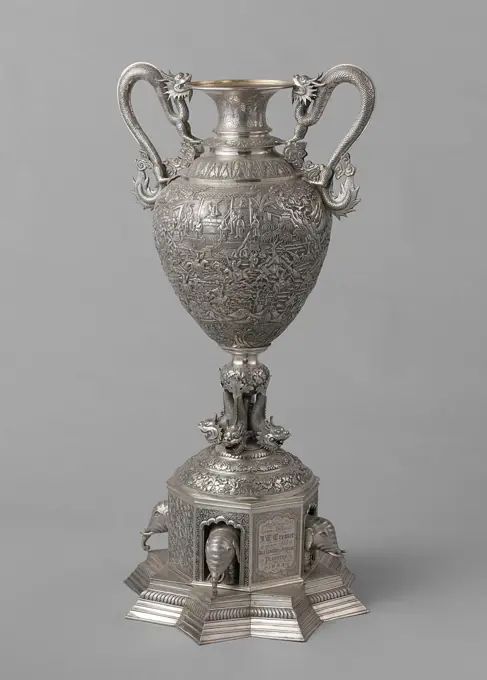
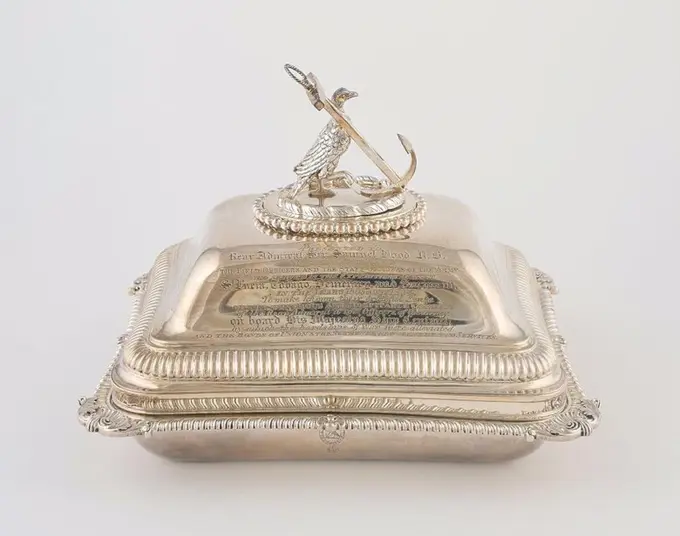
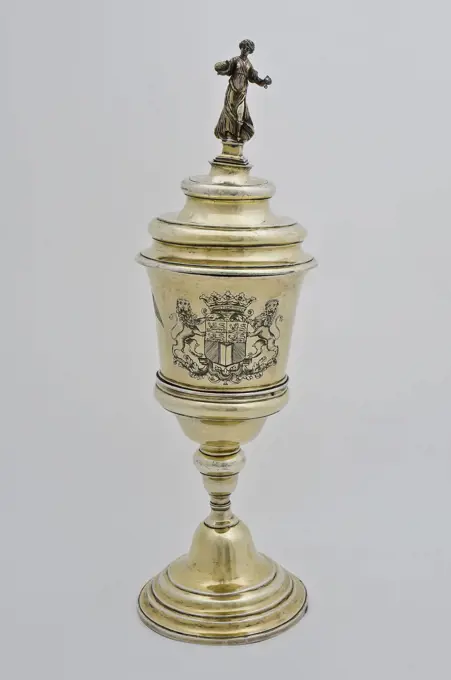
Silversmith: Lambert Fenema, Gilt silver cup with different weapons (Schieland, city arms Rotterdam and family arms mr. Elias van der Hoeven) and lid on which Lady Justice, goblet drinkware tableware holder silver gold, driven engraved cast gilded Whole gilded silver: round hollow bell-shaped foot with ascending profile edges baluster-shaped trunk with profile edges and nodus, cuppa, detachable from the lower part of the cuppa base is contained in an equally detachable cup-shaped holder (C) with annular thickening and profile edges on the upper edge which connects to protruding narrow edge on cuppa Vaulted lid (D) with two strong constrictions between convex annular edges crowned by poured and unscrewable Lady Justice (E) standing on square plinth with sword broken down in her hand and handle of scale bottom cuppa not gilded (stamped in; visible only if sheared from trunk) Rotterdam heraldry Hoogheemraadschap Schieland Elias van der Hoeven bailiff drinking dike 1738 Mr Elias van der HoEwer ca. 1600 Italian, Rome The procession of figures and animals represents either the Triumph of Julius Caesar on his return from Egypt or the Triumph of Scipio Africanus on his return from Carthage. The enameled plaque held by the lion rampant on the top of the ewer reads, Materium suprabat opus (the work transcended the material).. Ewer 194454Gold Goblet and Cover (). Culture: Avar or Byzantine. Dimensions: a only: 6 5/8 × 4 3/4 in., 13.439 Troy Ounces (16.8 × 12.1 cm, 418g)b only: 1.993 Troy Ounces (62g). Date: 700s.This goblet may in fact be a Byzantine export, though the foot of the cup does not conform to the standard shape of Byzantine chalices.The AvarsThe Avars were a nomadic tribe of mounted warriors from the Eurasian steppe. The Byzantine emperor Justinian negotiated with them in the sixth century to protect the Empire's northern border along the Black Sea. Emboldened by their subjugation of numerous tribes, they unsuccessfully attempted to seize the Empire's capital, Constantinople. They remained a scourge of both Byzantium and the Western kingdoms until Charlemagne defeated them through a series of campaigns in the 790s and early 800s.All the money and treasure that the Avars had been years amassing was seized, and no war in which the Franks have ever engaged . brought them such riches and such booty. Up toCaster ca. 1730 Charles Le Roux American. Caster 1471Small oval box 1773-75 Johann Christian Neuss. Small oval box 206267Silver pipe bowl on legs, smoking pipe stove smoking utensils silver, sawn cast Round chafing ring pivoting top edge on three volute-shaped legs bottom bottom (smashed) smoking lighting RotterdamCovered tureen. Culture: French, for American market. Dimensions: 10 1/4 x 15 9/16 x 7 3/4 in. (26 x 39.5 x 19.7 cm). Maker: Attributed to Dihl et Guérhard (French, 1781-ca. 1824). Date: ca. 1800-1815.This now-partial dinner service originally contained more than 125 pieces, including dinner and soup plates, sauceboats, tureens, platters, serving dishes, and butter dishes on stands. Porcelain dinner services made in Europe and Asia for the American market typically included motifs that resonated with consumers in the United States. Museum: Metropolitan Museum of Art, New York, USA.Chandelier 18th century Netherlandish. Chandelier 460702Candelabrum, c. 1800. France, late 18th-early 19th century. Gilt and patinated metal; overall: 50 x 25.9 x 12.3 cm (19 11/16 x 10 3/16 x 4 13/16 in.).Sugar bowl (pot à sucre ovoide). Culture: French, Sèvres. Decorator: Pictorial decoration by Jean Charles Develly (active 1813-47); Gilded by Pierre Riton (active 1821-60). Dimensions: Overall (confirmed): 5 5/8 x 5 1/4 x 4 1/16 in. (14.3 x 13.3 x 10.3 cm). Factory: Sèvres Manufactory (French, 1740-present). Patron: Commissioned by Louis Philippe, King of France (French, Paris 1773-1850 Claremont, Surrey) for Queen Marie-Amélie. Date: 1836.The best of the Sèvres porcelain produced in the mid-nineteenth century displays an originality of conception unmatched by the other European ceramic manufactories of the period. This inventiveness is reflected in the unusual subject matter and bold ornamental patterns employed in the decoration of this service. Each of the scenes depicts an aspect of the cultivation of cacao or the preparation of hot chocolate, and the various stages of production and the utensils employed are rendered with a surprising degree of historical accuracy. The scenes werEgg glass; Chamberlain & Co (England; Porcelain Factory; 1788-1852); 1811-40 (1840-00-00-1845-00-00);Pair of candlesticks ca. 1780 British. Pair of candlesticks. British. ca. 1780. Brass. Metalwork-BrassJumbo /Elephant pattern covered butter dish c 1883-1885 Canton. Glass . Canton Glass Company (Manufacturer)Lazio Roma Velletri Museo Capitolare0. Hutzel, Max 1960-1990 Medieval: Breviaries (two, 14-15th century); "The Passion" on vellum (French school, late 13th century); reliquaries. Post-medieval: Paintings, frescoes, vestments, sculpture, metalwork, panel painting Object Notes: Bibliographic material housed in Center library. Hutzel photo campaign dates: one undated, another November 9, 1985. It is likely that notes for the Pinacoteca Cattedrale (no separate Hutzel entry) describe items under this heading. TCI seems to indicate that the Museo Capitolare is adjacent to the cathedral. As well, some prints are missing; the initial Hutzel entry indicates that there are 422 prints. At this count, I can find 142. German-born photographer and scholar Max Hutzel (1911-1988) photographed in Italy from the early 1960s until his death. The result of this project, referred to by Hutzel as Foto Arte Minore, is thorough documentation of art historical development in Italy up to the 18th century, incluLazio Roma Velletri Museo Capitolare7. Hutzel, Max 1960-1990 Medieval: Breviaries (two, 14-15th century); "The Passion" on vellum (French school, late 13th century); reliquaries. Post-medieval: Paintings, frescoes, vestments, sculpture, metalwork, panel painting Object Notes: Bibliographic material housed in Center library. Hutzel photo campaign dates: one undated, another November 9, 1985. It is likely that notes for the Pinacoteca Cattedrale (no separate Hutzel entry) describe items under this heading. TCI seems to indicate that the Museo Capitolare is adjacent to the cathedral. As well, some prints are missing; the initial Hutzel entry indicates that there are 422 prints. At this count, I can find 142. German-born photographer and scholar Max Hutzel (1911-1988) photographed in Italy from the early 1960s until his death. The result of this project, referred to by Hutzel as Foto Arte Minore, is thorough documentation of art historical development in Italy up to the 18th century, incluCover of a tureen with blue and ornamental borders, anonymous, c. 1800 lid Cover of a porcelain terrine, painted on the glaze in blue and gold. The lid is covered with blue, with saved on the edge a band with a flower drink. France porcelain. glaze. gold (metal) painting / gilding / vitrificationPair of mounted vases porcelain early 18th century, mounts ca. 1765 Chinese with French mounts. Pair of mounted vases. Chinese with French mounts. porcelain early 18th century, mounts ca. 1765. Chinese porcelain; gilt-bronze mounts. Ceramics-PorcelainTazza. Culture: Italian, Venice (Murano). Dimensions: 3 3/4 × 7 in. (9.5 × 17.8 cm). Date: ca. 1850. Museum: Metropolitan Museum of Art, New York, USA.CoveredTureen.   Maker: Samuel Kirk and Son, American, 1815-1979Candlestick (one of a pair) ca. 1780 British or Irish. Candlestick (one of a pair). British or Irish. ca. 1780. Glass, gilt-bronze mounts. GlassTankard with Biblical Scenes. German, Passau or Ingolstadt. Date: 1569. Dimensions: H: 20.3 cm (8 in.). Silver gilt. Origin: Passau. Museum: The Chicago Art Institute, Chicago, USA.Salt 19th century, after 1613-14 original British, after British, London original This electrotype is after a seventeenth-century (1613-14) original, at time of reproduction at Romanoff House, Moscow.. Salt 186494Tea tray, cake stands, jam dish, sugar bowls, coffee pot and milk jug. This is not just any service. These objects belong to a huge coffee and tea service that originally comprised more than a thousand pieces. The Russian tsar Nicholas I bought it from the French silversmith Biennais in 1817. The pieces are double gilded, so they look like they are made of solid gold. The geometric shapes and type of rims are typical of the early Empire style.Compote - Nova Scotia Crown PatternStanding cup ca. 1730-50 Bohemian. Standing cup 195927Box 1749-50 G. D., London. Box. British, London. 1749-50. Silver, gilt lined. Metalwork-SilverArm with candle crown candle crown of two heights, Anonymous, 1650 Candle belonging to a brass candle crown of two heights. The S-shaped arm has a curl at the start, halfway through a dolphin head and turns outside into the flat thickening with a screw hole. The candle holder is secured with the fat catcher. The fat catcher is ribbed at the bottom of the opening and has one down and a slightly excellent edge. The Cylindrian candle holder has a profiled and an excellent edge, two grooved rings, a rib and a profiled narrower bottom piece, which turns into a protrusion with a thread with a center hole. The pin to attach the arm is cone -shaped with a round button on top. The Vetvanger has closed a close one, which indicates that the candle crown has ever been elected. This is the first arm of the upper position ring, numbered with the number 1. Amsterdam (possibly) brass (alloy) casting Candle belonging to a brass candle crown of two heights. The S-shaped arm has a curl at the start, halfInkstand. Culture: British, London. Dimensions: Width: 13 3/16 in. (33.5 cm). Maker: John Plimmer (active 1771-1803). Date: 1802.The inkstand has four vase-shaped containers supported in tripod frames that suggest, in miniature, the stands of antiquity that Europeans called "Atheniennes." Two of the containers have holes in the covers for pens and inks and a third has a pierced design on the cover for sand, which served to dry the ink. The fourth container probably held wafers--small readymade paste-disks for sealing letters. There is a deep slot on each of the long sides for pens and a tray to contain other equipment, such as spare quills and the pen knife that was used to recut quills when they split or frayed from use. A medley of decorative motifs combine for the ornament of what would be otherwise a plain rectangular low box with inkwells on its top. The feet are formed of bunched acanthus leaves and above them, on the diagonally cut corners, are lion masks with a suggestion of EWaste Bowl. Culture: American. Dimensions: Overall: 5 1/4 x 6 7/8 in. (13.3 x 17.5 cm); 19 oz. 2 dwt. (594.6 g)Foot: Diam. 4 5/8 in. (11.7 cm). Maker: Harvey Lewis (ca. 1783-1835). Date: 1827. Museum: Metropolitan Museum of Art, New York, USA.Goblet and Cover. Around 1600 the banded variety of chalcedony was called onyx. According to Rudolph IIs court physician, this stone had the power to soothe emotional outbursts. The blind Cupid on the goblets lid and the serpents around the foot allude to the cause of the distress: disappointment in love.Garden Urn Emblematic of Autumn 1750-1799 England. LeadVase base ca. 1840-60 James Dixon & Sons British. Vase base. British, Sheffield. ca. 1840-60. Electroplated silver. Metalwork-SilverplateFour Wall Lights. Attributed to Philippe Caffieri (French, 1714 - 1774, master 1743)Kandelaber, donated to captain Cornelis Schrijver, Pieter Mouritz (Attributed to), 1738 The Kandelabers (BK-NM-12502 and BK-NM-12503) consist of a candlestick and an attachment with three hinged arms. The profiled, rejuvenating foot is octagonal in diameter, with alternating straight and corrugated sides. In the flat top there is a round floor from which the also round, incorporated, rises through a ring rises from the foot. The baluster -shaped trunk, standing on a widened sphere -walled base, rests on it. The trunk is also octagonal; The alternating straight and flooded sides correspond with those of the foot. The vase -shaped, profiled candle holder is again in diameter. The constricted body is articulated by a ring. In the candle holder, the attachment, which consists of a hexagonal core that has alternately straight and corrugated sides, fits and three arms connected to the straight sides of the core by hinges. The profiled core, which first widens and then rejuvenates, rests on aStanding cup second half 19th century probably Reinhold Vasters German. Standing cup. probably Reinhold Vasters (German, Erkelenz 1827-1909 Aachen) or. second half 19th century. Rock crystal cut on the wheel, and enameled gold.Chalice. Culture: Syrian. Dimensions: Overall: 7 3/8 x 7 1/16 in. (18.7 x 17.9 cm). Date: 6th century, 20th century restorations.The high foot and large cup of this elegant work are typical features of chalices used in the early church for the distribution of consecrated wine during the Divine Liturgy (Eucharist). The inscription records a family's hope for salvation in the afterlife. Museum: Metropolitan Museum of Art, New York, USA.Silversmith's Art, England 18th century. George Wickes (1698-1761), Decorated, gilded silver jug. London, 1735.Terracotta stemmed dish. Culture: Greek, South Italian, Campanian, Teano. Dimensions: diameter 5 1/4in. (13.3cm). Date: ca. 330-300 B.C..Dish with tall foot, decorated with wave pattern, egg pattern on rim. Museum: Metropolitan Museum of Art, New York, USA.Paterka on the skeleton;  2. PO. 19th century (1851-00-00-1900-00-00);Cup with cover 1736-37 Gottlieb Menzel. Cup with cover 206238Salt cellar Patanazzi familyArm with candle holder of candle crown of two heights, c. 1525 - c. 1575 Candle arm belonging to a candle crown of two heights with naked woman at the top. The arm has a sphere and hollow-rounded nodus in the middle and thickens a little on both sides. At the trunk she ends in a spiral curl. She flows out in the screw end of iron. On it is the round fat catcher with a rim at the bottom. The round in each other's extended openwork candle holder has a holy -round base that is screwed onto the arm. This is the first arm of the upper ring, numbered with 1 triangular point (the second point is not visible). The candle holder is unnumbered. Northern Germany (Possible) brass (alloy) casting Candle arm belonging to a candle crown of two heights with naked woman at the top. The arm has a sphere and hollow-rounded nodus in the middle and thickens a little on both sides. At the trunk she ends in a spiral curl. She flows out in the screw end of iron. On it is the round fat catcher with a rim at thArm with candle holder of candle crown of two heights, c. 1525 - c. 1575 Candle arm belonging to a candle crown of two heights with naked woman at the top. The arm has a sphere and hollow-rounded nodus in the middle and thickens a little on both sides. At the trunk she ends in a spiral curl. She flows out in the screw end of iron. On it is the round fat catcher with a rim at the bottom. The round in each other's extended openwork candle holder has a holy -round base that is screwed onto the arm. This is the first arm of the bottom ring, numbered with 2 diamond -shaped pointed. The candle holder is unnumbered. Northern Germany (Possible) brass (alloy) casting Candle arm belonging to a candle crown of two heights with naked woman at the top. The arm has a sphere and hollow-rounded nodus in the middle and thickens a little on both sides. At the trunk she ends in a spiral curl. She flows out in the screw end of iron. On it is the round fat catcher with a rim at the bottom. The round in eacPair of porphyry urns.Covered Vase (2 of 2), mid-1700s. Meissen Porcelain Factory (German). Porcelain mounted in gilt bronze; overall: 38.1 x 33.7 x 20.7 cm (15 x 13 1/4 x 8 1/8 in.). One of these vases is dated 1749. They were perhaps part of a set of four covered vases that we know from documents were acquired by Mme. de Pompadour, mistress of Louis XV in 1752.Pair of Lidded Tureens, Liners, and Stands; Thomas Germain (French, 1673 - 1748 (master 1720)); Paris, France; 1744 - 1750; Silver;Potpourri Vase with Cover, c. 1860-80. France. Blanc-de-chine porcelain; gilt bronze mount; overall: 25.4 x 20.3 cm (10 x 8 in.). These vases were likely made by the celebrated Parisian ceramics firm of Edmé Samson (1810-91). To cater to the resurgence in taste for 18th-century designs, the Samson firm specialized in making reproductions of rare 18th-century European porcelains, especially those from firms that had already copied Chinese porcelains. In this case, these vases are designs taken from models produced by the St. Cloud factory in the 1750s after earlier Qing dynasty Chinese ceramics. However, the telltale sign that these vases are made by Samson and not St. Cloud is that the originals would have been made from a soft-paste porcelain (fired at a lower temperature), while these examples are made of hard-paste porcelain (fired at the highest temperature).Vase 1886 Worcester factory After the end of the Flight, Barr & Barr ownership of the Worcester factory in 1840, the firm went through a succession of owners and mergers before falling under the ownership of Kerr & Binns in 1852. During the partnership, the factory sought to rebuild its former eighteenth-century reputation in porcelain and known for Renaissance-inspired designs. With the establishment of the Royal Worcester Porcelain Company in 1862, the company gradually gained recognition for its Japanese-inspired designs, which formed part of Japonisme, a collective fascination with Japan that took place in Europe and the United States following the opening of Japanese markets to the West by Commodore Perry in 1853.. Vase. British, Worcester. 1886. Bone china. Ceramics-PorcelainBeaker (one of a pair) 1729-30 Probably Jacques Filassier. Beaker (one of a pair) 200294Terracotta calyx-krater (bowl for mixing wine and water) 4th century B.C. Greek, Attic A vine wreath circles the center of the body.. Terracotta calyx-krater (bowl for mixing wine and water) 247400Point of the Castanjevaas lid decorated with griffins, porcelain factory aan den Amstel, c. 1810 lid Point of the chestnut vas with ears in the form of griffins. Netherlands porcelainRELICARIO S XVI-XVII. Location: CONVENTO DE SAN CLEMENTE-MUSEO. Toledo. SPAIN.Terracotta lebes gamikos (round-bottomed bowl with handles and stand used in weddings). Culture: Greek, Attic. Dimensions: H. 20 1/8 in. (51.1 cm)diameter 8 3/4 in. (22.2 cm). Date: ca. 430-420 B.C..Bride with attendantsScenes of brides such as this are basically variants of those showing women in their domestic interiors. The nuptial representations are distinguished by objects that are specific to weddings. In this scene, the loutrophoros carried by the woman at left is special. Loutrophoroi contained water for the nuptial bath; they were also used as grave-markers for women who died unmarried. Museum: Metropolitan Museum of Art, New York, USA.Vase 1815-1825 Leeds. Earthenware with silver lustre decoration, monochrome brown, and yellow ground . Adam Buck (Decorator)Pair of vases 1789 Sèvres Manufactory French Made in 1789, on the eve of the French Revolution, this pair of vases reflects the superb quality and luxuriousness achieved by the Royal Porcelain Manufactory at Sèvres at the peak of its production. The vases were made to be purely decorative, and their diminutive scale was especially well suited to the intimate interiors that were in vogue in late eighteenthcentury France. They are painted with delicate scrolls that incorporate vegetal motifs, cornucopias, and birds heads. This type of decoration, known as the arabesque style, was very much in fashion in the 1780s not only throughout the decorative arts but also in interior decoration. On these vases the scrolling motifs surround panels painted to resemble prints depicting a male river god and a woman in classical dress. The richness of the decoration is enhanced by the two colors of marble employed for the base and by the finely worked coiling snakes that form the handles.[Jeffrey H. MuSpreading gun. Silver spreading with four twisted ribs that start to alternate over the pear-shaped belly with a twisted swelling, then to be observed in the corners of a final horizontal profile and continue in between over the high cap. This is awarded by a leaf rosette and a flour in a skellate as a button. At the foot, which surrounds through a leaf drink, four appliqué flowers. On one of the swellings a monogram of Peg is in engraving. Above which a deer as a helmet sign. Brands: The Hague, W (1768), KL. Lion, P.K.Inkstand.   Maker: George Christian Gebelein, American, 1878-1945Maker after: Philip Syng, Jr., American, 1703-1789Retailer: Gebelein Silversmiths, American, founded 1909Easter egg, lace, grey, eggcup, silverCompote 1845-1855 Bohemia. Glass; blown, cut, stained red and engraved .Tazza, c. 1575-1599, 15 1/2 x 15 in. (39.37 x 38.1 cm), Silver, gilt, Italy, 16th centurySilversmith's Art, Italy 19th century. Francesco Caputo, Potiche, large ceramic, silver plated vase. Made for the Roman jeweller Roberto Angeletti.Anonymous / 'Jasper and chalcedony tazza with garlands'. 1600 - 1630. Chalcedony, Enamel, Jasper, Gold. Museum: Museo del Prado, Madrid, España.A confidante of the Russian empress commissioned this 140-piece service, several items of which are displayed here. Silversmith Odiot, the painter Prudhon and the architect Cavelier proudly presented the new models at the 1819 French national exhibition of decorative art. Notable are the kneeling angels supporting the soup tureen, which are characteristic of the late Empire style.Vaas lid, manufacture Oud -Loosdrecht, 1774 - 1784 Porcelain lid. Loosdrecht porcelain Porcelain lid. Loosdrecht porcelainPerfume vase. Culture: British, Chelsea. Dimensions: Height: 15 1/2 in. (39.4 cm). Factory: Chelsea Porcelain Manufactory (British, 1745-1784, Gold Anchor Period, 1759-69). Date: ca. 1761. Museum: Metropolitan Museum of Art, New York, USA.Pilgrim bottle (one of a pair) 1823/24 William Elliott These bottles (see mate 2016.710.1) are early nineteenth century copies of a pair of Baroque vessels made in 1690. Though the form is derived from seventeenth-century wine bottles, these examples were only intended to be used as part of a grand display in the dining room. In the early nineteenth century, the appreciation of antique silver was novel, and these are early examples of the antiquarian taste.. Pilgrim bottle (one of a pair). British, London. 1823/24. Gilt silver, cork. Metalwork-SilverPair of three-light candelabra ca. 1760-65 French During the eighteenth century, gilt bronze was used extensively for different types of lighting, ranging from wall sconces, chandeliers and lanterns to freestanding candlesticks and candelabra. The exuberantly asymmetrical design of these gilt-bronze candelabra is a variation of a model by Juste-Aurèle Meissonnier (1695-1750), one of the leading Rococo designers. Active also as architect, painter, and silversmith to Louis XV, Meissonnier rendered three drawings for a candlestick with a loosely spiraling stem. Meissonniers design, engraved by Gabriel Huquier (1695-1772) and published in Dousième Livre des oeuvres de J.A. Meissonnier: chandeliers de sculpture en argent (1734-35), became very popular and was executed in both silver and gilt bronze. Incorporating shells, floral sprays and a blank cartouche in a whirlwind of motion, as seen in Meissonniers design, the French counts coronet featured on the stem of these candelabra may havePair of Casters 1732-1743 London. Silver . Paul Jacques de LameriePair of Double Salts 1798-1809 Paris. These objects for the dining table are part of a vast service made for Emperor Napoleon Bonaparteís sister Pauline on the occasion of her marriage to the Roman nobleman Camillo Borghese, Sixth Prince of Sulmona.In the years after the French Revolution, architects and designers adopted the visual language of ancient Greece and Rome to express the new imperial order. Napoleon, hoping to promote Parisís luxury trades, commissioned several silver dinner services as gifts to be sent abroad. The slender outlines and smooth surfaces of the vessels in the Borghese service contrast with the rich decoration.. Silver gilt with cast, applied and chased decoration . Martin-Guillaume BiennaisRoemer with two rows of smooth bumps, anonymous, c. 1650 - c. 1675 High, concave spun. Inserted soil. Bolle, vertically ribbed chalice, blown as a whole with the trunk, which is occupied with two rows of smooth, convex studs. The transition from the chalice to the trunk indicated by a ribbed thread. Low Countries glass glassblowing High, concave spun. Inserted soil. Bolle, vertically ribbed chalice, blown as a whole with the trunk, which is occupied with two rows of smooth, convex studs. The transition from the chalice to the trunk indicated by a ribbed thread. Low Countries glass glassblowingPair of Lidded Vases. UnknownHandbell. Bell-shaped table bubble with handle. The handle is baluster-shaped. The bell is halfway through a tilted trim. The table bell is noticed: stk. = Amsterdam, jrl. = Y (1758), mt. = Attributed to Johannes van Somerwil (i).Goblet, c. 1770, Attributed to William Beilby; Decorator: Attributed to Mary Beilby, British (Newcastle-on-Tyne, England), British (Newcastle-on-Tyne, England), 1740 - 1819, 6 15/16 x 3 1/2 x 3 1/2 in. (17.62 x 8.89 x 8.89 cm), Blown glass, enamel decoration, England, 18th century, The Beilby family is credited with introducing to England the process of enameling clear glass. Mary and her brother William were the most skilled Beilby enamelers. Their decoration varied from motifs of arms and armor to architectural ruins and rural landscapes framed in rococo flourishes, as on this goblet. The goblets enameled decoration and air-twist stem display the light, fluid quality of the rococo style.Pair of candlesticks (flambeaux or chandeliers). Culture: French, Paris. Designer: After designs by Juste Aurèle Meissonnier (French, Turin 1695-1750 Paris). Dimensions: .1 confirmed, diameter of base: 12 1/8 × 7 3/8 × 7 3/8 in., 93.466oz. (30.8 × 18.7 × 18.7 cm, 2650g).2 confirmed, diameter of base: 12 1/8 × 7 3/8 × 7 3/8 in., 112.864oz. (30.8 × 18.7 × 18.7 cm, 3200g). Date: 1735-50.In the era before gas lighting and electricity, candles played a principal role in illuminating the interior of a house. The number of candles lit was an indication of the status of the owner; beeswax candles, preferred over tallow because they burned cleaner and had a more pleasant smell, were enormously expensive. No wonder, then, that visitors commented on the quantity of light at certain events--as Philip Thicknesse did in his Useful Hints to Those Who Make the Tour of France (1768). The table at a dinner he attended in 1767 "was illuminated with upwards of sixty wax lights."1The exuberantly asymmMantel Clock (Pendule) with Arachne and Athena, Meissener porcelain manufactory, 1727 Chimney clock with painted porcelain. The clock has a trapezoidal base. The four overhoeks placed legs are on gilded rings and are decorated in relief with an acanthus leaf. The body is crowned by a vaulted dome on which two female figures. The lower part of three walls of the body is open on either side of a gate. Chinese figures are sitting or kneeling in the gate. The back wall is decorated with Indianic Blumen, the walls with Höroldt chinoiseries. porcelain company: MeissenMeissenMeissenclockmaker: Paris porcelain. pen: metal. gilding (material) vitrification / gilding Chimney clock with painted porcelain. The clock has a trapezoidal base. The four overhoeks placed legs are on gilded rings and are decorated in relief with an acanthus leaf. The body is crowned by a vaulted dome on which two female figures. The lower part of three walls of the body is open on either side of a gate. Chinese figures aAnonymous. CHAP. Alabaster, chiseled and gilded bronze, 1601. Paris, Carnavalet museum. 77642-20 Albatre, handle, bronze, coupler, halt, gold, gilding, Louis XIII time, Louis XIII style, XVIIth centuryPrzeszo Przyszoci unknownVase (vase Duplessis) (one of a group of three) ca. 1752 Vincennes Manufactory French. Vase (vase Duplessis) (one of a group of three) 231855Wineglass 19th century Italian, Venice (Murano). Wineglass. Italian, Venice (Murano). 19th century. Glass. GlassSilver Table Centrepiece with Chinese scenes. Richly decorated silver table piece offered to Mr. J.Th in 1883. Cremer. Star-shaped pedestal with 8 points on which an 8-cornered part with 4 outstanding elephants and inscription. Between vase and pedestal 4 bearing fish. On the vase performances from Chinese life. Two handles in the form of dragons. On top of loose lid awarded a Chinese mandarin.Entree Dish with Cover from the Hood Service. Paul Storr; English, 1771-1844; London, England. Date: 1806-1807. Dimensions: 22.2 x 28.6 x 24.3 cm (8 3/4 x 11 1/4 x 9 1/2 in.). Sterling silver. Origin: London. Museum: The Chicago Art Institute, Chicago, USA.Bottles 18th century. Bottles 446276Egg glass; Koenigliche Porzellan Manufaktur (KPM; Berlin; 1763-1918); 1780-1800 (1832-00-00-1850-00-00);Lamp. Culture: American. Dimensions: H. 19 in. (48.3 cm). Maker: Boston & Sandwich Glass Company (American, 1825-1888, Sandwich, Massachusetts). Date: 1850-67. Museum: Metropolitan Museum of Art, New York, USA.Box (Russia); chased, engraved and partially nielloed and gilt raised and cast silverCandlestick with a vase-shaped strain. The candlestick is composed of four parts: foot, strain, fat catcher and candle pin. The foot is coarse profiled. The trunk is below vase. The trunk has rinded in the foot.Taperstick. Culture: British. Dimensions: H. 6 1/8 in. (15.6 cm); Diam. 3 3/8 in. (8.6 cm). Maker: Possibly Michael Edkins. Date: 1760-70. Museum: Metropolitan Museum of Art, New York, USA.Arm of a candle crown in three heights, Anonymous, 1717 chandelier The S-shaped arm is equipped with a ridge on the tribe side to secure it with a pin in the stand ring. At the trunk, the arm is decorated at the end and to the center with two stylized dolphin heads and with curls, the shape of which is derived from the lobe ornament. To the outside, the arm ends in a thickening, in which a hole provided with a thread is applied to attach the candle holder to the fat catcher. The arm is cast using the same model as the other arms of the wreath. The candle holder is cylinder -shaped with profiled excellent edge and with a baluster foot, which turns into a threaded end, in which the center hole at the bottom. The fat catcher is deepened twice at the top towards the center. At the bottom it is profiled around the hole in the somewhat spherical center and the edge is ribbed. The fat catcher has been cast using the same model as the other fat catchers of this wreath. The pin is equipped withChestnut bowl, cover and plate, Lead-glazed earthenware ('cream ware'), Basketwork on all three pieces. Plate has openwork border of adjoining loops and an ogee foot with openwork. High ogee domed cover surmounted by handle in the form of a marigold. Ladle opening in cover., Leeds, England, ca. 1790, ceramics, Decorative Arts, Chestnut bowl, cover and plateCloches (dish covers), coolers, soup tureens, sauceboats, salt cellars, pepper and mustard pots, Jean Baptiste Claude Odiot, c. 1819 Empire double salt barrel, made of gilded silver. On a rectangular base, two dolphins rest that wear two shell -shaped scales on the wrinkled tails. Engraved with the weapon of Potemkin. Paris silver (metal). gilding (material) gilding Empire double salt barrel, made of gilded silver. On a rectangular base, two dolphins rest that wear two shell -shaped scales on the wrinkled tails. Engraved with the weapon of Potemkin. Paris silver (metal). gilding (material) gildingUnknown, Wall Sconce, 1800-2000, carved giltwood and plastic.Robert Garrard II, Soy Frame with Five Bottles, 1840/41, silver and glass.One of a Pair of Incense Burners China Vessels from China's ancient Bronze Age cultures, such as the Shang (ca. 1600-ca. 1050 B.C.) and Zhou (ca. 1046-256 B.C.) dynasties, often served as prototypes for later metalwork, particularly those with ritual or ceremonial functions. The shape of this incense burner is based on an archaic tripod vessel known as a ding, which was used for holding or serving food and other offerings. The floral scrolls in the background are embellished by the raised gilt-bronze band at the center, which is decorated with a pattern loosely based on the taotie, a masklike design ubiquitous in the imagery of the Bronze Age.. One of a Pair of Incense Burners 40622Garniture of Three Vases (vases des ges).Salt cellar;  19th century (1900-00-00-1910-00-00);Vase with cover (Vase Paris enfants) ca. 1778 Sèvres Manufactory French While the Sèvres factory produced a variety of vases for the display and growing of flowers, a large percentage of its vases were intended for ornamental purposes only. This model, with its cover and decorative handles in the form of cherubs clearly belongs to this latter category. The Museum's vase is decorated with biscuit (unglazed) porcelain medallions depicting Louis XVI and Marie-Antoinette.Jeffrey H. Munger, 2006. Vase with cover (Vase Paris enfants) 202183Candlestick on three legs in the form of Sirens. The three legs, the foot, the trunk, the fat catcher and the candle pin are poured separately. The legs have the form of sirens. The profiled base is decorated on top of graces. The stem consists of a reverse baluster decorated with leaf motifs, a middle part, which is decorated with grinders and cannelures and has three sections, and a baluster, which is also partially decorated at the bottom with graces and has cannelures above it. The fat catcher is also equipped with grains at the bottom, has twelve openings in the wall in the form of standing rectangles and a profiled cut-out edge. The grooves of the lathe can be seen at the bottom of the candlestick. The color of foot and trunk deviate slightly. The cavity in the strain is closed with tin and the legs have been reconnected. The candlestick has attachments with a pin and a fat catcher in the middle and three arms with candle holder that are manufactured in the same period.Triple wall lamp;  k. 18th century (1781-00-00-1810-00-00);Pair of Sauceboats c 1830 Philadelphia. Made by preeminent Philadelphia silversmith Thomas Fletcher, this pair of sauceboats reflects not only the vogue for French-inspired classical designs but also significant advances in the industrial and technological production of silver that took place in the 19th century. Coinciding with the American industrial revolution, silver making became increasingly mechanized through the introduction of flat rolled silver and die-rolled bandsóthree of which appear as decorative borders on each sauceboat. The elegant oval bodies with upswept spouts are typical neoclassical forms; however, the handles add distinct flourish the bold yet refined bud-shaped handles have no known precedent and are original to Fletcher.. Silver . Thomas FletcherCandlestick 1760-70 Possibly Michael Edkins. Candlestick 1313