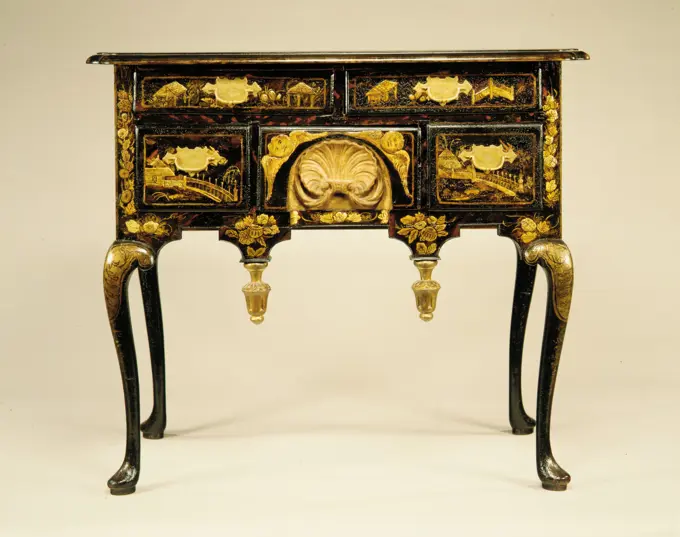
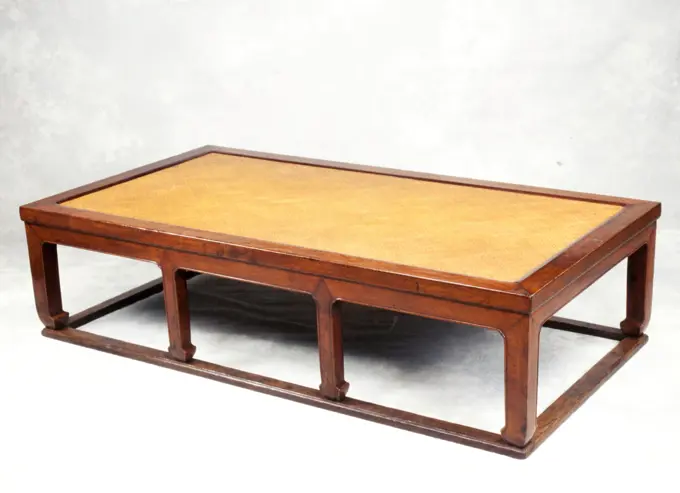
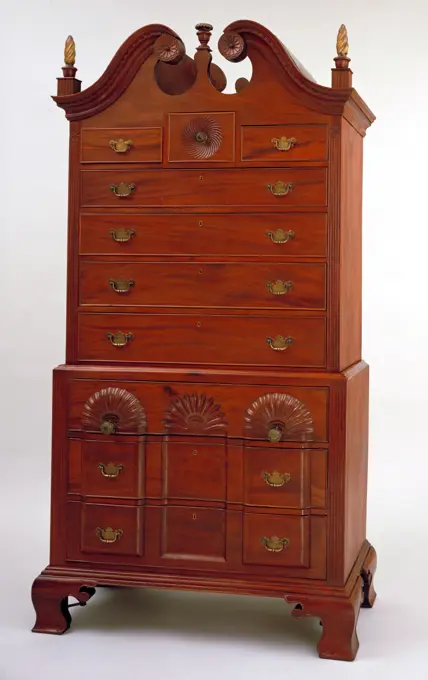
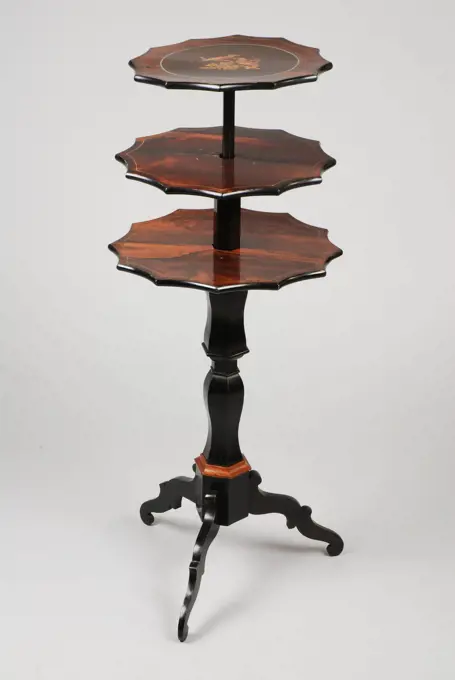
Elegant Wooden Chairs

A series of ornate wooden chairs from different eras, featuring intricate designs and upholstery, capturing classic craftsmanship and historical charm.

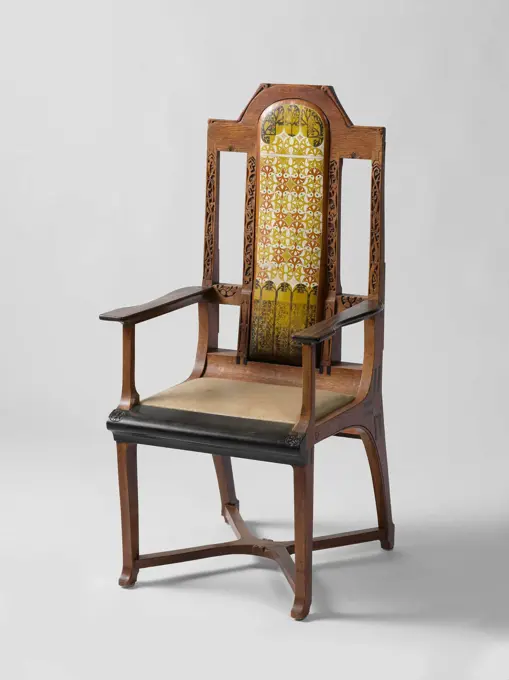
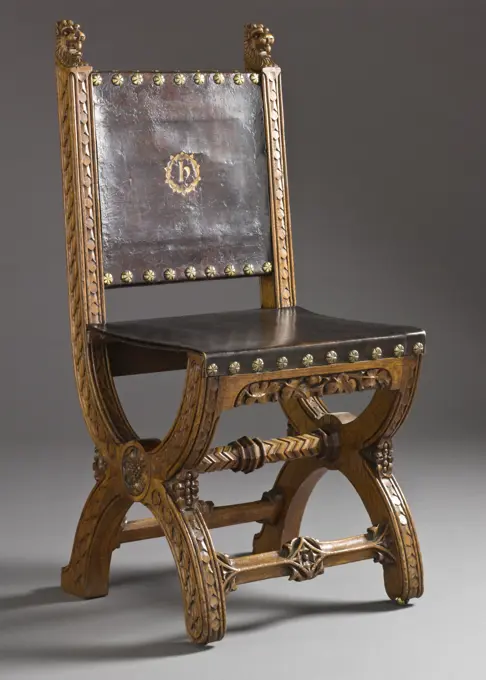
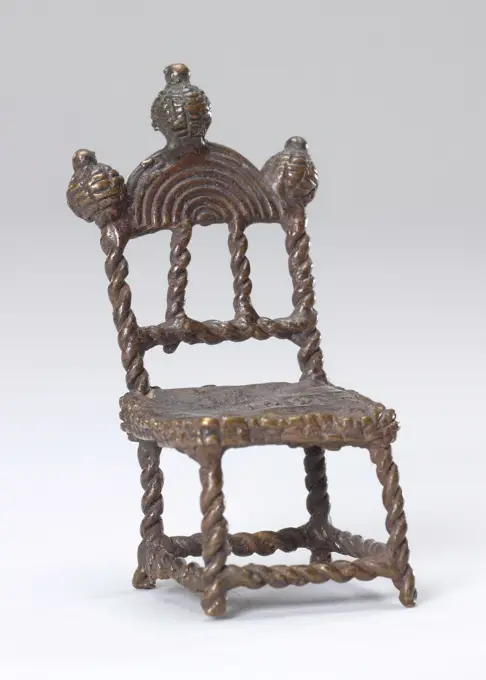
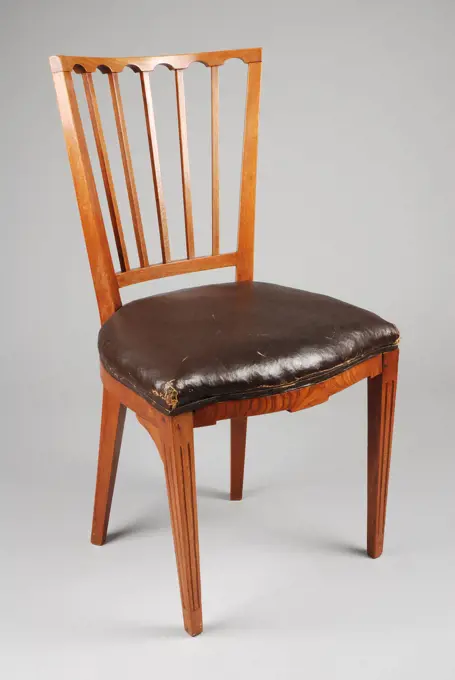
Chair with a brown leather upholstery, Hendrik Petrus Berlage, c. 1902 Eikhout chair. The front and hind legs are interconnected by means of an H-shaped cross with pen and hole connections, the pens of which stick through the legs. The slanted billioned backstyles end in bird heads and rest on the cross. The handrail rests on Stutten near the seat and these also serve as hind legs. The backrest is connected both above and below by an intermediate rule. The top line contains a sliced star shape in the middle. There is a panel between the lines that is covered with leather and is secured with copper nails. The seat is also covered with leather and secured with copper nails. designer: Netherlandsmaker: Amsterdam oak (wood). leather Eikhout chair. The front and hind legs are interconnected by means of an H-shaped cross with pen and hole connections, the pens of which stick through the legs. The slanted billioned backstyles end in bird heads and rest on the cross. The handrail rests on Stut
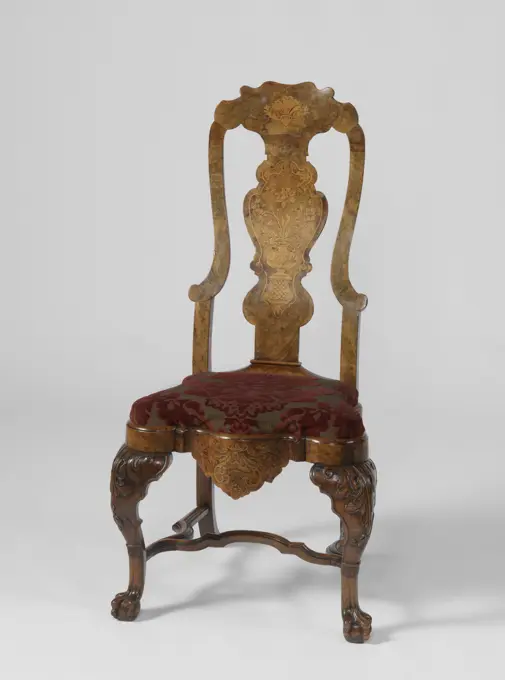
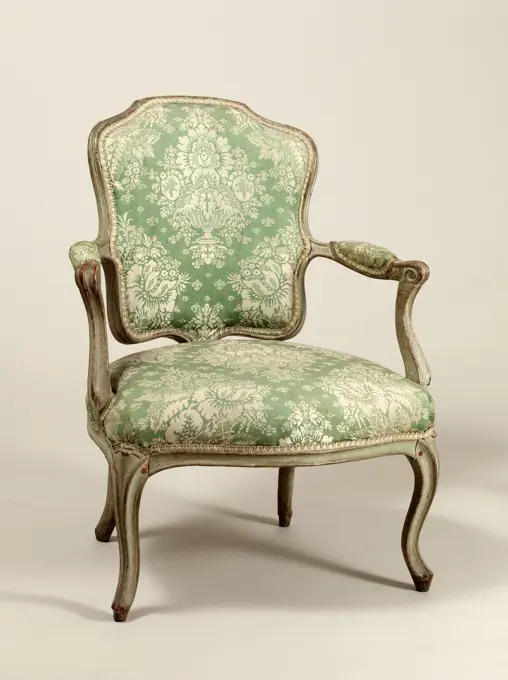
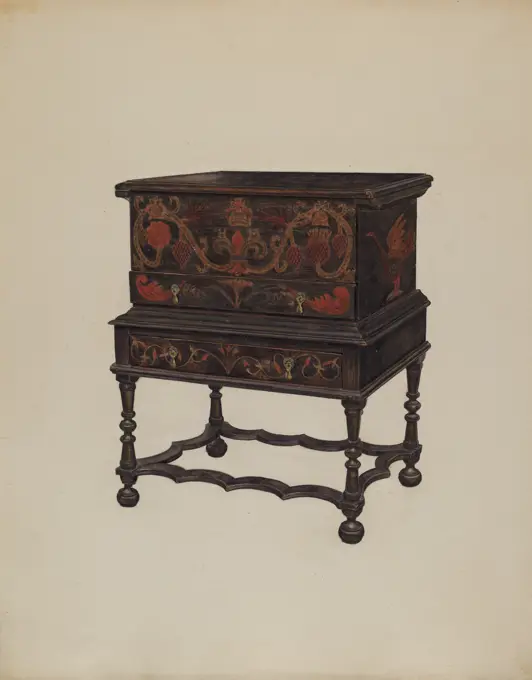
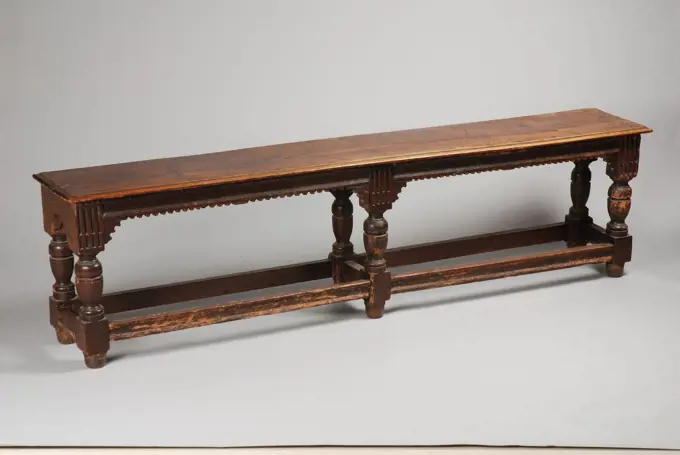
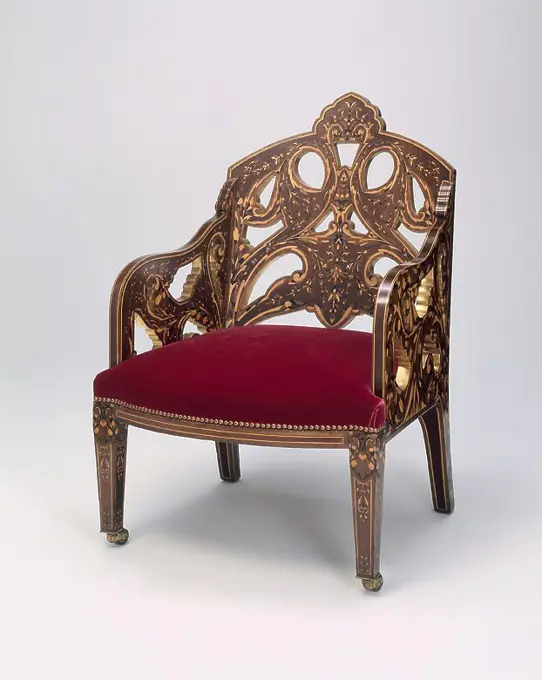
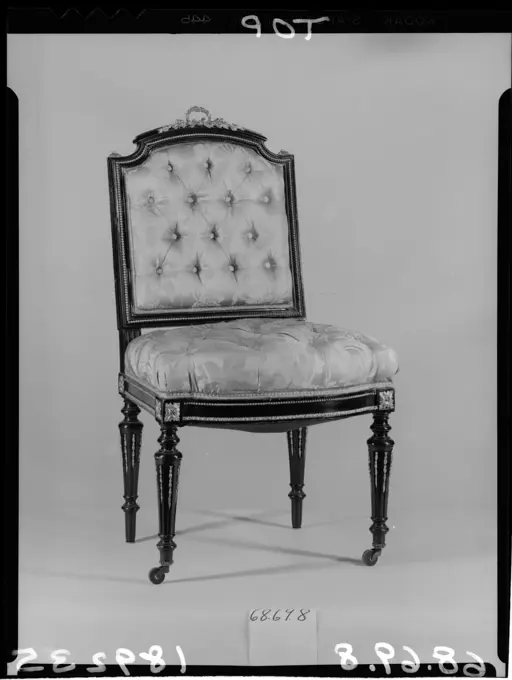
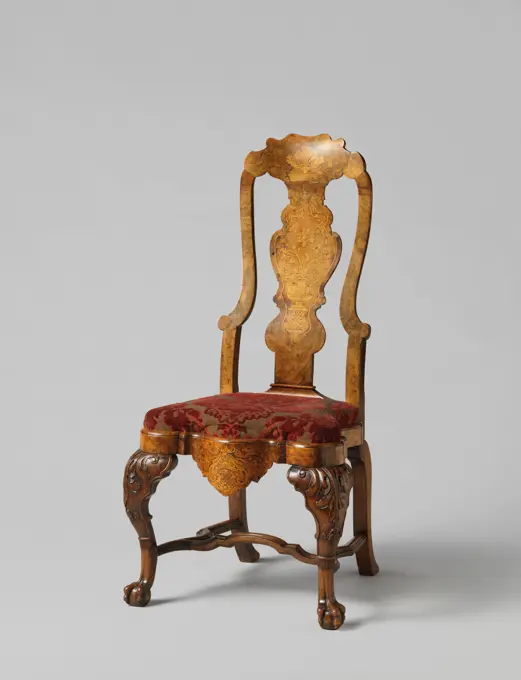
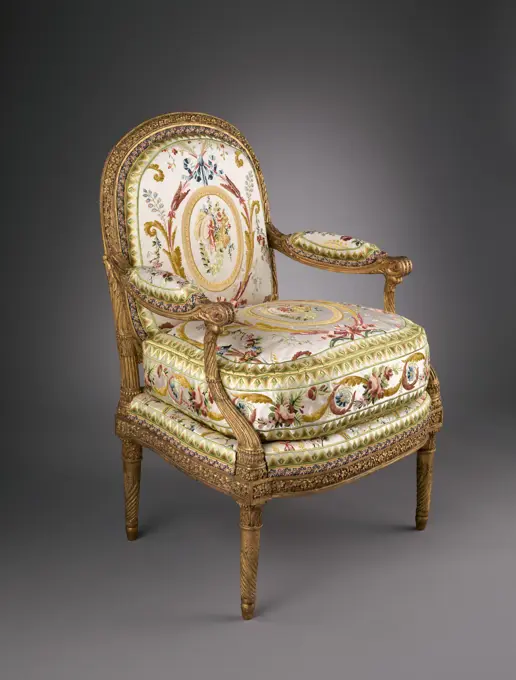
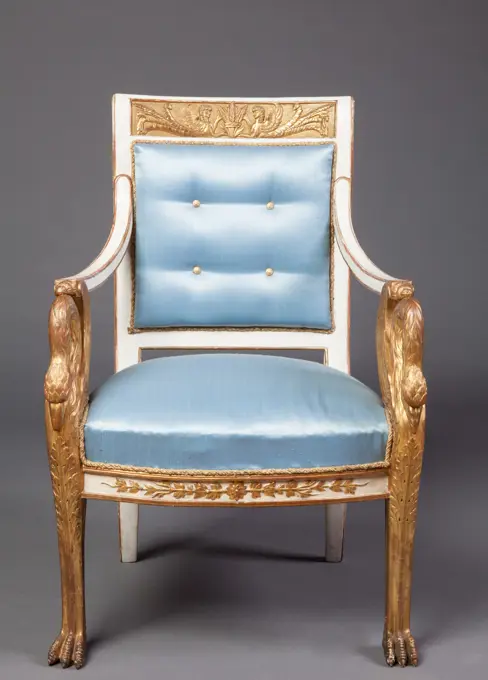
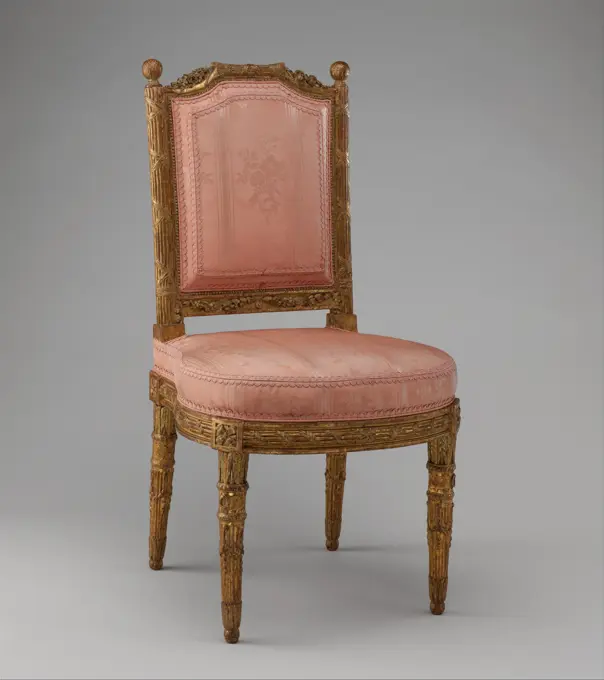
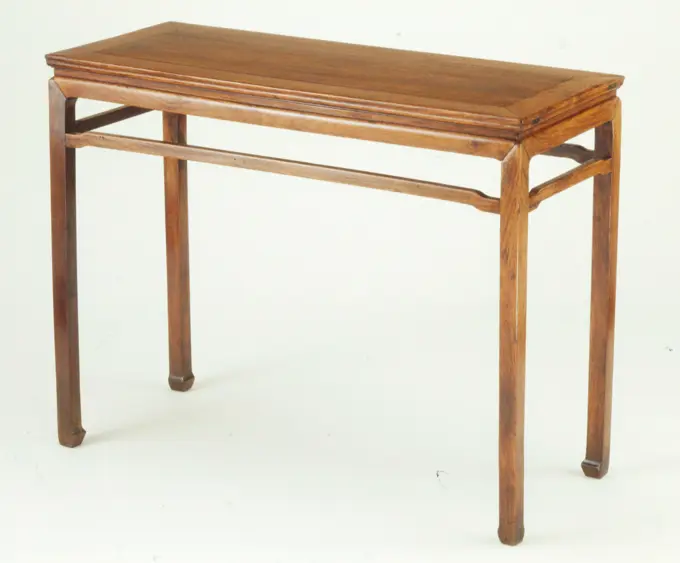
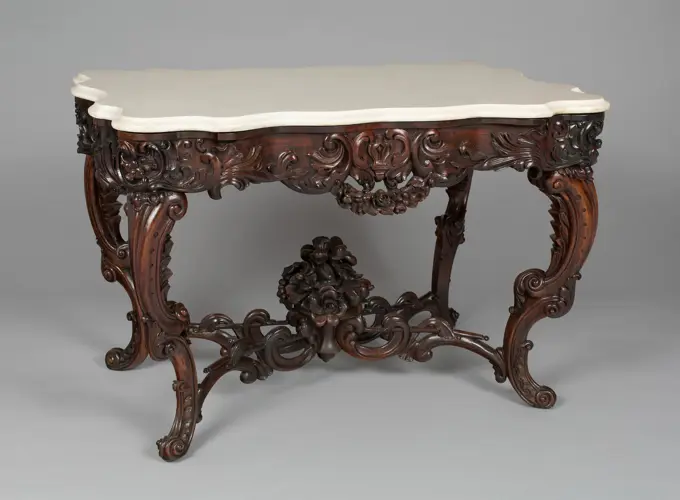
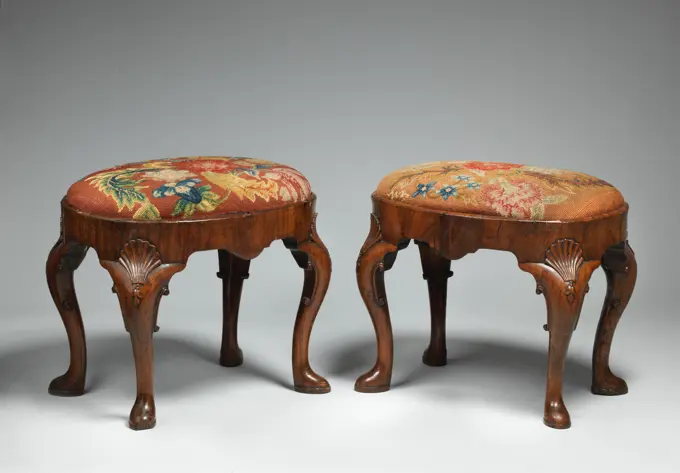
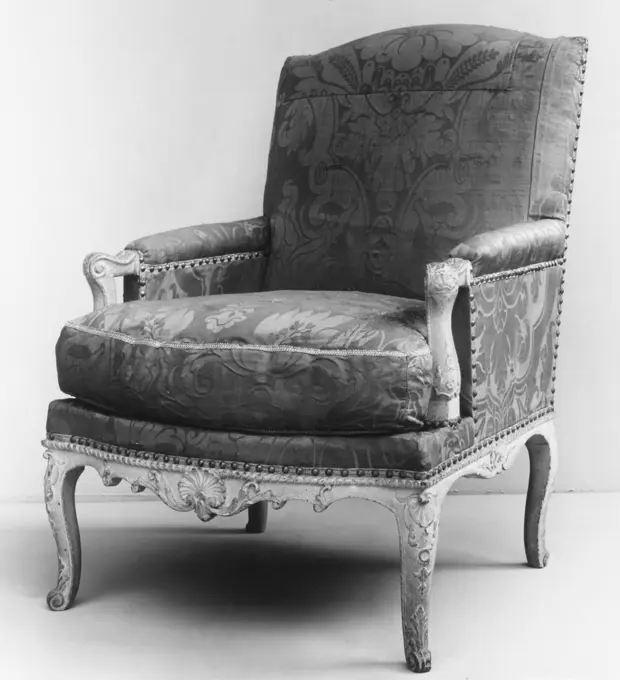
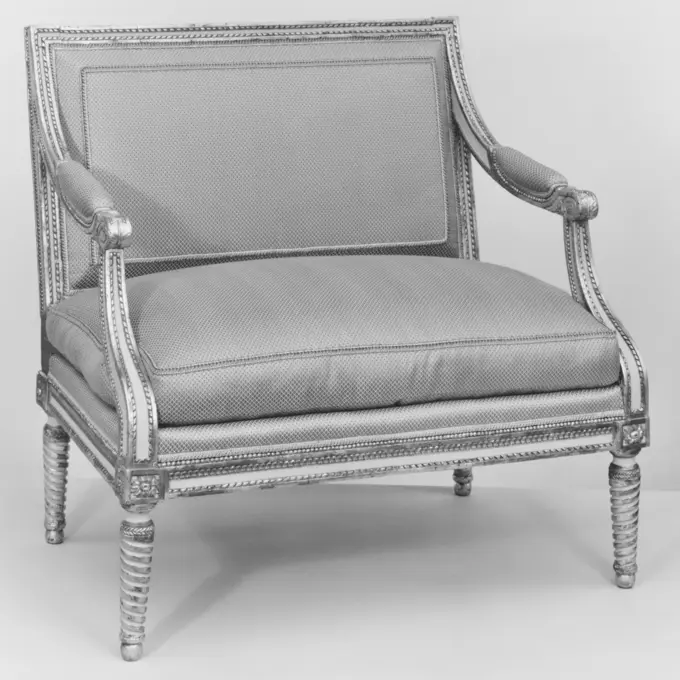
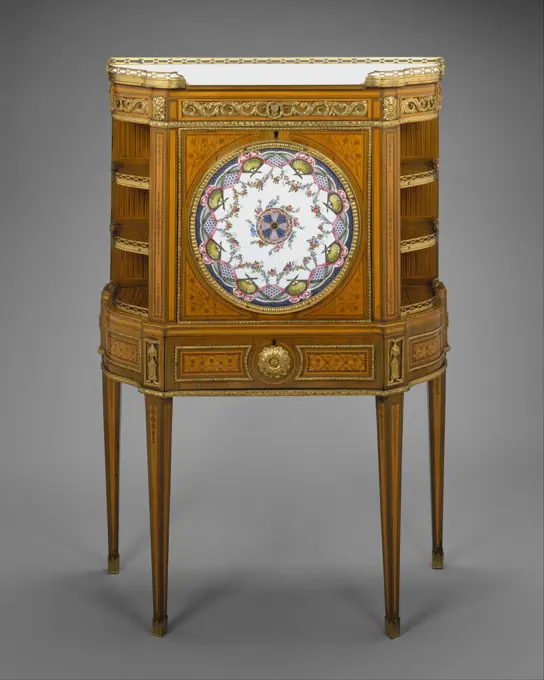
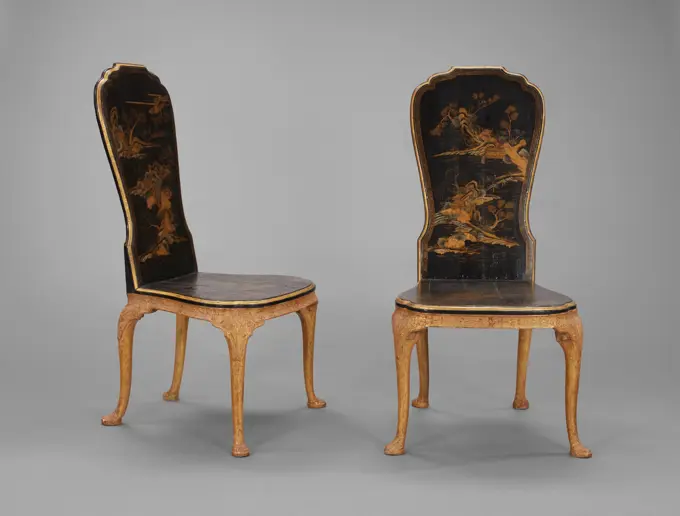
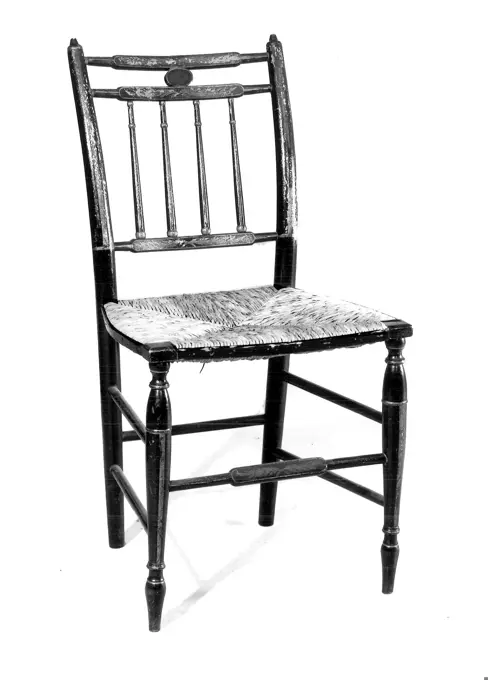
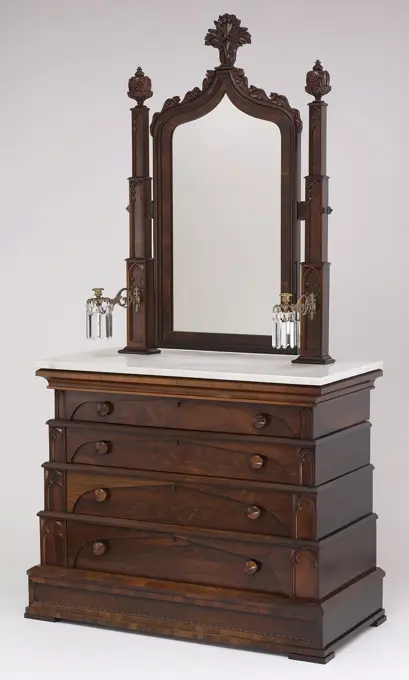
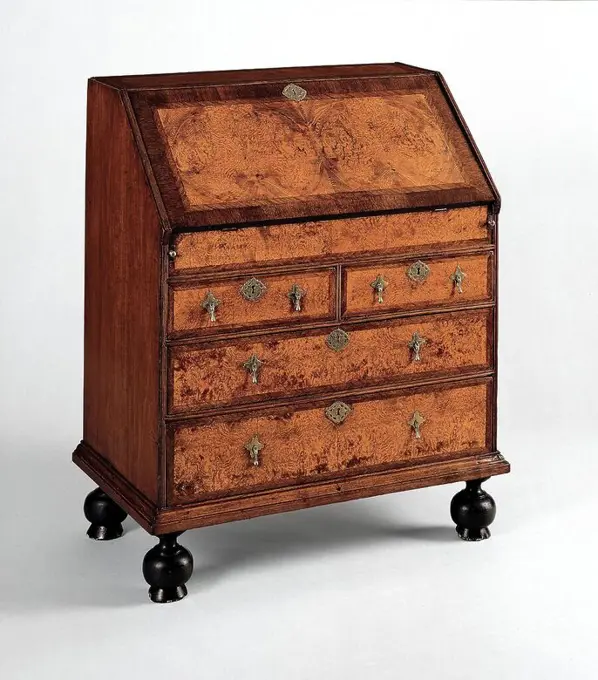
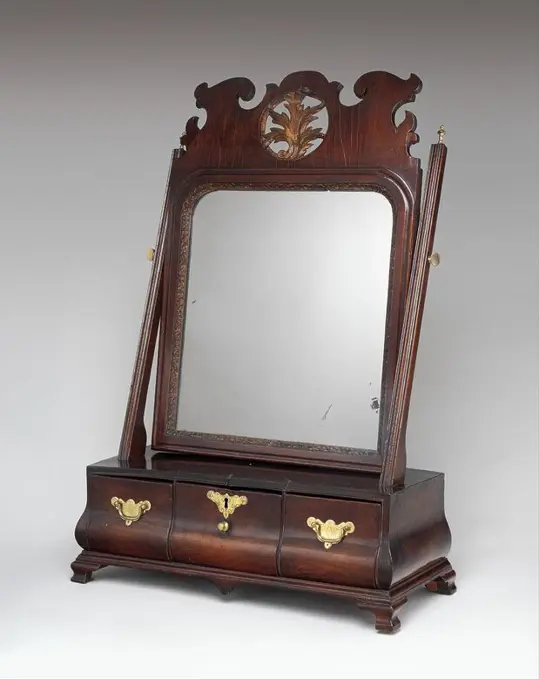
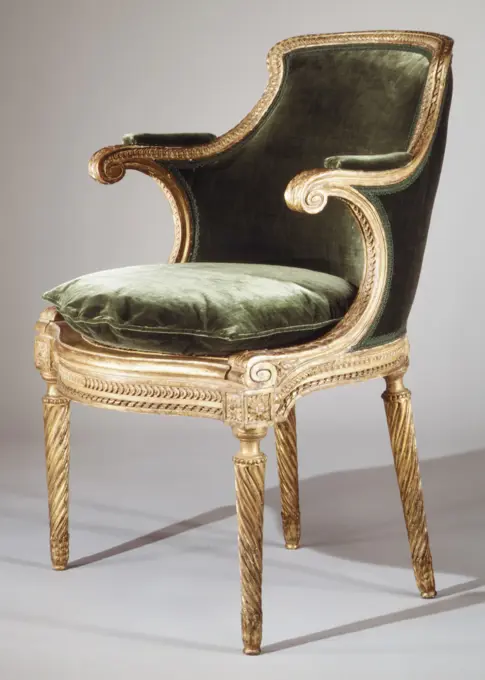
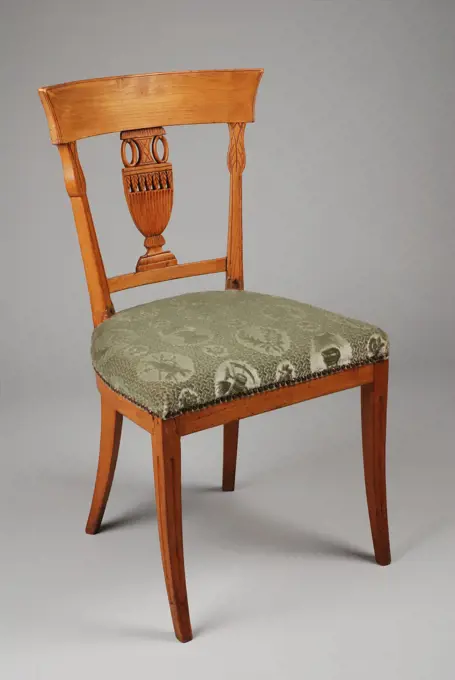
Armchair ca. 1790 British. Armchair. British. ca. 1790. Beechwood, painted white and gilt. Woodwork-FurnitureChair with Swans, Anonymous, 1830 Chair from a set of ten chairs and four arm chairs of partly solid and partly glued mahogany on elm core. Loose covered seats. The square hind legs areas backwards. Nine chairs and an armchair have square, slightly rounded at the front, front legs; The rest has round articulated front legs. The stretched S-shaped backs have a sculpted intermediate rule with a palmet flanked by two swans bending back with the necks. The flat volute -shaped armrests run high in the back. Northern NetherlandsNetherlands wood (plant material). mahogany (wood). elm (wood). textile materials Chair from a set of ten chairs and four arm chairs of partly solid and partly glued mahogany on elm core. Loose covered seats. The square hind legs areas backwards. Nine chairs and an armchair have square, slightly rounded at the front, front legs; The rest has round articulated front legs. The stretched S-shaped backs have a sculpted intermediate rule with a palmet flanked by two swans Belmead Center table c 1846 New York City. In 1845 Alexander Jackson Davis designed Belmead, a magnificent Gothic Revival villa, for the prominent builder Philip St. George Cocke of Powhatan County, Virginia. In addition to designing Belmeadís exterior, Davis also designed furniture for the interior, notably a parlor set that included the side chairs (1998.565.1-2). The table descended in the Cocke family along with the parlor set and, remarkably, retains its original marble top and intricately carved tracery lantern. Fitted between the supporting columns, the tracery was installed before the cabinetmaker assembled the table.. Rosewood, oak, walnut, marble . Alexander RouxChair, anonymous, c. 1720 - c. 1740 Chair of nuthout with a separate covered seat. The hind legs are stretched S-shaped; The front legs placed, on claw with ball, are widened from above and decorated with Acanthus leaf. Sculpted H-shaped cross. The sitting window is decorated at the front in Marqueterie with diamond-shaped and floral motifs. The high back has a scalloped center leaf, decorated with a flower vase on pedestal within a scalloped circumference. The styles are stretched from above S-shaped; Upper sill with palmet or shell. Netherlands wood (plant material). walnut (hardwood). oak (wood). elm (wood). maple (wood). velvet (fabric weave) Chair of nuthout with a separate covered seat. The hind legs are stretched S-shaped; The front legs placed, on claw with ball, are widened from above and decorated with Acanthus leaf. Sculpted H-shaped cross. The sitting window is decorated at the front in Marqueterie with diamond-shaped and floral motifs. The high back has a scalloped center Armchair (France); carved and painted wood, velvet upholstery (modern)antique chair in front of white backgroundArmchair.  Maker: John Meeks, 1801-1875 Maker: Joseph W. Meeks, 1806-1878Pierre Malbet. Cabriolet armchair. Beech, around 1765. Paris, Carnavalet museum. 50262-2 Cabriolet chair, stretch, furniture, floral motif. Armchair of oak and ebony, covered with batted parchment.Button chair, with a fixed seat cushion on pink silk, anonymous, c. 1700 - c. 1799 Arm chair, model button chair with five transverse sports, with fixed seat cushion and loose back cushion (50-b) of pink silk, filled with down, covered with green/white/pink crochet. Amsterdam (possibly) Walnut (Hardwood). Cushion: cotton (textile). to kiss:. Cushion: Silk Arm chair, model button chair with five transverse sports, with fixed seat cushion and loose back cushion (50-b) of pink silk, filled with down, covered with green/white/pink crochet. Amsterdam (possibly) Walnut (Hardwood). Cushion: cotton (textile). to kiss:. Cushion: SilkPembroketableOak chair, chair seating furniture furniture interior design oak wood, Open backrest forelegs and front turn turned scalloped lines in the back.. Cressent was renowned for his commodes fitted with rich gilt-bronze mounts. Sometimes he modelled the mounts in the shape of human figures or animals. Although this example is simpler, it is nevertheless in keeping with Cressents pictorial idiom. The mounts do not draw undue attention to the two drawers; the handles are fully integrated into the general design.Commode, anonymous, c. 1730 - c. 1745 Commode decorated with marqueterie in Violethout on pinewood core. The furniture has S-shaped, overhoeks placed front legs with batter and copper tires. The used front has three drawers in the upper field, the middle batter with a Chinese temple. The drawer in the lower field has a niche in the middle, continuously up to the sill. Both fields have been decorated with predominantly flower and leaf branches and leaf voltuties in gilded bronze. The wrapper is made of red-brown-veined marble. Paris wood (plant material). spruce (wood). oak (wood). kingwood (wood). rosewood (wood). softwood. bronze (metal). copper (metal). marble (rock) gilding Commode decorated with marqueterie in Violethout on pinewood core. The furniture has S-shaped, overhoeks placed front legs with batter and copper tires. The used front has three drawers in the upper field, the middle batter with a Chinese temple. The drawer in the lower field has a niche in the middle, continuousSide Chair (Germany); carved mahoganyEasy Chair with C-scroll Arms. United States, Pennsylvania, Philadelphia, 1765-1775. Furnishings; Furniture. Walnut, oak, yellow pine, and replaced upholsteryJacobean Chair-table. Dated: 1935/1942. Dimensions: overall: 29.5 x 23.9 cm (11 5/8 x 9 7/16 in.) Original IAD Object: none given. Medium: watercolor, colored pencil, and graphite on paperboard. Museum: National Gallery of Art, Washington DC. Author: William Sanders.Francis Borelli, Box Desk on Frame, c 1937 Box Desk on FrameOak renaissance bench of the Reformed Old Woman's House, bench seating furniture interior interior design oak wood timber, Bench with baluster legs Rotterdam City center Stadsdriehoek Hoogstraat Reformed Oudevrouwenhuis renaissance Elisabeth Stichting Anno 1455 Reformed Oudevrouwenhuis (St. Elisabeth Gasthuis)Armchair. Designed by Owen Jones; English, 1809-1874; Made by Jackson & Graham; London, c. 1840-85. Date: 1867-1870. Dimensions: 96.5 × 63.5 × 76.2 cm (38 × 25 × 30 in.). Mahogany, purpleheart, ebony, harewood, holly, and brass. Origin: London. Museum: The Chicago Art Institute, Chicago, USA.Side Chair ca. 1860 Léon Marcotte French This side chair is part of a suite of Louis XVI-style furniture that John Taylor Johnston (1820-1893) purchased from the firm of Ringuet-Leprince and L. Marcotte in about 1856. This international firm had showrooms in both Paris and New York, and it is believed that at least some of the pieces of the suite were made in Paris for the New York commission. Johnston, a railroad executive and the first president of The Metropolitan Museum of Art, used the furniture in the music room of his residence at 8 Fifth Avenue. The suite (68.69.1-68.69.11, 68.165.1-68.165.6) includes two sofas, two armchairs, a table, two matching cabinets, a third large cabinet, six matching side chairs, a pair of lyre-back side chairs, and a firescreen. After Ringuet-Leprince retired in 1860, the firm became known as L. Marcotte and Company. Léon Marcotte was New York's most noted cabinetmaker and interior decorator during the 1860s.. Side Chair. American. ca. 1860. Maple, pChair of nuthout with loose, covered seat, sitting window with windows and floral motifs in Marqueterie; Back with scalloped center leaf with flower vase, s-shaped legs, anonymous, c. 1700 - c. 1725 Chair of nuthout with a separate covered seat. The hind legs are stretched S-shaped; The front legs placed, on claw with ball, are widened from above and decorated with Acanthus leaf. Sculpted H-shaped cross. The sitting window is decorated at the front in Marqueterie with diamond-shaped and floral motifs. The high back has a scalloped center leaf, decorated with a flower vase on pedestal within a scalloped circumference. The styles are stretched from above S-shaped; Upper sill with palmet or shell. Northern Netherlands wood (plant material). walnut (hardwood). oak (wood). elm (wood). maple (wood). velvet (fabric weave) Chair of nuthout with a separate covered seat. The hind legs are stretched S-shaped; The front legs placed, on claw with ball, are widened from above and decorated with AcanHigh Chest ofDrawersArmchair (fauteuil à la reine) 1779 Jacques Gondouin Although intended to furnish Marie-Antoinettes grand cabinet intérieur at the chteau de Versailles during the winter months, the chair and the rest of the set were removed in 1783, when the grand cabinet intérieur was redecorated and placed in the queens billiard room on the floor above. Sold during the French Revolution, the entire set of furniture was acquired by the American statesman Gouverneur Morris, who served as minister of the United States in France from 1792 to 1794. The pieces were subsequently sent to Morrisania, Morriss country estate in the Bronx. Listen to experts illuminate this artwork's story Listen Play or pause #2266. Armchair (fauteuil íæ la reine), Part 1 Play or pause #2267. Armchair (fauteuil íæ la reine), Part 2 Supported by Bloomberg Philanthropies We're sorry, the transcript for this audio track is not available at this time. We are working to make it available as soon as possible.. Armchair (fauteuil ArmchairSide chair (chais à la reine) (one of a pair) 1784 Georges Jacob French "At eleven oclock set out for the Thuilleries, to see the balloon go off; we soon quitted the coach, and it was with the greatest difficulty we got through the crowd on the Pont-royal to the little garden door. It was not long afterwards, that the Duke of Cumberland was in danger of being squeezed to death, as announced in all the public journals. The Queen of France sat in the balcony in front of the Thuilleries, appeared serious, and our party remarked, that she looked like a very handsome English woman. As soon as the aëronauts had taken their flight, I quitted the gardens."[1 In his diary entry for December 1, 1783, Joseph Cradock (1742-1826) refers to the many spectators who watched a historic event take place that day: the first manned hydrogen balloon flight. The aeronauts Jacques-Alexandre-César Charles (1746-1823), a physicist, and his collaborator, Marie-Noël Robert (1760-1820), took off from the gardenSide Table (tiaozhuo), 17th century, 34 x 44 x 18in. (86.4 x 111.8 x 45.7cm), huang hua-li hardwood, China, 17th centuryFlorence Huston, Settee, c 1936 SetteeThree-Tiered CabinetQueen ann style furniture Queen ann style table and chair isolated over white background Copyright: xZoonar.com/IvonnexWierinkx 16866373Buffet with folding leaf. Marqueterieveriering with music trophes in medallions with bows and cord., Anonymous, c. 1780 - c. 1795 Buffet of oak, glued with several types of wood rests on conical legs and has angle styles placed overhoek. Above the two doors there is a wax drawer flanked by drawers, decorated with landscapes. The styles and medium -needed with batter show sham scanning and guttae; The styles wear trifliefs and an ionic capital at the loads of the drawers. The doors, sides and the folding leaf show within rectangular defined fields of music trophies in medallions, most hung on a cord with a bow Netherlands wood (plant material). oak (wood). maple (wood). purpleheart (wood). ebony (wood). walnut (hardwood). mahogany (wood). yew (wood). tin (metal). copper (metal) Buffet of oak, glued with several types of wood rests on conical legs and has angle styles placed overhoek. Above the two doors there is a wax drawer flanked by drawers, decorated with landscapes. The styles and Side Chair. Dated: 1935/1942. Medium: watercolor, graphite, and colored pencil on paper. Museum: National Gallery of Art, Washington DC. Author: Genevieve Sherlock.Table c 1856-1861 New York City. Rosewood . John Henry Belter and CompanyCupboardChildren's cabinet van Eikhout, Anonymous, 1720 - 1750 Under two large, two small drawers above it. Within the doors 3 small drawers  oak (wood). brass (alloy). iron (metal) Under two large, two small drawers above it. Within the doors 3 small drawers  oak (wood). brass (alloy). iron (metal)Hal Blakeley, Chair (Arm), 1941 Chair (Arm)Adam Weisweiler. Happiness of the day with two glass doors confined to columns in the shape of bamboo, two large shelves of crotch covered with white marble, golden bronzes (closed overall view), around 1780. Paris, Cognacq-Jay museum. Bamboo, happiness of the day, bronze gilded, column, two, shape, large between leg, white marble, furniture, glass door, Louis XVI style, 18th century, furnitureFirescreen-table. unknown, joinerLinen cabinet veneered with mahogany in early historical style, linen cupboard cupboard cupboard furniture furniture interior design wood oak mahogany flower mahogany iron, Linen cupboard veneered with mahogany wood and trimmed with beaded edge one large and two small drawers are provided with profile edge oak; belongs to 036142 and 036143.Pair of stools ca. 1710 British. Pair of stools. British. ca. 1710. Walnut, needlework. Woodwork-FurnitureDining Room Table. Dated: c. 1942. Dimensions: overall: 35.3 x 45.7 cm (13 7/8 x 18 in.) Original IAD Object: 27 1/4"high; top: 15x33x1. See data sheet for details.. Medium: watercolor, gouache, colored pencil, pen and ink, and graphite on paperboard. Museum: National Gallery of Art, Washington DC. Author: Jr. Ernest A. Towers.Painted Chest. Dated: c. 1937. Dimensions: overall: 24.5 x 28.5 cm (9 5/8 x 11 1/4 in.) Original IAD Object: 42"high; 36"long; 16 1/2"wide.. Medium: watercolor, colored pencil, and pen and ink on paper. Museum: National Gallery of Art, Washington DC. Author: Martin Partyka.Rebellion with two doors with glass windows behind which loading, horing with desk, anonymous, c. 1750 - c. 1800 Part of a desk, miniature with rebellion of ebony and the spider of tropical wood. The uprising with two doors with glass, behind which loading with silver battle and sculpted attachment. Indonesia wood (plant material). ebony (wood). silver (metal). glass Part of a desk, miniature with rebellion of ebony and the spider of tropical wood. The uprising with two doors with glass, behind which loading with silver battle and sculpted attachment. Indonesia wood (plant material). ebony (wood). silver (metal). glassAmos C Brinton, Gate legged Dining Table, c 1939 Gate-legged Dining TableCouchMaker, attributed to: Charles-Honore Lannuier, American, Cardtable, Mahogany, mahogany veneer; eastern white pine (front and side frame rails, glue blocks), black cherry (back frame rail, medial brace, stop pin), ash (pivot block), 30 1/8 × 35 1/2 × 17 13/16 in. (76.5 × 90.2 × 45.3cm), Made in New York, New York, American, 19thcentury, FurnitureHighboy. Dated: c. 1939. Dimensions: overall: 57.6 x 45.6 cm (22 11/16 x 17 15/16 in.) Original IAD Object: 96"high; 44"wide; 24 1/2"deep. Medium: watercolor, colored pencil, and graphite on paperboard. Museum: National Gallery of Art, Washington DC. Author: Francis Borelli.Armchair (Fauteuil à la reine). Culture: French, Paris. Dimensions: H. 38-3/4 x W. 26-3/8 x D. 23-5/8 in. (98.4 x 67.0 x 60.0 cm). Maker: attributed to Georges Jacob (French, Cheny 1739-1814 Paris). Date: ca. 1785.This armchair with a medallionshaped back surmounted by a rippled bowknot, its columnar uprights surmounted by finials shaped like flaming cassolettes, seems to be depicted in two paintings by Adelaide Labille-Guiard (1749-1803). Principal painter to "Mesdames Tantes," the unmarried aunts of Louis XVI, Labille-Guiard exhibited a full-length portrait of Madame Adelaide at the Salon of 1787. The princess stands in front of the chair, her robe draped over its arm. Three years later the artist painted Charles-Roger, prince de Bauffremont (1713-1795), seated in what seems to be the same chair. In both portraits it is upholstered in blue-green velvet. Since no other armchair of this model is known, it is possible that this very piece of seat furniture once belonged to Madame AdelaiSide Chair. Augustus Welby Northmore Pugin (England, 1812-1852)John Webb (England, London, Hanover Square). England, circa 1848. Furnishings; Furniture. Oak, leather, brassArmchair (bergère) first quarter 18th century French. Armchair (bergère) 189335 French, Armchair (bergre), first quarter 18th century, Carved and painted beech, red damask, Overall: 38 5/8  26  25 5/8 in. (98.1  66  65.1 cm). The Metropolitan Museum of Art, New York. Gift of J. Pierpont Morgan, 1906 (07.225.48)Rex Dolmith, Three Legged Gate leg Table, c 1936 Three Legged Gate-leg TableDesk and bookcase, c. 1832-1834, Attributed to Meads and Alvord, Albany, New York, 84 13/16 x 51 x 25 in. (215.42 x 129.54 x 63.5 cm), Mahogany, pine, tulip, brass, glass, United States, 19th century, The business partnership of John Meads (1777-1859) and William Alvord (1766-1853) resulted in some of the most artistically sophisticated furniture made in nineteenth-century America. Meads & Alvord was the premier Neoclassical furniture firm in Albany, and they used their status and shop location to serve a wide clientele throughout the Hudson River Valley and further west along the Erie Canal (completed in 1825). As demonstrated in this desk and bookcase, when designing furniture, Meads & Alvord adopted popular Grecian and Gothic Revival designs that were characteristic of larger American style centers. The overall form of this desk and bookcase was often seen in New York City furniture, while the decoration, such as the carved melon feet, was popular in Boston cabinetwork.cabinet Small settee (marquise) ca. 1775-80 Sulpice Brizard. Small settee (marquise) 205111Drop-front desk (secrétaire à abattant or secrétaire en cabinet) porcelain ca. 1764, secretary ca. 1775 Attributed to Roger Vandercruse, called Lacroix French Several related secretaries are known that have either a porcelain plaque or a marquetry roundel on the fall front and are signed or attributed to Roger Vandercruse. The son of a Flemish cabinetmaker, Vandercruse also used the French equivalent of his name, Lacroix. Typical of his oeuvre is the colorful cornflower and latticework marquetry. The decoration of the large Sèvres plaque, with its geometric pattern of ribbons and shells interspersed with diapered cartouches and garlands, is similar to that of useful wares, and thought to date to about 1764. Antedating the secretary by a decade, it may originally have been intended as the top for a small table. The maltese cross at the center of the plaque alludes to a special commission.. Drop-front desk (secrétaire à abattant or secrétaire en cabinet) 202158Armchair. Culture: Swiss. Dimensions: H. 44 x W. 24 in. (111.8 x 61.0 cm). Date: 1679. Museum: Metropolitan Museum of Art, New York, USA.Pair of Hall Chairs 1715-1725 England. Frames gilt gesso on beechwood; Backs and seats lacquered and gilt Chinese softwood .Chair;  End of the 19th century (1890-00-00-1899-00-00);Office of the Council of Ministers (Warsaw - 1945-) - collection, classicism (style), transmission (provenance)Chair from a set of furniture for the Żeleńsk bedroom Wyspiały, Stanis Aw (1869 1907), Sydor, AndrzejDressing Table 1820-40 American. Dressing Table 3433ArmchairCupboard, anonymous, c. 1630 - c. 1640 Cabinet glued with Note and Ebony. The base cabinet has Bolpoten and a wide plinth with two drawers, which, like the reversed ojief -shaped upper frieze, wear cropping on the corners and in the middle; At the top with Ebben Pipes, at the bottom with lion heads. The styles of the base cabinet wear ebben pipes, those from the upper cabinet hermat figures with ionic capital. The two doors of the lower and upper cupboard carry smooth panels with profile frames, bacon and diamond heads. Angle styles placed overhoek. Amsterdam (possibly) wood (plant material). walnut (hardwood). ebony (wood). oak (wood). padouk (wood) Cabinet glued with Note and Ebony. The base cabinet has Bolpoten and a wide plinth with two drawers, which, like the reversed ojief -shaped upper frieze, wear cropping on the corners and in the middle; At the top with Ebben Pipes, at the bottom with lion heads. The styles of the base cabinet wear ebben pipes, those from the upper cabinet hSide chair (one of a pair). Attributed to Chapin School of Cabinetmakers; Hartford County, Connecticut. Date: 1771-1790. Dimensions: 96.7 × 53.3 × 42.5 cm (38 1/2 × 21 × 16 3/4 in.). Mahogany with white and yellow pine. Origin: East Windsor Hill. Museum: The Chicago Art Institute, Chicago, USA.Cupboard. Dated: c. 1937. Dimensions: overall: 29.2 x 22.7 cm (11 1/2 x 8 15/16 in.) Original IAD Object: 54" high, 44" wide, 16" deep.. Medium: watercolor, colored pencil, and graphite on paperboard. Museum: National Gallery of Art, Washington DC. Author: Meyer Goldbaum.. Fireworks of walnut with extendable board and with flap leaf, hanging to hinges and bronze foldable carriers. The export styles are decorated on the sides with animals on branches and women's figures that symbolize the four seasons; On the other silk shell and floral motifs. The scalloped sills bear similar decorations. Dejected legs, between a leaf, wearing decorated lion legs on flat football. Styles crowned with bronze morsecasts. Handle decorated at the top.Armstoel, François Claude Menant, 1775 - 1800 Arm chair, covered, painted of white beech wood and resting on conical -canling legs, under square houses with rosettes. The square armrest stars have scanned basements, stabbed braid ornament and acanthus leaf and support the armrests, ending in a volute. The trapezoidal sitting window is bent. The slightly bent upper sill of the back window, decorated with grunt list, has running corners; The styles end in rosettes. Seat rules and back window wear stabbed scaling decoration. Stamped at the bottom of the prescription: F.C. Menant France wood (plant material). beech (wood). textile materials. paint (coating) Arm chair, covered, painted of white beech wood and resting on conical -canling legs, under square houses with rosettes. The square armrest stars have scanned basements, stabbed braid ornament and acanthus leaf and support the armrests, ending in a volute. The trapezoidal sitting window is bent. The slightly bent upper sill of the back Spittoon. unknown, creatorDesk. Dated: c. 1938. Dimensions: overall: 54.6 x 40.6 cm (21 1/2 x 16 in.) Original IAD Object: 44 3/4"high; 16"deep; 41"wide. Medium: watercolor, colored pencil, graphite and heightening on paper. Museum: National Gallery of Art, Washington DC. Author: Einar Heiberg.PembrokeTableRound Stool with Stone Seat, one of a pair, late 17th century, 17 x 18-5/16 x 17 in. (43.2 x 46.5 x 43.2 cm), Huang-hua-li hardwood and ta-li marble, China, 17th centuryFancy” Side ChairDressing bureau, c. 1844, Crawford Riddell's Journeymen Cabinet Makers, American, Philadelphia, 1837- c. 1844, 95 7/16 x 51 3/4 x 26 1/4 in. (242.4 x 131.4 x 66.7 cm), Rosewood, mahogany, tulip, marble, bronze, glass, United States, 19th century, During the mid-19th century, southern planters and industrialists often bought directly from manufacturers in New York and Philadelphia while vacationing, visiting family, or conducting business in the East. Some purchases were quite extensive, such as the thirteen-piece Gothic revival bedroom suite Daniel and Martha Turnbull bought for Rosedown, their plantation home in St. Francisville, Louisiana. It included this bureau, with spires, arches, and tracery derived from ecclesiastical architecture. The telescopic form of the mirror supports and chest is unparalleled in American Gothic revival furniture. The suite had been commissioned as the White House bedroom furniture for Henry Clay, had he won the presidency in 1844. However, he was defeateDesk. Culture: American. Dimensions: 40 x 33 3/4 x 19 in. (101.6 x 85.7 x 48.3 cm). Date: 1700-1730.Desks such as this one, combining the chest-of drawers and desk-box forms in one unit, became fashionable in Boston in the early eighteenth century. The slant-front lid is enlivened by richly figured burl veneers. It is hinged at the bottom and opens to provide a flat writing surface. Museum: Metropolitan Museum of Art, New York, USA.SideChairDressing Glass. Culture: American. Dimensions: 33 x 22 1/4 x 10 in. (83.8 x 56.5 x 25.4 cm). Date: 1760-90. Museum: Metropolitan Museum of Art, New York, USA.Goldweight Chair, 19th-20th century, 3 x 1 1/4 x 1 1/2 in. (7.62 x 3.18 x 3.81 cm), Brass, Ghana, 19th-20th centuryArmchair ca. 1785 Georges Jacob French The original purpose of this graceful armchair is not entirely clear. The boldly incurving supports with padded armrests could indicate that this chair was intended for use as a fauteuil de bureau or desk chair making it possible to pull the chair close to the writing surface. Many desk chairs of this period, however, had seats which could be rotated but the seat of this particular armchair is fixed. The back of the chair is slightly lower than customary possibly to facilitate its use at the dressing table as a fauteuil de toilette for hair dressing or wig powdering purposes. Just like desk chairs, dressing table chairs were often caned or covered in leather for practical reasons and they were sometimes fitted with a mechanism that allowed the seat to swivel. Whatever the case might be, it is clear who was responsible for cutting and joining the frame of this chair which once may have had a caned back as well as a caned seat (now hidden beneath a Pair of foot stools. Culture: American. Dimensions: 30 3/8 x 35 1/2 in. (77.2 x 90.2 cm). Date: 1825-30. Museum: Metropolitan Museum of Art, New York, USA.Desk. unknown, authorEgret Empire chair, chair furniture furniture interior design wood elmwood velvet brass, Vase in the back leaf lotus in back style green velor upholstery with medallion motif With still Louis Seize ornaments Empire Louis XVI Louis XVI Louis SeizeHigh Chest ofDrawersNoise armchair;  3. W. 19th century (1851-00-00-1875-00-00);Charles-Guillaume Diehl (1811-1885), cabinetmaker. Shelf console. Rosewood, rosewood and brass nets. Around 1855. Paris, Museum of Romantic Life. 77177-7 Rosewood, shelf console, brass net, furniture, rosewood, furniture. Wall cupboard, part of a timber, carried out in nuts, oak, pine and rosewood.Windsor Settee 1770-1800 American. Windsor Settee 9864Piano-piano; Leszczyczki, Antoni (Post 1780-1830); 1824 (1824-00-00-1824-00-00);Egyptians, NEMS scarves (iconogr.), Dar (provenance), Empire (style), Herms (Elem. Decor), columnsTea Table 1740-60 American. Tea Table. American. 1740-60. Maple. Made in New England, United StatesChilds Board Rocking ChairEbony straight chair, upright chair seat furniture furniture interior design wood elm wood textiles, square squares in the back and arches in the hood brown cloth on the seat square rejuvenated legs with cannelures.Small desk with folding top (bureau brisé) ca. 1685 Marquetry by Alexandre-Jean Oppenordt Dutch This desk and its pair were supplied in 1685 for use by Louis XIV in his study, or petit cabinet, in the north wing of the chteau de Versailles. The form is called a bureau brisé, literally a "broken desk," because the hinged front half of the flat top can be folded back, or "broken," to reveal a narrow writing surface. The elaborate decoration on top includes the king's crowned monogram of interlaced L's beneath a radiant sun symbol engraved with a now indistinct Apollo mask. Listen to experts illuminate this artwork's story Listen Play or pause #2253. Small Desk with Folding Top (Bureau Brisé) Supported by Bloomberg Philanthropies We're sorry, the transcript for this audio track is not available at this time. We are working to make it available as soon as possible.. Small desk with folding top (bureau brisé) 207667Dressing table 1730-60 American Japanning, the use of paint and gilded gesso to imitate the glossy finish on Asian lacquerwork, was a popular method of furniture decoration in colonial Boston. This group of japanned furniture (40.37.1,.2,.4) descended in the Pickman family of Salem, Massachusetts, and is an extraordinary survival. The painted decoration on the high chest, dressing table, and looking glass is all by the same hand.. Dressing table. American. 1730-60. Maple, birch, white pine. Made in Boston, Massachusetts, United StatesSide Chair (USA); Designed by Frank Lloyd Wright (American, 1867-1959); wood (oak), woven textile upholsteryPlatform Daybed, late 16th century, 19 9/16 x 76 9/16 x 41 3/16 in. (49.69 x 194.47 x 104.62 cm), Huang-hua-li hardwood, China, 16th centuryChest of Drawers. Culture: American. Dimensions: 40 x 43 1/2 x 22 in. (101.6 x 110.5 x 55.9 cm). Date: 1675-1700. Museum: Metropolitan Museum of Art, New York, USA.TableChest on Chest, c. 1770-1790, 84 1/2 x 42 3/8 in. (214.63 x 107.63 cm), Mahogany, white pine, brass hardware, United States, 18th centurySideboard c 1868-1880 Philadelphia. Marking the height of the ìmodern Gothicî style in Philadelphia, this sideboard resembles the furniture designed by notable architect Frank Furness, who frequently collaborated with cabinetmaker Daniel Pabst. Although details of the pieceís carving tie it unmistakably to Pabst, the design cannot be attributed conclusively to a particular hand. The designer was influenced by the writings of Christopher Dresser and Charles Eastlake, British reformers who advocated honesty of construction and conventionalized ornament. Instead of carving the decoration deeply in order to achieve a naturalistic effect, Pabst used a cameo technique, cutting through the burled elm veneer to reveal the darker walnut beneath and creating a striking color contrast and flattened style of decoration.In the mid-nineteenth century, dining-room furniture typically featured ornament that was intended to reinforce ideals of hospitality and gentility. Here the cabinet doors display dTwelve-cornered etagere, standard furniture interior fittings wood mahogany softwood beechwood rosewood satinwood brass copper, With three rosewood veneered blades on black hexagonal column with three rocaill-shaped legs on the top marquetry of birds.Table with oval table top and two side baths resting on wide rectangular cheeks. Table of plywood glued with rosewood resting on a chassis. The chassis consists of two broad rectangular cheeks that are angled at a broad high line, which protrudes. Four the cheeks are just as high but narrower rules embedded the ends. On the chassis, the oval table top rests on a wide curved rule. The table is extendable and has two side baths.