Elegant Wooden Chairs

A series of ornate wooden chairs from different eras, featuring intricate designs and upholstery, capturing classic craftsmanship and historical charm.

Chair with a brown leather upholstery, Hendrik Petrus Berlage, c. 1902 Eikhout chair. The front and hind legs are interconnected by means of an H-shaped cross with pen and hole connections, the pens of which stick through the legs. The slanted billioned backstyles end in bird heads and rest on the cross. The handrail rests on Stutten near the seat and these also serve as hind legs. The backrest is connected both above and below by an intermediate rule. The top line contains a sliced star shape in the middle. There is a panel between the lines that is covered with leather and is secured with copper nails. The seat is also covered with leather and secured with copper nails. designer: Netherlandsmaker: Amsterdam oak (wood). leather Eikhout chair. The front and hind legs are interconnected by means of an H-shaped cross with pen and hole connections, the pens of which stick through the legs. The slanted billioned backstyles end in bird heads and rest on the cross. The handrail rests on Stut
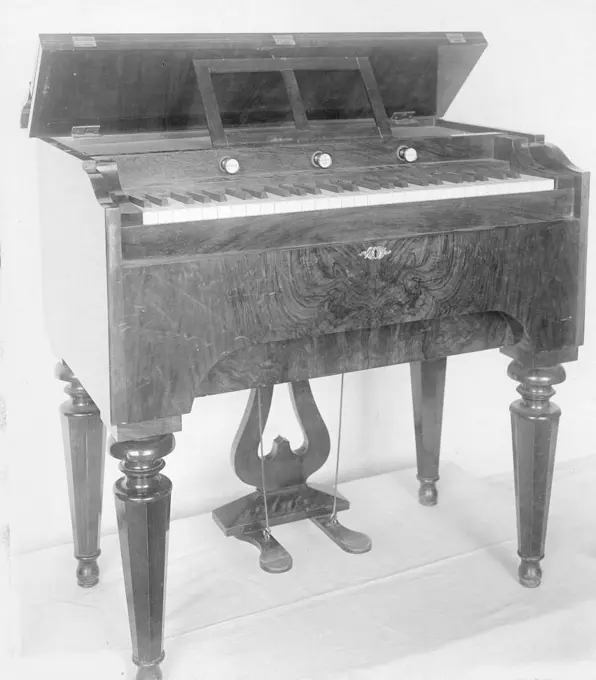
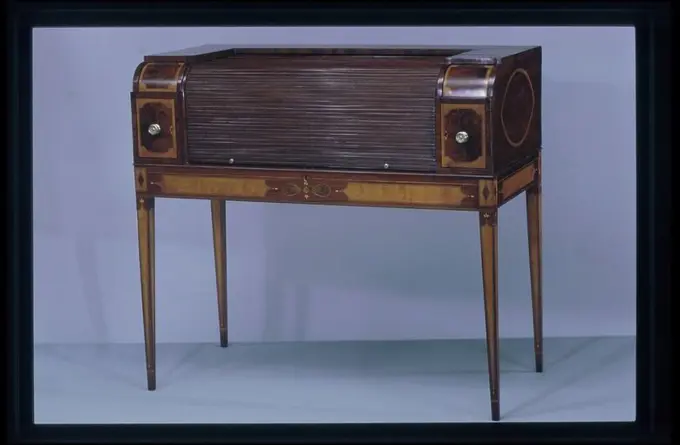
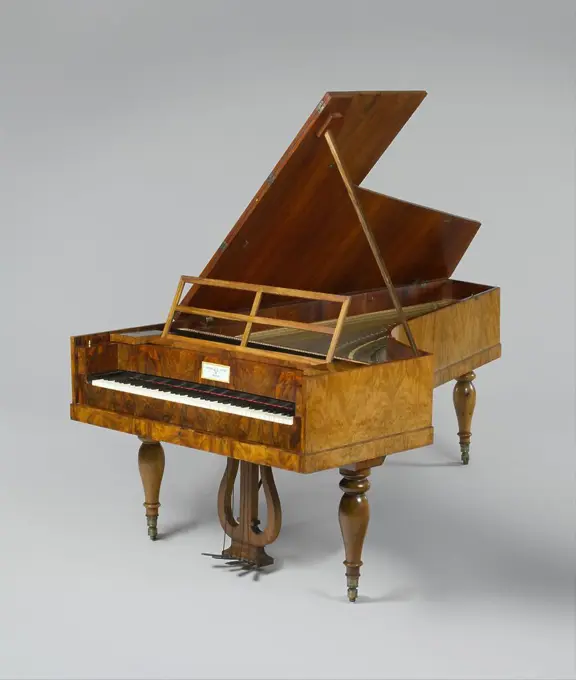
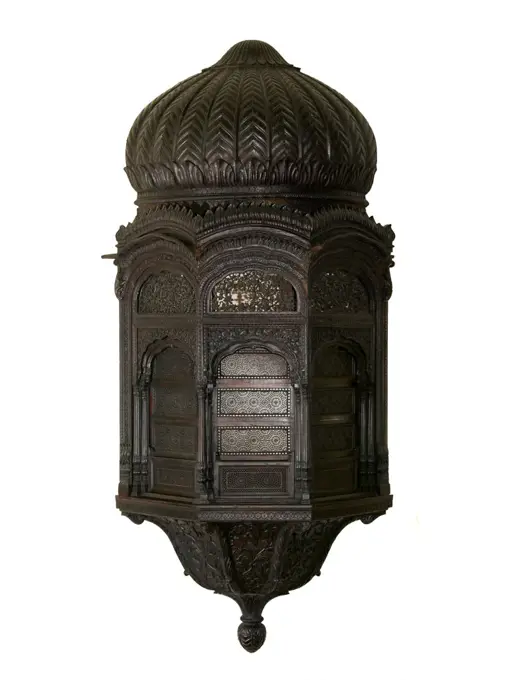
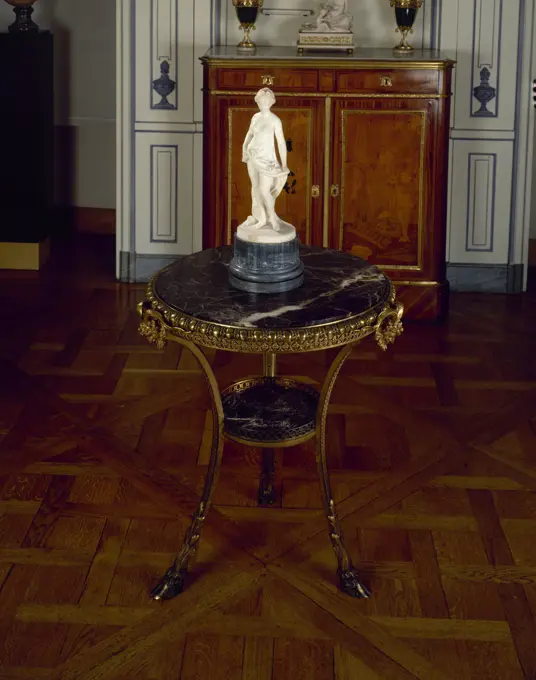
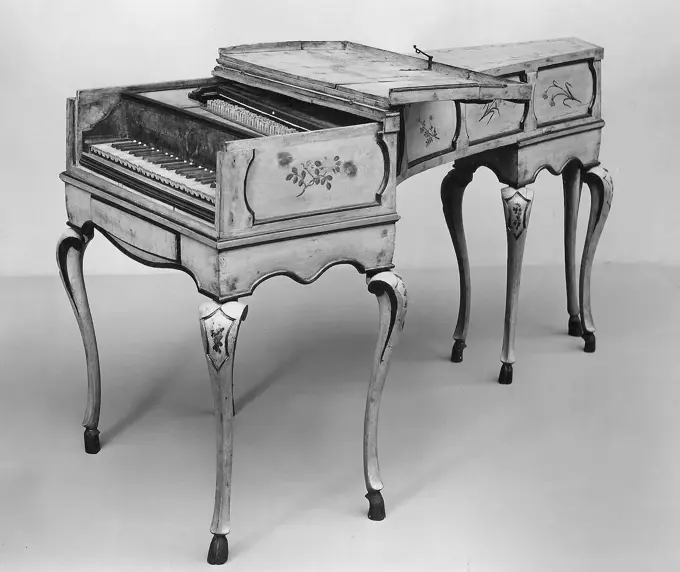
Alfred H Smith, Newel Post, c 1937 Newel PostshieldHarmonium mid-19th century F. Kaufmann & Sohn German The harmonium is the European name for a free reed keyboard instrument commonly known as a pump organ in the United States. This instrument, with an abbreviated keyboard range, utilizes pedals on what looks like a typical piano pedal lyre to pump the bellows. Technical description: Rectangular walnut-veneer case on four turned legs with tapered octagonal shafts; lid of four separately hinged pieces, one of which forms a concave curve over keyboard; music rack hinged to panel covered with rose-colored silk placed behind keyboard, above windchest; two wood pedals in lyre pump two square bellows below windchest; one set of brass free reeds individually screwed to four brass plates mounted in windchest below keyboard; bottom of each keytail, covered with leather, serves as a pallet valve; keys are returned by springs attached to batten over back of keyboard; entire keyboard and mechanism hinges forward when not secured by two hooks behinAntique wooden almira, Jodhpur, Rajasthan, India Copyright: xSafatxAli/DinodiaxPhotoxCabinet decorated with red-backed turtle shell. Dated 17th CenturyBlue sofa couch in vintage room with vintage telephone - classical styleServing Table. Culture: American. Dimensions: 43 3/4 x 46 3/4 x 22 3/4 in. (111.1 x 118.7 x 57.8 cm). Date: 1800-1810. Museum: Metropolitan Museum of Art, New York, USA.Cómoda tocador. Siglo XVII-XVIII Museo de las Artes Decorativas de Barcelona.Ice sleigh from Hindelopen with painting and carving. Ice sleigh from Hindelopen with painting and carving. The painted side walls show a representation of pan that embraces the reed and Mercury playing Argus, the Guardian of IO, asleep. A representation of Diana and her nymphs on the back; Dance in a 17th-century winter landscape to Hendrik Goltzius.Chest-on-chest 1760-90 American. Chest-on-chest 2026Fortepiano. Culture: Austrian. Dimensions: Width: 49 3/16 in. (125 cm)Length: 93 1/2 in. (237.5 cm). Maker: Conrad Graf (Austrian, Riedlinger, Wurttemberg 1782-1851 Vienna). Date: ca. 1838.Conrad Graf (1782-1851), maker of this six and one-half octave piano, was one of the most important fortepiano makers in Vienna between 1822-42. In 1824 Graf was appointed Austrian court keyboard instrument maker and in 1835 received a gold medal at the Austrian Industrial Products Exhibition. Composers such as Beethoven, Czerny, Schubert, Schumann, Kalkbrenner, Mendelssohn, Chopin, Liszt, and Brahms, as well as the Empress of Russia, the Queen of Saxony, and the Archduke and Archduchess of Austria owned Graf pianos. This instrument was probably made the year before Robert Schumann's Graf piano, a period that includes many of the greatest works of the piano repertoire.The walnut-veneered, oak case is constructed almost entirely of wood (there is no metal frame, as in the modern piano). The four pedalBow Window or Bakharcha, from Pakistan (North East), Jhang District, Panjab, Punjab, Chiniot, 1895 Maker: Mubarah Din, Window, Applied Arts, Asia, Wood, Architecture, Lattice, Carvedsilver sofa over whiteAnonymous. Table Guéridon with two cherry marble trays, chopped and golden bronze base, feet topped with ram heads and finished in hooves, upper border of the plateau added to the Second Empire (overview), end of the 18th century. Paris, Cognacq-Jay museum. Superior border, bronze chisel dore, two, end 18th century, marble cherry, furniture, cognacq-jay museum, foot, patch, plate, shoe, second empire, statuette, louis xvi style, gueridon table, headlet, furniture, furnitureDrawers Isolated Beige Drawers Cabinet Isolated Included Clipping Path Copyright: xZoonar.com/MarkoxBericx 10258859Harpsichord 1773 Giovanni Paolo Leoni Italian Technical description: Inner-outer case construction, interior case and soundboard of cypress, exterior and interior mouldings, bridge, and nut stained black, exterior mouldings include vertical members at every corner to complete a frame around every panel, painted deal exterior case; C/E-c3, 2x8 ', boxwood naturals with boxwood arcades, walnut accidentals with small ivory studs at the rear, three-rail keyframe, keys guided by rear rack; present jacks possibly of fruitwood, with quill springs and plectra, double flag dampers (may not be original); one box register with two rows of slots chiseled out, not movable; separate front and rear stands, each with four carved and painted cabriole legs, the front stand has a drawer; parchment rose in soundboard. (Douglas Maple 1983). Harpsichord 501793Cane chair at garden, handicraft, Gujarat, India Copyright: xNitinxKelvalkar/DinodiaxPhotox