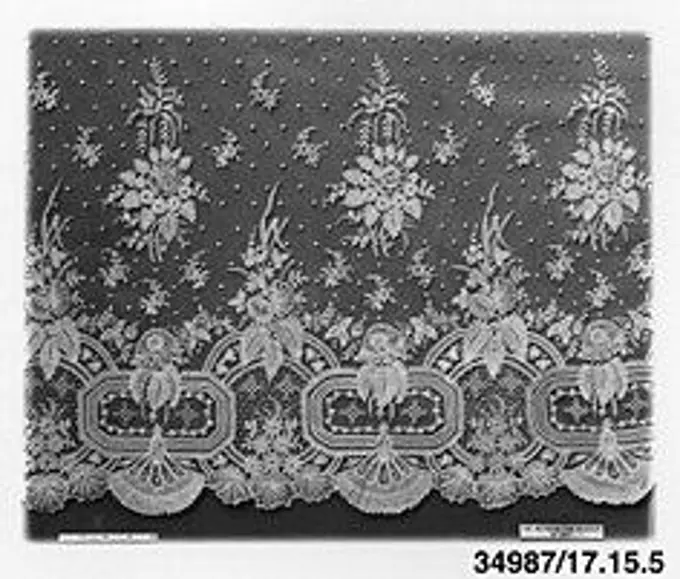
Exquisite Lace Trim Strips

Collection of intricate lace strips featuring various styles like Flemish, Maltese, and Venetian designs, showcasing natural colors and detailed botanical patterns.

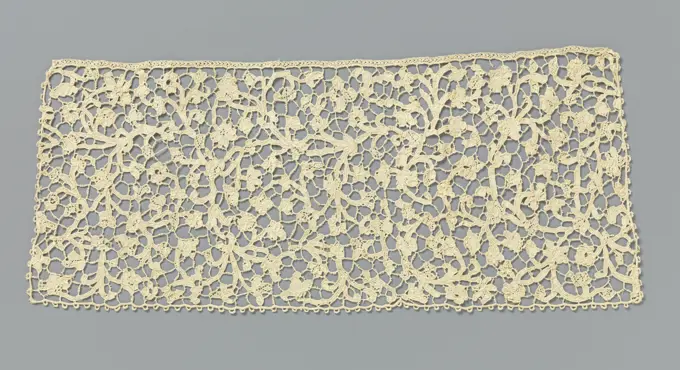
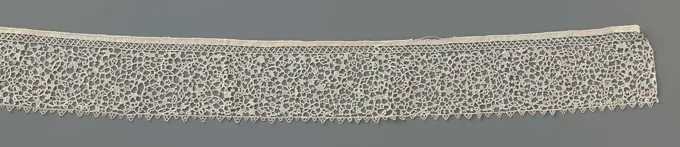
Strip of needle side with plumed tendrils, anonymous, c. 1875 - c. 1895 Strip of natural -colored needle side: Venetian rose side. On a bar of land with six -sided meshes, rich branches, to the left and right, are swiveling and right -wing, sometimes dwelling, sometimes walking. There are multifaceted, carefully detailed button -shaped flowers. Here and there the top of a slender has grown through an opening in the branch. Straight finish of alternately an eye and a triangle. BURANO linen (material) Venetian rose point Strip of natural -colored needle side: Venetian rose side. On a bar of land with six -sided meshes, rich branches, to the left and right, are swiveling and right -wing, sometimes dwelling, sometimes walking. There are multifaceted, carefully detailed button -shaped flowers. Here and there the top of a slender has grown through an opening in the branch. Straight finish of alternately an eye and a triangle. BURANO linen (material) Venetian rose point
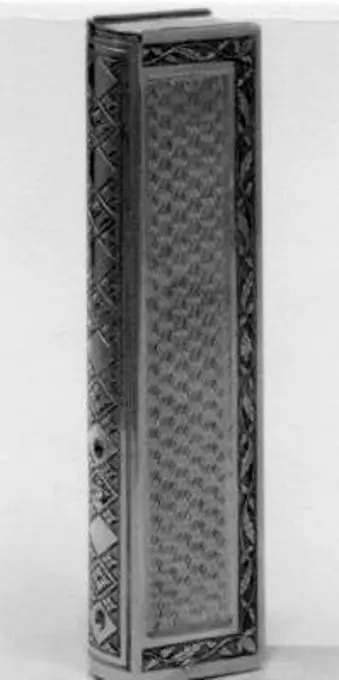
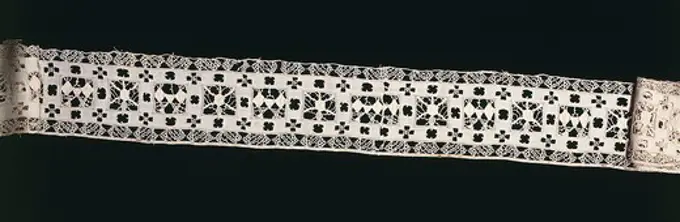
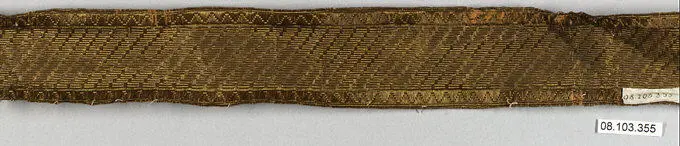
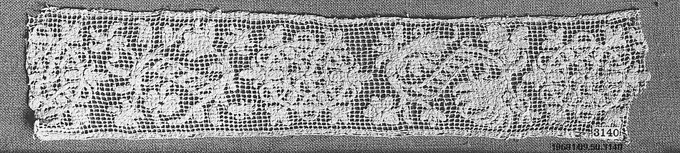
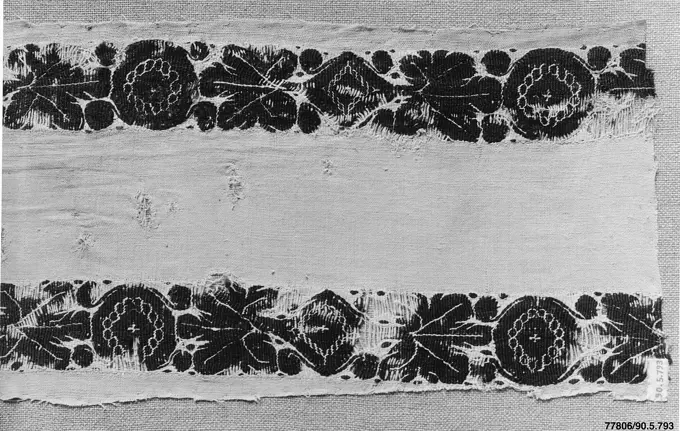
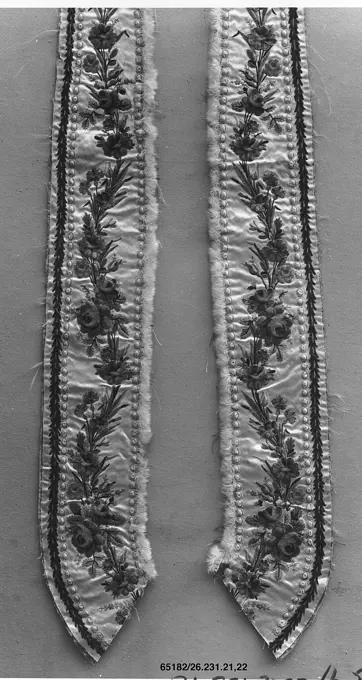
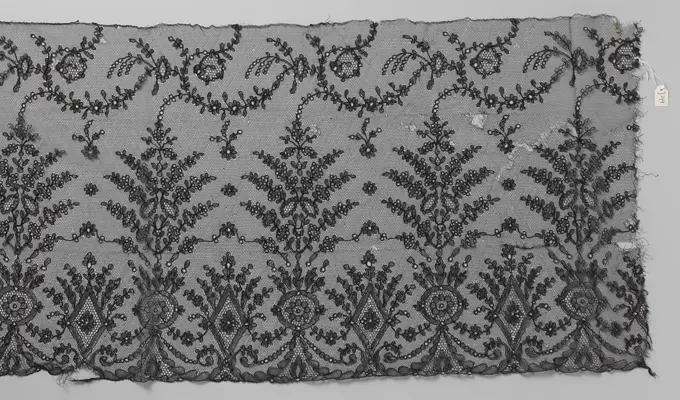
Strip 18th century Flemish. Strip 212854Kloskant strip with thick terres, anonymous, c. 1900 - c. 1924 Strip of natural -colored bobbin: Parisian side. On a square Valenciennes ground is an ongoing pattern of volute vines. In the Voluten a grid filling with coarse spiders. Three fleshy and lobed leaves or flowers that spring from the slender form the flat sculptures. The motifs are made in linen battle with a single recess and with thick contour threads. Gross snowflake grounds have been used as decorative grounds, with ringed and not ringed snowflakes. A decoration with form strokes has been realized in some motives. The top of the strip is straight finished. The silly outskirts of scales along the underside stems from the pattern with the volute bines and is finished with picots. Vadstena (possilly) linen (material) bobbin lace / Paris lace Strip of natural -colored bobbin: Parisian side. On a square Valenciennes ground is an ongoing pattern of volute vines. In the Voluten a grid filling with coarse spiders. Three fleshy aEdge ; medium:Piece 17th century Maltese. Piece. Maltese. 17th century. Bobbin lace. Textiles-LacesStrip of needle side with plumed tendrils, anonymous, c. 1875 - c. 1895 Strip of natural -colored needle side: Venetian rose side. On a bar of land with six -sided meshes, rich branches, to the left and right, are swiveling and right -wing, sometimes dwelling, sometimes walking. There are multifaceted, carefully detailed button -shaped flowers. Here and there the top of a slender has grown through an opening in the branch. Straight finish of alternately an eye and a triangle. BURANO linen (material) Venetian rose point Strip of natural -colored needle side: Venetian rose side. On a bar of land with six -sided meshes, rich branches, to the left and right, are swiveling and right -wing, sometimes dwelling, sometimes walking. There are multifaceted, carefully detailed button -shaped flowers. Here and there the top of a slender has grown through an opening in the branch. Straight finish of alternately an eye and a triangle. BURANO linen (material) Venetian rose pointTextile Panel 18th century. Textile Panel 446868Fragment 17th century German, Holstein. Fragment. German, Holstein. 17th century. Bobbin lace. Textiles-LacesStrip 18th century Flemish. Strip 218239Band (Italy); linenStrip bobbin with two shield -shaped main motifs, anonymous, c. 1700 - c. 1725 Strip of natural-colored bobbin, binche side. The repeating and thin pattern consists of a two different, symmetrical compositions. In both compositions, the main motif is a more or less shield-shaped element, composed of S-Voluutjes, C-Voluutjes and Snowflakes. A characteristic motif along the top are mirrored S-Voluten of feathered leaves, with a snowflake in the middle from which three curved leaves spring on both sides. The motifs are connected by a grid, a five -part ground. The motifs are made in linen battle with openwork edges and in netslag. A few decorative lands have been used, including a snowflake land. The top and bottom of the strip are straight finished, with the bottom with picots. Southern Netherlands linen (material) Bobbi Lace / Binche Lace Strip of natural-colored bobbin, binche side. The repeating and thin pattern consists of a two different, symmetrical compositions. In both compositioFragment of the lace;  18th century (1701-00-00-1800-00-00);Hanging 18th century. Hanging 448580Trimming (Italy); metal-wrapped silk thread, flat metal stripsTextile Fragment 17th century. Textile Fragment. 17th century. Silk on wool. Attributed to Iran. Textiles-EmbroideredBorder early 19th century French. Border 222011Border; linenBorder Made 1601-1700 Italy. .Galloon 18th-19th century French. Galloon. French. 18th-19th century. Metal thread. Textiles-TrimmingsPiece 18th century French. Piece 224344Dass slip with symmetrical pattern of many tendrils with small leaves and flowers, anonymous, c. 1675 - c. 1699 Dassle slip of natural -colored needle side: flat Venetian side. Apparently confused but symmetrical pattern with a vertical axis in the middle from which many curling flower and leaf vines move. The motifs are made with feston stitches, where simple patterns in different flowers and leaves have been realized with recesses. The motifs are connected by a potente soil. The top of the strip is finished with a tie. The underside and two short sides are finished with a bow edge. Venice linen (material) Venetian needlepoint Dassle slip of natural -colored needle side: flat Venetian side. Apparently confused but symmetrical pattern with a vertical axis in the middle from which many curling flower and leaf vines move. The motifs are made with feston stitches, where simple patterns in different flowers and leaves have been realized with recesses. The motifs are connected by a potente Pricked pattern, Medium: Technique: pricked pattern, Dated 1775, 1782, 1784, England. (information written on pattern), late 18th century, lace, Pricked patternPiece 1730-40 French. Piece 220512Strip mixed side with cracked flowers and 'gems' made like flower hearts made with festonated needle side rings, anonymous, c. 1900 - c. 1949 Strip of natural -colored mixed side: paved rosaline. The repeating pattern consists of many curling sling with different types of small and slightly larger flowers. The motifs are fiddled in linen battle with recesses a partly provided with burst relief contours. The flower hearts are equipped with 'gems': founded needle side rings. In the flower hearts of the larger flowers, a cracked decorative soil has been used, a closed pin stroke ground. The top is straight finished with a straight strap. The almost straight underside where the motifs form minimal shells is finished with picots. Belgium linen (material) mixed lace / pearled rosaline Strip of natural -colored mixed side: paved rosaline. The repeating pattern consists of many curling sling with different types of small and slightly larger flowers. The motifs are fiddled in linen battle with Bands; linenMusic Box ca. 1810 Swiss Gold musical toothpick case shaped like a book.. Music Box. Swiss. ca. 1810. Various materials. Switzerland. IdiophoneTrimming (Italy); silk, silver threadStrip 18th century Flemish, Mechlin. Strip. Flemish, Mechlin. 18th century. Bobbin lace. Textiles-LacesEdge, Medium: silk Technique: bobbin lace, Black silk, Du Puy, France (possibly), 19th century, lace, EdgeStrip of lace plunger with pulled threads with rosette flowers on a wavy slender, anonymous, c. 1925 - c. 1933  Strip of natural linen batist in which a square network has been created by work with extended threads. In the network a pattern in linen has been saved from a continuous wavy slender, with a strong curly stem with one rosette flower on it. One long side is unfinished, but a narrow edge has been taken. The other long side is the fringes of the linen. The short sides are not finished. Sicily linen (material)Laces, 16th century. Linen cloth hem, embroidered in cutwork (Punto Tagliato) lace, open stitches and panels, filled in reticella stitch, cm 10,5 high, approximately 1585.Strip of needle side with circles in fine -meshed lower edge, anonymous, c. 1775 - c. 1785 Strip of natural-colored needle side: men's-Aalençon. Pattern of a fine swinging slender with small leaves on a fine hexagonal ground with flooded meshes. The pattern on the underside of the strip consists of two wavy lines between which, among other things, leaf branches and circles with a paddle picot in the center. Feston stitches in (flower) leaves and apart from the rader picots in the circles, no decorative land. Nuance differences are made by applying an even finer hexagonal soil between the wavy lines along the bottom and in a few leaves on the slank. The meshes of this fine soil are not exhausted but turned. Festunned contour lines. The underside is finished with an almost straight edge with delicate picots. The top is trimmed with a border bobbin. Alençon linen (material) Alençon Lace Strip of natural-colored needle side: men's-Aalençon. Pattern of a fine swinging slender with small leaPiece 16th-17th century Italian. Piece 224438End of a tablecloth 15th-16th century Italian, Sicily or Spanish. End of a tablecloth. Italian, Sicily or Spanish. 15th-16th century. Silk on linen. Textiles-EmbroideredBand Made 1501-1700 Italy. Linen, plain weave; embrodered with silk floss in back and long-armed cross stitches .Border 18th century Italian. Border 212274Fragment (Border) Made 1601-1800 Iran. Brocaded plain compound cloth, silk and gold wound on yellow silk core, silver wound on white silk core .Panel Made 1501-1600 Italy. Silk, damask weave .Fragment of a Shoulder Band 5th-6th century. Fragment of a Shoulder Band 443822Piece of needle lace (one of a pair) early 18th century French or Italian. Piece of needle lace (one of a pair). French or Italian. early 18th century. Needle lace. Textiles-LacesBorder 18th century Italian. Border 212273Border, Medium: linen Technique: bobbin lace, Mechlin style, Straight border of Mechlin lace with a design of buds sprinkled over the field, and a border of conventionalized ornament., Belgium, early 19th century, lace, BorderGalloon 17th-18th century Unknown. Galloon 213852Border 17th century Italian. Border 212697Fragment Made 1675-1700 Italy. Silk .Alencon 18th century French. Alencon 218846Border 18th century German. Border. German. 18th century. Embroidered net, punto à rammendo. Textiles-LacesTextile Fragment 4th-5th century. Textile Fragment 445747Strook kloskant met twee besjes aan een takje.On a fond of square meshes are stiff twigs above a closed sculpture, to which two berries grow. A moot is placed between each sprig. Valenciennes side.Valance or frontal 17th century Italian. Valance or frontal. Italian. 17th century. Linen; silk. Textiles-LacesSampler Fragments (England); silk, metal-wrapped silk, linen; 20.5 x 18.5 cm (8 1/16 x 7 5/16 in.); Bequest of Mrs. Henry E. Coe; 1941-69-29Textile Fragment 3rd-4th century. Textile Fragment 443542Fragment. Culture: German. Date: 16th century. Museum: Metropolitan Museum of Art, New York, USA.Fragment (Border) Made 1701-1800 Iran. Brocaded plain compound cloth .Piece 18th century French. Piece 223274Piece early 19th century British, Northamptonshire. Piece 214396Textile Fragment 3rd-4th century. Textile Fragment 444272Needlepoint (Burano Point) Lace Edging, 20th century. Italy, Burano, 20th century. Lace, needlepoint: linen; average: 110.6 x 10.2 cm (43 9/16 x 4 in.).Dress panels (2) 1830-40 French. Dress panels (2). French. 1830-40. Silk on silk. Textiles-EmbroideredStrook naaldkant met serpentines.Strip natural needle side: Flat Venetian side. Irregular open bars soil from short, with cogs-picots occupied bars. Thin intersecting spiral ranks forming a running pattern of serpentines. Straight outline of equal triangles.Lace, 1800s, maker unknown.Textile; silk, metalHeft van een mes, gedecoreerd met bladranken.The decoration consists of a straight middle stalk with small side shoots.Upholstery passementerie second half 18th century Philippe de Lasalle French. Upholstery passementerie. French. second half 18th century. Silk. Textiles-TrimmingsPiece ca. 1760-70 French. Piece 223991Strip bobbin with carnation on curved stem and wide S-shaped leaves, anonymous, c. 1725 - c. 1740 Strip of natural-colored bobbin, binche side. The repeating pattern consists of a large carnation on a bent stem. A smaller lobed flower bends off a side branch in the opposite direction. A faint s-shaped and wide leaf forms the connection to the carnation from the subsequent pattern. The motifs are connected by a decorative land, a snowflake ground. The motifs are made in linen battle with openwork edges. In a space under the carnation, another snowflake land was used as a decorative land. And in the S-shaped leaf a decorative soil with moths similar on snowflakes is used. At the top and bottom are straight finished, with the bottom with picots, which are no longer all intact. Binche linen (material) Bobbi Lace / Binche Lace Strip of natural-colored bobbin, binche side. The repeating pattern consists of a large carnation on a bent stem. A smaller lobed flower bends off a side branch in thJaponstrook van kloskant met cirkeltjes en ruitjes.Japon strip from black climbing side: Chantilly side. On a coarse mesh stock is a closed edge of flat slump, above which symmetrically grouped circular and diamonds, connected by winding, rise. Strabs come from this leaf branches, while above the circles of large feathers from sprigs with rosette flowers. There is an airy, asymmetrical garland.Strip 18th century Italian. Strip 215509Strip of bobbin with fan -shaped shells, anonymous, c. 1600 - c. 1649 Strip of natural -colored bobbin. The pattern consists of fan -shaped shells hanging on a straight edge consisting of bundled braids. A thick thread has been worked. The top is finished with a straight edge with small dots. Southern Netherlands linen (material) bobbin lace Strip of natural -colored bobbin. The pattern consists of fan -shaped shells hanging on a straight edge consisting of bundled braids. A thick thread has been worked. The top is finished with a straight edge with small dots. Southern Netherlands linen (material) bobbin lacePiece 18th century French. Piece 220549Strip Flemish, Wallonia 19th centuryPiece 19th century Japan. Piece 67957Piece 17th-18th century Spanish. Piece 213202Bed curtain 18th century Greek Islands, Cyclades, Pholegandros. Bed curtain 222542Fragment 16th century Italian. Fragment 230589Fragment (Dress Fabric) Made 1801-1900 Iran. Brocaded plain cloth in silk and gold wound on an orange silk core .Stole 16th century Italian, Venice. Stole 219892Ornament from the spine of a book. Ruszczyc, Ferdynand (1870-1936), draughtsman, cartoonistFringe, Medium: silk Technique: woven, Green and tan fringe with a patterned heading and skirt threads arranged to form colored stripes., Italy, 17th century, trimmings, FringeTextile Sample from Sample Book 19th century Japan. Textile Sample from Sample Book 68199Trimming (Spain); gold metallic foil and gold metallic foil wound onto yellow silkBoetticher Carl (1806-1889), various decorations, fabrics, wallpaper (without date): Detail. Tusche watercolor on paper, 5.5 x 36.3 cm (including scan edges) Boetticher Carl  (1806-1889): Verschiedene Dekorationen, Stoffe, TapetenGalloon 18th century French. Galloon 213821Fragment (Italy); linenStrip bobbin with strong winding flower vines with one flower on it, anonymous, c. 1685 - c. 1699 Strip of natural -colored bobbin, Old Flemish side. The repeating pattern consists of a succession of strong and irregularly winding tendrils with one flower on it. The circumference of the flowers, just like the tendrils, is formed by a winding ribbon, it concerns two palm -shaped flowers and a circular flour with faintly lumped edges. There is hardly any soil. The motives are made in linen battle with recesses. Various decorative lands have been used in the tiflens and flower hearts, including mains fillings and five -hour ground. Leaves made in shape are used in a few places, including in the heart of the circular flowers. The top and bottom are straight finished, with picots on one side. Antwerp (possibly) linen (material) bobbin lace / old Flemish lace Strip of natural -colored bobbin, Old Flemish side. The repeating pattern consists of a succession of strong and irregularly winding tChasuble. Italy. Date: 1475-1500. Dimensions: 97 x 73 cm (38 1/4 x 28 3/4 in.). Silk, warp-float faced 4:1 satin weave with supplementary pile warps forming cut voided velvet; Orphrey: silk, plain weave with supplementary patterning warps; edged with gilt-metal strip and gilt-metal-strip-wrapped linen, plain weaves self-patterned by main warp floats. Origin: Italy. Museum: The Chicago Art Institute, Chicago, USA.Border 18th century possibly Spanish. Border 227610Bobbin Lace Edging, 18th century. Belgium, Mechelen, 18th century. Lace, bobbin: linen; average: 6.7 x 50.2 cm (2 5/8 x 19 3/4 in.).Border 17th century Italian, Milan. Border. Italian, Milan. 17th century. Bobbin lace, Milanese lace. Textiles-LacesFragment of lace. unknown, authorSampler 18th century Italian. Sampler 228025Piece 1730-40 Italian or French. Piece 217867Pleated fan and case, Ernest Kees Fabrique d'Eventail, (Paris, France), Painted and embroidered silk leaf, pierced, engraved and gilded horn sticks, Pleated fan, leaf of cream-colored silk painted on the obverse with a scene in a medallion of an interior with a man and girl dancing, with three women at left watching, all in Empire costume; a tripod at right and open door at back showing a landscape. Border at top and sides of leaf, green, with gold and brown rinceaux, central mascaron ornament, and festoons of roses and gilt 8-point sequins. Reverse decorated with gold eagle on blue-green ground in gold frame, border on leaf painted with gold scroll design. Top of leaf sewn with gold loop edging. Guards and sticks of horn with scalloped outline, pierced, obverse engraved, gilded and decorated with steel piques., France, late 19th-early 20th century, costume & accessories, Pleated fan and caseBand 4th-5th century. Band 445741Piece 19th century Japan. Piece 72154Flounce ca. 1860 Belgian, Brussels. Flounce 219876Garter with silver buckle, Before 1887 Garter with silver buckle. Louis XV. West-Europa Buckle: Silver (Metal). Garter: Silk Garter with silver buckle. Louis XV. West-Europa Buckle: Silver (Metal). Garter: SilkPiece possibly Spanish 1700-1705Fragment, 1100s - 1300s. India, 12th-14th century. Plain cloth, resist dyed; cotton; overall: 11.8 x 29.6 cm (4 5/8 x 11 5/8 in.).Piece 18th century Flemish. Piece 214486Needlepoint (Drawnwork) Lace Band, 16th-17th century. Italy, Sicily, 16th-17th century. Lace, needlepoint: linen; average: 8.3 x 156.2 cm (3 1/4 x 61 1/2 in.).