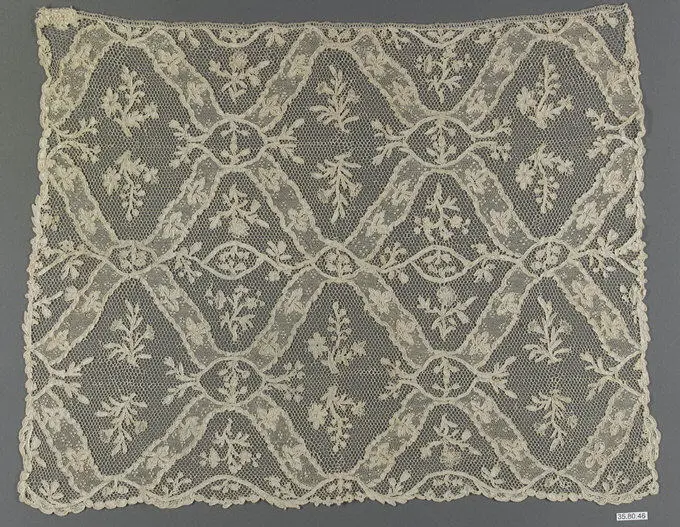
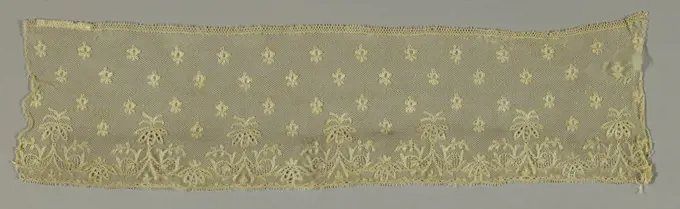
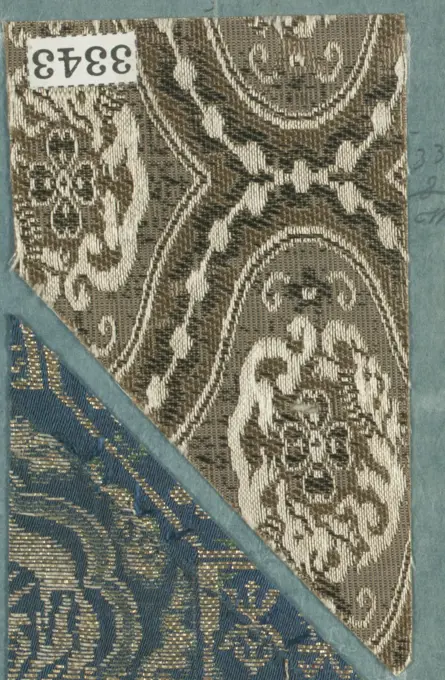
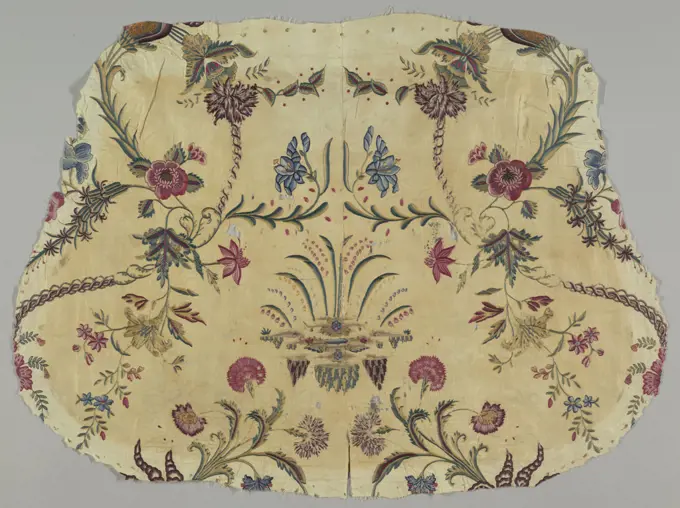
Floral Silk Fragments

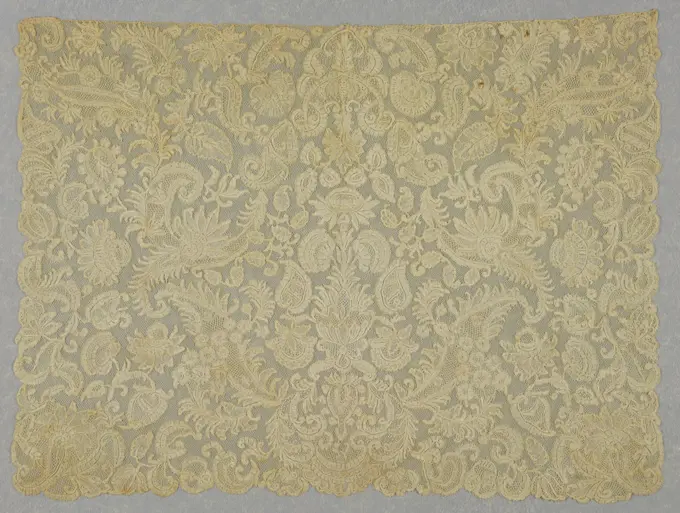
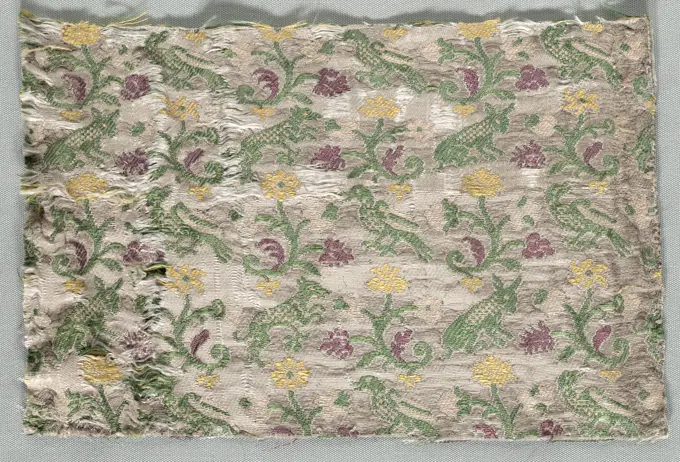
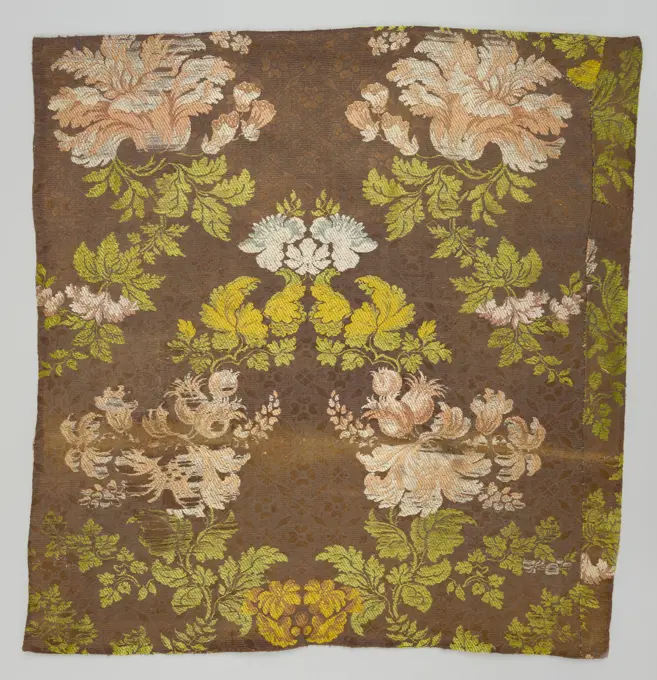
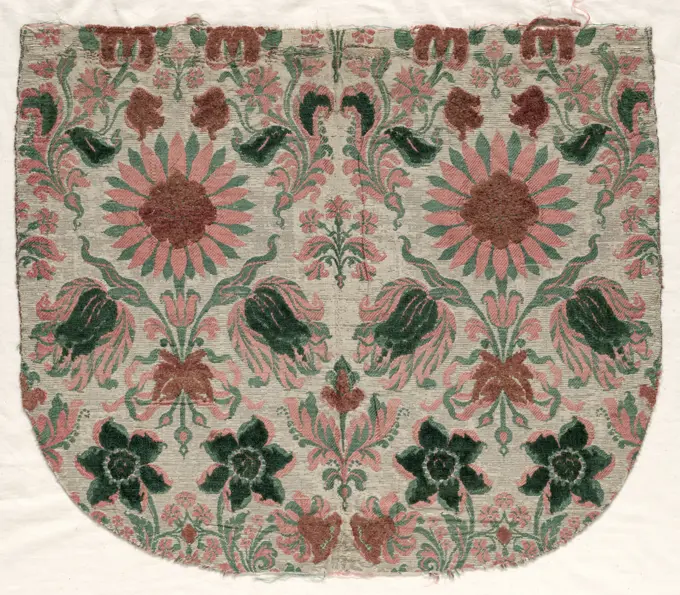
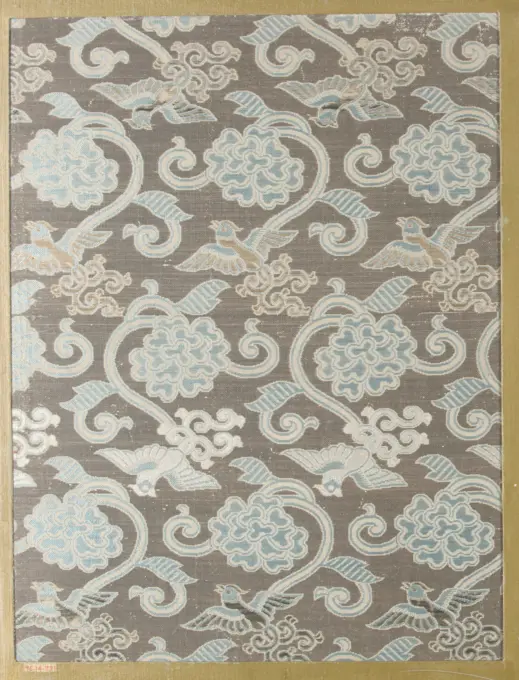
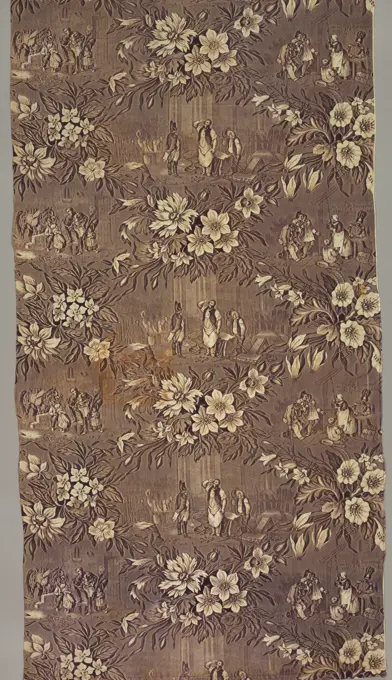
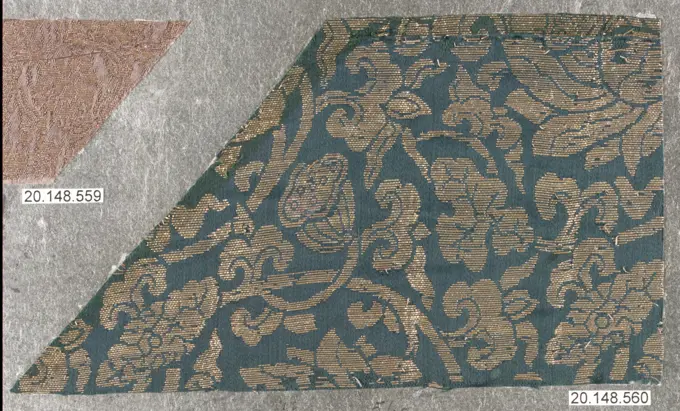
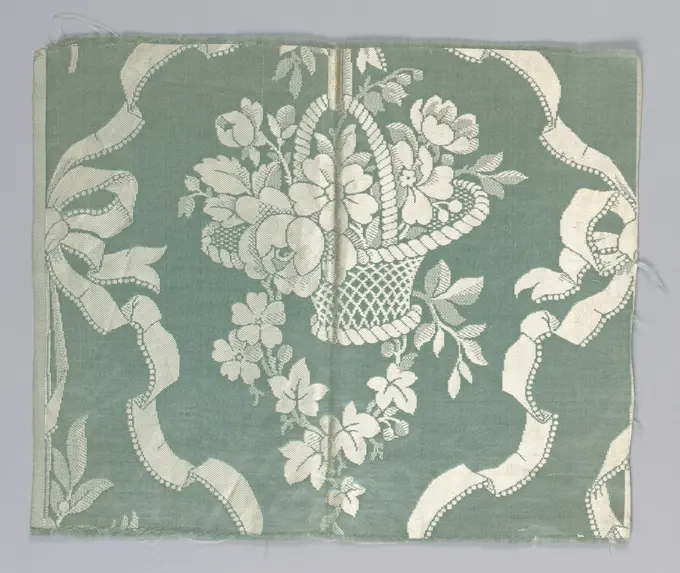
Fragments of elaborate floral brocade and silk textiles from the 18th century featuring detailed floral motifs on rich backgrounds.
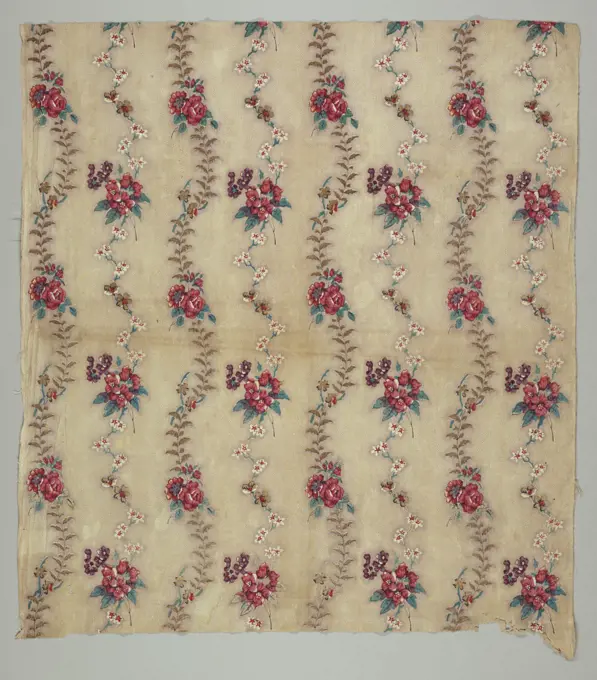
Textile, Medium: cotton Technique: block printed on plain weave printed by engraved roller on plain weave, Panel of cream white cotton, with block-printed design in perpendicular arrangement. Delicate ascending vine with clusters of small flowers, naturalistically drawn in shades of red, violet, blue and yellow drab; small flowers in pure white probably by discharge. Fine picotage in dark brown around the vines and blossoms. Left selvages present., early 19th century, printed, dyed & painted textiles, Textile
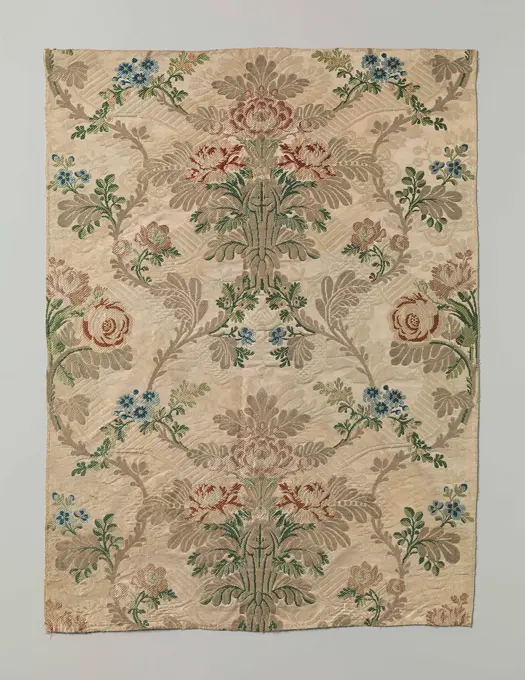
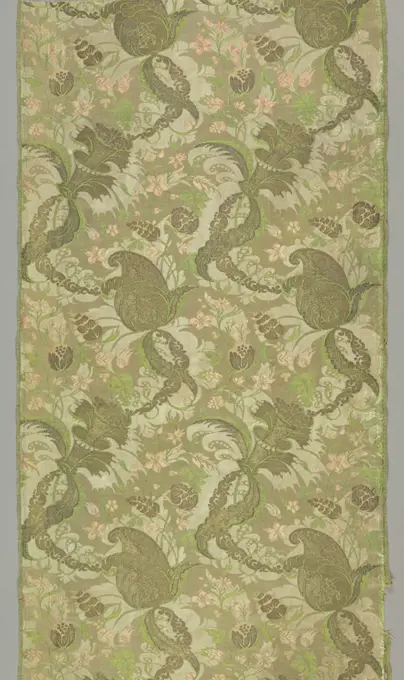
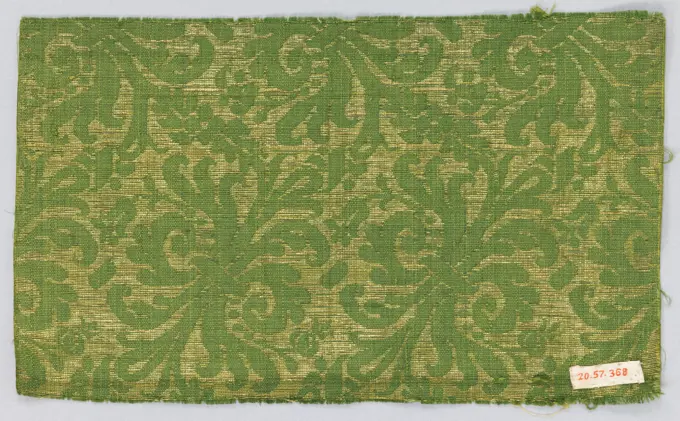
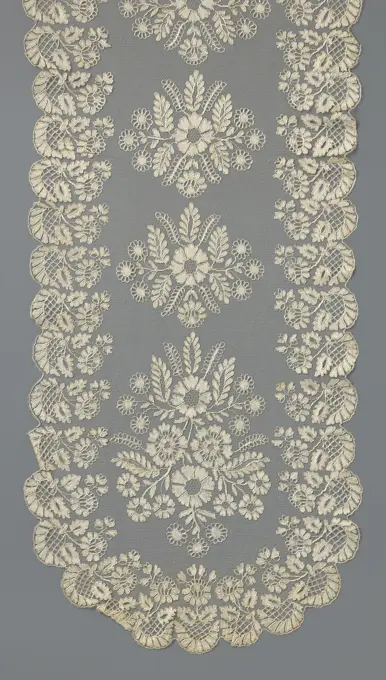
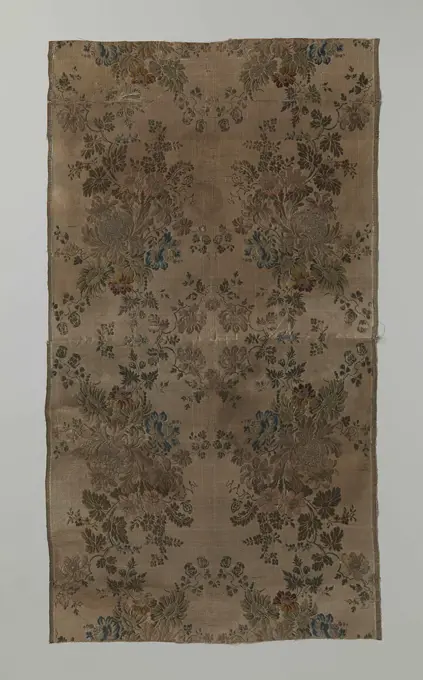
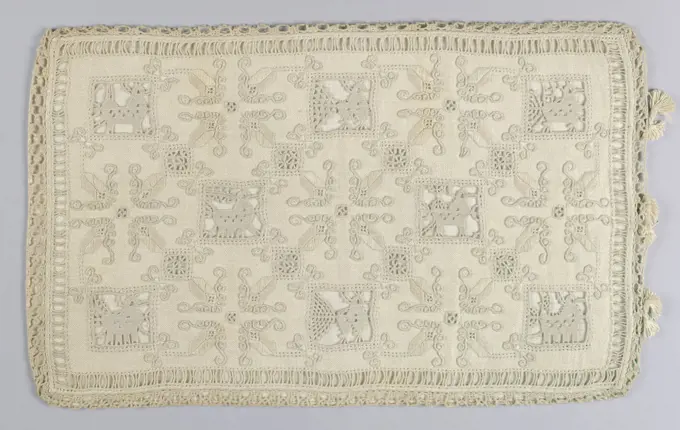
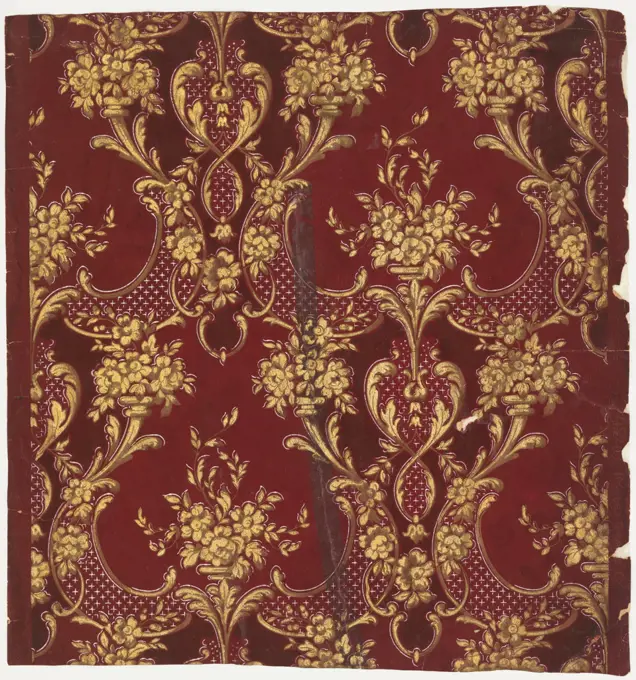
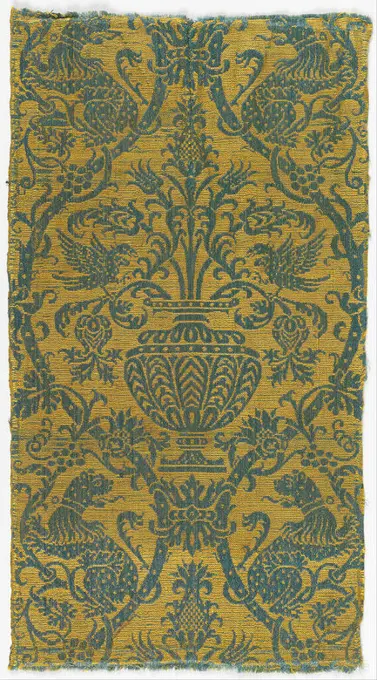
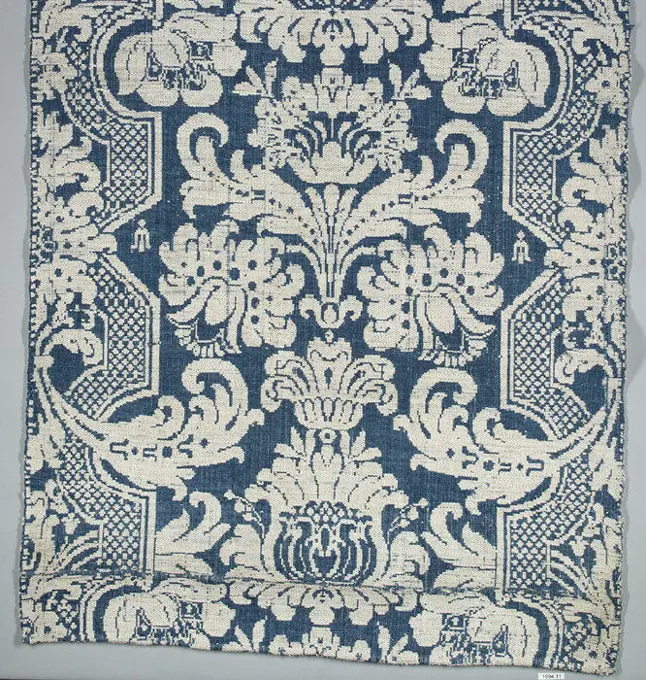
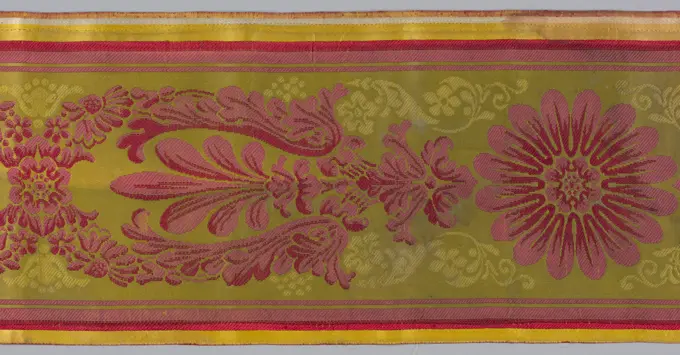
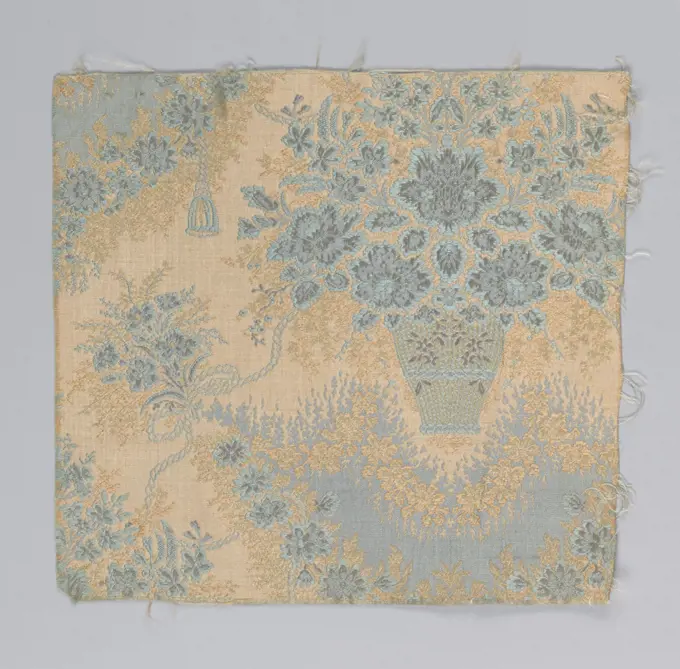
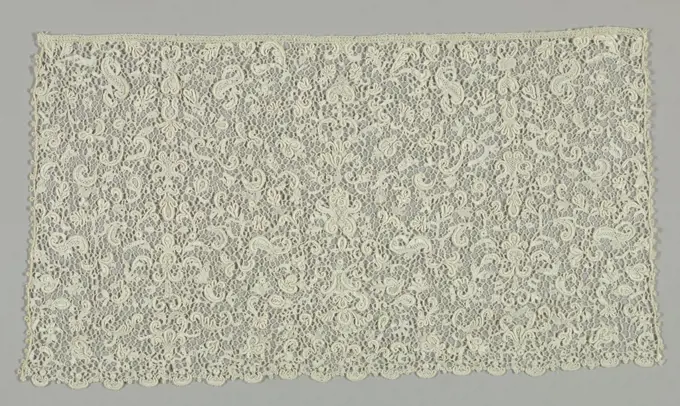
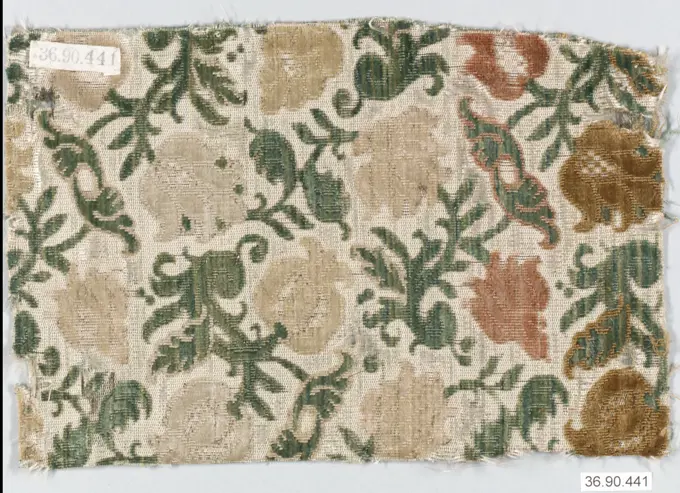
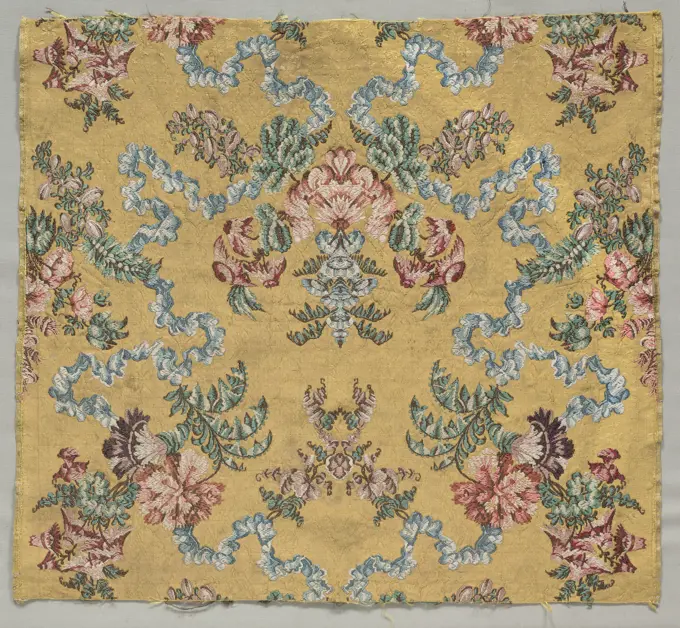
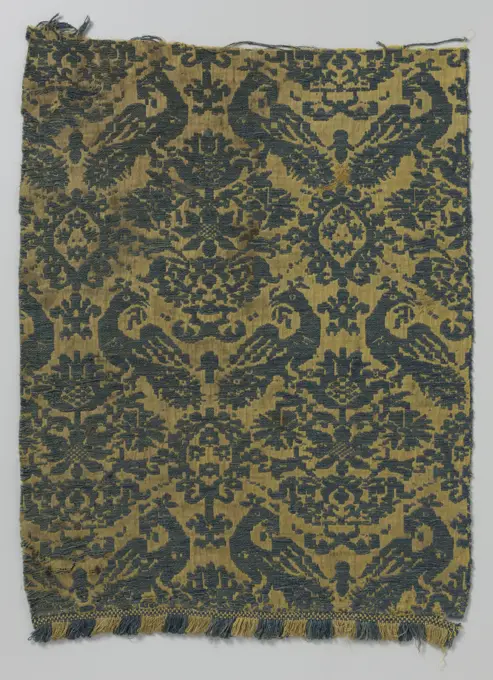
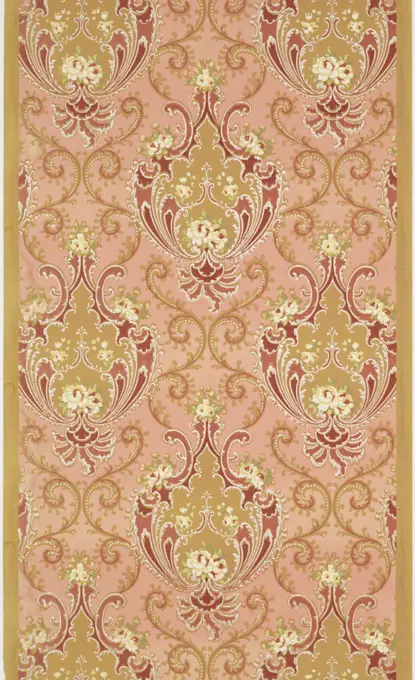
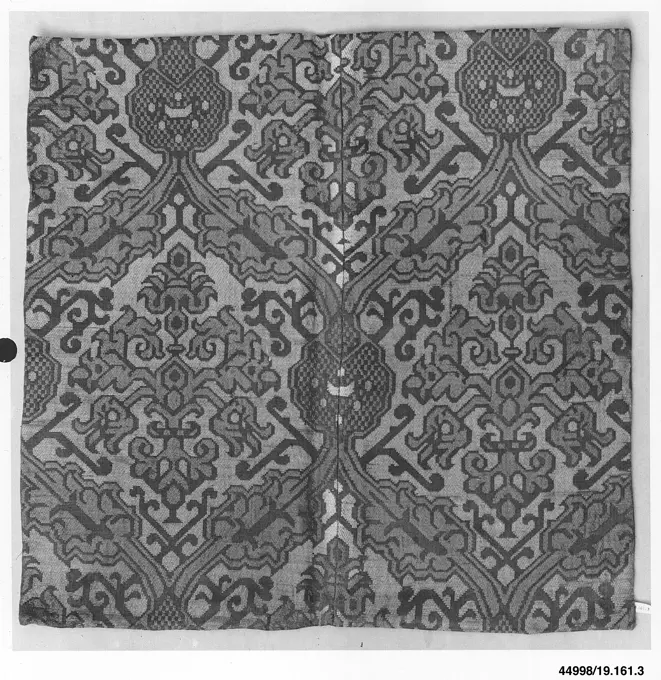
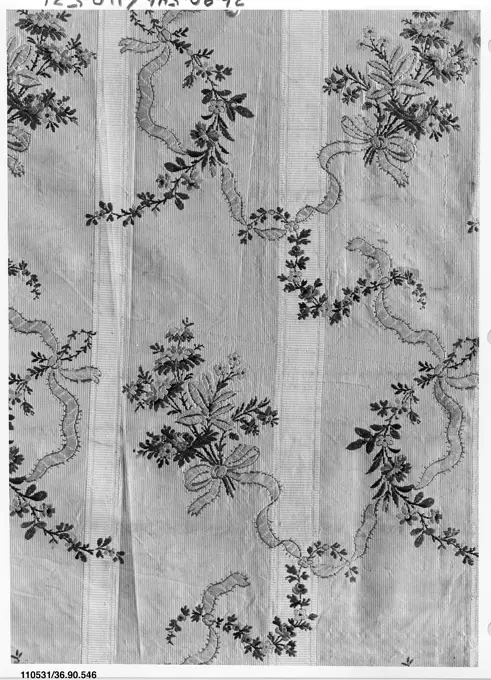
Length of Silk Brocade, 1774-1793. France, 18th century, Period of Louis XVI (1774-1793). Brocade, silk; overall: 87.6 x 54.6 cm (34 1/2 x 21 1/2 in.).Fragment multicolored brochure silk, 1700 - 1800 Fragment multicolored silk tissue. The beige soil has a multicolored pattern of a vase-like ornament from which leaves and flowers come, connected by winding flower branches and flower and leaf vines.  silk damask Fragment multicolored silk tissue. The beige soil has a multicolored pattern of a vase-like ornament from which leaves and flowers come, connected by winding flower branches and flower and leaf vines.  silk damaskFragment; silk, metallic yarnsTextile, Medium: silk, linen Technique: 5-harness satin damask, Damask with a vertically symmetrical pattern of two offset floral forms enclosed with a flowering branch forming a grid. Off-white pattern on a satin striped background of rose, pink, green and violet., ca. 1750, woven textiles, TextileFragment multicolored brochure side. Fragment multicolor silk tissue. The beige ground has a multicolored pattern of a vase-like ornament from which leaves and flowers come, connected by winding flower branches and flower and leaf refines.Textile, Medium: cotton Technique: block printed on plain weave printed by engraved roller on plain weave, Panel of cream white cotton, with block-printed design in perpendicular arrangement. Delicate ascending vine with clusters of small flowers, naturalistically drawn in shades of red, violet, blue and yellow drab; small flowers in pure white probably by discharge. Fine picotage in dark brown around the vines and blossoms. Left selvages present., early 19th century, printed, dyed & painted textiles, TextilePart of a wall fence of yellow silk daamast with flower design ,, 1700 - 1725 Part of a wall extension of yellow Zijddamast whose stock is woven in satin binding. Dessin: Symmetrical structure of two rising wavy flower and leaf vines that frame large peony-shaped flowers with a scaly heart. At the rear, along the upper and right edge a strip of upholstery with a few nails. NOTE: The fabric is part of the parts of the wall covering that were purchased in 1954 at the A. Mak auction in Dordrecht. The wall covering comes from the Voorstraat 140 building, Dordrecht. France silk. linen (material) damask Part of a wall extension of yellow Zijddamast whose stock is woven in satin binding. Dessin: Symmetrical structure of two rising wavy flower and leaf vines that frame large peony-shaped flowers with a scaly heart. At the rear, along the upper and right edge a strip of upholstery with a few nails. NOTE: The fabric is part of the parts of the wall covering that were purchased in 1954 at the A. Fragment, Medium: silk Technique: 5-harness satin damask, One rose-tan repeat of a symmetrical pattern (mirror image on the center line) of superimposed ogee trellis with leaves, fruit and acorns., Italy or Spain, 17th century, woven textiles, FragmentPiece 18th-19th century Japan. Piece. Japan. 18th-19th century. Silk. Edo (1615-1868). Textiles-WovenTextile, Medium: silk, metallic yarns Technique: damask weave with supplementary weft patterning (brocade), Tan colored silk damask brocaded in green and pink silk with metallic yarns. Brocading bound in twill by warps. Design in the bizarre’ style shows a pattern of large florals with serpentine chains composed of scrolls. Both selvages persent., France, late 17th-early 18th century, woven textiles, TextileFragment fabric. Fragment with red-brown fond decoration of stylized sperm dumplings and flowers.Textile Fragment, 20th century. England, 20th century. Plain weave cotton, printed; overall: 125.7 x 128.9 cm (49 1/2 x 50 3/4 in.).Textile (France); cottonPiece 17th century Italian. Piece. Italian. 17th century. Silk and metal thread. Textiles-WovenPanel (Dress Fabric). Iran. Date: 1601-1700. Dimensions: 66.4 × 32.4 cm (26 1/8 × 12 3/4 in.). Silk, 2:1 twill weave, with complementary weft plain weave double cloth. Origin: Iran. Museum: The Chicago Art Institute, Chicago, USA.Fragment of embroidery of a womans dress unknownFragments; silk and metallic threadKloskant stola with symmetrical floral motifs and tube rand.stola of natural colosside: blonde. Scalloped edge of large leaves with a flower branch above. Symmetrical pattern in midfield, with five symmetrical flower and leaf motifs on the weather side of central flower and leaf motif that is comparable but slightly larger. The sixth and largest flower and leaf motif from the center, at the two ends, is symmetrical about the length axis. The motifs are largely made in linen stroke and power stroke and are fitted with shiny contour wires. The motifs are connected by a grille, a toel. In different flowers, an ornamental soil has been applied and has provided a grid with contour wires. The sloping edge with semicircular shelters rondon the stole, are finished with picots.Cravat end, Medium: linen Technique: bobbin lace, Brussels lace, Brussels-style cravat with a central, urn-shaped motif composed and surrounded by symmetrically arranged floral and foliated forms., Belgium, 1700-1750, lace, Cravat endTextile Fragment, 1600s. Italy, 17th century. Silk lampas; overall: 15 x 23 cm (5 7/8 x 9 1/16 in.).Fragment of silk fabric  flower pattern unknownPillowcase. Culture: British. Dimensions: L. 29 x W. 18 inches (73.7 x 45.7 cm). Date: ca. 1700. Museum: Metropolitan Museum of Art, New York, USA.Chaperon (Hood), late 17th century. Spain, late 17th century. Silk and metal threads; overall: 45 x 52.7 cm (17 11/16 x 20 3/4 in.).Piece 18th-19th century Japan. Piece 66455Fragments of decorative fabrics sewn together unknownPiece mid-18th century French. Piece 223176Eastern embroidered fabric unknownTextile, Military scenes; France; cotton; Warp x Weft: 161 x 77.5 cm (5 ft. 3 3/8 in. x 30 1/2 in.) Repeat H: 38.5 cm (15 3/16 in.); Bequest of Elinor Merrell; 1995-50-177Fragment silk tissue. Fragment écru silk with pattern in blue from a few large flowers and leaves.Piece 18th-19th century Japan. Piece 67001Fragment Silk Lampas in dark brown, white and green with multicolored pattern of pomegranate in bouquet shape with all kinds of diamond shape around it, anonymous, c. 1725 - c. 1750 Fragment Silk Lampas, with a dark brown and white order that alternately serve as a long distance. Impulse of white and green, while the fabric is shot with red, white and blue silk and silver thread. Pattern consists of a flowering pomegranate in bouquet form around which a diamond-shaped wreath of flower branches surrounded by a wavy wide strap of S-shaped figures between which large and small flowers and leaves. Two parts sewn. Netherlands silk lampas (textile material) Fragment Silk Lampas, with a dark brown and white order that alternately serve as a long distance. Impulse of white and green, while the fabric is shot with red, white and blue silk and silver thread. Pattern consists of a flowering pomegranate in bouquet form around which a diamond-shaped wreath of flower branches surrounded by a wavy wiPiece 18th-19th century Japan. Piece 66258Sidewall, Fleur de Lys; USA; embossed; 52.5 x 58 cm (20 11/16 x 22 13/16 in.)Piece 18th century China. Piece. China. 18th century. Silk / Compound weave. Qing dynasty (1644-1911). Textiles-WovenChintz Fragments (India); cottonPiece ca. 1830 British. Piece. British. ca. 1830. Cotton. Textiles-PrintedFragment, Medium: silk, metallic thread Technique: cut supplementary warp pile (velvet) in a twill foundation, Fragment of 'velours miniatures' with oval flower wreaths framing a uniformed man in profile. Background has thin green cut velvet stripes that alternate with off-white stripes shot with silver threads., France, late 18th century, woven textiles, FragmentPiece 18th century Japan. Piece 71554Textile (France); silkSample (USA); Manufactured by Orinoka Mills (United States); 1989-80-69Fragment, Medium: silk, silver thread Technique: silk grosgrain brocaded with silver, Blue-green grosgrain with silver brocaded design of looping and interlacing serpentine ribbon and lace. Floral sprays caught in serpentine. Five complete and one incomplete width sewed together., France, late 18th century, woven textiles, FragmentPiece 18th-19th century Japan. Piece 66543Trimming, Medium: silk, Gold-colored border with Empire design in red., early 19th century, trimmings, TrimmingFragment 16th-17th century Italian. Fragment 230682Fragments; silkFragment Made 1701-1800 China. Fancy simple satin, silk. .Veelkleurig zijdeweefsel.Four fragments of a silk tissue. Loose asymmetrical bouquets on a light beige fond. With Saumon, Blue, Yellow And Red Colored Flowers. Two jobs leaned together. Somewhat damaged. Note: Selling; 0.6 cm, plain bond.Pillow cover, Medium: linen Technique: cutwork, embroidery, Cutwork pillow cover with squares containing an alternate arrangment of birds and geometric flowers., USA, ca. 1910, embroidery & stitching, Pillow coverTextile (France); cottonFragment, 1700s. Iran, 18th century. Brocade; silk and metal; overall: 28 x 32.1 cm (11 x 12 5/8 in.).Sampler 19th century Spanish. Sampler. Spanish. 19th century. Wool on cotton. Textiles-EmbroideredSidewall, Robert Graves Co., New York, New York, Machine-printed paper, On red patterned ground, metallic gold, red and white motif alternating in vertical columns; gold floral bouquets in tripartite formation rest on short pedestals., USA, 1905-1915, Wallcoverings, SidewallFragment. Date/Period: 17th century. Fragment. Medium: silk, linen. Technique: two integrated structures, 4&1 satin plus plain weave (brocatelle). Author: UNKNOWN.Kosode (Robe) Made 1701-1725 Japan. Silk, plain weave; resist dyed and painted .Two Lengths of Silk Damask, 1600s. Italy, 17th century. Damask, silk; average: 49.8 x 58.5 cm (19 5/8 x 23 1/16 in.).Napkin with a flower pattern, anonymous, 1625  Linnamast napkin with flower pattern. Midfield: loose tulips, daffodils, carnations, etc. Standing edges: flowers placed above each other, including tiger lily; Outside of a narrow block of blocks. Lying edge above: Cartouche with rolling work in which the inscription Gheleyn Havweel 1625. Lying edge below: Cartouche with rolling work within which the inscription Margriete Canel. Corners: Circle within which four flower skins. Flanders (Possible) linen (material) damaskLength ca. 1700 French, Abbeville. Length 229999Scarf, Medium: silk, metallic thread Technique: tambour embroidery on voile, Sheer white voile scarf embroidery in tambour work with gold. Design of floral motifs, star and crescent and conventionalized Arabic script. Worn with harem costume., Near East, late 19th century, embroidery & stitching, ScarfTrimming; silk; 1950-140-40-aFragment; silk; Bequest of Richard Cranch Greenleaf in memory of his mother, Adeline Emma Greenleaf; 1962-56-64-e/gPiece 18th-19th century Japan. Piece 67575Textile, Medium: cotton Technique: copperplate printed, England, late 18th-early 19th century, printed, dyed & painted textiles, TextileSidewall, Block printed on joined sheets, Floral stripes with alternating thin and thick bands. Thick bands contains alternating water mills and floral designs. Printed in varnished green, red and white on gray ground., USA, ca. 1800, Wallcoverings, SidewallSamples, Orinoka Mills, (Philadelphia, Pennsylvania, USA), a. pink ground with floral motif, b. tan ground with blue floral motif, USA, ca. 1910, woven textiles, SamplesCravat end, Medium: linen Technique: needle lace, Ruffle of dense symmetrical foliage with three dimensional details. 'Point de France, favorite of Louis XIV', France, 17th century, lace, Cravat endPiece 16th-17th century Italian. Piece 223543Textile (England); cottonLength of Brocaded Silk, 1723-1774. Style of Jean Baptiste Pillement (French, 1728-1808). Brocade on tabby; silk; overall: 49.1 x 53.5 cm (19 5/16 x 21 1/16 in.).Fragment (Northern France); cotton; Warp x Weft: 66 x 55 cm (26 x 21 5/8 in.) Repeat H: 27.5 cm (10 13/16 in.); Bequest of Elinor Merrell; 1995-50-245Panel (Furnishing Fabric) Made 1850-1900 China. brocade .Covering on the cup unknownCravat 18th century French. Cravat 223049Bedcover, Medium: linen, silk Technique: satin and stem stitch embroidery, Large bedcover of cream-colored linen embroidered in light yellow, yellow-green, blue, rose and white silk. The design is laid out in a central panel with a narrow border at the edge. Central panel has a design in natural scale of symmetrically arranged curving vines ending with flower heads, carnations, tulips, and lilies with occasional birds in the foliage. Borders have a vine pattern., Spain, 18th century, embroidery & stitching, BedcoverBorder, Medium: linen Technique: bobbin lace, Mechlin style, Straight border of Mechlin lace with a design of buds sprinkled over the field, and a border of conventionalized ornament., Belgium, early 19th century, lace, BorderFragment 16th century Italian. Fragment 230181Fragment; silk, metallic threadTextile Sample in Sample Book 19th century Japan. Textile Sample in Sample Book 67978Fragment of a multi-colored silk satin. A fragment of a silk tissue. Branches with yellow flowers on a blue satin ground.Piece 1670-90 Italian. Piece 228811Piece ca. 1730 Italian. Piece 217248Leather (Holland); stamped leather, silvered, varnished, and painted; L x W: 32.1 × 54 cm (12 5/8 × 21 1/4 in.); 1913-34-14Seat covers, Medium: cotton, silk Technique: chain stitch embroidery on fancy twill weave, Matching chair seat covers of fine undyed fancy cloth with tiny allover diamond diaper pattern. Hand seamed down the center and embroidered in fine multicolored silk with medium-scale varied flowering sprays that are highly detailed. Design is symmetrical around a central conventionalized pool with blade-like leaves and rows of drooping buds rising behind it and foliage extending down from it. Export style embroidery., India, ca. 1700, embroidery & stitching, Seat coversTextile; silk on silkSampler 18th century Spanish. Sampler 228536Piece 1700-1800 British, probably. Piece 13799Fragments; silkFragment, Medium: silk Technique: cut and uncut voided supplementary warp pile (velvet) in a twill foundation, Border fragment of cut and uncut pile with a central pattern of a dark brown interlacing vine and rosette pattern. Teal blue guard borders enclose stylized flower heads of dark yellow., Italy, 16th century, woven textiles, FragmentTextile; Manufactured by Schwartz-Huguenin; cottonTextile (France); silk, metallic thread; Anonymous bequest in memory of Albert and Rebecca Elsberg; 1938-82-126-dFragment zijdeweefsel, anonymous, c. 1600 - c. 1650 Fragment of blue and yellow side with a retiring pattern of peacocks with head -stuck to each other, interspersed by small trees and flower baskets. Fragment on the bottom of the bottom with passion with frills. Northern Germany Ketting an element: Silk. Entry: Cotton (Textile) Fragment of blue and yellow side with a retiring pattern of peacocks with head -stuck to each other, interspersed by small trees and flower baskets. Fragment on the bottom of the bottom with passion with frills. Northern Germany Ketting an element: Silk. Entry: Cotton (Textile)Sidewall, Alfred Peats Company, Machine-printed paper, ungrounded, liquid mica, Large-scale floral and scroll medallions. Each medallion is printed in shades of pink and contains multiple small white flowers. The background is pink printed on a deep tan ground., USA, 1905-1915, Wallcoverings, SidewallFragment late 16th century Spanish. Fragment. Spanish. late 16th century. Silk. Textiles-WovenSampler; wool and cottonPiece 1735-45 French. Piece 217218Ceiling Paper (USA); Manufactured by Robert Graves Co. (United States); machine-printed paper, liquid mica; 81.5 x 49 cm (32 1/16 x 19 5/16 in.)Textile (England); cottonBatist scarf, embroidered in white with sunflowers along the edges, anonymous, c. 1800 - c. 1820 Batist scarf with thick white embroidery; edges of sunflowers. Netherlands (possibly) batiste Batist scarf with thick white embroidery; edges of sunflowers. Netherlands (possibly) batisteSquare, Medium: Technique: block printed, Square kerchief with brown ground and a border with large roses and other smaller flowers in blue, yellow and red., France, 19th century, printed, dyed & painted textiles, SquarePiece 18th-19th century Japan. Piece 65856Piece late 18th century French. Piece 223648