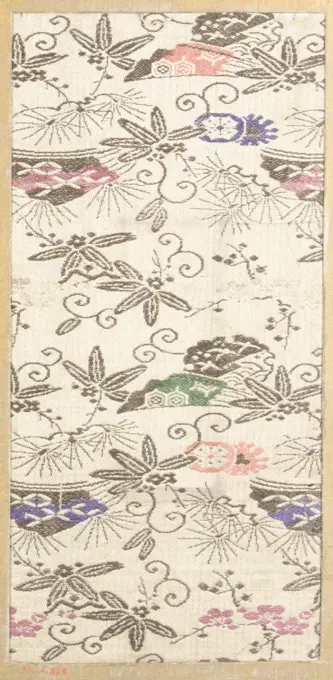
Floral Silk Fragments

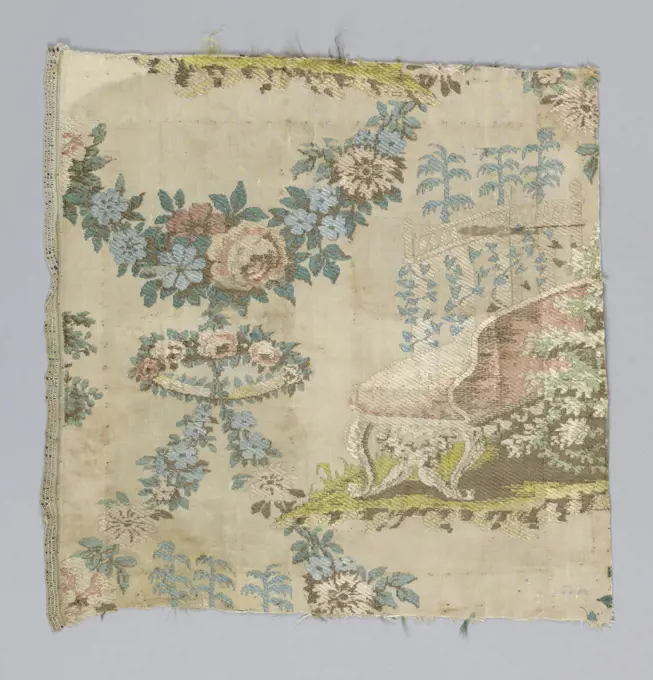
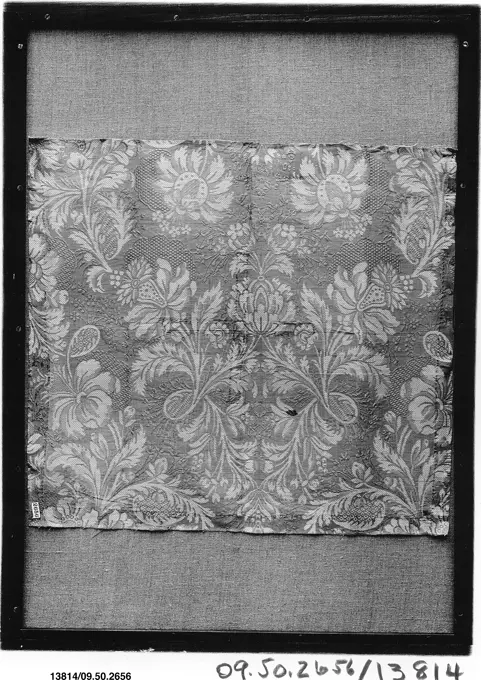
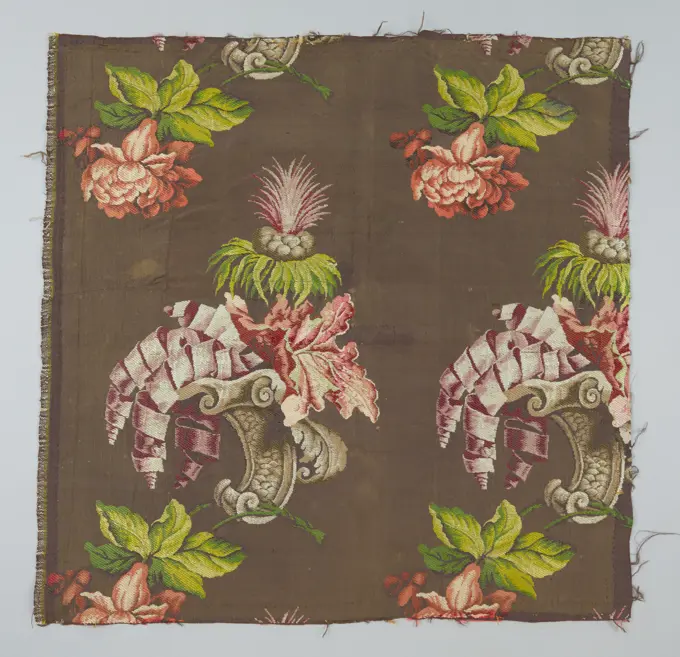
Fragments of elaborate floral brocade and silk textiles from the 18th century featuring detailed floral motifs on rich backgrounds.
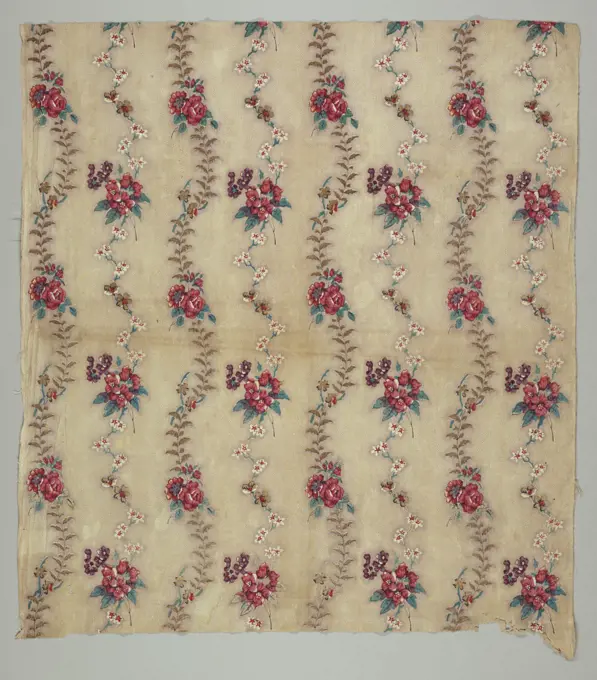
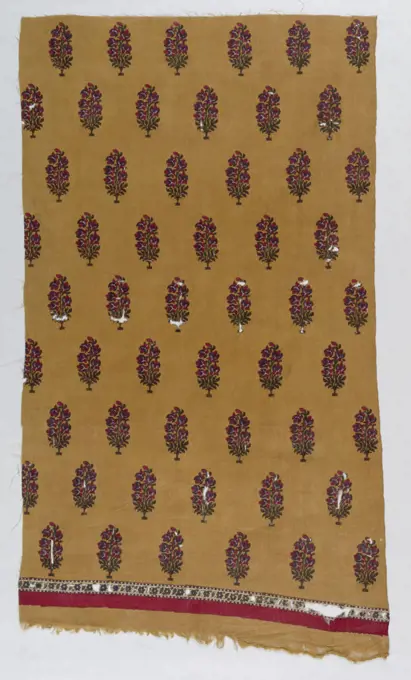
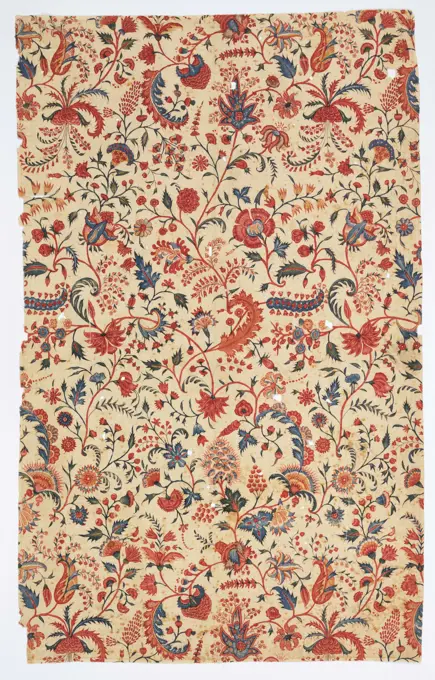
Textile, Medium: cotton Technique: block printed on plain weave printed by engraved roller on plain weave, Panel of cream white cotton, with block-printed design in perpendicular arrangement. Delicate ascending vine with clusters of small flowers, naturalistically drawn in shades of red, violet, blue and yellow drab; small flowers in pure white probably by discharge. Fine picotage in dark brown around the vines and blossoms. Left selvages present., early 19th century, printed, dyed & painted textiles, Textile
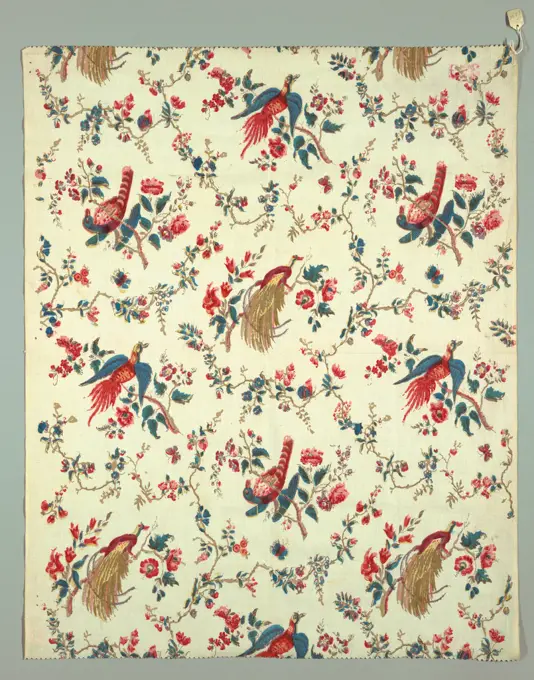
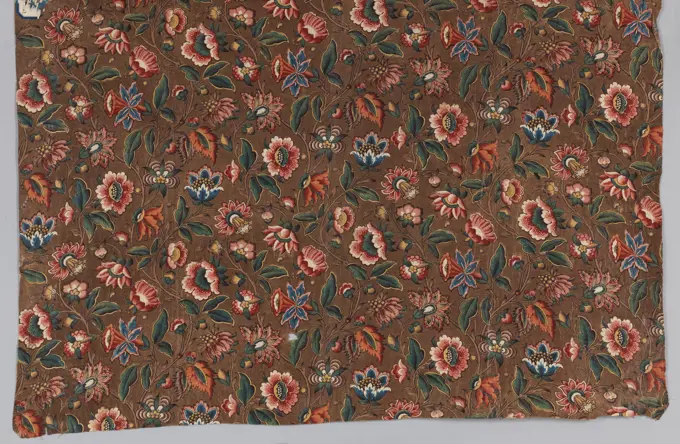
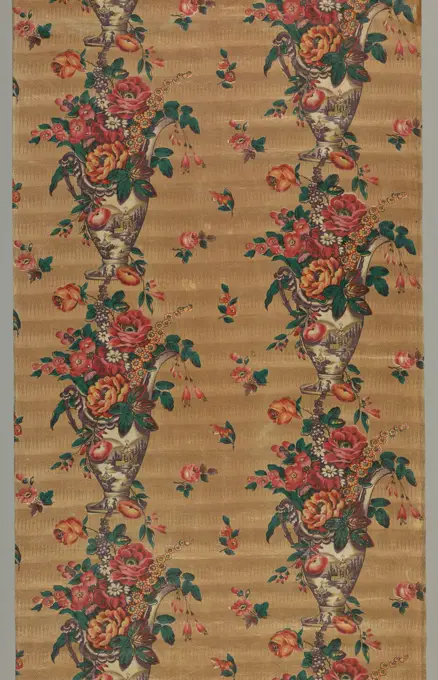
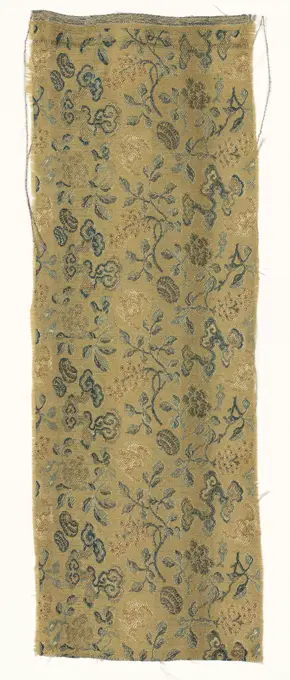
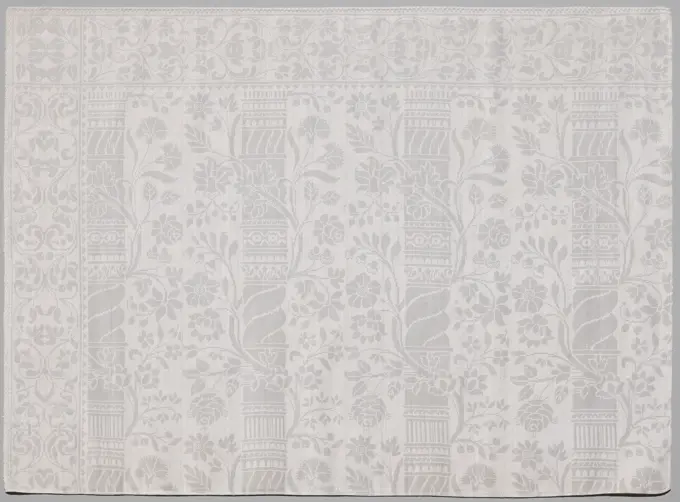
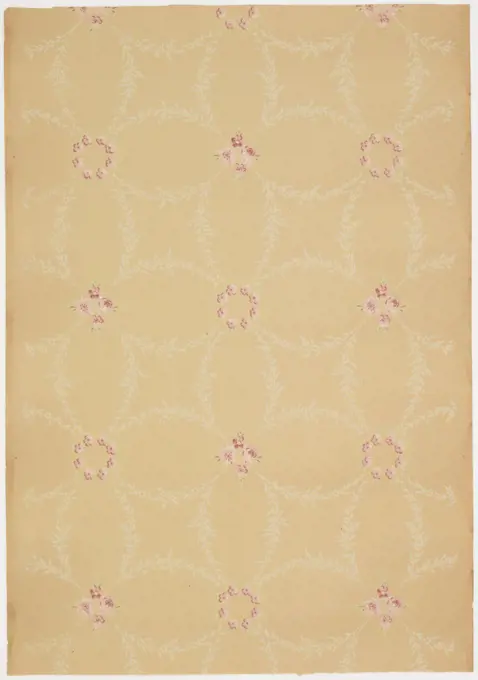
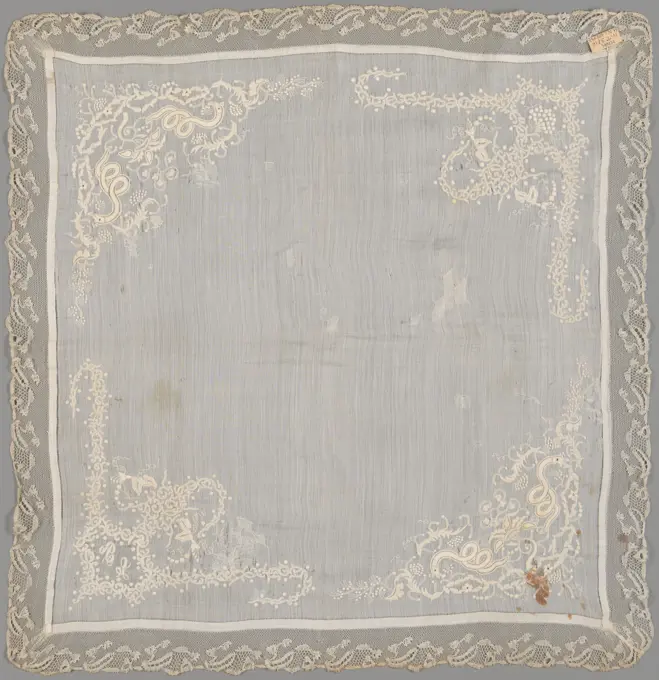
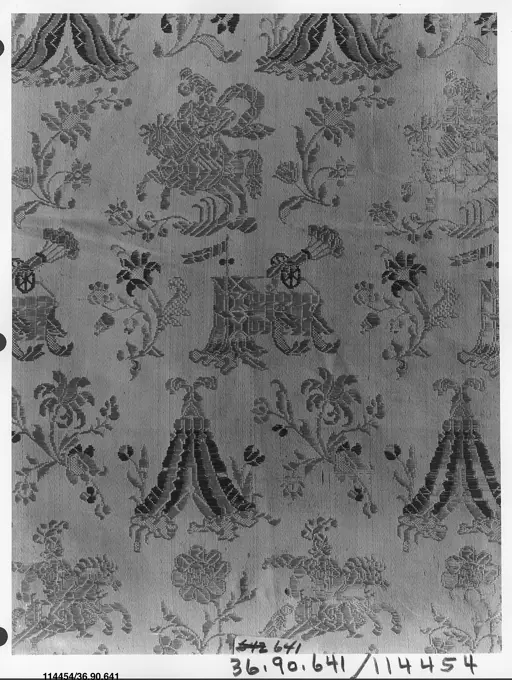
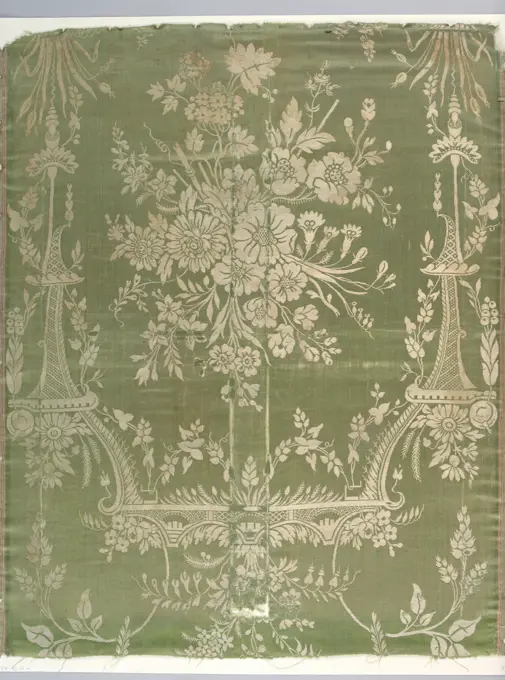
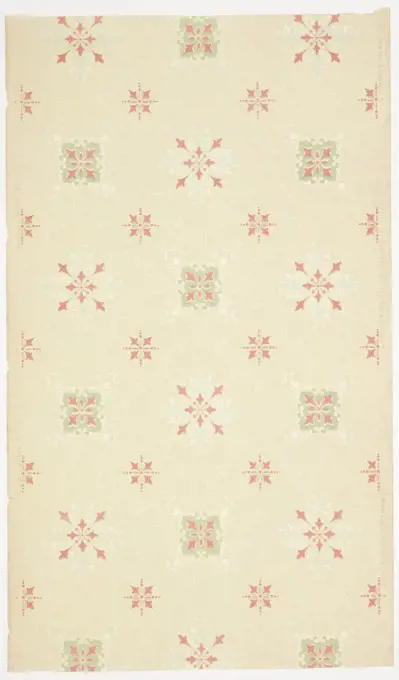
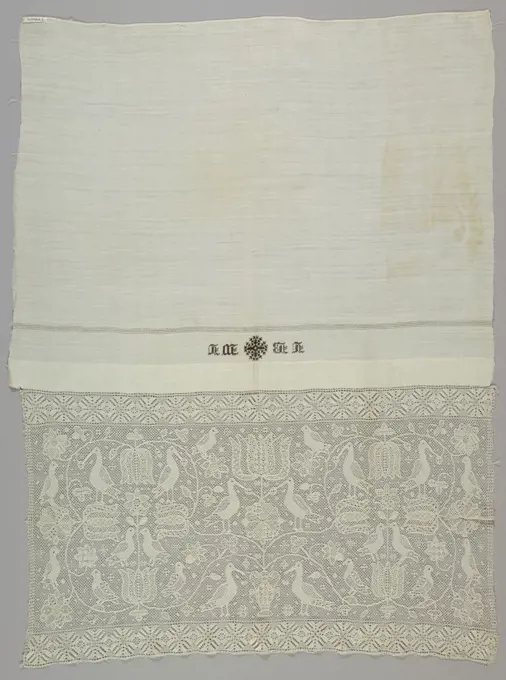
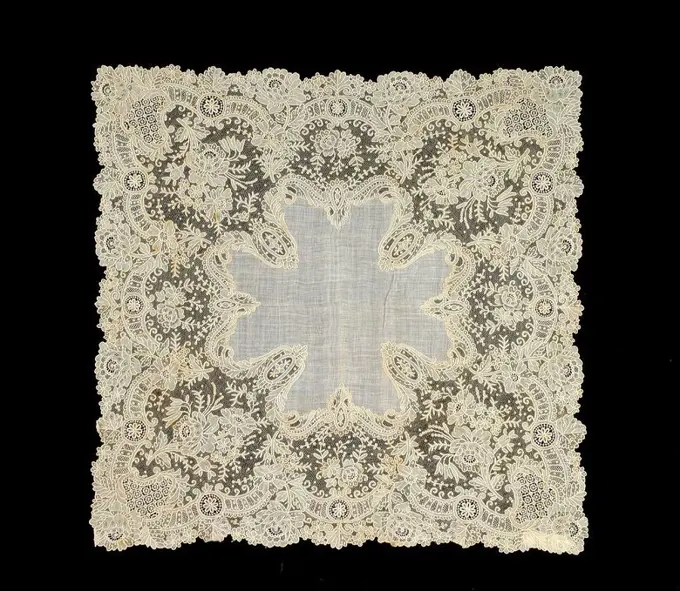
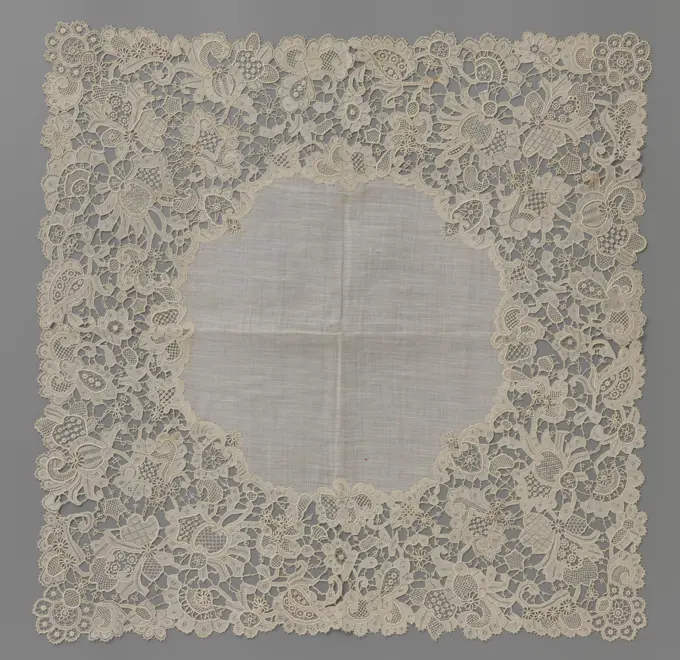
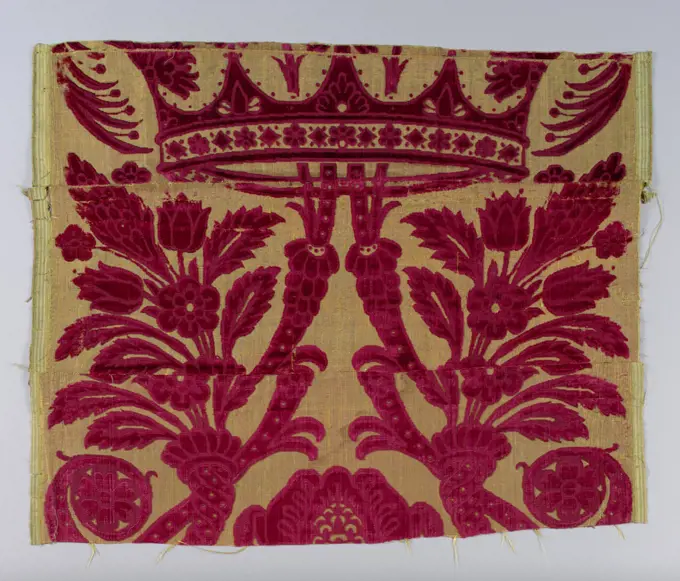
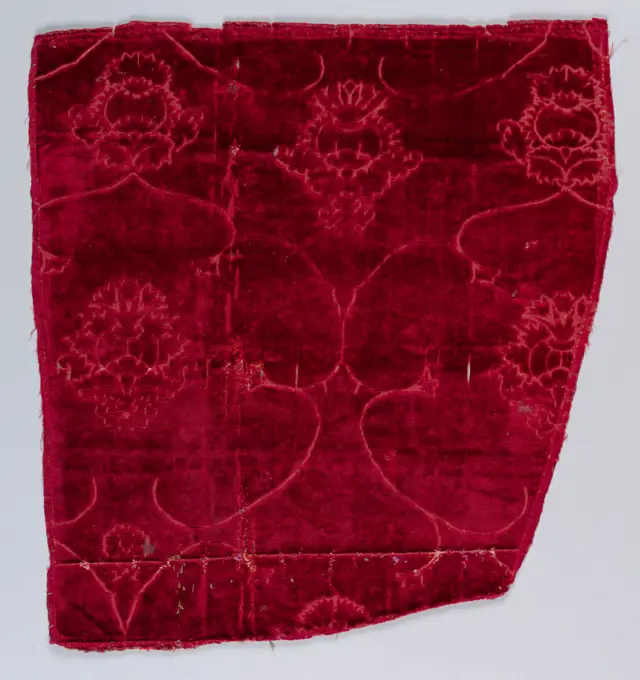
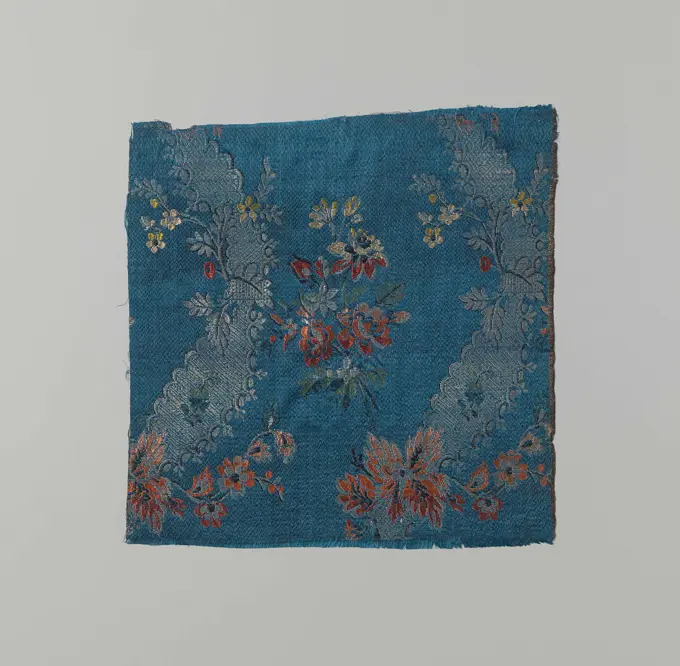
Carpet Fragments 17th century The pile of these fragments is pashmina, or cashmere wool, the hair of Himalayan mountain goats. It was used in the very finest Indian carpets, which were often misidentified until fairly recently as velvets.. Carpet Fragments. 17th century. Silk (warp and weft), wool (pashmina) pile. Attributed to India. Textiles-RugsPanel (Dress Fabric) Made 1725-1775 China. Silk, plain weave with supplementary patterning and brocading wefts .Fragment 16th century Spanish or Italian. Fragment 230357Textile (England); Warp; 231 cm (91in. - 7 ft. 7in) by weft (selvedge to selvedge) Pattern: Height of repeat: 13 3/4 in. Arranged as a half-drop. The rollers were wider than the fabric. 1 1/4 inches of the motif are missing from 2 full units of pattern.Fragment, Medium: silk, metallic yarns Technique: compound weave, Silk fragment showing design of red and metallic flowers against a blue and white geometric background against a white horizontally ribbed ground., possibly France, late 17th-early 18th century, woven textiles, FragmentCeiling paper, Hobbs, Benton & Heath, Hoboken, New Jersey, Machine-printed paper, textured, liquid mica, Floral bouquet of white flowers surrounded by wreath of petite white flowers, in the center of a larger quatrefoil motif. Printed in white and metallic gold on ungrounded paper., Hoboken, New Jersey, USA, 1905-1915, Wallcoverings, Ceiling paperPiece 18th-19th century Japan. Piece 66560Buffet runner of écru cotton, decorated with woven relief motifs with floral field and narrow stripes; Dark red beads were strung in the fabric factory ...Sleeve (Philippines); piña (pineapple) fiber, cottonFragment, 1700s. China, 18th century. Satin ground; silk diasper weave; overall: 35.6 x 14.6 cm (14 x 5 3/4 in.).Napkin with Weapons Camminga-Ockinga En Grovestins-Jongema, Anonymous, 1645 White linnendamasters napkin with fishing pattern and weapons with took Camminga-Ockinga and Grovestins-jongema, brand FSVG and W 22. Northern Netherlands (Possible) linen (material) damask White linnendamasters napkin with fishing pattern and weapons with took Camminga-Ockinga and Grovestins-jongema, brand FSVG and W 22. Northern Netherlands (Possible) linen (material) damaskTissue of woolen grein, multicolored flowers on a yellow stock with a patoon of branches, leaves and flowers in white, anonymous, c. 1750 - c. 1760 Multicolored flowers on a yellow stock with a paton of branches, leaves and flowers in white. Kam yarn broché, wool, grein. Norwich whole: Wool. whole: Multicolored flowers on a yellow stock with a paton of branches, leaves and flowers in white. Kam yarn broché, wool, grein. Norwich whole: Wool. whole:Piece ca. 1730 Italian. Piece 227394Textile (Japan); silk, paperPiece 18th century Japan. Piece 67407Napkin with flowers and fruits, anonymous, c. 1650 Linnamast napkin with pattern of "Sawed Blom" and fruits. A layer of symmetrical pattern shows fairly large flowers and fruits on a swivel twig. Among other things, rose, pomegranate, tulip, grapes and melon are recognizable. Standing edges: Single spiral rank with daffodil, grapes and flowers. Northern Netherlands (possibly) linen (material) damask Linnamast napkin with pattern of "Sawed Blom" and fruits. A layer of symmetrical pattern shows fairly large flowers and fruits on a swivel twig. Among other things, rose, pomegranate, tulip, grapes and melon are recognizable. Standing edges: Single spiral rank with daffodil, grapes and flowers. Northern Netherlands (possibly) linen (material) damaskFragment of a tablecloth from Linnamast, Anonymous, 1710 - 1715 White Linnamasten Tablecloth with a bizarre pattern with columns, brand GOVB. Northern Netherlands (Possible) linen (material) White Linnamasten Tablecloth with a bizarre pattern with columns, brand GOVB. Northern Netherlands (Possible) linen (material)Fragment Broched Gros the Tours, possibly the upper part of a choos. Fragment Broched Gros the Tours, possibly the upper part of a choos. Dessin: Purious repeating horizontal bands alternately left and right tending flower arrangements, with one course sprinkling from a spherical shape, with the other from a basket, in two colors of pink, orange, brown and green on a green fond. The silk tissue consists of five pieces sewed together in a semicircle shape, with the edge of a natural-colored path silk lining. Label on which printed: French and CO inc.; the number 10420; Price 125. Pached paper with the letter V.Fragment, Medium: silk, metallic Technique: 5 harness satin patterned by plain weave, Parrots and affronted lions in gold and tan on a green satin ground., possibly 19th century, woven textiles, FragmentFragment (France); silkCeiling paper, Maxwell & Co., S.A., Chicago, Illinois, USA, Machine-printed paper, ungrounded, Framework of floral swags connected at end points by bouquets of flowers., USA, 1905-1915, Wallcoverings, Ceiling paperHandkerchief, Medium: linen Technique: embroidered, Belgium or France, late 19th century, embroidery & stitching, HandkerchiefFragment, Medium: linen Technique: bobbin lace of discontinuous tape; six bobbins used for connecting bars, Lace fragment with a central design of a double-headed eagle surrounded by scrolls of large-scale floral and foliated forms connected by bars., Belgium, 1650-1700, lace, FragmentFragment (Italy); Bequest of Marian Hague; 1971-50-215Fichu third quarter 19th century Philippine. Fichu 169428Fragment of silk fabric with satin stripes  colourful motifs and blue and silver band unknownFragment, Medium: silk and linen Technique: 8 harness satin plus 1/7 twill (damassé), Yellow and green with a swan and water motif., Italy, 17th century, woven textiles, FragmentFragments; silk, metallic threadFragment; silkPiece. Culture: Italian. Dimensions: L. 11 1/4 x W. 7 1/2 inches (28.6 x 19.1 cm). Date: 16th-17th century. Museum: Metropolitan Museum of Art, New York, USA.Fragment Cream-colored brochet side with a multi-colored pattern of leaf branches and cherries on checkered (vertical zigzag lines). Fragment cream-colored silk damask with a pattern of vertical zig-saw lines on winding branches with cherries and leaves in brown, green and red tones.Fragment, Medium: silk Technique: woven, Soiled white ground horizontally ribbed with incomplete repeat of a landscape setting. Left selvedge present., ca. 1740, woven textiles, FragmentVelvet Fragment, 1400s. Italy, 15th century. Velvet; overall: 43.2 x 43.8 cm (17 x 17 1/4 in.).Flounce fragment, Medium: linen Technique: bobbin lace, Brussels style, Floral lace with scrolling and paisley motifs with finished edge and openwork areas., Belgium, 1755-70, lace, Flounce fragmentSidewall - Sample, Queen Anne; Designed by William Morris (British, 1834-1896); Manufactured by Jeffrey & Company (United Kingdom); Made for Morris & Co. (United Kingdom); block-printed paperPiece 1720-30 possibly Italian. Piece 224520Textile (England); cottonPiece ca. 1805-10 British. Piece. British. ca. 1805-10. Cotton. Textiles-PrintedPiece 18th-19th century Japan. Piece 67428Fragment, Medium: silk and metallic thread, Floral and S-shaped forms facing in alternate directions. In gold and silver on red ground., 17th century, woven textiles, FragmentPiece 1735-50 French. Piece 217314Band (Italy); silk on linenSquare, Medium: undyed linen warp, silk weft Technique: 9&1 satin damask, Center field has a straight repeat of four small flowers. Borders have a garland of roses threaded through a ring attached to a bar along the outer edge. Warp ends are hemmed, and weft is selvage to selvage., Europe, 19th century, woven textiles, SquareCeiling paper, Standard Wall-Paper Company, Standard Wall-Paper Company, Pittsburgh, Pennsylvania, Machine-printed paper, liquid mica, Pink floral bouquets with white mica foliate scrolls. Ground is white. Printed in greens, pinks, and white mica., USA, 1905-1915, Wallcoverings, Ceiling paperTextile, early 1900s. England, early 20th century. Cotton; printed; overall: 36.3 x 49.5 cm (14 5/16 x 19 1/2 in.).Fragment of silk fabric  naturaIIstic flower pattern unknownBook cover with overall floral and bud pattern 19th century Anonymous. Book cover with overall floral and bud pattern. Anonymous , 19th century. 19th century. Relief print (wood or metal). PrintsHandkerchief unknownPiece. Culture: French. Dimensions: L. 19 1/4 x W. 16 1/4 inches48.9 x 41.3 cm. Date: ca. 1750. Museum: Metropolitan Museum of Art, New York, USA.Textile; cotton; Warp x Weft: 73 × 58 cm (28 3/4 × 22 13/16 in.) Repeat H: 28 cm (11 in.)Piece ca. 1680-1700 Italian. Piece. Italian. ca. 1680-1700. Silk. Textiles-WovenBliżej Kultury unknownPiece ca. 1730 () Spanish. Piece 228863Purple-ground fragment with florals and kakuregasa motif, 19th century, Unknown Ryukyuan, 11 7/8 × 7 1/4 in. (30.16 × 18.42 cm) (overall), Cloth: cotton; bingata (stencil resist with applied pigments), Japan, 19th centuryCarpet fragment, Medium: wool Technique: double cloth, Floral design in shades of red and green on a light cream ground., USA, mid-19th century, woven textiles, Carpet fragmentPiece 18th-19th century Japan. Piece 67806Napkin with achievements from the Spanish Succession War, Anonymous, c. 1700 - c. 1724 Napkin from Linnamast with achievements from the Spanish Succession War. The symmetrically doubled pattern shows four scenes: 1 siege of Rijssel. Caption: Lilicidium. 2 A galloping marshal turned to the middle. Caption: Mons. 3 The crowned and the weapon of Eugenius of Savoy by Savoy. 4 Tournay. and Le Bataille Bavez. Standing edges: halved trophies; Round: Blocking edge. Kortrijk linen (material) damask  Lille. Lille. Tour. Torlative Napkin from Linnamast with achievements from the Spanish Succession War. The symmetrically doubled pattern shows four scenes: 1 siege of Rijssel. Caption: Lilicidium. 2 A galloping marshal turned to the middle. Caption: Mons. 3 The crowned and the weapon of Eugenius of Savoy by Savoy. 4 Tournay. and Le Bataille Bavez. Standing edges: halved trophies; Round: Blocking edge. Kortrijk linen (material) damask  Lille. Lille. Tour. TorlativePiece late 17th-early 18th century French. Piece 219697Carpet fragment, Medium: wool Technique: machine made, Floral design in shades of brown, cream, gray, and dull orange., USA, 1860-70, woven textiles, Carpet fragmentPiece late 18th-early 19th century French, possibly Nantes. Piece 222208Sidewall - Sample, Apple, 1887; Designed by Morris & Co. (United Kingdom); Manufactured by Jeffrey & Company (United Kingdom); block-printed paperFragment (England); cottonTextile (France); silk; a) Warp x Weft: 68.5 x 55.5 cm (26 15/16 x 21 7/8 in.) b) Warp x Weft: 69 x 55.5 cm (27 3/16 x 21 7/8 in.)Handkerchief 1840-60 Belgian. Handkerchief 168498Fragment of silk fabric unknownFragment, Medium: silk Technique: cut and uncut voided supplementary warp pile in a satin foundation (pile-on-pile velvet), Small-patterned or 'miniature' velvet with a white satin foundation forming short branch-like motif, which support a double floral spray in pink and black cut and uncut pile. Background design in uncut pink pile. Composed of two pieces, two selvedges present in seam., France, 1750-1800, woven textiles, FragmentBedcover (France); cottonCeiling paper, Maxwell & Co., S.A., Chicago, Illinois, USA, Machine-printed paper, liquid mica, Band of large blue and link and medium green and pink fleurons alternating with band of small green and pink fleurons. Fleurons are connected by white mica scrolls with sylized floral pendants. Printed in light green, pink, blue liquid mica and white liquid mica on light beige ground. Printed in selvedge: 'S.A. Maxwell & Co. New York & Chicago' ; 'Exclusive Design No. 2379'., USA, 1905-1915, Wallcoverings, Ceiling paperTowel end, Medium: linen Technique: needlework on knotted net, Towel end edged at one end with wide border of stylized tulips and birds., Germany, 18th-19th century, lace, Towel endFragment red silk tissue. Fragment interior textiles; Red silk with red-orange brochure in Jaquard tissue. The pattern has leaf drinks and volutes.Textile (France); linen, cottonBed Hanging (India (for European market)); cottonHandkerchief. Culture: Belgian. Date: 1870-80. Museum: Metropolitan Museum of Art, New York, USA.Cap crown, Medium: linen Technique: bobbin lace, Brussels style, Cap crown with a central design of a vase surrounded by elaborate stylized floral and foliated forms., Belgium, 1700-1750, lace, Cap crownBedcover (USA); linen, woolCeiling Paper (USA); Manufactured by Carey Bros. W.P. Mfg. Co.; machine-printed paper; 90 x 49 cm (35 7/16 x 19 5/16 in.)Textile (France); silk, metallic threadNeedle handkerchief with flowers and an inner piece of batist, anonymous, c. 1870 - c. 1909 Batist handkerchief with a wide edge of natural -colored needle side: Venetian relief side. The inner piece of linen batist is sculpted and rosette -shaped. Side: There are tumbles with multifaceted flowers, such as fan -shaped palm flowers, Paisley motifs, etc., which are grouped asymmetrically. BURANO linen (material) Venetian raised work Batist handkerchief with a wide edge of natural -colored needle side: Venetian relief side. The inner piece of linen batist is sculpted and rosette -shaped. Side: There are tumbles with multifaceted flowers, such as fan -shaped palm flowers, Paisley motifs, etc., which are grouped asymmetrically. BURANO linen (material) Venetian raised workNapkin from Linnendamast with a lace pattern. Napkin from Linnendamast with a lace pattern. At the napkin a napkin (BK-1977-295-a) and a tablecloth (BK-1977-294) heard.Fragment, Medium: cotton Technique: block-printed on plain weave, Fragment of cotton block-printed in red, green, and brown on dark brown ground, showing all-over pattern of a floral tree. Small scale floral border set off on one side by a dark red stripe., Jaipur, Rajasthan, India, late 18th-early 19th century, printed, dyed & painted textiles, FragmentPiece. Culture: French. Dimensions: L. 16 1/2 x W. 13 1/4 inches41.9 x 33.7 cm. Date: late 18th century. Museum: Metropolitan Museum of Art, New York, USA.Textile, Medium: silk Technique: warp printed and moired, Alternating stripes of ivory and brown faille with moire finish. The wide ivory bands have warp-printed flowers in soft blue, yellow and pink. The narrower brown bands contain a warp fringe., France, ca. 1855, printed, dyed & painted textiles, TextileFragment, Medium: silk Technique: 4 & 1 satin damask; warp float face of the satin as background, Dark green silk with two curving floral sprays vertically offset., Spitalfields, England, 1740s, woven textiles, FragmentFragment. Italy. Date: 1650-1700. Dimensions: 17.1 x 16.1 cm (6 3/4 x 6 3/8 in.). Silk, plain weave with self-patterning ground wefts. Origin: Italy. Museum: The Chicago Art Institute, Chicago, USA.Frieze (USA); Manufactured by Carey Bros. W.P. Mfg. Co.; machine-printed paper; 220.5 x 49.5 cm (86 13/16 x 19 1/2 in.)Fragment, Medium: silk, metallic thread Technique: cut and uncut supplementary warp pile in a plain weave foundation with supplementary weft (ciselé voided velvet), Fragment of a large-scale patterned velvet in red cut and uncut velvet on a gold-yellow ground: cornucopia with bouquet of flowers combined with what seems to be an ogee scroll passing through a crown to enclose a large floral motif., Italy, 17th century, woven textiles, FragmentPanel, 18th century, H.40-1/2 x W.41-1/8 in., silk, China, 18th centuryScarf Irish, Limerick 19th centuryWoman's Handkerchief. Switzerland, 19th century. Costumes; Accessories. Linen plain weave with cotton embroideryTextile (France); Designed by Paul Follot (French, 1877-1941); silkCeiling Paper (USA); Manufactured by A.M.P. & C.M. of U.S.; machine-printed paper, liquid mica; 92 x 49 cm (36 1/4 x 19 5/16 in.)Textile (India); cottonFragments; silkPiece ca. 1725-1730 Italian or Spanish. Piece 227395Textile (England)Fragment multicolor silk tissue with a blue ground. Fragment broached silk. On a blue ground, white lace garlands walk in which and between multicolored flower branches and bouquets.Piece ca. 1720 Italian. Piece 217184Sidewall (USA); Manufactured by York Card & Paper Co.; machine-printed paper, liquid mica; 92 x 47 cm (36 1/4 x 18 1/2 in.)Fragment with a Simulated Silk Textile Pattern ca. 1450-1550 Upper Rhenish. Fragment with a Simulated Silk Textile Pattern 468425Piece 18th-19th century Japan. Piece. Japan. 18th-19th century. Silk. Textiles-Woven