Floral Silk Fragments

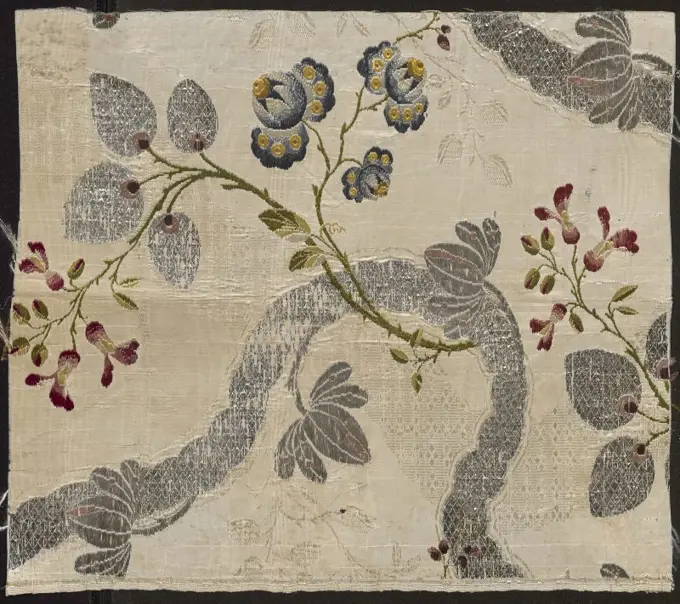
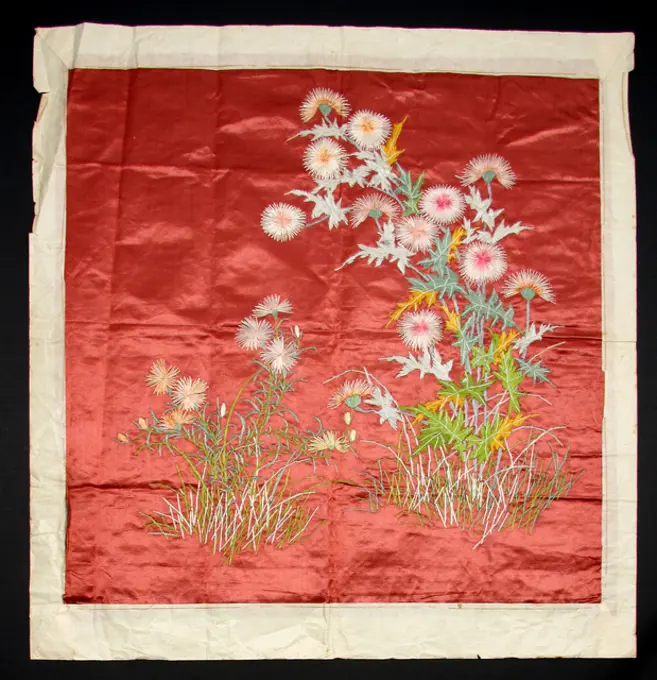
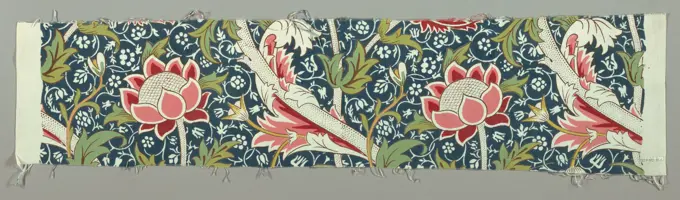
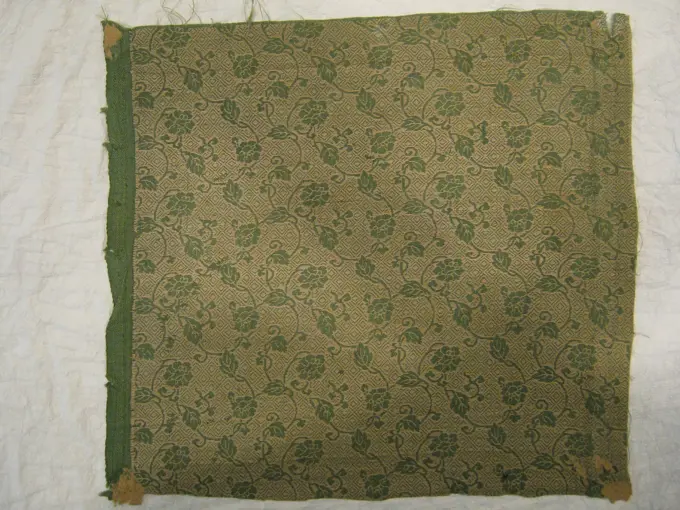
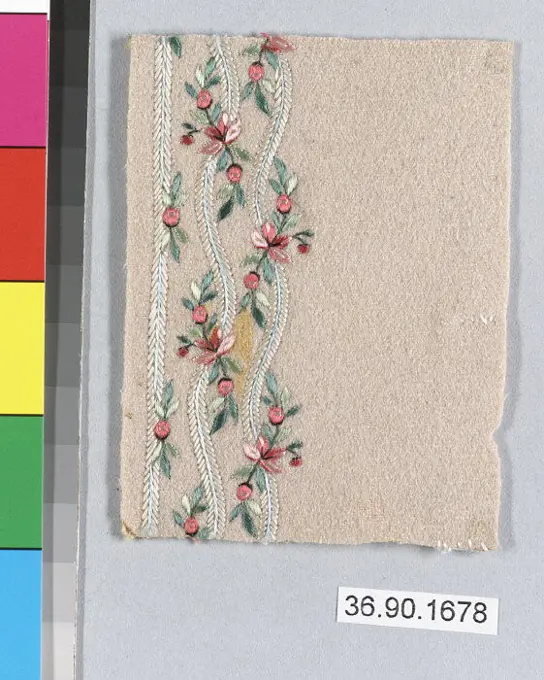
Fragments of elaborate floral brocade and silk textiles from the 18th century featuring detailed floral motifs on rich backgrounds.
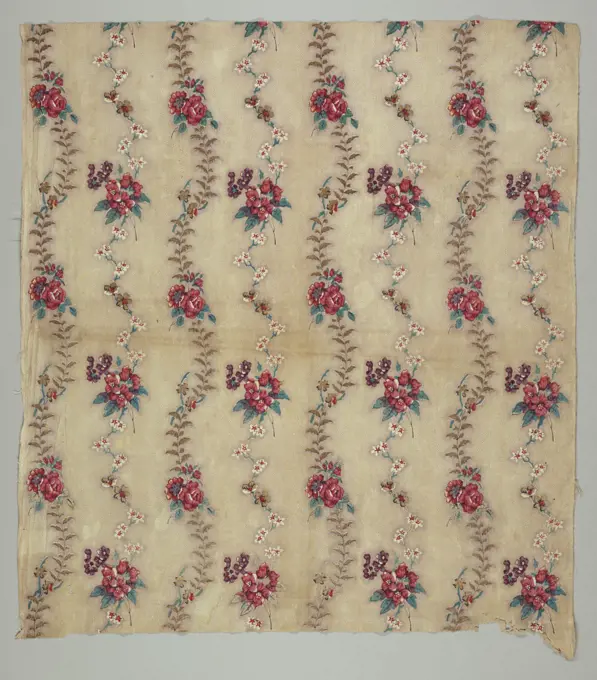
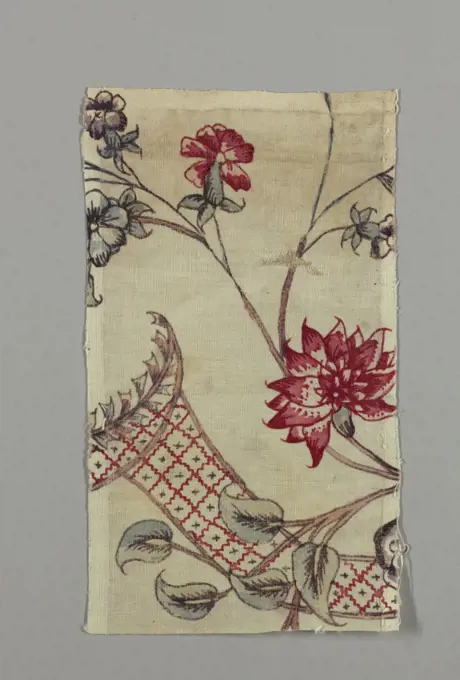
Textile, Medium: cotton Technique: block printed on plain weave printed by engraved roller on plain weave, Panel of cream white cotton, with block-printed design in perpendicular arrangement. Delicate ascending vine with clusters of small flowers, naturalistically drawn in shades of red, violet, blue and yellow drab; small flowers in pure white probably by discharge. Fine picotage in dark brown around the vines and blossoms. Left selvages present., early 19th century, printed, dyed & painted textiles, Textile
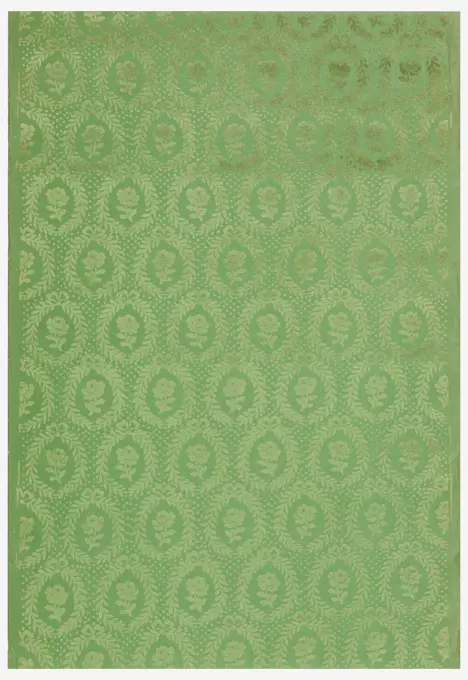
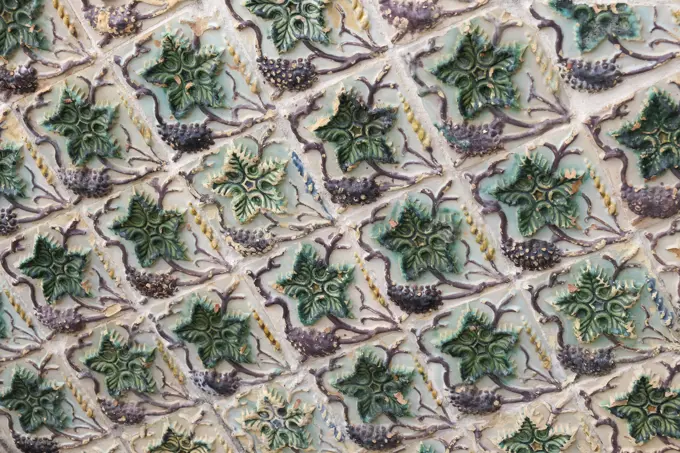
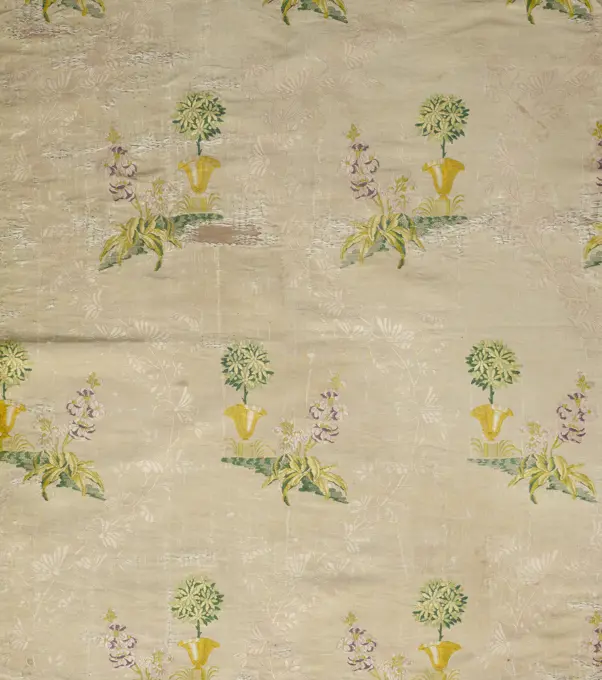
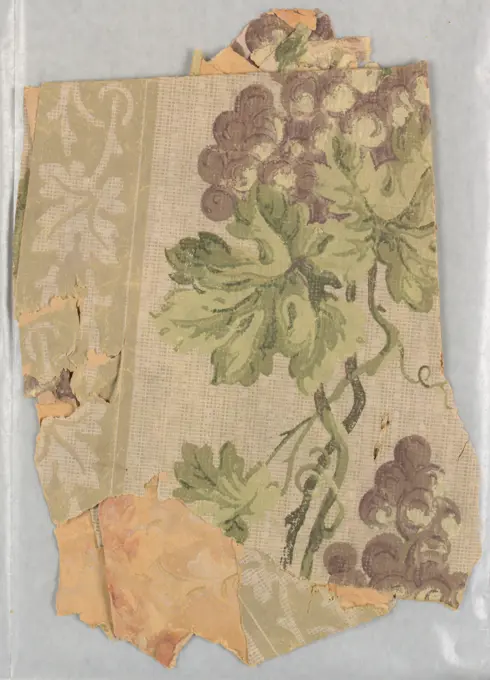
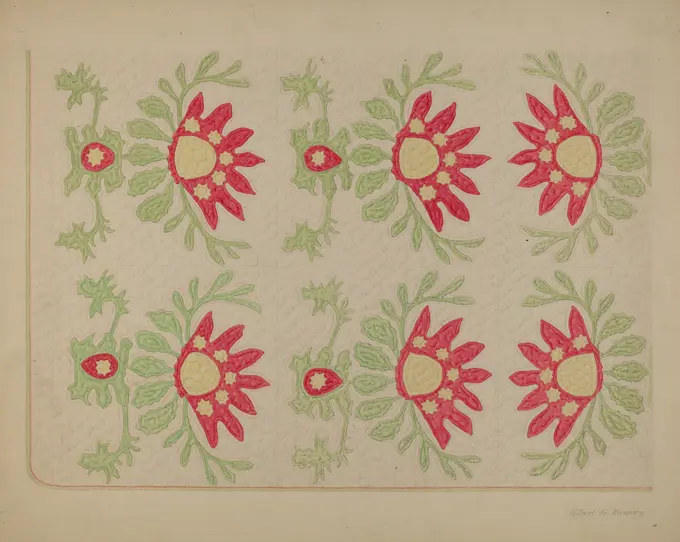
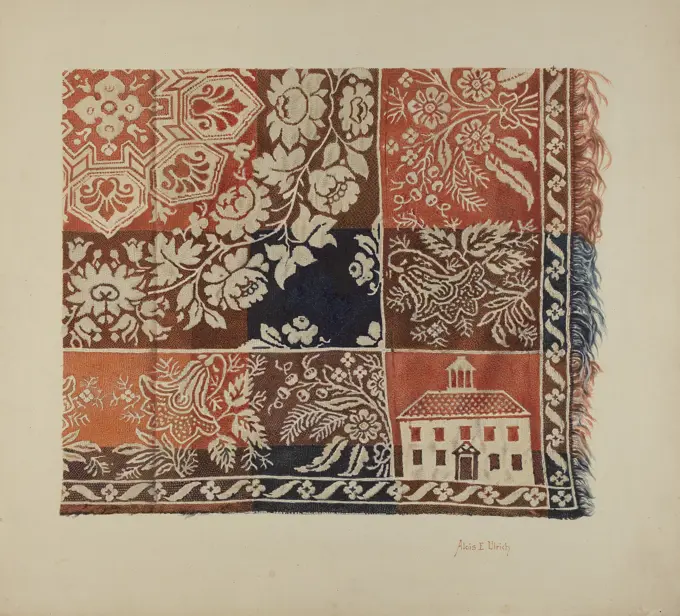
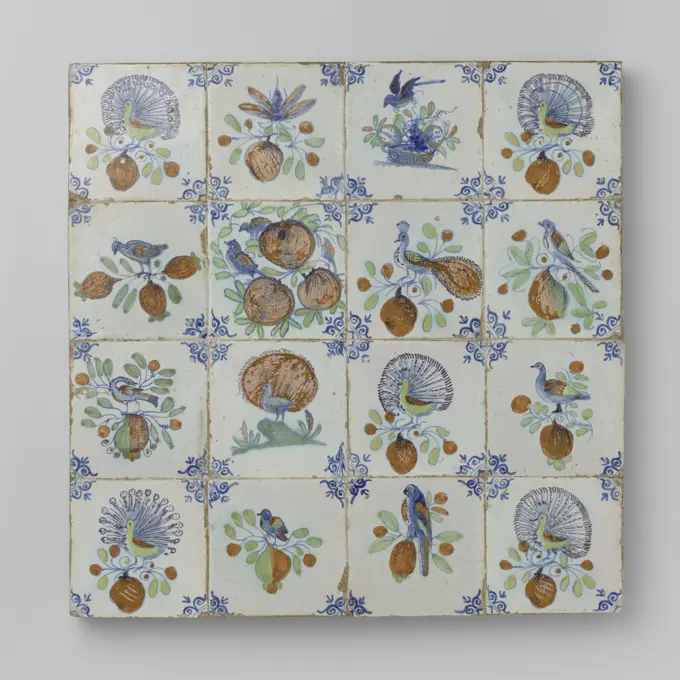
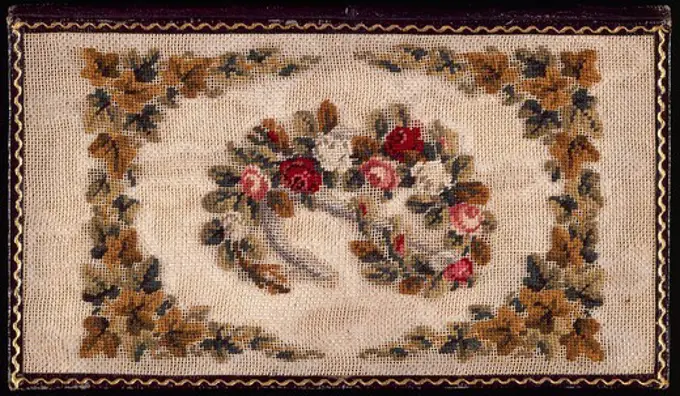
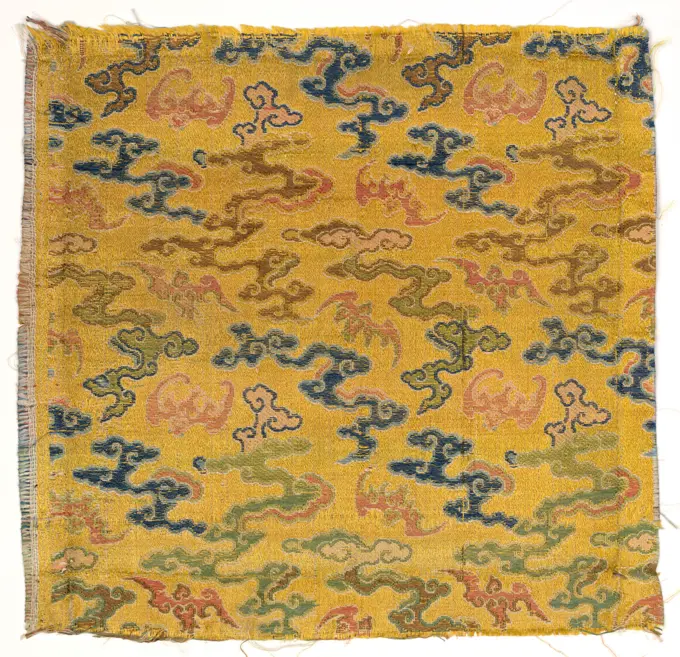
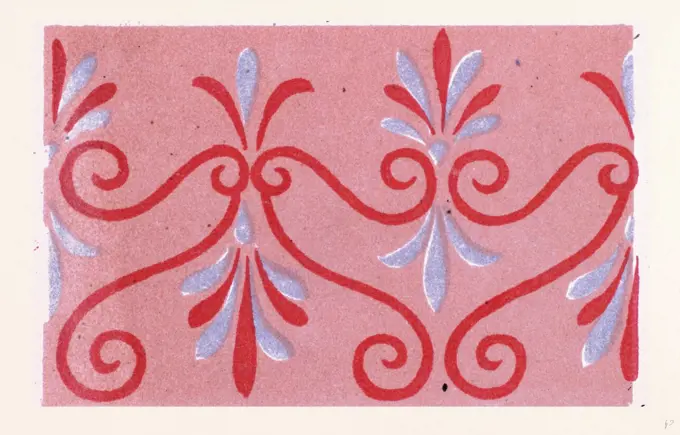
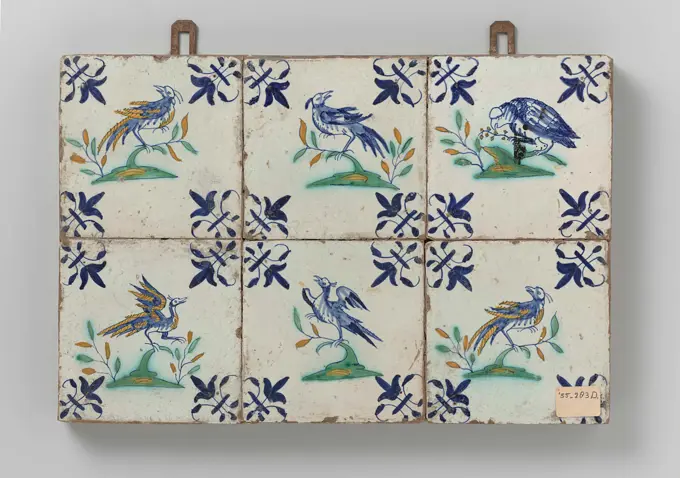
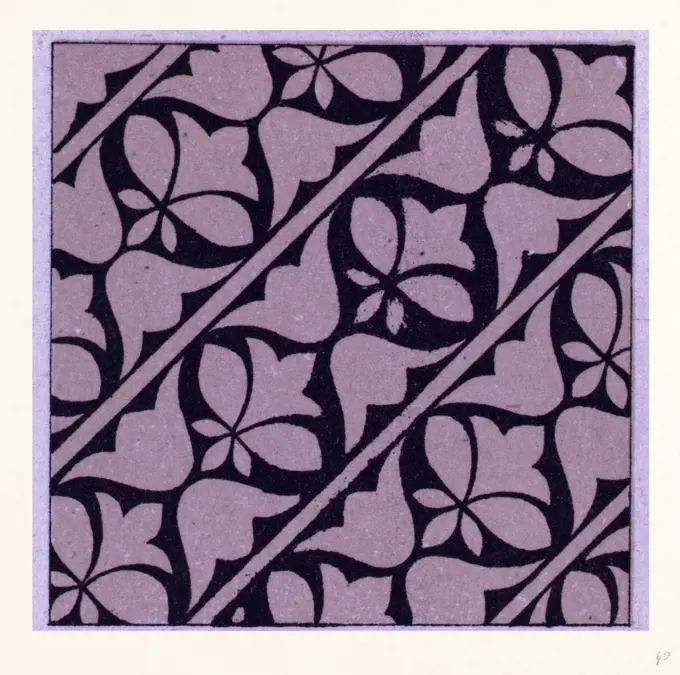
Dress of fillet side with crowned double eagle, anonymous, c. 1500 - c. 1699 Dress of natural -colored lace -ups: filet side. Pattern with a crowned double eagle in a wreath of stylized roses on a knotted network with square meshes. Corner fillings with stylized carnations. The motifs are made in the stop stitch and the linen stop stitch. Germany linen (material) embroidering Dress of natural -colored lace -ups: filet side. Pattern with a crowned double eagle in a wreath of stylized roses on a knotted network with square meshes. Corner fillings with stylized carnations. The motifs are made in the stop stitch and the linen stop stitch. Germany linen (material) embroideringTextile (France); silkFrieze, Liberty Paper & Bag Co., Machine-printed, Clusters of white roses surrounded by gold scrollwork and green net pattern, on shaded green ground., USA, 1900, Wallcoverings, FriezeTextile 19th century Japan. Textile 68071Sidewall (possibly France); flocked; 69 x 49.5 cm (27 3/16 x 19 1/2 in.)Textile samples, American Print Works, founded 1835, Medium: cotton Technique: printed on plain weave, White fabric printed in a design showing a repeating motif of a hat with a rolled brim and flower., Fall River, Massachusetts, USA, 1870s, printed, dyed & painted textiles, Textile samplesBack of the ornate;  18th century (1701-00-00-1800-00-00);Fragment (France); Company: Oberkampf & Cie. (France); cotton; Warp x Weft: 41 x 91.5 cm (16 1/8 x 36 in.) Repeat H (pattern): 25.5 cm (10 1/16 in.); Bequest of Elinor Merrell; 1995-50-66Purple ornament tile with diagonal decor and flower, wall tile tile sculpture ceramic earthenware glaze tin glaze, baked 2x glazed painted Ornament tile in manganese with diagonal decor. Half decorated with flower figures and leaves for the other part decorated with flat with lying and standing stripes with scalloped edge. Flower rosette in the corner with white heart.Sintra, Portugal. Old Portuguese tiles with Moorish influenceFragment of cream baize  deIIcate motifs of a vase with a tree growing out of it with floral twigs in the background unknownPiece 18th century Japan. Piece 71172Sidewall - Fragment; machine-printed; in 7.5x10.5 envelopeChintz fragment, Medium: cotton Technique: mordants for 3 reds, black and purple applied by pen or brush; madder dyed; blue applied by brush over resist; chintz on plain weave, Small fragment showing part of a cornucopia-like shape and floral vines., India, 18th century, printed, dyed & painted textiles, Chintz fragmentGigerl-Tarock, Treff Square, Medium: linen Technique: deflected element work, In center, Paschal Lamb surrounded by a floral wreath., Germany, 18th century, embroidery & stitching, SquarePiece 18th century Japan. Piece. Japan. 18th century. Silk / Compound weave. Edo period (1615-1868). Textiles-WovenPiece, 18th century, 15 3/4 x 12 7/8 in. (40.01 x 32.7 cm), Cotton, silk; needlework, Turkey, 18th centuryPiece ca. 1860 British or French. Piece. British or French. ca. 1860. Mohair. Textiles-PrintedTextile Fragment 17th century. Textile Fragment 454494Textile (China); silkSidewall (possibly USA); 72 x 23 cm (28 3/8 x 9 1/16 in.)Napkin with flowers, anonymous, c. 1700 - c. 1799 White Linnamasten Napkin with a flower basket pattern, brand Ig 4. Southern Netherlands (possibly) linen (material) damask White Linnamasten Napkin with a flower basket pattern, brand Ig 4. Southern Netherlands (possibly) linen (material) damaskFragments; cotton; Warp x Weft (a): 75 x 100 cm (29 1/2 x 39 3/8 in.) Warp x Weft (b): 96 x 100 cm (37 13/16 x 39 3/8 in.) Warp x Weft (c): 66 x 72 cm (26 x 28 3/8 in.) Warp x Weft (d): 76 x 57 cm (29 15/16 x 22 7/16 in.) Warp x Weft (e): 55 x 78 cm (21 5/8 x 30 11/16 in.) Warp x Weft (f): 76 x 36 cm (29 15/16 x 14 3/16 in.) Warp x Weft (g): 39 x 54 cm (15 3/8 x 21 1/4 in.) Warp x Weft (h): 76 x 73 cm (29 15/16 x 28 3/4 in.)Sari 18th century. Sari 450733Corporal or chalice cloth of linen with an embroidered cross in each corner and finished all around with a border bobbin, anonymous, c. 1600 - c. 1624 Corporal or chalice cloth of linen with embroidery - Whitework - in the corners and finished all with a border of natural -colored bobbin: Old Flemish side with ribbon decor (ribbon side). Square model. Embroidery: There is a cross -embroidered cross with equal arms in every corner, where each arm individually also ends in a cross again. Side: The repeating and symmetrical pattern consists of a narrow and continuous winding ribbon that forms a row of hearts with three -bit crowns. The ribbon is held in linen battle with openwork edges on one side. Brachtjes support the model of the motifs and connect the motifs with each other. The scrap edge is formed by the three -lobe crown on each of the successive hearts. Southern Netherlands (possibly) linen (material). batiste embroidering / bobbin lace / old Flemish lace / tape lace (bobbin lace)Piece of fabric. unknown, authorTextile (England); cottonFloral print ca. 1785 Indian, for French market. Floral print 221837Elbert S Mowery, Applique Quilt  King David's Crown, c 1938 Applique Quilt - King David's CrownPiece 1780-85 () Italian, Genoa. Piece 226345Sidewall, J. Zuber et Cie, Block-printed and embossed, Stylized red posie in white oval, surrounded by laurel crest. Printed in greens, ocher, coral, gilt white and red on greenish off-white ground., Rixheim, Alsace, France, 1875-1900, Wallcoverings, SidewallPersian ornamentPiece ca. 1860-70 French, Mulhouse or Thann. Piece 223962Chintz Fragments (India); cotton; Warp x Weft (a): 58 x 37.5 cm (22 13/16 x 14 3/4 in.) Warp x Weft (b): 56 x 22 cm (22 1/16 x 8 11/16 in.)J Howard Iams, Coverlet, c 1936 CoverletChristopher Hobbs, Coverlet, c 1936 CoverletSample early 19th century French. Sample 224744Wall extension, Chris Lebeau, 1911 - 1915 Light green damask wall compartment with a wild yacht. Eindhoven linen (material) damask Light green damask wall compartment with a wild yacht. Eindhoven linen (material) damaskTextile (England); cottonEmbroidered silk panel, Late 19th century, Japan, maker unknown. Gift of Shirley Brown (nee Kenning), 2009.Fragment (China); silk; temperaWoman's necktie 1870-80 French. Woman's necktie 221662Textile (England); Manufactured by Morris & Company, Decorators Ltd.; cottonTextile Fragment late 17th century. Textile Fragment. late 17th century. Silk, metal thread; brocaded. Made in Iran. TextilesRibbon, Medium: silk, Blue ribbon with crossing white lines and red roses with blue leaves., USA, late 19th century, woven textiles, RibbonSample card of macramé, Technique: 1 cord made of twisted wool, 2 fringes made with a sewing technique, the rest made with knotting and braiding techniques., Twenty-three examples of cords. Trimmings and watch fobs sewn onto a cardboard card. Three examples are sewn to small pieces of paper with notes in German., Germany, 1850-1900, knotted, knitted and crocheted textiles, Sample card of macraméRibbon French 19th centuryBedcover Made 1839 United States. Silk and cotton, variety of plain, satin and twill weaves, some with supplementary and/or self-patterning elements; pieced; quilted; edged with silk, warp-float faced satin weave .Bedcover. United States. Date: 1849. Dimensions: 208.3 x 236.2 cm (82 x 93 in.). Origin: United States. Museum: The Chicago Art Institute, USA.Textile, Medium: silk Technique: plain weave with continuous and discontinuous supplementary weft patterning, Length of woven silk with bouquets of flowers and larkspur-like spikes, tied together by angular ribbon-like bands, in many colors on an off-white ground., Spitalfields, England, 18th century, woven textiles, TextileTextile (France); silk, metallic threadFragment Made 1775-1800 Japan. Plain compound twill, silk and gilt paper; 2 1/2 strips to m.m. .Alois E Ulrich, Woven Coverlet, 1935 1942 Woven CoverletSampler (England); linenSidewall (France); Designed by A. H. Davenport; Manufactured by J. Zuber et Cie; block-printed and flocked paper; 115 x 50 cm (45 1/4 x 19 11/16 in.)Chinese ornamentField of sixteen tiles with birds, anonymous, c. 1640 - c. 1660 Field of sixteen tiles (4 x 4) each with a multicolored (blue, green, yellow, orange and purple) bird including 7 peacocks on a branch with berries. In the corners, an ox head. Netherlands earthenware. tin glaze majolica Field of sixteen tiles (4 x 4) each with a multicolored (blue, green, yellow, orange and purple) bird including 7 peacocks on a branch with berries. In the corners, an ox head. Netherlands earthenware. tin glaze majolicaBorder (France); Company: Oberkampf & Cie. (France); cotton; Warp x Weft: 32 x 10.5 cm (12 5/8 x 4 1/8 in.) Repeat H: 23.5 cm (9 1/4 in.)Embroidery, Germany 19th century. Back cover of a notebook, embroidered in woollen small stitch with silk threads on a canvas,  with floral motif and leather-binding, approximately  1830.Indian ornamentCrib Quilt. Dated: 1935/1942. Dimensions: overall: 44.3 x 41.6 cm (17 7/16 x 16 3/8 in.). Medium: watercolor, gouache, and graphite on paper. Museum: National Gallery of Art, Washington DC. Author: Charlotte Angus.Textile; cottonSewing sample, France, late 19th century, Sewing sampleSample early 19th century French. Sample 224748Fragments, Medium: silk Technique: plain compound satin with supplementary weft, Green satin ground with imcomplete design of large-scale flowers and smaller scale tree. Design partly in white and brown secondary wefts and partly in polychrome brocading threads. c: has left selvage present., France, mid-18th century, woven textiles, FragmentsPlaying Card; Manufactured by Ferdinand Piatnik and SonsCovering for a chair seat, Medium: cotton Technique: block printed on plain weave; glazed, Sprays of yellow, red and pink roses on a pale blue ground., England, ca. 1830, printed, dyed & painted textiles, Covering for a chair seatTextile Swatches Onondaga Silk Company, Inc. (1925-1981). , 1948-1959. Silk, a: 42 1/4 x 25 1/4 in. (107.3 x 64.1 cm).    1948-1959Darning Sampler (Netherlands); silk embroidery on linen foundationFragment, 1700-20. China, Qing dynasty (1644-1911). Satin ground; silk diasper weave; overall: 18 x 18.5 cm (7 1/16 x 7 5/16 in.).Sample (France)Sample French early 19th centuryGreek OrnamentEmbroidery, England 19th century. Sampler, embroidered in cross-stitch on linen, with floral hem containing darn tests.French and Indo-Chinese family album with 31 photos, anonymous, diverse manufacturers, c. 1900  Photo album with 34 pages with 31 cabinet photos. Each page contains a passe-partout framed with brown and golden edge for a cabinet photo. Not all passe-partouts are filled. Portrayed are portraits and group portraits of unknown men, women and children, as well as a photo of a girl in a cart drawn by a goat. The majority of photos are made in France (21) and Indo-China (3). The photos in the album were taken by various photographers, including Alphonse-Justin Liébert, Berger and Yu Chong. The photographer is anonymous of 7 photos. Under the photo with object number RP-F01023-26, an assignment has been written by hand, in which the name 'Pierre Violet' is mentioned. FranceIndo-China cardboard. leather. celluloid (cellulosic). photographic support. metal albumen print / gelatin silver print / printing / decorated paper historical persons. historical persons - BB - woman. child. anonymous histPanel Made 1700-1725 France. Silk, satin damask weave .Textile Swatches Onondaga Silk Company, Inc. (1925-1981). , 1948-1959. Silk, 23 3/4 x 17 in. (60.3 x 43.2 cm).    1948-1959Valentine - M. & S.Hand Sketched Borders and Frames, Dividers, SwirlsFragment; silk, linen, woolSquare scarf of natural wool with a woven edge in blue, pink, ecru and black, anonymous, c. 1840 - c. 1860 Square scarf of natural wool with a narrower and wider woven rim in blue, pink, ecru and black, which form windows when they cross in the corners. On the four sides fringes in the color of fabric. West-Europa whole: Wool. Decoration: Silk Square scarf of natural wool with a narrower and wider woven rim in blue, pink, ecru and black, which form windows when they cross in the corners. On the four sides fringes in the color of fabric. West-Europa whole: Wool. Decoration: SilkDesign for a Vase, Brush and watercolor, gold gouache, graphite on cream paper, Shaped like a vase, depicting yellow roses and thorns with white flowers and green and yellow leaves with a partial mountain in the background, against a yellowing sky. Above gold garlands hang (unfinished). Gold rim below., Japan, 1880-1910, tableware designs, Drawing, DrawingNapkin with a performance of a farm and two weapons, 1919 Linnamast napkin. Midfield: Presentation of a farm with two weapons and ribbons above it with 1835 A and C 1919 respectively. The left weapon is unclear (Carnegie). The right weapon is of the United States. Capture in Cartouche: Carnegie. Birthplace // and // memorial. Around an edge of connected cartouches in which a naval life of a ship respectively; a harp; A burning heart caught in a laurel wreath; a globe; A burning fire under arching; A still life with a book, oil lamp and ink jar with ferry; a peace pigeon; a palette and a mask; A medieval ship. On the left -handed: woven in Dunfermline. Dunfermline linen (material) damask Linnamast napkin. Midfield: Presentation of a farm with two weapons and ribbons above it with 1835 A and C 1919 respectively. The left weapon is unclear (Carnegie). The right weapon is of the United States. Capture in Cartouche: Carnegie. Birthplace // and // memorial. Around an edge of connected cartouBorder, Machine-printed in oil colors with engraved copper rollers, Intaglio print or sanitary paper with alternating motifs of flowers on stems, narrow band at top and wider band across bottom. Printed in shades of brown on tan ground., 1872-1900, Wallcoverings, BorderPatchwork of Woven Textiles China 13th-14th centuryRoundel. Culture: Italian or Spanish. Dimensions: Including tape: 55 x 42.5 cm (21 3/4 x 16 5/8 in). Date: 15th century (roundels) and 17th century (panels).This fifteenth-century roundel, together with three others in the Lehman Collection (1975.1.2442, 1975.1.2443, 1975.1.2444), was appliquéd to rectangular panels of dark red velvet embroidered and couched in allover strapwork forming fleur-de-lis and leaf patterns, dating to the seventeenth century. Two of the rectangles, finished with gilt metal tape, were attached directly to an upholstered couch; the other two were made into cushions, no doubt for the same couch. Each of the roundels contains a half-length figure. All four figures hold models of churches, three of them wear bishops' miters and the fourth, a cardinal's hat. The roundels were most likel once part of an orphery band or cross on either a chasuble, or a cope, although they also could have been parts of the border of an antependium or the apparels on a dalmatic. MuseuLeaf with a job pattern with flowers alternating with geometric list, anonymous, 1700 - 1850  Leaf with job pattern with flowers alternating with geometric list.  paper. block printing (relief printing process) ornament derived from plant formsField of six tiles with birds. Field of six tiles (2 x 3) each with a multi-colored (blue, green, yellow and orange) painted bird on a ground with a lily in the corners.Travel dressing table;  End of the 19th century (1890-00-00-1900-00-00);Indian ornamentSquare cushion cover, 19th century, 20 1/4 × 20 1/4 in. (51.4 × 51.4 cm), Embroidery on linen, Algeria, 19th centuryChristmas and Thanksgiving cards depicting fruit, birds, trees and decorative design.. Proofs, Greeting cards. 1883. The Miriam and Ira D. Wallach Division of Art, Prints and Photographs: Print Collection. Birds, FruitTextile Swatches Onondaga Silk Company, Inc. (1925-1981). , 1948-1959. 67 silk; 10 metal; 23 nylon, largest component (a): 22 x 18 in. (55.9 x 45.7 cm).    1948-1959Design for a hair comb, Jules Chadel, c. 1898 - c. 1905 drawing  Paris paper. pencil. deck paint. watercolor (paint) brush comb, brush and other tools (care of the hair) - AA - ~ womenLeaf from Winterbstdruckke Auer. Leaf From Series of 12 natlinglingbstdruckke Auer.Textile Sample Book 1895 possibly French. Textile Sample Book. possibly French. 1895. Silk. Textiles-Sample BooksBox 18th-19th centuryBob-o-link, from the Birds of America series (N37) for Allen & Ginter Cigarettes Issued by Allen & Ginter American 1888 Trade cards from the "Birds of America" series (N37), issued in 1888 in a set of 50 cards to promote Allen & Ginter brand cigarettes. Series N37 reproduces the cards from N4 in a larger size.Border (France); block printed on continuous paper, polished ground; 157 x 51 cm (61 13/16 x 20 1/16 in.)