Historic Fabrics with Floral Patterns

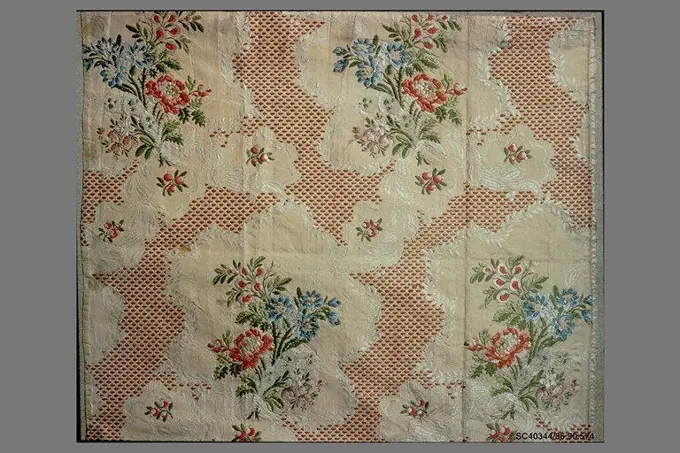
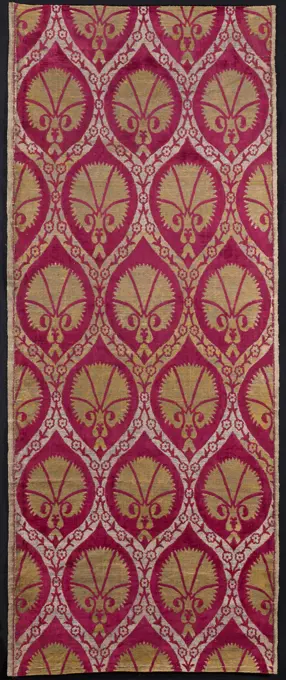
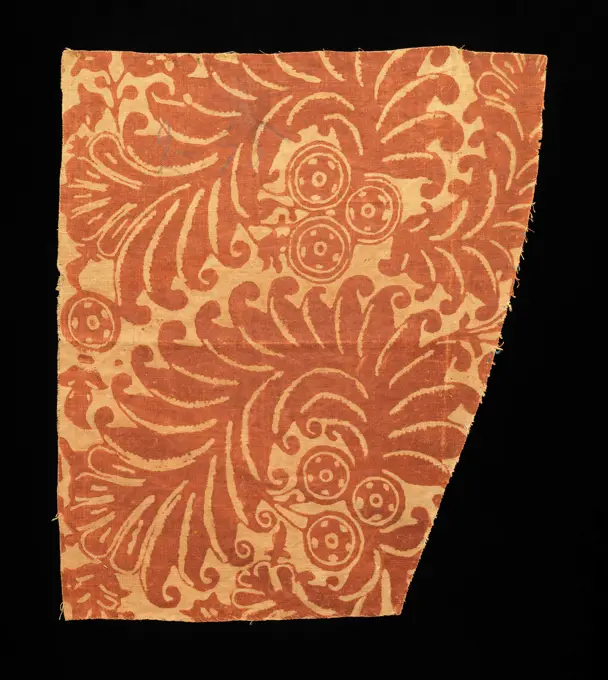
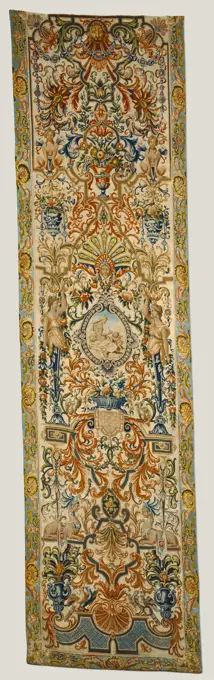
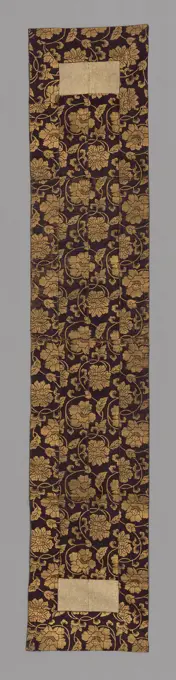
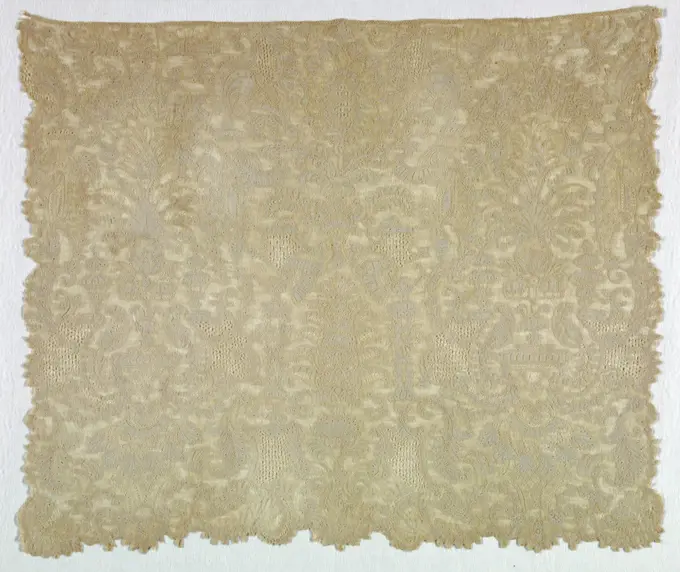
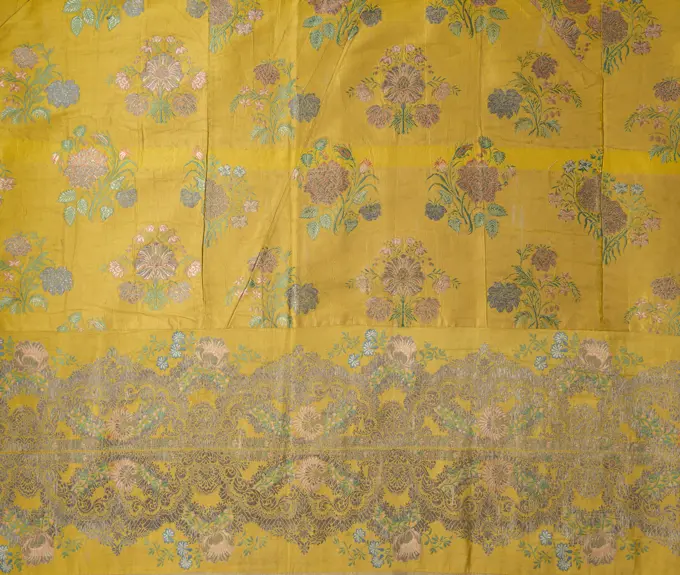
Collection of 18th-century fabric fragments showcasing intricate floral brocade and embroidery designs in rich colors and textures.

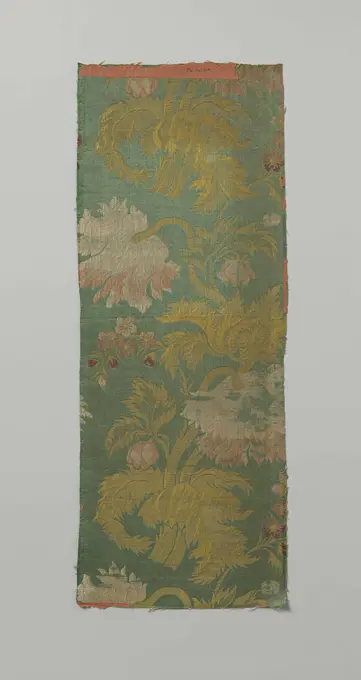
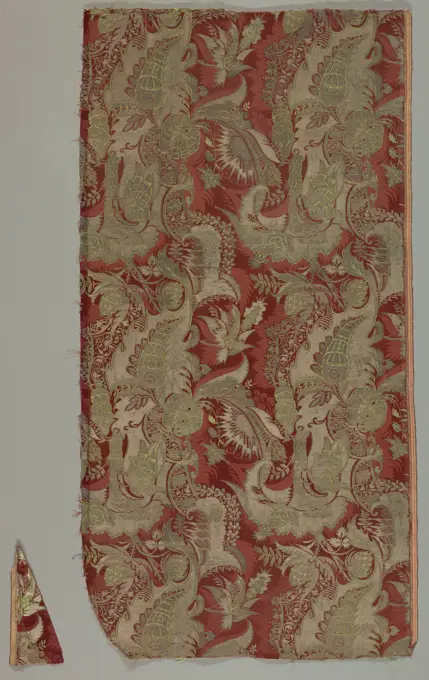
Fragment zijdeweefsel, c. 1690 - c. 1710 Fragment silver -gray silk with pattern in green, pink and light brown of vase with leaf work and flower -filled basket.  Ketting an element: Silk. lampas (textile material) Fragment silver -gray silk with pattern in green, pink and light brown of vase with leaf work and flower -filled basket.  Ketting an element: Silk. lampas (textile material)
Fragment zijdeweefsel, c. 1690 - c. 1710 Fragment silver -gray silk with pattern in green, pink and light brown of vase with leaf work and flower -filled basket. Ketting an element: Silk. lampas (textile material) Fragment silver -gray silk with pattern in green, pink and light brown of vase with leaf work and flower -filled basket. Ketting an element: Silk. lampas (textile material)
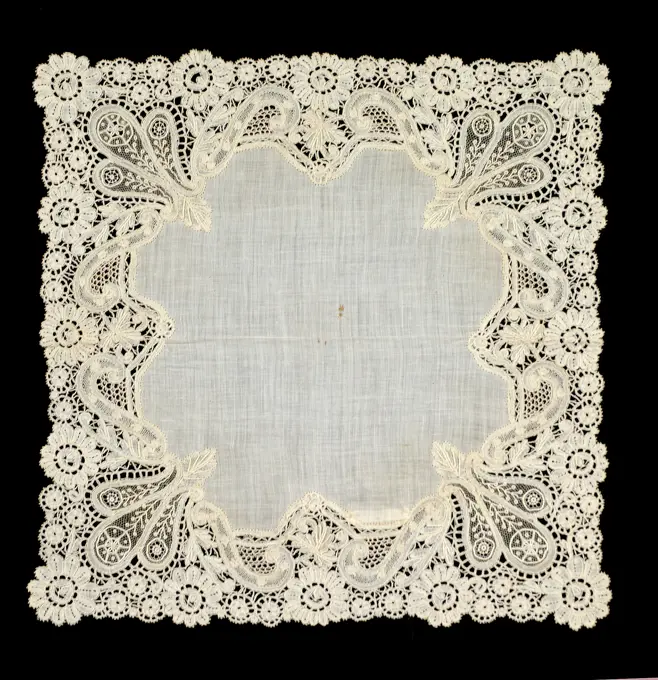
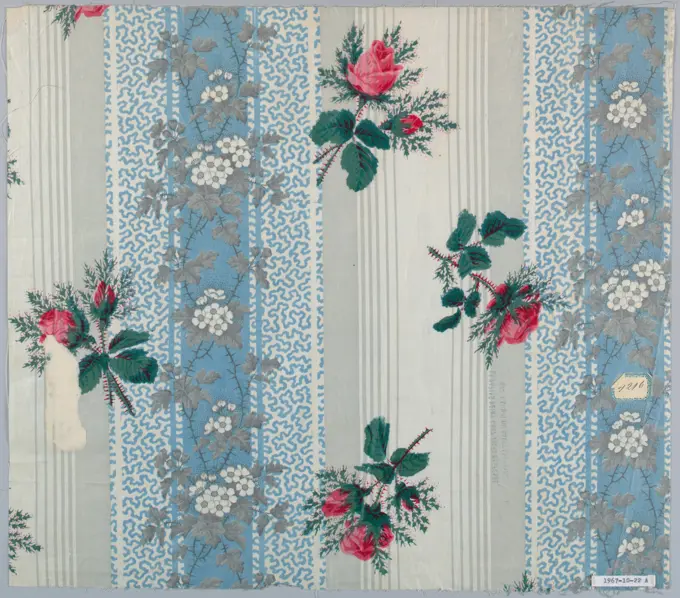
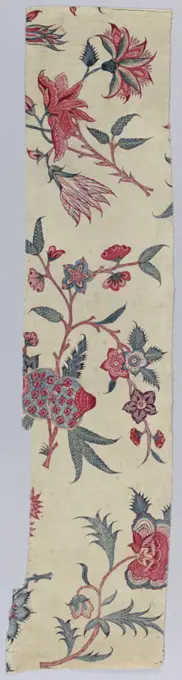
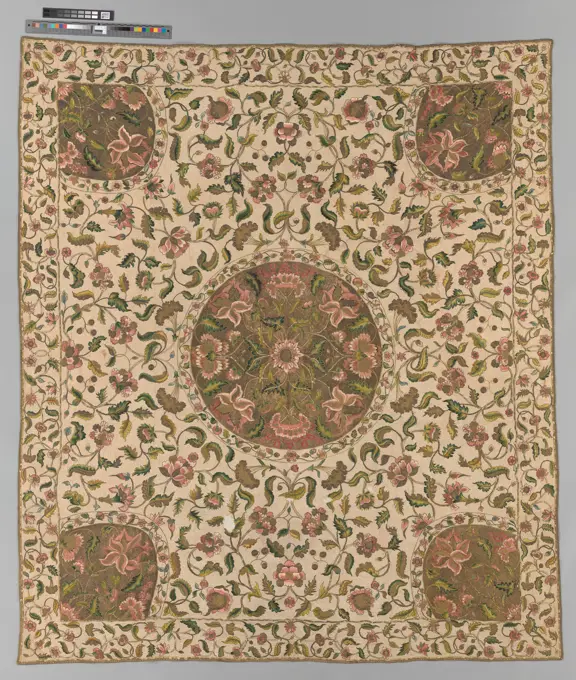
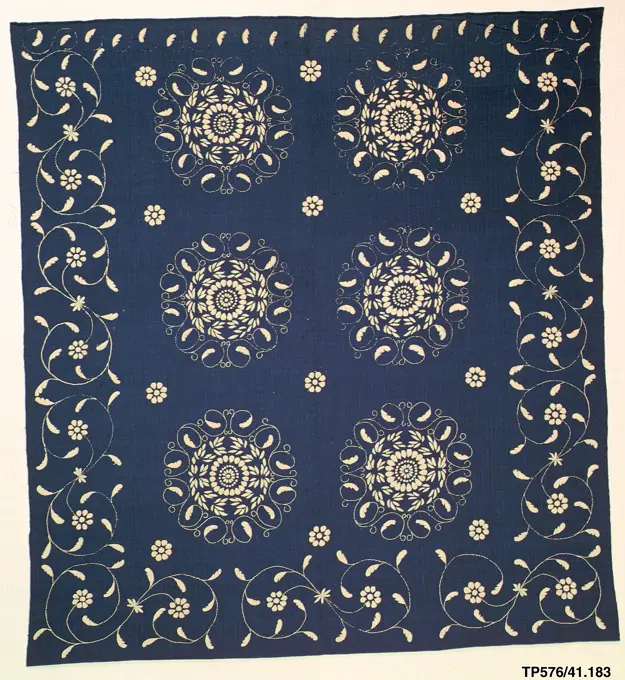
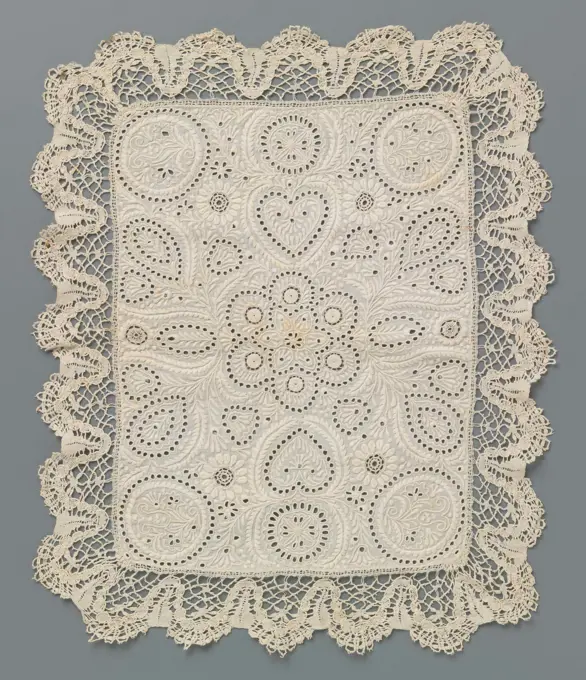
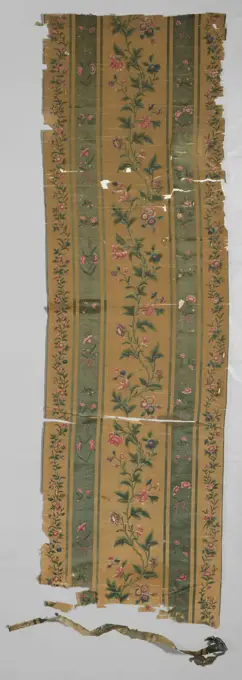
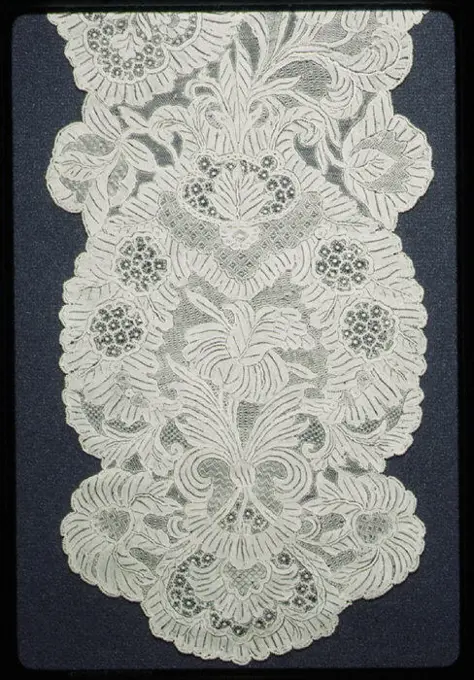
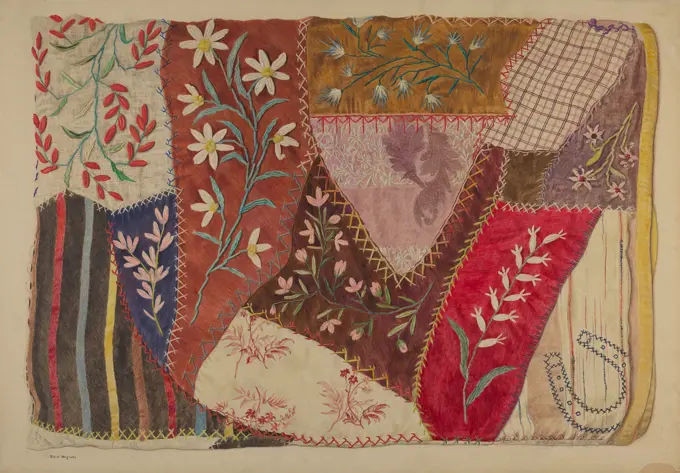
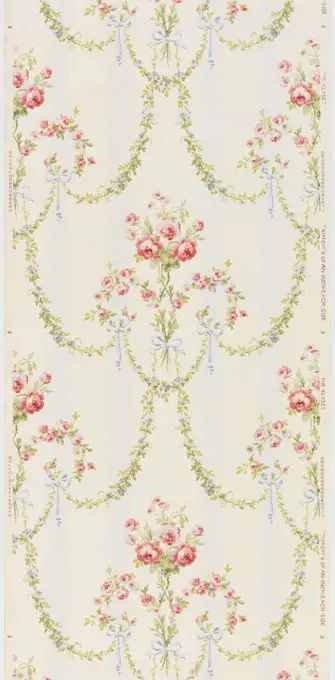
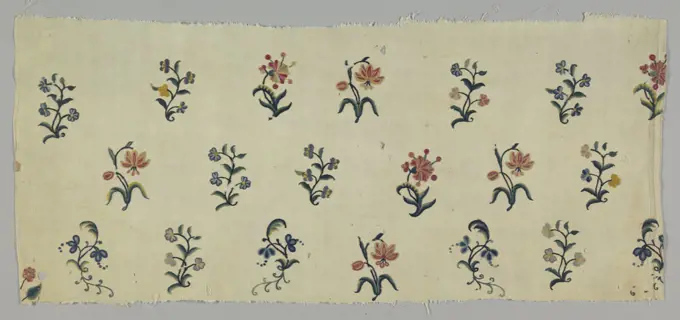
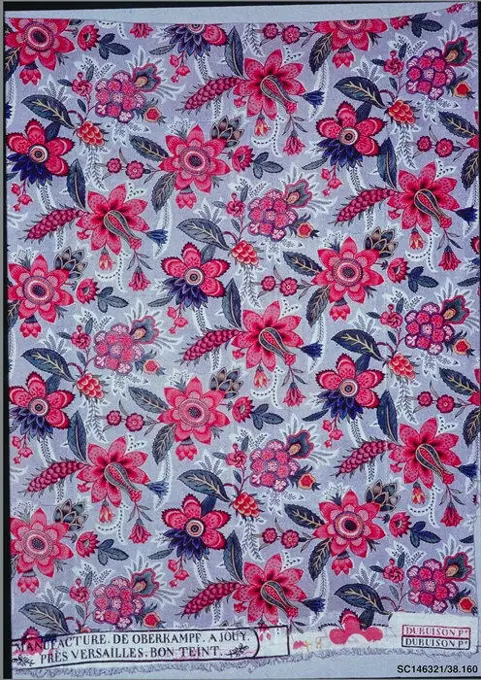
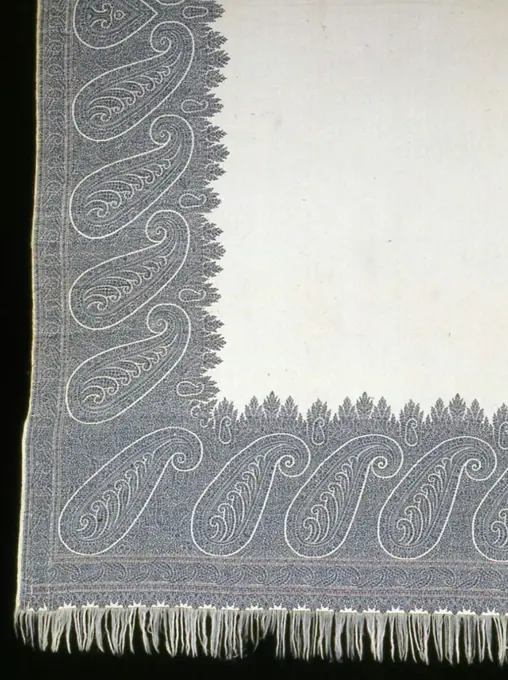
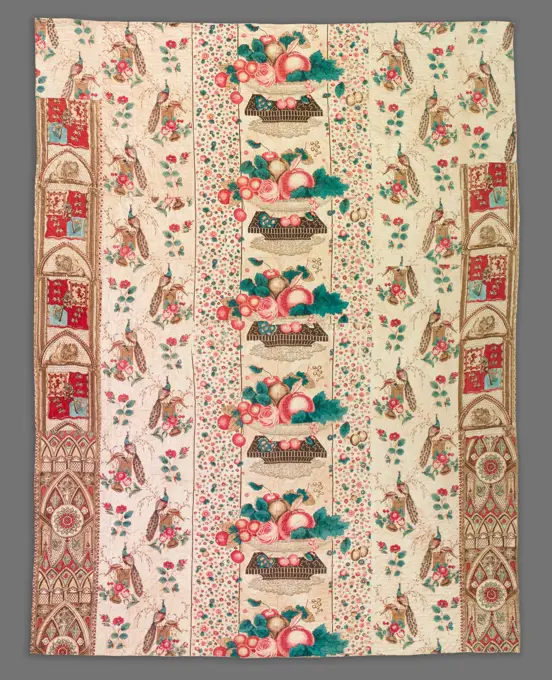
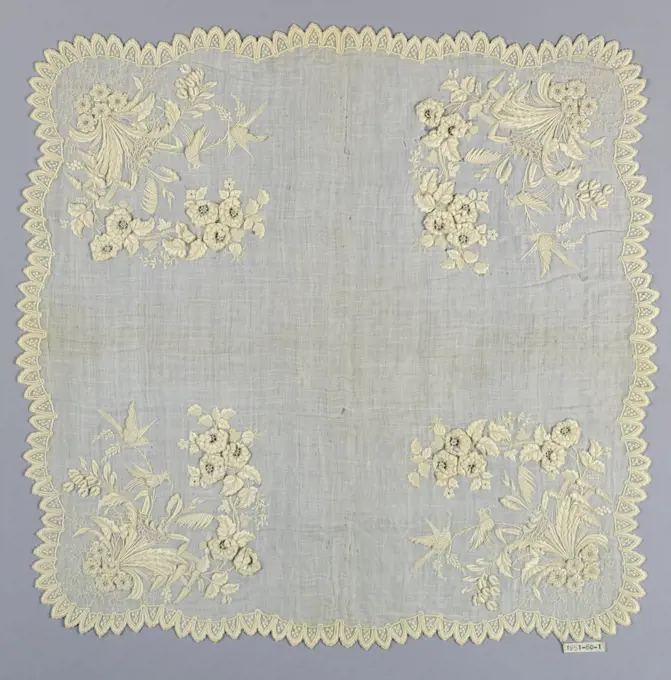
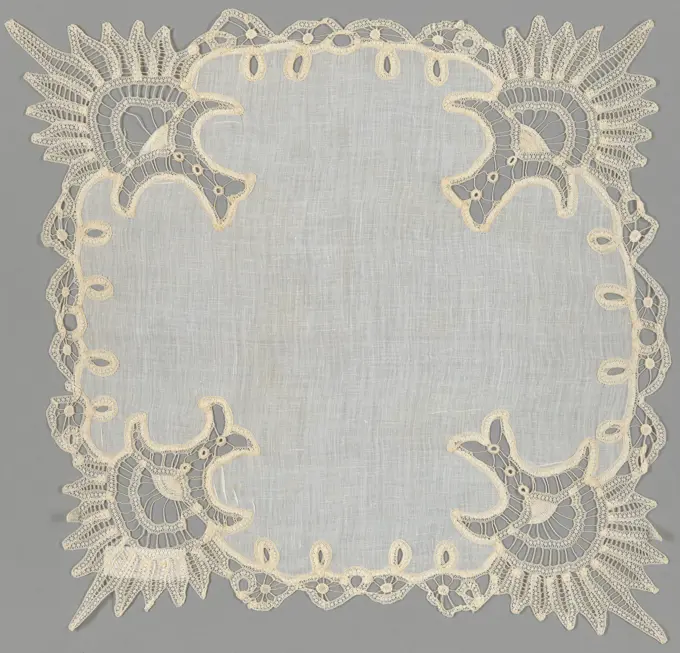
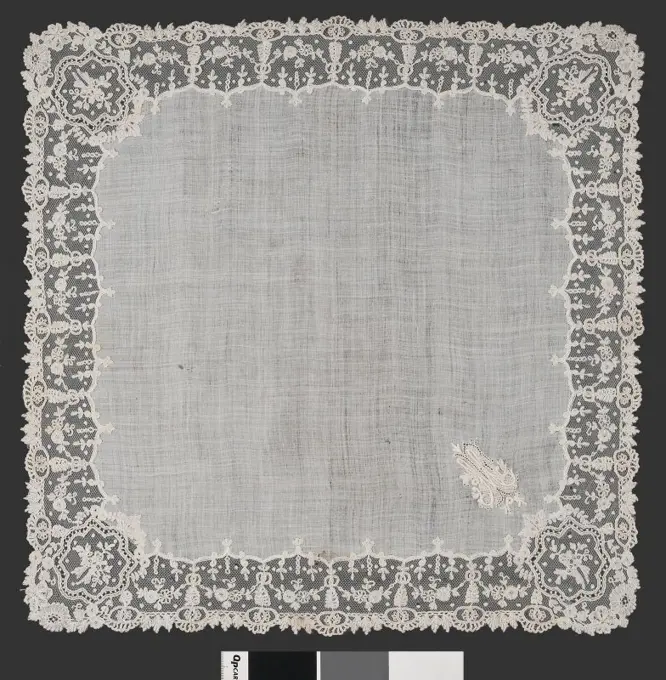
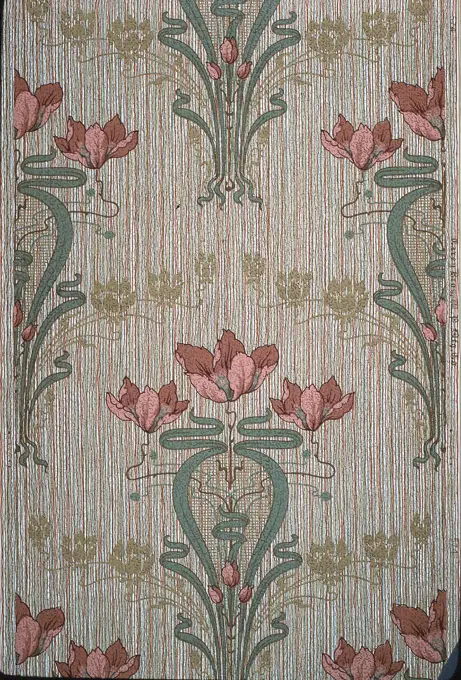
Sidewall (USA); Manufactured by Carey Bros. W.P. Mfg. Co.; machine-printed paper; 94 x 49.5 cm (37 x 19 1/2 in.)Handkerchief third quarter 19th century Belgian. Handkerchief 169440Glazed Chintz Fragment, c. 1830. England, 19th century. Machine and block printed cotton; overall: 45.2 x 64.8 cm (17 13/16 x 25 1/2 in.).Fragment early 18th century Italian. Fragment 230382Piece 1760-70 French. Piece 223676Piece 17th century Japan. Piece 71468Fragments (France); Company: J.P.Meiller et Cie.; Produced by Meillier et Cie; Warp x Weft (a): 31 x 53 cm (12 3/16 x 20 7/8 in.) Warp x Weft (b): 22 x 12 cm (8 11/16 x 4 3/4 in.); Bequest of Elinor Merrell; 1995-50-15-a,bPiece 18th-19th century Japan. Piece 67761Britain of fabric;  16th century (1501-00-00-1600-00-00);Fabrics, Turkish fabricsLength of Woven Silk Made 1735-1738 France. Silk and gilt-metal-strip-wrapped silk, plain weave with supplementary patterning wefts and some supplementary brocading wefts bound in weft-float faced 3 1 twill interlacings .Fragment Oriental textile. Fragment oriental textile, with a striped pattern. Red courses filled with a winding leaf drink with flowers in blue, green and silver alternate with a green and yellow striped job in which a silver geometric ornament.Batist handkerchief with an edge application side with flower garlands and the initials AVM. Natural batist's handkerchief with a rim applicationside around: Duchesse-side Applied to a square grille (machine tulle). The batist is eight. The side has a pattern with a few flower garlands between the wavy zigzag line that follows the contours of the eight-pubic center of Batist and the wavy zigzag line along the outer edges. The sloping edge is formed by semi-relieving cartouches, which points out nozzles from the outer zigzag line and are interrupted here and there by a hanging flower. In one corner, an oval cartouche hangs under a flower garland with the initials AVM. The initials, the flower hearts of larger flowers and the annular moes with which the ground soil is strewn are made with needle side sign. The other motifs are made in linen stroke (dump edge) with openwork edges and contour lines and partly equipped with clost relief contours. The motifs are connected by a square grilleChintz Fragments (India); cottonPanel Made 1820-1840 France. Cotton, plain weave; block printed .Piece 18th-19th century Japan. Piece. Japan. 18th-19th century. Silk. Edo period (1615-1868). Textiles-WovenFragment Multicolor striped silk Pekin. A fragment of white silk with stripes, about which multicolored sprinkled flower branches.Textile Fragment, 1774-1793. France, 18th century, Period of Louis XVI (1774-1793). Droguets Lisèrés; silk; overall: 12.4 x 13.3 cm (4 7/8 x 5 1/4 in.).Textile fragment 1700-1899 Russian This object is from the collection of Natalia de Shabelsky (1841-1905), a Russian noblewoman compelled to preserve what she perceived as the vanishing folk art traditions of her native country. Traveling extensively throughout Great Russia, she collected many fine examples of textile art of the wealthy peasant class. From the 1870s until moving to France in 1902, Shabelsky amassed a large collection of intricately embroidered hand-woven household textiles and opulent festival garments with rich decoration and elaborate motifs. The Brooklyn Museum holdings include many fine examples including the majority of the garments. Portions of Shabelsky's collection are also housed at the Museum of Fine Arts, Boston, the Cleveland Art Museum, and the Russian Museum of Ethnography in St. Petersburg.Naboyka are block-printed textiles used for clothing as well as household objects and book bindings. The design motifs of these textiles are very old, dating to as earTextile (France); cotton; Warp x Weft: 63 x 43 cm (24 13/16 x 16 15/16 in.)Sample (Russia); silk, metallic threadTextile; Manufactured by Schwartz-Huguenin; cottonPiece French 19th century View more. Piece. French. 19th century. Textiles-WovenBorder (France); silkFragment silk damest in red and white; damask. A fragment of red damask on which in white a symmetrical pattern of leaves and flower branches between which pagoda-like motifs and irregular striped striped forms.Textile; silkChintz fragments, Medium: cotton Technique: black outline drawn on; mordants for 3 reds and 2 purples applied (sometimes over resist) by pen or brush; blue applied by brush over resist; yellow (over blue for green) applied by brush., Three fragments from the same larger textile. Exotic flowering branches and scattered floral sprays in shades of violet, blue and red on a white ground. B. had one flower that matches a flower on A. and another flower which matches a flower on C., India, late 18th century, printed, dyed & painted textiles, Chintz fragmentsTextile Fragment, 1800s. Japan, 19th century. Silk; average: 20.3 x 9.6 cm (8 x 3 3/4 in.).Ceiling Paper (USA); Manufactured by Liberty Paper & Bag Co., Liberty Wall Paper Company; machine-printed paper; 71.5 x 47 cm (28 1/8 x 18 1/2 in.)Silk dress with silver thread, anonymous, c. 1700 - c. 1799 Silk rug with floral pattern in green, white and pink, with lobbed silver side along the edges.  silk. silver thread. linen (material) Silk rug with floral pattern in green, white and pink, with lobbed silver side along the edges.  silk. silver thread. linen (material)Piece 19th century Japan. Piece 67154Bedcover 1725-50 British While the Portuguese were undoubtedly the first importers and consumers of the Indian embroideries made for the western European market, at least a few examples of these textiles did appear in England by the late sixteenth century. The 1601 inventory of Bess of Hardwick, Countess of Shrewsbury (15271608), included two quilts that were almost certainly products of this trade: "a quilt of yellow India stuff embroidered with birds and beasts" and "a quilt of India stuff embroidered with beastes."¹ Indian quilts of the type produced for the Portuguese market appeared with increasing frequency in London sales into the 1620s, when their value began to decline, perhaps because of diminishing novelty.²The taste for Indian-style embroidery remained, however, and it is interesting to note that the English maker of another bedcover in the Museum's collection (MMA 34.104.1) used not only the Indian palette of golden yellow on white but also an imported Indian cotton as thPiece 17th century or earlier China. Piece 69813Sampler, Medium: silk embroidery on wool foundation Technique: counted and uncounted stitches; cross and satin stitches on plain weave foundation, Scattered motifs including flowers, crowns, animals, birds, and Adam and Eve with the Tree of Knowledge in colored silks, predominantly green and yellow., Europe, late 18th century, embroidery & stitching, SamplerTextile, Medium: silk Technique: plain compound weave with supplementary weft, Paired pink warp-ribbed stripes setting off floral serpentines of bright, multicolored flowers on a cream-colored ground., France, ca. 1775, woven textiles, TextileTextile; cottonFragment (India); cotton; Warp x Weft: 42.5 x 19 cm (16 3/4 x 7 1/2 in.)Sheet with ornaments, boat, car and weapon of the Netherlands, Carel Adolph Lion Cachet, 1874 - 1945 print   paper  coat of arms (as symbol of the state, etc.). ornaments ~ artSampler, 1829. England, 19th century. Embroidery: silk on linen tabby ground; overall: 45.4 x 37.2 cm (17 7/8 x 14 5/8 in.).Coverlet, Agriculture & Manufactures pattern 1837 American This double cloth coverlet is woven in one wide panel of undyed cotton and dark blue wool. The central field has large floral medallions, and the borders are decorated with images of eagles with outspread wings alternating with Masonic symbols.. Coverlet, Agriculture & Manufactures pattern 13638Piece 18th century Japan. Piece 71564Fragment; cotton; Warp x Weft: 41.5 x 63 cm (16 5/16 x 24 13/16 in.); Bequest of Elinor Merrell; 1995-50-274Fragment veelkleurig zijde lampas.Two fragments of a silk tissue. Two fragments sewn together. A large branch with yellow-green leaves, large salmon-colored flowers and ditto buttons in various shades on and green soil. Numbered a and B.Tablecloth, embroidered unknownFolding Screen (United States or England); wool and silk on cotton foundation, wooden frame, brass nailsSidewall, Genola; Manufactured by Shand Kydd, Ltd. (United Kingdom); England; machine-printed; 64.5 x 56 cm (25 3/8 x 22 1/16 in.)Embroidered blanket ca. 1835 American The dark blue twill-woven ground of this blanket is embroidered in heavy white cotton thread with economy stitches and stem stitches. The central area is decorated with large medallions. Three sides are bordered with embroidered vines, and the top edge has small embroidered leaves. The piece is made of two panels of fabric, which have been seamed at the center.. Embroidered blanket 13610Sampler (Mexico); silk embroidery on cotton foundationCope 1725-30 Italian. Cope. Italian. 1725-30. Silk and metal threadFragments, Medium: silk Technique: plain weave with discontinuous supplementary weft patterning (brocade), Fragments of woven brocade showing flower stalks on lattice in navy, pale blue and cream., Lyon, France, mid- 18th century, woven textiles, FragmentsBed Hanging. Design attributed to Daniel Marot (French, about 1663 - 1752)Front doublure.. Halévy, Ludovic (1834-1908). bindings (gathered matter components), Book covers. 1887. Spencer Collection. BookbindingDress from Batist with embroidery around finished with a climbing side. Dress of natural-colored batist with English embroidery with needle lace fillings and finished around with a climbing side. The embroidery covers the entire dress. It is a symmetrical pattern with a rosette with six flower leaves in the middle, flanked by a sideway-directed heart-like motif and a circular motif, respectively. There is also a circular motif in every corner. Along the long sides, above the central rosette and between the corner circles, are mirrored to each other two flower branches. Other motifs in the remains include daisies, chali flowers and rosette flowers. The motifs are formed by or surrounded by elongated feathered leaves and many circular recesses. In a few large round recesses, including in the flower leaves in the rosette flower, needle lace windows have been applied. The lace pattern consists of a wavy line of jointed ovals. In the field above each valley is a sun or flour, a fan-shaped mÔhi (Stole) Made 1801-1825 Japan. .Chalice cover, Medium: silk, metallic thread Technique: satin stitch embroidery, Faded purple ribbed silk ground embroidered in colored silk and metallic thread. Central design shows a cruciform composed of conventionalized flowerheads in profile and S-forms of foliage. Cover design of symmetrical delicately curving vine and flower. Narrow border of similar small scale design. Red, pale green and peach-colored silks., Italy, 16th-17th century, embroidery & stitching, Chalice coverTextile Fragment late 16th century. Textile Fragment 454448Needlework Bed Hanging in the Bizarre style (left half), 1710-20. France, 18th century. Silk, wool; needlework, tent, and cross-stitch embroidery on canvas; overall: 83.2 cm (32 3/4 in.).Fragment of two sewn parts. Fragment of two parts sewn together, predominantly green with pattern of scalloped tires with leaf and flower work and parts of circles that can be seen at one a fruit, flowers and leaves.Fragment (France); Company: Fils et Bompar; cotton; Warp x Weft (selvedge on left): 32.5 x 67 cm (12 13/16 x 26 3/8 in.) Repeat H: 33 cm (13 in.)Cravat end, Medium: linen Technique: needle lace with ground of loop and twist with twist return Label: linen needle lace, Cravat end with a central design of abstract foliated forms flanked by identical stylized representations of trees surrounded by an intricate pattern of volutes, urns, and rocaille decoration., France, early 18th century, lace, Cravat end. Silk, plain weave with weft-float faced 2 1 twill interlacings of secondary binding warps and brocading weftsFragment, Medium: silk, metal Technique: woven, 18th century, woven textiles, FragmentFragment Made 1650-1700 Europe. Linen and wool, compound weave (i.e. Beiderwand or Lampas 2 1) .Wallpaper painted on silk with stripes, stern bouquets, interspersed with loose flowers and raised tendrils with leaves and flower variations, anonymous, c. 1750 - c. 1800 A wall compartment with painted wallpaper on the side. The cream-white soil in rip binding is per track by two gray-blue stripes in satin binding, divided into a wide middle section and narrower side sections. On the blue bouquets were painted with loose flowers painted, a raised slender with leaves and flower variations in pink, lilac and blue and a narrower slender with flowers on the sides. Northern Netherlands (possibly)Netherlands (possibly) silk. paint (coating) A wall compartment with painted wallpaper on the side. The cream-white soil in rip binding is per track by two gray-blue stripes in satin binding, divided into a wide middle section and narrower side sections. On the blue bouquets were painted with loose flowers painted, a raised slender with leaves and flower variations in pink, lilac and blue and a naTextile (England); cottonFragment striped silk tissue with flowers, anonymous, c. 1800 - c. 1900 Fragment silk tissue. A green with red striped soil has rows of flower branches in pink and white. Spain (possibly) silk Fragment silk tissue. A green with red striped soil has rows of flower branches in pink and white. Spain (possibly) silkFragments (Spain); silkPair of lappets first half 18th century Italian, Venice or Flemish, Brussels. Pair of lappets 227612Piece 19th century Japan. Piece 66474Piece. Culture: Russian, Moscow. Dimensions: L. 47 1/2 x W. 20 5/8 inches (120.7 x 52.4 cm). Manufactory: Attributed to Lazareff. Date: 18th century. Museum: Metropolitan Museum of Art, New York, USA.Piece French 18th-19th centurySample, Orinoka Mills, (Philadelphia, Pennsylvania, USA), Pink/brown warp with lighter and darker pink/brown weft. It has a fringed edge that would have been the beginning of a length., USA, ca. 1910, woven textiles, SampleEdith Magnette, Crazy Quilt, c 1940 Crazy QuiltTablecloth of linen with pattern of a vase with roses in filet transition, c. 1900 Tablecloth made of linen with a pattern of a vase with roses in filet transition. Italy linen (material). Tablecloth made of linen with a pattern of a vase with roses in filet transition. Italy linen (material).Domino paper, Block-printed and stenciled paper, Vertical rectangle. Yellow field, with serpentine ribbon intertwined with floral vine, alternating with black band composed of leaves and fruit or berries., France, ca. 1750, Wallcoverings, Domino paperTextile; silk, metallicBorder (USA); Manufactured by Illinois W.P. Mills; machine-printed; 85 x 48 cm (33 7/16 x 18 7/8 in.)Fragment brocheted silk with a flower branch in yellow and green.A Fragment of White Silk with a Flower Branch Pattern with Three Stylized Flowers, in Green, Yellow and White.Scrapbook (USA); silk, metallic, wool; Closed book: 35 x 32 x 7 cm (13 3/4 x 12 5/8 x 2 3/4 in. ); Bequest of Benjamin E. Marks; 1967-54-10Fragment; silkTextile, Medium: linen warp, cotton weft Technique: plain weave foundation. Block-printed: black, red and yellow. Blue applied by brush over yellow for a dull greenish-blue., Fragment of a bold floral pattern on a 'picotage' background., France, 18th century, printed, dyed & painted textiles, TextileChef de piece, Louis Bire et Verdonnet, Medium: cotton Technique: block printed on plain weave with blocks for red and black., Floral stripe alternate with twining stripe. Red and black on natural., Bordeaux, Gironde, France, 1790-99, printed, dyed & painted textiles, Chef de pieceTextile (England); Manufactured by Bromley Hall (United Kingdom); cottonSampler (Mexico); linen and silk embroidery, linen foundationThe Elysee, Machine-printed on paper, Bouquets of red roses and foliate garlands tied with blue bows, printed on satin striped white background., USA, 1884-90, Wallcoverings, Sidewall, SidewallTextile, Medium: crewel wool, cotton, linen Technique: chain stitch embroidery on plain weave, Section of undyed cloth embroidered with medium-scale stylzied semi-fantastic flower sprays with graceful S-curve, in wool chain stitch in shades of pink, blue, green, yellow, white; horizontal rows, diagonal repeat. One plain selvage., France, 18th century, embroidery & stitching, TextileFragment; silk on silkPiece late 18th century Oberkampf Manufactory French. Piece 226339Piece 18th-19th century Japan. Piece 67274Hanging, Millefleur; Designed by John Henry Dearle (British, 1860-1932); Manufactured by Morris & Company, Decorators Ltd.; England; woolWall hanging made of silk fabric unknownSquare Shawl Made 1830-1835 Edinburgh (Object Probably made in), England (Object Probably made in), Norwich (Object Probably made in), Scotland (Object Probably made in), Paisley (Object Probably made in). Cotton and wool, center of weft-float faced 1 3 'Z' twill weave; borders of weft-float faced 3 1 twill weave with supplementary patterning wefts bound in weft-float faced 1 3 'Z' twill interlacings over warp-float faced twill weave; attached wool and silk, knotted fringe; two selvages present; woven on loom with Jacquard attachment .Wall hanging made of silk fabric unknownFragment of a multicolored silk tissue. A silk fabric with decor in Chinese trant. On a red soil a woven drawing in silver thread and silk. Note: Self side; 0.5 cm Plain bond (2 impacts in one jump).Quilt, Strip pattern ca. 1840 American. Quilt, Strip pattern. American. ca. 1840. Cotton. Made in New Hampshire, United StatesHandkerchief, Medium: cotton on linen Technique: buttonhole, padded buttonhole, padded satin, overcast cord, stem over running, and speckling stitch embroidery on plain weave; cutwork with needle lace fillings, Elaborately embroidered handkerchief of fine white linen. Corner design worked in naturalistic flower spray, bird's nest with baby birds, and a pair of adult birds with overhanging flower clusters. Latter are worked with raised separate flower petals, possibly made and attached separately. With openwork and buttonhole details in centers. Adult birds have raised wings. Partly free from ground and probably made separately. Edge is scalloped and worked in a kind of lambrequin design., Belgium or France, mid- 19th century, embroidery & stitching, HandkerchiefCornelius Christoffels, Handwoven Coverlet, c 1937 Handwoven CoverletTextile Swatches Onondaga Silk Company, Inc. (1925-1981). , 1948-1959. Silk, a: 42 3/4 x 22 1/4 in. (108.6 x 56.5 cm).    1948-1959Bliżej Kultury unknownHandkerchief. unknown, authorSpecimens of painted lacquer  work from the Collection at  the India House        Date: 1868