Historic Metal Candlesticks and Cups

Antique metal candlesticks and ornate cups from various periods, featuring intricate decorations and historical significance, reflecting craftsmanship and artistry.
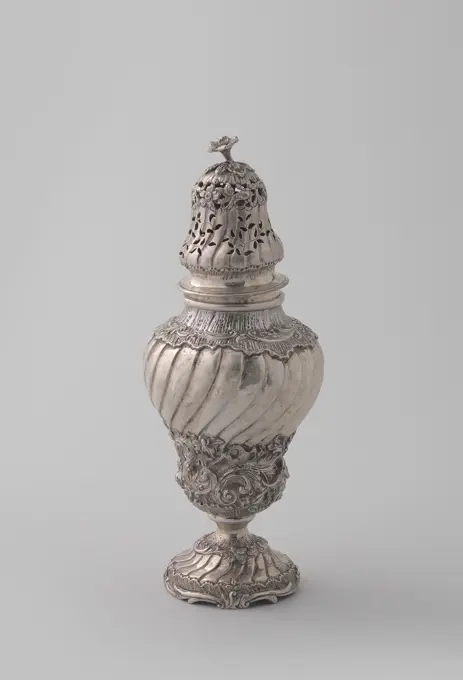
Silver sugar spreader, inverted pear shape on curved foot with twisted openwork cap decorated with driven rocailles, tibulas, flowers and birds., Jan Verdoes (Falsification of), 1746 Silver sugar spreader. The reverse pear -shaped barrel, the vaulted foot and the openwork cap are twisted and decorated with driven rocailles, tiflens, flowers and birds. Haarlem silver (metal) Silver sugar spreader. The reverse pear -shaped barrel, the vaulted foot and the openwork cap are twisted and decorated with driven rocailles, tiflens, flowers and birds. Haarlem silver (metal)
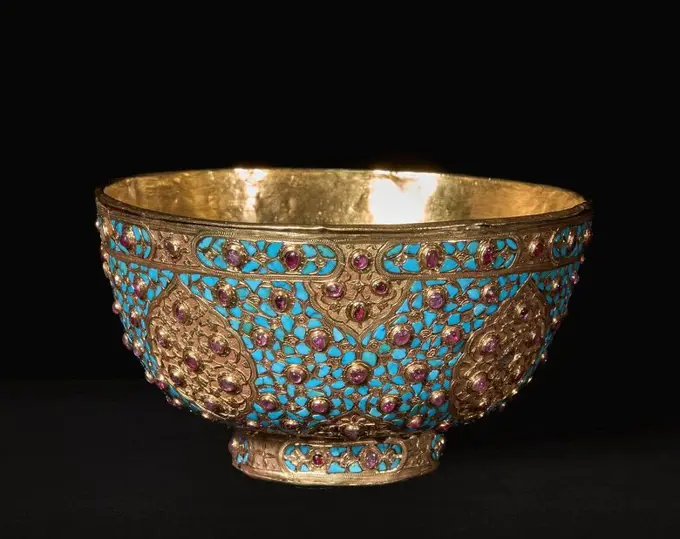
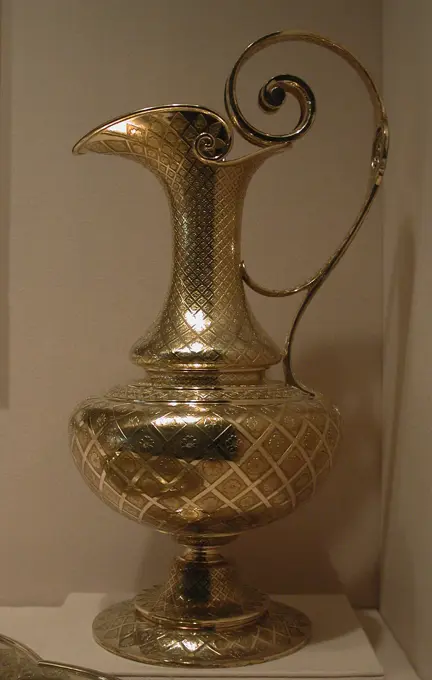
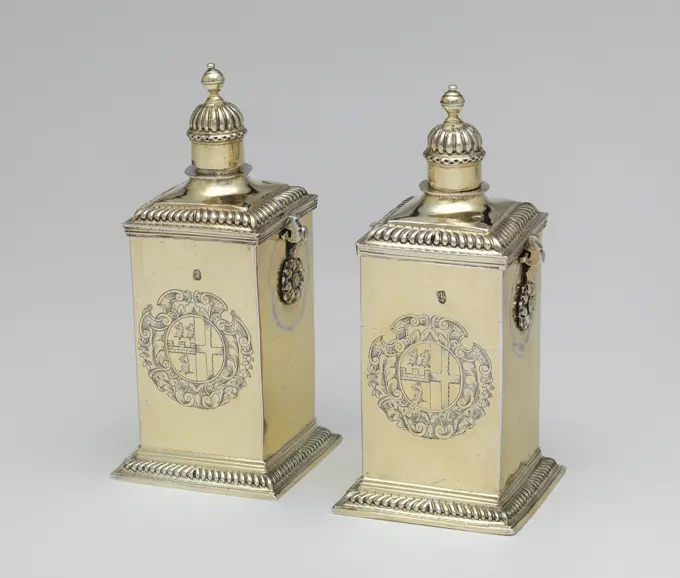
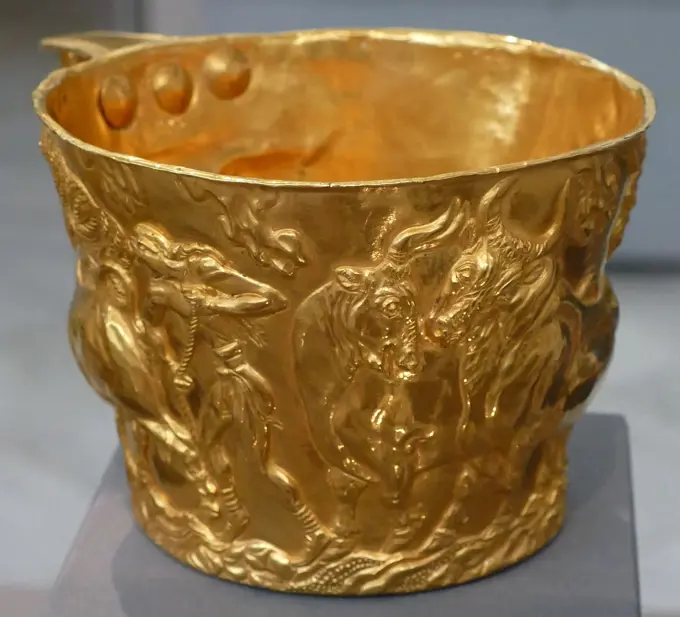
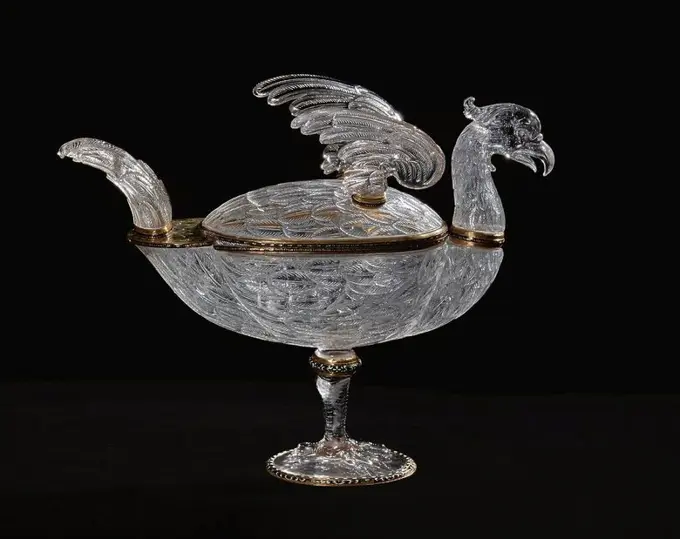
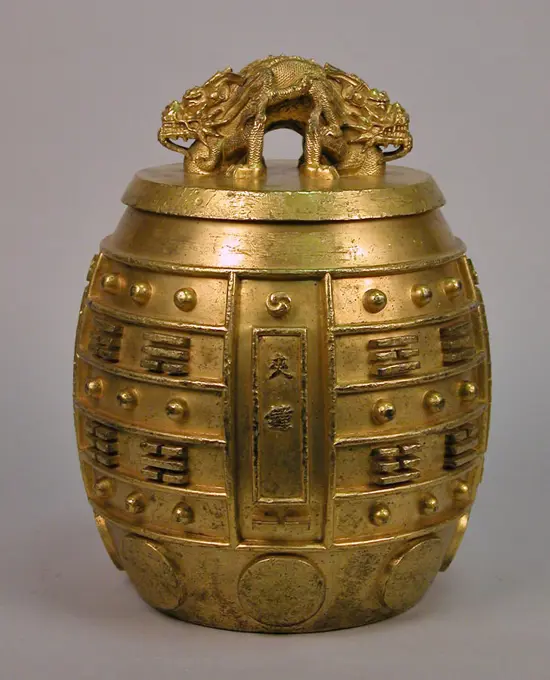
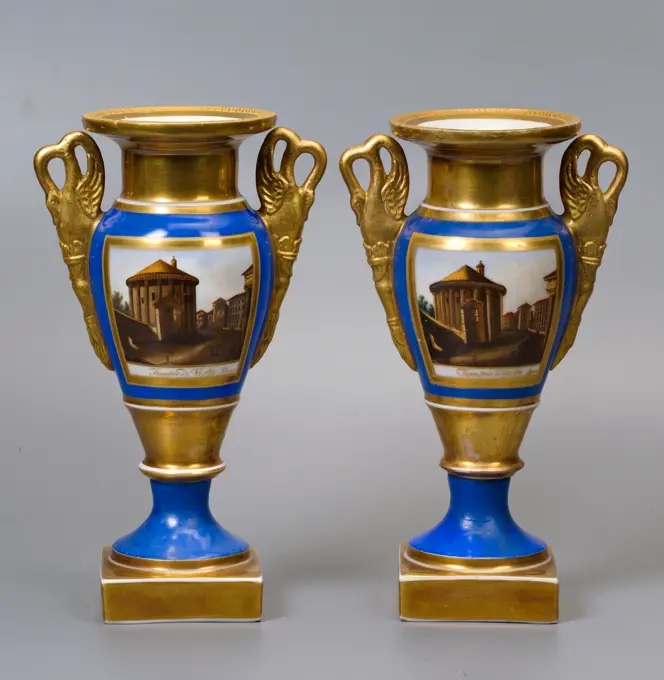
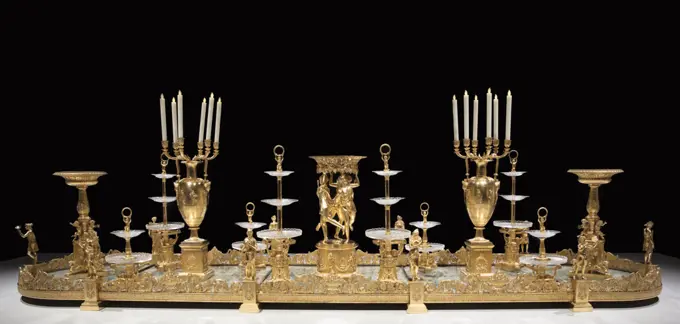
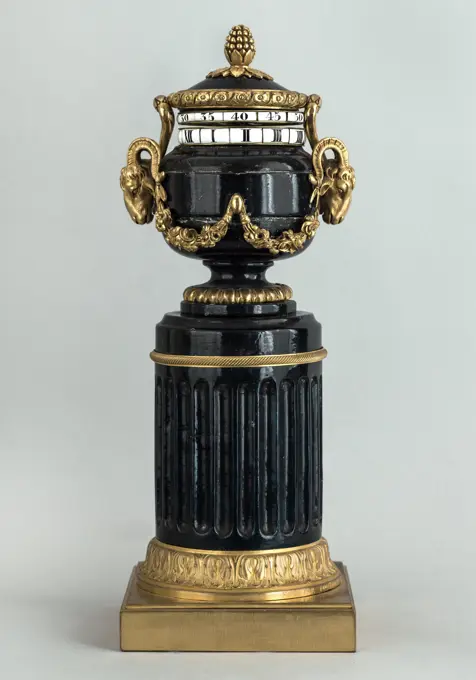
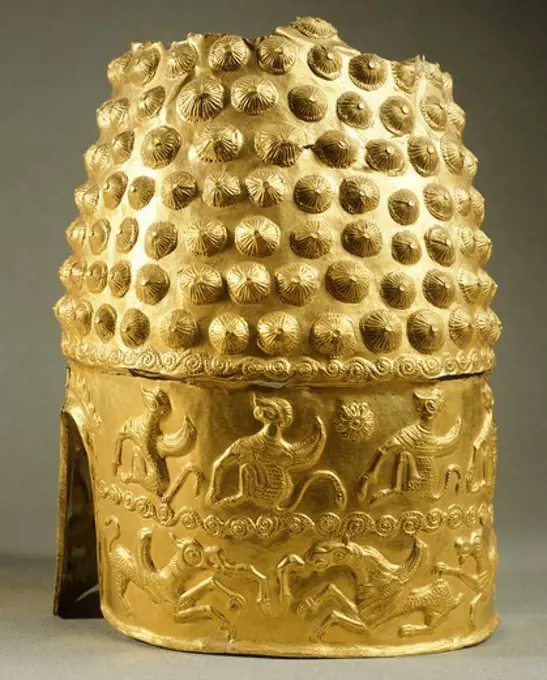
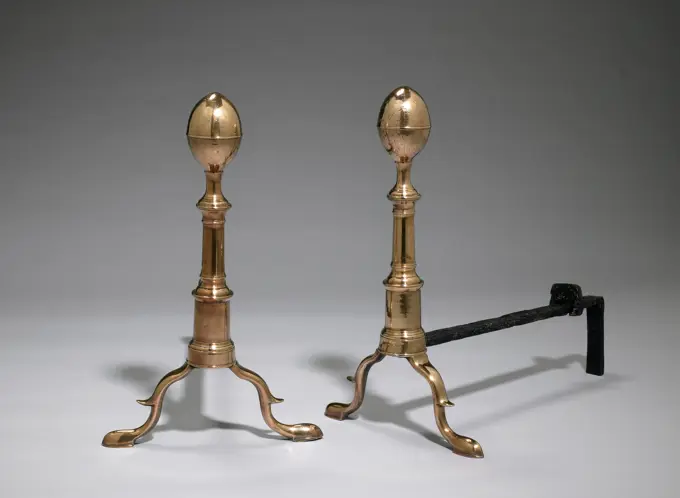
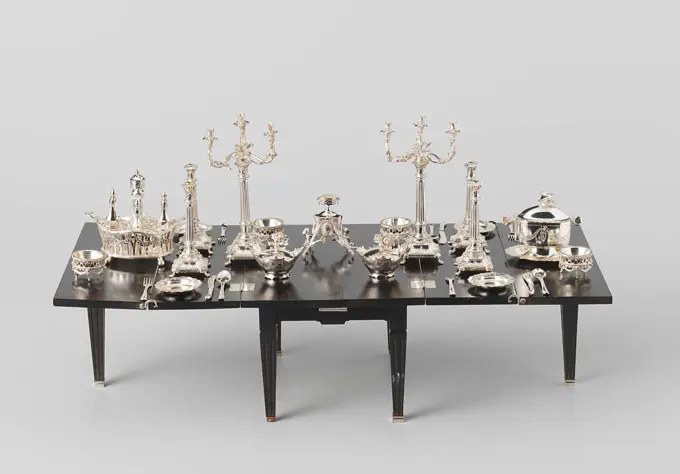
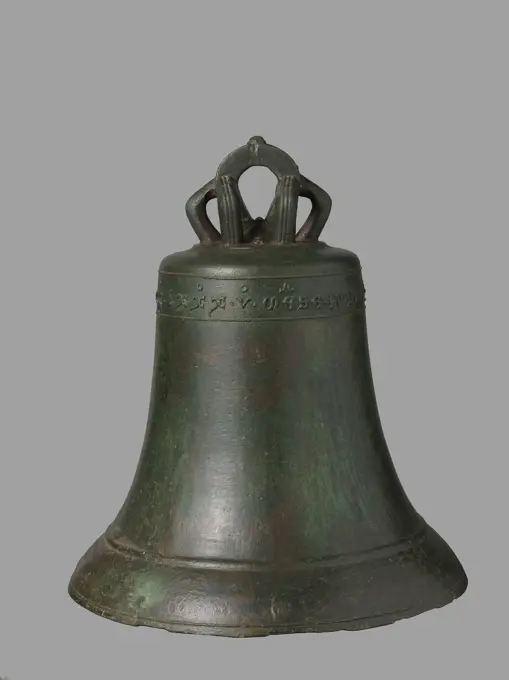
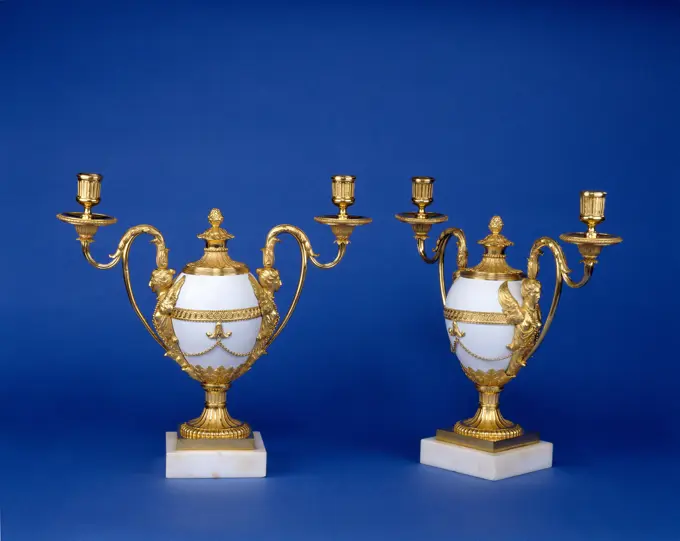
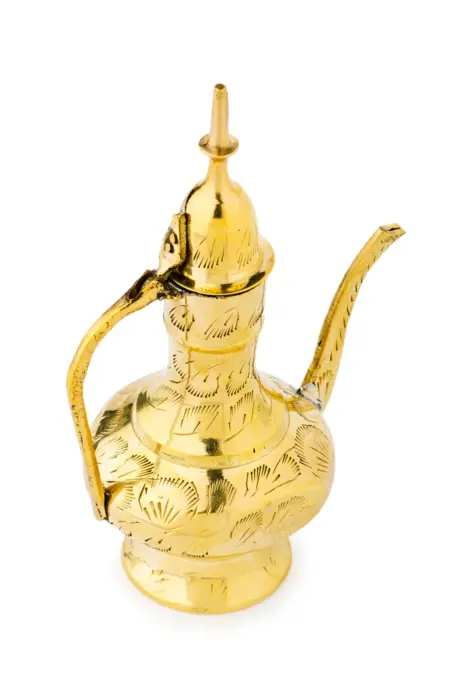
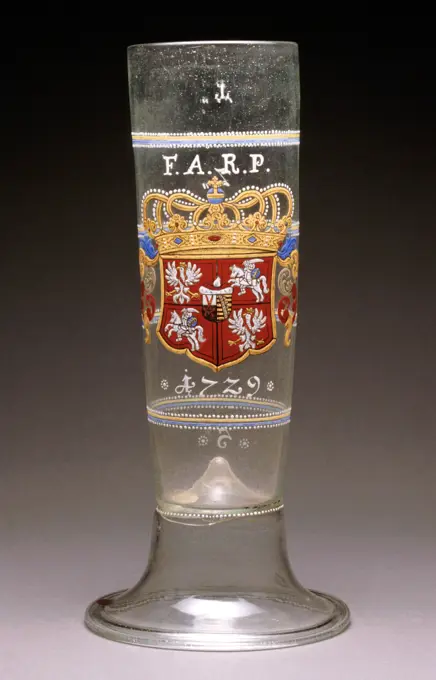
'Bronze Yu', c3rd century BC to 3rd century AD, (1936). Artist: Unknown.Antique glass 1898, Middle EastHoly water bucket (wessel) and aspersorium. 17th-18th centuries. Spun, cast an chased silver. Goa, in times as a colony of Portugal,India.Anonymous / 'Case for fluted heliotrope goblet with turquoises'. 1650 - 1711. Leather, Wood, Metal, Cloth. Museum: Museo del Prado, Madrid, España.Mughal Workshop; Ottoman Workshop / 'Gold tazza with turquoises and rubies'. 1580 - 1630. Gold, Ruby, Turquoise. Museum: Museo del Prado, Madrid, España.Stacking Boxes, anonymous, c. 1800 - before 1815 Stack box, consisting of two stacked trays, a lid and a handle. The walls of the bins and the lid always consist of eight openwork panels with representations of Chinese in many different out -of -home activities, contained in ribs decorated with simpler motifs; The handle is decorated with dragons in relief. On the foot a beautiful strap of flower branches with bats. The lid button consists of different fruits and flowers. Canton gegeel: ivory cutting Stack box, consisting of two stacked trays, a lid and a handle. The walls of the bins and the lid always consist of eight openwork panels with representations of Chinese in many different out -of -home activities, contained in ribs decorated with simpler motifs; The handle is decorated with dragons in relief. On the foot a beautiful strap of flower branches with bats. The lid button consists of different fruits and flowers. Canton gegeel: ivory cuttingCovered entrée dish, one of a pair, 1809-1810, Paul Storr; Manufacturer: Rundell, Bridge & Rundell, English (London), English, 1771-1844, 8 1/4 x 10 1/8 x 10 1/8 in. (20.96 x 25.72 x 25.72 cm), Silver, England, George III, These dishes were issued to Sir Gore Ouseley (1770-1844) upon his appointment in 1810 as Ambassador-Extraordinary and Minister, Plenipotentiary to the Court of Persia, when the dishes formed part of his ambassadorial service. On the side of each is engraved the arms, motto, and supporters of Ouseley and the arms of King George III. The finials feature a hound rising from a ducal coronet, a reference to the Ouseley family crest.Ewer ca. 1850 François-Desiré Froment-Meurice Froment-Meurice, among the most renowned silversmiths of mid-nineteenth-century Paris, was a historicist whose work embraced medieval, Renaissance, and Islamic styles, which he charged with an abundance of sculptural ornament. Here, in a radical departure both from his own manner and from the prevailing taste of the period, he let the suavely curved profiles speak for themselves, emphasizing them through the use of a single all over trellis and flower-head pattern, adjusted in scale and rhythm to each change of surface (see also 1999.217.2). Combining traditional and new techniques, Froment-Meurice introduced both chromatic and textural variety through chasing, engraving, and electroplated gilding in two colorsyellow and greenish white goldon a ground that had been partly polished and partly acid etched. Froment-Meurice frequently repeated his models, and this ensemble is one of three known versions. It was perhaps an experimental design Pair of perfume bottles 1700/1 John Bodington British The engraved arms on these perfume bottles are beautifully preserved. Even the delicate circle traced by the engraver as a compositional aid has not worn off. The system of indicating colors or tinctures in the arms had not been widely adopted yet, so these arms cannot be securely identified. The bottles were part of a large silver dressing-table service that would have included a mirror, combs, brushes, and boxes for powder and pomadeall the necessary implements for grooming.. Pair of perfume bottles 205210Gold grave object from the Pylos Tholos Tombs; 14th century BC; Mycenaean.Marble trophy cup - 3d made'Dish warmer and cover, c.1820', 1953. Artist: Unknown.Pitcher and shaving basin (Bacia). Chiselled white metal alloy from China (paktong), 18th-19th century.CUBO DE AGUA BENDITA EN MARFIL. Location: VICTORIA AND ALBERT MUSEUM. LONDON. ENGLAND.Vase 1810-1820 Burslem. Stoneware (caneware) with applied blue decoration . Wedgwood Manufactory (Manufacturer)Taller de las Águilas / 'Rock crystal vessel in the form of an eagle'. 1550 - 1600. Rock crystal / Hyaline quartz, Enamel, Gold. Museum: Museo del Prado, Madrid, España.Bell of Archaistic Design (Bo) dated 1715 China Bo (written with a different character from that for "cymbals") is a term for bells with suspension loops on the top. Bronze Age examples were lentoid in cross section and capable of producing two tones. The knowledge of the shape and function of the Shang and Zhou bells was lost in later periods, and the barrel-shaped bells made for ritual music in the Qing dynasty intone only one note, as is the case with this bell.. Bell of Archaistic Design (Bo) 61083. The engraved and embossed scenes on the ewer and basin portray the victories of the Dutch in their battle with Spain. The earliest success, the Relief of Alkmaar, dates from 1573, and the last one is the naval Battle of Gibraltar in 1607. The basins dazzling centrepiece is Prince Maurices triumph at the Battle of Nieuwpoort in 1600.Pair of vases-amp; Baranówka (Porcelain Manufaktura; 1804-2012); 1828-1829 (1828-00-00-1828-00-00);Westa (mitol.), Flower decorations, miniatures, purchase (provenance), templesBrass design fitting on antique wooden candle stands, Jodhpur, Rajasthan, India Copyright: xSafatxAli/DinodiaxPhotoxSurtout de Table (Table centerpiece), Cast and gilt bronze with hand engraving, cut glass, silvered-mirrored glass, Centerpiece consisting of two urn-shaped freestanding gilt bronze candelabra, two bowls on pedestals, one large bowl supported by three female figures on pedestal, and eight gilt bronze and glass tiered stands, all arranged on five-section gilt-bronze and mirrored oval plateau; ten gilt bronze female figures in classical garb inserted at points in rim of plateau where sections are joined by architectonic pedestals. Figures typical of personages in the joyful chorus of a vintage celebration. Example of Thomire's production of classical themes of Greek origin in design. Companion objects for table: four short oval stands on rectangular bases, six short circular stands on square bases., Glass 2-tiered dishes: (u and w); Urn-shaped candelabra bases (-hh and -jj); Four-arm candelabra tops (-ii and -kk); Bowls on pedestals: (-ll and -mm); Center piece with three figures: (-nn);Pair of firedogs. Firedogs were placed in the hearth as supports for the metal rods on which the logs of wood were laid. The poodle and the cat seem to be warming them-selves by the fire. The famous bronze-caster Philippe Caffieri is known to have made firedogs with such animals.RELICARIO CON UN CLAVO DE CRUZ DE CRISTO. Location: CONVENTO DE LAS CLARISAS / MUSEO DE ARTE SACRO. MONFORTE DE LEMOS. LUGO. SPANIEN.Khew Burmese late 19th century View more. Khew. Burmese. late 19th century. Metal. Myanmar (formerly Burma). IdiophoneSigned by Pierre Gouthière (1732-1813), French bronzier. Pendulum model. Copper and painted wood, gilded bronze, 1767. Paris, Cognacq-Jay museum. 78927-17 Anse, liking, painted wood, bronze gilded, lid, copper, dorurue, watchmaking, pendulum, head, 18th 18th 18th 18th 18th 18th 18Embossed silver helmet, from Poiana Prahova, Romania. Jewellery. Geto-Dacian Civilization, 5th Century BC.Late Gothic baptismal font, St., Saint, SaintCandlestick with bronze horn playing angel, 1800 - 1900 Candlestick with bronze horn playing angel.  bronze (metal) Candlestick with bronze horn playing angel.  bronze (metal)Andiron, one of a pair, 18th century, 17 x 10 x 17 1/2in. (43.2 x 25.4 x 44.4cm), Bell metal (brass and copper), United States, 18th centuryCandle holder. Kandodelaber with three arms. The three arms in the form of a separate attachment. The foot is square and has been deployed corners. The foot is on four claw legs. The tribe has the form of a fluted column with a capital. From the capital the three arms that each wound with leaves. The Kandelaber is labeled: STK. = Amsterdam, JRL. = X (1782) and an unknown master sign.Fork. Fork with four teeth and a slightly curved handle. The handle has a middle clad and double praise. The fork is equal to three forks with Invnrs. BK-NM-11177-225, BK-NM-11177-227 and BK-NM-11177-228. The fork has not been marked.Kastanjevaas. Egg-shaped chestnut on a square foot. The two handles are rectangular and bent at the top. The vase is grooved vertically. The high-roughing lid is not grooved. The button of the lid is formed by a bunch of flowers. Guird builds are engraved on the foot. The Kastanjevaas has been labeled: STK. = Amsterdam, JRL. = G (1791) and MT. = Hendrik Duller. The Kastanjevaas is part of an identical vase (BK-NM-11177-246).ANTIQUE ASIAN METAL STATUE and URNS Cuxhaven-Altenbruch, church baptismal font. Loud clock from the church in Hekelingen. At the top decorated with two profiled tires, between the text Xrian.me. Fecit.ao. Dni.m.cc.lxxx.v.mese.junii. A medallion with a small loud clock has been applied to the lower edge. At the top of the crown to hang the clock.Cane handle probably second half 18th century probably German, Rhenish. Cane handle 202364Pair of Candlevases, 1773. Ormolu with white marble and opaque white glass.. Manufacturers: Matthew Boulton, John Fothergill. Glass maker: James Keir.. During the second half of the eighteenth century ornamental vases were very popular, in some cases sets of up to seven vases were produced to be placed together on a chimneypiece... Boulton was one of the first manufacturers to seize on the commercial opportunities created by the craze for the 'antique taste', or neo-classicism as we now refer to it, which flourished in the 1760s.. Objects like this one were known as candle vases as they could be used to hold a candle or as a vase.. Ornamental wares of this and simpler kinds made up the bulk of Boulton's production.Ancient lamp isolated on the whiteGreen Vault in Dresden, on 8 September 2004 the Green Vault in Dresden's Royal Palace will be reopened. Initially, the reconstructed rooms will be opened with an exhibition of Augustus the Strong's collection, designed according to the latest standards. In 2006, the actual rooms of the Green Vault will be added in their restored versionTHE "GOLD CUP"Two-handled cup withcover.   Maker: Ann Bateman, British, 1748-1813  Maker: William Bateman I, British, 1774-1850  Maker: Peter Bateman, Britishexhibits in the museum of the Episcopal Palace in the historic city centre of Segovia Segovia, Spain - 7 April, 2024: exhibits in the museum of the Episcopal Palace in the historic city centre of Segovia Copyright: xZoonar.com/NandoxLardix 21779687A cup from the so called consular service ĆmielówHofkellerei Passglass (Court Cellar Beaker). Germany, Saxony, 1729. Furnishings; Serviceware. Glass, enamel, gilt