Historic Textile Fragments

Beautifully patterned textile fragments from different historical periods, highlighting intricate designs and craftsmanship.

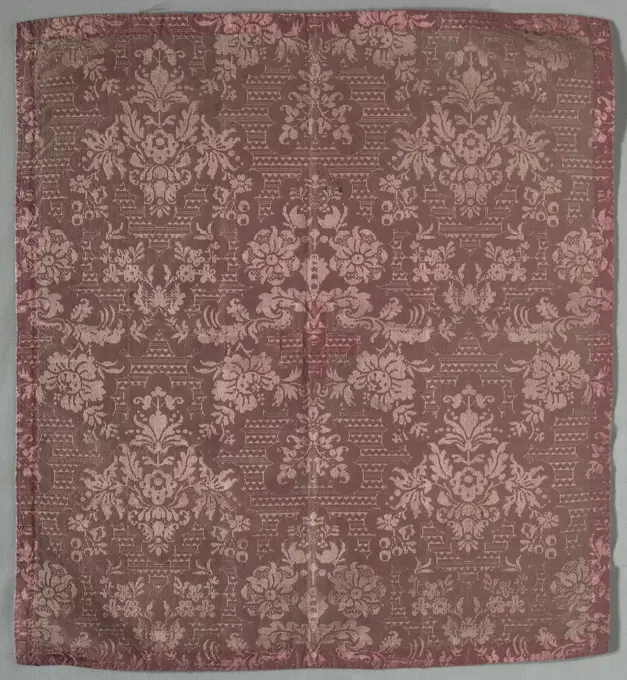
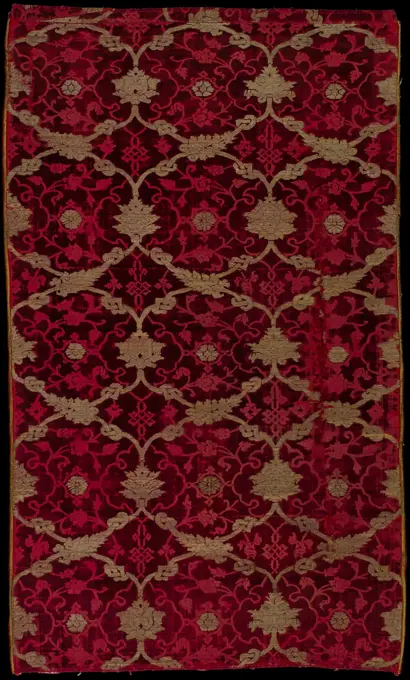
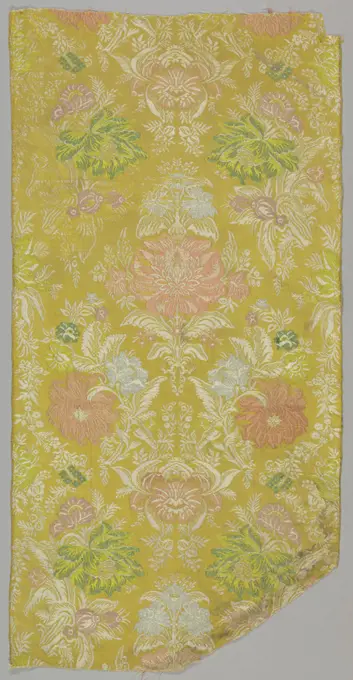
Textile, Medium: silk Technique: damassé (10-harness satin plus 9/1 twill with paired warps), Fragment of a large scale symmetrical pattern reversed on the center line of the textile. An urn with flowers placed in offset rows connected by a curving vine (almost an ogee framework) having grape vines and heads of wheat. Background is a dull salmon and the pattern is yellow twill. Intact selvage on right side., France, late 18th century, woven textiles, Textile
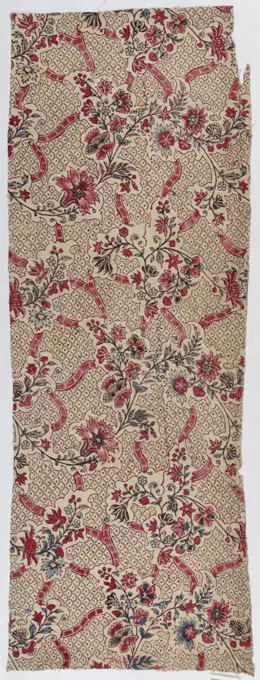
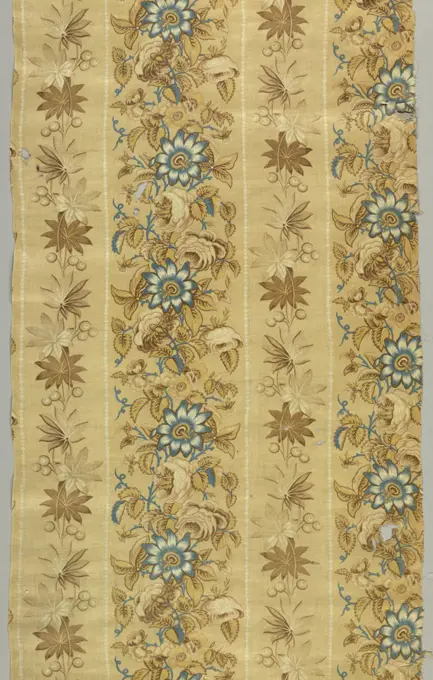
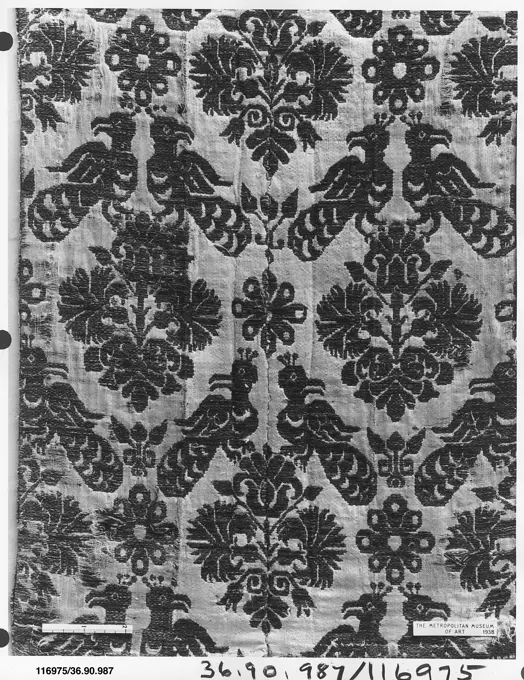
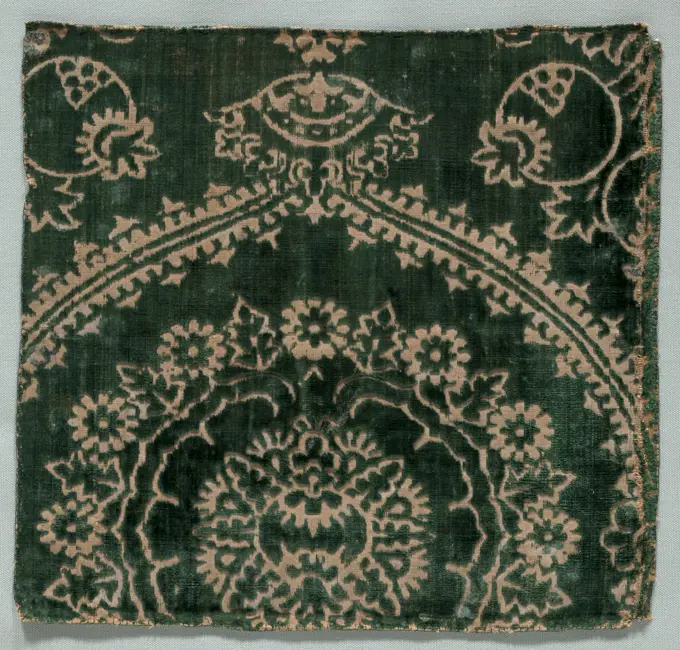
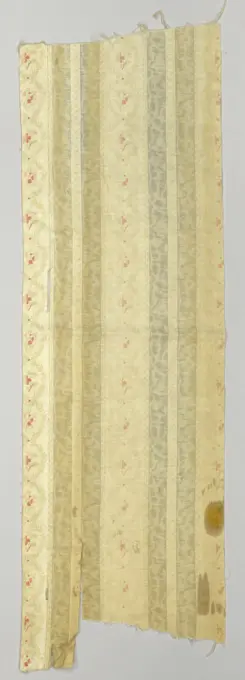
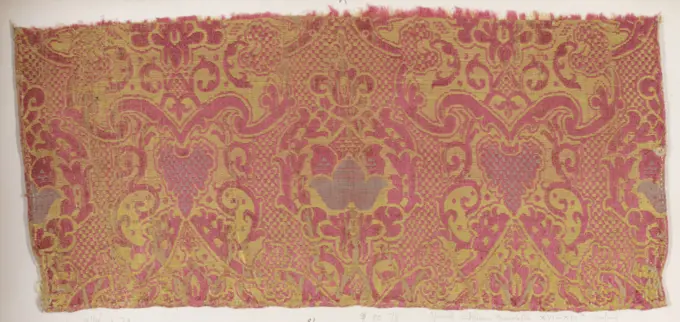
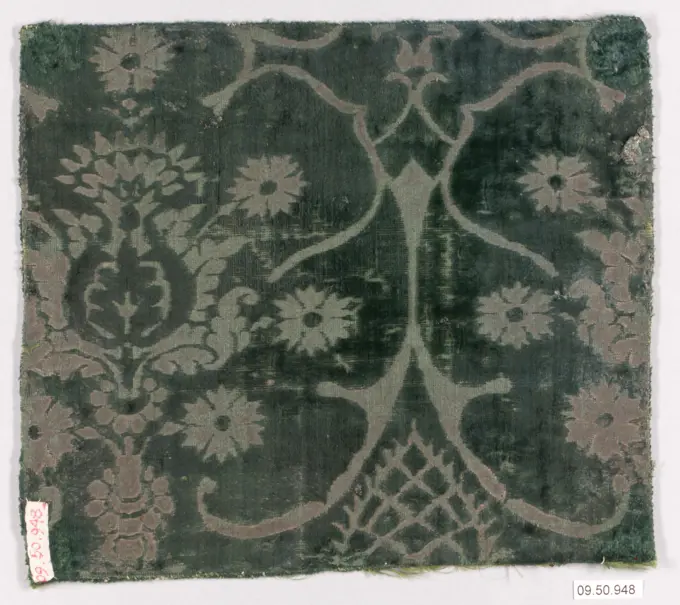
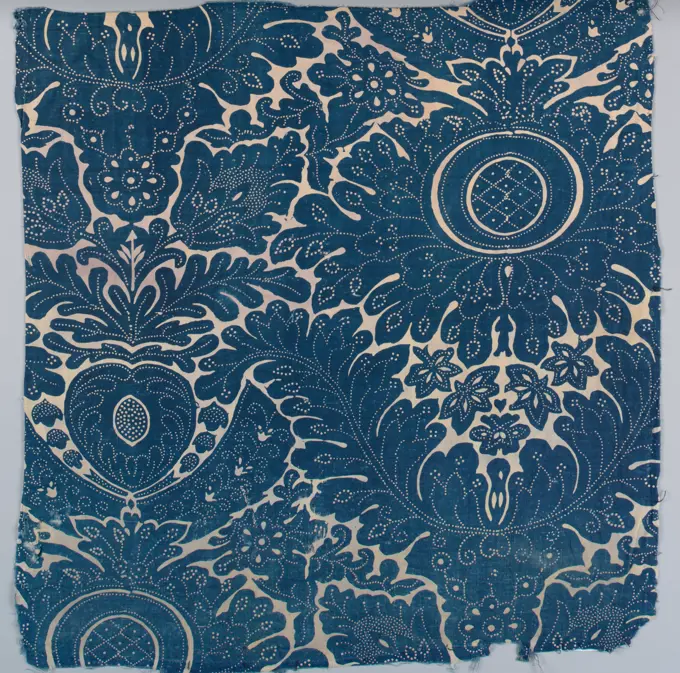
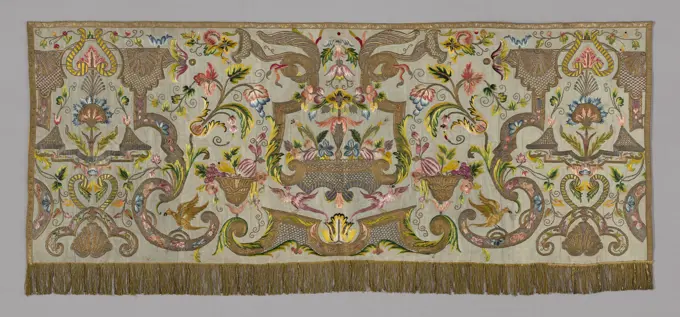
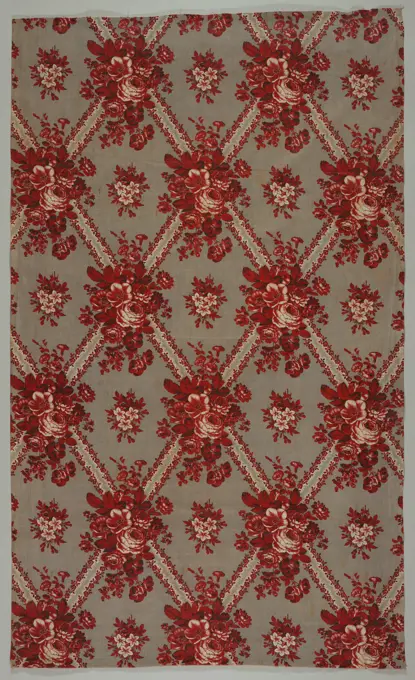
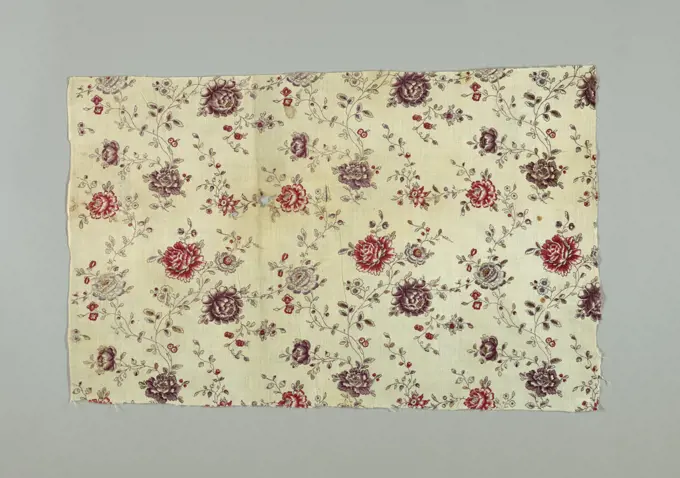
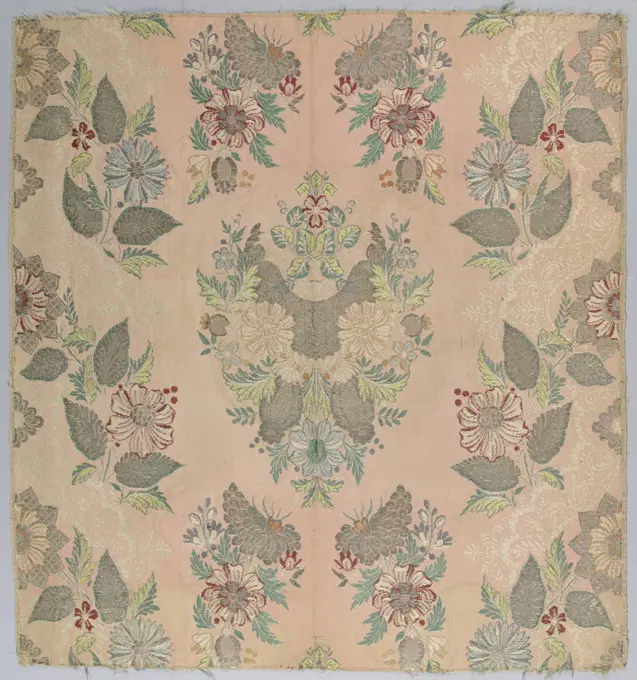
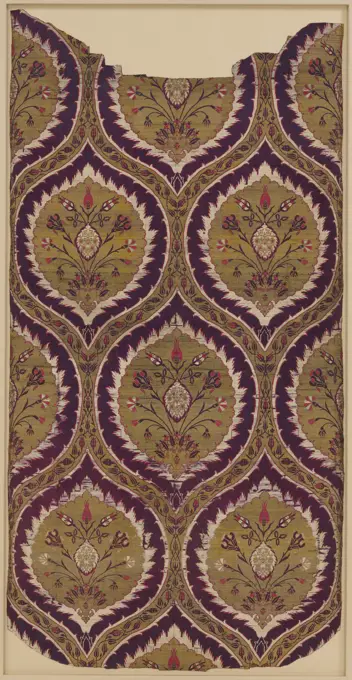
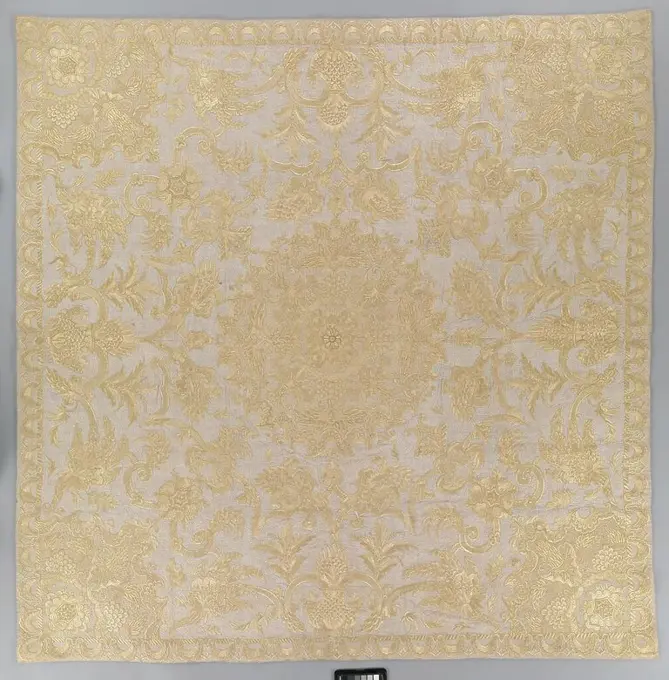
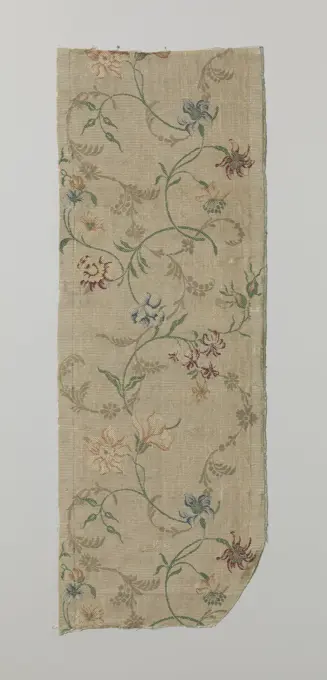
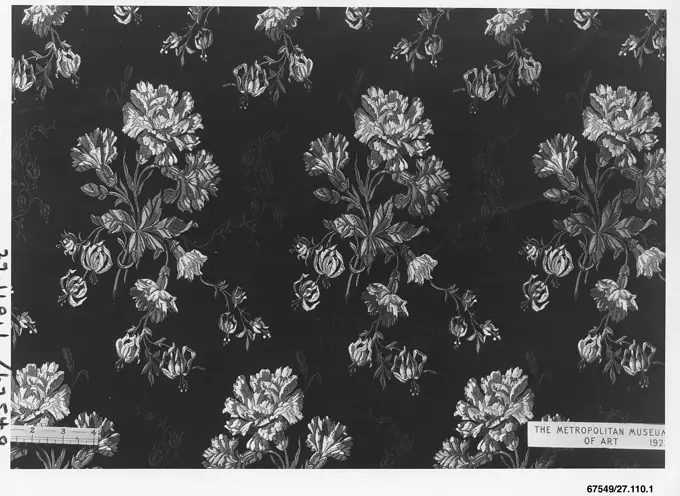
Piece 19th century Japan. Piece 66085Fragment zijdeweefsel, anonymous, c. 1720 - c. 1730 Fragment of two pattern patterns stuck together green silk on which decoration in yellow, green, red and brown from flowers and leaves stylized by Kantlingers. France Ketting an element: Silk lampas (textile material) Fragment of two pattern patterns stuck together green silk on which decoration in yellow, green, red and brown from flowers and leaves stylized by Kantlingers. France Ketting an element: Silk lampas (textile material)Chintz fragment, Medium: cotton Technique: block-printed for outlines and imbricated background with mordant painted over resist for fillings (chintz) on plain weave, Curving floral stems on white islands on a background of red ribbons and picotage., probably India, 1750-1800, printed, dyed & painted textiles, Chintz fragmentFragment 16th century Italian. Fragment 230361Textile (France); Company: Oberkampf & Cie. (France); cotton; 1994-33-6Textile, Medium: cotton Technique: resist patterning on plain weave, Textile with pattern of blue resist on ivory showing alternate vertical stripes, one twisted and one floral. Selvedge on one side., France, 18th century, printed, dyed & painted textiles, TextilePiece early 19th century Italian. Piece 217175Textile, Medium: Technique: printed, Red and brown peacocks with palm tree and large blossoms on a brown ground., England, 1850, printed, dyed & painted textiles, TextileTextile, Medium: silk Technique: damassé (10-harness satin plus 9/1 twill with paired warps), Fragment of a large scale symmetrical pattern reversed on the center line of the textile. An urn with flowers placed in offset rows connected by a curving vine (almost an ogee framework) having grape vines and heads of wheat. Background is a dull salmon and the pattern is yellow twill. Intact selvage on right side., France, late 18th century, woven textiles, TextileTextile, Medium: cotton Technique: printed by engraved roller on plain weave; relief print, Continuous vertical pattern of two alternating floral stripes - one a slightly curving leafy vine and the other a wider strongly curved floral vine. Colors are muted and accented by medium blue on a light brown background. Two stripes in one repeat unit. Half drop repeat., 19th century, printed, dyed & painted textiles, TextileFragment, Silk damask Technique: damask, 5 unit satin, Length of yellow damask: vertically symmetrical pattern created by a straight repeat every other row conterfaced with a flowering stem MA diagonal filling the unit., England or France, 18th century, woven textiles, FragmentTextile (France); Company: Oberkampf & Cie. (France); cotton; Warp x Weft: 74 x 41 cm (29 1/8 x 16 1/8 in.) Repeat H x W (straight): 47 x 27 cm (18 1/2 x 10 5/8 in.)Fragment of four strips of light silk with embroidered flower branches, c. 1690 - c. 1700 Fragment of four strips of light silk with embroidered flower branches. Japan Ca. 1695. Japan (possibly) silk embroidering Fragment of four strips of light silk with embroidered flower branches. Japan Ca. 1695. Japan (possibly) silk embroideringFragment; silk, metallicFragment Made 1775-1800 Japan. Plain double cloth, silk .Fragment brown-yellow silk ,, c. 1690 - c. 1710 Fragment brown-yellow silk with pattern of a branch with lancet-shaped leaves with five flowers surrounded by a leaf wreath with blue flowers. Netherlands Ketting an element: Silk lampas (textile material) Fragment brown-yellow silk with pattern of a branch with lancet-shaped leaves with five flowers surrounded by a leaf wreath with blue flowers. Netherlands Ketting an element: Silk lampas (textile material)Ribbon French 19th centuryTextile; cottonPiece 16th century Spanish. Piece 224079"Ferronnerie" Velvet Fragment, 1400s. Italy, 15th century. Velvet (cut and voided); overall: 24.5 x 24.8 cm (9 5/8 x 9 3/4 in.).Brocade Textile, 18th century. Spain, 18th century. Brocade; silk and gold; average: 95.5 x 53.7 cm (37 5/8 x 21 1/8 in.).Ribbon (USA); silkCarpet fragment, Medium: wool on linen and cotton Technique: warp pile on plain weave foundation, Floral rug design showing Persian influence in bold colors on a dark red ground. Wide plain weave selvage on left side., Wilton, England, ca. 1885, woven textiles, Carpet fragmentLily (Fragment) Designed 1870-1877 England. Wool and cotton, plain weave with supplementary pile warps forming cut solid pile; woven on loom with Jacquard attachment . William MorrisTextile; silkTextile, Cheney Brothers, (South Manchester, Connecticut, USA), Medium: silk Technique: compound satin weave, Reproduction textile inspired in a part by a Lucchese design in the Cooper Union Museum collection. A closely spaced, small-scale design has lobed trefoils, roundels filled with confronted and addorsed birds and palmettes, bands of mock Kufic inscriptions and sacred symbols including the lamb., USA, ca. 1915, woven textiles, TextileFragment late 16th century Italian. Fragment. Italian. late 16th century. Silk, metal thread. Textiles-VelvetsFragment upholstery of a four-poster bed. Fragment upholstery belonging to a wall sky bed.Fragment 16th-17th century Spanish or Italian. Fragment 230435Bobbin Lace Jabot, early 18th century. Flanders, early 18th century. Lace, bobbin; average: 28.6 x 42.2 cm (11 1/4 x 16 5/8 in.).Fragment multicolored brochure silk, 1700 - 1800 Fragment multicolored silk tissue. The beige soil has a multicolored pattern of a vase-like ornament from which leaves and flowers come, connected by winding flower branches and flower and leaf vines. Lined with silk.  silk damask Fragment multicolored silk tissue. The beige soil has a multicolored pattern of a vase-like ornament from which leaves and flowers come, connected by winding flower branches and flower and leaf vines. Lined with silk.  silk damaskNapkin with birds in wreaths. Napkin of Linnendamast with birds in wreaths. Midfield: The pattern shows two oval oval fields: 1 turns with wide brazed tire with left and right a half node in which rosette. Symmetrical indoor drawing of a stem with tawned lancet leaves with three palmmet flowers and two treated parrots with degenerated heads. 2 connected to field 1 by a vase; Curved by a spiral band in which branches and birds. A halved junction on the left and right. Symmetrical indoor drawing of a trunk with lancet leaves and as a candlestick swarmed side arms, to which sunflowers and on which two thrown birds. In the swing of pomegranates and carnations in a wreath. The edges show Spitsoval tendrils with symmetrically repeated birds, fruits and flowers. In the corners, four rosettes every time. Along the standing edges a block edge. Landscape edges caught in hems with stripe and block edge.Piece 15th century Italian. Piece 216219Sidewall (USA); Made by William H. Mairs and Company; machine-printed; 66.5 x 49.5 cm (26 3/16 x 19 1/2 in.)Piece 18th-19th century Japan. Piece. Japan. 18th-19th century. Silk. Edo (1615-1868). Textiles-WovenFragments, Medium: silk Technique: supplementary warp pile (velvet), voided, in satin ground with cut and uncut pile, Six fragments of velvet with an ivory satin ground and cut and uncut pile in shades of brown, green, rose and red. Large scale symmetrical arrangement with a floral bouquet framed by foliage, drapery and scrolls., 1850-70, woven textiles, FragmentsEmbroidery; silk, metalFragment (probably France); cotton; Warp x Weft: 52.2 x 49.4 cm (20 9/16 x 19 7/16 in.); Bequest of Elinor Merrell; 1995-50-308Fragment; wool, silk, linenPiece 1680-1700 French. Piece. French. 1680-1700. Silk and metal thread. Textiles-WovenBorder (France); linenSidewall, York Card & Paper Co., 1891, Machine-printed paper, Floral stripe design. Repeating motif of bouquet with four roses at top of 'v' formation of rose foliage. The rose stems form the outside edges of the stripe. A pair of leaves appears on either side of the stripe mid way between to bouquets. Printed in metallic gold and green pigments and brown on tan background., York, Pennsylvania, USA, 1905-1915, Wallcoverings, SidewallTextile, Medium: silk Technique: compound weave with supplementary weft patterning (brocade), Pink and white twill ground with symmetrical floral and lace-like pattern. Small floral details brocaded with green, blue and yellow silk. Broad selvage at each side., possibly Italy, possibly France, possibly Spain, early 18th century, woven textiles, TextilePiece 19th century Japan. Piece 65035Piece 18th-19th century Japan. Piece. Japan. 18th-19th century. Silk. Textiles-WovenSamples, Orinoka Mills, (Philadelphia, Pennsylvania, USA), a. green ground with 2 shades of gold color, b. bright pink ground with gold color and green/gold, USA, ca. 1910, woven textiles, SamplesTextile, Medium: cotton Technique: block printed on plain weave, Polychrome of small motifs - animals, birds, butterflies, people and flowers - on a picotage ground., France, 1775-85, printed, dyed & painted textiles, TextileTextile, Le Buveur (the Drinker); Produced by Oberkampf & Cie. (France); France; linen warp, cotton weft; 1975-27-1-aTextile (Japan); silk and metal; Overall: 52.2 x 28.1 cm (20 9/16 x 11 1/16 in.)Textile (France); Manufactured by Tassinari & Chatel (France); silkCarpet Fragment; cotton, bast fiber, woolFragment (Italy); silkFlounce (Italy); linenFragment; silk, metallic thread; Bequest of Richard Cranch Greenleaf in memory of his mother, Adeline Emma Greenleaf; 1962-56-130Ceiling Paper (USA); Manufactured by C. & W., Cresswell & Washburn Ltd; machine-printed paper, liquid mica; 91 x 49 cm (35 13/16 x 19 5/16 in.)Piece 18th-19th century Japan. Piece. Japan. 18th-19th century. Silk. Edo (1615-1868). Textiles-WovenTable cover, Medium: linen Technique: patchwork of techniques including needlework on knotted net, bobbin and needle lace, Squares with animals and grotesque figures alternate with squares of fabric with cutwork and needlework filling put together to form a checkerboard pattern. Deep scallop of bobbin lace on the border., Europe, 19th century, lace, Table coverLeaf with flowers and fruits, anonymous, 1700 - 1800 brocade paper Leaf with flowers and fruits. Used as a cover. Germany paper. paint (coating) relief printing ornament derived from plant formsBaan crème -colored silk daamast, with woven flower garlands and vertical tracks with dots, over which a scattering motif of large and small roses in multicolored silk has been broched, originally part of skirt, anonymous, 1750 - 1775 Baan crème -colored silk daum mast, with woven flower garlands and vertical lanes with dots, over which a scattering motif of large and small roses in multicolored silk has been broched. On both sides with a narrow green self -sided. In 1956 the skirt was entertained into a tablier and this track side remained, after manufacture of new, double pago -shaped cuffs and a two -part breastpiece. On the 'top' of the track there is a fold with pin holes over the entire width, where originally the waistband of the skirt has been. Netherlands (possibly) silk Baan crème -colored silk daum mast, with woven flower garlands and vertical lanes with dots, over which a scattering motif of large and small roses in multicolored silk has been broched. On both sides with a nAltar Frontal Made 1701-1800 France. Silk, plain weave (weft-faced), embroidered in silk and tarnished silver and gold threads .Textile; 1969-119-2Textile Fragment, 1800s. Japan, 19th century. Silk; average: 23.2 x 16.5 cm (9 1/8 x 6 1/2 in.).Textile, Medium: cotton Technique: block printed on plain weave, blue and yellow applied by brush, Printed cotton with a straight repeat of peony-like flowers on a fine vine in purples and reds on white background., France, 18th century, printed, dyed & painted textiles, TextileCiborium Veil, 1700s. Italy, 18th century. Silk damask; overall: 52.4 x 47.9 cm (20 5/8 x 18 7/8 in.).Band, Medium: silk and cotton Technique: plain compound cloth, Border strip with one broad and two narrow bands ornamented with scrolling stem with stylized fruit and leaves, in green on white ground. Woven in imitation of embroidery., Italy, 17th century, woven textiles, BandFragment; silk, cottonFragment, Medium: silk, metallic thread Technique: taffeta with supplementary weft, Pale rose taffeta brocaded in multicolored silks and gold metallic thread in a symmetrical floral pattern., France or Italy, mid- 18th century, woven textiles, FragmentTextile, Medium: cotton Technique: block printed on plain weave, Printed in vertical stripes of thickly clustered polychrome flowers on black ground. Between black stripes are narrow stripes with widely-spaced flower clusters printed on white ground. Two selvages with three blue threads., England, 1790, printed, dyed & painted textiles, TextilePanel (Furnishing Fabric) Made 1690-1710 Italy. Wool, 4 1 satin damask weave .Fragmentary Loom Width with Ogival Pattern ca. 1570-80 With its unusual eggplantpurple background, gold medallions, and crisp, stencillike drawing, this textile is an exceptionally fine example of the luxurious Ottoman silk fabrics referred to as kemha. Employing bold patterns, such as this ogival lattice design, these textiles were highly valued throughout the Mediterranean and beyond. Many datable fragments survive in the form of religious vestments of various Christian communities from Sweden to Moscow. Considering its overall shape, this fragment probably once served as part of a chasuble—a garment worn by Christian clergy.. Fragmentary Loom Width with Ogival Pattern. ca. 1570-80. Silk, metal wrapped thread; lampas (kemha). Attributed to Turkey, probably Istanbul. Textiles-WovenBedspread. Culture: British. Dimensions: L. 62 x W. 60 inches (157.5 x 152.4 cm). Date: late 17th century.The Portuguese were the first importers and consumers of Indian embroideries made for the European market, but at least a few appeared in England by the late sixteenth century. The taste for Indian embroidery influenced domestic design, and the English maker of this quilt included exotic pineapple-like flowers and the typical Indian palette of golden yellow thread on white. Fine imported Indian cotton was used for the ground fabric. The cotton is marked on the back with the initials G.C.E., for "The Governor and Company of Merchants of London Trading in the East Indies," the name the English East India Company used from 1600 to 1708. Museum: Metropolitan Museum of Art, New York, USA.Piece 18th century French. Piece 223267Fragment multicolored brochure silk, 1740 A silk tissue, consisting of two rectangular patches, green skeers with various flowers including large salmon -colored blue, red and white rosette flowers. NOTE: Two panels put together on the left and right a fringes; 0.3 cm Effenbinding. England (possibly) silk. A silk tissue, consisting of two rectangular patches, green skeers with various flowers including large salmon -colored blue, red and white rosette flowers. NOTE: Two panels put together on the left and right a fringes; 0.3 cm Effenbinding. England (possibly) silk.Textile (France); cottonFragment (France); silk; Warp x Weft: 44.2 x 33 cm (17 3/8 x 13 in.); 1942-30-2Bedcover (Spain); linen, silkFragment 1850-75 French. Fragment 222091Fragment (Japan)Fragment, Medium: silk Technique: cut and uncut supplementary warp pile (velvet) in a plain weave foundation, Blue cut velvet; stylized plant in octagonal fame; old rose ground., Italy, 16th-17th century, woven textiles, FragmentTextile; silkPiece 18th century Japan. Piece 65972Panel of velvet early 16th century Italian This splendid crimson velvet with pink voided areas and others brocaded with silver-wrapped yellow thread reflects the international style common in Turkey, Iran, Syria, and Egypt in the late fifteenth century. Yet, because of the mutual exchange of artistic vocabularies, especially in the production of velvets, there remains the possibility that this textile was actually woven in Venice.. Panel of velvet. Italian. early 16th century. Silk and metal thread. Textiles-VelvetsTable Cover Made 1801-1900 Japan. Uncut length of brocaded fabric, modern; deep blue, gold and green, design of dragons, flaming jewels and chrysanthemums .Piece ca. 1812 Bannister Hall The Bannister Hall print works was founded ca. 1798 by Richard Jackson and John Stephenson. Between 1809 and 1825 it was owned by Charles Swainson with varying partners. It was the leading firm for woodblock "furniture" chintzes.. Piece 219550Fragments (Italy); silk; Warp x Weft (a): 10.3 x 42.4 cm (4 1/16 x 16 11/16 in.) Warp x Weft (b): 7.1 x 8.5 cm (2 13/16 x 3 3/8 in.)Piece 18th century French. Piece 224104Bedcover, Russian Applied Art  Fragment, Medium: silk, metallic yarns Technique: plain weave with supplementary warp patterning and discontinuous supplementary weft patterning (brocade), Fragment of silk brocade with an orange ground with a minute tulip pattern forming a diaper in the background. The main, symmetrical floral pattern is brocaded in pale shades of blue, green, red, white, and gold., England, Lyon, France, early 18th-mid- 18th century, woven textiles, FragmentSheet with dot grid pattern with bouquets 19th century Anonymous. Sheet with dot grid pattern with bouquets. Anonymous , 19th century. 19th century. Relief print (wood or metal). PrintsPiece 18th century French. Piece 224259Textile (Japan); cottonPiece ca. 1745 French. Piece 226448Taffeta, c. 1760. France, 18th century, Period of Louis XV (1723-1774). Taffeta, brocaded; silk; overall: 44.6 x 55.6 cm (17 9/16 x 21 7/8 in.).Piece 18th century French. Piece 216854Piece 18th-19th century Japan. Piece. Japan. 18th-19th century. Silk. Textiles-WovenTextile Fragment, 1800s. Japan, 19th century. Silk, metallic thread; average: 16.2 x 18.8 cm (6 3/8 x 7 3/8 in.).Piece 18th-19th century Japan. Piece. Japan. 18th-19th century. Silk. Textiles-WovenFragment, 1700s. Iran, 18th century. Lampas weave; overall: 24.8 x 21 cm (9 3/4 x 8 1/4 in.).Coverlet, early 1800s. Ireland, early 19th century. Embroidery; silk thread on linen ground; overall: 152.4 x 152.4 cm (60 x 60 in.).Field of forty -eight tiles with flowers, anonymous, c. 1640 - c. 1660 Field of forty -eight tiles (8 x 6) each with a multicolored (blue, green and orange) flower on a ground. In the corners, a lily. Netherlands earthenware. tin glaze majolica Field of forty -eight tiles (8 x 6) each with a multicolored (blue, green and orange) flower on a ground. In the corners, a lily. Netherlands earthenware. tin glaze majolica