Historic Textile Trimmings

Close-up views of decorative textile trimmings and laces from the 18th century, showcasing intricate patterns and fine craftsmanship.


Border, Medium: linen Technique: needle lace, Border shows scrolls of floral and foliated forms. Pattern connected by picoted bars and outlined by cordonnet. Solidly-worked areas are interspersed by decorative filling stitches known as gaze quadrillée., France or Italy, 1650-1700, lace, Border
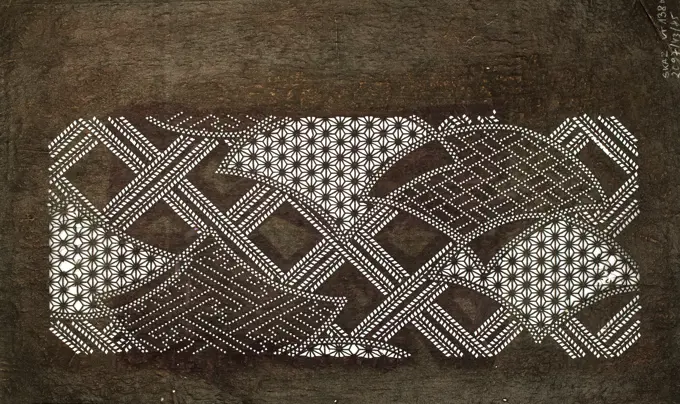
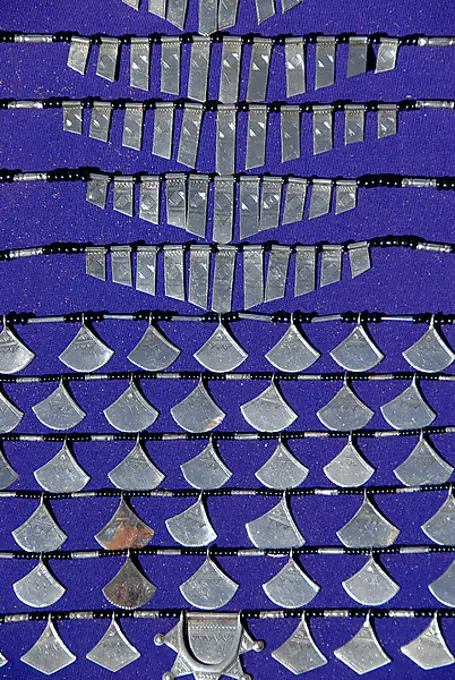
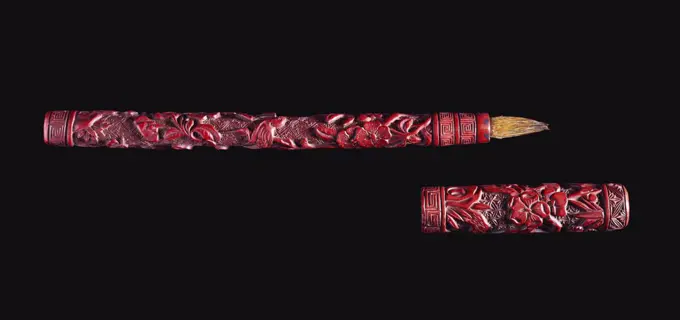
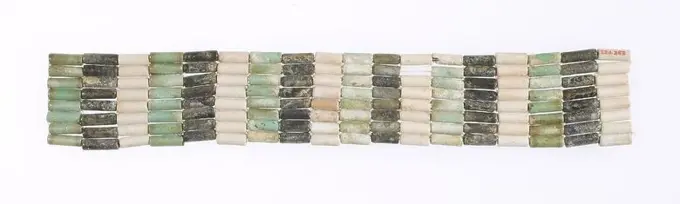
Fragment of a bed linen. Fragment of a bed linen, cotton herringbone, blue broken.Naamplaat behorend bij de 'Schuttersmaaltijd' van Bartholomeus van der Helst.The name plate is a rectangular plate of black painted wood, with lobe motif frame that splits the plate into three compartments. On the nameplate, the names of the portrayers are arranged at the Schutters meal of Bartholomeus van der Helst (including the name of Captain Cornelis Jan Wits and Vaandrich Jacob Banning).Trimming (France); silkDying template katagami; Dese from various geometric motives;  19th/20th century (1701-00-00-1900-00-00);Drabik, Cezary (Fl. Ca 1960 - 1980) - collection, geometric motifs, Japanese (culture), katags, templates, Japanese art, purchase (provenance)Trimming (France); silkBorder (France); block-printed and flocked on handmade paper; 70 x 12 cm (27 9/16 x 4 3/4 in.)Ruler BremantDisplay of Tuareg silver jewellery Mandara LibyaOmar Khayyam the Sufi. Spine. Bjerregaard, C. H. A. (Carl Henrik Andreas), 1845-1922. Book covers, bindings (gathered matter components). 1902. General Research Division. Omar Khayyam, Sufism in literaturePassementerie early 19th century probably European. Passementerie 214190A Red Lacquer Carved Brush and Cover. Ming Dynasty, Probably 16th Century. 24.5cm long.Trimming (France); silkHat Van Kloskant with oak leaves, Martha Berkers, 1914 Hat of natural-colored bobbin, Duchesse side. The model is three -part; Two diamond -shaped side pieces and a right -wing center track are surrounded by a lisière, that is, aanaingbandje. The side has an open bars stock and an asymmetrical pattern of loose florets and oak leaves that are suitable for rosettes. Lock linen (material) bobbin lace Hat of natural-colored bobbin, Duchesse side. The model is three -part; Two diamond -shaped side pieces and a right -wing center track are surrounded by a lisière, that is, aanaingbandje. The side has an open bars stock and an asymmetrical pattern of loose florets and oak leaves that are suitable for rosettes. Lock linen (material) bobbin laceAnklet. Dimensions: l. 20.8 cm (8 3/16 in). Dynasty: Dynasty 13 to 1700 B.C.. Date: ca. 1802-1700 B.C.. Museum: Metropolitan Museum of Art, New York, USA.Bookmark, Medium: silk, paper, wool Technique: compound weave (ribbon) and wool embroidery on punched paper, Bookmark of pink and white brocaded ribbon is mounted with an embroidered card worked in wool thread. Design of a cross with flower wreaths and the legend: 'Hope On.' Tan, green and pale pink., Coventry, England, 19th century, woven textiles, BookmarkCameo Brooch And Bracelet (Italy); carved shells, gold, cut velvetBobbin Lace Edging, 18th century. Belgium, Binche, 18th century. Lace, bobbin: linen; average: 4.5 x 108 cm (1 3/4 x 42 1/2 in.).Gimp 18th century French. Gimp. French. 18th century. Silk. Textiles-TrimmingsCeremonial scarf, 90 x 13 1/2 in. (228.6 x 34.29 cm) (with fringe), Silk, LaosBracelet ca. 1981-1640 B.C. Middle Kingdom. Bracelet. ca. 1981-1640 B.C.. Faience. Middle Kingdom. From Egypt, Memphite Region, Lisht North, Tomb 954, Burial 954J, MMA excavations, 1921-22. Dynasty 12-13Belt, 20th century, 34 11/16 x 3 3/8 in. (88.11 x 8.57 cm) (including braids), Wool, Bolivia, 20th centuryCombs, Tortoiseshell, coral, gold, A) and B) Tortoise shell side comb with cresting of gold and coral beads., Italy, mid-19th century, jewelry, Decorative Arts, CombsBorder, Block-printed on handmade paper, Wide central band of mixed fruit, including pear, peach, grapes and figs, on vine. A braided rope runs along top edge. Printed in shades of yellow ocher and brown on a gray ground. a) is the beginning of roll - no ground color at end., France, 1815-35, Wallcoverings, BorderStrip with two oval medallions, anonymous, after jacques vauquer, after 1631 - before 1676 print The medallions are surrounded by leaf vines. France (possibly) paper engravingBorder (possibly France); block-printed; 48 x 8.5 cm (18 7/8 x 3 3/8 in.); Purchase, Pauline Riggs Noyes Fund; 1953-202-5Lint 'Voor de omgekomen burgers in Europa - burgeroorlogsgetroffenen'.Two white ribbons bound together, laid on May 4, 2000 at the National Monument on Dam Square. The top ribbon is v.z.v. A golden print. Lower ribbon is blank. Ribbons are sloped off at the ends. On one side tied together with iron wire. Iron wire bent T.B.V. Confirmation to a wreath.A sash from the funeral of Adam Mickiewicz in Krakow on July 4, 1890Chinese ornamentDifferent types of Indian currency, Antique coinsOrnament with plants, Bernard Willem Wierink, c. 1910 print   paper  ornaments ~ art. fable of Reynard the FoxTobacco Pipe 19th century Japan. Tobacco Pipe. Japan. 19th century. Silver. Edo (1615-1868) or Meiji period (1868-1912). Smoking EquipmentFour small people (caricatures) to the dwarf tone, anonymous, c. 1710 - 1760  Four glasses with caricatures of small people in a wooden stress with handle. On the far left: A woman in red dress seen from the front. To the right of that: A wide -legged man with hat grabs his saber. To the right: a man with hat, saber and pointed mustache makes a pass. On the far right: a woman with hat and a handkerchief in her hand makes a dance step. All except the most right -wing copied to the dwarf tone. Netherlands glass. wood (plant material)  little peopleHalf Model of a Tambangan.Black and white stack model (starboard) of a canoe. He has two pointed ends, the vent is coming up. A cleat at both ends.Sealing wax case (étui) 1756-62 Probably by Jean Ducrollay In eighteenth-century Europe, Paris led the production of high-quality luxury goods. Parisian goldsmiths made a wide range of small, personal articles such as snuffboxes; étuis to hold sealing wax, tweezers, or utensils for sewing; souvenirs, which contained thin ivory tablets for note taking; and shuttles for knotting lace. Gold snuffboxes and boxes decorated with portrait miniatures were prized and frequently given as royal gifts, often to ambassadors or members of the court in lieu of cash payments for their services. Coveted and admired, these boxes were produced from a variety of materials. The best were skillfully made of gold and embellished with diamonds, enameled decoration, lacquer, and other luxurious materials. By the middle of the century, the taking of snuff had become an entrenched social ritual, and the snuffbox, too, had become an important social prop. Snuffboxes were considered highly fashionable accessories,Sculpture from a car people in Delphi, Frédéric Boissonnas, c. 1905 - In or Before 1910 photomechanical print  DelphiBerlin paper collotype charioteer, 'auriga'. sculpture DelphiVivatband, Vivat the nationwide , a world of enemies opposite , official band for the Red Cross, the war aid office, the war welfare office, draftA sash from the celebration of the hundredth anniversary of Adam Mickiewicz's birthMilledBordersA sash from the funeral of Adam Mickiewicz in Krakow on July 4, 1890