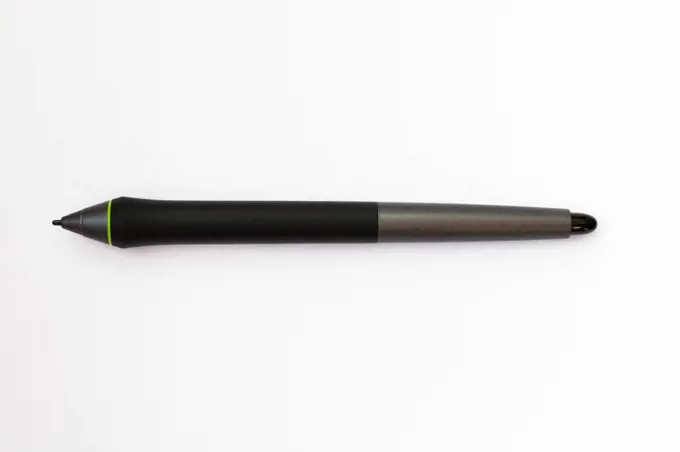
Historic Weaponry

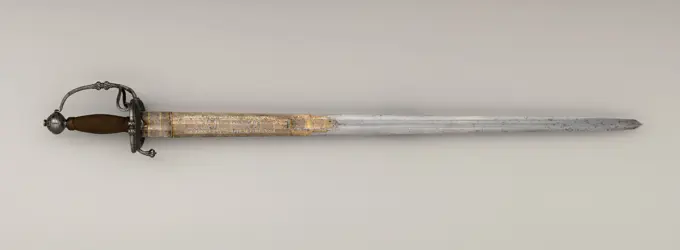
An assortment of historical weapon artifacts including swords, guns, and ceremonial daggers, featuring ornate designs and aged patinas, conveying a sense of craftsmanship.

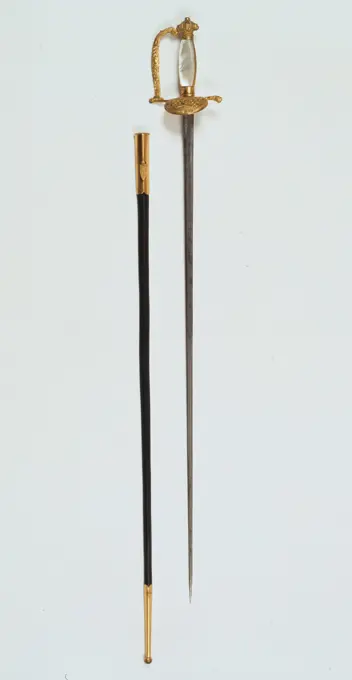
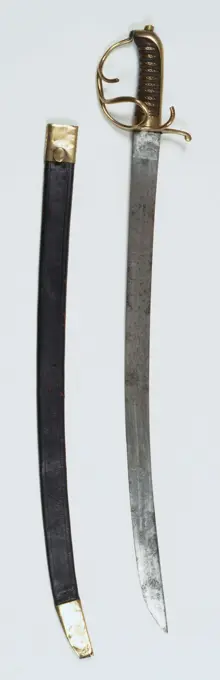
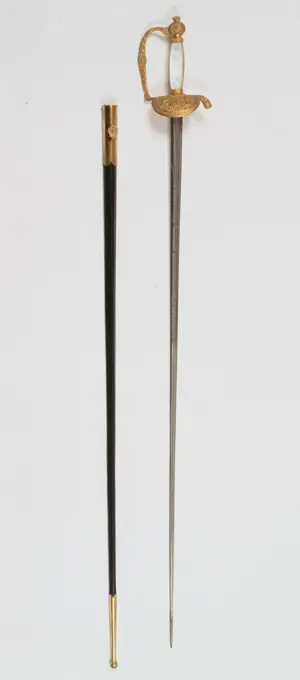
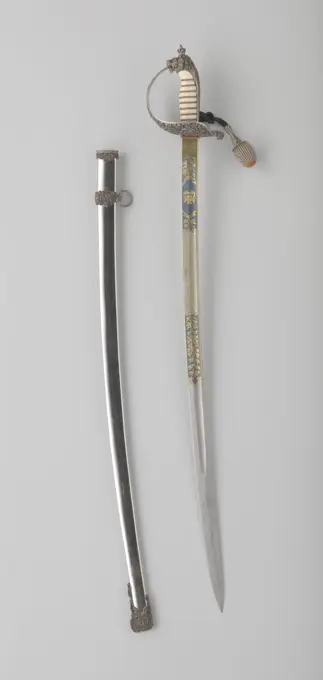
Statteniedegen with Schede from Minister P.J. Oud, Anonymous, 1933 - 1937 civil servant's sword Statementaltegen with a triangular etched iron blade and a white leather sheath. The hilt consists of a sideways pare bracket, a hanging shot and a handle button. The entire hilt is made of copper and decorated with various motifs and curls. On the mouth of the Schede an etched flor motif. Netherlands (possibly) kling: iron (metal). schede: leather. greep: mother of pearl. gevest: copper (metal) etching  The Hague
Statteniedegen with Schede from Minister P.J. Oud, Anonymous, 1933 - 1937 civil servant's sword Statementaltegen with a triangular etched iron blade and a white leather sheath. The hilt consists of a sideways pare bracket, a hanging shot and a handle button. The entire hilt is made of copper and decorated with various motifs and curls. On the mouth of the Schede an etched flor motif. Netherlands (possibly) kling: iron (metal). schede: leather. greep: mother of pearl. gevest: copper (metal) etching The Hague
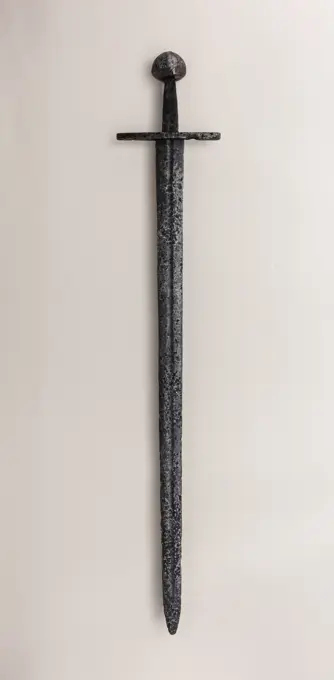
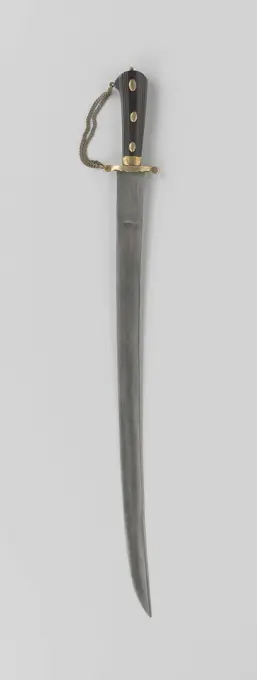
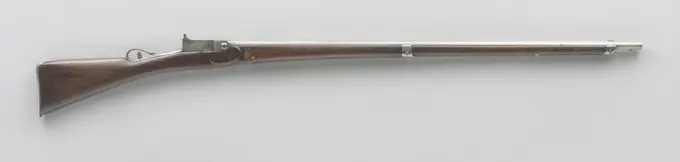
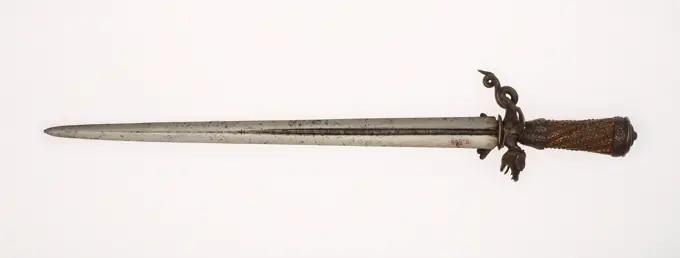
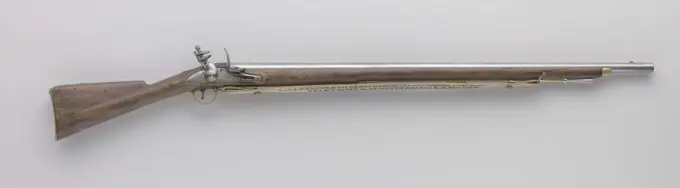
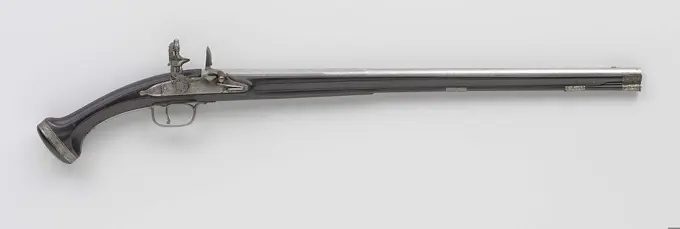
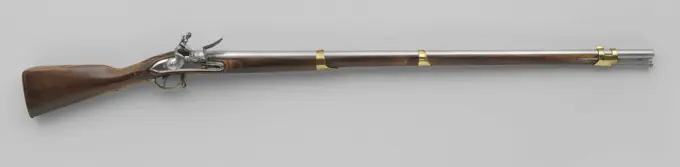
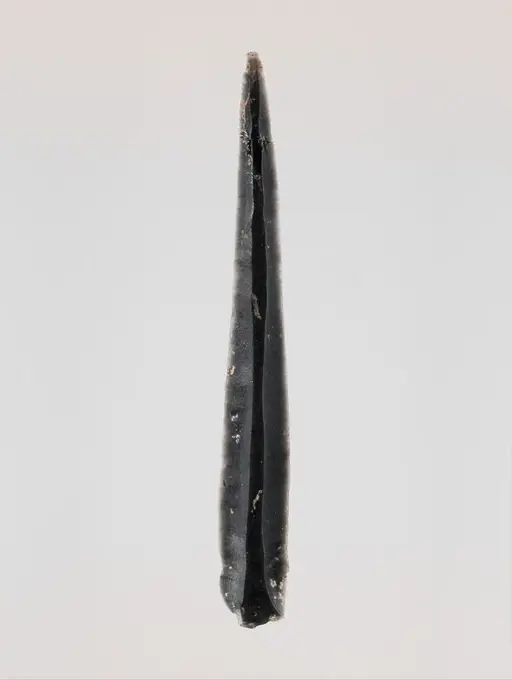
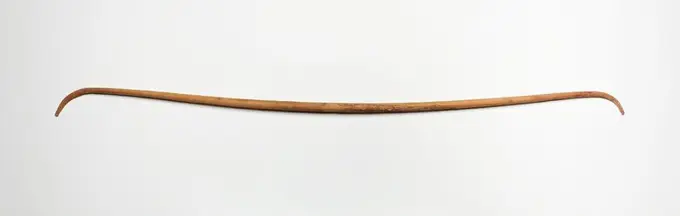
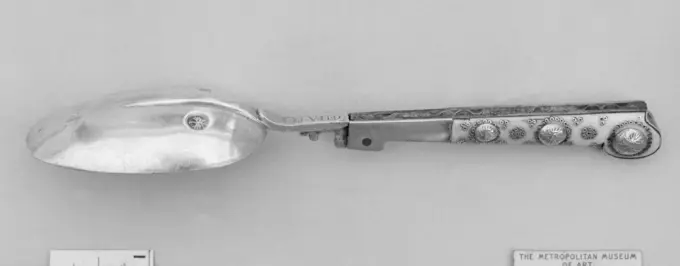
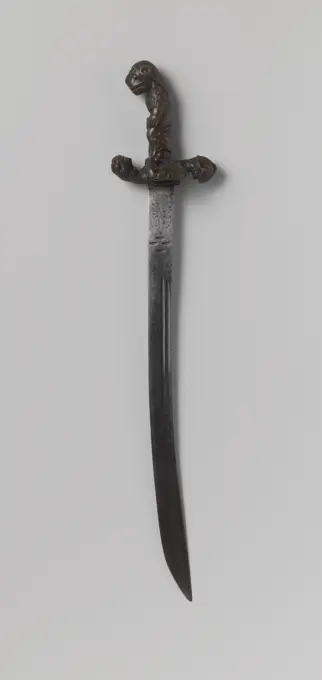
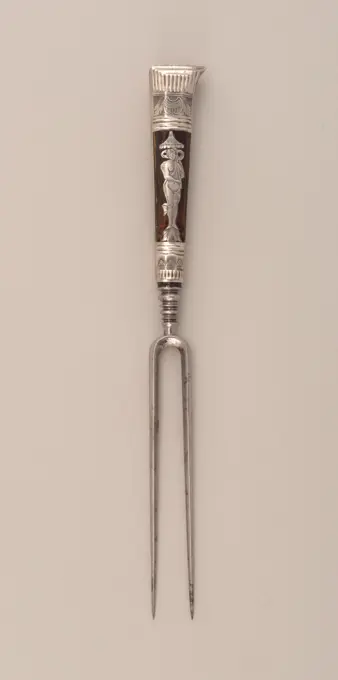
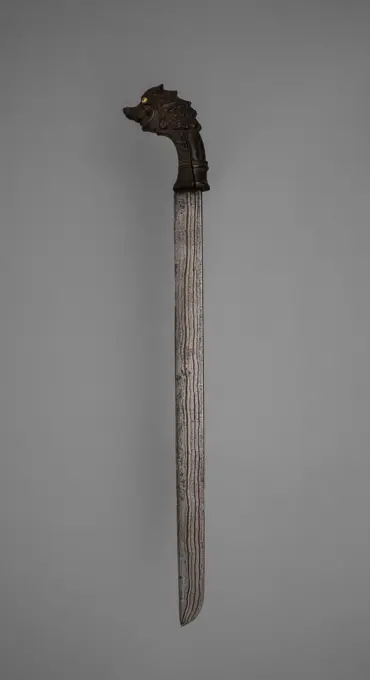
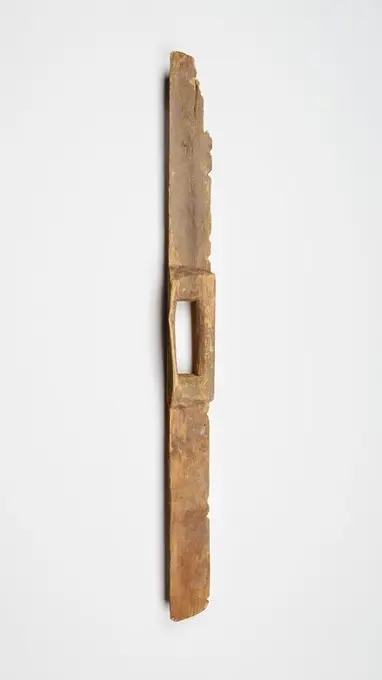
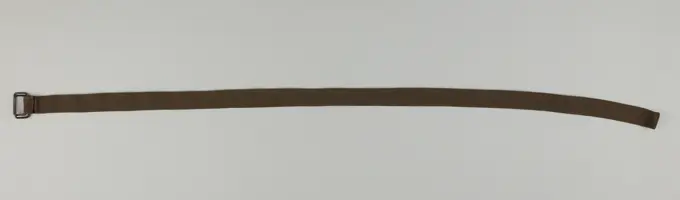
Openwork PinHouwer with flint gun, anonymous, 1655 - 1660 cutlass. flintlock pistol Combination of a houwer and a flint gun. The Iron Sight is chiseled in relief with praise and a dolphin; The shot has cut out ornaments including acanthus leaves; The hiding button has the shape of the handle of a gun. The curved blade is chiseled at the top of relief with leaf vines and engraved on the outside with an emblem consisting of an arm that emerges from a cloud with a falchion and below the text Concordia res parvae crescunt above branched praise; On the bearing side a man with a hat with the text Credens Pro Nobis Quis Consientius and branched praise. The lock of the gun is attached to the outside of the Houwer; The loop has a ring at the back and at the Tromp, where the loop on the blade of the Houwer is mounted. Netherlands iron (metal) sawing / engraving  NetherlandsScarier, Anonymous, c. 1590 - c. 1596  Hinge, presumably an aircraft. Presumably has been part of a box.  iron (metal) forging  Nova Zembla. Saving HuysFlintlock Gun 1725 Sardinia. Iron, wood, and steel .Sword possibly 12th-early 13th century Western European. Sword. Western European. possibly 12th-early 13th century. Iron. SwordsStatteniedegen with Schede from Minister P.J. Oud, Anonymous, 1933 - 1937 civil servant's sword Statementaltegen with a triangular etched iron blade and a white leather sheath. The hilt consists of a sideways pare bracket, a hanging shot and a handle button. The entire hilt is made of copper and decorated with various motifs and curls. On the mouth of the Schede an etched flor motif. Netherlands (possibly) kling: iron (metal). schede: leather. greep: mother of pearl. gevest: copper (metal) etching  The HagueModel of a Main Topmast, anonymous, c. 1780 - c. 1840 demonstration model Round steng made of a piece, with a thick square heel with two discs and slot wood hole, an octagonal bummer and square top. Netherlands wood (plant material). brass (alloy)Hartsvanger met ebbenhouten greep.Hearts catcher or yacht sword. The asymmetrical hilt is captured with Geelkoper; The ebony grip has the shape of a lifting, is vertically grooved and equipped with three buttons with shocked dots and lines; The straight pearl rod is engraved in the same way as the buttons and has a brace-shaped edge; A gold-plated glass double chain runs from an eye on top of the handle to the flat end of the pearl rod. The unnecessary blade with a light curve is etched on the outside with an inscription.Sanxian ( ) 19th century Chinese. Sanxian ( ). Chinese. 19th century. Rosewood, reptile skin, various materials.. China. Chordophone-Lute-plucked-unfrettedBrandweerstaf, anonymous, c. 1400 - before 1950 Fire brigade of the fire brigade in Zaandam. On top of the lion with weapon. Westzaandam wood (plant material) Fire brigade of the fire brigade in Zaandam. On top of the lion with weapon. Westzaandam wood (plant material)Landed handle for an umbrella or umbrella; With a gilt round button, Gustav Schnitzler, c. 1910 - c. 1920 Line with a square cross -section, for an umbrella or umbrella. The leg is decorated. There is a gilded round button on the handle. Nijmegen Handle: Bone (Material). Button: Gilding (Material) cutting / gilding Line with a square cross -section, for an umbrella or umbrella. The leg is decorated. There is a gilded round button on the handle. Nijmegen Handle: Bone (Material). Button: Gilding (Material) cutting / gildingSword 13th century French. Sword. French. 13th century. Iron. SwordsBreech-Loading Rifle, anonymous, 1866 - 1870 rifle Rear loading rifle with a smooth run. It has a central fire mechanism of unique design. The room opens by folding an arm forward, such as with Robert's rear loading rifle (compare NG-MC-730). The lock is attached to the arm. The lock fires with a beating pin that hits in the middle of the pattern. At the top of the rifle is a slot for the tractor, which is missing. unknown wood (plant material). iron (metal). brass (alloy)Pin 9th century Irish. Pin 468283Amsterdam El or Ellemat.wooden Rod, Amsterdam El or Ellemate.Fanfare trumpet, anonymous, c. 1815 - c. 1830 musical instrument. wind instrument. trumpet. fanfare trumpet Fanfaretrompet consisting of a thin straight tube that ends in a wide chalice. The mouthpiece is missing. Europe copper (metal) casting / solderingHunting cutlass Cain, PietroRifle with bayonet with carrying strap with inscription: to L.P. Zocher in memory of the ten-day campaign in August 1831 by K.G. Zocher.Whetstone, Mediaeval. Whetstone (a fine-grained stone used for sharpening cutting tools) with suspension hole to top and decorative band detail... Found at Weoley Castle site. .STOP fork; Gumpert, Georg Heinrich (Fl. 1850-1893); 2. PO. 19th century (1800-00-00-1848-00-00);STOP fork; Gumpert, Georg Heinrich (Fl. 1850-1893); 2. PO. 19th century (1800-00-00-1848-00-00);Stick Pin (USA); gold, pearl, silver; Overall: 6 x 1.5 cm (2 3/8 x 9/16 in.)Standing Degen with Schede for sea officers M 1824, Schnitzler & Kirschbaum, c. 1824 - c. 1843 sword Standing the Sea Officers m 1824. The blowing partially, gilded, a silk inscription of crowned W and the letters F and K. The hilt of brass and on the bump plate two crossed anchors. The handle is covered with mother -of -pearl. With black wooden sheath with brass tires and hook. The stitch plate has been broken down, signed. Worn by Vice-Admiral A.A. Buijskes.  kling: iron (metal). gevest: brass (alloy). greep: wood (plant material). greep: mother of pearl. schede: leather gilding / engraving  NetherlandsSabel belonging to Cornelis Tromp, Anonymous, c. 1650 - c. 1679  Sabel with wooden sheath with a small knife. The handle of rye façade is wrapped with green silk, Pommel van Hoorn, Ferrule (mounting above Tsuba) has a decoration that is common in North Vietnam and also the wide-spreading shape towards the Tsuba is typical of Northern Vietnam. TSUBA has a shape of a chrysanthemum. Tempered steel blade. North Vietnam (Possible) copper (metal). mother of pearl. cypress (wood). silk. steel (alloy). horn (animal material)Arrow Point, 1700s. Japan, Edo period (1615-1868). Steel; overall: 17.2 cm (6 3/4 in.); head: 5.2 cm (2 1/16 in.).Degen in Schede and Endui belonging to the office costume of Dr. A.H.J. Lovink, fa. Frans Pauwels, c. 1850 - c. 1950 dress sword Degen with fire gilt copper hilt, openwork bump plate with, among others, Garlande and the Rijkswapen, three-sided iron etched blade with a trench with garland decoration on each side. Signed at the rear 'Frans Pauwels, purveyor to' s Gravenhage '. For the front of the front: tarragon or sabel brush of braided gold thread with brush with fire-groted iron pear (17-2). In Zwartleeren Schede and in Bruin Lakense Foedraal with cord closure. The Hague Kling, hilt: Iron (metal). Schede: Leather etching  Dutch East Indies, TheJousting Lance 1700-1800 Germany. Iron, wood (pine), gesso, and paint .Staff, 1800s-1900s. The Baboon Master (African). Wood; overall: 120.7 cm (47 1/2 in.).Handle covered with leg, for an umbrella or umbrella; With gilt button, Gustav Schnitzler, c. 1910 - c. 1920 Line with a square cross -section, for an umbrella or umbrella. The leg is decorated. There is a gilded button on the handle. Nijmegen Handle: Bone (Material). Button: Gilding (Material) cutting / gilding Line with a square cross -section, for an umbrella or umbrella. The leg is decorated. There is a gilded button on the handle. Nijmegen Handle: Bone (Material). Button: Gilding (Material) cutting / gildingSpear, Before 1922. South Sea Islands. overall: 167.7 cm (66 in.); top: 18.5 cm (7 5/16 in.).Broadsword dated 1612 German, Solingen. Broadsword. German, Solingen. dated 1612. Steel, brass wire, gold. Solingen. SwordsPinIron frying fork, fork with two teeth, fork kitchen utensils soil find iron metal, forged Large iron fork Handle with trench. Hanging eye with curl. Long shaft with two arched and pointed teeth archeology frying meat fry food prepare nutrition kitchenRod, Measuring; woodStaff Weapon. Culture: Italian. Dimensions: L. 46 3/8 in. (117.8 cm); L. of head 34 5/8 in. (87.9 cm); W. 12 1/4 in. (31.1 cm); Wt. 5 lbs. 13 oz. (2636.5 g). Date: ca. 1585. Museum: Metropolitan Museum of Art, New York, USA.Measuring Rod, anonymous, anonymous, 1750 - 1825 measuring instrument Wooden size or dipstick of four Rhineland feet, finished with iron stripes. One foot is classified in twelve thumbs, the other three indicate half the foot. Netherlands wood (plant material). iron (metal)Ektar ca. 1885 Indian. Ektar 500745The tail of the lock plate and the rooster (restored) are engraved in bas-relief with flour rinks; The lock plate is provided with a signature. The loop has an iron visor grain; Stamped under top with a brand unclocked. The restored flask is from blackened walnut wood; inlaid with tossed silver wire; The trigger plate is made of ivory; The flask is inlaid with an ivory image. Apart from the front-faced iron trigger bracket with baluster-shaped ends, the batter of silver is engraved with floral drinks and branches; consisting of a drawer cap and two round charging bokekers; The ebony loading stick is equipped with a silver shade and suite with the drawer cap.Narwhal Tusk 1500-1700 Northern Europe. Ivory .STOP fork; Malcz, Karol (1797-1867), Silver Products Factory K.F. Malcza (Warsaw; Sreber label; 1828-1864); 1852 (1852-00-00-1860-00-00);Degen of Gala -costume of member honorary guard during the inauguration of Queen Juliana, Anonymous, 1909 - 1948 dress sword Degen in black leather sheath with hilt of brass and mother -of -pearl in cover. Worn by Ernst Hartmann, member of the guard of honor, during the inauguration of Queen Juliana on 6 September 1948. Netherlands gevest, schede: brass (alloy). kling: iron (metal). greep: mother of pearl   AmsterdamPortable barometer ca. 1695 Daniel Quare. Portable barometer. British, London. ca. 1695. Walnut, gilt bronze, ivory. HorologySiphoning Tube 1833-38 Marquand and Company. Siphoning Tube 7516ruaty vintage hand brace drill bit over white, clipping pathCooking stones with flattened handle. A covers of steel with flattened handle. Address: Imra / Schützt.Will know unknownSword of Jacob Cabeljauw.In 1573 the town of Alkmaar was besieged by Spanish troops. The Dutch commander Cabeljauw led the forces that defeated this attack and forced the Spanish to retreat. He was promoted to military governor of Alkmaar and was probably presented with this sword as a token of honour. The text on the blade was presumably added in the 18th century to record the swords historical significance.Ellemaat with handle, anonymous, 1800  Length of 1 tbsp with handle. V.z.v. 3 stamps near handle and damaged label (illegible). Netherlands wood (plant material)   NetherlandsDizi late 19th century Chinese. Dizi. Chinese. late 19th century. Bamboo and bone. China. Aerophone-Blow Hole-side-blown flute (transverse)The sword of King Stefan Batory from the Jasna Góra Treasury in Cz Stochów; Lesser, Aleksander (1814-1884); 1830-1884 (1830-00-00-1884-00-00);Kazimierz (Kraków - district), Lesser, Aleksander (1814-1884), Lesser, Emiljan Stanisław (Baron - 1847-1912), Lesser, Emiljan Stanisław (Baron - 1847-1912) - collection, Lesser, Wiktor Stanisław Zygmunt (Baron - Baron - 1853-1935), Skarbiec Jasna Góra (Częstochowa - Jasna Góra), Stefan Batory (Polish King - 1533-1586) - iconography, Stefan Batory (King of Poland - 1533-1586), 16th century, weapon, weapons, white weapons, Dar (provenance ), Church of St. Jana (Vilnius), swords, military, crafts, collections, museum collectionsTorricellian barometer ca. 1760 British. Torricellian barometer. British. ca. 1760. Mahogany. Scientific Instruments-Barometers and ThermometersRifle of the Admiralty on the Maas, Anonymous, c. 1700 - c. 1800 rifle Rifle with a plot on flask with no. 2286. Metal chest. Netherlands iron (metal). wood (plant material). brass (alloy)Infantry table with sheath Batavian Republic and Kingdom of Holland, 1805-1810.Copping hilt consisting of button, handle cover, front bracket, two side brackets, half pearl rod. Handle from Robben leather (or rye skin) with copper wire wrapped. Iron blade, black leather sheath with copper top tire with carrying button. Copper point.Dagger, by 1916. Africa, East Africa, Kenya or Uganda. Silver and metal; overall: 64.5 cm (25 3/8 in.); blade: 49 cm (19 5/16 in.).Sword and Scabbard, 1700s. Java, 18th century. Steel and ivory; blade: 47 cm (18 1/2 in.); hilt: 12.8 cm (5 1/16 in.); scabbard: 51.4 cm (20 1/4 in.).Folding fork, silver, gold, Fork has three straight tines, rounded shoulders, flaring neck. Handle has straight sides with rounded ends. Silver scales engraved with floral decoration and gilded details, three rivets. Fork folds partly into blade., Austria-Hungary, ca. 1790, cutlery, Decorative Arts, Folding forkConical parasol button with niello silver handle, anonymous, c. 1910 Konical parasol button with Niello silver handle. Dark brown-painted broken upside down and high Konian handle of silver with black cubes in Niello technology. Brands: V for strange and 800 for low silver content. Vienna (possibly) knop: silver (metal). stok: wood (plant material) Niello (technique) Konical parasol button with Niello silver handle. Dark brown-painted broken upside down and high Konian handle of silver with black cubes in Niello technology. Brands: V for strange and 800 for low silver content. Vienna (possibly) knop: silver (metal). stok: wood (plant material) Niello (technique)Snuff Spoon, c. 1770. England, 18th century. Luxurious personal objects were an essential part of a privileged wardrobe during the 1700s and early 1800s, emphasizing their owners refinement and wealth. Especially popular were étuis, small ornamented cases containing miniature sewing, writing, or grooming implements that hung at a womans waist from an ornate clasp, known as a chatelaine. Despite its glittering surface, this small expensive set disguised a system based on the labor and suffering of enslaved or indentured people, whether in gold and stone mines or the shop where it was made.Hairpin 7th century Frankish. Hairpin 465760 Frankish, Hairpin, 7th century, Bronze, Overall: 4 15/16 x 3/16 x 1/16 in. (12.6 x 0.4 x 0.2 cm). The Metropolitan Museum of Art, New York. Gift of J. Pierpont Morgan, 1917 (17.193.42)Ellemaat met handvat.Length of 1 tbsp with handle. V.Z.V. stamp.Obsidian blade. Culture: Cycladic. Dimensions: 3/8 × 3 1/16 × 1/8 in. (1 × 7.7 × 0.3 cm). Date: ca. 2700-2200 B.C..A small blade; the lower surface is straight, the upper surface rises to a flattened ridge at top. Museum: Metropolitan Museum of Art, New York, USA.Applecorer. Maker, attributed to: Thomas Hammersley, 1727-1781Bow. Dimensions: Length tip to tip 178.3 cm (70 3/16 in.); Length of outer curve 185.5 cm (73 1/16 in.); Greatest diam. 2.9 cm (1 1/8 in.). Dynasty: Dynasty 18. Reign: reign of Thutmose II to Early Joint reign. Date: ca. 1492-1473 B.C.. Museum: Metropolitan Museum of Art, New York, USA.Folding spoon late 17th century German, Frankfurt. Folding spoon 188152 German, Frankfurt, Folding spoon, late 17th century, Silver, Length: 6 1/8 in. (15.6 cm). The Metropolitan Museum of Art, New York. Gift of Mrs. Samuel P. Avery, 1897 (97.2.117)Measuring Rod.Wooden size or dipstick of four Rhine feet, finished with iron stripes. One foot is divided into twelve thumbs, the other three give the half foot.Small sabel, Anonymous, c. 1650 sabre Small saber (Houwer). Hilt: Dark brown horns hilt in the form of a lion standing on its hind legs with a lying predator (wolf) On the floor. Pare rod with lion heads at the ends. Kling: one -cutting. Two channels. The blade shows four horizontal notches. India (possibly) kling: iron (metal). greep: horn (animal material) cutting / forgingDegen from J.R. Thorbecke. Degree at official costume of J.R. Thorbecke as the Minister of the Interior. The knling of the swords etched with floram shoots is sad. The sheath is made of black leather with a brass mouth funnel. The hilt is brass and with decorated with floram motifs. On the baffle plate a shield with two lions on waltz. The handle is made of mother-of-pearl. The grip button is decorated with rosettes all around.Bipartite tongue sword. Bronze Age. Copper alloy, cast iron. Coming from: Paris region. Paris, Carnavalet museum. Bronze Age, Copper alloy, Alloy, Weapon, Bronze Age, Copper, Epee, Fonte, Bipartite, melting, protohistory, protohistoric, protohistory, shot, sword, weaponHorse shadow or Glove, 1500 - 1600  The blade splits at the top into a long narrow triangular blade and a sideways hook. About halfway through the blade (on the other side of the hook) a horizontal point. On the bottom there are two small, pointed protrusions on either side. On the blade a engraving with a representative of a soldier and a archer on the reverse. Italy wood (plant material). iron (metal)   EuropeFork (Germany); horn, silver, steel; L x W: 21.2 x 2.2 cm (8 3/8 x 7/8 in.); The Robert L. Metzenberg Collection, gift of Eleanor L. Metzenberg; 1985-103-19Pochette 18th century Italian. Pochette. Italian. 18th century. wood.. Italy. Chordophone-Lute-bowed-unfrettedSword, Before 1918. Indonesia, Sulawesi (Celebes). overall: 58.5 cm (23 1/16 in.); blade: 46.4 cm (18 1/4 in.).Spindle 580-640 Coptic. Spindle 474942Walter Praefke, Plumb Line and Board, 1939 Plumb Line and BoardHair accessory 1870s American. Hair accessory. American. 1870s. no medium availableShield handle. Dimensions: L. 82 cm (32 5/16 in.). Dynasty: Dynasty 11-18. Date: ca. 2124-1504 B.C.. Museum: Metropolitan Museum of Art, New York, USA.Honorable with Schede by H. Colijn, Anonymous, 1900 presentation sword Eresabel awarded on behalf of Queen Wilhelmina to the then 1st lieutenant of the infantry KNIL H. Colijn. The saber has a silver hilt whose bump plate is decorated with floral motifs. The ivory grip is wounded with twisted silver thread and a handcap that floats into an encling button in the form of a crowned lion's head. There is a tarragon or sabel brush on the hilt. The blade is partly blewy and etched in relief with the text Queen Wilhelmina for the bravery // 1st lieutenant of the infantry H. Colyn. Aceh, June-December 1899. De Schede is made of German silver and has flour motifs decorated towing plate and tires and a single ring. There is a customized box with the honorary label. Netherlands Kling: Steel (Alloy). hilt: Silver (Metal). Hurt: Ivory. Brush: Silver thread   AcehAnonymous, clothing belt that belonged to Madeleine Collomb (attributed title), 1939. Fabric, mechanical seams, metal. General Leclerc Museum of the Liberation of Paris - Jean Moulin Museum.Laanstok at Singalese cannon or Lewuke's cannon ..STOP fork; Fraget, Józef (Warsaw; Silver and Plated Products Factory; 1824-1945); Years of the 19th century (1880-00-00-1900-00-00);Richard Crosse, Apostle Spoon: Saint Bartholomew, 1634/35, silver.Pen graphic tablet on white backgroundKohl Stick 1550 BCE-1295 BCE Egypt. Bronze . Ancient EgyptianPen 580-640 Coptic. Pen 474921Alto flute.Transverse flutes have existed in various forms since 3000 bc. Around 1720, Amsterdam was a centre for the manufacture of woodwind instruments, including flutes. The earliest, with one key and often made of boxwood, ebony or ivory, were made individually. Alto flutes from that time are rare.Yeah dessert; Würtembergische metallwarefabrik - WMF (Germany; Wytwónia Z Otnarz; 1880-1914); after 1880 (1880-00-00-1905-00-00);Cyfrowe Dziedzictwo KulturoweBow, anonymous, c. 1800 - c. 1890 Bow-rich bastard with five sticks (BK-NM-11430-34-A to BK-NM-11430-34-F).  wood (plant material) Bow-rich bastard with five sticks (BK-NM-11430-34-A to BK-NM-11430-34-F).  wood (plant material)Bassoon.Fagot with ten valves. Middle pieceFork, brass, steel, Fork has two straight two tines. Rounded shoulders, baluster-shaped neck plain brass handle, round in section., England, ca. 1690, cutlery, Decorative Arts, ForkBracket; L x W x D: 28.2 x 1.4 x 1.1 cm (11 1/8 x 9/16 x 7/16 in.)Fork (England); silver (sterling)Tenor Recorder in C 18th century () German Recorders were popular with both professional and aristocratic amateur players during the Renaissance and Baroque periods. Baroque recorders, like the tenor seen here, were constructed of three detachable joints and had a brighter and more colorful sound than the Renaissance instruments. When enthusiasm for consort playing faded, soprano and alto recorders flourished as solo instruments until the demand for greater volume and expressivity led to a decline in popularity at the end of the eighteenth century.. Tenor Recorder in C. German. 18th century (). Wood, ivory, brass. Germany. Aerophone-Whistle Flute-recorderTemblak for the uniformed sword of the Galician StatesOfficer's Half-Pike (Spontoon) 1670-1700 Sweden. Steel and wood (oak) .Paneling of a four -poster bed from the Eerde Castle, Anonymous, c. 1715 - c. 1720 furniture. fragment Wooden paneling of a four -poster bed. Netherlands wood (plant material)  ornament derived from plant forms Castle EerdeIllustration showing Electric room heaters: left for wall mounting, right for free sending.1906Verrekijker van de seinpost van de optische telegraaf op de Weesperpoort te Amsterdam.Binoculars of wood with copper portions at the ends. The extendable eye section consists of five pieces and three lenses. Off is screwed to the copper end of the wooden sleeve. On the other hand, one large lens is screwed into the copper end, and a copper cap on it. Inscription; At extendable piece: Télégraphie Amsterdam / No 41. On the inside of the eye portion: 79. On the edge of the largest lens: IV. Signed; At sliding piece: Rochette Père / à Paris.Umbrella with deck of gray silk sliced in a sleeve of wood as a bamboo, with gold-plated copper fittings and a silk cord with ditto rosette. Model: Parasoldek from mouse gray silk. Wooden point. The metal stem from the parasolet is screwed into the top of the wooden sleeve. The lid is scrubbed down. Decoration: The sleeve is cut into the form of bamboo. To a thick-gold cord a gray silk rosette with heart of knotted cord.Alto Recorder in F ca. 1800-1810 Goulding & Co.. Alto Recorder in F 504157