Historical Decorative And Functional Objects

Artifacts including a wooden bow, Roman silver comb, and ornate sticks or swords, highlighting craftsmanship and design from different eras.

Officiersdegen, anonymous, c. 1800 - c. 1900 sword Degen, general army model, silver -plated and with inscription on the hinged shot: "The officers of the 15th National Infantry department, on their Brave Colonel Baron des Tombe". Ribbed handle of wood, copper bump plate with side bracket and diamond -shaped handle button. West-Europa kling: iron (metal). gevest: copper (metal). greep: wood (plant material). greepknop: gilding (material) engraving  Netherlands
Officiersdegen, anonymous, c. 1800 - c. 1900 sword Degen, general army model, silver -plated and with inscription on the hinged shot: "The officers of the 15th National Infantry department, on their Brave Colonel Baron des Tombe". Ribbed handle of wood, copper bump plate with side bracket and diamond -shaped handle button. West-Europa kling: iron (metal). gevest: copper (metal). greep: wood (plant material). greepknop: gilding (material) engraving Netherlands
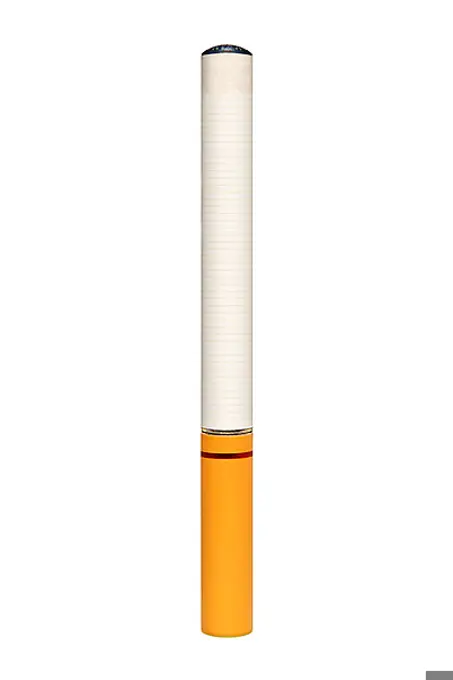
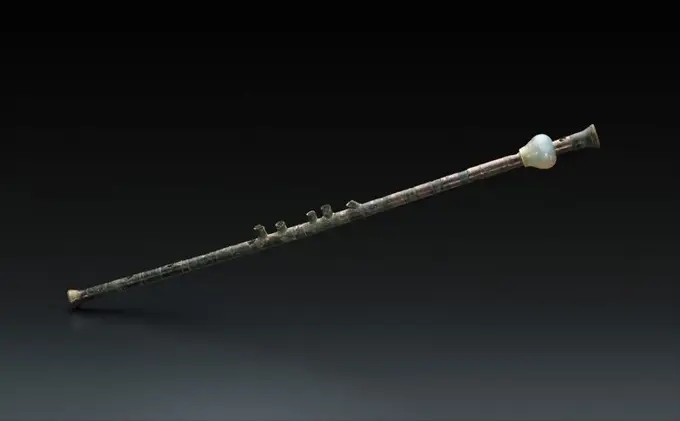
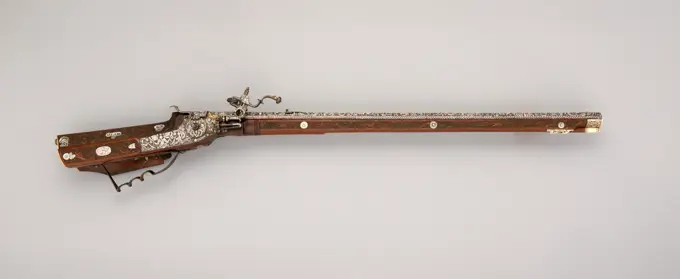
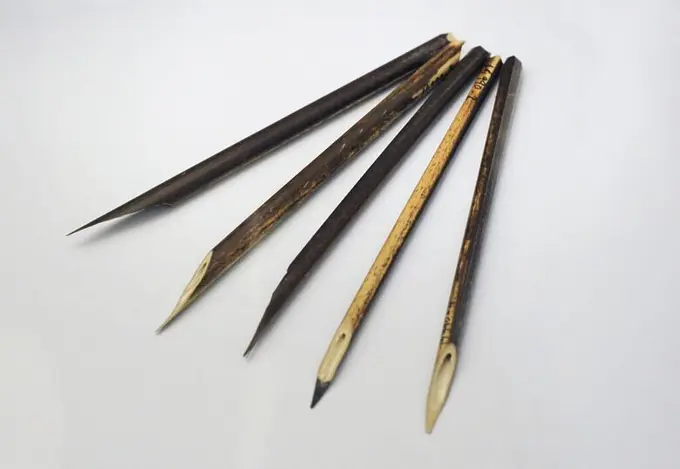
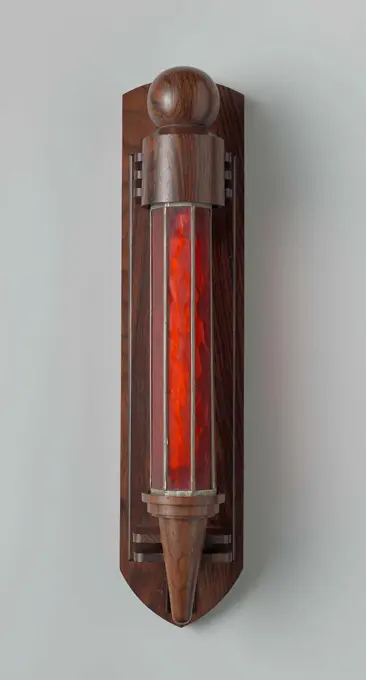
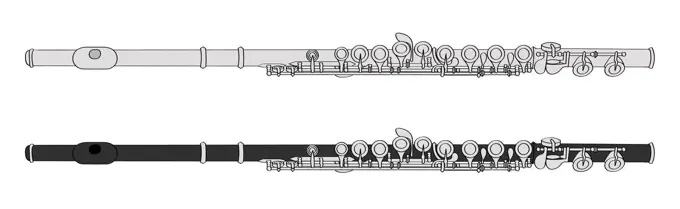
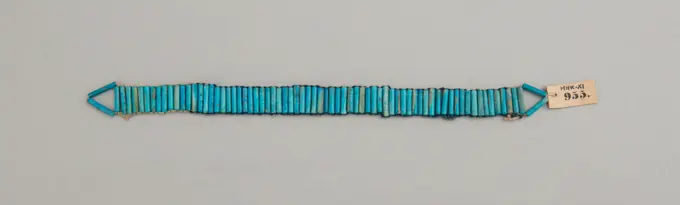
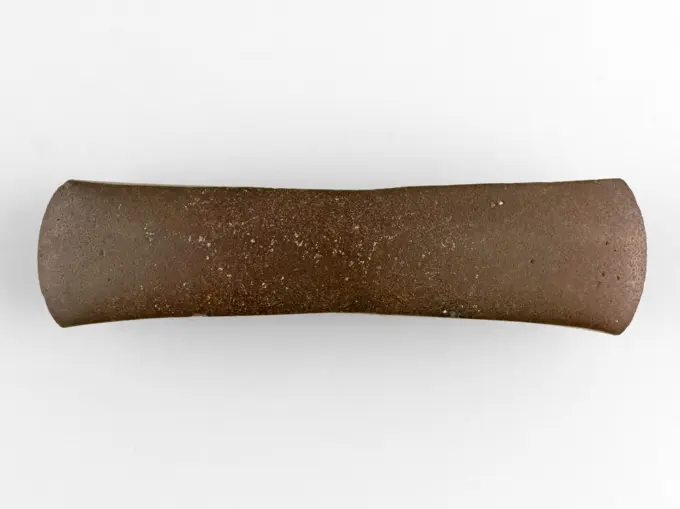
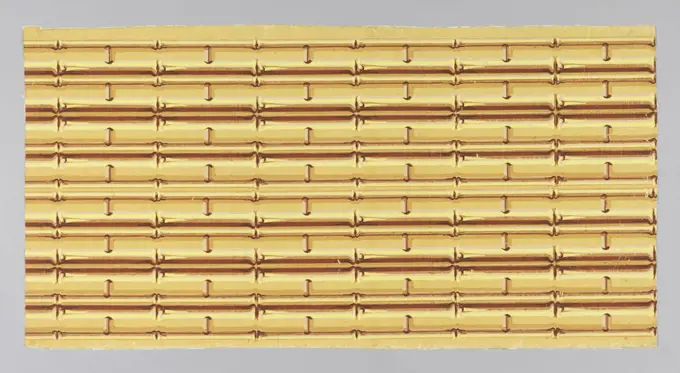
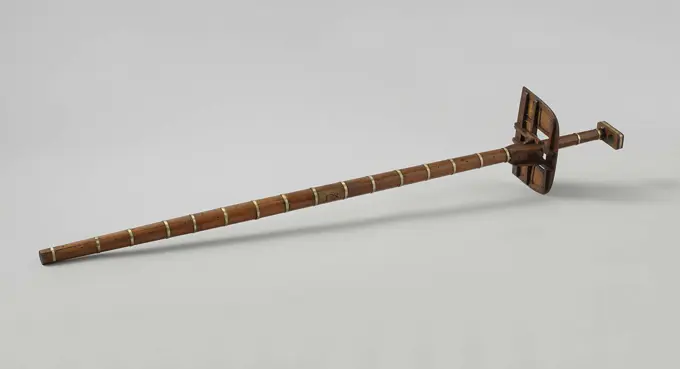
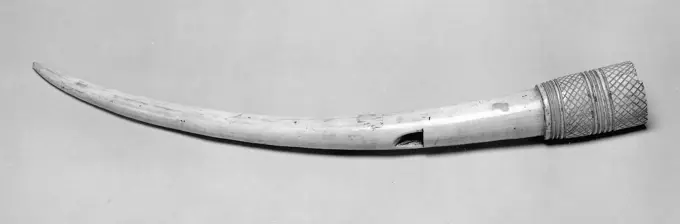
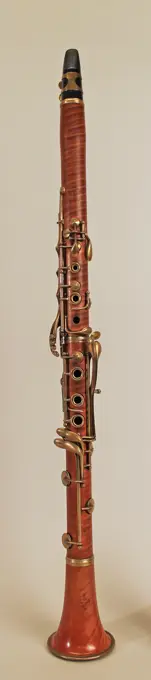
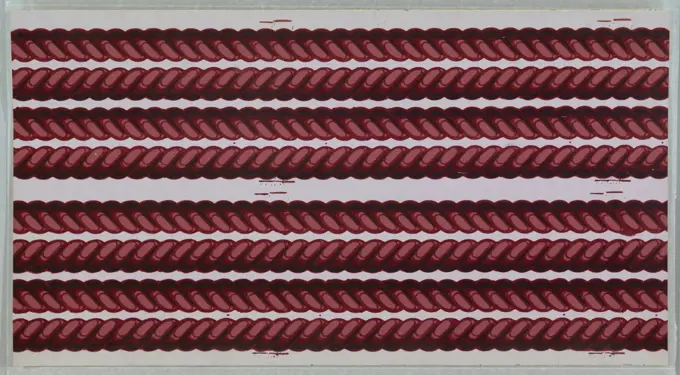
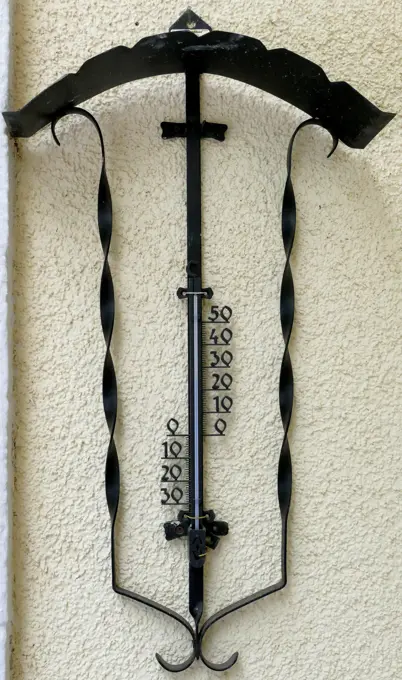
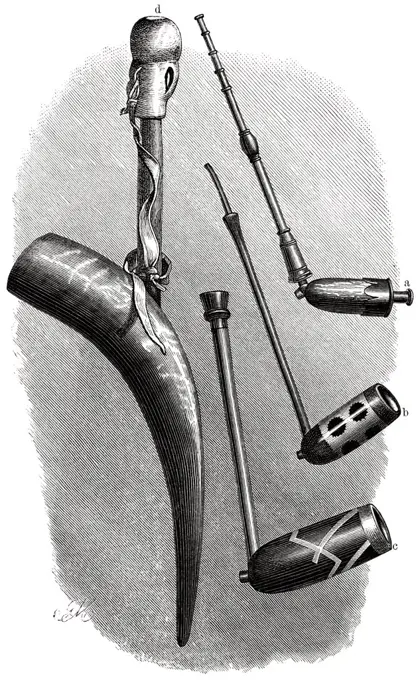
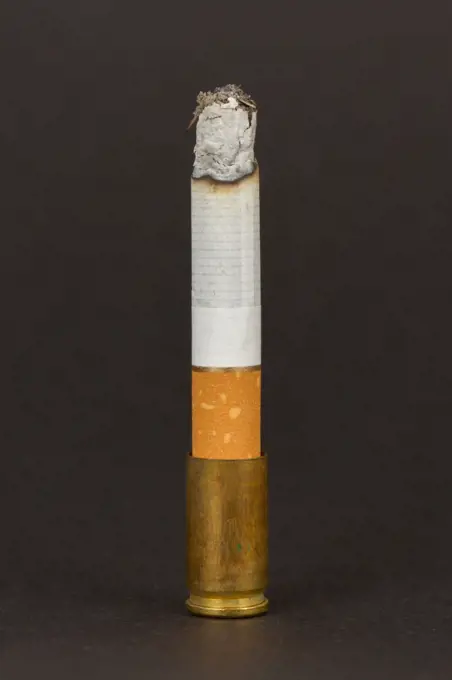
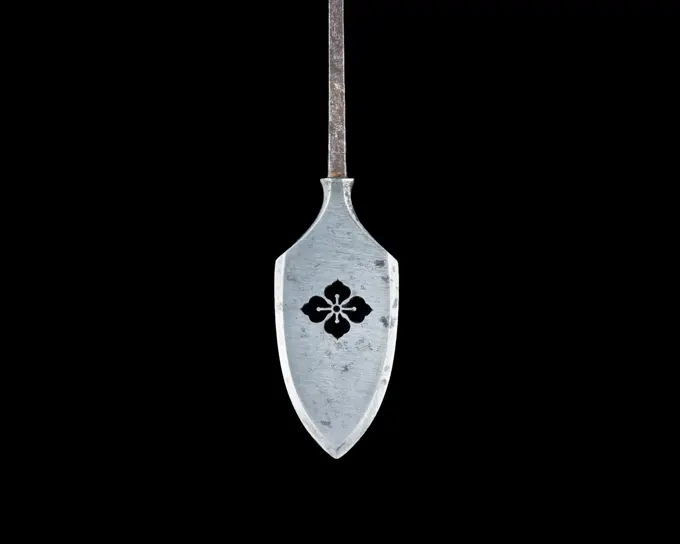
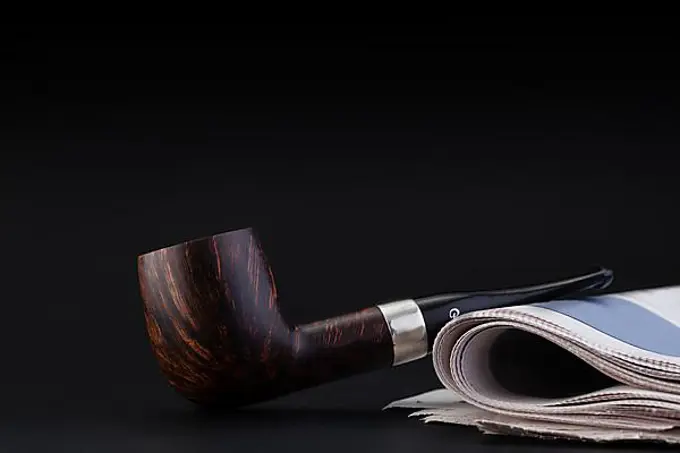
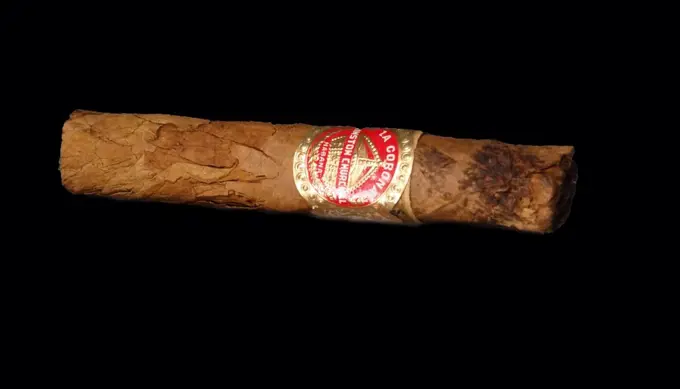
cutlery which Mahatma Gandhi used in his last home in New Delhi India. At 5:17 pm on 30 January 1948, Gandhi was with his grandnieces in the garden of the former Birla House (now Gandhi Smriti), on his way to address a prayer meeting, when Nathuram Godse fired three bullets from a Beretta 9 mm pistol into his chest at point-blank range.E-cigaretteTibia. Culture: Syrian. Dimensions: Height: 23 1/16 in. (58.6 cm)Diameter (At end): 1 in. (2.5 cm). Date: ca. 1-500.The tibia was sounded with a double reed, and two pipes would have been played simultaneously. The small tubes or chimneys projecting from the side of this instrument and the rings encircling its body were likely part of a complex mechanical system designed to increase the number of notes and modal scales that could be played on a single instrument.Often played in pairs, tibia were widespread throughout the Mediterranean world. They varied in length and construction and were used in many contexts: funerals, sacrificial rites, banquets, boxing matches, marriages and games. Museum: Metropolitan Museum of Art, New York, USA.Wheellock Rifle ca. 1630-40 Master of the Animal-Head Scroll (Meister der Tierkopfranke) A masterpiece of German baroque gunmaking, this luxurious wheellock rifle is one of the finest examples produced by the anonymous gunstocker called the Master of the Animal-Head Scroll, after the eponymous design motif that appears throughout his work. Probably employed by the imperial court in Vienna, he was active between 1624 and 1659, the dates recorded on his earliest and latest-known firearms. Characteristic of this master's work is the carving of the stock, with leafy tendrils ending in animal or bird heads, and the recessed background, which is either stippled or matted for contrast and, often, engraved with foliage. This rifle is among the most elaborately decorated works in the master's oeuvre, particularly the barrel, lock, and other metal parts--all intricately worked, chiseled, gilt, and encrusted with high-relief silver ornament--as well as the stock, which is extensively carved and iCalamus or reed pens. They were used by the expeditionaries to draw (Swedish expedition). Sweden. Last third of the 19th century. Museum of the Americas. Madrid, Spain.Modern metallic penWall lamp. .This illustration from the late 1800s shows a recontructed view of Roman bronze bed or couch that was found in Pompeii, based on the work done by the Nicolini brothers (Felice and Fausto) in their book published in 1854. Pompeii was a town south of Rome on the Bay of Naples that was destroyed in the A.D. 79 eruption of Mt. Vesuvius.Flutes vector set. Wooden and silver flutes.Necklace restrung with amulets and a faience cartouche bead of Tutankhamun ca. 1336-1327 B.C. New Kingdom, Amarna Period. Necklace restrung with amulets and a faience cartouche bead of Tutankhamun 549980Meterstab auf weißem Hintergrund - Folding rule on white background Meterstab auf weißem Hintergrund - Folding rule on white background Copyright: xZoonar.com/lantapixx 12914537Rectangle brown wooden border frame made of realistic brown bamboo stems with empty copy space for text or image. Vector clip art, banner, template or photo frame isolated on transparent background. Rectangle brown bamboo wooden border frame with copy spaceClarinet in C Hermann Wrede British ca. 1815-30 Hermann Wrede, who was obviously of German origin, was listed as "Mus. Wind Inst. Mkr." from 1811 and from 1837 also as "Mus. Wind Inst. & Pfte. & Importer". The firm had the address at 15th St Johns square, Clerkenwell, between 1814 and 1829. (Waterhouse, NLI, 436)Overall size: 585Bore: c-hole 13.4; f-hole 13.4Conical part: 110Technical description: Boxwood with ivory ferrules and brass keywork. Six pieces: mouthpiece, barrel, upper section, middle section for the fingers of the right hand, lower section with keys, bell. Long tenon ebony mouthpiece grooved for cord. English-style flask shaped barrel. Square wooden rings strengthened with pins. Speaker liner projects almost to the centre of the bore. Levers for L4, tone-hole and key for R4 mounted in a bell-shaped swelling. Zig-zag F♯3/C♯5 lever guided in a rudiment of a square wooden ring. Bevelled G♯3/E♭5 touchpiece.L0:   T; speaker. L1:   T; throat A♮. L2:   T. L3:   T. L4:   E3/B♮4; Spontoon. Culture: American. Dimensions: L. 77 7/8 in. (197.8 cm); L. of head 16 1/2 in. (41.9 cm); W. 4 5/8 in. (11.8 cm); Wt. 1 lb. 13 oz. (822 g). Date: 18th century. Museum: Metropolitan Museum of Art, New York, USA.Fragments Pipe states from the wreck of the East Indiesman Hollandia. Pipe, voice; Fragments with Stamped Decoration and Inscription ? vschu,? Ouda.Tiqin 19th century Chinese. Tiqin 500682Oboe, Jan Steenbergen, c. 1720 - c. 1730 Hobo of boxwood wood with three valves. Amsterdam boxwood (hardwood). silver (metal) Hobo of boxwood wood with three valves. Amsterdam boxwood (hardwood). silver (metal)BraceletArrowhead ca. 3100-2900 B.C. Early Dynastic Period. Arrowhead. ca. 3100-2900 B.C.. Ivory. Early Dynastic Period. From Egypt, Northern Upper Egypt, Abydos, Umm el-Qaab, Tomb of Djer, Egypt Exploration Fund excavations. Dynasty 1Pen in closed blue notepad on white Pen in closed blue notepad on white background Copyright: xZoonar.com/AndreyxEreminx 2238187Double -edged ax. Neolithic. Size and polishing. Coming from: Lit de la Seine. Paris, Carnavalet museum. AGE PIERRE POLIE, ARM, AXE, Arme, CARVING, DOUBLE TRANCHANT, DOUBLE-EDGED, HACHE, NEOLITHIC, NEOLITHIQUE, OUTIL, POLISHED STONE ERA, POLISHING, POLISSAGE, PREHISTOIRE, PREHISTORIC, PREHISTORIQUE, PREHISTORY, TAILLE, TOOL, shot, sword, weaponDessert knife, F. Nicoud, French, active 1890, Silver, steel, mother-of-pearl, gilding, One of twelve steel-bladed dessert knives with mother-of-pearl handles and gilt bolsters., ca. 1890, cutlery, Decorative Arts, Dessert knifeHalf model or a screw steamer. Polychromed stack model (starboard) of a three-way screw steam vessel. Almost vertical, straight forward with galleon and curl as shoeboard. Elliptical fence with national arms, mangan screw and stir with rounded stir sheet. The model has a chimney. The seam runs to both ends, a Reehout. Running. Scale 1:50 (derived).Border, Block-printed on handmade paper, Yellow bamboo shaded with brown. A series of coupled strips connected to one another at right angles by smaller widely spaced bamboo strips. Two complete borders to the width. Excise stamp on back has legend encircling crown: 'First Account Taken - 313 ()', England, ca. 1820, Wallcoverings, BorderCeremonial Waist Sash (ikak pinggang) Made 1801-1900 Sumatra. Cotton, silk, and gilt-metal-strip-wrapped cotton; in bands of plain weave, plain weave with supplementary patterning wefts and slit and dovetailed tapestry weave; ends of wool, plain weave; fulled; edged with tape of cotton and gilt-metal-strip-wrapped cotton and gilt-metal strip, plain weave with supplementary wefts; underlaid with tape of cotton, plain weave with extended paired weft and silvered-metal coil fringe . Minangkabaugrooved wood against a green surfaceFork, steel, glass beads, thread, Two-tined fork, baluster stem. Tubular-tapered handle, beaded with multi-color floral bands in spirals, ground of white beads, blue, yellow and green beaded bands., Germany, ca. 1720-1750, cutlery, Decorative Arts, ForkBourse. Gal1952.5.106Bead 500 B.C.-A.D. 300 Thailand. Bead 44531Iron candelabrum early 3rd century B.C. Etruscan This candelabrum has a wick trimmer attached.. Iron candelabrum 247090Close up bunch of uncooked spaghetti noodlesModel of a Made mast. Round mast with octagonal top, march and donkey head. The mast itself consists of an octagonal mast king surrounded by eight cheeks. The parts are held together by tub tires. A number of short shelves around the mast forms a flat dragon, on the sides the ears with cling that supports the calves, and behind half a socket. The Mars is around from the front and is worn by the longitudinal and wisdom. The marse edge is reinforced with copper and the mars floor is closed with wide shelves, which are secured on top and dragging with pinches. The donkey head is rectangular and flat in shape. This model can be exploited. This mast is made according to the 'Hollandse Method' (see NG-MC-127).Yad; silver; Overall: H x diam.: 30.1 x 4 cm (11 7/8 x 1 9/16 in.) Shaft: H x diam.: 30.1 x 1 cm (11 7/8 x 3/8 in.)Horn late 19th century Probably Igbo people Most Sub-Saharan horns and trumpets are blown from the side rather than from the tip where they may be pierced to allow the player to sound different notes by opening and closing the end hole. Depending on regional tradition, blowholes may have a distinctive shape and appear on the concave or convex curve of the tube. Despite diminished importance as military signal instruments, side-blown horns remain a symbol of power and retain an important position in royal regalia. They are played singly or more often, in a large ensemble.. Horn. Probably Igbo people. late 19th century. Ivory. Nigeria. Aerophone-Lip Vibrated-hornFluteFragment Pajesstelen from the wreck of the East Indians' t Vliegend Hart, 1700 - 1735  Three pieces of stem from earthen Goudse pipes, dark brown discolored. Fragments of Bowls and Stems.  pipe clayPiccolo Clarinet in A-flat ca. 1850-60 Johann Samuel Stengel German Piccolos in A-flat, B-flat, and C, the smallest clarinets, were mostly used in clarinet-only bands, which flourished for some time inItaly, the Netherlands, and the United States. Listen to experts illuminate this artwork's story Listen Play or pause #9321. Piccolo Clarinet in A-flat Supported by Bloomberg Philanthropies We're sorry, the transcript for this audio track is not available at this time. We are working to make it available as soon as possible.. Piccolo Clarinet in A-flat. German. ca. 1850-60. Boxwood, brass. Bayreuth, Germany. Aerophone-Reed Vibrated-single reed cylindricalblue tandem canoe with wood seats isolated on white - top and side viewsEnglish horn, Hanken, c. 1900 English horn (or althobo) of dark brown stained palmhout, consisting of 4 parts and with thirteen silver valves. Marked on the upper, middle and lower part: G. Hanken / & Son / Rotterdam. The oboe is in a wooden box covered with leather and with velvet on the inside. In the box there is a box intended for 3 wicks, containing 1 reed. In addition, a mouthpiece for the reeds. Rotterdam Boxwood. Valves: Silver (Metal) English horn (or althobo) of dark brown stained palmhout, consisting of 4 parts and with thirteen silver valves. Marked on the upper, middle and lower part: G. Hanken / & Son / Rotterdam. The oboe is in a wooden box covered with leather and with velvet on the inside. In the box there is a box intended for 3 wicks, containing 1 reed. In addition, a mouthpiece for the reeds. Rotterdam Boxwood. Valves: Silver (Metal)Glass stirring rod ca. 1st-4th century A.D. Roman Uncertain color.Solid, cylindrical rod, slightly thickened at either end into small knobs.Intact; thick, black enamel-like weathering, with small patches of pitting and iridescence.. Glass stirring rod 239740Knotted string in a curved shapeWooden Column Entrance Isolated Photo Wooden columns church part photo isolated on white background Copyright: xZoonar.com/DanielxFerreira-LeitesxCiccarinox 14972278 green street lamppost isolated on white backgroundRibbon of cream -colored mesh of 15 meters, c. 1900 - c. 1915 Ribbon of cream -colored mesh for 15 meters. Nijmegenfrance silk. Ribbon of cream -colored mesh for 15 meters. Nijmegenfrance silk.Ribbon 'commander of the Marechaussee', Anonymous, 2000 ribbon (material) Ribbon with three horizontal tracks red, white and blue, laid on 4 May 2000 at the National Monument on Dam Square. In the Witte Baan an inscription in black. Ends straight cut with cartel scissors. Bound on one side with iron wire, this is curved for confirmation to wreath.  textile materials. ink printing  AmsterdamRevers pin of a departmental member of the Dutch Christian Radio Association (NCRV), NCRV, 1924 - 1994  Rectangular pin with a crown on top. On the rectangle stands, between the inscription, a mast with the letters N / C / R / V (from top to bottom). In addition, there is an open book. Inscription: Ned. Chr. / Radio Ver. This rectangle is included in a round shape. Inscription along the bottom: Department MANAGEMENT. The pin is made of metal with blue as a spot color. Netherlands metal   NetherlandsContainer(Bungkan)Clarinet in A 1860-65 Buffet, Crampon & Cie. French The instrument shows the Boehm system clarinet in its early and largely original setup, which was developed between 1839 and 1844 by the clarinetist Hyacinthe Eléonore Klosé and the manufacturer Auguste Buffet jeune in Paris.The Buffet family originated from La Couture, which was a city focussing on instrument making. The brothers Denis (born La Couture 28 July 1783; Buffet-Auger) and Louis August (born La Couture, 6 Aug 1789; died Anet, 30 Sept 1864; Buffet jeune) had independent workshops in Paris. In 1825 Denis Buffet set up his workshop in Paris, his brother did so in 1830. Denis son Jean-Louis (born La Couture, 18 July 1813; died Paris, 17 April 1865) gradually took over the business after 1830. After 1844 it took the name Buffet Crampon. Buffet-Crampon were awarded bronze medals at the Paris Expositions of 1844 and 1849. The firms advertising for 1845 featured the new ring-keyed clarinets (later known as Boehm clarinets), as wOrgan pipes, organ of the Roman Catholic town parish church of St. Augustin, Coburg, Upper Franconia, Bavaria, Germany, EuropeGold Band Alabastron. UnknownABANICOS EN MARFIL. Location: PRIVATE COLLECTION. MADRID. SPAIN.Border, Block-printed on continuous machine-made paper, Narrow rope twist or cable molding borders. Printed in shades of deep red on lavender ground. Printed eight across., H# 135, France, 1835-1900, Wallcoverings, BorderModel of an Optical Telegraph.Model of an optical telegraph, at square base board. A mast is set to the corners of the base board on a pedestal. The mast has three ras, upwardly increasingly shorter, with round braided discs at the ends. These can be placed in horizontal and in vertical position with levers on the base. At the top of the mast a flagpole with Dutch tricolor.Old thermometer on the wall Old decorative thermometer on the wall Copyright: xZoonar.com/OgnjenxStevanovicx 9874535Tree Identification - Sassafras. Photographs Relating to National Forests, Resource Management Practices, Personnel, and Cultural and Economic Historyblack chinese chopsticks on red bamboo mat. asian style table place settingThree Tobacco Pipes (right) and Dacha Pipe, Africa, Illustration, 1885Spaghetti, still lifeSpindle 10th-16th century () Peruvian. Spindle 316861Burning cigarette in an old tin ashtray, isolatedSweden, Blekinge, Blekinge, Karlskrona, Karlskrona, external marina (depicted, town).Sweden, Blekinge, Blekinge, Karlskrona, Karlskrona, External War Gogs (depicted, City)Arrowhead (Yanone) 16th-19th century Signed on the tang of the blade by Seijiro Japanese Although today Japanese warriors are renowned most for their swordsmanship, archery, especially from horseback, has been an essential part of samurai warfare and culture for centuries. Arrows were fitted with heads of varying shape according to their intended use in war, the hunt, or target practice. This arrowhead and others like it also in the Metropolitan Museum's collection (acc. nos. 32.75.489, .503, .506, .519, .562, .586, .591, .614, .657, .658, .659) were made for use on the battlefield, with different designs intended for specialized purposes such as the piercing of armor or to cause maximum damage to horses and unarmored personnel. On the other hand, highly elaborate examples (acc. nos. 32.75.318, .321, .327, .330, .334, .337, .339, .340, .398, .399, .403, .406, .409, 36.25.2616) were made as gifts or for ceremonial purposes.This arrowhead in the shape of a willow-leaf (yanagi-ha) featureDräger's company badge badge unknown labelSmoking pipe on a blackSouvenir of Józef Czapski  Pastel Pencil Pastel Swan stabiloHavana cigar used by Sir Winston Churchill, british Prime Minister during World war two. 1945Five Cigar Ribbons Made 1880-1889 United States. Silk, plain weave; printed .