Historical Firearms

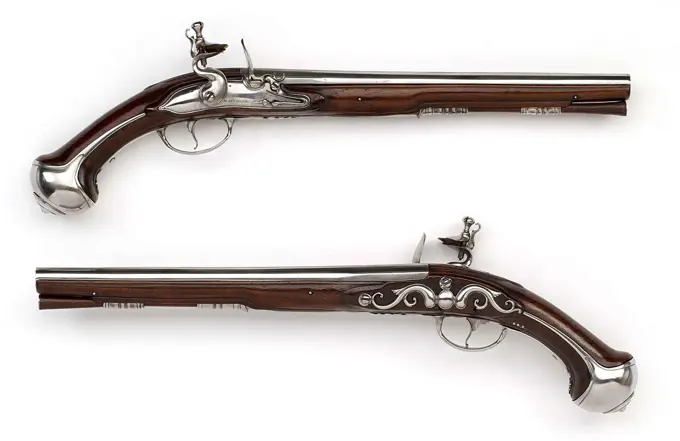
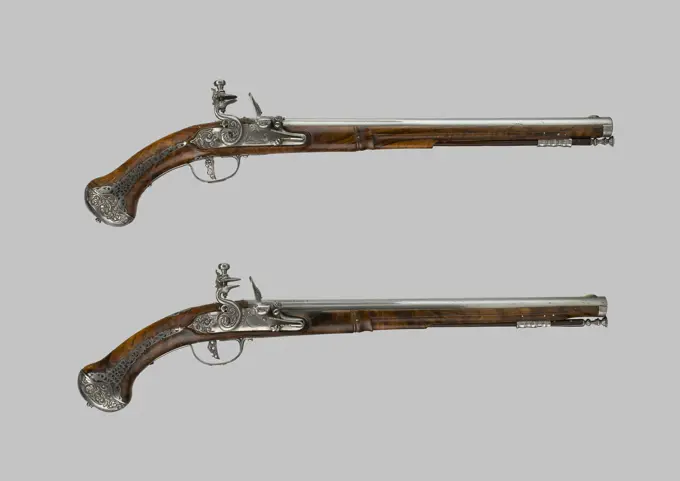
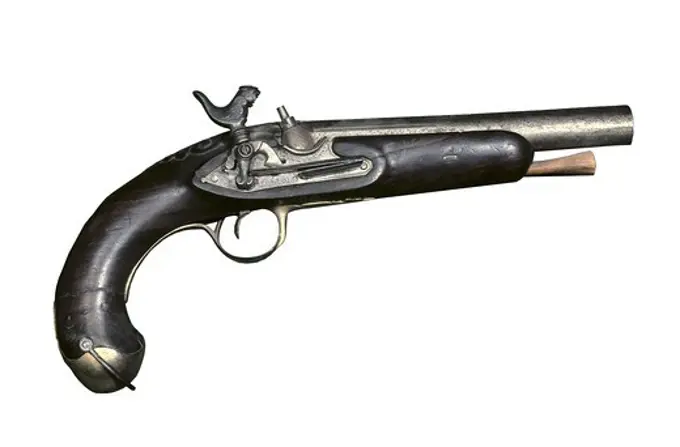
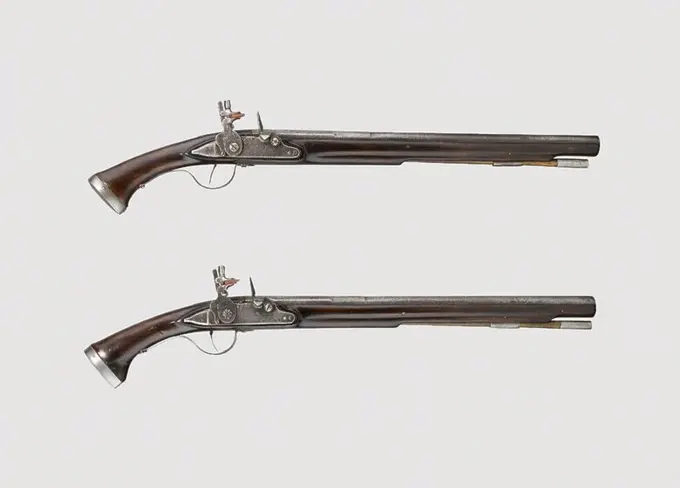
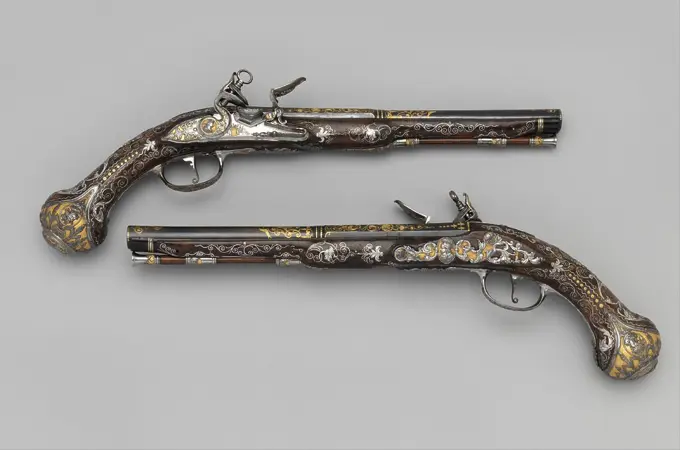
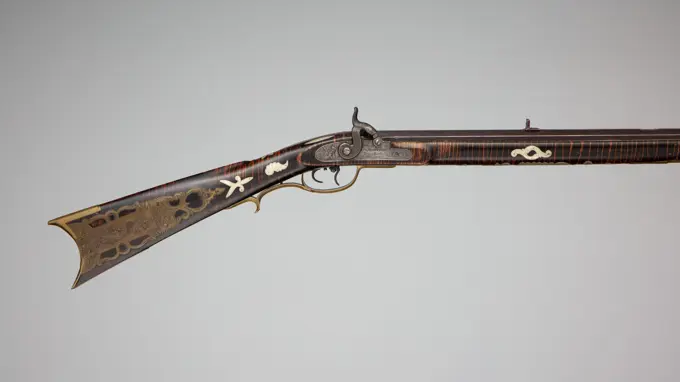
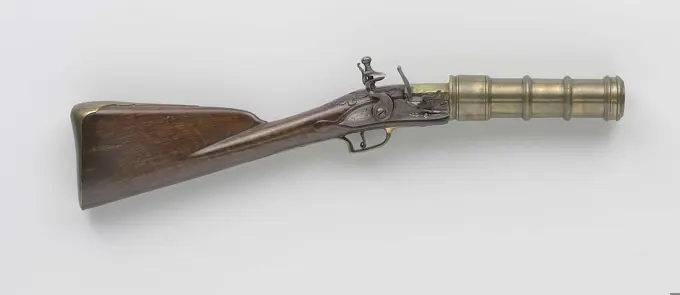
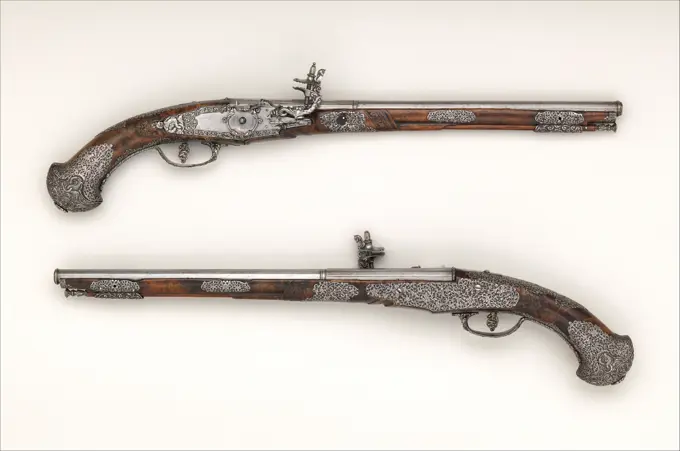
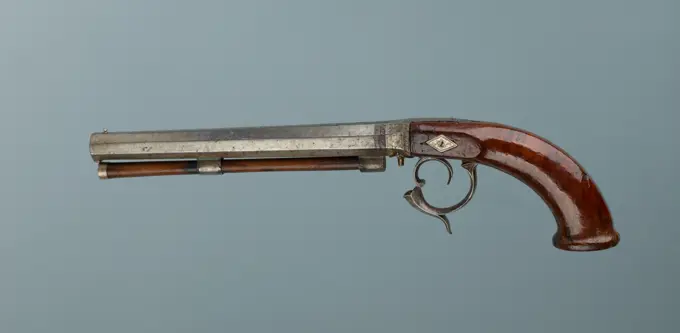
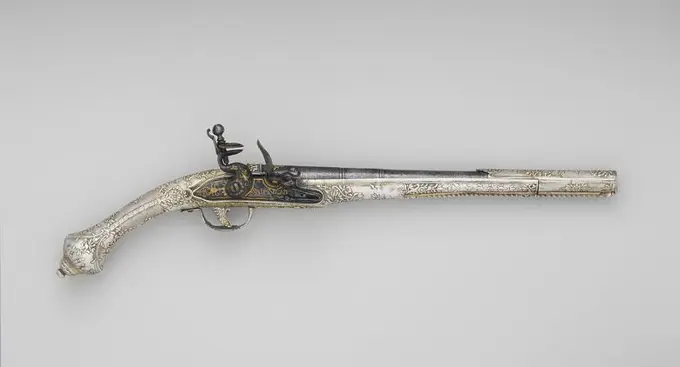
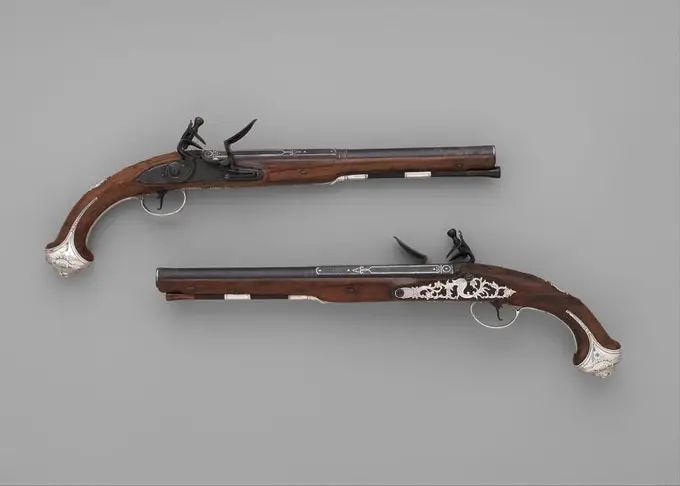
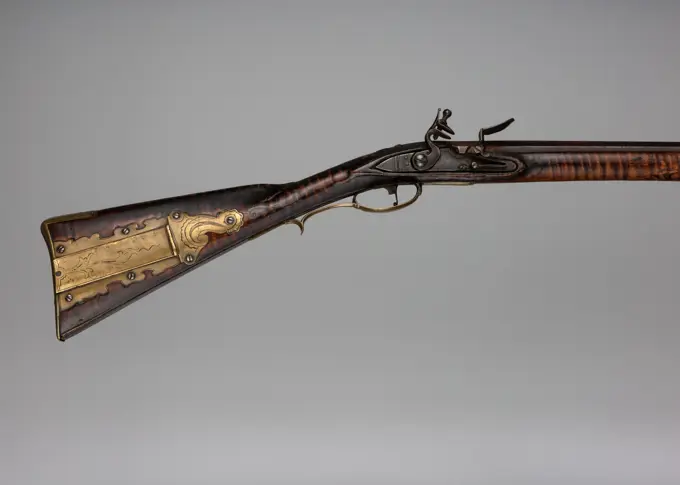
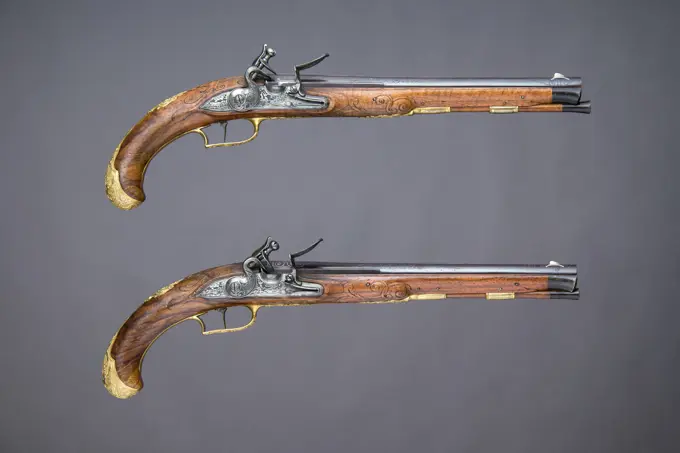
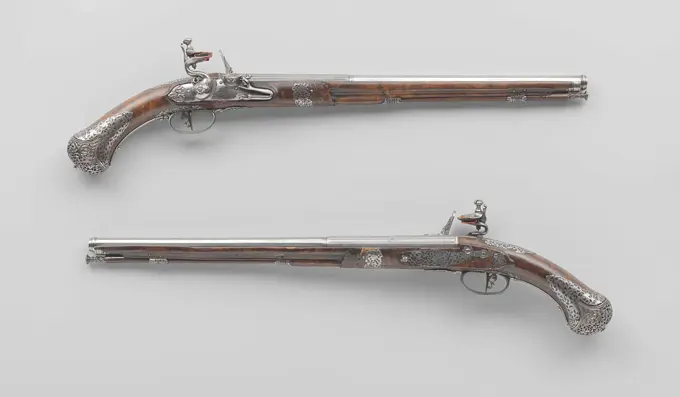
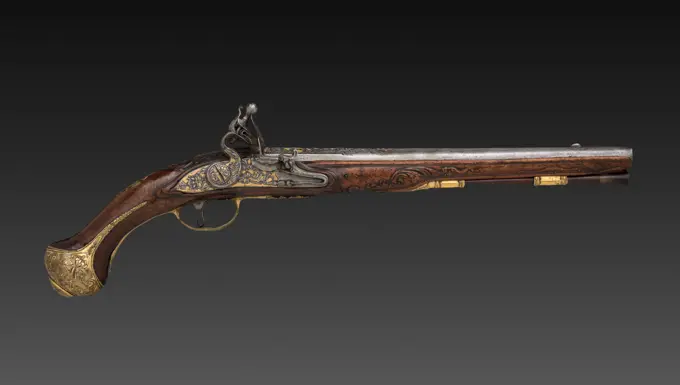
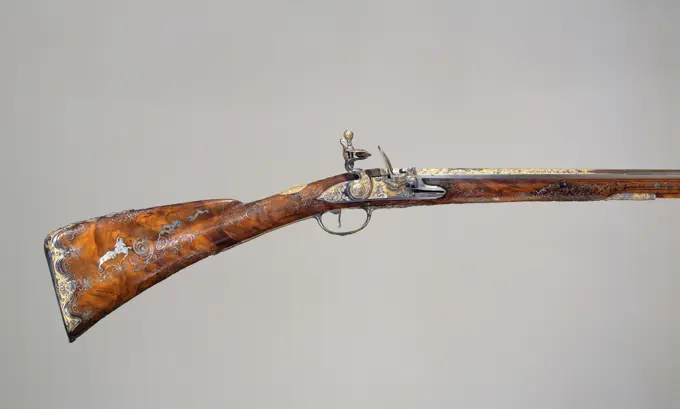
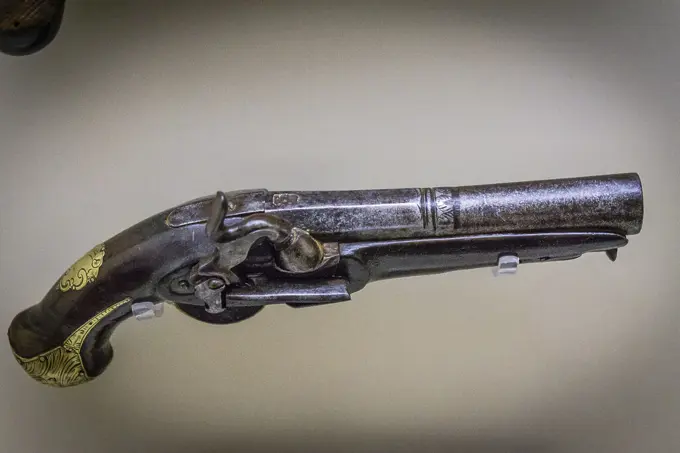
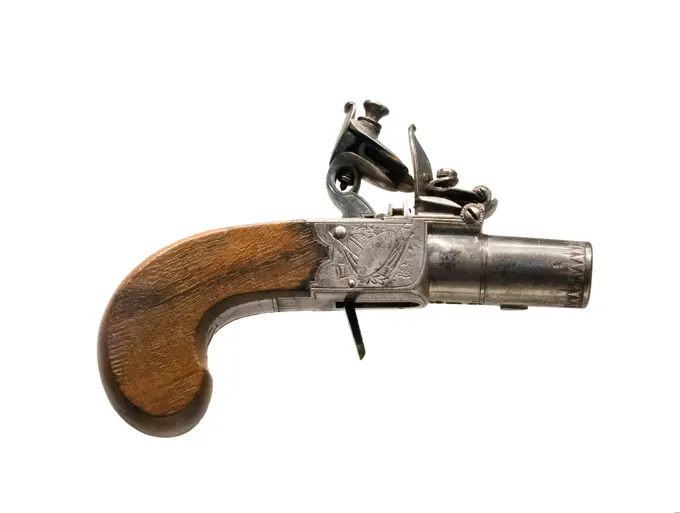
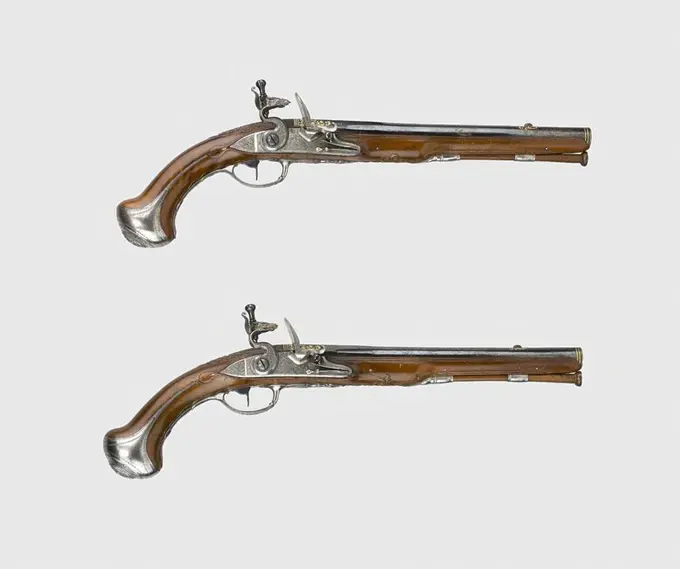
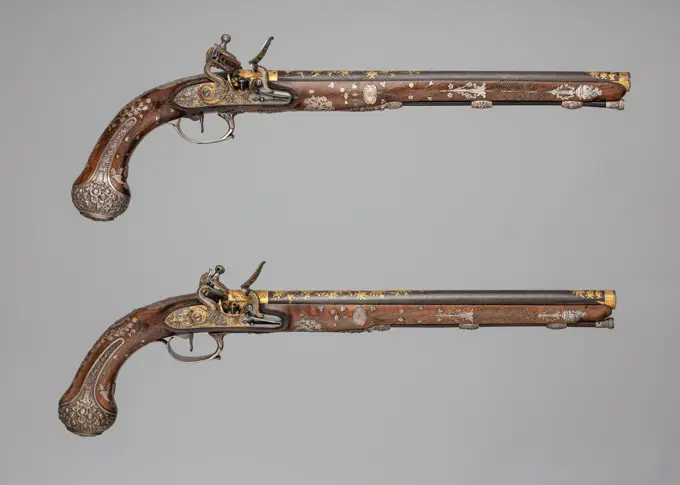
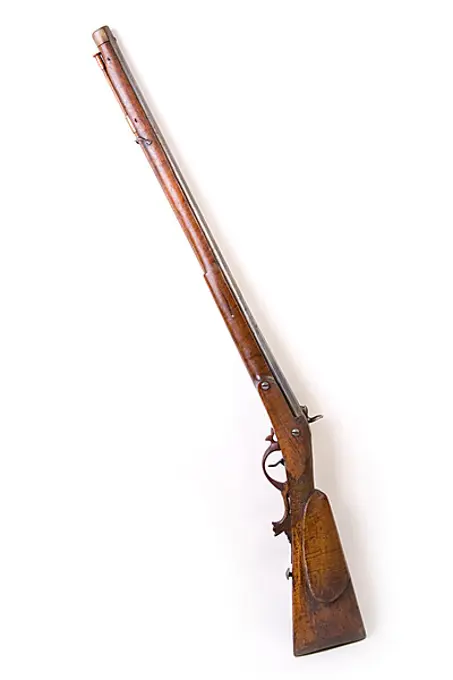
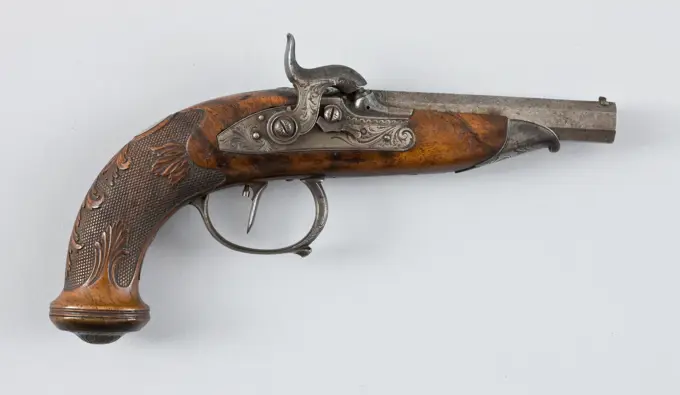
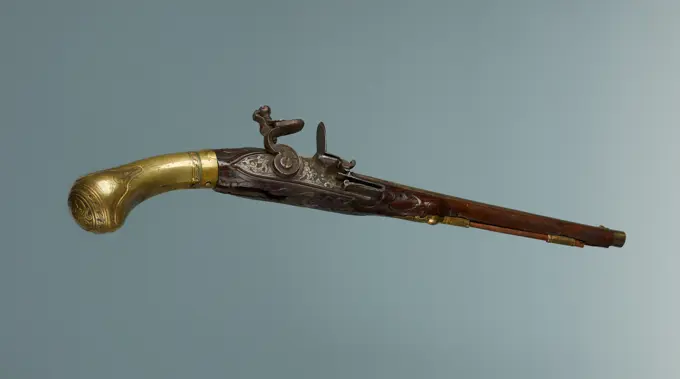
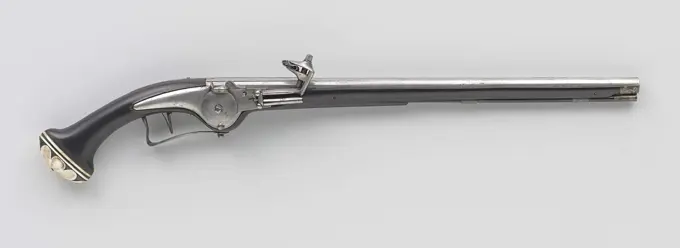
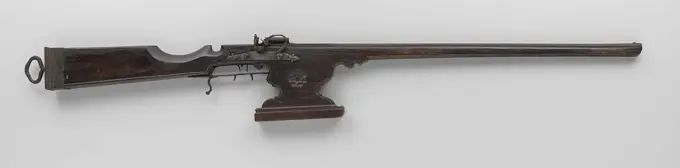
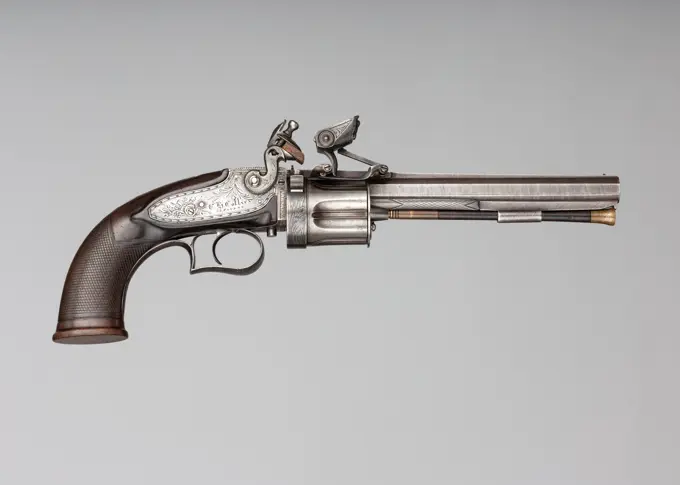
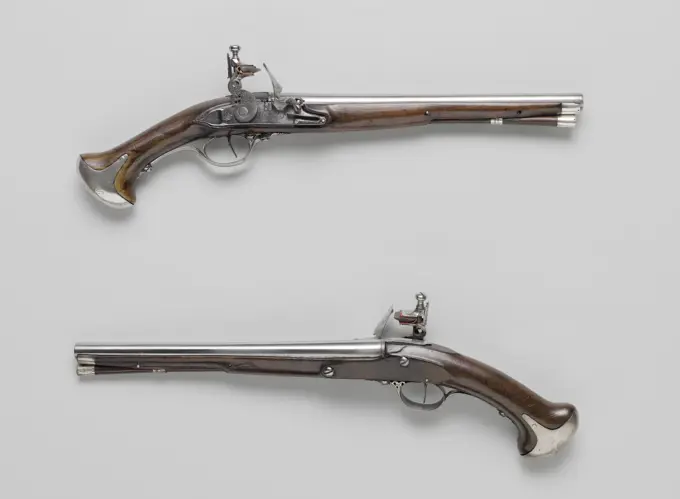
Display of vintage firearms such as flintlock pistols from various eras, showing intricate designs and materials, highlighting historical craftsmanship.

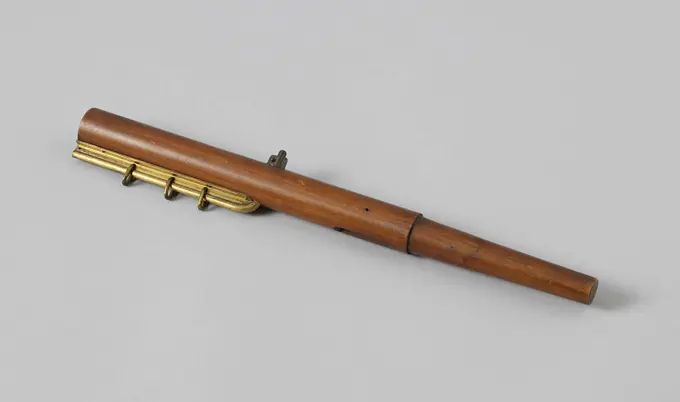
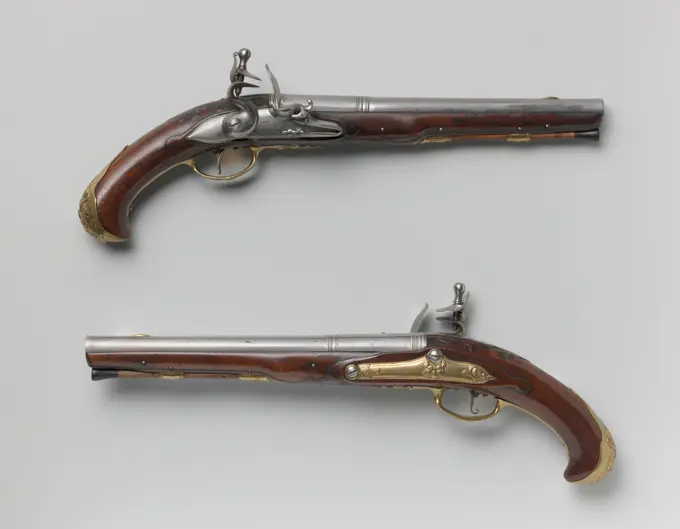
Flint gun for stacked drawer, Wijert Swartt (Possible), c. 1720 flintlock pistol The lock is decorated with relief and engraved animals, a mask, praise, ajour work and on the final plate the letters W.S.; The lock has a special construction with two pans above each other. The loop is stamped on the bottom with the letters WT and provided with a yellow grain and a visorkeep on the tail of the loop. The flask has simple cutting work. The iron batter includes a screw plate with leaf vines and the flask decorated flask. Amsterdam iron (metal). brass (alloy) engraving / cutting
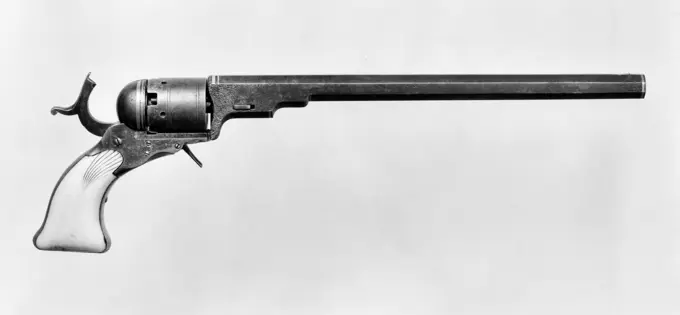
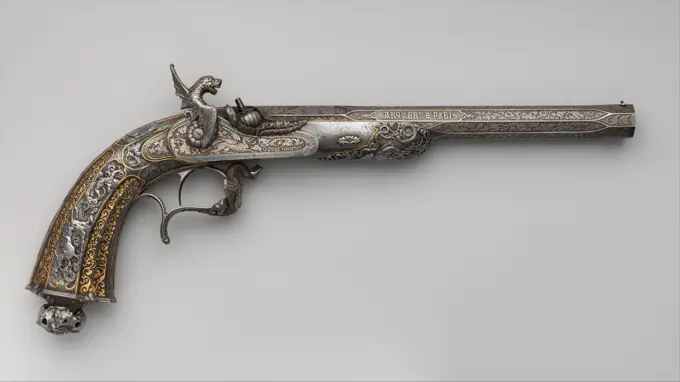
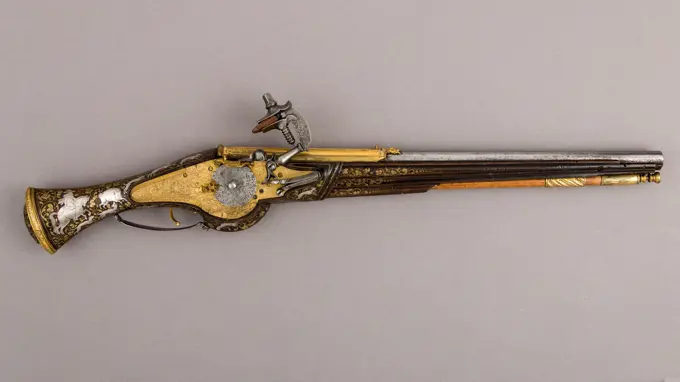
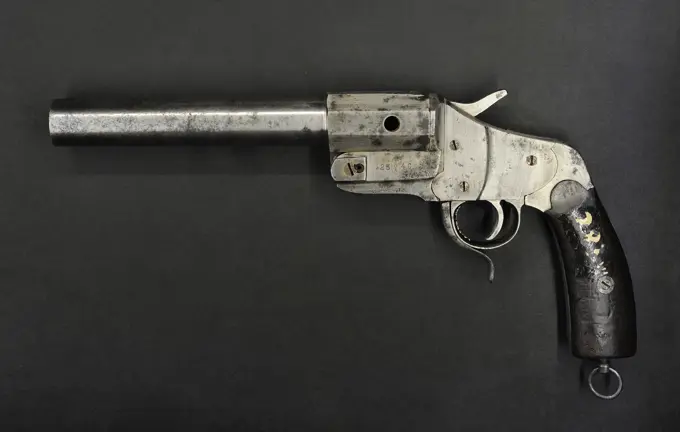
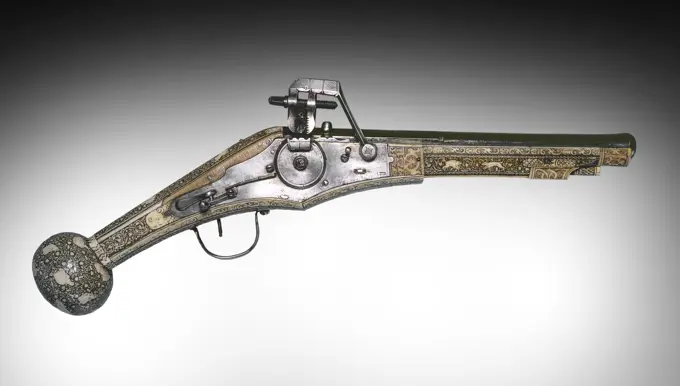
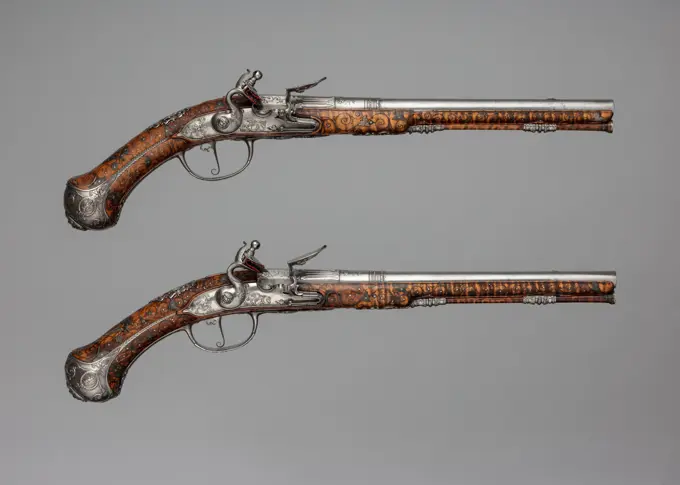
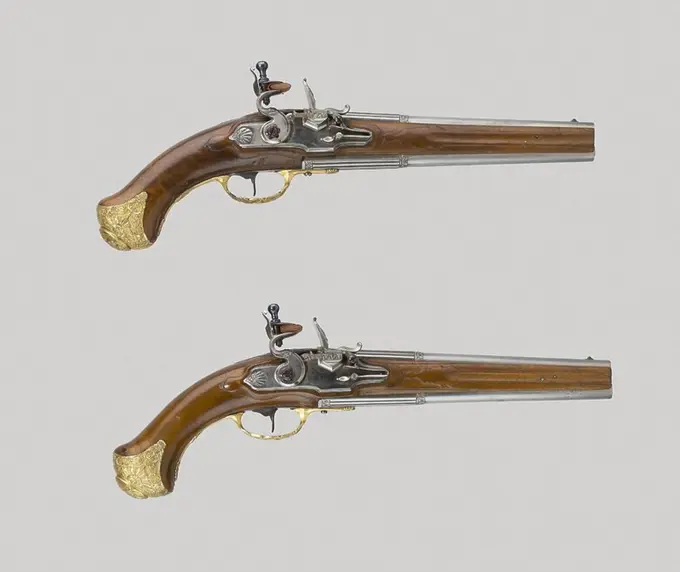
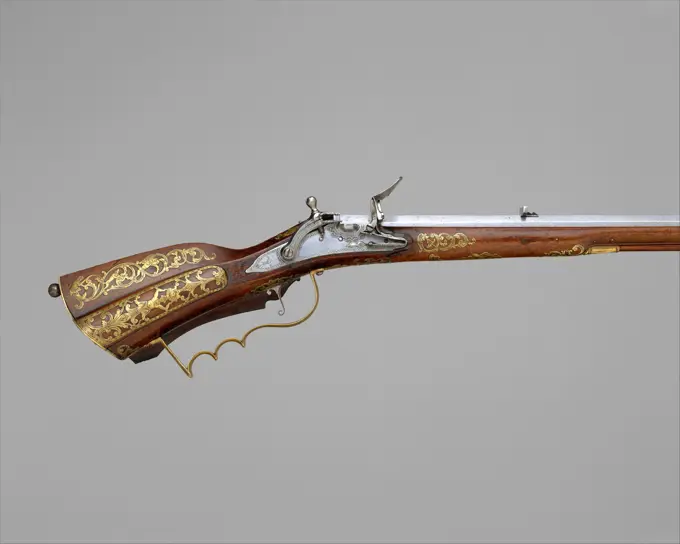
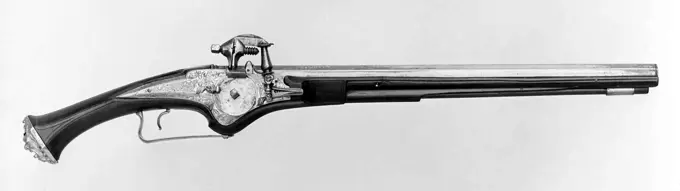
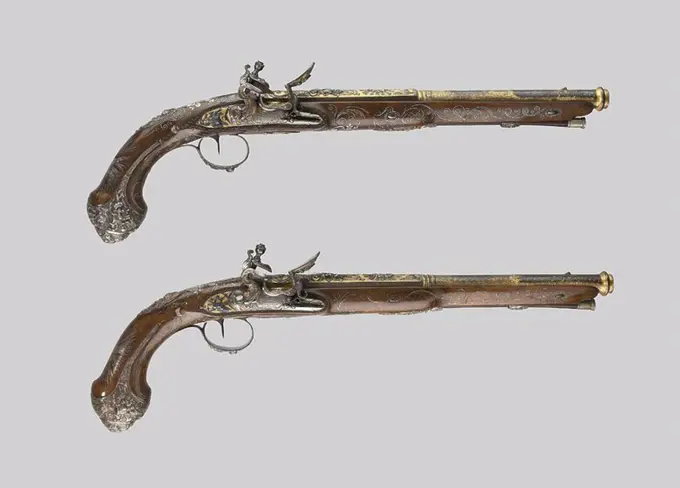
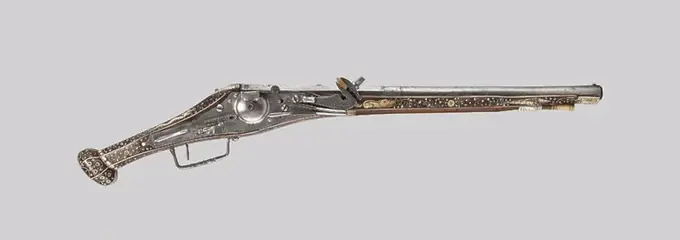
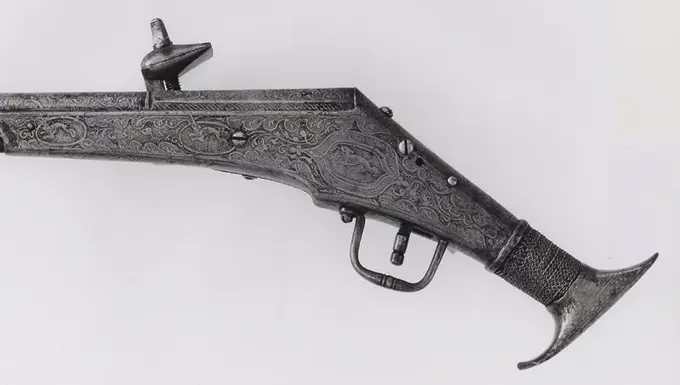
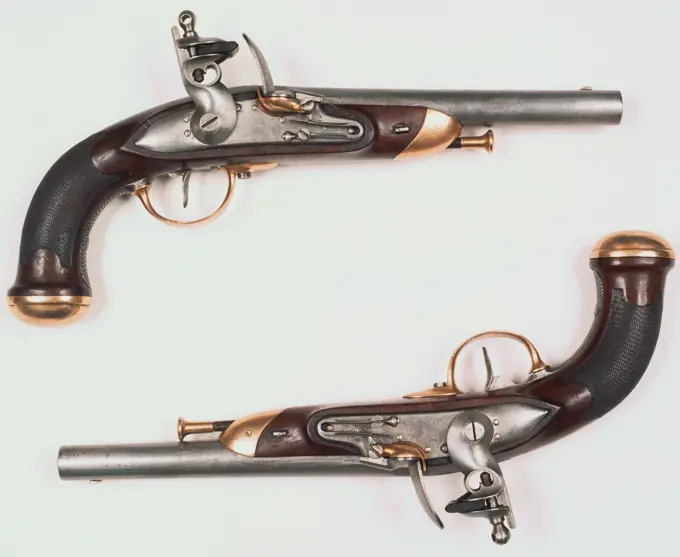
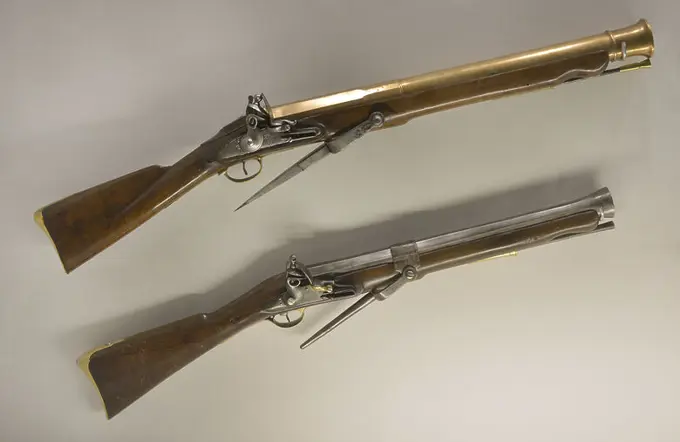
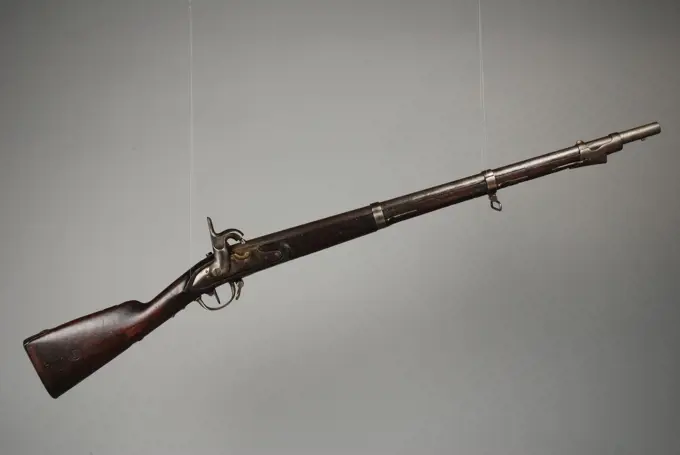
Werndl M1867 carabiner Frühwirth, Ferdinand, Wurzinger, LudwigWheellock Pistol dated 1630 Felix Werder Swiss This is the earliest recorded firearm by Werder and is perhaps his masterpiece. Whereas Werder's pistols typically have brass barrels, this one is of steel, the facets alternately gilt and (formerly) silvered.. Wheellock Pistol. Swiss, Zürich. dated 1630. Steel, bronze, wood (beech), silver. Zürich. Firearms-Pistols-WheellockPercussion Army pistool Model M 1815. Percussion Army pistool Model M 1815. Smooth, round loop, which passes the room in a five-sided section. A percussion fireplace is closed at the top of the room. On the tailpiece of the loop: M 1815. Signed on the loop: 1816, GB. Slot: Percussion slot. The rooster has a large ring for the thumb at the top. Signed on the lock plate: D (crown above). Wood: walnut. Batter: brass. On the front of the tray is an open-worked sleeve, which serves to confirm the loop; counterplate; trigger bracket; Kolfkap.Military flint gun. Simple military pistol of high quality; For the French market; Part of a couple. The lock plate carries the Inscription Mastreck. The loop is flattened up to almost with the trump; Mounted with what seems to be in a triangle in three buttons. The flask is easily cut with, among other things, an arrow in a recess for the tail of the loop. The iron batter includes a symmetrical screw plate consisting of two S-shaped tendrils on either side of an oval knob under the final bolt, and a flask with a stepped flask plate and a button; The loading stick is equipped with an iron hood.Mauser flare pistol M.1894, Germany. Latvian War Museum. Riga. Latvia.Miquelet Pistol ca. 1790-1807 Llorens Torrens Spanish This is a rare example of a Spanish firearm with Neoclassical decoration. Especially noteworthy is the cock shaped as a fluted column and the mounts of brightly polished steel decorated with faceted steel beads and raised gold ornament.. Miquelet Pistol. Spanish, Barcelona. ca. 1790-1807. Steel, gold, wood (walnut). Barcelona. Firearms-PistolsPair of Flintlock Holster Pistols 1650-1680 Italy. Ivy root, brass, and steel . Lazzarino CominazzoPecussion cap gun (19th c.). SPAIN. CATALONIA. GERONA. Ripoll. Ripoll Ethnographic Museum.Pair of Double-Barrel Flintlock Pistols 1720-1740 Saxony. Steel, gilt bronze .Flight gun. Part of a couple. The lock is virtually unfaired; Signed. The loop is embossed with branched praise and a dragon, equipped with an iron grain and stamped down with the weapon of Maastricht. The flask is sliced with leaves. The iron batter includes a screw plate in the form of a sea hose, but without head and equipped with ajour processed leaflets, the tail of the loop with decoration in the form of an onion with the inscription N 39, and the cob plate plateed with A mask with acanthus leaves around it.Pair of Flintlock Pistols. English. Date: 1640-1660. Dimensions: L. 58.8 (23 1/8 in.)Barrel L. 40.7 cm (16 in.)Wt. 2 lb. 1 oz.Caliber .50. Steel, walnut, iron, and maple. Origin: England. Museum: The Chicago Art Institute, Chicago, USA.Pair of Flintlock Pistols Made for Ferdinand IV, King of Naples and Sicily (1751-1825). Barrelsmith: Emanuel Esteva (Spanish, active in Naples, Italy, recorded about 1768-73). Culture: Italo-Spanish, Naples. Dimensions: L. of each 17 3/8 in. (44.1 cm); L. of each barrel 11 1/16 in. (28.1 cm); Cal.63 in. (16.0 mm); Wt. of each 2 lb. 4 oz. (1021 g). Gunsmith: Michele Battista (Spanish, active in Naples, Italy, recorded about 1760-90). Manufacturer: Royal Arms Manufactory at Torre Annunziata (Italian, Naples, established 1757). Date: ca. 1768.The Royal Arms Factory in Naples was established in 1757 with the significant participation of Spanish gunmakers, who strongly influenced Neopolitan arms production in both technical innovations and artistic style. These magnificent pistols are signed by two leading craftsmen of the factory and appear to have been made for their patron, King Ferdinand IV of Naples and Sicily (1751-1825). What may be portraits of the young king and his queen on the buPair of flintlock pistols, Michel de la Pierre, c. 1660 - c. 1665 flintlock pistol Part of a couple. The lock is signed and decorated with praise and a snake that bites itself in the tail. The loop is partially engraved with praise; Equipped with a ring and a trumping edge in the same shape; Marked at the bottom with MLMA and a crowned rosette flanked by the letters I and R. The flask of solid ivory, presumably walrunrising, is simply cut. The iron batter consists of a loading sticker, a screw plate engraved with a lying feminine nude and two hoses with dragon heads wrinkled around her, the tractor bracket fork, filled with chisel work on two sides, and a pump hood engraved with a branch with acanthus leaves and leaves and a flower chalice around the screw in the middle on the bottom; The chest of drawers has an iron roof. Maastricht ivory. iron (metal) engraving / cutting  NetherlandsFlint gun, Jan Flock, c. 1685 flintlock pistol Part of a couple. The lock is engraved with fauning, flower and leaf vines and a signature. The loop is divided by two pairs of rings; On the back marked with the weapon of Amsterdam, on the bottom with an eight -pointed star. The flask is easily cut with edges and praise. The previously gilt, brass batter consists of two loading stickers, a round tractor bracket, a symmetrical screw plate consisting of two winding sea snakes, a white, oval thumb plate with a grotesque mask on top and framed by breathranks, and an unprocessed flask with long spores; The loading stick has a yellow cap. Amsterdam brass (alloy). gilding (material) engraving / cutting / gildingFlight gun. Part of a couple. The lock is unfamiled on the engraved edge and a signature. The loop has been labeled with the coat of arms of Amsterdam and at the bottom with a lily. The flask has been cut with, among other things, praise. The iron attachment includes a screw plate of leaf raft, a heart-shaped thumb plate framed by edges and blossom branches with a crown above, and a kolf cap with an embossed mask on an octagonal flask plate; The loading stick is equipped with an iron hood.Flint belt gun, with emblem of the Admiralty of Westfriesland. Flint belt gun or thunderbus gun from a torque. The rooster of the lock is engraved with a curl and the screw with the usual slit. The loop starts straight and around and then narrowing slightly to the middle and then towards the trumpet wider and oval; The loop is stamped with a sign of two crossed anchors with an A and a W, the emblem of the Admiralty of Westfriesland, and the Arm of Amsterdam. The flask is easily cut and runs out in an unmedged, solid wood flask. The Geelkoperen attachment includes a lord and a loading cooker; The loading stick is made of steel; The iron belt hook has been filed.Flintlock Blunderbuss with Spring-Bayonet 1820 England. Brass, steel, walnut, and oak .Musketoon.Flint, front loader, incomplete. The brass runs are not held with brackets to the tray, but have small eyes down, through which pins are inserted, which also go through the tray. Similar to NG-MC-1334-A. The running of a slightly different fashion with small differences in ornaments, and one of them has a tail piece from iron instead of brass. One bus has an English lock, signed tower and marked with a crowned monogram VR; The rooster is missing from this slot. The other slot is unnoticed and the Pandekel and Upper jaw of the rooster are missing. One bus has an iron loading stick. The thin buses are risens from Borneo's creation.Percussion army pistool Model M 1815, Anonymous, c. 1815 - c. 1816  Percussion army pistool Model M 1815. Smooth, round loop, which turns into the room in a five -sided part. A percussion was taken into the top of the room. Marked on the course: 1816, is (crown above it), L and GB. Slot: percussion lock. Originally flint battery lock, later adjusted for percussion. The brass powder pan is cut off. The rooster has a large ring for the thumb at the top. The sawn -off pan is marked: W (crown above it). Wood: walnut. Batter: brass: at the front of the drawer is an openwork sleeve, which serves to confirm the loop; Tegenlotplaat; tractor bracket; Kolf hood. Netherlands walnut (hardwood). brass (alloy). iron (metal)Target gun with Tondelsnapslot, Anonymous, 1600 - 1649  The lock has a rectangular locking plate and a hose -shaped rooster in a hose head for the tinder. The barrel is of the so-called half-box run type that is common for target guns; On top of it with a Frisian between two rings; runs off at the Tromp; The groove of the block -shaped, iron rearvizier is formed by two curls, the visor grain is made of yellow icon; The bottom of the pan is chiseled with a cross. The large, wooden support tlass under the lock is cut into relief with panels on which a flower challenge is depicted in the middle; The front and rear of the support bobbin are cut in high relief with large lion heads in the midst of praise; A grotesque men's head has been cut behind the barrel. Apart from the iron tractor bracket, partly formed for the fingers, is the batter of yellow buyer and consists of two drawer caps, the tractor bracket, the flask and two decorated plates for the lock bolts; The steel chest of drawers iPercussion Longrifle ca. 1840-50 J. Douglass, possibly Joseph Douglass Jr. Huntingdon County longrifles represent one of the last stages of the American longrifle tradition. This example displays the major characteristics of a Huntingdon County rifle: slimmer architecture, particularly the small, thin buttstock, which has straight lines on the top and bottom; a deeply engraved patch box with a concealed hinge; an absence of incised or relief carving; a large number of engraved silver inlays (thirty in this case); and a heavy .40 caliber barrel.. Percussion Longrifle. American, Huntingdon County, Pennsylvania. ca. 1840-50. Steel, wood (curly maple, ash), brass, silver. Pennsylvania. Firearms-Guns-PercussionThe lock is blue and engraved with leaves, a yacht scene with two dogs and a boar, and the signature. The Geelkoperen loop is made from a rolled plate and can be screwed off; provided with rings and a double trombes; shows traces of gilding. The flask only consists of a grip and has been cut into relief with curls. The batter of previously golded, cast selector consists of a angled tractor bracket with a curl to the tractor, the screw plate engraved with an acanthus leaf, and the flask engraved and suite; No facility for a loading stick.Pair of Wheellock Pistols mid-17th century Pistols made and decorated by Giovan Antonio Gavacciolo Italian Gavacciolo was considered among the best lockmakers and most gifted steel-chiselers in Brescia. His work was so highly valued that the Venetian government presented sets of Gavacciolo's firearms to King Louis XIII of France (reigned 1610-43) and the King of Persia.. Pair of Wheellock Pistols 24784Radslotpistool, anonymous, c. 1650  Part of a couple. The external wheel has a hook at the bottom; The lock is clear and partially gilded; The final plate is damaged with golden arabesks around silver rosettes. The round loop is equipped with a visor rib flanked by two flat surfaces marked by two short ribs on the back of the loop; Decorated with three panels in the same way as the lock plate, on the back, in the middle and at the tromp; Stamped at the bottom with hi. The flask has a grooved frontade and is flattened opposite the lock; Before the slot, 18 is stamped. Apart from the unadorned frontade and loading sticker, the iron fittings is bluated, gilded and decorated in the same way as the lock and the loop; consists of two diamond -shaped screw plates for the lock bolts, a tractor bracket in the shape of a loop and a flask hood with triangular traces; The loading stick has a hood of gilded iron. Maastricht (possibly) gilding (material). gold (metal). silver (metal). iron (metal) gKapishone pistol with a special lock design Gyorgy JungFlintlock Pistol. Culture: Balkan, lock and barrel European (probably French). Dimensions: L. 20 1/2 in. (57.1 cm); L. of barrel 13 1/2 in. (34.3 cm); L. of lock 4 5/8 in. (11.8 cm); Cal.65 in. (16.5 mm); Wt. 2 lb. 12 oz. (1304.1 g). Date: 18th century. Museum: Metropolitan Museum of Art, New York, USA.Pair of Flintlock Pistols. Culture: Irish. Dimensions: L. of each 18 11/16 in. (47.5 cm); L. of each barrel 11 15/16 in. (30.3 cm); Cal. of each .69 in. (17.5 mm); Wt. of each 2 lb. 5 oz. (1048.9 g). Date: ca. 1775. Museum: Metropolitan Museum of Art, New York, USA.Pistol with a capither castleFlintlock Longrifle ca. 1770 Possibly by George Schreyer, Sr. This elegant, and beautifully made rifle probably dates to about 1770. It is complete and in nearly original condition, which is rare for an American longrifle of this period. Although the rifle is unsigned, the architecture of its stock, particularly the low comb and straight lines of the buttstock, and the form of the brass mountings suggest it comes from York County, a region that was home to many talented gunsmiths. Among the most prominent of these was George Schreyer Sr. (1739-1819), whose style influenced a generation of gunmakers in York and neighboring parts of Maryland and Virginia. This rifle displays Schreyers signature motif, a fleur-de-lis carved on the top of the stock at the base of the barrel and on the underside behind the rear ramrod pipe, which appears on all of his signed works. One of the most noteworthy features of this rifle is the very unusual, lively, and skillfully rendered carving on the cheek sPair of Flintlock Pistols ca. 1760-70 Johann Andreas Kuchenreuter German Several generations of the Kuchenreuter family were highly successful gunsmiths whose patrons included the King of Bohemia, Napoleon, and the Tsar of Russia. Johann Andreas and his father Johann Jacob were among the most famous members of this gun-making dynasty.. Pair of Flintlock Pistols. German, Regensburg. ca. 1760-70. Steel, wood, bronze, gold, silver, horn. Regensburg. Firearms-Pistols-FlintlockVuursteenpistool van Tromp.Brescian pistol, part of torque, with flint battery lock with convex lock plate and rooster. Walnut tray with à jour worked iron batter. The lock plate is signed Fraco: GERATTO BA. The loop is signed at the top: Lazarino Cominzo. At the bottom is a brand FG.Dubeltówka with capson locks Francotte, August (fl. 1845 1885)Flight gun. Not noticed, but very Dutch of form and implementation. On the lock plate a dragon is engraved with praise. The loop has two rings and be stamped at the bottom with a brand not to be identified. The flask is easily cut. The iron attachment consists of a loading cooker and a loop-shaped, fronted forked trigger bracket and a boot-shaped flask with an ajour editors and birds and prainmesh engraved; The loading stick is equipped with an iron hood.Model of the End Of A Gaff. Model of the peak of a gaffel with a hole for a disc for a cam trap and at the bottom a rail on which oval rings running. In the rings, the scaffolding sails were beaten. This device was for 'curtain sailing', which could easily be woven against the mast.Percussion army pistool model M 1815.Percussion army pistool model M 1815. Smooth, round loop, which passes the room in a five-sided section. A percussion fireplace is closed at the top of the room. On the tailpiece of the loop: M 1815; Marked on the loop: t (crown above), s (crown above) and yes (crown above). Slot: Percussion slot. Signed on the lock plate: S (crown above). Wood: walnut. Batter: brass: an open-worked sleeve is at the front of the tray, which serves to confirm the loop; counterplate; trigger bracket; Kolfkap.Wheel-Lock Hunting Pistol, 1578. South Germany, 16th century. Steel, walnut stock with engraved stag horn; ball butt; overall: 54.6 cm (21 1/2 in.); barrel: 31.8 cm (12 1/2 in.); bore: 1.4 cm (9/16 in.). The walnut stock of this pistol is inlaid with engraved stag horn in the form of interlacing foliage and arabesques interspersed with putti, birds, and animalsan elegant weapon befitting a noble patron. Since pistols of this type could deliver only one shot and had to be reloaded to fire the next round, they were commonly made in pairs to be worn in leather holsters. The large ball-shaped pommel on the grip made it easier to withdraw the pistol from its holster, and also served as a counterweight to a heavy steel barrel. Additionally, the pommel became a useful weapon when the firing mechanism failed or when close quarters required its use.Colt Paterson Percussion Revolver, No. 5, Holster Model, serial no. 528 ca. 1838-40 Samuel Colt American In 1835 and 1836, the American inventor and industrialist Samuel Colt (1814-1862) patented a revolutionary type of multishot pistol that is still used today. Colt's revolvers had a rotating cylinder that could be loaded with several rounds and fired quickly by cocking and releasing the hammer or, in later models, by simply pulling the trigger. Early Colt firearms used percussion ignition and had to be loaded with powder, bullets, and ignition caps in separate operations. After 1870, Colt models were produced for self-contained cartridges that are much like modern pistol ammunition.First manufactured by Colt's factory in Peterson, New Jersey (1836-42), from 1847, the revolvers were made at a much larger plant in Hartford, Connecticut. A special workshop at the Hartford factory employed highly skilled decorators and artisans, many of German origin. Their ornamental motifs, still populDisc with a rock lock, converted into a capshaft GirardMatchlock Gun of Horio Yoshiharu late 16th-early 17th century Japanese. Matchlock Gun of Horio Yoshiharu. Japanese. late 16th-early 17th century. Steel. Firearms-Guns-MatchlockFlint rifle, State Army M.1815, No. 1, Imperial Rifle Factory Mabeuge, 1815 flintlock gun Flint rifle or musket, from the State army M.1815, No. 1. Identical to the French model An 9 or Modèle 1777 Corrigé. On the final plate is an inscription with the name of the factory and AC is stamped on the inside. On the barrel is 1815 and IS and JS stamped with a crown above, the number 3279 and PB, on the bottom of LH and G67. The initials are stamped on the right in the handle. 3086 is stamped on the drawer. With accompanying bayonet. Maubeuge (Possible) wood (plant material). iron (metal). copper (metal). leatherPair of Flintlock Pistols Made for Christian Ernst, Margrave of Brandenburg-Ansbach-Bayreuth-Kulmbach ca. 1686-90 Charles Froment French Made by French craftsmen in Germany for a German patron, these pistols exemplify the dominance of French styles at the time.. Pair of Flintlock Pistols Made for Christian Ernst, Margrave of Brandenburg-Ansbach-Bayreuth-Kulmbach. Franco-German, Erlangen-Neustadt. ca. 1686-90. Steel, wood, silver. Erlangen. Firearms-Pistols-FlintlockFlint gun, Anonymous, 1660 - 1665 flintlock pistol Part of a couple. The lock is engraved with blossom branches and a bird; The final plate ends in a point and carries an inscription. The loop has a ring and a trump ring; Stamped at the bottom and the initials I and R on either side of a rosette under a crown. The flask made of palmhout is easily cut; The handle runs into a flask button of solid ivory, cut all around like a flower; The palmhout and ivory are separated from each other by an ebony band; The frontade is equipped with a hood of dark cow horn; The left side of the handle is branded with a brand in the form of two curved fish above the stamped number 13 on 113-A and 14 on 113-B. The iron batter consists of a short loading box, a front tractor bracket fork with a panel and with a round, bronelopered plate stamped with the number 503; The cheese has a hood of cow horn, in keeping with that of the frontade. Maastricht boxwood. ivory. ebony (wood). horn (animal material). iron (Flight gun. Part of a couple. The slot is engraved with edges, leaflets and a signature of the maker. The loop is equipped with three tires with rings and a gold-plated, selector vizier grain in the form of a grotesque mask in relief; On top of the coat of arms of Utrecht and at the bottom twice with a crowned heart. The flask is easily cut with acanthus leaves. The previously gold-plated, selector batter with punctured relief decorations, except the two octagonal loading boomers, consists of a trigger bracket with a mask on top, a symmetrical screw plate of Ajour processed leaflets around a mask, a crowned thumb plate with birds on either side and a mask underneath, and one Kolfkap with a mask at the bottom; The loading stick has a hood of Koehoorn.Pair of Double-Barrel Flintlock Pistols. German, Saxony. Date: 1720-1740. Dimensions: L. 38.7 cm (15 1/4 in.)Barrel L. 22.8 cm (9 in.)Wt. 1 lb. 15 oz.Caliber .45. Steel, gilt bronze. Origin: Saxony. Museum: The Chicago Art Institute, Chicago, USA.Flintlock Pistol (1 of 2), early 1700s. Franco-Flemish, Liège, early 18th century. Steel with gold inlay, gilt-brass mounts; walnut burl stock; chiseled high-relief decoration; overall: 49.5 cm (19 1/2 in.); barrel: 32.1 cm (12 5/8 in.); bore: 1.5 cm (9/16 in.). The exquisite ornament along the breech of the barrel is chiseled and engraved. The barrel of this pistol is signed g. massin, the name of a gunsmith working in eastern France or French-speaking Flanders, possibly the city of Liège.Flint gun, Johan George Erel, c. 1760 flintlock pistol Part of a couple; English style. The polished lock is chiseled on the tail of the final plate in relief with praise; Engraved with a signature in a banderole. The loop is polished and equipped with a silver sight grain; slightly engraved with praise; Stamped at the bottom with a large brand with the letters E and L. The flask has a curled hold; The frontade has a hood of Koehoorn; Cut in rococo style. The previously gilt, broneloper batter with driven and fed decoration, except for the tractor bracket with a martial trophy, consists of a screw plate with an unprocessed shield flanked by Rococo curls and a flask with a large mask; The cargo is equipped with a hood of cow horn matches the frontade. Amsterdam silver (metal). horn (animal material). brass (alloy). gilding (material). wood (plant material). iron (metal) polishing / engraving / cutting / gildingFlintlock Gun dated 1735 Louis Jaley French Known primarily as a producer of military weapons, the Royal Arms Manufactory at Saint-Etienne occasionally made luxury weapons, of which this is perhaps the finest example. Depictions of classical gods and goddesses are chiseled into the steel parts; and the left side of the butt is inlaid in silver with a scene of dogs attacking an imperial double-headed eagle, a reference to France's continual political and military struggle against the Holy Roman Empire.. Flintlock Gun. French, Saint-Etienne. dated 1735. Steel, gold, wood, silver. Saint-Etienne. Firearmspiston gun, Eibar, 1820, Castle of San Carlos, seventeenth century, Palma, Mallorca, Spain.Flight gun. Part of a couple. The lock is unmarried on a signature; The inside of the lock plate is marked in under a heart. The loop has two tires with rings and engraved here and there with praise; Rearizing in an acanthus sheet embossed on the tail of the loop, a silver mask embossed as a visor grain; Stamped under top with the coat of arms of Amsterdam and a crowned heart. The flask is easily cut with praise. The gold-plated, glass seizure with plain relief trim, after the two octagonal loading bokekers, consists of a trigger bracket with decoration against a granulated background including a medallion with a reared head, a symmetrical, ajour processed screw plate consisting of a two-headed bust with praise and praise and praise and a narran head, a crowned thumb plate framed by praise, and a kolf hood with praise and curls against a granular background and a mask; The loading stick is equipped with a gold-plated glass cap.Double-Barreled Flintlock Shotgun. French, Paris; Jean Arlot, active 1764-1818. Date: 1810-1820. Dimensions: L: 120.7 cm (47 1/2 in.). Steel, gold, silver, walnut, leather. Origin: Paris. Museum: The Chicago Art Institute, Chicago, USA.Flintlock Repeating Pistol with Lorenzoni Action, bearing the Crests of Vice Admiral Horatio Nelson, with Case and Accessories. Culture: British, London. Dimensions: Pistol (a); L. 14 1/2 in. (36.8 cm); L. of barrel 6 in. (15.2 cm); Cal.55 in. (14 mm); Wt. 3 lb. 15 oz. (1786 g); reserve barrel (b); L. 6 1/8 in. (15.6 cm); Wt. 14.4 oz. (408.2 g); bullet mould (c); L. 5 3/8 in. (13.7 cm); Wt. 2.6 oz. (73.7 g); punch (d); L. 5 1/2 in. (14 cm); Wt. 4.4 oz. (124.7 g); wrench (e); L. 3 3/4 in. (9.5 cm); Wt. 1.6 oz. (45.4 g); case (f); H. 4 1/8 in. (10.5 cm); W. 15 9/16 in. (39.5 cm); D. 7 5/8 in. (19.4 cm); Wt. 6 lb. 7.2 oz. (2925.7 g). Gunsmith: Harvey Walklate Mortimer (British, Newcastle-under-Lyme 1753-1819 Hampstead-heath (now London)). Date: ca. 1798-1799. Museum: Metropolitan Museum of Art, New York, USA.Signalling Gun, anonymous, 1750 - 1806 flintlock gun. signalling gun Flint rifle for notes. It has no loop: the drawer has a slot for powder that comes out in a pan at the end, in which a pyrotechnic fire must be lit. The slot and drawer are covered with a wooden lid, which can be lifted around a bolt at the lock. Lade and lid are decorated with elegant cutting work of browsing. France (possibly) wood (plant material). iron (metal). brass (alloy)One of a pair of flintlock boxlock pistols, made by Holmes of Liverpool, c.1815.Double-Barreled Flintlock Blunderbuss 1800 Russia. Walnut, iron, gold, and silver .Musketoon, anonymous, anonymous, c. 1850 - c. 1880 flintlock weapon Flint Donderbus, front loader, incomplete. The brass running are not held on the drawers with brackets, but have small eyes on the bottom, so pens are stabbed, which also go straight through the drawer. Similar to NG-MC-1334-B. The walking is of a slightly different creation with small differences in ornaments, and one of them has a tail piece of iron instead of brass. One bus has an English lock, signed Tower and marked with a crowned monogram VR; The Haan is missing from this slot. The other slot is unnoticed and the pandel and upper jaw of De Haan are missing. One bus has an iron cargo. The thunder buses are probably from Borneo's Maksel. United Kingdom iron (metal). brass (alloy). wood (plant material)Pistol with a rock castlePistol with a rock castleSnaphaunce Hunting Rifle dated 1722 Signed by Jonas Schertiger the Younger Swedish This rifle exemplifies the diverse influences shaping firearms design in eighteenth-century Sweden. Its slender proportions and small-caliber barrel are modeled after the Silesian Tschinke rifle; the prominent cheek stock is typically German, as is the use of inset brass decoration, yet the flat-faced lock copies French models. The lock mechanism, however, is unmistakably Swedish, as the snaphaunce lock was favored in Scandinavia over the wheellock and flintlock commonly used on the Continent. A gunstocker by trade, Jonas Schertiger the Younger was a member of the Stockholm cabinetmakers' guild. His name and the date of manufacture are prominently engraved on the brass inlay on the cheek stock. A blank escutcheon surmounted by a royal crown on the sideplate suggests that this gun was intended for the hunting cabinet of King Frederick I of Sweden (reigned 1720-51).. Snaphaunce Hunting Rifle 26554Wheellock Pistol dated 1640 Felix Werder Swiss Werder was the most renowned Swiss gunsmith of the period. This pistol is notable for the lively figural plaques of silver on the stock and the delicate floral engraving on the lockplate.. Wheellock Pistol 24824Vuursteenjachtweer, Jan van Wijk ( -1729), 1700 - 1710 flintlock gun Jachtwear with flint lock chiseled in relief and engraved with leaf motifs; The final plate is engraved with a mask and signature, and on the inside marked with an S. The loop is chiseled in releëf and has stamped a exalted surface on the back with the weapon of Utrecht within a banderol engraved with the signature; Stamped at the bottom with a crowned heart; Grain of yellow buyer, just like the rearvizier that is mounted on a bond with relief work. The root nut half frontade is cut into relief with, among other things, praise. The seizure of gilded yellow buyer consists of four faceted loading bokers, the second of which is equipped with an iron hinged bracket, just like the tractor bracket with relief, a screw plate of curled ajour work around a man on a car drawn, a crowned, white thumb plate framed by two branches with leaves tied together with a bow, and a flask engraved with a monogram and with a goddess in the Pair of Presentation Flintlock Pistols in the Eastern Fashion. Gunsmith: Vergnes; (French, active about 1825-45) Marseille. Date: 1801-1825. Dimensions: L. 51.5 cm (20 1/4 in.)Barrel L. 34.6 cm (13 5/8 in.)Wt. 2 lb. 14 oz.Caliber .64. Steel, silver, gold, walnut, and flint. Origin: Marseille. Museum: The Chicago Art Institute, Chicago, USA.Flint gun, c. 1770 - c. 1780 flintlock pistol Pistool with flint lock, part of couple. Round Loop. A few tires in relief work. Brass visor grain, not a keep. Round lock plate on which: Formez, Mastricht. Drawer somewhat edited. Brass batter. Silver relief decoration. On the flask button marked B.F. owner. Maastricht Kolf hood, tractor bracket: Brass (Alloy). Loop, lock: Iron (Metal). Baadstok, drawer, flask: Wood (Plant Material)   NetherlandsPyrotechnic flintlock pistol, Jan Nelleman (I), 1744 flintlock pistol Part of a couple. The lock is signed and the rooster is decorated with leaves. The round loop has a thickened ring in the middle and a ring at the tromp; provided with an inscription. The wooden flask has some carving of foliage at the tail. The copper batter has fed curls and on the screw plate an engraved hunting scene. The tractor bracket is angular in shape, the thumb plate is an oval blazon framed by foliage. On the pump hood you can see a engraved mask on a thickening surrounded by triangular acanthust branches on the edges. Maker: Utrechtmaker: Jülich wood (plant material). brass (alloy). gilding (material) engraving / cutting / gilding  NetherlandsDouble-barreled Shotgun Gunsmith Nicolas Bouillet French Barrelsmith Antoine Giraud French Gunsmith Jean François Brunon French dated 1784, converted to percussion locks ca. 1840-50 View more. Double-barreled Shotgun. French. dated 1784, converted to percussion locks ca. 1840-50. Steel, wood. FirearmsFlint gun from JHR J.C.G. Fabricius van Leyenburg, Anonymous, Before 1881 flintlock pistol Flint gun, part of couple. Octagonal browned drawn and with a faster. In the three areas of the loop a figure consisting of three gilt lilies () Placed 1.2 on the top surface. Between the lilies it says: ex and a gilded animal, a dog or sheep, turned from right to left. The ironwork is blew. Iron visor grain. Round -brown slot plate. Two engraved side plates. Handle from the drawer with carving. Coming from the 1st lieutenant of the Amsterdam militia on horseback Jhr. J.C.G. Fabricius van Leyenburg. West-Europa Drawer, Kolf: Wood (Plant Material). Slotplaat, Loop: Iron (Metal) cutting / engraving / gilding  AmsterdamFlint gun, Gerrit Lasonder (II), 1710 - 1720 flintlock pistol Part of a couple. The gilt, yellow -cut lock plate is engraved with a signature; The rooster is made of iron, the steel spring blew. The loop has a round cross -section and a series of octagonal rings on the back; There is a rib between the Kulas and the iron visor grain; Hand marked on the back with the coat of arms of Utrecht and on the bottom with a crowned coat of arms. The flask is cut with, among other things, praise. The gold -plated yellow -leaking batter includes a screw plate with ajour -edited leaf vines, one of which ending in a dragon, and a female figure with a short axle on a car drawn by a fabel figure, an unadorned thumb plate framed by praise and a masker on the octagonal flask cover; The loading stick has a yellow cap. Utrecht brass (alloy). gilding (material). wood (plant material). iron (metal) gilding / engraving / cuttingWheellock Pistol. I. (possibly Hans) Gender (German,1567--1568); Nuremberg. Date: 1567. Dimensions: L. 63.8 cm (25 1/8 in.) Barrel L. 44.5 cm (17 1/2 in.) Wt. 3 lb. 9 oz.Caliber .44. Steel, iron, fruitwood, and staghorn. Origin: Nuremberg. Museum: The Chicago Art Institute, Chicago, USA.Wheellock Pistol. Barrel smith: Peter Danner; (German, active 1582-1602) Nuremberg. Date: 1590-1600. Dimensions: L. 38.1 cm (15 in.)Barrel L. 22.5 cm (8 7/8 in.)Wt. 3 lb.Caliber .47. Steel, iron, gilding, and brass. Origin: Nuremberg. Museum: The Chicago Art Institute, Chicago, USA.Percussion cap muzzle loader used in the 19. th century 16mmBridle pistool with flint lock, c. 1760 - c. 1780 flintlock pistol The bridle pistool has a round smooth run with elevations. Vizier grain with raised keep, a weapon on the loop. Flat lock plate, engraved 'J.G. Ertell Amsterdam '. Iron pan with a fire screen. Swan neck. Processed iron side plate and processed iron batter and drawer. Wooden chest with an end of Hoorn. Amsterdam Walk, lock, flask hood: Iron (metal). drawer, flask, chest of drawers: Wood (plant material). Charging stake: Horn (Animal Material) engraving  NetherlandsFlintlock Pistol Made 1670-1680 Brescia. Steel, iron, and walnut .Flint rifle, colonial army m.1837, anonymous, 1837 flintlock gun Flint rifle or musket of the colonial army, m.1837. As the first gun designed for local soldiers and therefore also shorter and lighter. On the lock plate the G 42 brands are under one crown on the outside and EM W on the inside. The loop has no visor; M-1837 is engraved on the tail of the loop; In addition, various brands have been stamped on, including yes under a crown and 1842. The flask is stamped behind the loop with a crowned monogram consisting of the letters es in an oval and on the right on the handle with an arsenal stamp consisting of a large crowned W circled By a double line, where the gap is broken up in different areas with AOVT, H.V.G., 1842 and P.J.M., and the large, stamped initials NS. The batter contains various brands, especially quality marks, and on almost every part a crowned P. with bjo -hearing bayonet. Netherlands wood (plant material). iron (metal). copper (metal) engravingFlint gun, Anonymous, 1814 - 1866 flintlock pistol Flint gun, part of torque, with a smooth round loop with a small silver visor grain at the end, is marked with 'ELG'. Wooden drawer with a copper end, continuously in the flask whose handle is ribbed and the Kolfplaat is made of copper. Iron lock plate with copper pan. A wooden chop with a copper head is located in the drawer. Copper tractor bracket with iron tractor. Liège Vizier grain: German Silver. Kolf hood, drawer, pan: copper (metal). Kolf, drawer: Wood (Plant Material). Loop, Slotplaat, Haan: Iron (Metal) cutting  NetherlandsRevolver from Atjeh. Revolver, conquered or takes place in Aceh. Percussion system, cylinder with nine rooms and two running. With rooster whose head bases and precipitation to a 10 chamel, corresponding to the 2nd or underlying loop. Marked no. 8225. On the course: Lemat & Girard's Patent London.Flintlock Holster Pistol (One of a Pair) Made 1715-1725 France. Steel, walnut, silver, and gold .Kruittester, anonymous, 1775 - 1780  CREAT TESTERTH OF THE WILL Type with a vertical chimney; mounted on gun flask. The lock is unadorned. The flask is simply cut. The batter consists of a tractor bracket, an iron tractor plate and a large iron wing screw under the frontade that serves as a two -level at the back. The serrated wheel of the test mechanism is equipped with the numbers 1 to 14 and is held in place by a loop on a screw on the frontade; The Zundgat in the block is lined with gold.  brass (alloy). iron (metal). gold (metal) cutting / engravingNaval Blunderbusses. Muzzle-loading flintlock gunwale blunderbusses. Made in Portugal (above) and France (below), during the first half of the 19th century. Maritime Museum. Lisbon, Portugal.Pair of Flintlock Holster Pistols. Joseph Etienne Brion (French, active 1740-1747); Paris. Date: 1735-1745. Dimensions: L. 40.3 cm (15 7/8 in.)Barrel L. 25.4 cm (10 in.)Caliber .61Wt. 1 lb. 8 oz. each. Steel, gold, walnut, and flint. Origin: Paris. Museum: The Chicago Art Institute, Chicago, USA.Pair of Flintlock Pistols ca. 1815 French There are four Paris silver marks on this pair of pistols cast silver mounts, all of which date from the period 1809-19. The unidentified makers mark (in a lozenge the initials LB flanking a cross-like device), which may be that of L. B. Beaugeois, a jeweler recorded at 11 rue Chabanais, Pairs, whose mark is registered in 1810-11, also appears on several gold mounts of the Museums fowling piece by Nicolas Noël Boutet (Acc. No. 42.50.7). The mounts of the pistols and fowling piece share in common heavy, space-filling floral and scroll ornament, and both have stocks combining inlays of metal foil and wire. The style of both the pistols and fowling piece, in absence of specific Empire motifs, suggests the period of restoration of the monarchy in France following the fall of Napoleon in 1815. The shape of the pistols butts returns to the more traditional eighteenth-century style, probably a conscious rejection of the squared butts found on pistPercussions cap muzzle loader of the 19. th century 18mmPistol for steam from No. 1. Kuchenreuter, Johan Adam, I (1794 1869)Flint Gordelistool, with emblem of the Admiralty Westvriesland, Johannes Rousseau, 1780 - 1795 flintlock pistol Flint beltstolool or thunder wooden tool from a couple. The rooster of the lock is engraved with a curl and the screw with the usual crack; The inside of the lock plate is stamped with a D and the outside carries a signature. The barrel starts straight and around and then a little narrow to the middle and then to become wider and oval towards the tromp; The loop is stamped with a sign of two crossed anchors with an A and a W, the emblem of the Admiralty Westvriesland, and the Wapen van Amsterdam. The flask is simply cut and ends in an unadorned, solid wooden pump button. The yellow -lying batter includes a front loading tape and a loading sticker; The loading stick is made of steel; The iron belt hook has been made. Amsterdam wood (plant material). brass (alloy). steel (alloy) engraving / cutting  Hoorn (North Holland). EnkhuizenHunting pistol for compressed air with an apparent rock castleFlint gun, Lambertus Michaelis Thone, 1780 flintlock pistol Part of a couple. The lock plate carries a signature. The barrel is decorated with Arabesken, the coat of arms of the Van Hees van Berkel family and two small engravings, one of which is stolen in gold; Stamped on the left with the Wapen van Amsterdam and at the bottom with an indefinable stamp; The grain is made of silver. The flask is cut in high relief with praise and inlaid with silver thread. In addition to the loading sticker, the silver batter is engraved and consists of a drawer tape, the driven and fitted screw plate with a medaljon with a flower challenge, the tractor bracket with decorated thumb plate, the flask with a martial trophy, the cob cover plate with a flower chalice and the loading With a silver hood. Amsterdam wood (plant material). silver (metal). silver thread. gold (metal) cutting / striking (metalworking) / filing / engraving / inlay (process)Double-Barrel Revolving Flintlock Holster Pistol (One of a Pair) Made 1720-1730 Liège. Steel, brass, gilding, and walnut . T. ThiermayESCOPETA REVOLVER DE RIPOLL S XVII. Location: MUSEO LAZARO GALDIANO-COLECCION. MADRID. SPAIN.Pair of Wheellock Pistols Made for the Bodyguard of the Prince-Elector of Saxony ca. 1610 Simon Helbig German These slender, elegant pistols are sparingly inlaid with engraved staghorn and feature push-button pan covers. The finely carved pear-shaped, hexagonal pommels, engraved gilt brass accents, and crisply embellished three-stage barrels mark their quality. In superb condition, they were made for the Bodyguard of the Prince-Elector of Saxony and bear the arms of Saxony on the stocks.. Pair of Wheellock Pistols Made for the Bodyguard of the Prince-Elector of Saxony. German, Dresden. ca. 1610. Steel, gold, brass, staghorn, wood (beech). Dresden. Firearms-Pistols-WheellockTublous pistol with capshable locksThe lock is unfromed; The outer wheel is equipped with a hook on the bottom; The powder pan can be opened by means of a printing pin. The round loop is equipped with a rib at the top, headed on the back of two shorter ribs; On top of on either side of the rib stamped with I and K and a stamp not to be defined above the I, below with a brand in the form of a circle and pen. The ebony flask has a flat right opposite the lock and a grooved vain sauce; The kolknop is inlaid with two narrow tires of ivory on either side of an ebony band; The bottom of the flask is formed by a piece of solid ivory in relief sliced as a flower against a blacked background. Apart from the angled iron tractor bracket, the batter of silver, engraved with cross flowers, and consists of a drawer cap and a round loading cooker; The loading stick is made of flexible black material (horn or balein) and equipped with a hood and suite with the vain.The operator of this heavy target gun would have rested the flat base of the support stand on a table or bench, allowing him to take careful aim. There are two indentations on the top of the stock. The smaller of these, to the front, is for the thumb of his right hand, while the rear indentation accommodated the fingers of his left hand. The gun could be suspended from the iron eyelet when not in use.Bridle pistool with flint lock, c. 1710 - c. 1723 flintlock pistol Short rider pistool with flint lock, part of couple. Smooth round run with tires in relief. Brass visor grain, not a keep. Flat lock plate marked. Side plate edited. Bronze batter decorated in relief. Wooden chest. A coat of arms (presumably coat of arms of Utrecht). Utrecht brass (alloy). bronze (metal). wood (plant material)   NetherlandsCollier Second Model Five-Shot Flintlock Revolver ca. 1820 Patented by Elisha Haydon Collier The Collier pistols design was far ahead of its time. Its technology, construction, and appearance anticipated Colt percussion revolvers that were developed and manufactured in the United States two decades later. Patented in England on November 24, 1818 by Elisha Collier, an American engineer from Boston living in London, the mechanism features a hand-rotated five-shot cylinder and a priming powder magazine incorporated into the steel. Collier himself was not a gunsmith and did not invent the action. The action was originally conceived by Captain Artemas Wheeler (1781-1845) of Concord, Massachusetts, who patented it in the United States on June 10, 1818. Collier held the rights to manufacture and sell it in England, and his patent made improvements to Wheelers design.Firearms technology advanced at an extraordinary pace in Europe in the early nineteenth century. Londons elite gunmakers, intJHR J.C.G flint gun. Fabricius of Leyenburg. Flint gun, part of torque. Octagonal braintered walk and with a faster. In the three surfaces of the loop a figure consisting of three gold-plated lilies () Posted 1.2 on the top surface. Between the lilies stands: Ex and a gold-plated running animal, a dog or sheep, turned from right to the left. The ironwork is blue. Iron sight grain. Round brainted lock plate. Two engraved side plates. Handle from the tray with carving. Coming from the 1st Lieutenant of the Amsterdam militia, JHR horse. J.C.G. Fabricius of Leyenburg.Flint gun from Cornelis Tromp. Haags Flints gun from Cornelis Tromp, part of couple. Flint battery lock with flat lock plate and rooster. Walnut tray with engraved silver kolf cap and silver loading stick carrier. The lock plate is signed. The engraved weapon of trump has been applied to the silver kolf cap.Flint gun by Cornelis Tromp, Jan Knoop, c. 1660 flintlock pistol Utrecht's flint gun by Cornelis Tromp, part of Koppel. Flint battery lock with flat lock plate and rooster. The walnut drawer wears a silver flask hood with the engraved weapon of Tromp. Silver cheaper carrier. The lock plate is signed. Utrecht walnut (hardwood). silver (metal). iron (metal) engravingVuursteenjachtgeweer.The lock plate is engraved with human figures, leaves and a signature. The loop is equipped with a gold-plated, selector grain. The flask is easily cut with a leaf. The iron attachment includes, among other things, a four-loaded and engraved screw plate in the form of a heraldic emblem of a shield worn by angels and blistered with a small shield in the middle, and ajour processed chiseling behind the trigger.Target Crossbow. French, possibly Flemish. Date: 1500-1600. Dimensions: 21.6 × 101.6 × 74.9 cm (8 1/2 × 40 × 29 1/2 in.). Wood, steel, and cord. Origin: France. Museum: The Chicago Art Institute, Chicago, USA.Percussion Exhibition Pistol dated 1851 Signed by Gilles Michel Louis Moutier-Le Page French Commissioned by the renowned Paris gunmaking firm of Le Page, these are the only known pistols executed by Antoine Vechte (1799-1868), a virtuoso silversmith, sculptor, and chiseler, who was famous in his day as the "nineteenth-century Cellini" in reference to the accomplished Renaissance artist Benvenuto Cellini. The pistols are unique in their all-steel construction and in the variety of highly original Renaissance-inspired figural ornament. Probably not finished when the companion pistol (acc. no. 2013.514.1) was shown at the French Industry Exhibition in Paris in 1849, this pistol appears to have been completed by Vechte in London, to which he had emigrated. It certainly was featured at the Great Exhibition of the Works of Industry of All Nations in London in 1851, where Vechte received a prize medal for his collective achievements.. Percussion Exhibition Pistol 35866Sapper's gun M1815 or percussion gun with ramrod and bayonet, used by the boys of the Gereformeerde Weeshuis, Rotterdam, rifle rifle percussion rifle gun firearm weapon iron steel wood walnut metal, w 6.5 h 21.0 (bottom of the flask to the top of the cock) Sappurs rifle M1815 with transformed fireproof lock to percussion; frontloader ankle loops with smooth barrel loose ramrod and large bayonet fittings iron. Cupped flask crumbled fired plate 64 and 1830 on lockplate smashed diamond shaped brand S and round mark star on panrudiment crown and sign unrecognizable on rooster crown by the chimney debossed crowned G room in the back smashed 64 front cordon bracket debossed oval mark unreadable on rear cordon bracket debossed oval mark unreadable and loose 6 engraved on the backplate and C on flask debossed crowned V on flask circular burned mark in the middle GH upper edge DELFT lower edge 1844 at the same location on the flask inguinal LN army gunner war bullet gunpowder infantry Military Arkebuz with an internal wheeled lock unknown label