Historical Lace Fragments

A variety of intricate lace fragments from different centuries, showcasing detailed patterns and craftsmanship in cotton and silk.

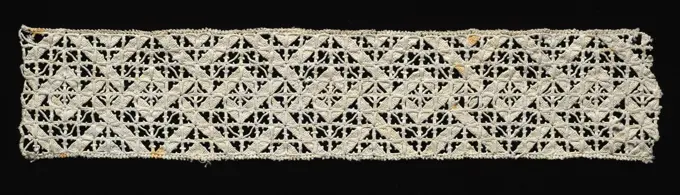
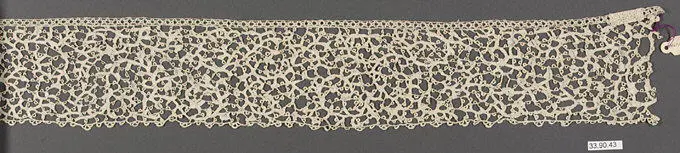
Strip bobbin with triangular fields and stylized chalice, anonymous, c. 1600 - in or before 1879 Strip of natural -colored bobbin. The repeating pattern consists of two varied triangular fields. One field is formed by a straight down, stylized chalice of chalice between two leaves. The other triangular field is formed by the space between two consecutive fields with chalices. There is a more or less Christmas tree -shaped motif in this field. The motifs are connected to each other by a coarse diamond-shaped Maas soil, a lace-hole stroke-grid, strewn with square mosies. The motifs are made with thick contour threads and regularly winding braided straps. The Mosjes are made in form. Top and bottom of the strip are straight finished, with the bottom with picots. Karlberg Palace (possibly) linen (material) bobbin lace Strip of natural -colored bobbin. The repeating pattern consists of two varied triangular fields. One field is formed by a straight down, stylized chalice of chalice between
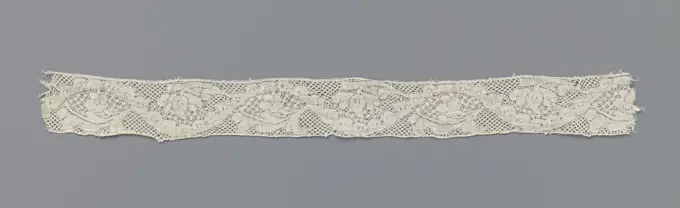
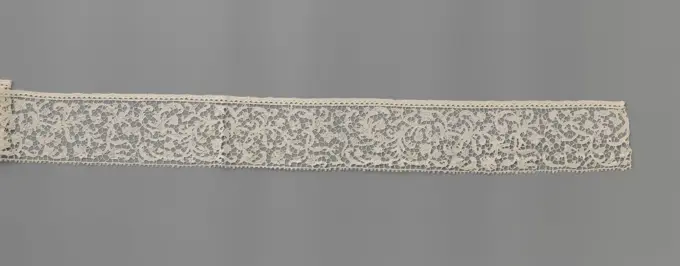
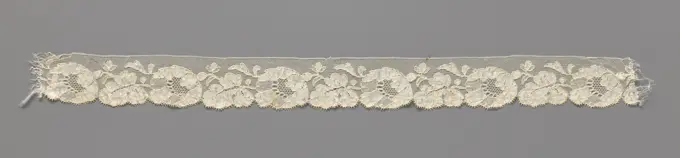
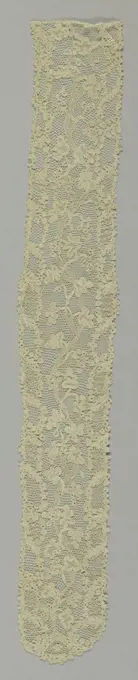
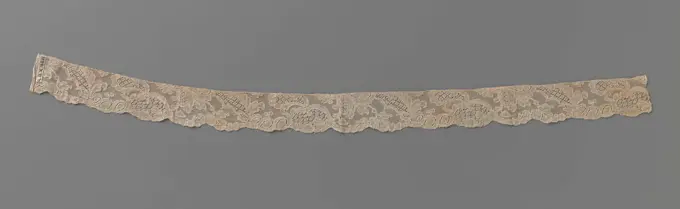
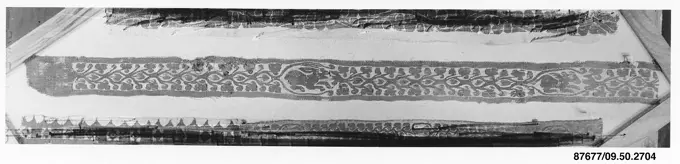
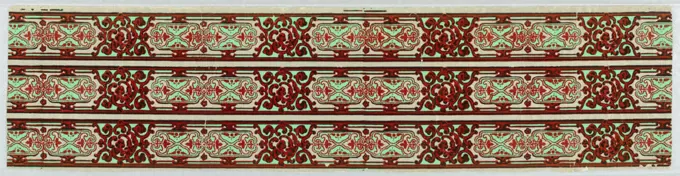
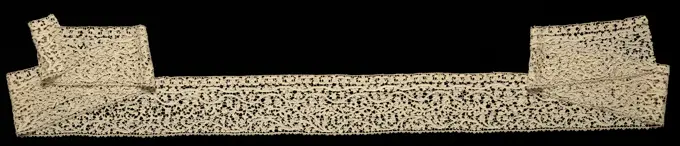
Edge, Medium: cotton Technique: bobbin lace, peasant style, Russia, 19th century, lace, EdgeFragment of the lace;  after. 18th century (1740-00-00-1760-00-00);lace, binche lacePiece 18th century Flemish, Brussels. Piece 212517Fragment of the lace;  18th century (1701-00-00-1800-00-00);Kloskant's intermediate creature with a wave line of rosette flowers, anonymous, c. 1750 - c. 1799 Piles of natural -colored bobbin, Flanders side. The repeating pattern consists of a regular wave line of densely connected rosette flowers with a flower stem below and above each wave. The flower stem is alternately a rosette flower with a large leaf and a stem with two smaller leaves. And at the end a drop -shaped flower heart between two heart -shaped petals. The motifs are connected by a grid, a five -part ground. The motives are made in linen battle. A decorative soil with balls is used around the flowers on the stems. Up and top are finished with a straight edge. Flanders  bobbin lace / Flanders lace Piles of natural -colored bobbin, Flanders side. The repeating pattern consists of a regular wave line of densely connected rosette flowers with a flower stem below and above each wave. The flower stem is alternately a rosette flower with a large leaf and a stem with two smaller leaves.Strip bobbin with triangular fields and stylized chalice, anonymous, c. 1600 - in or before 1879 Strip of natural -colored bobbin. The repeating pattern consists of two varied triangular fields. One field is formed by a straight down, stylized chalice of chalice between two leaves. The other triangular field is formed by the space between two consecutive fields with chalices. There is a more or less Christmas tree -shaped motif in this field. The motifs are connected to each other by a coarse diamond-shaped Maas soil, a lace-hole stroke-grid, strewn with square mosies. The motifs are made with thick contour threads and regularly winding braided straps. The Mosjes are made in form. Top and bottom of the strip are straight finished, with the bottom with picots. Karlberg Palace (possibly) linen (material) bobbin lace Strip of natural -colored bobbin. The repeating pattern consists of two varied triangular fields. One field is formed by a straight down, stylized chalice of chalice between Trimming (France); silkGalloon 18th century French. Galloon 213996Edging early 18th century Flemish, Brussels. Edging. Flemish, Brussels. early 18th century. Bobbin lace, Brussels bobbin lace, point d'Angleterre. Textiles-LacesBorder Made 1801-1900 Russia. Cotton, plain weave; embroidered with silk floss in back, Bosnian, chained border, double running, hem, satin, and single faggot stitches .Border; linen; 1933-1-12Ribbon early 19th century possibly French. Ribbon 220658Galloon 17th-18th century Unknown. Galloon 213793Strip 17th century Italian, Abruzzi. Strip 221137Textile Fragment 3rd century. Textile Fragment. 3rd century. Wool, linen; plain weave, tapestry weave. Attributed to Egypt. TextilesStrip bobbin with two berries on a twig, anonymous, c. 1875 - c. 1899 There are stiff twigs on a stock of square meshes above a closed scallops, on which two berries grow. A mush is placed between each twig. Valenciennes side. Belgium (possibly) linen (material) Bobbi Lace / Valenciennes Lace There are stiff twigs on a stock of square meshes above a closed scallops, on which two berries grow. A mush is placed between each twig. Valenciennes side. Belgium (possibly) linen (material) Bobbi Lace / Valenciennes LaceStrip of needle side with floral motifs, anonymous, c. 1690 - c. 1699 Strip of natural needle side, venise flat. Pattern with highly curved sities and simple flower and leaf shapes. The strip consists of two strips that are sewn together. Irregular bar with picots. The finish with a picot edge on the top is different from the finish with a picot edge on the bottom of the strip. unknown linen (material) flat Venetian (needle point) Strip of natural needle side, venise flat. Pattern with highly curved sities and simple flower and leaf shapes. The strip consists of two strips that are sewn together. Irregular bar with picots. The finish with a picot edge on the top is different from the finish with a picot edge on the bottom of the strip. unknown linen (material) flat Venetian (needle point)Fringe mid-18th century French. Fringe 224880Galloon late 18th-early 19th century European. Galloon 224970Hebrew ritual lace (one of four) early 18th century Italian, Burano. Hebrew ritual lace (one of four) 226257Galloon early 19th century French. Galloon 213774Trimming (Italy); silk, metallic threadLappet (one of a pair) 18th century French. Lappet (one of a pair) 226092Border, Medium: linen Technique: needle lace with 6-sided reworked ground, Curving stem with flowers and fruits intertwined with a curving band. One edge finally scalloped and ground of buttonholed hexagons., circa 1770, lace, BorderKloskant's intermediate creature with pointed album between two round shapes, Anonymous, c. 1640 - c. 1660 Intermediate springs of natural -colored Dutch bobbin side. With small recesses, a repeating pattern can be distinguished from a pointed dear that is varied alternately at the top or bottom between two slightly larger round shapes. There is hardly any soil. The motifs are made in linen battle with openwork edges. At the top and bottom are straight. Antwerp (possibly) linen (material) bobbin lace Intermediate springs of natural -colored Dutch bobbin side. With small recesses, a repeating pattern can be distinguished from a pointed dear that is varied alternately at the top or bottom between two slightly larger round shapes. There is hardly any soil. The motifs are made in linen battle with openwork edges. At the top and bottom are straight. Antwerp (possibly) linen (material) bobbin lacePiece late 18th-early 19th century European. Piece 225021Border (Belgium); linenFringe late 18th century Italian. Fringe 224867Bobbin Lace Strip of Insertion, 19th century. Morocco, 19th century. Lace, bobbin: linen; average: 5.8 x 108 cm (2 5/16 x 42 1/2 in.).Bobbin Lace Insertion, 17th-18th century. Italy, 17th-18th century. Lace, bobbin; average: 2.6 x 17.2 cm (1 x 6 3/4 in.).Strip bobbin with a leaf that forms a rectangle and a flower on a curved stem, anonymous, c. 1700 - c. 1799 Strip of natural -colored bobbin, Old Flemish side. The repeating and continuous pattern consists of a curved stem with a chalice -shaped flour at the end and at the beginning a plume -shaped leaf that splits off in the opposite direction and forms a kind of rectangle with rounded corners. The motifs are connected by a grid, a five -part ground. The motifs are made in linen battle with openwork edges. The top and bottom are straight, with the bottom with picots. Flanders linen (material) bobbin lace / old Flemish lace Strip of natural -colored bobbin, Old Flemish side. The repeating and continuous pattern consists of a curved stem with a chalice -shaped flour at the end and at the beginning a plume -shaped leaf that splits off in the opposite direction and forms a kind of rectangle with rounded corners. The motifs are connected by a grid, a five -part ground. The motifs are made Kloskant intermediate mate with wheels and suns, anonymous, c. 1600 - c. 1649 Piles of natural torque. It is possible to use as a decorative edge in a sheet. The pattern consists of two narrow tracks with a wider track in between with a repeating motif of a wheel, which is flanked on the left and right by a sun. In the narrow tracks, rows of five checks are made with braids over the motif, always with an interruption to the next motif. Top and bottom of the strip are straight. Italy (possibly) linen (material) bobbin lace Piles of natural torque. It is possible to use as a decorative edge in a sheet. The pattern consists of two narrow tracks with a wider track in between with a repeating motif of a wheel, which is flanked on the left and right by a sun. In the narrow tracks, rows of five checks are made with braids over the motif, always with an interruption to the next motif. Top and bottom of the strip are straight. Italy (possibly) linen (material) bobbin laceInsertion 16th century Italian, Venice. Insertion 220898Strip of needle side with feathered tendrils, anonymous, c. 1675 - c. 1699 On an open bars stock there is a running pattern of wide -leaving, feathered volute vines with palm flowers. Straight thick outside list with small cog-picots. Venise flat. Venice linen (material) flat Venetian (needle point) On an open bars stock there is a running pattern of wide -leaving, feathered volute vines with palm flowers. Straight thick outside list with small cog-picots. Venise flat. Venice linen (material) flat Venetian (needle point)Cap streamer, Medium: linen Technique: bobbin lace, Brussels style, Cap streamer in floral pattern. Brussels style but probably made in England., England, early 19th century, lace, Cap streamerTussenzetsel van kloskant met op- en neergaande rozen aan tak.A coarse mesh stock (square mesh) is filled with separate and slanted and down and down roses apart from each other on a branch, interspersed by a winding leaf. Valenciennes.Band; silver thread. technique: embroideryLambrequin;  XIXW. (1801-00-00-1900-00-00);Belt fragment, Medium: wool Technique: plain weave with supplementary warp patterning, Small fragment of a belt with stars, figures and birds in red on a tan ground., Mexico, 19th century, woven textiles, Belt fragmentBorderStrip bobbin with a flower stalk alternated by a drop -shaped leaf, anonymous, c. 1700 - c. 1749 Strip of natural -colored bobbin, Old Flemish side. The repeating and continuous pattern consists of a bent stem with an oval -shaped flower clamping between two leaves at the end. The flower touches the beginning of an ever -wider, drop -shaped leaf along the underside of the strip, which then touches on the next flower stalk. The motifs are connected by a grid, a five -part ground. The motifs are made in linen stroke with openwork edges, with a mains filling in the drop -shaped leaf, containing a configuration of four snowflakes. In the oval -shaped flour, a finer snowflake land is used as a decorative soil. Up and bottom of the strip are straight finished, with the bottom edge with picots. Southern Netherlands linen (material) bobbin lace / old Flemish lace Strip of natural -colored bobbin, Old Flemish side. The repeating and continuous pattern consists of a bent stem with an oval -shapeStrip of mechanical side with lying flour followed by a lying leaf, anonymous, c. 1850  Strip of natural -colored machine side: machine blonde. The repeating pattern consists of a horizontal flower followed by a lying leaf and some smaller leaf branches. The flowers and leaves ensure a sculpy edge along the underside of the strip. The motifs are equipped with thick shiny contour threads and are connected to each other with a traly land, a mechanical tuler land. A decorative land has been used in the Bloemharten, a machine rose ground. The top of the strip is straight finished. The scrap edge is finished with picots.  silkGalloon 17th-18th century Unknown. Galloon 213816Galloon Unknown 17th-18th centuryBorder. Date/Period: Early 17th century. Border. Medium: silk embroidery on linen. Technique: stem, outline, coral chain, satin, buttonhole, herringbone, detached chain stitches on plain weave. Height: 170 mm (6.69 in); Width: 360 mm (14.17 in). Author: UNKNOWN.Needlepoint (Reticella) Lace Edging, 17th century. Italy, 17th century. Lace, needlepoint: linen; overall: 59 x 264.4 cm (23 1/4 x 104 1/8 in.).Border (Germany); embossed, die cut, glitter, air brushed; 83 x 9 cm (32 11/16 x 3 9/16 in.)Insertion 17th-18th century Greek, Crete. Insertion 219564Strip of needle side with plumed tendrils, anonymous, c. 1875 - c. 1895 Strip of natural -colored needle side: Venetian rose side. On a bar of land with six -sided meshes, rich branches, to the left and right, are swiveling and right -wing, sometimes dwelling, sometimes walking. There are multifaceted, carefully detailed button -shaped flowers. Here and there the top of a slender has grown through an opening in the branch. Straight finish of alternately an eye and a triangle. BURANO linen (material) Venetian rose point Strip of natural -colored needle side: Venetian rose side. On a bar of land with six -sided meshes, rich branches, to the left and right, are swiveling and right -wing, sometimes dwelling, sometimes walking. There are multifaceted, carefully detailed button -shaped flowers. Here and there the top of a slender has grown through an opening in the branch. Straight finish of alternately an eye and a triangle. BURANO linen (material) Venetian rose pointCap streamers, Medium: linen Technique: needle lace, France, 18th century, lace, Cap streamersBobbin Lace (Point d'Angleterre) Lappet, early 18th century. Belgium, Brussels, early 18th century. Lace, bobbin: linen; average: 9 x 102.9 cm (3 9/16 x 40 1/2 in.).Strook kloskant met elkaar overlappende organische vormen waaronder rocailles en bladeren.Strip natural colosside: Mechelen side. The repeating pattern consists of overlapping and assembly organic forms including a rocaille, leaves and flower branches. The pattern along the top edge is halved. The strip is therefore intended to wear symmetrically doubled as a jabot. The motifs are connected by a fine Maas soil, the Malinois. The motifs are made in linen stroke, with thicker and shiny contour wires. Different ornamental grounds have been applied in which motifs without contour wires are processed such as flowers and seed beads. The bland scaled underside comes from the pattern and is finished with picots. The top is just finished.Fringe 18th century Italian or Spanish. Fringe 213704Textile Border FragmentTextile (France); Designed by Jean-Baptiste Marie Huet (French, 1745 - 1811); Manufactured by Oberkampf & Cie. (France); linen; L x W: 87 × 50 cm (34 1/4 × 19 11/16 in.); 1953-203-1Band 3rd-4th century. Band 445935Band, Medium: linen Technique: bobbin lace (Valenciennes diamond ground), Border with a design of joined flower and leaf motifs with dots and a scalloped edge., France, 19th century, lace, BandNeedlepoint Lace Barbe, 1715-1774. France, Argentan, 18th century (Louis XV Period, 1715-1774). Lace, needlepoint: linen; average: 10.2 x 139.8 cm (4 x 55 1/16 in.).Lice line is made of velvet velvet, wine red, salmon color and fletschel on a white satin fond. Lice line for a four-poster bed (bottom left). The lambrequin is made of velvet velvet, wine red, salmon color and fletschel on a white satin fond. The pattern has large symmetrical acanthus leaves, ending in volutes, and with dotted contours and small carried fields. This label belongs to the so-called Rosendaelbed.Band of Needlepoint (Reticella) Lace Insertion, 16th century. Italy, Venice, 16th century. Lace, needlepoint: linen; overall: 6.3 x 30.5 cm (2 1/2 x 12 in.).Strip 18th century Spanish. Strip 213132Doek, Anonymous, 1900 - 1949 Cloth with geometric motifs and human figures. Sarawak cotton (textile) Cloth with geometric motifs and human figures. Sarawak cotton (textile)Woman's Collar. United States, circa 1880. Costumes; Accessories. Silk plain weave, linen plain weave, silk embroideryShoulder Cloth (KainSandang)Strip bobbin with whimsically framed cartouche and Drielobbig motif, anonymous, c. 1700 - c. 1799 Strip of natural -colored bobbin: Mechelse side. The repeating pattern consists of a succession of a trapezoidal cartouche with a whimsical frame and a whimsically elongated three -bit motif. The motives are against the lower edge and the cartouches fill almost the entire strip to the top. They are connected by a fine Maas soil. The motifs are made in linen battle with thicker and shiny contour threads. A decorative land with coarser meshes has been used in the cartouches. Up and bottom are straight finished with picots along the bottom. Mechelen linen (material) bobbin lace / Mechlin (lace) Strip of natural -colored bobbin: Mechelse side. The repeating pattern consists of a succession of a trapezoidal cartouche with a whimsical frame and a whimsically elongated three -bit motif. The motives are against the lower edge and the cartouches fill almost the entire strip to the top. They are conBorder (France); block-printed on handmade paper; 87.5 x 3.5 cm (34 7/16 x 1 3/8 in.)Fragment of an aurifries, with embroidery of silk and gold council, anonymous, c. 1475 - c. 1500 Fragment of an aurifries, with embroidery. Germany (possibly) silk. embroidering Fragment of an aurifries, with embroidery. Germany (possibly) silk. embroideringGalloon 18th century French. Galloon. French. 18th century. Silk and cotton. Textiles-TrimmingsStola white silk with woven flowers of silk and gold thread, anonymous, c. 1725 - c. 1760 Stola part of a set of pieces of white silk with woven flowers of silk and gold thread served as stola and manipel. The Stola consists of nineteen pieces, the manipel of four pieces. Fragments silk in the form of a stole, there are no more passions or lining.  silk. Stola part of a set of pieces of white silk with woven flowers of silk and gold thread served as stola and manipel. The Stola consists of nineteen pieces, the manipel of four pieces. Fragments silk in the form of a stole, there are no more passions or lining.  silk.Fragment, Cooper Union Museum Lace Study Card; Made for Cooper Union Museum; Belgium; linenEdging 17th century Italian, Venice. Edging 222733Border, Medium: linen Technique: bobbin lace, Mechlin style, Bud sprays sprinkled in field above border of detached leaves and flower ornaments., Belgium, early 19th century, lace, BorderGalloon 17th-18th century Italian or Spanish. Galloon 213860Trimming, Medium: silk Technique: woven, Red, brown and white trimming fragment in a design of leaves and diagonal lines between borders of blocks., France, 19th century, trimmings, TrimmingMount; L x W x D: 34.2 x 1.5 cm (13 7/16 x 9/16 in.)Fragment (Japan)Fringe (Spain); silkFruit knife, F. Nicoud, French, active 1890, Silver, steel, mother-of-pearl, gilding, One of twelve fruit knives with mother-of-pearl handles and engraved and gilt decoration on blades., ca. 1890, cutlery, Decorative Arts, Fruit knifeKloskant intermediate mate with heart and round flower, anonymous, c. 1640 - c. 1660 Intermediate springs of natural -colored Dutch bobbin side. The repeating pattern consists alternately of a heart and one round flower between two elongated curling leaves. The heart is alternately upright and vice versa. The motifs are connected by a round grid with braid strokes. The motifs are made in linen battle with openwork edges and recesses in the circular flower heart. Top and bottom of the strip are straight finished and sewn to a fragment linen from a demolition. Antwerp linen (material) bobbin lace Intermediate springs of natural -colored Dutch bobbin side. The repeating pattern consists alternately of a heart and one round flower between two elongated curling leaves. The heart is alternately upright and vice versa. The motifs are connected by a round grid with braid strokes. The motifs are made in linen battle with openwork edges and recesses in the circular flower heart. Top and bottom oLint, anonymous, c. 1850 A silk ribbon, trimmed with aniline blue side from around 1850. Europe silk. aniline dye A silk ribbon, trimmed with aniline blue side from around 1850. Europe silk. aniline dyeGalloon 18th century French or Italian. Galloon 214052Miser's purse, Medium: silk, metallic beads Technique: beaded netting, Very fine netted silk in red and blue with ornament of fine gold beads in diamond pattern; side opening; wide gold rings slide to open or close. Long tassels of gold beads at either end., France, early 19th century, costume & accessories, Miser's purseLace laceTrimming, Medium: silk, metallic thread, metallic strips Technique: woven, Design with a simple, undecorated center bordered with metallic strips and diagonally placed blocks., France, 17th century, trimmings, TrimmingBobbin Lace Edging, mid 18th century. Belgium, Binche, mid 18th century. Lace, bobbin; average: 4.5 x 576.8 cm (1 3/4 x 227 1/16 in.).Fragment of Ribbon 13th-14th century Italian. Fragment of Ribbon 465944 Italian, Fragment of Ribbon, 13th14th century,  with silver gilt thread, Overall: 2 13/16  5/16 in. (7.2  0.8 cm) Storage (Mat): 4 1/2  13 in. (11.4  33 cm). The Metropolitan Museum of Art, New York. Rogers Fund, 1918 (19.191.2)Galloon 17th century French or Italian. Galloon 214114Band (France); linenGalloon 18th century French. Galloon 214036Trimming, Medium: silk Technique: woven, Red ground with yellow warp figure of leaves alternately turning left and right., Italy, late 18th-early 19th century, trimmings, TrimmingHanging/ Sash Made 1801-1900 Java. Batik dyed .Border, Medium: linen Technique: needle lace with ground of loop & twist with loop & twist return, Belgium, 19th century, lace, BorderTrimming (France); silkBand (Romania); wool, silk, cotton, linen, silver foil on silk coreFragment, Medium: linen Technique: needle lace, Fragment of Alençon needle lace with sprig and blossom pattern with occasional details in openwork., Alençon, France, 18th century, lace, FragmentBorder, Flocked, Pair of rectanglue cartouches, separated by scroll and strap work. Design outlined in bright red flocking, filled with light (arsenic) green on glossy gray ground. Printed three across., possibly Germany, 1840, Wallcoverings, BorderHeadband 15th-16th century Inca. Headband 313271Torsada;  19th century (1801-00-00-1900-00-00);Needlepoint (Point de Gaze) Lace Narrow Strip, 19th century. Belgium, Brussels, 19th century. Lace, needlepoint; overall: 40 x 5.8 cm (15 3/4 x 2 5/16 in.).Needlepoint and Bobbin Lace (Mezzo Punto) Flounce, 17th-18th century. Italy, 17th-18th century. Lace, needlepoint and bobbin: linen; average: 14 x 294.7 cm (5 1/2 x 116 in.).