Historical Lace Fragments

A variety of intricate lace fragments from different centuries, showcasing detailed patterns and craftsmanship in cotton and silk.

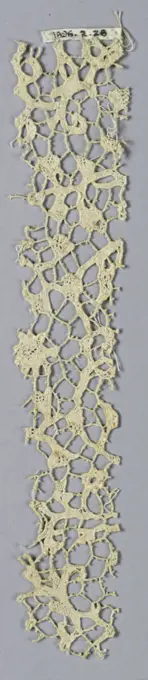
Strip bobbin with triangular fields and stylized chalice, anonymous, c. 1600 - in or before 1879 Strip of natural -colored bobbin. The repeating pattern consists of two varied triangular fields. One field is formed by a straight down, stylized chalice of chalice between two leaves. The other triangular field is formed by the space between two consecutive fields with chalices. There is a more or less Christmas tree -shaped motif in this field. The motifs are connected to each other by a coarse diamond-shaped Maas soil, a lace-hole stroke-grid, strewn with square mosies. The motifs are made with thick contour threads and regularly winding braided straps. The Mosjes are made in form. Top and bottom of the strip are straight finished, with the bottom with picots. Karlberg Palace (possibly) linen (material) bobbin lace Strip of natural -colored bobbin. The repeating pattern consists of two varied triangular fields. One field is formed by a straight down, stylized chalice of chalice between
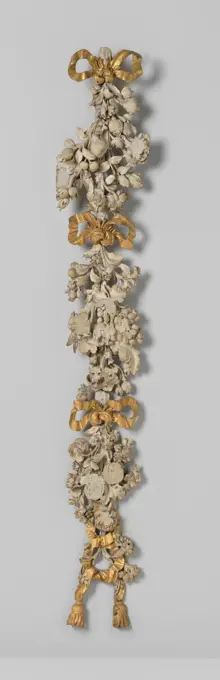
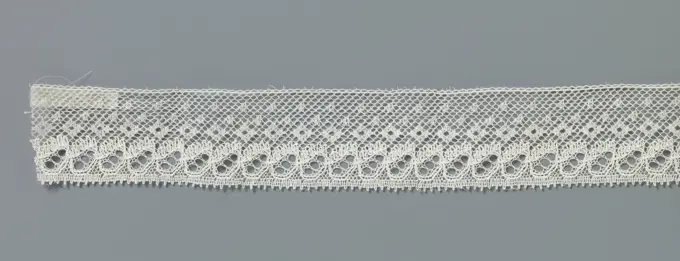
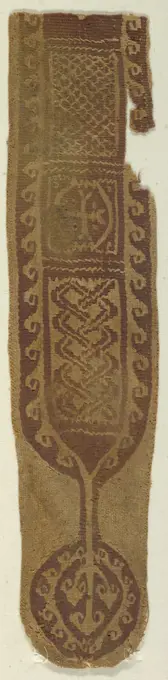
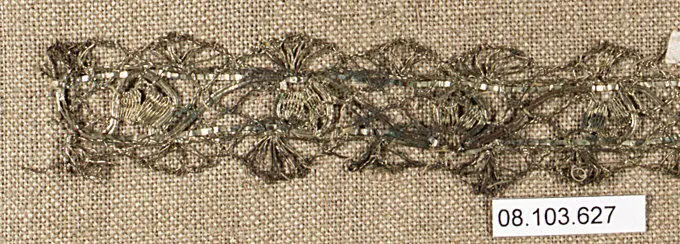
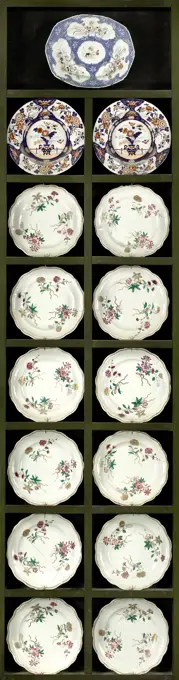
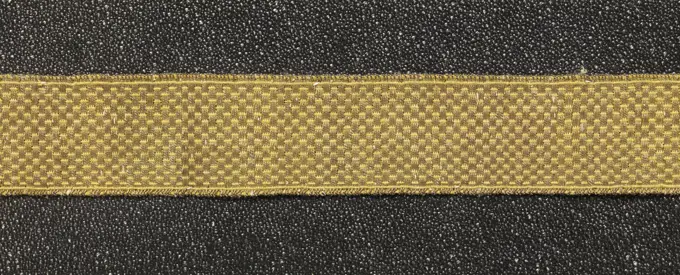
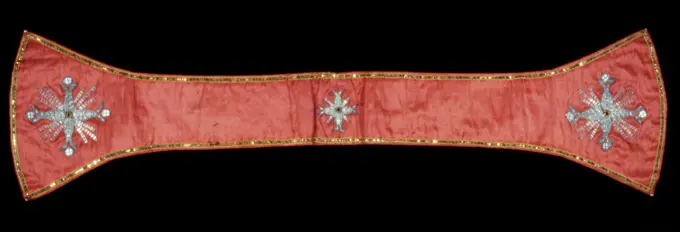
Pattern for an intermediate creature from Kloskant Valenciennes d'Auvergne, Anonymous, c. 1880  Pattern for an intermediate brush from bobbin on reddish -brown colored cardboard. On the pattern is the handwritten text: "Valencine d'Auvergne; Entredeux; 1880". France (possibly) cardboard drawingGUIRLANDE with flowers and fruits of gilded and painted Lindehout from home De Voorst, Anonymous, c. 1700 Garlande with flowers and fruits of gilded and painted lindenhout. Northern Netherlands wood (plant material). linden. gilding (material). paint (coating) gilding  House De Voorst Garlande with flowers and fruits of gilded and painted lindenhout. Northern Netherlands wood (plant material). linden. gilding (material). paint (coating) gilding  House De VoorstScarf, 20th century, 88 1/2 x 22 7/8 in. (224.8 x 58.1 cm), Silk; supplementary weft patterning, Cambodia, 20th centuryTrimming, Medium: silk Technique: woven, Pink and yellow trimming fragments in a design of lozenges with geometric ornaments., France, 19th century, trimmings, TrimmingBand, Medium: linen Technique: early 17th c. needle lace and style (commonly called punto in aria needle lace), Design of stem with scrolls surrounding flowers., England or Spain, 17th century, lace, BandBand, Medium: silk, metal Technique: embroidered and couched velvet, Red velvet ornamented with yellow silk and metal threads (couched) in pattern of leaves and scrolls within straight borders., 17th century, embroidery & stitching, BandStrip of machine side, anonymous, c. 1800 - c. 1899 Strip of natural -colored machine: mechanical Lille side. Under two rows of mushes and a row of rosette flowers or diamonds with a hole in the center is a succession of Schuinge -Plaatste Ovalen. Each oval is filled with a decorative soil with three large oval meshes and surrounded by a contour wire, which makes many swing at the top, like flames or the hair a brush. The motifs are connected by a mechanical Parisian land. Top and bottom of the strip are straight finished, with the bottom with picots. Europe cotton (textile) Strip of natural -colored machine: mechanical Lille side. Under two rows of mushes and a row of rosette flowers or diamonds with a hole in the center is a succession of Schuinge -Plaatste Ovalen. Each oval is filled with a decorative soil with three large oval meshes and surrounded by a contour wire, which makes many swing at the top, like flames or the hair a brush. The motifs are connected by a mechanical ParisiaClavus band, Medium: wool, linen Technique: tapestry weave, Woven linen and wool tunic ornament showing a Coptic cross between borders of advancing waves, and a roundel with three-pronged motif at center., Egypt, 600-900, woven textiles, Clavus bandFragment, Medium: linen Technique: bobbin lace of discontinuous tape, Design of curving stem with flower leaf and bud., Belgium, 19th century, lace, FragmentSlendang (Shawl) Made 1801-1900 Java. Cotton, batik dyed .Bobbin Lace Insertion without Selvage, mid 16th century. Italy, Venice, mid 16th century. Lace, bobbin; average: 2.6 x 19.1 cm (1 x 7 1/2 in.).Border, Medium: linen Technique: needle lace, Needlepoint lace border. Elaborate, emerging vine and foliage design., Venice, Italy, late 17th century, lace, BorderRibbon of brOOCHERED SILD with a cream-colored surface on which a side of each other pink and green flower and leaf vend have been applied over the entire length, anonymous, c. 1800 - c. 1815 ribbon (material) Ribbon of brochureed silk with a cream-colored surface on which a side-on-side pink and green flower and leaf vank have been applied over the entire length. The edges are scooped. West-Europa whole: SilkEmbroidered Band (India); silk embroidery on silk foundationMatrasomhang, Anonymous, 1720 - 1740 Yellow silk mattressomhang of a bed garnish embroidered with peacocks, flowers, butterflies, horns of abundance in multicolored silk, omboard and decorated with blue passion, lined with coarse linen. Intended for the right side of the bed. Canton silk. linen (material) Yellow silk mattressomhang of a bed garnish embroidered with peacocks, flowers, butterflies, horns of abundance in multicolored silk, omboard and decorated with blue passion, lined with coarse linen. Intended for the right side of the bed. Canton silk. linen (material)Pleated fan and case, Silk bobbin lace leaf backed with silk, mother-of-pearl sticks, paste jewel at rivet, Pleated fan. Leaf of black chantilly lace backed with stiff white georgette crêpe. Mother-of-pearl sticks. White paste jewel rivet heads. Box covered in tan silk marked Tiffany & Co. Union Square.”, France, late 19th century, costume & accessories, Pleated fan and casePiece 18th century French. Piece 214124Gimp mid-19th century French. Gimp 214228Ribbon of pink -red velvet, anonymous, c. 1400 - c. 1950 Ribbon of pink -red velvet. West-Europa velvet (fabric weave) Ribbon of pink -red velvet. West-Europa velvet (fabric weave)Bands 15th-16th century Italian The Metropolitan Museum's great lace collection was started when the Museum became the first among American museums to organize a permanent collection of lace with the acceptance of the McCallum Collection in 1879 and the bequests of Mrs. John Jacob Astor, Mrs. Robert L. Stuart, Mrs. Augustus Cleveland, and Mrs. A. W. Winters shortly thereafter. In 1893 a loan collection of antique laces shown at the World's Columbian Exposition in Chicago was assembled by a committee of New York women headed by Catharine Augusta Newbold. About 1900 Miss Newbold arranged and labeled an exhibition of laces and linenworks lent to the Metropolitan Museum by Mrs. James Boorman Johnstone and the Misses Johnstone. "Her scholarly knowledge of lace technique enabled the Museum for the first time to offer a comprehensive display of lace illustrating its historical development," wrote Miss Frances Morris, then curator of the textile department. Miss Newbold's name occurs again in Fragment, 1500-1550. Italy, first half of 16th century. Silk velvet; overall: 86.4 x 17.2 cm (34 x 6 3/4 in.).Fringe, Medium: silk Technique: woven, Yellow and pink fringe with a heading and striped skirt threads in short loops holding tufts., Italy or Spain, 16th century, trimmings, FringeTrimming (France); 1953-162-38Bobbin Lace (Point d'Angleterre) Lappet, 18th century. Belgium, Brussels, 18th century. Lace, bobbin: linen; average: 120.7 x 11.5 cm (47 1/2 x 4 1/2 in.).Border Made 1570-1590 England. Linen, plain weave; embroidered with silk, silvered-metal-wire-wrapped silk, and gilt-and-silvered-metal-strip-wrapped silk in double running, leaf, satin, and stem stitches .Fragment, Medium: linen Technique: needle lace, Narrow fragment with open, scrolling floral design. Brides picotées., France, early 18th century, lace, FragmentFragment (South India); cotton; Warp x Weft: 132 x 7.5 cm (51 15/16 x 2 15/16 in.); 1969-62-3Belt -Band Fragment 7th century Nasca. Band Fragment 307965Band (Italy); linenSotck exchange. XIXth. Gal1968.41.12Upholstery trimming, Medium: silk Technique: woven, Red and white trimming woven in an open design and decorated along the edges with small red tufts and white scallops., USA, ca. 1902, trimmings, Upholstery trimmingFragment; linenTweezer. UnknownCap streamers, Medium: linen Technique: needle lace, Pair of cap streamers of Point d'Argentan with an open floral pattern contained within compartments and alternated with medallions., France, mid-18th century, lace, Cap streamersFringe European 19th centuryTrimming (France); silkCollier, so -called 'Collier de Chien', Anonymous, c. 1900 - c. 1920 Collier de Chien, composed of 12 pearls with three intermediate pieces and a lock. The intermediate pieces are set with diamonds. France (possibly) diamond (mineral). pearl. platinum (metal) Collier de Chien, composed of 12 pearls with three intermediate pieces and a lock. The intermediate pieces are set with diamonds. France (possibly) diamond (mineral). pearl. platinum (metal)Fragment Made 1625-1675 Italy. Silk .Strip bobbin with large and small peonies on S-Volutranken, Anonymous, c. 1650 - c. 1660 Strip of natural -colored Dutch bobbin. The repeating and symmetrical pattern consists of a large peony between S-Volutranken with smaller peonies on curling side stems. The motifs are made in linen battle with openwork edges that also provide the drawing in the flowers. The motifs are connected by a grid with braid strokes. Top and bottom of the strip are straight finished with the bottom with picots. Southern Netherlands linen (material) bobbin lace Strip of natural -colored Dutch bobbin. The repeating and symmetrical pattern consists of a large peony between S-Volutranken with smaller peonies on curling side stems. The motifs are made in linen battle with openwork edges that also provide the drawing in the flowers. The motifs are connected by a grid with braid strokes. Top and bottom of the strip are straight finished with the bottom with picots. Southern Netherlands linen (material) bobbin laceNeedlepoint Lace Edging, 1715-1774. France, Argentan, 18th century (Louis XV Period, 1715-1774). Lace, needlepoint: linen; average: 5.5 x 332.7 cm (2 3/16 x 131 in.).Piece 18th century () European. Piece 225088Piece 18th century Italian. Piece 214974Bracelet presented by the people of the Ross of Mull to Princess Louise, 1871. 'Some of the jewellery and other beautiful things given to Princess Louise by her friends, upon the happy occasion of her marriage to the Marquis of Lorne, were shown in the engravings we published within a week or two after the wedding-day. We now engrave a representation of the bracelet given to her Royal Highness by the tenantry and other people of the Ross of Mull. The Ross, as our readers know, is the district forming the south-west promontory of the Isle of Mull, which belongs to the Duke of Argyll. This braceAldegrever, Heinrich, Germany, Design for a scabbard with the head of a man with a helmet at the top, Design for a dagger scabbard, decorated with foliate tendrils. At the top is a wreath with the head of a man with a helmet in it., print, ornament print, prints, height 144 mm, width 30 mm, width 19 mm, German, 1502 - 1561, print maker, printmaker, 1535 - 1535, second quarter 16th century, paper, engraving, engraving (printing process), Work conception, after own design byBorder (USA); block-printed on handmade paper; 131 x 12.5 cm (51 9/16 x 4 15/16 in.)Belt -Woman's Cermonial Breast or Shoulder Cloth. Indonesia, North Bali, Singaraja, late 19th century. Costumes. Silk plaine weave resist-dyed weft (ikat) with metallic foil-wrapped thread supplementary weft (songket)Braid. England or France. Date: 1650-1675. Dimensions: 9.3 × 107.5 cm (3 5/8 × 42.25 in.)Repeat: 22.1 cm (8 3/4 in.). Silk and silk-wrapped linen cords, bobbin straight lace. Origin: England. Museum: The Chicago Art Institute, Chicago, USA.Piece French 19th centurySash, 54 × 3 5/8 in. (137.16 × 9.21 cm)7 1/4 × 59 3/16 × 1 1/2 in. (18.42 × 150.34 × 3.81 cm) (outer frame), Beads, leather, United StatesHindu ornamentCushion Cover, 1700s. China, Qing dynasty (1644-1911). Silk, metallic thread; overall: 3.3 x 41.9 cm (1 5/16 x 16 1/2 in.).Trimming, Medium: silk, linen, metallic thread Technique: compound weave, Yellow gold, light gold and black warps which form the pattern of vertical stripes, the center ones with chevrons in black, and the outer ones with diagonal pin stripes, also in black. The weft, which is concealed, consists of six linen threads., Russia, 18th century, trimmings, TrimmingRitual Sword 16th-17th century Tibet. Ritual Sword 39383Trimming, Medium: silk, metallic thread Technique: woven, Design of stepped diagonal lines. Edges are slightly indented to give scallops., France, 17th century, trimmings, TrimmingFragment (Bonnet Trim) Made 1850 Europe. Silk and straw, plain weave with raised profile formed by extended, spaced, and crossed ground weft turns .Part of a valance 18th century Greek Islands, Ionian Islands. Part of a valance. Greek Islands, Ionian Islands. 18th century. Silk on cotton. Textiles-EmbroideredStrip bobbin with lying branch above opened oval, anonymous, c. 1800 - c. 1824 Strip of natural -colored bobbin: Lille side. For the upper half of the strip, the repeating pattern consists of a row of loose twigs with a configuration of four square mosies in between. The lower half of the pattern consists of a row lying branches, with two flowers on either side and two curling leaves in the middle on both sides. The lower leaf forms an openwork oval along the bottom of the strip. The motifs are connected by a fine grid, a tuler land. The motifs are made in linen battle, with thicker, shiny contour threads. A decorative land has been used in the ovals along the underside. The mosies and decorations in a few flower hearts are made in form. The top of the strip is straight finished. The faintly scalloped underside is finished with picots. Lille linen (material) bobbin lace / Lille lace Strip of natural -colored bobbin: Lille side. For the upper half of the strip, the repeating pattern conTrimming, Medium: linen, silk Technique: bobbin lace, Eastern european, peasant style, Design of stars surrounded by curving lines worked in red, blue and white with scalloped border., Russia, 19th century, lace, TrimmingBorder, Block-printed on handmade paper, Architectural cable molding over a row of dentilling., H# 656, France, 1800-1830, Wallcoverings, BorderStrip needle side with spreading motif of different flowers, anonymous, c. 1775 - c. 1799 Strip of natural-colored needle side: Alençon side. Spread motif of different flowers on a fine hexagonal mesh soil. The narrow pattern at the bottom of the strip consists of two intersecting golf lines. The spaces between the waves are filled with alternately a decorative soil with rading picots and a hexagonal mesh ground. The top is trimmed with a border bobbin. unknown linen (material) Alençon Lace Strip of natural-colored needle side: Alençon side. Spread motif of different flowers on a fine hexagonal mesh soil. The narrow pattern at the bottom of the strip consists of two intersecting golf lines. The spaces between the waves are filled with alternately a decorative soil with rading picots and a hexagonal mesh ground. The top is trimmed with a border bobbin. unknown linen (material) Alençon LaceFringe, Medium: silk Technique: woven, Fringe with a green and yellow checkerboard heading. Skirt threads are looped, arranged in scallops, and are alternately green and yellow., Spain, 17th century, trimmings, FringeWallpaper borders, 1930s, United Kingdom, maker unknown. Gift of Ray and Betty Weeber, 2010.Trimming (Italy); grren silk and silver and gilt thread.; Overall: 53 x 5.2 cm (20 7/8 x 2 1/16 in.)Dissertation tape of green silk with silver and gold brochure; with inscription, anonymous, 1728 Dissertation tape of green silk with silver and gold browed. Inscription: 1728 on April 14, Cornelis van der Waal Men comes to great knowledge sciences through Leesen and with Instigheyt. Netherlands (possibly) geheel: silk. silver thread. Dissertation tape of green silk with silver and gold browed. Inscription: 1728 on April 14, Cornelis van der Waal Men comes to great knowledge sciences through Leesen and with Instigheyt. Netherlands (possibly) geheel: silk. silver thread.Trimming (France); silkBorder Made 1601-1700 France. Linen, knotted thread ground known as filet with darned in patterning .Strook passement met gouddraad.Strip passing of gold thread.Edging, Medium: Technique: machine made, England, 19th century, lace, EdgingPair of Lappets (Joined) Made 1850-1869 France. Silk, bobbin straight lace .Band 16th century Italian. Band 212296Armlet 19th century. Armlet 444668Lint Allians.Silk ribbon, printed with two orange strips, between which an orange ribbon is throwing. Alternately bound a black eagle, a rose, a black hat with lion and a arrows bundle with crown and scepter. Banderol with the text: Allians.Close-up DesignSampler, Medium: cotton, glass beads Technique: plain weaved edged with needle lace, Small strip of white cotton with different beadwork patterns on the edge., Mexico, 19th century, embroidery & stitching, SamplerTrim, braid, 18th-19th century, 8 x 2 in. (20.32 x 5.08 cm), Passementerie, 18th-19th centuryFour Scallops of a Bobbin Lace Flounce, c. 1665. Belgium, Ghent , 17th century. Lace, bobbin: linen; average: 19.4 x 92.1 cm (7 5/8 x 36 1/4 in.).Fragment (Band) Made 1000-1476 Peru. Slit tapestry with weft loop fringe .Orphrey band, Medium: silk, linen, metallic Technique: complementary weft twill, Blue and red rosettes with a flowering plant in dark yellow, red and white on a gold ground. Inscriptions in blue and red., Germany, 15th century, woven textiles, Orphrey bandOrange fragment with polychrome stripes, 19th century, Unknown Ryukyuan, 6 3/8 × 46 5/8 in. (16.19 × 118.43 cm) (overall), Cloth: Japanese fiber banana (bashō), silk, and cotton; striping, tate-gasuri (warp ikat), Japan, 19th centuryTrimming (France); silkBelt -Textile (France); silkTrimming, Medium: silk Technique: woven, White trimming fragment in a design of satin and plain weave stripes., France, 19th century, trimmings, TrimmingWoman's overskirt (ncaka), late 1800s-early 1900s. Africa, Democratic Republic of the Congo, late 19th or early 20th century. Raffia, cloth, thread, and dye; overall: 413.2 x 63.6 cm (162 11/16 x 25 1/16 in.).Trimming, Medium: silk Technique: cut supplementary warp pile (velvet), Trimming fragment in a design of flowers separated by leaves ending in scrolls. In red cut velvet on a yellow ground., France, 19th century, trimmings, TrimmingChinese ornamentTrimming (Spain); silkSampler 1756 German. Sampler. German. 1756. Silk on linen. Textiles-EmbroideredTwo -flowing scholarships. Second Empire. Gal1969.32.14Silver wire switch bracelet with hammerlag, c. 1933 - c. 1953 Switch bracelet made of silver thread with a hammer stroke with a crochet closure and a weight -daringly sign (4). Netherlands silver (metal) hammering Switch bracelet made of silver thread with a hammer stroke with a crochet closure and a weight -daringly sign (4). Netherlands silver (metal) hammeringRibbon second quarter 19th century Italian, Venice. Ribbon 221767Trimming (France); silkVictor Hugo (1802-1885). Chinese decor from Juliette Drouet's house in Guernsey, West Wall. Green wooden record containing plates and dishes, composed of fourteen compartments (left side of the fireplace). Painted wood. 1857-1864. Paris, house of Victor Hugo. 78171-21 Asian art, decorative arts, green wood, Chinese cabinet, chinoiserie, compartment, decor, earthenware, painted, storage, Chinese living room, dishes, 19th XIX 19th 19th 19th 19th century, plate, dishStrip Passement with gold thread, 1800 - 1900 Strip passement of gold thread.  . Strip passement of gold thread.  .Glass Fragment 12th century European. Glass Fragment. European. 12th century. Colorless glass. Glass-StainedManiple, 19th century, 27 x 7 1/4 in. (68.6 x 18.4 cm), Embroidered red silk, Colombia, 19th centuryLamrequin of velvet velvet. Lice line for the sky of a four-poster bed (foot outside). The lambrequin is made of velvet velvet, wine red, salmon color and fletschel on a white satin fond. The pattern has large symmetrical acanthus leaves, ending in volutes, and with dotted contours and small carried fields. This label belongs to the so-called Rosendaelbed.Embrasse.Embrasse of red-white checkered silk, lined with white linen and with two set of metal hooks and eyes.