Historical Lace Fragments

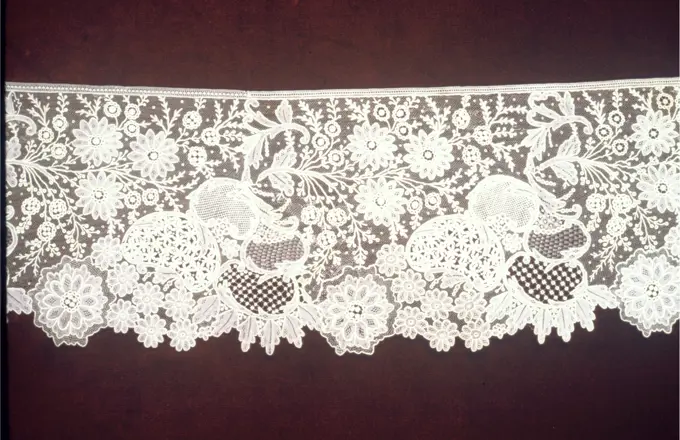
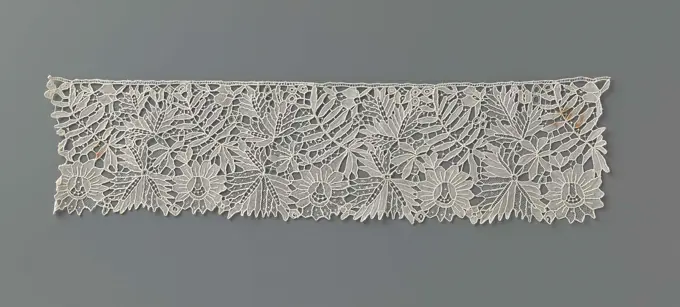
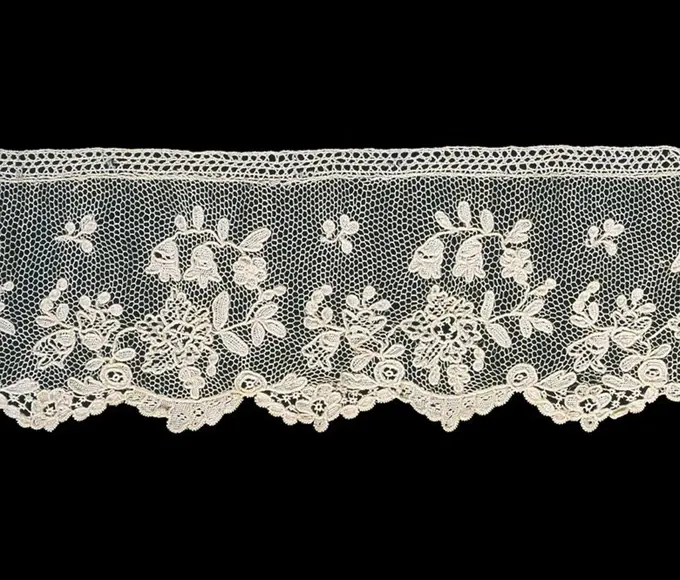
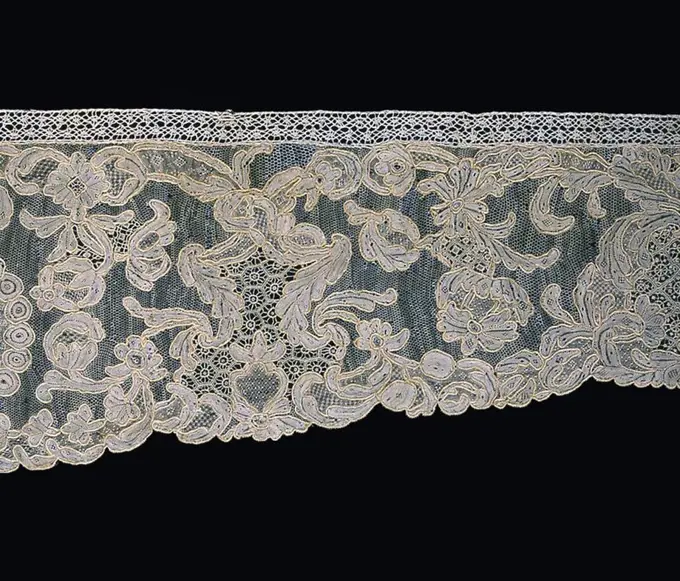
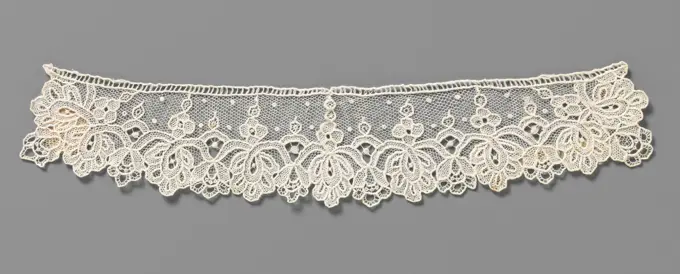
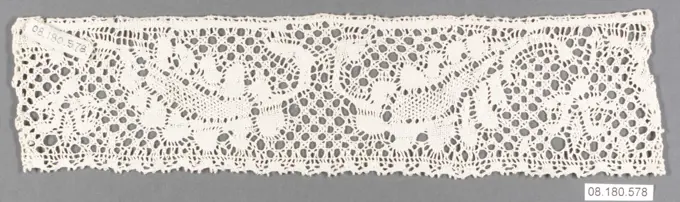
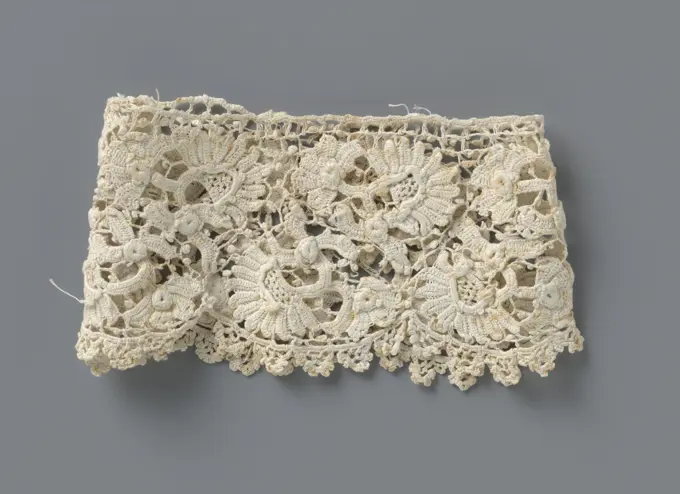
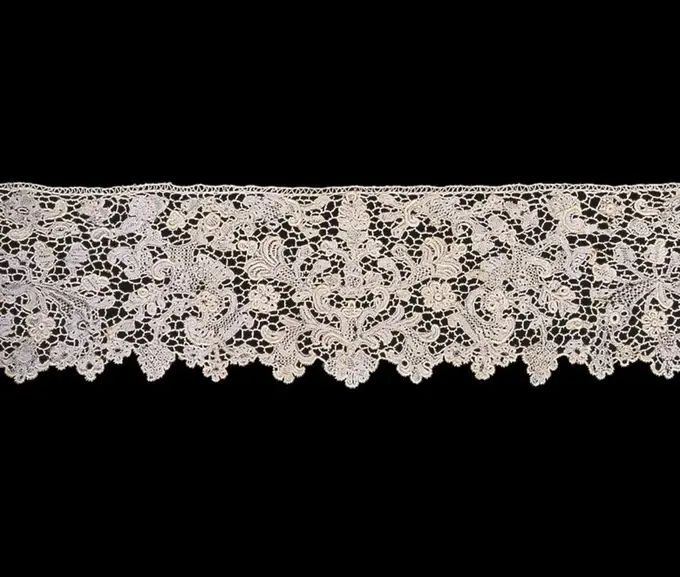
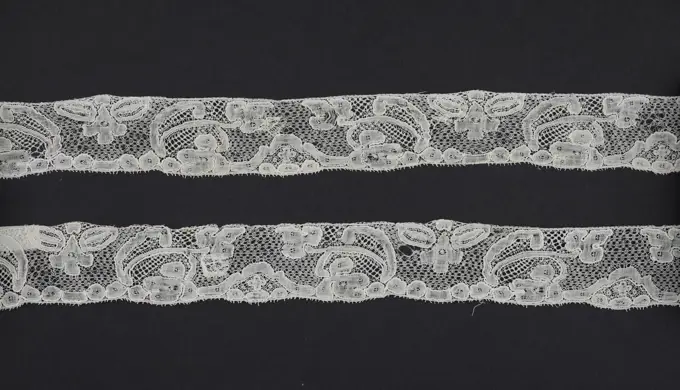
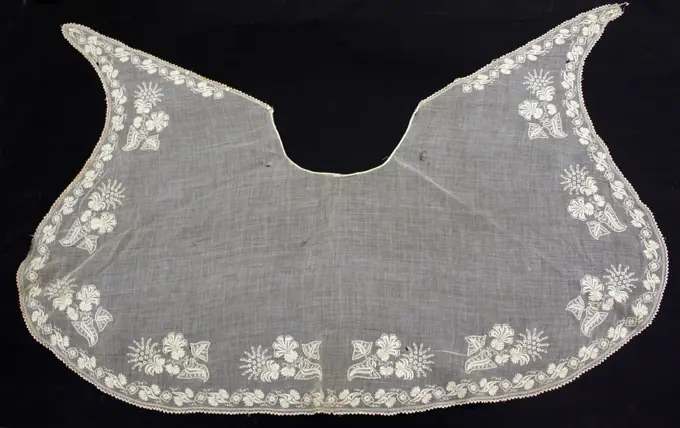
A collection of intricate bobbin lace fragments featuring floral and ribbon-like designs, showcasing craftsmanship from 17th to 19th century Europe. Delicate, detailed patterns on linen.

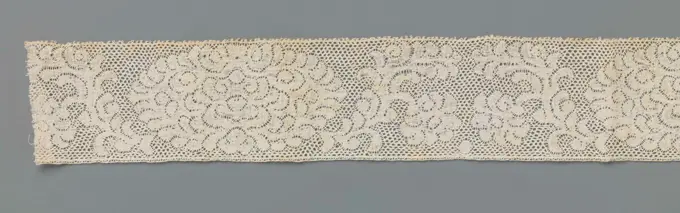
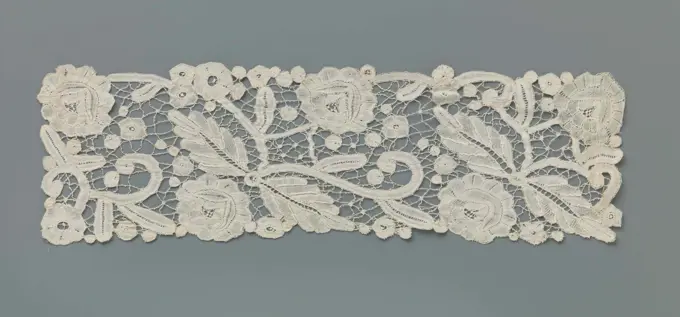
Strip bobbin with rocailles, anonymous, c. 1880 On the traly land, a Mechelen soil (also known as ice soil), is a running pattern of large rocailles with grid filling, which are connected to a double branch, which is decorated in the same way, connected to a double branch. Wingerd leaves grow on the standing side branch, roses and carnations grow on the horizontal. Mechelen side. Belgium linen (material) bobbin lace / Mechlin (lace) On the traly land, a Mechelen soil (also known as ice soil), is a running pattern of large rocailles with grid filling, which are connected to a double branch, which is decorated in the same way, connected to a double branch. Wingerd leaves grow on the standing side branch, roses and carnations grow on the horizontal. Mechelen side. Belgium linen (material) bobbin lace / Mechlin (lace)
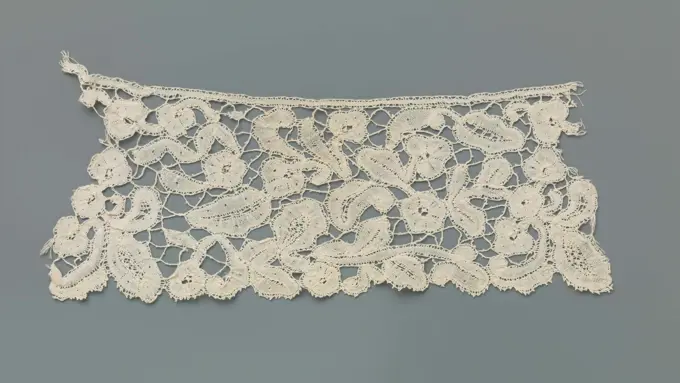
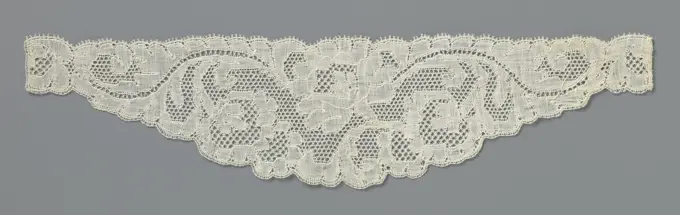
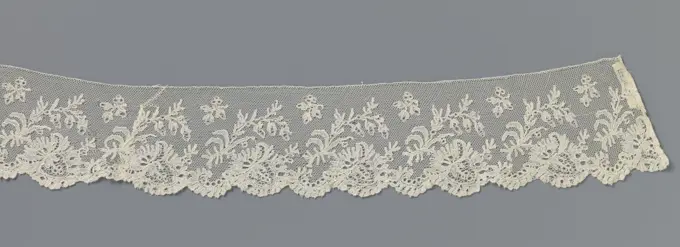
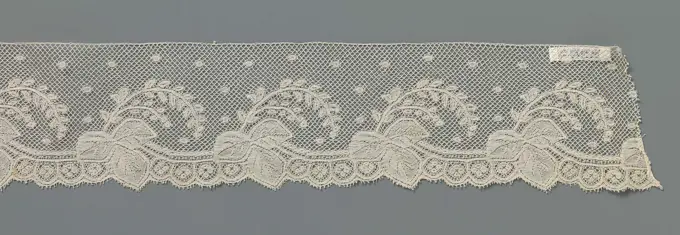
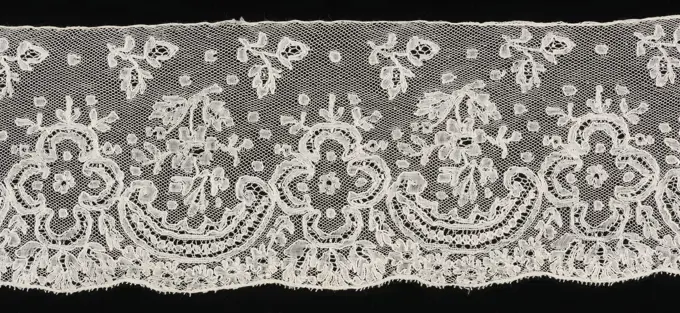
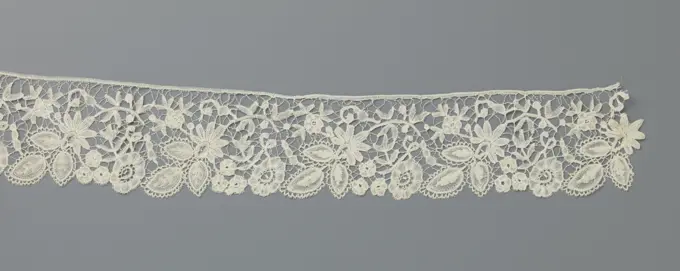
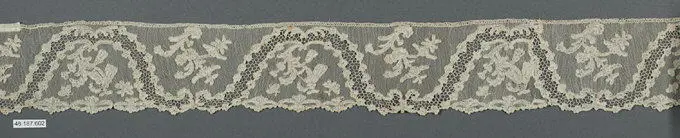
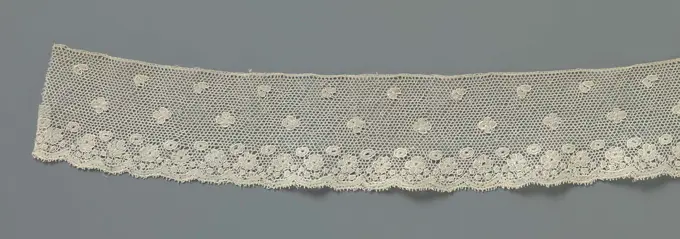
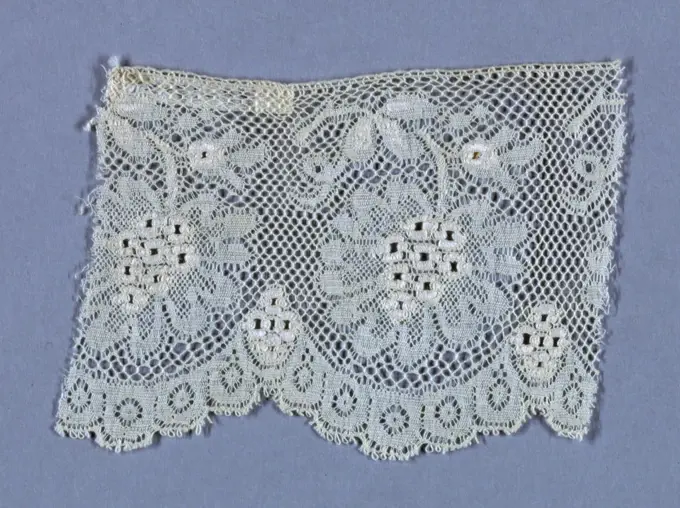
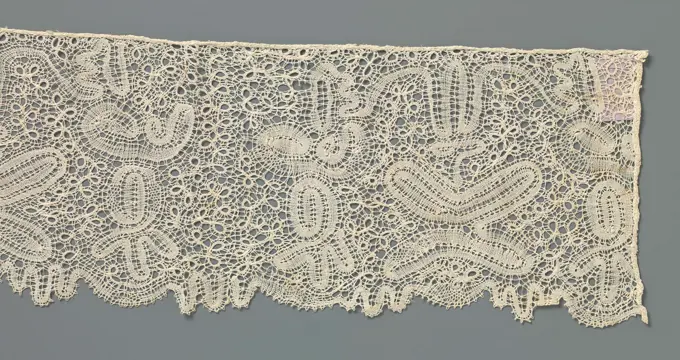
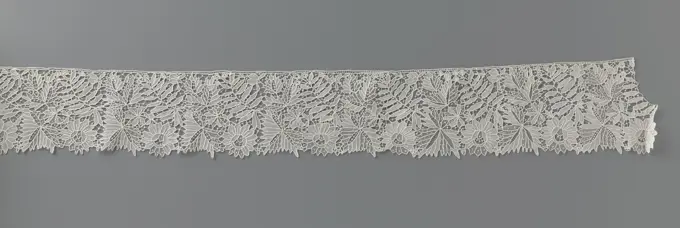
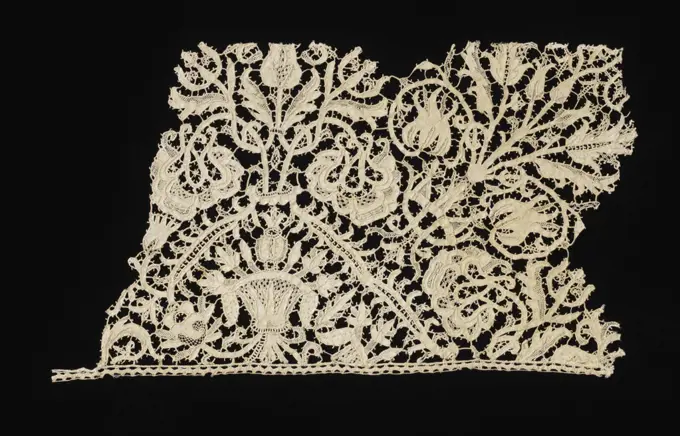
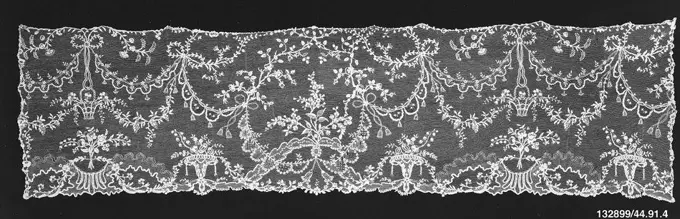
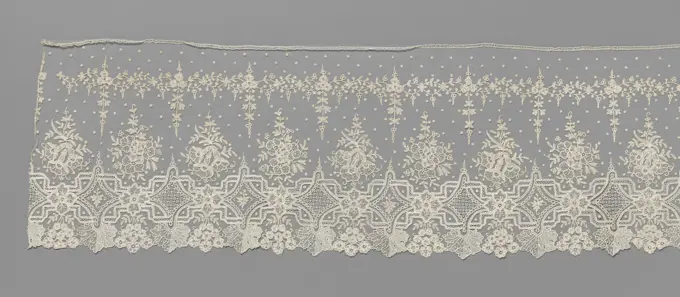
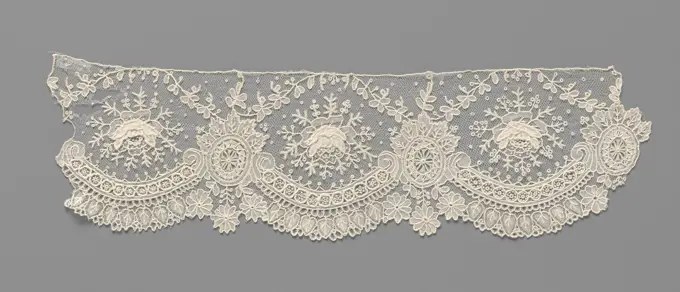
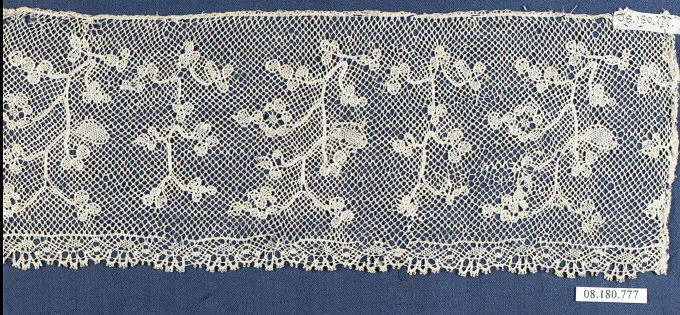
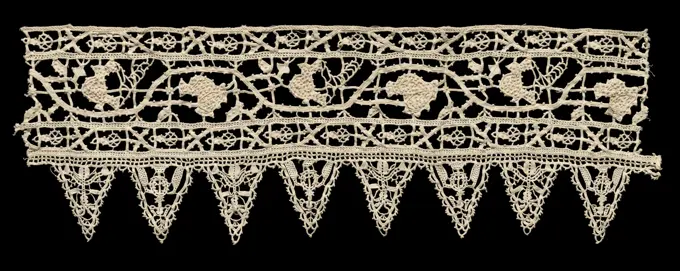
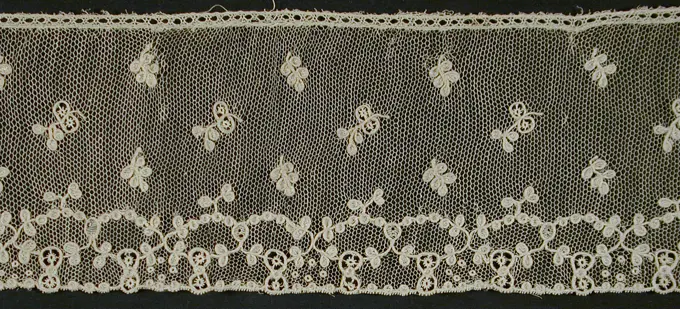
Fragment, Medium: linen Technique: bobbin lace (discontinuous tape), Lace fragment showing a ribbon-like serpentine floral design. No ground., Italy, 17th century, lace, FragmentStrook kloskant met eenvoudige bloemen en bladeren.Natural collate strip: Duchesse-Side. Simply designed flower and leaf motifs and volutes are connected by a braid soil. Along the edge, among other things, a spinner with two curly leaves.Strip bobbin with rocailles, anonymous, c. 1880 On the traly land, a Mechelen soil (also known as ice soil), is a running pattern of large rocailles with grid filling, which are connected to a double branch, which is decorated in the same way, connected to a double branch. Wingerd leaves grow on the standing side branch, roses and carnations grow on the horizontal. Mechelen side. Belgium linen (material) bobbin lace / Mechlin (lace) On the traly land, a Mechelen soil (also known as ice soil), is a running pattern of large rocailles with grid filling, which are connected to a double branch, which is decorated in the same way, connected to a double branch. Wingerd leaves grow on the standing side branch, roses and carnations grow on the horizontal. Mechelen side. Belgium linen (material) bobbin lace / Mechlin (lace)Fragment 17th century Italian. Fragment 214881Border Made 1650-1675 Flanders. Linen, bobbin straight lace .Kloskant insert for lingerie, anonymous, c. 1900 - c. 1924 Insert for lingerie of natural -colored bobbin, Parisian side. Half oval -shaped. The pattern is largely symmetrical except for the slanted flour, at the top of the center line. Long spring-shaped leaves spring from this flower, which waves along the top edge like an S-Volut. A flower bends back to the center line under both wave tops. The motifs are connected by a Maas soil, a Parisian soil. The motifs are made in linen battle with thicker and shiny contour threads. A snowflake soil has been used in the Bloemharten as a decorative soil. In the volute leaves a decoration has been realized by crossing couples. The top of the strip is straight finished. The scums along the long straight side are finished with picots. Along the short sides and the scallops along the curved long side, a strap runs in a linen battle with openwork edges France (possibly) linen (material) bobbin lace / Paris lace Insert for lingerie of natural -coloreStrip of bobbin with slanted flour under a branched branch, anonymous, c. 1800 - c. 1809 Strip of natural -colored bobbin: Lille side. The repeating pattern consists of a sloped flower that lies along the underside of the strip, under a branched branch with some hanging oval berries or flowers. Between the branches are loose twigs with similar berries. The successive flowers along the underside are connected by a curved leaf, together they form the scallops. The motifs are placed close together and are connected by a fine grid, a tuler land. The motifs are made in linen battle with large recesses and thicker contour threads. A few decorative lands have been applied. The top is straight. The scalloped underside stems from the pattern and is finished with picots. The short sides are cut diagonally and finished with a zoompje. Lille cotton (textile) bobbin lace / Lille lace Strip of natural -colored bobbin: Lille side. The repeating pattern consists of a sloped flower that lies along the Strook kloskant met pioenrozen waartussen losse stip langs de bovenrand.Strip natural-colored Dutch clamping side. The repeating pattern consists of a stylized peony between two leaves hanging down to me shown smaller flowers. There is a loose dot between the consecutive peonies each time the top edge. The motifs are connected by a round table ground with braid. The motifs are made in linen stroke with openwork edges that ensure contours around petals and leaf growers. Upper and bottom of the strip are straight finished, the underside with picots.Strook kloskant met wingerdblad aan gebogen stengel.Natural collate strip, Valenciennes side. The repeating pattern consists of a curved stem to which a wingerdate hangs down. The leaf cuts partly the wavy ornamental band running along the bottom. The band exists between the leaves from four lobes, with four berries in each. The motifs are connected by a maas soil, a diamond-shaped valenciennes ground, strewn with moes. The motifs are made in a cut-off and linselag with recesses and openwork edges. Upper and bottom of the strip are straight finished, the underside with picots.Strip of needle side with symmetrically decorated ovals, anonymous, c. 1710 - c. 1730 Strip of natural needle side: Argentan side. The repeating pattern consists of, among other things, symmetrically decorated ovals. The motifs are connected by or filled with many different types of decorative land, including a diamond soil with the iatric eyes typical of the Argentella side in the ovals. The motifs are made up of feston stitches with decorative recesses. The top is trimmed with a border bobbin. Schulpenrand on the bottom, arising from the pattern. France linen (material) Argentella (point) Strip of natural needle side: Argentan side. The repeating pattern consists of, among other things, symmetrically decorated ovals. The motifs are connected by or filled with many different types of decorative land, including a diamond soil with the iatric eyes typical of the Argentella side in the ovals. The motifs are made up of feston stitches with decorative recesses. The top is trimmed with a boManchet van naaldkant met strikjes.Cuff of natural needle side: Venetian relief side. On a very open bars soil there are irregular voluntaries with leaf volutes and multi-part flowers. List of triangles.Border; linenStrip bobbin with feathered leaves, anonymous, c. 1900 - c. 1949 Strip of natural-colored bobbin: Duchesse side. On a very open braiding soil with spider webs there is an ongoing pattern that becomes heavier on the shell side. In the middle is a row of sleek spiral stems with a hanging, feathered leaf with open grain. Star -shaped flowers and berries are on either side of this. Netherlands (possibly) linen (material) bobbin lace Strip of natural-colored bobbin: Duchesse side. On a very open braiding soil with spider webs there is an ongoing pattern that becomes heavier on the shell side. In the middle is a row of sleek spiral stems with a hanging, feathered leaf with open grain. Star -shaped flowers and berries are on either side of this. Netherlands (possibly) linen (material) bobbin laceSleeve band (one of a pair) early 18th century French. Sleeve band (one of a pair) 218287Edging, Medium: linen Technique: needle lace, reticella style, Edging of four scallops with wheel design., Italy, early 17th century, lace, EdgingStrip bobbin with the grapes bunches, anonymous, c. 1875 - c. 1899 Strip of natural-colored bobbin: Duchesse side. On an open braid soil is a running pattern of a short branch with two vine leaves and a grapes. In turns, a leaf and the bunch form the uneven scums. Netherlands linen (material) bobbin lace Strip of natural-colored bobbin: Duchesse side. On an open braid soil is a running pattern of a short branch with two vine leaves and a grapes. In turns, a leaf and the bunch form the uneven scums. Netherlands linen (material) bobbin laceFragment 18th century French. Fragment. French. 18th century. Bobbin lace. Textiles-LacesStrip of needle side with spindly flowers, anonymous, c. 1875 - c. 1909 Strip of natural -colored Venetian needle side "Gros Point". On an open bar of land there is a running slender with multiple -eared small flowers, which are set with spindly, strongly curved petals. The richly varied leaf voltues are also strongly curved. BURANO linen (material) Venetian gros point (heavy raised Venetian lace) Strip of natural -colored Venetian needle side "Gros Point". On an open bar of land there is a running slender with multiple -eared small flowers, which are set with spindly, strongly curved petals. The richly varied leaf voltues are also strongly curved. BURANO linen (material) Venetian gros point (heavy raised Venetian lace)Strook kloskant met bloemtak vol rozetbloempjes.Strip natural colosside: Mechelen side. The repeating and continuous pattern consists of a narrow horn-shaped reserve and a coincidence-shaped reserve located along the lower edge from which a flower branch releases full side branches with rosette flowers, such as a forget-me-not. Along the top edge, with a pleat on one short side, a narrower strip is sewn with a pattern of different seedillery reserves and some flowers and leaves. The motifs are connected to each other in both strips by a fine Maas soil, the Malinois. The motifs are made in linen stroke with few recesses, and is equipped with very thick contour wires. Different ornamental grounds, with coarser mesh, have been applied in the reserves and between the rosette flowers. The bland scalloped over both strips are finished with picots. The silk sewns are straight finished.Strip bobbin with daisies, anonymous, c. 1900 - c. 1924 A coarse mesh stock (square Maas) with daisies above scoops of pearls. Valenciennes side. Sluis (Possible) linen (material) Bobbi Lace / Valenciennes Lace A coarse mesh stock (square Maas) with daisies above scoops of pearls. Valenciennes side. Sluis (Possible) linen (material) Bobbi Lace / Valenciennes LaceStrip of needle side with rose branch and four leaf garlands, anonymous, c. 1900 - c. 1909 Strip of natural-colored needle side: Alençon side. Pattern with a repetitive motif of a rose branch and four leaf hangers on a fine hexagonal Maas soil. The four garlands, all with different leaves, waves in the same direction from one point. Regular arches with shells along the underside are formed by alternating a pendulum and a succession of rosette flowers, always connected by one larger rosette flower. In the center of the pendulum a zigzag line of potented bars. The top is trimmed with a border bobbin. France linen (material) Alençon Lace Strip of natural-colored needle side: Alençon side. Pattern with a repetitive motif of a rose branch and four leaf hangers on a fine hexagonal Maas soil. The four garlands, all with different leaves, waves in the same direction from one point. Regular arches with shells along the underside are formed by alternating a pendulum and a succession of rosette fBorder second half 18th century French. Border 227344Strook kloskant met klavertjes vier en rozetrand.Strip natural colosside, Paris side. The upper half of the strip consists of a row of double leaves and a row of four-leaf clovers. The repeating pattern along the underside of the strip consists of a row of opened circles, with a row of rosette flowers close by it. Each rosette flower lies in a shell in which four loose meadows are. A strap runs along the slip. The motifs are connected by a Maas soil, a Paris soil. The motifs are made in linen stroke with thicker and shiny contour wires. The top of the strip is straight finished. The tubs on the underside are finished with picots.Strip needle side with filled half oval, anonymous, c. 1750 - c. 1774 Strip of natural-colored needle side: Alençon side. Pattern with a repetitive motif of two different, split flower branches on a fine hexagonal mesh ground, an alençon ground. There is always a smaller twig between these branches, alternating with flowers and flower buds or berries. The lower edge is formed by a wavy slender with leaves and some flowers. The waves form large half ovals along the lower edge. These are filled with a decorative land with different (rader) picots. The top is trimmed with a messing strap. Alençon linen (material) Alençon Lace Strip of natural-colored needle side: Alençon side. Pattern with a repetitive motif of two different, split flower branches on a fine hexagonal mesh ground, an alençon ground. There is always a smaller twig between these branches, alternating with flowers and flower buds or berries. The lower edge is formed by a wavy slender with leaves and some flowers. The waves foFragment; linen; 1914-23-2Strip of needle side with star -shaped flour, anonymous, c. 1700 - c. 1749 Strip of natural needle side: Venetian rose side. Pattern with tendrils where flowers and leaves spring with different shapes and dimensions, without a repetitive motif. Central is a star -shaped flower with seven petals. Irregular bar with picots. The top is trimmed with a border bobbin. The underside is finished with a straight picot edge with arcs. unknown linen (material) Venetian rose point Strip of natural needle side: Venetian rose side. Pattern with tendrils where flowers and leaves spring with different shapes and dimensions, without a repetitive motif. Central is a star -shaped flower with seven petals. Irregular bar with picots. The top is trimmed with a border bobbin. The underside is finished with a straight picot edge with arcs. unknown linen (material) Venetian rose pointBorder, Medium: linen Technique: bobbin lace, Mechlin style, Border with an open pattern of floral sprays emerging from stylized horn of plenty., N. Europe, late 18th century, lace, BorderBorder Fragment (France); linenBobbin Lace (Needlepoint Design) Edging, second half of 16th century. Italy, Genoa, second half of 16th century. Lace, bobbin; average: 4.5 x 29.6 cm (1 3/4 x 11 5/8 in.).Fragment, A .G. Jennings & Sons, American, Medium: cotton Technique: machine made lace, Lace in the style of Valenciennes with embroidered details., USA, 1884, lace, FragmentStrook kloskant met symmetrische compositie met vlindervormig motief in centrum en omring door occhiolini-lussen.Strip natural colosside, osteuropese side. The repeating pattern consists of a more or less symmetrical composition in which the contours of the motifs are made with winding ribbons, which vary at least in width. The composition consists of a butterfly-shaped motif with a sort of ballroom above that the same curly motifs hang down on both sides. The motifs are connected by a loop pattern such as at Occhiolini. The ribbons are partly made in the battery and largely in linen battle with openwork edges. The top of the strip is straight finished. An throughout and winding ribbon provides a slot edge along the bottom of the strip.Strip bobbin with ivy leaf and lobed scales, anonymous, c. 1910 - c. 1920 A rough stock of square meshes is filled with a row of ivy leaves, which are always above a wide, lobed shell. Valenciennes. Netherlands (possibly) linen (material) Bobbi Lace / Valenciennes Lace A rough stock of square meshes is filled with a row of ivy leaves, which are always above a wide, lobed shell. Valenciennes. Netherlands (possibly) linen (material) Bobbi Lace / Valenciennes LaceStrip of needle side with incised leaves, anonymous, c. 1900 Walking pattern of incised leaves above a rose and a three -leaf, which together form the sharply toothed outside line. Cross-shaped bars with button (soil of long X-shaped bars with a spider). The Remplis consists of buttonholes and a long distance gazé. German side: 'Carlsbader Points'. Karlsbad (Germany) (possibly) linen (material) Walking pattern of incised leaves above a rose and a three -leaf, which together form the sharply toothed outside line. Cross-shaped bars with button (soil of long X-shaped bars with a spider). The Remplis consists of buttonholes and a long distance gazé. German side: 'Carlsbader Points'. Karlsbad (Germany) (possibly) linen (material)Fragments, Medium: linen Technique: early 17th c. needle lace and style, Fragments with alternating arrangements of floral and foliated sprays in a symmetric pattern connected by bars., Italy, early-mid-17th century, lace, FragmentsMitaine Van Kloskant with C-Voluten with zigzag lines and heart-shaped leaves with a double heart, anonymous, c. 1850 - c. 1899 Mitaine of natural -colored bobbin: fine bridge flower arrangements. The pattern exists along the edge at the part where the hand sticks out of the mitaine at the front and back from a C-volute from which two heart-shaped leaves spring. The heart of these leaves is double layer, made with an application from Kloskant. In every volute a zigzag line and pearl edge. This zigzag with pearl edge returns along the edge at the bottom. The remaining pattern includes tibbles with triple leaves and flowers with a closed oval flower heart and open worked oval petals. At the top and bottom edge of the Mitaine are finished with these flowers. The motifs are made in linen and mains with thick contour threads and relief contours. The motifs are connected by a braid ground. In a single rosette flower, a block is made in the flower heart, made in form. Belgium linen (material)Sierstuk voor een avondmantel van gemengde kant met rozenhaag.Ornamental piece (cuff) for an evening jacket of mixed side - climbing side in combination with coniferous lace - Brussels Duchesse. In a widely spread braid soil there are roses that usually support two leaves. An intermediate ornament consists of a few and double voluntaries and many small flowers.Flounce third quarter 18th century French. Flounce 227034Intermediate edge of a double strip of bobbin with hexagons, anonymous, c. 1890 - c. 1899  Piles of natural -colored bobbin, made of two strips sewn in length. The pattern is based on a sixteenth-century example and is reminiscent of Reticella. It consists of a row of hexagons made per strip made with a dense Maas soil that is connected to each other with braids from the corners. The pattern continues in the upper and bottom edge, but is interrupted halfway by a straight finish with picots. The pattern on the center line, where the strips are sewn together, does not fit exactly together. Italy linen (material) bobbin laceKloskant strip with hollow and convex double frames, anonymous, c. 1850 - c. 1860 Black bobbin strip: Chantilly side. A grid -founded shows an empty top and a very heavier symmetrical design. Holle and Bolle Double Lists, step -by -step together, follow the sculptures, which in turns consist of half rosettes and an arc of leaves. Belgium silk bobbin lace Black bobbin strip: Chantilly side. A grid -founded shows an empty top and a very heavier symmetrical design. Holle and Bolle Double Lists, step -by -step together, follow the sculptures, which in turns consist of half rosettes and an arc of leaves. Belgium silk bobbin laceJaponstrook van applicatiekant met schakelrand van geometrische vormen en rozetbloemen.Japon strip of Brussels application side, dick edge and coniferous side-brussels gauze side - applicated on machine tulle. Sprinkle pattern with moes and a density towards the lump side in density. Along the top, an airy garland runs, which consists of a double, intersecting wave line, which is always interrupted by three rosettes with a straight dependent leaf drink. Below that a repeating pattern of a loose-standing flower branch, alternating from three rosette flowers and three hanging flowers. At the bottom, a shift edge with geometric shapes, squares through diamonds overneath, which are coupled to each other by a large rosette flower. There is a wine leaf under each window and a bunch of small rosette flowers under each large rosette flower. These wine leaves and bunches of rosette flowers form the shallow slump along the lower edge. The top is finished with a border of clamping side.Application side strip with bijou on the garlands for a crinoline Japon, Anonymous, c. 1850 - c. 1860 Strip of natural -colored Brussels application side: mixed side - Brussels mesh side and bobbin - applied on mechanical tulle. The strip is intended or used as a decoration on a crinoline Japon. Two varied types of round sculptes together with a lace Banderolle form a succession of large round reserves, above which a land littered with mushes. The reserves are always filled with a bouquet or rose (bobbin). One shell shows a ribbon decorated with a standing oval bijou, which is hung on the Banderolle with a bow and with a scalloped ribbon. The other shell shows radiating twigs with roses between two rows of campanes. Above the reserves are small bouquets. The top of the strip is finished with a separate strap. Brussels linen (material) Brussels appliqué / mixed lace Strip of natural -colored Brussels application side: mixed side - Brussels mesh side and bobbin - applied on mechanical tuBorder; cotton (analyzed in lab); 1973-52-1Bobbin Lace (Blonde Lace) Edging, 18th-19th century. Spain, 18th-19th century. Lace, bobbin; average: 3.9 x 10 cm (1 9/16 x 3 15/16 in.).Fragment of the lace;  XVII-XVIII century (1601-00-00-1800-00-00);Strook naaldkant met ingesneden blad.Running pattern of incised leaves above a rose and a three-leaf, which together form the sharply toothed outside line. Cross-shaped bars with button (soil of long X-shaped bars with a spider). The REMPLIS consists of buttonhole stitches and a Fond Gazé. German side: 'Carlsbead points'.Border Made 1701-1725 Northern Europe. Linen, needle lace on woven tapes .Border; linen; 1933-1-65Fragment 1830 French. Fragment 214612Strook van naaldkant met medaillons en bladeren.Strip of natural needle side, Brussels mesh side. Repetitive symmetrical motif with a medallion of flower garlands in the bowl of a bow under which large leaves. The pattern stands on a fine soil with single twisted meshes, strewn with moes. In the medallion an asymmetrical bouquet. The arches are filled with circles, with a large circle with rosette flower in the middle and at the ends. Different ornamental grounds in the floral motifs and the circles. The slot along the underside are formed by the large leaves. The top is finished with a straight edge.Borders. France. Date: 1820-1839. Dimensions: a: 6.0 × 157.7 cm (2 3/8 × 62 1/8 in.)width repeat: 5.8 cm (2 1/8 in.)b: 6.4 × 38.7 cm (2 1/2 × 15 1/4 in.)Width repeat: 5.6 cm (2 1/4 in.)c: 6.3 × 36.1 cm (2 3/8 × 14 1/4 in.)Width repeat: 5.3 cm (2 1/8 in.). Linen and horsehair, needle lace of a type known as "Point D'Aleçon". Origin: France. Museum: The Chicago Art Institute, Chicago, USA.Fragment of lace 18th century Maltese. Fragment of lace 214327Fragment, Medium: linen Technique: bobbin lace (Mechlin-style), Fragment of Mechlin lace with scrolling bands and rococo curves set off areas in which appear conventionalized floral sprays. Variety of 'fond de neige' ground. Scalloped edge., Belgium, 18th century, lace, FragmentBand (Italy); linenFragment (France); linenNeedle and bobbin veil (Vieux Bruxelles Kant), Anonymous, c. 1775 - c. 1800  Lace veil with a soil of crushed meshes and a pattern of garlands, bouquets and bows with various fillings in needlework. The pattern has rosettes on the three scalloped sides. On the fourth side an edge of machine tulle, so -called Angleterre, that is trimmed with picots. Belgium . Brussels bobbin laceInsertion 17th century Italian. Insertion 214913Strook applicatiekant met rozetbloempjes langs de onderzijde.Strip of natural brussels application side: dick side applicated on machining tulle. On a fine hexagonal mesh soil, a concatenation of small, uniform, rosette flowers is sewn along the underside. Above a row with alternating a circle and a hanging twig with a round flower and two leaves. Motifs in clusters side with linen stroke, recesses such as ornamental element and closted relief contours. The top is straight finished with a widely scented wire bundle.Sleeve Ruffle (Engageante) and Lappets (Joined). France. Date: 1740-1749. Dimensions: 12.9 × 204.3 cm (5 1/8 × 80 1/2 in.). Linen, needle lace. Origin: France. Museum: The Chicago Art Institute, Chicago, USA.Band Fragment (Italy); linenEdging (France); linenManchet van naaldkant met hangende bloemen en in elkaar krullende stelen.Cuff from natural needle side: Brussels gauze side. The symmetrical pattern consists along the bottom edge from hanging flowers with five flower leaves and a drop-shaped flower heart that is formed by a loop. Between the consecutive flowers, a smaller chali flower always hangs at the ends of the loops with which the flower hearts are formed on either side. On the short sides, the pattern runs overhoeks. Each drop-shaped flower heart is crowned by a rosette flower and one or two (with the middle) circles. Above every chali flower is a cut-away arc awarded by a circle. The motifs are made with feston stitches and are accentuated by embossed contours. The motifs are connected by a mesh side ground with mashes. The slot edge is formed by the hanging flowers. The top is straight finished with two wires with a rail rail pattern.Piece early 19th century Italian, Abruzzi. Piece 214928Fragment 18th century Italian, Milan. Fragment 214900Edging 17th century Italian, Genoa. Edging 220970Fragment, Medium: linen Technique: bobbin lace, Binche style with Binche ground, Belgium, 18th century, lace, FragmentCuff from crocheted side with fan -shaped flowers, anonymous, c. 1890 - c. 1909 Cuff made of natural Irish crocheted side, imitation coarse Venetian side. Pattern with fan -shaped flowers with stems and a crocheted irregular mesh soil with picots. The top is finished with a straight edge. The semi -circular sculpts on the lower edge are trimmed with picoted arches. Ireland cotton (textile) Cuff made of natural Irish crocheted side, imitation coarse Venetian side. Pattern with fan -shaped flowers with stems and a crocheted irregular mesh soil with picots. The top is finished with a straight edge. The semi -circular sculpts on the lower edge are trimmed with picoted arches. Ireland cotton (textile)Cap Streamers (Belgium); linenBatist handkerchief with a richly worked wide ring of embroidery with four times three symmetrical flower branches between rosette with loop and needle lace stitches in open work, anonymous, c. 1850 - c. 1860 Batist handkerchief with embroidery: whitework with fine French embroidery and sand stitches. The embroidery forms a wide and richly worked edge forms a circle on the square piece of Batist, which is finished with simple narrow hems. The pattern consists of four equal parts that are marked by a rosette along the inner edge of the circle to which an elongated loop points towards the corners of the batist. Between the loops, the pattern consists of three symmetrical flower branches with three rosette flowers and two curlinged feathered leaves and along the inner and outer edge of the circle with graceful and richly treated frames. In the openwork parts, needle lace pier has been used that form small founded picots, star flower and diamonds in openwork parts. Europe cotton (textile) Fragment (Border) Made 1701-1725 Italy. Linen, bobbin straight lace .Strip bobbin with five -leaf, anonymous, c. 1890 Strip of natural -colored bobbin, fine bridge flower arrangements. On an open bars stock there are concentric U-shapes with a running pattern of branches, on which an anemone, a five-leaf and a bunch of three almond-shaped fruits or leaves. Bruges (possibly) linen (material) bobbin lace Strip of natural -colored bobbin, fine bridge flower arrangements. On an open bars stock there are concentric U-shapes with a running pattern of branches, on which an anemone, a five-leaf and a bunch of three almond-shaped fruits or leaves. Bruges (possibly) linen (material) bobbin laceBorder. France. Date: 1690-1710. Dimensions: 8 × 159.6 cm (3 1/8 × 62 7/8 in.)Height repeat: 68.5 cm (27 in.). Linen, needle lace. Origin: France. Museum: The Chicago Art Institute, Chicago, USA.Fragment, Cooper Union Museum Lace Study Card; Made for Cooper Union Museum; Belgium; linenQuille (one of a pair) 18th century French. Quille (one of a pair) 227070Length of lace, 19th Century, France, maker unknown. Gift of Mrs G. Acland Allen, 1955.Strip of needle side with hanging hearts under horizontal C-volute with rose, anonymous, c. 1880 Strip of natural needle side: Brussels mesh side. The repeating pattern consists of large semicircular sculptes formed by hiding C-Voluten. Above each volute is one loose rose with a jet wreath of short branches with berries. The switching points between the volutes are formed by oval medallions, which are decorated with a leaf crown. From the leaf crown a fine pendulum rises that runs over the rose to the next medallion. The scrap edge is formed by hanging heart -shaped leaves under the volutes interspersed by always three hanging daisies under the medallions. The motifs are made up of feston stitches and equipped with relief contours. The roses have relief leaves. The motifs are connected to each other by a fine Maas soil, a mesh side, on which a few mushes have been applied. Decorative stitches have been used in the roses and medallions. The top of the strip is straight finished. BrusselBobbin Lace Insertion and Edging with Loops, mid 16th century. Italy, Venice, mid 16th century. Lace, bobbin; average: 9.6 x 22.9 cm (3 3/4 x 9 in.).Border 18th century Spanish. Border 215128Needlepoint (Punto in Aria) Lace Cuff, 16th-17th century. Italy, Venice, 16th-17th century. Lace, needlepoint: linen; overall: 17.5 x 51.8 cm (6 7/8 x 20 3/8 in.).Needlepoint (Drawnwork) and Bobbin Lace Insertion, 16th century. Italy, 16th century. Lace, needlepoint; average: 4.8 x 28.6 cm (1 7/8 x 11 1/4 in.).Bobbin Lace Edging, 18th century. Spain, Huelva, 18th century. Lace, bobbin; average: 5.1 x 15.6 cm (2 x 6 1/8 in.).Fragment, Medium: linen Technique: bobbin lace, Pattern of small plain lozenges and large decorated lozenges., England, early 19th century, lace, FragmentStrook naaldkant met gepluimde ranken.Strip natural needle side: Venetian rosion side. On a bars soil with six-sided meshes there are rich branched, left and right swiveling tendrils, sometimes drew, sometimes walking. Veeloertige, carefully detailed knob-shaped flowers grow. Here and there the top of a rank has grown through an opening in the branch. Straight finish of alternation an eye and a triangle.Strip bobbin with pearls in composite rank, anonymous, c. 1740 - c. 1760 Strip of natural -colored Brussels bobbin. The pattern consists of a wavy slender, composed of all kinds of leaves, a heart -shaped flower, a bunch with oval flowers, a pearl necklace and at the end a carnation from which clovers four spring. The slender partially cuts the pattern along the underside of the strip, which includes a branch-me-nots, an oval-shaped cartouche and connected leaves and rosette flour caps. The motifs are connected by a fine Maas soil, a drachel soil. The fullwork is largely made in linen battle with openwork edges and some recesses. Some flower hearts and petals and the like are made in mains. Most motives are provided with burst relief contours. As a decorative land, a snowflake land has been used in the center of the oval cartouche and braids piced between the bunches. The top is finished with a separate stretched strap, to which fragments are attached of a hexagonal mesh ground. The irNeedlepoint (Venetian Rose Point) Lace Cuff (One of a Pair), 17th-18th century. Italy, Venice, 17th-18th century. Lace, needlepoint; overall: 15.3 x 29.5 cm (6 x 11 5/8 in.).Border, Technique: bobbin lace, Bobbin lace border, floral scroll; late 18th century Maline, late 18th century, lace, BorderFragment (USA); Manufactured by A .G. Jennings & Sons; cottonLengths of Lace. France, circa 1785-1790. Textiles; textile lengths. Linen point d'Alençon needle laceBorder Made 1860-1880 France. Linen and horsehair, needle lace of a type known as Point D'AlenÁon .Border (Belgium); linenBorder of Cut-Work Embroidery Edged with Macramé.Lace originated in the 16th century by systematically removing threads from a piece of linen or cutting it, and filling or wrapping the holes with embroidery. This is a rare example of early lace, in which the pattern is partly cut out. The bottom is edged with macramé, another early forerunner of lace, in which linen threads are decoratively knotted.Border 18th century Flemish, Brussels. Border 227682Kloskant's child collar with angular sculptes and intermediate sinks of batist with embroidery, anonymous, c. 1875 Children's collar of natural -colored bobbin side - Valenciennes side - with batist intermediate sinks with embroidery - Whitework - around angular rays -looking fields. The collar is finished all around with strips of Valenciennes side, where the strip along the neckline is narrower than the strip that forms a scrap edge around the angular fields. Netherlands (possibly) cotton (textile). batiste Bobbi Lace / Valenciennes Lace / Embroidering Children's collar of natural -colored bobbin side - Valenciennes side - with batist intermediate sinks with embroidery - Whitework - around angular rays -looking fields. The collar is finished all around with strips of Valenciennes side, where the strip along the neckline is narrower than the strip that forms a scrap edge around the angular fields. Netherlands (possibly) cotton (textile). batiste Bobbi Lace / Valenciennes Lace / EmbroiBand (Belgium); linenTwo fragment of the block lace unknownBobbin Lace (Needlepoint Design) Insertion, second half of 16th century. Italy, Genoa, second half of 16th century. Lace, bobbin; average: 3.9 x 29.3 cm (1 9/16 x 11 9/16 in.).BorderEdging 17th century Italian, Genoa. Edging 221007Collar 1840s probably American. Collar. probably American. 1840s. cottonVolant van applicatiekant met v-vormige takjes.Volant from natural colored application side, climbing side applied to machine tulle. A quarter of the fond is empty, a quarter has been strewn with meadows and the outer half has been invested with a symmetrical decor. V-shaped twigs, ending with inside and outward volutes, spring from a leaf roosery in the fairly straight exterior. This rosette forms with a rose and to the left and right-bending twigs with bows the scallops.Border ca. 1600 Netherlandish. Border. Netherlandish. ca. 1600. Needle lace. Textiles-Laces