Historical Lace Trimmings

An array of antique lace trimmings and fabrics, showcasing intricate designs and techniques from various time periods, primarily in neutral tones.


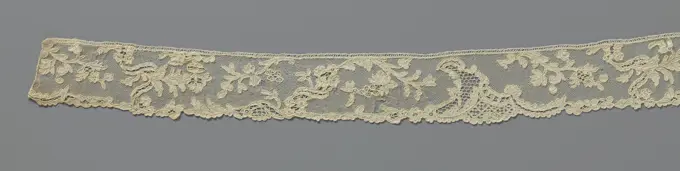
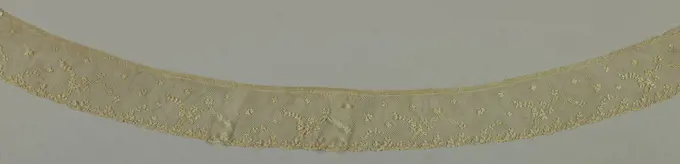
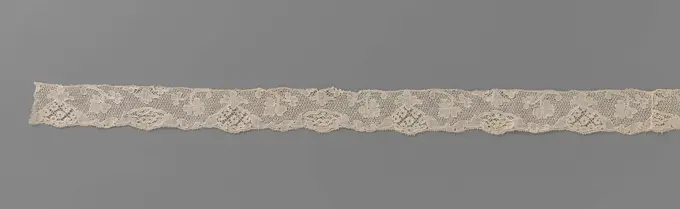
Strip of needle side with flower litter pattern and rush -hour, anonymous, c. 1775 - c. 1799 Strip of natural needle side, argent tank side. Strooi pattern of twigs that alternately have a small or larger flower, leaves and/or berries. Ground with meshes that are closed with buttonholes. The pattern along the lower edge consists of two pointed to each other, in between, between which a flower or berry branch rises. The oval pairs are connected by an arc of leaves and/or berries and hearts. Under these arcs along the lower edge a flat, lying oval. The oval -shaped figures in the pattern are filled with a fine hexagonal Maas soil (alençong round). Different decorative grounds in the flowers. Volwerk without recesses in flowers, leaves and berries. Schulpenrand on the underside by a succession of heart -shaped leaves, regularly interrupted by a rosette flower and the flat oval. The top is finished with a straight edge. Argentan linen (material) Argentan Lace Strip of natural needle side,
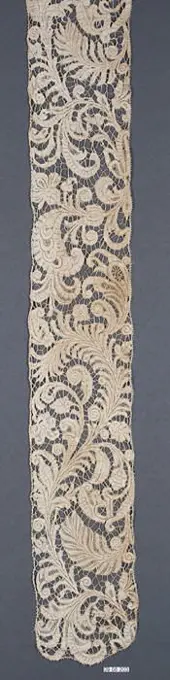
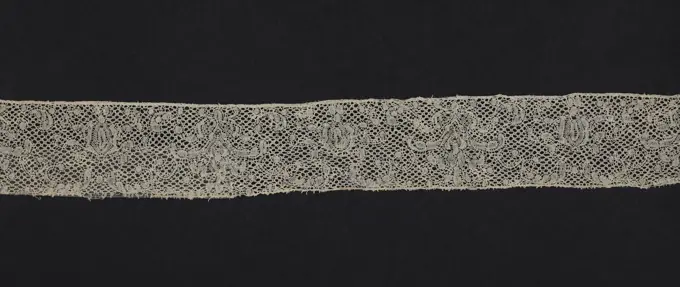
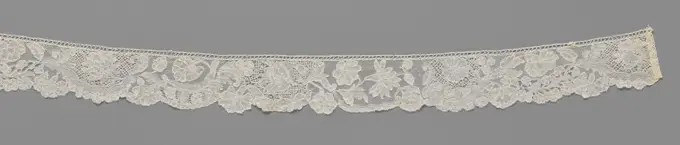
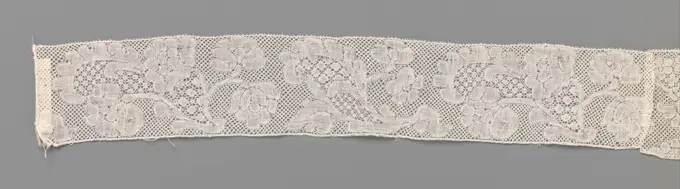
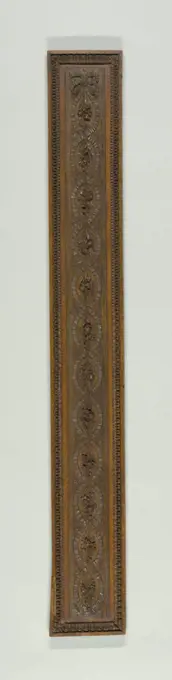
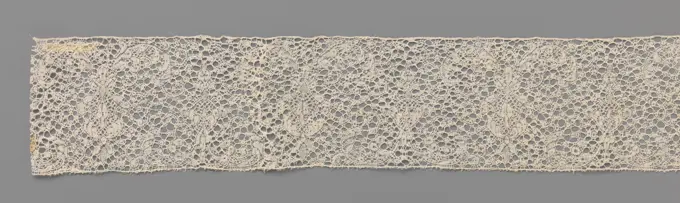
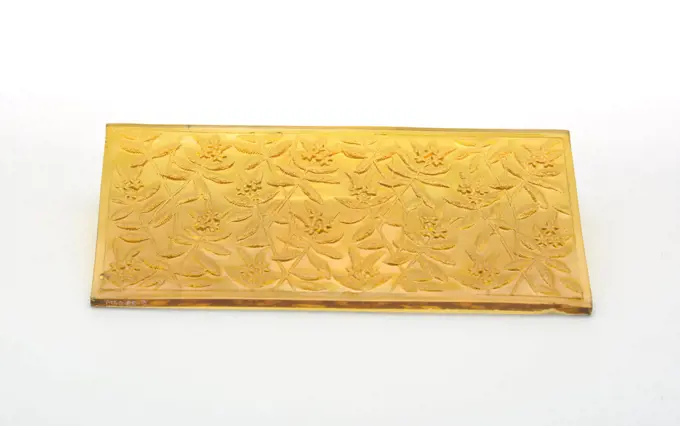
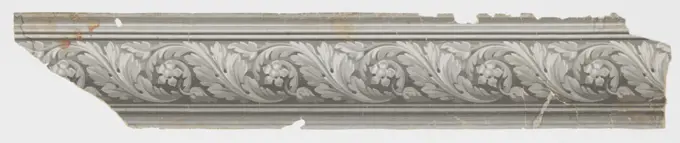
Trimming, Medium: silk Technique: woven, Design of a pink ground with small white ornaments or flowers with a blue selvage., France, 17th century, trimmings, TrimmingStrip ca. 1750 Dutch. Strip. Dutch. ca. 1750. Bobbin lace. Textiles-LacesFragments, Medium: linen Technique: bobbin lace (Lille-style with heavy outlining thread), Lille-style fragments with a pattern of floral forms separated by scrolls., England, 19th century, lace, FragmentsDasje of needle side with golden rain, anonymous, c. 1870 - c. 1890 A very narrow stretched shift strap from the pearl list and bells runs in incised, widened, button -shaped ends, with an edge of doubled rosettes. In the button a long rosette branch and a hanging goldenregros. At the tops a wreath of wingerd leaves. Point the Gaze de Bruxelles. Brussels linen (material) A very narrow stretched shift strap from the pearl list and bells runs in incised, widened, button -shaped ends, with an edge of doubled rosettes. In the button a long rosette branch and a hanging goldenregros. At the tops a wreath of wingerd leaves. Point the Gaze de Bruxelles. Brussels linen (material)Galloon 17th-18th century Unknown. Galloon. Unknown. 17th-18th century. Metal thread. Textiles-TrimmingsStrip ca. 1700 Flemish. Strip 218228Trimming, Medium: gold metallic foil and gold metallic foil wound onto yellow silk Technique: bobbin lace, Wide ribbons densely placed in a serpentine pattern., Spain, 18th century, lace, TrimmingKloskant intermediate mate with zigzag line, anonymous, c. 1875 - c. 1949 Piles of Natural -colored bobbin side: Mechelse side. In the middle of the fine grid, a Mechelen soil (also known as ice soil), an openwork band runs in Zigzaglijn, cut over by two types of rosettes. Belgium linen (material) bobbin lace / Mechlin (lace) Piles of Natural -colored bobbin side: Mechelse side. In the middle of the fine grid, a Mechelen soil (also known as ice soil), an openwork band runs in Zigzaglijn, cut over by two types of rosettes. Belgium linen (material) bobbin lace / Mechlin (lace)Strip bobbin with peony between curved elongated leaves, anonymous, c. 1650 Strip of natural -colored Dutch bobbin. The repeating pattern exists a stylized peony from which a long -curved leaf springs out on the left and at the end a smaller flower that is bothered to the peony. The motifs are connected by a round grid with braid strokes. The motifs are made in linen battle, where openwork edges ensure contours around petals and leaf rods. Top and bottom of the strip are straight. Antwerp (possibly) linen (material) bobbin lace Strip of natural -colored Dutch bobbin. The repeating pattern exists a stylized peony from which a long -curved leaf springs out on the left and at the end a smaller flower that is bothered to the peony. The motifs are connected by a round grid with braid strokes. The motifs are made in linen battle, where openwork edges ensure contours around petals and leaf rods. Top and bottom of the strip are straight. Antwerp (possibly) linen (material) bobbin laceStrip of needle side with flower litter pattern and rush -hour, anonymous, c. 1775 - c. 1799 Strip of natural needle side, argent tank side. Strooi pattern of twigs that alternately have a small or larger flower, leaves and/or berries. Ground with meshes that are closed with buttonholes. The pattern along the lower edge consists of two pointed to each other, in between, between which a flower or berry branch rises. The oval pairs are connected by an arc of leaves and/or berries and hearts. Under these arcs along the lower edge a flat, lying oval. The oval -shaped figures in the pattern are filled with a fine hexagonal Maas soil (alençong round). Different decorative grounds in the flowers. Volwerk without recesses in flowers, leaves and berries. Schulpenrand on the underside by a succession of heart -shaped leaves, regularly interrupted by a rosette flower and the flat oval. The top is finished with a straight edge. Argentan linen (material) Argentan Lace Strip of natural needle side, Strip 18th century possibly French. Strip 220060Galloon 17th-18th century Italian or Spanish. Galloon 213841Galloon 18th century French. Galloon 214013Kloskant intermediate mate with zigzag line, anonymous, c. 1875 - c. 1949 Piles of Natural -colored bobbin side: Mechelse side. In the middle of the fine grid, a Mechelen soil (also known as ice soil), an openwork band runs in Zigzaglijn, cut over by two types of rosettes. Belgium linen (material) bobbin lace / Mechlin (lace) Piles of Natural -colored bobbin side: Mechelse side. In the middle of the fine grid, a Mechelen soil (also known as ice soil), an openwork band runs in Zigzaglijn, cut over by two types of rosettes. Belgium linen (material) bobbin lace / Mechlin (lace)Kloskant's intermediate creature with Spitsovaaltje in U-shape, Anonymous, c. 1600 - c. 1699 Piles of natural -colored bobbins in densely crushed linen battle, Old Flemish side. With small cut-outs, a repeating pattern can be distinguished from a pointed dear surrounded by a more or less U-shaped edge. This pattern is alternately upright and upside down. At the top and bottom are straight. Flanders linen (material) bobbin lace / old Flemish lace Piles of natural -colored bobbins in densely crushed linen battle, Old Flemish side. With small cut-outs, a repeating pattern can be distinguished from a pointed dear surrounded by a more or less U-shaped edge. This pattern is alternately upright and upside down. At the top and bottom are straight. Flanders linen (material) bobbin lace / old Flemish lacePiece ca. 1700 Flemish, Mechlin. Piece 212986Lappet 17th century Flemish or Italian. Lappet 218145Strip of needle side with stems and palm flowers, anonymous, c. 1700 Strip of natural -colored needle side: flat Venetian side. On an open bar of land, which are decorated with cogs, there are truncated stems, on which carefully detailed palm flowers grow. A straight exterior in turn shows triangles and a few arches. Venice linen (material) flat Venetian (needle point) Strip of natural -colored needle side: flat Venetian side. On an open bar of land, which are decorated with cogs, there are truncated stems, on which carefully detailed palm flowers grow. A straight exterior in turn shows triangles and a few arches. Venice linen (material) flat Venetian (needle point)Strip of needle side with rocaille motif and flower branches with ribbons, anonymous, c. 1750 Strip of natural-colored needle side: Alençon side. Pattern with flower branches, occasionally wrapped with ribbons, on a fine hexagonal mesh ground. Between the branches an asymmetrical rocaille motif, filled with different decorative land. The top is finished with a border bobbin. The underside is finished with a picoted edge of Schulpen, which comes from a pattern of lying leaves and flowers and a few spaces filled with decorative grounds. unknown linen (material) Alençon Lace Strip of natural-colored needle side: Alençon side. Pattern with flower branches, occasionally wrapped with ribbons, on a fine hexagonal mesh ground. Between the branches an asymmetrical rocaille motif, filled with different decorative land. The top is finished with a border bobbin. The underside is finished with a picoted edge of Schulpen, which comes from a pattern of lying leaves and flowers and a few spaces filledFragment of bobbin lace unknownStrip bobbin with five variants of scales with flour above, anonymous, c. 1750 - c. 1760  Strip of natural -colored Brussels bobbin. The repeating pattern consists of a scrap edge that is formed by a lying leaf, a horizontal flower branch or a curved decorative band above which always one or two large flowers. This occurs in five variants. The motifs are made in linen battle with openwork edges and sparingly applied recesses, a few parts are made in netslag. Culped relief contours run around most motives. The motifs are connected by a fine grid, a drachel soil. A large decorative land has been used around a few flowers and a fine snowflake soil in a few decorative tires. The top of the strip is straight finished with a separate strap. The scrap edge is finished with picots. The two short sides are finished with a zoompje. Brussels linen (material) bobbin lace / Brussels bobbin laceEdge lace, Medium: linen Technique: needle lace, Edging lace of Point d'Alençon with a design of leaf sprays and flowers and short, twisted ribbons in 'petit réseau.' One edge worked in fine mesh with picots on cordonnet., France, 18th century, lace, Edge laceStrip bobbin of two pieces with different patterns, anonymous, c. 1740 - c. 1760 Strip bobbin, binche side. The strip consists of two strips of different patterns. The pattern of one strip consists of two symmetrical compositions, identical to the pattern of BK-NM-13249. The pattern of the other strip consists of slanted drop -shaped cartouches with feathered leaves, alternating with rosette flowers and peonies. For both strips, the motifs are connected by a grid, a five -part ground. The motifs are made in linen battle with recesses and openwork edges. In the cartouches, between the flower stalks and in the flowers, decorative lands have been used, especially snowflake grounds. The top and bottom of the strip are straight finished, with the bottom with picots. Flanders linen (material) Bobbi Lace / Binche Lace Strip bobbin, binche side. The strip consists of two strips of different patterns. The pattern of one strip consists of two symmetrical compositions, identical to the pattern ofGalloon 18th century Italian. Galloon 213933Miser's purse, Medium: silk, steel beads Technique: fishermen's knotted net technique, Miser's purse with beaded ornament and tassels of steel beads., possibly France, 19th century, costume & accessories, Miser's purseBorder, Medium: linen Technique: grid of withdrawn element work with needle lace, reticella style, Band of reticella with a pattern of acorns and oak leaves set in squares. Edging on one side in small points worked in buttonhole stitches., Venice, Italy, 16th century, lace, BorderFragment of the lace;  XVIII/19th century (1790-00-00-1810-00-00);Wampum belt -Border, Medium: Technique: needle lace, ground of loop and twist with twist return, Border of ecru lace with a design of a large swirling floral pattern, a modern adaptation of an earlier lace., Burano, Italy, late 19th century, lace, BorderFragment (Italy); metallic wrapped linen threadEdge; linen; 1933-1-158Fringe, Medium: silk Technique: woven, Red fringe with a plain-woven heading and a skirt of looped thread tied at intervals to form tassels., Italy, 16th century, trimmings, FringeStrip early 18th century Flemish, Antwerp. Strip 212780Needlepoint (Burano Point) Lace Flounce, 18th century. Italy, Burano, 18th century. Lace, needlepoint: linen; average: 15.9 x 156.2 cm (6 1/4 x 61 1/2 in.).Galloon 17th-18th century probably European. Galloon 213872Kloskant intermediate mate with zigzag line of circles and oval, anonymous, c. 1900 - c. 1914 Strip of natural-colored bobbin, Valenciennes side. A zigzag line of connected circles and openwork ovals runs over the center line of the strip. The zigzag line is made in a mesh ground, a diamond-shaped Valenciennes ground. The motifs are made in linen battle with openwork edges that run outside the thicker contour threads. Contour threads are a-typical for Valenciennes side. Three holes crossed by crossing couples in the openwork center of the ovals. The top and bottom of the strip are straight. Belgium cotton (textile) Bobbi Lace / Valenciennes Lace Strip of natural-colored bobbin, Valenciennes side. A zigzag line of connected circles and openwork ovals runs over the center line of the strip. The zigzag line is made in a mesh ground, a diamond-shaped Valenciennes ground. The motifs are made in linen battle with openwork edges that run outside the thicker contour threads. Contour threads arStrook naaldkant met vogels en leeuwen en honden.Strip natural needle side: Punto in Aria. Scattered between a few flowers on a partly wavy and partly winding rank are different animals to discover including birds, lions and dogs. At the top and bottom, a substantial flour, at the top and bottom, is increasingly emerging. The motifs are made with feston stitches and partly with decorative stitches. Light relief contours have been applied along various motifs. Only a few bars are used to connect the motives (better). Some animals are equipped with extra stitches with which a dot pattern has been created. Upper and bottom of the strip is immediately finished in which the underside is equipped with a row of riderpicots.Panel, oak, Framing panel carved with floral pendant intertwined with double ribbons, crossing over eachother and forming twelve elliptical openings in which clusters of flowers are enframed., France, ca. 1780, architecture, Decorative Arts, panel, panelTextile (Romania); silk, cottonGalloon 17th-18th century Unknown. Galloon. Unknown. 17th-18th century. Silk and metal thread. Textiles-TrimmingsShoulder cloth, Anonymous, 1900 - 1949 Shoulder cloth with geometric motifs. Bali silk Shoulder cloth with geometric motifs. Bali silkPiece 17th century Japan. Piece 71226Fringe late 18th century Italian. Fringe 224898Textile, Medium: silk, metallic Technique: compound weave of damassé foundation (8 harness satin plus plain weave) with floats of alternate foundation wefts and discontinuous supplementary wefts bound 3/1 twill  by a supplementary warp, Fantastic leafy forms and entwining plants form a motif in metallic edge with light green plants one above the other and side by side for a continuous pattern. The background is dark red and damassé, the pattern of which forms a narrow shadow-edge to the motifs., ca. 1705, woven textiles, TextileTrimming (France); silkNeedlepoint (Alençon) Lace Lappet, 1730s. France, Alençon, 18th century. Lace, needlepoint: linen; average: 106.1 x 9 cm (41 3/4 x 3 9/16 in.).Shoulder Cloth(Selendang)Kloskant intermediary with op and down roses on branch, anonymous, c. 1925 - c. 1930 A coarse mesh stock (square Maas) is filled with separate standing and diagonally on and down roses on a branch, interspersed with a blasted leaf. Valenciennes. Netherlands (possibly) linen (material) Bobbi Lace / Valenciennes Lace A coarse mesh stock (square Maas) is filled with separate standing and diagonally on and down roses on a branch, interspersed with a blasted leaf. Valenciennes. Netherlands (possibly) linen (material) Bobbi Lace / Valenciennes LaceBand, Medium: silk, metallic yarns Technique: twill weave, Narrow band showing repeating pattern of flowers and birds., Iran, 17th-early 18th century, woven textiles, BandGalloon 18th century French. Galloon 214068Passementerie 17th century Italian. Passementerie. Italian. 17th century. Metal thread. Textiles-TrimmingsCap StreamerBorder (Netherlands); linenBorder early 17th century Italian, Genoa. Border. Italian, Genoa. early 17th century. Bobbin lace. Textiles-LacesBobbin Lace (Point d'Angleterre) Edging, 18th century. Belgium, Brussels, 18th century (Louis XV period). Lace, bobbin: linen; average: 5.5 x 110.5 cm (2 3/16 x 43 1/2 in.).Sampler, Medium: cotton Technique: knitting (interlooping), Very long narrow sampler of forty-seven knitted patterns in white cotton., Germany, 19th century, knotted, knitted and crocheted textiles, SamplerStrook naaldkant met slakkenhuis.Strip natural needle side: Venetian relief side. Despite repairs, an axis of symmetry can be recognized, on sides of which two large extending Arabesque leaves are drew towards each other. They shed with some branches on two snail-shaped small volutes, which are cut and stopped against the straight inside. Moreover, two tendrils from the same junction, which originate in two overhoeks placed irises.Passement of linen and yellow side in diamond pattern, anonymous, c. 1700 - c. 1899 Passement of linen and yellow side in a pattern of windows in windows. BK-NM-12186-19, BK-NM-12186-20-A and BK-NM-12186-20-B have the same pattern. Europe silk. linen (material) Passement of linen and yellow side in a pattern of windows in windows. BK-NM-12186-19, BK-NM-12186-20-A and BK-NM-12186-20-B have the same pattern. Europe silk. linen (material)Trimming (France); silkRibbonBand (Italy); linenMatrasomhang, Anonymous, 1720 - 1740 Yellow silk mattressomhang of a bed garnish embroidered with peacocks, flowers, butterflies, horns of abundance in multicolored silk, omboard and decorated with blue passion, lined with coarse linen. Intended for the left side of the bed. Canton silk. linen (material) Yellow silk mattressomhang of a bed garnish embroidered with peacocks, flowers, butterflies, horns of abundance in multicolored silk, omboard and decorated with blue passion, lined with coarse linen. Intended for the left side of the bed. Canton silk. linen (material)Piece 18th century French. Piece 214125Strip of bobbin with candle pattern, anonymous, c. 1675 - c. 1699 Strip of natural-colored bobbin, binche side. The repeating and thin pattern consists of a two different symmetrical candle chef motifs, both crowned by two volute leaves. The Kandelaber motifs are alternately reversed. The motifs are connected by an irregular decorative land, a snowflake land. The top and bottom of the strip are straight finished, with the bottom with picots. Southern Netherlands linen (material) Bobbi Lace / Binche Lace Strip of natural-colored bobbin, binche side. The repeating and thin pattern consists of a two different symmetrical candle chef motifs, both crowned by two volute leaves. The Kandelaber motifs are alternately reversed. The motifs are connected by an irregular decorative land, a snowflake land. The top and bottom of the strip are straight finished, with the bottom with picots. Southern Netherlands linen (material) Bobbi Lace / Binche LaceBorder, Medium: linen Technique: bobbin lace, Mechlin style, Border with widely spaced floral sprays interspersed by openings filled with various grounds., Europe, mid-18th century, lace, BorderTrimming, Medium: silk Technique: woven, Design of a simple, unadorned center with saw tooth borders. In pink on yellow ground., Spain, 18th century, trimmings, TrimmingBand (Belgium); linenBand (Italy); linenPleated fan and case, Silk leaf, carved wood sticks, Pleated fan. Black organdy leaf. Guards and sticks of black wood, delicately carved on obverse with all-over flower and scroll motifs. Guards also decorated with a cartouche incised with quatrefoil and trefoil motifs. Box covered with maroon imitation leather with gilt tooling, marked: Tiffany & Co. Made in France, France, late 19th century, costume & accessories, Pleated fan and caseStrook kloskant met ananasvormige reserve.Strip natural colosside: Mechelen side. The repetitive and symmetrical pattern consists of two types of reserves with different fillings. One of the two reserves reminiscent of a halved pineapple and is flanked to the left and right by branches dawned towards each other. The motifs are connected by a fine Maas soil. Ornamental grounds are applied in the reserves with coarser meshes and with small motifs including in the pineapple of rosette flowers. The motifs are made in linen stroke with very few recesses and with thicker and shiny contour wires. The bland scalloped underside is finished with picots. The top is just finished.Textile Fragment 17th century. Textile Fragment 454465Brocaded Textile, early 1600s. Italy, early 17th century. Plain compound cloth, brocaded and couched; silk and metal thread; overall: 62.2 x 16.5 cm (24 1/2 x 6 1/2 in.).Piece 18th century Japan. Piece 71667Strip ca. 1750 Swiss. Strip 213408Piece late 18th century French. Piece 225133Fringe, Medium: silk Technique: woven, Blue, pink and white fringe with a woven striped heading and striped thread skirt., Italy, 16th century, trimmings, FringeCanvas, anonymous, c. 1900 - c. 1920 Cloth with geometric motifs. At the beginning of the twentieth century was in the possession of the artist W.O.J. Nieuwenkamp, who was one of the first Europeans who discovered these geringsing cloths. This cloth has been in his possession and has a label with its name ... Bali cotton (textile) Cloth with geometric motifs. At the beginning of the twentieth century was in the possession of the artist W.O.J. Nieuwenkamp, who was one of the first Europeans who discovered these geringsing cloths. This cloth has been in his possession and has a label with its name ... Bali cotton (textile)Galloon ca. 1600 Italian. Galloon. Italian. ca. 1600. Textiles-TrimmingsBand, 16th-17th century; silk on linen with glass beads addedPiece 18th century Japan. Piece 71294Bobbin Lace Edging with Points, mid 16th century. Italy, Venice, mid 16th century. Lace, bobbin; average: 2.3 x 20.7 cm (7/8 x 8 1/8 in.).Piece 18th century French. Piece. French. 18th century. Bobbin lace. Textiles-LacesBorder Made 1715-1725 Valenciennes. Linen, bobbin straight lace of a type known as Valenciennes with a five hole mesh ground .Belt late 19th century Italian. Belt. Italian. late 19th century. beads, leatherPiece 18th century Japan. Piece 71217Fringe (Italy); silkBorder; medium:Pouch, early 20th century, 21 x 4 in. (53.34 x 10.16 cm), Leather, beads, United States, 20th centuryOrphrey Band Made 1601-1700 Spain. Silk, warp-float faced with supplementary pile warps forming cut solid velvet, appliquÈd with linen, plain weave; embroidered with silk floss and gilt-metal strip and purl-wrapped silk in satin and split stitches; laid work and couching; edged with linen, plain weave; embroidered with silk and gilt-metal strip-wrapped silk in padded couching .Border, 1500s - 1600s. Greece, Ionian Islands, 16th-17th century. Embroidery: silk on linen tabby ground; overall: 191.8 x 22.9 cm (75 1/2 x 9 in.).Capslip from the needle side with coral vines and roses, anonymous, c. 1650 - c. 1699 Capslip of natural -colored needle side: Venetian relief side. Model with round end. The pattern consists of random random-arranged coral ranks with small flowers and leaves and here and there relief roses with sewn thick cordons with picots. The motifs are made with feston stitches and scantily applied decorative stitches. The motifs are connected to each other with few bars, the irregular bars of bar is decorated with picots. Along three sides, the hat -slip is finished with a bow edge. Venice linen (material) Venetian raised work Capslip of natural -colored needle side: Venetian relief side. Model with round end. The pattern consists of random random-arranged coral ranks with small flowers and leaves and here and there relief roses with sewn thick cordons with picots. The motifs are made with feston stitches and scantily applied decorative stitches. The motifs are connected to each other with few bStrook naaldkant met dubbele ranken.Strip natural needle side: Venetian relief side. Loose scattered, small and medium-sized palm-to-thick flowers grow on thick, doubled stems, which steal abruptly on the straight inside. An open bar soil forms the substrate. Edge with triangles.Textile Sample from Sample Book 19th century Japan. Textile Sample from Sample Book. Japan. 19th century. Silk. Textiles-WovenStrip bobbin with thistle or cornflower, anonymous, c. 1625 - c. 1649 Strip of natural -colored bobbin: Old Flemish side. Semi -round scales with whimsical edges with a symmetrical pattern in each shell with a flower hanging down, possibly a thistle or cornflower. The motifs are made in linen battle with openwork edges and recesses. Leaf-shaped forms are used in the length axis. The motifs are connected by short -crossing couples, a land is missing. The top of the strip is straight finished. The scrap edge is finished with picots. Southern Netherlands linen (material) bobbin lace / old Flemish lace Strip of natural -colored bobbin: Old Flemish side. Semi -round scales with whimsical edges with a symmetrical pattern in each shell with a flower hanging down, possibly a thistle or cornflower. The motifs are made in linen battle with openwork edges and recesses. Leaf-shaped forms are used in the length axis. The motifs are connected by short -crossing couples, a land is missing. The top ofTextile, Medium: cotton Technique: printed on plain weave, Fragment showing small purple and brown flowers with white centers on a dark brown ground., USA, 1870-80, printed, dyed & painted textiles, TextileBand, Medium: linen Technique: bobbin lace (Valenciennes diamond ground), Border with a design of joined flower and leaf motifs with dots and a scalloped edge., France, 19th century, lace, BandFragment striped, multicolored sides Mexicaine, 1775 - 1800 Fragment white silk with colored stripes (presumably sleeve garnish). NOTE: MEERSHIP; 5 mm in solid binding. Consists of three jobs of 44.5 cm. Self -sides on the inside plus one self -side folded right inwards. Netherlands silk Fragment white silk with colored stripes (presumably sleeve garnish). NOTE: MEERSHIP; 5 mm in solid binding. Consists of three jobs of 44.5 cm. Self -sides on the inside plus one self -side folded right inwards. Netherlands silkPanel, glass, USA, ca. 1880, glasswares, Decorative Arts, PanelDoggersbanklint, anonymous, in or after 1781 ribbon (material) Ribbon, with image printed on the front; along the bottom horizontal yellow band with inscription; Above that, a continuous performance that occurs 6½ times: ships at sea, left three ships with sails, strings in masts; Two have smoke clouds on the right side (from firing guns); To the right of this (central) mermaid used to the right, blowing on triton that she holds in the right hand; In the left she holds a Dutch flag, with a white job inscription; On the far right ship with sailing and English flag. Netherlands silk printing / snipping  DoggersbankBorder, Block printed on paper, Acanthus rinceau containing floral motif in center. This wider band runs between two narrower bands of architectural molding. Printed in grisaille on gray ground., France, 1820-50, Wallcoverings, Border