Historical Lace Trimmings

An array of antique lace trimmings and fabrics, showcasing intricate designs and techniques from various time periods, primarily in neutral tones.


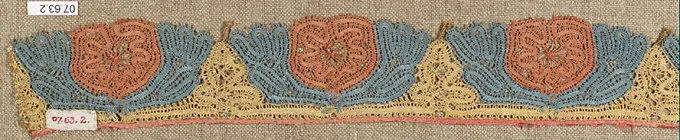
Strip of needle side with flower litter pattern and rush -hour, anonymous, c. 1775 - c. 1799 Strip of natural needle side, argent tank side. Strooi pattern of twigs that alternately have a small or larger flower, leaves and/or berries. Ground with meshes that are closed with buttonholes. The pattern along the lower edge consists of two pointed to each other, in between, between which a flower or berry branch rises. The oval pairs are connected by an arc of leaves and/or berries and hearts. Under these arcs along the lower edge a flat, lying oval. The oval -shaped figures in the pattern are filled with a fine hexagonal Maas soil (alençong round). Different decorative grounds in the flowers. Volwerk without recesses in flowers, leaves and berries. Schulpenrand on the underside by a succession of heart -shaped leaves, regularly interrupted by a rosette flower and the flat oval. The top is finished with a straight edge. Argentan linen (material) Argentan Lace Strip of natural needle side,
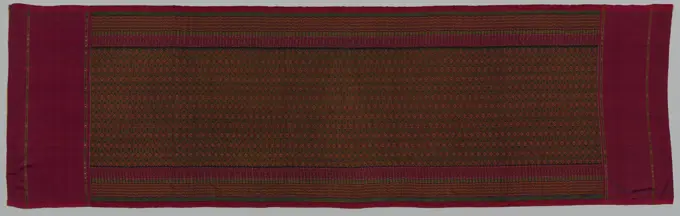
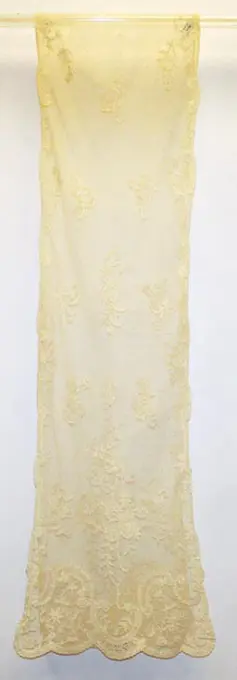
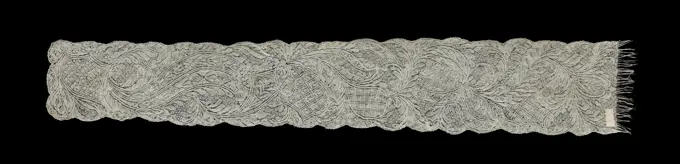
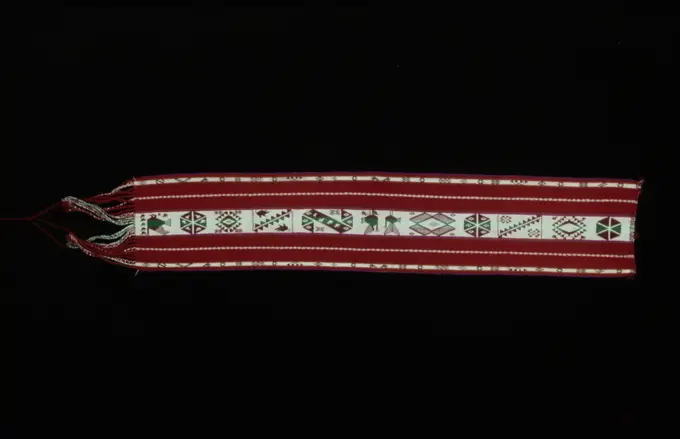
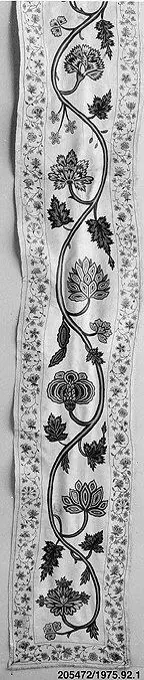
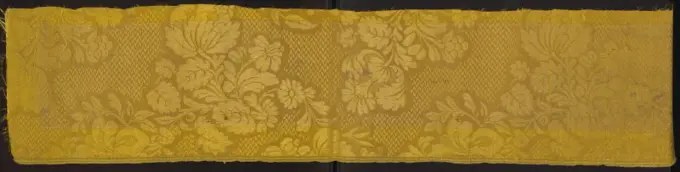
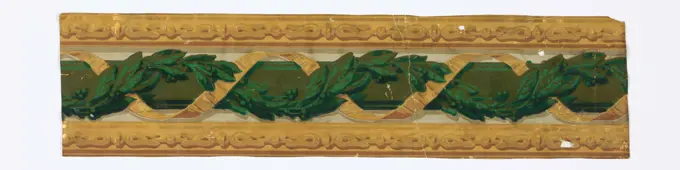
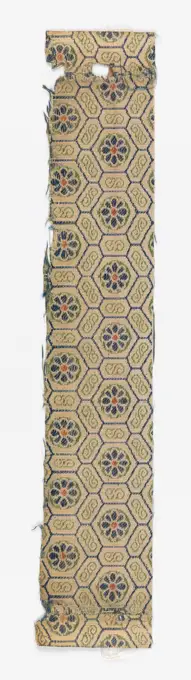
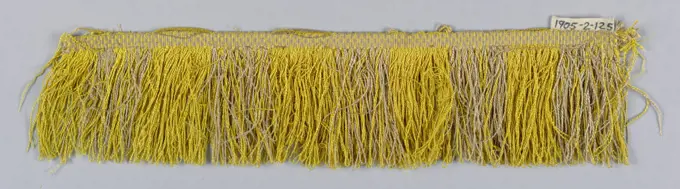
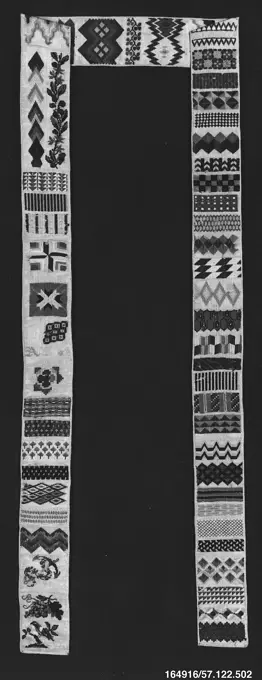
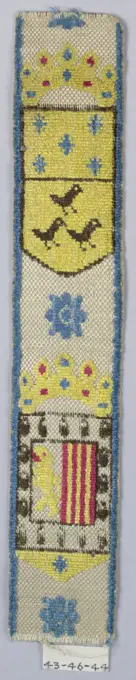
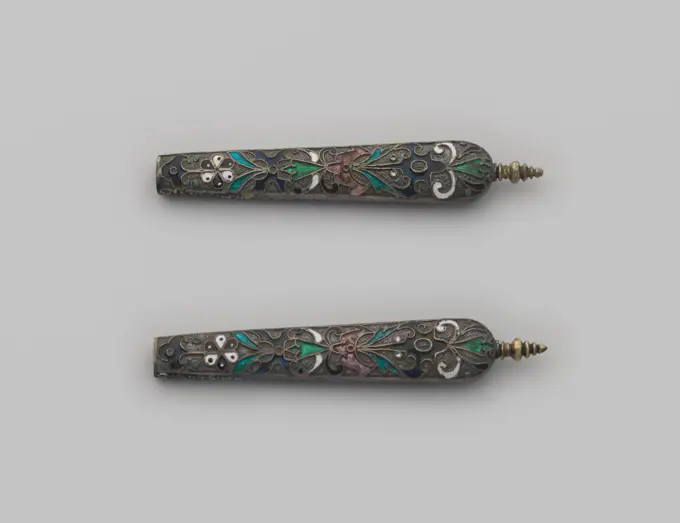
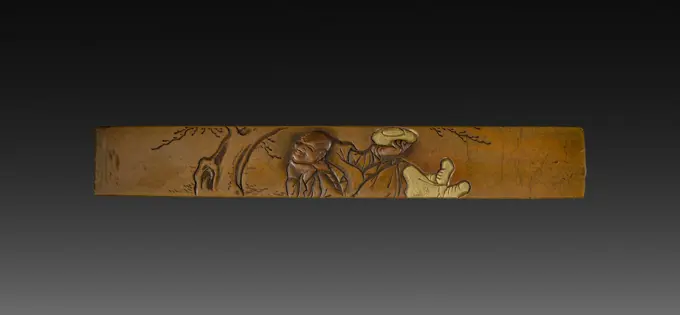
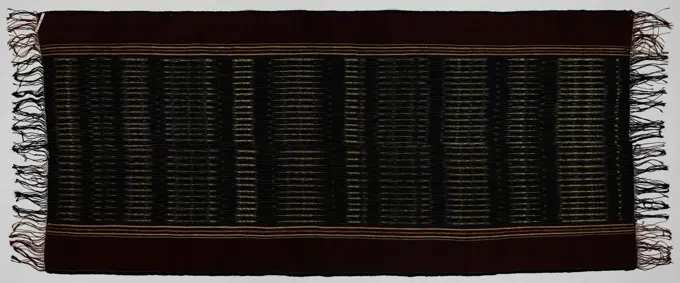
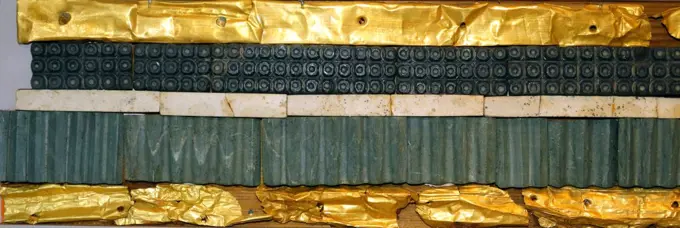
Trimming (Italy); silk, gilt foil on a silk coreBorder (England); block-printed; 80.5 x 4 cm (31 11/16 x 1 9/16 in.)Border (France); block-printed on handmade paperStole Made 1740-1760 France. Wool, 2 2 twill weave; embroidered with wool, in chain stitches and French knots; collar of cotton, plain weave with knitted edge; lined with linen, plain weave .Plinth 18th century French. Plinth. French. 18th century. Wood, gilt. WoodworkSilk "Sampot" (Loin Cloth), early 1900s. Cambodia, early 20th century. Tabby weave, weft ikat; silk; overall: 90.2 x 297.1 cm (35 1/2 x 116 15/16 in.).Scarf 19th century Belgian. Scarf 118926Insertion 18th century Swiss. Insertion 215181Woven Loom Piece, 1800-1825. China, Suzhou. Lampas, silk and gold thread; overall: 260 x 76.2 cm (102 3/8 x 30 in.).Belt (Mexico); wool; Warp x Weft: 227.6 x 8.4 cm (7 ft. 5 5/8 in. x 3 5/16 in.)Piece 18th century possibly French. Piece 225095Band; embroidery using silk threads on a plain weave linen backgroundTrimming, Medium: silk Technique: woven, Yellow trimming fragment in a design of eight-petal flowers separated by linear motifs; picot edges., France, 19th century, trimmings, TrimmingBobbin Lace Lappet, 18th century. Belgium, Binche, 18th century. Lace, bobbin: linen; average: 61 x 10.5 cm (24 x 4 1/8 in.).Border. Date/Period: Late 16th-early 17th century. Border. Medium: linen. Technique: grid of laid cords with needle lace (reticella style). Author: UNKNOWN.Bobbin Lace Edging, 18th century. Belgium, Mechelen, 18th century (Louis XV period). Lace, bobbin; average: 8.6 x 144.1 cm (3 3/8 x 56 3/4 in.).Knotted Lace Cuff, 17th century. Italy, 17th century. Lace, knotting; average: 6.4 x 28.6 cm (2 1/2 x 11 1/4 in.).Edge ; linenLeaf vines, sprouting from leaves in the middle and on both ends of Frisian, 1500 - 1600 print Shaded background. One of 11 magazines. Germany (possibly) paper engravingMan's belt (Faja), 20th century, 31 x 6 1/4 in. (78.74 x 15.9 cm), Cotton, synthetic, Peru, 20th centuryWalking stick ca. 2124-1504 B.C. Middle Kingdom-Early New Kingdom. Walking stick 550418Loincloth Fragment. Probably central coast, Peru. Date: 1000-1476. Dimensions: 27.3 x 5.1 cm (10 3/4 x 2 in.). Slit tapestry. Origin: Peru. Museum: The Chicago Art Institute, Chicago, USA.Belt, 20th century, 32 7/8 x 3 1/2 in. (83.44 x 8.89 cm) (including braids, without ties), Wool, Bolivia, 20th centuryFabric of a Glass Batist curtain. Tissue of a glass battery curtain, decorated with tulle cross-mounted embroidery (white on white). With note: 'These curtains are used for the windows of the dressing room of H.M. de Koningin July 16, 1874'.Border, Block-printed on machine-made paper, Matte finish with metallic gold highlights. Centered on this border is an undulating foliate vine. The edges are striped. Printed in green, metallic gold, ochre, tan and brown., H# 193, France, 1860-1900, Wallcoverings, BorderTextile Sample from Sample Book 19th century Japan. Textile Sample from Sample Book 68137Communion bank rug with embroidery, from silk on rips side., Anonymous, c. 1770 - c. 1780 Rectangular rug with embroidery, a yellow lining and silver fringe. The pattern has flower garlands with lilacs and poppies and bouquets of roses and poppies tied through ribbons. France (possibly) silk. silver thread embroidering Rectangular rug with embroidery, a yellow lining and silver fringe. The pattern has flower garlands with lilacs and poppies and bouquets of roses and poppies tied through ribbons. France (possibly) silk. silver thread embroideringPanel, 1715-1723. France, Regency Period, 18th Century. Wood; overall: 266.7 x 33.7 cm (105 x 13 1/4 in.).Trimming (France); silkTable leg 18th century French. Table leg. French. 18th century. Wood, gilt. WoodworkTrimming, Medium: silk Technique: woven, White trimming fragment in a design of an ornamented zigzag band., France, 19th century, trimmings, TrimmingTrimming, Medium: silk Technique: cut and uncut supplementary warp pile (velvet), Yellow trimming fragment in a design of lozenges in cut velvet separated by large X-shaped motifs. Borders in cut and uncut velvet., France, 19th century, trimmings, TrimmingBorder early 18th century Indian, for European market. Border 229470Strip 18th century possibly Greek, Crete. Strip 220842Strip Passement with gold thread, 1800 - 1900 Strip passement of gold thread.  . Strip passement of gold thread.  .Strip bobbin with oval below and above a wavy line, anonymous, c. 1875 - c. 1899  Strip mixed bobbin, Cluny side. The colors used are black, beige and white. The pattern consists of a regular wavy line, with one oval in the wave valleys and under the wave tops. Above the wavy line, along the top of the strip, a zigzag line runs between two straight lines. The motifs are made in linen and/or with braids and are connected by a braid ground. The top of the strip is straight finished. The scrap edge on the underside consists of semicircular sculptes, with the sculpts under the wave valleys fitting with a range of point scoops, made with braids and finished with picots. Brianza silk bobbin lace / Cluny laceSampler (Germany); cottonVelvet strip with embroidery in gold thread with text monstra ... matre, anonymous, c. 1500 - c. 1600 Red velvet strip with embroidery. The strip has a border in gold council and lovers, from a golf vank with an alternating palm-volute. The embroidery has the text: Monstra ... Matre. A flower and leaf ornament is embroidered around the M van Monstra. The strip is on a strip with invnr. BK-NM-3197 Sewn on a wooden framework. France (possibly) silk. velvet (fabric weave) / embroidering Red velvet strip with embroidery. The strip has a border in gold council and lovers, from a golf vank with an alternating palm-volute. The embroidery has the text: Monstra ... Matre. A flower and leaf ornament is embroidered around the M van Monstra. The strip is on a strip with invnr. BK-NM-3197 Sewn on a wooden framework. France (possibly) silk. velvet (fabric weave) / embroideringEdging (France); silkPiece of fabric. unknown, authorBand Made 1833 United States. Round glass beads, opaque and transparent, worked between taut vertical threads, 2 horizontal (or wefts) through each bead .Bobbin Lace Edging, 18th century. Belgium, Binche, 18th century. Lace, bobbin: linen; average: 5.1 x 162.5 cm (2 x 64 in.).Trimming (Russia); silk, metallic threadNeedlepoint (Burano Point) Lace Edging, second half of 18th century. Italy, Burano, second half of 18th century. Lace, needlepoint; average: 8.6 x 136.2 cm (3 3/8 x 53 5/8 in.).Fringe early 17th century Italian. Fringe 225074Needlepoint (Venetian Raised Point ) Lace Edging, 17th century. Italy or Spain, 17th century. Lace, needlepoint; average: 7.1 x 38.2 cm (2 13/16 x 15 1/16 in.).Border (France); block-printed and flocked on paper; 50 x 12.5 cm (19 11/16 x 4 15/16 in.)Fringe ca. 1880 probably European. Fringe 213637Border; block-printed and flocked; 68.5 x 11 cm (26 15/16 x 4 5/16 in.)Piece 18th century Japan. Piece 71424Velvet Ribbon, 20th century, 45 3/4 x 1 in. (116.21 x 2.54 cm), Silk, United States, 20th centurySampler, Medium: cotton, paper Technique: embroidered on net, Eleven patterns worked on four-sided double-ply twisted mesh. Mounted on stiff green paper., Germany, early 19th century, embroidery & stitching, SamplerTextile (China); silkBorder; 28.5 x 11.5 cm (11 1/4 x 4 1/2 in.)Trimming, Medium: silk Technique: woven, Yellow and pink trimming fragment in a design of alternating large and small lozenges., France, 19th century, trimmings, TrimmingBobbin Lace Insertion without Selvage, mid 16th century. Italy, Venice, mid 16th century. Lace, bobbin; average: 2.3 x 19.7 cm (7/8 x 7 3/4 in.).Pair of pilaster panels. Culture: French. Dimensions: Overall (each): 106 1/2 × 10 in. (270.5 × 25.4 cm). Date: 18th century. Museum: Metropolitan Museum of Art, New York, USA.Trimming, Medium: silk, metallic thread Technique: woven, Angular guilloche design in yellow and metallic thread., France, mid-18th century, trimmings, TrimmingTrimming (France); 1909-2-205Chair Cover, 19th century, L.62-5/8 x W.17-1/2 in., Silk, China, 19th centurySuspenders 19th century European. Suspenders. European. 19th century. silkBarbed Copper Point 3rd century B.C.-A.D. 2nd century Vicús. Barbed Copper Point 315625Greek Ornament and Etruscan OrnamentTrimming (Spain); silkBobbin Lace (Duchesse) Lappet, late 19th century. Belgium, Brussels, late 19th century. Lace, bobbin: linen; average: 144.8 x 14.3 cm (57 x 5 5/8 in.).Border (USA); machine-printed; 63.5 x 7.5 cm (25 x 2 15/16 in.)Ribbon 18th century () French. Ribbon 221540Livery trimming, Medium: silk Technique: woven, Design of a red galero (hat with tassles) over an eagle with a shield showing heraldic devices alternating with a dragon-like creature in red, pink, blue and green on a white ground., possibly Spain, 17th century, trimmings, Livery trimmingFringe, Medium: silk Technique: woven, Fringe with a yellow and tan plain-woven heading. Skirt threads of yellow and tan are looped and twisted., Spain, 18th century, trimmings, FringeSampler 19th century German. Sampler 228427Band (Italy); linen, silk; Bequest of Marian Hague; 1971-50-92Souvenirs of Józef Czapski  Pencil A. W. Faber  CASTELLFive professions, Anonymous, After Jan Luyken, After Caspar Luyken, c. 1700 - c. 1790 Five glasses with deputies of professions in a wooden stress. The appealed profession is also always mentioned on the glass. On the far left: 'Silver Smit', a silversmith, sitting at work at a window. To the right: 'Wiel Draijjer', a man sitting behind a wood lathe. In the middle: 'touch some butcher', a man brings a cow while another man is ready with a hammer. To the right of 'Molenaar', the miller lifts a bag of grain or flour, a wooden mill in the background. On the far right: 'Bakker', it kneads dough at a table above which a scale hangs, to his left an oven. Images seem to partly go back to the prints the Menselyk Bedryf of Jan and Caspar Luyken, but are not immediately copied or pulled over. The professions and the composition of the images deviate too much from the original prints for this. Netherlands oak (wood). glass Five glasses with deputies of professions in a wooden stress. The appealedFringe (Italy); silkKnife Handle (Kozuka). Culture: Japanese. Dimensions: L. 3 3/4 in. (9.5 cm); W. 9/16 in. (1.4 cm); thickness 1/4 in. (0.6 cm); Wt. 1.3 oz. (36.9 g). Date: ca. 1615-1868. Museum: Metropolitan Museum of Art, New York, USA.Iron Standard of 1 meter in Houten, with red velvet clad, case. On box inscription.Knife Handle (Kozuka). Culture: Japanese. Dimensions: L. 3 13/16 in. (9.7 cm); W. 9/16 in. (1.4 cm); thickness 3/16 in. (0.5 cm); Wt. 1.1 oz. (31.2 g). Date: ca. 1615-1868. Museum: Metropolitan Museum of Art, New York, USA.Trimming, White, black and colored silk in uncut velvet weave., Two shields, one showing three birds below five stars, and the other, a lion and red and yellow strips; crown above shields; ornaments between. Red, yellow, blue, and black on white ground., Spain, early 19th century, trimmings, TrimmingHandles with gilded silver with a crown of round button. Decorate in Email-Cloisonon. Engraved on the side: Endrickie Verbeeck/Rein van Harten; Traech in Tooren., Anonymous, 1600 - 1625 Handle from gilded silver. The end is crowned with a round button. The 2 sides are decorated with motifs in Cloisononé Émail. Engraved on the side: Hendrickie Verbeeck / Rein van Harten: Traech in Tooren. Northern Netherlands silver (metal). gilding (material). gilding Handle from gilded silver. The end is crowned with a round button. The 2 sides are decorated with motifs in Cloisononé Émail. Engraved on the side: Hendrickie Verbeeck / Rein van Harten: Traech in Tooren. Northern Netherlands silver (metal). gilding (material). gildingFive professions to the Menselyk Bedryf, Anonymous, After Jan Luyken, After Caspar Luyken, c. 1700 - c. 1790 Five glasses with deputies of professions in a wooden stress. On the far left: the rope butcher on a Lijnbaan. To the right of that: The glue maker continues a large basket. In the middle: the blacksmith at an anvil, next to him a fire. To the right of that: the bricklayer, with trowel and brick in hand bent over a low wall. Extremely law: a basket -maker braid a basket. Netherlands oak (wood). glass Five glasses with deputies of professions in a wooden stress. On the far left: the rope butcher on a Lijnbaan. To the right of that: The glue maker continues a large basket. In the middle: the blacksmith at an anvil, next to him a fire. To the right of that: the bricklayer, with trowel and brick in hand bent over a low wall. Extremely law: a basket -maker braid a basket. Netherlands oak (wood). glassKnife Handle (Kozuka), early to mid-1800s. Japan, Edo period (1615-1868). Inlaid bronze; overall: 1.4 cm (9/16 in.).Piece 14th century Japan. Piece 71009Arm Guard 18th-19th century Indian. Arm Guard 31933Strip of an antispendium, with embroidery, c. 1500 - c. 1600 Strip of a red velvet antpendium, with majuskels, around which a richly embroidered edge of gold and silver thread, silk and pearls with the text: Jubilate deo Omnis Terra. The strip is sewn into a long strip with BK-NM-8707 and BK-NM-8708.  velvet (fabric weave). silk. silver thread. pearl embroidering Strip of a red velvet antpendium, with majuskels, around which a richly embroidered edge of gold and silver thread, silk and pearls with the text: Jubilate deo Omnis Terra. The strip is sewn into a long strip with BK-NM-8707 and BK-NM-8708.  velvet (fabric weave). silk. silver thread. pearl embroideringCheers; Kaempffer, Eduard (1859-1926); around 1918 (1914-00-00-1918-00-00);print on fabric, ribbonsTrimming (France); silkFringe (France); silkShoulder cloth, Anonymous, 1900 - 1999 Shoulder cloth with arrow motifs. Noord-sumatra cotton (textile) Shoulder cloth with arrow motifs. Noord-sumatra cotton (textile)Piece 18th century () Northern Hungarian. Piece 213227Totem Pole, c. 1880. Northwest Coast, Tlingit, 19th century. Carved and painted wood; overall: 189.2 x 8.8 cm (74 1/2 x 3 7/16 in.).Altar frieze from the Eye Temple at Tell Brak. gold and stone elements fastened to wood. Late Uruk period, 3300-3000 BCHalf Model of a Tambangan, anonymous, c. 1860 - c. 1880 ship model. half model Black and white stacking model (starboard) of a canoe. He has two pointed ends, the prayer comes up. A clamp at both ends. Indonesian Archipelago wood (plant material)A sash from the funeral of Adam Mickiewicz in Krakow on July 4, 1890Ribbon fragment, Medium: silk Technique: woven with raised pile, Two faces of a ribbon (yellow and orange) passing over a blue bar., Italy, 19th century, woven textiles, Ribbon fragmentSouvenir of Józef Czapski  Pastel Pencil Pastel Caran d'ache