Historical Textile Embroideries

A collection of vintage textiles featuring intricate embroidery, lace details, and floral patterns, showcasing craftsmanship from England, France, and China, dating from the 1700s to early 1800s.

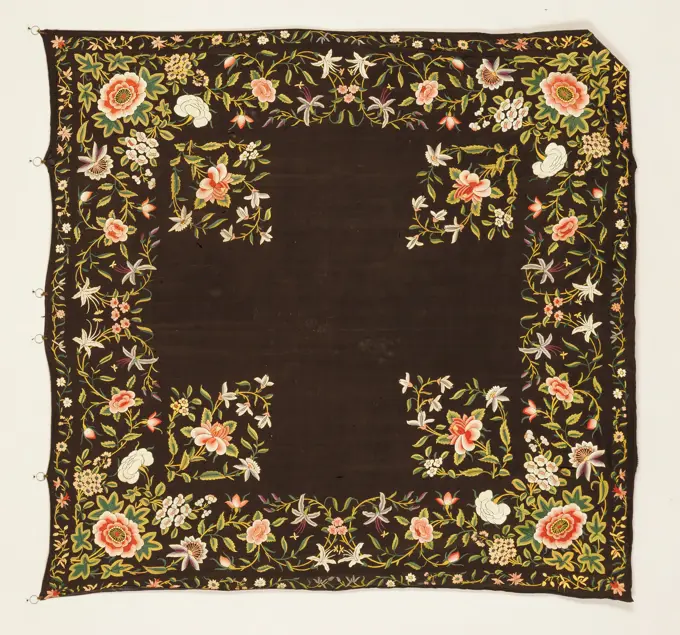
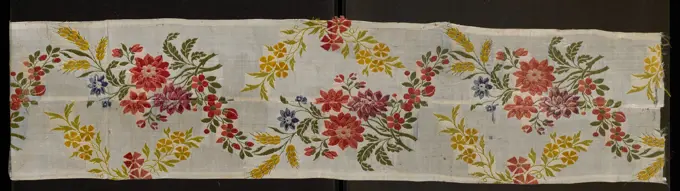
Square cashmere scarf, with mid -motif with beveled corners, filled with loose flowers, anonymous, c. 1830 - c. 1840 Square palms scarf, woven from wool, with a white center whose corners are chamfered. The middle is filled with loose flowers and border with densely overlooked flowers. The pattern is symmetrical around both cruising axes. In the heart a fine star flower in yellow, red, gray and white. Around it eight in a window, loose flowers in the same colors, of which four carnations with an inward Bota and four palm -shaped carnations. Around a circle of twelve flowers, of which eight carnations in yellow and four leaf -shaped yellow flowers. An outer edge of twenty other flowers, four times two Spitsovaal and the middle leaf -shaped, the latter is attached to the finely drawn gridwerkhoeke on which small Botas are and a square. The edge consists of smooth wavy treings, full of pattern flowers in the same colors. The side edges walk on the crosses with their lists. The technology
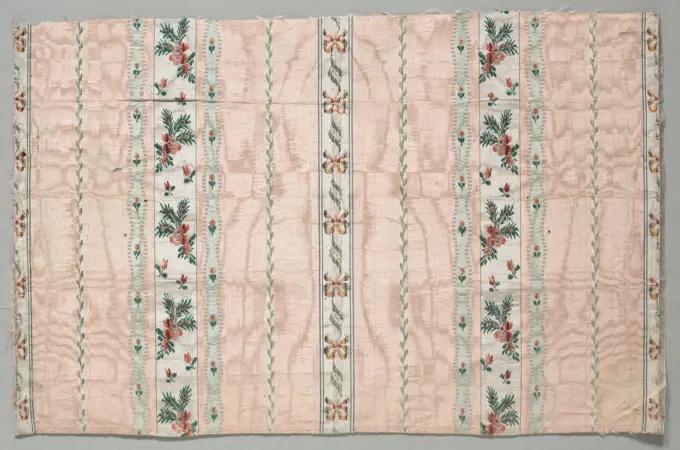
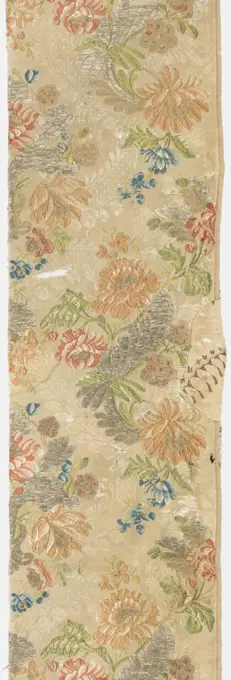
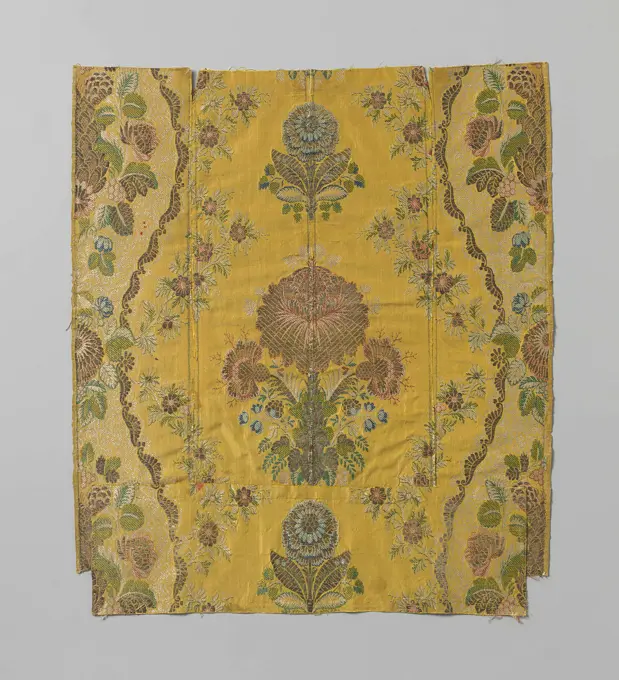
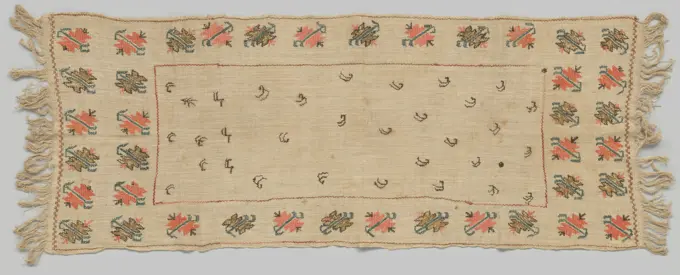
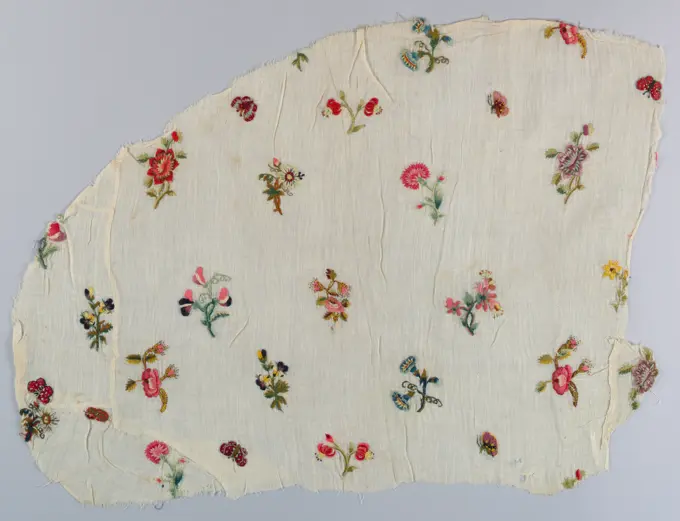
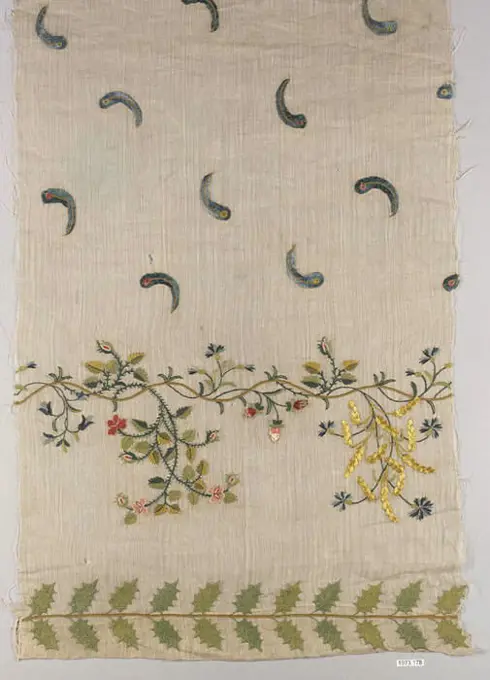
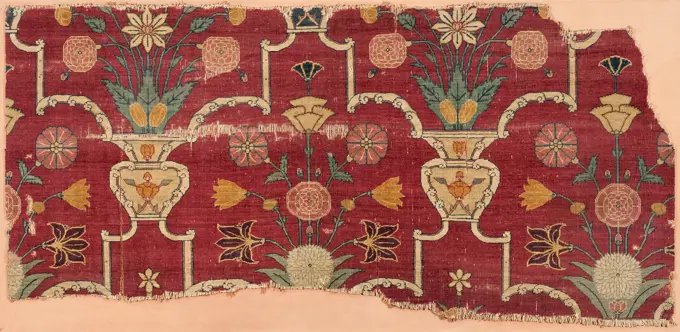
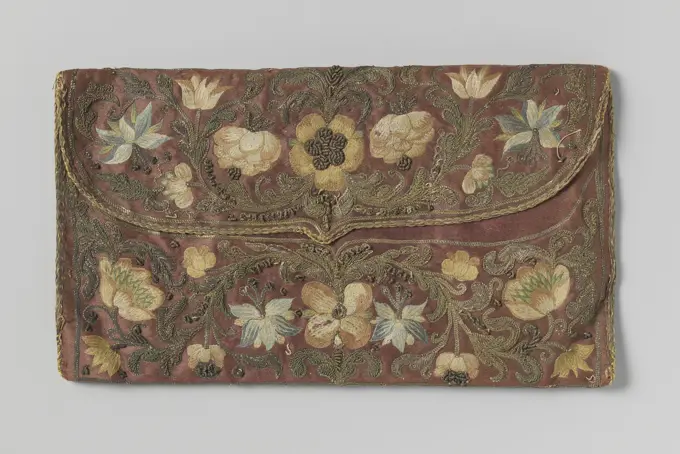
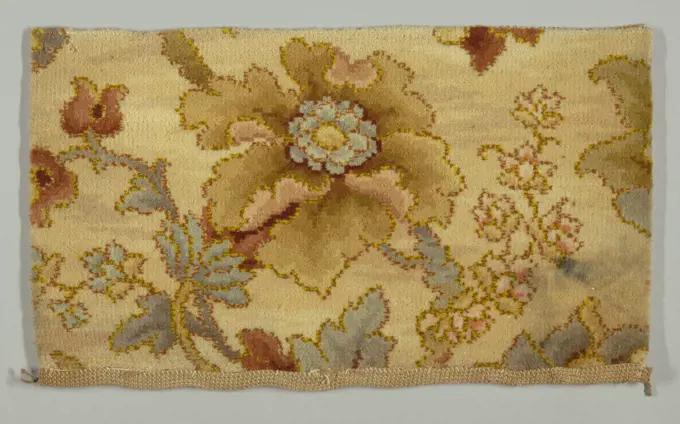
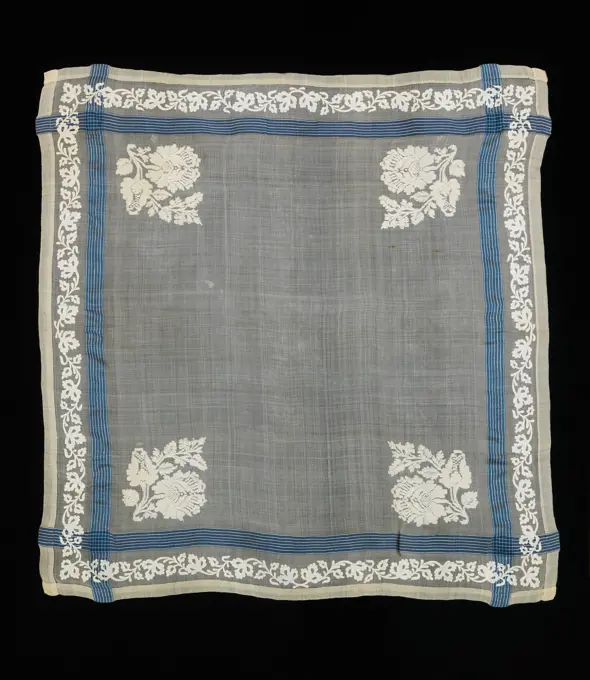
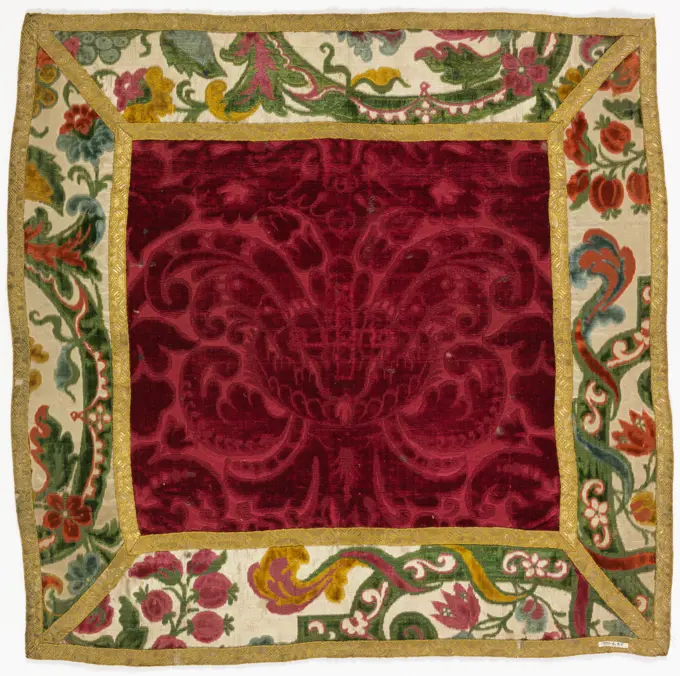
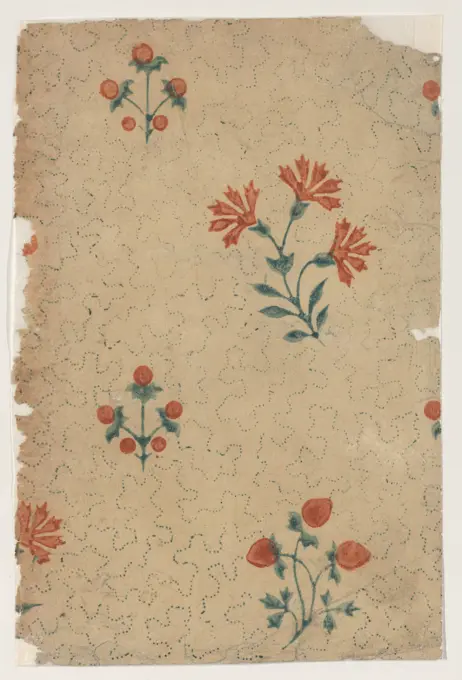
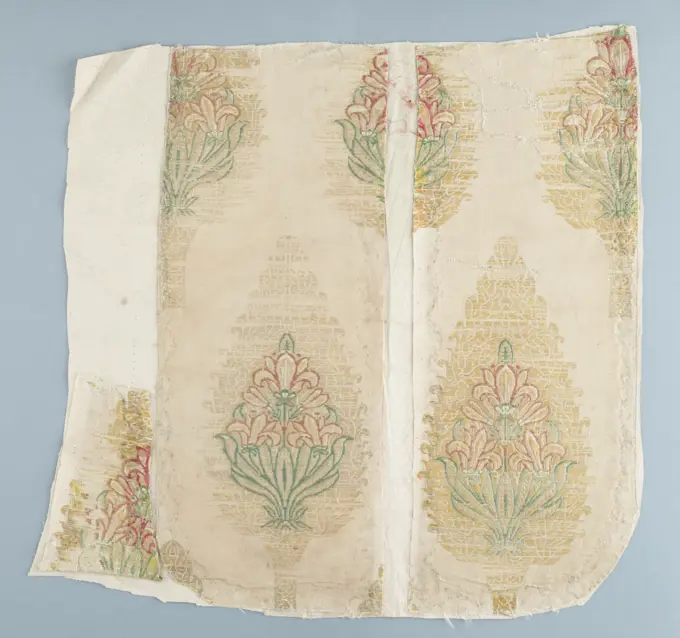
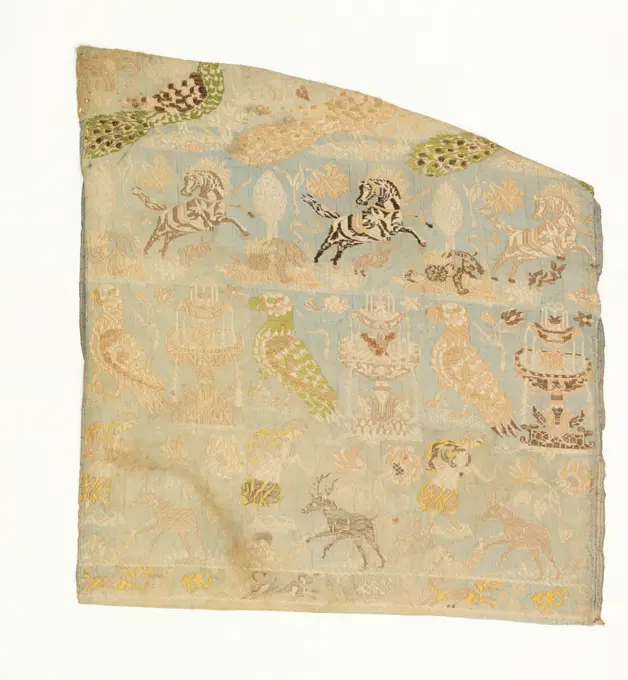
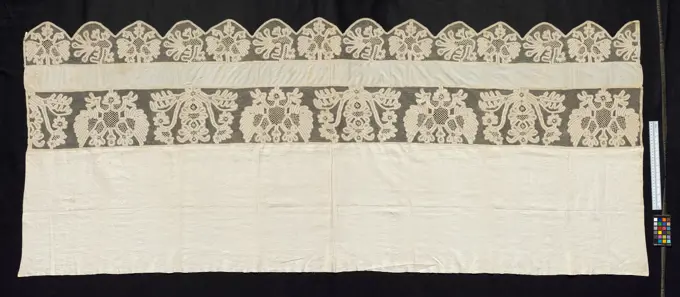
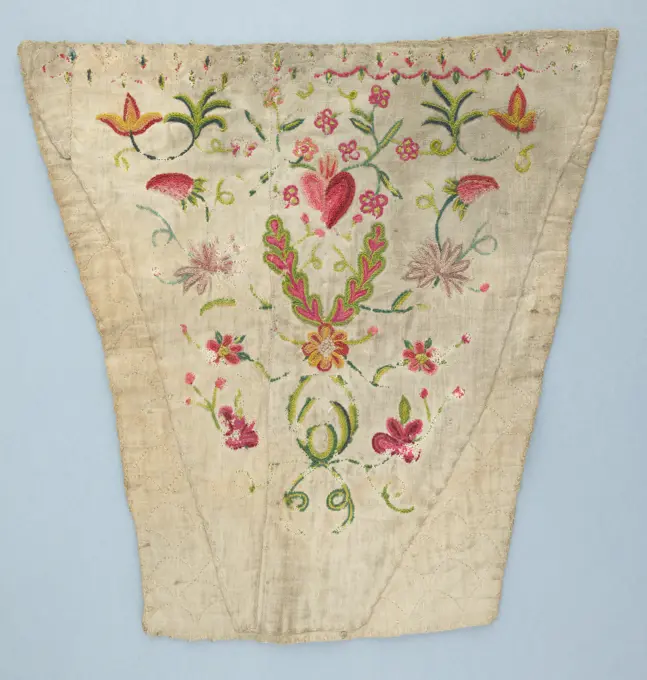
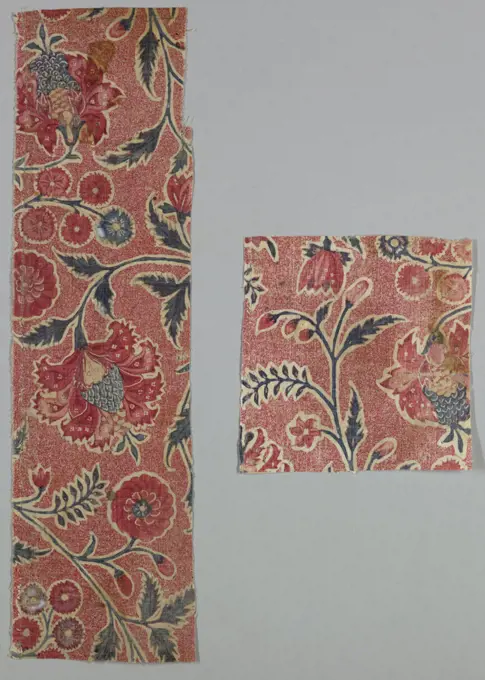
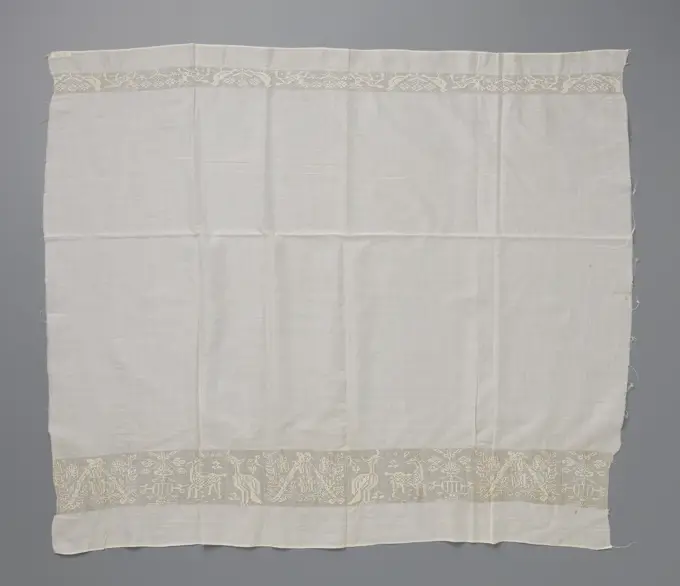
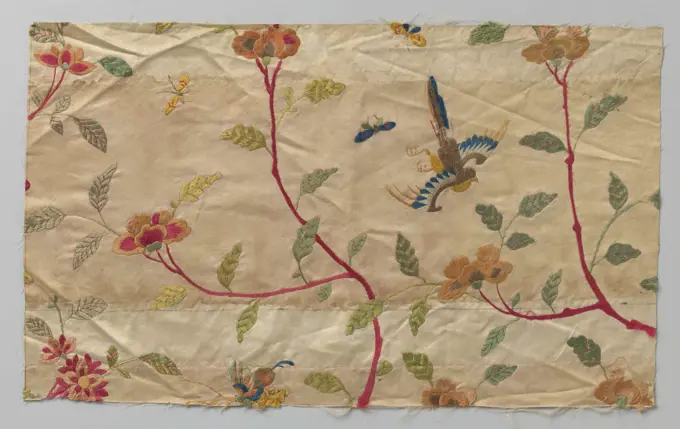
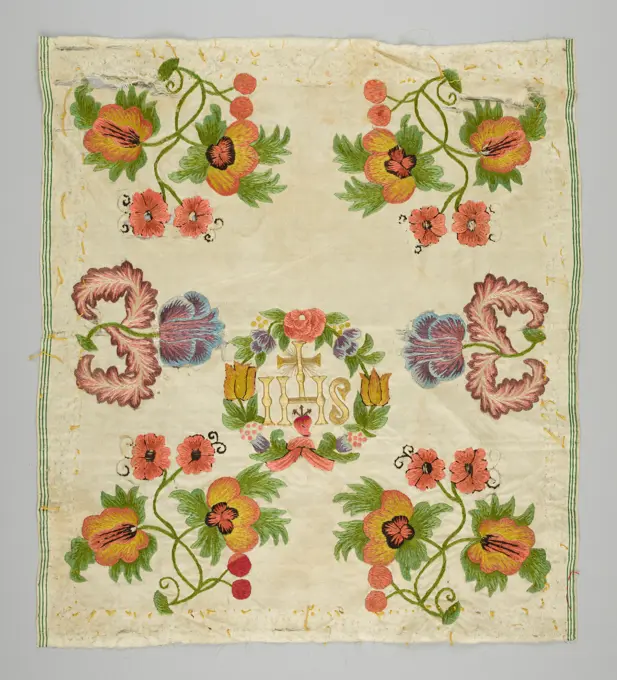
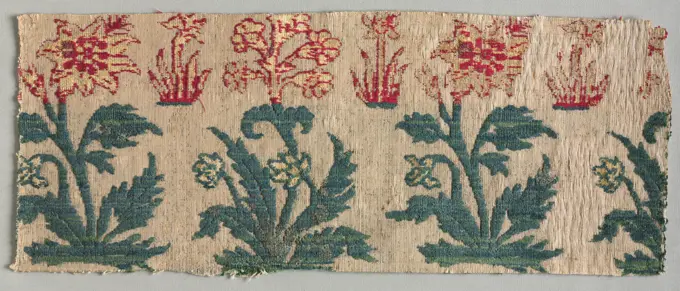
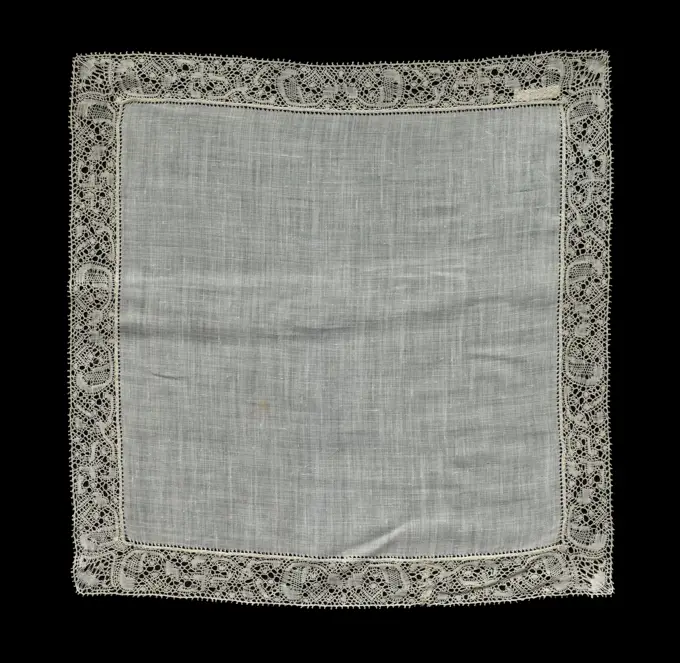
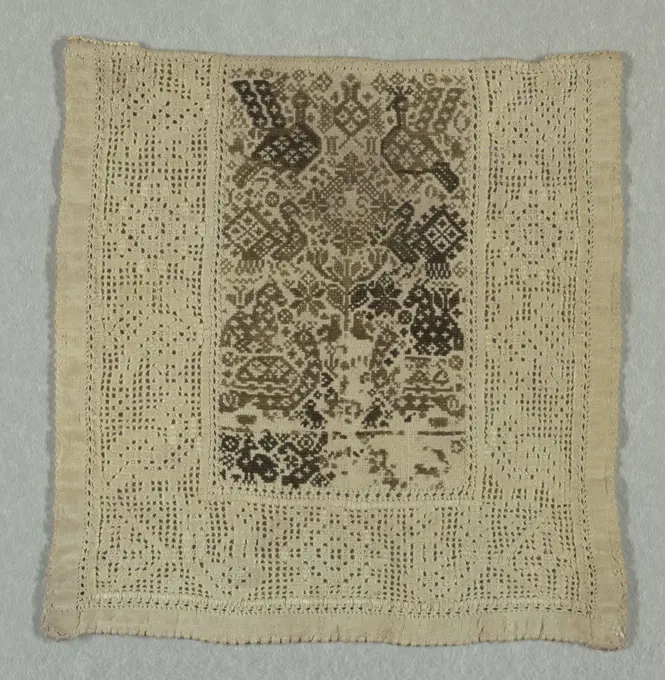
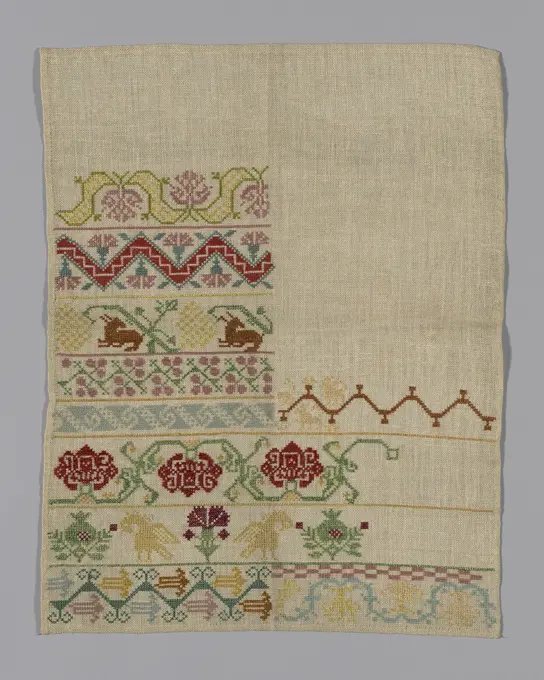
Sampler Made 1775-1825 England. Linen, plain weave; embroidered with silk in cross stitch .Wall rug with a border mixed side around Chinese embroidery on silk, anonymous, c. 1700 - c. 1724 Wall rug with a border mixed side - Venetian ribbon side - around a rectangular piece of natural -colored silk with Chinese embroidery. The edge of lace is placed on a background of heavy, dark blue velor against which the symmetrical pattern protrudes from volutes with flowers. The contours of the motifs are made with woven ribbons with various needle -sided soils in between. The motifs are connected to each other with picoted bars (needle side). Along the inner edge the side is finished with a border bobbin. Along the outside it is finished with a picotrand with arches. The embroidery on the side shows branches with emerging flowers, birds and butterflies. A square bar covered with fabric is attached to the top of the carpet. Venice (possibly)China (possibly)Boedapest (possibly) midfield (embroidery): Silk. Side: Linen (Material) mixed lace / Venetian tape lace (mixed lace) / embroiderinChurch tablecover. unknown, authorTaffeta, Brocaded, late 1700s. France, late 18th century, Period of Louis XVI (1774-1793). Watered silk, brocaded; overall: 49.6 x 30.5 cm (19 1/2 x 12 in.).Fragment Light silk with embroidered partially dragged stripes, semic circles, rectangles with scalloped edge, graceful flowers and rays, c. 1790 - c. 1820 Fragment (A) Light silk with embroidered partially flared stripes, whole and semi -circles, rectangles with scalloped edge, graceful flowers and rays. Corresponding small fragment (B) with identical pattern. France Ca. 1820. France (possibly) silk. paillette. embroidering Fragment (A) Light silk with embroidered partially flared stripes, whole and semi -circles, rectangles with scalloped edge, graceful flowers and rays. Corresponding small fragment (B) with identical pattern. France Ca. 1820. France (possibly) silk. paillette. embroideringFragment (China); silk; Warp x Weft: 37 x 18 cm (14 9/16 x 7 1/16 in.); 1968-13-4-dEmbroidery; silk on cottonTable Cover (Spain); cotton or linen; Bequest of Marian Hague; 1971-50-67Fragment, Medium: tempera on silk Technique: painted on plain weave, White horizontally ribbed ground with a design of slender serpentine stems with large blossoms of carnation, lotus, peony and chrysanthemums in red, purple, yellow and green., China, 18th century, printed, dyed & painted textiles, FragmentSquare cashmere scarf, with mid -motif with beveled corners, filled with loose flowers, anonymous, c. 1830 - c. 1840 Square palms scarf, woven from wool, with a white center whose corners are chamfered. The middle is filled with loose flowers and border with densely overlooked flowers. The pattern is symmetrical around both cruising axes. In the heart a fine star flower in yellow, red, gray and white. Around it eight in a window, loose flowers in the same colors, of which four carnations with an inward Bota and four palm -shaped carnations. Around a circle of twelve flowers, of which eight carnations in yellow and four leaf -shaped yellow flowers. An outer edge of twenty other flowers, four times two Spitsovaal and the middle leaf -shaped, the latter is attached to the finely drawn gridwerkhoeke on which small Botas are and a square. The edge consists of smooth wavy treings, full of pattern flowers in the same colors. The side edges walk on the crosses with their lists. The technology Textile, Medium: silk Technique: fancy satin, brocaded, Two pieces of white or cream-coloured damask brocaded in rose, green and blue silk and silver metal thread. Large vertical repeat of symmetrically arranged flowers enclosed by ribbon-like bands - a/: backed with coarse linen, edged with metal ribbon and silver lace - b/: backed with coarse linen and edged with metal ribbon. b/: two piece put together in the middle., France, ca. 1770, woven textiles, TextileApron early 18th century British. Apron 122545Piece ca. 1720 Italian or British. Piece. Italian or British. ca. 1720. Silk and metal thread. Textiles-WovenFragment of five yellow silk tags with pattern of a bouquet surrounded by flower garlands and loose flowers around which a wide band waves. Fragment of five pieces of yellow taft with a pattern of a bouquet surrounded by floral garlands and loose flowers why a wide tire waves with large flowers and leaves: imitation side.Fragment multicolored brochure silk ,, 1750 Fragment multicolored silk tissue. A pink soil has a striped column around which a winding white ribbon. To the left and right of the column, the pattern has white side garlands on which flower branches and flower bouquets. Netherlands silk Fragment multicolored silk tissue. A pink soil has a striped column around which a winding white ribbon. To the left and right of the column, the pattern has white side garlands on which flower branches and flower bouquets. Netherlands silkFragment multicolored brochure silk, c. 1700 - c. 1750 Two fragments of purple and white striped silk, on which colored flowers and tendrils. NOTE: MEERSHIP; Multicolored, plain binding keper (1 self -sided = 0.4 cm). 2 fragments with paper stuck together, is not correct in terms of pattern. Netherlands silk damask Two fragments of purple and white striped silk, on which colored flowers and tendrils. NOTE: MEERSHIP; Multicolored, plain binding keper (1 self -sided = 0.4 cm). 2 fragments with paper stuck together, is not correct in terms of pattern. Netherlands silk damaskElongated scarf made of ecrinkey cotton, with a black scattering motif in the middle of a black scattern and decorated along the edges with a running pattern of stylized flowers in salmon-orange and gold thread, anonymous, c. 1800 - c. 1900 Elongated scarf of coarse-woven ecrinkey cotton, with a black scattering motif in the middle and along the edges decorated with a running pattern of stylized flowers in turns salmon-orange and gold thread Turkey (Possible) whole: Cotton (textile). Decoration: Cotton (textile). Decoration: embroidering Elongated scarf of coarse-woven ecrinkey cotton, with a black scattering motif in the middle and along the edges decorated with a running pattern of stylized flowers in turns salmon-orange and gold thread Turkey (Possible) whole: Cotton (textile). Decoration: Cotton (textile). Decoration: embroideringFragment (France); crewel wool on cottonPiece French 19th centuryEmbroidered shawl unknownTowel (Switzerland); cotton, linen; Warp x Weft: 26 x 36 cm (10 1/4 x 14 3/16 in.); Bequest of Mrs. Henry E. Coe; 1941-69-32Fragments; silkTaffeta, Brocaded, c. 1790. France, 18th century, Louis XVI Period (1774-1793). Taffeta, brocaded; overall: 50.8 x 40.6 cm (20 x 16 in.).Carpet Fragment. India, Jaipur (), circa 1650. Textiles; carpets. Wool pile; cotton warp; cotton and silk weftRed letter case, anonymous, 1727  Letter bag (portfolio) with different types of embroidered colored flowers on a red stock. At the rear is 'Constantinopoli 1727'. Istanbul textile materials. embroidering flowers ~ ornamentTextile; silkSampler Made 1601-1700 Germany. Linen, plain weave; embroidered with silk .Embroidered kerchief trimming unknownTextile (France); linen warp, cotton weftFragment Made 1701-1800 China. Silk, plain weave, painted .Piece ca. 1760 French. Piece 222660Towel or Napkin Made 1801-1900 Turkey. embroidered . AnonymousCarpet fragment, No catalog card., 1878, woven textiles, Carpet fragmentFragment, Medium: cotton Technique: cut loops of a supplementary weft in a 2/1 twill foundation (velvet), Length of painted cotton velvet upholstery fabric with offset rows of naturalistic flowers including jonquil, tulip, rose, lilac, daisy and morning glory and others which do not systematically repeat., Europe or USA, late 19th century, printed, dyed & painted textiles, FragmentPiece 17th century Japan. Piece 71588Fragment; silkHandkerchief third quarter 19th century Philippine The nearly transparent woven pineapple cloth that comprises this handkerchief contains supplementary woven motifs at the corners that are echoed by the intricately detailed and finely cut muslin appliqué border. The cutwork appliqué seen here is very specific to the Philippines. Known as sombrado technique, it is highly painstaking and difficult work and is done on only the finest pieces of pineapple cloth accessories and garments. Handkerchief 155772Border fragment, Medium: cotton Technique: block printed on plain weave, Repeating pattern of a mound and a basket of flowers., France, mid-late 18th century, printed, dyed & painted textiles, Border fragmentTextile (France); crewel wool on cottonFragment; silk; Warp x Weft: 35.6 x 49.3 cm (14 x 19 7/16 in.)Corporal (Italy); silk, wool, metallic trimEmbroidered pyx veil unknownDoily (USA); linen, silkRug of squares and rectangles alternately of linen and lace border with tracing, anonymous, c. 1600 - c. 1624 Dress of squares and rectangles alternately from linen and lace bobbins: fillet side. In the middle of the rug there are two square pieces of fillet side with a pattern of a vase with a symmetrical bouquet of grapes and vines and with a border of flowers and leaves. The other elongated or square pieces of lace have a pattern with different flower and leaf motifs. The motives are embroidered in the stopping technique on a knotted network with square meshes. France (possibly) whole: Linen (Material) embroidering Dress of squares and rectangles alternately from linen and lace bobbins: fillet side. In the middle of the rug there are two square pieces of fillet side with a pattern of a vase with a symmetrical bouquet of grapes and vines and with a border of flowers and leaves. The other elongated or square pieces of lace have a pattern with different flower and leaf motifs. The motiRumal, 18th century, 22 3/4 x 21 11/16 in. (57.79 x 55.09 cm), Cotton, silk; double-faced embroidery, India, 18th centuryChasuble, embroidered unknownSheet with overall dot pattern with bouquets 19th century Anonymous. Sheet with overall dot pattern with bouquets. Anonymous , 19th century. 19th century. Relief print (wood or metal). PrintsDarning sampler, Medium: silk embroidery on cotton foundation Technique: embroidered in running and cross stitches on plain weave foundation, Central square with duck and flowers in the middle; seven darning crosses and darned corner., Netherlands, 1807, embroidery & stitching, Darning samplerTwo pieces of upholstery from a seat unknownEmbroidered Handkerchief, 1800s. Switzerland, 19th century. Linen, embroidery; average: 46.4 x 46.4 cm (18 1/4 x 18 1/4 in.).Drawing, Mise-en-carte for flower sprays for silk brocade; schemes for weaving; France; pen, ink, gouache, paint, paperFragments of silk fabric unknownTablecloth, embroidered, red  floral branch motif unknownFragment; silkFragments (China); silkValance, 19th century. Russia, 19th century. Cotton or linen (est.); straight (continuous) bobbin lace (Vologda tape lace). The tape forms figural or plant motifs outlined with gimp (heavy cord), plaited ground links the tape; overall: 91.5 x 215.9 cm (36 x 85 in.).IInen stomacher embroidered with colourful wool unknownTop of embroidered pall unknownTextile, Medium: cotton Technique: mordants for three reds and purple applied by brush or pen; blue applied over resist; yellow over blue to create green; mordant for background spattered through a stencil; chintz on plain weave, Large, exotic flowers and curving stems in reds and blues on a red speckled background., India, 18th century, printed, dyed & painted textiles, TextileNeedle handkerchief with flowers and an inner piece of batist, anonymous, c. 1870 - c. 1909 Batist handkerchief with a edge of natural -colored needle side: Venetian relief side. The inner piece of linen batist is scalloped. On a bar soil there are tumbles with multifaceted flowers, such as fan -shaped palm flowers, Paisley motifs, etc., which are grouped asymmetrically. BURANO linen (material) Venetian raised work Batist handkerchief with a edge of natural -colored needle side: Venetian relief side. The inner piece of linen batist is scalloped. On a bar soil there are tumbles with multifaceted flowers, such as fan -shaped palm flowers, Paisley motifs, etc., which are grouped asymmetrically. BURANO linen (material) Venetian raised workLap Batist with edges of lace -ups with birds and mammals, anonymous, c. 1900 - In or Before 1930 Rectangular piece of natural -colored batist with openwork edges with lace plunger, work with pulled threads. In the widest edge there is a pattern with the letter W in a triangular shape surrounded with leaves. Left and right, the triangle on either side is flanked by a vase of flowers or by a bird with a headed head. There is a mammal between the vase and the bird. In the narrower edge, a branch with three flowers is depicted with a mammal on either side, interspersed by the flower branch with a bird on either side. Indonesia Rectangular piece of natural -colored batist with openwork edges with lace plunger, work with pulled threads. In the widest edge there is a pattern with the letter W in a triangular shape surrounded with leaves. Left and right, the triangle on either side is flanked by a vase of flowers or by a bird with a headed head. There is a mammal between the vase and the birdFragment With Chef De Piece (France); Company: Bayon et Gautier Lemasurier; cottonFragment of Persian Silk Fabric Persian unknownChair upholstery, embroidered unknownShawl, 19th century, L.60 x W.60 in, silk, embroidery, China, 19th centurySampler, Medium: silk embroidery on cotton foundation Technique: embroidered in running (pattern darning) and cross stitches on plain weave foundation, Twelve darning crosses, central square with initials and flowering plant., Netherlands, 1849, embroidery & stitching, SamplerFragment zijde met veelkleurig borduurwerk in zijde.Fragment white silk with multicolored embroidery. The pattern has flower branches between whom birds and insects.Prie-Dieu Cover Made 1847-1870 England. Cotton, plain weave; embroidered with wool and silk in cross stitches .Curtain of painted silk decorated with flowers and birds ,, 1750 - 1775 Curtain of painted silk. A contour drawing was printed on a fine white rips side and a painting in colors by hand (), Of which the pattern consists of an upright wavy branched and flowering stem, on which two pheasants are seated and whose a green slim winds. The flowers are: Lotus of red and white large purple and pink -red peon, Lotus of blue and pink, purple and pink carnation and fantasy flower in pink, purple, yellow and bleu. The leaves similar to those of chrysanthemums. The curtain consists of two jobs. Lining of fine bright light brown cotton and 20th century Shantung. France silk.. cotton (textile) Curtain of painted silk. A contour drawing was printed on a fine white rips side and a painting in colors by hand (), Of which the pattern consists of an upright wavy branched and flowering stem, on which two pheasants are seated and whose a green slim winds. The flowers are: Lotus of red and white large purpleTextile, Medium: cotton Technique: block printed, blue applied by brush, on plain weave, Half drop repeat ofa flowering vine which produces an irregular ogee lattice., France, late 18th century, printed, dyed & painted textiles, TextileFragments; silk wovenEmbroidery; silk on cottonSampler (England); silk embroidery on linen foundationFragment of a multi -colored silk Mexicaine ,, 1770 - 1800 Two sewn fragments of silk tissue. Red stripes, Wartuses woven cubes, divide the cream -colored sides soil into stripes, on which multicolored loose bouquets are woven. Note: Self -sides to the seam 6 mm in plain binding. France (possibly) silk Two sewn fragments of silk tissue. Red stripes, Wartuses woven cubes, divide the cream -colored sides soil into stripes, on which multicolored loose bouquets are woven. Note: Self -sides to the seam 6 mm in plain binding. France (possibly) silkFragment; silk, metallic; 1896-30-1Shawl with interlocking twill tapestrybordersTextile; silkTop of embroidered chaIIce veil unknownWall pocket, Medium: silk, metallic thread, metal paillettes, gilt wire Technique: embroidered on plain weave; appliqué of padded silk satin stich and couching on natural linen plain weave; couched gold-wrapped silk and gilt wire plus attached coils of gilt wire and spangles, Wall pocket with three pockets and rounded top, made of dark green silk and decorated with floral designs of applied and padded silk in strong relief; outlined with gold thread and paillettes. Each pocket has a different design of symmetrical floral sprig in green, blue, red, and dark cream. At the top, a winged cherub with a painted face. Edged with fringed gold braid., Switzerland or Italy, late 17th-early 18th century, embroidery & stitching, Wall pocketFragment of furnishing textile. unknown, authorVelvet Fragment, 1600s. India, 17th century. Velvet; overall: 16.5 x 41 cm (6 1/2 x 16 1/8 in.).Sampler; silk embroidery on linen foundationTextile (England); silk on cottonBobbin Lace Handkerchief, 20th century. Belgium, Binche, 20th century. Linen center with bobbin lace edging; average: 22.3 x 22.3 cm (8 3/4 x 8 3/4 in.).Mary Berner, Bedspread, c 1936 BedspreadSampler 1818 Austrian. Sampler 228158Textile; woolFragment multicolored, striped silk mexicaine. A fragment of green, white and pink striped silk, between which multicolored bouquets.Sampler, Medium: cotton, linen, silk Technique: cross stitch, Panel showing birds, animals, initials 'PS' and date, '1704' worked in cross stitch; surrounded on three sides by a band of drawnwork with pattern of birds and animals in darning. Edge worked in clustered overcasting., Denmark, 1704, embroidery & stitching, SamplerFragment of Brocaded Silk, 18th century. Spain, 18th century. Satin, brocaded; silk and metal; average: 106.4 x 22.1 cm (41 7/8 x 8 11/16 in.).Fragment of fabric with floral motifs and leavesTowel border 1800-1850 Russian. Towel border 173353Fragment, Medium: silk Technique: cut and uncut voided supplementary warp pile in a satin foundation (pile-on-pile velvet), Small-patterned or 'miniature' velvet with a ground of uncut pink pile. Design of slender serpentine stem with heavy drooping blossom in pink and green cut and uncut pile. Design heightened by voided outline in white satin of the ground., France, 1750-1800, woven textiles, FragmentHandkerchief 1850-60 French. Handkerchief 168339Stop patch of multicolored silk on linen., 1772 Stop patch with multi -colored embroidery. The embroidery consists of the initials MF, anno 1772 under a crown, around which four throughpatrons. Amsterdam (possibly) linen (material). silk embroidering Stop patch with multi -colored embroidery. The embroidery consists of the initials MF, anno 1772 under a crown, around which four throughpatrons. Amsterdam (possibly) linen (material). silk embroideringFragment of the fabric;  XVIII/19th century (1790-00-00-1810-00-00);Fabrics, purchase (provenance)Cushion Cover. Greece, Northern Sporades Islands, Skíros. Date: 1601-1700. Dimensions: 86 x 45.4 cm (33 3/4 x 17 7/8 in.). Linen, plain weave; embroidered with silk in running (pattern darning), satin, and stem stitches; edged with silk and horsehair, needle lace. Origin: Skíros. Museum: The Chicago Art Institute, Chicago, USA.Chintz Fragments (India); cottonChintz Fragment (India); cottonGeorge Beyer, Piece of Cross Stitch, c 1937 Piece of Cross-Stitch