Historical Textile Fragments

Collection of intricate textile pieces from various periods, showcasing lace, silk, and detailed floral patterns with historical significance.

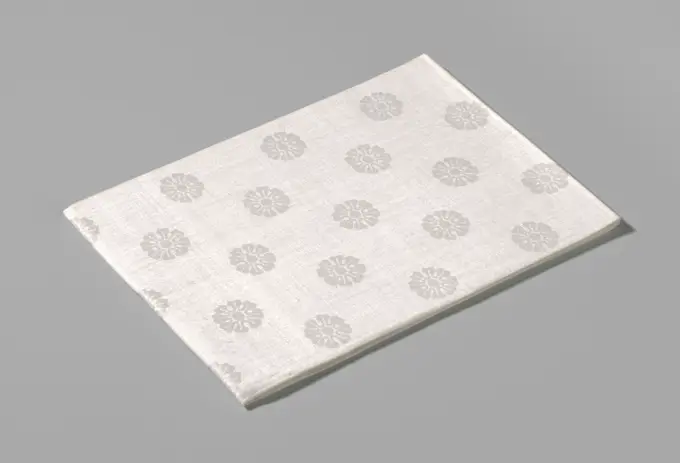
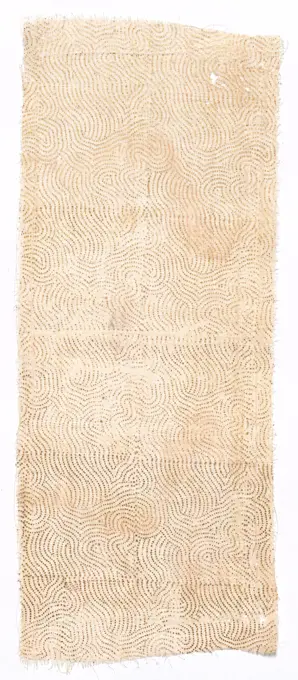
Textile, Medium: cotton Technique: plain weave, indigo dyed, resist applied with stencil (katazome), Oval and circular floral rosettes in dotted goemetrical framework, forming overall pattern, In white with occasional hand application of orange, on blue ground., Japan, late 19th century, printed, dyed & painted textiles, Textile
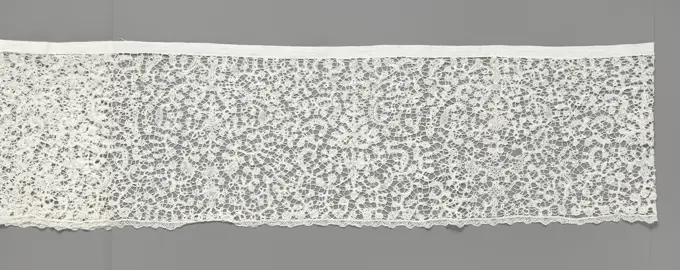
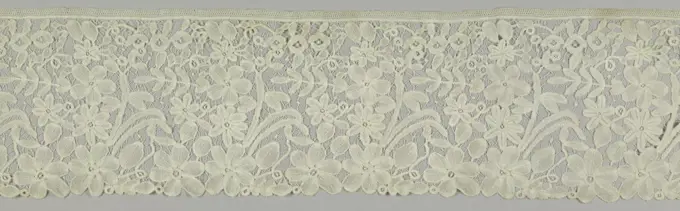
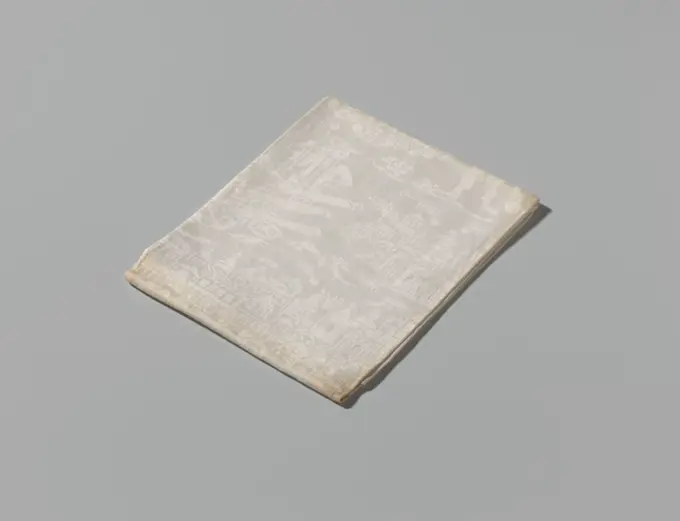
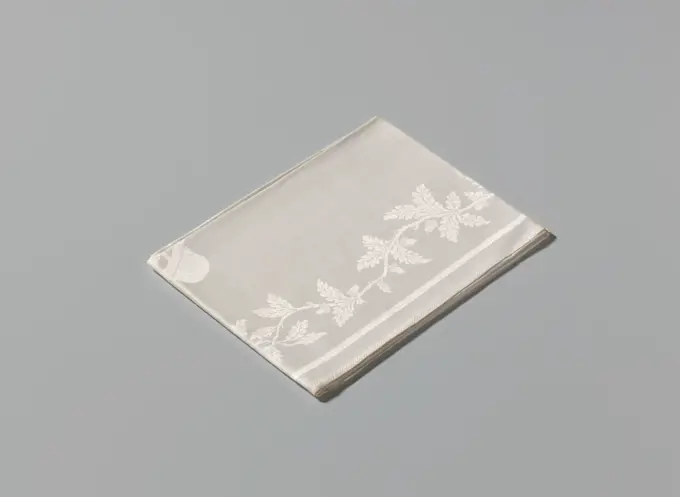
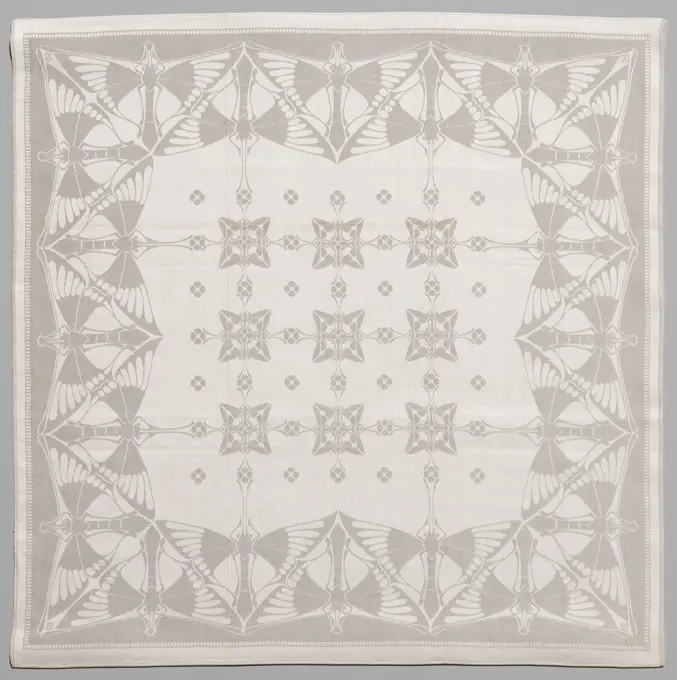
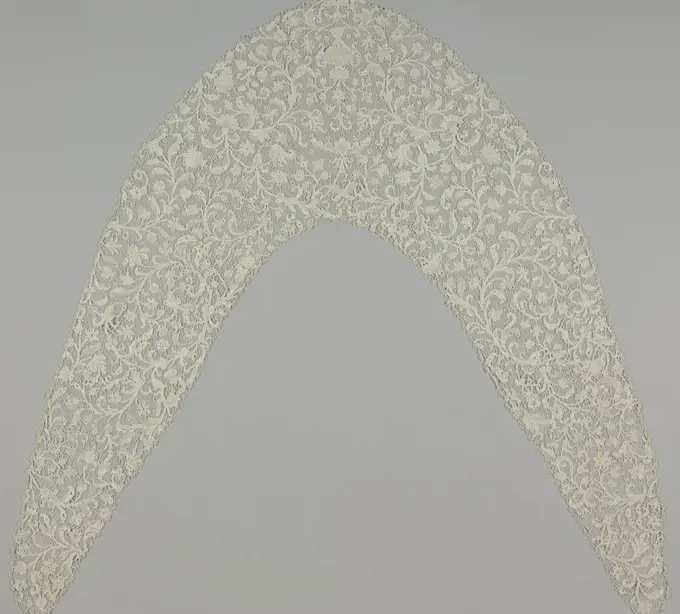
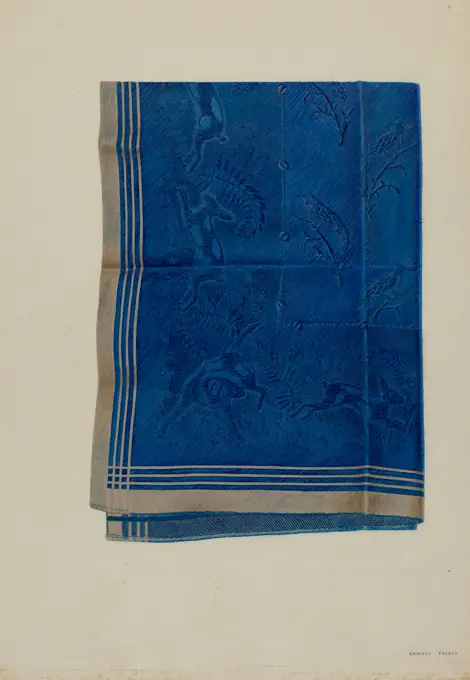
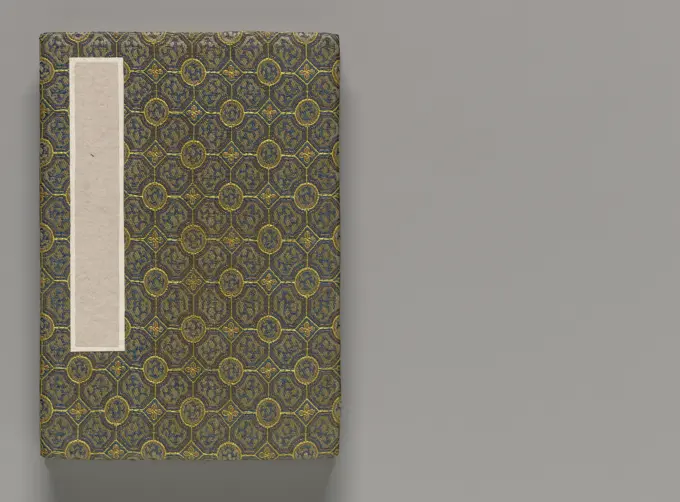
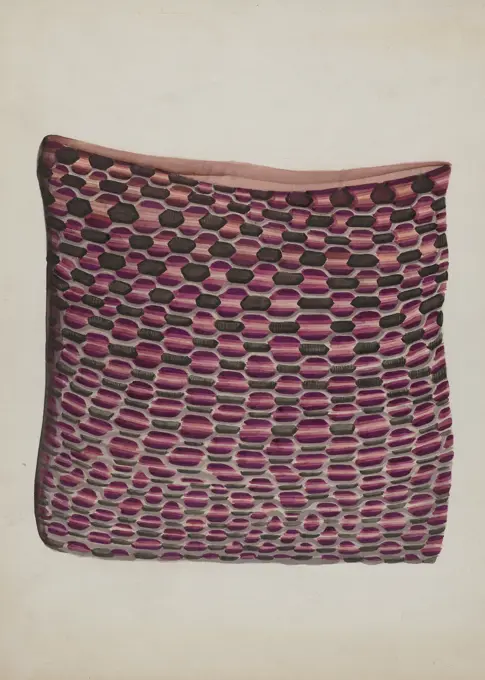
Suspension of lace pledger on mechanical tulle with flower branches and a stray pattern of wreath flowers, anonymous, c. 1840 - c. 1860 Apron of natural -colored lace -ups on mechanical tulle, machine embroidery. Square model with a spray pattern of wreath flowers. A semi -circular scallop run runs along the sides and bottom. There is a curved branch with leaves in each shell, from which one large egg -shaped flower rises. Along the bottom edge, a repeating pattern of one standing branch with various large and smaller egg -shaped flowers and leaves runs above this sculp pattern. Along the top is made a zoompje with a slot with a woven strap through it. Friesland (possibly)  embroidering Apron of natural -colored lace -ups on mechanical tulle, machine embroidery. Square model with a spray pattern of wreath flowers. A semi -circular scallop run runs along the sides and bottom. There is a curved branch with leaves in each shell, from which one large egg -shaped flower rises. Along the botFragment, Medium: silk Technique: cut and uncut voided supplementary warp pile (velvet) in a plain weave foundation, Fragment of blue cut and uncut pile on a ground shot with silver; pattern is small floral sprigs., Italy, 17th century, woven textiles, FragmentTextile, Medium: cotton Technique: plain weave, indigo dyed, resist applied with stencil (katazome), Oval and circular floral rosettes in dotted goemetrical framework, forming overall pattern, In white with occasional hand application of orange, on blue ground., Japan, late 19th century, printed, dyed & painted textiles, TextileFragment, Medium: silk, metallic Technique: supplementary warp forming cut and uncut raised pile on plaineweave (velvet) with supplementary wefts., Interlacing strapwork forming compartments which have a fleur-de-lys motif or an acorn motif. . In blue on gold ground. Right selvage present., 16th-17th century, woven textiles, FragmentHanddwaal of white linen, anonymous, c. 1650 - c. 1675 White Linnamasten Handdwaal with a pattern of stripped flowers and weapons of Ommeren and Pauw, Brand Kroon LP 12. Northern Netherlands (Possible) linen (material) damask White Linnamasten Handdwaal with a pattern of stripped flowers and weapons of Ommeren and Pauw, Brand Kroon LP 12. Northern Netherlands (Possible) linen (material) damaskWIT LINES POLLOWS SERVETT, 1700 - 1750 White linen peel napkin, marked pH and 82. Northern Netherlands linen (material) White linen peel napkin, marked pH and 82. Northern Netherlands linen (material)Flower wreath with two bows, in the corners a crowned monogram, anonymous, c. 1680 - c. 1690 Linnamast napkin with a flower wreath with two bows in the middle of the field. Flower bouquets come from the corners of the field. The edge has flower bouquets and leaves, the corners a crowned monogram. Northern Netherlands (Possible) linen (material) damask Linnamast napkin with a flower wreath with two bows in the middle of the field. Flower bouquets come from the corners of the field. The edge has flower bouquets and leaves, the corners a crowned monogram. Northern Netherlands (Possible) linen (material) damaskFragment (Spain); silk; Warp x Weft: 30.5 x 20.5 cm (12 x 8 1/16 in.); 1953-162-62Cord of clutter and treasures; Kuzutama Renju. Leporellolatbum; Brown broke cover with stylized tendrils; Top left blank title strip; 21 sheets with 19 paintings of people, flowers, animals and landscapes made by various artists.Napkin from white Linnamast with thrown flowers and in the corners the celebrated weapon Rijckaert-Bartolotti van den Heuvel, Anonymous, c. 1660 - c. 1670 Napkin from white Linnamast with pattern of stripped flowers (fritillaria imperialis), edges with ornamental trusses, in the corners the celebrated weapon Rijckaert-Bartolotti; for Jacobus Rijkckaert (1610-1671) and Constantia Bartolotti (1615-1679), who married in 1638. RH and 48 marked in blue cross stitch, perhaps for Susanna Rijckaert (1642-1712), a daughter of the couple, who married Constantijn Huygens jr. (1642-1697) in 1668. Northern Netherlands (Haarlem). Northern NetherlandsHaarlem (possibly) linen (material) damask Napkin from white Linnamast with pattern of stripped flowers (fritillaria imperialis), edges with ornamental trusses, in the corners the celebrated weapon Rijckaert-Bartolotti; for Jacobus Rijkckaert (1610-1671) and Constantia Bartolotti (1615-1679), who married in 1638. RH and 48 marked in blue cross stitch, peWIT LINES PLEASE PROVIDE,, 1800 - 1850 White linen peel napkin, marked (kk) R28. Added to BK 1980-415 Northern Netherlands linen (material) White linen peel napkin, marked (kk) R28. Added to BK 1980-415 Northern Netherlands linen (material)Ribbon, Medium: silk Technique: woven, Pale blue gauze cap ribbon with tiny allover tree pattern and white silk scalloped edge., France, ca. 1840, woven textiles, RibbonLinnamast napkin, c. 1800 - c. 1900 Linnamast napkin with thrown oak leaves and acorns on the field and an edge of oak branches. The napkin is marked in red with a cross stitch: G52 and has a sewn number: 1193 in red on white. The napkin has a stamp with the text: Lingie de la Couronne (). Netherlands linen (material) damask Linnamast napkin with thrown oak leaves and acorns on the field and an edge of oak branches. The napkin is marked in red with a cross stitch: G52 and has a sewn number: 1193 in red on white. The napkin has a stamp with the text: Lingie de la Couronne (). Netherlands linen (material) damaskStrip bobbin with candle -sloring motifs for a rochet, anonymous, c. 1685 - c. 1699 Strip of natural -colored bobbin: Flemish guipure side. The strip is used or intended for a rochet. The repeating pattern is formed by ribbons made in linen stroke and consists of two varied symmetrical candle -sloring motifs, which fill the entire width. The ribbons are connected by an irregular braiding ground. A few decorative stitches have been applied. The scrap edge is turned on. Southern Netherlands linen (material) bobbin lace / tape lace (bobbin lace) / Flemish guipure lace Strip of natural -colored bobbin: Flemish guipure side. The strip is used or intended for a rochet. The repeating pattern is formed by ribbons made in linen stroke and consists of two varied symmetrical candle -sloring motifs, which fill the entire width. The ribbons are connected by an irregular braiding ground. A few decorative stitches have been applied. The scrap edge is turned on. Southern Netherlands linen (material) bPellen.Merk: Kroon iavg Wh 2oonl., Anonymous, c. 1725 - c. 1760 Napkin made of white linen with a peel pattern, brand crown iavg 30 WH 2oonl. Netherlands (possibly) linen (material) Napkin made of white linen with a peel pattern, brand crown iavg 30 WH 2oonl. Netherlands (possibly) linen (material)Linnamast napkin with a flower pattern ,, 1849 Linnamast napkin. The field has staggered rows of rosettes and the edges of flowers and acanthus leaves. The corners have a vase with fruits. The napkin is marked: HW36 1849. The napkin belongs to thirteen napkins (BK-1980-377-A to BK-1980-377-N). Northern Netherlands (Possible) linen (material) damask Linnamast napkin. The field has staggered rows of rosettes and the edges of flowers and acanthus leaves. The corners have a vase with fruits. The napkin is marked: HW36 1849. The napkin belongs to thirteen napkins (BK-1980-377-A to BK-1980-377-N). Northern Netherlands (Possible) linen (material) damaskNapkin of linen with pellet pattern, 1680 - 1710 White linen napkin with a peel pattern. Brand HW. North Netherlands linen (material) White linen napkin with a peel pattern. Brand HW. North Netherlands linen (material)Napkin from white Linnamast ,, 1670 - 1680 White linen Damas napkin with a pattern of stripped flowers. Brand Ig and 12. North Netherlands linen (material) damask White linen Damas napkin with a pattern of stripped flowers. Brand Ig and 12. North Netherlands linen (material) damaskCover (seven strips joined) 18th century possibly German. Cover (seven strips joined) 227420Piece French 19th centuryFragment yellow tripe with pattern of tulips inside stretched diamond shapes, anonymous, c. 1740 - c. 1760 Fragment pressed yellow tripe with a pattern in relief of stretched diamond -shaped figures in which a tulip steel. Netherlands linen (material). wool Fragment pressed yellow tripe with a pattern in relief of stretched diamond -shaped figures in which a tulip steel. Netherlands linen (material). woolRibbon samples, Herman A. Elsberg, (American, 1869-1938), Medium: silk, metallic thread Technique: compound weave, Eight samples of wide ribbon. Background of plain weave with a design of interlacing lines outlined in gold thread. Highly stylized gold rose blossoms and scrolling lines form a border on each side. Both selvages present on all samples. Component 'a' has interlacing lines of bright and dark red with gold thread accents., Lyon, France, 1919, woven textiles, Ribbon samplesLength ca. 1880 French. Length 229961Towel of coarse linen, c. 1925 - c. 1950 Towel of coarse linen with a grid pattern in relief and up and bottom with open hems, decorated with large picots; In red marked: Emmens and 8. See: BK-1972-169-A.  linen (material) Towel of coarse linen with a grid pattern in relief and up and bottom with open hems, decorated with large picots; In red marked: Emmens and 8. See: BK-1972-169-A.  linen (material)Piece 17th century Japan. Piece 71203Fragment mid-15th century Spanish. Fragment 461381White pillowcase of linen, brand wg 48 1752, 1752 White pillowcase of linen. In a corner hole brand Kroon "WG 48", including "1752" embroidered in white. Cord closure.  linen (material) White pillowcase of linen. In a corner hole brand Kroon "WG 48", including "1752" embroidered in white. Cord closure.  linen (material)Napkin with a flower pattern, anonymous, c. 1655 - c. 1665 Linnamast napkin with garlandes, flowers in tied wreaths, tied bouquets and sprinkling flowers. Edges with grape vines; In the corners a grape chocolas on blinded stem. Northern Netherlands linen (material) damask Linnamast napkin with garlandes, flowers in tied wreaths, tied bouquets and sprinkling flowers. Edges with grape vines; In the corners a grape chocolas on blinded stem. Northern Netherlands linen (material) damaskNapkin van Wit Linnamast, Anonymous, 1640 - 1650 White Linnamasten napkin with pattern of stripped flowers and insects, brand Kroon IB 24. Northern Netherlands (Possible) linen (material) damask White Linnamasten napkin with pattern of stripped flowers and insects, brand Kroon IB 24. Northern Netherlands (Possible) linen (material) damaskLinnamast napkin with stars, c. 1800 - c. 1900 Linnamast napkin. The field has stars on a ground of moesjes. The edge is striped with rectangles (Greek edge). The corners have a star on a ground of moesjes. The napkin is marked in red with a cross stitch: G40. North Brabant (Possibly) linen (material) damask Linnamast napkin. The field has stars on a ground of moesjes. The edge is striped with rectangles (Greek edge). The corners have a star on a ground of moesjes. The napkin is marked in red with a cross stitch: G40. North Brabant (Possibly) linen (material) damaskTie slip from Kloskant with a symmetrical pattern of candelabers or flower baskets surrounded by garlands of volutes, anonymous, c. 1690 - c. 1720 Tie slip of natural -colored bobbin. Pattern with short tifles, rosettes and candelabers or flower baskets, in which various decorative stitches and shape strokes are also clopped, are connected to a symmetrical drawing by garlands of volutes and a grid. Curded reliaps surround some details of the decor. Three sides of each slip are sculpted from two repeating motives. Brussels linen (material) bobbin lace Tie slip of natural -colored bobbin. Pattern with short tifles, rosettes and candelabers or flower baskets, in which various decorative stitches and shape strokes are also clopped, are connected to a symmetrical drawing by garlands of volutes and a grid. Curded reliaps surround some details of the decor. Three sides of each slip are sculpted from two repeating motives. Brussels linen (material) bobbin laceNapkin with the coat of arms of Cornelis Hop, Anonymous, c. 1700 - c. 1724 Napkin van Linnamast with the coat of arms of Cornelis Hop. Midfield: Symmetrical pattern of multifaceted volutes with blocked thickenings at the junctions. In between a lying oval shield with a weapon of Cornelis Hop (1685-1762), ambassador at the court of King Louis XV of France: celebrated, 1 and 4 header standing on Bol (the bird of 1, that of 4 surrounding); 2 and three two lined wings. Heart shield shared: 1 a crossbar, 2 on the right a five -pointed star, on the left a desired Wassenaar. The shield covered with five -sized crown. Shield holders: On the right an eagle, on the left an aligned lion. Edges: weapon trophies. Corners: a round axle. All around blocks. Southern Netherlands linen (material) damask Napkin van Linnamast with the coat of arms of Cornelis Hop. Midfield: Symmetrical pattern of multifaceted volutes with blocked thickenings at the junctions. In between a lying oval shield with a weapon oBed sheet. Brand: Kroon WG and Year 1737 and HW21., Anonymous, 1737 Cloths of White Linen, Brand Kroon WG and year 1737 and HW2 1 Northern Netherlands (Possible) linen (material) Cloths of White Linen, Brand Kroon WG and year 1737 and HW2 1 Northern Netherlands (Possible) linen (material)Shawl first quarter 19th century American or European. Shawl 81349Piece 18th-19th century Japan. Piece. Japan. 18th-19th century. Silk. Edo period (1615-1868). Textiles-WovenNapkin from white Linnamast ,, 1692 - 1700 White Linnamasten napkin with pattern of volutes, brand is 24. Northern Netherlands (Possible) linen (material) damask White Linnamasten napkin with pattern of volutes, brand is 24. Northern Netherlands (Possible) linen (material) damaskPiece 18th century Japan. Piece 71886Servet van Pellendem, c. 1800 - c. 1900 Linen Pellendamast napkin. The field has squares in which stylized blocked rosettes. The wavy striped edges have a band with stylized, checked rosettes between the stripes. North Brabant (Possibly) linen (material) Linen Pellendamast napkin. The field has squares in which stylized blocked rosettes. The wavy striped edges have a band with stylized, checked rosettes between the stripes. North Brabant (Possibly) linen (material)Velvet Fragment, 1600-1640. Italy, 1st third of 17th century. Velvet (cut, uncut, and voided); silk; overall: 64.8 x 17.1 cm (25 1/2 x 6 3/4 in.).Ribbon, Medium: silk, cotton Technique: plain weave, Dark gray ribbon with self-color floral and chevron pattern., USA, late 19th century, woven textiles, RibbonStrip bobbin with split branch and tulip, anonymous, c. 1750 Strip of natural-colored bobbin, binche side. On a traly -round, a five -piece ground, is a spiral branch -occupied branches -occupied branches. A large tulip, in which a split branch with two flowers and a small grapes vary each other. The motifs are made in linen battle and mains with openwork edges. As a decorative land, a snowflake land has been used sparingly. Top and bottom of the strip are straight finished, with the bottom with picots. Southern Netherlands linen (material) Bobbi Lace / Binche Lace Strip of natural-colored bobbin, binche side. On a traly -round, a five -piece ground, is a spiral branch -occupied branches -occupied branches. A large tulip, in which a split branch with two flowers and a small grapes vary each other. The motifs are made in linen battle and mains with openwork edges. As a decorative land, a snowflake land has been used sparingly. Top and bottom of the strip are straight finished, with the Fragment of Draped Garment worn by Members of the Court for Festive Occasions, 1700s. India, Rajasthan or Northern Deccan, 18th century. Block printed with gold leaf on cotton muslin; overall: 30.5 x 12.2 cm (12 x 4 13/16 in.).Border, Medium: linen Technique: bobbin lace, Brussels style, Border with a repeating design of open flowers, leaves and stems all connnected with delicate brides. Brussels technique but Honiton style., England, 19th century, lace, BorderNapkin van Wit Linnamast ,, 1708 - 1709 White Linen Damas napkin with the conquest of Lille and the inscription "Princeps Evgenius Insvlas Dellavit 1708", marked B. Flanders linen (material) damask White Linen Damas napkin with the conquest of Lille and the inscription "Princeps Evgenius Insvlas Dellavit 1708", marked B. Flanders linen (material) damaskLinnamast napkin with butterflies, Chris Lebeau, c. 1904 Linnamast napkin with butterflies: Butterfly Motif, Dessin No. 505. The napkin belongs to twelve napkins (BK-1979-259-A to BK-1979-259-M), twelve finger cloths (BK-1979-260-A T/m BK-1979-260-L) and two tablecloths (BK-1979-258-A and BK-1979-258-B). Eindhoven linen (material) damask Linnamast napkin with butterflies: Butterfly Motif, Dessin No. 505. The napkin belongs to twelve napkins (BK-1979-259-A to BK-1979-259-M), twelve finger cloths (BK-1979-260-A T/m BK-1979-260-L) and two tablecloths (BK-1979-258-A and BK-1979-258-B). Eindhoven linen (material) damaskNapkin with the coat of arms of Cornelis Hop, Anonymous, c. 1700 - c. 1724 Napkin van Linnamast with the coat of arms of Cornelis Hop. Midfield: Symmetrical pattern of multifaceted volutes with blocked thickenings at the junctions. In between a lying oval shield with a weapon of Cornelis Hop (1685-1762), ambassador at the court of King Louis XV of France: celebrated, 1 and 4 header standing on Bol (the bird of 1, that of 4 surrounding); 2 and three two lined wings. Heart shield shared: 1 a crossbar, 2 on the right a five -pointed star, on the left a desired Wassenaar. The shield covered with five -sized crown. Shield holders: On the right an eagle, on the left an aligned lion. Edges: weapon trophies. Corners: a round axle. All around blocks. Southern Netherlands linen (material) damask Napkin van Linnamast with the coat of arms of Cornelis Hop. Midfield: Symmetrical pattern of multifaceted volutes with blocked thickenings at the junctions. In between a lying oval shield with a weapon oSampler (England); linen embroidery on linen foundationLinnamast napkin with a volute pattern ,, 1723 - 1730 White Linnamasten Napkin with Pattern of Volutes, Brand: Kroon WG 26. Northern Netherlands (Possible) linen (material) White Linnamasten Napkin with Pattern of Volutes, Brand: Kroon WG 26. Northern Netherlands (Possible) linen (material)Napkin of linen with pellet pattern ,, 1726 White linen napkin with peel pattern, brand GS 60 and 1726 Northern Netherlands (Possible) linen (material) White linen napkin with peel pattern, brand GS 60 and 1726 Northern Netherlands (Possible) linen (material)Fragment, Medium: silk Technique: cut and uncut supplementary warp pile (velvet) in a plain weave foundation, Fragment of dark brown cut and uncut velvet in small-scale floral pattern against a light gray ground., Italy, 17th century, woven textiles, FragmentBed sheet. Brand: Kroon IAVG and HW11., Anonymous, 1725 - 1786 Cloths of White Linen, Brand Kroon IAVG and HW1 1 Northern Netherlands (Possible) linen (material) Cloths of White Linen, Brand Kroon IAVG and HW1 1 Northern Netherlands (Possible) linen (material)Example of Kant, c. 1890 photograph   paper cyanotype laceLinnamast napkin with a flower and lace pattern ,, c. 1725 - c. 1730 White Linnamasten Napkin, flatly filled with different flowers, pineapple, pomegranates with a pendulent lace pattern. Flanders (Possible) linen (material) White Linnamasten Napkin, flatly filled with different flowers, pineapple, pomegranates with a pendulent lace pattern. Flanders (Possible) linen (material)Textile; silk, metallic thread; Bequest of Richard Cranch Greenleaf in memory of his mother, Adeline Emma Greenleaf; 1962-56-19To peel. Brand: WH114 WH 2OONL., Anonymous, c. 1800 - c. 1899 Napkin made of white linen with a peel pattern, brand WH 114 Wh 2oonl. Netherlands (possibly) linen (material) Napkin made of white linen with a peel pattern, brand WH 114 Wh 2oonl. Netherlands (possibly) linen (material)Servet van Pellendas, Anonymous c. 1700 - c. 1800 Pellendam napkin. The pattern has concentric circular shapes. The napkin is marked in red with a cross stitch: FVH 24. (see also napkin bk-1980-144). Netherlands (possibly) linen (material) Pellendam napkin. The pattern has concentric circular shapes. The napkin is marked in red with a cross stitch: FVH 24. (see also napkin bk-1980-144). Netherlands (possibly) linen (material)Linnamast napkin with a volute pattern ,, 1723 - 1730 White Linnamasten Napkin with Pattern of Volutes, Brand: Kroon WG 26. Northern Netherlands (Possible) linen (material) damask White Linnamasten Napkin with Pattern of Volutes, Brand: Kroon WG 26. Northern Netherlands (Possible) linen (material) damaskFlower ornament;  before 1850 (1701-00-00-1849-00-00);Kindaklaken with brand HW 12, Anonymous, 1852 - 1860 Children's towel of white linen, brand HW 12 Northern Netherlands (Possible) linen (material) Children's towel of white linen, brand HW 12 Northern Netherlands (Possible) linen (material)Napkin with the Wapen van Wijk bij Duurstede, Anonymous, 1786 Napkin van Linnamast with the Wapen van Wijk bij Duurstede. Midfield: placed in width for a spear with freedom hat, the Wapen van Wijk bij Duurstede: gold with a beam of throat, loaded with three columns; It is surrounded by two lauwert branches and rest on a trophy of bayonets, flags, fire mouth and phases bundle. Below that: 20 March AO 1786 and above it 36. Edges: winding branch with oak leaves and acorns, a plain band list and a block of blocks. North Brabant (Possibly) linen (material) damask  Wijk bij Duurstede Napkin van Linnamast with the Wapen van Wijk bij Duurstede. Midfield: placed in width for a spear with freedom hat, the Wapen van Wijk bij Duurstede: gold with a beam of throat, loaded with three columns; It is surrounded by two lauwert branches and rest on a trophy of bayonets, flags, fire mouth and phases bundle. Below that: 20 March AO 1786 and above it 36. Edges: winding branch with oak leaves and acorns, a Textile Swatch , 1950s to 1960s. Silk, 20 x 17 3/4 in. (50.8 x 45.1 cm).    1950s to 1960sDamask napkin, c. 1757 - c. 1800 Damboasts napkin with the weapon quack, marked QW 18. Northern Netherlands (possibly) linen (material) damask Damboasts napkin with the weapon quack, marked QW 18. Northern Netherlands (possibly) linen (material) damaskTextile, Medium: cotton Technique: printed by engraved roller on plain weave, Red woodbine sprays on drab ground., USA, mid-19th century, printed, dyed & painted textiles, TextileBed sheet. Brand: Kroon R2 and, Anonymous, 1625 - 1675 Cloths of white linen, brand Kroon R 2 and () Northern Netherlands (Possible) linen (material) Cloths of white linen, brand Kroon R 2 and () Northern Netherlands (Possible) linen (material)Finger cloth of Linnamast Motif Naaldveld, Dessin 607, Chris Lebeau, c. 1900 - c. 1925 Finger cloth of Linnamast with Dessin 607; Motive "Needleveld". The finger cloth belongs to eleven finger cloths (BK-1973-179-A to BK-1973-178-L) and a tablecloth (BK-1973-178). Eindhoven linen (material) damask Finger cloth of Linnamast with Dessin 607; Motive "Needleveld". The finger cloth belongs to eleven finger cloths (BK-1973-179-A to BK-1973-178-L) and a tablecloth (BK-1973-178). Eindhoven linen (material) damaskNapkin made of linen with peel pattern, c. 1400 - c. 1950 White Linnamasten napkin with peel pattern, brand is crown and 36. Northern Netherlands (Possible) linen (material) White Linnamasten napkin with peel pattern, brand is crown and 36. Northern Netherlands (Possible) linen (material)Textile, Medium: cotton Technique: stenciled resist (katazome) on plain weave, Length of stencil resist (katazome) with ivory patter on blue ground. Pattern of vertical ogee containing either a full-faced flower or a leaf cluster., Japan, 19th century, printed, dyed & painted textiles, TextileTea dress of mixed side four -pointed shape in the center, Anonymous, c. 1900 - c. 1924 Tea dress of natural -colored fat with needleyard, bars of land and mesh soil. Symmetrical pattern from the center, built around a four -pointed shape. In the corners of the rug a rectangular shape with a flower vase. In the middle along the edges a circle with rosette flower, flanked by volute vines. Belgium . tape lace (mixed lace) Tea dress of natural -colored fat with needleyard, bars of land and mesh soil. Symmetrical pattern from the center, built around a four -pointed shape. In the corners of the rug a rectangular shape with a flower vase. In the middle along the edges a circle with rosette flower, flanked by volute vines. Belgium . tape lace (mixed lace)Demolition of linen with intermediate brush, c. 1700 - c. 1800 Demolition of linen with an intermediary of white openwork embroidery from the 20th century. Marked in Red Cross stitch: RV 4 (v.d.ven). Netherlands linen (material) embroidering Demolition of linen with an intermediary of white openwork embroidery from the 20th century. Marked in Red Cross stitch: RV 4 (v.d.ven). Netherlands linen (material) embroideringDemolition of white linen ,, 1880 - 1920 White linen demolition with openwork edges, brand Kroon H Wh 2oonl. Northern Netherlands (Possible) linen (material) White linen demolition with openwork edges, brand Kroon H Wh 2oonl. Northern Netherlands (Possible) linen (material)Napkin van Linen with peel pattern ,, 1784 White linen napkin with peel pattern, so -called English wardrobe, brand ws 104 and 1784 Northern Netherlands (Possible) linen (material) White linen napkin with peel pattern, so -called English wardrobe, brand ws 104 and 1784 Northern Netherlands (Possible) linen (material)White side intermediate base with floral motif on cardboard, Gustav Schnitzler, c. 1920 White side intermediate mate with floral motif on cardboard. NijmegenFrance (possibly) cardboard White side intermediate mate with floral motif on cardboard. NijmegenFrance (possibly) cardboardIndian ornamentTextile Swatches Onondaga Silk Company, Inc. (1925-1981). , 1948-1959. 63 silk, 37 wool, 47 x 17 1/2 in. (119.4 x 44.5 cm).    1948-1959Bed sheet. Brand: DT6., Anonymous, 1710 - 1748 Cloth from white linen, brand DT 6 Northern Netherlands (Possible) linen (material) Cloth from white linen, brand DT 6 Northern Netherlands (Possible) linen (material)Textile Swatches Onondaga Silk Company, Inc. (1925-1981). , 1948-1959. Silk, 47 1/4 x 17 1/2 in. (120 x 44.5 cm).    1948-1959Blanket, 53 x 38 1/4 in. (134.62 x 97.16 cm), Cotton; needlework, ChinaFragment 18th century Flemish, Mechlin. Fragment 214560Towel of white linen ,, 1800 - 1875 White Linnamasten Towel with a pattern with a star and round, brand RVD HW 36. Northern Netherlands (Possible) linen (material) damask White Linnamasten Towel with a pattern with a star and round, brand RVD HW 36. Northern Netherlands (Possible) linen (material) damaskFragment (Spain); silkFragment 18th century China. Fragment 68419Napkin with the Wapen van Wijk bij Duurstede, Anonymous, 1786 Napkin van Linnamast with the Wapen van Wijk bij Duurstede. Midfield: placed in width for a spear with freedom hat, the Wapen van Wijk bij Duurstede: gold with a beam of throat, loaded with three columns; It is surrounded by two lauwert branches and rest on a trophy of bayonets, flags, fire mouth and phases bundle. Below that: 20 March AO 1786 and above it 36. Edges: winding branch with oak leaves and acorns, a plain band list and a block of blocks. North Brabant (Possibly) linen (material) damask  Wijk bij Duurstede Napkin van Linnamast with the Wapen van Wijk bij Duurstede. Midfield: placed in width for a spear with freedom hat, the Wapen van Wijk bij Duurstede: gold with a beam of throat, loaded with three columns; It is surrounded by two lauwert branches and rest on a trophy of bayonets, flags, fire mouth and phases bundle. Below that: 20 March AO 1786 and above it 36. Edges: winding branch with oak leaves and acorns, a Napkin 'butterfly' from Linnamast, Chris Lebeau, 1905 Linnamast napkin in butterfly motif. The napkin is part of five napkins (BK-1970-81-A to BK-1970-81-F) and a tablecloth (BK-1970-80). Eindhoven linen (material) damask Linnamast napkin in butterfly motif. The napkin is part of five napkins (BK-1970-81-A to BK-1970-81-F) and a tablecloth (BK-1970-80). Eindhoven linen (material) damaskLength of Velvet, 1600-1640. Italy, first third of 17th century. Velvet (cut, voided, and brocaded): silk and gold thread; overall: 80.7 x 58.8 cm (31 3/4 x 23 1/8 in.).Bertha, Medium: linen Technique: needle lace, Bertha collar worked with a central design of an urn and flower motif surrounded by symmetrically arranged floral scrolls on either side. Edged on four sides with tiny picots., Italy, 18th century, lace, BerthaPerkal samples  on a white background a pattern of rose branches in lily and pink lily unknownPiece 18th century Japan. Piece 65968Samuel Faigin, Blue Silk Scarf, c 1937 Blue Silk ScarfLendloop ,, 1852 - 1872 Lendloop van Linnen, brand HW16. Northern Netherlands linen (material) Lendloop van Linnen, brand HW16. Northern Netherlands linen (material)Napkin van Linen with peel pattern ,, 1784 White linen napkin with peel pattern, so -called English wardrobe, brand ws 104 and 1784 Northern Netherlands (Possible) linen (material) White linen napkin with peel pattern, so -called English wardrobe, brand ws 104 and 1784 Northern Netherlands (Possible) linen (material)Album of 40 seals of Weng Tonghe(1830-1904).  Artist: Various Qing MastersPiece 18th century Japan. Piece 71889Napkin of linen with pellet pattern ,, 1734 White linen napkin with peel pattern, brand AVG 38 and 1734 Northern Netherlands (Possible) linen (material) White linen napkin with peel pattern, brand AVG 38 and 1734 Northern Netherlands (Possible) linen (material)Compiled group portrait of members of the Assembée Nationale of 1873, François Marie Louis Franck, c. 1868 - in Or Before 1873 photograph  France photographic support albumen print anonymous historical persons portrayed in a group, in a group-portrait. politician, e.g. party leader. Lower House, Parliament, ChamberPiece 17th century Japan. Piece. Japan. 17th century. Silk / Compound weave. Textiles-WovenPrinting Block; walnut wood, brassNatalie Simon, Pillow, c 1936 PillowPattern Pattern of Various Fruits, Anonymous, 1800 - 1900 Linnamast napkin with pattern of various fruits and flowers in midfield.  linen (material) damask Linnamast napkin with pattern of various fruits and flowers in midfield.  linen (material) damaskNapkin with peel pattern ,, 1756 Napkin made of white linen with peel pattern, brand Kroon G 30 and 1756. Northern Netherlands (Possible) linen (material) Napkin made of white linen with peel pattern, brand Kroon G 30 and 1756. Northern Netherlands (Possible) linen (material)Large fragment red silk dead. Two fragments red silk tissue with a pattern of stylized floral motifs.