Historical Textile Fragments

Intricate textile pieces featuring patterns and embroidery, showcasing artistry from various historical periods and regions.

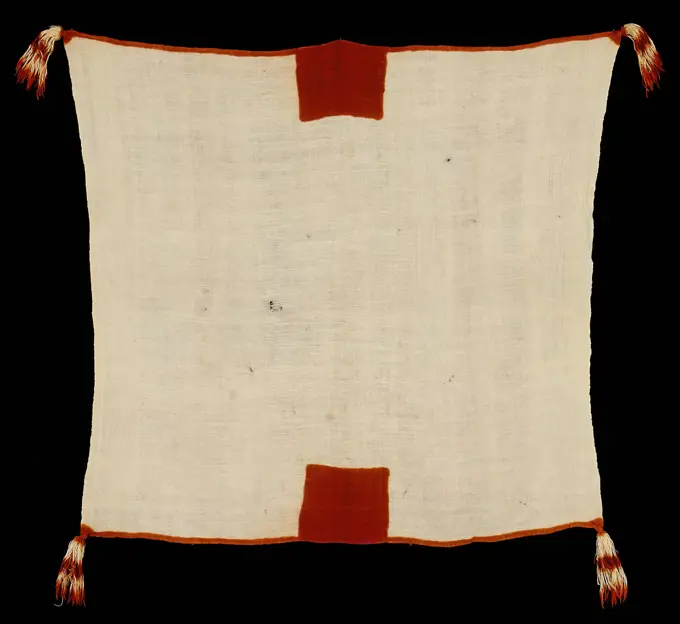
Comforter cover, 19th century, H.63-5/16 x W.36-1/16 in., Cotton, China, 19th century
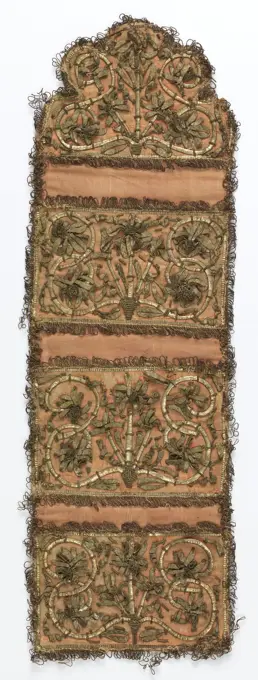
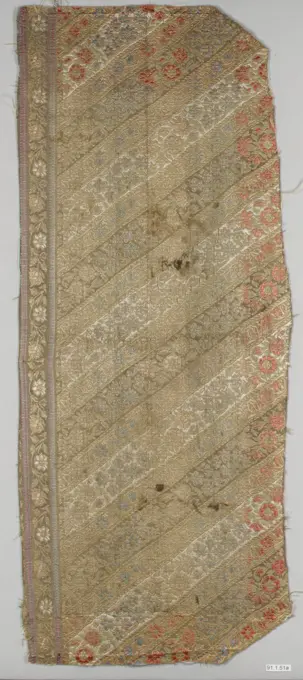
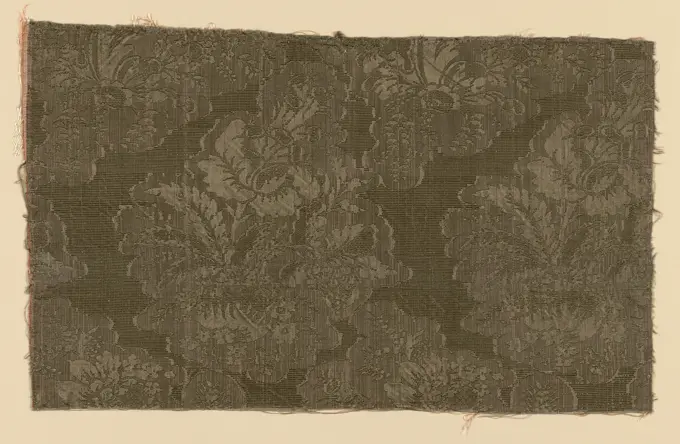
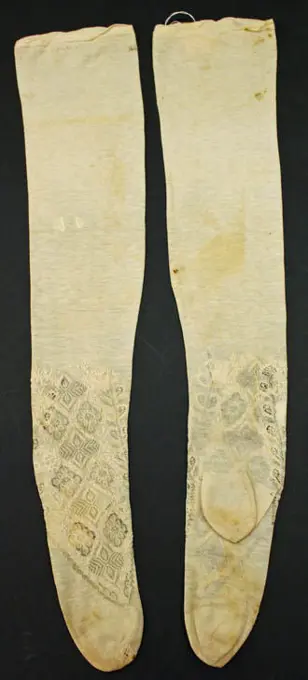
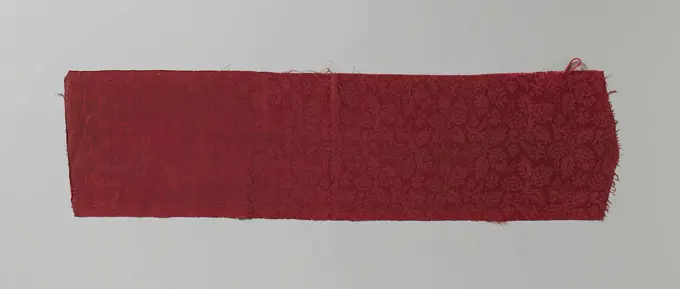
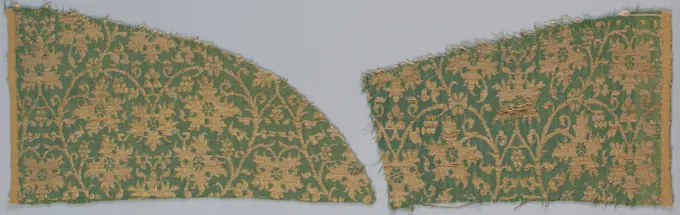
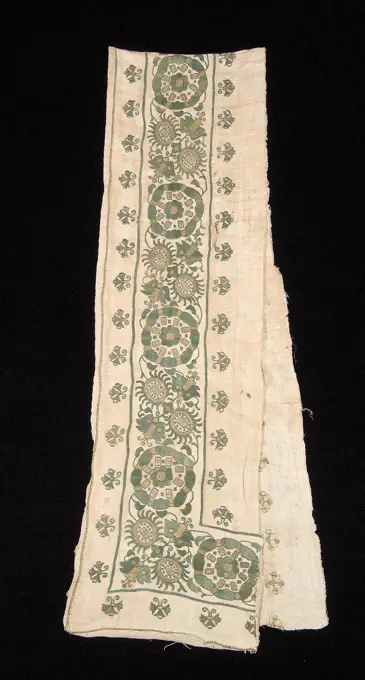
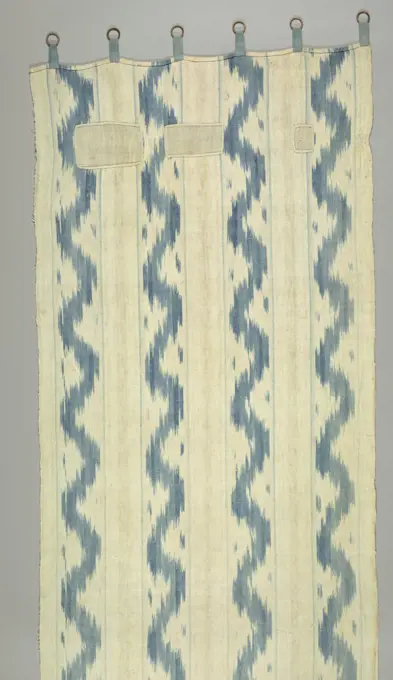
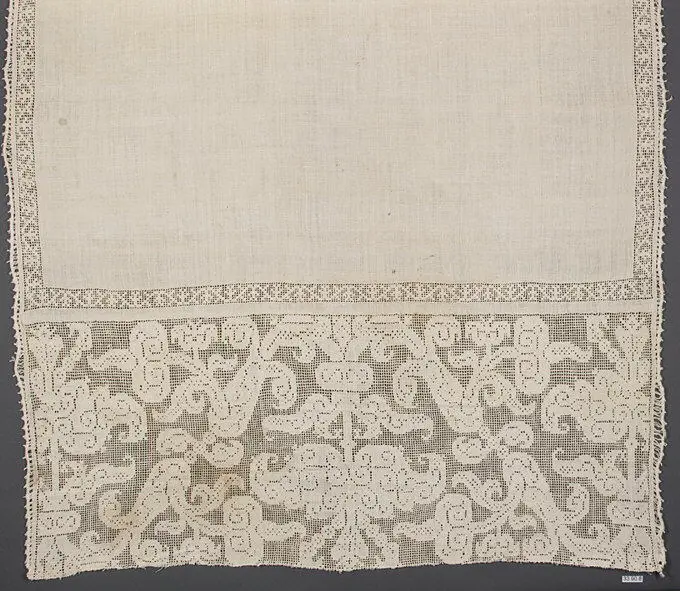
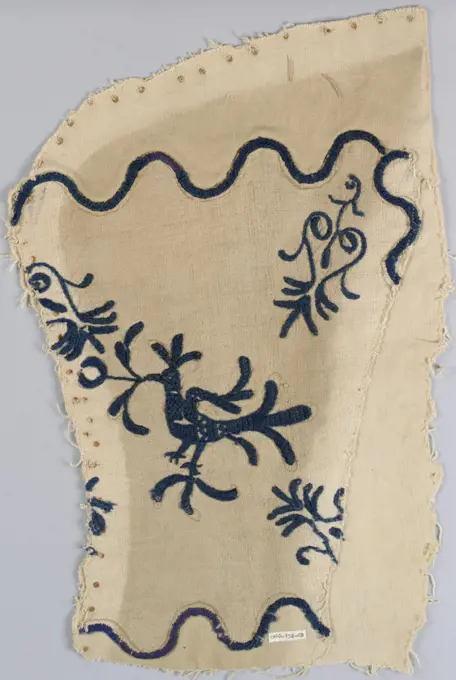
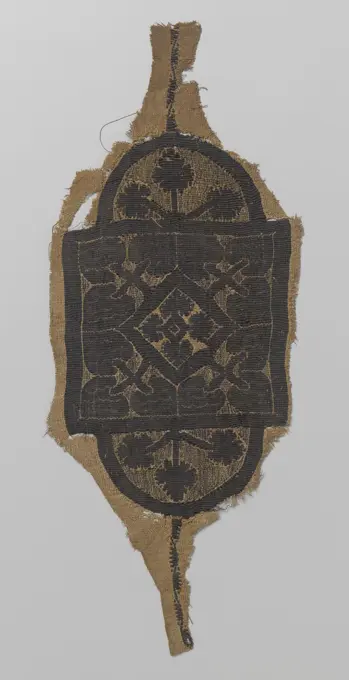
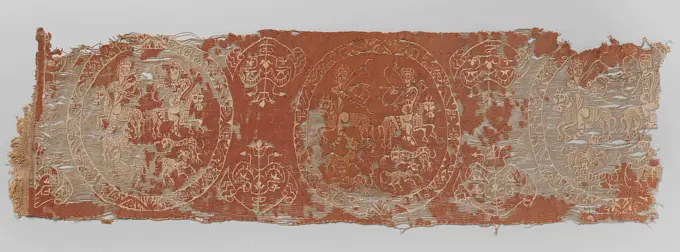
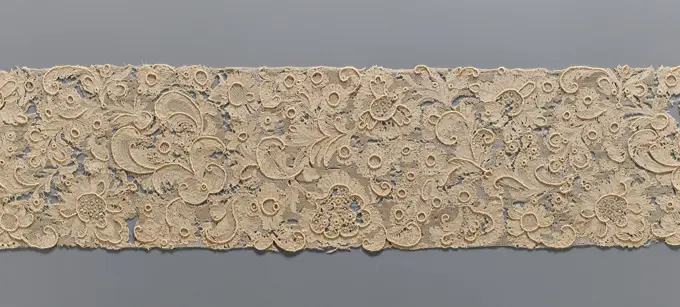
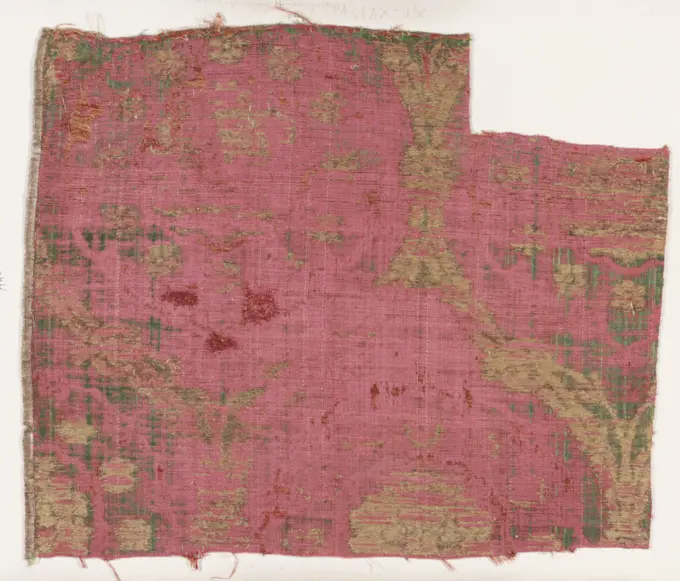
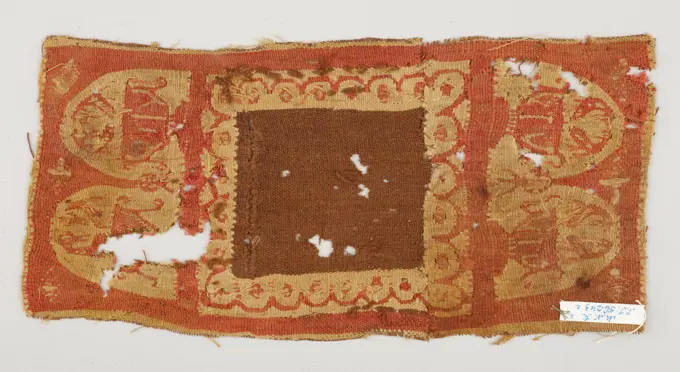
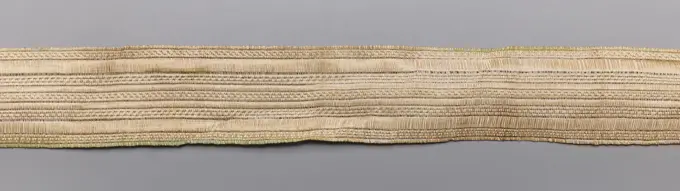
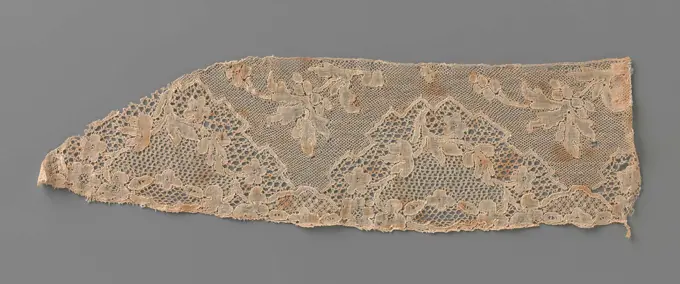
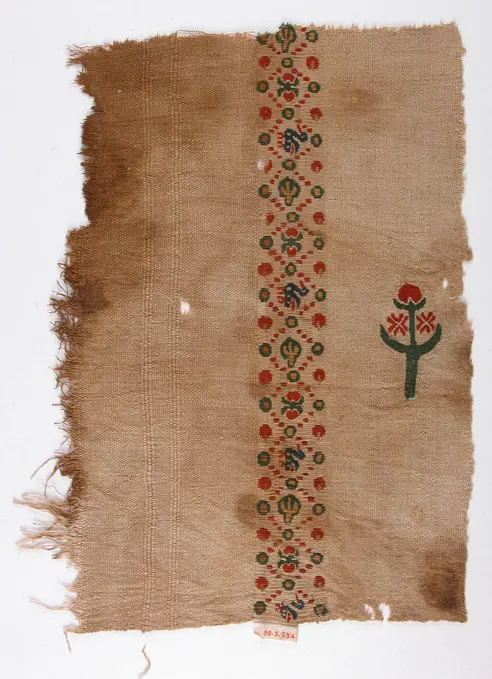
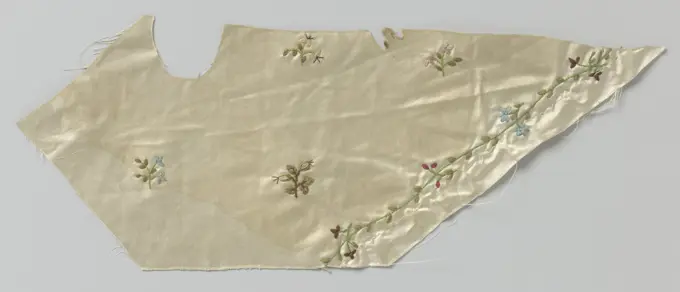
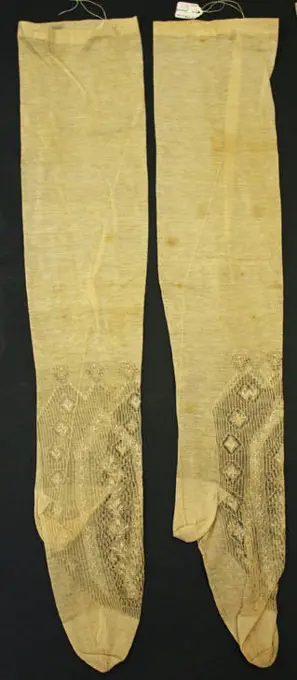
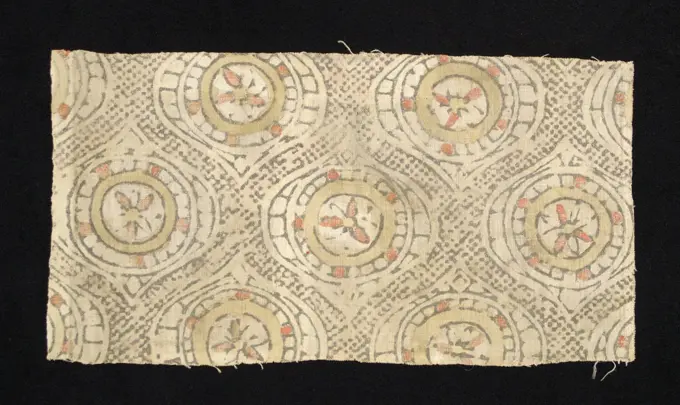
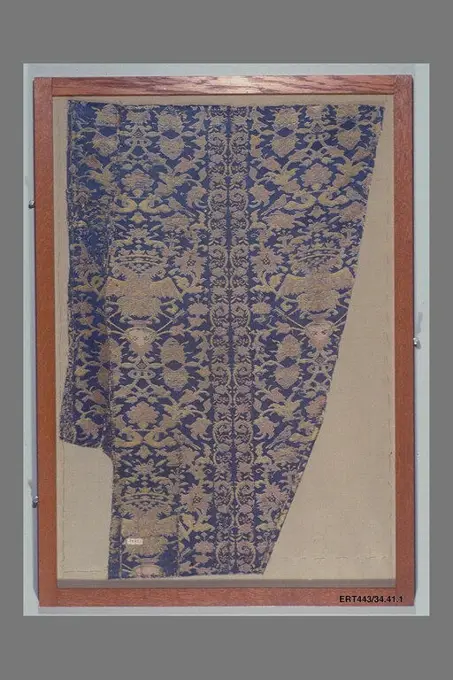
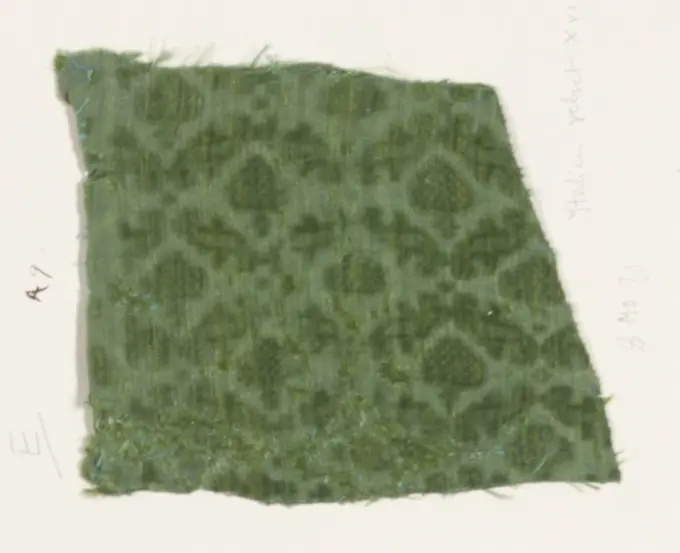
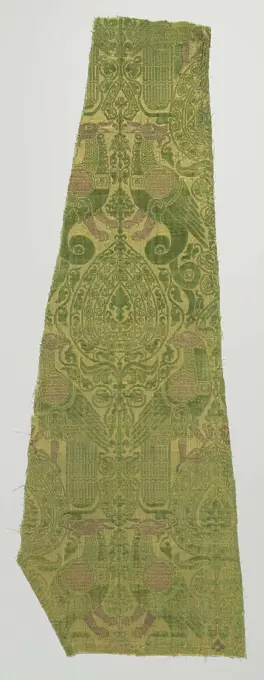
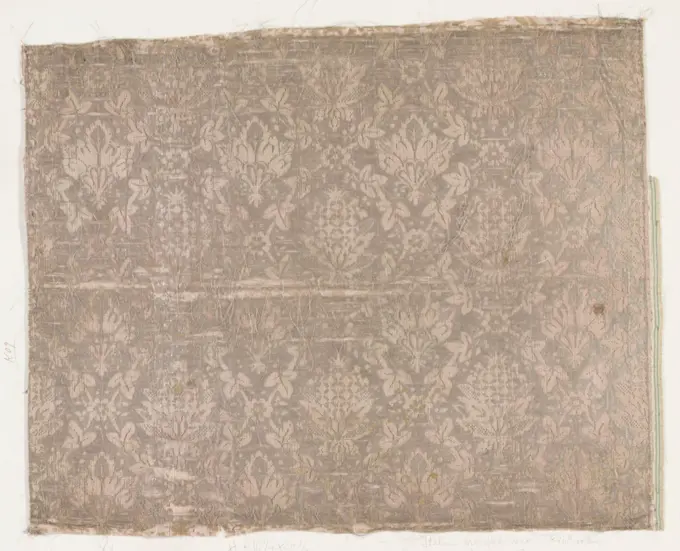
Fragment 17th century Italian. Fragment 230666Textile (Near East); embroidery using silk threads in a running stitch on linen plain weaveWall Pocket (Italy); silk, metalFragment, Medium: cotton Technique: resist-printed on plain weave, Untreated fine plain weave ground with small-scale all-over design of squares formed by diagonally crossing lines of dots alternate, alternate squares enclosing concentric circles and rosette. Design in tan and red against brown background., India, 13th-15th century, printed, dyed & painted textiles, FragmentFragment green silk tissue with pattern in gold thread, anonymous, c. 1400 - c. 1499 Fragment green silk with pattern in gold from large heart -shaped leaf figures between which French lilies. Two parts put together. Germany (possibly) Ketting an element: Silk. Ketting: Linen (material). element: twill Fragment green silk with pattern in gold from large heart -shaped leaf figures between which French lilies. Two parts put together. Germany (possibly) Ketting an element: Silk. Ketting: Linen (material). element: twillFragment of Coptic fabric unknownFragment, Medium: silk Technique: velvet, Mirror image pattern on a central line. In off-white., 17th century, woven textiles, FragmentComforter cover, 19th century, H.63-5/16 x W.36-1/16 in., Cotton, China, 19th centuryFichu made of cotton cheese cloth, square with silk tulle on every corner with a bouquet of tulle deflation, c. 1820 - c. 1840 Fichu made of cotton cheese cloth, square with silk tulle on every corner with a bouquet of tulle through and needle side. Model: square. Zoompje on all sides. Decoration: The corners are hollow cut away and supplemented with silk tulle, in which a bouquet of tulle plums of white silk yarn. Along the outside with a needle side. Netherlands (possibly) whole: Cotton (textile). Tulle: Silk. Continue:. Fichu made of cotton cheese cloth, square with silk tulle on every corner with a bouquet of tulle through and needle side. Model: square. Zoompje on all sides. Decoration: The corners are hollow cut away and supplemented with silk tulle, in which a bouquet of tulle plums of white silk yarn. Along the outside with a needle side. Netherlands (possibly) whole: Cotton (textile). Tulle: Silk. Continue:.Textile Fragment. Italy, 1575-1600. Textiles; fragments. Silk plain weave with metallic thread supplementary weft patterningFragment, Medium: silk on linen Technique: embroidered, Fragment showing dense floral forms in blue-green silk on linen., North Africa, 19th century, embroidery & stitching, FragmentFragment of Woman's Trousering 19th century. Fragment of Woman's Trousering 444426Trimming (Spain); silk; 1932-3-27Fragment Made 1725-1775 England. Silk, plain weave with supplementary patterning warps .Stockings 19th century probably French. Stockings 121533Strip ca. 1800 British. Strip 212349Fragment rood zijdendamast.Fragment red silk tamper with a pattern of flowers and leaves.Textile, Medium: silk, linen Technique: woven brocatelle, Scrolling leaves and central vase in red, white and yellow., 17th century, woven textiles, TextileFragments (Italy); silk, metallicFragment of a shirt fourth quarter 18th century Russian. Fragment of a shirt 173431Rosette Fragment Coptic. , 5th-7th century C.E. Flax, wool, 3 1/4 x 4 1/4 in. (8.3 x 10.8 cm).   Egyptian, Classical, Ancient Near Eastern Art 5th-7th century C.E.Curtain panel, Medium: cotton, linen Technique: resist printed warp (ikat) on plain weave, Vertical curtain panel with four broad vertical bands; each filled with a single broad serpentine band in shaded blue with a small blaze in each scallop and with a straight narrow pale blue stripe on each side. All formed by blue ikat in the warp direction., Spain, 18th-early 19th century, printed, dyed & painted textiles, Curtain panelBorder fragment, Medium: silk on linen Technique: embroidered, Border fragment showing a pattern of heraldic lions and small birds. In red silk on linen., North Africa, 16th-17th century, embroidery & stitching, Border fragmentFragment Made 1476-1532 Peru. Plain compound cloth (old card) . ChuquibambaFragment oriental textile, silk tissue. A fragment of brown silk and cotton, with a diamond pattern in gold. The diamond pattern is formed by flour and leaf lines, in which a stylized flower.Fragment; silkEmbroidered velum;  End of the 17th century (1691-00-00-1700-00-00);Towel (Denmark); linenBand, Medium:Warp; silk. Wefts; silk, linen Technique: slit tapestry, Design of interlaced straps in red and yellow, 10th-12th century, woven textiles, BandExcerpt with a large leaf pattern on red long distance, c. 1690 - c. 1710 Fragment with a large leaf pattern on red long distance. Italy Ketting an element: Silk. lampas (textile material) Fragment with a large leaf pattern on red long distance. Italy Ketting an element: Silk. lampas (textile material)Scarf 16th century Italian. Scarf 222701Skirt, c. 1950, 10 x 24 in. (25.4 x 60.96 cm), Cotton, Myanmar (Burma), 20th centuryTwo Brocaded Fragments, late 1500s. Italy, late 16th century. Lampas weave (), silk and metal thread; overall: 22.5 x 13.5 cm (8 7/8 x 5 5/16 in.).Sleeve fragments, Medium: wool, linen, cotton Technique: embroidered, Fragments of embroidered sleeve in coarse linen worked in dark blue wool. Design shows bird with leaf spray in its beak and stylized floral forms. Pieces applied on coarse cotton., Spain, 18th-19th century, embroidery & stitching, Sleeve fragmentsFragment; silk; Bequest of Richard Cranch Greenleaf in memory of his mother, Adeline Emma Greenleaf; 1962-56-124Weefselfragment met tabula, anonymous, c. 300 - c. 499 Okker -colored linen tissue fragment with woven pattern in dark blue wool from a square in which a window. A semicircle on two sides of the square, from which a twisted line comes. Square, window and semi -circles filled with a large leaf motif with detailing in flying wire technology. Egypt Ketting an element: Linen (material). Entry: Wool tapestry Okker -colored linen tissue fragment with woven pattern in dark blue wool from a square in which a window. A semicircle on two sides of the square, from which a twisted line comes. Square, window and semi -circles filled with a large leaf motif with detailing in flying wire technology. Egypt Ketting an element: Linen (material). Entry: Wool tapestryTextile Fragment 4th-5th century. Textile Fragment 443687Weefselfragment met drie medaillons met jachttafereel.Tissue fragment with three medallions in natural on brick red soil. In the medallions the same hunting carrier of two arched riders from each other always with four animals. In the edge of the circle a fine leaf ornament. In the surfaces between the circles a leaf ornament facing up and down.Gallon;  19th century (1801-00-00-1900-00-00);Strip bobbin with a spray pattern of reversed V-shaped twigs, anonymous, c. 1785 - c. 1799 Strip of natural -colored bobbin, Lille side. Under a spray pattern of reverse V-shaped branches, an edge runs along the underside with an oval from which a branch originates. The motifs are connected by a Maas soil, a tuler land. The motifs are surrounded by thicker and shiny contour threads, very sparingly fullwork in linen battle. A decorative land has been used in the ovals along the lower edge. The top and bottom are straight, with the bottom with picots. Southern Netherlands linen (material) bobbin lace / Lille lace Strip of natural -colored bobbin, Lille side. Under a spray pattern of reverse V-shaped branches, an edge runs along the underside with an oval from which a branch originates. The motifs are connected by a Maas soil, a tuler land. The motifs are surrounded by thicker and shiny contour threads, very sparingly fullwork in linen battle. A decorative land has been used in the ovals Piece 18th-19th century Japan. Piece 65994Length mid-18th century Italian or French. Length 229475Fragment, Medium: silk Technique: supplementary warp pile in a plain weave foundation (velvet) then embossed, Small fragment of very worn, stamped red velvet., 17th century, woven textiles, FragmentSampler 1735 Swiss. Sampler 218796Fragment, Medium: silk, linen Technique: plain compound satin, Circular medallions and arabesques in yellow and green. Stylized foliage forms six-sided design separated by oval frames., Spain, 16th century, woven textiles, FragmentFragment of a Tunic 5th-6th century. Fragment of a Tunic. 5th-6th century. Wool, linen; plain weave, tapestry weave. Attributed to Egypt. TextilesFragment of the lace;  around 1700 (1690-00-00-1710-00-00);Panel, Medium: silk on linen Technique: counted stitch embroidery, cross and stem stitches, Embroidered panel in three different designs arranged in bands: one showing alternating knots and four petal flowers in drop repeats; the second, vertically placed leaf forms crossed by a line with S-shaped ornaments; the third, lozenges and crosses. Worked in pink, blue, yellow and green silk., Spain, 16th century, embroidery & stitching, PanelFragment silk tissue with multicolored embroidery. Fragment silk tissue, damask, with multicolored embroidery. The pattern has two yellow courts with red crosses along the top and bottom. There is a green leaf slinger in the middle in the middle.Fragment early 16th century Italian, Venice or Turkish. Fragment 230087Fragment of Coptic fabric  figural motif unknownGallon;  19th century (1801-00-00-1900-00-00);Fragment, Medium: silk, metallic Technique: two integrated structures; plain weave plus plain weave, Niskhi inscription in gren on gold., Turkey, possibly 16th century, woven textiles, FragmentStrip of textiles in which two lace strips with diamond shapes, anonymous, c. 1900  Strip of natural textile with two lace strips with diamond shapes, Spanish side. Saba .Textile FragmentBrocade, 1800s. India, Benares, 19th century. Brocade, "kimkhwab"; silk with metal ground; overall: 8.9 x 15.2 cm (3 1/2 x 6 in.).White rectangular cloth with woven geometric pattern, Susanna Maria from Pabst Rutgers-Linse, c. 1836 - c. 1898  Netherlands textile materials  Netherlands textile materialsFragment (Dressing Fabric) Made 1501-1600 China. Silk and gold-leaf-over-lacquered-paper-strip-wrapped silk, chevron twill weave with supplementary patterning wefts and supplementary pile warps forming cut and uncut voided velvet; embroidered with silk and gold-leaf-over-lacquered-paper-strip-wrapped silk in laidwork and couching .Fragment, Medium: silk, metallic thread Technique: cut and uncut supplementary warp pile (velvet), Fragment of green cut and uncut velvet on a tan ground originally heavily shot through with fine strips of flat metal. Design of small flowering branches in horizontal rows turning alternately left and right., Italy or Spain, late 16th-early 17th century, woven textiles, FragmentSilk with Dogs and Arabic Script in Swaying Bands, 1370-1400. Italy, last third of 14th century. Silk and silver thread; a combination of two weaves, 2/1 twill and 1/5 twill (lampas); overall: 30.2 x 31.1 cm (11 7/8 x 12 1/4 in.); mounted: 46.4 x 69.2 cm (18 1/4 x 27 1/4 in.).Fragments with Griffins in Roundels, before 1966. Iran or Iraq, in the style of the Seljuq period (1037-1194). Silk: lampas weave; overall: 41 x 32.8 cm (16 1/8 x 12 15/16 in.).Fragment (France); silkFragment Made 1501-1600 Italy. cisele voided cloth velvet .Woman's Breast Cover, 20th century, 13 1/4 x 26 1/2 in. (33.66 x 67.31 cm), Cotton, Myanmar (Burma), 20th centuryStrook kloskant met driehoekig veld met zich splitsende tak.Strip natural colosside: Mechelen side. The repeating pattern consists of a triangular field, with the bottom of the strip and a top that ends slightly below the top of the strip. The sides of the triangle are formed by a line with kinks in it. From the top a splitting branch hangs down, with whimsical leaves and rosette flowers. The pattern along the underside is formed by the flowers and leaves at the end of these branches and by more or less oval cartouches. Between the successive triangular fields, a loose flour can be seen with stem and leaf, which is slightly slanted from top to bottom. The motifs are connected by a Maas soil, the Mechelen soil. The motifs are made in linen stroke with few recesses and thicker and shiny contour wires. Two different ornamental grounds have been applied in the triangular field and two other in the cartouches along the underside, including a snowflakes soil. The bland scaled underside is fiTextile Fragment 5th century. Textile Fragment 444020Velvet Fragment, 1500s. Italy, 16th century. Velvet weave (cut with two heights of pile); overall: 38 x 52 cm (14 15/16 x 20 1/2 in.).Fragment multicolored embroidered tissue, c. 1700 - c. 1750 Fragment white silk tissue with an embroidered pattern of small, multicolored flowers. Germany silk embroidering Fragment white silk tissue with an embroidered pattern of small, multicolored flowers. Germany silk embroideringBaptismal veil of application side with flowering roses on a branch and snowballs above curved feathered leaves, anonymous, c. 1825 Baptismal veil of natural -colored Brussels Application side: Brussels bobbin side Applicated on Drochelgrond. Square model and lined with a natural taf side. Strooi pattern of leaves in midfield and along the edges A repeating pattern of two leaves placed by two, between which a foresed branch. Both the slightly curved leaves in the spreading pattern and the larger version of these leaves along the edges are feathered on hollow side and smooth on the convex side. The convex side of the large leaves has a Zigazag edge and these leaves always have one blossom branch with rosette flowers. The outer edge is a sculpy edge and consists of a succession of half -standing half -lying leaves with the same semi -supplied shape. The motifs are made in linen battle with openwork edges and partly equipped with burst relief contours. Various decorative lands have been uFragment (Germany); linenFragment, Medium: silk, metallic Technique: supplementary warp loops in plain weave foundation (velvet) with supplementary weft., Incomplete pomegranate motifs at left and right in green velvet with metallic., Italy, 15th century, woven textiles, FragmentNapkin, with woven peel pattern. Napkin of linen with peel pattern, cut from larger piece; zoomed on four sides.Textile with Paired Ducks in Roundels (Copy of a Medieval Silk), early 1900s. France, early 20th century. Compound twill weave woven on Jacquard loom; silk; overall: 30.5 x 19.5 cm (12 x 7 11/16 in.).Wool Fragment with ColorfulPatternPiece 18th-19th century Japan. Piece 67735Trouser Band Made 1875-1900 China. Forty-four pairs and eight odd pieces of embroidered sleeve, ankle bands, etc. on gauze. . Han-ChineseStockings 19th century French. Stockings 121587Handkerchief, 18th century, 35 x 35 1/2 in. (88.9 x 90.2 cm), Cotton, silk; needlework, Turkey, 18th centuryTextile 1700-1899 Russian. Textile 173403Piece second half 16th century Chinese, Macao, for Iberian market. Piece 222986Fragment, Medium: silk and metallic thread Technique: cut and uncut supplementary warp pile in a satin foundation (velvet), One end of a stole (religious apparel). Large dark red floral design on gold background., 17th-18th century, woven textiles, FragmentTEJIDO TAHITIANO HECHO CON CORTEZA DE ARBOL. Location: MUSEO DE AMERICA-COLECCION. MADRID. SPANIEN.Sampler (Mexico); cotton; Warp x Weft: 26.7 x 14.6 cm (10 1/2 x 5 3/4 in.); Bequest of Gertrude M. Oppenheimer; 1981-28-389. Cotton, plain weave; embroidered with wool threads in chain stitch; quilted .Fragment 16th-17th century Italian. Fragment 230545Piece 18th-19th century Japan. Piece. Japan. 18th-19th century. Silk. Textiles-WovenSampler (England); linen embroidery on linen foundationBrand patch from silk on linen., Elizabeth Gorhum, c. 1840 Brand patch from silk on linen. The embroidery has the text: Elizabeth van Gorhum 12 years old in 1840, eight times the alphabet, initials and on the bottom line: anno 1841. Amsterdam linen (material). silk embroidering Brand patch from silk on linen. The embroidery has the text: Elizabeth van Gorhum 12 years old in 1840, eight times the alphabet, initials and on the bottom line: anno 1841. Amsterdam linen (material). silk embroideringFragment van een zijdeweefsel met vogels en mythologische dieren.Fragment of green silk with stylized pattern of two birds with head and two fabached animals closed towards each other. Between these animals a palm with a palm drinks.Fragment; silk, metallic yarnsFerahan type shelf;  XIX W (1801-00-00-1900-00-00);Fragment of Zupan fabric  small trapezium pattern unknownFragment formed of Four Separate Fabrics Joined, c. 1100-1400. Peru, Central Coast, Chancay, 12th-15th century. Two pieces plain cloth, two pieces compound twill; cotton; average: 34.3 x 56 cm (13 1/2 x 22 1/16 in.).Overskirt (Democratic Republic of the Congo); raffia, hempTextile Fragment 5th-6th century. Textile Fragment 443490Head covering (Amendil), 20th century, H.45-1/16 x W.40-3/16 in. (irregular, without tassels), Wool; plain weave with henna paint; dyed, Morocco, 20th centuryFragment; silkTextile Fragment 4th century. Textile Fragment 443511Ribbon of side brokaat; On a silver -colored background with diamond pattern, a repeat pattern of a colored bouquet is applied, anonymous, c. 1700 - c. 1725 Ribbon of side brokaat; A repeat pattern of a colored bouquet has been applied to a silver -colored background with diamond pattern. The edges are trimmed with decorative band. West-Europa geheel: silk. brocade (textile). silver thread Ribbon of side brokaat; A repeat pattern of a colored bouquet has been applied to a silver -colored background with diamond pattern. The edges are trimmed with decorative band. West-Europa geheel: silk. brocade (textile). silver threadBand Fragment with Animal and Botanical Decoration Coptic. Band Fragment with Animal and Botanical Decoration, 5th-7th century C.E. Wool, 1 9/16 x 9 13/16 in. (4 x 25 cm).   Egyptian, Classical, Ancient Near Eastern Art 5th-7th century C.E.