Historical Tools

Artifacts like swords, knives, and measuring rods from different eras, depicted in a serious and historical context, showcasing craftsmanship in metalwork.

Wedding knife, Steel, silver, iron, ivory, Blade straight-sided and tapering to a point. Hollow bolster, silver ferrules with geometrical and circular pattern. Ivory handle in honeycomb pattern. Silver cap has rounded end, slightly projecting at the sides, cap decorated with geometrical and circular pattern., England, early 17th century, cutlery, Decorative Arts, Wedding knife
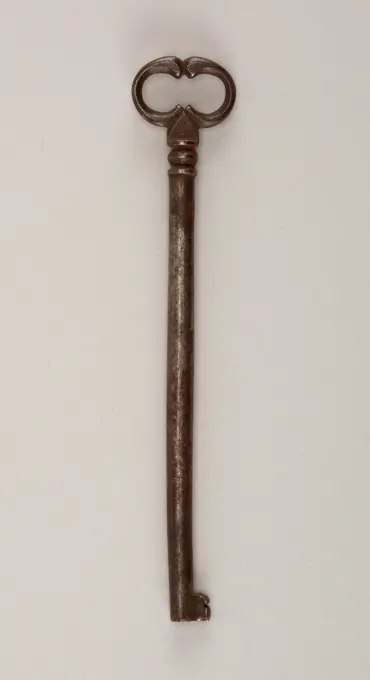
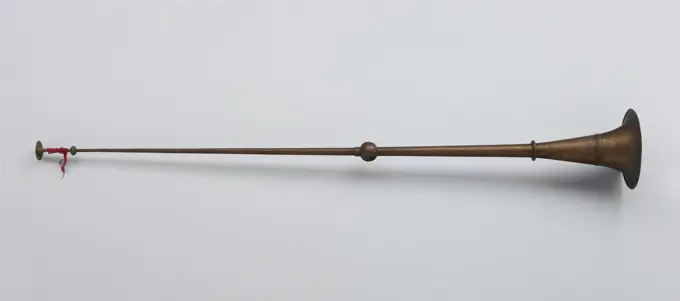
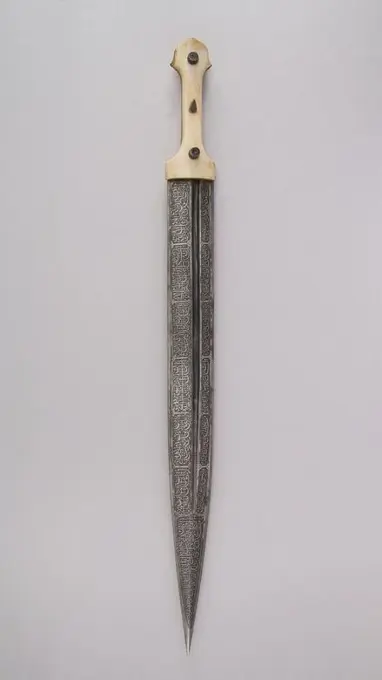
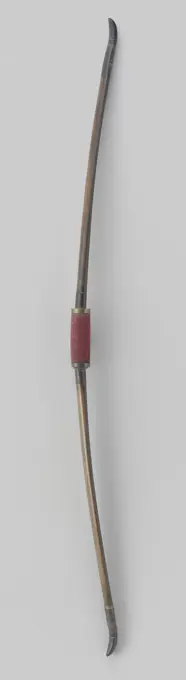
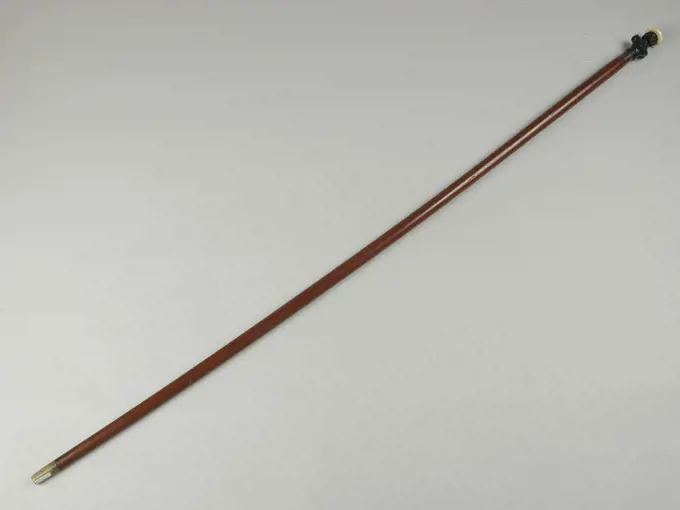
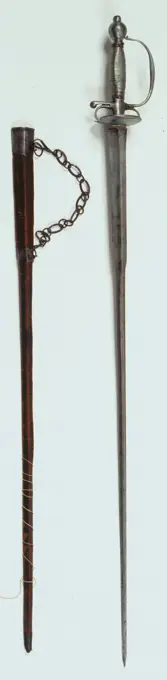
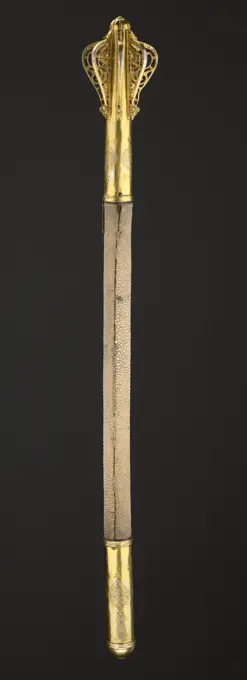
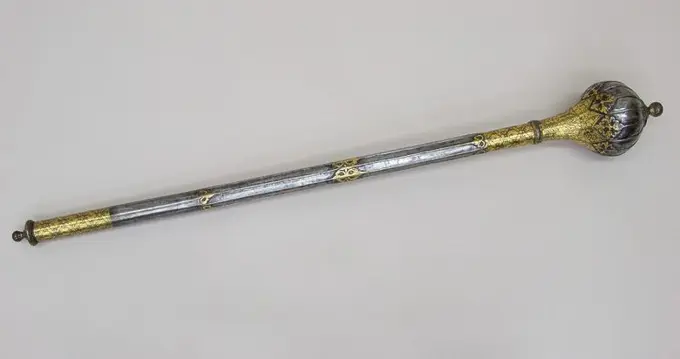
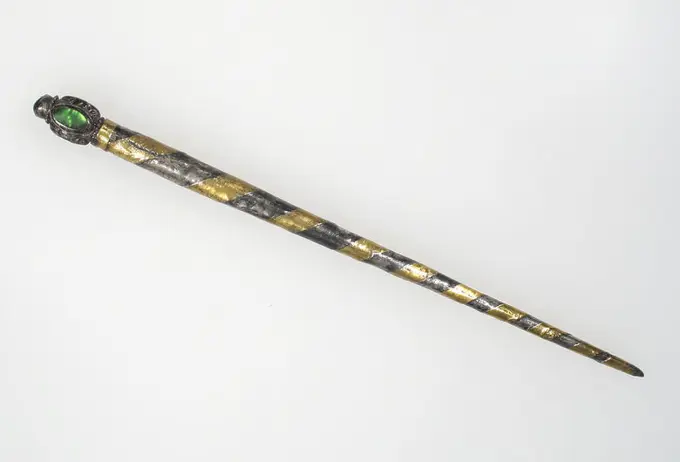
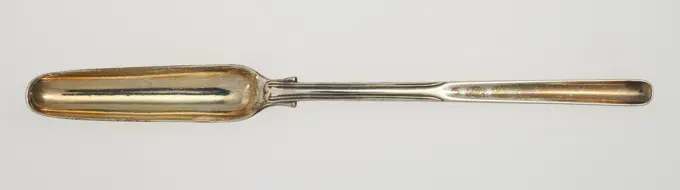
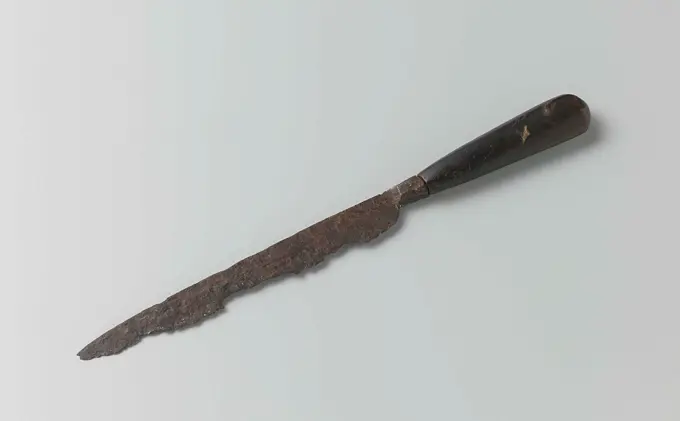
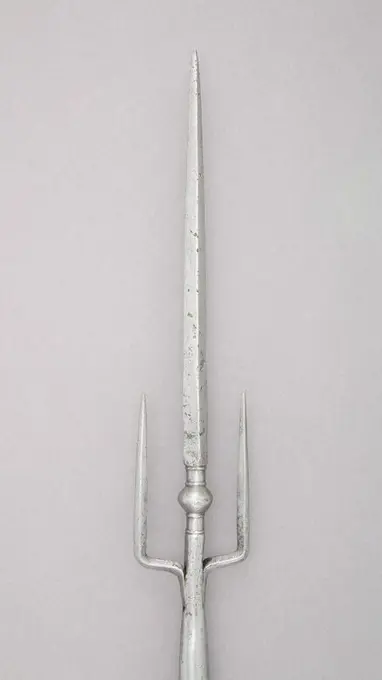
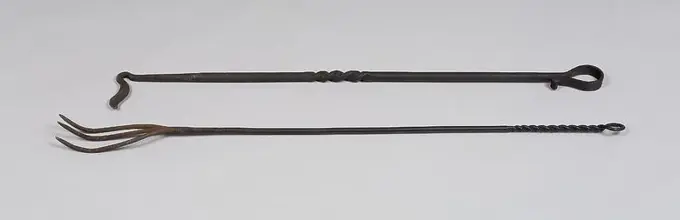
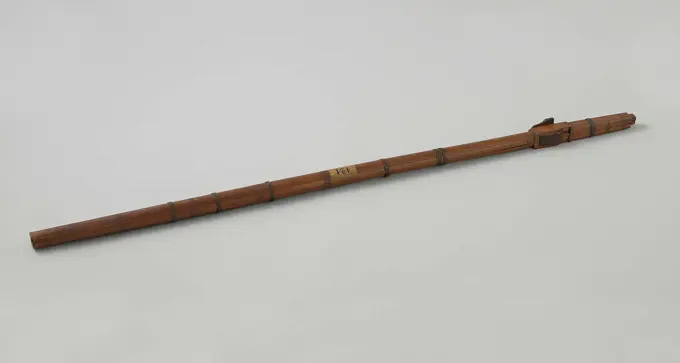
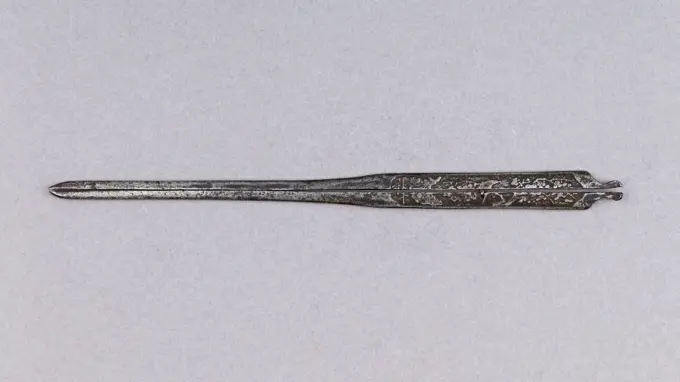
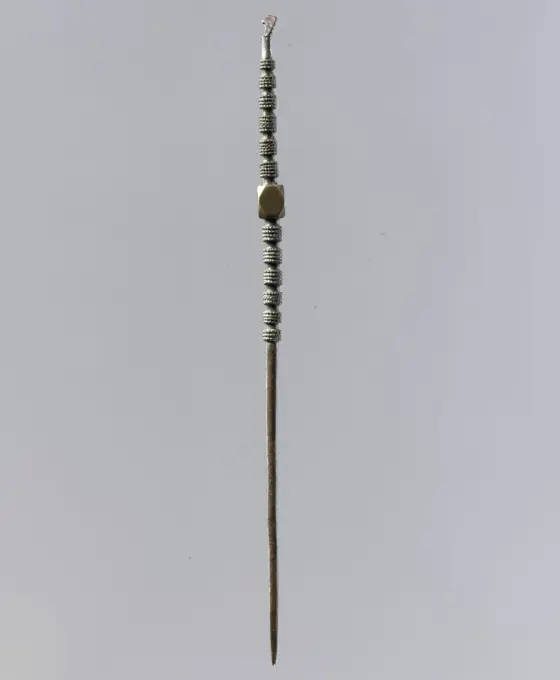
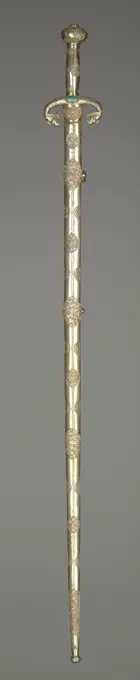
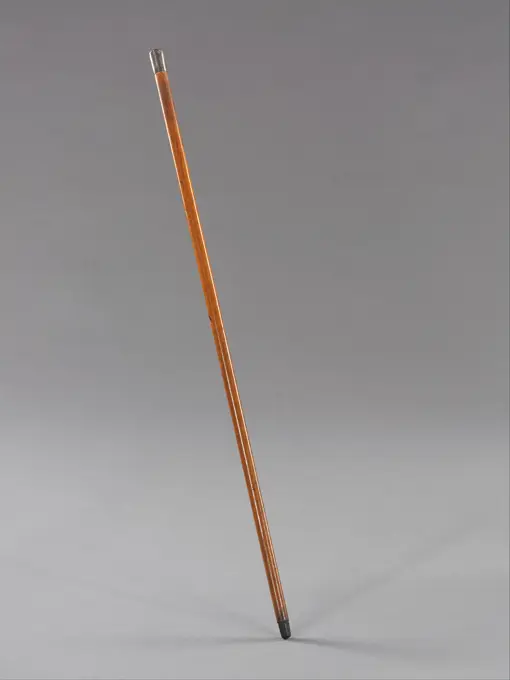
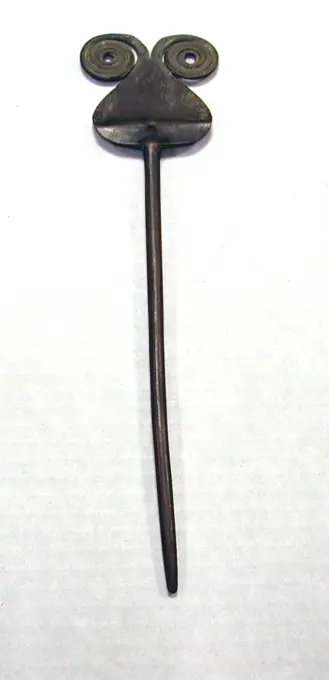
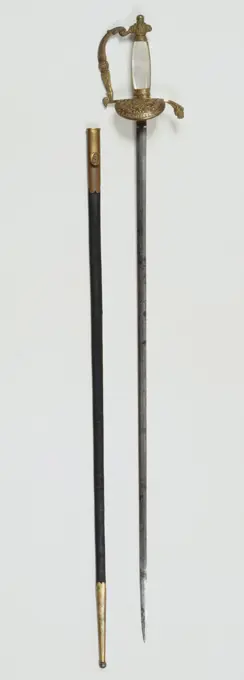
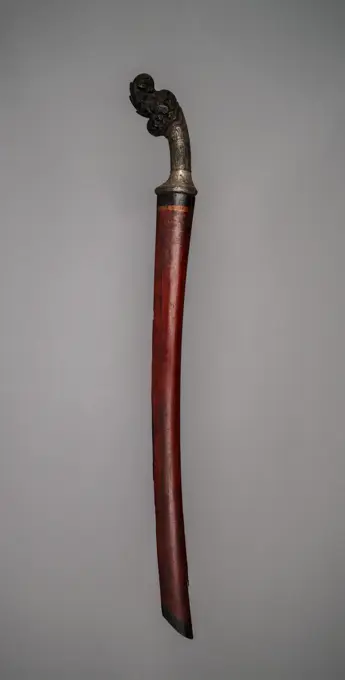
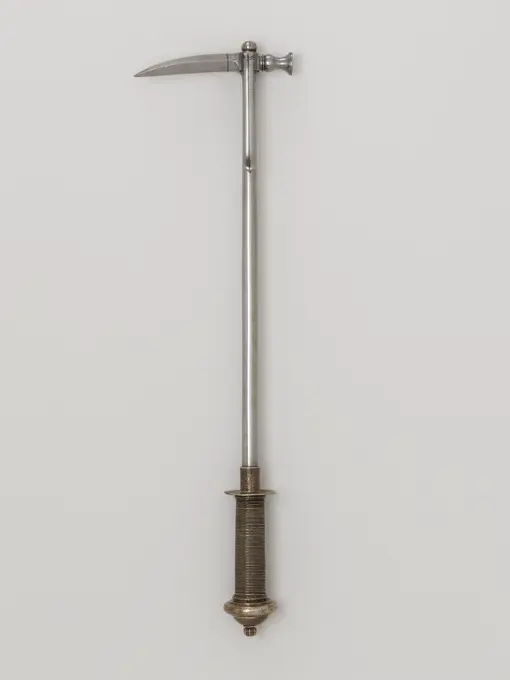
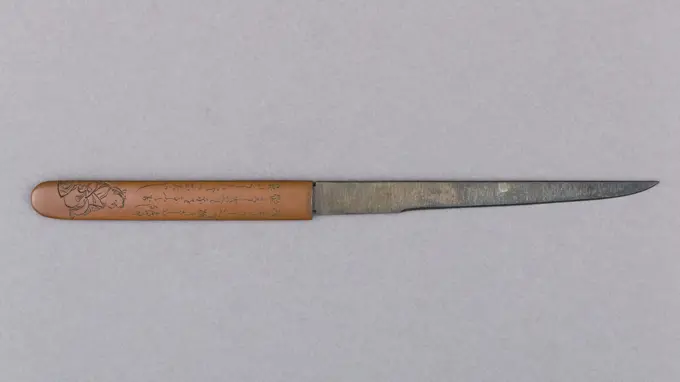
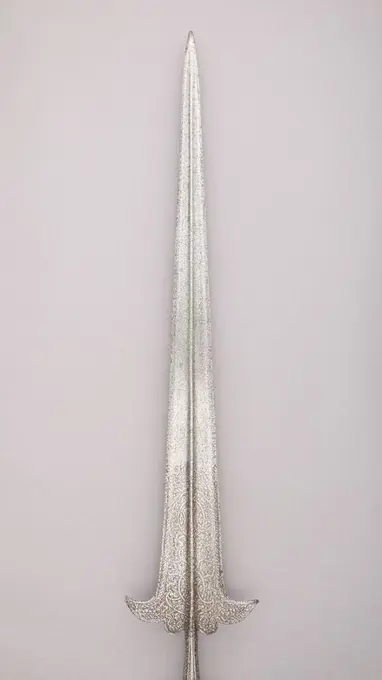
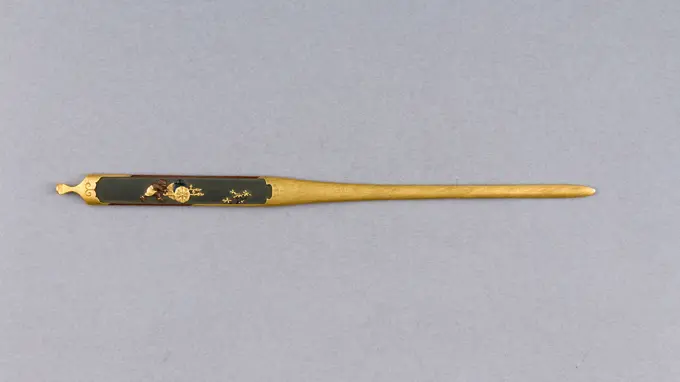
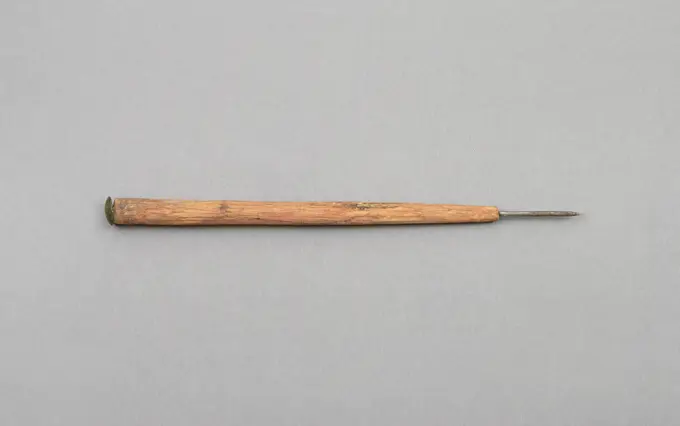
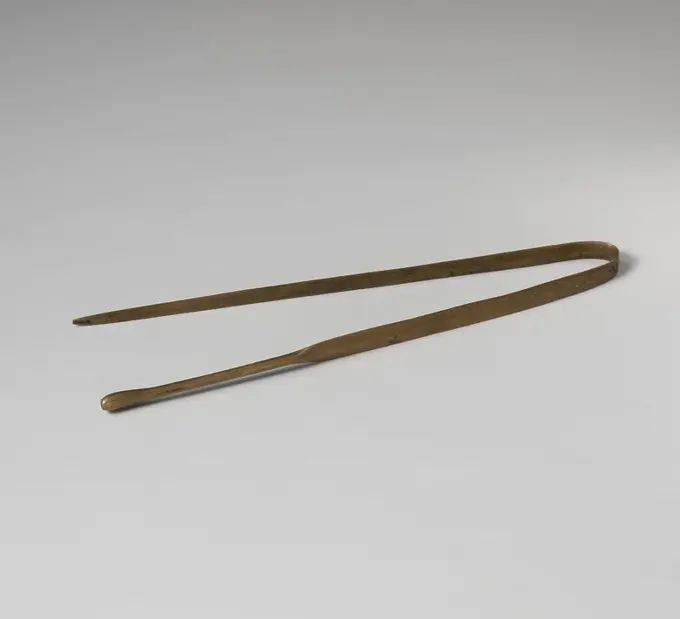
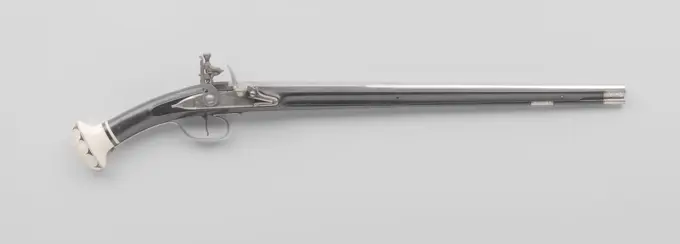
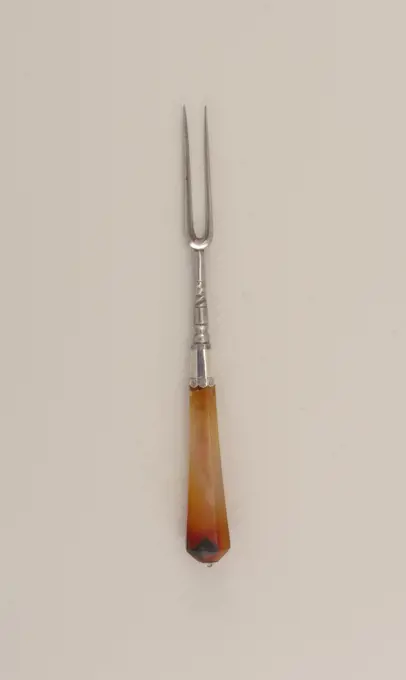
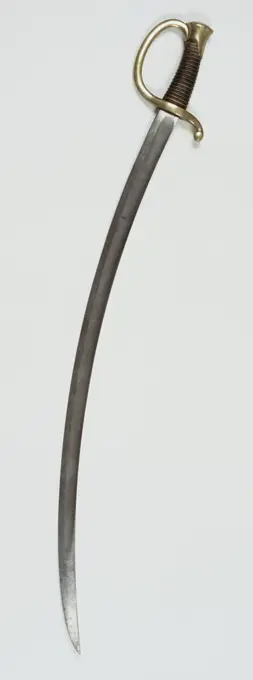
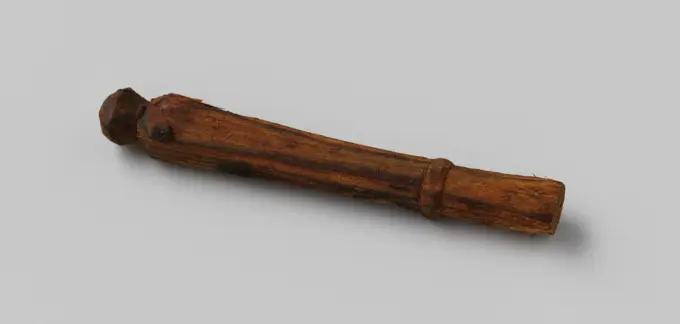
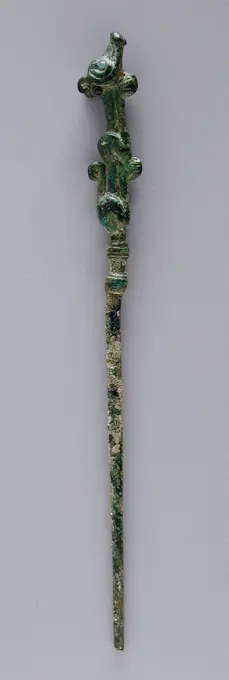
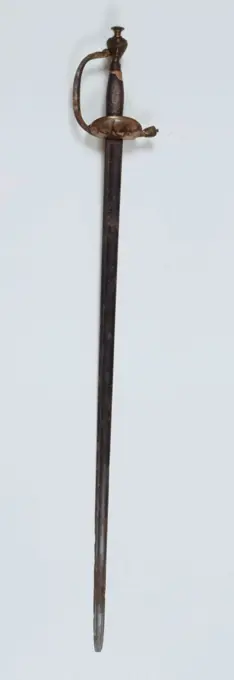
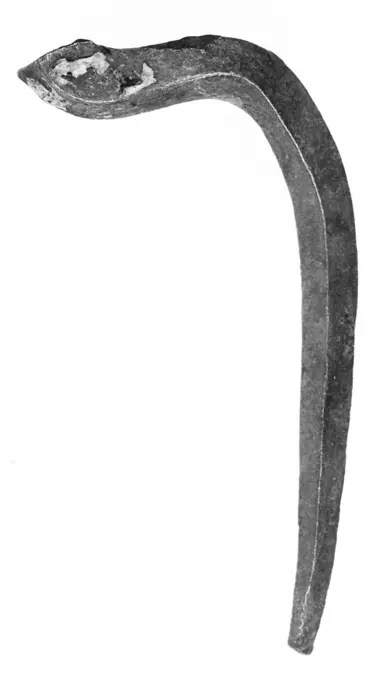
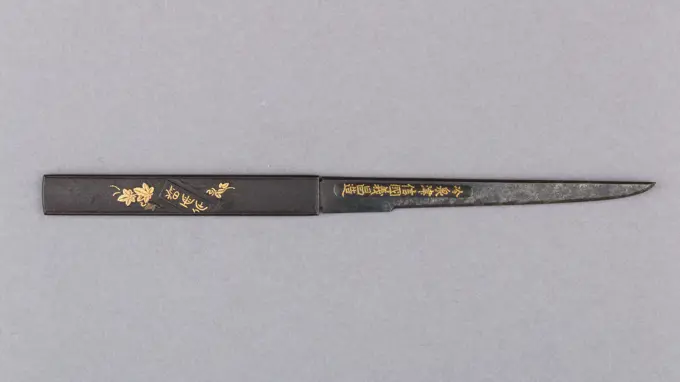
File, half round without a handle, with parallel notches and very fine notches, anonymous, c. 1590 - c. 1596  File, half round without a handle, with parallel notches. The file is grater with sharp dots. Very fine notches are visible on both sides.  iron (metal) forging  Nova Zembla. Saving HuysArmour, helmet and sword of Admiral Jacob van Heemskerck.Jacob van Heemskerck commanded the Dutch ships that defeated a Spanish fleet near Gibraltar in 1607. The admiral lost his life in the fray. He was commemorated with a monument in the Oude Kerk in Amsterdam. In keeping with custom, his armour washung above the tomb. The left cuisse (thigh defence) is missing: it was shattered by the cannonball that cost Van Heemskerck his life.Wedding Knife (England); steel, silver, iron, ivory; L x W: 20.1 x 9 cm (7 15/16 x 3 9/16 in.); The Robert L. Metzenberg Collection, gift of Eleanor L. Metzenberg; 1985-103-89Measure from V.O.C.-ship De 'Witte Leeuw', Before 1613 measuring rod Measure from V.O.C. ship the 'Witte Leeuw'. All four sides of the measure are divided into stripes with numbers in different ways. The benchmark was used by the Constapel to calculate the required powder load.  bronze (metal)   Sint-HelenaMarine's Sword in Scabbard.Ship cable No. 2 in sheath. Curved blade with wide blood stuff, glass hilt with curved front bracket and hanging pearl rod with end button. On both sides, rough an anchor is engraved on the blade. The sheath has a brass under tape and top tire with carrying knob.Stick Chimú or Chancay 12th-15th century View more. Stick. Chimú or Chancay. 12th-15th century. Silver (hammered), copper, wood. Peru. Metal-ImplementsKling of a heart catcher, Jan Hofsee, c. 1400 - c. 1800 hunting hanger Kling of a heart catcher on which engraved a hunting presentation and a text: "Jan Hofsee mr. Zwaardveger on the Vijgendam to Amsterdam". Reverse: "In Tenomenene 1414". Amsterdam iron (metal) engravingWedding knife, Steel, silver, iron, ivory, Blade straight-sided and tapering to a point. Hollow bolster, silver ferrules with geometrical and circular pattern. Ivory handle in honeycomb pattern. Silver cap has rounded end, slightly projecting at the sides, cap decorated with geometrical and circular pattern., England, early 17th century, cutlery, Decorative Arts, Wedding knifeKey; 1908-25-76Lapa (Trumpet) late 19th century Chinese. Lapa (Trumpet) 504717Dagger (Qama). Culture: Caucasian. Dimensions: L. 26 3/8 in. (67 cm); L. of blade 20 3/8 in. (51.8 cm); W. 2 1/8 in. (5.4 cm); D. 1 3/8 in. (3.5 cm); Wt. 1 lb. 10.5 oz. (751.3 g). Date: 19th century. Museum: Metropolitan Museum of Art, New York, USA.Stylus or tool. Stylus or tool. Bronze. BronzesSmall-sword with scenes from the Old Testament.This small-sword is decorated with a number of scenes from the Old Testament. On the pommel, God is depicted in a cloud. Representations of Adam and Eve, Cain and Abel, Noahs Ark and Lot and his daughters are on the hilt.Arch belonging to Cornelis Tromp, Anonymous, c. 1650 - c. 1679  Boog consisting of two, relatively short, throwing arms, with cams (the ends) that come together in a handle covered with red sheet. The cams and grabbed are European in shape. The throwing arms are made of Hoorn, which is a sturdy but heavy material. The arms are probably made up of 3 layers, like a sandwich: a layer of horn, a layer of wood in the middle and again a layer of horn. In this way one could use the strength of the horn, but prevent the bow from becoming too heavy to handle. The tendons, often made of linen or silk, are missing. southeast Asia horn (animal material). middenstukken: cloth. band: silver thread. band: copper (metal). ash (wood)Walking stick with button in the shape of female bust, walking stick wood ebony leg metal horn, Walking stick with lacquered wooden handle button in the shape of black ebony woman bust with white legs hat attached with gray metal rosette Between the stem and the knob is gray metal ring placed on the point sits horn cap walking physical tool clothing accessory animal material keratinArtillery kanjar with a scabbardHairpin 200-500 Roman. Hairpin 464917 Roman, Hairpin, 200500, Copper alloy, Overall: 3 3/8 x 5/16 x 3/16 in. (8.6 x 0.8 x 0.4 cm). The Metropolitan Museum of Art, New York. Gift of J. Pierpont Morgan, 1917 (17.191.216)Axe 1480-1500 Italy. Steel and wood (ash) .Drumsticks, c. 1900 - c. 2000 musical instrument. elements (of musical instruments). percussion instrument. beater. drumstick - Replica Tromstok of a 17th or 18th century tromks. - Replica Tromstok of a 17th or 18th century Tromstok, the Netherlands, 20th century. Netherlands wood (plant material)Degen with iron hilt with wrapped handle and leather sheath. Hilt with button and wrapped handle. Half pearl rod, donkey hole and bumpers. Three-old blade, narrowing, with inscription on a silk: Fran van Demmeltedtt Swordsger to be found. On the other side: Francois van Demmeltedreden Fourbisseur A welded. The whole in etched ornaments. With leather sheath with chain, carrier tapes.Przeszo Przyszoci unknownEVENTAIL. "Rustic scene" (the milking and shepherd with herd). Gouache and watercolor, ivory frame inlaid silver, pivot rhinestones. Paris, Carnavalet museum. 100131-11 Fashion accessory, EventailSpoon Korea. Spoon. Korea. Bronze. Goryeo dynasty (918-1392). MetalworkFile, half round without a handle, with parallel notches and on the convex side local notches, anonymous, c. 1590 - c. 1596  File, half round without a handle, with parallel notches. The file is rasp -shaped with sharp dots, local notches are visible on the convex side.  iron (metal) forging  Nova Zembla. Saving HuysMace (Gada). Culture: Indo-Persian. Dimensions: L. 26 in. (66 cm); wt. 7 lb 0.7 oz (3.194 g). Date: 17th century.This mace, or gada, is extremely top-heavy, so much that it would be impossible to use effectively as a weapon. It is perfectly weighted, however, for gada-yuddha, or mace training, a form of exercise and a martial art known in India for centuries and still practiced there today. Its beautiful workmanship and lavish decoration would have made it a fine training implement for a Hindu prince. Compare this mace, weighing just over 7 pounds, with another mace in the collection (36.25.1874), which is very similar in form, decoration, and size, but is evenly balanced and weighs less than 3 pounds. Museum: Metropolitan Museum of Art, New York, USA.Model of a Main Topmast.Round steam made of one piece, with a thick square heel with two holes for disks and a slotwood hole, an octagonal homer and square top.Sinclair saberStylus. Culture: French. Dimensions: 7 7/8 × 1/2 in. (20 × 1.2 cm). Date: 14th-15th century. Museum: Metropolitan Museum of Art, New York, USA.Marrow spoon, 1764-1766, Hester Bateman, British, 1708 - 1794, 9 1/8 × 7/8 × 11/16 in. (23.18 × 2.22 × 1.75 cm), Silver, United States, 18th century, Marrow spoons were commonly used by European diners in the eighteenth century for the easy removal of marrow from the bone. They were often made of silver, with a long, thin bowl. Many, such as the present, were double-ended. Hester Batemanthe maker of the larger spoonwas the most prolific female silversmith of her age. During her thirty- year career after she took over her late husband’s workshop in 1760, her silver would have been found in nearly every middle-class household in London.Tafelmes met zeskantig heft van hoorn.Table knife with lifting of Hoorn. It lift is irregular in shape and more or less hexagonal. The shape of the lifting, presumably, in the form of the lifting protector. The lifting is cracked in the longitudinal direction, the shape of the blade is still intact.Scarf pin with salamander Stick Pin; France; gold, silver, pastesSnow beater -Fritz Boehmer, Steel Spatula, 1935 1942 Steel SpatulaShip carmans drill with large spoon and a handle with round cross -section, anonymous, c. 1590 - c. 1596 drill Ship carpermans drill with spoon and a handle with a round cross -section. This drill has a larger spoon than NG-NM-7664. LepelaveGaar.  iron (metal) forging  Nova Zembla. Saving HuysCopper Powder spoon, Anonymous, 1700 - 1800 spoon Round wooden stick with a copper powder spoon attached to it with nails. Kruit spoon has a round tube shape from which a rectangle with a hollow underside is cut. The stick has a bobbin with a flat bottom at the bottom. A copper plate has been beaten on the bottom.  wood (plant material). copper (metal) cutting / forgingKnife sharpener  -Military Fork. Culture: French. Dimensions: L. 94 1/4 in. (239.4 cm); L. of head 21 1/4 in. (54 cm); W. 3 9/16 in. (9 cm); Wt. 3 lbs. 15 oz. (1786 g). Date: 16th century. Museum: Metropolitan Museum of Art, New York, USA.a hundred;  19th century (1800-00-00-1848-00-00);STOP fork; Gumpert, Georg Heinrich (Fl. 1850-1893); 2. PO. 19th century (1800-00-00-1848-00-00);Set of Wrought-Iron Fireplace Tools. Designed by Frank Lloyd Wright; American, 1867-1959. Date: 1901. Dimensions: length: b: 114.6 cm (45 1/8 in.); c: 123.8 cm (48 3/4 in.). Iron. Origin: United States. Museum: The Chicago Art Institute, Chicago, USA.vase; Malcz, Karol (1797-1867), Silver Products Factory K.F. Malcza (Warsaw; Sreber label; 1828-1864); 1852 (1850-00-00-1855-00-00);Sabel from Tamboer major., C. 1800 - c. 1899 sabre Sabel of a Tamboer major with leather sheath. The hilt of the saber is cast from one piece and completely brass. The handcap is a curved lion's head on the slippery handle. The pare rod is curled down on both sides with disc buttons. In the middle of the Pareestang, a half -doval porter heart. The blade is straight with a broad blood channel. De Schede is made of leather with brass batter. A shield -shaped suspension button on the mouth band. The towing plate has the shape of a cloverleaf. Netherlands (possibly) Kling: Iron (Metal). hilt, Schedebeslag: Brass (Alloy). towing plate: brass (alloy). Schede: Leather   NetherlandsGold pin possibly 6th-5th century B.C. Etruscan Irregularly shaped head with granular decoration.. Gold pin. Etruscan. possibly 6th-5th century B.C.. Gold. Possibly Archaic. Gold and SilverKnife fragment. Knife fragment 251919 Knife fragment, Bronze, Other: 3/8 x 2 7/8 in. (1 x 7.3 cm). The Metropolitan Museum of Art, New York. Fletcher Fund, 1925 (25.78.139)Hair needle in bronze. Length 81 mm (1 St - 4 Th Ce )- Roman period, from the " Miracle Wall " ( Martyrdom of Saints Children ; Justo y Pastor ) -Archaeological site of Complutum in Alcala de Henares (Madrid). SPAIN.Model of a Made mast. Round mast with square top, homer with ears and driving bed. The mast itself consists of five parts: Three heavy parts are set against each other with curved on the inside, one at the front and two at the back; Two thin cheeks completely round out. The parts are held together by tub tires. The bribe is a thickening of the front part. This model can be exploited.Flintlock Gun. Culture: Indian, Sindh (now Pakistan); lock, British. Dimensions: L. 58 7/8 in. (149.5 cm); L. of barrel 42 3/4 in. (108.6 cm); Cal.56 in. (14.0 mm); Wt. 9 lb. 11 oz. (4393 g). Date: second quarter of the 19th century.Guns of this type, with sharply curved flaring butts and mounts in enameled gold of Iranian manufacture, are typical of Sind, now a province of southern Pakistan. The British lock is inscribed "H. M.," possibly referring to the well-known London gunmaker Harvey Walklate Mortimer (1753-1817). It may be a remnant of the firearms given to the mirs, rulers of Sind, by the British government. The barrel, possibly made locally, is of boldly patterned Damascus steel. The gilt muzzle is in the shape of a dragon's head, the eyes set with rubies and emeralds. Museum: Metropolitan Museum of Art, New York, USA.Split Hair Dressing Tool (Kogai) probably 19th century Japanese A kōgai is a hairdressing tool that is part of a sword mounting. The long slender implement is carried in a slot on the obverse of a katana scabbard, often with a matching kozuka (handle of a by-knife) in a slot on the reverse.. Split Hair Dressing Tool (Kogai) 26110BASTON DE MANDO-CAPITAN GRAL EJERCITO ESPANOL. Location: MUSEO WELLINGTON / ASPLEY HOUSE. LONDON. ENGLAND.Spindle, Medium: wood shaft, ceramic whorl, paint, cotton yarn, Spindle with slender wooden shaft tapered to ends. One end broken. Other end split with yarn caught through it. Cylindrical black pottery whorl in center, incised and painted red and white. Traces of black, red and white paint on shaft. Small amount of brown cotton yarn on shaft., Peru, 1100-1400, appliances & tools, SpindleFlute, anonymous, c. 1590 - c. 1596 musical instrument. wind instrument. flute. transverse flute Flute of beech wood with five holes and the remains of a sixth hole. There is a seventh hole near the mouth hole. The flute is broken at the end. Netherlands wood (plant material) cutting  Nova Zembla. Saving HuysKey, c. 1600 - c. 1699 Long key with small beard and oval eye.  iron (metal) Long key with small beard and oval eye.  iron (metal)Target Bolt. Culture: German, probably Saxony. Dimensions: L. 13 15/16 in. (35.3 cm); Diam. head 17/32 in. (1.4 cm); Wt. 2 oz. (56 g). Date: ca. 1575-1650. Museum: Metropolitan Museum of Art, New York, USA.Crossbow Bolt, 1500s-1600s. Germany, 16th-17th century. Wood, leather, steel; average: 37.2 cm (14 5/8 in.).a hundred;  19th century (1800-00-00-1810-00-00);Steel hook with flattened handle, Imra, c. 1900 - c. 1950 A steel hook with flattened handle. Address: Imra / Geschützt. Germany (possibly) whole: Steel (Alloy) A steel hook with flattened handle. Address: Imra / Geschützt. Germany (possibly) whole: Steel (Alloy)Onderstak of parasol or umbrella of bamboo with straight hook of Hertshoorn, with ring and point of copper, Gustav Schnitzler, c. 1920 - c. 1940 Understop of a umbrella or parasol of bamboo with a straight hook of Hertshoorn and a copper ring. Copper point. Nijmegen hook:. Ring: Copper (Metal). Stok: Bamboo. Point: Copper (Metal) Understop of a umbrella or parasol of bamboo with a straight hook of Hertshoorn and a copper ring. Copper point. Nijmegen hook:. Ring: Copper (Metal). Stok: Bamboo. Point: Copper (Metal)Pin 7th century Frankish Pins were used to secure a veil or to hold a hairstyle in place. Most were made simply of copper alloy, sometimes tinned to look like silver, but some were elaborate objects, showcasing an array of metalsmithing techniques.. Pin 465312 Frankish, Pin, 7th century, Copper alloy, tinned surface, Overall: 8 1/16 x 5/16 in. (20.4 x 0.8 cm). The Metropolitan Museum of Art, New York. Gift of J. Pierpont Morgan, 1917 (17.192.243)Hairpin with Decorated Gold Bead Finial 7th century Frankish. Hairpin with Decorated Gold Bead Finial 465315 Frankish, Hairpin with Decorated Gold Bead Finial, 7th century, Silver with gold head, Overall: 8 1/8 x 3/8 in. (20.7 x 1 cm) knop: 1 5/8 x 3/8 in. (4.2 x 1 cm). The Metropolitan Museum of Art, New York. Gift of J. Pierpont Morgan, 1917 (17.192.246)Nail. Nail 244254PrzeszoPrzyszoci unknownCane ca. 1883 American The completion of the Brooklyn Bridge in 1883 was a major cultural and engineering landmark of New York history. The event was celebrated with much fanfare, including the sale of assorted souvenirs and memorabilia. The wood used for this walking stick is said to have come from the Brooklyn Bridge. The cane was donated to the Brooklyn Museum from a retirement home, with no specific history as to its history save the inscribed name and the anecdote about the wood. Despite this lack of documentation, the association with this historical event, whether true or false, demonstrates the importance of the event and the consequent desire to associate oneself with it through physical objects.. Cane 155947Hairpin Comb ca. 1295-1070 B.C. New Kingdom, Ramesside. Hairpin Comb 544746Knife. Southern Siberia, 6th-5th century B.C.. Arms and Armor; knives. BronzeTupu (pin) A.D. 1400-1533 () Inca () This object is a tupu, a Quechua term for pin (“pithu” in Aymara and “alfiler” in Spanish).[1 Women in the Andes have used these pins to fasten textile garments, such as the acsu or lliclla (for more information on the use of tupus, please see Metropolitan Museum of Art 64.228.702). Tupus have a basic form that consists of a head and a stem, but there is wide variation in their design. In this case, the head is comprised of a rounded triangular shape from which emerge two spirals at top. Some investigators (e.g., Gibaja et al. 2014) have identified these motifs as floral. Others associate this form of tupu with butterflies, especially nocturnal butterflies (“thaparanku” in Quechua) (Fernández 2015, 35; Vargas-Musquipa 1995). In particular, the spirals are indexical of antennae. Here, the tupu’s head is symmetric in design and shows a circular perforation near where it meets the stem, which is thick and pointed. Indeed, the thickness of the stem sDegen of Gala -costume of member honorary guard during the inauguration of Queen Juliana, Anonymous, 1909 - 1948 sword Degen in black sheath with hilt of brass and mother -of -pearl without a carrying tape, in cover with handle. Degen cannot be gotten out of Schede. Worn by Ernst Hartmann, member of the guard of honor, during the inauguration of Queen Juliana on 6 September 1948. Netherlands gevest, bus, mondingskap: brass (alloy). kling: iron (metal). greep: mother of pearl. schede: leather   AmsterdamSword, Before 1918. Indonesia, Sulawesi (Celebes). overall: 68.6 cm (27 in.); blade: 50.8 cm (20 in.).War Hammer mid-16th century German, Saxony The slender steel shaft bears a baluster-shaped hammerhead, and a sharp beak, square in cross section; attached to one side is a narrow belt hook. The cylindrical grip is wrapped in silver wire, with a flat disk as rondel guard and a bulbously domed pommel of silver. The etched ornaments of floral arabesques are similar in style to those found on Saxon silver hilted cavalry swords (Reitschwerter) of the period.War hammers were used by knights as auxiliary weapons during the fifteenth and sixteenth centuries, after body armor of plates had made attack by sword edge almost useless. The hammerhead was designed to deliver a stunning blow on a steel helmet, but the sharp beak (bec-de-corbin) would be able to penetrate the chinks between plates and possibly even pierce one of the lighter armor plates.During the sixteenth century, war hammers could also be borne as badges of rank by leaders of mounted troops. The precious material of this war hammer Knife Handle (Kozuka) with Blade 19th century Japanese A kozuka is a handle of a by-knife that is part of a sword mounting. It is kept in a slot on the reverse of a katana scabbard, often with a matching kōgai (hairdressing tool).. Knife Handle (Kozuka) with Blade 35066Gold ear pick 1st century A.D. Roman Such implements, which are common at sites of the Roman period and later, are usually made of bronze or bone.. Gold ear pick. Roman. 1st century A.D.. Gold. Early Imperial. Gold and SilverTime Marker late 19th century Papua New Guinean Lime spatulas, commonly found at the eastern tip of Papua New Guinea, occur in 2 types: with sculpted figural handle, and with split handle decorated with incising. The second type, shown here, is held by the blade and struck against the hand or leg to mark song and dance rhythms. Highly prized by their owners, these spatulas range from 6 inches to 2 feet long and are also used to stir and intoxicating mixture of lime and betel nut, which is chewed like tobacco.. Time Marker 503646Leather case belonged to the degen of the mayor Holyema's office costume. Leather case belonged to the degen of the mayor Holyema's office costume.Ladle. China. Date: 618 AD-907 AD. Dimensions: . Beaten silver. Origin: China. Museum: The Chicago Art Institute, Chicago, USA.Wheellock Gun of Tschinke Form. Polish, Silesia, Teschen. Date: 1650. Dimensions: L. 127 cm (50 in.)Wt. 5 lb. 12 oz. Ebony, horn, and ivory. Origin: Teschen. Museum: The Chicago Art Institute, Chicago, USA.Partisan. Culture: Italian. Dimensions: L. 9 ft. 4 3/4 in. (286.4 cm); L. of head 36 1/2 in. (92.7 cm); W. 7 1/16 in. (17.9 cm); Wt. 6 lbs. 1 oz. (2749.9 g). Date: ca. 1550. Museum: Metropolitan Museum of Art, New York, USA.Hair Dressing Tool (Kogai) 18th century Japanese A kōgai is a hairdressing tool that is part of a sword mounting. The long slender implement is carried in a slot on the obverse of a katana scabbard, often with a matching kozuka (handle of a by-knife) in a slot on the reverse.. Hair Dressing Tool (Kogai) 32144Awl -Short Sword, 1920-1960, 19 3/4 x 7 1/2 x 1 5/8 in. (50.17 x 19.05 x 4.13 cm), Metal, wood, Democratic Republic of the Congo, 20th centuryTweezers. Dimensions: L. 14.6 cm (5 3/4 in.). Dynasty: Dynasty 21. Date: ca. 1070-945 B.C.. Museum: Metropolitan Museum of Art, New York, USA.Bone Weaving Bobbin 8th-mid-16th century Peru; north coast (). Bone Weaving Bobbin 309264Flint gun, anonymous, c. 1645 flintlock pistol The lock is engraved with flower vines, as well as the ajour edited Haan. The barrel is stamped on the bottom with a brand in the shape of a leaf. The ebony flask is grooved at the front; The handle ends in a separate flask button of ivory, decorated with petals and partially gushed. The silver batter is driven with cross flowers, the tractor bracket is made of iron; The ebbenhoute loading stick has a silver roof, decorated and suite.  ebony (wood). ivory. silver (metal). iron (metal). engraving / cuttingLance, 1900s. Eastern Africa, Kenya, Masaai, 20th century. Iron and wood; overall: 17.6 cm (6 15/16 in.).Knife, Agate, silver, steel, Eight-panelled agate haft with scalloped, engraved ferrule below a flaring, square-ended steel blade., London, England, 18th century, cutlery, Decorative Arts, KnifeFork, silver, agate, Fork has three short curved tines. Long baluster-shaped neck. Plain ferrule. Tapering agate handle, with rounded top. Small metal ring on the top., England, ca. 1630-50, cutlery, Decorative Arts, ForkSpatula Cypriot. Spatula 244389Sabel der Franse Artillery, Anonymous, 1854 sabre Sabel French artillery without sheath. Heavy brass hilt with one bracket. Pare rod with curled curly down. Brass head. Handle with leather and braided brass wire. On the hilt 'No 2983' and two set numbers. Three inspection brands. On the back of the Kling is' Manufacture Impériale Chattelbert. Feb. 1854 '. Holling up to 15 cm. France (possibly) iron (metal). gevest: brass (alloy). greep: leather. greep: brass (alloy) braiding  FranceWooden Steel from the wreck of the East Indies Hollandia, Anonymous, 1700 - in Or Before 1743  Varied parts or fragments, shafts; circular in section, slightly tapering, raised band, straight lower end, ball-shaped upper end. Netherlands wood (plant material)   SecondPinBone needle 2nd-5th century A.D. Roman The exact purpose for which needles with triple perforations were used has not been determined, but they have been found most commonly at Roman sites of the mid-to-late Imperial period.. Bone needle 246456Officiersdegen.Officer definitions with black iron blade and copper hilt. Various motifs are insured on the blade. The hilt has a double closed baffle plate, a side pairer bracket and a decorated blade button on the grip wrapped with iron wire. The pearl rod has a decorated button at the end.Twisted Nail Shaft. UnknownKnife Handle (Kozuka) with Blade 18th century Japanese A kozuka is a handle of a by-knife that is part of a sword mounting. It is kept in a slot on the reverse of a katana scabbard, often with a matching kōgai (hairdressing tool).. Knife Handle (Kozuka) with Blade 35067Fork;  19th century (1800-00-00-1810-00-00);Mbita-Ni-Tanga ca. 1830 Melanesian Nose flutes are played by blowing the instrument with the nose rather than the mouth. Holding one nostril shut with thumb or finger, the musician blows into a small hole near the top of the instrument with the other nostril. Nose flutes are typically made from bamboo and used in informal settings. This example is from Fiji, where nose flutes were played by both sexes to provide soothing music when at rest or during courting.. Mbita-Ni-Tanga 501408Arrowhead (Yanone). Culture: Japanese. Dimensions: L. 6 3/8 in. (16.2 cm); L. of head 1 5/8 in. (4.1 cm); W. 3/8 in. (1 cm); Wt. 0.5 oz. (14.2 g). Date: 18th century. Museum: Metropolitan Museum of Art, New York, USA.Sample or tiller rope. Sample of control strip, suspension of three cable stroke strands of sixteen yarns each. Storys of animal skin, preferably from the buffalo, bleaching higher than that of hemp.Palestranian pencil case with Ka Amierz, in the collections of the National Museum in Warsaw from 1920 - general view;  Not after 1925 (1918-00-00-1925-00-00);DAGA ARABE. Location: MUSEO ARQUEOLOGICO NACIONAL-COLECCION. MADRID. SPANIEN.Otoe, Richard so, c. 1680 - c. 1690 Hobo van Ebony, with ivory mounted and with three valves of silver. Marked: R. Haka. Amsterdam ebony (wood). ivory. kleppen: silver (metal) Hobo van Ebony, with ivory mounted and with three valves of silver. Marked: R. Haka. Amsterdam ebony (wood). ivory. kleppen: silver (metal)Knife (Piha Kaetta) with Sheath 18th-19th century Sri Lankan. Knife (Piha Kaetta) with Sheath 31544