My Boards
View Pictures
  • My Boards
← Science

International Space Station Imagery

Images showcasing the International Space Station, including robotic arms and Earth views. The color palette features deep blues and dark space, emphasizing technology in orbit.

. GMT119_14_20_Stephen Bowen_1013_EVA 86
252 assets in this story
6145-44972575
ISS036-E-039523 (04 Sept. 2013) ---  One of the Expedition 36 crew members aboard the International Space Station took this picture of the Japanese HTV-4 unmanned cargo spacecraft, backdropped against a land mass on Earth, following its unberthing but just prior to its release from the orbital outpost.  HTV-4, after backing away from the flying complex, headed for re-entry into Earth's atmosphere, burning upon re-entry.  HTV-4 was launched by Japans Aerospace Exploration Agency (JAXA) on Aug. 4 of this year in order to bring up supplies for the astronauts and cosmonauts onboard the station.
6145-45197570
iss059e016956 (April 8, 2019) --- Expedition 59 Flight Engineers Anne McClain of NASA and David Saint-Jacques of the Canadian Space Agency are seen while working outside the International Space Station. In a six and a half hour spacewalk, McClain and Saint-Jacques successfully established a redundant path of power to the Canadian-built robotic arm, known as Canadarm2, and installed cables to provide for more expansive wireless communications coverage outside the orbital complex, as well as for enhanced hardwired computer network capability. The duo also relocated an adapter plate from the first spacewalk in preparation for future battery upgrade operations.
6145-45205472
iss059e102792 (June 12, 2019) --- Two docked Russian spaceships, the Soyuz MS-12 crew ship (foreground) and the Progress 72 resupply ship, are pictured as the International Space Station orbited 258 miles above the Atlantic Ocean northeast of Puerto Rico.
4389-1976
Rendezvous with Zarya
6145-45104470
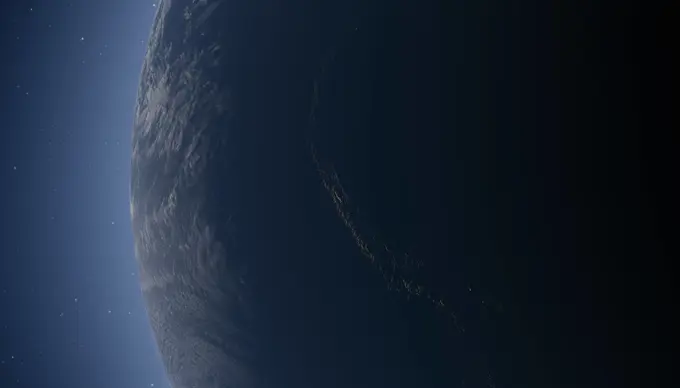
iss047e001114 (March 2, 2016) --- An Expedition 47 crewmember photographed the Earths limb during a starry night pass. One of the International Space Stations solar arrays is seen in the right foreground as the orbital complex flew 258 miles above the Indian Ocean in between Indonesia and Australia.
6145-45065400
ISS040-E-069192 (16 July 2014) --- Intersecting the thin line of Earths atmosphere during an orbital sunrise, the Orbital Sciences Cygnus cargo craft attached to the end of the Canadarm2 robotic arm is berthed to the nadir port of the Harmony node of the International Space Station.
6145-44805791
ISS022-E-068274 (18 Feb. 2010) --- An orbital sunrise is featured in this image photographed by Japan Aerospace Exploration Agency (JAXA) astronaut Soichi Noguchi, Expedition 22 flight engineer, from a window in the newly-installed Cupola of the International Space Station while space shuttle Endeavour remains docked with the station.
6145-44520313
STS102-E-5095  (10 March 2001) --- The Leonardo Multi Purpose Logistics Module rests in Discovery's payload bay in this view taken from the station by a crew member using a digital still camera.
6145-44890296
ISS031-E-066037 (22 May 2012) --- Aurora Australis, accompanied by star streaks and air glow, is pictured in this view recorded by one of the Expedition 31 crew members when the orbital outpost was above a point on Earth located at approximately 49.5 degrees south latitude and 173.9 east longitude or about 290 miles southeast of southern New Zealand.  Two Russian spacecraft, docked to the station, are seen in the foreground.
6177-V53550743
6145-44731387
ISS018-E-006428 (2 Nov. 2008) --- Astronaut Greg Chamitoff, Expedition 18 flight engineer, wears a communication system headset while looking through a window in the Kibo laboratory of the International Space Station.
6145-45087538
N/A
6145-45243606
In this 1986 artist's concept, the Orbital Maneuvering Vehicle (OMV), at right, prepares to reboost the Hubble Space Telescope after being deployed from an early Space Station configuration (left). As envisioned by Marshall Space Flight Center plarners, the OMV would be a remotely-controlled free-flying space tug which would place, rendezvous, dock, and retrieve orbital payloads.
6145-54684516
Earth Observations during Expedition 69. iss069e027354 (July 2, 2023) -- Clouds cover Earth and the orbital lab's solar arrays are shown in the top left corner as the space station orbits 270 miles above the Atlantic Ocean off the coast of Argentina.
6145-58970695
iss063e031761 (June 21, 2020) --- The International Space Station was orbiting over Kazakhstan and into China when this picture of the solar eclipse shadowing a portion of the Asian continent was captured by an external high definition camera. In the left foreground, is the H-II Transfer Vehicle-9 from Japan.
6145-44828828
STS061-98-0AR (8 Dec 1993) --- Earth is partially illuminated but the Hubble Space Telescope (HST) and the Space Shuttle Endeavour are still mostly in darkness, in this 70mm frame photographed during the fourth of five space walks. Astronaut Kathryn C. Thornton, barely visible above left center in the frame, works to install the Corrective Optics Space Telescope Axial Replacement (COSTAR).
6145-45179293
iss056e195853 (Sept. 27, 2018) --- The H-II Transfer Vehicle-7 (HTV-7) from JAXA (Japan Aerospace Exploration Agency) is pictured approaching the International Space Station as both spacecraft were orbiting over the Indian Ocean. Expedition 56 Commander Drew Feustel was waiting to capture the HTV-7 resupply ship with the Canadarm2 as Flight Engineer Serena Auñón-Chancellor backed him up inside the cupola. The HTV-7 took a four and a half day trip to the space station after launching Sept. 22, 2018, from the Tanegashima Space Center in Japan.
6177-V53604546
6145-44529949
ISS003-E-6849 (23 October 2001) --- A Soyuz spacecraft approaches the International Space Station (ISS) carrying the Soyuz taxi crew, Commander Victor Afanasyev, Flight Engineer Konstantin Kozeev and French Flight Engineer Claudie Haignere for an eight-day stay on the station. Afanasyev and Kozeev represent Rosaviakosmos, and Haignere represents ESA, carrying out a flight program for CNES, the French Space Agency, under a commercial contract with the Russian Aviation and Space Agency. This image was taken with a digital still camera.
6145-44772222
ISS020-E-018081 (12 July 2009) --- An unpiloted ISS Progress 33 cargo craft approaches the International Space Station. On June 30, the Progress undocked from the station and was commanded into a parking orbit for its re-rendezvous with the ISS on July 12, approaching to within 10-15 meters of the Zvezda Service Module to test new automated rendezvous equipment mounted on Zvezda during a pair of spacewalks earlier this month by Gennady Padalka and Mike Barratt that will be used to guide the new Mini-Research Module-2 (MRM2) to an unpiloted docking to the zenith port of Zvezda later this year. MRM2 will serve as a new docking port for Russian spacecraft and an additional airlock for spacewalks conducted out of the Russian segment.
6145-45064128
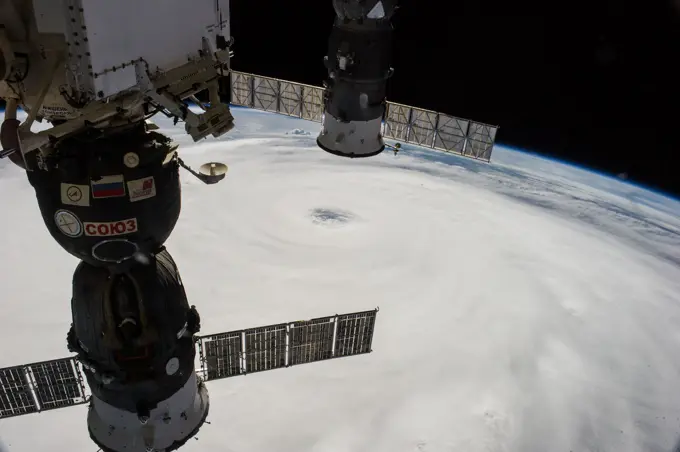
ISS040-E-045603 (7 July 2014) --- The International Space Station, including these two temporarily docked Russian spacecraft, made more than one pass near Typhoon Neoguri on July 7, and Expedition 40 Flight Engineers Reid Wiseman of NASA and Alexander Gerst of the European Space Agency captured its startling dimensions in a day-long series of still photos. In a tweet later in the day, Gerst marveled that even with a fish-eye lens he couldn't capture the whole storm. A 28mm focal length was used for a small sequence of oblique pictures such as this one. The picture was taken at 06:57:32 GMT on July 7, 2014.
6145-44792171
ISS021-E-024520 (12 Nov. 2009) --- Backdropped by a blue and white part of Earth, the new unpiloted Russian Mini-Research Module 2 (MRM2), also known as Poisk, approaches the International Space Station. The MRM2 docked to the space-facing port of the Zvezda Service Module at 9:41 a.m. (CST) on Nov. 12, 2009. It began its trip to the station when it was launched aboard a Soyuz rocket from the Baikonur Cosmodrome in Kazakhstan on Nov. 10. Poisk is a Russian term that translates to search, seek and explore. It will provide an additional docking port for visiting Russian spacecrafts and will serve as an extra airlock for spacewalkers wearing Russian Orlan spacesuits. Poisk joins a Russian Progress resupply vehicle and two Russian Soyuz spacecraft currently docked at the station.
6145-44806343
S130-E-012452 (20 Feb. 2010) --- The empty cargo bay and the aft portion of the Earth-orbiting space shuttle Endeavour are featured in this image photographed by an STS-130 crew member from inside the spacecrafts crew cabin. The panoramic view sweeps across South Africa over the Great Karoo and Little Karoo arid regions, past the Western Cape area to the Cape of Good Hope and the Atlantic ocean.  The Orange River is seen flowing to the Atlantic away from the orbiter along the right hand side of the image.
6188-64642236
Illustration of a serene view of Earth from space showcasing the planet s curvature and the blackness of space against a starry backdrop. boer00070 Copyright: xConnectxImagesx ,property released
6145-44522177
ISS002-E-5121 (5 April 2001) --- The solar panel supporting the Zvezda Service Module on the International Space Station (ISS)  is backdropped against Earth's horizon at dawn. The image was made by one of the Expedition Two crew members using a digital still camera.
6145-44510833
S106-E-5330 (18 September 2000) --- Backdropped against black space above Earth's horizon, the International Space Station (ISS) is seen following its undocking with the Space Shuttle Atlantis. After accomplishing all mission objectives in outfitting the station for the first resident crew, the seven astronauts and cosmonauts undocked at 3:46 GMT on Sept. 18 over Russia near the northeastern portion of  Ukraine. When Atlantis was at a safe distance from the station, about 450 feet, astronaut Scott D. Altman, pilot, performed a 90-minute, double-loop fly around to enable the crew to document the station’s exterior. He fired Atlantis’ jets one final time to separate from the station at 5:35 (GMT) September 18.
6145-44904762
ISS032-E-025603 (9 Sept. 2012) --- Tropical Storm Leslie is clearly seen in the Atlantic Ocean on Sept. 9, 2012, as photographed by one of the Expedition 32 crew members aboard the Cupola of the International Space Station. At the time of the photo, Leslie was centered near 33.4 degrees north latitude and 62.1 degrees west longitude (approximately 175 miles east-northeast of Bermuda) moving northward at 14 miles per hour with winds of 60 miles per hour. The HTV-3 (H-II Transfer Vehicle) of the Japan Aerospace Exploration Agency (JAXA), which will be disconnected from the orbital outpost and sent to fall into Earth's atmosphere after fully completing its mission, is in the upper left corner.
6145-44952257
Earth observation taken by the Expedition 35 crew aboard the ISS. The Canadarm2 Space Station Remote Manipulator System (SSRMS) is in view.
6145-52961238
. DCIM100GOPROGOPR2059.
6145-44824433
S66-54559 (14 Sept. 1966) --- Gulf Coast from Corpus Christi, Texas, to mouth of Mississippi River, as seen from the Gemini-11 spacecraft during its 29th revolution of Earth. This photo was taken near sunrise.
6145-44886026
ISS030-E-254053 (22 April 2012) ---  An unpiloted Progress resupply vehicle approaches the International Space Station, carrying 2.8 tons of food, fuel and supplies. The cargo delivery includes 1,988 pounds of propellant, 110 pounds of oxygen and air, 926 pounds of water and 2,703 pounds of spare parts, resupply items and experiment hardware for the residents of the space station. Progress 47 docked to the station's Pirs Docking Compartment at 10:39 a.m. (EDT) on April 22, 2012. The points below are centered at approximately 36.6 degrees north latitude and 20.0 degrees east longitude. Recognizable are the northeast part of the Greek Island of Corfu; the strait of Corfu (center); and the Greek-Albanian mainland (top-top right).  The city of Kerkyra (Corfu) is on seen the island at bottom-center.
6145-44645586
ISS013-E-05884 (11 April 2006) --- A setting sun and the thin blue airglow line at Earth’s horizon was captured in this image photographed by an Expedition 13 crewmember from a window on the International Space Station. Station solar array panels are visible at right.
6145-44917829
ISS034-E-005476 (2 Dec. 2012) --- One of the Expedition 34 crew members aboard the International Space Station captured this still image of Super Typhoon Bopha on Dec. 2, 2012.  The storm was bearing down on the Philippines with winds of 135 miles per hour. Meteorologists are predicting that the storm will make landfall on Mindanao in the early morning of Dec. 4 local time, as either a category 4 or 5. Parts of the orbital outpost are seen in the picture -- the Permanent Multipurpose Module on the left, and Mini-Research Module 1 (MRM1) on the right.
6177-V54005682
6145-45064108
Earth Observation taken during a day pass by the Expedition 40 crew aboard the International Space Station (ISS). Folder lists this only as Hurricane Arthur wide angle.
6145-44982188
View of three cube satellites (Cubesats), or nanosatellites, shortly after deployment. Image was released by astronaut on Twitter.
6145-44975746
ISS037-E-003534 (29 Sept. 2013) --- The first Cygnus commercial cargo spacecraft built by Orbital Sciences Corp. is photographed by an Expedition 37 crew member on the International Space Station during rendezvous and docking operations. The two spacecraft converged at 7:01 a.m. EDT on Sept. 29, 2013.
6145-45130703
As depicted in this illustration, NASA's Cassini will plunge into Saturn's atmosphere on Sept. 15, 2017.
6145-44733257
ISS018-E-008678 (16 Nov. 2008) --- Backdropped by a cloud-covered part of Earth, Space Shuttle Endeavour approaches the International Space Station during STS-126 rendezvous and docking operations. Docking occurred at 4:01 p.m. (CST) on Nov. 16, 2008. The Leonardo Multi-Purpose Logistics Module is visible in Endeavour's cargo bay with over 14,000 pounds of cargo for the space station.
6145-45026741
ISS030-E-005118 (22 Nov. 2011) --- A dust plume over the Bahia Blanca, Argentina is featured in this image photographed by an Expedition 30 crew member on the International Space Station. This panoramic view of eastern Argentina and the Atlantic coastline is centered near Bahia Blanca, which is also highlighted by sun glint. The oblique view looks generally westward (and downwards) from the orbital position of the space station towards a large plume of dust blowing southeastward from the interior and over the open Atlantic Ocean. The only significant cloud cover was located offshore (upper left). Northwestern and central Argentina are subject to frequent dust storms where a combination of extensive late Pleistocene loessfine sediments deposited by wind and typically associated with former continental glaciersand strong, dry westerly winds descending from the Andes, known locally as the pampero sucio, combine to produce sudden and extensive clouds of the fine soil. The particular dust
6145-44890946
ISS031-E-070943  (25 May 2012) --- Backdropped against the Namib Desert  on the Atlantic coast of Namibia, the SpaceX Dragon commercial cargo craft approaches the International Space Station on May 25, 2012 for grapple and berthing. Expedition 31 Flight Engineers Don Pettit and Andre Kuipers grappled Dragon at 9:56 a.m. (EDT) with the Canadarm2 robotic arm and used the robotic arm to berth Dragon to the Earth-facing side of the station's Harmony node at 12:02 p.m.
6145-45253610
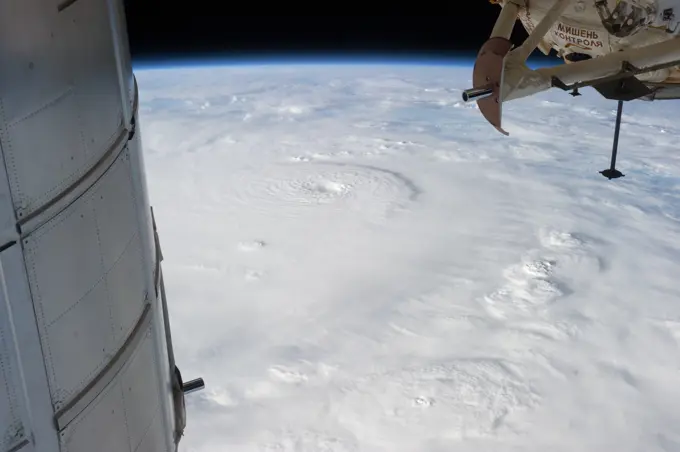
ISS012-E-22031 (30 March 2006) --- Cyclone Glenda and a docked Soyuz spacecraft are featured in this image photographed by an Expedition 12 crewmember on the International Space Station.
6145-44599851
ISS007-E-12866 (17 August 2003) --- This photo showing the Manicouagan Reservoir in Quebec, Canada, and a partial view of a solar array panel was taken by an Expedition 7 crewmember onboard the International Space Station (ISS).
6145-45153869
iss054e042067 (Feb, 12, 2018) --- NASA astronaut Scott Tingle captured a photo of the Bahamas from the vantage point of the International Space Station.
6145-44529414
ISS003-E-5614 (17 September 2001) --- The Russian docking compartment Pirs approaches the International Space Station (ISS).  The Pirs will provide a docking port for future Russian spacecraft as well as an airlock for extravehicular activities (EVA).
1746-19661400
Eruption of Sarychev Peak Volcano, Kuril Islands, north-eastern Japan, 12 June 2009, viewed the International Space Station. The white matter on the side of the volcano is pyroplastic flow. Credit NASA. Science Geology Vulcanology
6145-44510619
S106-E-5302 (18 September 2000) --- The International Space Station (ISS) is seen with the U.S.-built Unity node facing the camera, following its undocking with the Space Shuttle Atlantis. After accomplishing all mission objectives in outfitting the station for the first resident crew, the seven astronauts and cosmonauts undocked at 3:46 (GMT) on Sept. 18 over Russia near the northeastern portion of Ukraine. When Atlantis was at a safe distance from the station, about 450 feet, astronaut Scott D. Altman, pilot, performed a 90-minute, double-loop fly around to enable the crew to document the station’s exterior. He fired Atlantis’ jets one final time to separate from the station at 5:35 GMT, September 18.
6145-45097714
iss044e065321 (Aug. 24, 2015) --- JAXA's (Japan Aerospace Exploration Agency) H-II Transfer Vehicle-5, also known as the "Kounotori," is pictured during Expedition 44 approaching the International Space Station as both spacecraft orbited above the Sahara Desert.
6145-45087244
N/A
6145-44529948
ISS003-E-6847 (23 October 2001) --- A Soyuz spacecraft approaches the International Space Station (ISS) carrying the Soyuz taxi crew, Commander Victor Afanasyev, Flight Engineer Konstantin Kozeev and French Flight Engineer Claudie Haignere for an eight-day stay on the station. Afanasyev and Kozeev represent Rosaviakosmos, and Haignere represents ESA, carrying out a flight program for CNES, the French Space Agency, under a commercial contract with the Russian Aviation and Space Agency. This image was taken with a digital still camera.
6145-44829919
ISS024-E-012796 (29 Aug. 2010) --- Hurricane Earl is featured in this Aug. 29 image photographed by an Expedition 24 crew member on the International Space Station.
1899-34964
Niuafo'Ou Volcano, Tonga Islands, True Colour Satellite Image. Niuafo'ou volcano, Tonga, true colour satellite image. Niuafo'ou (250m) is an active volcano located in the Tonga archipelago. Image taken on 28 January 2000 using LANDSAT data. Print size 30 x 30 cm.
PREVIOUS
of 3
NEXT
2401 S. Ervay, Suite 206
Dallas, Texas 75215
United States
Get Started
Free ResearchMy BoardsMy Cart
For Creators
How To License Your ContentContributor PortalFrame of Mind
Resources
API accessPricing
Contact
+1 866 236 0087help@viewpictures.co.uk Contact form
©2026 View Pictures. All Rights Reserved. -A
This site is protected by reCAPTCHA and Google Privacy Policy and Terms of Service apply.