Intricate Lace Designs

Delicate lace trims and appliqués with floral and intricate patterns, highlighting craftsmanship from various periods, suitable for fashion or decor.

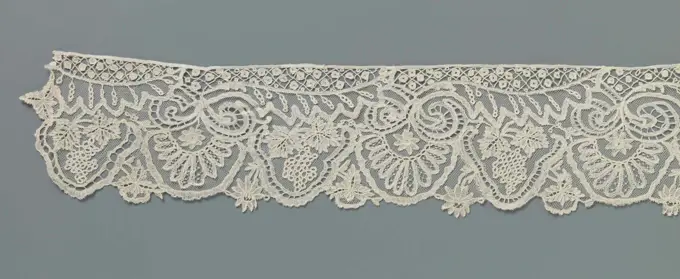
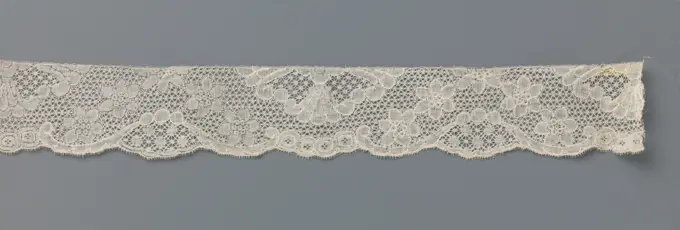
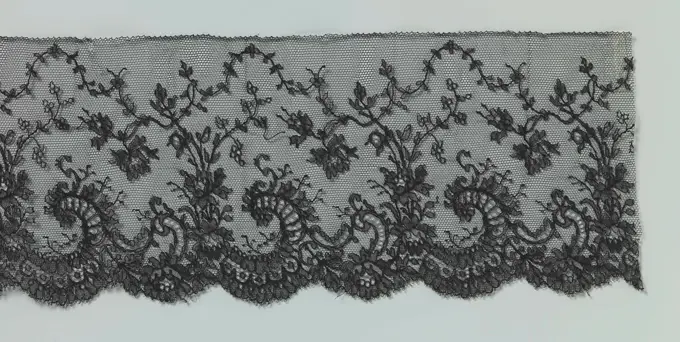
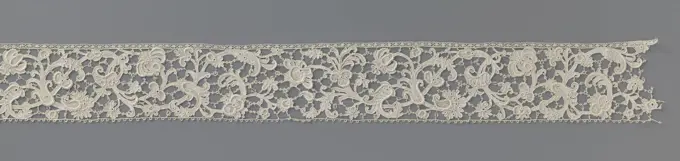
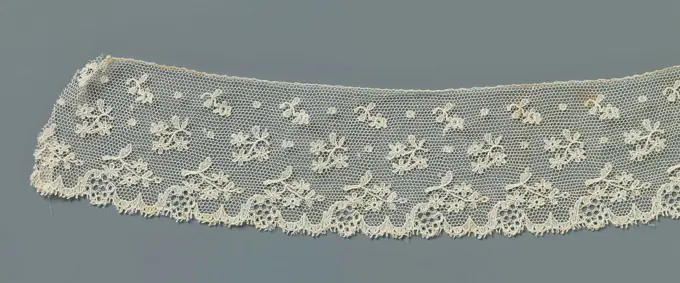
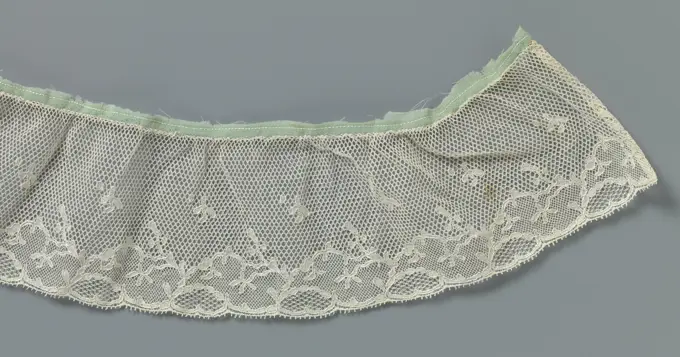
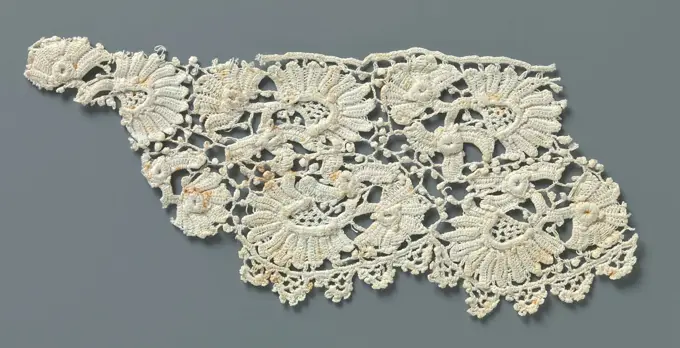
Strip lace with V-shaped motif above clamped shell, anonymous, c. 1700 - c. 1899 Strip of natural-colored needle side: Burano side. The symmetrical pattern consists of a V-shaped motif above an open shell that lies along the bottom of the strip. The V is formed by a row diagonally stacked leaves, with a larger drop -shaped and curlinged leaf at the top. A stem with three rosette flowers bends down from this leaf. The stem ends with a leaf that lies along the underside of the strip and whose top touches the shell. In the V-shaped field there is an as-symmetrical motif at the top with a rosette flower between three more or less oval flowers or shapes. The motifs are connected by a Maas soil, a Burano ground. Different decorative grounds have been used. Among other things between rosette flowers and in the decorative tires along the underside of the strip. The top of the strip is straight finished. The silly outskirts of scales along the underside of the strip stems from the pattern. BURA
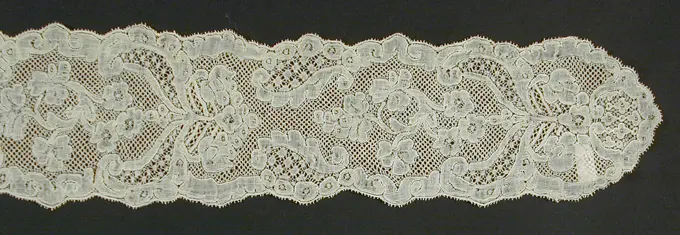
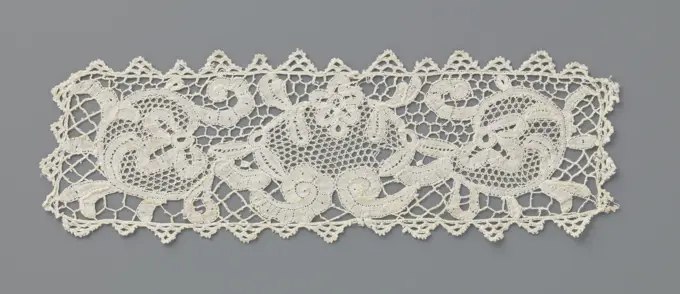
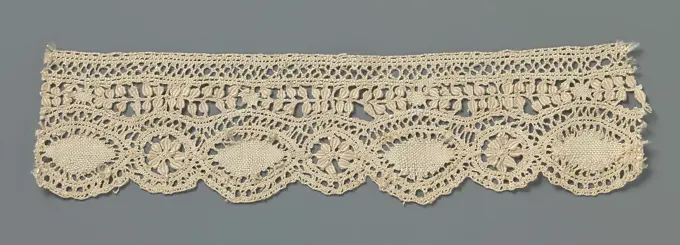
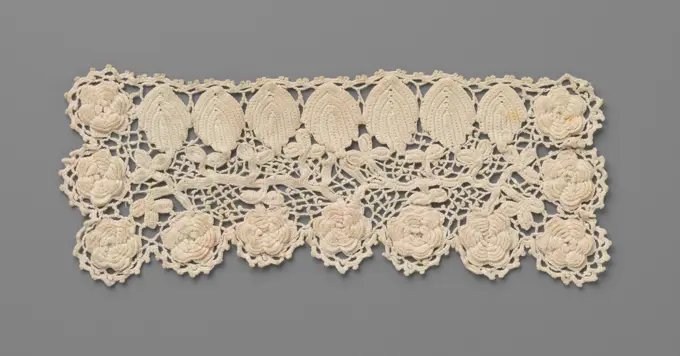
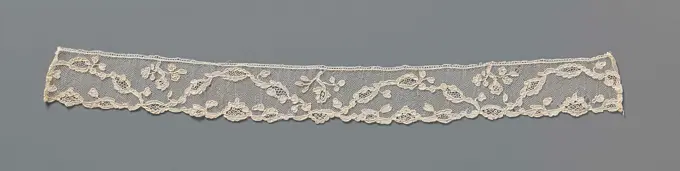
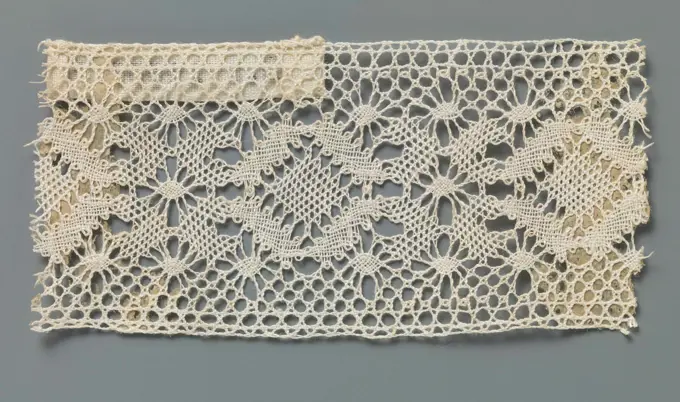
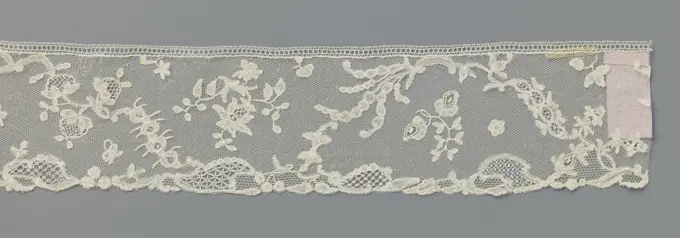
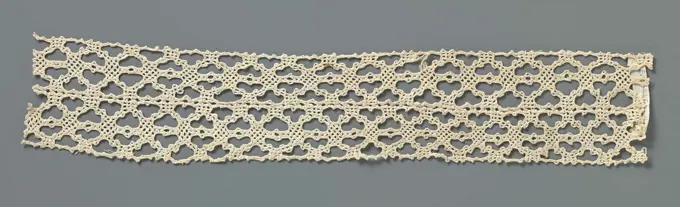
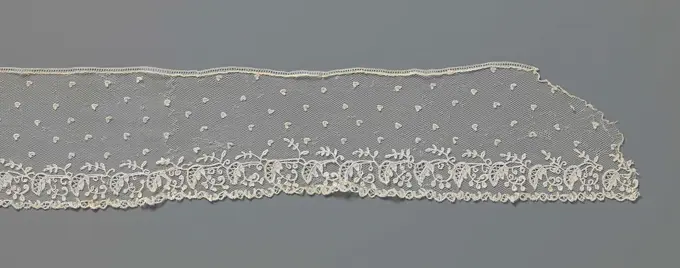
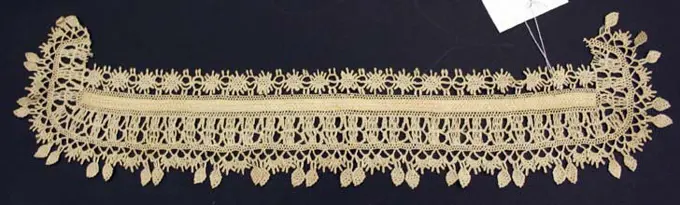
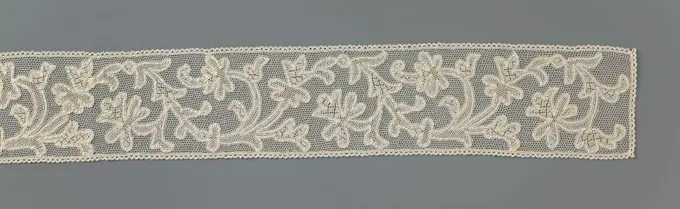
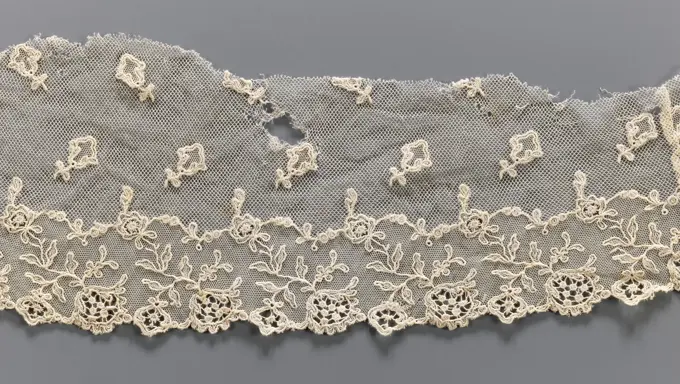
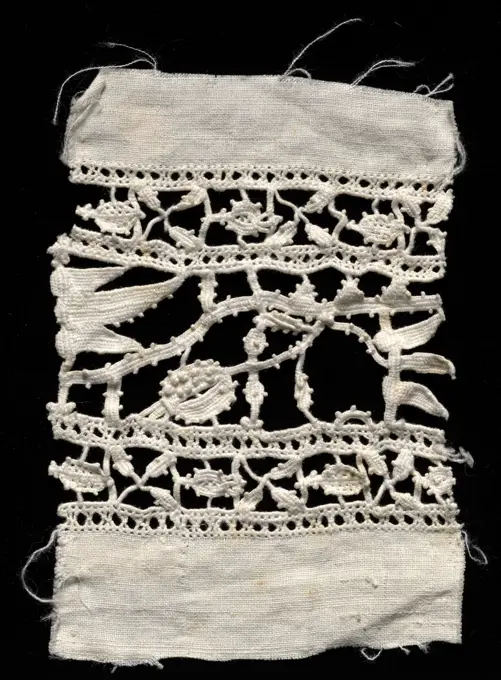
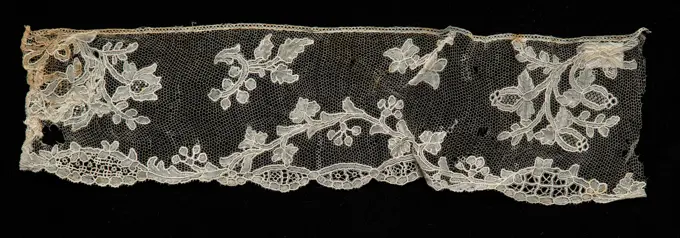
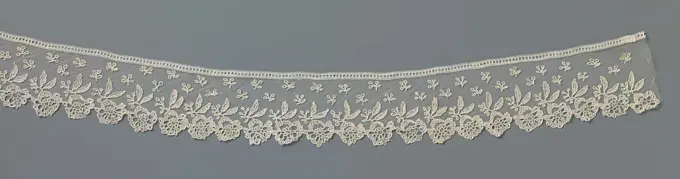
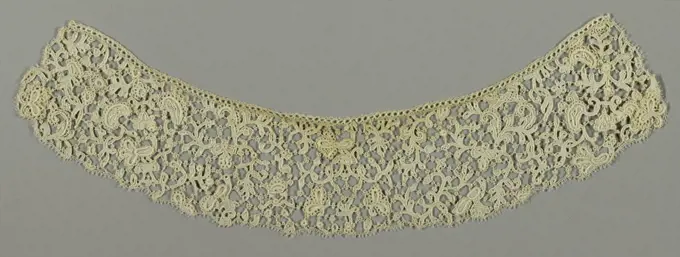
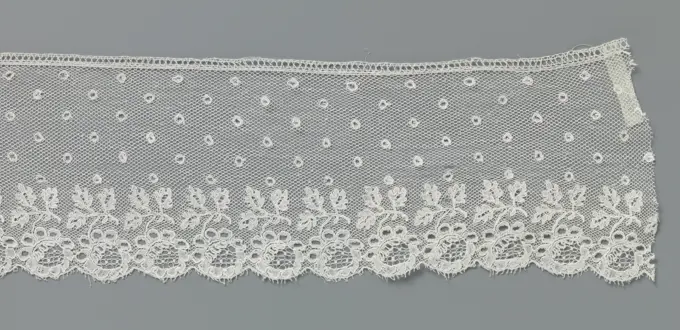
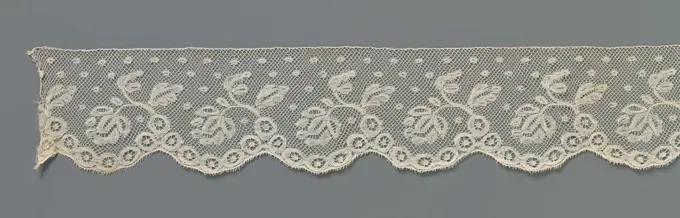
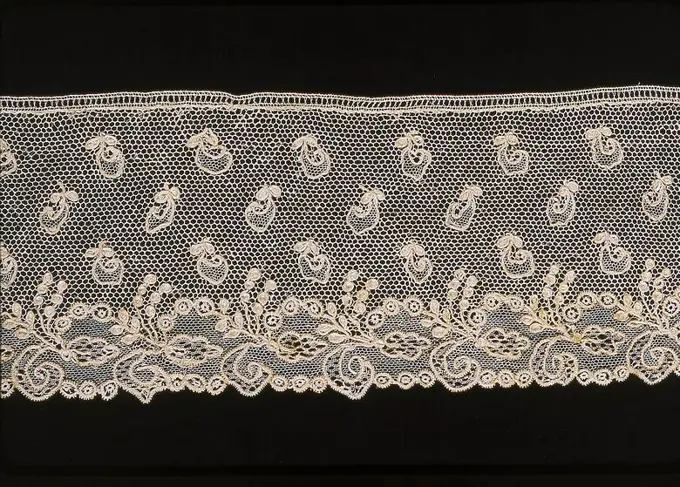
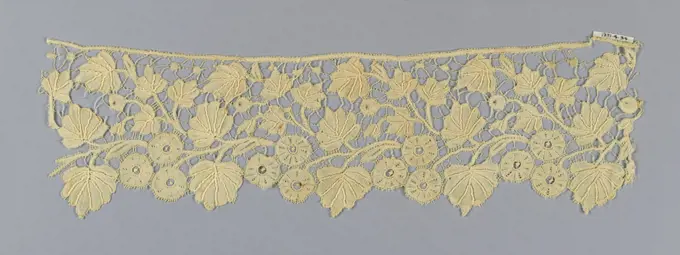
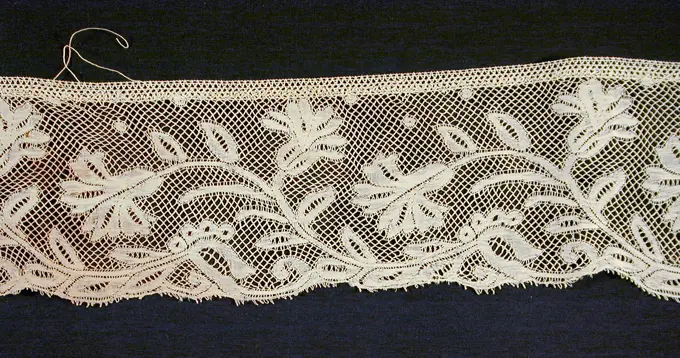
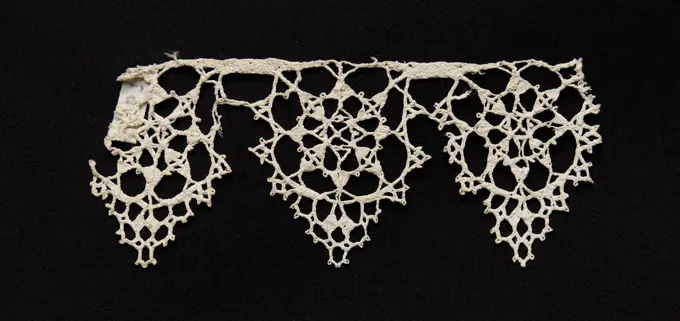
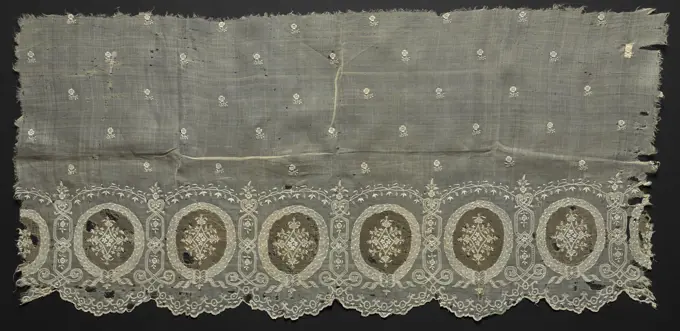
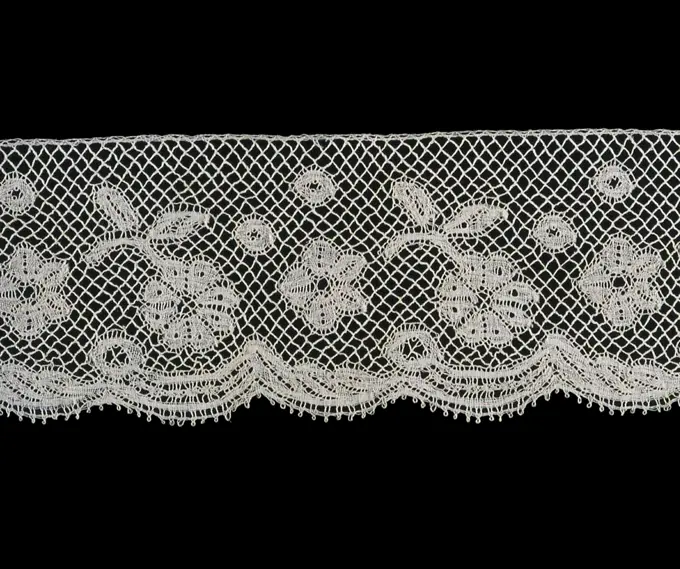
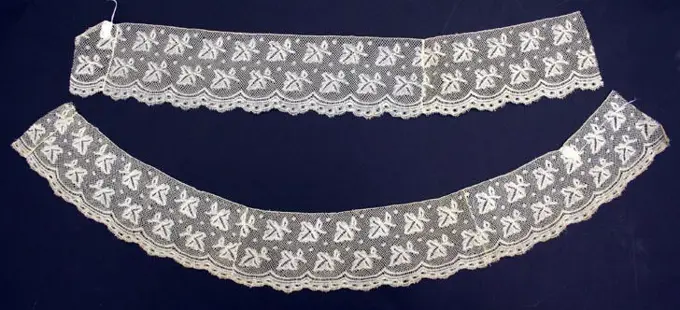
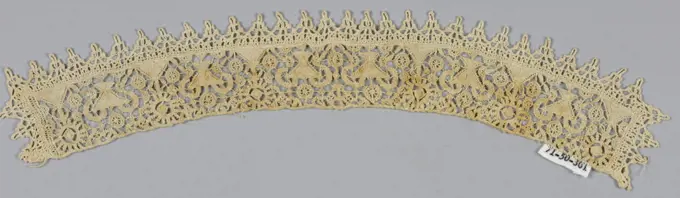
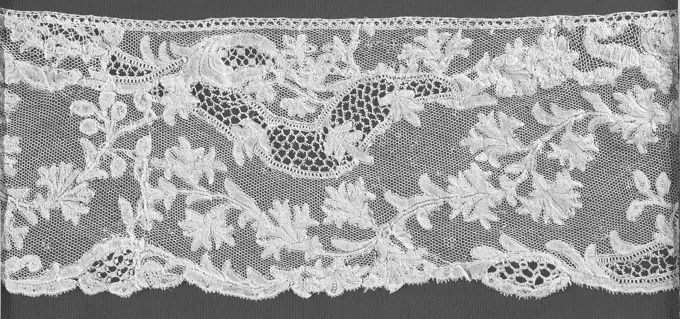
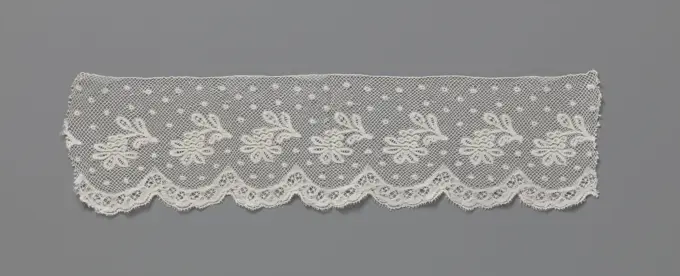
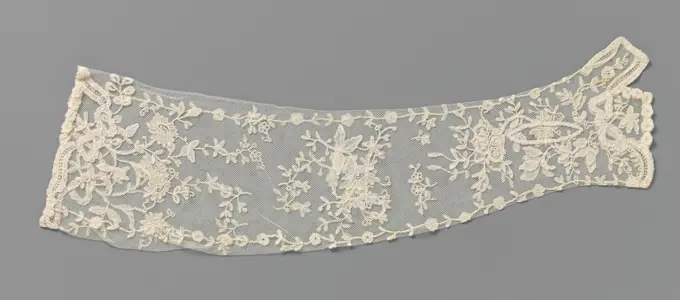
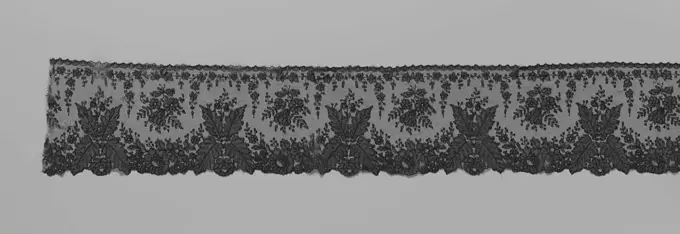
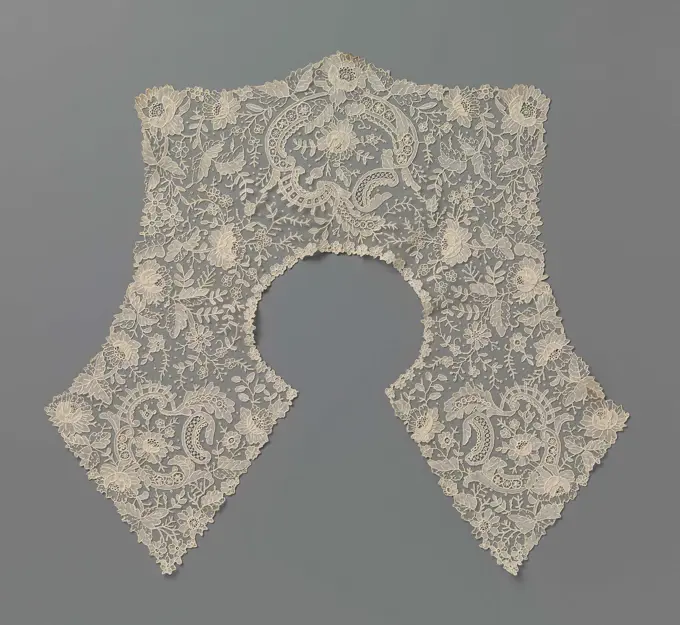
Strook applicatiekant met druiventrossen en gehalveerde bladeren.Strip natural colored application side, climbing side applicated on machine tulle. A narrow part, along the inside, exhibits a running pattern of halved, lobed leaves, which accompanies an equally halved medallion with a raster filling. On a wide part with a substrate of tulle, symmetrical, deep slot, which are in turn are filled with a grinding tray and a fan plant.Pair of Lappets (joined). Belgium, Mechlin, mid-18th century. Costumes. Linen and silk Mechlin bobbin lace on five-hold mesh groundStrook gemengde kant met brede spiraalrank.Strip natural-colored mixed side - Mezzo Punto - with a splitting or woven ribbon and a needle lace ground. On a Maas soil (needle side) is a pattern that consists of wide curly stems with exotic flowers. The contours of the flowers and stems consist of closted or woven ribbons. Different ornamental grounds (needle side) have been applied within the contours. A splitting bow border serves as a finish along the outer sides, with the exception of one long side that is finished with a straight red strap.Bobbin Lace Edging, mid 18th century. Belgium, Mechelen, mid 18th century (Louis XV period). Lace, bobbin; average: 7 x 28.9 cm (2 3/4 x 11 3/8 in.).Border, Medium: linen Technique: bobbin lace, Binche style with snowflake ground, Border of Binche style lace with a scroll pattern., Belgium, 17th-18th century, lace, BorderStrip lace with V-shaped motif above clamped shell, anonymous, c. 1700 - c. 1899 Strip of natural-colored needle side: Burano side. The symmetrical pattern consists of a V-shaped motif above an open shell that lies along the bottom of the strip. The V is formed by a row diagonally stacked leaves, with a larger drop -shaped and curlinged leaf at the top. A stem with three rosette flowers bends down from this leaf. The stem ends with a leaf that lies along the underside of the strip and whose top touches the shell. In the V-shaped field there is an as-symmetrical motif at the top with a rosette flower between three more or less oval flowers or shapes. The motifs are connected by a Maas soil, a Burano ground. Different decorative grounds have been used. Among other things between rosette flowers and in the decorative tires along the underside of the strip. The top of the strip is straight finished. The silly outskirts of scales along the underside of the strip stems from the pattern. BURAKloskant investment piece with volutes, anonymous, c. 1910 - c. 1930 Investor of natural -colored bobbin, possibly Flemish guipure. Symmetrical pattern with volutes of which three, four and five-leaf flowers spring. A braided bar with picots around the motifs. A honeycomb land within the motives. Finishing on all sides with triangles built from arches. Belgium  bobbin lace / Flemish guipure lace Investor of natural -colored bobbin, possibly Flemish guipure. Symmetrical pattern with volutes of which three, four and five-leaf flowers spring. A braided bar with picots around the motifs. A honeycomb land within the motives. Finishing on all sides with triangles built from arches. Belgium  bobbin lace / Flemish guipure laceStrook kloskant met spitsovaal en bloem in cirkel onder een lijn met aan weerszijden blaadjes.Strip natural colosside, maltese side. The repeating pattern consists of a wide ornamental edge along the top, from a more or less straight line with spitsoval leaves on either side. The line is interrupted by a circle around the many leaves. The lower half of the pattern consists alternately from a spinner and a circle, with openworked decorative edges. There is a flower with eight spiral petals in the circle. The motifs are connected by braiding. The motifs are made in linen stroke. The (flower) leaves are made in shape stroke. Such a sheet is known in Maltese as a maltese top. The top is just finished. Pointovals and circles are shot along the underside.Fragment; linen; 1938-23-25Capslip of needle side with hanging flowers, anonymous, c. 1760 - c. 1790 The elongated sculptures of a wavy ribbon, interspersed by medallions with gridwork, form the outer edges of a soil, on which it turns a wavy branch with hanging flowers and pomegranates and a short flower branch. In the strip, the pattern is symmetrical to a standing middle branch. Alençon side. France linen (material) Alençon Lace The elongated sculptures of a wavy ribbon, interspersed by medallions with gridwork, form the outer edges of a soil, on which it turns a wavy branch with hanging flowers and pomegranates and a short flower branch. In the strip, the pattern is symmetrical to a standing middle branch. Alençon side. France linen (material) Alençon LaceLengths of Lace. Belgium, made circa 1740-1750; altered 19th century. Textiles; textile lengths. Linen Brussels bobbin lace on machine netManchet van gehaakte kant met reliëfrozen als schulpenrand.Cuff of natural colored Irish crochet side. Rectangular model. A sloping edge of co-switched relief roses runs along three sides. A row of diamond-shaped leaves is located along one long side. In the narrow midfield two horizontal stems with three-piece leaves. The motifs are connected by a diamond-shaped network with picots. Along the roses a thongrom runs along the outside, which passes into a picro edge above the diamond-shaped leaves.Strip bobbin with three -lobe flower and slanted flower branch, anonymous, c. 1725 - c. 1749 Strip of natural -colored bobbin: Mechelse side. The repeating pattern consists of a three -lobe flower a slanted twist. Both motifs arise from the edge, where the leaves of the lobed flower seem to be halved. The motifs are connected by a Maas soil. The motifs are made in linen battle with few recesses and with thicker and shiny contour threads. A decorative land has been used in the heart of the lobed flower. Top and bottom of the strip are straight finished, with picots on one side. Southern Netherlands linen (material) bobbin lace / Mechlin (lace) Strip of natural -colored bobbin: Mechelse side. The repeating pattern consists of a three -lobe flower a slanted twist. Both motifs arise from the edge, where the leaves of the lobed flower seem to be halved. The motifs are connected by a Maas soil. The motifs are made in linen battle with few recesses and with thicker and shiny contour threads. Strip bobbin with an arc of six -leaf flowers and fan, anonymous, c. 1750 - c. 1760 Strip of natural-colored bobbin, binche side. The pattern consists of an alternation of two symmetrical compositions. One composition consists of an arc of five flowers with six petals, with the upper flower, which is against the top edge, halved. Under the arch is a rush -in cartouche along the lower edge. The other composition consists of a fan -shaped motif hanging down from the top edge. Under the fan there are four connected circles that look like buttons along the lower edge. The scalloped underside is created from the pattern. The motifs are connected by a mesh ground, a snowflake soil. The motifs are made in linen battle with thicker and shiny contour threads. A coarser snowflake land was used in the rushally -shaped cartouche and in the fan, combined in the cartouche with rosette flowers without contour threads. The top is straight. Southern Netherlands linen (material) Bobbi Lace / Binche LaceStrip 16th century Italian, Genoa. Strip 220869Border; 1974-52-57Strook naaldkant met bogen van ovale cartouches.Strip natural-colored coniferous lace: Alençon side. Pattern of half circles of arches with oval cartouches on a fine hexagonal Maas soil. The cartouches are connected to each other by a narrow leaf garland. Three cartouches in the arc and three along the lower edge per half circle. The arches themselves are also connected by a cartouche along the lower edge. A hanging flower branch from the top edge in the space between the arches, in two variations. Full work without recesses in the flowers and leaves and ornamental grounds in the cartouches and in the heart of the flowers. Slight slip ridge along the bottom. The top is trimmed with a border clamping side.Tussenzetsel van kloskant met een rij ruiten omringd door spitsovaaltjes.Strip natural colosside: straw side. The repeating pattern consists of a row of diamonds surrounded by spitskaljes. The diamonds are made in a crossblank with a line in linen stroke along each side with an interruption at the points. The motifs are connected along the underside and the top of the strip by a nozzle ground. Upper and bottom of the strip are straight finished.Bed curtain border 1800-1850 Russian. Bed curtain border 173365Strip bobbin with arches and loose flower branches, anonymous, c. 1740 - c. 1760 Strip of natural -colored Brussels bobbin. The repeating pattern consists of arches, in which a symmetrical arch is interspersed by two mirrored as-symmetrical arches. In the fields under the arches and in between there is always a large loose flower branch and a few loose flowers or leaves. The pattern along the underside of the strip consists of a succession of different forms of cartouches, elongated leaves and rosette flowers. The motifs are connected by a fine Maas soil, a drachel soil. The motifs are made in linen battle with openwork edges and are largely equipped with burst relief contours. Different decorative lands have been applied, mainly in the cartouches along the underside and in a few flower hearts. The top is finished with a separate strap. The faintly scalloped underside stems from the pattern with the cartouches and is finished with picots. Brussels linen (material) bobbin lace / BrusselInsertion 16th century Italian, Genoa. Insertion 220941Strip of needle side with lying branch with three flowers under moesjes, anonymous, c. 1825 - c. 1835 Strip of natural-colored needle side: Alençon side. Under a spreading pattern of three rows of moesjes, the repeating pattern consists of a horizontal flower branch. The successive branches are directed to the left and each have three flowers, a few small leaves and one larger drop -shaped leaf. The largest of the three flowers are alternately with the drip -shaped leaf the Schulpenrand along the bottom of the strip. The two smaller flowers are on the other side of the branch and stick in the bottom row between the mosjes. The motives are made up of feston stitches and are accentuated by relief contours. Decorative grounds have been used in the flowers and in the drop -shaped leaf. The motifs are connected by a fine Maas soil, an alençon ground. The top of the strip is straight finished with a tie. Alençon linen (material) Alençon Lace Strip of natural-colored needle side: Alençon sideFragment; linenStrip bobbin with oval formed by curved leaves, anonymous, c. 1830 Strip of natural -colored bobbin: Lille side. The upper half of the strip has no pattern. The repeating pattern along the bottom half consists of two curved leaves that together form an interrupted oval with a flower in the center. This flower is attached to the upper leaf. There are five flowers on the lower leaf, which form a fan -shaped shell. The motifs are placed close together, with the flowers merging at the bottom. The motifs are connected by a fine grid, a tuler land. The motifs are made in linen battle with large recesses and with thicker, shiny contour threads. The top of the strip is straight finished. The scums along the bottom are finished with picots. Lille cotton (textile) bobbin lace / Lille lace Strip of natural -colored bobbin: Lille side. The upper half of the strip has no pattern. The repeating pattern along the bottom half consists of two curved leaves that together form an interrupted oval with a Strip bobbin with a three -lobe leaf between two rosette flowers, anonymous, c. 1900 - c. 1924 Strip of natural -colored bobbin: fine bridge flower arrangements. The pattern consists of a three -lobe leaf between two rosette flowers. The motifs are on a straight strap on the top and connected to each other by a few picoted braids. The straight strap and the three -lobe leaf are made in linen battle, with contour threads within the openwork edges and with recesses such as leaf grafts. The petals of the rosette flowers are made in netslag with contour threads and the flower hearts are made in linen battle, with one block made in staging in each open -up center. The top of the strip is straight finished. The flowers and the leaf form the scrap edge along the bottom, which is finished with picots. Belgium cotton (textile) bobbin lace Strip of natural -colored bobbin: fine bridge flower arrangements. The pattern consists of a three -lobe leaf between two rosette flowers. The motifs are on aFragments of needle lace unknownFragment, A .G. Jennings & Sons, American, Medium: cotton Technique: machine made lace, Valencienne-type with embroidered details., USA, ca. 1884, lace, FragmentTussenzetsel van een dubbele strook kloskant met zeshoeken.Natural colosside intersection, made of two strips sewn together in length. The pattern is based on a sixteenth-century example and is reminiscent of Reticella. It consists of a row of hexagons per strip with a dense maas soil that are connected to each other with braiders from the corners. The pattern continues in the top and bottom edge, but is interrupted halfway through a straight finish with picots. The pattern on the center line, where the strips are sewn together, do not fit precisely.Fragment of punto in aria needlelace unknownFragment; linen; Bequest of Marian Hague; 1971-50-415Strook applicatiekant met hartjes strooipatroon.Strip natural-colored application side, dick side on slighten ground. Scattering pattern of hearts on a very fine hexagonal clooted mesh soil, with a repetitive and continuous motif of a C-shaped flower with zigzag and curled leaf twigs. The picoted bottom edge consists of a concatenation of small open circles and lying c shapes, which form fine scallops. Motifs with closted relief contours, ribs. One kind of decorative stitch (needle side stitch). The top is trimmed with a border clamping side.Collar early 19th century Croatian. Collar 98167Strook naaldkant met vallende bloesem.There are circular flowers placed in oblique rows with a downward twig in sloping rows. Standing arcs, supporting round medallions form a border together with a triple bow garland. Alençon sideStrook gemengde kant met brede spiraalrank.Strip natural-colored mixed side - Mezzo Punto - with a splitting or woven ribbon and a needle lace ground. On a Maas soil (needle side) is a pattern that consists of wide curly stems with exotic flowers. The contours of the flowers and stems consist of closted or woven ribbons. Different ornamental grounds (needle side) have been applied within the contours. A splitting bow border serves as a finish along the outer sides, with the exception of one short side that is finished with a straight splitting strap.Fragment of the lace;  19th century (1801-00-00-1900-00-00);Piece 18th century Flemish. Piece 214548Fragment of Needlepoint (Reticella and Cutwork) Lace, 17th century. Italy, Venice, 17th century. Lace, needlepoint: linen; average: 13.1 x 8.9 cm (5 3/16 x 3 1/2 in.).Strip bobbin with rocailles and pineapples, anonymous, c. 1700 - c. 1724 Strip of natural -colored bobbin: old Brabant side. For a Rochet or Superplie. The pattern has two varied symmetrical compositions, which are triangular in shape and where the motifs are connected by an irregular braid of ground with picots. One composition consists of sloping rocailles that form two lines of a triangle in which four crosses, or four -point stars, and round shapes or berries are caught. In the other composition, a large pineapple or pomegranate fills the triangle, which is further filled by a round motif and flowers and leaves. The motives are made in loosely worked linen battle and mains, with very sparingly occurring relief contour lines. The top is finished with a cracked edge with a woven edge above it. The scrap edge on the underside stems from the pattern. The ends are sewn together. In the woven edge, a few marks and/or letters are sewn with colored wire, a s, a t (or a plus sign) and a W, Needlepoint (Burano Point) Lace Edging, 18th century. Italy, Burano, 18th century. Lace, needlepoint: linen; average: 6.4 x 24.2 cm (2 1/2 x 9 1/2 in.).Strip bobbin with French lily, anonymous, c. 1890 Strip of natural-colored bobbin, Valenciennes side. A wavy richly decorated pendulum forms scoops along the underside of the strip. A French lily stands above every shell on the middle track. The motifs are connected by a Maas soil, a diamond-shaped Valenciennes ground. The motifs are made in linen battle with recesses and openwork edges. Couples crossing, among other things, decorate the open -worked winding ribbon and the recesses in the French lily. The top of the strip is straight finished. The scums along the bottom are finished with picots. France cotton (textile) Bobbi Lace / Valenciennes Lace Strip of natural-colored bobbin, Valenciennes side. A wavy richly decorated pendulum forms scoops along the underside of the strip. A French lily stands above every shell on the middle track. The motifs are connected by a Maas soil, a diamond-shaped Valenciennes ground. The motifs are made in linen battle with recesses and openwork edges. CStrip bobbin with hanging twigs, anonymous, c. 1780 - c. 1795 Strip of natural -colored bobbin, Parisian side. The repeating pattern consists alternately of a small loose twig and a larger twig. Both hang down, with the oval flower on the larger branch touching the underside of the strip. The motifs are connected by a Maas soil, the Paris soil. The motifs are made in linen battle with thicker and shiny contour threads. The top is straight. The very faintly scalloped underside is equipped with picots. Southern Netherlands linen (material) bobbin lace / Paris lace Strip of natural -colored bobbin, Parisian side. The repeating pattern consists alternately of a small loose twig and a larger twig. Both hang down, with the oval flower on the larger branch touching the underside of the strip. The motifs are connected by a Maas soil, the Paris soil. The motifs are made in linen battle with thicker and shiny contour threads. The top is straight. The very faintly scalloped underside is equipped Strook met hangende bloemen.Strip natural colored application side, needle side applicated on machining tulle, point d'Angleterre. An edge of round slot is formed by a contiguous row of large flowers that depend on the right, of small flower branches. Loose up there is a narrow road of a wavy branch with smaller similar flowers. The upper part consists of a fond of undelinded tulle. Two narrower strips have the same, and a reduced pattern.Cuff from crocheted side with loose stems and layered rosette flowers, anonymous, c. 1890 - c. 1910 Cuff made from two strips of natural -colored Irish crocheted side on a strip of white cotton. The pattern of the strip used as intermediate sinks consists of two separate stems with a three -piece leaf, interspersed with a loose stem with a layered rosette flower. The pattern of the other strip consists of a loose stem with three -part leaves interspersed by a loose stem with a layered rosette flower on either side. The regular semicircular scallops on the underside are trimmed with picoted arches. The soil with square meshes in both strips is reminiscent of the knotted network side network. Ierland (possibly) cotton (textile) Cuff made from two strips of natural -colored Irish crocheted side on a strip of white cotton. The pattern of the strip used as intermediate sinks consists of two separate stems with a three -piece leaf, interspersed with a loose stem with a layered rosette flowerFragment, Medium: linen Technique: needle lace, Fragment of elaborate coral shapes. Pattern outlined by cordonnet and connected by brides picotées, interspersed by portes and gaze quadrillée., Belgium or Italy, 18th century, lace, FragmentPiece 18th century Flemish or Italian. Piece 214475Strip of bobbin with a scales of hanging roses under spreading pattern of openwork circles, c. 1800 - c. 1820 Strip of natural -colored bobbin: Mechelse side. Under a spreading pattern of openwork circles, the repeating pattern consists of the underside of the strip from a succession of one hanging rose, on a curved stalk with three leaves. The motifs are connected by a fine Maas soil, a Mechelen soil. The motifs are made in linen battle with recesses and thicker and shiny contour threads. In the Bloemharten, a decorative land has been used with a coarser mesh soil, decorated with mosques made in shape. The top of the strip is finished with a separate strap. The scrap edge along the bottom comes from the pattern and is finished with picots. One short side is also finished with picots in a continuous line and with a rounded angle from the bottom. Southern Netherlands linen (material) bobbin lace / Mechlin (lace) Strip of natural -colored bobbin: Mechelse side. Under a spreading pattern Strook kloskant met bloem en schulpenrand met cirkels.Natural collate strip, Valenciennes side. The repeating pattern consists of a one-sided curved flower stalk with one flower, which hangs down in the middle of a shell. Along the tubular edge, a decorative belt of co-switched circles, with a snowflake in every open work center. The successive flower stems always escue to the highest circle in the decorative tire. The motifs are connected by a maas soil, a diamond-shaped valenciennes ground, strewn with moes. The motifs are made in linen battle with recesses and open editors. Crossing couples decorate the recesses in the petals, among other things. The top of the strip is straight finished. The shelters along the underside are finished with picots.Doubled strip of needle side with heart -shaped slens, anonymous, c. 1690 - c. 1699 Strip of natural -colored needle side: flat Venetian side. On a soil of regular six-sided meshes is a fine pattern of two symmetrical, heart-shaped slens connected by serpentine ranks. Straight finish of large triangles. Venice linen (material) flat Venetian (needle point) Strip of natural -colored needle side: flat Venetian side. On a soil of regular six-sided meshes is a fine pattern of two symmetrical, heart-shaped slens connected by serpentine ranks. Straight finish of large triangles. Venice linen (material) flat Venetian (needle point)Fragment 18th century Italian, Abruzzi. Fragment. Italian, Abruzzi. 18th century. Bobbin lace. Textiles-LacesBorder. France. Date: 1880-1899. Dimensions: 8.7 × 254.9 cm (3 3/8 × 139 5/8 in.)Width repeat: 3.2 cm (1 1/4 in.). Linen and horsehair, needle lace of a type known as "Point d'Argentan" with whipped mesh ground. Origin: France. Museum: The Chicago Art Institute, Chicago, USA.Fragment, Medium: linen Technique: bobbin lace made in Lille style with heavy outline thread, 18th century, lace, FragmentLace panel, Medium: linen, Technique: bobbin lace, discontinuous tape, Design showing two angels bearing monstrance; two angles bearing sacred monegram and scrolling leaf frame on which birds perch., Milan, Italy, mid-18th century, lace, Lace panelBorder, Medium: linen Technique: Brussels-style bobbin lace, Design of scrolling vine at lower border with some branches curving up to top edge. Leaves solid white blossoms have some openwork. Known as 'Point Duchesse.', Belgium, 19th century, lace, BorderStrip Kloskant made for Italian example from the 17th century, Anonymous, c. 1900 - c. 1920 Strip of natural -colored bobbin: ribbon side. Made after Italian example from the 17th century. The repeating and symmetrical pattern consists of sculptures of five -lobe fan -shaped leaves formed by an ongoing winding ribbon. The ribbon is held in linen battle with openwork edges on one side, which is also equipped with picots. The top of the strip is straight finished. Italy linen (material) bobbin lace / tape lace (bobbin lace) Strip of natural -colored bobbin: ribbon side. Made after Italian example from the 17th century. The repeating and symmetrical pattern consists of sculptures of five -lobe fan -shaped leaves formed by an ongoing winding ribbon. The ribbon is held in linen battle with openwork edges on one side, which is also equipped with picots. The top of the strip is straight finished. Italy linen (material) bobbin lace / tape lace (bobbin lace)Kraagje van gemengde kant met hartvormige blaadjes.Collar of natural mixed side: Brussels duchesse-side. Rectangular model with a nod in the middle. A small reserve of C-Volutes, with a rose on a fine Maas soil, stands in the middle of a braid soil, on which branches, aforementioned with flowers and heart-shaped leaves.Strip of mechanical side with stylized flowers on slanted branches, anonymous, c. 1900 - c. 1914 Strip of natural-colored machine side: machine valenciennes side. The repeating pattern consists of slanted branches with stylized flowers and leaves. The motifs are connected by a mechanical square Valenciennes ground. The top of the strip is straight finished. The very silly edge of the scaffold along the bottom is finished with picots. Calais cotton (textile) Strip of natural-colored machine side: machine valenciennes side. The repeating pattern consists of slanted branches with stylized flowers and leaves. The motifs are connected by a mechanical square Valenciennes ground. The top of the strip is straight finished. The very silly edge of the scaffold along the bottom is finished with picots. Calais cotton (textile)Fragment of Lace. Belgium, Western Flanders, 1850-1900. Textiles; fragments. Valenciennes d'ypres laceStrip of bobbin with large round mushes and edge pattern with heart -shaped leaves and snowballs, anonymous, c. 1800 - c. 1899 Strip of natural -colored bobbin: Lille side. Under a wide track with large round mosjes, the repeating pattern consists of twigs with two large heart -shaped leaves and one small heart -shaped leaf, in two variations. A pattern of crosses and square mouses is alternately below and above the twigs and may represent a snowball (flour). A double edge of a strap runs along the semicircular scallops and loose round moses. The motifs are connected by a fine grid, a tuler land. The motifs are made in linen battle with thicker, shiny contour threads. One type of decorative land has been used in the center of the large leaves. The square mosies in the snowball are made in form. The top of the strip is straight finished. The scums along the bottom are finished with picots. Lille (possibly) silk bobbin lace / Lille lace Strip of natural -colored bobbin: Lille side. UnderBobbin Lace (Needlepoint Design) Edging of Points, 16th-17th century. Italy, Genoa, 16th-17th century. Lace, bobbin; average: 1.3 x 20.7 cm (1/2 x 8 1/8 in.).Embroidered Strip, 19th century. Philippines, 19th century. Embroidery in ecru thread on pina cloth; overall: 43.5 x 88.5 cm (17 1/8 x 34 13/16 in.).Strip of needle side with pomegranate and jet wreath in oak leaf, anonymous, c. 1625 - c. 1650 Strip of natural needle side: Punto in Aria. The repeating pattern consists of the oak leaf contour that alternately contains a pomegranate or ray wreath. There is a French lily among the oak leaves. The motifs are made up of feston stitches, partly equipped with recesses. The motives are connected by an irregular, open bar with picots. The scrap edge forms from the oak leaf motif and is finished with picots. The top of the strip is straight finished with a tie. Italy linen (material) Strip of natural needle side: Punto in Aria. The repeating pattern consists of the oak leaf contour that alternately contains a pomegranate or ray wreath. There is a French lily among the oak leaves. The motifs are made up of feston stitches, partly equipped with recesses. The motives are connected by an irregular, open bar with picots. The scrap edge forms from the oak leaf motif and is finished with picots. ThLace, 1800s , maker unknown. Bequest of Mrs Alice Bakewell, 1965.Lace, 1800s , Belgium, maker unknown.Border 18th century French. Border 226115Strook machinale kant met rozentakken tussen c-voluten langs de onderzijde.Machine lace strip: Machine chantilly side. The repeating pattern along the underside of the strip consists of c-volutes between which rosa branches spring. The branches in part partly cut a thin leaf garrier that moves along the top of the strip with bows and loops. The motifs are equipped with contour wires and are connected to each other by machining. Ornamental grounds are applied in the motifs. The sloping edge along the underside of the strip stems from the pattern with the C-voltages and is finished with picots. The top of the strip is straight finished.Border with Foliage Scrolls, anonymous, c. 1660 - c. 1690 Strip of natural -colored needle side: Venetian relief side. The repeating pattern includes lotus flowers and peonies on volute vines. Various deeply incised acanthus leaves can also be seen in the motif. Open soil with a single and doubled potented bars. The top is trimmed with a border bobbin. The underside is finished with a straight edge with rader picots. Venice linen (material) Venetian raised work Strip of natural -colored needle side: Venetian relief side. The repeating pattern includes lotus flowers and peonies on volute vines. Various deeply incised acanthus leaves can also be seen in the motif. Open soil with a single and doubled potented bars. The top is trimmed with a border bobbin. The underside is finished with a straight edge with rader picots. Venice linen (material) Venetian raised workStrook machinale kant met drie rijen bloemtakken en w-vormige motiefjes langs de onderzijde.Strip natural-colored machining: Machine Alençon side. The strip is slightly curved in shape. The repeating pattern consists of three rows of flower branches with always one mole between the flower branches in the upper two rows. The consecutive flower branches in the upper row consist of one flower with two leaves. In the middle row there are always three flowers on the flower branches. The lower flower branches are greatest with three flowers and a flower bud in the top. Along the bottom edge, W-shaped motifs are between which circles made with an ornamental ground, a machining rose. The motifs are equipped with contour wires and are interconnected by a hexagonal Maas soil, a machining alençon ground. The top of the strip is straight finished. The bland scalloped underside stems from the pattern with the w-shaped motifs and circles and is finished with picots.Strip Machinal side with oval fields and green ribbon along the top, anonymous, c. 1880 - c. 1899 Strip of natural -colored machine side: Machine Parisian side. The repeating pattern consists of more or less oval fields along the underside of the strip that are at some distance apart. From each oval, a branch originates on one side, which goes to the next oval with an arc and thus forms a closed field. Above this edge with fields there is a row of loose leaf branches in the Machinale Parisian soil, always with a glove next to it. In the fields, finer decorative lands have been used than the Paris soil at the top of the strip. A green ribbon is sewn along the top, where the strip is slightly wrinkled. The very silly edge of the scaffold along the underside of the strip is finished with picots. The short sides are finished with a zoompje. Europe cotton (textile) Strip of natural -colored machine side: Machine Parisian side. The repeating pattern consists of more or less oval fields alongCollar;  1920 (1920-00-00-1920-00-00);Magdalena, Witwińska, Dar (provenance)Strip of needle side with apples, anonymous, c. 1775 - c. 1795 Strip of natural-colored needle side: Alençon side. Spread motif with two rows of apples and twigs, dots and circles on a fine hexagonal Maas soil. The pattern at the bottom of the strip consists of two rows of fantasy forms filled with decorative grounds. The underside is finished with a scrap edge that comes from the pattern. The top is trimmed with a border bobbin. France linen (material) Alençon Lace Strip of natural-colored needle side: Alençon side. Spread motif with two rows of apples and twigs, dots and circles on a fine hexagonal Maas soil. The pattern at the bottom of the strip consists of two rows of fantasy forms filled with decorative grounds. The underside is finished with a scrap edge that comes from the pattern. The top is trimmed with a border bobbin. France linen (material) Alençon LaceTwo Borders Made 1850-1900 Belgium. Cotton, bobbin straight lace of a type known as Valenciennes with a square Valenciennes mesh ground .Border; linenEdging, Medium: linen Technique: bobbin lace, Chantilly style, Chantilly-type black lace of curving floral sprays within a scalloped border., France, 19th century, lace, EdgingEngageantes ca. 1780 British. Engageantes 120001Fragment, Medium: linen Technique: bobbin lace with needle inserts, Typical design of flowers and leaves. Insertion has been sewed to edging., 19th century, lace, FragmentStrip of needle side with diamond and rosette in squares, anonymous, c. 1620 - c. 1630 Strip of natural needle side, reticella. A repeating pattern of a square, alternately with a window or rosette, which is made up of 4x4 small squares. Along the bottom edge under large square a semicircular shell with changing filling between two bell -shaped, hanging flowers. The top is trimmed with a woven edge, this is probably from a later date than the side. Italy linen (material) Strip of natural needle side, reticella. A repeating pattern of a square, alternately with a window or rosette, which is made up of 4x4 small squares. Along the bottom edge under large square a semicircular shell with changing filling between two bell -shaped, hanging flowers. The top is trimmed with a woven edge, this is probably from a later date than the side. Italy linen (material)Cap streamer, Medium: linen Technique: bobbin lace, Brussels style, Cap streamer worked with rococo bands and floral forms, at ends, with symmetrical floral motif., Belgium, early 18th century, lace, Cap streamerBand, Medium: natural linen Technique: grid of laid cords with needle lace, reticella style and edge of bobbin lace, continuous braid-like, Curved needle lace band of small flower baskets and pointed edge of continuous braid bobbin lace., Italy, 16th-17th century, lace, BandStrip 18th century Flemish, Brussels. Strip. Flemish, Brussels. 18th century. Bobbin lace. Textiles-LacesFragment; linenLace laceStrook gehaakte kant met waaiervormige bloemen.Strip natural-colored Irish crochet side. Pattern with impeller-shaped flowers with stems and a crocheted irregular maase ground with picots. The top is finished with a straight edge. The semi-circular shelter on the lower edge are deposited with picoted arcs.Border. Flanders or France. Date: 1775-1800. Dimensions: 14.6 × 91.9 cm (5 3/4 × 36 1/8 in.)Width repeat: 36.5 cm (14 3/8 in.). Linen, bobbin straight lace. Origin: Flanders. Museum: The Chicago Art Institute, Chicago, USA.Bobbin Lace (Rose Lace) Edging of Points, 17th century. Italy, Genoa, 17th century. Lace, bobbin; overall: 9 x 32.5 cm (3 9/16 x 12 13/16 in.).Bobbin Lace Edging, 18th century. Italy, Abruzzi, 18th century. Lace, bobbin: linen; average: 9 x 59.8 cm (3 9/16 x 23 9/16 in.).Fragment, Medium: linen Technique: needle lace, Fragment has a design scrolling stems with flowers and leaves decorated with ornamental filling stitches, raised areas, and picoted bars., Italy, mid- 17th century, lace, FragmentKloskant dress strip with ferns, anonymous, c. 1850 - c. 1855 Black bobbin jelly strip: Chantilly side. On an empty mesh stock there is a closed edge with scoops, filled with a garland of flowers and leaves. On the intersections there is a small shell with a hanging rose, above which a striker bouquet rises from four large fern leaves and a flower branch, which extends to the top edge. Here a horizontal climbing window with hanging twigs runs, while on the field above the large shell of this climbing crank a large bouquet depends, among other things with a tulip. France (possibly) silk bobbin lace Black bobbin jelly strip: Chantilly side. On an empty mesh stock there is a closed edge with scoops, filled with a garland of flowers and leaves. On the intersections there is a small shell with a hanging rose, above which a striker bouquet rises from four large fern leaves and a flower branch, which extends to the top edge. Here a horizontal climbing window with hanging twigs runs, while on Band, Medium: linen Technique: bobbin lace, continuous braid-like, 17th century, lace, BandStrip of bobbin with crooked twigs, anonymous, c. 1875 - c. 1899 On a coarse and mushroom mesh stock (square Maas) stands, above a semi -circular shell, an open pattern of an overhanging twig with a flower. The strip consists of four parts that were sewn together, which was set to a strip in 1966 with a similar, but not identical pattern. Valenciennes side. Sluis (Possible) linen (material) Bobbi Lace / Valenciennes Lace On a coarse and mushroom mesh stock (square Maas) stands, above a semi -circular shell, an open pattern of an overhanging twig with a flower. The strip consists of four parts that were sewn together, which was set to a strip in 1966 with a similar, but not identical pattern. Valenciennes side. Sluis (Possible) linen (material) Bobbi Lace / Valenciennes LacePiece ca. 1600 Italian. Piece 218006Edging 17th century Italian, Genoa. Edging 220979Mitaine from Application side with roses and Margrites and bows, anonymous, c. 1900 Mitaine of natural -colored Brussels application side: bobbin with needle lace stitches applied on mechanical tulle. The model is cut rounded sleeves, hollow on the inside and full of outside. The pattern is the same on both sides and has tied Margrites and other flowers with a bow together. In the middle it has a loose bouquet of flowers and thrown rosewoods, framed by a thin pendulum with roses. The motifs are made in netslag and linen battle with openwork edges and in various places accentuated by relief contour lines. Needle -cantal stitches have been used in Bloemharten and ribbons. Brussels linen (material). Brussels appliqué / mixed lace Mitaine of natural -colored Brussels application side: bobbin with needle lace stitches applied on mechanical tulle. The model is cut rounded sleeves, hollow on the inside and full of outside. The pattern is the same on both sides and has tied Margrites and otherJaponstrook van kloskant met varens.Japon strip from black climbing side: Chantilly side. On a blank mesh stock is a closed edge with slot, filled with a garland of flowers and leaves. On the intersections there is a small shell with a hanging rose, above which a striker bouquet rises from four large fern leaves and a flower branch, which reaches the top edge. Here a horizontal ivy drink with hanging twigs runs, while a large bouquet depends on the large scallop of this ivy drink, among other things with a tulip.Needlepoint (Point Alençon) Lace Edging, second half of 18th century. France, Alençon, second half of 18th century. Lace, needlepoint; average: 7.7 x 26.1 cm (3 1/16 x 10 1/4 in.).Edge, Medium: linen Technique: bobbin lace (Valenciennes ground), Border showing freely spaced floral garlands forming continuous intertwining serpentine., Belgium, mid-18th century, lace, EdgeBobbin Lace Insertion, 17th-18th century. Italy, 17th-18th century. Lace, bobbin; average: 1 x 19.1 cm (3/8 x 7 1/2 in.).Border, Technique: bobbin lace, Bobbin lace border, scrolling leaves; early 18th century Bruges., Belgium, early 18th century, lace, BorderMachinale sleeve with rush -in medallions for an evening gown, anonymous, c. 1915 - c. 1925 Sleeve of natural -colored machine side for an evening gown. Rectangular model with one sloping lace and a scrap edge. The pattern consists of a row of rush -in medallions, outlined by a flower garland above garlands of chalice with a diamond pattern and some flower garlands with hanging leaves. Above are garlands of ribbons and branches with bows above and below and in between a motif of volutes and branches with leaves and buds. West-Europa cotton (textile) Sleeve of natural -colored machine side for an evening gown. Rectangular model with one sloping lace and a scrap edge. The pattern consists of a row of rush -in medallions, outlined by a flower garland above garlands of chalice with a diamond pattern and some flower garlands with hanging leaves. Above are garlands of ribbons and branches with bows above and below and in between a motif of volutes and branches with leaves and buds. West-EuroStrip bobbin with very thin tan with C-shaped splits and buttons, anonymous, c. 1700 Strip of natural -colored bobbin, Old Flemish side. The repeating and continuous pattern consists of a very thin rank with a lot of C-shaped splits and with small oval buttons or berries at the ends. The rank is made in a grid, a five -piece ground. The very sparingly applied fullwork is made in linen battle, where the openwork edges are approximately the same wide as the fullwork. The top of the strip is straight finished. The bottom is straight finished with picots. Southern Netherlands linen (material) bobbin lace / old Flemish lace Strip of natural -colored bobbin, Old Flemish side. The repeating and continuous pattern consists of a very thin rank with a lot of C-shaped splits and with small oval buttons or berries at the ends. The rank is made in a grid, a five -piece ground. The very sparingly applied fullwork is made in linen battle, where the openwork edges are approximately the same wide as thRecycling collar of needle side with asymmetrical reserves. In the almost square back and the two rabats is a rocaille-shaped reserve, framed by a large and two small C-Volutes. Hereby a full of spreading pattern of pink and forgetmine bins. The blades show a closed and an open half. The roses are now and then doubled with a recovering relief. Along the round neckline a cord of forgetmine ties. Point the Gaze de Bruxelles.