Intricate Lace Designs

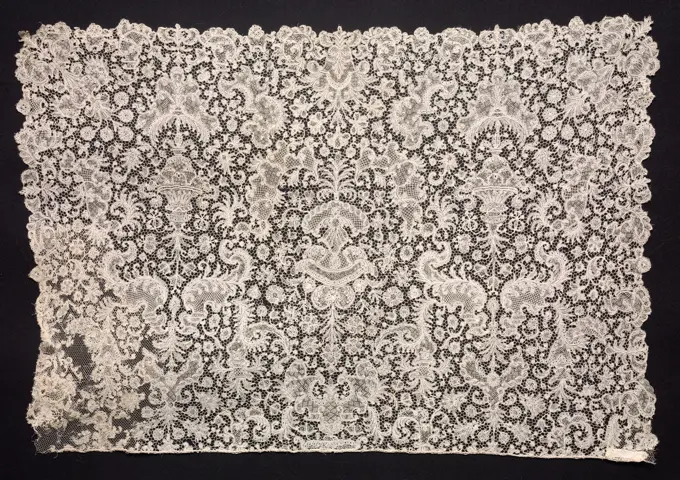
Delicate lace trims and appliqués with floral and intricate patterns, highlighting craftsmanship from various periods, suitable for fashion or decor.

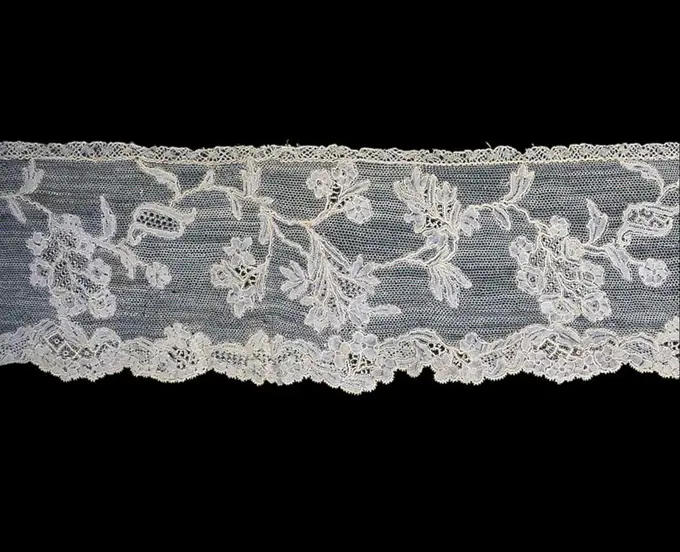
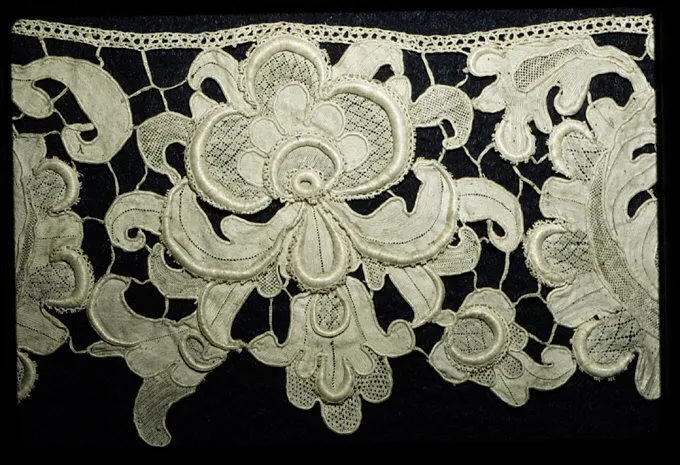
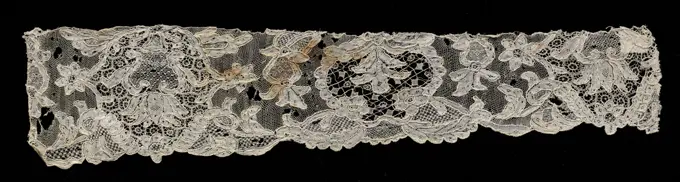
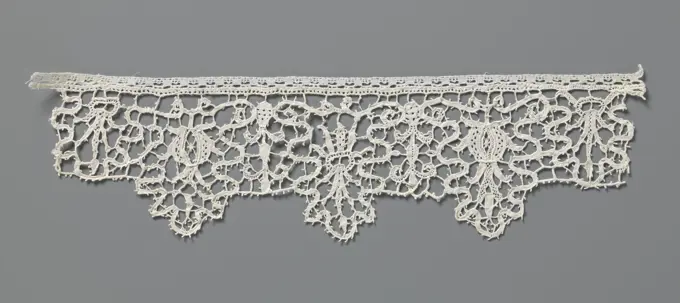
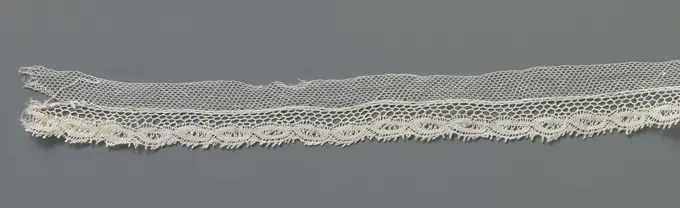
Strip lace with V-shaped motif above clamped shell, anonymous, c. 1700 - c. 1899 Strip of natural-colored needle side: Burano side. The symmetrical pattern consists of a V-shaped motif above an open shell that lies along the bottom of the strip. The V is formed by a row diagonally stacked leaves, with a larger drop -shaped and curlinged leaf at the top. A stem with three rosette flowers bends down from this leaf. The stem ends with a leaf that lies along the underside of the strip and whose top touches the shell. In the V-shaped field there is an as-symmetrical motif at the top with a rosette flower between three more or less oval flowers or shapes. The motifs are connected by a Maas soil, a Burano ground. Different decorative grounds have been used. Among other things between rosette flowers and in the decorative tires along the underside of the strip. The top of the strip is straight finished. The silly outskirts of scales along the underside of the strip stems from the pattern. BURA
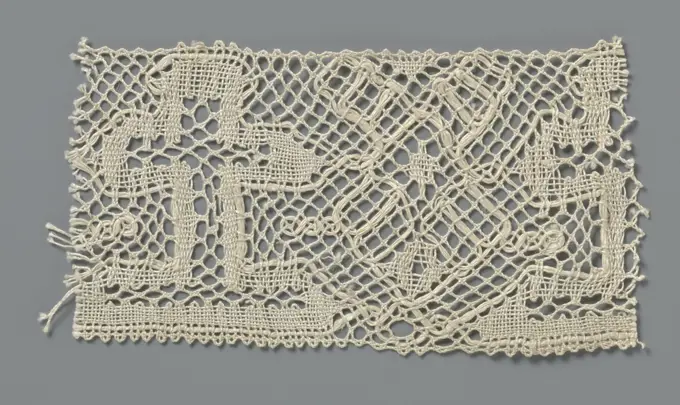
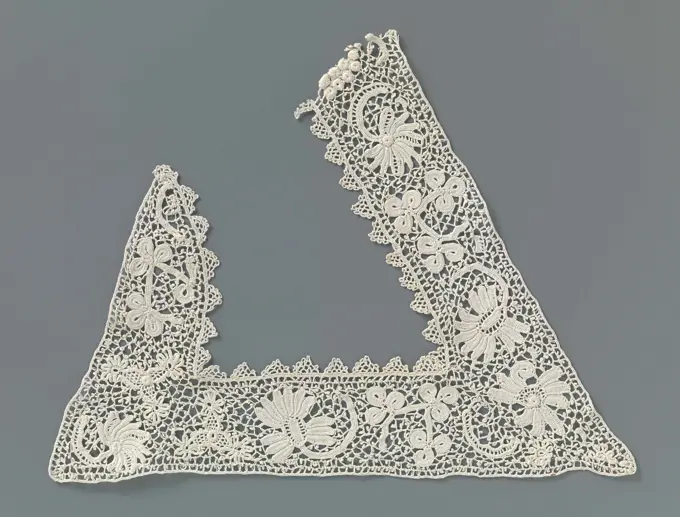
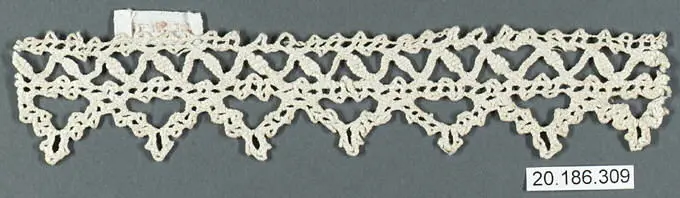
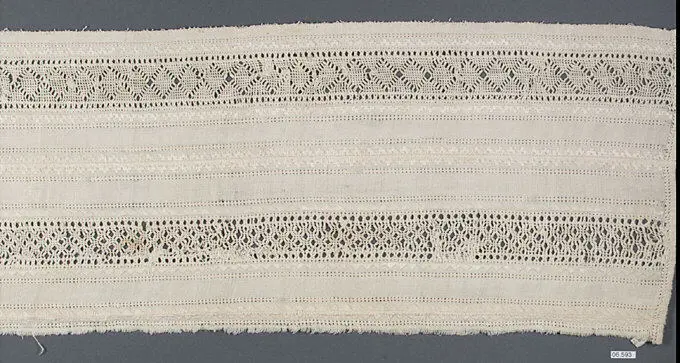
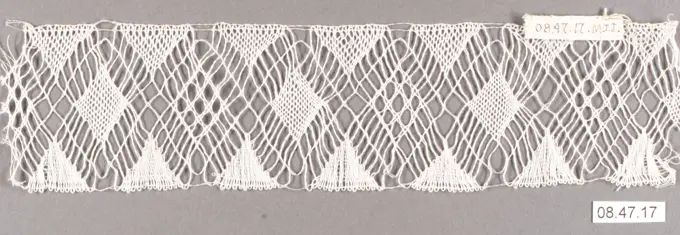
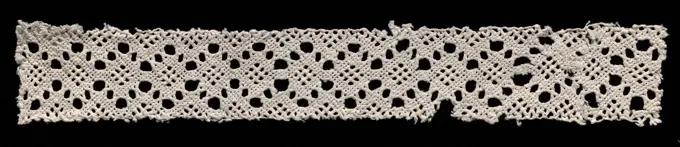
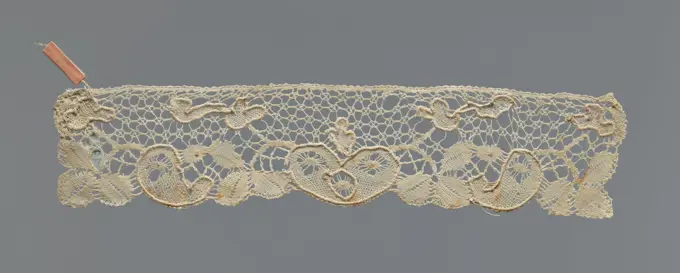
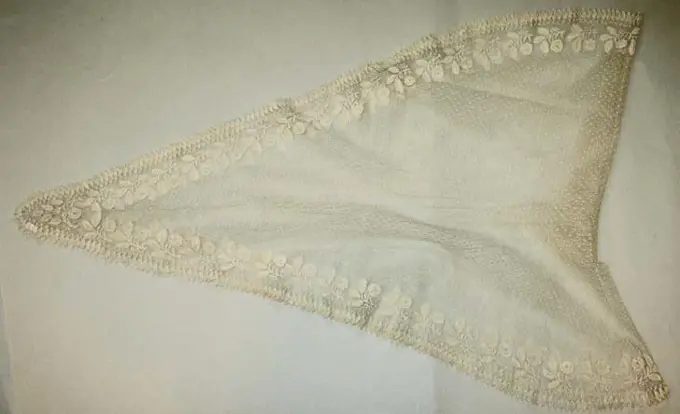
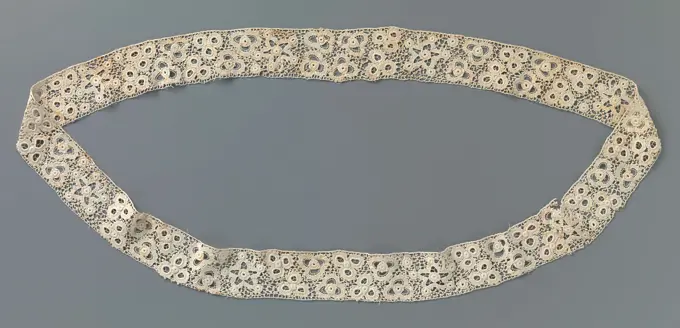
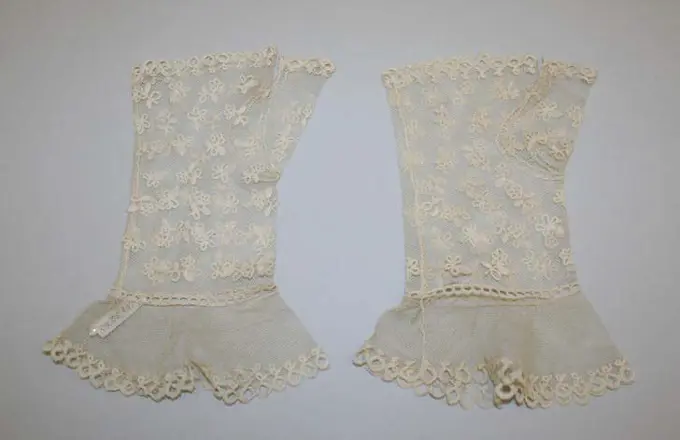
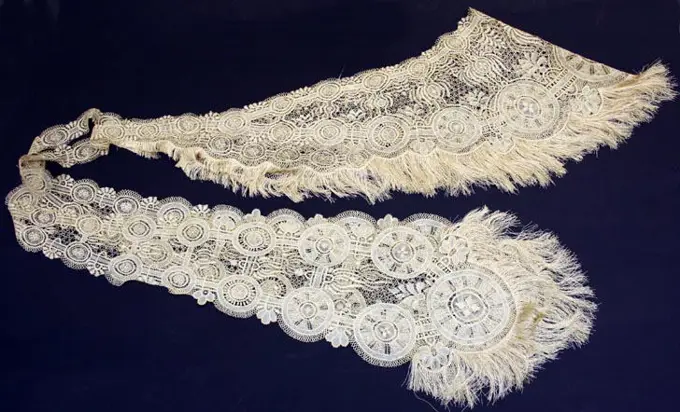
Border. Italy, Venice or Burano. Date: 1770-1789. Dimensions: 7.4 x 124.8 cm (2 7/8 x 49 1/8 in.)Width repeat: 15.2 cm (6 in.)Heading height: .5 cm (1/4 in.). Linen, needle lace. Origin: Italy. Museum: The Chicago Art Institute, Chicago, USA.Fragment 17th century Italian. Fragment 222727Strip bobbin with cross and window or "silverzoren", anonymous, c. 1800 - c. 1899 Strip of natural -colored bobbin, Swedish side. The strip is attached to a light blue cardboard with pins, with seven other strips. Above the strip is on the cardboard "Laces from Dalecarlia. (Dalarna)" written and underneath "Silvercross. (Silverkors)". The repeating pattern is formed by a bundle of wires that has been worked through a mesh soil, a diamond -shaped tuneral. The threads alternately form the contours of a cross on a flat base and a diamond -shaped motif crowned by two rectangles. Within the contour threads of the cross, a border is made in linen battle with openwork edges. In the diamond -shaped motif, two small motifs are made in linen and one small triangular motif above it. Top and bottom of the strip are straight and equipped with picots. Dalarna (possilly) linen (material) bobbin lace / Swedish lace Strip of natural -colored bobbin, Swedish side. The strip is attached to a light blue cFragment 18th century German, Saxony. Fragment 214725Strip mixed side with curling stems with simple flowers and leaves, anonymous, c. 1900 - c. 1914 Strip of natural -colored mixed side: Milanese ribbon side or Flemish guipure side. Curling stems with simple flowers and leaves. The motifs are connected by a grid -wide (bobbin) and bars of bar (needle side). The bar of bar forms a wavy band along the lower edge. Belgium linen (material) mixed lace / tape lace (mixed lace) / Milanese tape lace (mixed lace) / Flemish guipure lace Strip of natural -colored mixed side: Milanese ribbon side or Flemish guipure side. Curling stems with simple flowers and leaves. The motifs are connected by a grid -wide (bobbin) and bars of bar (needle side). The bar of bar forms a wavy band along the lower edge. Belgium linen (material) mixed lace / tape lace (mixed lace) / Milanese tape lace (mixed lace) / Flemish guipure laceHandkerchief Made 1801-1900 France. Linen, plain weave; embroidered with linen threads in padded satin, overcast, eyelet, buttonhole and hem stitches and back stitch known as Point de SablÈ; openwork with drawn filling and overcast .Bobbin Lace (Rose Lace) Edging, 18th century. Italy, Genoa, 18th century. Lace, bobbin; average: 3.2 x 26.1 cm (1 1/4 x 10 1/4 in.).Strip with two sharp corners of crocheted side. Strip with two sharp corners of crocheted side, possibly used as a piece of clothing. Pattern with c-shaped stems to which one large flower, stems with three three-piece leaves and a triangular motif with rosette flowers to the points. Crocheted irregular mesh soil with picots. Right finished on the outside. Triangular scarps on the inside.Piece early 17th century Spanish. Piece 220744Two fragments of lace;  End of the 16th century (1600-00-00-1625-00-00);Strook kloskant met ruitvormig veld tussen gespiegelde waaiers.Strip natural colosside, blonde. The repeating pattern consists of a impeller mirrored over the length axis, which form slots on the top and bottom of the strip. A cut-away diamond field is formed between the mirrored impellers in which an ornamental ground is applied. The windows are equipped with continuous contour wires, which cross each other on the length axis.Strip knotted side with a row of squares between two straight jobs, anonymous, c. 1925 - c. 1930  Strip of natural knotted side: chebka. Between two straight tracks there is a repeating pattern of a row of squares with an open worker in each square. Between the squares a column with a rectangular grid. Top and bottom of the strip are straight. Tunis linen (material)Fragment of bobbin lace unknownBobbin Lace (Needlepoint Design) Edging of Points, second half of 16th century. Italy, Genoa, second half of 16th century. Lace, bobbin; average: 5.1 x 17.5 cm (2 x 6 7/8 in.).Jabot ca. 1882 French. Jabot 119051Sample End Of Lappet; linen; 1933-1-178Border. Date/Period: Late 16th-early 17th century. Border. Medium: linen. Technique: bobbin lace, continuous braid-like. Author: UNKNOWN.Sierstuk voor een avondmantel van gemengde kant met rozenhaag.Decorative piece for an evening casing of natural-colored mixed side - climbing side in combination with coniferous lace - Brussels Duchesse. In a widely spread braid soil there are roses that usually support two leaves. An intermediate ornament consists of a few and double voluntaries and many small flowers.Fragment (Border) Made 1725-1750 France. Linen, needle lace of a type known as Point d'Argentan with a buttonholed mesh ground .Border (Italy); linenBorder (From a Cover) Made 1550-1600 Italy. Linen, needle lace worked on plain weave cut and drawn thread grid; embroidered in double hem and overcast stitches; two portions joined .Two strips 18th century South American. Two strips 212772Collar; linen, metal-wrapped silkKloskant intermediate mate with flour between elongated volute leaves, anonymous, c. 1650 Piles of natural -colored Hollanse bobbin side. The pattern consists of a repeating symmetrical motif of a flower between elongated volute leaves. The motifs are made in linen battle with openwork edges and are connected by a more or less round grid with braid strokes. The top and bottom are straight. The intermediate brush is sewn on the same strip of bobbin with a few coarse stitches. Antwerp linen (material) bobbin lace Piles of natural -colored Hollanse bobbin side. The pattern consists of a repeating symmetrical motif of a flower between elongated volute leaves. The motifs are made in linen battle with openwork edges and are connected by a more or less round grid with braid strokes. The top and bottom are straight. The intermediate brush is sewn on the same strip of bobbin with a few coarse stitches. Antwerp linen (material) bobbin laceFragment 18th century Flemish, Mechlin. Fragment 212781Fragment of the lace;  around 1750 (1740-00-00-1760-00-00);Needlepoint Lace Edging, 18th century. France, Alençon, 18th century. Lace, needlepoint: linen; average: 7.7 x 33.4 cm (3 1/16 x 13 1/8 in.).Edging 16th century Italian, Genoa. Edging 221120Cooper Union Museum Lace Study Card, Medium: linen Technique: needle lace, Alençon-style narrow border with lower edge in a design of minute blossoms. Ground powdered with dots., France, late 18th century, lace, Fragment, FragmentBobbin Lace (Needlepoint Design) Insertion, second half of 16th century. Italy, Genoa, second half of 16th century. Lace, bobbin; average: 5.8 x 35.6 cm (2 5/16 x 14 in.).Border ca. 1600 Greek. Border 212814Laces, 17th-18th century. Collar made with fragments of a flat or royal stitch (Punto Piatto or Punto Reale) lace of 1685-99. Detail.Voile from application side with wavy Campane-Rand, Anonymous, c. 1885 - c. 1915 Voile of natural -colored application side, bobbin lacquered on mechanical tulle. Halveman-shaped. On a fond littered with mushes, a wavy edge of two frames runs within the flat scoops of Campanes, which encloses a leaf branch. This edge is cut by half to the left, half -bent twigs with seven leaves. In between, rosette branches are loose above the wavy edge. Sluis (Possible) linen (material) Voile of natural -colored application side, bobbin lacquered on mechanical tulle. Halveman-shaped. On a fond littered with mushes, a wavy edge of two frames runs within the flat scoops of Campanes, which encloses a leaf branch. This edge is cut by half to the left, half -bent twigs with seven leaves. In between, rosette branches are loose above the wavy edge. Sluis (Possible) linen (material)Fan leaf. Date/Period: 18th century. Fan leaf. Medium: linen. Technique: embroidered with deflected element work with overcasting and looping; buttonhole, overcast cord, stem, satin, chain, looping, darning, surface satin, and herringbone stitches on plain weave. Author: UNKNOWN.Fragment, Medium: linen Technique: bobbin lace, discontinuous tape, a technique called leaded, Fragment with two circular lobed tabs formed by scrolling lines. Nestled with the scrolls at the bottom are wheel-like shapes. Tabs are attached to a narrow border of triangles., Italy, 17th century, lace, FragmentTie van Kloskant applied on mechanical tulle, anonymous, c. 1880 - c. 1900 Das Van Kloskant applied on mechanical tulle. On both flared ends a thin branch with a large six -leaf flower above three hanging gadrons. In the middle flower motifs in a field outlined with straight tires. The edge is scalloped and equipped with picots. Belgium . bobbin lace Das Van Kloskant applied on mechanical tulle. On both flared ends a thin branch with a large six -leaf flower above three hanging gadrons. In the middle flower motifs in a field outlined with straight tires. The edge is scalloped and equipped with picots. Belgium . bobbin laceInsertion and Edging, 16th century. Italy, 16th century. Knotted lace ; average: 7.4 x 24.8 cm (2 15/16 x 9 3/4 in.).Lace, 1800s , Bedford, maker unknown. Gift of Mrs G. Acland Allen, 1955.Dress of dick edge with a rosette nozzle surrounded with golden control branches and flowers. Dress of natural colosside: Duchesse-side. Rectangular model, irregular scallops. There is a rosette flower in the center with eight spiral leaves. From the center, sixteen nozzles run straight lines, surrounded by three-part leaves and bending flower clusters such as a golden rain. The motifs are largely made in a cut-off and linen stroke with open editors and recesses. The motifs are connected to each other by ground grounds and braid gones, which alternate each other in concentric 'circles' from the center point to the edges. Many leaves in shape stroke are used on the Spitsoval leaves. The design drawing and lace patterns have been preserved at the rug.Lace laceManchet van naaldkant met grote palmetbloem.Cuff of natural needle side: Venetian relief side. On a barrier ground, some richly branched feathered leaves and a very large palmet flower together are grouped.Piece 18th century Italian. Piece 214901Strip of needle side with half oval crowned with a daffodil, anonymous, c. 1750 - c. 1770 Strip of natural-colored needle side: Alençon side. Pattern with a repetitive motif of different tifles with multifaceted flowers on a fine hexagonal Maas soil. Between the tenders openwork figures, including half ovals. The half ovals are filled with a decorative soil with six -pointed flowers, they cover the entire width of the strip and are crowned by a daffodil. The scalloped bottom edge forms partly from the tendetry pattern and further leaves with some flowers from narrow. The top is trimmed with a border bobbin. France linen (material) Alençon Lace Strip of natural-colored needle side: Alençon side. Pattern with a repetitive motif of different tifles with multifaceted flowers on a fine hexagonal Maas soil. Between the tenders openwork figures, including half ovals. The half ovals are filled with a decorative soil with six -pointed flowers, they cover the entire width of the strip and are crFragment Swedish (Rättvik) (Dalarna) 19th centuryStrip application side with mismosataks, anonymous, c. 1890 - c. 1909 Strip of natural -colored application side: bobbin lacquered on mechanical tulle. The pattern shows a row of mimosa branches to the right. Belgium (possibly) linen (material) Strip of natural -colored application side: bobbin lacquered on mechanical tulle. The pattern shows a row of mimosa branches to the right. Belgium (possibly) linen (material)Edging 16th century Italian, Genoa. Edging 221121Strip of needle side with pomegranate and jet wreath in oak leaf, anonymous, c. 1625 - c. 1649 Strip of natural needle side: Punto in Aria. The repeating pattern consists of the oak leaf contour that alternately contains a pomegranate or ray wreath. There is a French lily among the oak leaves. The motifs are made up of feston stitches, partly equipped with recesses. The motives are connected by an irregular, open bar with picots. The scrap edge forms from the oak leaf motif and is finished with picots. The top of the strip is straight finished with a tie. Italy linen (material) Strip of natural needle side: Punto in Aria. The repeating pattern consists of the oak leaf contour that alternately contains a pomegranate or ray wreath. There is a French lily among the oak leaves. The motifs are made up of feston stitches, partly equipped with recesses. The motives are connected by an irregular, open bar with picots. The scrap edge forms from the oak leaf motif and is finished with picots. ThHemenbol van Kloskant with heart -shaped center, anonymous, c. 1720 - c. 1740 Hat of natural -colored Brussels bobbin. The symmetrical, rich pattern consists of a heart -shaped center, formed by a triangular vase with bulb foot and two curlinged feathered leaves. A drop -shaped flour rises straight from the heart between flowers and from a palm leaf. Left and right, diagonally under the heart, originates from a thick volute, a carnated carnation and rosette flower. Various flowers, including many rosette flowers and leaves fill the pattern further. There is not really a land, the motifs are connected by crossing couples. The motifs are made in fine and closed linen battle and mains, with openwork edges and partly with burst relief contour lines. Sparingly, a decorative land has been applied of snowflakes in combination with mains stroke around a few motifs. All sides are finished right. Brussels linen (material) bobbin lace / Brussels bobbin lace Hat of natural -colored Brussels bobbinFlounce (Belgium); linenWoman's handkerchief handkerchiefsBorder, Medium: Technique: needle lace, Needle lace edge sample, floral pattern; late 18th century Alencon, late 18th century, lace, BorderStrip of cotton with lace pledger with daisies between feathered S-shaped leaves, C.I. Bosch Reitz-Teding van Berkhout, c. 1860 - c. 1880 Strip of natural cotton with lace bobbins: English embroidery. The pattern has sloping, feathered S-leaves between two Margrites, one of which hangs in each shell. Amsterdam cotton (textile) Strip of natural cotton with lace bobbins: English embroidery. The pattern has sloping, feathered S-leaves between two Margrites, one of which hangs in each shell. Amsterdam cotton (textile)Needlepoint (Punto Avorio or Ivory Stitch) Lace Insertion, 17th century. Italy, 17th century. Lace, needlepoint; average: 4.2 x 28.9 cm (1 5/8 x 11 3/8 in.).Cap Streamer (France); linenCuff;  2nd half 19th century (1851-00-00-1900-00-00);Echarpe from Machinale ribbon side with tire work, anonymous, c. 1920 Echarpe of natural -colored machine side: Machinal ribbon side. The Echarpe has a widened back piece. An open, symmetrical pattern of thin spiral vines, with widely spread leaves and florets, is framed by a flat scalley, formed by a smooth list and star flower. Belgium linen (material). cotton (textile) Echarpe of natural -colored machine side: Machinal ribbon side. The Echarpe has a widened back piece. An open, symmetrical pattern of thin spiral vines, with widely spread leaves and florets, is framed by a flat scalley, formed by a smooth list and star flower. Belgium linen (material). cotton (textile)Sample end of lappet, Medium: linen Technique: bobbin lace, Mechlin style, N. Europe, 19th century, lace, Sample end of lappetBand (Italy); linenFragment; linenBobbin Lace Insertion, mid 16th century. Italy, Venice, mid 16th century. Lace, bobbin; average: 4.5 x 20.4 cm (1 3/4 x 8 1/16 in.).Edging 17th century Italian, Genoa. Edging. Italian, Genoa. 17th century. Bobbin lace. Textiles-LacesPelerine ca. 1800 British. Pelerine 102631Fragment 16th century Italian. Fragment 214864Band; linen; Bequest of Marian Hague; 1971-50-387Strip of a climbing side with spits releases in reverse V-shaped tape. Strip natural colosside, sling. The pattern consists of a openwork and reverse V-shaped band, in which spindle releases between crossing pairs are made. The triangular fields that arise along the top and bottom of the zigzag band are made in linen stroke. The top of the strip is straight finished. The underside is finished with arcs made with a continuous braid that is equipped with three picots per corn.Bobbin Lace Insertion without Selvage, mid 16th century. Italy, Venice, mid 16th century. Lace, bobbin; average: 5.1 x 17.2 cm (2 x 6 3/4 in.).Fragment 16th century German, Munich. Fragment 214703Insertion (For a Cover). Italy. Date: 1601-1625. Dimensions: 11.3 x 65 cm (4 1/2 x 25 5/8 in.)Width repeat: 14.2 - 15.2 cm (5 5/8-6 in.). Linen, needle lace worked on a laid and plaited thread grid, Reticello pattern. Origin: Italy. Museum: The Chicago Art Institute, Chicago, USA.Fragment (Italy); linenNeedlepoint (Cutwork and Drawnwork) Lace Insertion, 16th century. Italy, Venice, 16th century. Lace, needlepoint: linen; average: 9 x 31.2 cm (3 9/16 x 12 5/16 in.).Bobbin Lace Jabot, 17th-18th century. Flanders, 17th-18th century. Lace, bobbin; average: 28 x 43.2 cm (11 x 17 in.).Fragment, Bobbin Lace 5; linenTussenzetsel van kloskant met hartje en rond bloempje.Interesting of natural Dutch clamping side. The repeating pattern consists alternately from a heart and a flower ride between two elongated curly leaves. The heart is alternately upright and vice versa. The motifs are connected by a round table ground with braid. The motifs are made in linen stroke with openwork edges and recesses in the circular flower heart. Upper and bottom of the strip are straight finished and attached to a fragment linen from a demolition.Strook kloskant met rand van opengewerkte spitsovalen.Natural collate strip, Valenciennes side. Along the underside of the strip a band runs from concerted spinders, which form regular slots. Above the band, the strip consists of a Maas soil, a round valenciennes ground. The spitsavals are made in linen stroke with openwork edges and a recess in the center, which is decorated with small snowflakes. The top of the strip is straight finished and attached to a strip of mechanical tulle. The shelters along the underside are finished with picots.Collar late 19th century Belgian. Collar 120833Kloskant motif in the form of a rush-hour, Sophia Gerardine Cenijn-Smit, c. 1914 Motif in the form of a pointed dial of natural-colored bobbin: Cluny side. The narrow contour of the oval is made in Linnenlag. In the center there is a flower with eight petals made in shape. A braid makes a circle around the flower. Another braid with picots winds around the circle and makes a bow at the height of each petal. Amsterdam linen (material) bobbin lace / Cluny lace Motif in the form of a pointed dial of natural-colored bobbin: Cluny side. The narrow contour of the oval is made in Linnenlag. In the center there is a flower with eight petals made in shape. A braid makes a circle around the flower. Another braid with picots winds around the circle and makes a bow at the height of each petal. Amsterdam linen (material) bobbin lace / Cluny laceGuimpe van naaldkant met klaverbladeren.Flumpe of natural-colored coniferous lace: Venetian rosion. Symmetrical floral and tendrils pattern. Open bars soil. Continuous triangles form the finish to four sides.Bobbin Lace (Needlepoint Design) Band or Border, 16th century. Italy, Genoa, 16th century. Lace, bobbin; average: 12.7 x 78.8 cm (5 x 31 in.).Strip clamp side with three rows of windows and semicircular slot. Strip natural colosside: Cluny side. The repetitive and symmetrical pattern consists of diagonal paths split into scroll striews, which form three rows of diamond-shaped fields and an upper fourth row with triangular fields, half windows. The middle field row is filled with diamonds in linen striking in which a cross is made with small recesses. The half version of this is in the upper row. The other fields are filled with a five-grade ground and has split a flower with eight petals in the center in the center. The semicircular slip edge is formed because the diagonal lines are rounded off here. The sloping edge is finished with a bow edge formed by a strong winding braid with picots.Bobbin Lace Edging of Points, mid 16th century. Italy, Venice, mid 16th century. Lace, bobbin; average: 2.6 x 15.3 cm (1 x 6 in.).Strook gehaakte kant met vijfpuntige sterren en bloemen gemaakt met open cirkels.Strip natural-colored Irish crochet side. A recurring pattern of a double row with a total of eight triangular floral motifs made with open circles, interspersed with one five-pointed star with a circle in the middle and to each point a circle. Crocheted irregular mesh soil with picots. Top and bottom they finished with a straight edge. The short sides of the strip are adjacent to each other.Mitts 19th century British. Mitts 102583Collar of clamping side with heart and drop shape between two lobes formed by a narrow through ribbon. Collar of natural colosside: Russian side. Hemery model with slot. A thoroughly narrow ribbon in linen battle with thick decorative thread in the middle forms the contours of the symmetrical motifs. The repeating pattern consists alternately from a heart and a drop form between two lobes. The motifs are directed to the outside. In each drop shape and between the two balls of the heart, a flower with five petals is always split into shape stroke. Connections are made with double-piced braids and braids forming four-pointing stars. The pattern is probably by Mrs. L.W. Van der Meulen-Nulle made and the collar has been split by her student Alida Maria van Schaik.Fragment, Medium: linen Technique: bobbin made (continuous tape with net added), Scrolling ribbon like floral design. Ground with small scale ribbon like circular motifs. Two pieces sewn together., Belgium, 17th century, lace, FragmentCap 19th century British. Cap 98207Lace-making, Historical Folklore Museum, Gavalochori village with its original character, Crete, Gavalochori, Crete, Greece, EuropeCap crown, Medium: linen Technique: needle lace with a ground of loop & twist with twist return, Cap crown of Point d'Alençon with a design of floral garlands framing a central spray and forming an oval. Pattern is interspersed at right and left by an elaborate ribbon., Belgium, 18th century, lace, Cap crownFichu mid-19th century American. Fichu 119314Border. France. Date: 1801-1825. Dimensions: 5.6 × 117.5 cm (2 1/4 × 46 1/4 in.)Width repeat: 5.2 cm (2 in.). Linen, needle lace of a type known as "Point d'Alençon". Origin: France. Museum: The Chicago Art Institute, Chicago, USA.Border Made 1601-1625 Italy. Linen, needle lace worked on a laid and plaited grid .Fragment, Medium: Technique: grid of laid cord with needle lace reticella style, Fragment with a design of a diamond-shaped lattice with rosettes., Italy, 16th-17th century, lace, FragmentLappet (one of a pair) early 18th century Flemish. Lappet (one of a pair) 219928Bobbin Lace (Rose Lace) Edging, 17th century. Italy, Genoa, 17th century. Lace, bobbin; average: 7.7 x 185.4 cm (3 1/16 x 73 in.).Fragment, Medium: linen Technique: bobbin lace (continuous braid-like), Fragment of heavy coarse edging lace with points. Small 'seeds' in band above points., Italy, 16th century, lace, FragmentFragments (Spain); silk; 1943-24-3-a,bLace with edges stapled together;  1st half 20th century (1901-00-00-1950-00-00);Magdalena, Witwińska, Dar (provenance), lace, block lace, cotton fabrics, decorative fabricsKerchief 18th century European. Kerchief 120949Edging 16th-17th century Italian, Venice. Edging. Italian, Venice. 16th-17th century. Bobbin lace. Textiles-LacesFragment, Medium: linen Technique: needle lace (reticella), Wide insertion of reticella that is divided into squares containing geometric motifs and conventionalized floral motifs., Italy, 16th century, lace, FragmentCollar of needle side with symmetrical pattern with five rose fields, anonymous, c. 1880 Collar of natural needle side: Brussels mesh side. Half -round model. The pattern has a double wavy line along the edge. Above that five fields with rose branches and moesjes. Under the wavy line, under each rose branch, a hanging chalice of a flower garland of connected rosette flowers. The scrap edge stems from the pattern with these waves and the flower garland. Along the top or neck line is a narrow mechanical lanble strip with arcs sewn. Brussels linen (material) Brussels Gaze Point Collar of natural needle side: Brussels mesh side. Half -round model. The pattern has a double wavy line along the edge. Above that five fields with rose branches and moesjes. Under the wavy line, under each rose branch, a hanging chalice of a flower garland of connected rosette flowers. The scrap edge stems from the pattern with these waves and the flower garland. Along the top or neck line is a narrow mechanical