Intricate Lace Designs

Various historical lace pieces including bobbin lace and needlepoint, showcasing delicate patterns and craftsmanship, presented on contrasting backgrounds.
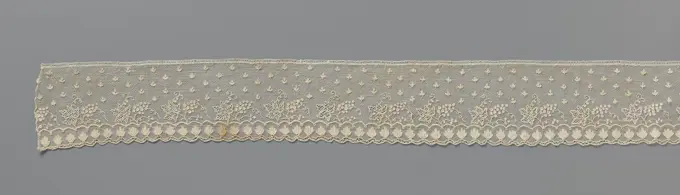
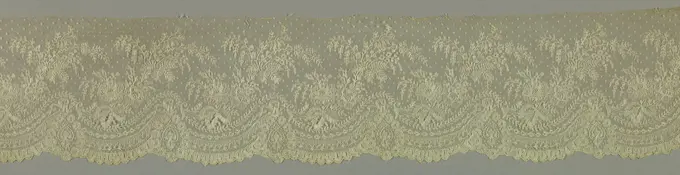
Strip of needle side with wine leaves and grape bunches, anonymous, c. 1800 - c. 1820 Strip of natural-colored needle side: men's-Aalençon. Repetitive motif of a grape vock with wine leaf on a fine hexagonal mesh ground with walled bars. Above it a spreading motif of small twigs with round flower and two oval leaves. The grapes and the leaf spring up from a horizontal spiral rank and bend in the opposite direction, but always in the same direction. Under the Spiralrank a very fine ground of a few, strongly twisted meshes, with a repetitive motif of a narrow five -fingery leaf. Fullwork without recesses in these five -fingered leaves and in the oval leaves and the grapes. One kind of decorative land in the wine leaves. Schulpenrand with regular arcs along the lower edge. The top is trimmed with a border bobbin. Alençon linen (material) Alençon Lace Strip of natural-colored needle side: men's-Aalençon. Repetitive motif of a grape vock with wine leaf on a fine hexagonal mesh ground with w
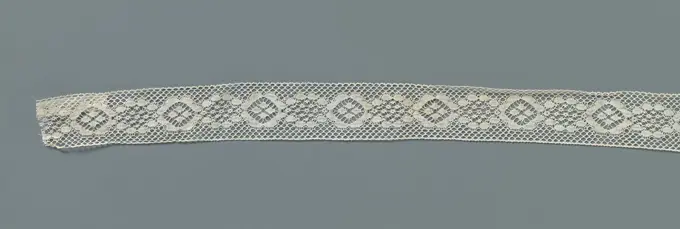
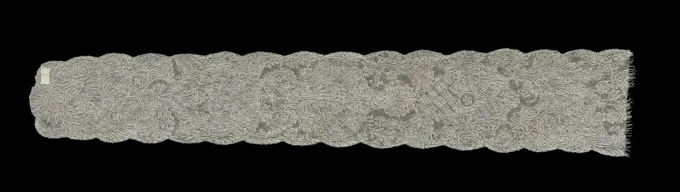
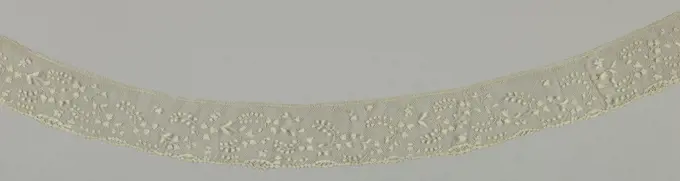
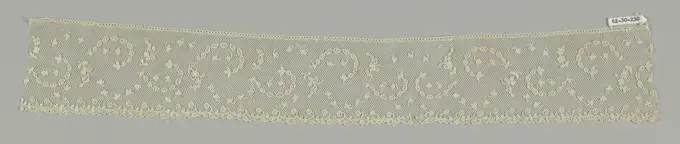
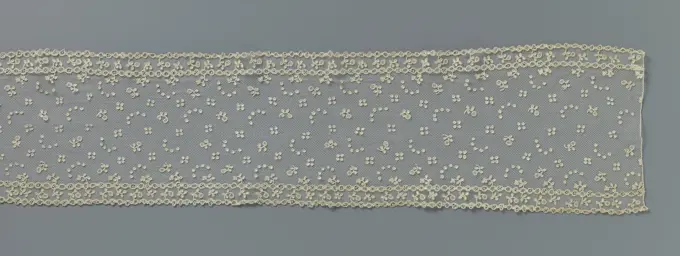
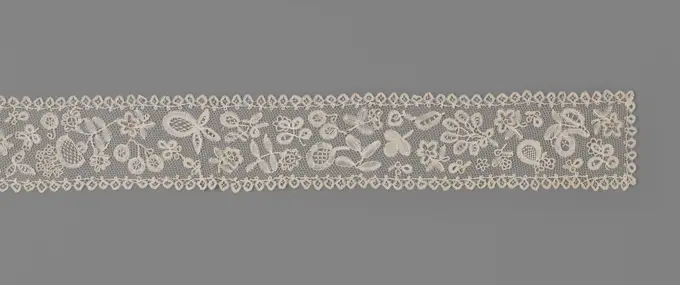
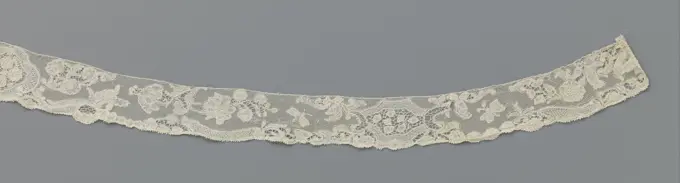
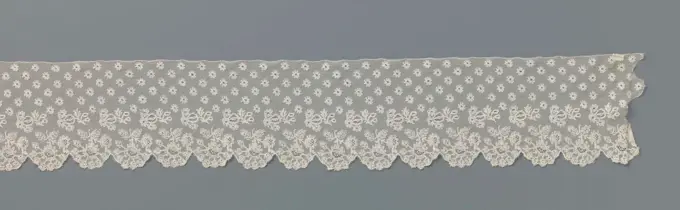
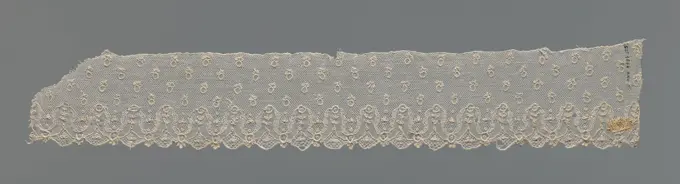
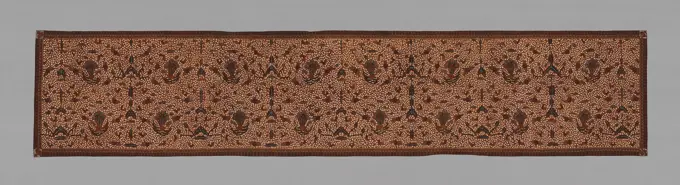
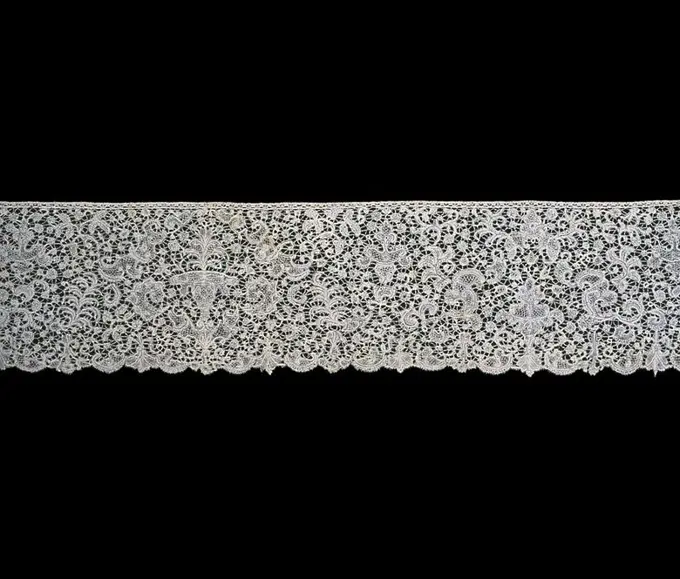
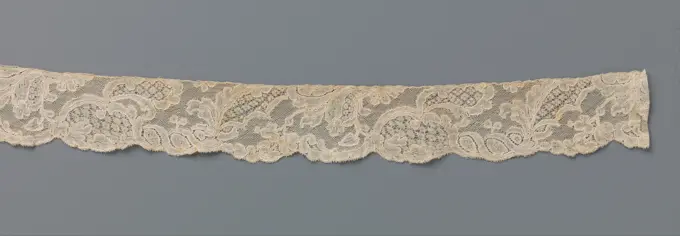
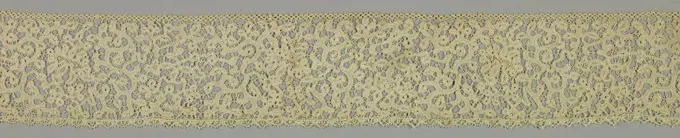
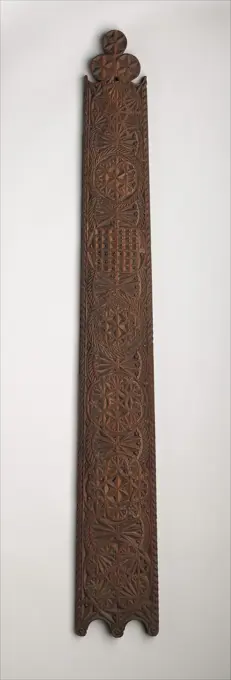
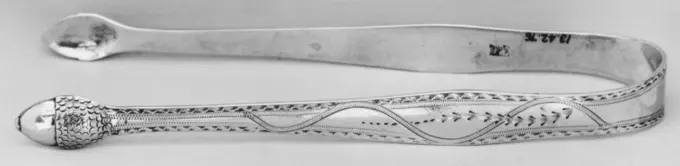
Kloskant intermediate mate with zigzag line, anonymous, c. 1875 - c. 1949 Piles of Natural -colored bobbin side: Mechelse side. In the middle of the fine grid, a Mechelen soil (also known as ice soil), an openwork band runs in Zigzaglijn, cut over by two types of rosettes. Belgium linen (material) bobbin lace / Mechlin (lace) Piles of Natural -colored bobbin side: Mechelse side. In the middle of the fine grid, a Mechelen soil (also known as ice soil), an openwork band runs in Zigzaglijn, cut over by two types of rosettes. Belgium linen (material) bobbin lace / Mechlin (lace)Needlepoint (Coralline Point) Lace Lappet, 17th century. Italy, Venice, 17th century. Lace, needlepoint: linen; average: 114.3 x 11.2 cm (45 x 4 7/16 in.).Strip bobbin with hanging three -sheet, anonymous, c. 1930 Strip of natural-colored bobbin: Valenciennes side. On a square grid, there is always a hanging vlying leaf with berry above a smooth shell. Netherlands (possibly) linen (material) Bobbi Lace / Valenciennes Lace Strip of natural-colored bobbin: Valenciennes side. On a square grid, there is always a hanging vlying leaf with berry above a smooth shell. Netherlands (possibly) linen (material) Bobbi Lace / Valenciennes LaceLace, 1700s , maker unknown. Gift of Mrs G. Acland Allen, 1955.Shoulder Cloth (Selendang RimangSutro)Piece late 18th century Dutch. Piece 214755Tussenzetsel van machinale kant met keten van gestileerde ronde bloemen.Machine side intermediate: Machine Valenciennes side. The repeating pattern consists of a succession of two different stylized round flowers with a coarser and a finer machining snowflakes soil as a flower heart. One flower consists of eight loose round petals that form a circle. The other flower consists of a circle of eight connected semi-circular motifs. The motifs seem to be made in linselag with openwork edges. They are connected by a machining ground.Fragment 18th century Flemish, Mechlin. Fragment. Flemish, Mechlin. 18th century. Bobbin lace. Textiles-LacesStrip of needle side with wine leaves and grape bunches, anonymous, c. 1800 - c. 1820 Strip of natural-colored needle side: men's-Aalençon. Repetitive motif of a grape vock with wine leaf on a fine hexagonal mesh ground with walled bars. Above it a spreading motif of small twigs with round flower and two oval leaves. The grapes and the leaf spring up from a horizontal spiral rank and bend in the opposite direction, but always in the same direction. Under the Spiralrank a very fine ground of a few, strongly twisted meshes, with a repetitive motif of a narrow five -fingery leaf. Fullwork without recesses in these five -fingered leaves and in the oval leaves and the grapes. One kind of decorative land in the wine leaves. Schulpenrand with regular arcs along the lower edge. The top is trimmed with a border bobbin. Alençon linen (material) Alençon Lace Strip of natural-colored needle side: men's-Aalençon. Repetitive motif of a grape vock with wine leaf on a fine hexagonal mesh ground with wStrip bobbin with two berries on short twig, anonymous, c. 1850 - c. 1870 Strip of natural -colored bobbin, Lille side. The repeating pattern consists of a short loose twig on the center line with two berries on it. Along the underside are very narrow, elongated ovals, which are connected to each other with a flower or leaf. The motifs are connected by a fine Maas soil, a tuler land. A decorative land has been used in the very small motifs, which is almost impossible to see because of the thicker glimizing contour threads that have been used. The top is straight. The very silly, elongated scoops along the bottom are finished with picots. Belgium (possibly) linen (material) bobbin lace / Lille lace Strip of natural -colored bobbin, Lille side. The repeating pattern consists of a short loose twig on the center line with two berries on it. Along the underside are very narrow, elongated ovals, which are connected to each other with a flower or leaf. The motifs are connected by a fine Maas EdgingStrip of needle side with flower litter pattern and rush -hour, anonymous, c. 1775 - c. 1799 Strip of natural needle side, argent tank side. Strooi pattern of twigs that alternately have a small or larger flower, leaves and/or berries. Ground with meshes that are closed with buttonholes. The pattern along the lower edge consists of two pointed to each other, in between, between which a flower or berry branch rises. The oval pairs are connected by an arc of leaves and/or berries and hearts. Under these arcs along the lower edge a flat, lying oval. The oval -shaped figures in the pattern are filled with a fine hexagonal Maas soil (alençong round). Different decorative grounds in the flowers. Volwerk without recesses in flowers, leaves and berries. Schulpenrand on the underside by a succession of heart -shaped leaves, regularly interrupted by a rosette flower and the flat oval. The top is finished with a straight edge. Argentan linen (material) Argentan Lace Strip of natural needle side, Strook naaldkant met driebloemige rozentak.Strip natural-colored coniferous lace: Alençon side. Six rows of sprigs with two leaves and a repetitive motif of a rosa branch with three flowers, on a fine hexagonal maas soil. One flower on the rose roof bends up, the other two down in the same direction. The flowers are filled with different ornamental grounds. The tube edge on the underside is formed by the two floral facing down. The top is trimmed with a border clamping side.Fringe, Medium: silk Technique: woven, Fringe in pink, yellow and gold with a plain-woven heading. Skirts threads are made up of pink, yellow and gold threads that are twisted and looped., Italy, 17th century, trimmings, FringeTrimming, Medium: metallic strips wrapped around linen core Technique: bobbin lace, Border with a design of garlands., Italy or Spain, late 17th-early 18th century, lace, TrimmingBobbin Lace Lappet, mid 18th century. Belgium, Binche, mid 18th century. Lace, bobbin: linen; average: 11.5 x 64.2 cm (4 1/2 x 25 1/4 in.).Insertion ca. 1700 Flemish. Insertion 212884Trimming, Medium: linen Technique: needle lace, six-sided reworked grounds, Serpentine floral pattern with a straight border on one side., France, 18th century, lace, TrimmingStrip of batist with lace pledger with two rows of open worked margrites and a sculpes edge, C.I. Bosch Reitz-Teding van Berkhout, c. 1860 Strip natural -colored batist with lace bobbins: English embroidery. The repeating pattern from two rows of consecutive openwork Margrites, the rows of jumps and around the lower flowers have been created, with five embroidered lobes per shell. The batist is not finished on the long and short sides. Amsterdam cotton (textile) Strip natural -colored batist with lace bobbins: English embroidery. The repeating pattern from two rows of consecutive openwork Margrites, the rows of jumps and around the lower flowers have been created, with five embroidered lobes per shell. The batist is not finished on the long and short sides. Amsterdam cotton (textile)Trimming (France); silk, metallic threadInsertion 16th century Spanish. Insertion. Spanish. 16th century. Embroidered net. Textiles-LacesEdging early 18th century Flemish, Brussels. Edging 222785Strook kloskant met 'oorbelletjes'.The ground ground of the climbing side (Malinois of land or ice soil) is decorated with mates, a row of one-sidedly directed leaf branches and a series of 'earrings', which form the scivels with Campanes. Mechelen side.Border, Medium: linen Technique: needle lace, 6-sided reworked ground, Border with a design of dots and leaves powdered over the ground. Edging is a narrow garland of ribbon and sprays., France, late 18th century, lace, BorderBorder (Belgium); linenBorder, Medium: linen Technique: needle lace, 6-sided reworked grounds, Band in a design of foliated branches interlaced by little floral baskets., France, 18th century, lace, BorderStrip of needle side with drop -shaped flour, anonymous, c. 1685 - c. 1699 Strip of natural needle side, Venetian rose side. Pattern with multifaceted flowers and acanthus leaves on branches, in a repetitive motif. One of the larger flowers is drip -shaped and has leaf voltuties on either side. Irregular open bar with picots. The top is trimmed with a border bobbin. The underside is finished with a straight picot edge with arcs. unknown linen (material) Venetian rose point Strip of natural needle side, Venetian rose side. Pattern with multifaceted flowers and acanthus leaves on branches, in a repetitive motif. One of the larger flowers is drip -shaped and has leaf voltuties on either side. Irregular open bar with picots. The top is trimmed with a border bobbin. The underside is finished with a straight picot edge with arcs. unknown linen (material) Venetian rose pointStrook kloskant met gespleten tak en tulp.Strip natural colosside, binche side. At a grille, a five-gaming ground, is a spiral branch that has been occupied with feathered leaves. A large tulip, in which a split branch with two flowers and a small grape denses alternate. The motifs are made in linen stroke and cut-off with open editors. As ornamental soil, a snowflakes soil has been sparingly used. Upper and bottom of the strip are straight finished, the underside with picots.Edging, Medium: linen Technique: bobbin lace, peasant style, peasant style lace or early student, 19th century, lace, EdgingBorder (Belgium); linenTextile Fragment 3rd-4th century. Textile Fragment 443930Band (Sweden); linen; Bequest of Miss Adele Kneeland through Mrs. Philip Ainsworth Means; 1939-64-8Strook of kraag van naaldkant met symmetrisch patroon met bloemen en omkrullende gevederde bladeren.Strip or collar of natural needle side: Venetian relief side. Symmetrical and rich pattern with flowers and curling feathered leaves. In the middle of the strip, a candelaber motif from which a rank comes down to both sides and then curls with a large bow and ends in an exotic flower with a quadruped flower heart. Similar flowers return in addition to the curling and volutely feathered leaves in the rest of the pattern. The motifs are made with feston stitches where cut-outs and many types of decorative tickets are worried. The motifs are equipped with relief contours. In the flower hearts and around the outside of some larger leaves, cordons decorated with picots are used for extra relief. The motifs are connected by a picoted bars soil. Upper and bottom of the strip are straight finished, the underside with picots. The short sides are straight finished and extended with a narrow strip Dass slip from the needle side with each other overcuting thin spiral ranks, anonymous, c. 1680 - c. 1699 Dassle slip of natural -colored needle side: flat Venetian side. Apparently confused but symmetrical pattern with a vertical axis in the middle from which it is thin, over -cutting spiral vines with small star -shaped flowers and flowers with three leaves. In the corners there are small lily-like flowers that are targeted inwards. The motifs are made with strongly connected feston stitches, with simple patterns in different flowers and leaves being realized with recesses. The motifs are connected by a hexagonal soil with potented bars. The top of the strip is finished with a tie. The underside and two short sides are finished with a bow edge. Venice linen (material) flat Venetian (needle point) Dassle slip of natural -colored needle side: flat Venetian side. Apparently confused but symmetrical pattern with a vertical axis in the middle from which it is thin, over -cutting spiral viJapon slip with cresons, anonymous, c. 1800 On a coarse Maas soil there is a spray pattern of moesjes, which are grouped into half moons, quadrilles and daisies. A narrow straight edge with fine Maas soil closes the outside and is bordered by pearl lists. Alençon side. France linen (material) Alençon Lace On a coarse Maas soil there is a spray pattern of moesjes, which are grouped into half moons, quadrilles and daisies. A narrow straight edge with fine Maas soil closes the outside and is bordered by pearl lists. Alençon side. France linen (material) Alençon LaceThe () Van Kloskant, Anonymous, c. 1800 - c. 1850 Das () Van Kloskant (Honiton). The pattern has loose bouquets with large openwork flowers on a ground of meshes. The whole is trimmed with a toothed and potente edge of connecting diamond shapes. West-Europa linen (material) bobbin lace / Bucks point (lace) Das () Van Kloskant (Honiton). The pattern has loose bouquets with large openwork flowers on a ground of meshes. The whole is trimmed with a toothed and potente edge of connecting diamond shapes. West-Europa linen (material) bobbin lace / Bucks point (lace)Strook naaldkant met stippen.Strip natural-colored coniferous lace: Alençon side. Regular pattern of dots, which are formed by circular meadows with cordon, on a fine hexagonal maas soil. The pattern on the underside consists of one finely round flower with Raderpicot interspersed with ovals. Flowers stalks indicate vertically up and curls at the end. The ovals are filled with an ornamental ground, alternating with and without (rover) picots. The Maas land between the flowers and ovals is finer than the Maas soil with dots above it. The top is trimmed with a border clamping side. At the bottom, a bow bow connects the flowers and ovals described above.Strip bobbin with flower branch and insect between two cartouches, anonymous, c. 1735 - c. 1750 Strip of natural -colored Brussels bobbin. The strip is bent in shape. The repeating pattern consists of a hanging flower branch and a flying insect between two different forms of cartouches. The insects alternately concern a butterfly and insect with four narrow wings. The motifs are connected by a fine Maas soil, a drachel soil. The fullwork is largely made in linen battle with openwork edges, some recesses and with mains fillings. Various motives have chattered relief contours. Different decorative lands have been applied, including snowflake grounds and picoted braids. The top is straight. The slightly scalloped underside and the straight short sides are finished with picots. Brussels linen (material) bobbin lace / Brussels bobbin lace Strip of natural -colored Brussels bobbin. The strip is bent in shape. The repeating pattern consists of a hanging flower branch and a flying insect betweStrip bobbin with rush -hour and stylized males, anonymous, c. 1900 - c. 1914 Strip of natural -colored bobbin, Lille side. The repeating and continuous pattern consists of connected pointed dovals along the underside of the strip. From each oval, a round flower originates between two leaves, like a stylized man who stands up with two arms. There is always one square mushy between the successive heads. There are always two moes in the open worked ovals. The motifs are connected by a fine Maas soil, a tuler land. The sparing fullwork is made in loose -worked linen battle. The thicker and shiny contour threads dominate. The Mosjes are made in form. The top of the strip is straight finished and sewn to a strip of machine tulle. The faintly scalloped underside is finished with picots. Belgium cotton (textile) bobbin lace / Lille lace Strip of natural -colored bobbin, Lille side. The repeating and continuous pattern consists of connected pointed dovals along the underside of the strip. FromStrook kloskant met twee rijen bloempjes.Natural collate strip: Mechelen side. Under a scattering pattern of 'daisies' a row is one-sided-facing flour branches and there again under larger, hanging flower branches, which fill the tub. The motifs are made in linen stroke and with thicker and shiny contour wires. The motifs are connected by a nice ground ground, a Mechelen soil. The sloping edge is finished with picots. The top of the strip is straight finished.Galloon late 18th-early 19th century European. Galloon 225002Flounce first half 18th century French. Flounce 226331Border, Medium: linen Technique: bobbin lace, Mechlin style, N. Europe, 18th century, lace, BorderSilver side strip with connected ovals, anonymous, c. 1900 - c. 1915  Strip bobbin, silver side. The pattern consists of a succession of ovals, which forms a two -sided scalloped strip. Vertical loops, which come together on the center line in each shell a rush -dick. A mains filling in shapes in shapes in forms of length wires. Padang silver thread bobbin laceTextile, Medium: Technique: needle lace, Needle lace; mid-17th century Point Plat de Venise, mid-17th century, lace, TextileSilk Garter, crocheted in white with yellow cubes, Before 1886 Silk garter, crocheted in white with yellow cubes. Europe whole: Silk crocheting Silk garter, crocheted in white with yellow cubes. Europe whole: Silk crochetingTrimming, Medium: silk Technique: woven, Blue and yellow trimming fragment with a conventionalized design of crossing lines and lozenges., France, 19th century, trimmings, TrimmingTrimming (France); 1909-2-183Border, Medium: Technique: needle lace, Needle lace; mid-17th century Point Plat de Venise, mid-17th century, lace, BorderFragment of Needlepoint (Cutwork) Lace, 17th century. Italy, 17th century. Lace, needlepoint: linen; average: 19.1 x 3.2 cm (7 1/2 x 1 1/4 in.).Fragments (England); cottonBreischede of silver with engraved rank ornament, C.J. Van Dalsum (Possible), 1855 - 1865 Breischede of silver with engraved rank ornament. The Netherlands, ca. 1860. Flushing (possibly) silver (metal) Breischede of silver with engraved rank ornament. The Netherlands, ca. 1860. Flushing (possibly) silver (metal)Band, Medium: linen Technique: bobbin lace (Lille-style with heavy outlining thread), Bobbin-made lace (Lille style)., 19th century, lace, BandJaponstrook van kloskant met zigzag-rivière.Strip natural colored Brussels climbing side. A river in zigzag line is crossed by spiral raft, enclosing impeller-shaped medallions. The motifs are connected by a draft ground. A coarse hexagonal soil has been applied in the Rivieres. On the fields that are bounded by the Rivier are twigs, to which flowers in the form of pomegranates, pears or winged insects. The strip is probably used or made for a dress.Fragment of the lace;  18th century (1701-00-00-1800-00-00);Border (Italy); linenBobbin Lace Lappet, mid 18th century. Belgium, Binche, mid 18th century. Lace, bobbin: linen; average: 11.5 x 64.2 cm (4 1/2 x 25 1/4 in.).GOUMPE Van Kloskant with butterflower flowers, anonymous, c. 1910 Guimpe of natural-colored bobbin: Duchesse side. Rectangular model with slightly widened ends. The background, half -grid, half braid ground, is divided by an arc list. There are some loosely sprinkled branches with berries and an edge of 'butterflower' on stalks on the traly land. Belgium linen (material) bobbin lace Guimpe of natural-colored bobbin: Duchesse side. Rectangular model with slightly widened ends. The background, half -grid, half braid ground, is divided by an arc list. There are some loosely sprinkled branches with berries and an edge of 'butterflower' on stalks on the traly land. Belgium linen (material) bobbin laceStrip bobbin with clover leaves, anonymous, c. 1910 On a coarse mesh stock (square Maas) is a row of 'sequins' and two rows of clovers. The shells are flat and smooth. Valenciennes side. Netherlands (possibly) linen (material) Bobbi Lace / Valenciennes Lace On a coarse mesh stock (square Maas) is a row of 'sequins' and two rows of clovers. The shells are flat and smooth. Valenciennes side. Netherlands (possibly) linen (material) Bobbi Lace / Valenciennes LaceStrook kloskant met hoorn van overvloed afgesloten door een acanthusblad.Strip natural colosside: Binche-Side. The repeating pattern consists of a horn of abundance, which is closed by an acanthus sheet. Apparently from below this Acanthus leaf, a leaf stalk releases from the edge of the horn, to which a three-dyed flower hangs. These flowers, possibly carnations, shapes shot along the bottom of the strip. The tubing edge along the underside of the strip is formed between the 'flower shuts' by a sheet that lies under the handset of abundance. The motifs are made in linen battle with openwork edges and recesses. The motifs are connected by a grille, a five-gag soil. Some different ornamental grounds have been applied, including a snowflaking ground in the horn of abundance and in the field above the hanging flower. The top of the strip is straight finished. The sloping edge is finished with picots.Fringe (France); silkEdging, Medium: linen Technique: bobbin lace, peasant style, peasant style in geometric design, Austria, 19th century, lace, EdgingIket (Headcloth) Made 1801-1900 Java. Cotton, batik dyed .Flounce. Belgium, Flanders, Brussels. Date: 1701-1725. Dimensions: 17.2 × 384.2 cm (6 3/4 × 151 1/4 in.)Width repeat: 59 cm (23 1/4 in.)Heading height: .6 cm (1/4 in.). Linen, bobbin part lace. Origin: Flanders. Museum: The Chicago Art Institute, Chicago, USA.Rectangular Pendant, 206 BCE - 220 CE, 5 1/2 x 5/8 x 1/4 in. (13.97 x 1.59 x 0.56 cm), Green jade, China, 3rd century BCE - 3rd century CEBobbin Lace (Point d'Angleterre) Lappet, early 18th century. Belgium, Brussels, early 18th century. Lace, bobbin; average: 11.5 x 120.7 cm (4 1/2 x 47 1/2 in.).Gallon;  19th century (1801-00-00-1900-00-00);Strip bobbin with each other overlapping organic shapes including rocailles and leaves, anonymous, c. 1740 - c. 1750 Strip of natural -colored bobbin: Mechelse side. The repeating pattern exists apart overlapping and in each other, through organic forms including a rocaille, leaves and flower branches. The pattern along the top edge is halved. The strip is therefore intended to wear, symmetrically doubled, like Jabot. The motifs are connected by a fine Maas soil, the Mechelen soil. The motifs are made in linen battle, with thicker and shiny contour threads. Different decorative grounds have been applied in which motifs without contour threads are incorporated such as flowers and rocailles. The faintly scalloped underside stems from the pattern and is finished with picots. The top is straight. Southern Netherlands linen (material) bobbin lace / Mechlin (lace) Strip of natural -colored bobbin: Mechelse side. The repeating pattern exists apart overlapping and in each other, through organiBand, Medium: linen Technique: bobbin made continuous tape with bars added, Border with a pattern of elaborate, intertwining narrow branches accented by blossoms at intervals., Italy, 1650-1700, lace, BandTweezer. UnknownBand, Medium: cotton technique: bobbin lace, peasant style, China, late 19th century, lace, BandBand, Medium: wool Technique: slit tapestry, use of non-horizontal wefts; long slits up the side are sewn together; warp selvage at one end of each fragment; sides: ragged, some intact, Narrow band in dark red, black and shades of brown and tan. Pattern shows intricate step design., Peru, 18th century (crossed out and marked 'L. C. Coast'), woven textiles, BandMangle-board 18th century Dutch. Mangle-board 191720Border (United States or England); block-printed; 38 x 4 cm (14 15/16 x 1 9/16 in.)Belt, from a set of three, 22 5/16 x 1 3/8 in. (56.67 x 3.49 cm) (without tie), Cotton, ChinaTrimming (France); silkBand (China); cottonFragment early 17th century Italian, Venice. Fragment 212504Fragment, Medium: silk Technique: cut supplementary warp pile (velvet), embossed, Velvet fragment stamped with a small-scale pattern of paired oval shapes that alternate in direction., 16th century, woven textiles, FragmentPiece 18th-19th century Japan. Piece 67131Needlepoint Lace (Argentan Lace) Lappet, mid 18th century. France, Argentan, mid 18th century (Louis XV Period, 1715-1774). Lace, needlepoint: linen; average: 122 x 11.5 cm (48 1/16 x 4 1/2 in.).Band, Medium: linen Technique: bobbin lace, Binche style with no ground, Actuallly this is all snow ball ground and no pattern., 17th-18th century, lace, BandBrisé fan and case, Painted and gilded horn sticks, silk ribbon, Brisé fan of translucent, off-white horn with scalloped points at the top, painted with clusters of blue and red roses and sprays of gold leaves., possibly France, possibly Netherlands, 1820-1830, costume & accessories, Brisé fan and caseInsertion 18th century Italian. Insertion 214876Galloon 17th-18th century Unknown. Galloon. Unknown. 17th-18th century. Metal thread. Textiles-TrimmingsStrip bobbin with a zigzag edge and one row of moes in a blue tuler land, anonymous, c. 1850 Strip of natural and blue colored bobbin: blonde van caen. Under one row of mosjes, a zigzag edge of reverse V-motifs runs along the bottom edge of the strip. One leg of each V-motif has been held in linen battle with a thicker shiny contour thread and the other leg only consists of a contour wire in which a decorative land has been applied, a rose ground. The traly land above that the mosques have been worked concerns a tuler floor and has been held with a blue wire. The top of the strip is straight finished. The scrap edge with triangular scallops is formed by the zigzag and is finished with picots. Caen (possibly) silk bobbin lace / Caen blonde Strip of natural and blue colored bobbin: blonde van caen. Under one row of mosjes, a zigzag edge of reverse V-motifs runs along the bottom edge of the strip. One leg of each V-motif has been held in linen battle with a thicker shiny contour thread anFringe, Medium: silk Technique: woven, White skirt threads arranged in bunches with heading outlined in silk cord forming scallops at the top., France, 19th century, trimmings, FringeGalloon 18th century German, Silesia. Galloon 216398Fringe 18th century British. Fringe 224890Sugar tongs 1774-76 Hester Bateman. Sugar tongs 192167Border fragment, Medium: linen Technique: bobbin lace, Narrow border of Binche-style lace with scalloped edge. Flower and leaf design. Ground: 'fond de neige.', France, early 18th century, lace, Border fragmentBorder Made 1701-1800 France. Silk, warp-float faced satin weave; embroidered in satin stitch .Belt -Strip of needle side with fine, strongly curved tendrils, anonymous, c. 1685 - c. 1699 Strip of white needle side with a fine pattern of interrupted and highly curved tifles with sparing small flowers. Fullwork with few recesses. Open soil with irregularly potented bars. The top is straight. The bottom is finished with a picot edge with triangles. Venise flat. unknown linen (material) flat Venetian (needle point) Strip of white needle side with a fine pattern of interrupted and highly curved tifles with sparing small flowers. Fullwork with few recesses. Open soil with irregularly potented bars. The top is straight. The bottom is finished with a picot edge with triangles. Venise flat. unknown linen (material) flat Venetian (needle point)Border early 18th century British. Border 215249Border, Block-printed and flocked on embossed paper, Solid band of green flock, running lengthwise, flanked by gold stripes set with salmon lozenges. Printed in salmon, gold and green flock on embossed paper., England, ca. 1850, Wallcoverings, BorderNeedlepoint (Cutwork) Lace Insertion, 16th century. Italy, Venice, 16th century. Lace, needlepoint: linen; average: 6.1 x 39.4 cm (2 3/8 x 15 1/2 in.).Fragment, Medium: silk Technique; plain weave patterned by supplementary warp floats, Pink, blue and white striped fabric with tiny motifs., 1750-1800, woven textiles, FragmentLace insert;  around 1920 (1915-00-00-1925-00-00);Magdalena, Witwińska, Dar (provenance)Galloon 17th-18th century Unknown. Galloon 213807