Intricate Lace Designs

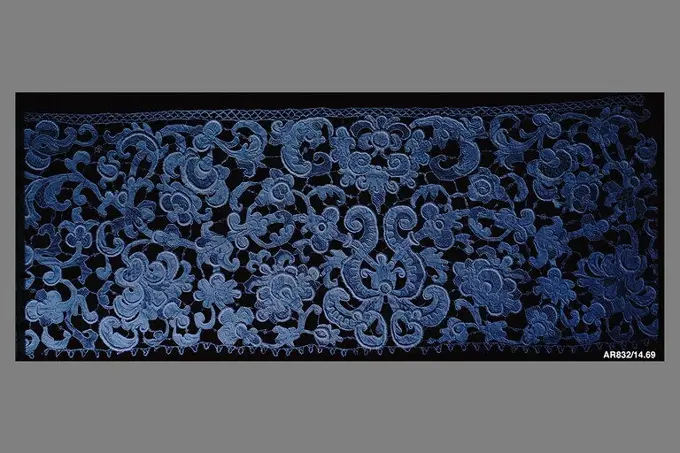
Various historical lace pieces including bobbin lace and needlepoint, showcasing delicate patterns and craftsmanship, presented on contrasting backgrounds.
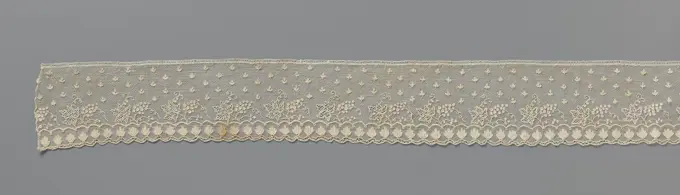
Strip of needle side with wine leaves and grape bunches, anonymous, c. 1800 - c. 1820 Strip of natural-colored needle side: men's-Aalençon. Repetitive motif of a grape vock with wine leaf on a fine hexagonal mesh ground with walled bars. Above it a spreading motif of small twigs with round flower and two oval leaves. The grapes and the leaf spring up from a horizontal spiral rank and bend in the opposite direction, but always in the same direction. Under the Spiralrank a very fine ground of a few, strongly twisted meshes, with a repetitive motif of a narrow five -fingery leaf. Fullwork without recesses in these five -fingered leaves and in the oval leaves and the grapes. One kind of decorative land in the wine leaves. Schulpenrand with regular arcs along the lower edge. The top is trimmed with a border bobbin. Alençon linen (material) Alençon Lace Strip of natural-colored needle side: men's-Aalençon. Repetitive motif of a grape vock with wine leaf on a fine hexagonal mesh ground with w
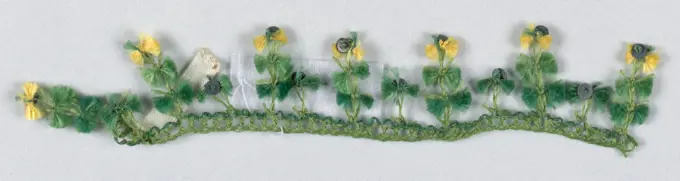
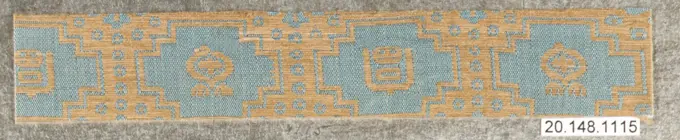
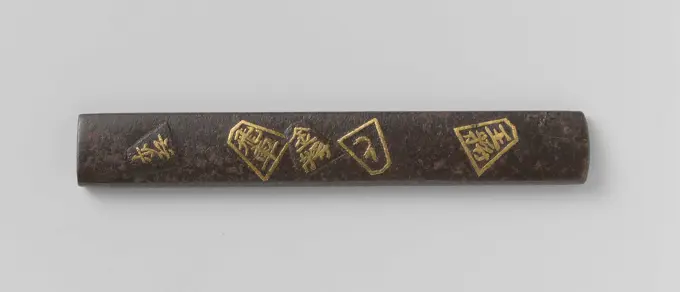
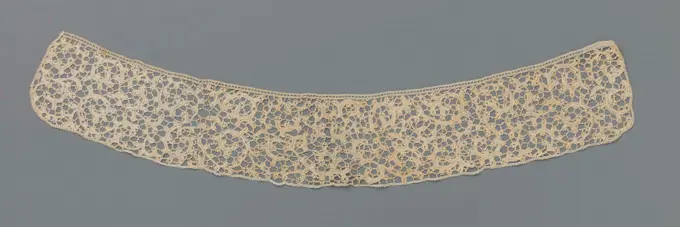
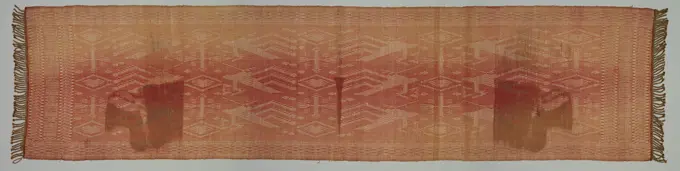
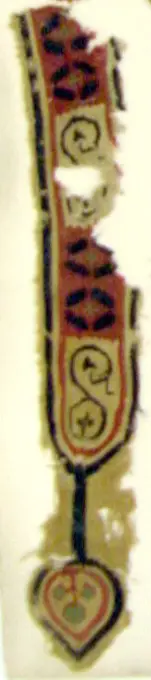
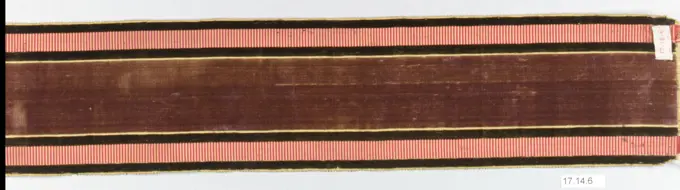
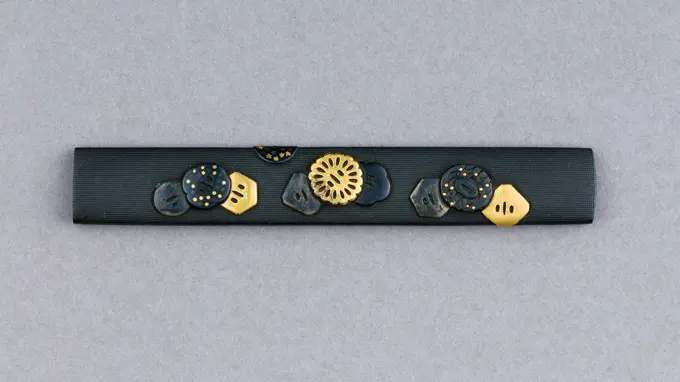
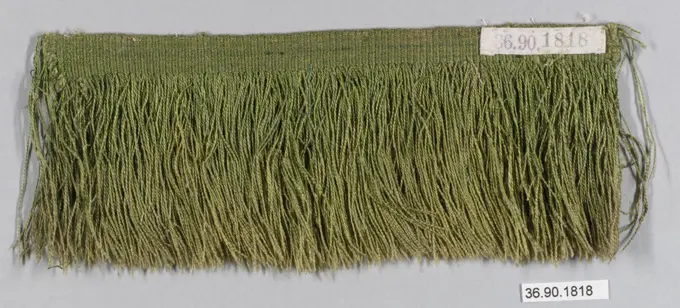
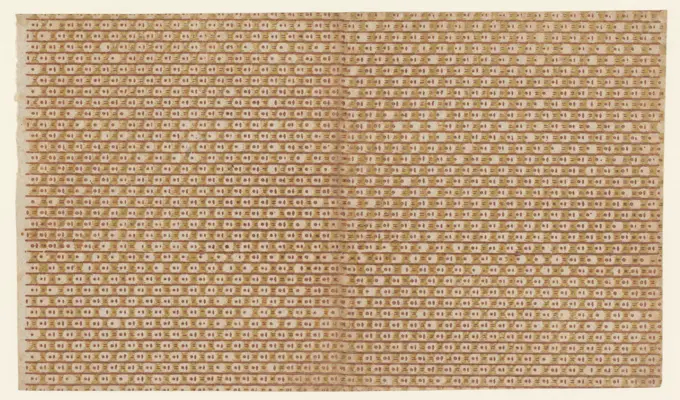
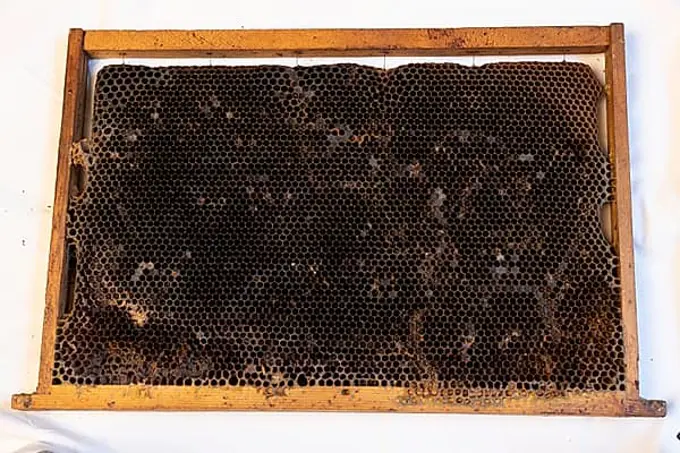
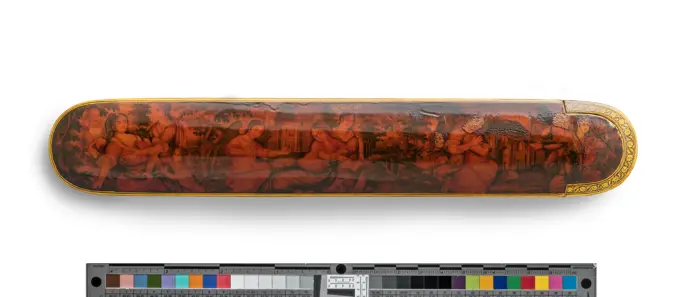
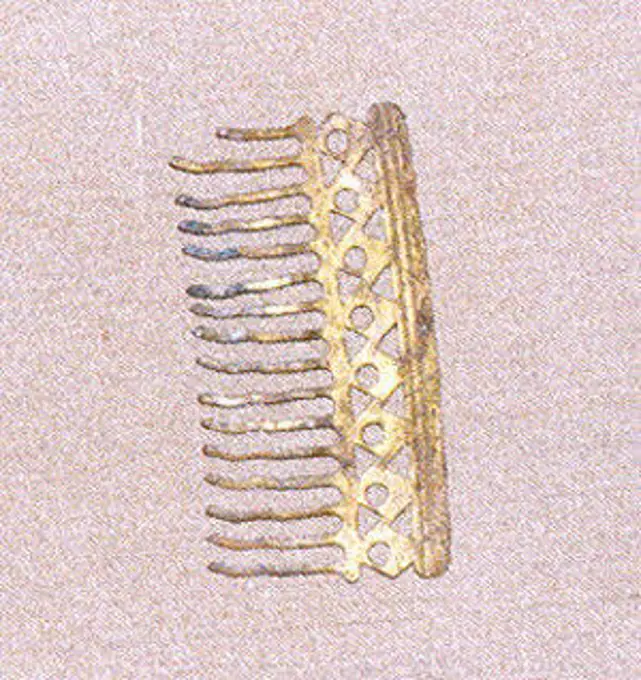
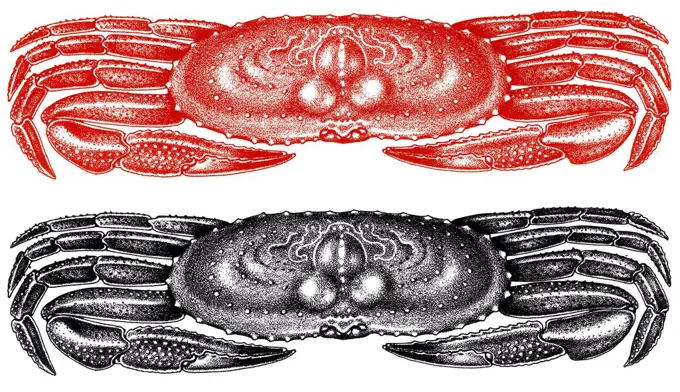
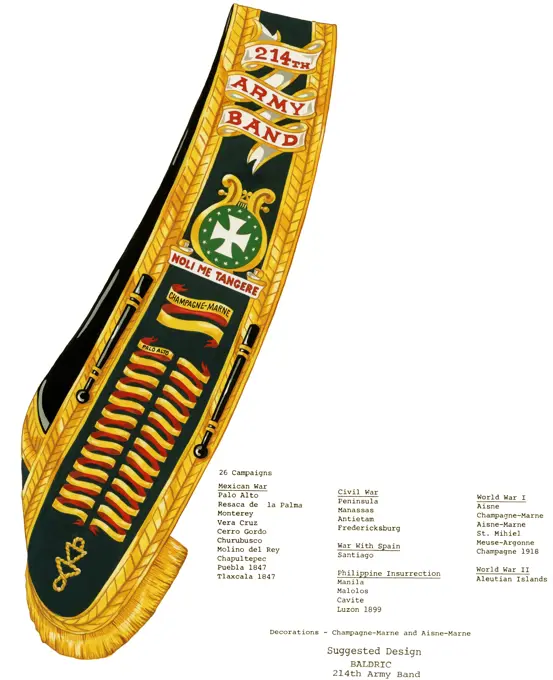
Flat cardboard boxPiece 18th century Japan. Piece 72100Cap streamer or tie, Medium: linen Technique: bobbin lace, Narrow length with a design of pointed leaves parting symmetrically down the center., Belgium, 19th century, lace, Cap streamer or tieNecklace (Patrihar) 1801-1900 India. Turquoise, gold, and seed pearls inset in the kundan technique, with polychrome enamel (minakari) .Knife Handle (Kozuka). Culture: Japanese. Dimensions: L. 3 13/16 in. (9.7 cm); W. 9/16 in. (1.4 cm); thickness 1/4 in. (0.6 cm); Wt. 1 oz. (28.3 g). Date: ca. 1615-1868. Museum: Metropolitan Museum of Art, New York, USA.Decoration with chess pieces with characters in gold, on an iron surface; Three of the five have a border.Strook kloskant met smalle voluutranken en stompe knoppen.Natural collate strip: Milanese side. The strip is slightly bent and has rounded corners at the bottom. The pattern consists of narrow voluntaries with blunt buttons. The tendrils are made with double ribbons closed in linse stroke with openwork borders, with a very open braid soil of double and branched braids with picots. The ribbons make a loop in different places, as applied to Occhiolini (-Chant). The top is finished with a separate clust strap. The sides and bottom are one piece continuously with another splitting strap with picots finished.Fringe, Medium: silk Technique: plain weave, Green, pink and white fringe with a plain weave heading, trellis band and skirt threads arranged in stripes., Greece, 17th century, trimmings, FringeBorder Made 1601-1625 Italy. Linen, plain weave; cut work with silk and gold-gilt-metal-strip-wrapped silk in laid work and couching .Brocade, late 1800s. Indonesia, Sumatra, Minangkabau, late 19th century. Brocade; silk and metal; overall: 180.3 x 44.5 cm (71 x 17 1/2 in.).Cap streamer, Medium: linen Technique: bobbin lace, Brussels style, Design of flowers and leaves and leaf forms containing small flowers arranged to make scalloped edges., 18th century, lace, Cap streamerTextile Fragment 6th century Coptic. Textile Fragment 475249Flounce fragment late 17th century Italian, Venice. Flounce fragment 219704Fringe (France); silkPiece 12th century Japan. Piece 71023Border, Medium: linen Technique: bobbin lace, Brussels style, Border with Droschel ground ornamented by minute floral sprays and small-scale cartouche forms along one side., Belgium, late 18th century, lace, BorderRibbon 18th century French. Ribbon 219870Band (Russia); linen; Bequest of Marian Hague; 1971-50-450Close-up of an abacusKnife Handle (Kozuka) ca. 1615-1868 Japanese A kozuka is a handle of a by-knife that is part of a sword mounting. It is kept in a slot on the reverse of a katana scabbard, often with a matching kōgai (hairdressing tool).. Knife Handle (Kozuka) 34526Fringe mid-18th century French. Fringe. French. mid-18th century. Textiles-TrimmingsBorder. Date/Period: 1820-30. Border. Block-printed on paper. Height: 1,160 mm (45.66 in); Width: 145 mm (5.70 in). Author: UNKNOWN.Leaf with stripes and points, anonymous, 1750 - 1900  Leaf with horizontal job pattern with stripes and points. Used as a cover.  paper. block printing (relief printing process) ornament ~ geometric motifsPersian walnut (Juglans regia), male flower, Germany, EuropeTextile Swatches Onondaga Silk Company, Inc. (1925-1981). , 1948-1959. Silk, 49 x 17 in. (124.5 x 43.2 cm).    1948-1959MoldingDesign for a decorative border ..Band. Date/Period: Early 17th century. Band. Medium: linen. Technique: grid of laid cords with needle lace (reticella style), edge of punto in aria. Author: UNKNOWN.Miser's purse, Medium: silk, metallic beads Technique: beaded netting, Netted silk of cerulean blue color, ornamented with gold beads in diamond pattern. Side opening controlled by two etched hexagonal gold rings; gold bead tassels at each end., Europe, 1800-1820, costume & accessories, Miser's purseBrown velvet attachment. Plug of brown velvet hearing at the sky of the so-called Rosendaelbed. For the accompanying attachments, see BK-1958-20-A-3 and -5.Border, Block-printed, Band of blue ground divided from band of gray by feathery rope of daisies, wheat, poppies., USA, 1850-1900, Wallcoverings, BorderDress trimming, Medium: silk Technique:, Pink and green silk forms rose buds and leaves that are on a green silk cord., France, 18th century, trimmings, Dress trimmingOrnament with leaves, Bernard Willem Wierink, c. 1910 print   paper  foliage, tendrils, branches ~ ornament. fable of Reynard the FoxWax frames for bees, the brood nest, turn to dark brown or black (from light yellow) over time, which is a key indicator that they need to be replaced for hive hygiene and health reasonsPen Box. Iran, Mid-19th century. Lacquer. Papier mache, lacquerLeaf with geometric block pattern, anonymous, 1750 - 1900  Leaf with geometric block pattern.  paper. lacquer (coating) block printing (relief printing process) ornament ~ geometric motifsSpine. bindings (gathered matter components), Book covers. 1825 - 1826. Spencer Collection. BookbindingTrimming; medium:; 1952-5-9Bronze comb ca. 7th-9th century A.D. Alanic. Bronze comb 327559Nameplate Harend at the 'Officers and other shooters of neighborhood VIII in Amsterdam led by Captain Roelof Bicker and Lieutenant Jan Michielsz Blauw' by Bartholomeus van der Helst.The Name Plate is a Rectangular Plate of Black Painted Wood Framed by Acanthus Leaves Stealed to C -Sholutions, And Herene And There An Olive Branch. On the board, the names of the portrayers on the painting 'officers and other shooters or neighborhood VIII in Amsterdam led by Captain Roelof Bicker and Lieutenant Jan Michielsz Blue' by Bartholomeus van der Heist.Mosaic tiles decorative border 19Strip with two oval medallions, anonymous, after jacques vauquer, after 1631 - before 1676 print The medallions are surrounded by leaf vines. France (possibly) paper engravingTrimming, Medium: silk Technique: woven, Yellow trimming fragment in a design of a zigzag between straight borders; picot edges., France, 19th century, trimmings, TrimmingTextile Fragment, undetermined or Tassel, Fragment Nasca-Wari. , 200-1000 C.E. Camelid fiber, bast fiber, 19 5/16 x 2 3/8in. (49 x 6cm).   Arts of the Americas 200-1000 C.E.Half Shawl. England or France. Date: 1860-1869. Dimensions: 139.8 × 272.2 cm (55 × 106 3/4 in.). Silk and mohair, Pusher machine lace. Origin: England. Museum: The Chicago Art Institute, Chicago, USA.Decorative band for clothing, late 19th-early 20th century, 32 x 3 1/4 in. (81.28 x 8.26 cm), Cotton, silk; cross-stitch, Uzbekistan, 19th-20th centuryEtching by an unknown artist, 1785, depicting Sicilian coins and medals with relief details, inscriptions, and decorative motifs.Spine. bindings (gathered matter components), Book covers. 1892. Spencer Collection. BookbindingRed and black crabs on whiteDA-SC-87-02650. Country: UnknownFive Cigar Ribbons. United States. Date: 1880-1889. Dimensions: .1: 65.8 x 2.5 cm (25 7/8 x 1 in.).2: 62.3 x 2.2 cm (24 1/2 x 7/8 in.).3: 48.8 x 2.0 cm (19 1/4 x 3/4 in.).4: 46.3 x 2.1 cm (18 1/4 x 7/8 in.).5: 44.5 x 2.6 cm (17 1/2 x 1 in.). Silk, plain weave; printed. Origin: United States. Museum: The Chicago Art Institute, Chicago, USA.