Intricate Lace Designs

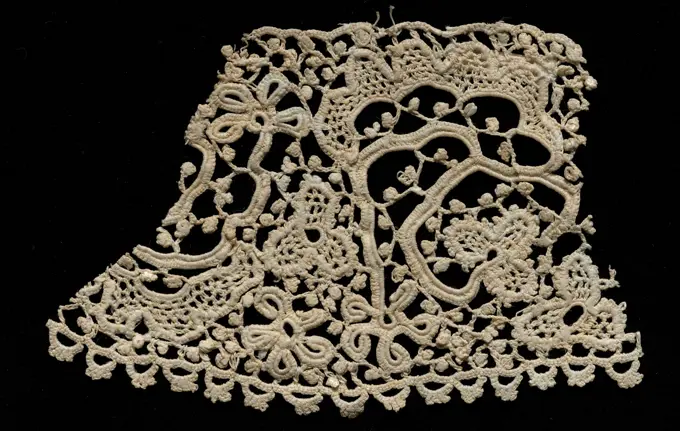
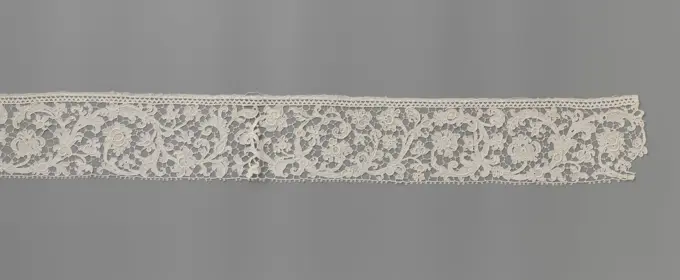
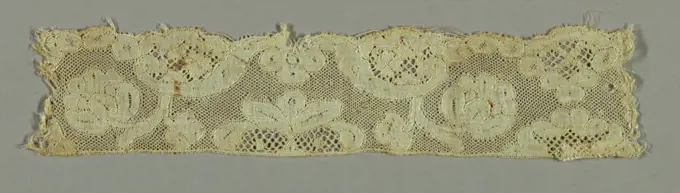
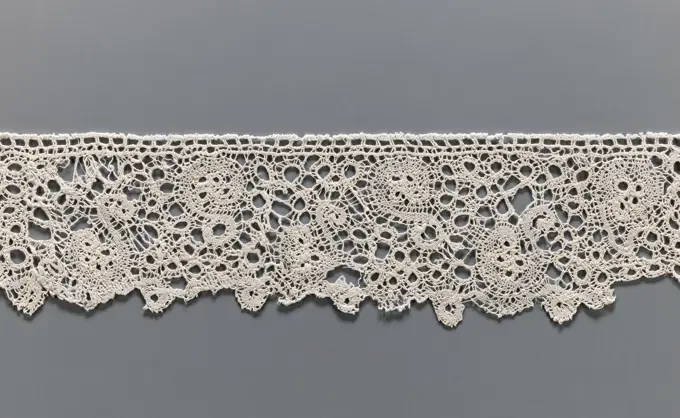
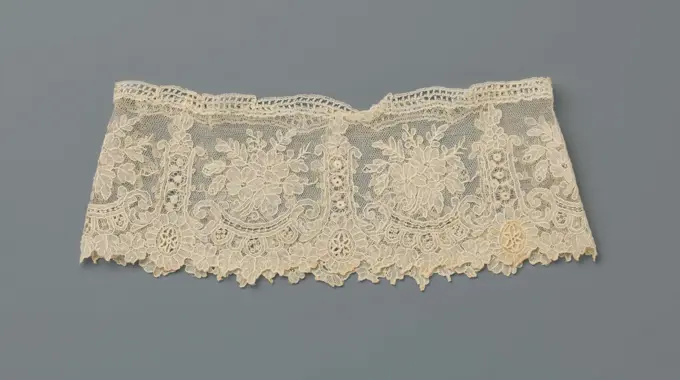
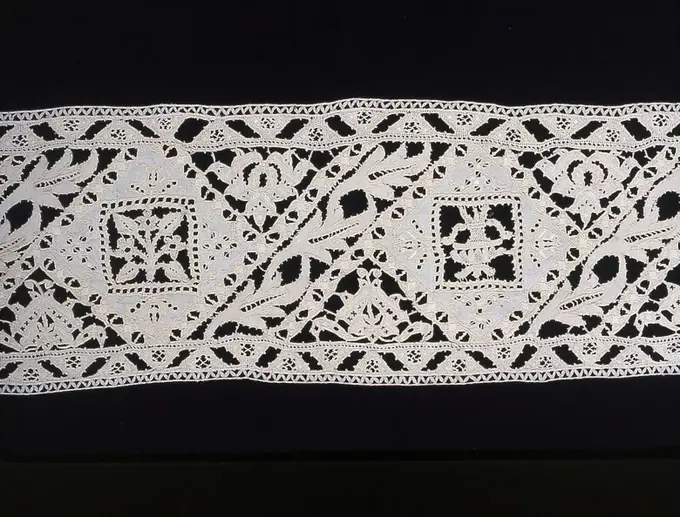
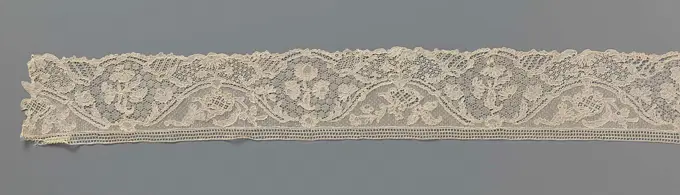
Elegant lace strips showcasing floral and geometric designs, crafted from natural-colored threads, highlighting traditional textile artistry.

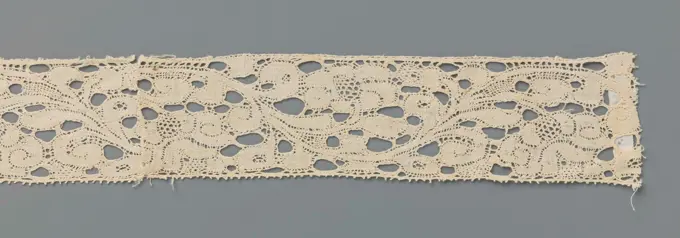
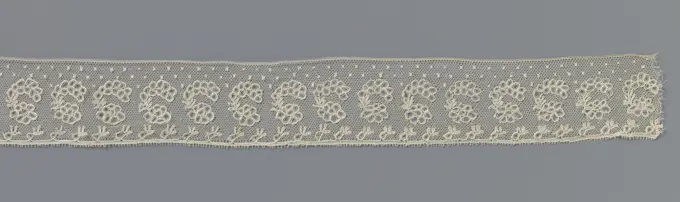
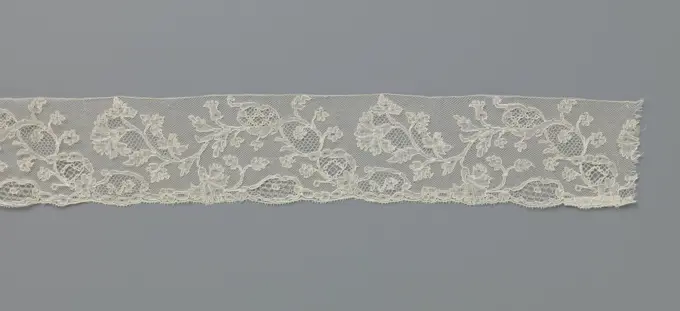
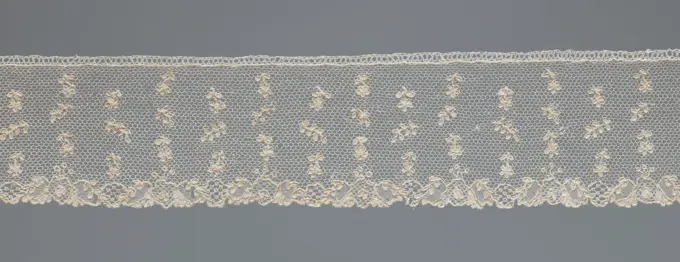
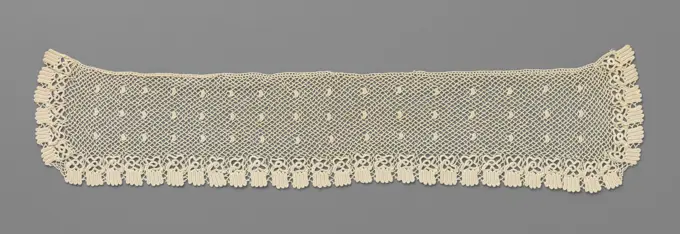
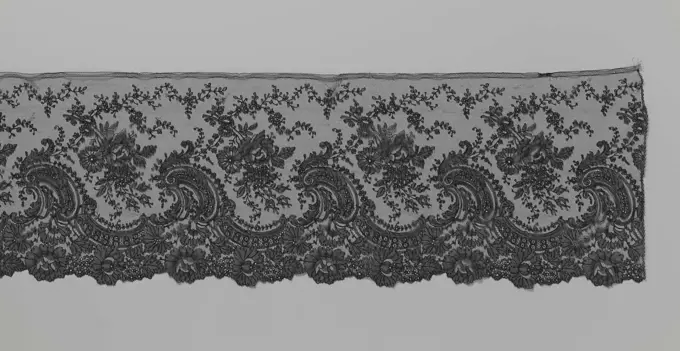
Strip Machine with wavy slender with two different flowers and berries, anonymous, c. 1900 - c. 1924  Strip of natural-colored machine side: machine valenciennes side. The repeating pattern consists of a continuous wavy slender, which is formed by two different flowers of bent stalks. From each, constantly curling flour, two short stalks with three berries stick to it. There are two loose berries next to the always bending flower. The motifs are equipped with openwork edges and small recesses and are connected by a machine Valenciennes ground with square Maas. A mechanical snowflake has been used in the Bloemharten. Along the underside of the strip, a regular sculpe edge with lying arches is formed, with the Maas soil turning into a narrow strap. The top of the strip is straight finished. The silly scrap edge along the bottom is finished with picots. Europe cotton (textile)
Strip Machine with wavy slender with two different flowers and berries, anonymous, c. 1900 - c. 1924 Strip of natural-colored machine side: machine valenciennes side. The repeating pattern consists of a continuous wavy slender, which is formed by two different flowers of bent stalks. From each, constantly curling flour, two short stalks with three berries stick to it. There are two loose berries next to the always bending flower. The motifs are equipped with openwork edges and small recesses and are connected by a machine Valenciennes ground with square Maas. A mechanical snowflake has been used in the Bloemharten. Along the underside of the strip, a regular sculpe edge with lying arches is formed, with the Maas soil turning into a narrow strap. The top of the strip is straight finished. The silly scrap edge along the bottom is finished with picots. Europe cotton (textile)
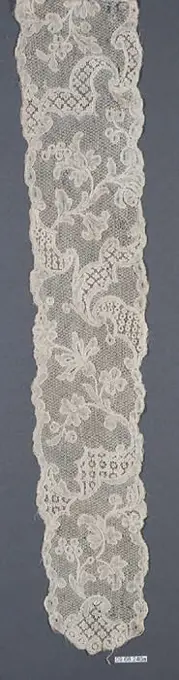
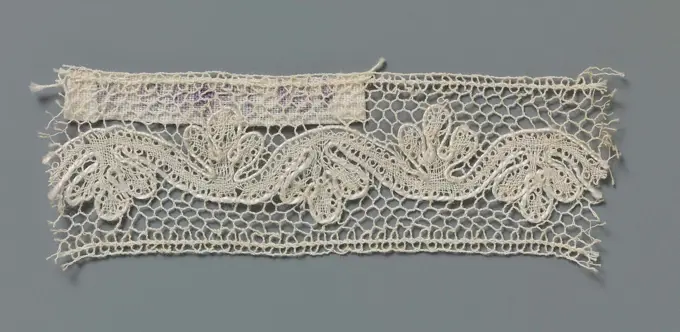
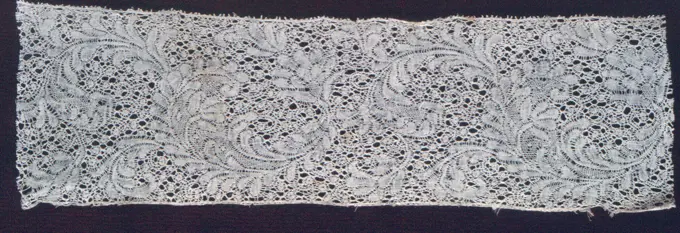
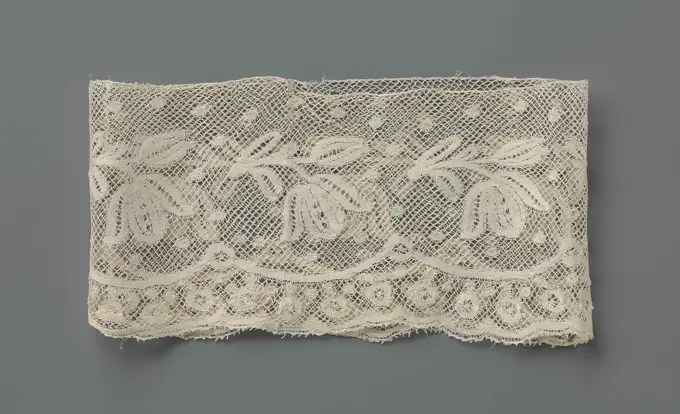
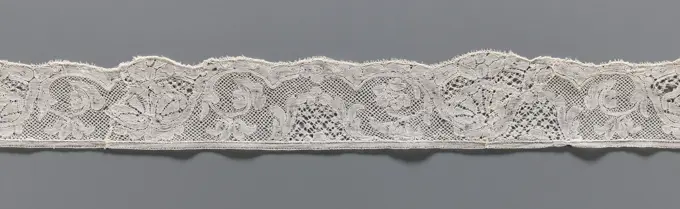
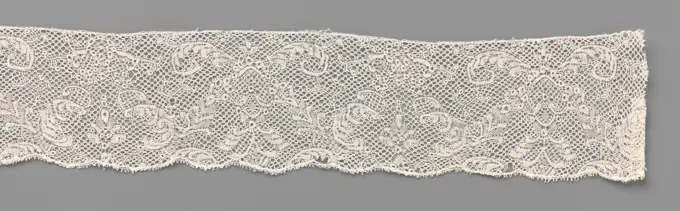
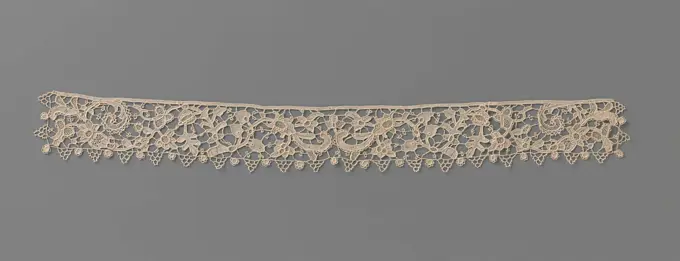
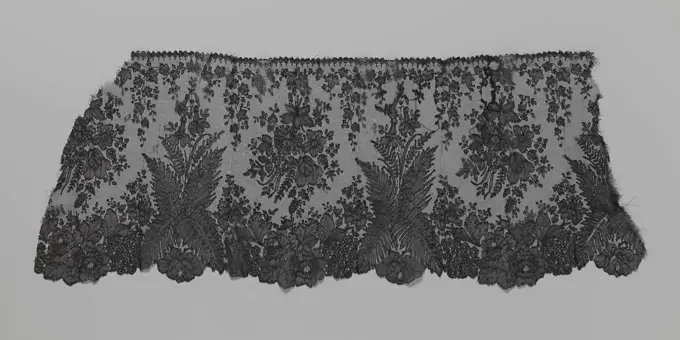
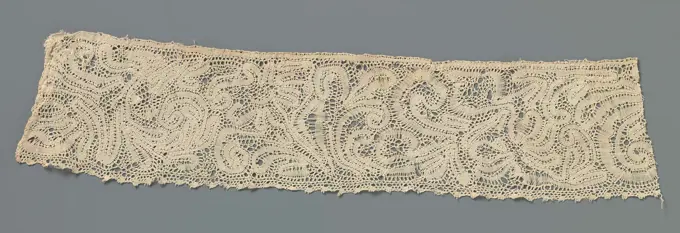
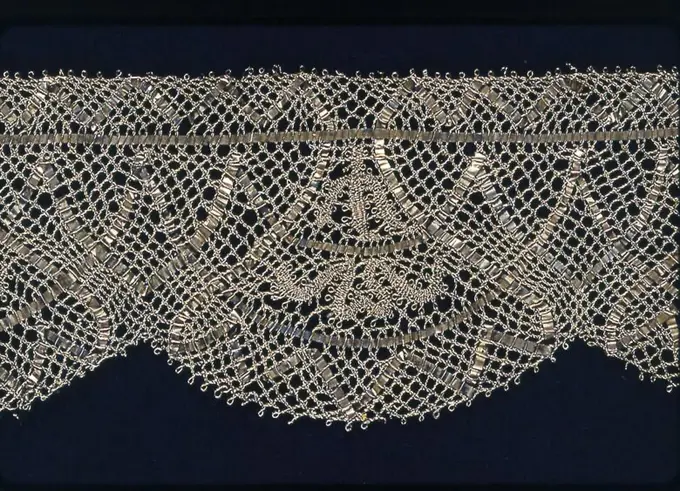
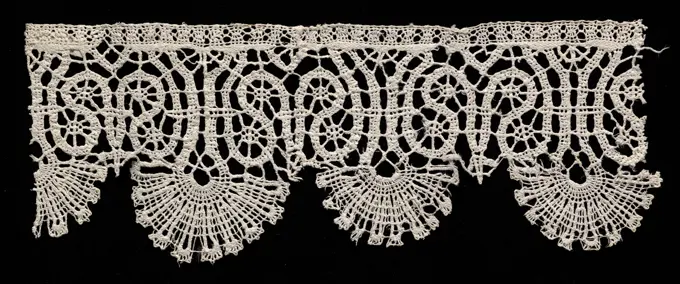
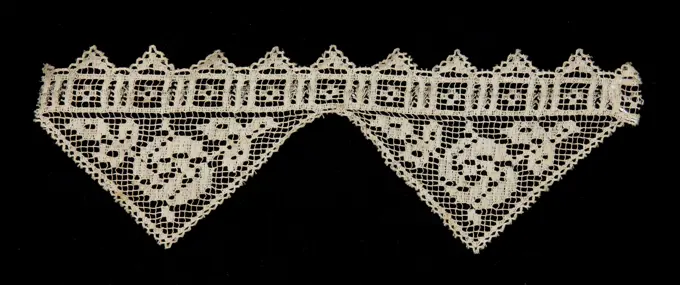
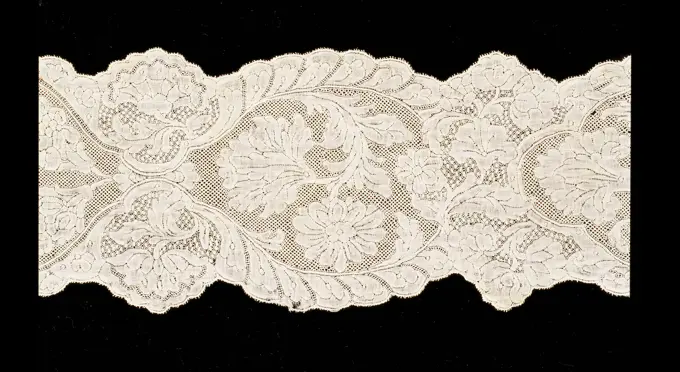
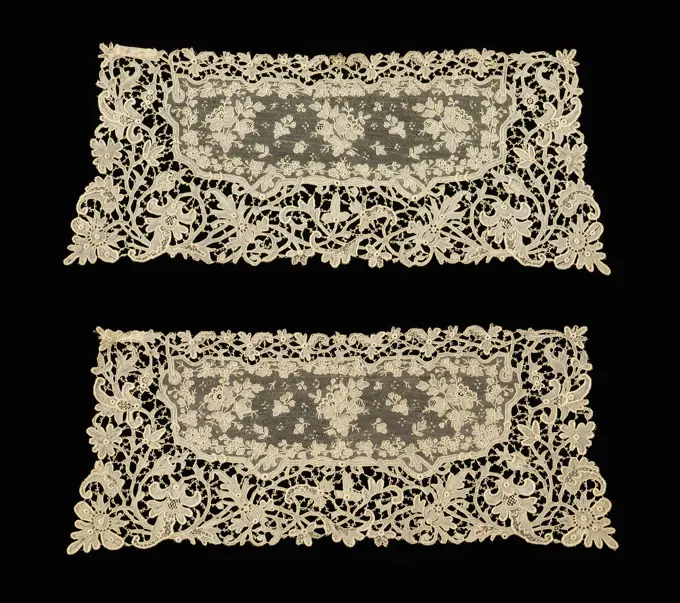
Strook kloskant met golvende bloemenrank.Natural collate strip, old lace. The pattern consists of a wavy rank with flowers and leaves. Halfway through a break in the pattern can be seen because two strips are sewn together, the pattern being mirrored. There is hardly any floor, the motifs are connected to each other here and there with wide short braids and here and there with a row of thinner braids. Ornamental grounds are used in the flower hearts and some leaves, with square meshes and round meshes. The motifs are made in linen stroke with openwork edges. The top and bottom of the strip are immediately finished, with picots on one side.Japon strip of application side with symmetrical reserves along the lower edge, anonymous, c. 1840 - c. 1850 Japon strip of natural -colored application side, bobbin and needle side Applicated on mechanical tulle. Almost symmetrical pattern along the bottom edge with two reserves with grid works, crowned with volutes and with five flowers at the bottom. A rosette flower between the two reserves. And on the outside of these reserves two large flowers adjacent to each other. Bent branches with large flowers from the decorated lower edge. The strip consists of three pieces of pieces and is sewn to BK-BR-J-191. Brussels Japon strip of natural -colored application side, bobbin and needle side Applicated on mechanical tulle. Almost symmetrical pattern along the bottom edge with two reserves with grid works, crowned with volutes and with five flowers at the bottom. A rosette flower between the two reserves. And on the outside of these reserves two large flowers adjacent to each other. Bent brStrip bobbin with C-shaped motif made with circles, anonymous, c. 1830 - c. 1850 Strip of natural -colored bobbin: Lille side. Spray pattern of square mosques with below, on the center line, a repeating pattern of a unilaterally oriented C-shaped motif of openwork circles or so-called 'Punaises'. There are circles or berries along the underside of the strip, crowned with three narrow leaves. All circles are made with thicker and shiny contour threads, along which a decorative land has been used. Hardly any fullwork has been applied, only the three narrow leaves of the berries and some narrow leaves in the C-shaped motif are made in linen battle. Top and bottom of the strip are straight finished, with the bottom with picots. Belgium linen (material) bobbin lace / Lille lace Strip of natural -colored bobbin: Lille side. Spray pattern of square mosques with below, on the center line, a repeating pattern of a unilaterally oriented C-shaped motif of openwork circles or so-called 'Punaises'.Strook kloskant met voluten.Strip natural colosside, possibly Flemish guipure. Symmetrical pattern with volutes to which three, four and five-leaf flowers spring. Around the motifs different braided bars with picots. Within the motifs a honeycomb ground. The top is finished with a straight edge. The bottom is finished with triangles built from arcs.Lappet (one of a pair) early 18th century Flemish, Mechlin. Lappet (one of a pair) 218178Strip of needle side with flower vase in which branches form a V and a kidney -shaped cartouche, anonymous, c. 1880 - c. 1899 Strip of natural needle side: youghal side. The repeating pattern consists of two almost symmetrical compositions that merge. One composition consists of a flower vase contained between two mirrored faint s-shaped feathered leaves. Two branches in V-shape are placed in the vase, between which a rosette flower with ten rush-hour petals. At the bottom of each branch, a similar flower cuts the edge of the vase. The other composition consists of a more or less kidney -shaped cartouche that is formed by two mirrored curly flower branches with a hanging leaf. The field is closed at the bottom of the strip by a rosette flower flanked by two palm flowers. Diagonally above each palm flower a pomegranate. The motives are made with feston stitches with many recesses and are accentuated by contour threads with varying relief. A wide variety of decorative stitches and decoraStrip Machine with wavy slender with two different flowers and berries, anonymous, c. 1900 - c. 1924  Strip of natural-colored machine side: machine valenciennes side. The repeating pattern consists of a continuous wavy slender, which is formed by two different flowers of bent stalks. From each, constantly curling flour, two short stalks with three berries stick to it. There are two loose berries next to the always bending flower. The motifs are equipped with openwork edges and small recesses and are connected by a machine Valenciennes ground with square Maas. A mechanical snowflake has been used in the Bloemharten. Along the underside of the strip, a regular sculpe edge with lying arches is formed, with the Maas soil turning into a narrow strap. The top of the strip is straight finished. The silly scrap edge along the bottom is finished with picots. Europe cotton (textile)Strook kloskant met een golvende lijn en drielobbige bladeren.Strip natural colosside, Buckingham side. The repetitive and continuous pattern consists of a regular wavy line on the center line. From every golf valley and every wave cap, a triple blade that protrudes slightly above or below the waves. The waves and leaves are made in linen stroke and are fitted with thick and shiny contour wires on all sides. The strip also exists from a Maas soil, a tulet. Upper and bottom of the strip are straight finished.Band; linen; Bequest of Marian Hague; 1971-50-390Strip of bobbin with wingerd leaf on curved stem, anonymous, c. 1900 Strip of natural-colored bobbin, Valenciennes side. The repeating pattern consists of a curved stem on which a wingerd leaf hangs down. The leaf cuts partly the wavy decorative band that runs along the underside. The tire consists of four lobes between the leaves, with four berries each. The motifs are connected by a mesh ground, a diamond-shaped Valenciennes-ground, strewn with moesjes. The motifs are made in netslag and linen battle with recesses and openwork edges. Top and bottom of the strip are straight finished, with the bottom with picots. Belgium cotton (textile) Bobbi Lace / Valenciennes Lace Strip of natural-colored bobbin, Valenciennes side. The repeating pattern consists of a curved stem on which a wingerd leaf hangs down. The leaf cuts partly the wavy decorative band that runs along the underside. The tire consists of four lobes between the leaves, with four berries each. The motifs are connected by a mesManchet van kloskant met hangende tulp.Cuff of natural colosside: Valenciennes side. On a coarse grille (square grating), strewn with 'sequins', is an ongoing pattern. Single-sided pending tulips are separate from a garland from a firm berry apart from a garland.Strip bobbin with varied ribbon that forms U-shaped shell with six lobes, anonymous, c. 1900  Strip of natural -colored bobbin, Russian side. The repeating pattern is formed by a ribbon that forms a U-shaped shell with six lobes on the bottom. The ribbon is made in three overflowing variations of strokes, all with openwork edges: mains, closed linen battle and linen battle with an open -worked center in which crossing pairs with diagonal lines form. The top is straight. Russia linen (material) bobbin lace / Russian laceStrook naaldkant met hartvormige moesjes en aaneengeschakelde ovalen langs de onderzijde.Strip natural-colored coniferous lace: Alençon side. Pattern with seven rows of heart-shaped meadows and connected oval cartouches along the bottom. The ovals are each crowned by a cut-away oval and with Raderpicots in it. Such a self-worked oval is also in the center of each oval cartouche and always rises with a stalk from the right. The semicircular underside of the cartouches are formed by a row of connected and worked ovals. The motifs are made with feston stitches and equipped with relief contours. The motifs are connected by a fine Maas soil. The top of the strip is straight finished. The sloping edge with semicircular slot comes from the pattern and is finished with picots.Fragment of the lace;  2. PO. 18th century (1751-00-00-1800-00-00);Fragment, Medium: linen Technique: bobbin lace (Mechlin-style), Scalloped border fragment with reserve areas of openwork along the edge. Floral spray design with heavy solid leaves., France, late 18th century, lace, FragmentSleeve ruffle, Medium: linen Technique: bobbin lace, Mechlin style, Mechlin sleeve ruffle with the upper part showing floral sprays and leaf ornaments with little squares sprinkled over the field. The lower part has an openwork band with medallions and a scalloped border of pendant flowers., Belgium or France, early 19th century, lace, Sleeve rufflePiece ca. 1700 Flemish. Piece 218592Strip bobbin with two triangular compositions, anonymous, c. 1690 - c. 1710 Strip of natural-colored bobbin, binche side. The repeating and thin pattern consists of two different compositions, both symmetrical and triangular. The sloping lines of one composition consist of v-shaped leaves put together. An inverted heart forms the top of the triangle, which is crowned by two large feathered volute leaves. In the other composition, such volute leaves provide the oblique lines of the triangle, which is crowned by a not clearly defined, composed motif. There is a Kandelaber motif in both triangular fields. The motifs are made in linen battle with openwork edges and in netslag. They are connected to each other by a traly land, a five -part ground. Different decorative lands have been applied, in the heart, among other things, in one of the Kandelaber motifs and under C-Voluten. The top of the strip is straight finished. The faintly scalloped underside is finished with picots. The sculptes sKloskant dress strip with reserves and carnations, anonymous, c. 1850 Japon strip of natural -colored bobbin: Mechelen side. Continuous pattern with wavy stems over the entire width, with branches, along which oval reserves stand and which end in Carnations. The motifs are connected by a fine Maas soil, the Mechelen soil. The motifs are made in linen battle with thicker and shiny contour threads. Ornamental grounds in the reserves. Flat sculpture on the bottom occurring from a pattern with connected reserves. The top is finished with a separate strap. Bruges (possibly) linen (material) bobbin lace / Mechlin (lace) Japon strip of natural -colored bobbin: Mechelen side. Continuous pattern with wavy stems over the entire width, with branches, along which oval reserves stand and which end in Carnations. The motifs are connected by a fine Maas soil, the Mechelen soil. The motifs are made in linen battle with thicker and shiny contour threads. Ornamental grounds in the reserves. Flat sculptuCuff of needle side with wavy zigzag-siering and rose branch, anonymous, c. 1900 - c. 1924 Cuff of natural -colored needle side: Brussels mesh side. The repeating pattern consists of a regular wavy decorative frame, with a rose branch in each valley. On the rose branch there is one big rose in the center under which a smaller rose hangs, on the thin branch that goes to the top two more open work rosette flowers. Under each wave top, a semi -circular flour hangs on a thin handle with two heart -shaped leaves. The flower consists of a horizontal C-Volut with seven lobes as petals. The wavy decorative frame consists of two sealed contour threads that form a narrow line and under which a strong winding contour wire hangs, which ensures an open zigzag line. Under the open zigzag a succession of circles. The wavy decorative frame forms the scrap edge, along with the hanging circular flour. The connected circles and seven petals ensure the lobes on the scrap edge. The motifs are equipped withNeedlepoint (Point Alençon) Lace Band, second half of 18th century. France, Alençon, second half of 18th century. Lace, needlepoint; average: 10.5 x 29.9 cm (4 1/8 x 11 3/4 in.).Strip of needle side with asymmetrical acanthus leaves, anonymous, c. 1900 - c. 1905 Strip of natural needle side, Venetian relief side. Pattern with asymmetrical acanthus leaves in S and C-Voluten that run into palm flowers. Irregular bar with picots. The upper edge is straight with a zigzag line of picoted bars inside. A scalloped edge at the bottom. BURANO linen (material) Venetian raised work Strip of natural needle side, Venetian relief side. Pattern with asymmetrical acanthus leaves in S and C-Voluten that run into palm flowers. Irregular bar with picots. The upper edge is straight with a zigzag line of picoted bars inside. A scalloped edge at the bottom. BURANO linen (material) Venetian raised workStrook naaldkant met korenbloemen.Two-thirds of the width is filled with a scattering pattern of falling cornflowers on a coarse ground (of abusive bars). A third of the width forms a right sealed outer edge (with a single Alençon soil), lined with two parel lists, and decorated with a horizontal rank of coordinated stems, each with three cornflowers, which are always in the same direction. Alençon side.Border (Belgium); linenBobbin Lace (Needlepoint Design) Insertion and Edging of Points, 17th century. Italy, Genoa, 17th century. Lace, bobbin; average: 9.9 x 40.7 cm (3 7/8 x 16 in.).Kloskant intermediate mate with two zigzag jobs, anonymous, c. 1900  Strip of natural -colored bobbin: sling. The repeating pattern consists of two parallel zigzag lanes with a center line of connected fine checks made in form. A tuning ground has been applied to the top and bottom of the Zigzag lanes and a twisted cross-stroke soil has been applied between the Zigzag lanes. Spitsovaaltjes are in the grounds. Top and bottom of the strip are straight. Russia (possibly) linen (material) Bobbi lace / lace clothBorder (France); linenFragment of the lace;  18th century (1701-00-00-1800-00-00);Length of Lace. England, mid-19th century. Textiles; textile lengths. Cotton "Bucks" or Buckinghamshire bobbin laceStrip application side with C-shaped flower branch, anonymous, c. 1850 Strip of natural -colored Brussels Application side: bobbin side with a few needle lace piera applicated on mechanical tulle. The repeating pattern consists of C-shaped flower branches, which spring from a wavy lower edge with zigzag pattern. This edge is trimmed with potente arches, with a rocaille-like motif under each wave top with a dot in the center. The motifs are made in linen battle with openwork edges and equipped with relief contours. The top is trimmed with a separate strap. Brussels cotton (textile) Brussels Applied Strip of natural -colored Brussels Application side: bobbin side with a few needle lace piera applicated on mechanical tulle. The repeating pattern consists of C-shaped flower branches, which spring from a wavy lower edge with zigzag pattern. This edge is trimmed with potente arches, with a rocaille-like motif under each wave top with a dot in the center. The motifs are made in linen battle wCrochet Lace Fragment, 19th century. Ireland, 19th century. Lace, crochet: cotton; average: 7.7 x 10.8 cm (3 1/16 x 4 1/4 in.).Fragment of punto in aria needlelace unknownFragment (France); linen; Bequest of Marian Hague; 1971-50-295Strip of needle side with volute vines, anonymous, c. 1675 - c. 1699 Strip of natural -colored needle side: Venetian relief side. On an open bars of bar is an ongoing pattern of wide wavy, branched volutes. The volutes have been awarded with ever -varied palm flowers while the feathered Balderen have doubled here and there as an arabesk. Venice linen (material) Venetian raised work Strip of natural -colored needle side: Venetian relief side. On an open bars of bar is an ongoing pattern of wide wavy, branched volutes. The volutes have been awarded with ever -varied palm flowers while the feathered Balderen have doubled here and there as an arabesk. Venice linen (material) Venetian raised workLace laceStrip of needle side with hanging bell flower, anonymous, c. 1850 - c. 1875 Strip of natural -colored needle side: Brussels mesh side. Stiffly hanging large clock flowers alternate with pure semi -rounds with a single rosette. Brussels linen (material) Brussels Gaze Point Strip of natural -colored needle side: Brussels mesh side. Stiffly hanging large clock flowers alternate with pure semi -rounds with a single rosette. Brussels linen (material) Brussels Gaze PointBed curtain border. Culture: Russian. Dimensions: 72 in. (182.9 cm). Date: fourth quarter 18th century.This object is from the collection of Natalia de Shabelsky (1841-1905), a Russian noblewoman compelled to preserve what she perceived as the vanishing folk art traditions of her native country. Traveling extensively throughout Great Russia, she collected many fine examples of textile art of the wealthy peasant class. From the 1870s until moving to France in 1902, Shabelsky amassed a large collection of intricately embroidered hand-woven household textiles and opulent festival garments with rich decoration and elaborate motifs. The Brooklyn Museum holdings include many fine examples including the majority of the garments. Portions of Shabelsky's collection are also housed at the Museum of Fine Arts, Boston, the Cleveland Art Museum, and the Russian Museum of Ethnography in St. Petersburg.The exquisite workmanship of this example displays the variety and fineness of stitches in an eleBorder (one of three) 18th century Flemish, Brabant. Border (one of three) 223083Border, Medium: linen Technique: bobbin lace, Mechlin style, N. Europe, 18th century, lace, BorderVolant Van Kloskant with diamond -shaped medallions, anonymous, c. 1870 - c. 1920 Volant of natural -colored bobbin: Parisian side. The soil is divided in two in a Paris soil with clovers at the top and a tuler ground underneath. In the latter is a symmetrical pattern of diamond -shaped openwork medallions with side vines crowned by a flower between two leaves. The leaves, the side ranks and a series of flowers and sling in the scallops are loose on the other in three closed garlands. The motifs are made in linen stroke and provided with contour threads. A rose soil has been applied as a decorative land. Belgium linen (material) bobbin lace / Paris lace Volant of natural -colored bobbin: Parisian side. The soil is divided in two in a Paris soil with clovers at the top and a tuler ground underneath. In the latter is a symmetrical pattern of diamond -shaped openwork medallions with side vines crowned by a flower between two leaves. The leaves, the side ranks and a series of flowers and sFlounce (Belgium); linenNeedlepoint (Drawnwork) Lace Insertion and Bobbin Lace Edging, 16th century. Italy, Venice, 16th century. Lace, needlepoint and bobbin: linen; average: 9 x 30.2 cm (3 9/16 x 11 7/8 in.).Strip of needle side with spirals, anonymous, c. 1600 - c. 1699 Strip of natural needle side. Pattern with destroyed crowded volutes and palmets, without soil. The full work consists of thick contour threads that are laid spiral, where connections were made by rotated feston stitches in one tour height. The top and bottom are finished with a straight edge, but very small stalks or dots hang on the bottom. The short sides are stitched to prevent fraying. Italy (possibly) linen (material) Strip of natural needle side. Pattern with destroyed crowded volutes and palmets, without soil. The full work consists of thick contour threads that are laid spiral, where connections were made by rotated feston stitches in one tour height. The top and bottom are finished with a straight edge, but very small stalks or dots hang on the bottom. The short sides are stitched to prevent fraying. Italy (possibly) linen (material)Kraag van gehaakte kant met vierpassen en vierkante godronschulpen.Collar of natural-colored Irish crochet side. Rectangular model with rounded corners. Midfield consists of a network with three rows of mashes. The collar is finished on three sides with a concatenation of open four passes (rosettes with four flower blades). There is a circle in the center of every four-pass. And under every four-pass a square shell, filled with godrewes. The top of the collar is straight finished.Bef van naaldkant met arabeskenbladeren.BEF of natural needle side: Venetian relief side. There are very large spiral raft on an open bars, among other things and there with a ring. Fleid arabesque leaves and various flowers show a moderate relief. On three sides a (new) bow edge runs.Cuff from crocheted side with flower basket and bow, anonymous, c. 1890 - c. 1909 Cuff made of natural Irish crocheted side. The cuff is rectangular and runs in the middle in a point. In the point a vase with a large flower. Next to the flour a branch with leaves. Along the top edge a horizontal slender with oval -shaped leaves and berries. In the middle, the rank is placed in a knot with large loops. The ends hang above the vase. Above the slender an irregular bar with picots. Under the slender a finer diamond -shaped Maas soil with picots. Finished on all sides with a border with triple arches and picots. Ireland cotton (textile) Cuff made of natural Irish crocheted side. The cuff is rectangular and runs in the middle in a point. In the point a vase with a large flower. Next to the flour a branch with leaves. Along the top edge a horizontal slender with oval -shaped leaves and berries. In the middle, the rank is placed in a knot with large loops. The ends hang above the vase. Above tEdging 17th century Italian, Genoa. Edging 220952Fragment late 18th century French. Fragment 212890Band (Italy); linenFragment 17th century Italian. Fragment 214909Flounce (Belgium); linenGuimpe van naaldkant met miniatuur granaatappel.Flumpy of natural needle side: Venetian relief side or Venetian rosion side. Symmetrical, stretched tendrils stitch against an open bars. There are miniature vegetables on the outside. Large triangles and florets form a straight finish.Japonstrook van kloskant met varens.Japon strip from black climbing side: Chantilly side. On a blank mesh stock is a closed edge with slot, filled with a garland of flowers and leaves. On the intersections there is a small shell with a hanging rose, above which a striker bouquet rises from four large fern leaves and a flower branch, which reaches the top edge. Here a horizontal ivy drink with hanging twigs runs, while a large bouquet depends on the large scallop of this ivy drink, among other things with a tulip.Insertion 17th century Italian, Genoa. Insertion 220870Strook kloskant.Strip natural colosside, osteuropese side. The pattern is formed by clooted ribbons, creating all windling organic shapes, which arose apart and passing together. There are different voltage leaves and a single flower celk, including a daisy or sun hat. The ribbons are made in linen stroke with openwork edges. Most space is occupied by the ribbons, connections are made, among other things, with crossing couples and made with a few meshes, including round valenciennes-meshes. The top is finished with a straight splitting ribbon, with openwork edges on both sides. Along the bottom, a variety of a few meshes and always one small fan-shaped motif with picots for a slot edge with small scaps.Doubled strip of needle side with heart -shaped slens, anonymous, c. 1690 - c. 1699 Strip of natural -colored needle side: flat Venetian side. On a bar of land that forms regular six-sided meshes, there is a fine pattern of two symmetrical, heart-shaped slens connected by serpentine ranks. Straight finish of large triangles. Venice linen (material) flat Venetian (needle point) Strip of natural -colored needle side: flat Venetian side. On a bar of land that forms regular six-sided meshes, there is a fine pattern of two symmetrical, heart-shaped slens connected by serpentine ranks. Straight finish of large triangles. Venice linen (material) flat Venetian (needle point)Border. Possibly France. Date: 1650-1700. Dimensions: 9.4 × 156.6 cm (3 3/4 × 61 5/8 in.)Width repeat: 11.6 cm (4 5/8 in.). Gold-gilted-silver strip-wrapped silk and gold-gilted-silver strips, bobbin straight lace. Origin: France. Museum: The Chicago Art Institute, Chicago, USA.Volant Van Kloskant with diamond -shaped medallions, anonymous, c. 1870 - c. 1920 Volant of natural -colored bobbin: Parisian side. The soil is divided in two in a Paris soil with clovers at the top and a tuler ground underneath. In the latter is a symmetrical pattern of diamond -shaped openwork medallions with side vines crowned by a flower between two leaves. The leaves, the side ranks and a series of flowers and sling in the scallops are loose on the other in three closed garlands. The motifs are made in linen stroke and provided with contour threads. A rose soil has been applied as a decorative land. The top of the strip is finished with a separate strap. Belgium linen (material) bobbin lace / Paris lace Volant of natural -colored bobbin: Parisian side. The soil is divided in two in a Paris soil with clovers at the top and a tuler ground underneath. In the latter is a symmetrical pattern of diamond -shaped openwork medallions with side vines crowned by a flower between two leaves. Pieces (2) French 19th centuryBobbin Lace (Rose Lace) Edging of Bell Points, 17th century. Italy, Genoa, 17th century. Lace, bobbin; average: 9.6 x 24.8 cm (3 3/4 x 9 3/4 in.).Border; linenInsertion 16th century Italian, Venice. Insertion. Italian, Venice. 16th century. Bobbin lace. Textiles-LacesStrip bobbin with oval -shaped cartouche and two round flowers, anonymous, c. 1700 - c. 1799  Strip of natural -colored bobbin, Antwerp side. The repeating and symmetrical pattern consists of an oval -shaped cartouche along the bottom edge, the top of which reaches the center line of the strip. From the top, a round flower springs on both sides of the cartouche on a long curling stem. The motifs are connected by a Maas soil, a square Valenciennes ground. The motifs are made in linen battle with thicker and shiny contour threads. Different snowflake grounds have been used in the flowers and the cartouche, among other things. At the top and bottom are straight finished, with the bottom with picots. Antwerp linen (material) bobbin lace / Antwerp laceLace lace, filet laceLappet, 18th century, 36 x 12 in. (91.44 x 30.48 cm), Lace; bobbin lace, France, 18th centuryStrook gehaakte kant met rozettenkrans.Strip natural-colored Irish crochet side. A repeating pattern of a wreath with six rosette flowers interspersed by two right-hand rosette flowers. Crocheted irregular mesh soil with picots. In the wreath a coarse hexagonal maas soil. Along the top and bottom finished with three-piece arcs with a few picots.Lace, 1800s , maker unknown.Fragment, Medium: linen Technique: bobbin lace (early Valenciennes ground), Valenciennes fragment with a loosely massed floral design., 17th century, lace, FragmentCuffs ca. 1890 probably Belgian. Cuffs 156838Flounce early 17th century Italian. Flounce 222763Piece 18th century Italian. Piece 214911Lappet (one of a pair) early 18th century Italian, Venice. Lappet (one of a pair) 227674Collar And Cuff (Belgium); linen, cottonFlounce Made 1865-1885 Belgium. Cotton, bobbin part lace of a type known as Duchesse de Bruges .Piece early 19th century French. Piece 214648Kloskant intermediate base with wavy center line and loose ovals, anonymous, c. 1600 - c. 1624 Piles of natural -colored bobbin side. The pattern consists of a regularly wavy narrow center line with a loose oval under each wave top and in any golf valley. The motives are connected by Maas soil. The motifs are made in linen battle with openwork edges. Top and bottom of the strip are straight finished, with the underside originally equipped with picots, but these are no longer visible due to the ragged edges. The intermediate facility comes from or intended for bedding. Friesland (possibly) linen (material) bobbin lace Piles of natural -colored bobbin side. The pattern consists of a regularly wavy narrow center line with a loose oval under each wave top and in any golf valley. The motives are connected by Maas soil. The motifs are made in linen battle with openwork edges. Top and bottom of the strip are straight finished, with the underside originally equipped with picots, but these are Fragment of lace. unknown, authorStrip of gold side with two rows of circles with six -pointed flowers, anonymous, c. 1920  Strip bobbin, gold side. The pattern consists of two rows of circles with a six -pointed flower or star. The circles are connected to each other by potented braids, which form four -pointed stars on the center line. The flowers in the circles are made in shape. The semicircular scoops along the bottom follow the curve of the circles, with three small lobes hanging on each shell. The top is straight. The side is cloned in two parts and then sewn together. Lyon . bobbin laceCollar. Culture: Irish. Date: ca. 1890. Museum: Metropolitan Museum of Art, New York, USA.Fragment; linen; 1897-8-202Manchet van naaldkant met bloemtak in u-vormig cartouche.Cuff from natural needle side: Brussels gauze side. The repeating pattern consists of a U-shaped cartouche with a flower branch with two rosette flowers and two chali flowers. The 'legs' of the you are formed by two straight pillars, awarded by a rosette flower and triple leaf. Under every pillar, an oval medallion hangs with a rosette flower in the center. Between the pillars and consecutive medallions, a triple frame with five lobes hangs and there a garland of three leaves between two rosette flowers. The medallions together with this pendulum for the sloping edge along the bottom of the strip. The motifs are equipped with contour wires, the three circles in the pillars and the rosette flower in each medallion have thicker relief contours. The motifs are connected by a fine Maas soil, a mesh side ground. The top of the cuff is finished with a separate clamp. The ends of the cuff are apparently invisible to each other.Insertion for Cover. Italy. Date: 1575-1600. Dimensions: 19.7 x 214.5 cm (7 3/4 x 84 3/8 in.)Weft repeat: 42.6-43.9 cm (16 3/4 -17 1/4 in.). Linen, plain weave; embroidered in buttonhole, double hem, overcast back, overcast, and satin stitches; eyelet holes; cut and drawn thread work embroidered in buttonhole and hem stitches with needle lace fillings (including: buttonhole and overcast bars, some decorated with woven picots, lace filling stitches, etc., some decorated with buttonhole picots and overcast edges). Origin: Italy. Museum: The Chicago Art Institute, Chicago, USA.Strip 17th century possibly German. Strip. possibly German. 17th century. Needle lace. Textiles-LacesBand ca. 1600 Italian. Band 217965Strook naaldkant met spitsovalen en bloempotten.Strip natural needle side: Argertella side. Pattern with a regular wavy garland with zigzag line, flower branches, cartouches and flower pots. The pendulum forms whole and half peakovals, with a flower branch with three flowers in the entire oval and a cartouche in half oval with flowers and leaves. Motifs in the ovals are alternately in two variations. The pattern along the underside includes rocaille cartouches between which a hanging flowerpot with a large daisy-like flower. The motifs are interconnected by many different types of ornamental grounds, including diamond soil with the patch eyes typing for the Argertella side, rosettes of hexagonets and alençon meshes with moes. In addition to the many ornamental grounds, also full of recesses to fill the flowers, leaves and pendulum. The top is trimmed with a border clamping side. Faintic scalloped lower edge.Borders Made 1820-1839 France. Linen and horsehair, needle lace of a type known as Point D'AleÁon .Fragment; linen; 1897-8-214-a,bMouw van machinale kant met spitsovale medaillons voor aan een avondjapon.Sleeve from natural machine side for an evening dress. Rectangular model with one sloping side and a sloping edge. The pattern consists of a row of spiral oval medallions, outlined by a flower garland above garlands of bowl flowers with a diamond pattern and some flower garlands with hanging leaves. Above are garlands of ribbons and branches with bows above and down and a motif of volutes and branches with leaves and buttons.Insertion 18th century Italian, Abruzzi (Gessopalena). Insertion 221138Cuff Made 1880-1899 Belgium. Cotton, mixed lace bobbin part lace of a type known as Duchesse and of needle lace of a type known as Point de Gaze .Fragment of lace - frill. unknown, authorBobbin Lace Insertion, mid 16th century. Italy, Venice, mid 16th century. Lace, bobbin; average: 10.2 x 19.1 cm (4 x 7 1/2 in.).Fragment (Belgium); linenEdging 17th century Italian, Genoa. Edging 228821Band; linen; 1943-70-4-a/eJaponstrook van zwarte kloskant met brekende golven.Japon strip from black climbing side: Chantilly side. On a blank mesh fence there is an ongoing pattern of à-jour band work from lying and standing C volutes, which form a breaking wave line. From the crested peaks, rearwardly facing winding blossom branches emerged, which are intersected by a large, hanging dash of rose, daisy and blossoms. Below the waves a closed sculpture runs from a 'poppy' between blossoms and a rose among three hanging carnations.Border Fragment; linen; 11.5 x 26.5 cm (4 1/2 x 10 7/16 in. ); Bequest of Marian Hague; 1971-50-474Strip of black machine side with diamond -shaped cartouches, anonymous, c. 1880 - c. 1899 Strip of black machine side: Machinal Chantilly side. The repeating and almost symmetrical pattern consists slightly below the center line of the strip of a succession of diamond -shaped cartouches. Each window is crowned by a narrow spring-shaped top on C-Voluten. Between the windows there is a leaf garland with one rosette flower and a loose rose branch above it and moesjes. At the bottom runs behind the windows along a straight horizontal track. There are three longer -leaking half ovals with dots in this course between the successive windows. On each half oval, a straight down -shaped leaf or corner hangs straight, alternating with and without round recesses in the middle. The motifs are connected by a machine tulip. The scrap edge consists of narrow deep shells and are formed by the hanging corners. Part of the underside with the spring-shaped leaves has been cut and probably used to finish tStrip bobbin with anemones, anonymous, c. 1850 - c. 1874 There is a running pattern on a coarse mesh stock (square Maas). In an open section there are two rows of rose buttons between Moesjes. In a more filled part stands above the feathered leaves that form the semi -circular scallops a resulting branch with an anemone, a double leaf and a button. The strip consists of four parts that are sewn together and was sewn in 1966 on a strip with a similar, but not identical pattern. Valenciennes side. Sluis (Possible) linen (material) Bobbi Lace / Valenciennes Lace There is a running pattern on a coarse mesh stock (square Maas). In an open section there are two rows of rose buttons between Moesjes. In a more filled part stands above the feathered leaves that form the semi -circular scallops a resulting branch with an anemone, a double leaf and a button. The strip consists of four parts that are sewn together and was sewn in 1966 on a strip with a similar, but not identical pattern. ValencienFragment early 19th century Italian, Venice. Fragment 212741