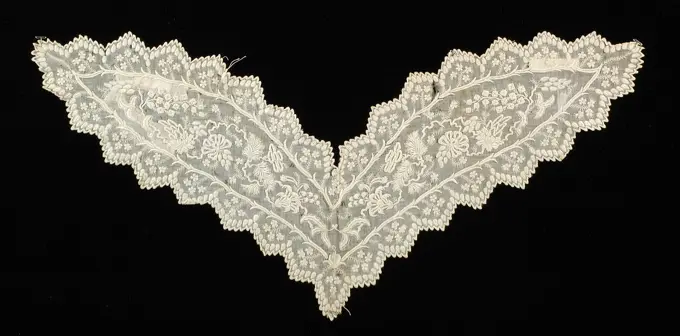
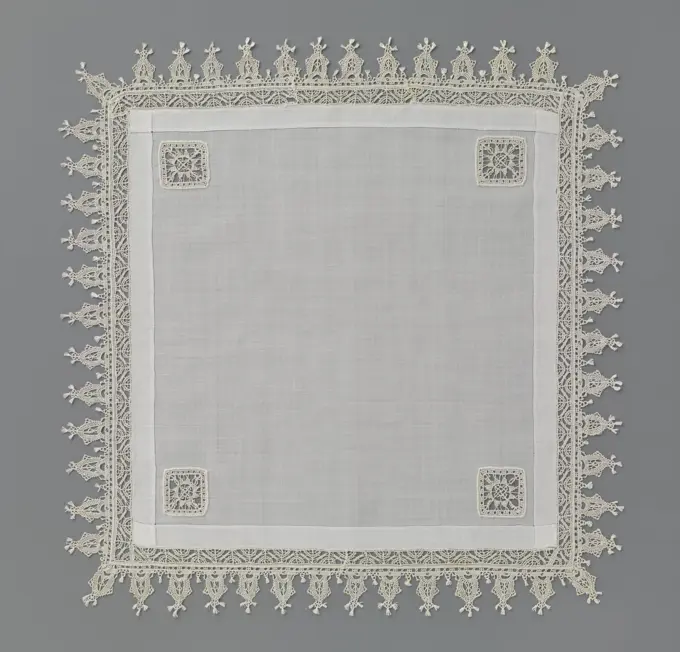
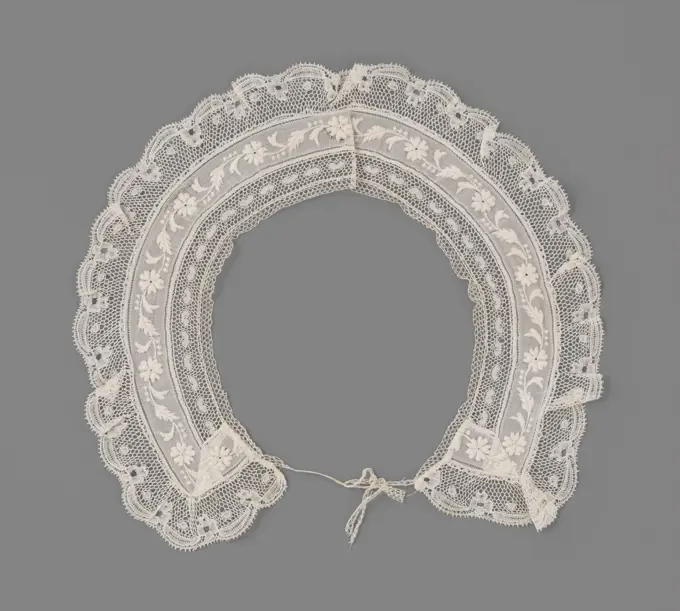
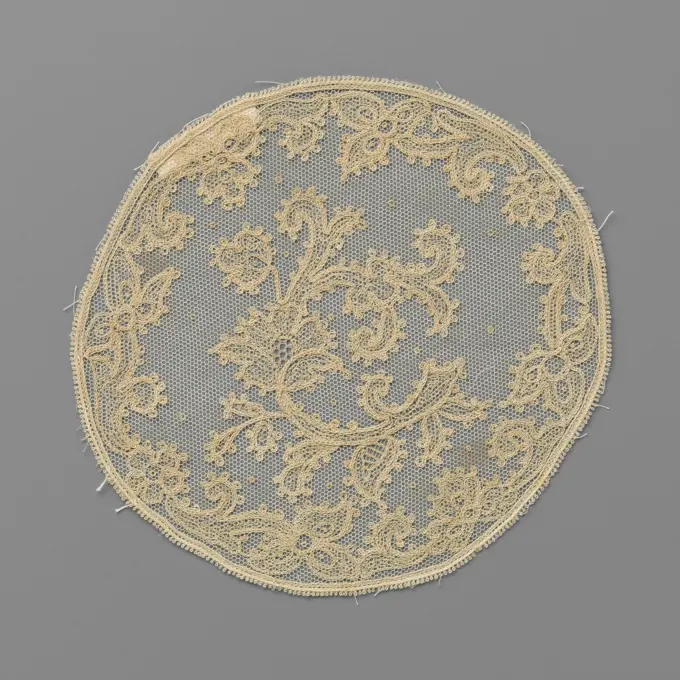
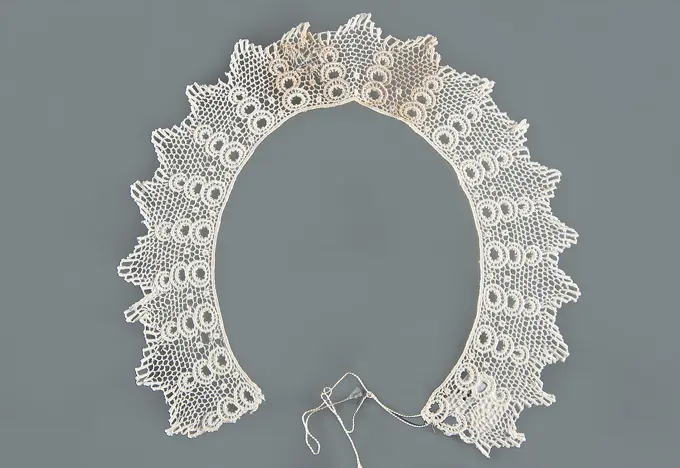
Intricate Lace Designs

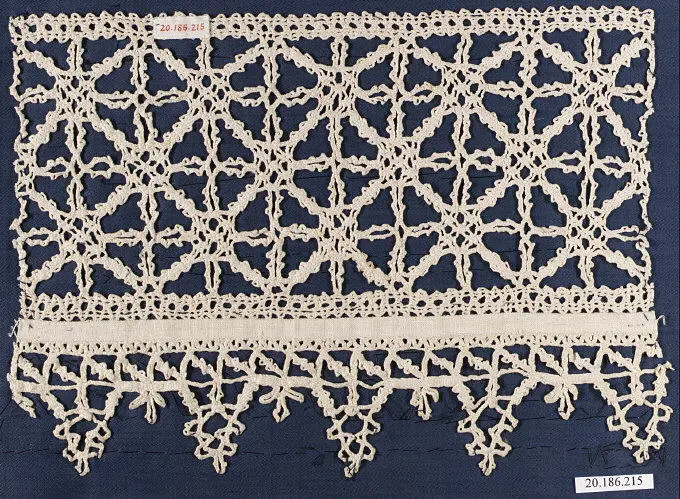
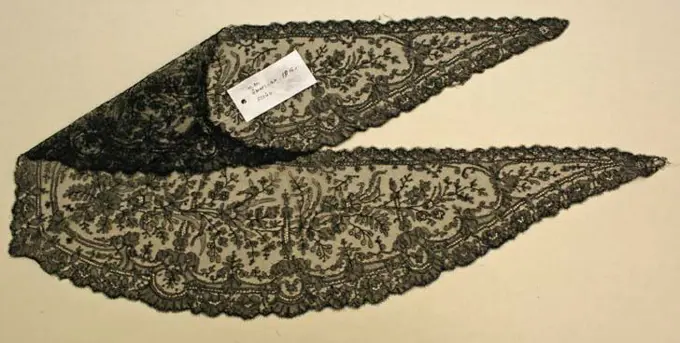
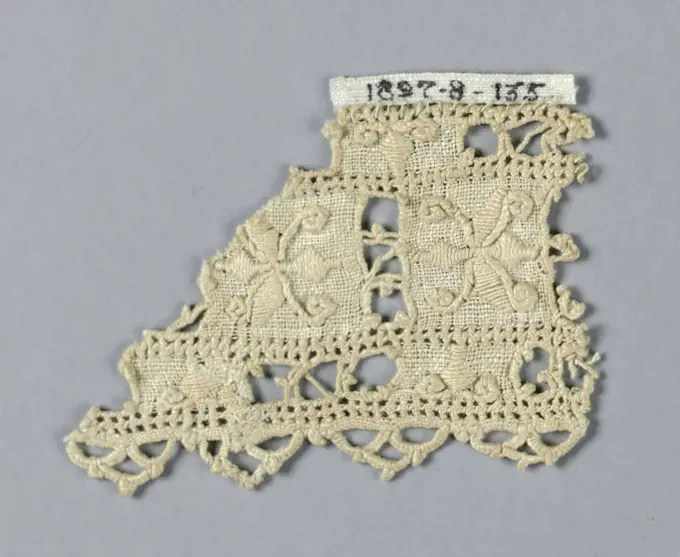
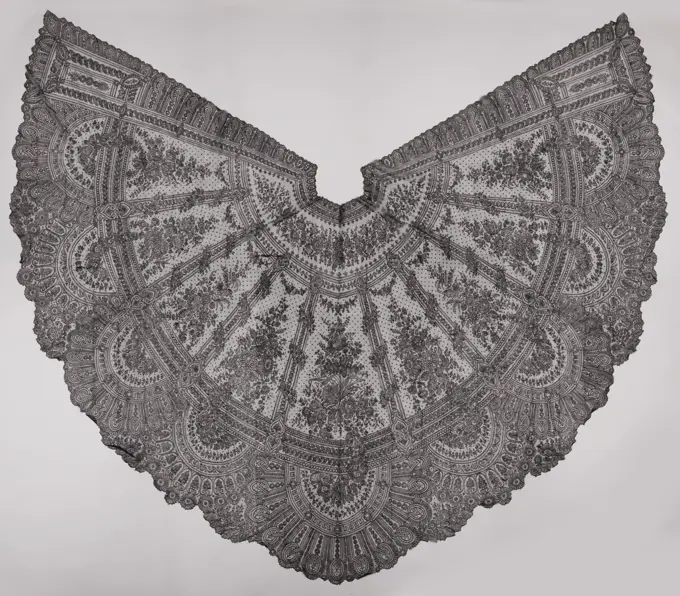
Elegant lace strips showcasing floral and geometric designs, crafted from natural-colored threads, highlighting traditional textile artistry.

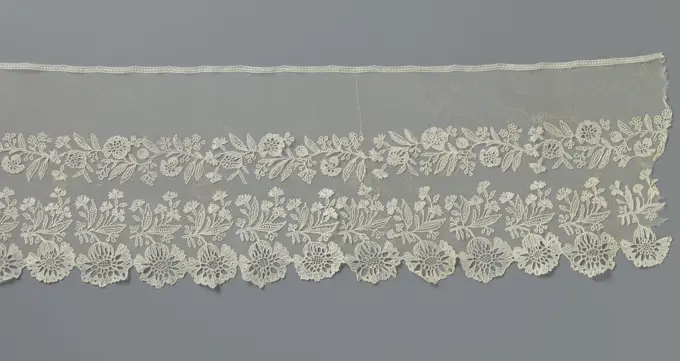
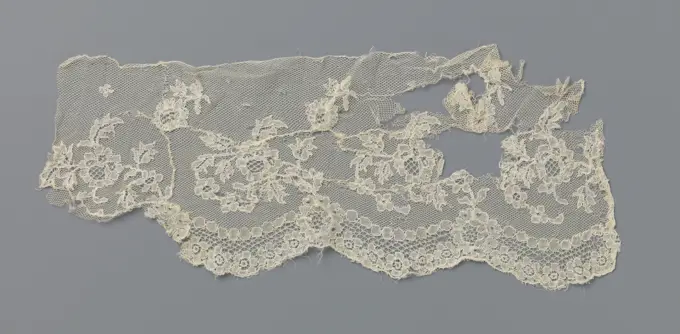
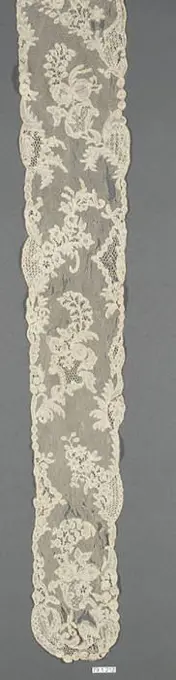
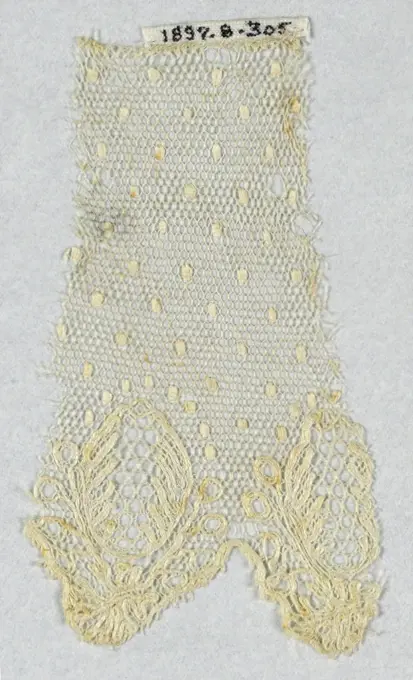
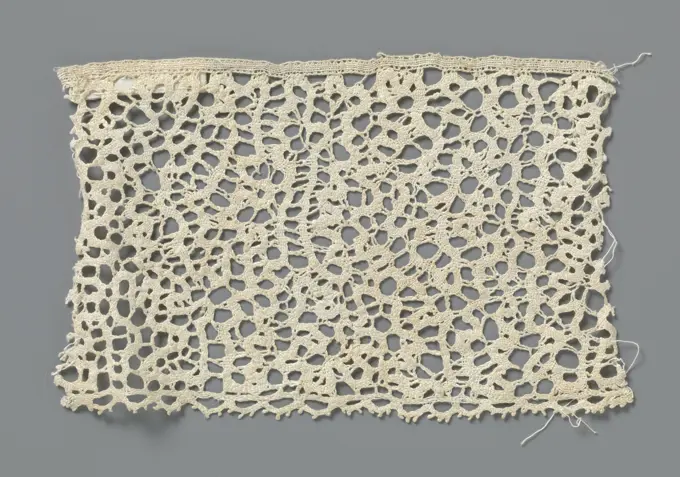
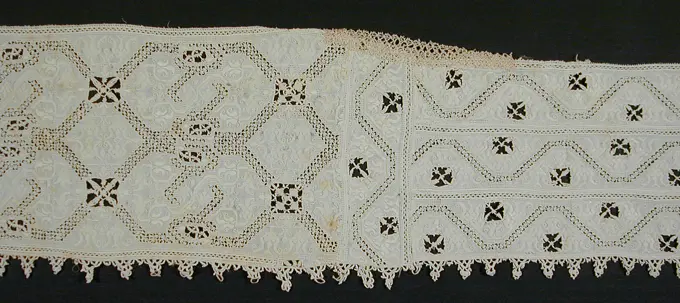
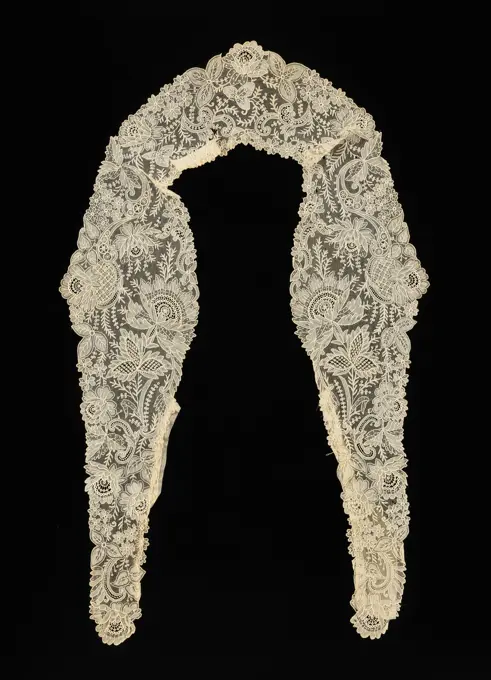
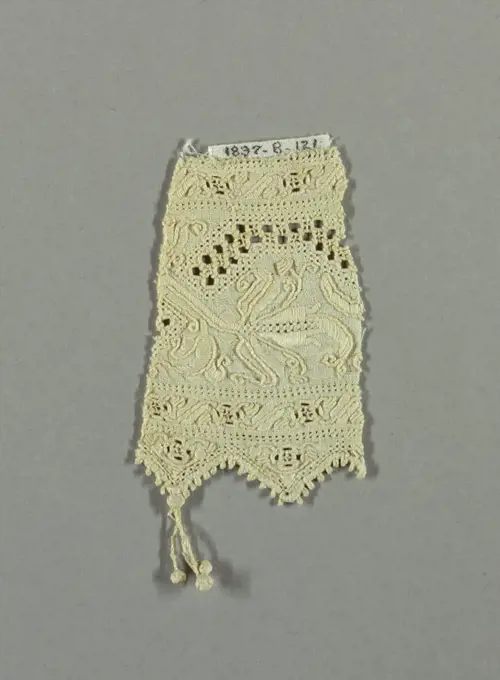
Strip Machine with wavy slender with two different flowers and berries, anonymous, c. 1900 - c. 1924  Strip of natural-colored machine side: machine valenciennes side. The repeating pattern consists of a continuous wavy slender, which is formed by two different flowers of bent stalks. From each, constantly curling flour, two short stalks with three berries stick to it. There are two loose berries next to the always bending flower. The motifs are equipped with openwork edges and small recesses and are connected by a machine Valenciennes ground with square Maas. A mechanical snowflake has been used in the Bloemharten. Along the underside of the strip, a regular sculpe edge with lying arches is formed, with the Maas soil turning into a narrow strap. The top of the strip is straight finished. The silly scrap edge along the bottom is finished with picots. Europe cotton (textile)
Strip Machine with wavy slender with two different flowers and berries, anonymous, c. 1900 - c. 1924 Strip of natural-colored machine side: machine valenciennes side. The repeating pattern consists of a continuous wavy slender, which is formed by two different flowers of bent stalks. From each, constantly curling flour, two short stalks with three berries stick to it. There are two loose berries next to the always bending flower. The motifs are equipped with openwork edges and small recesses and are connected by a machine Valenciennes ground with square Maas. A mechanical snowflake has been used in the Bloemharten. Along the underside of the strip, a regular sculpe edge with lying arches is formed, with the Maas soil turning into a narrow strap. The top of the strip is straight finished. The silly scrap edge along the bottom is finished with picots. Europe cotton (textile)
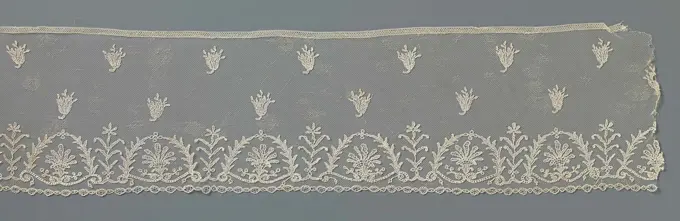
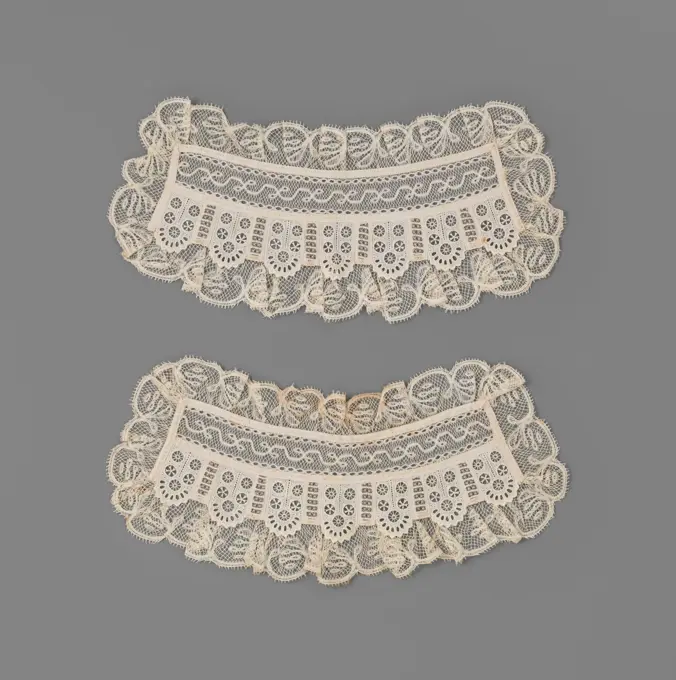
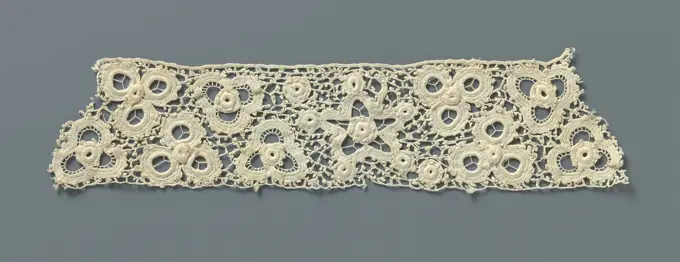
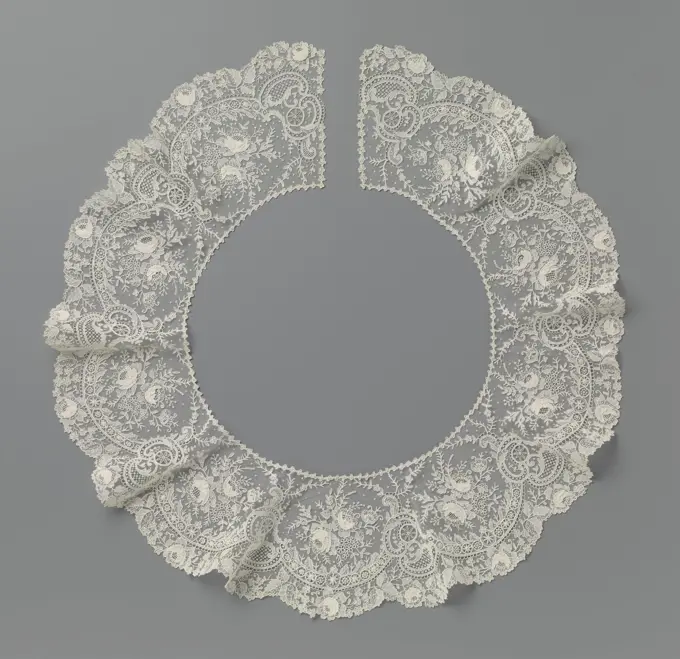
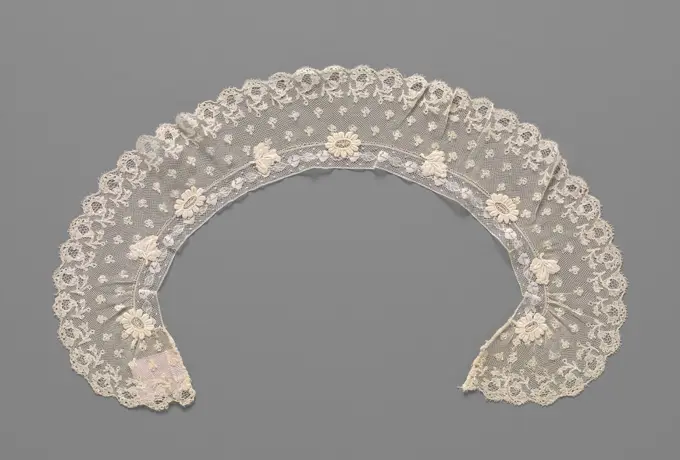
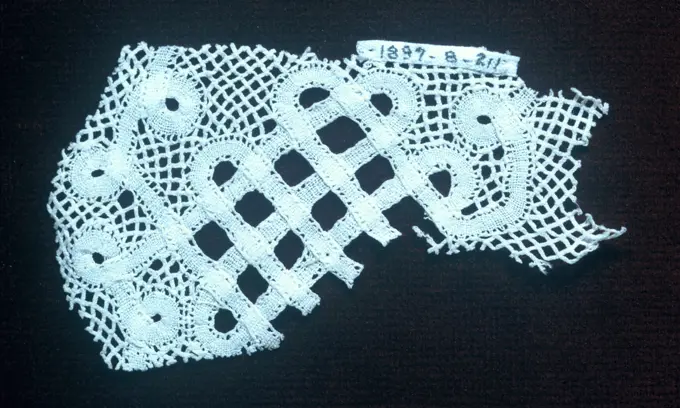
Japon strip of application side with hanging flowers, anonymous, c. 1820 - c. 1840 Japon strip Natural -colored application side, needle side Applicated on Machine Tulle, Point d'Angleterre. An edge of round scallops is formed by an enclosed row of large flowers that, to the right, depend on small flower branches. Loos above that, a narrow edge of a wavy branch with smaller similar flowers runs. The upper part consists of a stock of unadorned tulle. Two narrower strips have the same and a reduced pattern. Brussels linen (material) Japon strip Natural -colored application side, needle side Applicated on Machine Tulle, Point d'Angleterre. An edge of round scallops is formed by an enclosed row of large flowers that, to the right, depend on small flower branches. Loos above that, a narrow edge of a wavy branch with smaller similar flowers runs. The upper part consists of a stock of unadorned tulle. Two narrower strips have the same and a reduced pattern. Brussels linen (material)Square (Italy); linenStrip bobbin with pearl and rosette list, anonymous, c. 1830 - c. 1850 There is a running pattern on the traly land, a Mechelen soil (also known as ice ground), with a few stripped four -pass -shaped mulets. Along the inside there are small hanging rosette branches, a dune rose in the middle on larger volute stems, which spring with the same flower that forms the final piece of the pure circular arch -shaped scallops. The sculptes consist of a pearl and rosette list, which encloses a middle track with gridwork. Mechelen side. Belgium linen (material) bobbin lace / Mechlin (lace) There is a running pattern on the traly land, a Mechelen soil (also known as ice ground), with a few stripped four -pass -shaped mulets. Along the inside there are small hanging rosette branches, a dune rose in the middle on larger volute stems, which spring with the same flower that forms the final piece of the pure circular arch -shaped scallops. The sculptes consist of a pearl and rosette list, which encloseCooper Union Museum Lace Study Card, Medium: linen Technique: needle lace, Venetian point in low relief with various needlemade stitches and picots. Design of scrolling stem with leaves and flowers., Venice, Italy, 17th century, lace, Fragment, FragmentJaponstrook van applicatiekant met spitsbogen en klokjes.Japon strip natural colored Brussels application side: needle side applicated on machine tulle. This type of side is also known as the name: Point d'Angleterre. The outer, ornamental edge consists of palms, under pointed arches, interspersed with a standing twig. The outside is right ended by an eye list. A scattering pattern of hanging bells flowers fills the entire edges above the edges.Chalice cover. Date/Period: 17th century. Chalice cover. Medium: linen. Technique: grid of withdrawn element with needle lace, reticella style. Author: UNKNOWN.Fragment. Culture: Italian. Dimensions: L. 84 x W. 5 1/2 inches (213.4 x 14.0 cm). Date: 17th century. Museum: Metropolitan Museum of Art, New York, USA.Collar late 19th century Belgian. Collar 169957Lappet second quarter 18th century Flemish. Lappet 212418Strip crocheted side with five -pointed stars and flowers made with open circles, anonymous, c. 1890 - c. 1909 Part of a strip of natural -colored Irish crocheted side. The original, repeating, pattern consists of a double row with a total of eight triangular floral motifs made with open circles, interspersed with one five -pointed star with a circle in the middle and a circle on each point. Crochet irregular mesh soil with picots. At the top and bottom are finished with a straight edge. Ireland cotton (textile) Part of a strip of natural -colored Irish crocheted side. The original, repeating, pattern consists of a double row with a total of eight triangular floral motifs made with open circles, interspersed with one five -pointed star with a circle in the middle and a circle on each point. Crochet irregular mesh soil with picots. At the top and bottom are finished with a straight edge. Ireland cotton (textile)Cuff with English embroidery and a strip of Valenciennes side, anonymous, c. 1880 Curved cuff with a scalloped edge. A circle is embroidered in the sculptures between which an ornament. The cuff is trimmed with a strip of Valenciennes side. Netherlands . Embroidering / Valenciennes lace Curved cuff with a scalloped edge. A circle is embroidered in the sculptures between which an ornament. The cuff is trimmed with a strip of Valenciennes side. Netherlands . Embroidering / Valenciennes laceSampler (Austria); Marianne Fein (d. 1826); linen; Overall: 185 x 12 cm (6 ft. 13/16 in. x 4 3/4 in.)Strook gehaakte kant met vijfpuntige sterren en bloemen gemaakt met open cirkels.Part of a strip of natural-colored Irish crochet side. The original, repetitive pattern consists of a double row with a total of eight triangular floral motifs made with open circles, interspersed with one five-pointed star with a circle in the middle and a circle of each point. Crocheted irregular mesh soil with picots. Top and bottom are finished with a straight edge.Godet from needle side with rocaille sculptes, anonymous, c. 1860 - c. 1890 Clocking model with alternating large and small scallops. In the large scoops with a tire of circles is a tuild of roses and forget mine beers. In the small sculpts there are two asymmetrical C-volutes, one with a wheel filled, the other with a spring motif with gridwork. Rand with wavy branch with one rose per shell. Inner edge of consecutive rosettes. Point the Gaze de Bruxelles. Brussels linen (material) Clocking model with alternating large and small scallops. In the large scoops with a tire of circles is a tuild of roses and forget mine beers. In the small sculpts there are two asymmetrical C-volutes, one with a wheel filled, the other with a spring motif with gridwork. Rand with wavy branch with one rose per shell. Inner edge of consecutive rosettes. Point the Gaze de Bruxelles. Brussels linen (material)Handkerchief Made 1801-1900 France. .Fragment of the lace;  2. PO. XVII century (1651-00-00-1700-00-00);plant ornamentsHandkerchief Belgian late 19th century The outstanding quality of this bleached linen handkerchief is evident in both the plain-weave central area and the border made in the Binche bobbin lace technique. The warp and weft threads of the central section were spun remarkably thin, with a low Z twist. The fibers are perfectly aligned parallel to each other, contributing to the exceptional quality of this fabric. A stronger thread, created by plying two highly twisted threads, was used for the lace.Fragment, Medium: linen Technique: bobbin lace (Lille-style with heavy outlining thread), Fragment of Lille type bobbin lace., France, early 19th century, lace, FragmentLace, 1800s, maker unknown. Gift of Mary Francis, 1977.Zakdoek van batist met een rand kloskant met cartouches en schuin lopende ranken met ovale blaadjes aan weerszijden.Batist handkerchief around finished with a strip of Brussels climbing side. Square model with rounded corners along which the strip side has been wrinkled. The pattern exists along the underside from more or less spitsoval cartouches and tendrils with oval leaves on either side. Two tendrils from one cartouche spring, in a sloping line to the left and right, where they bend and end up at the top of the strip and end in a flower. The subsequent cartouche is formed by a rank that bends over a flower with a large bow, which lies along the bottom of the strip. The motifs are made in linen stroke with openwork edges, very few and fine recesses and partly equipped with contour deeds and clost relief contours. The motifs are connected by a grille: Drachelland. Different grounds have been applied if ornamental soils, including grid work decorated with shape strokes. The sloping eFichu early 19th century Spanish. Fichu 102575A doily A detail of a decorated ornamental doily - over black background Copyright: xZoonar.com/ClaudioxDiviziax 3468664Embroidery and Bobbin Lace (Valenciennes) Handkerchief, 19th century. France, 19th century. Linen ground with linen embroidery, bobbin lace edging; average: 39.4 x 39.4 cm (15 1/2 x 15 1/2 in.).Batist handkerchief around finished with edge embroidery on machine tulle with three flower branches in every corner. Natural batist handkerchief around finished with natural-colored edge embroidery: tuledo strop on machine tulle. Work has been done with a strong shiny wire. The pattern is symmetrical. From every corner from the batist and three branches with one flower in the tulle and in the tulle. Curved side branches are twigs with many small leaves, like poultry. A similar motive is in the middle between the corners, but with one flower on a branch. The edge consists of four strips that are sewn around the square piece of batist and are sewn together with straight seams. The pattern continues around the seams. The tulle forms a sloping edge with faint lobing to every quarter round.Collar of mixed side with sickle leaves, Louise Wilhelmina Nulle, c. 1903 - c. 1904 Collar of natural -colored mixed side, bobbin - Duchesse -side and Machinal Maas soil. Two -thirds part of the collar shows a mesh stock along the inside, a third part a very open bars stock. Long stems, which bend left and right per half, stand on the part with Mazenfond; The stems are crowned by a wreath of star flowers and a palm with sickle leaves, which are on the open stock. Apeldoornapeldoorndesigner: Vienna linen (material) mixed lace Collar of natural -colored mixed side, bobbin - Duchesse -side and Machinal Maas soil. Two -thirds part of the collar shows a mesh stock along the inside, a third part a very open bars stock. Long stems, which bend left and right per half, stand on the part with Mazenfond; The stems are crowned by a wreath of star flowers and a palm with sickle leaves, which are on the open stock. Apeldoornapeldoorndesigner: Vienna linen (material) mixed laceStrip bobbin with a confused ribbon pattern, anonymous, c. 1890 - c. 1899 Strip of natural -colored bobbin. The confused pattern is formed by a strong winding ribbon made in closed linen battle. Between the twists in his connections made with braids. The top is finished with a separate strap. Along the straight underside runs an edge of potente arches. Malib linen (material) bobbin lace Strip of natural -colored bobbin. The confused pattern is formed by a strong winding ribbon made in closed linen battle. Between the twists in his connections made with braids. The top is finished with a separate strap. Along the straight underside runs an edge of potente arches. Malib linen (material) bobbin laceLength of Lace. Italy, late 16th century. Textiles; textile lengths. Linen punto tirato (embroidery and needle lace)Cuff Made 1850-1875 England. Cotton, plain weave; cut and drawn work embroidered in buttonhole, eyelet, hem and overcast stitches; embroidered in back, buttonhole, overcast, and padded satin stitches; insertions of cotton, bobbin straight lace of a type known as Valenciennes ; edged with cotton and linen, bobbin straight lace .Neckpiece ca. 1870 Belgian This neckpiece, in its original form, was made to be worn under a jacket. Brussels point de gaze lace was much favored in the Victorian period. This is a good example of the typical motifs and variety of fillings used in its design.. Neckpiece 156708Accessory set ca. 1840 French. Accessory set 168330Fragment, Medium: linen Technique: needle lace, Fragment with both edges showing deep pointed scallops. Dots powdered over the ground. Floral sprays in each scallop. Edges of scallops have minute rosettes., France, late 18th century, lace, FragmentLinen Batist handkerchief, equipped with four bets and an intermediate creature of needle side (Point Coupé), trimmed all around with a ditto scum and miniature brushes (Akers), Anonymous, c. 1600 - c. 1699 Linen Batist handkerchief, equipped with four bets and an intermediate creature made of fine needle side (Point Coupé), trimmed all around with a ditto scum and miniature brushes (Akers). ItalyNetherlands (possibly) Middle piece: Linen (Material). Needle side: Linen (Material). Kwasts: Linen (Material). Needle side: Linen Batist handkerchief, equipped with four bets and an intermediate creature made of fine needle side (Point Coupé), trimmed all around with a ditto scum and miniature brushes (Akers). ItalyNetherlands (possibly) Middle piece: Linen (Material). Needle side: Linen (Material). Kwasts: Linen (Material). Needle side:Tassel, Medium: linen Technique: braided and knotted, Linen tassel, braided and knotted. Loop attached to short stem, terminating in pear-shaped tassel, from which hang seven short stems with clusters of knots, including one suspended from center., Italy, Europe, 17th century, trimmings, TasselTablecloth unknownCollar of Rijsselse side with an intermediate creator of linen batist with whitework, anonymous, c. 1840 - c. 1850 Collar of Rijsselse side with an intermediate creator of linen batist with whitework. The outer edge is sculpted and equipped with picots. West-Europa linen (material). Lille lace Collar of Rijsselse side with an intermediate creator of linen batist with whitework. The outer edge is sculpted and equipped with picots. West-Europa linen (material). Lille laceCollar ca. 1850 French. Collar 102647Edging and insertion 16th century Italian, Venice. Edging and insertion 221025Fragment, Medium: linen Technique: bobbin lace, Fragment of Valenciennes lace with large oval blossom or fruit with leaves and bud. Round mesh., France, late 18th century, lace, FragmentFichu 1700-1942 American. Fichu 119212Biblin incustation with circles in diamond -shaped field, anonymous, c. 1900 - c. 1924  Incrustation of natural-colored bobbin, Cluny side. Square model with slightly hollow sides. The symmetrical pattern consists of a diamond -shaped field with on the outside of each of the four sides, a semi -circular field with seven spokes, made alternately with braids and leaf -shaped forms. In the center of the diamond -shaped field is a double circle with eight spokes made with braids. Outside the central circle, these spokes alternately run out in a funnel -shaped motif or a leaf -shaped motif. Both motifs are made in form, where the funnel has nine ribs and the leaf -shaped motif three ribs. The funnel -shaped motifs are crowned by half -circular field with three spokes, made with braids. France linen (material) bobbin lace / Cluny laceFragment, Medium: linen Technique: cutwork, Border fragment with cutwork, embroidered scrolling floral forms and tiny insertions of reticella. Border of tiny buttonholed and picoted points., Italy, 16th century, lace, FragmentDoily of linen rosette -shaped with eight lobes and around a border bobbin, anonymous, the Molenwiekje, c. 1925 - c. 1949 Doily of natural linen with a border bobbin all around: Dutch side. Rosette -shaped model with eight semi -circular scallops or lobes. The Doily is sewn with a few stitches to three the same rugs, forming a larger rug. They almost overlap each other half. It is a merger of the rugs with the following object numbers: BK -1970-370 -B, -c, -e and -f. Netherlands linen (material) bobbin lace Doily of natural linen with a border bobbin all around: Dutch side. Rosette -shaped model with eight semi -circular scallops or lobes. The Doily is sewn with a few stitches to three the same rugs, forming a larger rug. They almost overlap each other half. It is a merger of the rugs with the following object numbers: BK -1970-370 -B, -c, -e and -f. Netherlands linen (material) bobbin laceBag 1740-70 European. Bag 169687Cape of clamping side with the pergola with wounded columns. Cape of black climbing side: Chantilly side. A fan-shaped model with an extended tip is divided into a collar, a center piece, a pergola with eight columns and a edge of peacock tail-shaped slot. A fairly coarse ground ground is empty only in the citizen piece, but incidentally strewn with moes. The collar piece is decorated with a closed garland from Winde. The pergola shows columns, which are wound with garlands and an indoor decor of high, triangular bouquets, which are suitable for symmetrical compared to the middle and largest bouquet. Flower wreaths depend on this, where the terrace of the pergola runs through it. The shelters are more than half a circle deep and alternately filled with radiating, jammed pointed and oval links and with palmets, accompanied by a daisy. Small indoor tubes consist of a bouquet with hanging eike leaves edge. Along the closure a cross-row of braided links.Fragment, Medium: linen Technique: withdrawn element work with needlemade fillings, embroidery, minor deflected element work, Fragment with a zigzag border and one tassel has a central scrolling floral vine with leaves. Smaller areas of scrolling forms above and below., Italy, 16th century, embroidery & stitching, FragmentPillow late 17th century British. Pillow 223007Fragment bobbin consisting of one shell with thistle or cornflower, anonymous, c. 1625 - c. 1649 Strip of natural -colored bobbin: Old Flemish side. Semi -round scales with whimsical edges with a symmetrical pattern in each shell with a flower hanging down, possibly a thistle or cornflower. The motifs are made in linen battle with openwork edges and recesses. Leaf-shaped artificial strokes are used in the length axis. The top of the strip is straight finished. The scrap edge is finished with picots. Southern Netherlands linen (material) bobbin lace / old Flemish lace Strip of natural -colored bobbin: Old Flemish side. Semi -round scales with whimsical edges with a symmetrical pattern in each shell with a flower hanging down, possibly a thistle or cornflower. The motifs are made in linen battle with openwork edges and recesses. Leaf-shaped artificial strokes are used in the length axis. The top of the strip is straight finished. The scrap edge is finished with picots. Southern NetherlanABOT;  19th/20th century (1890-00-00-1915-00-00);Trimming ornament, Medium: linen Technique: crochet, Flower and leaf ornament in a style known as 'Irish lace.', USA, 1919, knotted, knitted and crocheted textiles, Trimming ornamentFragment, A .G. Jennings & Sons, American, Medium: cotton Technique: machine made lace, Dots and floral border on net ground., USA, ca. 1884, lace, FragmentSample, Technique: bobbin lace, Bruges bobbin lace sample, symmetrical floral; late 17th century, Belgium, late 17th century, lace, SampleCurtainDish ca. 1700-1720 French, Lille Faience, or tin-glazed and enameled earthenware, first emerged in France during the sixteenth century, reaching widespread usage among elite patrons during the seventeenth and early eighteenth centuries, prior to the establishment of soft-paste porcelain factories. Although characterized as more provincial in style than porcelain, French faience was used at the court of Louis XIV as part of elaborate meals and displays, with large-scale vessels incorporated into the Baroque garden designs of Versailles. Earlier examples of French faience attest to the strong influence of maiolica artists from Italy. Later works demonstrate the ways in which cities such as Nevers, Rouen, Lyon, Moustiers, and Marseille developed innovative vessel shapes and decorative motifs prized among collectors throughout Europe. While faience can be created from a wide mixture of clays, it is foremost distinguished by the milky opaque white color achieved by the addition of tin oxideStrip lace made as furniture covering with lily, anonymous, c. 1900  Strip of natural -colored bobbin: ribbon side. The repeating and symmetrical pattern consists of a stylized hanging lily. The successive lilies touch each other at the height of the curled outer petals. The leaves of two adjacent flowers form a U-shaped field. In these fields a drop -shaped leaf hangs down from the top of the strip. The motifs are formed by ribbons that have been clipped in linen battle with openwork edges and contour threads. The motifs are connected by a braid of double braids that form stars. The lilies form the scrap edge. The top of the strip is straight finished. It concerns monastery work from Naples. Naples linen (material) bobbin lace / tape lace (bobbin lace)Collar (France); Designed by Hector Guimard ((French, 1867-1942)); Made by Maison Coudyser; silkCuff made of linen batist, trimmed with a strip of wrinkled batist with scallops, anonymous, c. 1875 - c. 1925 Linnenbatist cuff, fell off with a strip of wrinkled batist with scallops. The cuff closes with a knot. West-Europa linen (material) embroidering Linnenbatist cuff, fell off with a strip of wrinkled batist with scallops. The cuff closes with a knot. West-Europa linen (material) embroideringKraag van kloskant met langs de binnenrand applicaties van afwisselend een geborduurde ovale bloem en een geborduurd blad.Collar of natural colosside - Mechelen lace - with a narrow strip of valenciennes side along the inner edge. On the seam between the two strips of lace, a row of applications is sewn from alternating an embroidered oval flower and an embroidered sheet. Hemery model. The wide strip of mechelen side has a slip edge under a scattering pattern of berry branches, with a hanging flower in each shell on a slanted twig.Trimming ornament, Medium: linen Technique: crochet, USA, 1919, knotted, knitted and crocheted textiles, Trimming ornamentSleeves, Medium: linen Technique: crochet, Pair of sleeves crocheted in white linen with a design of roses., Ireland, 19th century, knotted, knitted and crocheted textiles, SleevesCollar 1860s American. Collar 119208Fragment; linen; 1897-8-211Collar van Duchessekant, Anonymous, c. 1880 - c. 1890 Lying round collar with square corners of Duchessekant. Decoration of grapes and leaf vines and a few florets on an open stock. Belgium . Lying round collar with square corners of Duchessekant. Decoration of grapes and leaf vines and a few florets on an open stock. Belgium .Turkish needle work embroidery Ornamental with lace patterns, details, flowersAccessory set ca. 1850 British. Accessory set 169143Collar. Belgium, Brussels. Date: 1885-1900. Dimensions: 24.1 × 129.4 cm (9 1/2 × 50 7/8 in.). Cotton, mixed lace: bobbin lace of a type known as "Duchesse" with insets of needle lace of a type known as "Point de Gaze". Origin: Brussels. Museum: The Chicago Art Institute, Chicago, USA.Fragment; linen; 1897-8-292Fragment 19th century French. Fragment 212655Insertion 16th century Italian. Insertion 220876Kloskant collar with rows of rows of fine ovals with flower interspersed with rows of braided ovals, anonymous, c. 1850 Collar of natural-colored bobbin: Cluny side. Half -round model. The repeating pattern consists of rays -placed fields of three columns and six rows of ovals. The fields are alternately made of ovals made in linen stroke on which a rosette flower with four leaves is in shape, followed by a block braided open ovals with a rush -in, a so -called 'spider with an eye'. France linen (material) bobbin lace / Cluny lace Collar of natural-colored bobbin: Cluny side. Half -round model. The repeating pattern consists of rays -placed fields of three columns and six rows of ovals. The fields are alternately made of ovals made in linen stroke on which a rosette flower with four leaves is in shape, followed by a block braided open ovals with a rush -in, a so -called 'spider with an eye'. France linen (material) bobbin lace / Cluny laceRond kleed van kantborduurwerk.Dress of edge embroidery: Lierse side (machine tulle with tambourish). Round model. Two C-Volutes together form a large C form in the center of the dress. Halfway through the round there is a flower and curling side branches from the C-form, some leaves and stalks with flowers. A flower edge has been made along the edge of the dress. Some mashes are in the tulle between the floral edge and the C form. The edge of the rugs is finished with fine picots.Collar;  the twenties of the 20th century (1920-00-00-1929-00-00);Magdalena, Witwińska, Dar (provenance)Strip of a climbing side with windows Padang not Sadiah. Strip natural colosside, sling. Along the bottom of the strip, the pattern consists of a row of windows in slot stroke. Above it runs a row of diamonds with a grille, a five-grade ground, between coarse spiders. On the strip a label is sewn with the text: Padang not Sadiah.Edging 18th century Flemish. Edging. Flemish. 18th century. Linen, bobbin lace. Textiles-LacesFragment kloskant met wijnblad, anonymous, c. 1875 - c. 1899 fragment Fragment natural -colored bobbin: fine bridge flower arrangements. The pattern consists of a symmetrical wine leaf with two curls next to the short handle. The leaf is surrounded by three smaller rosette flowers, four chalice flowers and two other leaves. Part of these surrounding motives is not complete. The motifs are connected by a potented braid ground. The motifs are made in netslag and linen battle with openwork edges and recesses. The motifs are provided with thin to very thick contour threads. In the open -worked main groves of the wine leaf and in the flower hearts, cubes have been made in shape. The sides are not finished, with the exception of the picotrand along the top of the wine leaf and the edge of the rosette flowers located next door. Belgium cotton (textile) bobbin laceHaekeldeckchen - Crochet doily Haekeldeckchen - Crochet doily Copyright: xZoonar.com/lantapixx 5882329Design for a Brooch, Pen and black ink, brush and gray wash on paper, Jewelry design for a brooch. A double bowone larger and one smaller, stacked upon one another. The smaller one has six slopes. Lace ribbons with branches entwined by a scroll of ribbon between two framing bands. In the center, a blossom., probably Naples, South Italy, Italy, late 18th century, jewelry, Drawing, DrawingLace doily on dark woodMetal objects in the blacksmith´s workshop, Axoum Axum, Tigre region, Ethiopia, Africa