Intricate Lace Designs

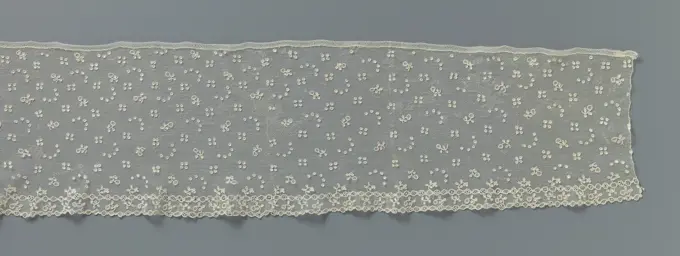
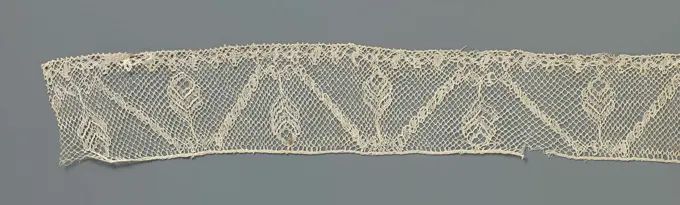
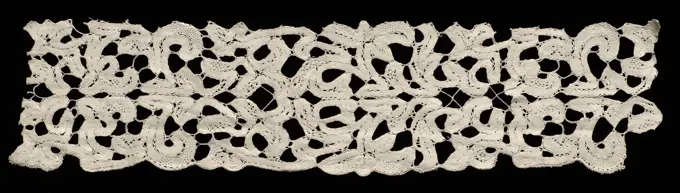
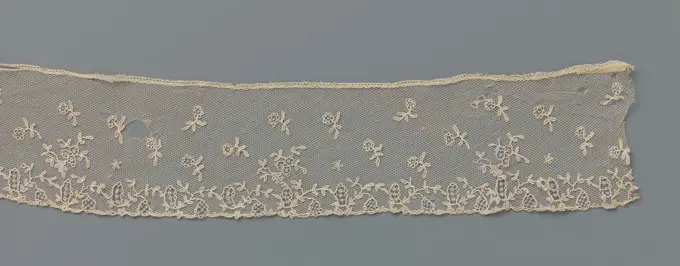
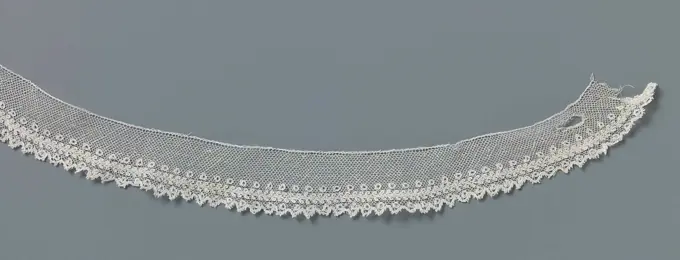
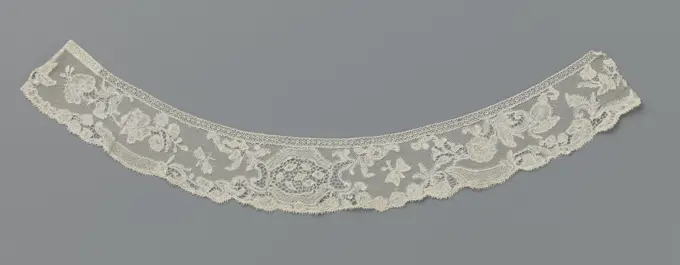
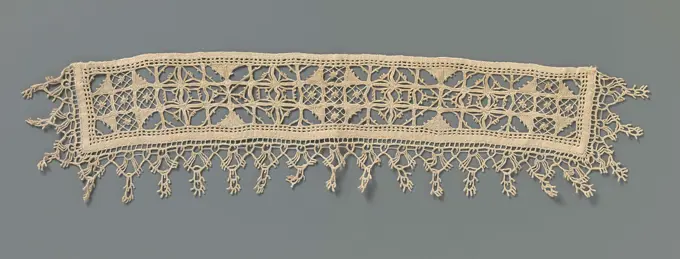
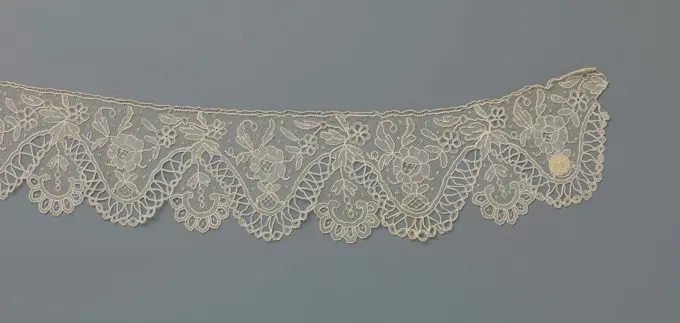
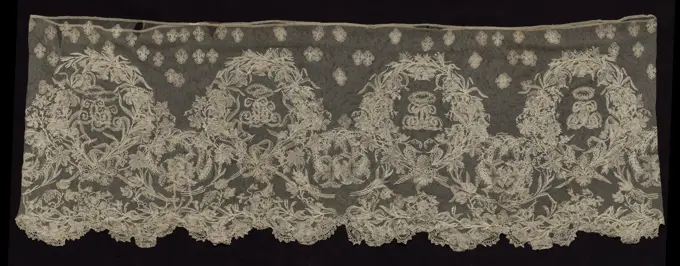
Delicate lace strips and cuffs showcasing intricate floral and geometric patterns. The collection emphasizes craftsmanship and historical textile art from different eras.

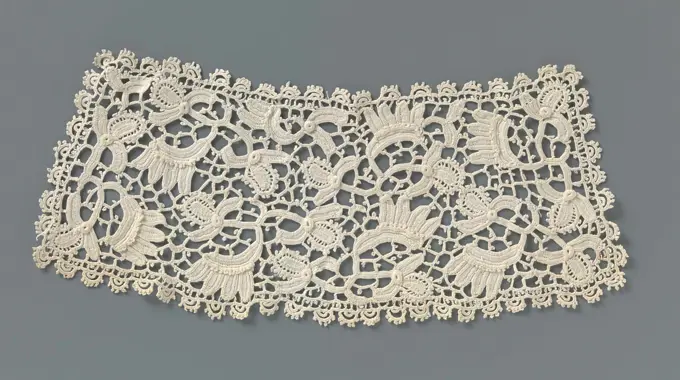
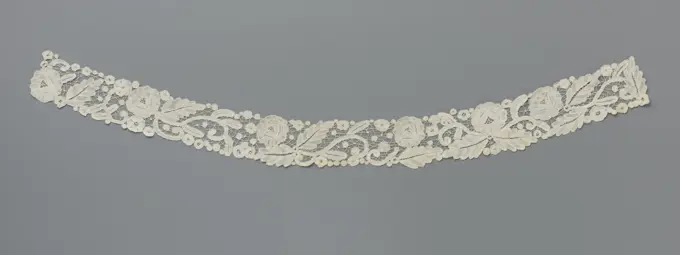
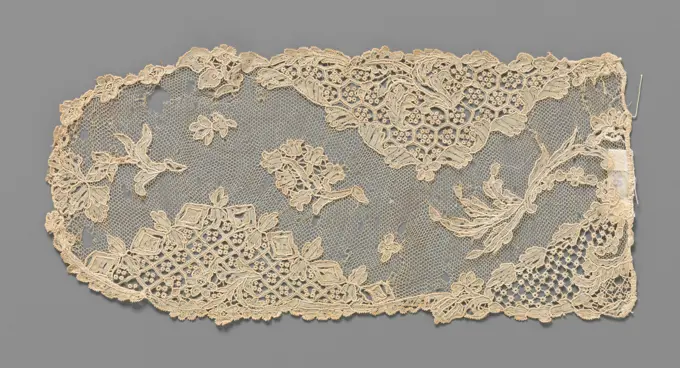
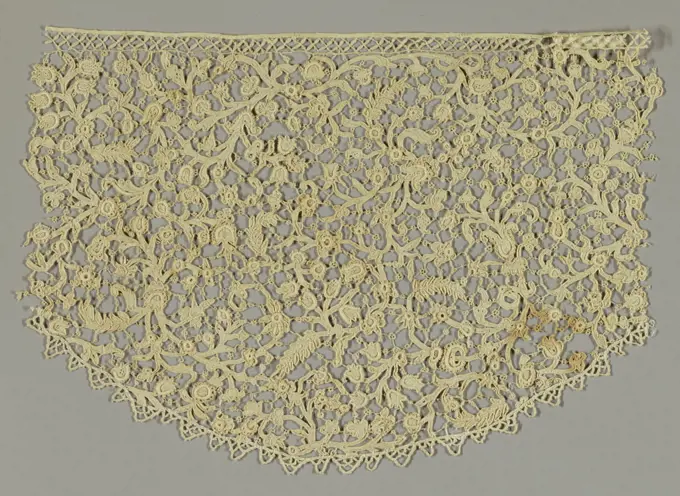
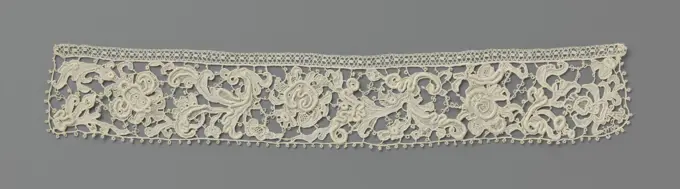
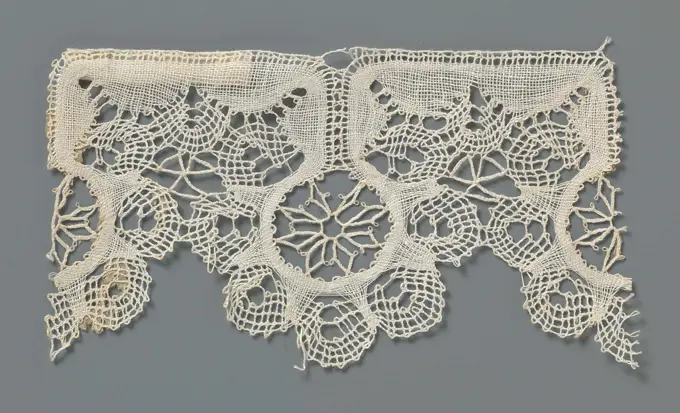
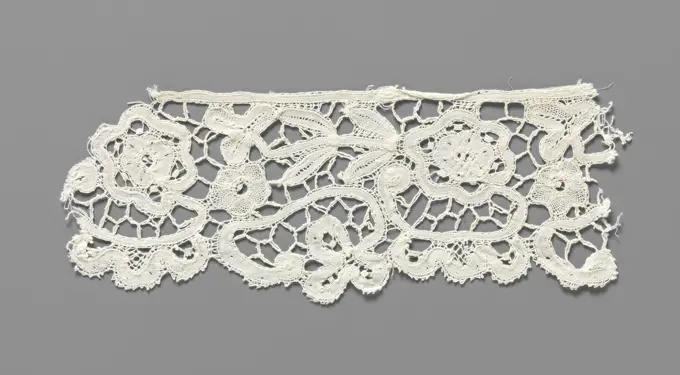
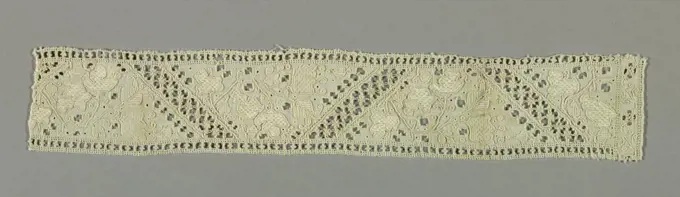
Cuff of needle side with bows, anonymous, c. 1875 - c. 1909 Cuff of natural -colored needle side: Venetian relief side. On a very open bar of land there are irregular volute vines with leaf voltuties and multifaceted flowers. List of triangles. Venice (possibly) linen (material) Venetian raised work Cuff of natural -colored needle side: Venetian relief side. On a very open bar of land there are irregular volute vines with leaf voltuties and multifaceted flowers. List of triangles. Venice (possibly) linen (material) Venetian raised work
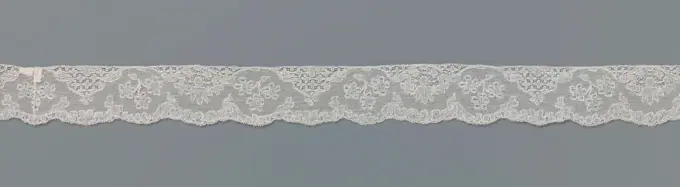
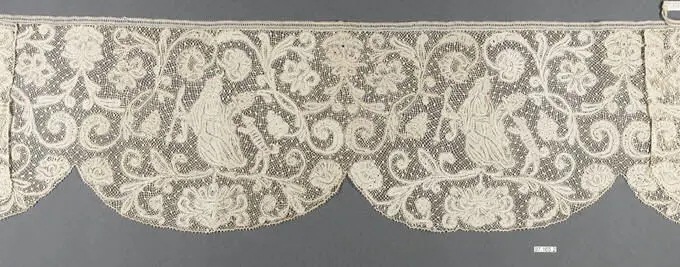
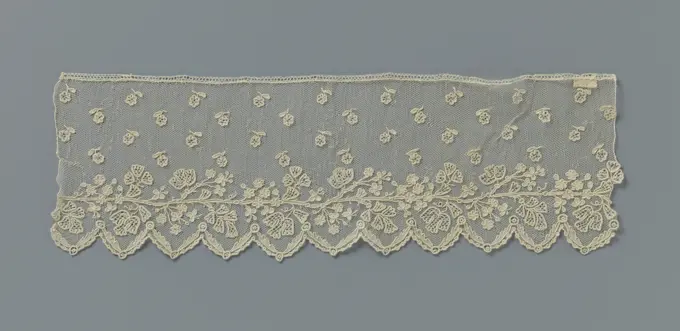
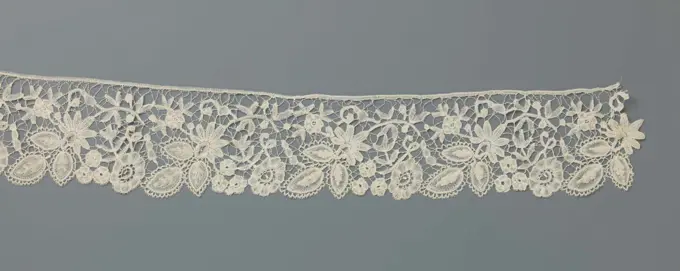
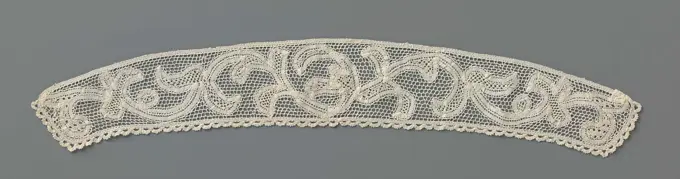
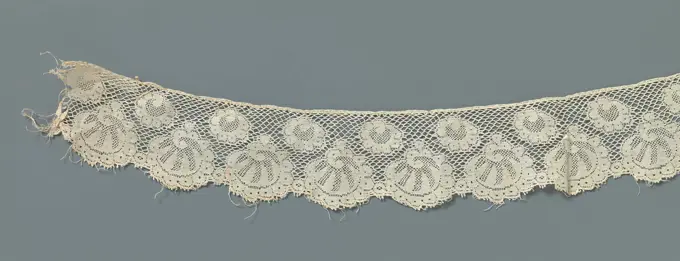
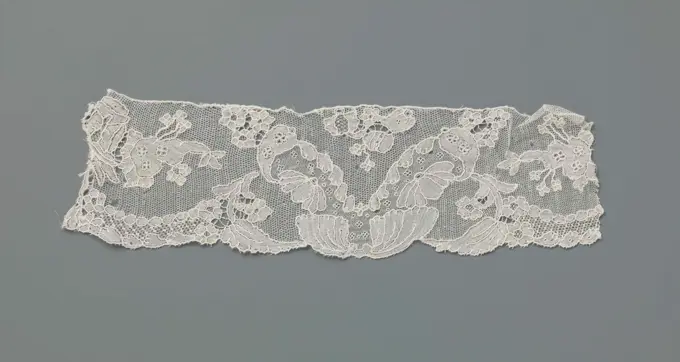
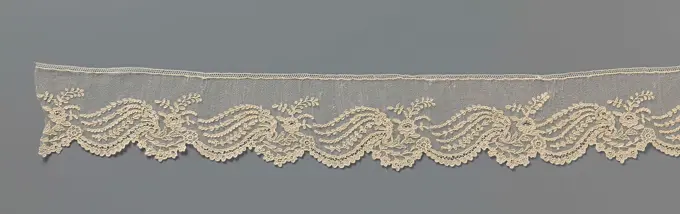
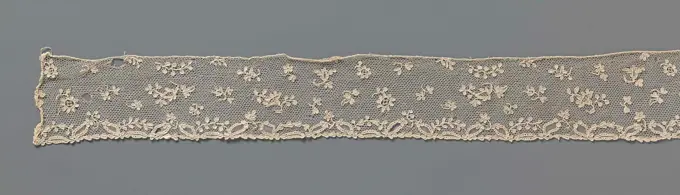
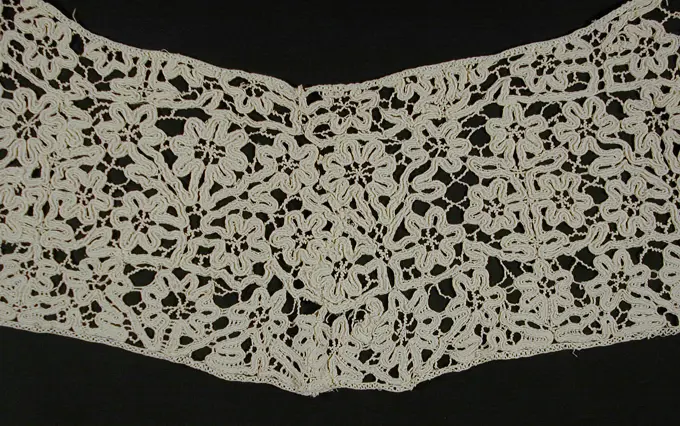
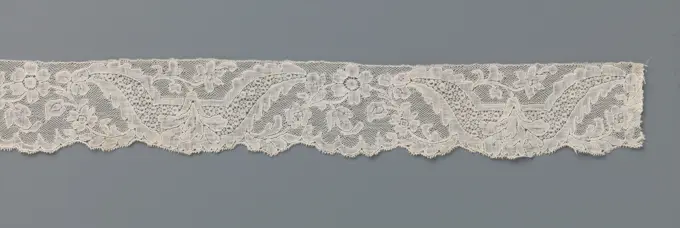
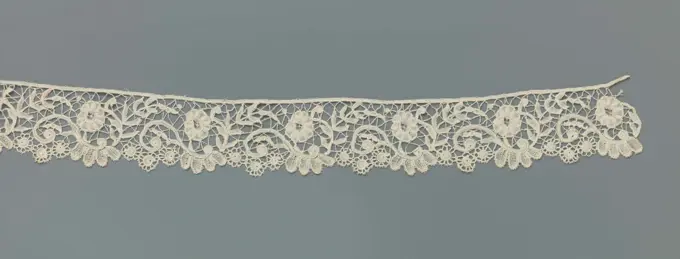
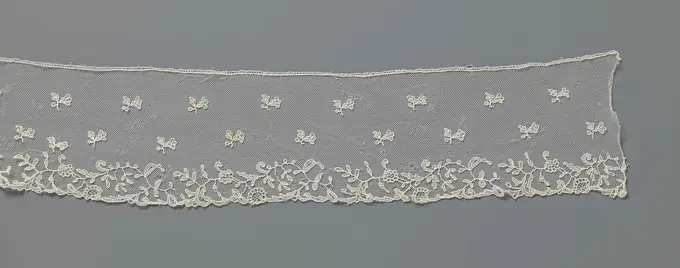
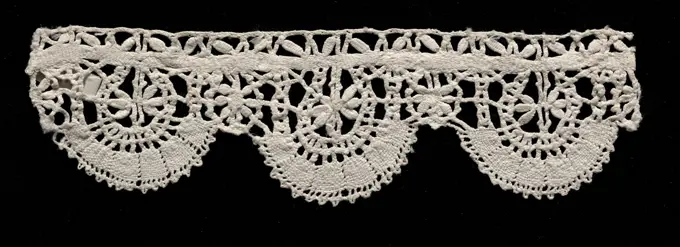
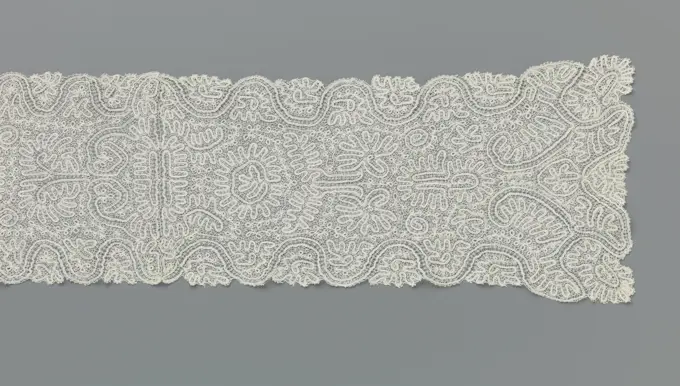
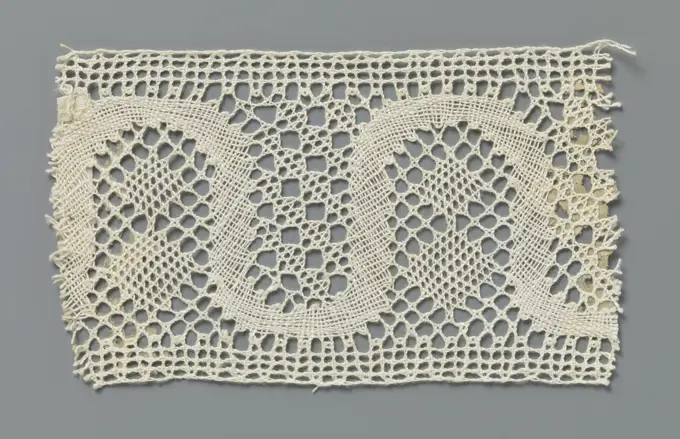
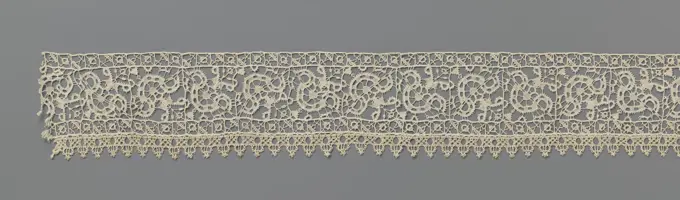
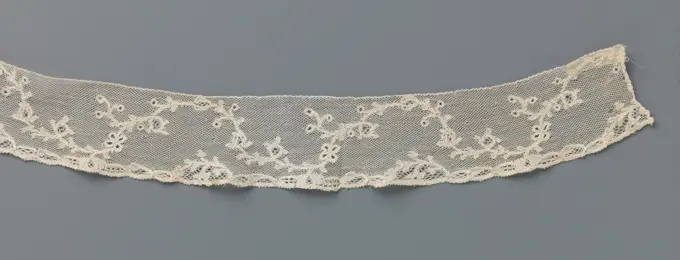
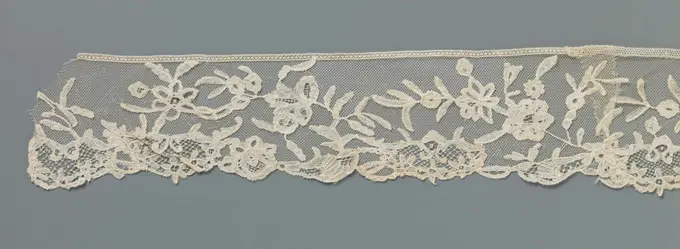
Japonstrook van applicatiekant met symmetrische reserves langs de onderrand.Japon strip of natural colored application side, dick edge and needle side applicated on machine tulle. Virtually symmetrical pattern along the bottom edge with two reserves with grid work filling, crowned with volutes and with five flowers at the bottom. Between the two reserves a rosette flower. And on the outside of these reserves, two large flowers adjacent to each other. Uprived curved branches with large flowers from the decorated bottom edge. The strip consists of three pieces sewn together and is attached to BK-BR-J-191.Cuff of needle side with bows, anonymous, c. 1875 - c. 1909 Cuff of natural -colored needle side: Venetian relief side. On a very open bar of land there are irregular volute vines with leaf voltuties and multifaceted flowers. List of triangles. Venice (possibly) linen (material) Venetian raised work Cuff of natural -colored needle side: Venetian relief side. On a very open bar of land there are irregular volute vines with leaf voltuties and multifaceted flowers. List of triangles. Venice (possibly) linen (material) Venetian raised workManchet van gehaakte kant met borstelachtige bladeren.Cuff of natural colored Irish crochet side. Pattern of flower stems with brushy leaves, put together with picoted bars. Raised circular flower hearts and a layered edge along the stem where the leaves steal. Finished on all sides with a border shines in the form of double bowes.Border early 17th century Italian. Border 222761Strip bobbin with an arc of six -leaf flowers and fan, anonymous, c. 1750 - c. 1760 Strip of natural-colored bobbin, binche side. The pattern consists of an alternation of two symmetrical compositions. One composition consists of an arc of five flowers with six petals, with the upper flower, which is against the top edge, halved. Under the arch is a rush -in cartouche along the lower edge. The other composition consists of a fan -shaped motif hanging down from the top edge. Under the fan there are four connected circles that look like buttons along the lower edge. The scalloped underside is created from the pattern. The motifs are connected by a mesh ground, a snowflake soil. The motives are made in linen battle without contour threads. A coarser snowflake land was used in the rushally -shaped cartouche and in the fan, combined in the cartouche with rosette flowers without contour threads. The top is straight. Southern Netherlands linen (material) Bobbi Lace / Binche Lace Strip of natuBorder 18th century Flemish or French. Border 226300Strip of needle side with rocaille and rosette flower, anonymous, c. 1725 - c. 1749 Strip of natural needle side, Brussels mesh side. Pattern with a rocaille with leaves and oval flowers or fruits above it and also a slender with leaves and flowers, including a rosette flower. Fine Maas soil. Fullwork with relief contours and a limited amount of decorative stitches. The top is finished with a straight edge. Southern Netherlands linen (material) Brussels Gaze Point Strip of natural needle side, Brussels mesh side. Pattern with a rocaille with leaves and oval flowers or fruits above it and also a slender with leaves and flowers, including a rosette flower. Fine Maas soil. Fullwork with relief contours and a limited amount of decorative stitches. The top is finished with a straight edge. Southern Netherlands linen (material) Brussels Gaze PointStrip of needle side with zigzagschulpen, anonymous, c. 1810 On a sleek, lying branch, to the right-oriented side branches, on which forget my mitaries and three types of chalid florets, the sharp zigzagschulpen show a double contour, consisting of a leaf and pearl edge, while a 'lover' has been applied to each point. In the field is a spray pattern of hanging daisies. Alençon side. France linen (material) Alençon Lace On a sleek, lying branch, to the right-oriented side branches, on which forget my mitaries and three types of chalid florets, the sharp zigzagschulpen show a double contour, consisting of a leaf and pearl edge, while a 'lover' has been applied to each point. In the field is a spray pattern of hanging daisies. Alençon side. France linen (material) Alençon LaceFragment 16th-17th century Italian. Fragment 218820Strook kloskant met de druiventrossen.Natural collate strip: Duchesse-Side. On an open braid soil there is an ongoing pattern of a short branch with two winger leaves and a grape tray. For turns a leaf and the bunch form the uneven slip.Kraag van gemengde kant met brede spiraalrank.Collar of natural mixed side - Mezzo Punto - with a splitting or woven ribbon and a needle lace ground. Rectangular narrow model with slightly sloping shorts and one slightly curved long side. On a maas soil (coniferous side) is a substantially symmetrical pattern that consists of connected S-shaped stems with curved leaves and a drop-shaped leaf at the ends of the collar. The contours of the flowers and stems consist of closted or woven ribbons. Different ornamental grounds (needle side) have been applied within the contours. A splitting bow rim serves as a finish along the outside, with the exception of the long curved side that is finished with a straight (without bowjes) splitting strap.Border first quarter 17th century Italian. Border 227510Fragment, Medium: linen Technique: bobbin lace, Scrolling leaves and flowers formed by heavy cord., possibly Spain, 18th century (), lace, FragmentBobbin Lace Lappet, 18th century. Belgium, Mechelen, 18th century. Lace, bobbin: linen; average: 53.1 x 9.6 cm (20 7/8 x 3 3/4 in.).Strook machinale kant met ronde schelpvormen.Strip natural-colored machining, machine valenciennes side. The repeating pattern consists of a row of smaller and a row of larger round shell shapes, where the larger on the underside also form the slip edge. The motifs are connected by a machine square valenciennes ground. The top of the strip is straight finished. The sloping edge along the bottom of the strip is finished with picots.Strook kant met v-vormig motief boven opgeklapte schelp.Strip natural needle side: Burano side. The symmetrical pattern consists of a V-shaped motif above an opened shell that lies along the bottom of the strip. The V is formed by a row of slanted leaves, with a larger drip-shaped and curled leaf at the top of each leg. From this leaf a stem bends with three rosette flowers to it. The stem ends with a leaf that lies along the bottom of the strip and whose top hits the shell. In the V-shaped field, there is an α-symmetrical motif with a rosette flower between three more or less oval flowers or shapes. The motifs are connected by a Maas soil, a Burano ground. Different ornamental grounds have been used. Among other things between rosette flowers and in the decorative tires along the bottom of the strip. The top of the strip is straight finished. The slight sloping edge along the bottom of the strip stems from the pattern.Siercraft for an evening mantle of mixed side with rose hedge, Martha Berkers, 1915 Ornamental piece for an evening mantle of natural -colored mixed side - bobbin in combination with needle side - Brussels Duchesse. There are roses on a wide -spread braid that usually support on two leaves. An intermediate ornament consists of single and double volutes and many small flowers. Lock linen (material) mixed lace / mixed Brussels Ornamental piece for an evening mantle of natural -colored mixed side - bobbin in combination with needle side - Brussels Duchesse. There are roses on a wide -spread braid that usually support on two leaves. An intermediate ornament consists of single and double volutes and many small flowers. Lock linen (material) mixed lace / mixed BrusselsStrip of needle side with suns separated by an x motif, anonymous, c. 1700 - c. 1799 Strip of natural-colored solar side (needle side): Tenerife side. The repeating pattern consists of a strip -filling circular motif, with an edge consisting of connected circles. On the short strip are three of these 'suns', which are separated from each other by an X-shaped motif, made with two thick thread bundles. The motifs are connected by a hexagonal Maas soil. One short sides and both long sides are finished straight, with some remnants of an arc edge to see. One short side is not finished. Spain linen (material) sun lace / Tenerife lace Strip of natural-colored solar side (needle side): Tenerife side. The repeating pattern consists of a strip -filling circular motif, with an edge consisting of connected circles. On the short strip are three of these 'suns', which are separated from each other by an X-shaped motif, made with two thick thread bundles. The motifs are connected by a hexagonal Maas Strip Kloskant with careless shell, company J. Minne-Dansaert, c. 1880 A wavy branch with feathered leaves and three star -shaped flowers grows from right to left. One of the flowers is aimed out and forms a small intermediate scoop between larger ones, which are constructed as a careless arch or a piped collar with an open grid filling (needle side). As a termination of the fine mesh stock (square meshes), a fine border of palms, applied as a side head, runs along the inside. Brabantse Valenciennes side. Brussels linen (material) Bobbi Lace / Brabant Valenciennes Lace A wavy branch with feathered leaves and three star -shaped flowers grows from right to left. One of the flowers is aimed out and forms a small intermediate scoop between larger ones, which are constructed as a careless arch or a piped collar with an open grid filling (needle side). As a termination of the fine mesh stock (square meshes), a fine border of palms, applied as a side head, runs along the inside. Brabantse ValStrip bobbin with four-lobbish rosette above and below a zigzag band, anonymous, c. 1840 - c. 1860 Strip of natural -colored bobbin, blonde. The repeating and continuous pattern consists of a zigzag band, which divided the strip into triangular fields. There is a four -lobe rosette in the center of each field. Along the top and bottom of the strip runs a scallop, which consists of a succession of circles. The scallops are finished with picots. The motifs are connected by a coarse mesh soil, strewn with square moes. The zigzag band, rosettes and circling edges are made in linen stroke, with the rosettes equipped with a contour wire. unknown silk. blonde (lace) / bobbin lace Strip of natural -colored bobbin, blonde. The repeating and continuous pattern consists of a zigzag band, which divided the strip into triangular fields. There is a four -lobe rosette in the center of each field. Along the top and bottom of the strip runs a scallop, which consists of a succession of circles. The scalStrip bobbin with pearl list and flower branch, anonymous, c. 1875 - c. 1899 Strip of natural-colored bobbin: Valenciennes side. On a rough traly -round -fine symmetrical arches with partice list and flower branch. Sewn in 1966 on a wider strip side with careless scallops and hanging Margriet. Valenciennes side. Sluis (Possible) linen (material) Bobbi Lace / Valenciennes Lace Strip of natural-colored bobbin: Valenciennes side. On a rough traly -round -fine symmetrical arches with partice list and flower branch. Sewn in 1966 on a wider strip side with careless scallops and hanging Margriet. Valenciennes side. Sluis (Possible) linen (material) Bobbi Lace / Valenciennes LaceStrook naaldkant met rozentak en vier bladslingers.Strip natural-colored coniferous lace: Alençon side. Pattern with a repetitive motif of a rosa branch and four leaf garlands on a fine hexagonal maas soil. The four garlands, all with different leaves, waves the same direction from one point. Regular arches with scallops along the underside are formed by alternating a pendulum and a concatenation of rosette flowers, always connected by one larger rosette flower. A zigzag line of picoted bars in the center of the garland. The top is trimmed with a border clamping side.Fragment 18th century German, Saxony. Fragment. German, Saxony. 18th century. Drawnwork. Textiles-LacesYoughal lace, 1900s, maker unknown. Acquisition history unknown.Mutsenslip (fragment) van naaldkant met raderpicots in driehoekige velden en een lelietje-van-dalen in het golvende middenveld.Hatslip (fragment) of natural needle side: Brussels gauze side. It is about the bottom of the straight hats slip with rounded end. Between triangular fields along the edges, with an ornamental filling of Raderpicots in a hexagonal or diamond-shaped grid, a wide wavy midfield with a fine mesh soil, a mesh side ground. In this midfield lies a flower branch, a lily of the trash with bells), two loose spreading trays and a flour branch with a flower that forms part of the fine sloping edge in the rounded end. The motifs are made up of feston stitches with fine recesses and scented relief contours. Ornamental fills are mainly applied in the triangular fields. The flat sloping edge consists of connecting flowers and elongated leaves and is finished with picots.Border; linenStrip of needle side with half moons, anonymous, c. 1800 On a coarse Maas soil there is a spray pattern of moesjes, which are grouped into half moons, quadrilles and daisies. A narrow straight edge with fine Maas soil closes the outside and is bordered by pearl lists. Alençon side. France linen (material) Alençon Lace On a coarse Maas soil there is a spray pattern of moesjes, which are grouped into half moons, quadrilles and daisies. A narrow straight edge with fine Maas soil closes the outside and is bordered by pearl lists. Alençon side. France linen (material) Alençon LaceStrip crocheted side with fan -shaped flowers, anonymous, c. 1890 - c. 1909 Strip of natural -colored Irish crocheted side. Pattern with fan -shaped flowers with stems and a crocheted irregular mesh soil with picots. The top is finished with a straight edge. The semi -circular sculpts on the lower edge are trimmed with picoted arches. Ireland cotton (textile) Strip of natural -colored Irish crocheted side. Pattern with fan -shaped flowers with stems and a crocheted irregular mesh soil with picots. The top is finished with a straight edge. The semi -circular sculpts on the lower edge are trimmed with picoted arches. Ireland cotton (textile)Strook kloskant met boom tussen zigzag-lijn.Strip natural colosside. The repeating pattern consists of a zigzag line, which forms trapezoidal fields. The fields fill the entire width of the strip and in each field or is one tree, with a thin strain and a more or more oval shaped crown. Along the bottom of the strip, a concatenation of four and diamond clovers runs. The motifs are connected by a maas soil, a fat mat of grille. The sparse and loosened full work is made in linen stroke and slicer with large recesses, especially the tree and with thicker contour wires. The top and bottom of the strip are straight finished, the underside with picots.Bobbin Lace Edging, 19th century. Europe, 19th century. Lace, bobbin: linen; average: 14.7 x 35.6 cm (5 13/16 x 14 in.).Strip of bobbin curly hulls with stylized flowers and leaves, anonymous, c. 1700 Strip of natural -colored bobbin, Flanders side. The pattern consists of a curly thin rank with stylized flowers and leaves. The motifs are made in linen battle with openwork edges. They are connected to each other by a traly land, a five -part ground. The top and bottom are straight finished, with picots on one side. Antwerp  bobbin lace / Flanders lace Strip of natural -colored bobbin, Flanders side. The pattern consists of a curly thin rank with stylized flowers and leaves. The motifs are made in linen battle with openwork edges. They are connected to each other by a traly land, a five -part ground. The top and bottom are straight finished, with picots on one side. Antwerp  bobbin lace / Flanders laceStrip bobbin with palm tree-like application, anonymous, c. 1725 - c. 1749  Strip of natural -colored Brussels bobbin. In the middle, the symmetrical pattern consists of a cartouche in the form of a coat of arms, formed by curling leaves and volutes. A palm tree-like motif has been applied in the cartouche. The shield is flanked by various flowers, which are connected by potented braids. Half of a lobed cartouche can be seen on the short sides. The fields in all cartouches consist of a fine Maas soil, a drachel soil. The fullwork is largely made in linen battle with openwork edges and some recesses and partly in Omslag. Most of the motifs have bursts of relief contours. Ornamental grounds, including a snowflake land, is used in the frames to see the cartouches and in a triangular field along the underside, a decorative land can be seen with sloping stripes. The top is finished with a separate strap. The scalloped underside is finished with picots. Brussels linen (material) bobbin lace Strook naaldkant met aaneengeschakelde bloemen.Strip natural-colored coniferous lace: Alençon side. Repetitive motif with a split rank. The rank is created from the bottom edge and splits to the right with a winding series of connected flowers (branches) and to the left with a shorter floral branch. The top is trimmed with a border clamping side. The scalloped underside is partly formed by the split rank.Strip bobbin with fine pendulum around straight line under spray pattern, anonymous, c. 1800 Strip of natural -colored bobbin: Mechelse side. The upper part of the strip consists of two rows of alternately an open work and a hanging star -shaped flower with three leaves on a split stalk. Along the lower part of the strip runs a straight line where a slender winds around with fine flowers and leaves. Immediately below is a succession of ovals along the underside of the strip, always with one three -lobe leaf in between. The motifs are made in linen battle, with thicker and shiny contour threads. The motifs are connected by a fine Maas soil, a Mechelen soil. The top of the strip is finished with a separate strap. The underside of the strip is straight finished and provided with picots. The short sides are finished with a zoompje. Southern Netherlands linen (material) bobbin lace / Mechlin (lace) Strip of natural -colored bobbin: Mechelse side. The upper part of the strip consists of two Strook kloskant met hartvormige motieven tussen occiolini-lussen.Strip natural colosside: Occhiolini. The repeating pattern consists of three inverted heart-shaped motifs in a rectangular field that is formed by a wirwar to loops. The loops are formed by a narrow ribbon that is clamped in linseed openwork borders on one side and that continuously scrubbed over itself. The hearts stem from this continuous ribbon and partially cost in linen stroke with a bow border and an ornamental ground on the inside with open stitches and elongated spiders in scroll. The loops are connected to each other by charging in the places where they hit each other, some extra connections are made with braids. The rectangular fields are connected to each other by a vertical column formed by a zigzagged braid and attached to a hook between the loops of the successive rectangular fields. Upper and bottom of the strip are straight finished in which the underside is equipped with edge with fat mat strokes and braiStrook naaldkant met bloemenstrooipatroon en spitsovaaltjes.Strip natural needle side, Argent tank. Spreading pattern from twigs to whom alternately a small or larger flower, leaves and / or berries. Ground with meshes that are close to the buttonhole stitches. The pattern along the lower edge consists of two-way-around spindle releases between which a flower or berry branch exprements. The oval pairs are connected by a bow of leaves and / or berries and hearts. Among these arcs along the bottom edge a flat, oval oval. The oval-shaped figures in the pattern are filled with a fine hexagonal Maas soil (alençong soil). Different ornamental grounds in the flowers. Full work without recesses in flowers, leaves and berries. Sloppy edge on the underside through a concatenation of heart-shaped leaves, regularly interrupted by a rosette flower and the flat oval oval. The top is finished with a straight edge.Collar. probably Central Europe, Flanders, possibly 18th century. Costumes; Accessories. Linen bobbin lace with linen cord appliqueBorder (one of two joined) early 18th century () Italian. Border (one of two joined) 226154Strook kloskant met berg en dal-lijn.There is a symmetrical pattern at a nice ground ground, a mechelen soil (also known as ice soil). Within a stretched sculpture of lobed leaves and roses, triple flower branches are in either side of a leaf rosette under a 'mountain and dal' line. This limits two halved diamond-shaped medallions with a raster filling of crucifixes. Part of a strip that consists of two parts sewn together. Mechelen side.Strip bobbin with horizontal flower branches, anonymous, c. 1830 - c. 1850 On a fine grid, a Mechelen soil (also known as ice soil), there are rich twigs, with three small roses; In between some scattered berry branches. An edge with open grid -work filling consists of contiguous spiral ranks, including three roses and edges of Campanes, which form the sculpes. Mechelen side. Belgium linen (material) bobbin lace / Mechlin (lace) On a fine grid, a Mechelen soil (also known as ice soil), there are rich twigs, with three small roses; In between some scattered berry branches. An edge with open grid -work filling consists of contiguous spiral ranks, including three roses and edges of Campanes, which form the sculpes. Mechelen side. Belgium linen (material) bobbin lace / Mechlin (lace)Strip bobbin with anjer in U-shaped reserve, anonymous, c. 1700 - c. 1749 Strip of natural -colored bobbin: Mechelse side. The repeating pattern consists of two compositions, one with a carnated carnation from a U-shaped reserve and the other with a bow formed by two flower branches with one rosette flower in the top. The motifs are connected by a fine Maas soil, the Mechelen soil. The motifs are made in linen battle with recesses, and is equipped with thicker and shiny contour threads. A decorative soil with snowflakes combined with larger round motifs is used in the U-shaped reserves. The scalloped underside stems from the pattern and is finished with picots. The top is straight. Mechelen linen (material) bobbin lace / Mechlin (lace) Strip of natural -colored bobbin: Mechelse side. The repeating pattern consists of two compositions, one with a carnated carnation from a U-shaped reserve and the other with a bow formed by two flower branches with one rosette flower in the top. The motiTussenzetsel van kloskant met ruitvormige velden gevormd door dunne vlechten.Inserting natural colosside: Maltese side. The repeating and symmetrical pattern consists of a row of coated diamond-shaped fields formed by thin braids. In each field there is a flower with four petals made in shape stroke, between two triangular motifs in linen stroke. The triangular fields above and below this row of windows show a halved version of this pattern. Upper and bottom of the strip are straight finished.Fragment, Medium: linen Technique: needle lace, Fragment of Point de Venise à Rose with foliated and floral forms in asymmetric design. Pattern connected by brides picotées, outlined by cordonnet, interspersed by gaze quadrillée. Style of lace commonly called Rosaline., Venice, Italy, late 17th-early 18th century, lace, FragmentStrook kloskant met s-ranken.Natural collate strip: Duchesse-Side. There is an ongoing pattern on a braid soil. S-tanks with three daisies and an edge of Campanes form the slot and end in a simple rose.Cuff of needle side with Acanthusvoluten, Anonymous, c. 1875 - c. 1910 Cuff of natural -colored needle side: Venetian relief side. Narrow rectangular model. S spent and branched acanthus voluten and always varied palm flowers protrude against an open bar soil. A straight pearl list runs along three sides. The top is straight finished with a messing strap. Venice linen (material) Venetian raised work Cuff of natural -colored needle side: Venetian relief side. Narrow rectangular model. S spent and branched acanthus voluten and always varied palm flowers protrude against an open bar soil. A straight pearl list runs along three sides. The top is straight finished with a messing strap. Venice linen (material) Venetian raised workStrip of mechanical side with three rows of flower branches and W-shaped motifs along the bottom, anonymous, c. 1850  Strip of natural-colored machine side: machine alençon side. The strip is slightly bent in shape. The repeating pattern consists of three rows of flower branches with one muse between the flower branches in the upper two rows. The successive flower branches in the upper row consist of one flower with two leaves. In the middle row there are always three flowers hanging on the flower branches. The lower flower branches are the largest with three flowers and a flower bud in the top. Along the lower edge are W-shaped motifs between which circles made with a decorative soil, a machine rose soil. The motifs are provided with contour threads and are connected by a hexagonal Maas soil, a machine alençon ground. The top of the strip is straight finished. The faintly scalloped underside stems from the pattern with the W-shaped motifs and circles and is finished with picots. FrancBand (Italy); linenStrook applicatiekant met klokjesbloemen en golvende bloemtak.Strip natural colored Brussels application side, needle side applicated on machine tulle. Sprinkle with two rows of brigs to which one bells flower, on a fine hexagonal mesh soil. The bland scalloped bottom edge stems from the repetitive motif of a wavy leaf branch to which two flowers and a flower bud. Motifs with relief contours of widely scented thread bundles. Decorative stitches in the flowers and flower buds and between a few leaves. The top is finished with a splitting strap.Bobbin Lace (Rose Lace) Edging of Bell Points, 17th-18th century. Italy, Genoa, 17th-18th century. Lace, bobbin; average: 4.5 x 16.6 cm (1 3/4 x 6 9/16 in.).Strook naaldkant met bloemenstrooipatroon en spitsovaaltjes.Strip natural needle side, Argent tank. Spreading pattern from twigs to whom alternately a small or larger flower, leaves and / or berries. Ground with meshes that are close to the buttonhole stitches. The pattern along the lower edge consists of two-way-around spindle releases between which a flower or berry branch exprements. The oval pairs are connected by a bow of leaves and / or berries and hearts. Among these arcs along the bottom edge a flat, oval oval. The oval-shaped figures in the pattern are filled with a fine hexagonal Maas soil (alençong soil). Different ornamental grounds in the flowers. Full work without recesses in flowers, leaves and berries. Sloppy edge on the underside through a concatenation of heart-shaped leaves, regularly interrupted by a rosette flower and the flat oval oval. The top is finished with a straight edge.Fragment of a Lappet. France, circa 1738. Costumes; Accessories. Linen Valenciennes bobbin laceFragment ca. 1700 Flemish. Fragment 212779Bobbin Lace Insertion, mid 16th century. Italy, Venice, mid 16th century. Lace, bobbin; average: 6.7 x 23.9 cm (2 5/8 x 9 7/16 in.).Strip bobbin with torped straps, anonymous, c. 1920 - c. 1930 Strip of natural-colored bobbin, Valenciennes side. Two torped straps are running along the scalloped side against a background. 's Gravenmoer linen (material) Bobbi Lace / Valenciennes Lace Strip of natural-colored bobbin, Valenciennes side. Two torped straps are running along the scalloped side against a background. 's Gravenmoer linen (material) Bobbi Lace / Valenciennes LacePiece early 18th century Flemish, Mechlin. Piece 213490Fragment of lace. unknown, authorStrip bobbin with four -fold mosies, anonymous, c. 1900 - c. 1909 Strip of natural-colored bobbin, Valenciennes side. Repetitive motif of a flower, made with a four -time mush. Diagonally above the flour is a single mush. Faint scallop with decorative tires. The top is finished with a straight edge. Belgium linen (material) Bobbi Lace / Valenciennes Lace Strip of natural-colored bobbin, Valenciennes side. Repetitive motif of a flower, made with a four -time mush. Diagonally above the flour is a single mush. Faint scallop with decorative tires. The top is finished with a straight edge. Belgium linen (material) Bobbi Lace / Valenciennes LaceKloskant scarf with golf edge, anonymous, c. 1875 - c. 1899 Scarf of natural bobbin, Russian or Ooste European side. Ground of irregular short braids. Two -sided symmetrical pattern of branches laid out and deep garlands with sunflowers, carnations and palm branches, three times separated by an oval. Deep golf lines form the edges, which are almost straight, because the waves are always filled with a playful ribbon garland. Eastern Europe linen (material) bobbin lace / Russian lace / East European lace Scarf of natural bobbin, Russian or Ooste European side. Ground of irregular short braids. Two -sided symmetrical pattern of branches laid out and deep garlands with sunflowers, carnations and palm branches, three times separated by an oval. Deep golf lines form the edges, which are almost straight, because the waves are always filled with a playful ribbon garland. Eastern Europe linen (material) bobbin lace / Russian lace / East European laceFragment, Medium: linen Technique: bobbin lace (Valenciennes ground), Band with human figures and blossoms., 18th century, lace, FragmentStrip bobbin with two scales, each formed by a seven -lobe flower between two oval leaves made with a messed up ribbon, anonymous, c. 1925 - c. 1932  Strip of natural -colored bobbin: Eastern European side. Part of a longer strip that is intended or used as a furniture decoration. The repeating and symmetrical pattern consists of a hanging seven -lobe flower between two oval leaves. The strip consists of two of these flowers that also form deep scumples. The ribbon is equal to width everywhere and is made in linen battle with openwork edges. In the center of the ribbon, a thick smooth contour thread provides relief. The contour wire is tightly wounded with fine yarn and shines a bit. In the center of every flower and between the flowers, connected with double braids with picots. The top of the strip is straight finished with a messing around in which a relief wire has also been worked. Used linen (material) bobbin lace / tape lace (bobbin lace) / East European laceKloskant intermediate mate with a regular wavy line, anonymous, c. 1900 - c. 1924  Piles of natural spot of torway side: sling. The repeating pattern consists of a regular wavy line in linen battle. The waves form U-shaped fields. Under the wave top are under two windows placed in Ovenlag, the wave top touches the straight decorative band along the top of the strip. A decorative land has been used in the wave valleys that forms square cubes. Top and bottom of the strip are straight finished, both with a brutal decorative band with a square grid. Russia . bobbin lace / Russian laceStrip needle side with vases, anonymous, c. 1600 - c. 1620 Strip of natural needle side - reticella - with a strip of bobbin with pointed sculpts on the bottom. Needle side: The repeating pattern consists of squares in which a bang -cut vase, in turn is tilted to the left and to the right. The vase is connected with small dogs and arches on the sides of the square and on the top and bottom through a frame of filled squares. The motifs are made with feston stitches, decorated with recesses and with closed picots. The motifs are connected to each other by tolal bars and bars with feston stitches. The horizontally continuous lines are made with a lace -up band. Along the underside of the Reticella strip has been sewn from Kloskant with a pattern of rectangles and windows with elongated triangular scallops that are finished with open picots. Italy linen (material) bobbin lace Strip of natural needle side - reticella - with a strip of bobbin with pointed sculpts on the bottom. Needle side: Strip bobbin with continuous wavy slender with berries and butterfly, anonymous, c. 1770 - c. 1780 Strip of natural -colored bobbin: Mechelse side. The repeating pattern consists of a continuous and wavy slender with small leaves on both sides, a single short branch with a berry on it and a few flowers. At the start of each wave top is a butterfly or butterfly -shaped flour, the slender makes a loop twice within one wave. The faintly scalloped underside is formed by a double narrow pendulum, which forms a succession of pointed -shaped cartouches. Under each wave top there is always a larger cartouche in the pattern along the lower edge, with a browse branch and a star -shaped flower. The motifs are connected by a fine Maas soil, the Mechelen soil. The fullwork is made in linen battle with thicker and shiny contour threads. Different decorative lands have been applied in the cartouches along the underside, in the loops, berries and flower hearts. The faintly scalloped underside stems frStrook kloskant met gelobte ronde schulp met ster of bloem erin.Strip natural colosside, Russian side. The pattern consists of a openwork round shell with seven lobes all around. The motifs are made in linen stroke, the lobes with curved straps with square meshes. In the center of the shell is a flower or star made with diamonds made with picoted braids. The top of the strip is straight finished. The lobes around the sculpt are finished with picots.Border (Belgium); linenEvening shawl. Culture: European. Date: ca. 1850.Rita de Acosta Lydig (1880-1929), a noted beauty and style icon of the early 20th century, collected antique textiles and lace, which she often incorporated into her wardrobe. Born in Spain, de Acosta Lydig attributed her love of lace to her aristocratic Spanish heritage. In this black lace shawl, the scrolling tendrils resemble the patterns seen in Fourth Style Roman wall paintings. Shawls of this type began to be made by machine in the mid 19th-century. Since much handwork was still needed to finish the pieces made by machine, it can be difficult to determine which were handmade and which were made by machine. This, however, is a handmade example. Museum: Metropolitan Museum of Art, New York, USA.Manchet van een strook kloskant met een rozetbloem aan een c-vormige stengel waaronder drie lobben hangen.Strip natural colosside: fine bridges flower work. The strip is probably used as a cuff, the short sides are not finished but cut. The repeating pattern consists of a rosette flower with a C-shaped stem, including three loss. The rosette flower is flanked by two lying stems with a smaller rosette flower and underneath by a twice down stalk with a three-piece sheet. The three-part leaves and the three lobes under the C-shaped stems form the slip edge, which is finished with picots. The motifs are largely made in linen stroke with openwork edges, recesses and contour wires. The smaller rosette flowers and a few other parts are made in a cut-off. In the flowers and some leaves are cubes to decoration, made in shape stroke. In the three lobes a sparingly decorative soil in vetergat grating. The other long side is straight finished, with a straight smooth strap.Strook applicatiekant met ovaaltjes en klokjesbloemen aan ijle rank langs de onderzijde.Strip natural colored Brussels application side: needle side applicated on slighten ground. The repeating pattern consists along the underside of the strip from a continuous wavy rank with oval leaves, openwork ovals and unilaterally directed bells flowers. Above a scattering pattern of loose rosette flowers, a single asterisk and a winding twig. The sparing top is enclosed by festived thread bundles. The top is finished with a separate clust strap. The virtually straight finished bottom is equipped with very fine picots.Fragment, Medium: linen Technique: bobbin lace (continuous tape with net added), Fragment of continuous tape bobbin made lace. Border added much later, probably 19th century Lille-style lace., 17th century, lace, FragmentFragment of the lace;  Ok. PO. 19th century (1840-00-00-1860-00-00);Strook kloskant met drie lengtestrepen.Strip natural colosside: Lille side. The continuous pattern starts under the middle line and consists of two rows of circles, with a horizontal rank in between with small leaves on the other hand. Along the bottom row of circles runs a wavy line that forms shifts, with one circle in each scallop. The motifs are connected by a fine grille, a tulet. The energy-saving fireworks is made in linen stroke, with thicker and shiny contour wires. The top of the strip is straight finished. The scivels along the underside are finished with picots.Kloskant strip with insect on either side of an octagonal cartouche, anonymous, c. 1735 - c. 1750 Strip of natural -colored Brussels bobbin. The strip is bent in shape. The pattern consists of an octagonal cartouche in the middle with a flying insect on both sides and then a long flower branch, where the left branch carries flowers other than the branch on the right side of the cartouche. The motifs are connected by a fine Maas soil, a drachel soil. The fullwork is largely made in linen battle with openwork edges, some recesses and with mains fillings. Various motives have chattered relief contours. Different decorative lands have been applied, including snowflake land and picoted braids. The top is finished with a separate strap. The scalloped underside is finished with picots. Brussels . bobbin lace Strip of natural -colored Brussels bobbin. The strip is bent in shape. The pattern consists of an octagonal cartouche in the middle with a flying insect on both sides and then a long flowStrip bobbin with a continuous winding ribbon that forms whimsical flowers, anonymous, c. 1925 - c. 1929  Strip of natural -colored bobbin: Eastern European side. Pattern with a continuous winding ribbon that forms whimsical flowers. The ribbon has been hit in linen battle with openwork edges and fairly coarse cut -outs. The motifs are connected by double braids with picots. A round Valenciennes ground has been used as a decorative land in the flowers. The top is finished with a straight strap. The scrap edge stems from a winding ribbon that forms semi -circular shells at a regular distance and is finished with picots. Eastern Europe (Possible) linen (material) bobbin lace / tape lace (bobbin lace) / East European laceBorder (Italy); linenStrip early 18th century Italian, Genoa. Strip 215512Kloskant dress strip with ferns, anonymous, c. 1850 - c. 1855 Black bobbin jelly strip: Chantilly side. On an empty mesh stock there is a closed edge with scoops, filled with a garland of flowers and leaves. On the intersections there is a small shell with a hanging rose, above which a striker bouquet rises from four large fern leaves and a flower branch, which extends to the top edge. Here a horizontal climbing window with hanging twigs runs, while on the field above the large shell of this climbing crank a large bouquet depends, among other things with a tulip. France (possibly) silk bobbin lace Black bobbin jelly strip: Chantilly side. On an empty mesh stock there is a closed edge with scoops, filled with a garland of flowers and leaves. On the intersections there is a small shell with a hanging rose, above which a striker bouquet rises from four large fern leaves and a flower branch, which extends to the top edge. Here a horizontal climbing window with hanging twigs runs, while on Strook kantborduurwerk met vierkanten en rechthoeken.Strip natural-colored edge embroidery, carved work. Symmetrical pattern of three squares between which two rectangles. The squares are made up of nine small squares. The rectangles are made up of six times three small squares. In the squares a diamond-shaped grid and poetry triangles. In the center of the rectangles a cross with a double four-pointed star on either side. Around the cartridge a narrow edge work with pulled wires and finished linen tissue. Along two short and one long side, the strip is deposited with a frills of braided and scented wires with picots.Strook naaldkant met golvende zigzag-sierlijst en rozentak.Strip natural-colored coniferous lace: Brussels gauze side. The repeating pattern consists of a regularly wavy decorative frame, with a rose roof in every valley. On the rosary is one large rose in the center, including a smaller rose, on the thin branch that goes to the top two open-worked rosette flowers. Under each wave top hangs a semi-circle flower on a thin handle with two heart-shaped leaves. The flower consists of a lying c-volute with seven lobes such as petals. The wavy decorative frame consists of two contour wires placed together that form a narrow line and, including a strong winding contour wire, which ensures an open zigzag line. Under the open zigzag a concatenation of circles. The wavy decorative frame forms the sloping edge, along with the hanging circular flower. The connected circles and seven petals ensure the lobes on the slip edge. The motifs are equipped with thick contour wires and are interconnected byFragment of a Band with Birds and Trees, 16th century. Italy, Sicily, 16th century. Needle lace, burato (twined ground and darned in one direction); bleached linen (est.); overall: 5.4 x 23.5 cm (2 1/8 x 9 1/4 in.). This lace, made in Sicily, shows a close relationship to a pattern in a model book published in Lyon, France, a commercial center of printing and luxury textile trade with strong ties to Italy. The designs were based on a grid, making it easier for the lace maker to translate the printed image into needlework.Sample end of lappet, Medium: linen Technique: bobbin lace, Mechlin style, N. Europe, 19th century, lace, Sample end of lappetKloskant intermediate mate with zigzag line, anonymous, c. 1875 - c. 1949 Piles of Natural -colored bobbin side: Mechelse side. In the middle of the fine grid, a Mechelen soil (also known as ice soil), an openwork band runs in Zigzaglijn, cut over by two types of rosettes. Belgium linen (material) bobbin lace / Mechlin (lace) Piles of Natural -colored bobbin side: Mechelse side. In the middle of the fine grid, a Mechelen soil (also known as ice soil), an openwork band runs in Zigzaglijn, cut over by two types of rosettes. Belgium linen (material) bobbin lace / Mechlin (lace)Quille (one of a pair) 18th century French. Quille (one of a pair) 227071Border, Medium: linen Technique: knotting (macramé), Border for a pillowcase or towel with a pattern of flowers and birds., Italy, 19th century, knotted, knitted and crocheted textiles, BorderBand; linen; 1914-23-1Border, Medium: linen Technique: bobbin lace, Buckingham, England style, England, 19th century, lace, BorderBorder; linenCap Crown (Belgium); linenCap crown. Date/Period: Mid- 18th century. Cap crown. Medium: linen. Technique: needle lace with ground of loop and twist with twist return. Author: UNKNOWN.Machine and Needlepoint Lace Flounce, 19th century (after 1810). Belgium, Brussels, 19th century (after 1810). Lace, needlepoint on machine ground; average: 57.2 x 317.5 cm (22 1/2 x 125 in.).Textile, Medium: cotton on piña cloth (pineapple fiber) Technique: embroidered, Rectangular piece of fabric embroidered in a design of a plant in a basket alternating with leaf and scroll motif. One scalloped edge., Philippines, 19th century, embroidery & stitching, TextileFragment 17th century () Flemish. Fragment 226147Fragment of the lace;  beginning of the 18th century (1701-00-00-1710-00-00);Fragment 18th century French. Fragment 214593Cuff;  19th century (1801-00-00-1900-00-00);Strip bobbin with diamond -shaped field between mirrored fans, anonymous, c. 1840 - c. 1860 Strip of natural -colored bobbin, blonde. The repeating pattern consists of a fan mirrored over the length axis, which forms on the upper and bottom of the strip. In between the mirrored fans, an open -shaped field is formed in which a decorative land is used. The windows are equipped with continuous contour threads that cross each other on the length axis. unknown silk bobbin lace / blonde (lace) Strip of natural -colored bobbin, blonde. The repeating pattern consists of a fan mirrored over the length axis, which forms on the upper and bottom of the strip. In between the mirrored fans, an open -shaped field is formed in which a decorative land is used. The windows are equipped with continuous contour threads that cross each other on the length axis. unknown silk bobbin lace / blonde (lace)Collar, Medium: linen Technique: bobbin lace (late Valenciennes ground), Fragment of flounce made into a collar. Design of oval medallions enclosing S-shaped scrolls., 19th century, lace, CollarFragment (Border). France. Date: 1725-1750. Dimensions: 7.4 × 23.2 cm (3 × 9 1/8 in.). Linen, needle lace of a type known as "Point d'Argentan" with a buttonholed mesh ground. Origin: France. Museum: The Chicago Art Institute, Chicago, USA.Fragment 17th century Flemish. Fragment 213245Border, Medium: linen Technique: withdrawn element work, cutwork, needle lace, embroidery, Border of diagonal elements balanced by asymmetric floral sprays at intervals., Italy, late 16th-early 17th century, lace, BorderEngageantes ca. 1765 British. Engageantes. British. ca. 1765. cotton