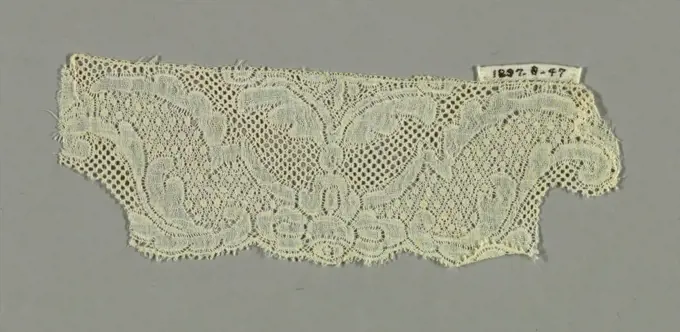
Intricate Lace Patterns

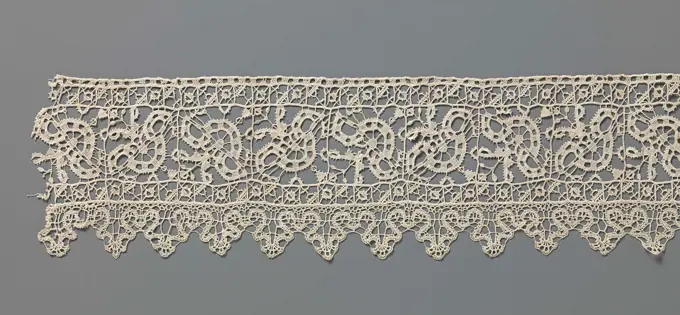
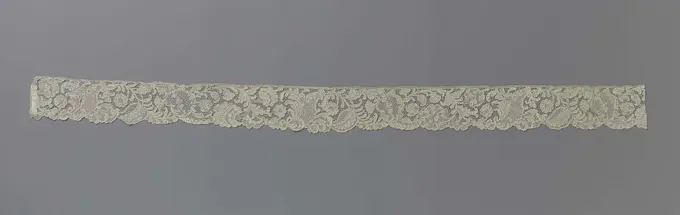
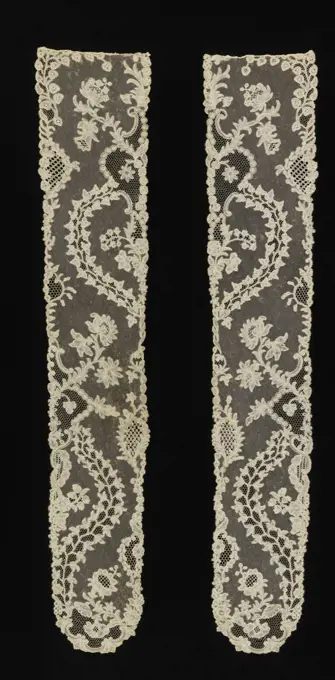
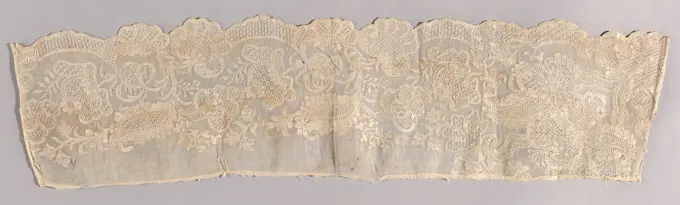
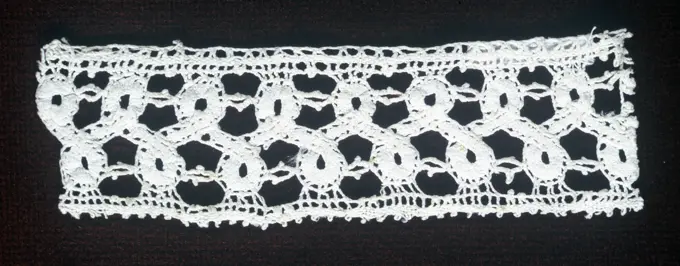
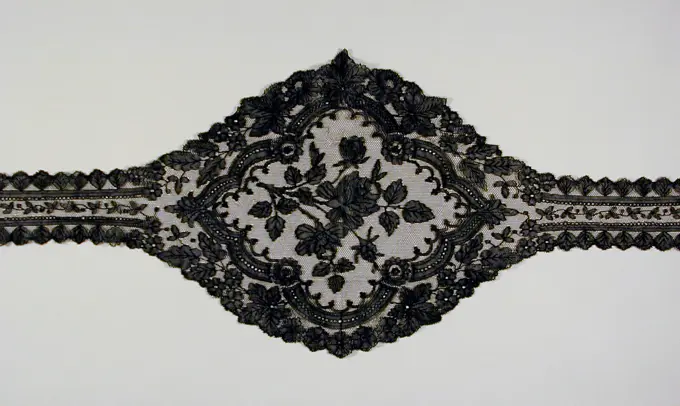
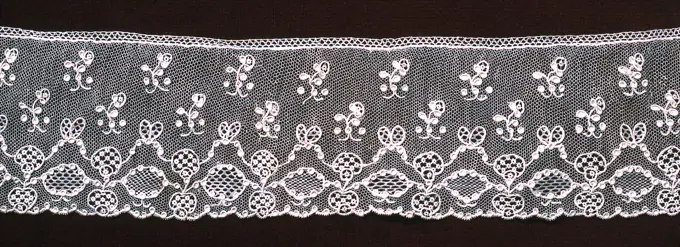
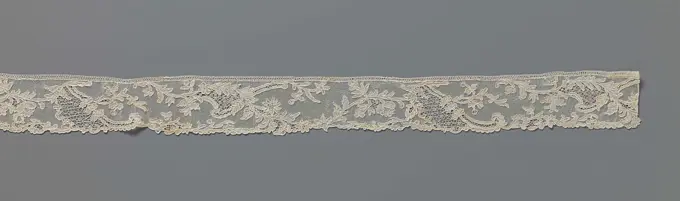
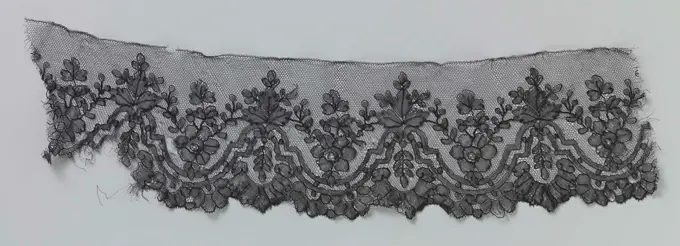
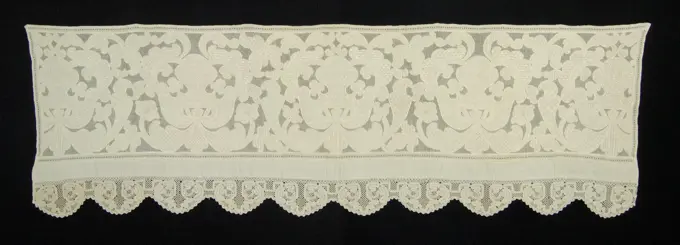
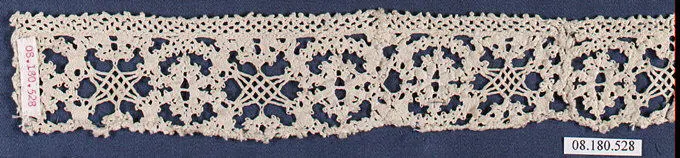
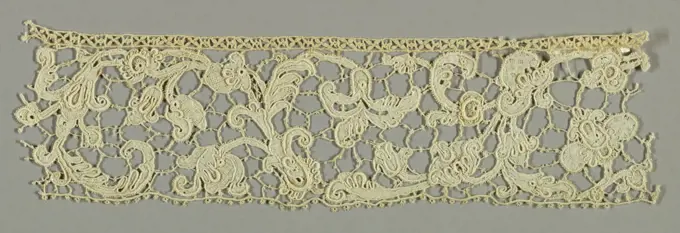
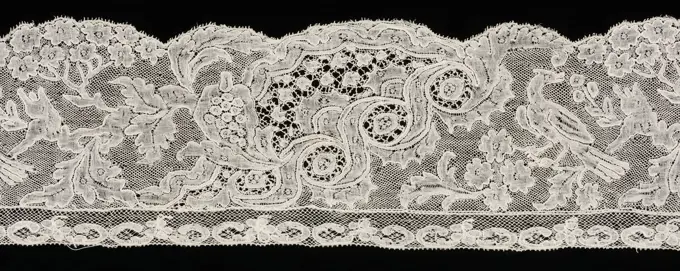
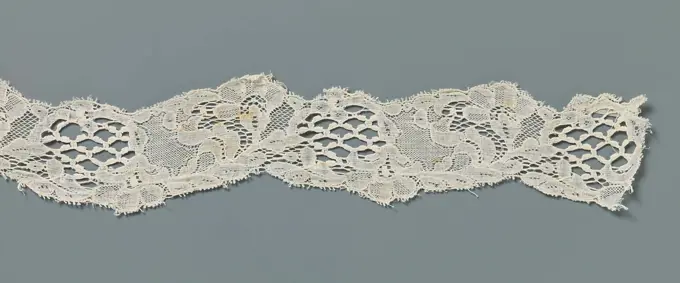
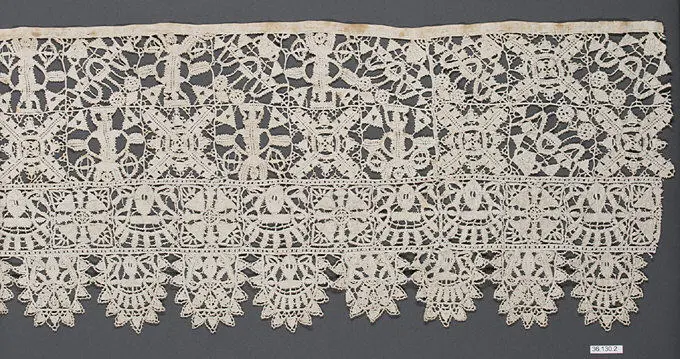
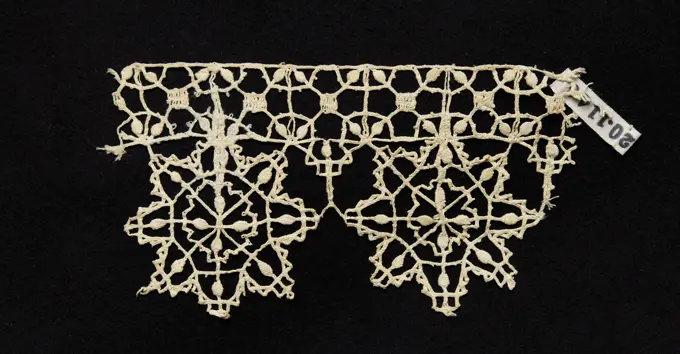
Detailed historical lace trims featuring floral motifs, wavy borders, and fine craftsmanship in various colors and styles from different time periods.
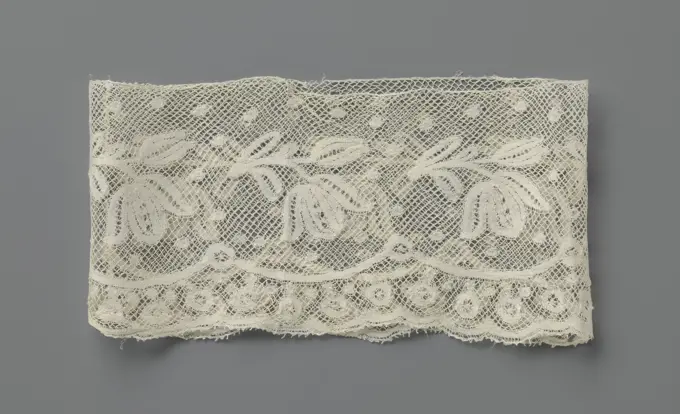
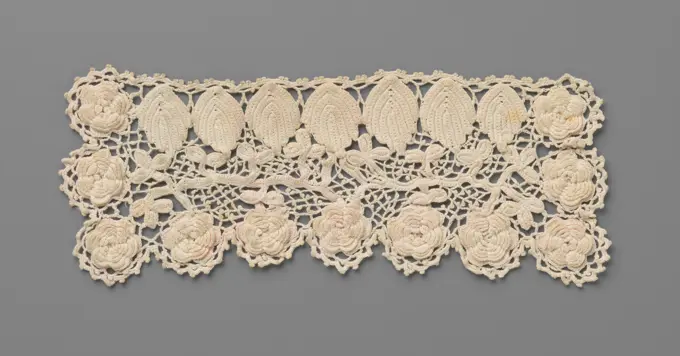
Kloskant cuff with hanging tulip, anonymous, c. 1900 - c. 1909 Cuff made of natural-colored bobbin: Valenciennes side. There is a running pattern on a gross traly soil (square grater), which is littered with 'sequins'. Unilaterally targeted hanging tulips are loose above stretched scales of a garland with hanging berries. Netherlands (possibly) linen (material) Bobbi Lace / Valenciennes Lace Cuff made of natural-colored bobbin: Valenciennes side. There is a running pattern on a gross traly soil (square grater), which is littered with 'sequins'. Unilaterally targeted hanging tulips are loose above stretched scales of a garland with hanging berries. Netherlands (possibly) linen (material) Bobbi Lace / Valenciennes Lace
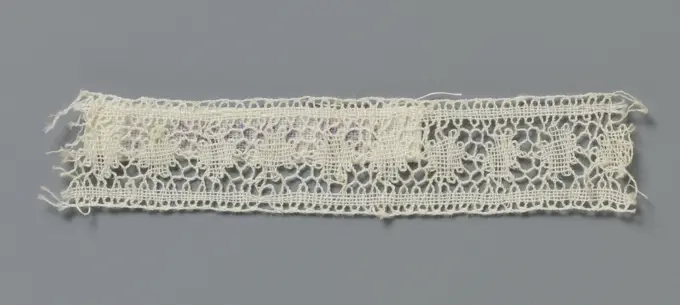
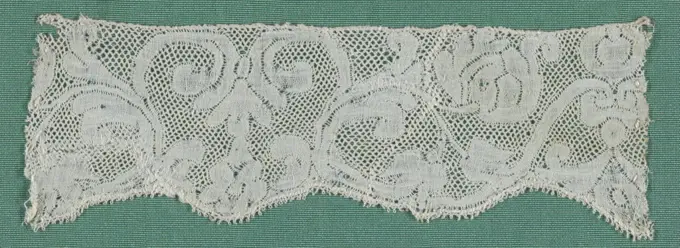
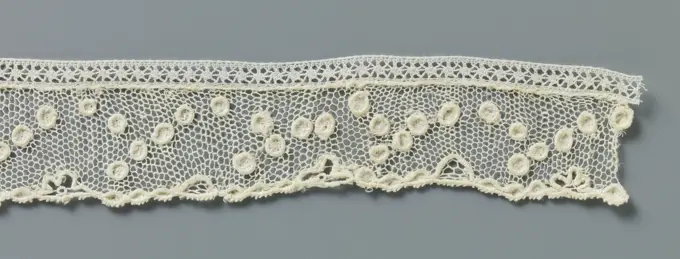
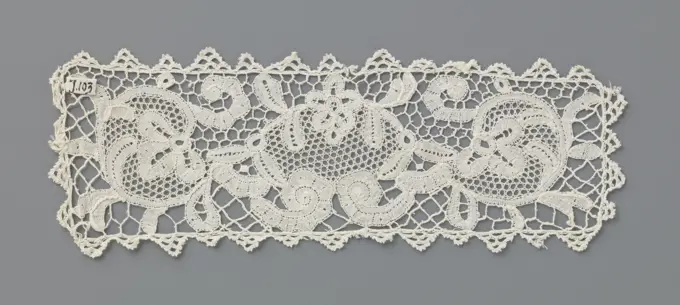
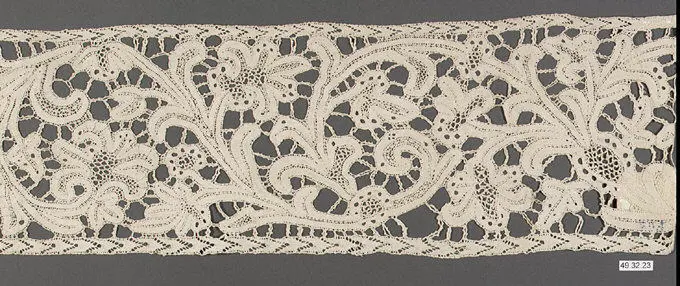
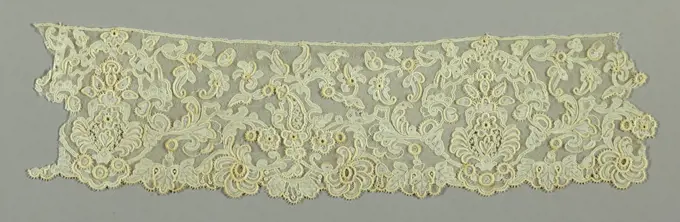
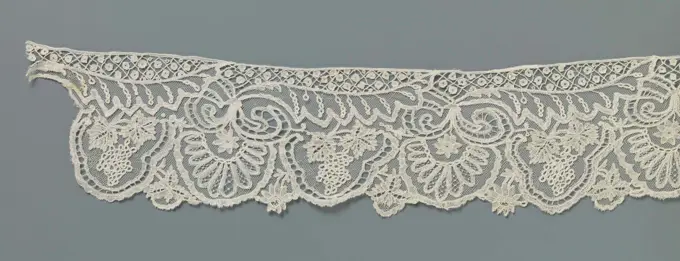
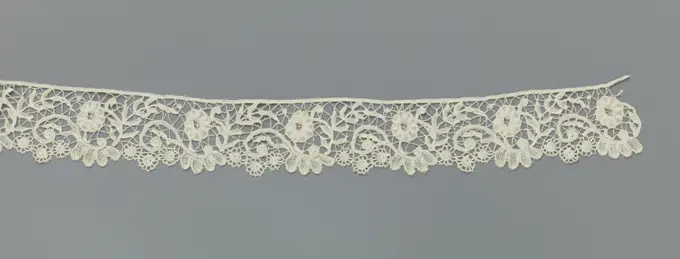
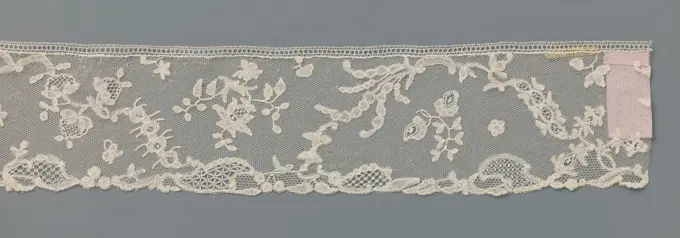
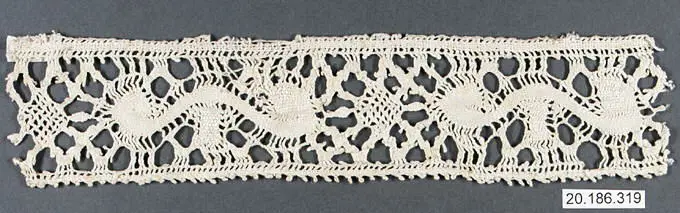
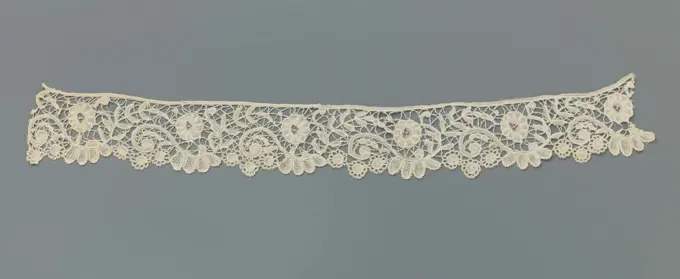
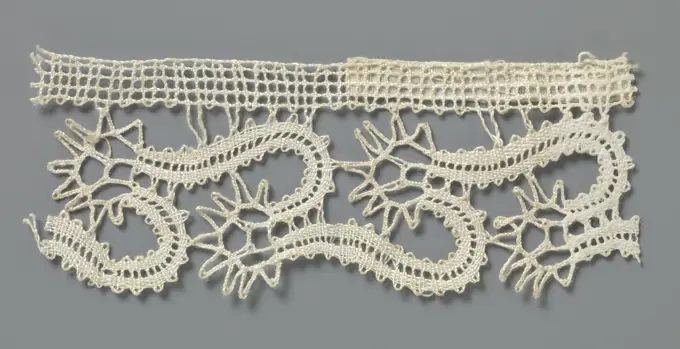
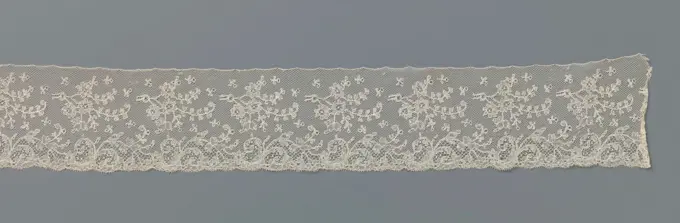
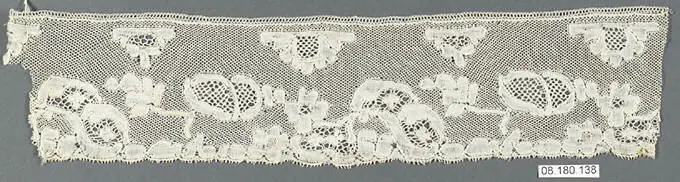
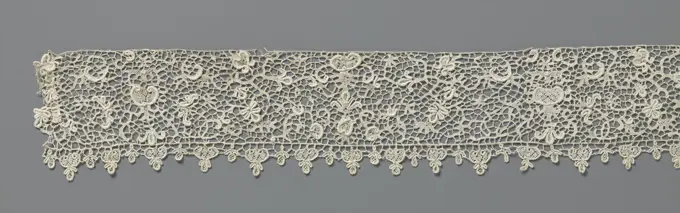
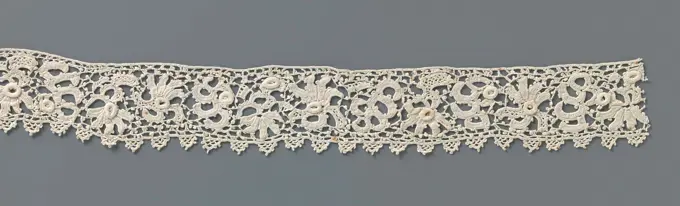
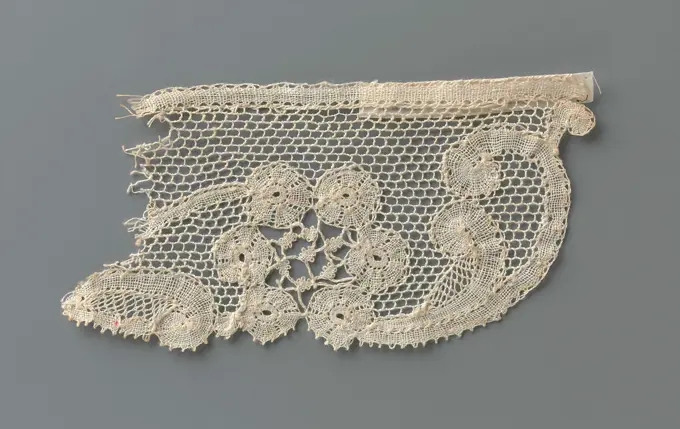
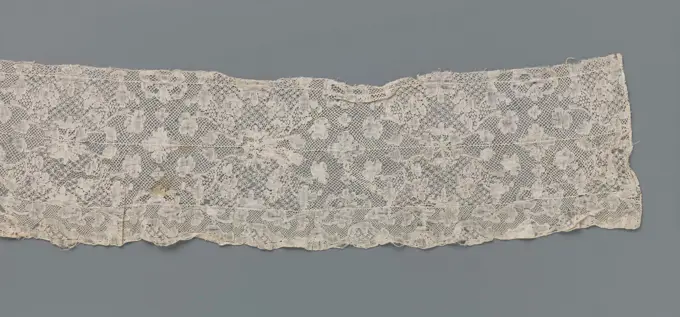
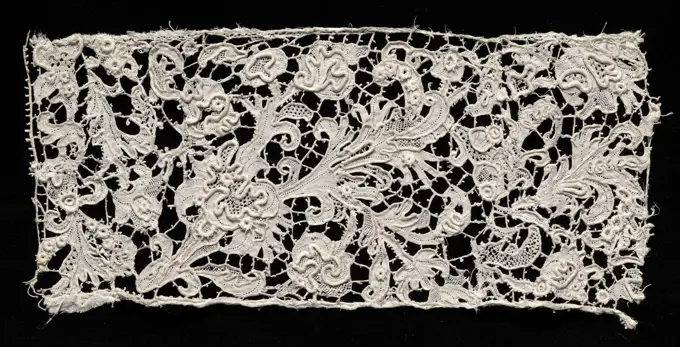
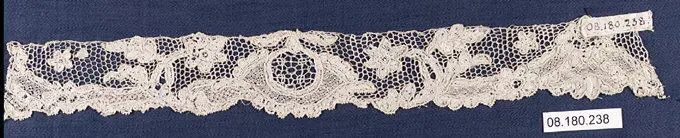
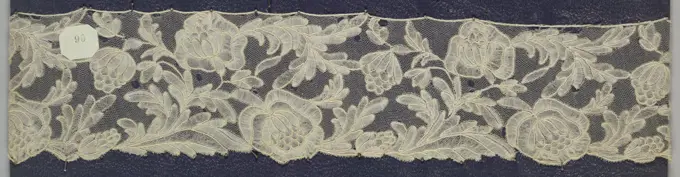
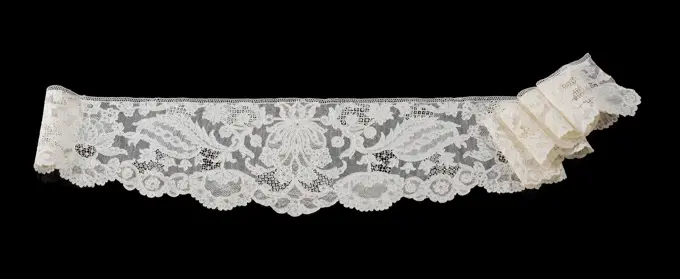
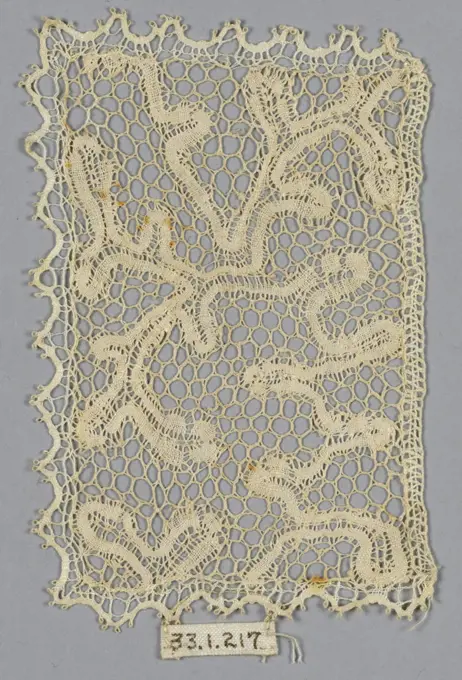
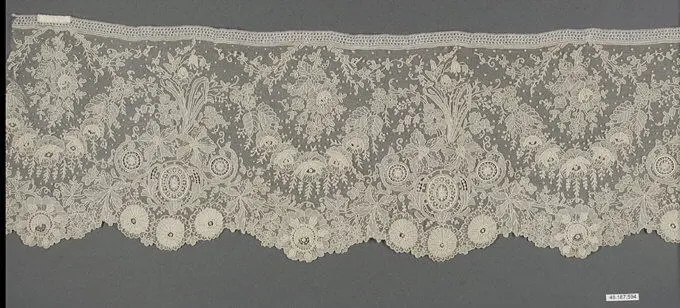
Strook naaldkant met papaverbollen.Strip natural-colored coniferous lace: Alençon side. Spreading motif with three rows of twigs with oval leaves under the upper row, on a fine hexagonal mesh. On the underside of the strip a repetitive motif of poppy solves, narrow leaves and fantasy forms filled with ornamental grounds. The underside is finished with a slightly wavy border with ragfine picots. The top is trimmed with a border clamping side.Length of Lace. Italy or Belgium, 1600-1625. Textiles; textile lengths. Linen bobbin laceBorder 18th century French or Flemish. Border 215252Border, Medium: linen Technique: bobbin lace, Mechlin style with five hole ground, Fragment with an unusual design of curving stems forming medallions filled with cinq trous (five hole) stitches., Genoa, 18th century, lace, BorderKloskant cuff with hanging tulip, anonymous, c. 1900 - c. 1909 Cuff made of natural-colored bobbin: Valenciennes side. There is a running pattern on a gross traly soil (square grater), which is littered with 'sequins'. Unilaterally targeted hanging tulips are loose above stretched scales of a garland with hanging berries. Netherlands (possibly) linen (material) Bobbi Lace / Valenciennes Lace Cuff made of natural-colored bobbin: Valenciennes side. There is a running pattern on a gross traly soil (square grater), which is littered with 'sequins'. Unilaterally targeted hanging tulips are loose above stretched scales of a garland with hanging berries. Netherlands (possibly) linen (material) Bobbi Lace / Valenciennes LaceStrip bobbin with a row of snowflakes between two straight lines, anonymous, c. 1800 - c. 1899 Strip of natural-colored bobbin, Buckingham side. The repeating pattern consists of a row of snowflakes in a mesh soil, a tuler floor. The snowflakes fill almost the entire width of the strip and are made in linen battle. Kangs The top and bottom of the strip runs a very narrow straight strap in linen battle. The top and bottom of the strip are straight. Buckingham cotton (textile) bobbin lace / Bucks point (lace) Strip of natural-colored bobbin, Buckingham side. The repeating pattern consists of a row of snowflakes in a mesh soil, a tuler floor. The snowflakes fill almost the entire width of the strip and are made in linen battle. Kangs The top and bottom of the strip runs a very narrow straight strap in linen battle. The top and bottom of the strip are straight. Buckingham cotton (textile) bobbin lace / Bucks point (lace)Bobbin Lace 5, Medium: cotton Technique: bobbin lace, Fragment of Valenciennes lace has a symmetrical design of scrolling flowering branches and palmettes with scalloped border. Round mesh., France, late 18th century, lace, Fragment, FragmentStrip bobbin with multifaceted flowers, anonymous, c. 1875 - c. 1924 Strip of natural-colored bobbin: Duchesse side. On a braid of ground is a running and closed tendril pattern with flowers, rosettes and volutes. Netherlands (possibly) linen (material) bobbin lace Strip of natural-colored bobbin: Duchesse side. On a braid of ground is a running and closed tendril pattern with flowers, rosettes and volutes. Netherlands (possibly) linen (material) bobbin laceStrip of needle side with muse motifs, anonymous, c. 1790 - c. 1799 The strip shows arches of moesjes. It has an edge of small medallions. Alençon France linen (material) Alençon Lace The strip shows arches of moesjes. It has an edge of small medallions. Alençon France linen (material) Alençon LaceFragment, Medium: linen Technique: bobbin lace, Mechlin style, Mechlin ground with areas of snowball ground., N. Europe, 18th century, lace, FragmentFragment 18th century French or Italian. Fragment. French or Italian. 18th century. Needle lace. Textiles-LacesKloskant investment piece with volutes, anonymous, c. 1910 - c. 1930 Investor of natural -colored bobbin, possibly Flemish guipure. Symmetrical pattern with volutes of which three, four and five-leaf flowers spring. A braided bar with picots around the motifs. A honeycomb land within the motives. Finishing on all sides with triangles built from arches. Belgium  bobbin lace / Flemish guipure lace Investor of natural -colored bobbin, possibly Flemish guipure. Symmetrical pattern with volutes of which three, four and five-leaf flowers spring. A braided bar with picots around the motifs. A honeycomb land within the motives. Finishing on all sides with triangles built from arches. Belgium  bobbin lace / Flemish guipure laceFragment of the lace;  2. PO. 18th century (1751-00-00-1800-00-00);Lace length laceBorder 17th century Italian, Milan. Border 227427Length of Lace. Italy, 1550-1600. Textiles; textile lengths. Linen Reticello needle laceBorder, Medium: linen Technique: needle lace with ground of loop & twist with loop & twist return, Burano, Italy, 19th century, lace, BorderStrook applicatiekant met druiventrossen en gehalveerde bladeren.Strip natural colored application side, climbing side applicated on machine tulle. A narrow part, along the inside, exhibits a running pattern of halved, lobed leaves, which accompanies an equally halved medallion with a raster filling. On a wide part with a substrate of tulle, symmetrical, deep slot, which are in turn are filled with a grinding tray and a fan plant.Machine side with curling flower vines and C-volutes, anonymous, c. 1900 Machine side: Machinale Venetian relief side (Etskant). Light bent rectangular model with silly round neckline. The symmetrical pattern consists of curling flower vines and C-volutes. Relief around Bloemharten and some leaf edges and C-Voluten. The motifs are connected by a mechanical bar with picots. The collar is finished all around with a bow edge with picots. Sankt Gallen cotton (textile) Machine side: Machinale Venetian relief side (Etskant). Light bent rectangular model with silly round neckline. The symmetrical pattern consists of curling flower vines and C-volutes. Relief around Bloemharten and some leaf edges and C-Voluten. The motifs are connected by a mechanical bar with picots. The collar is finished all around with a bow edge with picots. Sankt Gallen cotton (textile)Strip bobbin with S-Ranken, Anonymous, c. 1875 - c. 1899 Strip of natural-colored bobbin: Duchesse side. There is an ongoing pattern on a braid ground. S-ranks with three daisies and a border of Campanes form the scallops and end in a volute with single rose. Netherlands (possibly) linen (material) bobbin lace Strip of natural-colored bobbin: Duchesse side. There is an ongoing pattern on a braid ground. S-ranks with three daisies and a border of Campanes form the scallops and end in a volute with single rose. Netherlands (possibly) linen (material) bobbin laceStrook naaldkant met ingesneden blad.Running pattern of incised leaves above a rose and a three-leaf, which together form the sharply toothed outside line. Cross-shaped bars with button (soil of long X-shaped bars with a spider). The REMPLIS consists of buttonhole stitches and a Fond Gazé. German side: 'Carlsbead points'.Border. Belgium, Flanders, Mechlin. Date: 1755-1765. Dimensions: 8.2 x 180 cm (3 1/4 x 70 7/8 in.)Width repeat: 16.2-16.8 cm (6 3/8-5/8 in.). Linen, bobbin straight lace of a type known as "Mechlin" with a five-hole mesh ground. Origin: Mechelen. Museum: The Chicago Art Institute, Chicago, USA.Strip bastard with peonies between which loose dot along the upper edge, anonymous, c. 1650 - c. 1674 Strip of natural -colored Dutch bobbin. The repeating pattern consists of a stylized peony between two leaves hanging down, smaller flowers. Between the successive peonies there is always a loose dot along the upper edge. The motifs are connected by a round grid with braid strokes. The motifs are made in linen battle with openwork edges that ensure contours around petals and leaf rods. Top and bottom of the strip are straight finished, with the bottom with picots. Antwerp linen (material) bobbin lace Strip of natural -colored Dutch bobbin. The repeating pattern consists of a stylized peony between two leaves hanging down, smaller flowers. Between the successive peonies there is always a loose dot along the upper edge. The motifs are connected by a round grid with braid strokes. The motifs are made in linen battle with openwork edges that ensure contours around petals and leaf rods. TopFragment 18th century Italian, Milan. Fragment 215046Strook kloskant met bogen en losse bloemtakken.Strip natural colored Brussels climbing side. The repeating pattern consists of bows, with a symmetrical arc interspersed by two mirrored α-symmetrical arches. In the fields under the arches and there is always a large loose flower branch and some loose flowers or leaves. The pattern along the underside of the strip consists of a concatenation of different shapes cartouches, elongated leaves and rosette flowers. The motifs are connected by a fine Maas soil, a slighten ground. The motifs are made in linen stroke with openwork edges and is largely equipped with clost relief contours. Various ornamental grounds have been applied, mainly in the cartouches along the bottom and in a few flower hearts. The top is finished with a separate clust strap. The bland scaled underside comes from the pattern with the cartouches and is finished with picots.Fragment of lace. unknown, authorFragment 17th century () Flemish. Fragment 226146Fragment, Medium: Technique: bobbin lace (Valenciennes ground), France, 19th century, lace, FragmentFragment, Medium: linen Technique: bobbin lace made in Lille style but without heavy outlining thread, 19th century, lace, FragmentStrip bobbin with oval formed by curved leaves, anonymous, c. 1820 - c. 1830 Strip of natural -colored bobbin: Lille side. The upper half of the strip has no pattern. The repeating pattern along the bottom half consists of two curved leaves that together form an interrupted oval with a flower in the center. This flower is attached to the upper leaf. There are five flowers on the lower leaf, which form a fan -shaped shell. The motifs are placed close together, with the flowers merging at the bottom. The motifs are connected by a fine grid, a tuler land. The motifs are made in linen battle with large recesses and with thicker, shiny contour threads. The top of the strip is straight finished. The scums along the bottom are finished with picots. Lille linen (material) bobbin lace / Lille lace Strip of natural -colored bobbin: Lille side. The upper half of the strip has no pattern. The repeating pattern along the bottom half consists of two curved leaves that together form an interrupted ovManchet van naaldkant met strikjes.Cuff of natural needle side: Venetian relief side. On a very open bars soil there are irregular voluntaries with leaf volutes and multi-part flowers. List of triangles.Cuff of needle side with hanging points from bobbin, anonymous, c. 1660 - c. 1699 Cuff of natural Venetian needle side "Gros Point", trimmed with a strip of Old Flemish bobbin side. The needle side has a pattern of flowers and volutes. The motives are provided with contour threads and partly with thick cordons, decorated with Pictos. Different decorative stitches have been used within each motif. The bobbin pattern consists of hanging cook flowers, possibly tulips. The motifs are made in linen battle with openwork edges and recesses. The top of the cuff is finished with a bow edge (needle side). The showered scales are finished with picots. And the short sides are finished with a messing strap. The scrap edge of Kloskant is probably older than the needle side and is made in the Southern Netherlands. The needle side is made in Italy. The sides have been compiled into a cuff in the 19th century. Southern Netherlands linen (material) Venetian gros point (heavy raised Venetian lace) / bobbManchet van gehaakte kant met bloemenmand en strik.Cuff of natural colored Irish crochet side. The cuff is rectangular and runs out in a point in the middle. In the point a vase with a large flower. Next to the flower a branch with leaves. Along the top edge a horizontal rank with oval-shaped leaves and berries. In the middle the rank has laid in a knot with large loops. The ends hang up above the vase. Above the rank an irregular bars soil with picots. Under the rank a finer diamond-shaped mesh soil with picots. Finished on all sides with a border with triple arcs and picots.Insertion Italian, Abruzzi (Gessopalena) 18th centuryStrook kloskant met s-ranken.Natural collate strip: Duchesse-Side. There is an ongoing pattern on a braid soil. S-tanks with three daisies and an edge of Campanes form the slot and end in a simple rose.Strip bobbin with stars between J-shaped ribbons, anonymous, c. 1900  Strip of natural -colored bobbin, Russian side. The pattern is formed a two rows of lying J-shaped ribbons, with the J-'s mirrored in the bottom row compared to the Js in the row above. A star -shaped motif connects the ribbons. The ribbon is made in closed linen battle, with openwork edges and an upbred center. The stars are made with potented braids. The top is straight finished with a strap with square meshes. The scums along the underside are formed by the points of the stars and the shape of the ribbons. Russia linen (material) bobbin lace / Russian laceStrip bobbin with round flowers with bow, anonymous, c. 1750 - c. 1799 Strip of natural -colored bobbin, stuck side. The repeating pattern consists alternately of two round flowers bothered to each other with an S-shaped stems, which are tied together with a bow and a large oval-shaped flour on a stem with a heart-shaped motif. The motifs are connected by a Maas soil, the square Valenciennes ground. The motifs are made in linen battle with thicker and shiny contour threads. Various snowflake grounds have been used in the flowers, the bow and the heart. The top is straight. A narrow strip runs unfinished linen along the bottom. The short sides are finished with a zoompje. Southern Netherlands linen (material) bobbin lace / pot lace Strip of natural -colored bobbin, stuck side. The repeating pattern consists alternately of two round flowers bothered to each other with an S-shaped stems, which are tied together with a bow and a large oval-shaped flour on a stem with a heart-shaped motif. Strook kloskant met liggende bloemtakjes.At a nice ground ground, a mechelen soil (also known as ice soil), are righ-facing lying twigs, to which three small florets; Things of this single scattered bakes. An edge with open grid work fills consists of consecutive spiral drinks, including three florets and edges of Campanes, which form the slot. Mechelen side.Piece Flemish, Brabant 18th centuryStrip bobbin with one -sided targeted twigs with stiff straight leaves, anonymous, c. 1805 - c. 1815 Strip of natural -colored bobbin: Lille side. Under a wide spreading pattern of square mouses, the repeating pattern consists of a crooked branch with stiff straight leaves. The twig springs together on a row of connected ovals along the underside of the strip. The motifs are connected by a fine grid, a tuler land. The sparing fullwork is made in linen battle, with thicker and shiny contour threads. The Mosjes are made in form. The top and bottom of the strip are straight finished, with the bottom with picots. Lille linen (material) bobbin lace / Lille lace Strip of natural -colored bobbin: Lille side. Under a wide spreading pattern of square mouses, the repeating pattern consists of a crooked branch with stiff straight leaves. The twig springs together on a row of connected ovals along the underside of the strip. The motifs are connected by a fine grid, a tuler land. The sparing fullwoFragment, Medium: linen Technique: bobbin lace (Lille-style with heavy outlining thread), Fragment of Lille type bobbin lace., 19th century, lace, FragmentFragment (Italy); linenStrip of needle side with candle -wham motifs and coral ranks, anonymous, c. 1690 - c. 1699 Strip of natural needle side, point the france. Repetitive motif with two different candlestick motifs between which coral vines with palm and rosette flowers, volutes and C-shapes. Hexagonal soil with picoted bars. Made full work with feston stitches, with recesses. Motives largely without relief, partly with Kordons. On the straight edge on the underside there are hearts and oval -shaped flowers with two leaves on picoted bars. The top is finished with a straight edge. France linen (material) Strip of natural needle side, point the france. Repetitive motif with two different candlestick motifs between which coral vines with palm and rosette flowers, volutes and C-shapes. Hexagonal soil with picoted bars. Made full work with feston stitches, with recesses. Motives largely without relief, partly with Kordons. On the straight edge on the underside there are hearts and oval -shaped flowers with twBorder, Medium: linen Technique: bobbin lace (Valenciennes ground), Border with shallow scallops and Valenciennes ground. Each scallop is filled with a flower motif., Netherlands, 17th century, lace, BorderStrip of needle side with clover leaves and fan -shaped flowers, anonymous, c. 1775 - c. 1799 Strip of natural-colored needle side: men's-Aalençon. Spread motif with clover leaves on a fine hexagonal Maas soil. Along the top edge a row of mosjes. The pattern on the underside of the strip consists of a succession of leaf branches with plumes. Among them fan -shaped flowers that spring from the bottom edge, filled with a decorative land. The underside is finished with scalloped edge of potented circles with a Raderpicot. The top is finished with a straight edge. Alençon linen (material) Alençon Lace Strip of natural-colored needle side: men's-Aalençon. Spread motif with clover leaves on a fine hexagonal Maas soil. Along the top edge a row of mosjes. The pattern on the underside of the strip consists of a succession of leaf branches with plumes. Among them fan -shaped flowers that spring from the bottom edge, filled with a decorative land. The underside is finished with scalloped edge of Strook gehaakte kant met afwisselend een bloem en een blad.Strip natural-colored Irish crochet side. Pattern with a hanging or standing whimsical flour interspersed by a flower or leaf consisting of C-shapes stacked on top of each other. Crocheted irregular mesh soil with picots. The top is finished with a straight edge. The straight bottom is trimmed with picoted arcs.Border early 18th century Italian, Venice. Border 227062Lace, 1800s , maker unknown.Strip bobbin with thin s and C-shaped tumbles with oval buttons, anonymous, c. 1850 - c. 1874  Strip of natural-colored bobbin, binche side. The pattern consists of a maze of thin s and c-shaped tumbles with oval buttons. The motifs are connected by a Maas soil, a Flemish grid. The very sparing fullwork is made in linen battle with openwork edges. Top and bottom of the strip are straight finished, with the bottom with picots. Abruzzi linen (material) Bobbi Lace / Binche LaceInzetstuk van kloskant voor lingerie.Insert for lingerie of natural colosside, Parisian side. Half oval-shaped. The pattern is largely symmetrical on the sloped flour, at the top of the center line. From this flower, long feather-shaped leaves, which waves as an S-voltage along the top edge. Under both golf tops a flower bends back to the center line. The motifs are connected by a Maas soil, a Paris soil. The motifs are made in linen stroke with thicker and shiny contour wires. In the flower hearts a snowflakes soil has been applied as ornamental ground. In the Volulageren a decoration has been realized by crossing couples. The top of the strip is straight finished. The shelters along the long straight side are finished with picots. Along the short sides and the shelter along the curved long side runs a band in linen stroke with open edgesCuff made of crocheted side with relief stations such as Schulpenrand, W. de Jong, c. 1910 - c. 1920 Cuff made of natural Irish crocheted side. Rectangular model. Along three sides, a sculpy edge of connected relief senes runs. There is a row of diamond -shaped leaves on one long side. Two horizontal stems with three -part leaves in the narrow midfield. The motifs are connected by a diamond -shaped network with picots. Along the roses, a continuous bow edge runs along the outside, which turns into a picot edge above the diamond -shaped leaves. Nijmegen cotton (textile) Cuff made of natural Irish crocheted side. Rectangular model. Along three sides, a sculpy edge of connected relief senes runs. There is a row of diamond -shaped leaves on one long side. Two horizontal stems with three -part leaves in the narrow midfield. The motifs are connected by a diamond -shaped network with picots. Along the roses, a continuous bow edge runs along the outside, which turns into a picot edge above theBorder with Vases.The earliest lace has geometrical patterns. The diagonally placed vases in this band, however, are rare. Such motifs hardly ever occur in pattern books.Strook naaldkant met rozen en pioenrozen.Strip natural-colored coniferous side with a repetitive motif of flowers and leaves. A splitting rank with two large peonies, which covered the full width of the strip, as well as the roses to tendrils with relatively large leaves. Hexagonal Maas soil and a variety of ornamental grounds. The top is trimmed with a border clamping side. There is no separate pattern for the bottom edge, the sloping edge forms from the motif of flowers and leaves. Alençon side.Cap streamers, Medium: linen Technique: bobbin lace, Brussels style, Brussels-style cap streamers. Half-cartouches on each piece (as if from a continutous textile) containing sprays of flowers., Belgium, 1700-1750, lace, Cap streamersFragment of embroidery;  1 PO. 18th century (1701-00-00-1750-00-00), 1. PO. 18th century (1701-00-00-1750-00-00);embroideryDas van Linnenbatist with ends of Duchesse Kant, Anonymous, c. 1890 Das van Linnenbatist with ends of Duchesse Kant. The edges are equipped with picots. The irregularly scalloped edge pattern consists of a medallion formed by two C-shaped volutes crowned by a palm with a flower between six leaves underneath. Belgium linen (material). mixed lace Das van Linnenbatist with ends of Duchesse Kant. The edges are equipped with picots. The irregularly scalloped edge pattern consists of a medallion formed by two C-shaped volutes crowned by a palm with a flower between six leaves underneath. Belgium linen (material). mixed laceStrook gemengde kant met een krans van rozetbloempjes.Strip natural-colored mixed side: Milanese ribbon side. Pattern with a wreath of six rosette flowers from which a rank of C-Volutes exprements. The top of the short strip is straight finished. The slight sloping edge comes from the pattern and is finished with picots. The volunt range forms the finish of one short side. The other short side is frayed.Strook kloskant voor een 'Duitse muts' gebruikt in de Friese dracht.Strip natural colosside, Antwerp Pottekant. The strip has been composed of four strips and intended for a 'German hat' used in the Frisian pregnancy. The middle two strips are the same and are symmetrically sewn against each other. The pattern has interspersed in a wreath placed flowers with halved quadruple flowers, turned into a whole through the seam. The lower strip has a running pattern of a rocaille and a double flower branch in which the rocaille and one of the flowers also form the slight sloping edge. The upper strip is a cut part of the middle type and is finished with a very narrow, partly missing soil. The motifs are connected by a Maas soil. The motifs are made in linen stroke and two types of ornamental soil have been used, the motifs run thicker contour wires.Strook kloskant met parel- en rozetlijst.On the ground soil, a mechelen soil (also known as ice soil), with some sprinkled four-pastor moes is a running pattern. Along the inside are small hanging rosette branches, a dune rose in the middle of a dune rose to larger voluntaries, which shown at the same flour that forms the closing piece of pure circle arc shut. The tubes consist of a pearl and rosette list, which enclose a center barrier with grid work. Mechelen side.Cuff from crocheted side with round flowers and elongated chalice, anonymous, c. 1900 - c. 1910 Cuff made of natural Irish crocheted side. Rectangular model. Pattern with two round flowers and two elongated chalice. The cuff is finished all around with a scrap of double arches, with picots on the outer arches. Netherlands (possibly) cotton (textile) Cuff made of natural Irish crocheted side. Rectangular model. Pattern with two round flowers and two elongated chalice. The cuff is finished all around with a scrap of double arches, with picots on the outer arches. Netherlands (possibly) cotton (textile)Needlepoint (Venetian Raised Point) Lace Border, 17th century. Italy, Venice, 17th century. Lace, needlepoint; average: 9.6 x 21 cm (3 3/4 x 8 1/4 in.).Fragment of the lace;  XVII/18th century (1601-00-00-1700-00-00);Fragment 18th century French. Fragment 214592Fragment, Cooper Union Museum Lace Study Card; Made for Cooper Union Museum; linenStrip bobbin with symmetrical pattern with fine tulip vrilas, anonymous, c. 1645 - c. 1655 Strip of natural -colored bobbin: Old Flemish side. The pattern consists of a repeating symmetrical composition of fine tulip vans, which move from a central vase or flowerpot to the lower edge. The branching tiflens finally end in five tulips, which form the faint grip edge. A sparingly used irregular traly land connects the motifs. The motifs are made in linen battle with openwork edges. The top is finished with a separate strap. Antwerp (possibly) linen (material) bobbin lace / old Flemish lace Strip of natural -colored bobbin: Old Flemish side. The pattern consists of a repeating symmetrical composition of fine tulip vans, which move from a central vase or flowerpot to the lower edge. The branching tiflens finally end in five tulips, which form the faint grip edge. A sparingly used irregular traly land connects the motifs. The motifs are made in linen battle with openwork edges. The top is fiFragment; linen; 1933-1-238Headcovering. Belgium, Grammont, third quarter of the 19th century. Costumes; Accessories. Silk bobbin lace (Chantilly)Border (France); linenFragment of the lace;  XVIII/19th century (1790-00-00-1810-00-00);Strook naaldkant met halve ovalen bekroond met een narcis.Strip natural-colored coniferous lace: Alençon side. Pattern with a repetitive motif of different tendrils with multifacetous flowers on a fine hexagonal maas soil. Figures open between the tendrils, including half ovals. The half ovals are filled with an ornamental ground with six-lasting flowers, they cover the entire width of the strip and are crowned by a daffodil. The scalloped lower edge is partly from the tendrils pattern and further from narrow lying leaf refines with a few flowers. The top is trimmed with a border clamping side.Band, Medium: linen Technique: bobbin made continuous tape with net added, Band of bobbin lace, loosely worked pattern of scrolls and floral motifs., Belgium, 17th century, lace, BandCap streamers. Date/Period: 1700-1750. Cap streamers. Medium: linen. Technique: bobbin lace. Author: UNKNOWN.Kloskant intermediate mate with zigzag line, anonymous, c. 1875 - c. 1949 Piles of Natural -colored bobbin side: Mechelse side. In the middle of the fine grid, a Mechelen soil (also known as ice soil), an openwork band runs in Zigzaglijn, cut over by two types of rosettes. Belgium linen (material) bobbin lace / Mechlin (lace) Piles of Natural -colored bobbin side: Mechelse side. In the middle of the fine grid, a Mechelen soil (also known as ice soil), an openwork band runs in Zigzaglijn, cut over by two types of rosettes. Belgium linen (material) bobbin lace / Mechlin (lace)Band (Netherlands); linenBorder, Medium: linen Technigue: bobbin lace, peasant style, Border worked in bleached and unbleached thread, edged with pointed bobbin lace., Abruzzi, Italy, 19th century, lace, BorderStrook van kloskant met holle en bolle dubbele lijsten.Strip of black climbing side: Chantilly side. A ground ground shows an empty top and a downwardly severely symmetrical design. Hollow and convex double tables, cascading, follow the slot, which exist for turns from half rosettes and a bow of leaves.Bed curtain border 1800-1850 Russian. Bed curtain border 173363Fragment, Medium: linen Technique: bobbin lace, Fragment of Valenciennes lace has a conventionalized branch and leaf border. Round mesh and straight edges., France, 18th century, lace, FragmentInsertion 17th century Italian, Rome. Insertion 214878Fragment, Medium: linen Technique: raised needle lace, Border fragment of Gros Point de Venise in a large floral and foliated serpertine design. Pattern outlined by cordonnet and connected by brides picotées and interspersed by portes and gaze quadrillée., Venice, Italy, late 17th-early 18th century, lace, FragmentBorder; linen; Bequest of Marian Hague; 1971-50-420Tussenzetsel van machinale kant met zigzaggend model.Natural Machining Machine Machine Mechelen. The strip has a faint zigzag model. The repeating pattern consists of a flower along one long side and a flower along the other long side that are connected to each other with leaves. One leaf stalk forms a more or less round frame, filled with a grid work of crosses, made with machining forms. The motifs are cleaved with a few recesses and equipped with contour wires. They are connected by different machining grounds, including with machining soil. The long sides are finished with picots.Strip of mechanical side with hooking C-shaped flower stems, anonymous, c. 1850 - c. 1899 Strip of natural -colored machine side: Machinal Mechelen side. The repeating pattern consists of two hooking C-shaped flower stems, with a three-lobe flower on each handle. Along the underside of the strip are three ovals and two openwork circles alternately. The motives are sparingly provided with recesses and all with shiny contour threads. They are connected by a mechanical hexagonal grid. A mechanical fine snowflake soil has been applied between the flower stems as a decorative soil. Top and bottom of the strip are straight finished, with the bottom with picots. France (possibly) cotton (textile) Strip of natural -colored machine side: Machinal Mechelen side. The repeating pattern consists of two hooking C-shaped flower stems, with a three-lobe flower on each handle. Along the underside of the strip are three ovals and two openwork circles alternately. The motives are sparingly provided with Fragment 16th century Italian. Fragment 214854Border 17th century Italian Punto in arialiterally, "stitches in the air"is one of the earliest styles of needle lace, which is itself developed from cutwork of primarily geometric design. When lacemakers transitioned to using a foundation of threads laid out according to a pattern drawn on parchment, they were able to incorporate more fluid lines and curves into their designs.. Border 226022Bobbin Lace (Needlepoint Design) Edging of Star Points, second half of 16th century. Italy, Genoa, second half of 16th century. Lace, bobbin; average: 6.7 x 11.2 cm (2 5/8 x 4 7/16 in.).Fragment 18th century Flemish. Fragment 218910Cap Crown (Belgium); linenFragment, Medium: linen Technique: bobbin lace (Binche style with Binche ground), Binche-style fragment with a large-scale conventionalized floral design. Cinq trous ground. Slightly scalloped edge., Belgium, 17th century, lace, FragmentBorder, Technique: bobbin lace, Bobbin lace pillow border, scrolling leaves and flowers; late 18th century Brussels, late 18th century, lace, BorderENGINEANTE OF NATURAL CONNECTION: ALENÇ Side. Symmetrical pattern that is interrupted because a part of the Engagante is missing on the left. In the original center consists of pattern from a flaming flower along the top including half a wreath of rosette flowers. The flaming flour is flanked on both sides by a rocaille-like motif with grid patterns, including a lying elongated led leaves with a large hanging impeller-shaped flower underneath. One of the other large flowers in the pattern is a carnation. The flowers are made up of feston stitches with many small recesses and relief contours. The motifs are connected by a fine Maas soil, an Alençon ground. There are many different types of ornamental soils and decorative stitches applied in and between the flowers. The top is straight finished with a splitting strap. The sloping edge stems from the pattern and is finished with PICTO.Piece early 18th century Flemish, Mechlin. Piece 214500Fragment of reticella lace unknownFragment, Medium: linen Technique: bobbin made continuous tape with net added, 18th century, lace, FragmentEdging late 18th century Flemish. Edging 222818Border Belgian, Brussels second half 19th centuryFragment, Medium: linen Technique: bobbin lace, Fragment of Binche-style lace with symmetrical design of paired scrolling leaves. 'Cinq trous' and 'snowball' ground. Scalloped edge., Belgium, 18th century, lace, FragmentBorder Made 1860-1880 Belgium. Cotton, needle lace of a type known as Point de Gaze .Bobbin Lace Insertion and Edging, 17th-18th century. Italy, Abruzzi, Pescocostanzo , 17th-18th century. Lace, bobbin; average: 8 x 32.7 cm (3 1/8 x 12 7/8 in.).Application side strip with bijou on the garlands for a crinoline Japon, Anonymous, c. 1850 - c. 1860 Japon strip Natural -colored application side, needle side Applicated on Machine Tulle, Point d'Angleterre. Two varied types of round sculptes together with a lace Banderolle form a succession of large round reserves, above which a fond littered with mushes. The reserves are always filled with a bouquet or rose (bobbin). One shell shows a ribbon decorated with a standing oval bijou, which is hung on the Banderolle with a bow and with a scalloped ribbon. The other shell shows radiating twigs with roses between two rows of campanes. Above the reserves are small bouquets. Brussels linen (material) Japon strip Natural -colored application side, needle side Applicated on Machine Tulle, Point d'Angleterre. Two varied types of round sculptes together with a lace Banderolle form a succession of large round reserves, above which a fond littered with mushes. The reserves are always filled with a