Intricate Lace Patterns

Detailed historical lace trims featuring floral motifs, wavy borders, and fine craftsmanship in various colors and styles from different time periods.
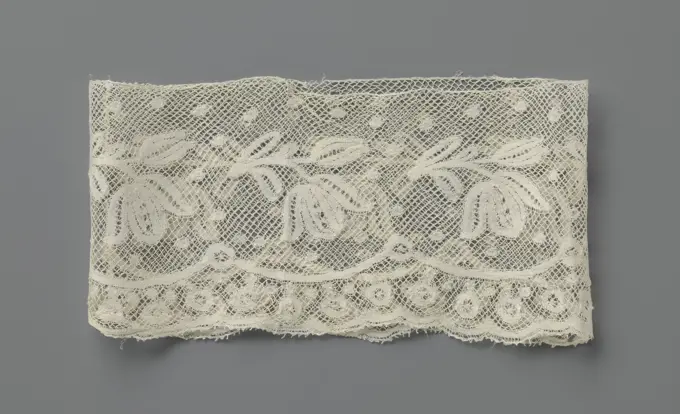
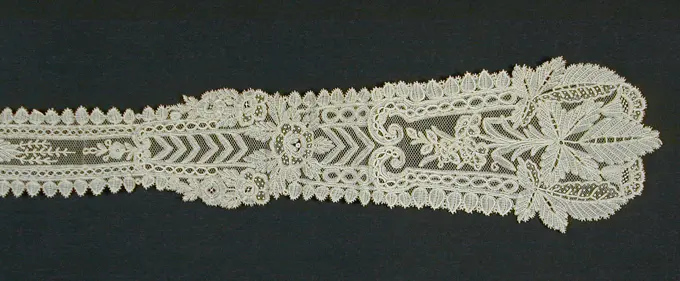
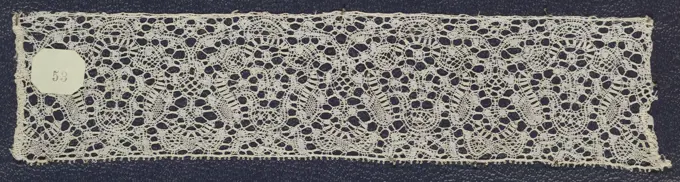
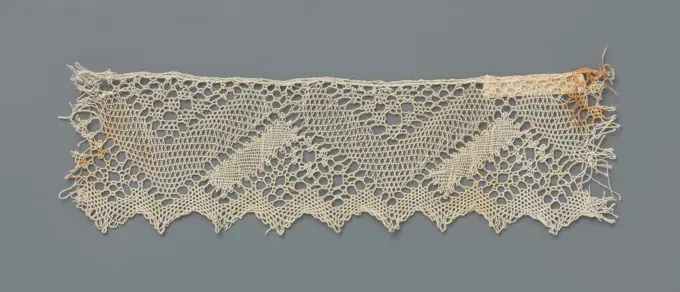
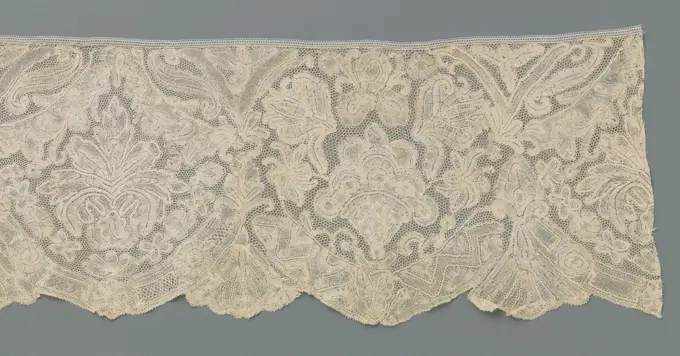
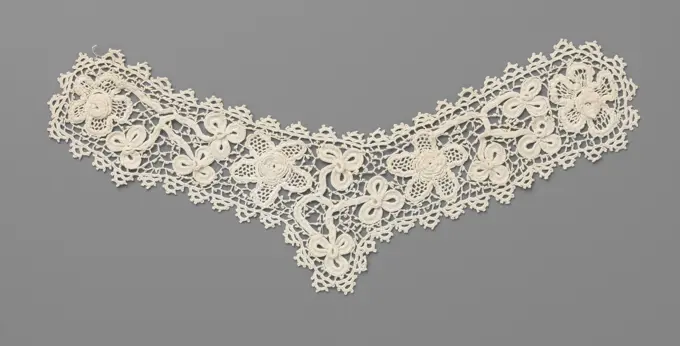
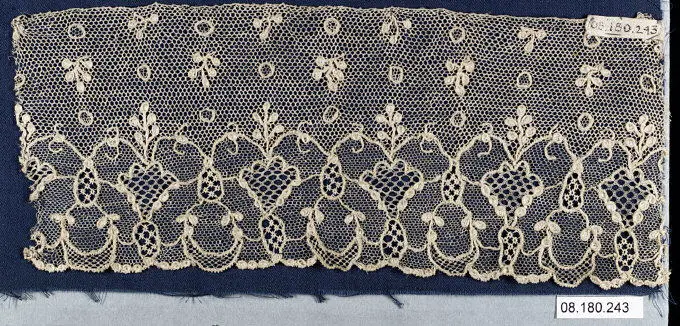
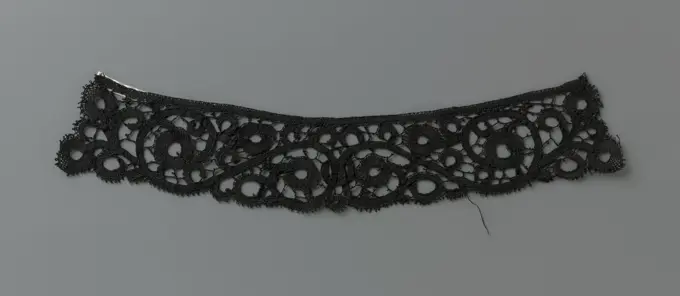
Kloskant cuff with hanging tulip, anonymous, c. 1900 - c. 1909 Cuff made of natural-colored bobbin: Valenciennes side. There is a running pattern on a gross traly soil (square grater), which is littered with 'sequins'. Unilaterally targeted hanging tulips are loose above stretched scales of a garland with hanging berries. Netherlands (possibly) linen (material) Bobbi Lace / Valenciennes Lace Cuff made of natural-colored bobbin: Valenciennes side. There is a running pattern on a gross traly soil (square grater), which is littered with 'sequins'. Unilaterally targeted hanging tulips are loose above stretched scales of a garland with hanging berries. Netherlands (possibly) linen (material) Bobbi Lace / Valenciennes Lace
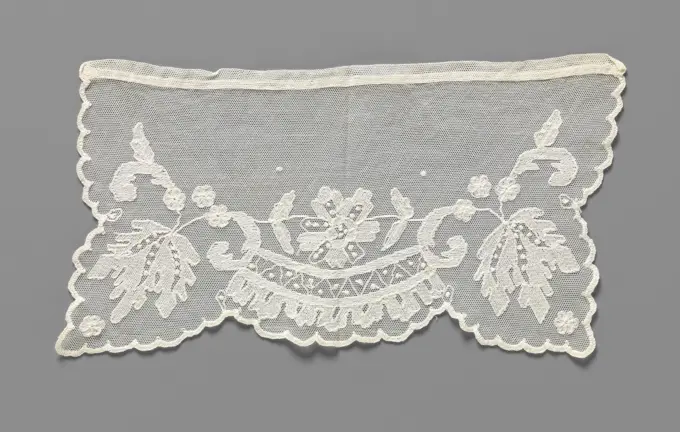
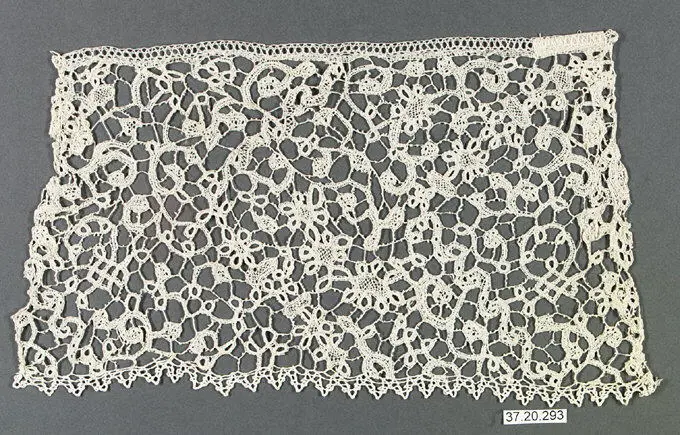
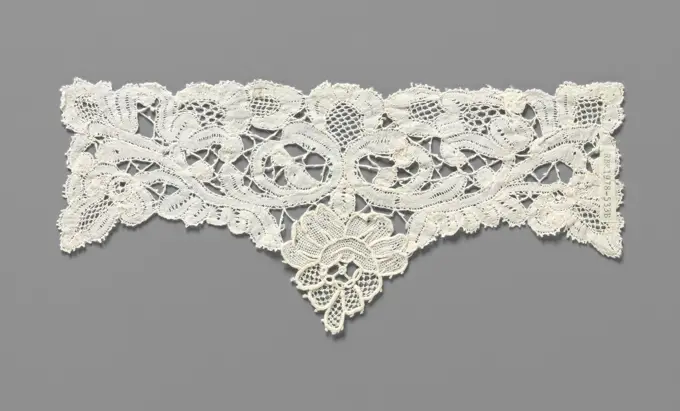
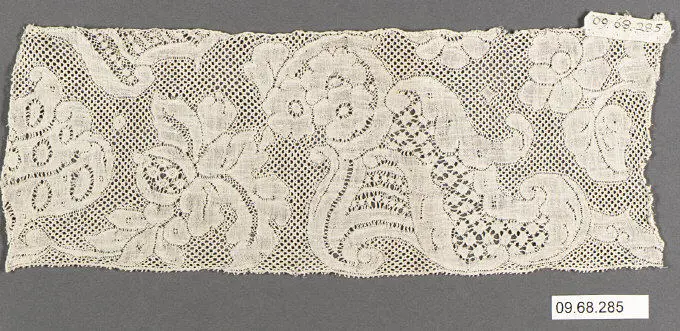
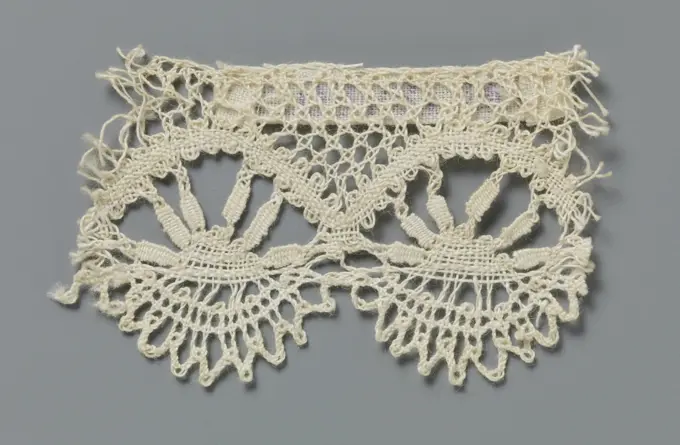
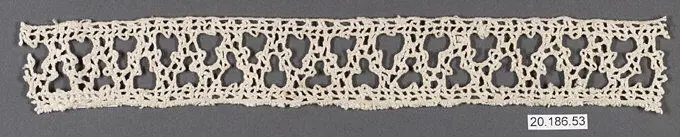
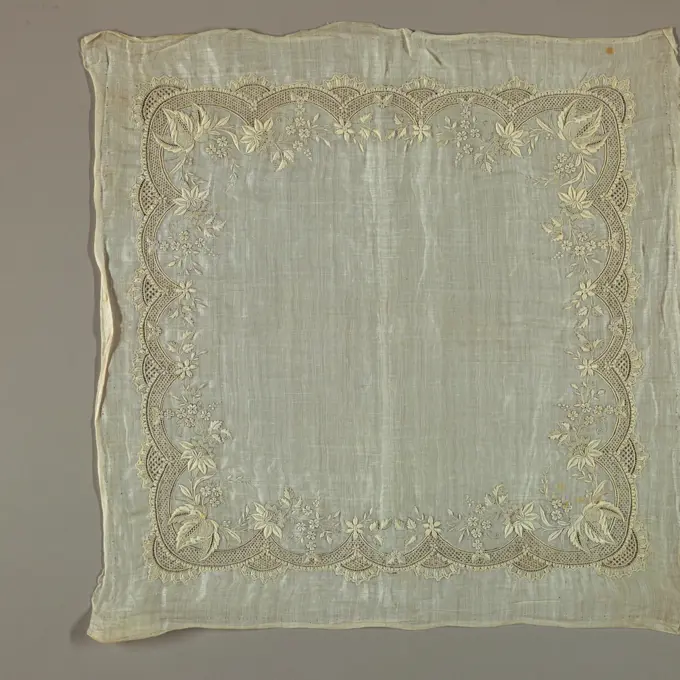
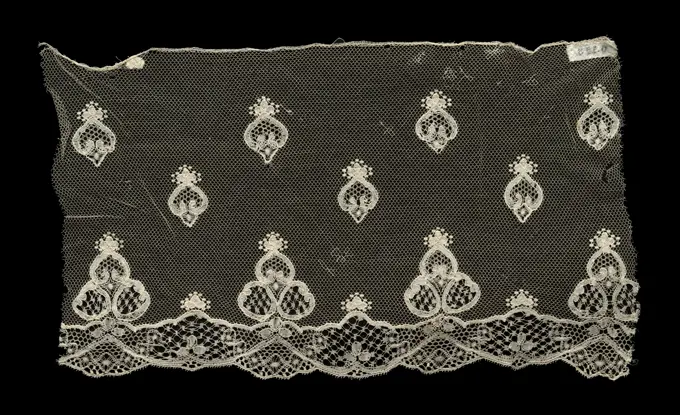
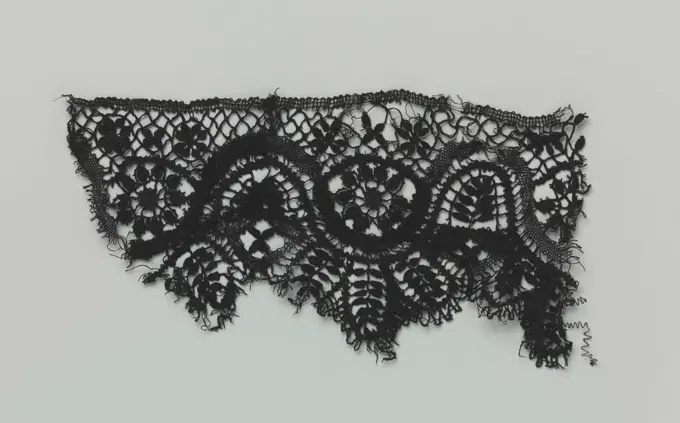
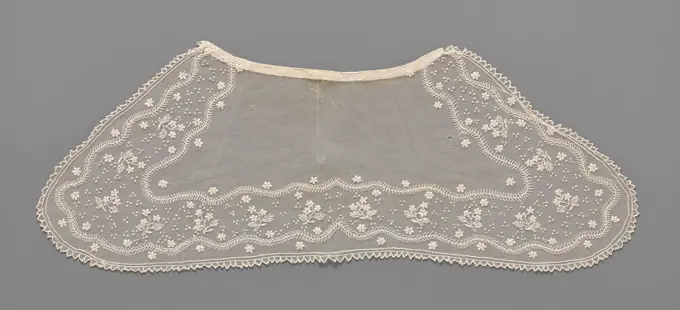
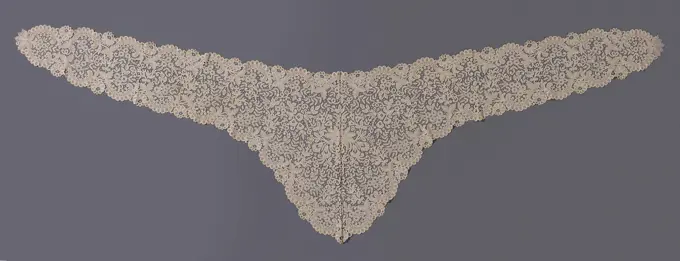
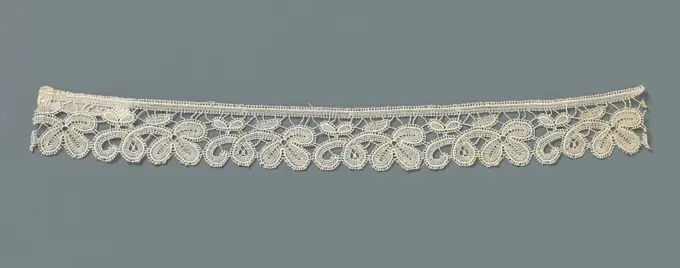
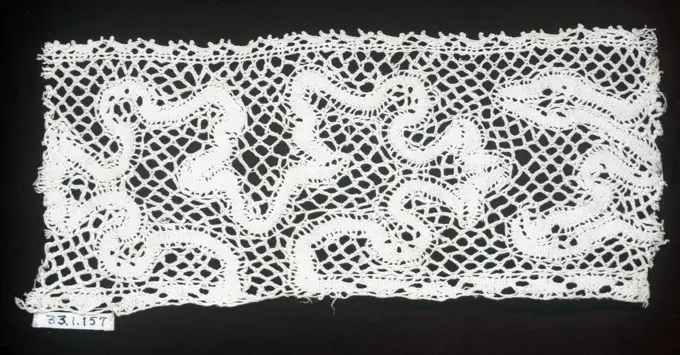
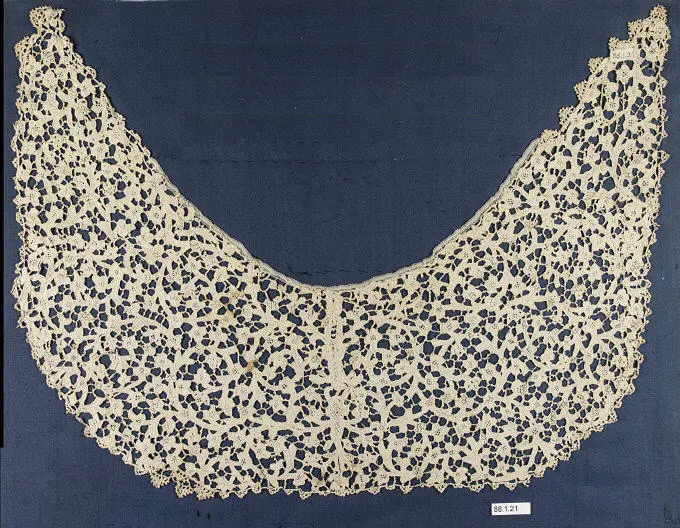
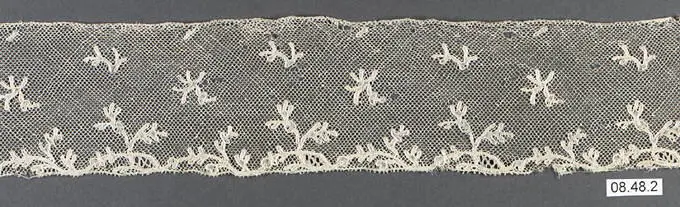
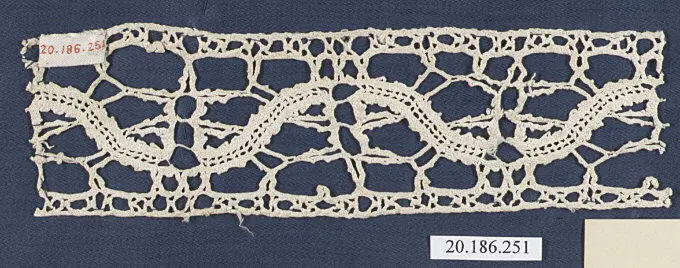
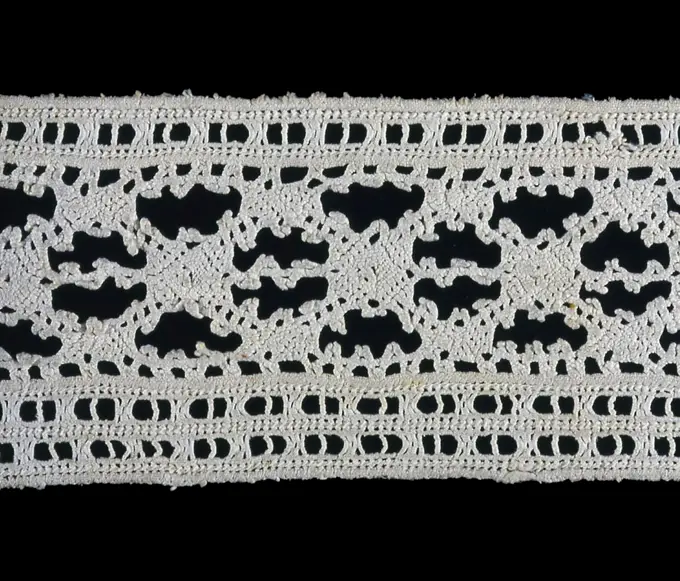
Border (Belgium); linenManchet van kantborduurwerk met een symmetrisch patroon van een roos boven een sierband met een zigzag en godrons.Cuff from edge embroidery: machine tulle with penetration. Rectangular model with sloping edges. The crossed-on symmetrical pattern consists of a rose above a decorative tire with a zigzag and godrinks. On either side of the rose are two slanted voltull leaves between which three small rosary flowers and including a large incised leaf, which points to the corner where there is still a rosette flower. The top of the cuff is finished with a soil. The other sides have lied sloping edges, which are finished with feston stitches.Fragment 17th century () Flemish. Fragment 226149Manchet van gemengde kant met een roos en twee liggende gespiegelde c-vormige stengels met kelkbloemen.Cuff from natural colosside - Brugse lace - in coin. With one motif of coniferous lace. Narrow rectangular model with a point in the middle on a long side and pointed corners on the two sides. The side has a symmetrical pattern in which the tip is formed in the middle by a rose of needle side. The rose is made with feston stitches with embossed contours and some recesses in the petals and petals filled with an ornamental ground. In the openwork flower heart is a festive circle. The rest of the cuff is made of dick edge: above the rose two lying c-shaped stems, crowned in the middle by a chalis flour and with dock flowers to each other at the ends, which also form the shelters along the top of the cuff. The points on the underside are each formed by a hanging chali flower, a fuchsia-like flower. The dick side is made in linen stroke with openwork edges and recesses. Different (ornamentFragments 18th century Flemish. Fragments. Flemish. 18th century. Bobbin lace. Textiles-LacesNeedlepoint (Punto in aria) Lace Cuffs, early 17th century. Italy, early 17th century. Lace, needlepoint; average: 10.9 x 17.8 cm (4 5/16 x 7 in.).Strip of a climbing side with standing ears or "Stående Ax". Natural collate strip, Swedish side. The strip is mounted with pins on a light blue cardboard, with four other strips. At the top of the cardboard is "Wadstena. Sweden." Written and under the strip "Standing Ears (Stående AX)" written. The repeating and symmetrical pattern consists of a stylized ear of corn, which ranks straight up from the center of a semicircular roughly, until almost at the top of the strip. The ear of corn is made up of cubes, with a sloping block on both sides. Between the successive ears of ears in the hexagonal Maas land alternately two and four mashes. A dense band runs along the scalloped underside, with a few lines made with recesses. The motifs are made in linen stroke with contour wires. The Moeses are made in square shape stroke. The top of the strip is straight finished. The shelters are finished with picots. On the strip a red thread hangs with a golden seal on which three bobbins are depicted Antependium strip Van Kloskant with wide Rivière, Anonymous, c. 1750 - c. 1760 Antepensium strip of natural -colored Brussels bobbin. Four different loose branches of ecclesiastical flowers (lily, pomegranate, grapesros) fill triangular and shield-shaped fields, which are bordered by a rivière of wide C-Voluten. The triangles are alternately high and narrow and short and thick and display a fine mesh network, while the shield -shaped fields are filled with a coarse maliën fond. Along the scalloped edge, a mountain and valley line runs again from C-Voluten, which are cut over by a fine closed flowerguirle, which repeats itself at the top of the strip. The C-Voluten are filled with gridwork and wound with a fine flower garland or cut by a feathered leaf. Brussels linen (material) bobbin lace / Brussels bobbin lace Antepensium strip of natural -colored Brussels bobbin. Four different loose branches of ecclesiastical flowers (lily, pomegranate, grapesros) fill triangular and shield-shaped Tie. Belgium, Brussels, late 19th century. Costumes; Accessories. Cotton bobbin and needle lace appliqué on machine netFragment, Medium: linen Technique: bobbin lace, Mechlin style, Belgium, 18th century, lace, FragmentBorder; 1974-52-53Hat -slip (barbe) from Brussels bobbin, anonymous, c. 1715 - c. 1725 Capslip (Barbe) from Brussels bobbin. The pattern consists of flowers and flower branches on different grounds. The varied scalloped edge is equipped with picots and has a round end. Belgium linen (material) Brussels bobbin lace Capslip (Barbe) from Brussels bobbin. The pattern consists of flowers and flower branches on different grounds. The varied scalloped edge is equipped with picots and has a round end. Belgium linen (material) Brussels bobbin laceFragment; linenLace fragment, Medium: cotton Technique: machine made, Imitation Alençon lace has design of small five-petaled flowers sprinkled on field above a border of curving leaves and flowers and five-petaled flowers within circles., France, ca. 1870, lace, Lace fragmentStrip crocheted side with rod wreath, anonymous, c. 1890 - c. 1909 Strip of natural -colored Irish crocheted side. A repeating pattern of a wreath with six rosette flowers interspersed by two directly placed loose rosette flowers. Irregular crocheted Maas soil with picots. In the wreath a coarser hexagonal Maas soil. Along the top and bottom finished with three -part arches with a few picots. Ireland cotton (textile) Strip of natural -colored Irish crocheted side. A repeating pattern of a wreath with six rosette flowers interspersed by two directly placed loose rosette flowers. Irregular crocheted Maas soil with picots. In the wreath a coarser hexagonal Maas soil. Along the top and bottom finished with three -part arches with a few picots. Ireland cotton (textile)Strook kloskant met v-vormige motieven en zigzag-schulpenrand.Strip natural colosside: straw side with motifs in sloping and blank, also called 's gravesmother side. The repetitive and symmetrical pattern consists of a V-shaped motif that is made in slot stroke, with a rectangle in linen stroke in parallel under the left leg. The triangular fields above each V are filled with an ornamental ground made of cubes made in scroll. Under the V the field partly consists of a rose ground. The top of the strip is straight finished. Slip edge on the underside of the strip consists of point absorption shapes that are formed by a zigzag orbit. The points are 'unkempt' because no extra rotation has been given to the current couple at the end of each tour.Scarf End; cotton, linenStrip bobbin with deep wave line, anonymous, c. 1880 - c. 1899 Strip of black bobbin, cluny side. The strip is made up of coarsely sewn fragments of an original strip. The repeating and symmetrical pattern consists of a deep wave line. In each golf valley there is a rosette with two smaller rosettes and a four -pointed star in between. Each wave summit comprises a composite, standing leaf, with five leaves on either side. Under the leaf is a framed four -pointed star. The scrap edge along the underside of the strip is formed by three radiating lobes under each golf valley. A composite leaf hangs down in each of these lobes. The lobes are finished with arches made with potente braids. The golf lines and frames are made in netslag and linen battle, the rosette leaves, composite leaves and stars in shape. They are connected by a braid ground, which forms a coarse square grille on the top of the strip. The top of the strip is straight finished. Geraardsbergen (Possible) silk bobbin lace / Edging 16th-17th century Italian, Venice. Edging 221070Corporal. Probably Italy. Date: 1601-1625. Dimensions: 23.1 x 23.2 cm (9 1/8 x 9 1/8 in.). Linen, plain weave; embroidered in chain and overcast stitches; edged with bobbin straight lace. Origin: Italy. Museum: The Chicago Art Institute, Chicago, USA.Insertion 16th century Italian. Insertion 220862Border, Medium: Technique: needle lace, Needle lace; mid-17th century Point Plat de Venise, mid-17th century, lace, BorderSleeve of the needle side with stripes and moesjes, anonymous, c. 1800 Short and straight coupe, narrow gathering to the lower edge. Stripes, formed by a swinging twig with fine buttons alternate with intermediate strips, strewn with mushes. A double edge of standing ovals runs on the lower side, the lower also forms the shells. Alençon side. France linen (material) Alençon Lace Short and straight coupe, narrow gathering to the lower edge. Stripes, formed by a swinging twig with fine buttons alternate with intermediate strips, strewn with mushes. A double edge of standing ovals runs on the lower side, the lower also forms the shells. Alençon side. France linen (material) Alençon LaceStrip crocheted side with reticella motifs, anonymous, c. 1890 - c. 1909 Strip of natural Irish crocheted side, imitation reticella. The wide strip is made up of two narrower strips, with the original undersides being put together with picoted bow edges. The top and bottom are finished with a straight edge. unknown cotton (textile) Strip of natural Irish crocheted side, imitation reticella. The wide strip is made up of two narrower strips, with the original undersides being put together with picoted bow edges. The top and bottom are finished with a straight edge. unknown cotton (textile)Oval dress made of lace plaque on mechanical tulle with rosette flowers, anonymous, c. 1900 - c. 1924 Oval rug of natural -colored lace plunger on mechanical tulle, tulleboard. Symmetrical pattern with rosette flowers and feathered leaves. Finish with a braided edge with picots. Belgium (possibly) cotton (textile) embroidering Oval rug of natural -colored lace plunger on mechanical tulle, tulleboard. Symmetrical pattern with rosette flowers and feathered leaves. Finish with a braided edge with picots. Belgium (possibly) cotton (textile) embroideringFragments. Date/Period: 17th-mid- 17th century. Fragments. Medium: linen. Technique: needle lace. Author: UNKNOWN.Fragment, Medium: linen Technique: needle lace, Fragment of Argentan, finely and closely worked, in an elaborate floral design., France, 18th century, lace, FragmentCollar, Medium: linen Technique: bobbin lace appliqué on machine-made net, Collar with an appliqué border and decorated with conventionalized roses and other motifs., Belgium, 19th century, lace, CollarBobbin Lace Insertion, mid 16th century. Italy, Venice, mid 16th century. Lace, bobbin; average: 6.4 x 12.1 cm (2 1/2 x 4 3/4 in.).Strook kloskant met palmetbloem in hartvormige vaas.Strip natural colosside: Old cravings. Pattern of concatenated and symmetrical slot that consist of a palm down palm tree in a heart-shaped vase with base. The motifs are connected by a braid ground. The motifs are made in linen stroke. The top is just finished.Strip bobbin with rising sun, anonymous, c. 1800 - c. 1899 Strip of natural-colored bobbin, cluny side. The repeating pattern consists of a circle with an emerging or setting sun. The sun is made in linen and the rays are made in form. The top of the circle is made with a strap in linen stroke. The bottom of the circle, which also forms a semicircular shell, is finished with a zigzagging braid with a picot on each corner point. The successive circles are connected to each other at the top by a Maas soil, a tie. The top of the strip is straight finished. Buckingham cotton (textile) bobbin lace / Cluny lace Strip of natural-colored bobbin, cluny side. The repeating pattern consists of a circle with an emerging or setting sun. The sun is made in linen and the rays are made in form. The top of the circle is made with a strap in linen stroke. The bottom of the circle, which also forms a semicircular shell, is finished with a zigzagging braid with a picot on each corner point. The successiveStrip of needle side with winding flower garland, anonymous, c. 1740 - c. 1760 Strip of natural-colored needle side: Alençon side. Pattern with a winding pendulum with flowers and leaves, on a fine hexagonal mesh ground. The top is trimmed with a border bobbin. The underside is scooped. unknown linen (material) Alençon Lace Strip of natural-colored needle side: Alençon side. Pattern with a winding pendulum with flowers and leaves, on a fine hexagonal mesh ground. The top is trimmed with a border bobbin. The underside is scooped. unknown linen (material) Alençon LaceInsertion 17th century Italian, Genoa. Insertion 221128Border, Technique: bobbin lace, Bobbin lace edge, floral tab edge; mid-18th century Flemish, mid-18th century, lace, BorderRochetstrook van kloskant met symmetrische composities in hoefijzervormig cartouches.Strip natural colosside: Old Brabantse side. The pattern has two alternating symmetrical compositions, each in a horseshoe-shaped cartouche. One composition consists of a palm with a V-shaped canopy. The other composition consists of a basket with a more or less triangular flower arrangement and above two sloping loose tulips. The motifs are connected by a grille. The motifs are made in detached and linen battle with recess and openwork edges. Limited ornamental grounds have been applied. The top is finished with a separate splitting strap. The large shelters along the lower edge are formed by the underside of the horseshoe-shaped cartouches and the large clock flower that is always between them. The shelters are finished with picots.Pair of Alb Cuffs. France or Germany, circa 1750. Costumes; ecclesiastical. Linen Dresden work on cotton, trimmed with linen and silk Mechlin bobbin laceFragment 18th century Flemish. Fragment 212448Dress yoke, Mecium: cotton Technique: machine made tape with needlework fillings, USA, ca. 1890, lace, Dress yokeBobbin Lace (Needlepoint Design) Edging of Points, second half of 16th century. Italy, Genoa, second half of 16th century. Lace, bobbin; average: 3.5 x 20 cm (1 3/8 x 7 7/8 in.).Insertion 17th century Italian. Insertion. Italian. 17th century. Bobbin lace. Textiles-LacesFragment 18th century Swiss. Fragment 215182Lace laceBorder (USA); silk embroidery with artificial pearls on cotton netCollar of crocheted side with clovers and five -leaf roses with a heart in relief, anonymous, c. 1900 - c. 1910 Collar of natural -colored crocheted side: Irish crocheted side. Model with a point in the back and right angles from the front. The pattern is symmetrical and assumes a center, where clovers start, in addition to five -leaf roses with a flower heart in relief. Netherlands (possibly) cotton (textile) Collar of natural -colored crocheted side: Irish crocheted side. Model with a point in the back and right angles from the front. The pattern is symmetrical and assumes a center, where clovers start, in addition to five -leaf roses with a flower heart in relief. Netherlands (possibly) cotton (textile)Insertion 16th century Italian, Venice. Insertion. Italian, Venice. 16th century. Bobbin lace. Textiles-LacesCollar 1850-69 American. Collar 119329Veil early 19th century British, Bedfordshire. Veil. British, Bedfordshire. early 19th century. Bobbin lace. Textiles-LacesHandkerchief (Switzerland); linenBobbin Lace Flounce, 18th-19th century. England, Buckinghamshire, 18th-19th century. Lace, bobbin; average: 15.3 x 26.1 cm (6 x 10 1/4 in.).Bobbin Lace Insertion with Edging of Points, early 17th century. Italy, Venice and Genoa, early 17th century. Lace, bobbin; average: 8 x 16.6 cm (3 1/8 x 6 9/16 in.).Sample End Of Lappet; linen; 1933-1-177Ornament 17th century Italian Punto in arialiterally, "stitches in the air"is one of the earliest styles of needle lace, which is itself developed from cutwork of primarily geometric design. When lacemakers transitioned to using a foundation of threads laid out according to a pattern drawn on parchment, they were able to incorporate more fluid lines and curves into their designs.. Ornament. Italian. 17th century. Needle lace, punto in aria. Textiles-LacesWide, lace ruffle around the neckIIne of a bodice unknownFragment late 18th century French. Fragment 214597Fragment Swedish, Dalarna 19th centuryHandkerchief with a rim of needle side with twelve oval, anonymous, c. 1870 - c. 1890 Handkerchief with a border of natural -colored needle side, Brussels mesh side. Around a diamond -shaped, batisten centerpiece runs a wide edge with deep scoops, filled with a rose with double, imposed leaves. The final pieces consist of twelve ovals, which are decorated with a crest of leaves. The edges of the sculptes show, among other things, a wheel edge and a row of heart shape leaves that form the shells. The inside consists of hollow and bolle C-volutes. Brussels linen (material) Brussels Gaze Point Handkerchief with a border of natural -colored needle side, Brussels mesh side. Around a diamond -shaped, batisten centerpiece runs a wide edge with deep scoops, filled with a rose with double, imposed leaves. The final pieces consist of twelve ovals, which are decorated with a crest of leaves. The edges of the sculptes show, among other things, a wheel edge and a row of heart shape leaves that formVolant Van Kloskant with diamond -shaped medallions, anonymous, c. 1870 - c. 1920 Volant of natural -colored bobbin: Parisian side. The soil is divided in two in a Paris soil with clovers at the top and a tuler ground underneath. In the latter is a symmetrical pattern of diamond -shaped openwork medallions with side vines crowned by a flower between two leaves. The leaves, the side ranks and a series of flowers and sling in the scallops are loose on the other in three closed garlands. The motifs are made in linen stroke and provided with contour threads. A rose soil has been applied as a decorative land. The top of the strip is finished with a separate strap. Belgium linen (material) bobbin lace / Paris lace Volant of natural -colored bobbin: Parisian side. The soil is divided in two in a Paris soil with clovers at the top and a tuler ground underneath. In the latter is a symmetrical pattern of diamond -shaped openwork medallions with side vines crowned by a flower between two leaves. Border fragment, Medium: linen Technique: knotting (macramé), Fragment of a border with knotted oval tabs., Italy or Spain, 17th century, knotted, knitted and crocheted textiles, Border fragmentFlounce late 17th century Italian, Venice. Flounce 222743Fragment of needlelace unknownTwo Cravat Ends Made 1701-1725 Italy. Linen, bobbin part lace .Snacking of lace pledger with a cuff consisting of two types of bobbin, anonymous, c. 1900 Snack of lace -ups - Tuledoor stop work on machine tulle - and a cuff of two strips of bobbin: Lille and Mechelen side. The strip of Lillese side is sewn on the lower sleeve and the strip Mechelse side at the bottom of the strip of Lillese side. Pago model. A spray pattern of berry branches is embroidered on the machine tulle. The repeating pattern of the Lille side consists of a horizontal branch with a rosette flower, three berries and a few whimsically shaped leaves. The repeating and symmetrical pattern of the Mechelen side consists of a horseshoe -shaped arch formed by two flower branches with a few different flowers. Along the very flat edge of the scoop, oval fields are formed by leaves or twigs, interspersed with a hand -shaped leaf right under the arch. The edge is finished with picots. Belgium . Bobbi Lace / Lille Lace / Mechlin (Lace) Snack of lace -ups - Tuledoor stop work on machine Border fragment 16th-17th century Italian or Sicilian. Border fragment 217744Strook kloskant met diepe golflijn.Strip of black climbing side, Cluny side. The strip is made up of coarsely sown damaged fragments of an original strip. The repetitive and symmetrical pattern consists of a deep wave line. There is a rosette in each golf valley with two smaller rosettes and a four-pointing asterisk in between. Each wave top comprises a composite, standing leaf, with five leaves on either side. Under the leaf is a four-pointed asterisk framed. The sloping edge along the bottom of the strip is formed by three radiating lovers under each golf valley. A composite leaf hangs down in each of these lobes. The lobes are finished with arcs made with picotted braids. The wave lines and picture frames are made in a slur in and linen, the rosette leaves, composite leaves and stars in shape stroke. They are connected by a braid soil, which forms a coarse square grain on the top of the strip. The top of the strip is straight finished.Collar, Medium: linen Technique: needle lace with ground of loop & twist with loop & twist return, Belgium, late 19th century, lace, CollarFragment of the lace;  XVIII-XIX century (1701-00-00-1900-00-00);Handkerchief, early 1800s. Flanders, early 19th century. Embroidery on linen ground; lace edging; overall: 52.8 x 54.6 cm (20 13/16 x 21 1/2 in.).Cap crown (fond de bonnet) early 18th century Flemish, Brussels. Cap crown (fond de bonnet) 213010Fragment late 17th century Italian. Fragment 212834Sample, Technique: tape lace with filling stitches, Tape lace motif, floral vine; early 18th century Flemish mixed., early 18th century, lace, SampleFragment, Medium: linen Technique: bobbin lace, Mechlin style, N. Europe, 18th century, lace, FragmentFragment, Medium: linen Technique: bobbin lace (early Valencienne ground), Straight-edged fragment with Valenciennes ground in a large, solidly massed floral design., Netherlands, late 17th century, lace, FragmentSleeve, c. 1875-1900. Philippines, late 19th century. Plain weave piña cloth with embroidery; overall: 48.3 x 102.9 cm (19 x 40 1/2 in.).Pelerine-kraag, alleen de bovenste laag, van kantborduurwerk op machinale tule met bloemtakjes tussen golvende geverderde lijnen.Collar of a natural-colored pelerine on machining tulle: tuledo strop. It only concerns the upper layer of a pelerine. Trapezoidal model with strongly rounded corners. A wide embroidered list of two continuous and slightly wavy feather lines runs around an empty midfield. There is a rosette flower in every golf valley and under every wave side. Between the feathered lines, flower branches with similar rosette flowers are between a spreading pattern of Moesjes in groups of three. Along the sloping sides and continuously along the bottom, a slip edge of triangular scallops runs. Along the top is a woven ribbon sewn.Fichu ca. 1835 American. Fichu 119384Edging 16th century Italian, Venice. Edging. Italian, Venice. 16th century. Bobbin lace. Textiles-LacesCap Streamers (France); linenCollar or border of black bobbin side with a symmetrical spiral vines with oval flowers with open flower heart, anonymous, c. 1900 - c. 1924  Black bobbin collar: Venetian bobbin or cantu side. Symmetrical pattern with spiral vines and oval flowers with open flower heart Pellet linen (material) bobbin lace / tape lace (bobbin lace)Border, Medium: silk Technique: bobbin lace, white silk, White lace border with a pointed, scallop edge showing a geometric design of small squares of heavy silk arranged in diamond-shaped areas., France/Belgium, 19th century, lace, BorderBorder Made 1840-1859 England. Cotton and linen, bobbin straight lace .Sjaal van kloskant met de geschulpte c-voluten.Natural climbing side scarf, duchesse side. A large three-corner form ends in narrow, long slip. An open bar fee is surrounded by the middle-turned equal c-volutes, which are scalloped on the outside and every time are interrupted by a rose. There are wingerd leaves in the middle and in points. Furthermore, branches with rose buttons and inside every virgin palm branches.Belt of side brokaat; A repeating pattern has been applied to a black surface that consists of a flower, fruits and berry branch in white, anonymous, c. 1700 - c. 1750 Belt of side brokaat; A repeating pattern has been applied to a black surface that consists of a flower, fruits and berry branch in white. The ends are from Ripszijde. One of the ends has a buttonhole. West-Europa whole: Silk. Brocade (textile). Decoration: Belt of side brokaat; A repeating pattern has been applied to a black surface that consists of a flower, fruits and berry branch in white. The ends are from Ripszijde. One of the ends has a buttonhole. West-Europa whole: Silk. Brocade (textile). Decoration:Hat of cream -colored silk needle, tenerife, anonymous, c. 1912 Hat of creme -colored silk needle tenerife. Scalloped edge with pattern of circles with four -leaf flowers. Along the bottom edge three large circles in which a different motif is always. Land of servetwork with also flowers and circles. This hat includes a satin under-hat (BK-1994-15). Paraguay whole: Silk. Tenerife lace  Paraguay Hat of creme -colored silk needle tenerife. Scalloped edge with pattern of circles with four -leaf flowers. Along the bottom edge three large circles in which a different motif is always. Land of servetwork with also flowers and circles. This hat includes a satin under-hat (BK-1994-15). Paraguay whole: Silk. Tenerife lace  ParaguayStrook machinale kant met drieblad aan een twee maal omkrullende steel.Strip natural-colored mechanical side: Machine Brussels Duchesse. The repeating pattern consists of a three-leaf with a twice curling stem that lies along the bottom of the strip. The motifs are made in linen stroke with openwork edges and contour wires. The successive leaves with stems are connected by a machining ground. In the first loop that makes the curling stem, a block is made with which a closted shape beat is suggested. The top of the strip is straight finished. The sloping edge along the underside comes from the pattern with the three-leaf.Strip of needle side with tulip and rose branch in medallions, anonymous, c. 1860 - c. 1870 Strip of natural-colored needle side: Alençon side. Pattern with a repetitive motif of medallions on a fine hexagonal Maas soil, which is littered with moesjes. In the medallions alternately a tulip and a rose branch. The outer edge of the medallions consists of multifaceted flowers and leaves that are getting larger downwards. Decorative land in a single flower and in the space formed by C-Voluten between the medallions. The underside is finished with a scrap edge that comes from the pattern. The top is trimmed with a border bobbin. Alençon linen (material) Alençon Lace Strip of natural-colored needle side: Alençon side. Pattern with a repetitive motif of medallions on a fine hexagonal Maas soil, which is littered with moesjes. In the medallions alternately a tulip and a rose branch. The outer edge of the medallions consists of multifaceted flowers and leaves that are getting larger downwards. Needlepoint (Reticella) and Bobbin Lace Band, 16th century. Italy, 16th century. Lace, needlepoint and bobbin: linen; average: 14.1 x 71.8 cm (5 9/16 x 28 1/4 in.).Shawling of linen batist, triangular, embroidered along two sides with flower garlands of cotton and open hems of fils tirés and cotton, anonymous, c. 1800 - c. 1815 Shawling of linen batist, triangular, embroidered with flower garlands of cotton and open hems of fils tirés and cotton. Model: Finished all around with rolling soil. Decoration: In the tip a flower constructed from stalk stitches with a heart of the needle side within a double square of open hems of Fils Tiré's openings interspersed with linen batist wrapped by cotton threads. To the left and right, the open hems form elongated surfaces in which flower garlands made of cotton analogue to the flower in the square. Netherlands whole: Linen (Material). Embroidery: Cotton (textile) embroidering Shawling of linen batist, triangular, embroidered with flower garlands of cotton and open hems of fils tirés and cotton. Model: Finished all around with rolling soil. Decoration: In the tip a flower constructed from stalk stitches withFragment; linen; 1933-1-157Cape 18th century Italian. Cape 212500Fragment, Cooper Union Museum Lace Study Card; France; linenEdging French, Lille 19th centuryInsertion 17th century Italian, Venice. Insertion 221061Strip 18th century Flemish. Strip. Flemish. 18th century. Bobbin lace. Textiles-LacesFragment (Italy); linenInsertion Made 1550-1600 Italy. Linen, plain weave; cut and drawn work embroidered in double and Italian hem stitches; darned and overcast bars; with insertion of bobbin straight lace .Handkerchief. Probably England, Buckinghamshire, late 19th century. Costumes; Accessories. Linen plain weave, cotton and silk Lille-type bobbin laceEmbroidered Machine Lace Handkerchief, late 19th century. Ireland, Limerick, late 19th century. Linen center with wide border of tambour work in white cotton on machine net; average: 29.9 x 28.6 cm (11 3/4 x 11 1/4 in.).Lappet (one of a pair) 18th century French or Danish. Lappet (one of a pair) 223023Fragment, Cooper Union Museum Lace Study Card; Made for Cooper Union Museum; Italy; linenBorder. Date/Period: 1550-1600. Border. Medium: linen. Technique: withdrawn element work with needle lace, bobbin lace edging. Author: UNKNOWN.