Intricate Lace Strips

A variety of delicate bobbin lace strips featuring floral and geometric patterns, showcasing craftsmanship from different historical periods.
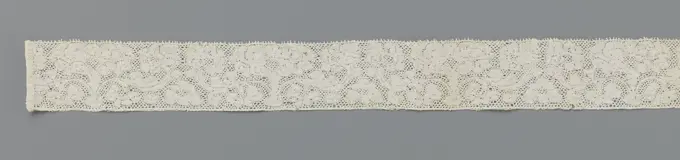
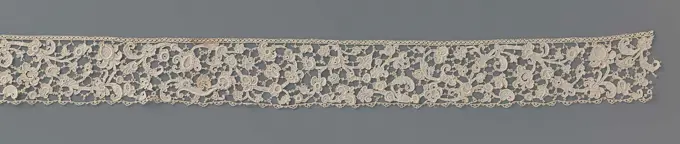
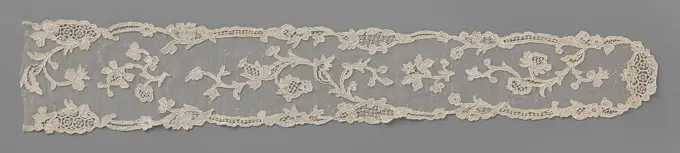
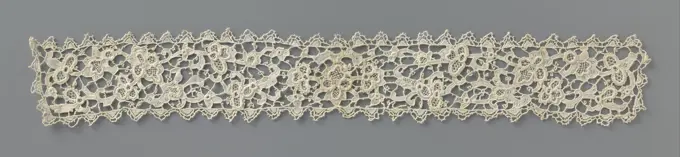
Strip bobbin with peony between two smaller peonies, anonymous, c. 1650 - c. 1660 Strip of natural -colored Dutch bobbin. The pattern consists of a repeating symmetrical motif of a stylized peony with a wavy side branch on the left and right. At the end of each side branch, a smaller peony curls up and focuses on the large central flower. The motifs are connected by a round grid with braid strokes. The motifs are made in linen battle with openwork edges. The top and bottom of the strip are straight finished, with picots on one side. Antwerp (possibly) linen (material) bobbin lace Strip of natural -colored Dutch bobbin. The pattern consists of a repeating symmetrical motif of a stylized peony with a wavy side branch on the left and right. At the end of each side branch, a smaller peony curls up and focuses on the large central flower. The motifs are connected by a round grid with braid strokes. The motifs are made in linen battle with openwork edges. The top and bottom of the strip are
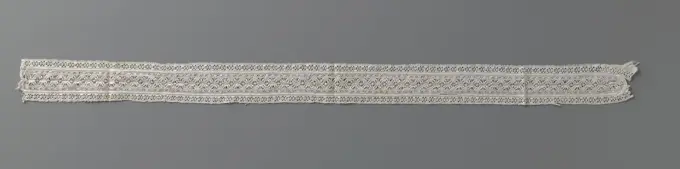
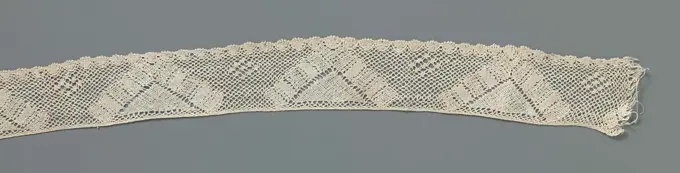
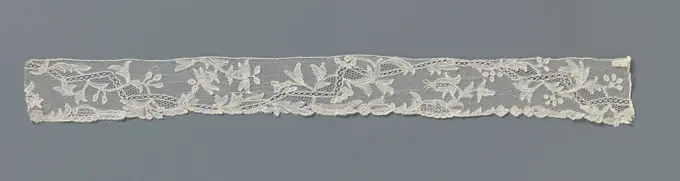
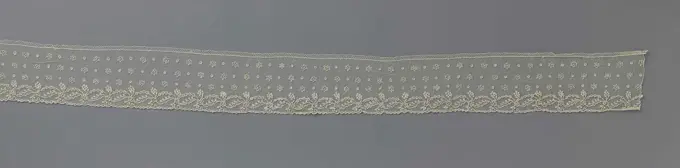
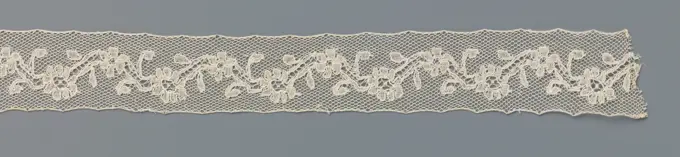
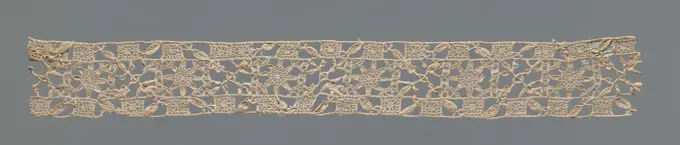
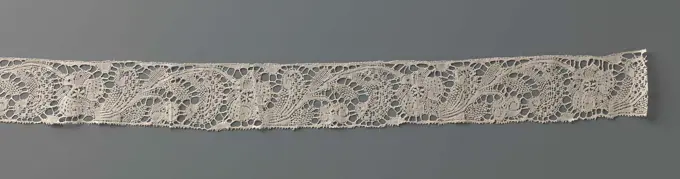
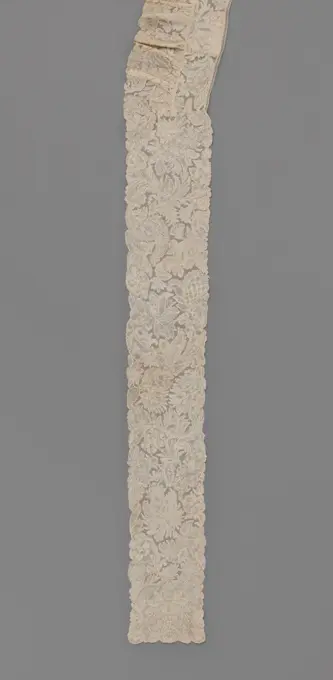
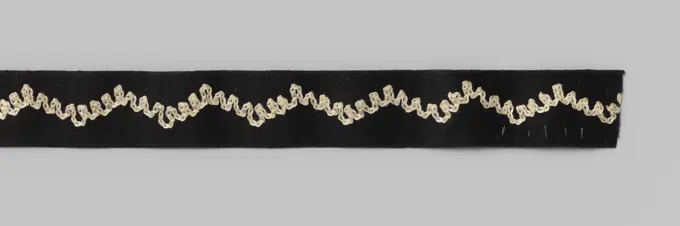
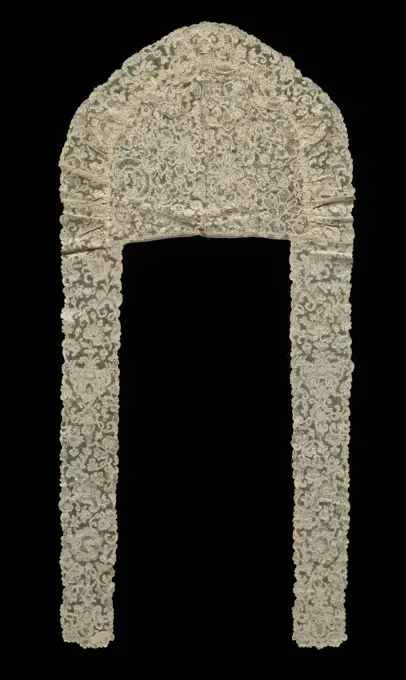
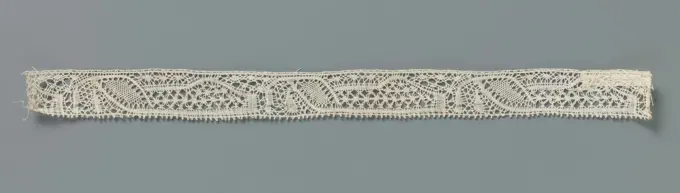
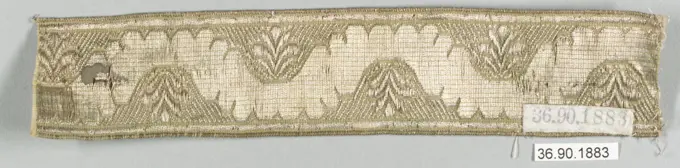
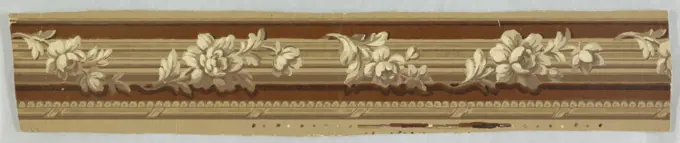
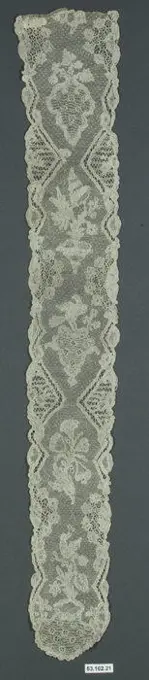
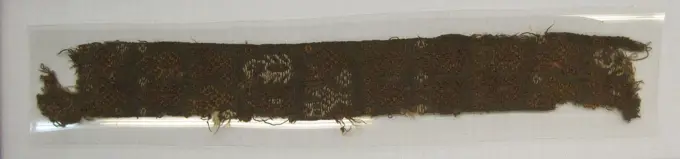
Strip bobbin with tree motifs, anonymous, c. 1880 - c. 1899  Strip of natural -colored bobbin: Eastern European side. The repeating pattern consists of two alternating stylized flowers. The flowers are symmetrical and are formed by a swinging and continuous ribbon, cloated in linen stroke with openwork edges. The top of the strip is straight finished. The very flat scrap edge is finished with picots. Eastern Europe (Possible) linen (material) bobbin lace / tape lace (bobbin lace) / East European laceBorder, Medium: linen Technique: bobbin lace (late Valenciennes ground), Ground of diamond mesh with horizontally placed sprays and scalloped edge., late 19th century, lace, BorderStrip bobbin with peony between two smaller peonies, anonymous, c. 1650 - c. 1660 Strip of natural -colored Dutch bobbin. The pattern consists of a repeating symmetrical motif of a stylized peony with a wavy side branch on the left and right. At the end of each side branch, a smaller peony curls up and focuses on the large central flower. The motifs are connected by a round grid with braid strokes. The motifs are made in linen battle with openwork edges. The top and bottom of the strip are straight finished, with picots on one side. Antwerp (possibly) linen (material) bobbin lace Strip of natural -colored Dutch bobbin. The pattern consists of a repeating symmetrical motif of a stylized peony with a wavy side branch on the left and right. At the end of each side branch, a smaller peony curls up and focuses on the large central flower. The motifs are connected by a round grid with braid strokes. The motifs are made in linen battle with openwork edges. The top and bottom of the strip are Strip 18th century Flemish or German. Strip 212787Kloskant intermediary with geometric pattern of double crosses and windows, anonymous, c. 1590 - c. 1624 Piles of natural -colored bobbin side between two narrower strips of lace -ups: work with together threads pulled together. The intermediary is probably intended for or used in a bed sheet or pillowcase. The pattern of Kloskant is geometric and consists of double crosses and windows. Northern Netherlands linen (material) bobbin lace Piles of natural -colored bobbin side between two narrower strips of lace -ups: work with together threads pulled together. The intermediary is probably intended for or used in a bed sheet or pillowcase. The pattern of Kloskant is geometric and consists of double crosses and windows. Northern Netherlands linen (material) bobbin laceStrook kloskant met v-vormige motieven boven waaiertjes-rand.Strip natural colosside. The repeating and geometric pattern consists of a symmetrical V-shaped motif that extends from the bottom to the top of the strip. The wide line that forms the motif is divided into rectangles that have been made in linen stroke and scroll and are surrounded by thicker contour wires. The triangular space in the V-shaped motif is closed. The motifs are connected by a maas soil, a fat mat of grille. Between the consecutive V-shaped motifs in the Maas soil, a diamond-shaped motif is realized without contour wires, with a network of larger meshes and nine small motifs in linen stroke. The top of the strip is straight finished. The slight sloping edge along the underside stems from a concatenation of impeller motifs, which are finished with picots.Strip 18th century Flemish. Strip 212410Galloon late 18th-early 19th century European. Galloon 224984Border ca. 1600 Netherlandish. Border 217989Border, Medium: linen Technique: bobbin lace, Mechlin style, N. Europe, 18th-19th century, lace, BorderTrimming (Italy); silk, gold and silver metallic thread, metal stripsMutsenstrook van kloskant met zigzag-rivière.Strip natural colored Brussels climbing side. A river in zigzag line is crossed by spiral raft, enclosing impeller-shaped medallions. The motifs are connected by a draft ground. A coarse hexagonal soil has been applied in the Rivieres. On the fields that are bounded by the Rivier are twigs, to which flowers in the form of pomegranates, pears or winged insects. The strip is probably used or made for a hat.Fragments of fabric unknownGalloon 18th century French. Galloon 213997Band, Medium: linen Technique: bobbin lace, peasant style, peasant style, Dalecarlia, Sweden, 19th century, lace, BandStrook naaldkant met moesjes en stervormige bloemen.Strip natural-colored coniferous lace: Alençon side. Spreading dotty with three rows of a star-shaped flower interspersed with a mole, on a fine hexagonal Maas soil. The pattern on the underside of the strip consists of arcs with a lancet leaf, filled with an ornamental ground below. The lancet leaves are connected to each other with a star-shaped flower. Between the arcs a trush-shaped flower raises up. The underside is finished with an arc edge through a conciliation of four circular cordons with a rover pic. Always between the four circles a curlly stuffed with an ornamental ground. The top is trimmed with a border clamping side.Strook naaldkant met druppelvormige bloem.Strip natural-colored coniferous lace, Venetian rosary. Pattern with varied flowers and acanthus leaves to tendrils, in a repetitive motif. One of the larger flowers is dropped and has leaf volutes on either side. Irregular open bars soil with picots. The top is trimmed with a border clamping side. The underside is finished with a straight picro edge with arcs.Textile Fragment 18th century. Textile Fragment 454482Piece 18th century German, Nuremberg. Piece 214681Edging late 18th century French. Edging. French. late 18th century. Needle lace, point dAlençon. Textiles-LacesPiece 17th century Japan. Piece 72161Kloskant intermediate mate with zigzag line, anonymous, c. 1875 - c. 1949 Piles of Natural -colored bobbin side: Mechelse side. In the middle of the fine grid, a Mechelen soil (also known as ice soil), an openwork band runs in Zigzaglijn, cut over by two types of rosettes. Belgium linen (material) bobbin lace / Mechlin (lace) Piles of Natural -colored bobbin side: Mechelse side. In the middle of the fine grid, a Mechelen soil (also known as ice soil), an openwork band runs in Zigzaglijn, cut over by two types of rosettes. Belgium linen (material) bobbin lace / Mechlin (lace)Border, Medium: linen Technique: needle lace with 6-sided reworked border, Band with a design of floral sprays alternating with S-shaped bars and entwined by floral garlands., France, mid-18th century, lace, BorderBorder; linenFragment of lace. unknown, authorStrip bobbin with double three -leaf flower, anonymous, c. 1700 - c. 1749 Strip of natural -colored bobbin, Old Flemish side. The repeating and continuous pattern consists of a three-leaf flower interspersed over the length axis interspersed by two elongated leaves. The easily designed flowers are not entirely identical to each other, the upper flower has more pointed petals. The motifs are connected by a grid, a five -part ground. The motives are made in linen battle with contour threads. In a room between the elongated leaves, the partly bending over each other, a decorative land has been used, a snowflake land. The top of the strip is straight finished. The bottom is straight finished with picots. Flanders linen (material) bobbin lace / old Flemish lace Strip of natural -colored bobbin, Old Flemish side. The repeating and continuous pattern consists of a three-leaf flower interspersed over the length axis interspersed by two elongated leaves. The easily designed flowers are not entiHead Veil, late 1800s. India, Lucknow, late 19th century. Embroidery (chikan) and drawnwork; cotton; overall: 232.4 x 41.9 cm (91 1/2 x 16 1/2 in.).Band, Medium: silk on linen with glass beads added Technique: embroidered; deflected element work using wrapping and double running stitch on linen plain weave, Heads of cherubs over diagonal flowering scrolls., Italy or Sicily, 16th-17th century, embroidery & stitching, BandTrimming, Medium: silk, metallic thread Technique: woven, Design of a patterned weave with one saw tooth border and one scalloped edge formed by wefts., Italy, 17th century, trimmings, TrimmingStrip bobbin with wavy flower and leaf vank, anonymous, c. 1730 - c. 1760 Piles of natural -colored bobbin: Flanders side. The repeating and continuous pattern consists of wavy flower and leaf vend. A wide leaf with pointed ends forms half a wave, from which a drop -shaped flower rises. The other half of each wave consists of a more or less oval -shaped narrower leaf from which curling leaves spring and a bouquet of three rosette flowers. The motifs are largely made in linen battle with openwork edges and here and there nice recesses. The motifs are connected by a five -part ground. Snowflake grounds are used as a decorative soil and a mains filling has been used in the wide leaf with pointed ends containing five circles in linen stroke. Top and bottom of the strip are straight and equipped with picots. A strip of linen is attached along one of the long sides, a fragment of bedding. One third of seam between the strip of linen and the intermediate brush has been released. The side is pBand, Medium: silk, metal Technique: warp-faced plain weave patterned by warp stripes, some stripes are warp-ikat (jaspe), Narrow woven band patterned by stripes: the center and widest stripe is patterned by ikat in red and white. The narrow stripes on each side are orange, red-orange with gold pinstripes on each side and an ikat patterned stripe in blue and white. Each end is turned under and sewn with a narrow salmon tape attached to one end and a strip of green silk to the other., Mexico, 19th century, printed, dyed & painted textiles, BandTrimming (Italy); silkBorder, Medium: linen Technique: bobbin lace (late Valencienne ground), Festoons, detached sprays and border of vine; nearly straight edge; square edge, France, 19th century, lace, BorderEdging, Medium: linen Technique: bobbin lace, Brussels style, Duchesse-style pattern of leaf and flower sprays under arches with border showing alternating leaf and flower pattern., Belgium, 19th century, lace, EdgingStrook naaldkant met à-jour medaillons.Retired slot is formed by leaves with a cut-away center front, a round flower and medallions with coarse grid work. The ground in the middle part has been updated. Alençon side.Saranjint ,, c. 1795 ribbon (material) Ribbon with medallion on the front right-wing medallion in which sitting freedom with a staff with a hat in the right and laurel wreath in the left hand. She is a helmet for her a lion. On the reverse side on the right three gilded lilies. Netherlands silk. ribbon (material). printingTrimming (Italy); silk, gilt foil on a silk coreGalloon 17th-18th century Unknown. Galloon 213804Strook kloskant met aaneengeschakelde gebogen bloemstengels.Inconsive of natural college side: Old clamp side with braid soil. The repeating pattern consists of a succession of the same curved flower stalk, which starts at the bottom of the strip and walks into a bow along the top and ends in a large rosette flower. The motifs are partly made in linen stroke with openwork edges and recesses. Single (flour) leaves are made in fat handles and other leaves are formed by a snowflakes soil or spinning soil. The flower hearts of the large rosette flowers have a six-lasting star made in shape stroke. The motifs are connected by a braiding ground with long braids. Upper and bottom of the strip are directly finished in which the underside is equipped with picots.Strip 18th century Flemish. Strip. Flemish. 18th century. Bobbin lace. Textiles-LacesTextile Swatch; Manufactured by Deerfield Society of Blue and White Needlework (American, 1896-1926) (United States)Strip of needle side with mushrooms, anonymous, c. 1795 Strip of natural-colored needle side: Alençon side. Under a spreading pattern of three rows of hanging flower branches, it is repeating and continuous pattern along the underside of the strip from mushrooms, interspersed with a thin volute with a circle crowned in the center by a standing oval. The scrap edge is formed by fan -shaped motifs, one under each mushroom. The impellers are connected by a pendulum of three circles with rader picots in it. The motifs are connected to each other by a fine hexagonal Maas soil, an alençon soil with collected feston stitches. The sparing fullwork is made with feston stitches, the motives are equipped with relief contours. A few different fine decorative lands have been used in the motifs in the pattern on the underside of the strip. The top of the strip is finished with a separate strap. The scums along the bottom are finished with picots. Alençon linen (material) Alençon Lace Strip of naturaHats slips from Brussels bobbin with forehead strip from two pieces, Anonymous, c. 1735 Hats slips from Brussels bobbin with forehead strip from two pieces. The forehead strip is wrinkled. The whole is irregularly sculpted and provided with a picotrand. The slips have straight ends. Different contours in the pattern of flowers and foliage are raised. Brabant linen (material) Brussels bobbin lace Hats slips from Brussels bobbin with forehead strip from two pieces. The forehead strip is wrinkled. The whole is irregularly sculpted and provided with a picotrand. The slips have straight ends. Different contours in the pattern of flowers and foliage are raised. Brabant linen (material) Brussels bobbin laceTrimming, Medium: linen, blue silk Technique: bobbin lace, Eastern European, peasant style, Russia, 19th century, lace, TrimmingEdge ; linenBorder, Medium: linen Technique: needle lace, 6-sided reworked grounds, Band with a curvilinear design of floral and foliated garlands., France, 1700-1750, lace, BorderBands; linen; 1933-1-83-a,bStrip bobbin with running pattern of volute vines with flowers and buds, anonymous, c. 1655 - c. 1674 Strip of natural -colored bobbin. The repeating pattern consists of a continuous slender with curling side branches with many different flowers, flower buds and leaves of more or less the same size. The motifs are made in linen battle with openwork edges and sparingly fine unispieces. Sporadically, a leaf, flower or button is made with a decorative soil, including a snowflake ground. The motifs are connected by a braid ground. Top and bottom of the strip are straight finished, with the bottom with picots. Southern Netherlands linen (material) bobbin lace Strip of natural -colored bobbin. The repeating pattern consists of a continuous slender with curling side branches with many different flowers, flower buds and leaves of more or less the same size. The motifs are made in linen battle with openwork edges and sparingly fine unispieces. Sporadically, a leaf, flower or button is made withEdging 17th century Italian. Edging 220949Strip bobbin with trapezoidal cartouche and clover four, anonymous, c. 1700 - c. 1899 Strip of natural -colored bobbin: Mechelse side. The repeating and continuous pattern consists of a succession of a trapezoidal cartouche, elongated leaves and a clover four. The motifs are connected by a fine Maas soil, the Mechelen soil. The motifs are made in linen battle, with thicker and shiny contour threads. Two different decorative grounds, with coarse meshes, are used in the cartouches and in a room between the leaves. The very slightly scalloped underside is finished with picots. The top is straight. Mechelen linen (material) bobbin lace / Mechlin (lace) Strip of natural -colored bobbin: Mechelse side. The repeating and continuous pattern consists of a succession of a trapezoidal cartouche, elongated leaves and a clover four. The motifs are connected by a fine Maas soil, the Mechelen soil. The motifs are made in linen battle, with thicker and shiny contour threads. Two different decorative gEdging 18th century Flemish, Brussels. Edging. Flemish, Brussels. 18th century. Bobbin lace, point d'Angleterre. Textiles-LacesLace, 1800s , maker unknown.Edge; silk; 1933-1-201Mutsenslip van naaldkant met hangende bloemen.Elongated slopes of a wavy ribbon, interspersed by medallions with grid work, form the outer edges of a ground, on which there are an evenings a wavy branch with hanging flowers and pomegranates and a short flower branch. In the strip, the pattern is symmetrical with respect to a standing center branch. Alençon side.Fringe ca. 1700 French or Swiss. Fringe 225075Fringe European 19th centuryAguja romana de bronce. Can Serra Museu de Mataró.Fragment 17th century Italian. Fragment 215003Roll black satin ribbon with embroidered wavy line in white on cardboard, Gustav Schnitzler, c. 1900 - c. 1925 Roll black satin ribbon with embroidered wavy line in white on cardboard. Nijmegenfrance silk. satin. cardboard embroidering Roll black satin ribbon with embroidered wavy line in white on cardboard. Nijmegenfrance silk. satin. cardboard embroideringNeedlepoint (Point de Sedan) Lace Garniture for Cap with Lappets, 18th century. France, Sedan, 18th century. Lace, needlepoint; overall: 74.5 x 35.7 cm (29 5/16 x 14 1/16 in.).Band, Medium: linen Technique: needle lace, Band in an open design of floral sprays., France, mid-18th century, lace, BandFringe (France); silkPiece 17th century Japan. Piece 71313Trimming, Medium: silk Technique: woven, Design of a central zigzag line with a leaf form in the opposing triangles., Spain, 17th century, trimmings, TrimmingTrimming, Medium: silk, metallic thread Technique: woven, Design of curving leaves and open flowers with borders on both sides with slightly scalloped edges. In yellow and metallic thread., France, 18th century, trimmings, TrimmingBobbin 18th century () Italian, Venice. Bobbin. Italian, Venice. 18th century (). Glass. Textiles-Methods and MaterialsGuimpe of needle side with clover leaves, anonymous, c. 1900 Guimpe of natural -colored needle side: Venetian rose side. Symmetrical flower and tiflin pattern. Open bars soil. Continuous triangles form the finish on four sides. BURANO linen (material) Venetian rose point Guimpe of natural -colored needle side: Venetian rose side. Symmetrical flower and tiflin pattern. Open bars soil. Continuous triangles form the finish on four sides. BURANO linen (material) Venetian rose pointTrim for Hem of Tunic or Skirt (Tablet WovenBand)Lace border with emblems of the Passion 17th century Flemish. Lace border with emblems of the Passion. Flemish. 17th century. Bobbin lace, needle lace, punto occhilino, linenThree lanes of wallpaper painted on linen with vertical stripes alternately decorated with branches with berries and a flower sipel, anonymous, c. 1785 - c. 1800 Three jobs in oil paint on linen painted wallpaper. Above a panel of broken white with blue -gray frames, gray -blue vertical vertical stripes have been applied to a broken white stock, alternately decorated with sprinkled twigs with berries and a flower drink in red and blue. Northern NetherlandsNetherlands linen (material). oil paint (paint) Three jobs in oil paint on linen painted wallpaper. Above a panel of broken white with blue -gray frames, gray -blue vertical vertical stripes have been applied to a broken white stock, alternately decorated with sprinkled twigs with berries and a flower drink in red and blue. Northern NetherlandsNetherlands linen (material). oil paint (paint)Strip early 17th century Italian Punto in arialiterally, "stitches in the air"is one of the earliest styles of needle lace, which is itself developed from cutwork of primarily geometric design. When lacemakers transitioned to using a foundation of threads laid out according to a pattern drawn on parchment, they were able to incorporate more fluid lines and curves into their designs.. Strip 212407Fringe, Medium: silk Technique: woven, Fringe in red and black with a heading of lozenges and stripes and a picot edge at the top. Skirt threads hang from the middle and edge of the heading., France, late 18th century, trimmings, FringeTrimming, Medium: silk Technique: woven, Trimming fragment in a design of a Greek motif in yellow on a blue ground., France, ca. 1820, trimmings, TrimmingKloskant's intermediate mate with rows of pointed dovals and four -lobe rosettes, anonymous, c. 1600 - c. 1649 Piles of natural -colored bobbin side. The repeating pattern consists of a center line of connected pointed so, between two rows of four -lobe rosette flowers. There is a succession of half pointed soils along the top and bottom edge. The motifs are connected by braids, which form the start of a mesh ground. The motifs are made in linen battle with openwork edges. The short sides are double folded and stitched. The edge is probably cut out of a pillowcase, the finish of top and bottom edge is damaged. Southern Netherlands linen (material) bobbin lace Piles of natural -colored bobbin side. The repeating pattern consists of a center line of connected pointed so, between two rows of four -lobe rosette flowers. There is a succession of half pointed soils along the top and bottom edge. The motifs are connected by braids, which form the start of a mesh ground. The motifs are made inGimp mid-19th century French. Gimp 214218Piece 18th-19th century Japan. Piece 66962Trimming, Medium: silk and silver foil, Trimming (galloon) in a brown silk ornamented stripe between borders of green with silver stripe; furnishing trim, France, mid-19th century, trimmings, TrimmingGalloon 18th century French. Galloon. French. 18th century. Metal thread. Textiles-TrimmingsStrook kloskant met bult op rechthoek en spitsovaal.Strip natural colosside, binche side. The repeating pattern consists of a horizontal rectangle with a bump on one side and against the short side on the other hand lies a spindle-spitting location. The contours of the motifs are made in linen stroke. The center of the Spitsoval is made in a cut-off. And in the center of the rectangle, a snowflakes soil has been applied as ornamental ground. The motifs are connected by a combination of ornamental grounds, various snowflakes and a Paris soil. Upper and bottom of the strip are straight finished, the underside with picots.Trimming, Medium: silk Technique: woven, Yellow trimming fragment in a design of a central band of stripes between checkerboard borders., France, 19th century, trimmings, TrimmingMedical Instrument: () Spatula. UnknownGalloon late 18th-early 19th century European. Galloon 224964Trimming (France); silkMolding; wood, carved; 1917-12-23Pipe Case 19th century Japan. Pipe Case 61922Lace, 1800s, Brussels, maker unknown. Gift of Mrs G. Acland Allen, 1955.Bobbin Lace Edging, 20th century. Belgium, Binche, 20th century. Lace, bobbin: linen; average: 6.4 x 99.1 cm (2 1/2 x 39 in.).Edging, Medium: linen Technique: bobbin lace (Valenciennes ground), Narrow edge lace with shallow scallops and small detached leaf motif on a diamond mesh., France, 19th century, lace, EdgingBand; linenWoman's Sash, c 1900s . Oceania, Micronesia, Caroline Islands, Early 20th century (). Dyed plantfiber; plain weave, twill weave and floats; overall: 172.7 x 10.2 cm (68 x 4 in.).Green ribbon for a festive decor, isolated on a white background Green ribbon for a festive decor, isolated on a white background Copyright: xZoonar.com/OleksandrxKostiuchenkox 10044619Border, Block-printed and flocked, Beige flowers twist around fluted column. Bead molding along lower edge. Gold highlights and flocked on beige ground., England, ca. 1860, Wallcoverings, BorderLappets (one of a pair) 18th century French. Lappets (one of a pair). French. 18th century. Needle lace, point dAlençon. Textiles-LacesBelt, Fragment or Textile Fragment, undetermined Chancay. , 1000-1532. Cotton, camelid fiber, 13 3/8 x 1 9/16 in. (34.0 x 4.0 cm).   Arts of the Americas 1000-1532Trimming (France); silkDeurpost on the left, part of a buffetnis, anonymous, c. 1750  Northern Netherlands wood (plant material). paint (coating)  Northern Netherlands wood (plant material). paint (coating)Edging 17th century, with 19th century additions Italian. Edging. Italian. 17th century, with 19th century additions. Linen, needle lace. Textiles-LacesLappets mid-18th century French. Lappets 222844Belt, from a set of three, 21 x 1 5/8 in. (53.34 x 4.13 cm) (without tie), Cotton, ChinaChisel or Awl From Foundation Deposit 2 of Hatshepsut's Valley Temple ca. 1479-1458 B.C. New Kingdom. Chisel or Awl From Foundation Deposit 2 of Hatshepsut's Valley Temple. ca. 1479-1458 B.C.. Bronze or copper alloy. New Kingdom. From Egypt, Upper Egypt, Thebes, Asasif, Hatshepsut Valley Temple, Foundation Deposit 5AFD2, MMA excavations, 1915-16. Dynasty 18