Intricate Lace Strips

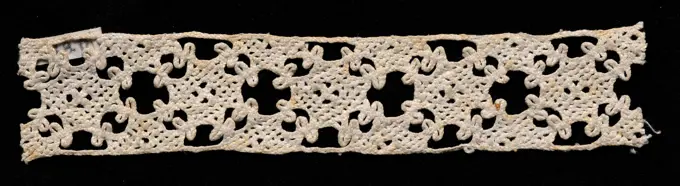
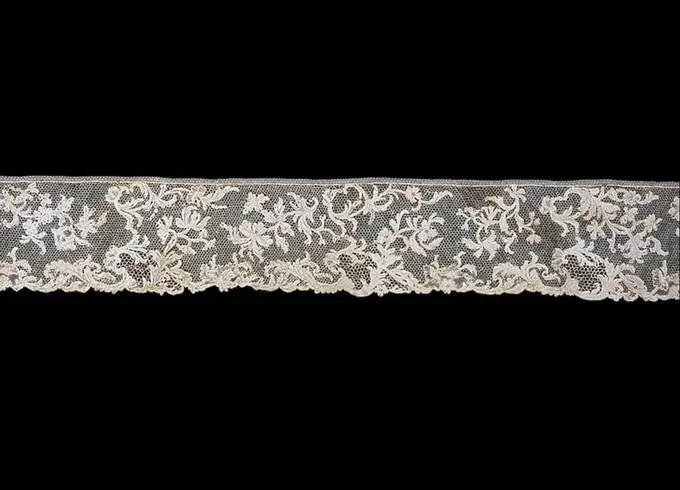
A variety of delicate bobbin lace strips featuring floral and geometric patterns, showcasing craftsmanship from different historical periods.
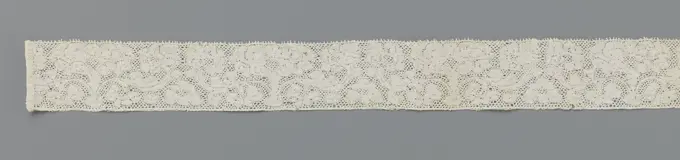
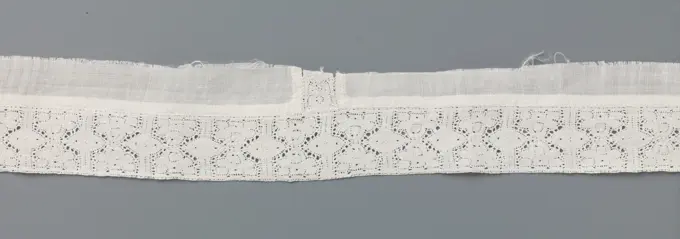
Strip bobbin with peony between two smaller peonies, anonymous, c. 1650 - c. 1660 Strip of natural -colored Dutch bobbin. The pattern consists of a repeating symmetrical motif of a stylized peony with a wavy side branch on the left and right. At the end of each side branch, a smaller peony curls up and focuses on the large central flower. The motifs are connected by a round grid with braid strokes. The motifs are made in linen battle with openwork edges. The top and bottom of the strip are straight finished, with picots on one side. Antwerp (possibly) linen (material) bobbin lace Strip of natural -colored Dutch bobbin. The pattern consists of a repeating symmetrical motif of a stylized peony with a wavy side branch on the left and right. At the end of each side branch, a smaller peony curls up and focuses on the large central flower. The motifs are connected by a round grid with braid strokes. The motifs are made in linen battle with openwork edges. The top and bottom of the strip are
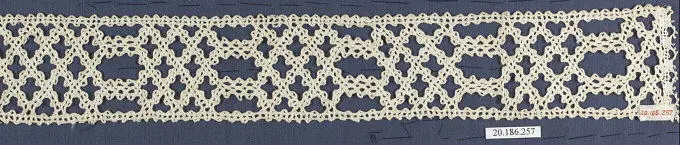
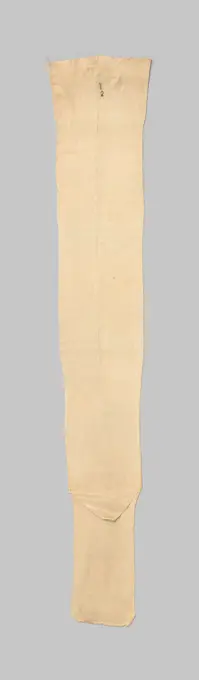
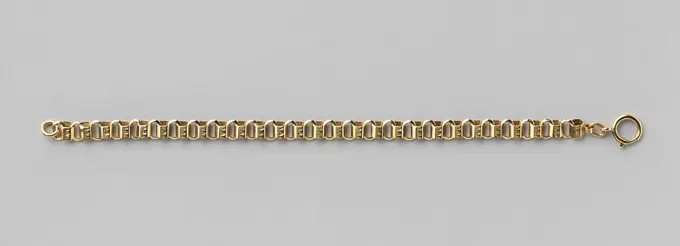
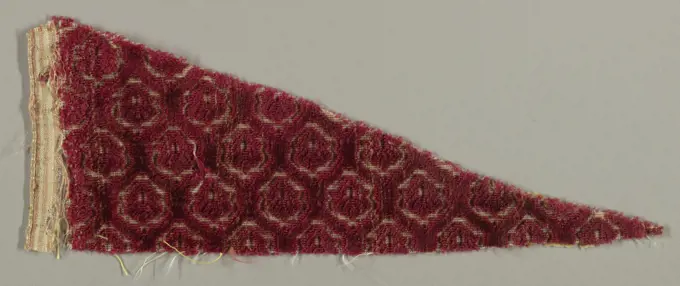
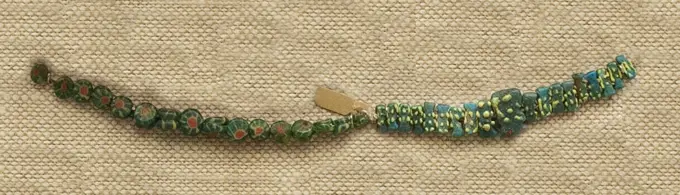
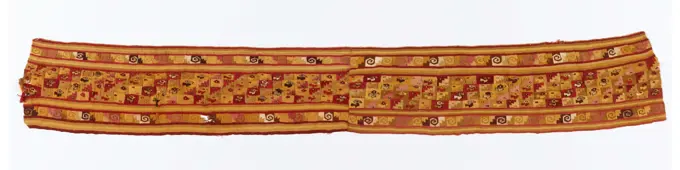
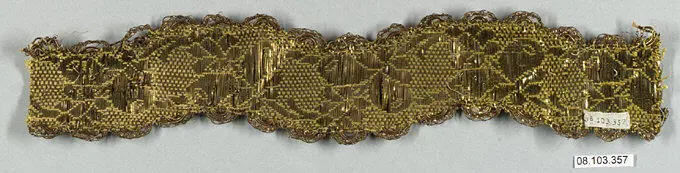
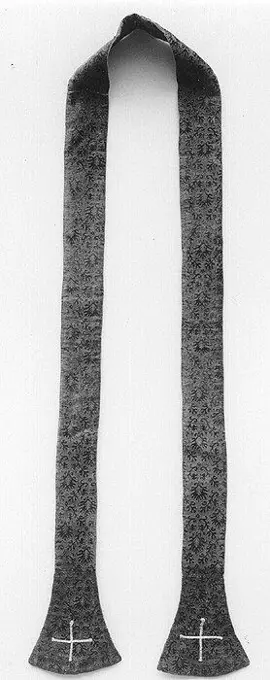
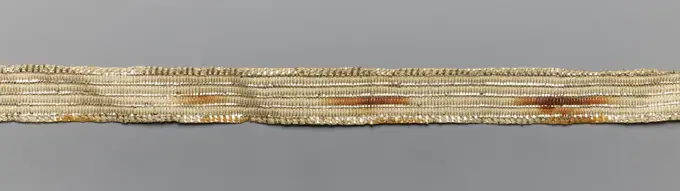
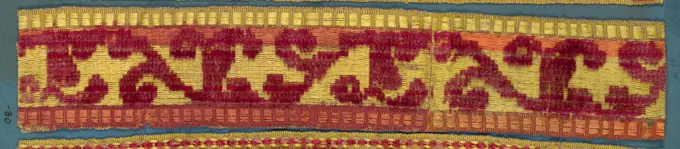
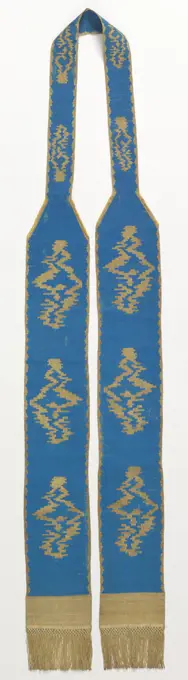
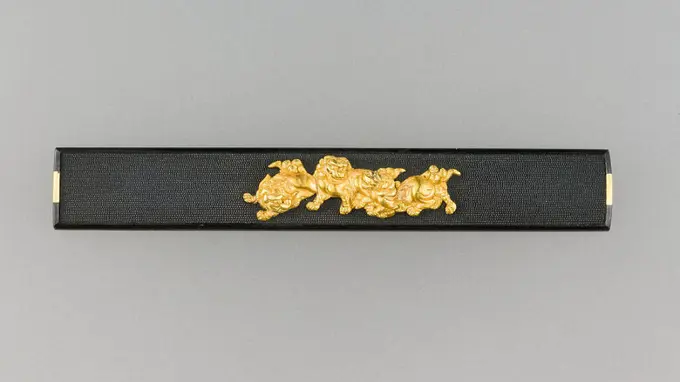
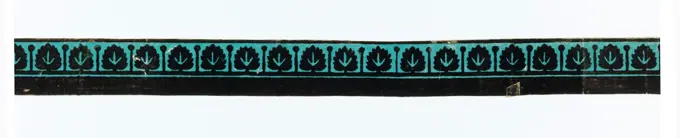
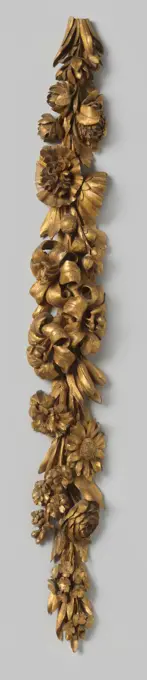
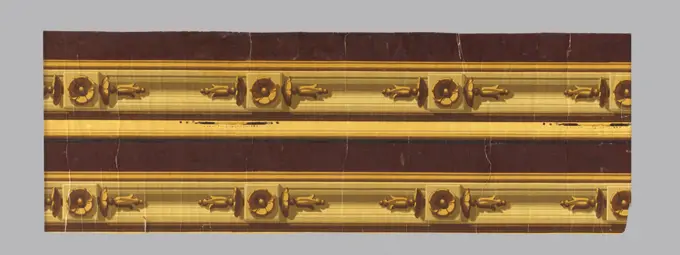
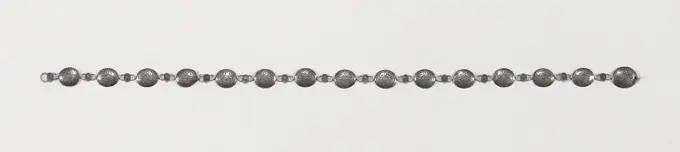
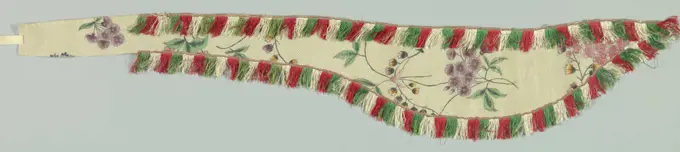
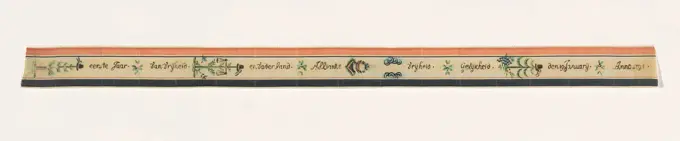
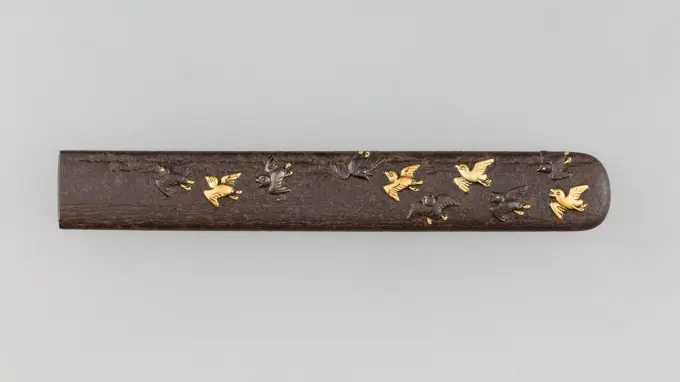
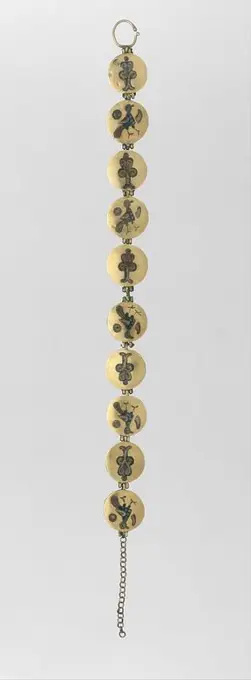
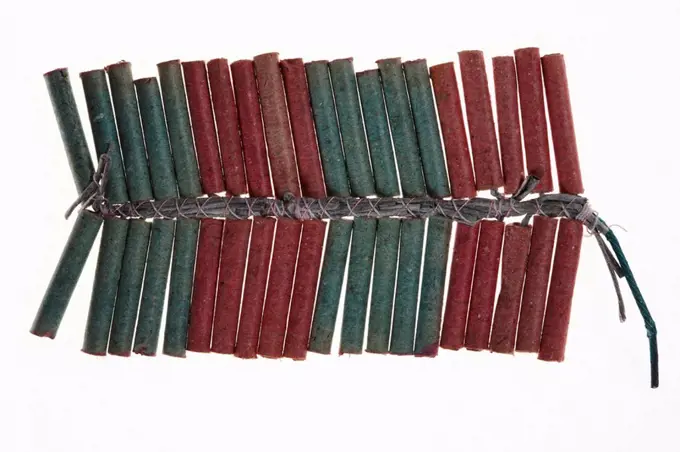
Sotck exchange. Restoration. Gal1952.5.103Trimming (USA); silkEdging early 18th century Flemish. Edging 222812Insertion 16th century Italian, Venice. Insertion. Italian, Venice. 16th century. Bobbin lace. Textiles-LacesNeedlepoint (Burano Point) Lace Lappet, 18th century. Italy, Burano, 18th century. Lace, needlepoint: linen; average: 109.3 x 10.2 cm (43 1/16 x 4 in.).Necklace 19th century. Necklace. 19th century. Silver. Made in Yemen. JewelryGlass Fragment 14th century () European. Glass Fragment. European. 14th century (). Colorless glass. Glass-StainedStrip 17th century Italian, Venice. Strip 212455Fringe, Medium: silk Technique: woven, Fringe in gray and white with a plain-woven heading. Skirt of gray and white threads., Italy, 17th century, trimmings, FringeWhite silk stocking in jersey stitch, decorated on one side with an embroidered decorative line, ending in a flower, anonymous, c. 1815 - c. 1830 Knitted white side in jersey stitch, decorated on one side with an embroidered decorative line, ending in a flower; marked in black cross stitch: xx2. Possible court clothing. Netherlands (possibly) whole: Silk. knitting / embroidering Knitted white side in jersey stitch, decorated on one side with an embroidered decorative line, ending in a flower; marked in black cross stitch: xx2. Possible court clothing. Netherlands (possibly) whole: Silk. knitting / embroideringMolding; wood, carvedLappet (one of a pair) early 18th century Flemish, Mechlin. Lappet (one of a pair) 212933Border; medium:; 1974-52-27Schakelarmband van goud met Emmaschakel.Switch bracelet of gold with EmmasChakel. The bracelet closes with a spring ring.Printing Block; wood, metal and felt; 1945-58-1Wood carving 17th century Japan. Wood carving 61927Fragment, Medium: silk Technique: cut and uncut supplementary warp pile (velvet), Fragment of dark red cut and uncut velvet on a cream-colored ground. Surface divided into small irregular ogive-shaped areas, each enclosing a tiny blossom., Italy, late 16th-early 17th century, woven textiles, FragmentSampler (USA); silk embroidery on linen foundation; 1976-100-51Glass Fragment 14th century () European. Glass Fragment. European. 14th century (). Colorless glass. Glass-StainedMiser's Purse (France); silk, steel beadsTrimming (France); silkCuff of needle side with button -shaped flowers, anonymous, c. 1690 - c. 1699 Cuff of natural -colored needle side: Venetian rose side. Stijlen soil that forms regular six-sided meshes, with thin ganks with button-shaped flowers and here and there a relief rose. Venice linen (material) Venetian rose point Cuff of natural -colored needle side: Venetian rose side. Stijlen soil that forms regular six-sided meshes, with thin ganks with button-shaped flowers and here and there a relief rose. Venice linen (material) Venetian rose pointString of 16 Double Beads after 300 Roman Period or later. String of 16 Double Beads. after 300. Glass. Roman Period or later. From EgyptTextile (Peru); woolBobbin Lace Insertion, late 16th century. Italy, Venice, late 16th century. Lace, bobbin; average: 3.2 x 16.6 cm (1 1/4 x 6 9/16 in.).Galloon 17th-18th century Italian or French. Galloon 213854Two bracelets, J.J.R. van de Wilde, c. 1835 - c. 1837 Two bracelets of gold in filigrein technology. The bracelets are part of a parure. Amsterdam gold (metal) filigree Two bracelets of gold in filigrein technology. The bracelets are part of a parure. Amsterdam gold (metal) filigreePort coal, fruits boats, vintage engraving. Port coal, fruits boats, vintage engraved illustration. Magasin Pittoresque 1846. Copyright: xZoonar.com/PatrickxGuenettex 10673287Stole early 17th century German, Cologne. Stole 219734Gallon;  19th century (1801-00-00-1900-00-00);Beads ca. 7th-6th century B.C. Iran. Beads 326165Moro Cloth, c 1900s. Philippines, Early 20th century. Plain weave hemp, dyed; overall: 320 x 67.3 cm (126 x 26 1/2 in.).Trimming (France); silkHalf of a Ritual Textile (PuaSungkit)Trimming, Medium: silk, silver metallic thread, Design of a scalloped border in white with silver thread., France, 17th century, trimmings, TrimmingTextile (USA); cotton. Choose box made of cardboard with silk, on which a honey ward pattern with red swastikas. The inside has a recess in the form of the closed impeller and is covered with red paper and taft side. The lid is connected to the box along a side by means of the silk fabric.Trimming (France); silkTrimming, Medium: silk Technique: woven, Trimming fragment in a design of red and white chevrons on a yellow ground; picot edges., France, 19th century, trimmings, TrimmingBaluster Leg 9th-10th century. Baluster Leg 449953Trimming (France); silk, metallic threadRibbon Made 1801-1900 France. Silk, plain weave with supplementary patterning warp and supplementary three-color pile warps forming cut solid velvet .Piece early 19th century Italian. Piece 227878Trimmings, Medium: linen Technique: needle lace (commonly called Rosaline), Group of lace intended for costume that includes seven pieces: a collar, two cuffs, two bands, and two shaped pieces. Pattern is an allover foliate scroll design., Italy, ca. 1725, lace, TrimmingsBorder (France); block-printed and flocked on machine-made paper; 35 x 6 cm (13 3/4 x 2 3/8 in.)Strip bobbin with two stylized mirrored flowers between vertical lines and oval, anonymous, c. 1600 - c. 1635 Strip of natural -colored Dutch bobbin. The pattern consists of a repeating motif with two vertical straight lines, which are cut in the middle by a rush -in. There are two stylized flowers between the vertical lines that are mirrored over the length axis. The motives are made in densely worked linen battle with recesses. There is hardly any soil, the motives are held together by very short braids. Top and bottom of the strip are straight. On one long side you can see a narrow strip of linen batist, possibly a fragment of a sheet or something similar to which the strip was originally attached. Southern Netherlands (possibly) linen (material) bobbin lace Strip of natural -colored Dutch bobbin. The pattern consists of a repeating motif with two vertical straight lines, which are cut in the middle by a rush -in. There are two stylized flowers between the vertical lines that are miGalloon early 19th century French. Galloon 213956Fragment 16th century Italian or French. Fragment. Italian or French. 16th century. Silk. Textiles-VelvetsGalloon 18th century French. Galloon 214042Bobbin Lace Edging, 18th century. Spain, Seville, 18th century. Lace, bobbin; average: 2 x 9 cm (13/16 x 3 9/16 in.).Miser's purse, Medium: silk, steel beads Technique: fishermen's knotted net technique, Miser's purse of netted black and yellow silk and finished at the ends with steel beads., France, 19th century, costume & accessories, Miser's purseBorder, c. 1957, 54 1/2 x 5 3/4in. (138.4 x 14.6cm), Synthetic; supplementary weft patterning, Thailand, 20th centuryPiece 18th century possibly French. Piece 225177Band, Medium: linen Technique: machine lace, Narrow lace band with a pattern of two confronted antelope-like animals. Machine made in imitation of Mechlin-style bobbin lace., Europe, early 19th century, lace, BandLint Allians, anonymous, before 1894 Silk ribbon, printed with two orange strips, with an orange ribbon thrown in between. Alternately connecting a black eagle, a rose, a black hat with lion and a bundle of arrows with a crown and scepter. Banderol with the text: Allians. West-Europa silk printing Silk ribbon, printed with two orange strips, with an orange ribbon thrown in between. Alternately connecting a black eagle, a rose, a black hat with lion and a bundle of arrows with a crown and scepter. Banderol with the text: Allians. West-Europa silk printingManchet van naaldkant met knopvormige bloempjes.Cuff from natural needle side: Venetian rosary. Ship soil that forms regular six-sided meshes, with thin ranks with knob-shaped flowers and a relief rose here and there.Band Fragment 7th century Nasca. Band Fragment 307968.Crest rail of a settee 17th-18th century In the manner of François Roumier The crest rail with its symmetric design was executed during the early stage of the Rococo style known as Régence which encompassed the period of 1715-1723, when Philippe II, duc dOrléans, served as regent to the young Louis XV. The Régence style was a reaction against the Baroque grandeur and formality of the court under Louis XIV and transitioned to a more frivolous and intimate sensibility developing into the full-blown Rococo with its penchant for asymmetry by circa 1730. The carved ornament on this railing, consisting of trelliswork inscribed by rosettes, flanked by asymmetrical C and S-shaped scrolls, shells, as well as floral decoration, bears resemblance to a design by François Roumier, published in his Livre de plusieurs coins de Bordures of 1724. As a decorative carver employed by the Btiments du Roi, the agency in charge of the construction and maintenance of the various French royal palaces, RoumieChildren's mitaine from crocheted side, anonymous, c. 1800 - c. 1899 Children's mitaine of natural -colored crocheted side. Network of rows of openwork circles and narrow straight tracks with cubes and semi -circles. Something tapered rectangular model. The Mitaine can be tied up above by means of a ribbon. West-Europa cotton (textile) Children's mitaine of natural -colored crocheted side. Network of rows of openwork circles and narrow straight tracks with cubes and semi -circles. Something tapered rectangular model. The Mitaine can be tied up above by means of a ribbon. West-Europa cotton (textile)Piece 19th century Japan. Piece 72227Band; embroidery using silk on plain weave linenTurned RodVestment, Medium: silk and metal Technique: tapestry weave, Blue silk with abstract ornaments in gold; the edges are gold and each end has bands of gold and gold fringe., 19th century, woven textiles, VestmentKnife Handle (Kozuka). Culture: Japanese. Dimensions: L. 3 13/16 in. (9.7 cm); W. 9/16 in. (1.4 cm); thickness 1/4 in. (0.6 cm); Wt. 1.2 oz. (34 g). Date: mid-15th-early 16th century. Museum: Metropolitan Museum of Art, New York, USA.Headband of black silver brocade, anonymous, c. 1920 - c. 1925 Black silver brocade headband. For the type of the Garçonne. Relief tissue of a network with cubes at the nodes; At the front, the Silver Band is main affair. Netherlands . Black silver brocade headband. For the type of the Garçonne. Relief tissue of a network with cubes at the nodes; At the front, the Silver Band is main affair. Netherlands .Greek Ornament and Etruscan OrnamentFringe; silkCollar (USA); cottonFringe early 18th century British. Fringe 224891Bobbin Lace Edging, mid 18th century. England, Devonshire, mid-18th century. Lace, bobbin; average: 4.5 x 23.5 cm (1 3/4 x 9 1/4 in.).Border (possibly USA); block-printed paper; Overall: 12 x 75 cm (4 3/4 x 29 1/2 in.)Border (France); block-printed and flocked on handmade paper; 77.5 x 6 cm (30 1/2 x 2 3/8 in.)Guirlande of gilded wood with cut tendrils and flowers., Anonymous, c. 1675 - c. 1699 Guirlande of gilded wood with cut tendrils and flowers.  linden Guirlande of gilded wood with cut tendrils and flowers.  lindenborders, Block-printed paper, varnish, Shaded buff and yellow strips carry rosette enclosed in a square. Square has bell-flower shaped ornament on each side. Strips separated by a deep maroon band. Printed in buff, yellow, maroon, France, ca. 1870, Wallcoverings, bordersgold jewelry Gold jewelry. jewellery ornaments shop display in gold market famous Golden souk in Dubai UAE. Copyright: xZoonar.com/DanilinxVladyslavx 13891920Border (France); block-printed and flocked on paper; 76 x 8.5 cm (29 15/16 x 3 3/8 in.)Concha belt, 33 in. (83.82 cm), Silver, United StatesValances, Medium: tempera on pineapple fiber, silk fringe Technique: painted on plain weave gauze, White sheer fabric painted with a fragmentary floral design in polychrome. Green, red and white fringe on the edges. Tapes for tieing at either end., China, 18th century, printed, dyed & painted textiles, ValancesElizabethan ornamentFlounce (Used as Quilling). Italy, Burano. Date: 1760-1769. Dimensions: a: 808.4 x 11.2 cm (318 1/4 x 4 3/8 in.)b: 193.5 x 10.8 cm (76 1/8 x 4 1/4 in.)c: 43.7 x 10.9 cm (17 1/4 x 4 1/4 in.)d: 34.2 x 10.9 cm (13 1/2 x 4 1/4 in.)e: 32.0 x 11.2 cm (12 5/8 x 4 3/8 in.)Height repeat: 36.2-37 cm (14 1/4-14 1/2 in.). Linen, needle lace. Origin: Italy. Museum: The Chicago Art Institute, Chicago, USA.Swatches, Medium: silk Technique: woven, France, late 19th century, woven textiles, SwatchesZijden lint ter viering van het eerste jaar van de vrijheid, 1795.Silk red-white-blue hat ribbon decorated with inscriptions and drawn symbols such as the freedom tree to celebrate the batavian republic, freedom and the alliance with France, 19 January 1795.Hat, 33 1/2 x 9 5/8 x 4 1/4 in. (85.09 x 24.45 x 10.8 cm), Cotton, silk, buttons, metallic threads; needlework, AfghanistanPiece 18th-19th century Japan. Piece. Japan. 18th-19th century. Silk. Textiles-WovenRibbon (USA); silkNecktie 1860-65 European. Necktie 120937Strip from a Cope England. Linen, plain weave; painted and stamped .Rand decoration with pattern of braided ornaments, Reinier Willem Petrus de Vries (1874-1953), 1884 - 1952 print   paper  interlace ~ ornamentKnife Handle (Kozuka) first half 18th century Japanese A kozuka is a handle of a by-knife that is part of a sword mounting. It is kept in a slot on the reverse of a katana scabbard, often with a matching kgai (hairdressing tool).. Knife Handle (Kozuka). Japanese. first half 18th century. Iron, gold, silver. Sword Furniture-KozukaSample (France); silk; Anonymous bequest in memory of Albert and Rebecca Elsberg; 1938-82-189-dAguja paleolítica, procedente de la Cova del Parco de Alòs de Balaguer. Museu d'Història de Catalunya.Chain with Birds and Trees of Life. Culture: Kievan Rus'. Dimensions: Overall: 12 7/16 x 13/16 x 1/8 in. (31.6 x 2.1 x 0.3 cm)Overall: 9 11/16 x 13/16 x 1/8 in. (24.6 x 2.1 x 0.3 cm). Date: 1000-1200.Chains, called riazni, were created from small cloisonné enamel medallions. The chains may have joined layers of dress, been worn as necklaces or bracelets, or used to suspend circular or crescent-shaped pendants known as temple pendants or kolti. Rus' women wore temple pendants in pairs, suspended beside the face, at the temple, as part of their elaborate headdress. Museum: Metropolitan Museum of Art, New York, USA.Roll Chiné ribbon () With three jobs Ajour work and printed flower pattern in Rose and Green, Gustav Schnitzler, c. 1875 - c. 1900 Roll Chiné ribbon () With three jobs Ajour work and printed flower pattern in Rose and Green. Nijmegenfrance silk printing Roll Chiné ribbon () With three jobs Ajour work and printed flower pattern in Rose and Green. Nijmegenfrance silk printingFringe late 18th century Swiss. Fringe 213414Firecrackers, close_upBand 18th century Peruvian. Band 215296Frieze, Block-printed on continuous paper, polished ground, A band of alternating oval and rectangular medallions along the upper edge. Below this a long enframed medallion stretching horizontally. Foliate clusters interrupt the latter from above and below at the medallion's center point. The same cluster form alternates horizontally with the large medallion., France, 1840-45, Wallcoverings, FriezeReed Pipe 19th century Native American (Skittagetan). Reed Pipe. Native American (Skittagetan). 19th century. wood. British Columbia, Canada. Aerophone-Reed Vibrated-pipeSampler (Germany); cotton, paper