Intricate Lace Strips

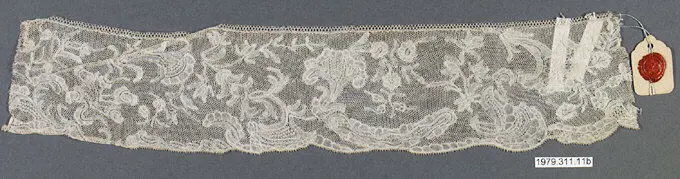
Delicate lace strips in various styles and designs, showcasing intricate patterns and craftsmanship from different historical periods.

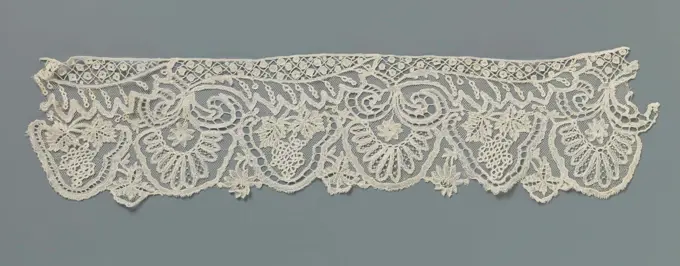
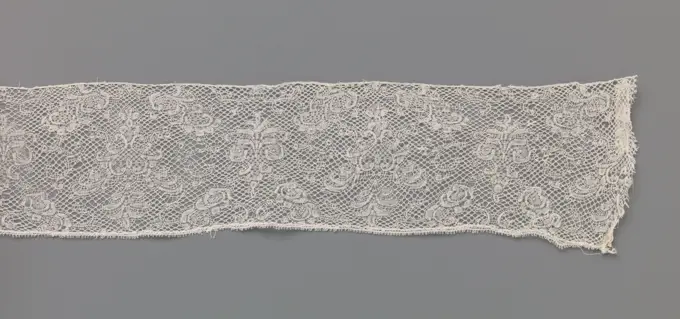
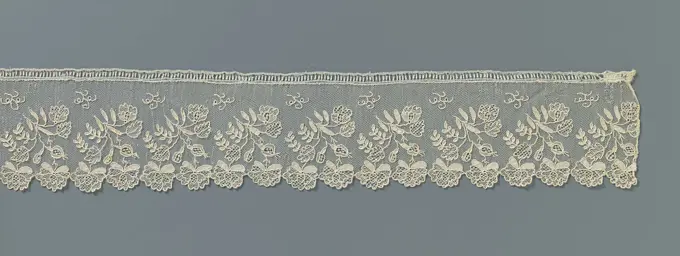
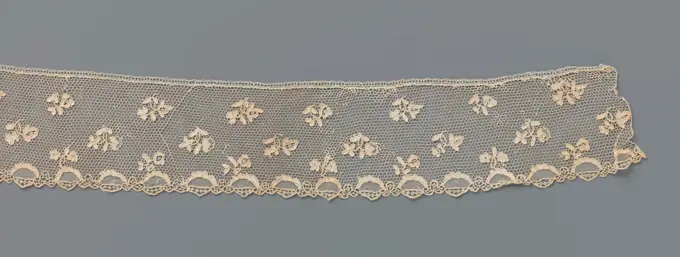
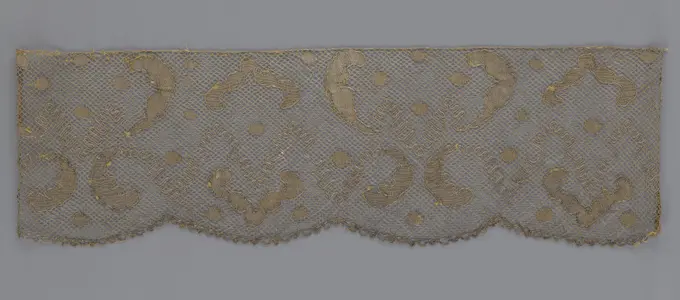
Strip of needle side with hanging clocks between C-volutes, anonymous, c. 1860 - c. 1870 Strip of natural -colored needle side: Brussels mesh side. The repeating and largely symmetrical pattern consists of a hanging clock contained between lying C-Voluten. Three rosette flowers hang under the clock. Federed leaves hang under the C-Voluten. In the field above the C-Voluten, an as-symmetrical bouquet with a rose originates. The motives are made up of feston stitches and are accentuated by relief contours. Decorative stitches have been used in the clock and C-Voluten. The motifs are connected by a mesh soil, a mesh side strewn with mushes. The top is straight finished with a messing strap. The scrap edge stems from the pattern with the hanging rosette flowers and feathered leaves and is finished with picots. Brussels linen (material) Brussels Gaze Point Strip of natural -colored needle side: Brussels mesh side. The repeating and largely symmetrical pattern consists of a hanging clock cont
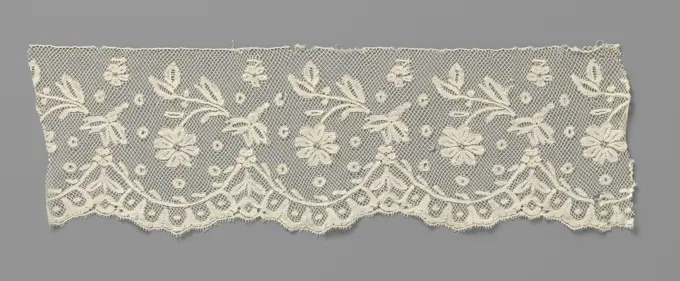
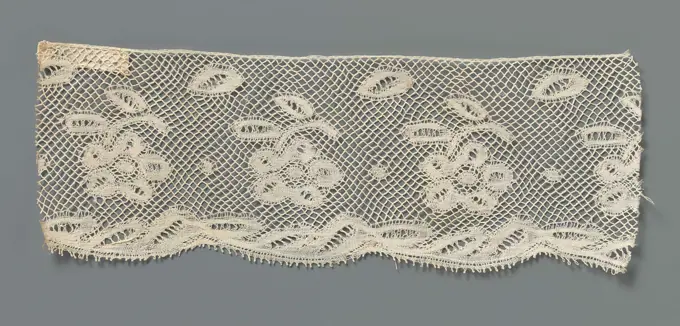
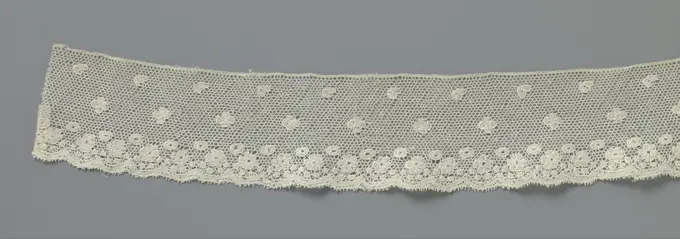
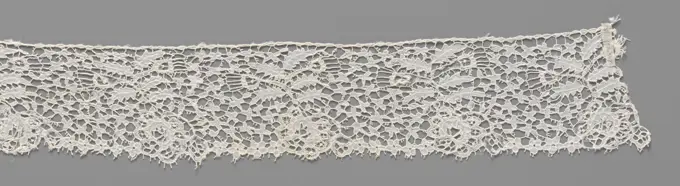
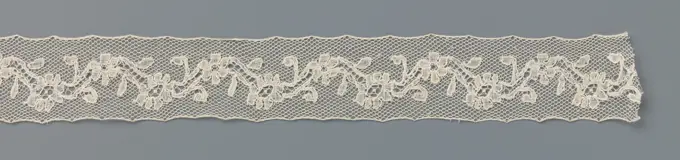
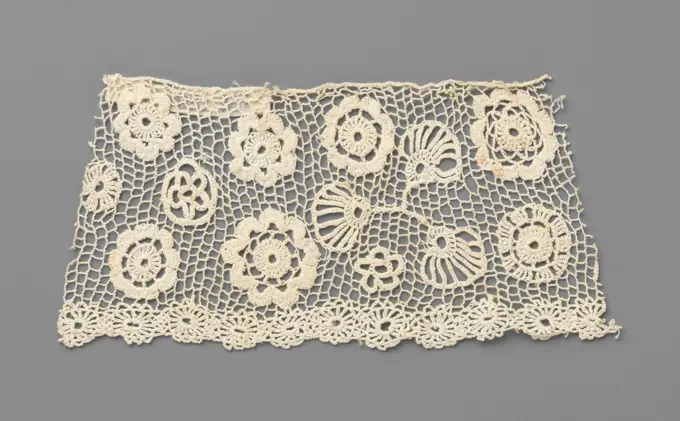
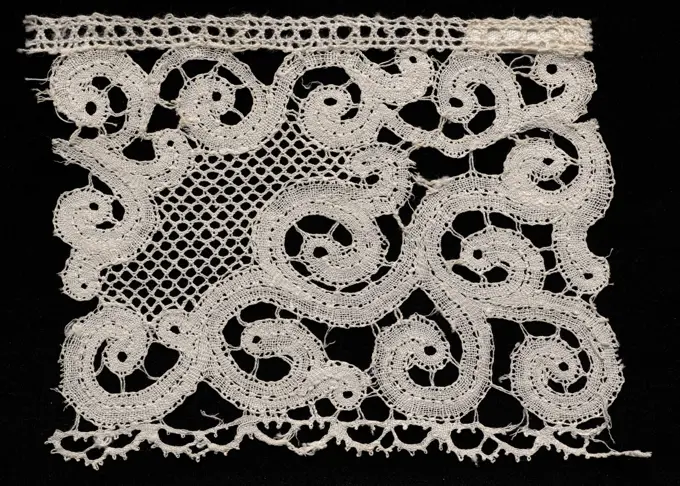
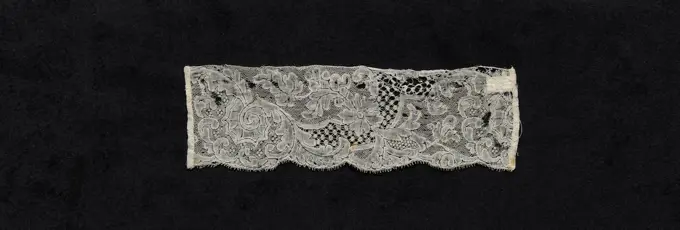
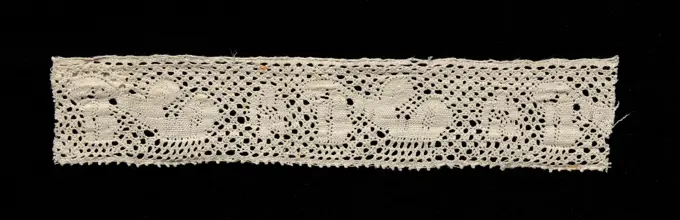
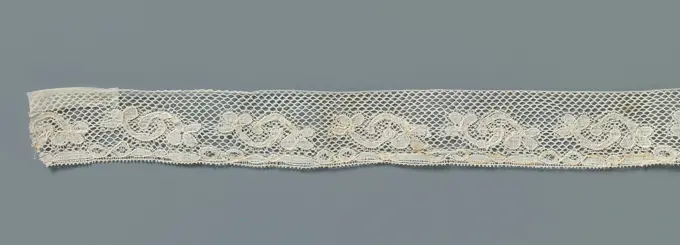
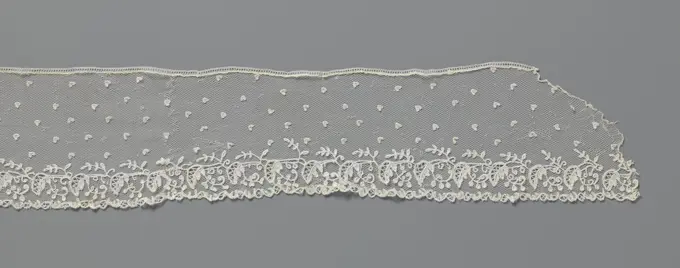
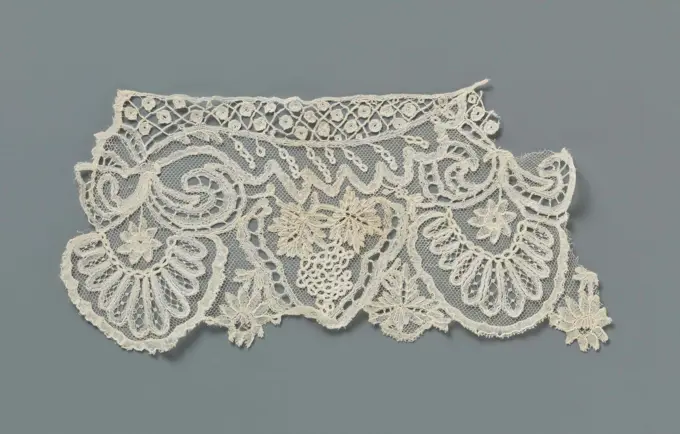
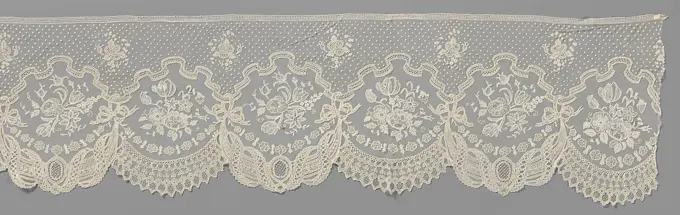
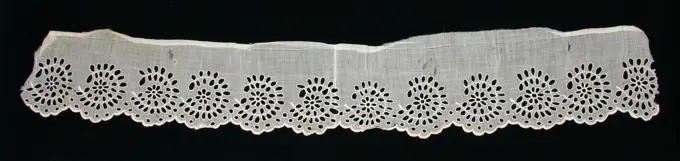
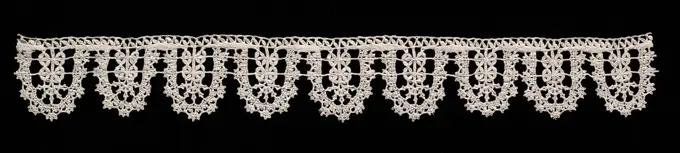
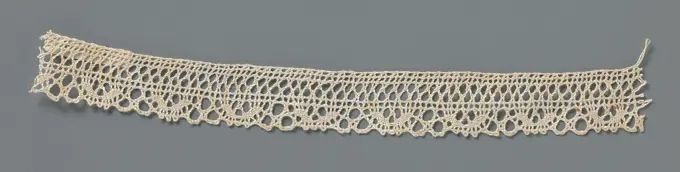
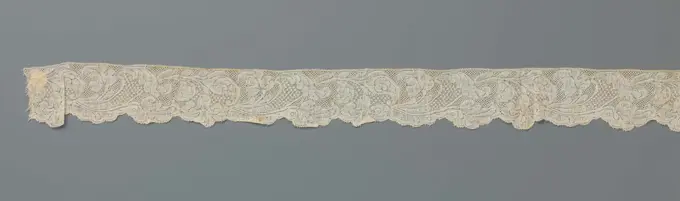
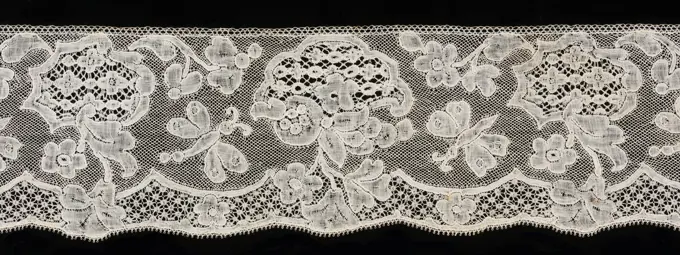
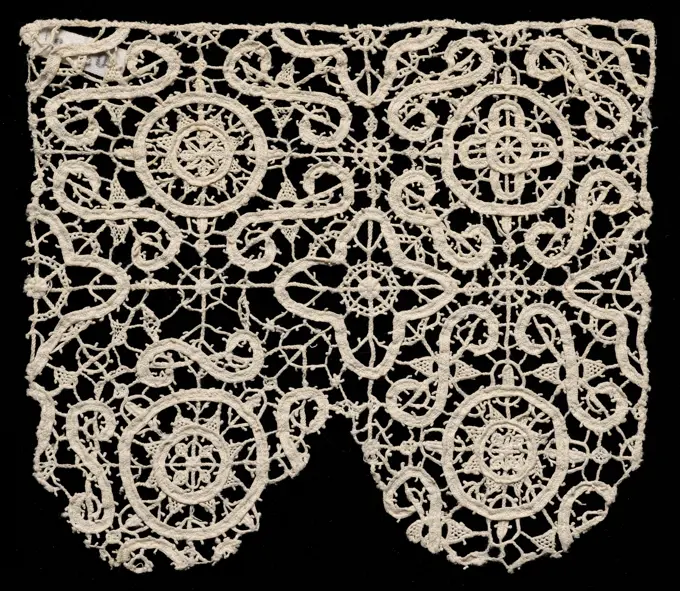
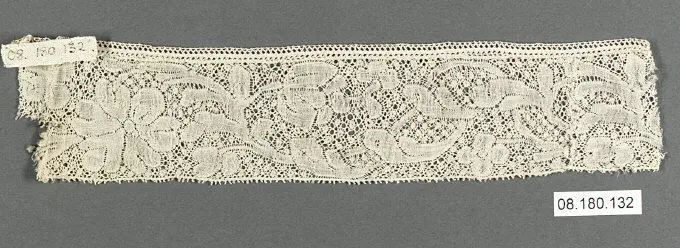
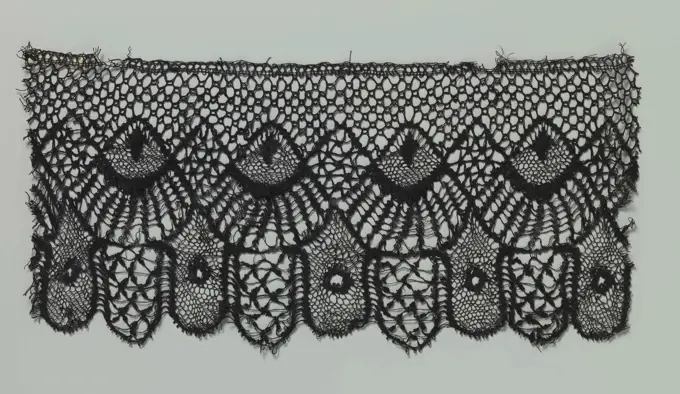
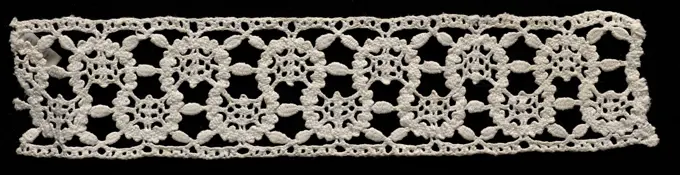
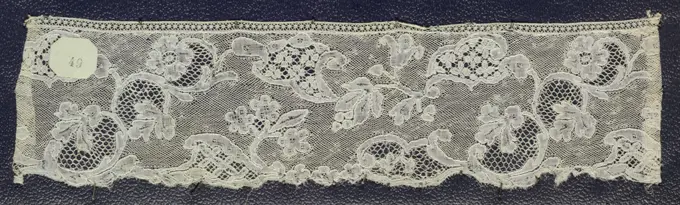
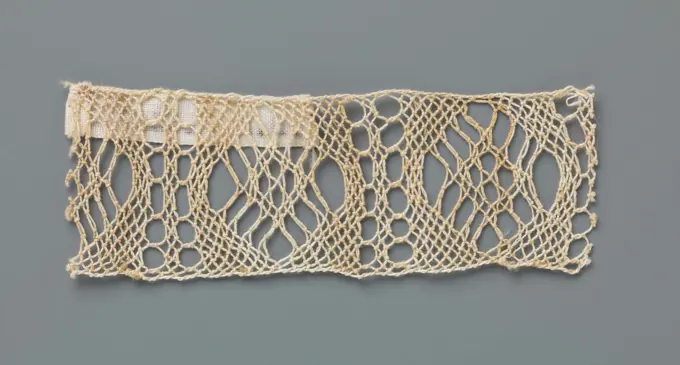
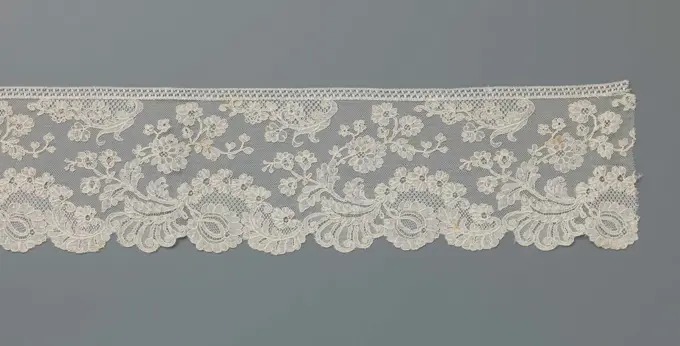
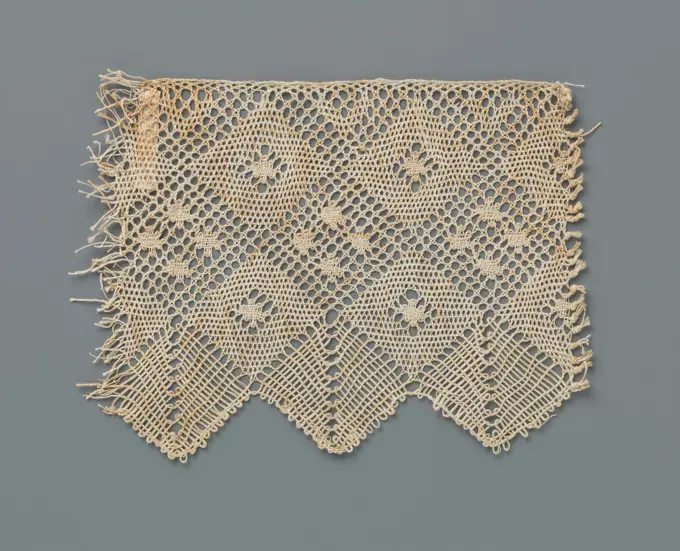
Strip of needle side with dadverbollen, anonymous, c. 1775 - c. 1799 Strip of natural-colored needle side: Alençon side. Spread motif with three rows of branches with oval leaves under the upper row, on a fine hexagonal mesh ground. On the underside of the strip a repetitive motif from Papaverbollen, narrow leaves and fantasy forms filled with decorative grounds. The underside is finished with a slightly wavy border with delicate picots. The top is trimmed with a border bobbin. Alençon linen (material) Alençon Lace Strip of natural-colored needle side: Alençon side. Spread motif with three rows of branches with oval leaves under the upper row, on a fine hexagonal mesh ground. On the underside of the strip a repetitive motif from Papaverbollen, narrow leaves and fantasy forms filled with decorative grounds. The underside is finished with a slightly wavy border with delicate picots. The top is trimmed with a border bobbin. Alençon linen (material) Alençon LaceBands, Medium: linen Technique: needle lace with ground of loop and twist with twist return, Bands with elaborate leaves and blossoms., Italy, 18th century, lace, BandsStrook naaldkant met oogjespatroon.Strip natural-colored coniferous lace: Alençon side. The midfield shows a coarse, the edge of a fine Maas soil. The field is filled with scattered eyes. The transition is formed by double garlands, one of which consists of a ribbon, the other from a rank with leaves. Fine shifting edge of circles with several decorative stitches.Strip bobbin with careless scales, anonymous, c. 1875 - c. 1899 Strip of natural-colored bobbin: Valenciennes side. Pattern with careless half -circular sculptures, above which a hanging daisy between 'sequins'. Belgium (possibly) linen (material) Bobbi Lace / Valenciennes Lace Strip of natural-colored bobbin: Valenciennes side. Pattern with careless half -circular sculptures, above which a hanging daisy between 'sequins'. Belgium (possibly) linen (material) Bobbi Lace / Valenciennes LaceStrip crocheted side with fan -shaped flowers, anonymous, c. 1890 - c. 1909 Strip of natural -colored Irish crocheted side. Pattern with fan -shaped flowers with stems and a crocheted irregular mesh soil with picots. The top is finished with a straight edge. The semi -circular sculpts on the lower edge are trimmed with picoted arches. Ireland cotton (textile) Strip of natural -colored Irish crocheted side. Pattern with fan -shaped flowers with stems and a crocheted irregular mesh soil with picots. The top is finished with a straight edge. The semi -circular sculpts on the lower edge are trimmed with picoted arches. Ireland cotton (textile)Strook applicatiekant met druiventrossen en gehalveerde bladeren.Strip natural colored application side, climbing side applicated on machine tulle. A narrow part, along the inside, exhibits a running pattern of halved, lobed leaves, which accompanies an equally halved medallion with a raster filling. On a wide part with a substrate of tulle, symmetrical, deep slot, which are in turn are filled with a grinding tray and a fan plant.Strip of needle side with hanging clocks between C-volutes, anonymous, c. 1860 - c. 1870 Strip of natural -colored needle side: Brussels mesh side. The repeating and largely symmetrical pattern consists of a hanging clock contained between lying C-Voluten. Three rosette flowers hang under the clock. Federed leaves hang under the C-Voluten. In the field above the C-Voluten, an as-symmetrical bouquet with a rose originates. The motives are made up of feston stitches and are accentuated by relief contours. Decorative stitches have been used in the clock and C-Voluten. The motifs are connected by a mesh soil, a mesh side strewn with mushes. The top is straight finished with a messing strap. The scrap edge stems from the pattern with the hanging rosette flowers and feathered leaves and is finished with picots. Brussels linen (material) Brussels Gaze Point Strip of natural -colored needle side: Brussels mesh side. The repeating and largely symmetrical pattern consists of a hanging clock contStrook kloskant met rozetbloempjes.Natural collate strip, Valenciennes side. The repeating pattern consists of a rosette flower that depends on a curved twig. There is a loose dot between the consecutive flowers, with right above, slightly under the top of the strip a spiral leaf. Along the bottom of the strip, a wavy path is formed by such a leaves diagnown to each other. The motifs are connected by a mesh soil, a diamond-shaped valenciennes ground. The motifs are made in linen battle with recesses and open editors. The top of the strip is straight finished. The shelters along the underside are finished with picots.Strip bobbin with clovers four and rose land, anonymous, c. 1800 - c. 1824 Strip of natural -colored bobbin, Parisian side. The upper half of the strip consists of a row of double leaves and a row of clovers four. The repeating pattern along the underside of the strip consists of a row of open -worked circles, with a row of rosette flowers. Each rosette flower is in a shell, in which four separate mushes are located. A band runs along the scallops. The motifs are connected by a Maas soil, a Parisian soil. The motifs are made in linen battle with thicker and shiny contour threads. The top of the strip is straight finished. The scums on the bottom are finished with picots.  linen (material) bobbin lace / Paris lace Strip of natural -colored bobbin, Parisian side. The upper half of the strip consists of a row of double leaves and a row of clovers four. The repeating pattern along the underside of the strip consists of a row of open -worked circles, with a row of rosette flowers. Each roseStrip of bobbin with interrupted diamond -shaped fields and candelabar motifs, anonymous, c. 1690 - c. 1710 Strip of natural-colored bobbin, old binche side. The repeating and thin pattern consists of interrupted diamond -shaped fields, formed by four sloping flowers. In the field is a symmetrical candle pattern, with a reversed heart -shaped center. A smaller Kandelaber motif stands on the center line between the successive diamond -shaped fields. The motifs are connected by a mesh soil, a lace-hole strike-grid. And they are made in linen battle with openwork edges and in netslag. Some snowflakes are used as part of the motifs and a decorative land is used in the centers of the Kandelaber motifs. The top and bottom of the strip are straight finished, with the bottom with picots. The picot edge seems to be made of another wire and may be turned on later. The whole gives the impression that the strip was once wider. Southern Netherlands linen (material) bobbin lace / old Binche lace StrStrip of guipure side with roses between clovers three 'Irish shamrock', anonymous, c. 1880 - c. 1890 Strip of natural guipure side: Carrickmacross-Guipure. The motifs are in Batist Omnaid, then attached to each other with bars and eventually the batist was cut away from the spaces. The repeating pattern consists of a slightly sloping rose on a handle with five leaves with a wavy border. Two side branches with a smaller flowers each between these leaves. The roses are connected to each other by a number of clovers three and founded bars with picots. The Klavertje three is the national symbol of Ireland, called Shamrock. Advancing of (flower) leaves are embroidered on the batist. Needle -cantal straps have been used in the rose petals. The scrap edge is formed by the hanging roses between which a row of connected rosette flowers always hangs. The top of the strip is straight finished with a succession of ovals. Ireland cotton (textile). batiste Strip of natural guipure side: CarrickmacrPiece 18th century Italian. Piece 215048Strip of needle side with flower branches and star -shaped flowers, anonymous, c. 1795 Strip of natural needle side, argent tankant and alençonkant. Repetitive motif with two different flower branches, each flanked by two star -shaped flowers placed one above the other, on a ground with meshes that are closed with button hole stitches (argent tankant). The flower branches bend alternately to each other. Along the underside under a wavy line including a pattern of flowers and berries on a fine hexagonal Maas soil (alençonkant). Ornamental soil with road picots in the larger flowers and the circles along the lower edge. Fullwork with minimal recesses within the contours of the other motives. Schulpenrand on the bottom due to a succession of circles, interrupted at a regular distance by a rosette flower. The top is trimmed with a border bobbin. Argentan linen (material) Argentan Lace Strip of natural needle side, argent tankant and alençonkant. Repetitive motif with two different flower bKloskant intermediate mate with zigzag line, anonymous, c. 1875 - c. 1949 Piles of Natural -colored bobbin side: Mechelse side. In the middle of the fine grid, a Mechelen soil (also known as ice soil), an openwork band runs in Zigzaglijn, cut over by two types of rosettes. Belgium linen (material) bobbin lace / Mechlin (lace) Piles of Natural -colored bobbin side: Mechelse side. In the middle of the fine grid, a Mechelen soil (also known as ice soil), an openwork band runs in Zigzaglijn, cut over by two types of rosettes. Belgium linen (material) bobbin lace / Mechlin (lace)Needle's tie with sprinkling flowers and openwork flowers, anonymous, c. 1775 - c. 1799 Engageante of natural-colored needle side: Alençon side. The pattern has sprinkling flowers on a soil of twisted (square) meshes and a tendrils with various fillings of decorative grounds and decorative stitches including grounds in diamond stitch and grid with radar picots. Special are the openwork flowers that occur sporadically in this way in Alençon side. The motifs are made up of feston stitches and equipped with founded relief contours. The top is straight finished with a messing strap. The very flat scrap edge is finished with picots. The ends are almost invisibly put together. France linen (material) Alençon Lace Engageante of natural-colored needle side: Alençon side. The pattern has sprinkling flowers on a soil of twisted (square) meshes and a tendrils with various fillings of decorative grounds and decorative stitches including grounds in diamond stitch and grid with radar picots. SpecialStrip crocheted side with triple fan flower between different rosette flowers, anonymous, c. 1800 - c. 1899 Strip of natural crocheted side: Irish crocheted side. Pattern with triple fan flower between different rosette flowers. The top of the strip is straight finished. The flat scrap edge consists of a row of connected rosette flowers. Ireland cotton (textile) Strip of natural crocheted side: Irish crocheted side. Pattern with triple fan flower between different rosette flowers. The top of the strip is straight finished. The flat scrap edge consists of a row of connected rosette flowers. Ireland cotton (textile)Strook naaldkant met dubbele roosjes.A fine Maas soil (single mesh) is almost the entire width filled with a row of one-sided facing hanging twigs with rose knobs and two double roses, which form the scallops. Alençon sideStrip of needle side with small dense and large open circles, anonymous, c. 1900 - c. 1949 Strip of natural needle side - reticella - between edges open sewing: work with pulled out threads. The repeating and symmetrical pattern consists of one row of squares, which are made up of four small squares. Each large square has been crossed, at every intersection alternating a small closed and a large openwork circle. Demizes along the edges. The top and bottom of the strip are straight finished with open diamonds (work with threads pulled out). unknown cotton (textile) Strip of natural needle side - reticella - between edges open sewing: work with pulled out threads. The repeating and symmetrical pattern consists of one row of squares, which are made up of four small squares. Each large square has been crossed, at every intersection alternating a small closed and a large openwork circle. Demizes along the edges. The top and bottom of the strip are straight finished with open diamonds (work Strip bobbin with two candelabar motifs, anonymous, c. 1690 - c. 1699 Strip of natural-colored bobbin, binche side. The repeating and thin pattern consists of a two different symmetrical candle -bug motifs. The narrowest of the two has a drop -shaped center, the wider is fitted with volutes from four points around the center, and form an X. The Kandelaber motifs are alternately reversed. The motifs are connected by an irregular decorative land, a snowflake land. The top is finished with a separate strap. The bottom is straight finished and provided with picots. Southern Netherlands linen (material) Bobbi Lace / Binche Lace Strip of natural-colored bobbin, binche side. The repeating and thin pattern consists of a two different symmetrical candle -bug motifs. The narrowest of the two has a drop -shaped center, the wider is fitted with volutes from four points around the center, and form an X. The Kandelaber motifs are alternately reversed. The motifs are connected by an irregular decoratStrip bobbin with, anonymous, c. 1740 - c. 1760  Strip bobbin decorated with leaf vine, flower and slat work motifs. Lille.  linen (material). Lille laceStrip of needle side with volutes and peonies, anonymous, c. 1850 - c. 1899 Strip of natural needle side: Brussels mesh side. The repeating pattern consists of slanted flower branches and asymmetrical C-volutes on a fine soil with single twisted meshes: a mesh cantar, which is strewn with mosies. A flower branch with a few large flowers alternates with a flower branch with many small florets and berries. Along the underside, the pattern consists of an elongated C-Volute under each branch with the large flowers, with a decorative frame of connected circles with different rosettes in decorative stitches at the bottom. Made full work with feston stitches with nuances where the denser filling is made with dust mark (a Festonsteek variant). Relief contours of widded wire bundles (cordonnets) wide apart. Many coordonated rings decorate the side. The scrap edge is formed by connected flowers under each horizontal C-Volute and smaller tilted C-Voluten in between, under which one big peony is aBobbin Lace (Bride Ground) Edging, 18th century. Italy, Milan, 18th century. Lace, bobbin: linen; average: 10.2 x 13.4 cm (4 x 5 1/4 in.).Border with Vases, anonymous, c. 1600 - c. 1620 Strip of natural needle side, reticella, with a scalloped bobbin side at the bottom. In the needle side a repetitive motif of a square in which a sluing -stained vase, in turn is tilted to the left and to the right. The vase is connected with small dogs and arches on the sides of the square and on the top and bottom through a frame of filled squares. Ground with tiled bars and buttonholes. The horizontally continuous lines are made with a lace -up band. Fullwork with buttonholes, decorated with recesses and with closed picots. Scalloped edge of bobbin with a strong swinging strap in linen battle, connected and finished with braided bars and fine arches. Italy linen (material) bobbin lace Strip of natural needle side, reticella, with a scalloped bobbin side at the bottom. In the needle side a repetitive motif of a square in which a sluing -stained vase, in turn is tilted to the left and to the right. The vase is connected with small dogs aBobbin Lace Edging, 18th century. Belgium, Mechelen, 18th century. Lace, bobbin: linen; average: 6.7 x 20.4 cm (2 5/8 x 8 1/16 in.).Strip bobbin with connected ovals along the underside, anonymous, c. 1800 - c. 1899 Strip of natural-colored bobbin, Buckingham side. The repeating and continuous pattern consists of connected ovals along the underside of the strip. The motifs are made in linen battle and are connected to each other at the top by a grid, a tuler land. The top of the strip is straight finished. The ovals form the semicircular shells along the bottom. Buckingham cotton (textile) bobbin lace / Bucks point (lace) Strip of natural-colored bobbin, Buckingham side. The repeating and continuous pattern consists of connected ovals along the underside of the strip. The motifs are made in linen battle and are connected to each other at the top by a grid, a tuler land. The top of the strip is straight finished. The ovals form the semicircular shells along the bottom. Buckingham cotton (textile) bobbin lace / Bucks point (lace)Fragment, Medium: linen Technique: bobbin lace, Mechlin style, Belgium, 18th century, lace, FragmentBobbin Lace Insertion, 18th century. Italy, Abruzzi, Pescocostanzo , 18th century. Lace, bobbin; average: 3.5 x 17.9 cm (1 3/8 x 7 1/16 in.).Jabot of needle side with heart -shaped tiflens, anonymous, c. 1700 Jabot of natural -colored needle side: Venetian rose side. On a very open bar of land, which are full of cogs, is a symmetrical decor on either side of a thin candelabar pattern of multifaceted palms, consisting of two heart -shaped, twisting volutes. These are richly decorated with short and long branches, including tongened exotic flowers and spring -shaped leaves and fine buttons, richly decorated with florets, arches and picots. Venice linen (material) Venetian rose point Jabot of natural -colored needle side: Venetian rose side. On a very open bar of land, which are full of cogs, is a symmetrical decor on either side of a thin candelabar pattern of multifaceted palms, consisting of two heart -shaped, twisting volutes. These are richly decorated with short and long branches, including tongened exotic flowers and spring -shaped leaves and fine buttons, richly decorated with florets, arches and picots. Venice linen (Bobbin Lace (Needlepoint Design) Edging, 18th century. Italy, Genoa, 18th century. Lace, bobbin; average: 6.1 x 25.1 cm (2 3/8 x 9 7/8 in.).Strook naaldkant met strooipatroon van verschillende bloemtakjes.Strip natural needle side: Argentan side. The strip is equipped with a scattering pattern of different flower branches. The flat sculpture along the bottom edge consists of a concatenation of elongated oval filled with a row of riderpicots, over each oval is always a half oval-shaped bow. The motifs are on a hexagonal mesh of hexagonal mesh, which are close to feston stitches. The folder is made with feston stitches without recesses and the motifs are equipped with relief contour lines, here and there provided with picots. As ornamental soil is used under the arcs in the edge pattern and a very fine maas soil in a few flower hearts. Except in the edge pattern, radar picots also occur in most flower hearts. The sides are finished with a straight edge. The top is finished with a border clamping side.Hebrew ritual lace (one of four) early 18th century Italian, Burano. Hebrew ritual lace (one of four) 226265Border 17th century Italian or Spanish. Border 218041Fragment late 17th century Italian, Venice. Fragment 212939Batist cuff with contiguous hex corners in which margins of lace -ups and finished on three sides with a strip of machine side, C.I. Bosch Reitz-Teding van Berkhout, c. 1910 Cuff of natural -colored batist with lace bobbins: English embroidery. Rectangular model with a scales of scales at the bottom. The pattern consists of a row of continuous hexagons made with openwork circles, with an open work Margriet in each hexagon. The scrap edge follows the pattern with the hexagons. The cuff is finished along three sides with a wrinkled strip of mechanical side: Machinal Valenciennes side. The embroidery was made around 1870, the collar around 1910. Amsterdam cotton (textile). batiste Cuff of natural -colored batist with lace bobbins: English embroidery. Rectangular model with a scales of scales at the bottom. The pattern consists of a row of continuous hexagons made with openwork circles, with an open work Margriet in each hexagon. The scrap edge follows the pattern with the hexagons. The cuStrip bobbin with S-shaped motifs along the underside, anonymous, c. 1880 - c. 1914 Strip of natural -colored bobbin, Lille side. The continuous pattern consists of connected and whimsical S-shaped motifs along the underside of the strip. Above that, a row of square mosies in a fine Maas soil, a tuler land on the center line. The motifs are made in linen battle with thicker and shiny contour threads. The Mosjes are made in form. The top of the strip is straight finished and sewn to a strip of machine tulle. The faintly scalloped underside is finished with picots. Belgium cotton (textile) bobbin lace / Lille lace Strip of natural -colored bobbin, Lille side. The continuous pattern consists of connected and whimsical S-shaped motifs along the underside of the strip. Above that, a row of square mosies in a fine Maas soil, a tuler land on the center line. The motifs are made in linen battle with thicker and shiny contour threads. The Mosjes are made in form. The top of the strip is straighFragment, Medium: linen Technique: bobbin lace (continuous braid-like), Fragment of a geometric lace band with oval tab edge., Belgium, early 17th century, lace, FragmentStrook machinale kant met in elkaar hakende c-vormige bloemstelen.Strip natural-colored mechanical side: Machine Malinois. The repeating pattern consists of two haking c-shaped flower stems, with a triple flower to each steal. Along the underside of the strip there are alternately three ovals and two openwork circles. The motifs are sparingly with recesses and all equipped with shiny contour wires. They are connected by a machining hexagonal grille. Between the flour stems, a machine fine snowflakes of land is used as ornamental soil. Upper and bottom of the strip are straight finished, the underside with picots.Strip application side with heart straw pattern, anonymous, c. 1800 - c. 1824 Strip of natural application side, bobbin on drachel soil. Spray pattern of hearts on a very fine hexagonal cracked mesh ground, with a repetitive and continuous motif of a C-shaped flower with zigzag and curled leaf branches. The potented lower edge consists of a succession of small open circles and lying C-shapes, which form fine shells. Motives with burst relief contours, ribs. One kind of decorative stitch (needle side stitch). The top is trimmed with a border bobbin. Brussels linen (material) bobbin lace / Brussels bobbin lace Strip of natural application side, bobbin on drachel soil. Spray pattern of hearts on a very fine hexagonal cracked mesh ground, with a repetitive and continuous motif of a C-shaped flower with zigzag and curled leaf branches. The potented lower edge consists of a succession of small open circles and lying C-shapes, which form fine shells. Motives with burst relief contours, ribs. Strip Application side with C-Volute and spring-shaped leaf, anonymous, c. 1850 Strip of natural -colored Brussels Application side: Kloskant Applicated on machine tulle. Spray pattern with mosjes on a fine hexagonal Maas soil. Repetitive motif with a rosette flower under which a large spring -shaped leaf hangs and a branch with small leaves. At the bottom of the magazine a lying C-Volute on which five lobes hang. Motives in linen battle with thicker contour threads. Decorative stitches (needle side stitches) in, among other things, the C-Volute. The scalloped bottom edge stems from the pattern with the leaf and the lobes. The top is trimmed with a border bobbin. Brussels cotton (textile). Brussels Applied Strip of natural -colored Brussels Application side: Kloskant Applicated on machine tulle. Spray pattern with mosjes on a fine hexagonal Maas soil. Repetitive motif with a rosette flower under which a large spring -shaped leaf hangs and a branch with small leaves. At the bottom of thStrip Application side with grape bunches and halved leaves, anonymous, c. 1850 - c. 1890 Strip of natural -colored application side, bobbin lacquered on mechanical tulle. A narrow part, along the inside, shows a running pattern of halved, lobed leaves, which also accompanies a halved medallion with grid filling. On a wide part with a tulle surface are symmetrical, deep sculptures, which are alternately filled with a grape vice and a fan plant. Belgium (possibly) linen (material) Strip of natural -colored application side, bobbin lacquered on mechanical tulle. A narrow part, along the inside, shows a running pattern of halved, lobed leaves, which also accompanies a halved medallion with grid filling. On a wide part with a tulle surface are symmetrical, deep sculptures, which are alternately filled with a grape vice and a fan plant. Belgium (possibly) linen (material)Strip knotted side with windows in rectangular fields, anonymous, c. 1900 - c. 1930  Strip of natural knotted side: chebka. The repeating pattern consists of rectangular fields with a diamond -shaped soil in which an open -up Spitsovaal. Two columns with openwork circles between the diamond -shaped fields. Tunis linen (material)Strook applicatiekant met druiventrossen en gehalveerde bladeren.Strip natural colored application side, climbing side applicated on machine tulle. A narrow part, along the inside, exhibits a running pattern of halved, lobed leaves, which accompanies an equally halved medallion with a raster filling. On a wide part with a substrate of tulle, symmetrical, deep slot, which are in turn are filled with a grinding tray and a fan plant.Application side with chain of miniature rosettes, anonymous, c. 1880 - c. 1909 Cuff made of natural application side, bobbin - Duchesse side - Applicated on Machine Tulle. Narrow, rectangular. Symmetrical design of a stiff edge of connected miniature roses and arches with palms. A speckled stock is only decorated in the pointed collar ends with a loose flower branch. Belgium Cuff made of natural application side, bobbin - Duchesse side - Applicated on Machine Tulle. Narrow, rectangular. Symmetrical design of a stiff edge of connected miniature roses and arches with palms. A speckled stock is only decorated in the pointed collar ends with a loose flower branch. BelgiumInsertion 16th century Italian, Genoa. Insertion 220880Collar early 18th century French. Collar. French. early 18th century. Needle lace. Textiles-LacesBorder, Technique: bobbin lace, Bobbin lace border, floral vine; early 18th century Bruges a Brides, early 18th century, lace, BorderEdge (Italy); linen; 1933-1-172Edging early 18th century Flemish, Brussels. Edging 222778Bobbin Lace Edging, 18th century. Belgium, Binche, 18th century. Lace, bobbin: linen; average: 2.6 x 5.1 cm (1 x 2 in.).Fragment of the lace;  18th century (1701-00-00-1800-00-00);Application side strip with Bijou on the garlands for a crinoline-jawon. Strip natural-colored Brussels application side: mixed side - Brussels gauze side and climbing side-applicated on machine tulle. The strip is intended or used as a decoration to a crinoline-jaw. Two alternating types of round shelters together with a lace banderelle form a succession of large round reserves, upstairs a soil stewed. The reserves are always filled with a bouquet or rose (clamping side). One scallop shows a ribbon decorated with a standing oval oval, which is suspended with a bow on the banderolle and is wound with a scalloped ribbon. The other scallop shows radiating twigs with rosettes between two rows of Campanes. There are small bouques above the reserves. The top of the strip is finished with a separate splitting strap.Fragment (Belgium); linenFragment, Medium: linen Technique: bobbin lace, continuous braid-like and withdrawn with needle lace, Band of bobbin lace in a reticello pattern of continuous braid like , between 2 narrow bands of needle lace., Italy, 16th-17th century, lace, FragmentFragment (England); silkStrip bobbin with continuous slender on which some flowers, anonymous, c. 1700 - c. 1749 Strip of natural -colored bobbin, Old Flemish side. The repeating and continuous pattern consists of a wavy slender with two flowers and hardly any leaves. One flower splits off the slender under the wave top, the other halfway through the wave top with a light -bent branch, leaving the flower in the middle above a golf valley. The motifs are connected by a grid, a five -part ground. The fullwork is largely made in linen battle with openwork edges. Up and bottom of the strip are straight finished, with the bottom edge with picots.  linen (material) bobbin lace / old Flemish lace Strip of natural -colored bobbin, Old Flemish side. The repeating and continuous pattern consists of a wavy slender with two flowers and hardly any leaves. One flower splits off the slender under the wave top, the other halfway through the wave top with a light -bent branch, leaving the flower in the middle above a golf valBroderie Anglaise, 1800s , maker unknown. Gift of Geraldine Sanger, 1981.Bobbin Lace (Rose Lace) Edging of Points, 17th century. Italy, Genoa, 17th century. Lace, bobbin; average: 7 x 57.5 cm (2 3/4 x 22 5/8 in.).Strook kloskant met een rand van u-vormige motiefjes afgewisseld door drie ronde mazen.Natural collate strip, Swedish side. The strip is attached with pins on a light blue carton, with seven other strips. At the top of the cardboard is "Laces from Skåne. Sweden." Written and above the strip is "From Toesterup". Tosterup is a castle in Skåne, which lies in the south of Sweden. The repeating pattern exists along the underside of the strip of a row of flat U-shaped motifs made in linen stroke with openwork edges, between which a triangular field is always formed by three round meshes. The upper half of the strip consists of a mesh soil, a steam ground soil, with two rows of meshes. The top of the strip is straight finished. The pattern along the underside of the strip ensures a slot rim with small scallops, which are equipped with picots.Strook kloskant met hoorn van overvloed afgesloten door een acanthusblad.Strip natural colosside: Binche-Side. The repeating pattern consists of a horn of abundance, which is closed by an acanthus sheet. Apparently from below this Acanthus leaf, a leaf stalk releases from the edge of the horn, to which a three-dyed flower hangs. These flowers, possibly carnations, shapes shot along the bottom of the strip. The tubing edge along the underside of the strip is formed between the 'flower shuts' by a sheet that lies under the handset of abundance. The motifs are made in linen battle with openwork edges and recesses. The motifs are connected by a grille, a five-gag soil. Some different ornamental grounds have been applied, including a snowflaking ground in the horn of abundance and in the field above the hanging flower. The top of the strip is straight finished. The sloping edge is finished with picots.Cap crown. Date/Period: 18th-mid- 18th century. Cap crown. Medium: linen. Technique: needle lace with ground of loop and twist with twist return. Author: UNKNOWN.Collar late 17th century-early 18th century Belgian. Collar 102572Border (Belgium); linenFragment van een rochetstrook van kloskant met twee driehoekige composities.Fragment of a strip of natural colosside: old Brabantse side. The original pattern has two alternating and more or less triangular compositions with large motifs, which are partly connected to each other by a braid soil with picots and partly by a grille. One of the compositions can be seen here and concerns the symmetrical composition with centrally a large flower, or fruit in a bowl surrounded by rosette flowers and four spitsavals. The motifs are made in loosened linen battle with openwork edges and with very economical relief contour lines. A five-grade soil is used as ornamental ground. The top is finished with a scrossed edge. The tube edge on the underside comes from the pattern.Edging Italian, Burano 18th-19th centuryBobbin Lace (Mezzo Punto) Fragment, 17th century. Italy, 17th century. Lace, bobbin; average: 13.4 x 14.7 cm (5 1/4 x 5 13/16 in.).Border; linenPiece 18th century Flemish. Piece 214487Cuff 18th century Danish. Cuff. Danish. 18th century. Drawnwork. Textiles-LacesFragment 17th-18th century Flemish. Fragment 212333Strook kloskant met drie lange lobben onder hangende waaiers.Strip of black climbing side: Le Puy side. The repeating pattern consists of concerted hanging impellers. The space above the points where the fans touch each other is filled by a window. There are three semi-relieving lobes under each impeller, where the two are shared with the previous or subsequent impeller. On the top of the strip the motifs are connected by a coarse land. In the lobes straight under the fans, an ornamental ground is applied, decorated with motifs made in shape stroke. The top of the strip is straight finished. The sloping edge along the underside of the strip stems from the semi-relocated lobes and is finished with picots.Bobbin Lace (Rose Lace) Insertion, 17th century. Italy, Genoa, 17th century. Lace, bobbin; average: 5.1 x 22.3 cm (2 x 8 3/4 in.).Border, Technique: bobbin lace, Bobbin lace sample, floral scrolls repeating; late 18th century Maline, late 18th century, lace, BorderStrip Application side with flower branches above an edge -shaped cartouches, anonymous, c. 1775  Strip of natural -colored Brussels Application side: Needle side Applicated on Drochelgrond. The pattern consists of oval -shaped cartouches along the underside of the strip, above which a flower branch with a few flowers and leaves and a larger winding branch with a few flowers and lots of side branches with small leaves on both sides. Three variations from both the flower branches and winding branches. The sparing fullwork is enclosed by founded wire bundles. Different decorative lands have been used in the ovals with coarser meshes, the finer drochel soil does not run past. The top is finished with a separate strap. The faint and irregularly scalloped underside is finished with very fine picots. Brussels linen (material) Brussels AppliedFragment (Border) Made 1601-1650 Italy. Linen, bobbin straight lace .Sample End Of Lappet; linen; 1933-1-175Strip of needle side with multifaceted flowers, anonymous, c. 1690 - c. 1699 Strip of natural -colored mixed side: Venetian ribbon side. Pattern with a volute drink over the full width of the strip, on a square Maas soil (needle side) with twisted feston stitches. Leaves and multifaceted flowers, including rosette flowers, palm flowers and chalice flowers in a repeating pattern. The contours of the pattern are formed by a woven ribbon. Different decorative lands have been used with feston stitches within the contours. The finish at the top is a straight edge with groups of some very small thickening, made with a few stitches. The underside is finished with a straight edge bobbin with arches. Venice linen (material) mixed lace / tape lace (mixed lace) / Venetian tape lace (mixed lace) Strip of natural -colored mixed side: Venetian ribbon side. Pattern with a volute drink over the full width of the strip, on a square Maas soil (needle side) with twisted feston stitches. Leaves and multifBorder, Medium: linen Technique: needle lace (punto in aria), Border of serpentine bands of floral and foliated forms irregularly placed., Italy, early 17th century, lace, BorderNeedlepoint (Punto Avorio or Ivory Stitch) Lace Insertion and Edging of Points, 17th century. Italy, 17th century. Lace, needlepoint; average: 7 x 14.3 cm (2 3/4 x 5 5/8 in.).Border 18th century Italian. Border 222768Bobbin Lace Insertion and Edging of Points, 17th century. Italy, Umbria , 17th century. Lace, bobbin; average: 8.6 x 33.1 cm (3 3/8 x 13 1/16 in.).Bobbin Lace Insertion, early 17th century. Italy, Venice, early 17th century. Lace, bobbin; average: 2.9 x 40.7 cm (1 1/8 x 16 in.).Lace border 18th century Italian, Genoa. Lace border 218021Mixed side cuff with a rose and two lying mirrored C-shaped stems with chalice, anonymous, c. 1900 Cuff made of natural -colored bobbin side - Brugse Kant - in cobination with one needle -sided motif. Narrow rectangular model with a point in the middle on one long side and pointed corners on the two sides. The side has a symmetrical pattern in which the point in the middle is formed by a rose of needle side. The rose is made with feston stitches with relief contours and some cut -outs in the petals and petals filled with a decorative land. There is a festoned circle in the openwork Bloemhart. The rest of the cuff is from bobbin: two lying C-shaped stems above the rose, crowned in the middle by a chalice flower and with chalel flowers twisted at the ends, which also form the scallops along the top of the cuff. The points on the underside are each formed by a hanging chalice, a fuchsia-like flower. The bobbin side is made in linen battle with openwork edges and recesses. Various (ornamenWedding Handkerchief. Ireland, circa 1885. Costumes; Accessories. Linen plain weave with linen embroidery and linen needle lace (Youghal) borderFragment; linenBand fragment, Medium: linen Technique: bobbin lace, continuous braid-like, Band fragment has six oval tabs that are filled with radiating floral forms. Below tabs is a staggered scrolling line filled with wheel-like forms., Italy, early 17th century, lace, Band fragmentStrip of lace bobbins on mechanical tulle with flowers with trapezoidal flower hearts, anonymous, c. 1850 Strip of natural -colored lace -ups, tuldoor stop work on mechanical tulle. A repeating pattern of a flower with a trapezoidal flower heart with an oval in the center. Between the successive flowers there are always two fine star -shaped flowers in vertical line. Strooi pattern of strik -shaped mosies above the pattern with the flowers. Under the flower row, a narrow, continuous and winding thread with an equally narrow golf line underneath. West-Friesland  embroidering Strip of natural -colored lace -ups, tuldoor stop work on mechanical tulle. A repeating pattern of a flower with a trapezoidal flower heart with an oval in the center. Between the successive flowers there are always two fine star -shaped flowers in vertical line. Strooi pattern of strik -shaped mosies above the pattern with the flowers. Under the flower row, a narrow, continuous and winding thread with an equally naStrip Kloskant with careless shell, company J. Minne-Dansaert, c. 1880 A wavy branch with feathered leaves and three star -shaped flowers grows from right to left. One of the flowers is aimed out and forms a small intermediate scoop between larger ones, which are constructed as a careless arch or a piped collar with an open grid filling (needle side). As a termination of the fine mesh stock (square meshes), a fine border of palms, applied as a side head, runs along the inside. Brabantse Valenciennes side. Brussels linen (material) Bobbi Lace / Brabant Valenciennes Lace A wavy branch with feathered leaves and three star -shaped flowers grows from right to left. One of the flowers is aimed out and forms a small intermediate scoop between larger ones, which are constructed as a careless arch or a piped collar with an open grid filling (needle side). As a termination of the fine mesh stock (square meshes), a fine border of palms, applied as a side head, runs along the inside. Brabantse ValFragment; linen; Bequest of Marian Hague; 1971-50-395Strip of a climbing side with a narrow ornamental band along the underside of connected cables. Strip natural colosside, Buckingham side. Under a scattering pattern of square moes, the pattern consists along the underside of the strip from a narrow ornamental band, which is formed by a staggered row of connected cables. The strip consists largely of a maas soil, a tulet. The circles themselves are made with thick and shiny contour wires around the meshes of an ornamental ground, a rose soil. The Moeses are made in shape stroke. The top of the strip is straight finished. The very slight sloping edge along the underside comes from the pattern with the circles and is finished with picots..Strook geknoopte kant met ruiten in rechthoekige velden.Strip natural-colored knotted side: Chebka. The repeating pattern consists of rectangular fields with a diamond-shaped soil in which a cut-away spindle release. Two columns with open-worked circles between the diamond-shaped fields.Fragment (France); linenLace fragment. unknown, authorBorder fragment 16th-17th century Italian or Sicilian. Border fragment 217745Strook machinale kant met een grote bloem onder een bloemenboogje met daaroverheen een terugbuigende bloementak.Strip natural-colored machining: Machine Alençon side. The repeating pattern consists of an arc of jointed flowers, starting and ending with a curved and feeded leaf. There is a row of five C-shaped curls under one of these leaves. In the field under the arch one large round flower with heart-shaped petals to an oval flower heart. From the side of the floral arch, a flower branch rises, which ranks in the direction of the corn on which it bends itself to halfway. On the branch one large and several smaller flowers, which reach almost at the top of the strip. Along the top, the flower branch is caught between half pear-shaped cartouches, which are formed by a curly leaf with three flowers. The motifs are equipped with contour wires and are connected to each other by a fine machining growth. Under the floral arch and in the cartouches, a machine ornamental soil has been appliedStrip of a climbing side with windows. Strip natural colosside: sloping. Pattern with four rows of windows and a row of triangles along the straight top. Slip edge with pointing shuts formed by the bottom row of windows. The row of triangles at the top and the middle row of windows are made with a nozzle ground in which four diamonds in linen stroke (middle row) or a V-shaped motif in the water base (in the triangles). The other windows are made in a slipper with a diamond in the center in the center. The windows that form the slip edge are oblique lines.Woman's StoleStrip mixed side with two rising branches with rosette flowers with a symmetrical motif with round shapes and hanging drop -shaped leaves, anonymous, c. 1900 - c. 1924  Strip of natural -colored mixed side: Milanese ribbon side. The symmetrical pattern consists of two rising branches with short curved twigs and a few rosette flowers. Between the branches there is a symmetrical motif at the top of the strip with two round parts where a drop -shaped leaf hangs down. The motifs are largely fiddled in linen battle with recesses and partly equipped with burst relief contours. Small parts have been held in netslag. The motifs are connected by a needle -sided soil. The top of the strip is straight and equipped with a two metal stamps that state 'Dentelle' and 'Véritable', which can be translated as 'real side'. The silly outskirts of scales stems from the pattern and is finished with picots. Belgium cotton (textile) mixed lace / tape lace (mixed lace) / Milanese tape lace (mixed lace) / needlEdging Flemish or British mid-18th century The Metropolitan Museum's great lace collection was started when the Museum became the first among American museums to organize a permanent collection of lace with the acceptance of the McCallum Collection in 1879 and the bequests of Mrs. John Jacob Astor, Mrs. Robert L. Stuart, Mrs. Augustus Cleveland, and Mrs. A. W. Winters shortly thereafter. In 1893 a loan collection of antique laces shown at the World's Columbian Exposition in Chicago was assembled by a committee of New York women headed by Catharine Augusta Newbold. About 1900 Miss Newbold arranged and labeled an exhibition of laces and linenworks lent to the Metropolitan Museum by Mrs. James Boorman Johnstone and the Misses Johnstone. "Her scholarly knowledge of lace technique enabled the Museum for the first time to offer a comprehensive display of lace illustrating its historical development," wrote Miss Frances Morris, then curator of the textile department. Miss Newbold's name occur