Intricate Lace Strips

Delicate lace strips in various styles and designs, showcasing intricate patterns and craftsmanship from different historical periods.

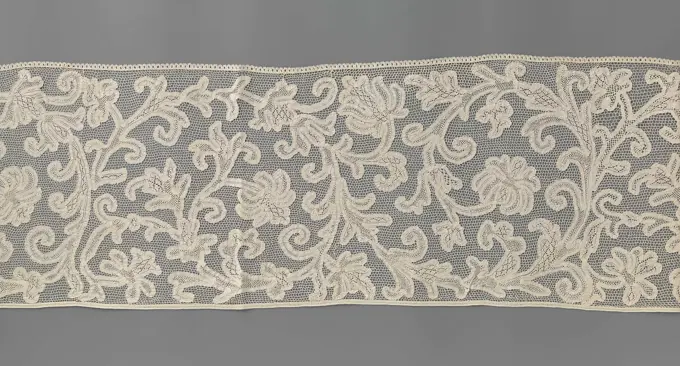
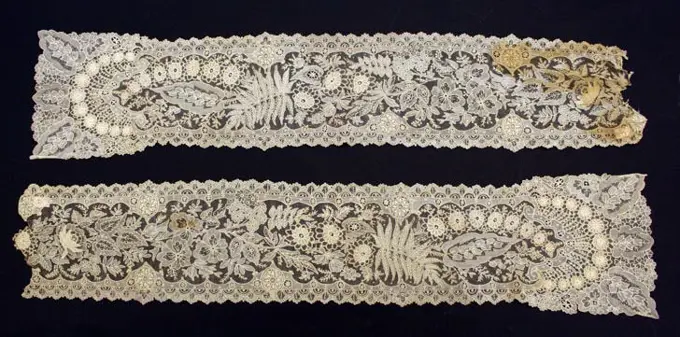
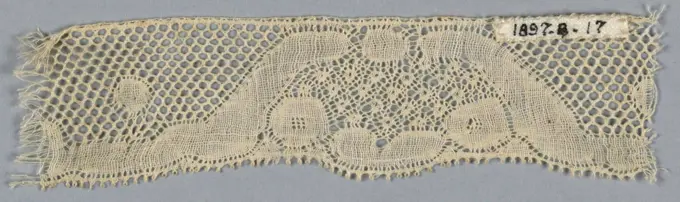
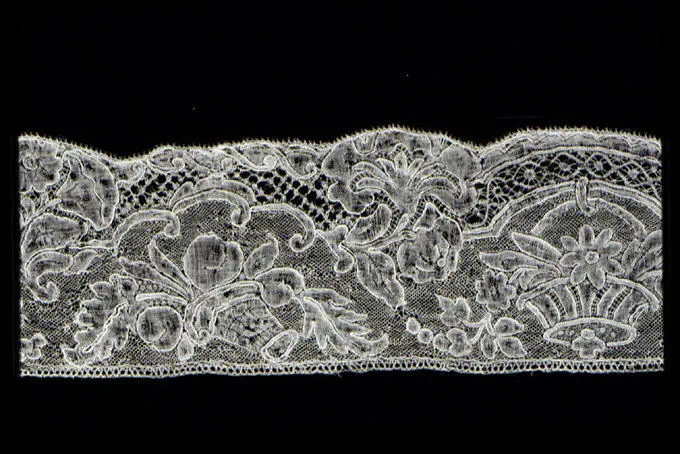
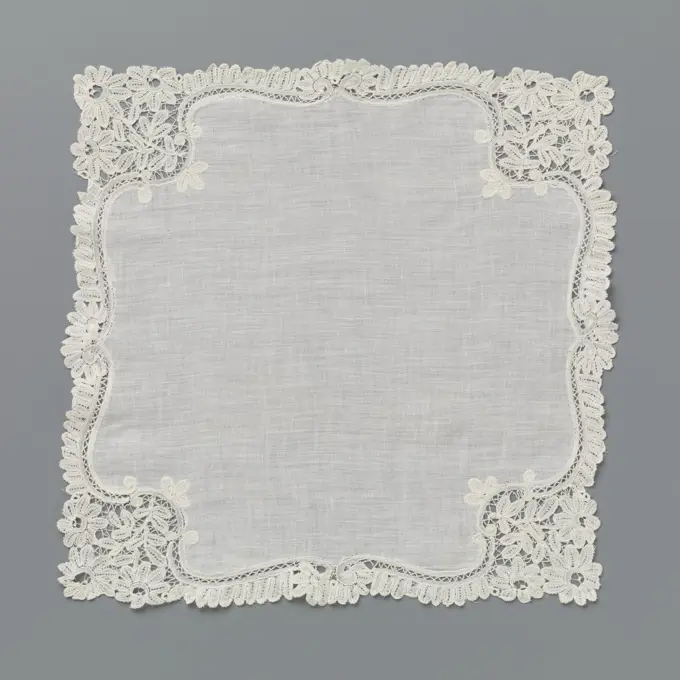
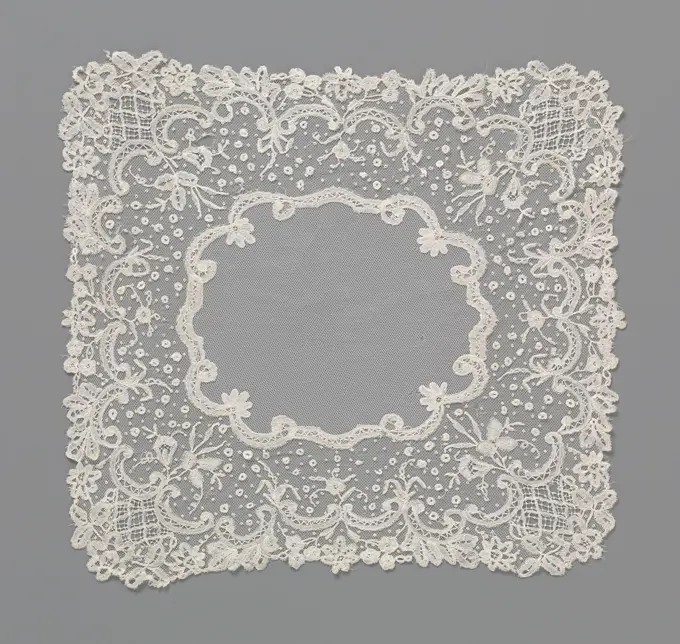
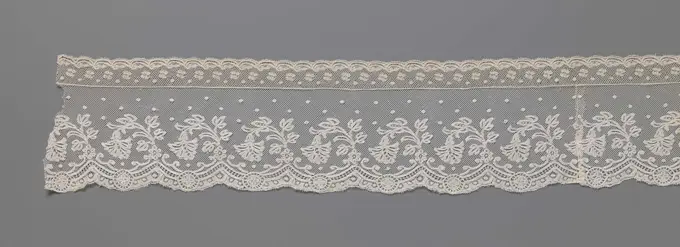
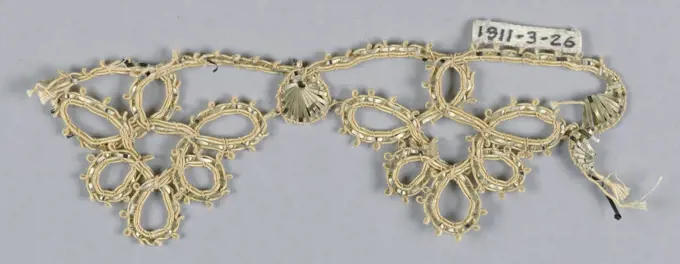
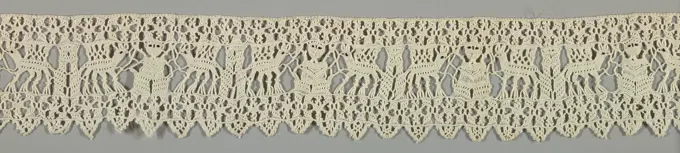
Strip of needle side with hanging clocks between C-volutes, anonymous, c. 1860 - c. 1870 Strip of natural -colored needle side: Brussels mesh side. The repeating and largely symmetrical pattern consists of a hanging clock contained between lying C-Voluten. Three rosette flowers hang under the clock. Federed leaves hang under the C-Voluten. In the field above the C-Voluten, an as-symmetrical bouquet with a rose originates. The motives are made up of feston stitches and are accentuated by relief contours. Decorative stitches have been used in the clock and C-Voluten. The motifs are connected by a mesh soil, a mesh side strewn with mushes. The top is straight finished with a messing strap. The scrap edge stems from the pattern with the hanging rosette flowers and feathered leaves and is finished with picots. Brussels linen (material) Brussels Gaze Point Strip of natural -colored needle side: Brussels mesh side. The repeating and largely symmetrical pattern consists of a hanging clock cont
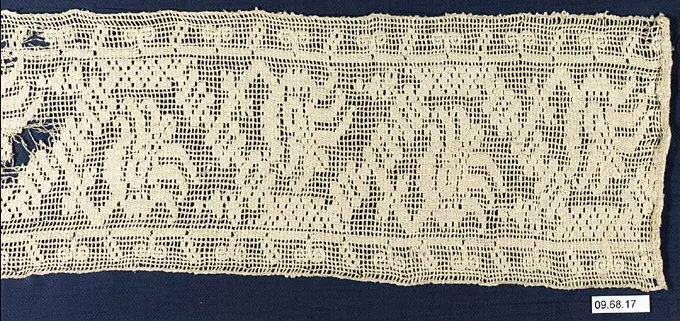
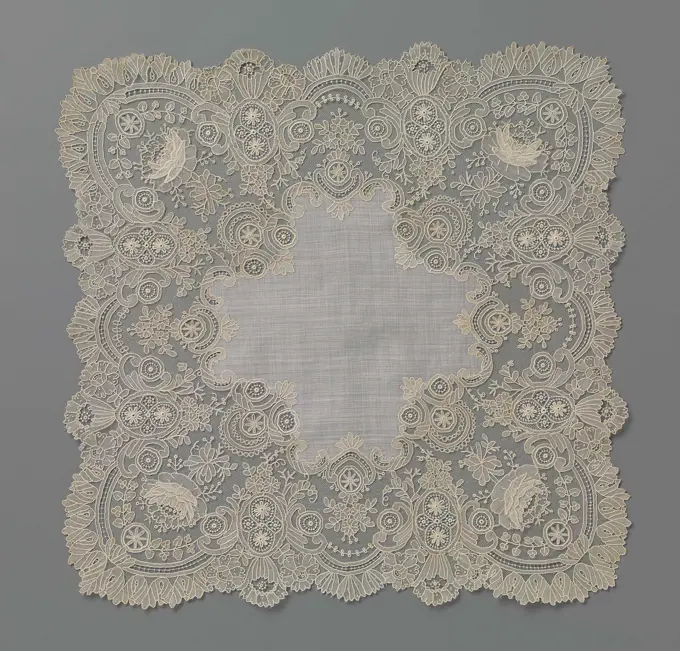
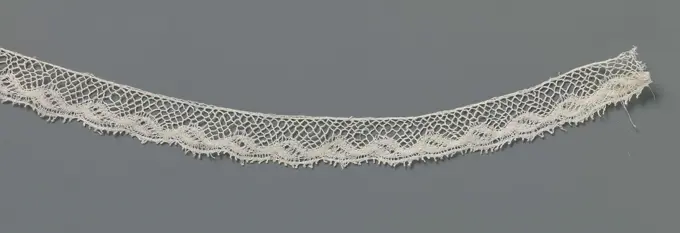
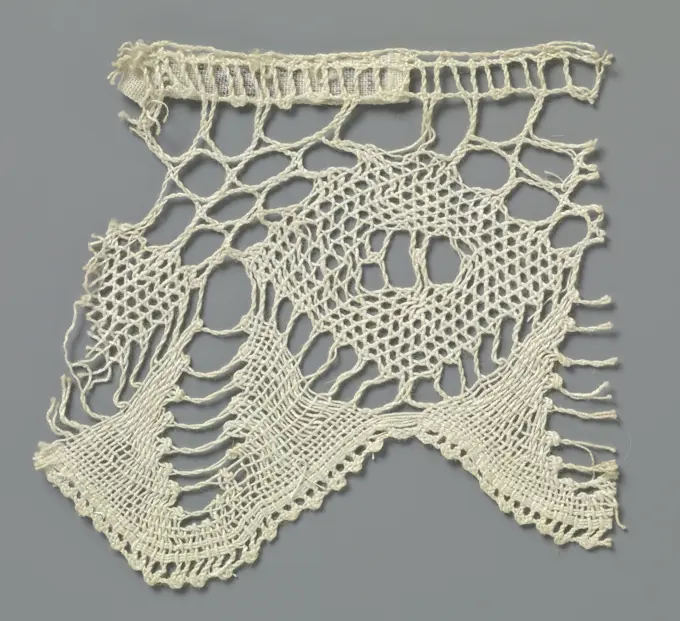
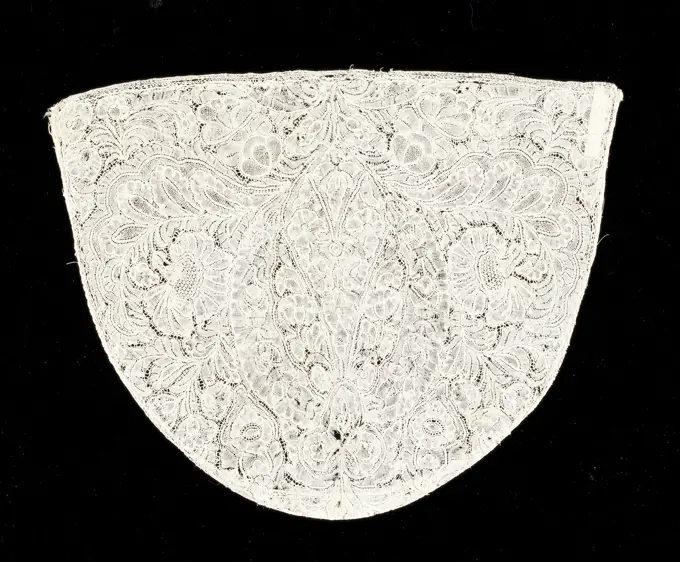
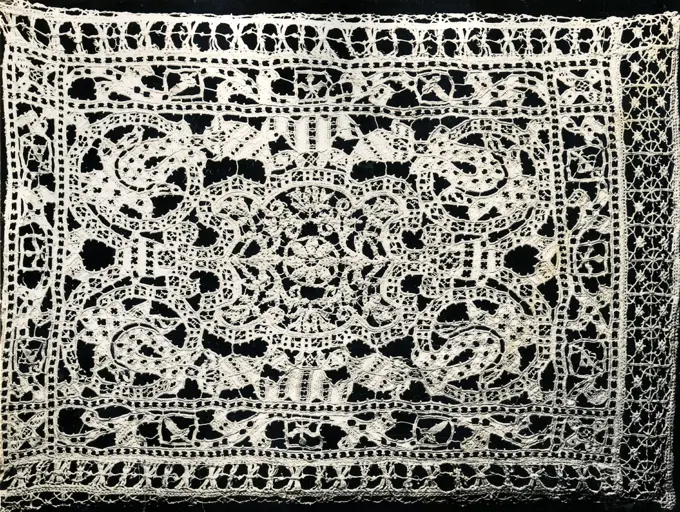
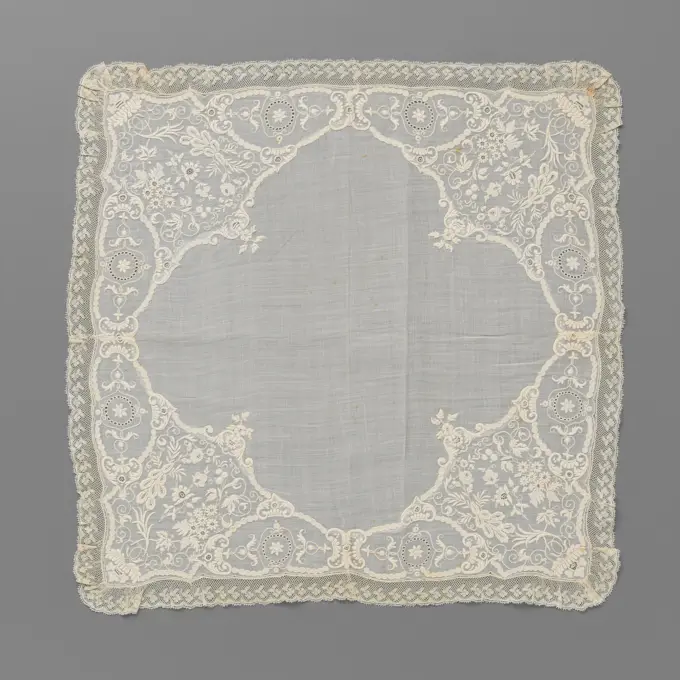
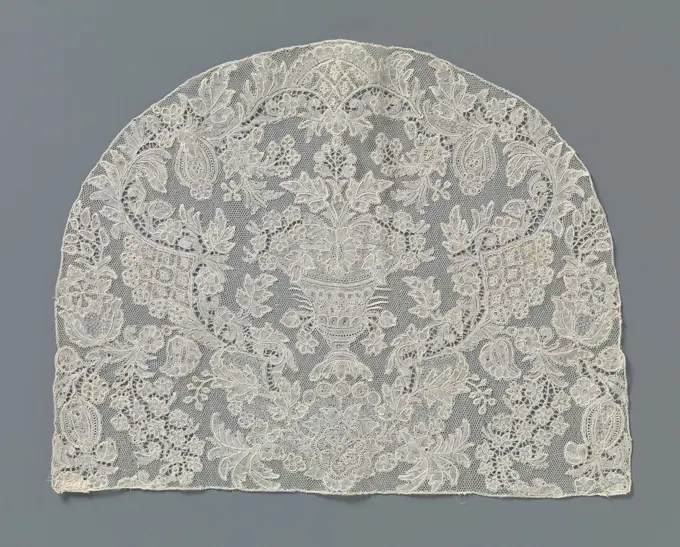
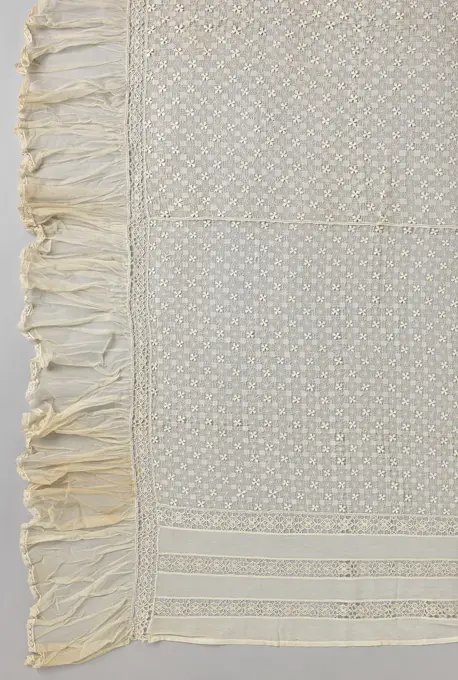
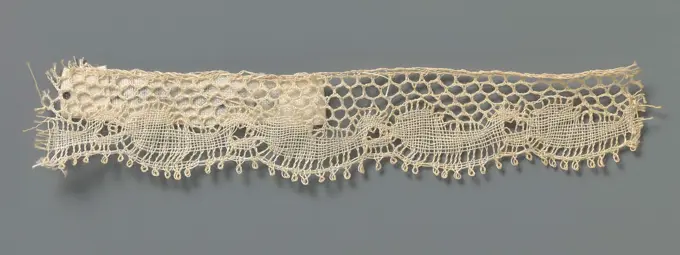
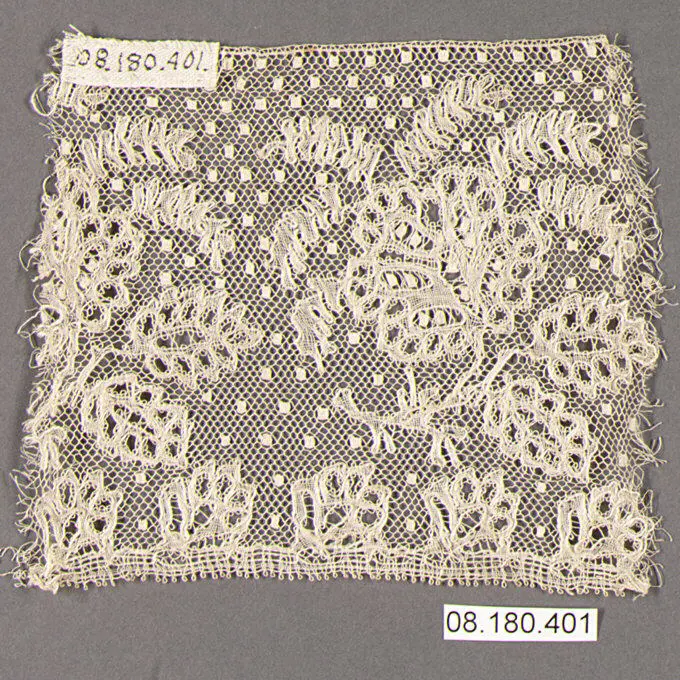
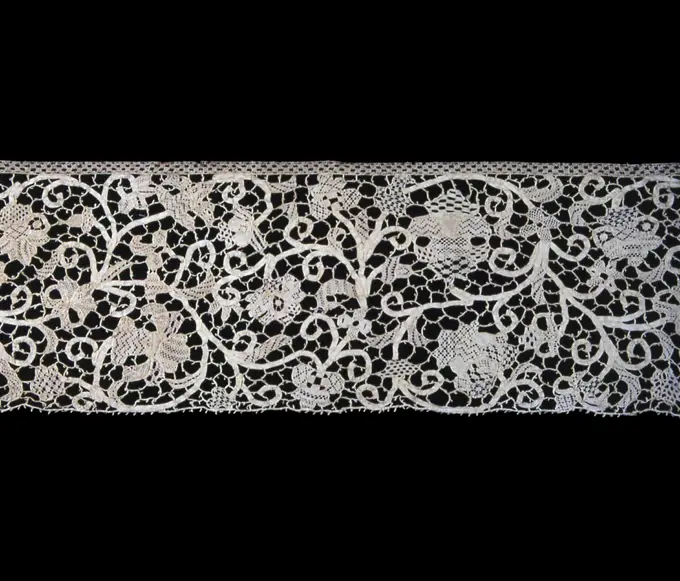
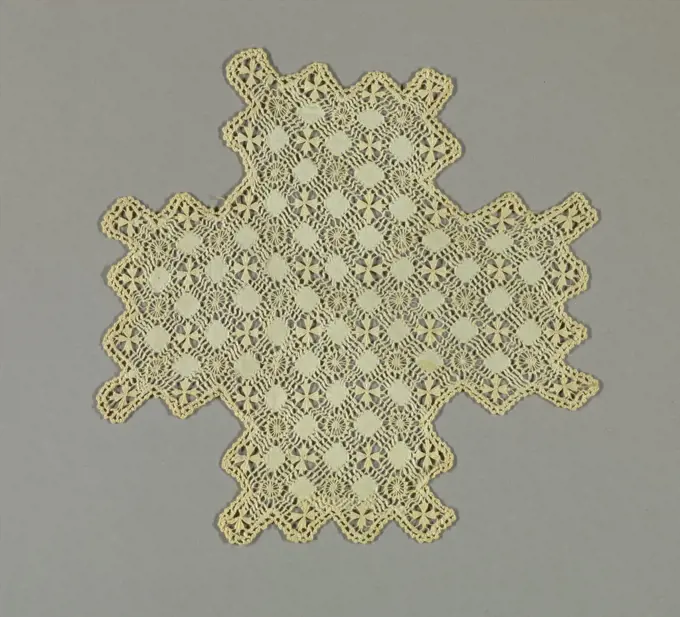
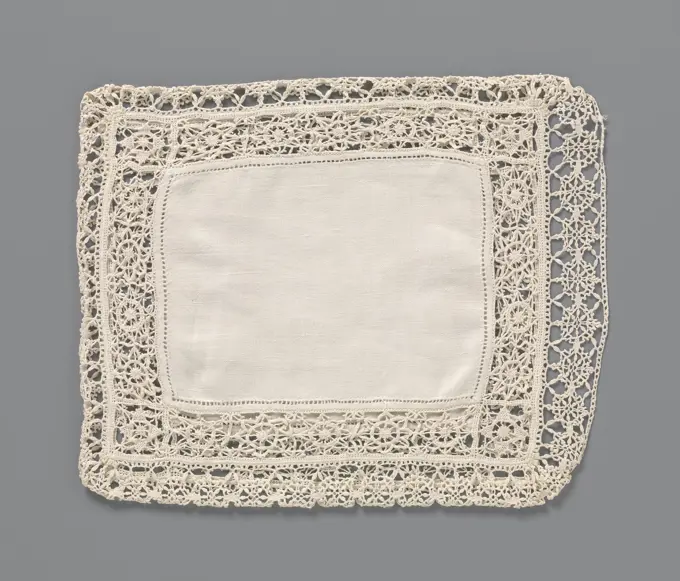
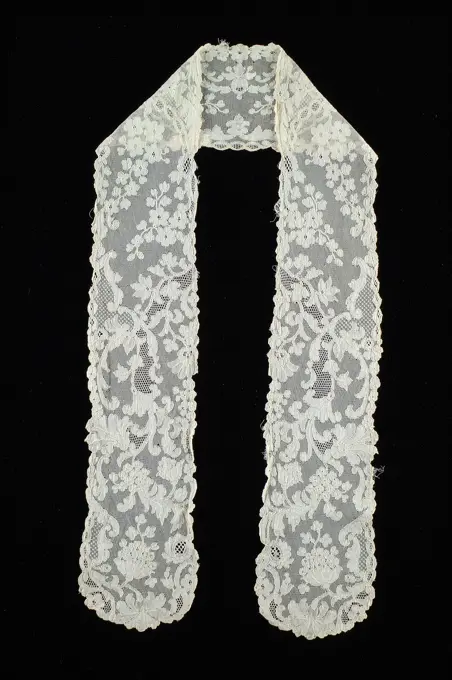
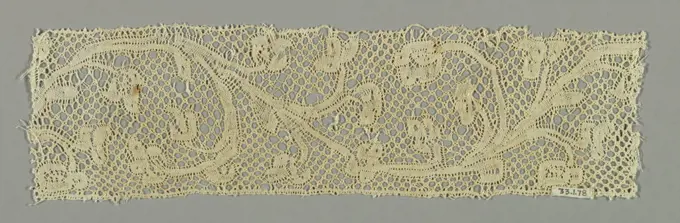
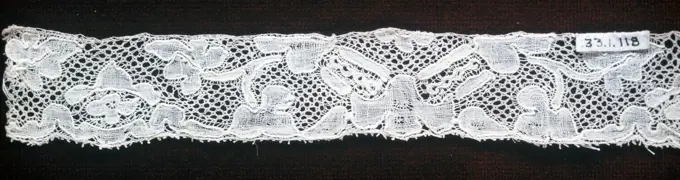
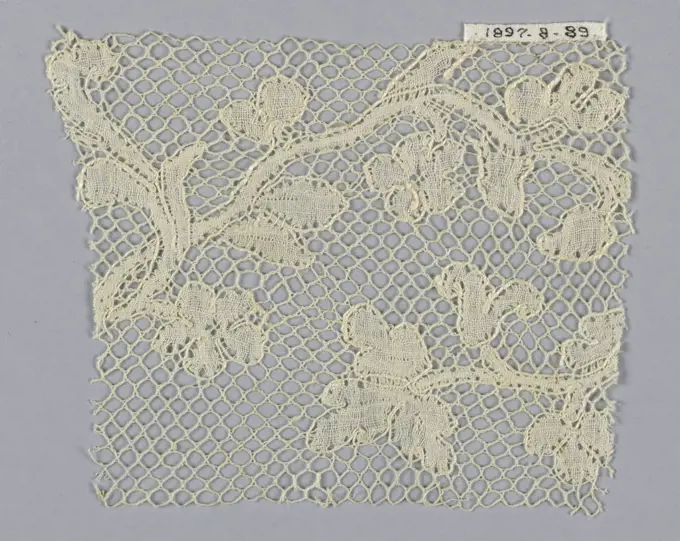
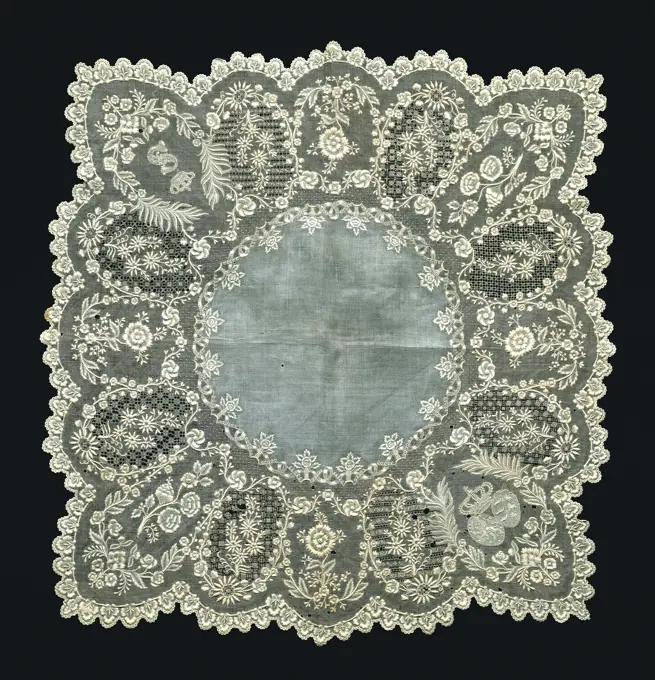
Scarf from edge embroidery and etc. with stripes. Natural machine tulle scarf with mechanical side embroidery and etchant. Elongated rectangular model. Pattern with three continuous longitudinal stripes made with a faint wavy thin rank to which varied fine leaves and one cutter rosette. In the tracks between the stripes are separate cherry branches on a regular distance. At the ends the scarf is finished with a richly decorated and opened symmetrical pattern with three large rosette flowers and C volutes. Along the long sides, a regular tube edge along which a bow garrier runs with open-worked rosettes.Strip bobbin with connected three -lobe leaves, anonymous, c. 1800 - c. 1899 Strip of natural-colored bobbin, Buckingham side. The repeating and continuous pattern forms a wide track over the center line of the strip. It consists of a succession of lying three -lobe leaves with a circle at the base. The lobes are made in linen battle, each circle consists of a Siermaas. A thick and shiny contour thread runs around both lobben and circle. Up and below the circle is a loose square mush, made in form. The motifs are connected by a Maas soil, a tuler land. Top and bottom of the strip are straight. Buckingham cotton (textile) bobbin lace / Bucks point (lace) Strip of natural-colored bobbin, Buckingham side. The repeating and continuous pattern forms a wide track over the center line of the strip. It consists of a succession of lying three -lobe leaves with a circle at the base. The lobes are made in linen battle, each circle consists of a Siermaas. A thick and shiny contour thread runs arouBorder, Medium: linen Technique: withdrawn element work with needle-made fillings and embroidery plus macramé, Wide border of openwork edged at one side with a macramé border with deep triangular pendants., Italy, 17th century, knotted, knitted and crocheted textiles, BorderHeadscarf. Culture: Russian. Date: first quarter 19th century. Museum: Metropolitan Museum of Art, New York, USA.Strook gemengde kant voor een superplie met brede spiraalrank.Strip natural-colored mixed side: Mezzo Punto. On a Maas soil (coniferous lace) is a wider, running rank with left and right spirals, to which many branches with volutes and very large palmet flowers on the tops. A splitting bow rim serves as a finish along the straight exterior. The strip is used or intended for a superplie.Fragment, Medium: linen, silk Technique: embroidered, bobbin lace, Fragment of a woven linen band showing design of octagons containing heraldic crosses. These are connected by smaller squares containing eight-pointed stars. Narrow border of small flower sprigs and scalloped bobbin lace. Embroidered in yellow silk with dark blue used for outlines., possibly Italy, possibly Spain, 18th century, embroidery & stitching, FragmentStrip with hanging triangles that form scallops, anonymous, c. 1885 - c. 1899  Strip of natural -colored bobbin. The repeating pattern consists of hanging triangles that form a scrap edge. The triangles consist of a vertical center line made in shape with two ribs. Funnel -shaped motifs are connected to this, which are piled up from the bottom to top of the center line and form the two long sides of each triangle. The funnel -shaped motifs are made in shape with five ribs. The exterior of each triangle is finished with a double row of arches, made with picoted braids. The top of the strip is straight finished. Volvic linen (material) bobbin laceFragment (France); silkFragment Made 1675-1725 Italy. Linen, bands of knotted square netting embroidered in cloth stitch; inserts of linen, plain weave; cut work embroidered in buttonhole, four-sided, and squared ground stitches; buttonhole bars and rings and bullion picots .Strip 16th century Italian. Strip 220854Strip bobbin with lying flower branch in shell with rosette flowers, anonymous, c. 1850 - c. 1899 Strip of natural -colored bobbin: Mechelse side. The repeating pattern consists of a horizontal flower branch with different types of flowers. Each successive branch is right above an elongated leaf in a shell in a faintly bent sculpt. A succession of rosette flowers runs along the scrap edge. The motifs are connected by a fine Maas soil, a Mechelen soil. The motifs are made in linen battle with thicker and shiny contour threads. In the openwork flower hearts, cubes are made in shape. The top of the strip is straight finished. The scrap edge is finished with picots. The short sides are finished with a zoompje. Belgium linen (material) bobbin lace / Mechlin (lace) Strip of natural -colored bobbin: Mechelse side. The repeating pattern consists of a horizontal flower branch with different types of flowers. Each successive branch is right above an elongated leaf in a shell in a faintly bent scBorder ca. 1600 Italian or German. Border 217949Handkerchief with a border of needle side with eight oval. Handkerchief with an edge of natural needle lace, Brussels mesh edge. Around a small, cross-shaped batters, a lace edge with eight deep slopes. These are separated by eight, in c-voluten, standing ovals, in which, among other things, closed worked asterisks occur. The shelters are formed by 'railways', which depend on dicks and double, stoped acanthus leaves. There is a chalis flour among the ovals between two roses. In the corner shelter there is always a rose with triple relief leaves. Small C-Volutes form the inner edge.Fragment, Medium: linen Technique: withdrawn element work, Fragment of a band in white with a blue embroidered snowflake pattern., Italy or Spain, 16th-17th century, lace, FragmentStrook kloskant met golvend bandje.Natural collate strip, Valenciennes side. Along the bottom of the strip a wavy band runs that the slight regular schulls forms. Above the strap, the strip consists of a maas soil, a diamond-shaped valenciennes ground. The FOOL (the strap) is made in linen stroke with openwork edges and a recess in the middle where crossing couples are concerned for an ornamental filling. The top of the strip is straight finished. The shelters along the underside are finished with picots.Bobbin Lace Edging, 16th-17th century. Spain, Huelva, 16th-17th century. Lace, bobbin; average: 12.7 x 10.8 cm (5 x 4 1/4 in.).Lappet late 19th century Belgian. Lappet 117466Strip of bobbin with diamond and fan -shaped scales, anonymous, c. 1800 - c. 1899 Strip of natural -colored bobbin, straw side. The repeating pattern consists of a window on the center track. Between the successive windows there is always a fan -shaped shell down, with an openwork vertical track. The windows are connected to each other along the top by a coarse Maas soil, a Paris soil. The windows are made in Netslag and the fans in Linnenlag. The top of the strip is straight finished. The scums are finished with picots. Brazil linen (material) Bobbi lace / lace cloth Strip of natural -colored bobbin, straw side. The repeating pattern consists of a window on the center track. Between the successive windows there is always a fan -shaped shell down, with an openwork vertical track. The windows are connected to each other along the top by a coarse Maas soil, a Paris soil. The windows are made in Netslag and the fans in Linnenlag. The top of the strip is straight finished. The scums are fiCap back, 18th century, D.7-1/2 in., Linen; bobbin lace (Point de Angleterre), Belgium, 18th centuryGalloon. Culture: Italian or French. Dimensions: 11 7/8 x 2 inches30.2 x 5.1 cm. Date: 17th-18th century. Museum: Metropolitan Museum of Art, New York, USA.Fragment early 17th century Italian Punto in arialiterally, "stitches in the air"is one of the earliest styles of needle lace, which is itself developed from cutwork of primarily geometric design. When lacemakers transitioned to using a foundation of threads laid out according to a pattern drawn on parchment, they were able to incorporate more fluid lines and curves into their designs.. Fragment 230797Pillow Cover Made 1590-1610 Italy. Linen, plain weave, front embroidered in buttonhole, double hem, hem, overcast, and satin stitches; couching and eyelet holes; cut and drawn work with needle lace filling stitches; sides (replacement) 3 strips of cut and drawn work embroidered in buttonhole, coral, hem, and needle lace filling stitches; back center panel plain weave with cut and drawn work embroidered in double hem, hem and needle lace filling stitches; center panel is a symmetrical scrolling floral motif; inner borders combine geometric and scrolling floral patterns outer borders geometric patterning .Black bobbin gloss strip with oval cartouches and roslingers, anonymous, c. 1860 - c. 1880 Black bobbin jelly strip: Chantilly side. The strip is intended or used for under a skirt, the two short sides are sewn together. The repeating pattern consists of an oval cartouche around the center line of the strip, crowned by two roses and a few leaf branches. At the bottom of the cartouche, three long spring -shaped leaves are hanging. The underside of these leaves form part of the scrap edge. The successive oval cartouches are connected by a wide V-shaped decorative band. In the field littered with square Mosjes above, there is a bouquet with roses of which side branches touch the roses above the cartouche and thus the top of the pattern with a rose garland. Three garlands hang between the cartouches under the decorative band. From top to bottom: three large roses with leaves in between; a succession of simple rosette flowers; A succession of five heart -shaped motifs, including fan motifs.Bobbin Lace Insertion without Selvage, late 16th century. Italy, Venice, late 16th century. Lace, bobbin; average: 4.8 x 17.9 cm (1 7/8 x 7 1/16 in.).Needlepoint and Bobbin Lace Cuff, 20th century. Belgium, Brussels, 20th century. Lace, needlepoint and bobbin: linen; average: 12.1 x 27.1 cm (4 3/4 x 10 11/16 in.).Silk bobbin lace collar early 19th century Spanish. Silk bobbin lace collar 218345Batist handkerchief with embroidery in every corner with multi -type flowers in a shield -shaped cartouche, anonymous, c. 1860 - c. 1870 Natural Batist handkerchief with embroidery - Whitework with plumetis and shade work - and finished all around with a strip of bobbin: Valenciennes side. The embroidery fills each angle to the center of each side, leaving a diamond -shaped piece of unprocessed batist in the center. The embroidery pattern is the same for every corner and consists of a cartouche with pearl edge in the form of a coat of arms, containing various flower species and fine curling lines. The shield is flanked on both sides by an oval cartouche with pearl edge, in which a circle with seven -leaf flower is central and around fine curling lines and curling of feathered leaves around it. The strip of bobbin has a repeating pattern of a hanging flower above a lying arc. The horizontal arcs form a scrap edge that is finished with picots. The motifs are made in linen battle with opeBorder Spanish, Tenerife 19th centuryHats globe of climbing side with flower vase. Hats globe of natural-colored Brussels climbing side. Symmetrical pattern. In a large lobby cartouche is a large flower vase, on a foot and filled with flower branches, large leaves and a middle rosette. The cartouche shows an open zigzag contour, which overflows in a fine flower drink. On the outside there are three impeller-shaped cartouches decorated with very rich grid work, as well as a very large wear, in the middle of the bottom. As ornamental grounds, snowflakes are applied. Upstairs two pumpkins hang in the cartouche, down two in the corners to blossom branches, sprouting in the cartouche.Fragment; linenFragment of the lace;  2. PO. 19th century (1851-00-00-1900-00-00);Cap mid-19th century American. Cap 98040Collar 17th century Italian or French. Collar 218085Cap crown. Date/Period: 1700-1750. Cap crown. Medium: linen. Technique: bobbin lace. Author: UNKNOWN.Lace, maker unknown. Acquisition history unknown.Volant from dick side with diamond-shaped medallions. Volant of natural colosside: Parisian side. The ground has been shared in two in a paris soil with clover leaves at the top and a tulet below. In the last one is a symmetrical pattern of diamond-shaped openwork medallions with sidewalks crowned by a flower between two leaves. The leaves, the side drinks and a series of flowers and ranks in the sculpture are released in three closed garlands. The motifs are made in linen stroke and equipped with contour wires. A rose soil has been applied as ornamental ground. BK-BR-J-375-G and -I are sewn together in the length. A portion of the bottom edge is a portion of both strips, only at -i is a small portion of the bottom edge undamaged.Blouse Pieces (Philippines); piña (pineapple) fiber, cottonCollar of needle side with radiant -growing branches, anonymous, c. 1700 - c. 1720 Collar of natural -colored needle side: Venetian rose side. Curved strip -shaped model. The pattern consists of curling tendrils, with splitting stems on which leaves, flowers and C-volutes. Different ornamental grounds are used in leaves and flowers. Most motifs are equipped with relief contours and in particular the larger flowers are fitted with thick cordons decorated with fine picots. The motifs are connected by a bar with radar picots. The top is straight finished with a narrow track in which a different pattern of crosses and circles is standing. The underside is finished with a scrap edge of alternately small and larger sculptures, which turn into the middle pattern without separation. The scrap edge runs along the two sides with a silly bend. Venice linen (material) Venetian rose point Collar of natural -colored needle side: Venetian rose side. Curved strip -shaped model. The pattern consists ofSuspension of lace with males cross and sun motifs. Spray from side. Midfield with Point Coupé and edges of Cluny cluster side. The fine linen batist shows largely tipped squares that are filled with open embroidery sign. Pattern: Small squares are stored in the linen that are connected to loose weft and warp threads. Intermediate large open squares exhibit an evenings of MasterZerkruis and a radiant sun. A strip of open tissue, regularly interrupted by three entre-deux runs along top and bottom. On the sides, a Entre-deux and a wide wrinkled strip of tulle is finished with an edge of Cluny side.Strook kloskant met cirkeltjes en komma's langs onderzijde.Natural collate strip, Valenciennes side. The continuous pattern exists along the underside of the strip from a concatenation of a circle and a horizontal comma. Above the strip consists of a Maas soil, a round valenciennes ground. The motifs are made in detached linen stroke with openwork edges. The top of the strip is straight finished. The shelters along the underside are finished with picots.Fragment early 19th century Dutch, Lille. Fragment 214753Strip of needle side with small dense and large open circles, anonymous, c. 1900 - c. 1949 Strip of natural needle side - reticella - between edges open sewing: work with pulled out threads. The repeating and symmetrical pattern consists of one row of squares, which are made up of four small squares. Each large square has been crossed, at every intersection alternating a small closed and a large openwork circle. Demizes along the edges. The top and bottom of the strip are straight finished with open diamonds (work with threads pulled out). unknown cotton (textile) Strip of natural needle side - reticella - between edges open sewing: work with pulled out threads. The repeating and symmetrical pattern consists of one row of squares, which are made up of four small squares. Each large square has been crossed, at every intersection alternating a small closed and a large openwork circle. Demizes along the edges. The top and bottom of the strip are straight finished with open diamonds (work Strip crocheted side with five -pointed stars and flowers made with open circles, anonymous, c. 1890 - c. 1909 Part of a strip of natural -colored Irish crocheted side. The original, repeating, pattern consists of a double row with a total of eight triangular floral motifs made with open circles, interspersed with one five -pointed star with a circle in the middle and a circle on each point. Crochet irregular mesh soil with picots. At the top and bottom are finished with a straight edge. Ireland cotton (textile) Part of a strip of natural -colored Irish crocheted side. The original, repeating, pattern consists of a double row with a total of eight triangular floral motifs made with open circles, interspersed with one five -pointed star with a circle in the middle and a circle on each point. Crochet irregular mesh soil with picots. At the top and bottom are finished with a straight edge. Ireland cotton (textile)Needlepoint (Reticella) Lace Cuff, second half of 16th century. Italy, Genoa, second half of 16th century. Lace, needlepoint; average: 7.4 x 24.2 cm (2 15/16 x 9 1/2 in.).Border Made 1675-1700 England. Linen, needle lace with woven tapes .Doily, Medium: linen Technique: withdrawn element, Drawn work doily in the shape of a cross with geometric filling stitches., Mexico, 19th century, lace, DoilyCap crown second quarter 18th century Flemish. Cap crown 212541Cravat (one of a pair) 18th century French. Cravat (one of a pair) 223016Lappet ca. 1700 French. Lappet 218198Fragment of lace mid-18th century Flemish, Mechlin. Fragment of lace 213029Fragment, Medium: linen Technique: needle lace (reticella), Rounded tab of reticella with design of concentric circles and triangles., Italy, 16th century, lace, FragmentCushion cover of linen with an intermediate creature of reticella and an intermediate creature from Kloskant, Anonymous, c. 1900 Cushion cover of linen with an intermediate installation of needle side- Reticella and an intermediate creature from Kloskant with a reticella appearance. Pattern with squares in which star flowers and radio motifs on straight and diagonal lines. The motifs in the needle side are made with feston stitches and are connected by a bar soil. The bobbin motifs are made in linen and in shape and they are connected by braids. Italy (possibly) linen (material) bobbin lace Cushion cover of linen with an intermediate installation of needle side- Reticella and an intermediate creature from Kloskant with a reticella appearance. Pattern with squares in which star flowers and radio motifs on straight and diagonal lines. The motifs in the needle side are made with feston stitches and are connected by a bar soil. The bobbin motifs are made in linen and in shape and they are Stole first quarter 19th century British. Stole 169149Collar ca. 1860 Belgian. Collar 169328Fragment (Belgium); linenChalice cover. Date/Period: Late 17th-early 18th century. Chalice cover. Medium: linen. Technique: needle lace. Author: UNKNOWN.Edging French, Arlauc 19th centuryBorder, Medium: linen Technique: bobbin lace, Binche style with Binche ground, possibly Italy, 18th century, lace, BorderStrip bobbin with coarse three -leaf, anonymous, c. 1875 - c. 1899 Strip of natural-colored bobbin: Duchesse side. On a very open braiding soil there are one-sided, targeted serpentine branches with an anemone and a large Drieblad, which alternately form the unequal sculpts. Netherlands cotton (textile) bobbin lace Strip of natural-colored bobbin: Duchesse side. On a very open braiding soil there are one-sided, targeted serpentine branches with an anemone and a large Drieblad, which alternately form the unequal sculpts. Netherlands cotton (textile) bobbin laceStrip bobbin with windows under zigzag line, anonymous, c. 1800 - c. 1899 Strip of natural-colored bobbin, Buckingham side. The repeating pattern consists slightly above the center line of the strip of a zigzag line, with a succession of windows underneath. The motifs are connected to each other at the top by a Maas soil, a tuler land. The Zigzag line and the center of each window is made in Linnenlag, with a recess in every window. Thick and shiny contour threads do not run around the fullwork. They form a decorative band of circles and loops in the rose soil around the windows, which has been used here as a decorative land. The top of the strip is straight finished. The scrap edge along the bottom is finished with picots. Buckingham cotton (textile) bobbin lace / Bucks point (lace) Strip of natural-colored bobbin, Buckingham side. The repeating pattern consists slightly above the center line of the strip of a zigzag line, with a succession of windows underneath. The motifs are connecBatist handkerchief all around with bobbin side with zigzag bacbolades and a flower branch with three daisies in every corner, c. 1890 Natural -colored batist handkerchief finished with natural -colored bobbin: fine brugs flower arrangements. The batist is cut into accolade shape on each side, just like the shape of the side. Each burst of accolade consists of two zigzag decorative frames in an elongated silly S-shape. This contains a succession of half ovals, arches or leaves, which form the scrap edge. In each corner there is a flower branch with oval leaves and three daisies that form the sculpes in the corner. The flower branch originates from a C-Volut under which a three-lobe flower hangs that is attached to the batist. The motifs are made in linen battle with thick contour lines. The veins of (flower) leaves and arches are made with recesses in which crossing pairs can be seen. The flowers are connected by a braid ground. The openwork flower hearts are each decorated with a blocBobbin Lace Insertion, mid 16th century. Italy, Venice, mid 16th century. Lace, bobbin; average: 6.1 x 14.3 cm (2 3/8 x 5 5/8 in.).Kussendek van applicatiekant.Kisseneck of application office: dick side with a single needle stitch appliqued on machining. In the corners the pattern has a flower branch above two C volutes, with a filling pattern, flowers and leaves below. In the middle of the sides, the pattern has C-Votting with flowers and leaves. The ground is littered with large and small meadows.Strook kloskant met viervoudige moesjes.Natural collate strip, Valenciennes side. Repetitive motif from a flower made with a quadruple moot. Santa above the flour is a single mouth. Slight sculpture with decorative tires. The top is finished with a straight edge. Originally this strip was one of the parts of a strip, which consisted of nine separate parts. However, six of these loose parts are sewn together: BK-B-J-274-A, -C, -d, -e, -f, -g. In 1966 on the top of the long strip that has arisen, then a wide strip with another pattern set: BK-B-J-267.Upholstery trimming, Meduim: silk, copper strips Technique: woven, Trimming of gray and white silk cord and flat copper strips twisted into an ornamental design of loops., USA, ca. 1902, trimmings, Upholstery trimmingFragment 18th century French. Fragment 218767Strip bobbin with hanging flour on branch, anonymous, c. 1850 - c. 1900 Strip of natural-colored bobbin: Valenciennes side. Above a scalloped edge with tire work, a row of hanging flower branches on a square Valenciennes ground. Belgium linen (material) Bobbi Lace / Valenciennes Lace Strip of natural-colored bobbin: Valenciennes side. Above a scalloped edge with tire work, a row of hanging flower branches on a square Valenciennes ground. Belgium linen (material) Bobbi Lace / Valenciennes LaceBobbin Lace (Needlepoint Design) Insertion with Fringe, second half of 16th century. Italy, Genoa, second half of 16th century. Lace, bobbin; average: 10.2 x 24.5 cm (4 x 9 5/8 in.).Box-board early 19th century Indo-Portuguese, Goa. Box-board 199971Strip crocheted side with triangular floral pattern made with open circles, anonymous, c. 1890 - c. 1909 Strip of natural -colored Irish crocheted side. A pattern with a single row of triangular floral motifs made with open circles placed against each other, randomly interspersed with triangular floral motifs with hemisons stated against each other. Limited crocheted irregular mesh soil with picots. Top finished with a straight edge. The potented scales on the underside stem from the pattern with the triangular floral motifs. Ireland cotton (textile) Strip of natural -colored Irish crocheted side. A pattern with a single row of triangular floral motifs made with open circles placed against each other, randomly interspersed with triangular floral motifs with hemisons stated against each other. Limited crocheted irregular mesh soil with picots. Top finished with a straight edge. The potented scales on the underside stem from the pattern with the triangular floral motifs. Ireland cotton (Border (Belgium); linen; 1957-190-2Fragment; linen; 1933-1-118Accessory set ca. 1890 Irish. Accessory set 168336Edging 17th century Italian. Edging 220915Fragment, Medium: linen Technique: bobbin lace (Lille-style with heavy outlining thread), Serpentine stem with leaves and flowers and Lille ground., Belgium, 18th century, lace, FragmentLappet (one of a pair) early 18th century Flemish, Brussels. Lappet (one of a pair) 222780Barbe Belgian 19th centuryEdge (Belgium); linenCap streamers, Medium: linen Technique: bobbin lace, Mechlin style, Cap streamers of Mechlin lace in a design showing repeated floral spray set within oval medallions, connected by a symmetric swirling and crossing leaf pattern, forming additional medallions containing centrally placed quatrefoil shapes., Belgium, mid-18th century, lace, Cap streamersStrook machinale kant met kruisende takken met anjers.Strip natural-colored machining. The repeating pattern consists of a double branch, with one carnate flower on each branch. One branch bends down and crosses the other branch that bends up. There are curly feathered leaves and some smaller flowers and leaves along the underside. The curly leaves form Rocaille-like fields that are filled with an ornamental ground. The motifs suggestion to be made in linen stroke and are fitted with shiny contour wires. The motifs are connected by a very fine machining tulet. The tube edge along the bottom of the strip stems from the pattern. The top is finished with a separate strap of machining.Lappet (one of a pair) early 18th century French or Italian. Lappet (one of a pair). French or Italian. early 18th century. Needle lace. Textiles-LacesFragment; silkLappet late 19th century Belgian. Lappet 169954Fragment 17th century Dutch. Fragment 212739Cap Border (USA)Scarf collar with black leaf edge. Scarf collar with an edge of natural colosside: Cluny side. A medium center piece is entirely deposited on one side on one side with a strip on one side. This shows a symmetrical pattern of matte triangles with ovals hanging in the swing of numerous, long braids and a four-blasting clock flower in points.Border Fragment (England); silkWaaierblad van zwarte kloskant met hoorn van overvloed.Range sheet of black climbing side: Chantilly side. An asymmetrical design is an asymmetrical desic on an empty ground ground. The outer edge shows C-Volutes and seed beads, filled with palisades and grid work. On the right side by the decorated right-hand outdit and starting with a volute, lies a horn of abundance with a large-coming bouquet with anemone (), Tulips, daffodil, lily and so on.Border (Italy); linenHandkerchief with a border needle side with rose bouquets in medallions on the corners and violets along the edges. Batist handkerchief with natural-colored coniferous side around a border: Brussels gauze side. Square model with an octagonal middle piece of batist and a wide edge side. There is an oval medallion in every corner with a rose booklet and radiating feathered leaves around. There is a straight decoration between the medallions with a diamond-shaped grid with a diamond-shaped grid, along the outer edge of the handkerchief, a flower row of five violets. The feathered leaves around the medallions and the violins form the slump edge. Around the batters middle piece volutes with acanthus leaves. The motifs are made up of feston stitches and equipped with relief contours. The motifs are connected to each other by a mesh side floor, with here and there mashes. Spinal applied decorative stitches in flower hearts.Echarpe from application side with cone -shaped configuration of flower branches at the ends, anonymous, c. 1835 Echarpe from Application side: Needle side Applied on Machinal Tulle. The applications are installed around the Echapre in a continuous row and at the ends. The application at each end consists of curved flower branches that form a conical configuration. There are various large and smaller flowers and leaves on the flower branches. The repeating pattern along the edge consists of an elongated leaf that is slightly bent along the edge. A relatively very small rosette flower rises from the hollow part of the leaf. Just above, a flower branch with three slightly larger rosette flowers and an elongated leaf bend over this. The sequence of curved leaves ensures a sculpe edge. Brussels linen (material) Echarpe from Application side: Needle side Applied on Machinal Tulle. The applications are installed around the Echapre in a continuous row and at the ends. The application at each Band; linen; Bequest of Marian Hague; 1971-50-233. Linen, needle lace of a type known as Point d'Argentan with buttonholed mesh ground .Handkerchief (Belgium); linenBoy collar of frivolité. Collar for a boy of natural-colored knotted side: Frivolité. Square shoulder collar, at all, with a straight and wide wrinkled strip with tubular edge. The collar closes in the middle of three small pearl knots. The pattern consists exclusively of loops in squares configurations with a circle with four loops in the center. In the Vestja, the squares in sloping rows and in the edge are in straight rows. The tube edge consists of flowers with three petals made with loops and finished with arcs.Fichu van Naaldkant with carnation and rose branch, anonymous, c. 1860 - c. 1870 A broad scalloped back piece gradually runs in pointed ends. The finely drawn edges show small C-volutes, which also frame five round medallions in the backpiece. In between are bell-shaped scales with an oval in the top, an asymmetrical rocaille medallion in the heart and a wreath of leaves along the outside. Anjer and rose branches alternate with flower garlands in the back piece. The long distance above the medallions has sown mushes of four dots each. The distance in the medallions is unadorned. Point the Gaze de Bruxelles. Brussels linen (material) A broad scalloped back piece gradually runs in pointed ends. The finely drawn edges show small C-volutes, which also frame five round medallions in the backpiece. In between are bell-shaped scales with an oval in the top, an asymmetrical rocaille medallion in the heart and a wreath of leaves along the outside. Anjer and rose branches alternate with flower gCollar 1700-1943 American. Collar 118882Handkerchief of batist with thin wavy branch of plunity embroidery and a border climbing side with three rows of mashes. Batist handkerchief with a thin wavy branch along the edges with leaves and flowers of blur embroidery. The handkerchief is finished along the edges with a strip of natural colosside: Valenciennes side. The side has a pattern of three rows of meadows in a grille, a square valenciennes ground, above a slip edge that is finished with picots.Batist handkerchief with a border mixed side with a wavy decorative border with diamonds around rose branches and an outer edge with vine leaves, anonymous, c. 1850 - c. 1870 Batist handkerchief with a rim of natural -colored mixed side: bobbin in combination with a needle -sided soil and needle side motifs. Square model with rounded corners and a round center of Batist. Pattern with an uninterrupted wavy sling of roses and rose buttons (Duchesse-Kloskant with a needle-sided soil). A wavy decorative band with diamonds and pearl edge (needle side, Brussels gauze side) is around. The outer edge is largely from the needle side with a pattern of rays -wisely sculpted wingerd leaves, which are half matte, half speckled filled. The matte parts have been hit. The cracked parts are made in linen stroke and equipped with relief contours. Very sparingly mains stroke is used in the cracked roses. Brussels (possibly) cotton (textile) mixed lace / mixed Brussels / Brussels point de gaze Batist hand. Handkerchief from natural-colored edge embroidery: work with pulled out wires and plugus on batist. A circle of an unforced batist is surrounded by sixteen lobes with work with pulled wires and plugus. In one corner there is a crowned s (for Queen Sophie, the first wife of King Willem III), in the opposite angle, the Crowned Alliance Weapon Netherlands-Wurtemberg. The remaining lobes show a pendulum, in egg shape that surrounds a very varied ornamental ground on which a flower branch is located. There are eight different ornamental grounds with diamond stitch or goose eye pattern. The shelters have a concatenation of lobed leaves along the outside.