Intricate Lace Strips

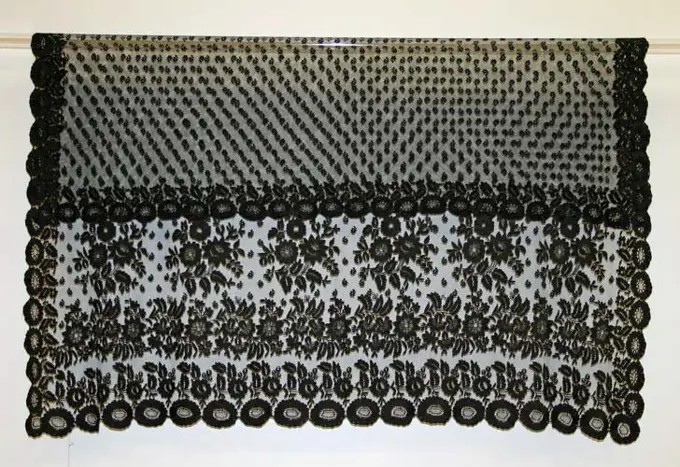
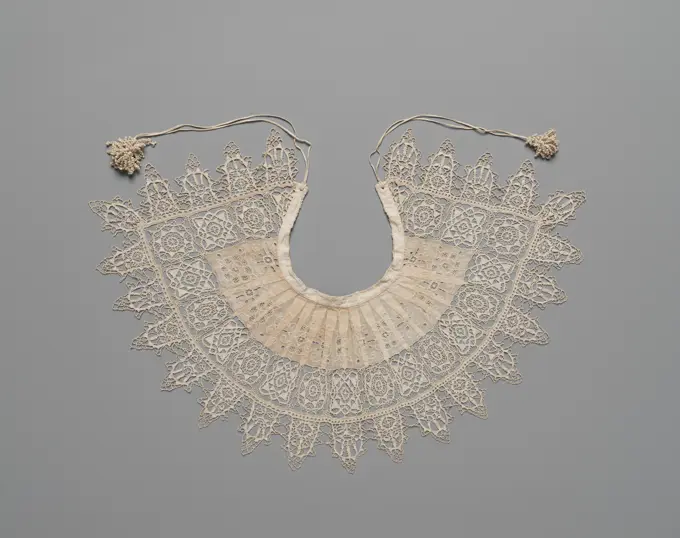
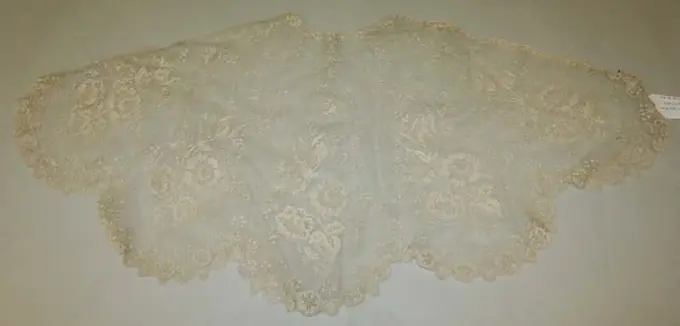
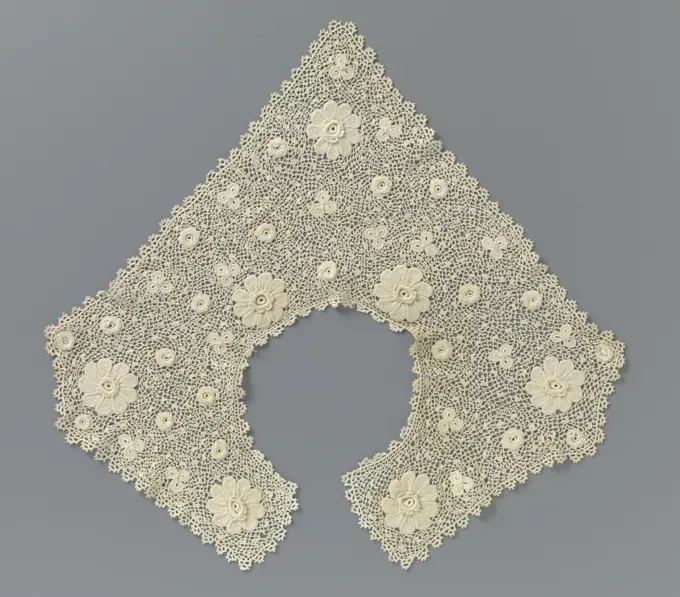
Delicate lace strips in various styles and designs, showcasing intricate patterns and craftsmanship from different historical periods.

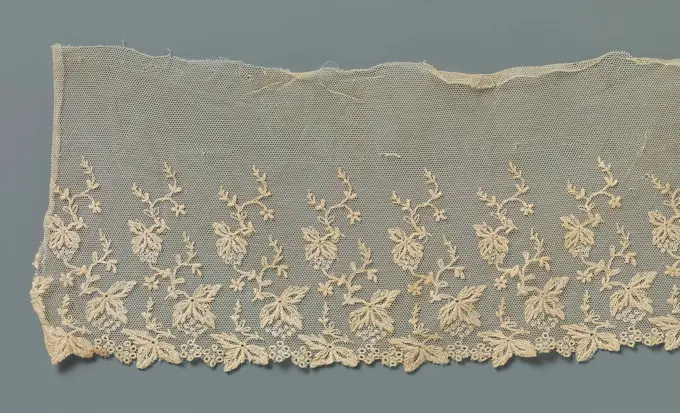
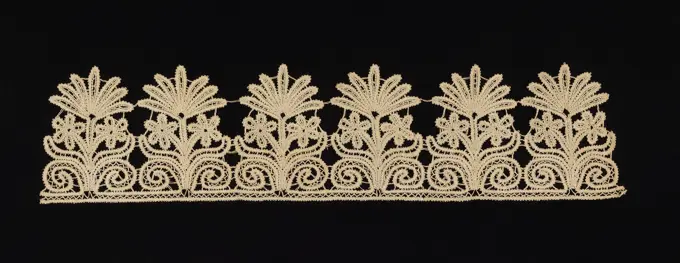
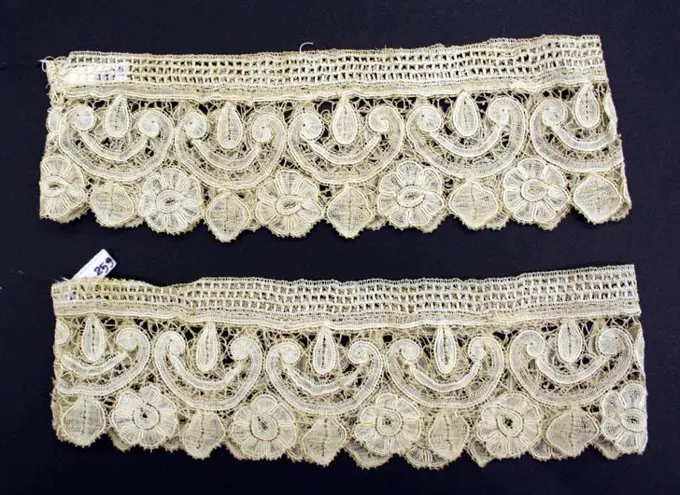
Strip of needle side with hanging clocks between C-volutes, anonymous, c. 1860 - c. 1870 Strip of natural -colored needle side: Brussels mesh side. The repeating and largely symmetrical pattern consists of a hanging clock contained between lying C-Voluten. Three rosette flowers hang under the clock. Federed leaves hang under the C-Voluten. In the field above the C-Voluten, an as-symmetrical bouquet with a rose originates. The motives are made up of feston stitches and are accentuated by relief contours. Decorative stitches have been used in the clock and C-Voluten. The motifs are connected by a mesh soil, a mesh side strewn with mushes. The top is straight finished with a messing strap. The scrap edge stems from the pattern with the hanging rosette flowers and feathered leaves and is finished with picots. Brussels linen (material) Brussels Gaze Point Strip of natural -colored needle side: Brussels mesh side. The repeating and largely symmetrical pattern consists of a hanging clock cont
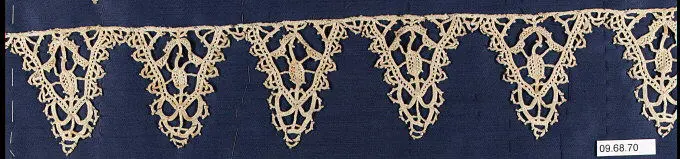
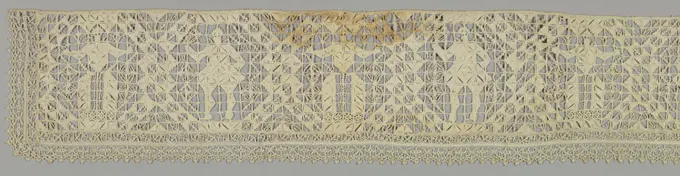
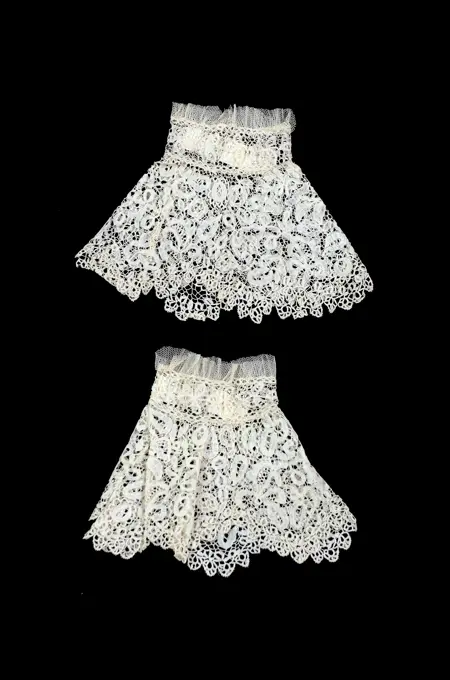
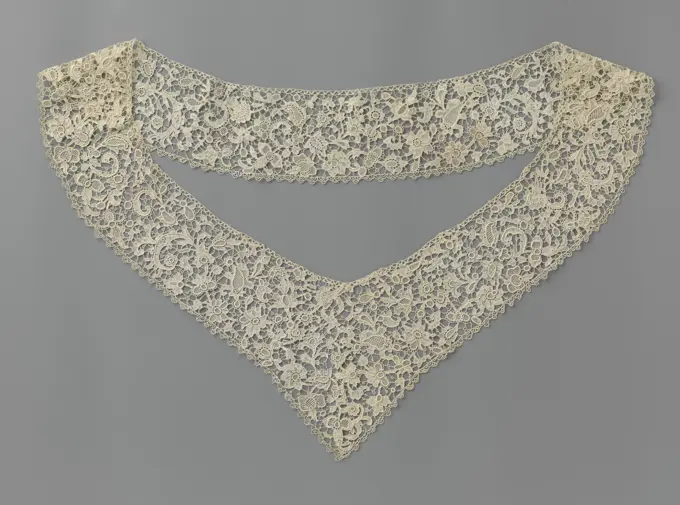
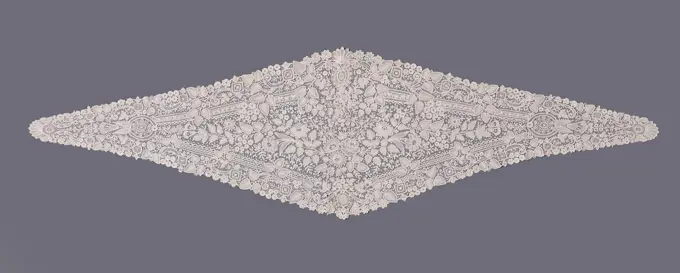
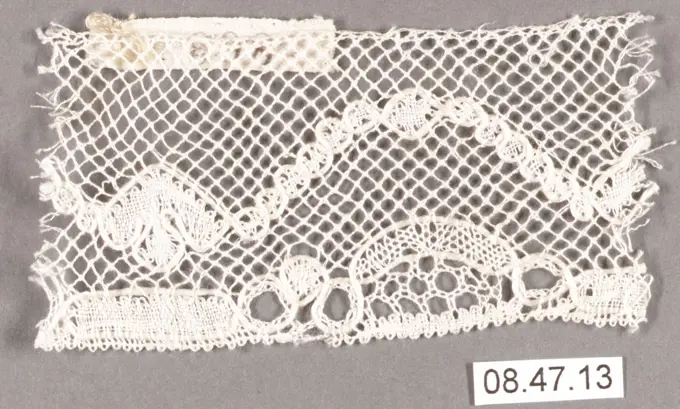
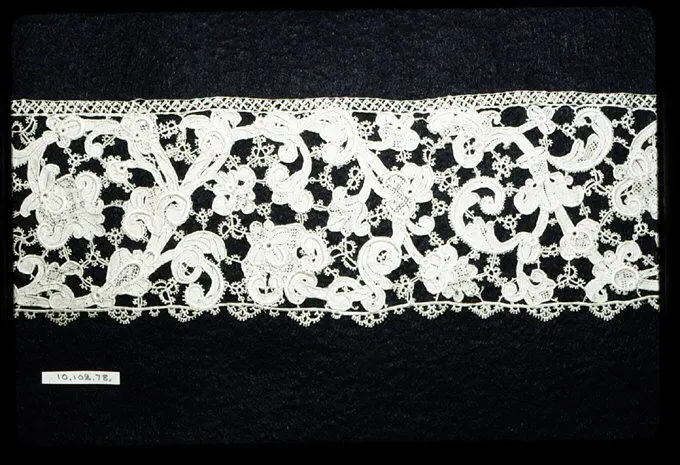
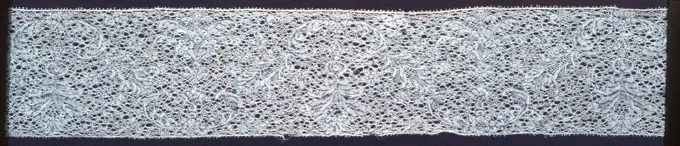
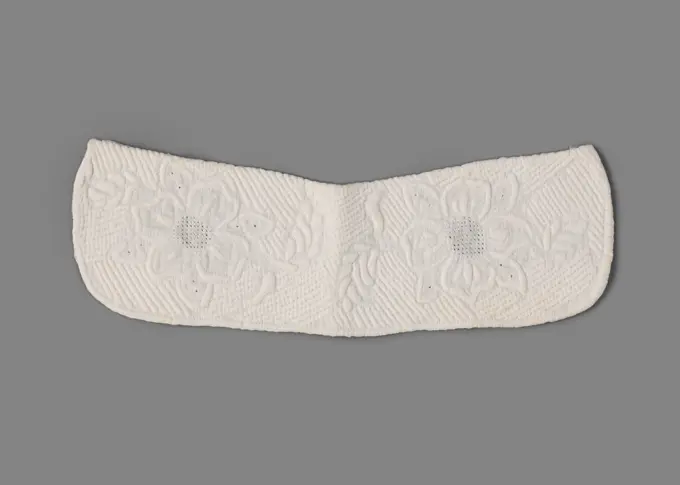
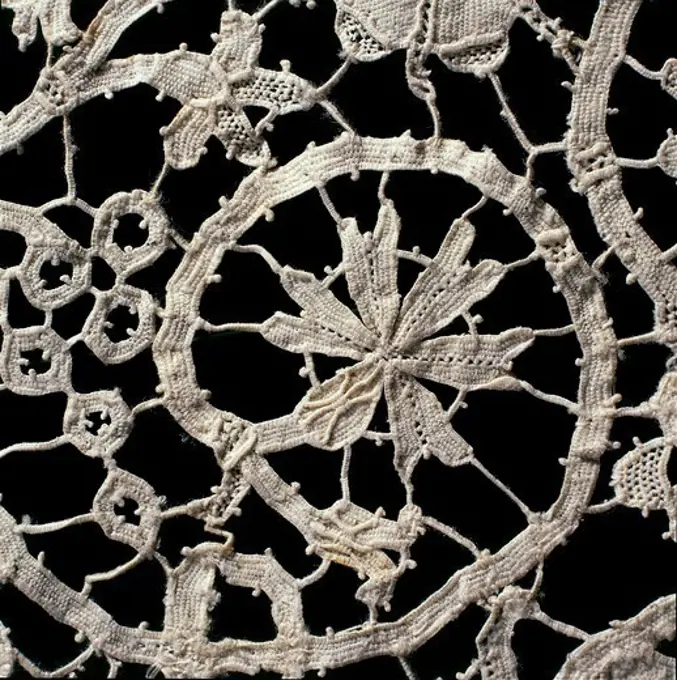
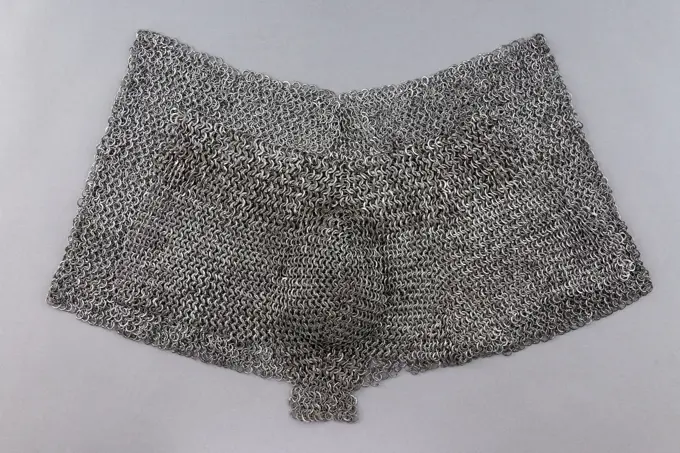
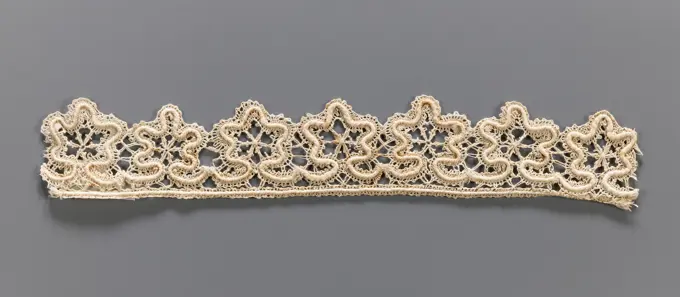
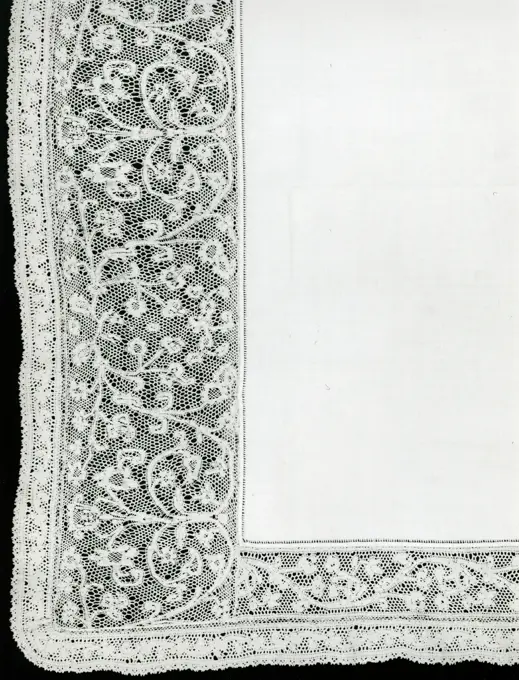
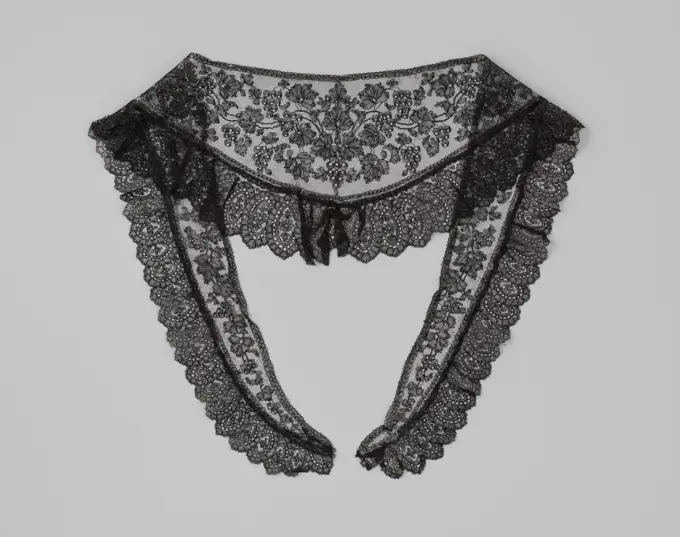
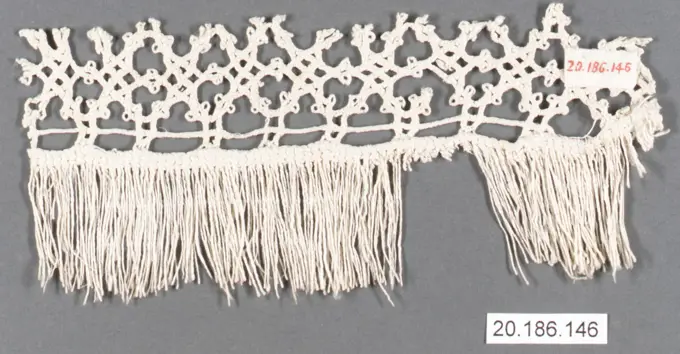
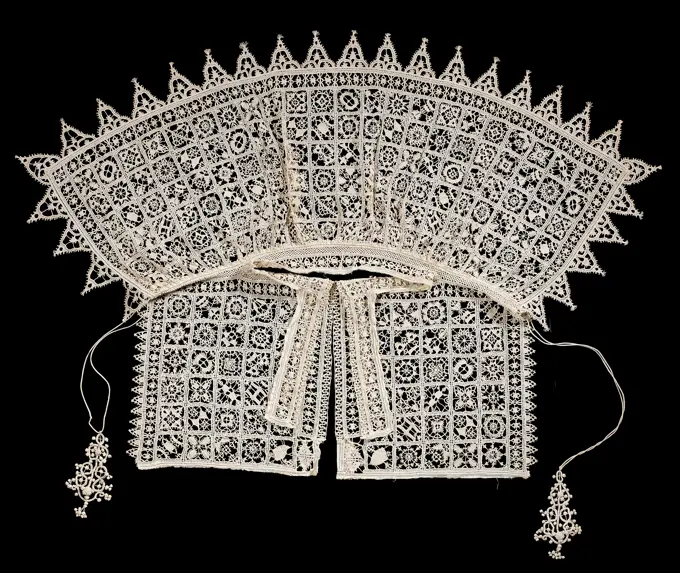
Fragment, Medium: linen Technique: bobbin lace (Valenciennes ground), Design of serpentine branch with stems and leaves curving alternatively right and left. Leaf border and scalloped edge. Round mesh., Belgium, 18th century, lace, FragmentBorder ca. 1600 Italian. Border. Italian. ca. 1600. Needle lace. Textiles-LacesBobbin Lace Collar, 19th century. France, Valenciennes or Flanders, 19th century. Lace, bobbin: linen; overall: 21 x 38 cm (8 1/4 x 14 15/16 in.).Fragment of the lace;  2. PO. 19th century (1851-00-00-1900-00-00);Two Portions from a Flounce Made 1850-1900 Southern Europe. Cotton, machine-made net; embroidered in cross, darning, wave filling, and a variety of buttonhole stitches .Bobbin Lace Cloth, mid 16th century. Italy, Venice, mid 16th century. Lace, bobbin; average: 69.9 x 166.7 cm (27 1/2 x 65 5/8 in.).Strook machinale kant met geborduurde hangende takken met samengesteld driedelig blad.Strip natural-colored mechanical side: machine embroidery on machine tulle. The embroidery makes thick relief. The repeating pattern consists of two rows hanging branches, each with a small star flower and fine leaves and one large and composed of three-piece leaves at the bottom. The underside of the strip consists of a concatenation of uniform hanging three-part leaves, with two rosette flowers with round petals between each consecutive leaf. Between the rows hanging branches and the edge on the underside of the strip, the motifs are connected by motifs made with a lighter and thinner wire, which forms trusses with circles. The top of the strip is not finished.Lace laceBorder Made 1525-1575 Italy. Gilt-metal-strip-wrapped silk, bobbin straight lace; edged with points of bobbin straight lace .Insertion 16th century Italian. Insertion. Italian. 16th century. Bobbin lace. Textiles-LacesCollar ca. 1850 Belgian, Brussels. Collar. Belgian, Brussels. ca. 1850. Needle lace, Point de Gaze. Textiles-LacesEdging 17th century Italian, Liguria. Edging 221017Handkerchief 1840-80 French or Swiss. Handkerchief 236966Border, Medium: linen Technique: withdrawn element work with needle lace, edging is bobbin lace of continuous braid like, A row of intertwining hexagons enclosing alternating male and female figures. Geometric edging on three sides., Italy, 1550-1600, lace, BorderCollar fragment, Medium: linen Technique: needle lace, early 17th c. and style, Collar fragment with symmetrical plants forming pointed tabs., Italy, early 17th century, lace, Collar fragmentHat from knitted side, anonymous, c. 1900 - c. 2000 Hap of knitted side, made up of a ball on which an recommended canopy strip. Friesland . knitting Hap of knitted side, made up of a ball on which an recommended canopy strip. Friesland . knittingLace, 1800s , maker unknown. Gift of M Thorpe, 1984.Kloskant stocking with peacock, c. 1900 - c. 1914 Pine insert of natural-colored bobbin: Valenciennes side. Pointed -shaped. In the middle is a peacock, his tail hangs down and turns into three connected wreaths. A long flower branch runs up behind the peacock, up to the tip of the stocking. The motifs are made in linen battle with recesses and openwork edges. A decorative land has been used in the tail springs and the flower hearts. The motifs are connected by a grid, a diamond-shaped Valenciennes-ground, littered with moesjes. The sides are right finished. Belgium (possibly) linen (material) Bobbi Lace / Valenciennes Lace Pine insert of natural-colored bobbin: Valenciennes side. Pointed -shaped. In the middle is a peacock, his tail hangs down and turns into three connected wreaths. A long flower branch runs up behind the peacock, up to the tip of the stocking. The motifs are made in linen battle with recesses and openwork edges. A decorative land has been used in the tail springs andCollar (Belgium); linenFragment; natural linen; Bequest of Marian Hague; 1971-50-276Strip bobbin with Drieblad, Anonymous, c. 1820 On a fine mesh network there is a stiff row of three-part leaves in the outer half, which are one-sided. A straight edge shows smaller, opposite oriented flower branches. Valenciennes side. Ieper (possibly) linen (material) Bobbi Lace / Valenciennes Lace On a fine mesh network there is a stiff row of three-part leaves in the outer half, which are one-sided. A straight edge shows smaller, opposite oriented flower branches. Valenciennes side. Ieper (possibly) linen (material) Bobbi Lace / Valenciennes LaceLength of Lace. Belgium, 1830-1850. Textiles; textile lengths. Cotton and silk Lille-type bobbin laceCap Streamers (Belgium); linenCuffs ca. 1850 British. Cuffs 169850Bobbin Lace Edging with Points, early 17th century. Italy, Venice, early 17th century. Lace, bobbin; average: 6.4 x 25.4 cm (2 1/2 x 10 in.).Berthe van Naaldant with spring motif, anonymous, c. 1875 - c. 1909 Berthe of natural -colored needle side: Venetian relief side. The Berthe is closed and has in the middle of a closed point. On an open bar of land stands a single volutrank and many confused flowers, including some with a spring motif standing in the heart. BURANO linen (material) Venetian raised work Berthe of natural -colored needle side: Venetian relief side. The Berthe is closed and has in the middle of a closed point. On an open bar of land stands a single volutrank and many confused flowers, including some with a spring motif standing in the heart. BURANO linen (material) Venetian raised workNeck;  Ok. PO. XIXW. (1870-00-00-1890-00-00);colored round floral ornamental frame in Thailand Ethnic styleSample flap for hats bulbs of edge embroidery with 41 lobed circles. Trial flap of natural-colored edge embroidery, cross-pitch on machine tulle. Pattern with 41 lobed circles with a flower and leaf ornaments. Small pieces of application side in the center of the circles. It is an unprocessed workpiece for hats bulbs.Woman's Collar. United States, circa 1850. Costumes; Accessories. Cotton plain weave, cotton machine net, cotton embroideryBorder (USA); Made by Sybil Carter Indian Mission and Lace Industry Association (United States); linenBorder (possibly Belgium); linenFragment 17th century Flemish. Fragment. Flemish. 17th century. Bobbin lace. Textiles-LacesCORPORAL Y PALIO DE SANTA TERESA - SIGLO XVI. Location: CONVENTO DE SAN JOSE. Toledo. SPANIEN.Border; linen; 1933-1-121Wallpaper Unknown. , ca. 1890. Paper, 18 3/4 x 22 in. (47.6 x 55.9 cm).   Decorative Arts ca. 1890Cover. Culture: Greek Islands. Dimensions: L. 57 x W. 28 inches (144.8 x 71.1 cm). Date: 16th century. Museum: Metropolitan Museum of Art, New York, USA.Fichu van gemengde kant met ruit.Fichu of natural mixed side - climbing side in combination with needle lace - Brussels Duchesse. An elongated diamond shape has an interior window made of a ribbon, partly filled with floral and leaf branches, partly with cubes with rosettes. In the sharp points are a very large and a small oval with rad and star filling (coniferous side), ovals are placed in the blunt corners, one of which has been awarded with a palm with. On the open braid soil there is a series of ranging windows in the outer edge, in the inner field, a large symmetrical bouquet of branches with bunch of spray flowers, triple leaves, composite flowers and a rose.Fragment Swedish 19th centuryCollar of tulle with moesjes and a scalloped edge with tuldoor stop, c. 1875 - c. 1890 Collar of tulle with moesjes and a scalloped edge with tuldoor stop Netherlands . Collar of tulle with moesjes and a scalloped edge with tuldoor stop Netherlands .BorderFragment 17th century Italian, Venice. Fragment 218826Band; linen; Bequest of Marian Hague; 1971-50-383Cuff with stitched embroidery, c. 1700 - c. 1850  Cuff with stitched embroidery. Netherlands linen (material)Handkerchief 1863 French, Paris. Handkerchief 221435Doily of linen rosette -shaped with eight lobes and around a border bobbin, anonymous, the Molenwiekje, c. 1925 - c. 1949 Doily of natural linen with a border bobbin all around: Dutch side. Rosette -shaped model with eight semi -circular scallops or lobes. Netherlands linen (material) bobbin lace Doily of natural linen with a border bobbin all around: Dutch side. Rosette -shaped model with eight semi -circular scallops or lobes. Netherlands linen (material) bobbin laceLaces, 17th century. Needle lace hem with floral motifs, cm 2,8 high. Detail.Valance, Medium: cotton Technique: embroidery in chain stitch (machine) on plain weave; areas of delected element work, Deeply pointed edge with a design of plants filling in the points. In white on white., Switzerland or France, 19th century, embroidery & stitching, Valanceembroidery truquoise fabric white flower design patternNeedlepoint (Reticella) Lace Insertion, 16th century. Italy, Venice, 16th century. Lace, needlepoint: linen; average: 3.5 x 10.9 cm (1 3/8 x 4 5/16 in.).Brayette and Buttock Defense 16th century German From about the third century B.C. through the early fourteenth century A.D., mail, also called chain mail, was the predominant and most effective type of body armor known in Europe. From about the mid-fifteenth century onward, mail was used in conjunction with full plate armor to fill the gaps between plates. Separate mail sleeves were made to be worn with a cuirass (breastplate and backplate); shaped panels of mail called gussets, covered the armpits or the crooks of the elbows and were attached to arming jackets, garments specially tailored to be worn under armor; and mail breeches, called brayettes or pairs of paunces, could be worn by men fighting on foot.. Brayette and Buttock Defense. German. 16th century. Steel, copper alloy (latten). MailCuffs 19th century Belgian. Cuffs 119775Base for a spice bottle; Fox, Charles Thomas & George (London; company Z Otnicz; Fl. 1801-1922), Fox, George (1816-1910); 1896/97 (1896-00-00-1897-00-00);Fragment of the lace;  19th century (1801-00-00-1900-00-00);Fragment; linen; 1933-1-115Collar 1700-1945 American or European. Collar 119279Collar (Maltese), 19th century, 30 x 21 in. (76.2 x 53.34 cm), Silk; lace, Malta, 19th centuryCover Made 1750-1825 Italy. Linen, plain weave; cut and drawn work; embroidered with cotton in antique hem stitches; edged with linen, bobbin straight lace .BOOK;  2. PO. 19th century (1851-00-00-1900-00-00);Veil 1840s probably American. Veil 110186Standing band (collar) with tassels ca. 1610-20 possibly French Punto in arialiterally, "stitches in the air"is one of the earliest styles of needle lace, which is itself developed from cutwork of primarily geometric design. When lacemakers transitioned to using a foundation of threads laid out according to a pattern drawn on parchment, they were able to incorporate more fluid lines and curves into their designs.. Standing band (collar) with tassels. possibly French. ca. 1610-20. Cutwork, needle lace, reticello, punto in aria, embroidery, linenMarquette Building Elevator Grille Base 1893-1895 Dearborn Street, 140 South. Cast iron with Bower Barff finish . Holabird and Roche (Architect)Collar mid-19th century French. Collar 102693Turkish needle work embroidery Ornamental with lace patterns, details, flowersDress of lace pledger with an eight -pointed inner piece and round scallop of scales, anonymous, c. 1925 - c. 1949  Dress of Batist with a peripheral border border border: work with threads pulled out. Round model with scrap edge, the batists inner piece has the shape of an eight -pointed star or flower. ChinaInsert of needle side in the form of a window with a person who is wearing a jacket and lights a hand, anonymous, c. 1920 - c. 1935 Insert of needle side: flat Venetian side. Diamond -shaped model. The pattern consists of a person with a cut coat and a round 'pillbox' hat. He or she lights one hand while the other hand sticks in the jacket (bag). On either side, in the corners of the window, people are flanked by square flower or sun. The motifs are made in closed feston stitches with recesses. The motifs are connected by picoted bars. Czechoslovakia (Possible) cotton (textile) flat Venetian (needle point) Insert of needle side: flat Venetian side. Diamond -shaped model. The pattern consists of a person with a cut coat and a round 'pillbox' hat. He or she lights one hand while the other hand sticks in the jacket (bag). On either side, in the corners of the window, people are flanked by square flower or sun. The motifs are made in closed feston stitches with recesses. The motifs are conCollar of crocheted side with spreading pattern of large and small rosette flowers, anonymous, c. 1890 - c. 1909 Collar with triangular backpiece made of natural Irish crocheted side. Balanced spreading pattern with seven large rosette flowers and various small rosette flowers and loose three -part leaves, all with relief and/or with multiple layers. The crocheted irregular mesh soil with picots has been working with a spread pattern of slightly curved rectangles. Along the entire circumference with a border with three -part arches with picots. Inspired on Venetian needle side. Ierland (possibly) cotton (textile) Collar with triangular backpiece made of natural Irish crocheted side. Balanced spreading pattern with seven large rosette flowers and various small rosette flowers and loose three -part leaves, all with relief and/or with multiple layers. The crocheted irregular mesh soil with picots has been working with a spread pattern of slightly curved rectangles. Along the entire circumKeys on keyring hanging on wallScarf collar or black bobbin with grape bunches, anonymous, c. 1850 - c. 1870 Scarf collar or black bobbin side: chantilly side. In a triangle in the middle is a symmetrical grape vine with grape bunches and leaves. The pattern of the sewn strip consists of standing ovals or wreaths, each filled with a rose. The motifs are made in netslag with contour threads and they are connected by a fine grid, a tuler land. There is a separate strip with object number BK-1979-155-B, which may be intended to confirm this scarf collar or forfichu. Geraardsbergen (Possible) silk bobbin lace Scarf collar or black bobbin side: chantilly side. In a triangle in the middle is a symmetrical grape vine with grape bunches and leaves. The pattern of the sewn strip consists of standing ovals or wreaths, each filled with a rose. The motifs are made in netslag with contour threads and they are connected by a fine grid, a tuler land. There is a separate strip with object number BK-1979-155-B, which may be intendedFine example of Ottoman art patterns in viewFragment 16th century Italian. Fragment 220956Fragment; linen; 1897-8-308Edge (Italy); linen; Bequest of Marian Hague; 1971-50-486Textile; embroidered machine net; 1974-52-140Rectangular frame from golden beads garland on knitted pink background. Top view Flat lay Template for design.. Rectangular frame from golden beads garland on knitted pink background. Top view Flat lay Template for designPanels Reticella combined into a 'collar' with two Akers, Anonymous, c. 1880 - c. 1899 Panels Reticella merged into a 'collar'. Model: A fan -shaped part, deposited with Punto in Aria in Aria, is connected to both rectangular breastpieces by means of an open -standing intermediary. There are a number of folds and folds in the fan -shaped part. The two narrow tires that have been put on the collar seem to have no function. Two woven cords with Akertjes (knotted ornaments) are attached to the intermediate brush by means of trensjes. A number of the open homen, which are located vertically in the whom -shaped part, continue in the linen that is now all the intermediate facility. This is illogical if the collar were cut from a contemporary shirt. Decoration: The pattern has squares in which different variations. Italy whole: Linen (Material)   Loosdrecht. Castle Sypesteyn Panels Reticella merged into a 'collar'. Model: A fan -shaped part, deposited with Punto in Aria in Aria, is connected Cuff of application side with a jet of flowers around Spitsovals that form the scoops and two branches of bunches, anonymous, c. 1835 - c. 1840 Cuff made of natural -colored application side: needle side applied on mechanical tulle. Trapezoidal model with a wrinkled wide strip of decorated tulle on a narrow unadorned board. The cuff is hanging hanging in three -quarters of sleeves, such as Pagodamouwen. The repeating shell pattern consists of a rush -in with a jet wreath of flowers, the flowers at the top easier than the hanging flowers that form the lobes of each shell. On the right side, a curling stem with a rosette flower originates from the Spitsovaal. In the field above, on one side of the cuff is two identical branches with spray ries on the tulle just below the cuff. Brussels cotton (textile). Cuff made of natural -colored application side: needle side applied on mechanical tulle. Trapezoidal model with a wrinkled wide strip of decorated tulle on a narrow unadorned board. The cCollar 1700-1942 American. Collar 119209Wallpapersample. Retailer: A. H. Davenport, American, late 19th-early 20th centurySmall white wicker baskets with white ribbons stand on a bench