Intricate Lace Strips

A series of historical fabric lace strips showcasing detailed floral and geometric patterns, highlighting craft techniques from various centuries.

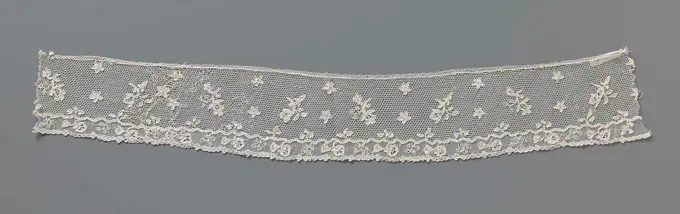
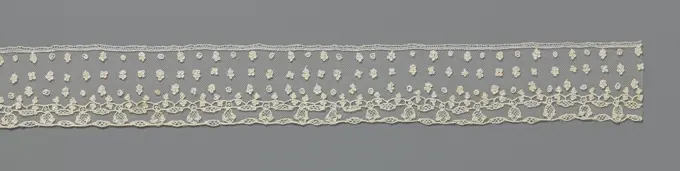
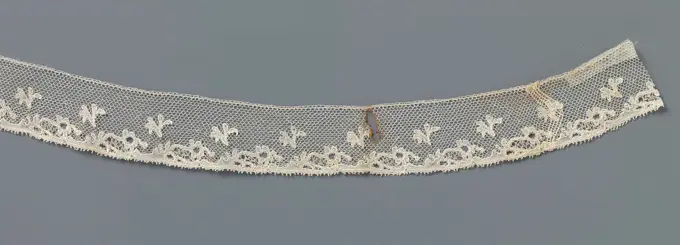
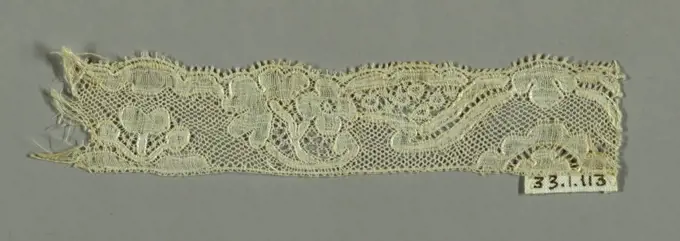
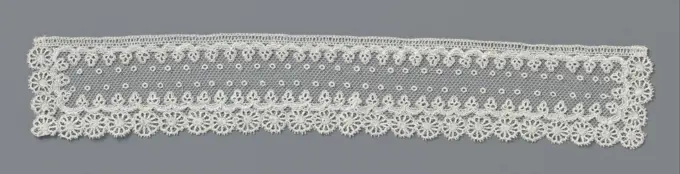
Strip bobbin with four-lobbish rosette above and below a zigzag band, anonymous, c. 1840 - c. 1860 Strip of natural -colored bobbin, blonde. The repeating and continuous pattern consists of a zigzag band, which divided the strip into triangular fields. There is a four -lobe rosette in the center of each field. Along the top and bottom of the strip runs a scallop, which consists of a succession of circles. The scallops are finished with picots. The motifs are connected by a coarse mesh soil, strewn with square moes. The zigzag band, rosettes and circling edges are made in linen stroke, with the rosettes equipped with a contour wire. unknown silk bobbin lace / blonde (lace) Strip of natural -colored bobbin, blonde. The repeating and continuous pattern consists of a zigzag band, which divided the strip into triangular fields. There is a four -lobe rosette in the center of each field. Along the top and bottom of the strip runs a scallop, which consists of a succession of circles. The scall
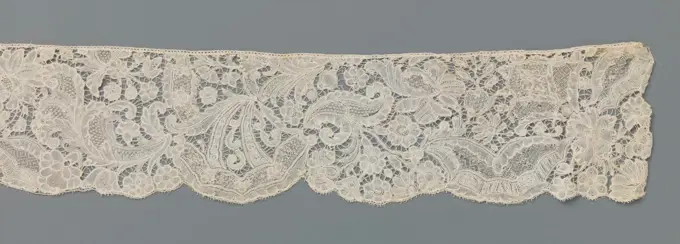
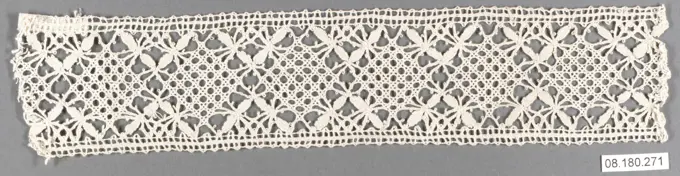
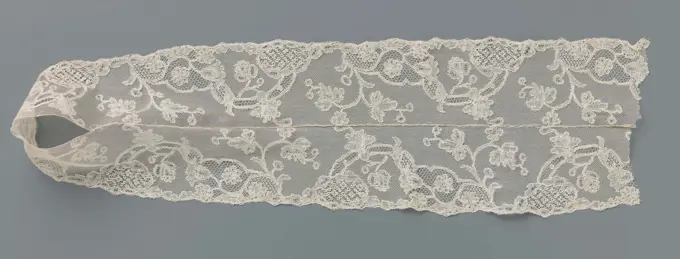
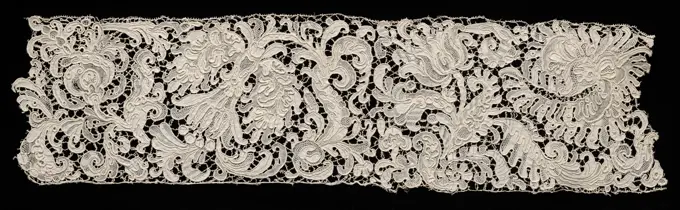
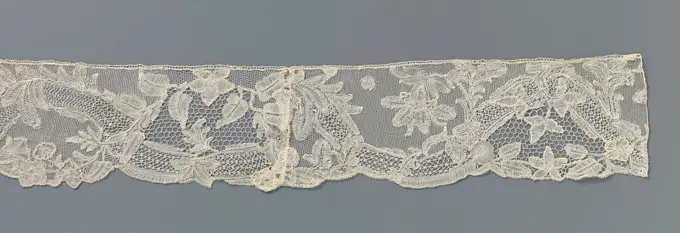
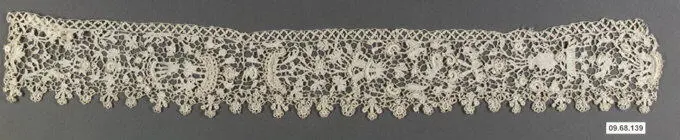
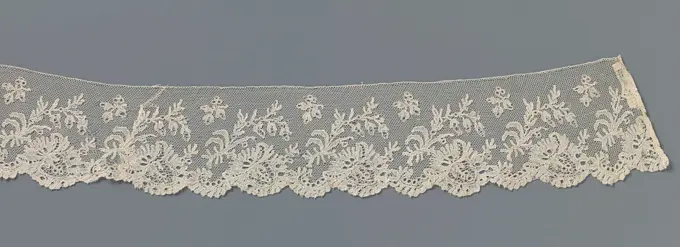
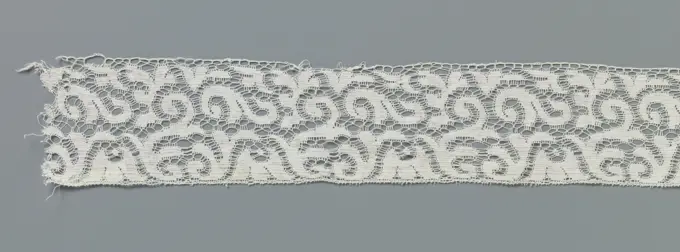
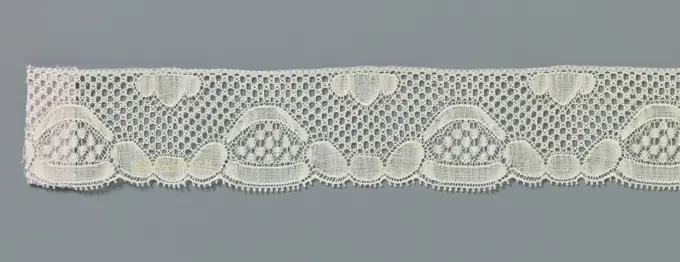
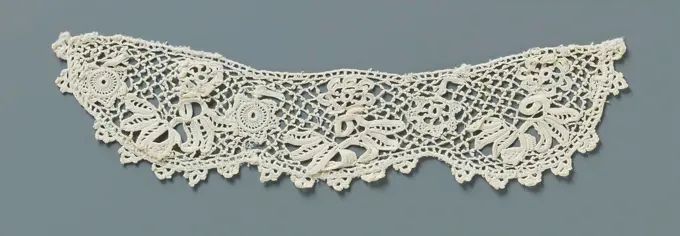
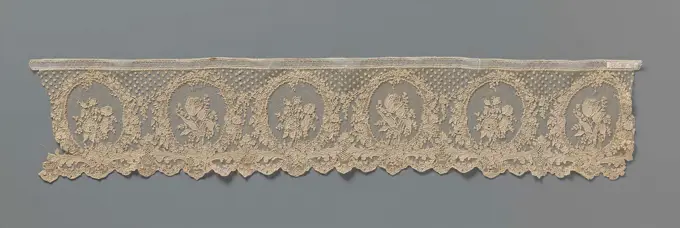
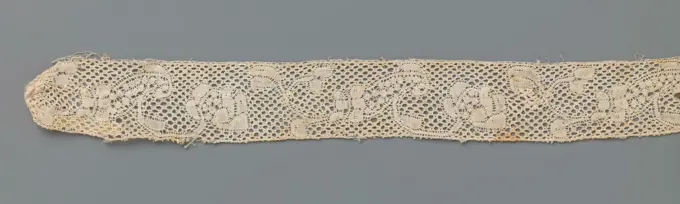
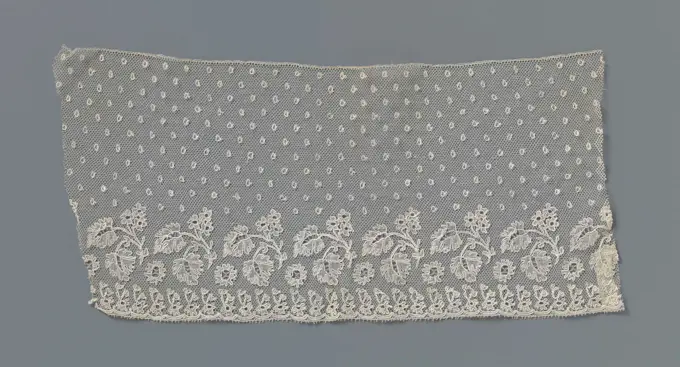
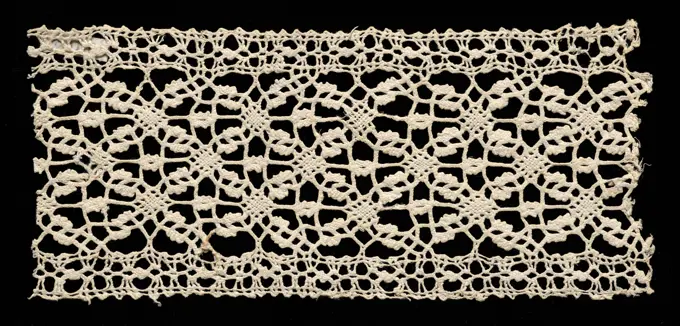
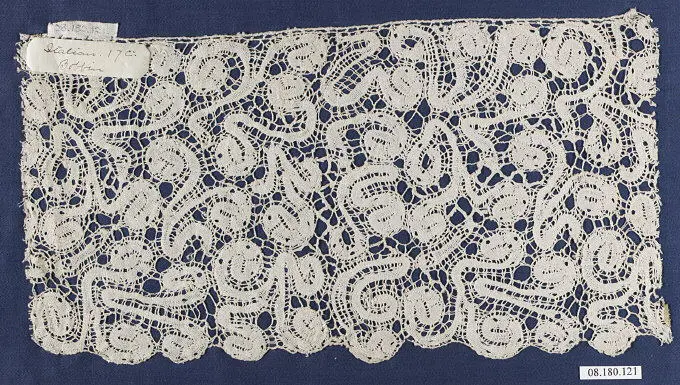
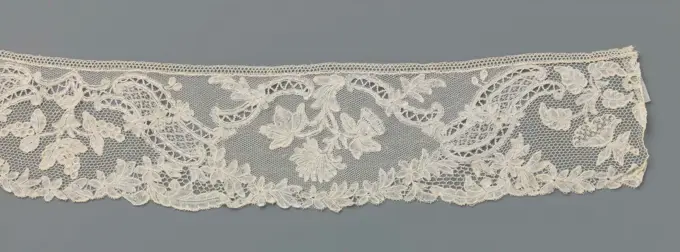
Piece 18th century Flemish. Piece 215387Strook applicatiekant met druiventrossen en gehalveerde bladeren.Strip natural colored application side, climbing side applicated on machine tulle. A narrow part, along the inside, exhibits a running pattern of halved, lobed leaves, which accompanies an equally halved medallion with a raster filling. On a wide part with a substrate of tulle, symmetrical, deep slot, which are in turn are filled with a grinding tray and a fan plant.Strip bobbin with simple flowers and leaves, anonymous, c. 1900 - c. 1924 Strip of natural-colored bobbin: Duchesse side. Easily designed flower and leaf motifs and volutes are connected by a braid ground. Along the edge, among other things, a rush -in with two curly leaves. Belgium linen (material) bobbin lace Strip of natural-colored bobbin: Duchesse side. Easily designed flower and leaf motifs and volutes are connected by a braid ground. Along the edge, among other things, a rush -in with two curly leaves. Belgium linen (material) bobbin laceStrip bobbin with four-lobbish rosette above and below a zigzag band, anonymous, c. 1840 - c. 1860 Strip of natural -colored bobbin, blonde. The repeating and continuous pattern consists of a zigzag band, which divided the strip into triangular fields. There is a four -lobe rosette in the center of each field. Along the top and bottom of the strip runs a scallop, which consists of a succession of circles. The scallops are finished with picots. The motifs are connected by a coarse mesh soil, strewn with square moes. The zigzag band, rosettes and circling edges are made in linen stroke, with the rosettes equipped with a contour wire. unknown silk bobbin lace / blonde (lace) Strip of natural -colored bobbin, blonde. The repeating and continuous pattern consists of a zigzag band, which divided the strip into triangular fields. There is a four -lobe rosette in the center of each field. Along the top and bottom of the strip runs a scallop, which consists of a succession of circles. The scallStrip bobbin with four-lobbish rosette above and below a zigzag band, anonymous, c. 1840 - c. 1860 Strip of natural -colored bobbin, blonde. The repeating and continuous pattern consists of a zigzag band, which divided the strip into triangular fields. There is a four -lobe rosette in the center of each field. Along the top and bottom of the strip runs a scallop, which consists of a succession of circles. The scallops are finished with picots. The motifs are connected by a coarse mesh soil, strewn with square moes. The zigzag band, rosettes and circling edges are made in linen stroke, with the rosettes equipped with a contour wire. unknown silk. blonde (lace) / bobbin lace Strip of natural -colored bobbin, blonde. The repeating and continuous pattern consists of a zigzag band, which divided the strip into triangular fields. There is a four -lobe rosette in the center of each field. Along the top and bottom of the strip runs a scallop, which consists of a succession of circles. The scalStrook kloskant met twee gehalveerde cartouches met brede gekartelde sierrand.Strip natural colored Brussels climbing side. The symmetrical pattern consists of the middle of two adjacent cartouches placed adjacent, the semi-relocated center of which is located against the top of the strip. The widely serrated decorative edge reaches around it to the underside of the strip and is richly decorated with, among other things, sloping stripes and a straight down iris or French lily. The pattern between the cartouches is not symmetrical, but beyond on either side. This pattern consists of rosette flowers and volute leaves in which elements from the cartouches return in different ways. The motifs are connected by picoted braids. The motifs are made in linbroof with recesses and openwork edges and with power stuffs. Most motifs are equipped with closted relief contours. Different ornamental grounds have been applied, including fine snowflakes and fine Maas soils with square motifs in shape stroBobbin Lace Edging, 18th century. Italy, Abruzzi, Pescocostanzo, 18th century. Lace, bobbin: linen; average: 13.4 x 61 cm (5 1/4 x 24 in.).Strook naaldkant met bloemtakken en stervormige bloemen.Strip natural-colored coniferous lace, Argent tanker and alençonant. Repetitive motif with two different flower branches, each flanked by two star-shaped flowers placed above each other, on a ground with meshes that are close to naid with buttonhole stitches (Argentankant). The flower branches bend to and to each other. Along the bottom under a wavy line including a pattern of flowers and berries on a fine hexagonal Maas soil (Alençonker). Decorative ground with rover picots in the larger flowers and the circles along the bottom edge. Full work with minimum recesses within the contours of the other motifs. Slip edge on the underside through a concatenation of circles, regularly interrupted by a rosette flower. The top is trimmed with a border clamping side.Insertion 1805 French, Craponne. Insertion 214625Strook kloskant met rocailles.On the ground soil, a mechelen soil (also known as ice soil), there is an ongoing pattern of large seed beads with grid work filling, which are connected to a double branch that stealed in the same way-decorated bow. To the standing side branch, wingerd leaves grow, roses and carnations growth growing. Mechelen side.Strip bobbin with stars and wheels, anonymous, c. 1800 - c. 1824  Strip of natural -colored bobbin. The repeating pattern consists alternately of a wheel and an eight -pointed star. The circumference of the motifs consists of a tire made in form. 'Spokes' were made with braids within the circumference. A straight band runs above the wheels. Under the wheels and stars, a band runs semi -circular sculptes, with five lobes formed by arcs formed. Tires and arches are both made in form. The motifs are connected by a braid of soil, which forms coarse diamond-shaped meshes, such as with a Valenciennes ground. The top of the strip is straight finished with a zigzagging braid. The arches on the sculptes are finished with a few picots. Volvic cotton (textile) bobbin laceLength of bobbin lace, circa 1890, maker unknown. Gift of Dr Tom Farrar, 2010.Capslip of mixed side with medallions in leaf volute, Bôval-de Beck, c. 1850 - c. 1874 Heat slip of natural -colored mixed side: Brussels bobbin side in combination with a needle side including a needle -sided soil and various motifs in needle side. This type of lace is also called Point d'Angleterre. Rectangular with slightly wider straight ends. A wheel edge (needle side) is interrupted both by large oval (needle side) and roses (needle side) contained in a leaf volume (bobbin). The roses with leaves (bobbin) form the scrap edge. In midfield there are fine branches (bobbin) each with a large rose (needle side), with imposed relief sheets. Brussels linen (material) mixed lace / Brussels bobbin lace Heat slip of natural -colored mixed side: Brussels bobbin side in combination with a needle side including a needle -sided soil and various motifs in needle side. This type of lace is also called Point d'Angleterre. Rectangular with slightly wider straight ends. A wheel edge (needle side) iStrip bobbin with female breast image, anonymous, c. 1700 - c. 1724 Strip of natural -colored Brussels bobbin. The pattern consists of many small motifs, where the women's breast image stands out in the middle. Along the bottom are often C-shaped motifs connected to a border with shells. The motifs are connected by picoted braids. The motifs are made in linen battle with recesses, partly with openwork edges and partly with cracked relief contours. Different decorative lands have been applied in the motifs, including a decorative land with squares made in shape. The top is straight. The shells along the bottom are finished with picots. Brussels linen (material) bobbin lace / Brussels bobbin lace Strip of natural -colored Brussels bobbin. The pattern consists of many small motifs, where the women's breast image stands out in the middle. Along the bottom are often C-shaped motifs connected to a border with shells. The motifs are connected by picoted braids. The motifs are made in linen baStrip of a climbing side with symmetrical floral pattern with curling leaves and drip-shaped leaves. Strip of a climbing side: old Milanese side. The symmetrical pattern consists of a large oval flower above the center line of the strip. The flower is crowned by two curly leaves and flanked by two shouting hanging flowers. From the flower heart of the middle flower, a thick straight stem runs down, which turns around around the center line from the strip to two sides. The curls rest on a small rosette flower with thick hanging leaves and underneath-curling voluntaries. There is a diamond between the voluntary leaves that rests on a low flowerpot or scale. Curling and dropulating leaves fill the rest of the pattern. The contours of the motifs consist of ribbons that are clamped in linen stroke and vary in width. The ribbons around some motifs are equipped with significant cut-outs that are in a row. Ornamental grounds are used between the ribbons. The motifs are interconnected by some aBorder 17th century Italian, Venice. Border. Italian, Venice. 17th century. Needle lace, gros point lace. Textiles-LacesFragment, Medium: linen Technique: needle lace with ground of loop and twist with twist return, Fragment, probably a sleeve ruffle, has elaborate blossoms, leaves, stepped geometric shapes, and zigzags., France, 18th century, lace, FragmentStrip of needle side with irises on volute vines, anonymous, c. 1650 - c. 1699  Strip of natural -colored mixed side: Venetian ribbon side. Pattern of volute bines, with various iris -like flowers on an irregular, open bars of bar. The bars were made separately and sewn as a connection between the tendrils and flowers. The contours of the pattern are formed by a sloping woven and therefore stretchable ribbon. Within the contours and also within the individual flowers different decorative land through recesses in the fullwork. The top is trimmed with a border bobbin. The bottom is finished with a straight picotrand. Venice linen (material) mixed lace / Venetian tape lace (mixed lace)Needlepoint (Venetian Raised Point) Lace Edging, 17th century. Italy, Venice, 17th century. Lace, needlepoint: linen; average: 16.6 x 61 cm (6 9/16 x 24 in.).Collar of mixed side with wide spiral rank, anonymous, c. 1690 - c. 1699 Collar of natural -colored mixed side - Mezzo Punto - with a messing around or woven ribbon and a needley strand. Rectangular narrow model with slightly sloping short sides and one slightly bent long side. On a mesh ground (needle side) is a almost symmetrical pattern that consists of connected S-shaped stems with curved leaves and a drop-shaped leaf at the ends of the collar. The contours of the flowers and stems consist of burst or woven ribbons. Different decorative land (needle side) have been used within the contours. A chattered bow edge serves as a finish along the outer sides, with the exception of the long curved side that is finished with a straight (without arches) cloated strap. Milan (possibly) linen (material) mixed lace / tape lace (mixed lace) Collar of natural -colored mixed side - Mezzo Punto - with a messing around or woven ribbon and a needley strand. Rectangular narrow model with slightly slopAntependiumstrook van kloskant met brede rivière.Antependium strip from natural brussels climbing side. Four different loose branches of ecclesiastical flowers (lily, pomegranate, grape roos) fill triangular and shield-shaped fields, limited by a river of broad C-Volutes. The triangles are alternately high and narrow and short and thick and exhibit a fine grille, while the shield-shaped fields are filled with a coarse grille. Along the scalloped edge, a mountain and valley line runs from C-Volutes, which are overcurred by a fine closed flowerguirland, which repeats itself at the top of the strip. The C-voltages are filled with grid work and wound with a fine flower garland or overcures by a feeder.Strip of needle side with sloping twigs, anonymous, c. 1780 - c. 1790 Schuingericht branches, with decreasing buttons and berries, in pair -wise a field, in which turns a growing and hanging double flower branch. An almost flat edge shows shells of leaves and flowers and has a media with very open grid work over large distances. Alençon side. France linen (material) Alençon Lace Schuingericht branches, with decreasing buttons and berries, in pair -wise a field, in which turns a growing and hanging double flower branch. An almost flat edge shows shells of leaves and flowers and has a media with very open grid work over large distances. Alençon side. France linen (material) Alençon LaceBorder 17th century French. Border 218080Strook kloskant met schuin geplaatste bloem onder een schuingeplaatste tak.Strip natural colosside: Lille side. The repeating pattern consists of a shouted flower that lies along the underside of the strip, under a shouting branch with some hanging oval berries or flowers. There are loose twigs between the branches with similar berries. The successive flowers along the underside are connected by a curved blade, together they form the slot. The motifs are placed close together and are connected by a fine grille, a tulet. The motifs are made in linen stroke with large recesses and thicker contour wires. Some ornamental grounds have been applied. The top is just finished. The scalloped underside comes from the pattern and is finished with picots. The short sides are sloped off and finished with a soil.Strip bobbin with a pot or dish with pine cone, anonymous, c. 1800 - c. 1899 Strip of natural -colored bobbin, Parisian side. The repeating and symmetrical pattern consists of a pot or dish on a low base, in which a large pine cone or drop -shaped motif is located. The edges of the pots are decorated with a few flowers, papaverbollen and leaves. The successive pots are connected by a rosette flower. The motifs are connected by a Maas soil, a Parisian soil. The fullwork is largely made in linen battle with few recesses and with thicker contour threads. The center of the pine cone is partly made in netslag. Different decorative lands have been used, including a snowflake land. The top and bottom of the strip are finished with separate curled straps. The short sides are finished with a zoompje. France linen (material) bobbin lace / Paris lace Strip of natural -colored bobbin, Parisian side. The repeating and symmetrical pattern consists of a pot or dish on a low base, in which a large pinStrip of machine side with hanging chalice of loose S-Voluten, anonymous, c. 1890 - c. 1914 Strip of natural -colored machine side: Machine Flanders side. The repeating pattern consists along the bottom half of the strip of a hanging chalice, flanked and crowned by loose S-volutes. Openwork edges run around the closed motifs. The motifs are connected by a machine soil that suggests a braid ground. Top and bottom of the strip are straight finished, with the bottom with picots. Nottingham (possibly) cotton (textile) Strip of natural -colored machine side: Machine Flanders side. The repeating pattern consists along the bottom half of the strip of a hanging chalice, flanked and crowned by loose S-volutes. Openwork edges run around the closed motifs. The motifs are connected by a machine soil that suggests a braid ground. Top and bottom of the strip are straight finished, with the bottom with picots. Nottingham (possibly) cotton (textile)Kloskant handkerchief strip with triangles and spiders, 's-Gravenmoersche Kantvereniging, c. 1930 Handkerchief strip made of natural -colored bobbin, straw side. A pendulum forms small shells along an open middle edge of large spiders and a closed edge of triangles. 's Gravenmoer linen (material) Bobbi lace / lace cloth Handkerchief strip made of natural -colored bobbin, straw side. A pendulum forms small shells along an open middle edge of large spiders and a closed edge of triangles. 's Gravenmoer linen (material) Bobbi lace / lace clothStrip of machine side with clouds along the top and trapezoidal cartouches along the bottom, anonymous, c. 1800 - c. 1899 Strip of natural -colored machine side: Machine Flanders side. The repeating pattern consists of a cloud along the top of the strip and a trapezoidal cartouche diagonally along the bottom of the strip. The successive cartouches are connected by three connected thick ovals. The motifs are made in linen battle and equipped with openwork edges with contour threads, where the contour threads are within the openwork edges. They are connected by a machine five -hole ground. A coarse machine snowflake land has been used in the cartouches. The top of the strip is straight finished. The silly outskirts of scales along the underside stems from the pattern and is finished with picots. Europe cotton (textile) Strip of natural -colored machine side: Machine Flanders side. The repeating pattern consists of a cloud along the top of the strip and a trapezoidal cartouche diagonally Scarf 18th century Italian, Burano. Scarf 213006Border early 18th century French. Border 218146Strip machine side for a toilet table, anonymous, c. 1800 - c. 1920 Strip machine side for a toilet table in a boudoir.  . Strip machine side for a toilet table in a boudoir.  .Manchet van gehaakte kant met getorst takje en stervormige bloem.Cuff of natural colored Irish crochet side. Pattern where a source of flour with a rosette flower and several elongated leaves are interspersed by a hanging star-shaped flower on a short stem without leaf. Crochet diamond-shaped Maas soil with picots. The top is finished with a straight edge. The wavy lower edge is deposited with picoted three-part arcs.Fragment of the lace;  after. 18th century (1701-00-00-1750-00-00);Strip of needle side with wavy decorative frame and wine leaves, anonymous, c. 1850 - c. 1855 Strip of natural needle side: Brussels mesh side. The repeating and largely symmetrical pattern consists at the bottom of the strip of a continuous wavy decorative band that is cut over at a regular distance by an oval. A wine leaf hangs under each wave top and three more or less heart -shaped leaves under each golf valley. Above the decorative belt hanging from the top of the strip of leaf branches straight down, alternately a branch with a wine leaf and a shorter branch with smaller leaves on either side. Around the leaves fine curling sling and swingers with connected oval (grapes). The motifs are made up of feston stitches and equipped with relief contours. The motifs are connected to each other by a fine Maas soil, a mesh side, on which a few mushes have been applied. Decorative stitches have been used in the decorative band and the largest wine leaves. The scrap edge is formed by the hanEdging early 17th century Italian, Genoa. Edging 218022Strook naaldkant met tulp en rozentak in medaillons.Strip natural-colored coniferous lace: Alençon side. Pattern with a repetitive motif of medallions on a fine hexagonal maase soil, strewn at the top with moes. In the medallions around and around a tulip and a rose roof. The outer edge of the medallions consists of multi-layer flowers and leaves that grow upwards. On either side of the largest flower at the bottom of an acanthus sheet. Different ornamental grounds in the diamond-shaped spaces between the acanthus leaves and in a single flower. Along the bottom of the flowers, leaves that shot off. The top is trimmed with a border clamping side.Border; silkStrip of needle side with oval on tops and in valleys of wavy leaf branch, anonymous, c. 1760 - c. 1770 Strip of natural needle side: Argentan side. The strip was part of a scary. The largely repeating pattern consists of a regularly wavy leaf branch, with three ovals at the highest and lowest point of each wave. From the top of the strip a flower branch hangs down in each golf valley. The flowers differ. The motifs are made up of feston stitches with recesses as a decoration and equipped with relief contours. The wavy branch has a ladder pattern. The motifs are connected by a hexagonal soil of founded meshes, an Argentan ground. In the ovals a finer Maas soil and a grid with radar picots have been used as decorative grounds. The flat scrap edge is formed by a flower garland, which forms at a regular distance Spitsovale Cartouches in which different decorative lands have been used. The top of the strip is straight finished with a tie. Argentan . Argentan Lace Strip of natural needle siStrip of bobbin with thrown twigs and curved double twigs, anonymous, c. 1775 - c. 1795 Strip of natural -colored Brussels bobbin. The pattern consists of stealed flowers, stars and twigs with berries. Along the bottom runs a border with various connected ovals, from which double twigs spring that bend to the left to the left and bend to the right to the right. The motifs are connected by a fine Maas soil, a drachel soil. The motifs are made in linen battle with openwork edges and largely equipped with burst relief contours. In the flower hearts of the larger stripped flowers, a block is made in form. In the ovals along the underside, decorative lands have been used with coarser meshes than the drochel soil. The top is straight. The faintly scalloped underside is finished with picots. Brussels linen (material) bobbin lace / Brussels bobbin lace Strip of natural -colored Brussels bobbin. The pattern consists of stealed flowers, stars and twigs with berries. Along the bottom runs a bordeStrook kloskant met berg en dal-lijn.There is a symmetrical pattern at a nice ground ground, a mechelen soil (also known as ice soil). Within a stretched sculpture of lobed leaves and roses, triple flower branches are in either side of a leaf rosette under a 'mountain and dal' line. This limits two halved diamond-shaped medallions with a raster filling of crucifixes. Part of a strip that consists of two parts sewn together. Mechelen side.Fragment; linen; 1933-1-99Strook kloskant met rozetten gemaakt van cirkeltjes.Strip natural colosside, Lille side. The repeating pattern consists of a rosette made of a circles forming ornamental soil, a rose ground. The motifs are connected by a Maas soil, a tulet. Along the bottom of the strip, the tulet overlooks a job of slurry ground. The contours of the round petals are accentuated with a thicker and shiny wire. Such a same wire has also been used to accentuate the transition from the tulet to the slurry ground and the slippers along the bottom of the strip. The top of the strip is straight finished. The shelters along the underside are finished with picots.Fragment of bobbin lace unknownStrip bobbin with semi -circles along the bottom, anonymous, c. 1850 Strip of natural-colored bobbin: Lille side or Buckingham side. The repeating and connected pattern consists of a semicircle along the underside of the strip, framed by openwork ovals and various leaves, including a clover four and a lancet leaf along the bottom. The successive semi -circles are against each other. Above it a row hanging oval flower with two leaves. The motifs are connected by a fine Maas soil, a tuler land. The motifs are made in linen battle with thicker and shiny contour threads. In the circles, a decorative land has been used, a rose ground. The top of the strip is straight finished. The very faintly scalloped underside is finished with picots. Buckingham (possibly) cotton (textile) bobbin lace / Lille lace Strip of natural-colored bobbin: Lille side or Buckingham side. The repeating and connected pattern consists of a semicircle along the underside of the strip, framed by openwork ovals and varioStrip of lace with three -lobe cartouche and hanging flour with drop -shaped heart, anonymous, c. 1740 - c. 1760  Strip of natural -colored bobbin: Mechelse side. The repeating pattern consists of two merging symmetrical compositions. One composition consists of a three-lobe cartouche, which is located along the underside and is flanked left and right by an elongated S-Volut with five lobes at the bottom. A splitting branch with one leaf and two flowers originates from the S-Voluten. The other composition consists of a flower hanging from the top with a drop -shaped heart, between two leaves. The motifs are connected by a fine Maas soil. The motifs are made in linen battle with few recesses, but with openwork edges. Contour lines are applied around the motifs with slightly thicker and shiny wire. A few different decorative lands have been applied, including a snowflake land, in the cartouche and between the leaves, among others. The faintly scalloped underside stems from the pattern anBelegstuk van kloskant met voluten.Insignment of natural colosside, possibly Flemish guipure. Symmetrical pattern with volutes to which three, four and five-leaf flowers spring. Around the motifs a braided barrier ground with picots. Within the motifs a honeycomb ground. Finish on all sides with triangles built from arcs.Strip of needle side with incised leaves, anonymous, c. 1900 Walking pattern of incised leaves above a rose and a three -leaf, which together form the sharply toothed outside line. Cross-shaped bars with button (soil of long X-shaped bars with a spider). The Remplis consists of buttonholes and a long distance gazé. German side: 'Carlsbader Points'. Karlsbad (Germany) (possibly) linen (material) Walking pattern of incised leaves above a rose and a three -leaf, which together form the sharply toothed outside line. Cross-shaped bars with button (soil of long X-shaped bars with a spider). The Remplis consists of buttonholes and a long distance gazé. German side: 'Carlsbader Points'. Karlsbad (Germany) (possibly) linen (material)Verdubbelde strook naaldkant met hartvormige rankjes.Strip natural needle side: Flat Venetian side. On a ground of regular six-sided mesh is a fine pattern of two symmetrical, heart-shaped ranks connected by serpentine ranks. Straight finish of large triangles.Strip bobbin with four volutes that form a more or less square motif, including a five -lobe fan -shaped flour, anonymous, c. 1925 - c. 1934  Strip of natural-colored bobbin side: Abruzzan side. The repeating and symmetrical pattern consists of four volutes that form a more or less square motif, including a five -lobe fan -shaped flower. The motifs are formed by a continuous ribbon of equal width with openwork edges. At the start of all upper volutes, a flower with eight petals is made in form. The motifs are connected by a braided traly land, such as a Valenciennes ground. The top is straight. The deep scrap edge stems from the pattern with the volutes and hanging fan -shaped flour. L'Aquila (Stad) linen (material) bobbin lace / tape lace (bobbin lace) / Abruzze laceBorder, Technique: bobbin lace, Bobbin lace border, scrolling leaves; early 18th century, Bruges., Belgium, early 18th century, lace, BorderStrip of bobbin with drop -shaped motif, anonymous, c. 1900 - c. 1909  Strip of natural -colored bobbin, straw side. The repeating and symmetrical pattern consists of a drop -shaped motif. The successive drops touch each other. In the openwork center of each drop is a stylized flower with twelve oval petals, which are connected to the flower heart with braids. The points of the drops ensure triangular fields along the top of the strip, filled with a mesh ground, a twisted cross -stroke soil. The majority of the drop is made in Ovenlag, the petals and the Bloemhart are made linen battle. The top of the strip is straight finished. The curves of the drop shapes form the sculpts along the underside of the strip, which are finished with arcs made with picoted braids. Russia linen (material) Bobbi lace / lace clothStrip of needle side with spring motif, anonymous, c. 1875 - c. 1909 Strip of natural -colored needle side: Venetian relief side. On an open bar of land there are tumbles with multifaceted flowers, including flowers with a spring motif. It is a continuous pattern with a report. The top edge is straight finished with equal triangles. The lower edge is finished with a zigzag line with arcs and picots. BURANO linen (material) Venetian raised work Strip of natural -colored needle side: Venetian relief side. On an open bar of land there are tumbles with multifaceted flowers, including flowers with a spring motif. It is a continuous pattern with a report. The top edge is straight finished with equal triangles. The lower edge is finished with a zigzag line with arcs and picots. BURANO linen (material) Venetian raised workFragment (possibly Spain); linen; 1897-8-198Strip with hanging flowers, anonymous, c. 1820 - c. 1840 Strip of natural application side, needle side applicated on mechanical tulle, point d'Angleterre. An edge of round scallops is formed by a continuous row of large flowers that, to the right, depend on small flower branches. Loos above that, a narrow roand runs from a wavy branch with smaller similar flowers. The upper part consists of a stock of unadorned tulle. Two narrower strips have the same and a reduced pattern. Brussels linen (material) Strip of natural application side, needle side applicated on mechanical tulle, point d'Angleterre. An edge of round scallops is formed by a continuous row of large flowers that, to the right, depend on small flower branches. Loos above that, a narrow roand runs from a wavy branch with smaller similar flowers. The upper part consists of a stock of unadorned tulle. Two narrower strips have the same and a reduced pattern. Brussels linen (material)Fragment 18th century French. Fragment. French. 18th century. Needle lace. Textiles-LacesStrook kloskant met losse bloemenranken met reserve.Strip natural colosside, Flanders side. The repeating pattern consists of two curved flower stems, which are connected to a leaf-shaped motif. The motifs are made in linen battle with few recesses, but with open editors. They are connected by a grille, a five-grain soil. A snowflaking ground is used as ornamental soil in one of the flowers and in the reserve. The top and bottom are straight finished.Fragment of the lace;  after. 18th century (1740-00-00-1760-00-00);Strip of needle side with three rows of twigs, flowers and road picots, anonymous, c. 1790 - c. 1795 Strip of natural-colored needle side: Alençon side. Spread motif with three rows of a sprig always interspersed with a four -leaf flower or with a Raderpicot in a circular cordon. The spreading motif is on a fine hexagonal mesh ground. The pattern on the underside of the strip consists of arches with three -stark leaves on either side. Below that and standing oval, filled with decorative land. The underside is finished with an almost straight edge with delicate picots. The top is trimmed with a border bobbin. Alençon linen (material) Alençon Lace Strip of natural-colored needle side: Alençon side. Spread motif with three rows of a sprig always interspersed with a four -leaf flower or with a Raderpicot in a circular cordon. The spreading motif is on a fine hexagonal mesh ground. The pattern on the underside of the strip consists of arches with three -stark leaves on either side. Below thStrook kloskant met bloesemtakken onder brede baan moesjes.Strip natural colosside: Lille side. Under a wide job with a scattering pattern of oval mates, it consists of a repeating pattern from a blossom branch, with three small rosette flowers and downwards bending leaves. There is a loose rosette flower between the consecutive branches. Along the bottom of the strip is a row with close-up hanging twigs with always one rosette flower at the bottom. The motifs are connected by a fine grille, a tulet. The motifs are made in linen stroke with recesses and thicker and shiny contour wires. A contour wire also runs around the mates. Sparingly, an ornamental ground has been used in the veins of the leaves, in the loose rosette flowers and the blossom hearts. Upstairs and bottom are straight finished, with the underside with picots.Bobbin Lace Insertion, 17th-18th century. Italy, 17th-18th century. Lace, bobbin; average: 9 x 21 cm (3 9/16 x 8 1/4 in.).Strook kloskant met v-vormige blaadjes en eenzijdig gerichte bloempjes.Strip natural colosside: Lille side. Under the middle line, with a row of V-shaped leaves, it consists of a repeating pattern from a one-sided target sprig that rises from the bottom of the strip. Every twig is one flower with a cut-away circular heart and a whimsical edge. The motifs are connected by a fine grille, a tulet. The energy-saving fireworks is made in linen stroke, with thicker and shiny contour wires. One type of ornamental ground has been applied under the curved flower stalk. Upper and bottom are straight finished, with the underside with picots.Needle's tie with sprinkling flowers and openwork flowers, anonymous, c. 1775 - c. 1799 Engageante of natural-colored needle side: Alençon side. The pattern has sprinkling flowers on a soil of twisted (square) meshes and a tendrils with various fillings of decorative grounds and decorative stitches including grounds in diamond stitch and grid with radar picots. Special are the openwork flowers that occur sporadically in this way in Alençon side. The motifs are made up of feston stitches and equipped with founded relief contours. The top is straight finished with a messing strap. The very flat scrap edge is finished with picots. The ends are almost invisibly put together. France linen (material) Alençon Lace Engageante of natural-colored needle side: Alençon side. The pattern has sprinkling flowers on a soil of twisted (square) meshes and a tendrils with various fillings of decorative grounds and decorative stitches including grounds in diamond stitch and grid with radar picots. SpecialBorder, Medium: linen Technique: needle lace with bobbin ground, Pattern of delicate floral sprays forming garlands., Belgium, late 18th century, lace, BorderInsertion 16th century Italian, Venice. Insertion 220928Border ca. 1600 Spanish. Border. Spanish. ca. 1600. Bobbin lace. Textiles-LacesBobbin Lace (Rose Lace) Edging of Points, 17th century. Italy, Genoa, 17th century. Lace, bobbin; average: 5.5 x 25.4 cm (2 3/16 x 10 in.).Edge, Medium: linen Technique: bobbin lace (Valenciennes ground), Coarse peasant lace with angular vine pattern., 18th-19th century, lace, EdgeBobbin Lace Edging, 18th century. France, Normandy, 18th century. Lace, bobbin: linen; average: 19.7 x 89 cm (7 3/4 x 35 1/16 in.).Strip mixed side with wide spiral rank, anonymous, c. 1690 - c. 1699 Strip of natural -colored mixed side - Mezzo Punto - with a messing around or woven ribbon and a needley strand. On a mesh ground (needle side) is a pattern that consists of wide curling stems with exotic flowers. The contours of the flowers and stems consist of burst or woven ribbons. Different decorative land (needle side) have been used within the contours. A messing bow edge serves as a finish along the outside, with the exception of one short side that is finished with a straight strap. Milan (possibly) linen (material) mixed lace / tape lace (mixed lace) Strip of natural -colored mixed side - Mezzo Punto - with a messing around or woven ribbon and a needley strand. On a mesh ground (needle side) is a pattern that consists of wide curling stems with exotic flowers. The contours of the flowers and stems consist of burst or woven ribbons. Different decorative land (needle side) have been used within the contours. AStrook applicatiekant met c-voluut en veervormig blad.Strip natural colored Brussels application side: dick side applicated on machine tulle. Spreading pattern with mates on a fine hexagonal maas soil. Repetitive motif with a rosette flower including a large veer-shaped sheet and a branch with small leaves. At the bottom of the magazine a landscape C volunt with which five lovers hang. Motifs in linen stroke with thicker contour wires. Decorative stitches (needle seating) in the C-volt, among others. The scalloped lower edge stems from the pattern with the leaf and lobes. The top is trimmed with a border clamping side.Cuff of a strip of bobbin with a rosette flower on a C-shaped stem under which three lobes hang, anonymous, c. 1900 Strip of natural -colored bobbin: fine bridge flower arrangements. The strip was probably used as a cuff, the short sides are not finished but cut. The repeating pattern consists of a rosette flower with a C-shaped stem under which three lobes hang. The rosette flower is flanked by two horizontal stems with a smaller rosette flower and underneath by a stem bent twice with a three -piece leaf. The three-part leaves and the three lobes under the C-shaped stems form the scrap edge, which is finished with picots. The motifs are largely made in linen battle with openwork edges, recesses and contour threads. The smaller rosette flowers and some other parts are made in netslag. In the flowers and some leaves, cubes for decoration are made, made in form. The other long side is straight finished, with a straight narrow strap. Belgium cotton (textile) bobbin lace / tape lace (bobbiLace lace, ornamentsFragment; linenStrip early 18th century German. Strip 212412Strook kloskant met hangende bladtak.Natural collate strip: Mechelen side. Under a scattering pattern of one-sided sprigs with a one-way flower-looking branch, it consists of a trickling pattern from a curved twig. A large composite flower depends on this twig between two leaf volutes. The flower consists of a drip-shaped flower heart that lies half a wreath of five rosette flowers. Every consecutive flower forms a semicircular shell in this way. The motifs are made in linen stroke and with thicker and shiny contour wires. The motifs are connected by a nice ground ground, a Mechelen soil. In the drop-shaped flower hearts, a coarse ornamental soil has been applied with cubes made in shape stroke. The sloping edge is finished with picots. The top of the strip is straight finished.Strook kloskant met een band van ovalen en een rij afgeknotte kegeltjes.Strip natural colosside, Lille side. The pattern consists of jointed ovals with smaller openwork ovals in it. On top of this continuous tire is between the smaller ovals in a leaving bun, with two inward lobes in the top. The motifs are made with a circles-forming ornamental land, a rose ground. Thicker and shiny contour wires accentuate the shapes. At the top of the strip, the motifs are connected by a fine Maas soil, a tulet. The top of the strip is straight finished. The tubes along the underside are formed by the ovals and are finished with picots.Fragment, Medium: linen Technique: bobbin lace, Mechlin style, N. Europe, 18th century, lace, FragmentBorder of Valenciennes Lace. France, Valenciennes, 1745-1750. Textiles; borders. Linen Valenciennes bobbin laceStrip crocheted side with fan -shaped flowers, anonymous, c. 1890 - c. 1909 Strip of natural -colored Irish crocheted side. Pattern with fan -shaped flowers with stems and a crocheted irregular mesh soil with picots. The top is finished with a straight edge. The semi -circular sculpts on the lower edge are trimmed with picoted arches. Ireland cotton (textile) Strip of natural -colored Irish crocheted side. Pattern with fan -shaped flowers with stems and a crocheted irregular mesh soil with picots. The top is finished with a straight edge. The semi -circular sculpts on the lower edge are trimmed with picoted arches. Ireland cotton (textile)Fragment, Medium: linen Technique: block printed on plain weave, Small fragment of heavy hand-woven grayish linen block printed in black. Design a series of contiguous circular forms enclosing rosettes. Linen ground color forms most of the design with background and center of circular frame in black., Russia, 18th century, printed, dyed & painted textiles, FragmentHapslip van Kloskant with Rivières, Anonymous, c. 1750 - c. 1760 Heat slip of natural -colored bobbin: Mechelen side. Rivière with two leaf and flower stalks as a boundary, while a grapes are on the intervening fields. The sculptures are flat and display medallions filled with grid work. By mistake, this Mechelen Cutslip was set to a Brussels hat-slip (BK-BR-J-175-A), while the matching second Brussels hat-slip (BK-BR-J-177) remained separately. Brussels linen (material) bobbin lace / Mechlin (lace) Heat slip of natural -colored bobbin: Mechelen side. Rivière with two leaf and flower stalks as a boundary, while a grapes are on the intervening fields. The sculptures are flat and display medallions filled with grid work. By mistake, this Mechelen Cutslip was set to a Brussels hat-slip (BK-BR-J-175-A), while the matching second Brussels hat-slip (BK-BR-J-177) remained separately. Brussels linen (material) bobbin lace / Mechlin (lace)Strip of needle side with flowers and tendrils, anonymous, c. 1800 - c. 1899 Strip of natural -colored needle side: flat Venetian side. Asymmetrical, angular tantrens with button -shaped flowers in very open grouping spring in crowd at a few nodes. Right edge of equal triangles. Burano (possibly) linen (material) flat Venetian (needle point) Strip of natural -colored needle side: flat Venetian side. Asymmetrical, angular tantrens with button -shaped flowers in very open grouping spring in crowd at a few nodes. Right edge of equal triangles. Burano (possibly) linen (material) flat Venetian (needle point)Borders (2) mid-19th century Irish. Borders (2) 214991Fragment late 18th century French, Chantilly. Fragment 212872Strip bobbin with hearts made with circles, anonymous, c. 1850 Strip of natural -colored bobbin: Lille side. The repeating pattern consists of a heart made of a circles forming ornamental soil. The hearts are placed on the underside. Above the hearts there is a row of square mousjes, always one muse between the successive hearts. The motifs are connected by a fine grid, a tuler land. The contours of the hearts are made with thicker and shiny threads. The Mosjes are made in form. The top and bottom of the strip are straight finished, with the bottom with picots. Lille linen (material) bobbin lace / Lille lace Strip of natural -colored bobbin: Lille side. The repeating pattern consists of a heart made of a circles forming ornamental soil. The hearts are placed on the underside. Above the hearts there is a row of square mousjes, always one muse between the successive hearts. The motifs are connected by a fine grid, a tuler land. The contours of the hearts are made with thicker and shiny tFragment (possibly France); cottonJabot of needle side with heart-shaped tendrils. Jabot of natural-colored coniferous lace: Venetian rosary. On a very open bars soil, which are fully occupied with cogs, is a symmetrical backdrop for both sides of a thin candelabermotive of large-sheet palms, consisting of two heart-shaped, degenerated voluntaries above each other. These are richly decorated with short and long branches that fitted, among other things, exotic flowers and veer-shaped leaves and fine buttons, richly decorated with florets, bowjes and picots.Fragment late 17th century Italian. Fragment 214476Border (Spain); silkCapslip of two sewing strips of bobbin with oval cartouches in which diamond -shaped cartouche with tulips and ten -pointed cartouches, anonymous, c. 1725 - c. 1749 Capslip of two lengthwise sewn -sewn strips of natural -colored bobbin, Mechelen side. In the middle of the strip, one of the strips of the Batist sewn together is interrupted by a piece of linen, which is not finished along the outer edge. The merged and repeating pattern consists in its entirety of connected and merging oval cartouches, containing two alternating symmetrical motifs. One motif is a diamond -shaped cartouche from which branches to the left and right of the point with tulips spring. The other motif is a ten -pointed cartouche. The short sides have been completed and the entire outer edge is sculpted and finished with picots. Europe linen (material) bobbin lace / Mechlin (lace) Capslip of two lengthwise sewn -sewn strips of natural -colored bobbin, Mechelen side. In the middle of the strip, one of the strips Stole Made 1850-1875 Nottingham. Cotton and linen, Pusher machine lace .Strip 18th century Flemish, Antwerp. Strip 212858Strook kloskant met gespiegelde s-voluten waartussen een bloemtak hangt.Strip natural colored Brussels climbing side. The repeating pattern consists of obliquely placed and mirrored S volutes, between which a flower branch hangs down. The opened volutes are alternately wide and narrow and there are four variations in flower branches. The pattern along the bottom consists of garlands of flowers with pointed leaves and some feather-shaped leaves. The motifs are connected by a fine Maas soil - a slighten ground - and under the wide volutes with a coarse hexagonal Maas soil. The full work is largely made in linen battle with cut-outs and open editors and partly in a cut-off. Most motifs are equipped with closted relief contours. Different ornamental grounds have been applied, including panned braid for snow, a snowflakes soil and an ornamental ground with a diamond-shaped pattern. The top is finished with a separate clust strap. The irregular scalloped underside comes from the pattern withBobbin Lace Insertion, mid 16th century. Italy, Venice, mid 16th century. Lace, bobbin; average: 3.9 x 23.6 cm (1 9/16 x 9 5/16 in.).Strip bobbin with reticella pattern of windows and stars, anonymous, c. 1800 - c. 1899  Strip of natural -colored bobbin. The pattern is based on reticella and consists of two lanes with braids that form windows and that are interspersed with two stars, also made with braids. A narrower lane with braids in the shape of an x walk along the lower and top of the strip and over the center line of the strip, between the two lanes with windows. The top and bottom of the strip are straight and both with picots. One short side has been cut and the other is finished with an edge with a zigzag pattern and long pointed scallops. Italy linen (material) bobbin laceApplication side with chain of miniature rosettes, anonymous, c. 1880 - c. 1909 Cuff made of natural application side, bobbin - Duchesse side - Applicated on Machine Tulle. Narrow, rectangular. Symmetrical design of a stiff edge of connected miniature roses and arches with palms. A speckled stock is only decorated in the pointed collar ends with a loose flower branch. Belgium Cuff made of natural application side, bobbin - Duchesse side - Applicated on Machine Tulle. Narrow, rectangular. Symmetrical design of a stiff edge of connected miniature roses and arches with palms. A speckled stock is only decorated in the pointed collar ends with a loose flower branch. BelgiumBand, Medium: linen Technique: bobbin lace, Binche style with Binche ground, 18th-19th century, lace, BandStrip bobbin with elongated chalice -shaped scales, anonymous, c. 1630 - c. 1640 Strip of natural -colored bobbin, Old Flemish side. The pattern consists of elongated scales that are formed by a chalice -shaped flour hanging down. The motifs are connected by a braid ground. The motives are made in linen battle with few recesses. The top is finished with a linen strap. Southern Netherlands linen (material) bobbin lace / old Flemish lace Strip of natural -colored bobbin, Old Flemish side. The pattern consists of elongated scales that are formed by a chalice -shaped flour hanging down. The motifs are connected by a braid ground. The motives are made in linen battle with few recesses. The top is finished with a linen strap. Southern Netherlands linen (material) bobbin lace / old Flemish laceHat veil or needle of needle with diamond -shaped medallions, anonymous, c. 1775 - c. 1795 Hat veil of natural needle side: a combination of Argentan side and Alençon side. Rectangular elongated model. The veil has a pattern of diamond -shaped medallions in which a loose flower branch. Double -flinged scallops run along the edges. Argentan (Possible) linen (material) Argentan Lace Hat veil of natural needle side: a combination of Argentan side and Alençon side. Rectangular elongated model. The veil has a pattern of diamond -shaped medallions in which a loose flower branch. Double -flinged scallops run along the edges. Argentan (Possible) linen (material) Argentan LaceBorder Made 1701-1800 Italy. Linen, bobbin part lace; continuous clothwork tapes .