Intricate Lace Strips

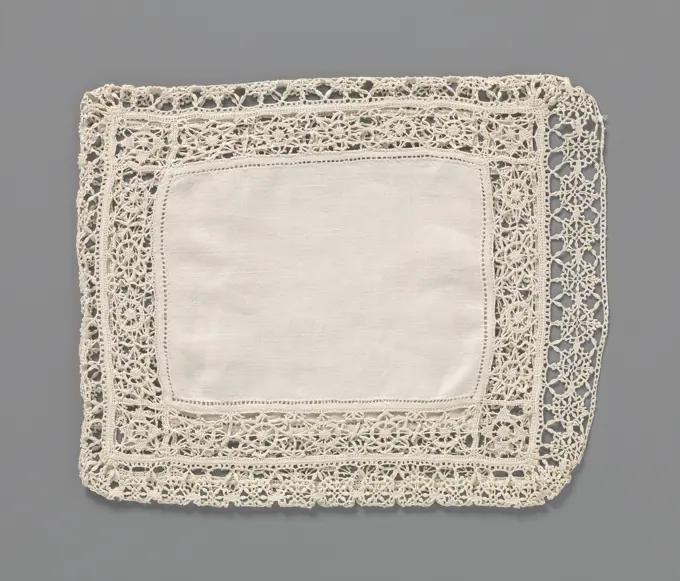
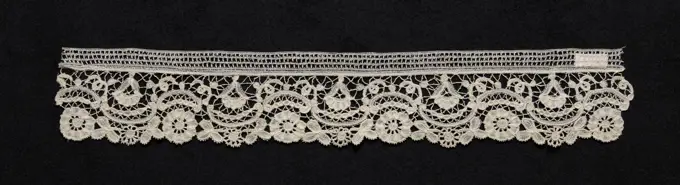
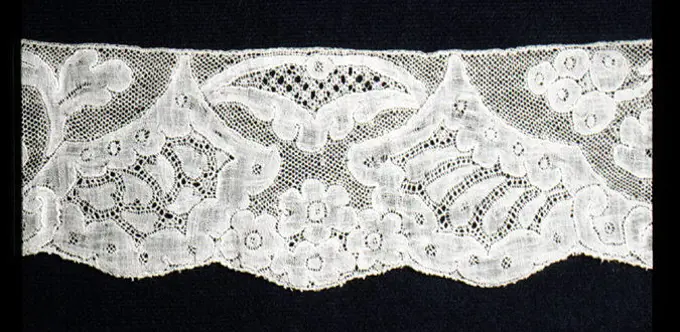
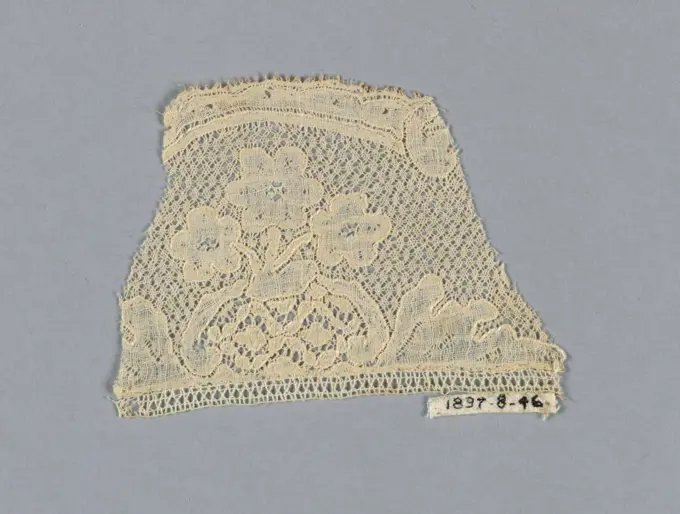
A series of historical fabric lace strips showcasing detailed floral and geometric patterns, highlighting craft techniques from various centuries.

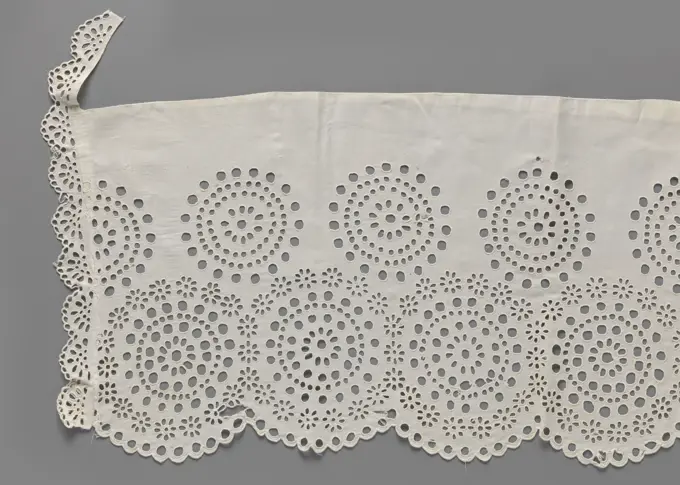
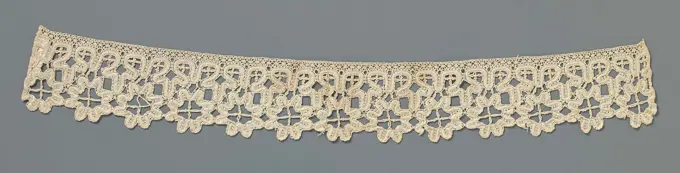
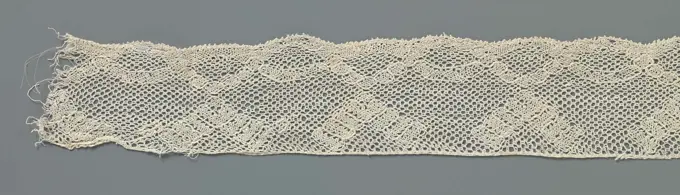
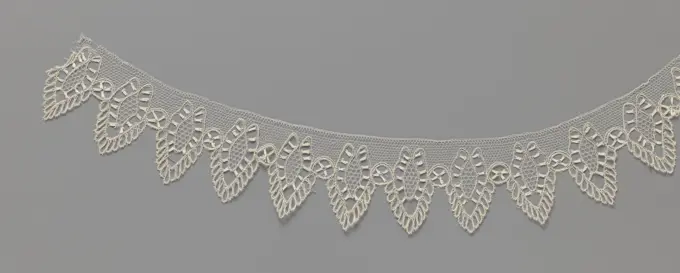
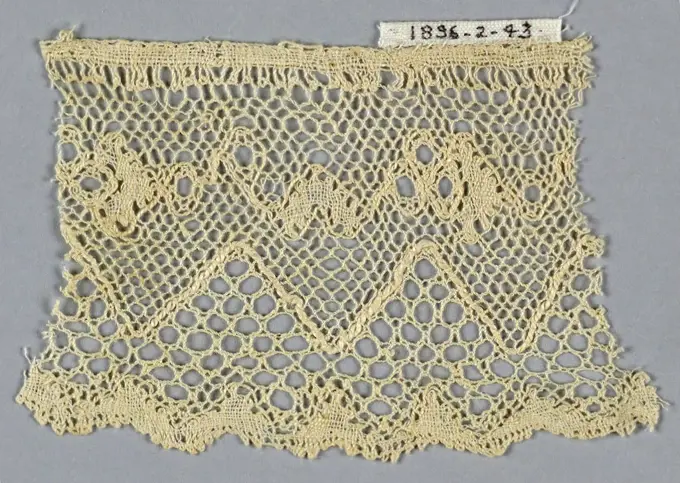
Strip bobbin with four-lobbish rosette above and below a zigzag band, anonymous, c. 1840 - c. 1860 Strip of natural -colored bobbin, blonde. The repeating and continuous pattern consists of a zigzag band, which divided the strip into triangular fields. There is a four -lobe rosette in the center of each field. Along the top and bottom of the strip runs a scallop, which consists of a succession of circles. The scallops are finished with picots. The motifs are connected by a coarse mesh soil, strewn with square moes. The zigzag band, rosettes and circling edges are made in linen stroke, with the rosettes equipped with a contour wire. unknown silk bobbin lace / blonde (lace) Strip of natural -colored bobbin, blonde. The repeating and continuous pattern consists of a zigzag band, which divided the strip into triangular fields. There is a four -lobe rosette in the center of each field. Along the top and bottom of the strip runs a scallop, which consists of a succession of circles. The scall
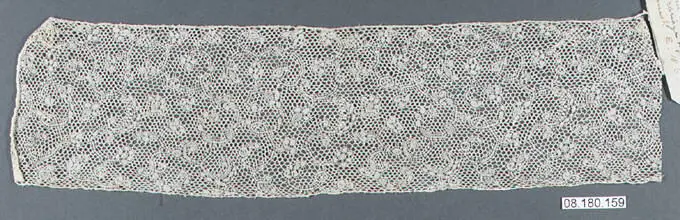
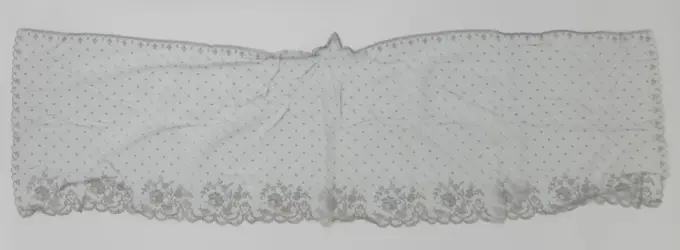
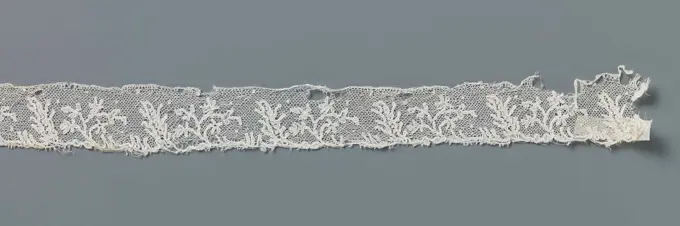
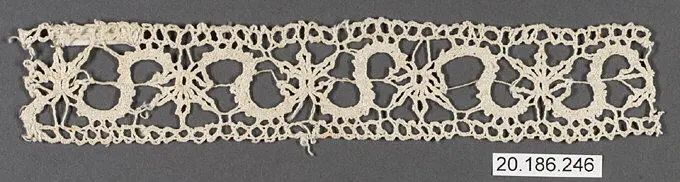
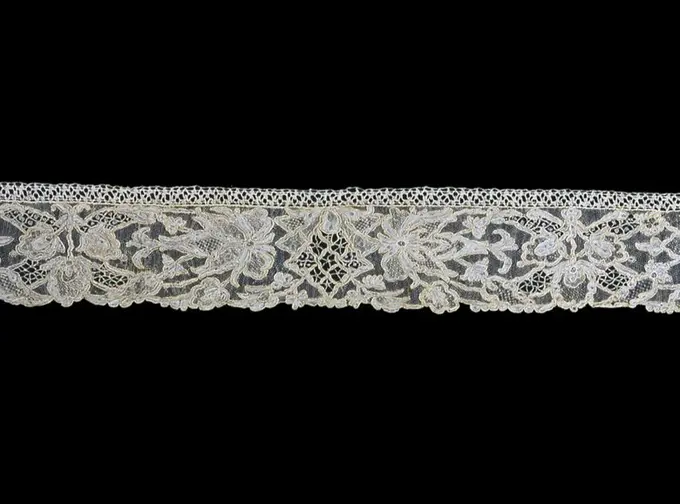
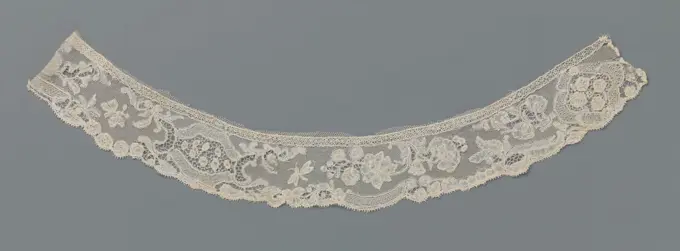
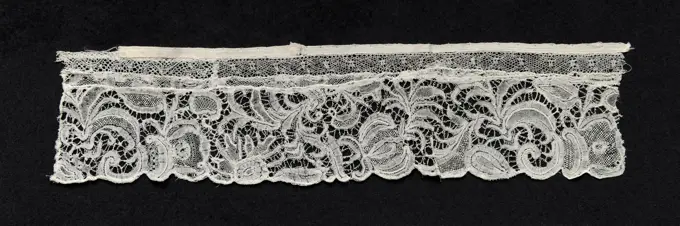
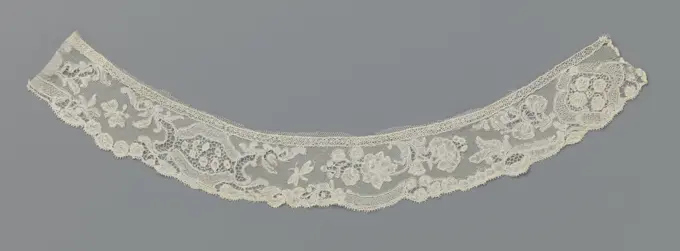
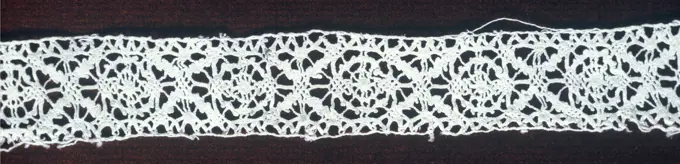
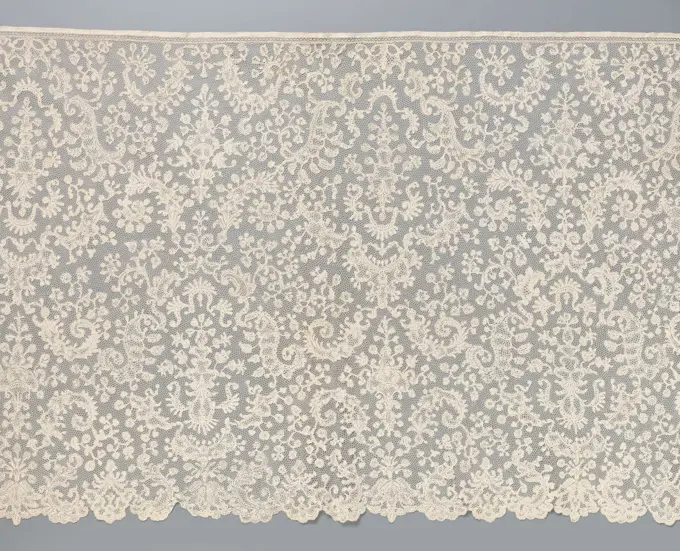
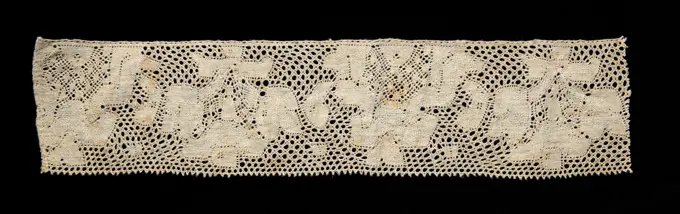
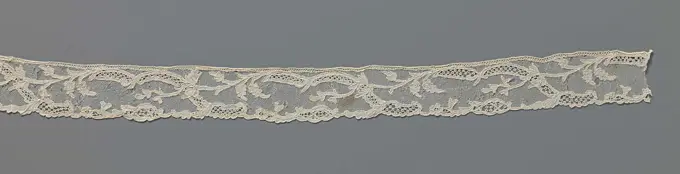
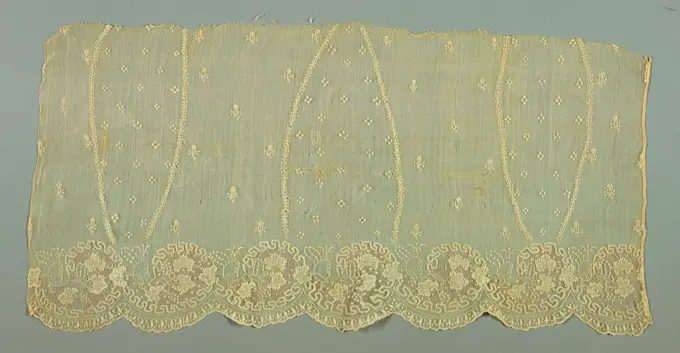
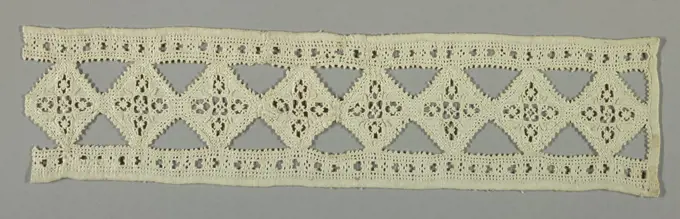
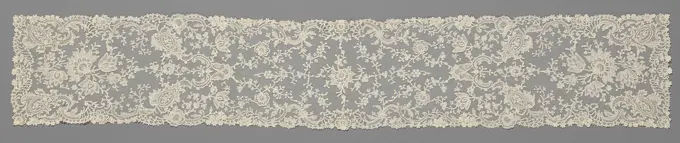
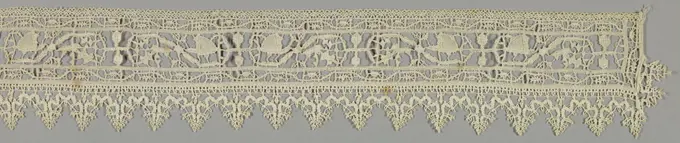
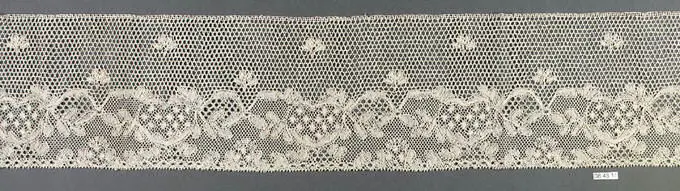
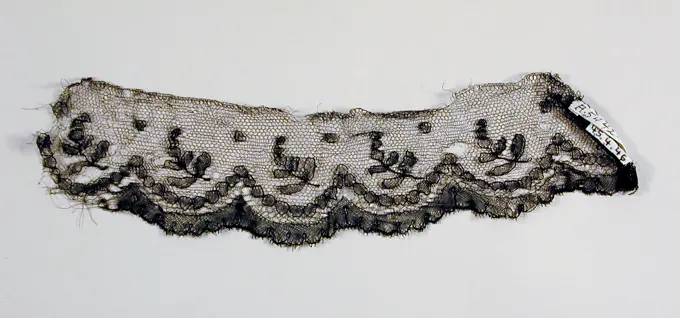
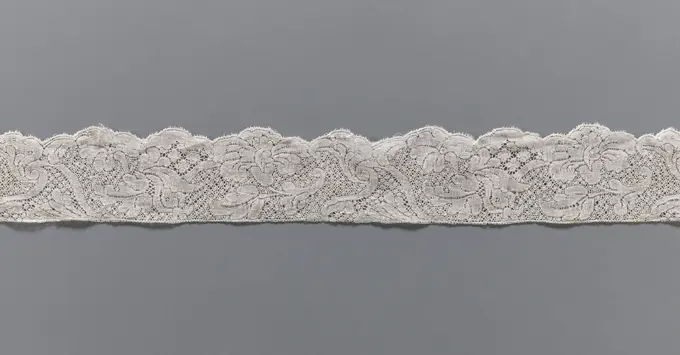
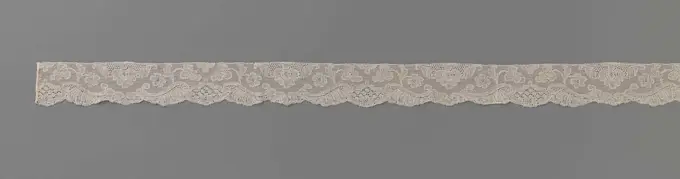
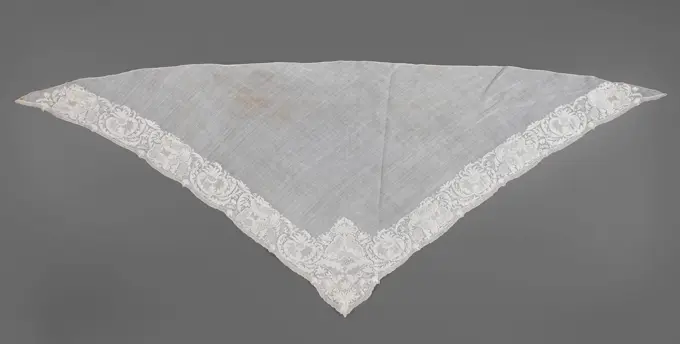
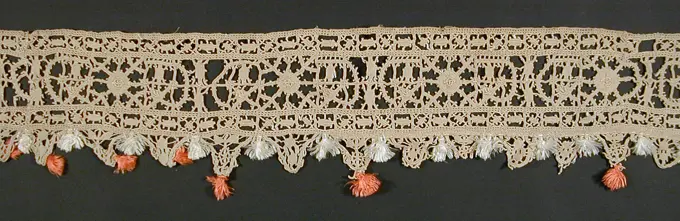
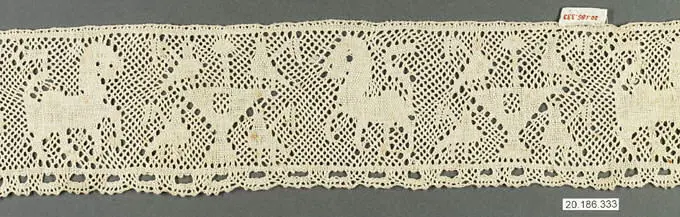
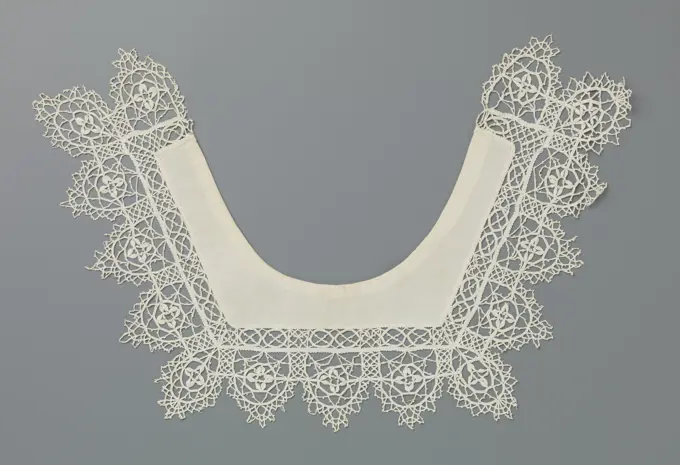
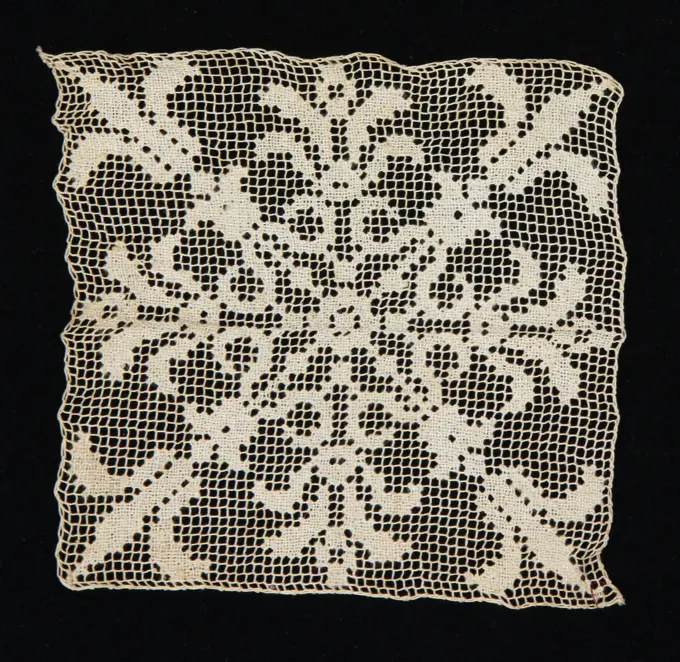
Border. Date/Period: Early 17th century. Border. Medium: linen. Technique: bobbin lace, continuous braid-like. Author: UNKNOWN.Band, Medium: linen Technique: bobbin made continuous tape with bars added, Scrolling tape set between borders with picots., 19th century, lace, BandCap Streamers (Belgium); linenJapon strip application side with palm tree, anonymous, c. 1840 Japon strip of natural -colored application side, bobbin side with some details in the needle side applied on mechanical tulle. The stock is evenly filled with a running pattern of palm trees, which tilted to the left and start with a trunk and a fan -shaped crown, and then split into various tribes and smaller crowns. From the latter, multifaceted branches, among other things with arrow -shaped leaves, hang out, which hang deeply on the left and right, while here and there garlands have been hung in their voluten garlands. A low flowering plant grows between two tribes, which starts with a fine leaf rosette. The scales are formed by winding lace strips and feathered leaves. Brussels linen (material) Japon strip of natural -colored application side, bobbin side with some details in the needle side applied on mechanical tulle. The stock is evenly filled with a running pattern of palm trees, which tilted to the left and starFragment early 18th century Flemish. Fragment 214514Strip of gray lace, c. 1400 - c. 1950 Strip of gray lace, probably mechanically manufactured. One of the long edges is trimmed with C Voluten above which flower vines. The soil is littered with moesjes.  textile materials Strip of gray lace, probably mechanically manufactured. One of the long edges is trimmed with C Voluten above which flower vines. The soil is littered with moesjes.  textile materialsStrip of needle side with butterfly above S-Voluten, anonymous, c. 1925 - c. 1936  Strip of natural -colored needle side: Venetian relief side. Symmetrical pattern with butterfly above S-Voluten. To the right of this another flower. The motifs are made up of feston stitches with sparingly applied recesses and with fested relief contours. The motifs are connected by a picoted sijpen soil. Ornamental stitches in, among other things, the wings of the butterfly and in the petals. Top and bottom of the strip are straight. Belgium cotton (textile) Venetian raised workPiece Irish 19th centuryStrook kloskant met takje met sterbloempjes en dik takje met zijtakjes.Strip natural colosside: Lille side. Between scattered moes, the repeating pattern consists of two different thin twigs, which spring from the bottom of the strip. On one branch are some star-shaped flowers, the other branch has a thick base with thin short twigs on both sides. The motifs are connected by a fine grille, a tulet. The very sparse full work is made in linen stroke, where the thicker and shiny contour wires dominate. The thicker branch is filled with stacked cubes made in shape stroke. Upper and bottom of the strip are straight finished, the underside with picots.Insertion 17th century Italian, Venice. Insertion 221056Strip bobbin with a narrow decorative belt along the bottom of connected circles, anonymous, c. 1800 - c. 1899 Strip of natural-colored bobbin, Buckingham side. Under a spray pattern of square mosies, the pattern along the underside of the strip consists of a narrow decorative band, which is formed by a staggered row of connected circles. The strip largely consists of a mesh ground, a tuler land. The circles themselves are made with thick and shiny contour threads around the meshes of a decorative soil, a rose ground. The Mosjes are made in form. The top of the strip is straight finished. The very silly edge of the scaffold along the bottom comes from the pattern with the circles and is finished with picots. Buckingham cotton (textile) bobbin lace / Bucks point (lace) Strip of natural-colored bobbin, Buckingham side. Under a spray pattern of square mosies, the pattern along the underside of the strip consists of a narrow decorative band, which is formed by a staggered row of connected Border. France. Date: 1830-1849. Dimensions: 7 × 150.6 cm (2 3/4 × 59 3/8 in.). Linen, needle lace of a type known as "Point d'Alençon". Origin: France. Museum: The Chicago Art Institute, Chicago, USA.Strook kloskant met bloemtak en insect tussen twee cartouches.Strip natural colored Brussels climbing side. The strip is slightly curved in shape. The pattern consists of a hanging flower branch and a flying insect between two different shapes cartouches. The motifs are connected by a fine Maas soil, a slighten ground. The full work is largely made in linen battle with openwork edges, single recesses and with power stuffs. Different motifs have closted relief contours. Different ornamental grounds have been applied, including piced braid forces. The top is finished with a separate splitting strap, to which fragments are stuck from a hexagonal maas soil. The scalloped underside is finished with picots.Scarf collar from a tulle strip point the gaze de bruxelles, anonymous, c. 1860 Scarf collar from a tulle strip point the gaze de Bruxelles. One long edge is straight, the other edge and the ends are scalloped with a repeating leaf motif. The pattern has thickened contour threads. West-Europa . Scarf collar from a tulle strip point the gaze de Bruxelles. One long edge is straight, the other edge and the ends are scalloped with a repeating leaf motif. The pattern has thickened contour threads. West-Europa .Cuffs (2) late 19th century Belgian, Brussels. Cuffs (2) 212636Fragment of the lace;  18th century (1701-00-00-1800-00-00);Kloskant motif in the form of an elongated drop, Sophia Gerardine Cenijn-Smit, c. 1914 Motif in the form of an elongated drop of natural-colored bobbin: Cluny side. The contour of the drop is made in Linnenlag. Within the contour, a branch hangs down from the pointed end that ends in the convex part of the drop at the bottom. However, the branch is interrupted in midfield by a decorative soil with spiders with an eye. On the braided branch, leaves are made in form on either side. Amsterdam linen (material) bobbin lace / Cluny lace Motif in the form of an elongated drop of natural-colored bobbin: Cluny side. The contour of the drop is made in Linnenlag. Within the contour, a branch hangs down from the pointed end that ends in the convex part of the drop at the bottom. However, the branch is interrupted in midfield by a decorative soil with spiders with an eye. On the braided branch, leaves are made in form on either side. Amsterdam linen (material) bobbin lace / Cluny laceStrip 17th century possibly Italian. Strip 217235Border Made 1610-1640 Italy. Linen, needle lace worked on a laid and plaited thread grid, Reticello pattern .Bobbin Lace (Point d'Angleterre) Cuff, early 18th century. Belgium, Brussels, early 18th century. Lace, bobbin; average: 7.7 x 30.5 cm (3 1/16 x 12 in.).Edging Italian, probably Burano late 19th centuryStrip bobbin with flower branch and insect between two cartouches, anonymous, c. 1735 - c. 1750 Strip of natural -colored Brussels bobbin. The strip is slightly bent in shape. The pattern consists of a hanging flower branch and a flying insect between two different forms of cartouches. The motifs are connected by a fine Maas soil, a drachel soil. The fullwork is largely made in linen battle with openwork edges, some recesses and with mains fillings. Various motives have chattered relief contours. Different decorative lands have been applied, including picoted braids. The top is finished with a separate stretched strap, to which fragments are attached of a hexagonal mesh ground. The scalloped underside is finished with picots. Brussels linen (material) bobbin lace / Brussels bobbin lace Strip of natural -colored Brussels bobbin. The strip is slightly bent in shape. The pattern consists of a hanging flower branch and a flying insect between two different forms of cartouches. The motifs aStrip of black bobbin with rose in U-shaped double decorative frame, anonymous, c. 1850 Strip of black bobbin: chantilly side. The repeating and symmetrical pattern consists of a succession of U-shaped double decorative frames. Above the decorative frame is a flower garland with leaves, flower buds and large hanging roses, always one rose in each U-shaped field. Two half rosettes are interspersed with half a wreath of leaves under the decorative moldings. The rosettes and half wreaths form the scrap edge. The motifs are made in netslag and are accentuated by contour threads. The motifs are connected by a traly land, a tuler land. A decorative land has been used in the heart of the rose, a rose ground. The scrap edge is finished with picots. The top of the strip is straight finished. Bayeux silk bobbin lace Strip of black bobbin: chantilly side. The repeating and symmetrical pattern consists of a succession of U-shaped double decorative frames. Above the decorative frame is a flower garStrip bobbin with windows, anonymous, c. 1900 - c. 1924  Strip of natural -colored bobbin: tie. Pattern with four rows of windows and a row of triangles along the straight top. Schulpenrand with pointed sculpts formed by the bottom row of windows. The row of triangles at the top and the middle row windows are made with a tie in which four diamonds in linen battle (middle row) or a V-shaped motif in netslag (in the triangles). The other windows are made in netslag with a window in Linnenslag in the center. The windows that form the scrap edge have sloping lines. 's Gravenmoer linen (material) Bobbi lace / lace clothCollar with split tiles. Collar of natural needle side: Venetian relief side. Circular model with close-fitting neckline. Large and several palmet flowers grow on branched and split spiral drinks. Open bars soil. Finished with a straight list of arcs, which are formed as zulls.Fragment 18th century Flemish. Fragment 218914Strip of cotton with lace plunger with openwork concentric circles, C.I. Bosch Reitz-Teding van Berkhout, c. 1860 - c. 1880 Strip of natural cotton with lace bobbins: English embroidery. Schulpenrand with large scales above which two staggered rows of concentric circles, made up of three ever -increasing circles and a daisy in the middle. The bottom row also has an extra circle on the outside that consists of small daisies. The other circles are made up of openwork small and larger circles. A continuous list of openwork circles runs along the scrap edge. Along one of the short sides is a sculpy strip sewn with smaller sculptures. Amsterdam cotton (textile) Strip of natural cotton with lace bobbins: English embroidery. Schulpenrand with large scales above which two staggered rows of concentric circles, made up of three ever -increasing circles and a daisy in the middle. The bottom row also has an extra circle on the outside that consists of small daisies. The other circles are made up oStrip bastard with four-lobbig rosettes between four zigzag tires, anonymous, c. 1840 - c. 1860 Strip of natural -colored bobbin, blonde. The repeating and continuous pattern consists of four zigzag tires placed among each other, which divided the strip into diamond-shaped fields. There is a four -lobbish rosette in the center of each diamond -shaped field. A faint wavy band runs along the top and bottom of the strip. Here the fields are triangular and the rosettes are missing. The motifs are connected by a coarse mesh soil, strewn with square moes. The zigzag band, rosettes and tires along the top and bottom of the strip are made in linen battle. Only the rosettes and the lower or upper wavy band are provided with a contour wire. unknown silk bobbin lace / blonde (lace) Strip of natural -colored bobbin, blonde. The repeating and continuous pattern consists of four zigzag tires placed among each other, which divided the strip into diamond-shaped fields. There is a four -lobbish rosettePiece early 18th century Flemish. Piece 214572Manchet van kloskant met v-vormig blad in halfronde schulp.Cuff of natural colosside, Valenciennes side. The repeating pattern consists of a V-shaped sheet in a semicircular shell formed by a double band. The motifs are connected by a mesh soil, a diamond-shaped valenciennes ground. The motifs are made in linen battle with recesses and open editors. In the recesses and between the double tire along the shelter, a dash cartridge has been realized with braids. The top of the strip is straight finished. The shelters along the underside are finished with picots.Strook kloskant met aaneenschakeling van achtlobbige rozetbloemen.Strip natural colosside: Russian side (ribbon side). The pattern is formed by clusted ribbons of equal width. The pattern consists along the underside of the strip from a succession of symmetrical-eight rosette flowers, with a cross of four double braids in the large opened heart. Above this row with rosette flowers runs a through ribbon that alternately forms a single-spoiled leaf and a triple leaf alternately, the middle blade of which sticks between the rosette flowers. The motifs are connected to each other with some picoted braids. The ribbons are made in linen stroke with openwork edges and with a thicker wire in the middle of the relief ribbon. The top is straight finished with a knitted and fine decorative strap of linked snowflakes. The sloping edge along the underside of the strip is formed by the lower lobes of the rosette flowers.Fragment Swedish, Vadstena 19th centuryEcharpe of machine ribbon side with band work. Echarpe of natural-colored machining: machine ribbon side. The echarpe has a wideed backpiece. An open, symmetrical pattern of thin spiral drinks, which is widely scattered leaves and florets, is framed by a flat sculpture, formed by a smooth frame and starflowers.Band; linen; 1946-42-53Scarf  jabot made of black lace unknownInsertion 16th century Italian, Venice. Insertion 220890Strip Application side with grape bunches and halved leaves, anonymous, c. 1850 - c. 1890 Strip of natural -colored application side, bobbin lacquered on mechanical tulle. A narrow part, along the inside, shows a running pattern of halved, lobed leaves, which also accompanies a halved medallion with grid filling. On a wide part with a tulle surface are symmetrical, deep sculptures, which are alternately filled with a grape vice and a fan plant. Belgium (possibly) linen (material) Strip of natural -colored application side, bobbin lacquered on mechanical tulle. A narrow part, along the inside, shows a running pattern of halved, lobed leaves, which also accompanies a halved medallion with grid filling. On a wide part with a tulle surface are symmetrical, deep sculptures, which are alternately filled with a grape vice and a fan plant. Belgium (possibly) linen (material)Alternate from dick edge with candelaber motifs. Alternate of natural spein climbing side: Old Flemish side. The symmetrical pattern consists of a double row of candelaber motifs, to and around in two variants. One motif consists of a tulip vase between leaves in the form of C and S volutes, with a vase with flowers in a diamond shape of four hollow shelters made with leaves and flowers. The other motif consists of a vase with flowers between four leaves in the form of S volutes, with a tulip vase above that also stands between leaves in the form of C and S volutes. The motifs are made in linen stroke with recesses. The motifs are connected by a grille and an ornamental soil has been applied in various motifs. The underside is finished with a sloping edge that comes from the pattern. The top of the strip is finished with a separate scrossed edge with a woven edge above above. The ends of the strip are sewn together.Cuff of needle side with hanging flowers and curly stems, anonymous, c. 1825 - c. 1849 Cuff of natural -colored needle side: Brussels mesh side. The symmetrical pattern consists of hanging flowers along the bottom edge with five petals and a drop -shaped flower heart that is formed by a loop. Between the successive flowers there is always a smaller chalice flower on the ends of the loops with which the flower hearts are formed on either side. The pattern runs over -corner on the short sides. Each drop -shaped flower heart is crowned by a rosette flower and one or two (with the middle) circles. Above each chalice, there is an open -up arch crowned by a circle. The motives are made with feston stitches and are accentuated by relief contours. The motifs are connected to each other by a mesh cantar with moesjes. The scrap edge is formed by the hanging flowers. The top is straight finished with two threads with a rail rail pattern. Brussels linen (material) Brussels Gaze Point Cuff of naturBobbin Lace Insertion, 17th-18th century. Italy, Abruzzi, Pescocostanzo, 17th-18th century. Lace, bobbin; average: 10.9 x 47.7 cm (4 5/16 x 18 3/4 in.).Strook naaldkant met gespiegelde s-vormige sierband en iris.Strip natural-colored coniferous lace: Alençon side. The repeating pattern consists of a flat S-shaped decorative tire in mirror image. The band continues at the top in a wavy branch of pointed and feathered leaves and with an iris that lies over the next ornamental band. The tires touch the top of the strip and run diagonally with a slight S-shaped curve to end along the underside of the strip. The motifs are made up of feston stitches where sparingly very fine recesses are used for decoration. The motifs are equipped with relief contours and are interconnected by a fine hexagonal Maas soil, an alençon ground. Ornamental grounds with radar picots are used in decorative tires, seed beads and flower hearts. The flat sloping edge is finished with picots. The top of the strip is finished with a splitting strap.Sleeve (Philippines); piña (pineapple) fiber, cottonBand, Medium: linen Technique: plain weave embroidered with deflected element work, needlemade filling stitches, Woven linen band showing design of interconnected diamonds with narrow borders on top and bottom. Each diamond has five small squares filled with tiny needlemade filling stitches., Italy, 16th-17th century, lace, BandFragment 17th century Flemish. Fragment 214485Piece 18th century Flemish, Mechlin. Piece 214510Echarpe van gemengde kant met tulpen.Echarpe of natural mixed side: Brussels climbing side with needle lace ground, a fine mesh side ground. This type of side is also called Point d'Angleterre. A rectangle shape shows a reserve at the ends with an inward-facing top facade. The contours of this symmetrical reserve consist of small C volutes, seed beads and overhoek ovals. Inside there is a branch with tulips and a large palmet flower. Some volutes and seed beads have coniferous clad fills. There is a lot of relief from pearls. In the middle, symmetrical relative to two axes, a pattern of five palm-free browses and four tulips on fine branches. In addition, the flowers and fine side branches with pearls are decorated in thick relief. Decorative stitches of open grid work, zigzag arrows and pearls.Border. Date/Period: Early 17th century. Border. Medium: linen. Technique: bobbin lace, continuous. Author: UNKNOWN.Band; linen; 1933-1-80Strip application side with wine range, anonymous, c. 1800 - c. 1815 Strip of natural -colored Brussels Application side: Needle side Applicated on Drochelgrond. Under a spray pattern of wine leaves, a continuous slender runs along the lower edge, from which branches sprout to two sides with wine leaves and grape bunches. The very flat scrap edge is formed by straight upright wine leaves, interspersed by wreaths with pearl edges and filled with decorative stitches. Motives are constructed with feston stitches and are accentuated by relief contours of wide -ranging wire bundles. The top is straight finished with a messing strap. Brussels linen (material) Brussels Applied Strip of natural -colored Brussels Application side: Needle side Applicated on Drochelgrond. Under a spray pattern of wine leaves, a continuous slender runs along the lower edge, from which branches sprout to two sides with wine leaves and grape bunches. The very flat scrap edge is formed by straight upright wine leavesBand, Medium: linen Technique: withdrawn element work with needle lace (reticella), bobbin lace edging of continuous braid, Band with a grid of withdrawn element work of needle lace (reticella) with continuous repeat of a scrolling vine. Edge of bobbin lace of continuous braid like., Italy, 17th century, lace, BandNeedlepoint (Drawnwork) Lace Insertion, 16th century. Italy, 16th century. Lace, needlepoint: linen; average: 6.1 x 24.5 cm (2 3/8 x 9 5/8 in.).Cap Streamer; linen; 1901-8-1Edging French, Craponne 19th centuryFragment, Medium: linen Technique: needlework on knotted net, Square made up of four small squares in rosette with surrounding border in geometric design., Italy, 17th century, lace, FragmentStrook kloskant met v-vormige motieven boven spitsovalen.Strip natural colosside. The repetitive and partly continuous pattern consists of two wavy lines, which cross each other and thus pace along the lower half of the strip. Each second wave cap is awarded by a V-shaped motif that extends to the top of the strip. The motifs are connected by a maas soil, a fat mat of grille. The motifs are made in scroll, with thicker contour wires. The top of the strip is straight finished. The slight sloping edge along the underside stems from the wavy lines and is finished with picots.Border; 1974-52-56Lace Fragment. Italy, Venice, late 17th-early 18th century. Textiles; fragments. Linen needle lace (point de Venise)Lace, 1700s, France, maker unknown. Gift of Mrs G. Acland Allen, 1955.Border 17th century Italian. Border 223101Lappet. France, 1700-1725. Costumes. Linen point de France needle laceFichu with transhipment of black bobbin with mosies and snowballs, anonymous, c. 1860 - c. 1870 Fichu with a return of black silk bobbin, chantilly side. Diamond -shaped model with a midfield and scalloped edges strewn. The edge consists of a succession of narrow diamonds through which a ribbon seems to be strung. This pattern is always interrupted by a flower feast, with a snowball under a large leaves from which fine flower branches and reed stalks spring. A slender flower garland runs above the sculp pattern. The motifs are connected by a mesh soil, strewn with moesjes. The fullwork is made in Netslag and one type of decorative land has been used, thicker contour threads run around the motifs. Bayeux (possibly) silk. bobbin lace Fichu with a return of black silk bobbin, chantilly side. Diamond -shaped model with a midfield and scalloped edges strewn. The edge consists of a succession of narrow diamonds through which a ribbon seems to be strung. This pattern is always interrupted by Handkerchief Italian, Burano ca. 1875Strip bobbin with a wavy band of lancet leaves and all kinds of different flowers, anonymous, c. 1740 - c. 1750 Strip of natural -colored Brussels bobbin. The pattern consists of a wavy band of elongated leaves and all kinds of different flowers. In the wave valleys there are always one or a few flowers with large leaves, including two rosette flowers between a lobbed heart -shaped leaf, a rosette flower with a pear -shaped leaf and a flower with six pointed petals. The motifs are largely made in linen battle with openwork edges, few recesses and provided with burst relief contours. A mains filling has been used here and there. The motifs are connected to each other at the top of the strip by a fine grid, a drachel soil. Under the Golf, an irregular and open braiding ground with picots connects the motifs. Different decorative grounds have been used, predominantly in the elongated leaves, including fine snowflake grounds and decorative land with a diamond -shaped pattern. The top is stBorder 17th century Italian. Border 222760Steel bobbin with tuler land, anonymous, c. 1875 - c. 1899 Steel or short strip of a strip of natural -colored bobbin side: Lillese Kant. Coming from a lifted side school in Turnhout. Turnwood cotton (textile) bobbin lace / Lille lace Steel or short strip of a strip of natural -colored bobbin side: Lillese Kant. Coming from a lifted side school in Turnhout. Turnwood cotton (textile) bobbin lace / Lille laceBorder, Medium: linen Technique: bobbin lace, discontinuous tape, Border with narrow band in repeat pattern of birds in flight and geometric foliated forms from which three large rounded pendants are suspended. In each, a double-headed eagle surmounted by a crown and surrounded by foliated and floral forms. Border consists of smaller pendants, each composed of a single geometric motif., Europe, 1640-60, lace, BorderBobbin Lace Insertion with Edging, mid 16th century. Italy, Venice, mid 16th century. Lace, bobbin; average: 2.3 x 20.4 cm (7/8 x 8 1/16 in.).Strip bobbin with deep wave line, anonymous, c. 1880 - c. 1899 Strip of black bobbin, cluny side. The repeating and symmetrical pattern consists of a deep wave line. In each golf valley there is a rosette with two smaller rosettes and a four -pointed star in between. Each wave summit comprises a composite, standing leaf, with five leaves on either side. Under the leaf is a framed four -pointed star. The scrap edge along the underside of the strip is formed by three radiating lobes under each golf valley. A composite leaf hangs down in each of these lobes. The lobes are finished with arches made with potente braids. The golf lines and frames are made in netslag and linen battle, the rosette leaves, composite leaves and stars in shape. They are connected by a braid ground, which forms a coarse square grille on the top of the strip. The top of the strip is straight finished. Geraardsbergen (Possible) silk bobbin lace / Cluny lace Strip of black bobbin, cluny side. The repeating and symmetFragment of Lace. Belgium, Grammont, 1850-1900. Textiles; fragments. Silk Chantilly bobbin laceTwo hat slips (barbes) from Argentankant, Anonymous, c. 1775  Two hat slips from Argentankant. The pattern consists of flower branches that are framed by a wavy band. The scalloped edges consist of lilies and leaves. France linen (material). Argentan LaceFragment of the lace;  Ok. PO. 18th century (1740-00-00-1760-00-00);Strip bobbin with windows between zigzag lines of openwork circles, anonymous, c. 1800 - c. 1899 Strip of natural -colored bobbin, straw side. The pattern consists of a row of windows between zigzag lines of connected and openwork circles. Along the underside of Dest Smoke hangs under each top in the zigzag line, a fan-shaped motif as shell down. Along the top is the zigzag line connected to a Maas soil, a tender floor. The windows are made in netslag. The openwork circles are made with a decorative land where four threads such as Sierdraad emphasize the contours of the circles Brazil linen (material) Bobbi lace / lace cloth Strip of natural -colored bobbin, straw side. The pattern consists of a row of windows between zigzag lines of connected and openwork circles. Along the underside of Dest Smoke hangs under each top in the zigzag line, a fan-shaped motif as shell down. Along the top is the zigzag line connected to a Maas soil, a tender floor. The windows are made in netslag. The opeEdging 17th century Italian, Genoa. Edging 220943Insertion 18th century Italian. Insertion 214920Strook kant met drielobbig cartouche en afhangende bloem met druppelvormig hart.Strip natural colosside: Mechelen side. The repeating pattern consists of two accumulating symmetrical compositions. One composition consists of a triple cartouche, which lies along the bottom and is flanked left and right by an elongated s-voltage with five lobes at the bottom. From the S vultuts, a splitting branch with one leaf and two flowers exprceed. The other composition consists of a flour dependent on the top with a drip-shaped heart, between two leaves. The motifs are connected by a fine Maas soil. The motifs are made in linen stroke with few recesses, but with openwork edges. There are contour lines around the motifs with slightly thicker and shiny wire. Some different ornamental grounds have been applied, including a snowflakes soil, in, among other things, the cartouche and between the leaves. The bland scaled underside comes from the pattern and is finished with picots. The top is just finisheBorder. Belgium, Flanders, Mechlin. Date: 1730-1749. Dimensions: 5 x 120.4 cm (2 x 47 3/8 in.)Width repeat: 16.1-16.5 cm (6 3/8 in.). Linen, bobbin straight lace of a type known as "Mechlin" with a double torchon mesh ground. Origin: Mechelen. Museum: The Chicago Art Institute, Chicago, USA.Strip bobbin with windows between double zigzag band, anonymous, c. 1900 - c. 1924  Strip of natural -colored bobbin, straw side. The pattern consists of over-cutting tires that go over the strip with a zigzag movement, creating windows and triangles. One band is made in closed linen battle, the over -cut decorative band is made in mains with snowflakes in between. Immediately below are two narrower and continuous zigzag lanes with larger snowflakes in between the triangular scallops along the underside of the strip. The zigzag lanes are connected to each other along the top of the strip by a mesh ground. The top of the strip is straight finished. The scums are finished with picots. Russia linen (material) Bobbi lace / lace clothStrip bobbin with ovals that form deep pointed sculptes, anonymous, c. 1925 - c. 1949 Strip of natural -colored bobbin: blonde. The color tends vague to blue. The repeating pattern consists of an oval with one pointed point that hangs down and forms a deep shell. The successive scallops are connected by an openwork circle, in which an X-shaped motif is made in form. The ovals are formed by a decorative soil, a rose ground, around which a wide open work runs from contour threads between which are blocks made in shape. An extra decorative band runs around the lower part of the ovals, which is formed by a succession of openwork and fine picots finished. The contour threads consist of a combination of a bundle of floss threads and a twisted wire. At the top, the motifs are connected by a traly land, a tuler floor. The top is straight. Belgium (possibly) silk bobbin lace / blonde (lace) Strip of natural -colored bobbin: blonde. The color tends vague to blue. The repeating pattern consists oBorder Made 1770-1789 Italy. Linen, needle lace .Kussenovertrek van linnen met een tussenzetsel van reticella en een tussenzetsel van kloskant.Cushion cover of linen with an intermediate socket - reticella and a climbing side intermediate site with a reticella appearance. Pattern with squares in which star flowers and radical motifs on straight and diagonal lines. The motifs in the needle side are made with feston stitches and are connected to each other by a bars. The cluster side motifs are made in linen stroke and in shape stroke and they are connected by braids.Bobbin Lace (Duchesse) Edging, 19th century. Belgium, Brussels, 19th century. Lace, bobbin: linen; average: 6.4 x 39.4 cm (2 1/2 x 15 1/2 in.).Striping closen with hanging sepals, anonymous, c. 1820 Strip of natural -colored bobbin: Lille side. Under a spreading pattern of square mouses, the repeating pattern consists of a hanging chalice flower, on a curved stalk with three round leaves. The chalice flowers are placed against each other and form the shells along the underside of the strip. The motifs are connected by a fine grid, a tuler land. The fullwork in the Kelkbloem is made in linen battle, with an openwork center track and equipped with thicker and shiny contour threads. The stalk and the leaves are made with contour threads where a decorative land has been used in the leaves. The Mosjes are made in form. The top of the strip is straight finished. The shells along the bottom are finished with picots. Southern Netherlands linen (material) bobbin lace / Lille lace Strip of natural -colored bobbin: Lille side. Under a spreading pattern of square mouses, the repeating pattern consists of a hanging chalice flower, on a cuStrook zwarte machinale kant met libellen.Strip black machine side: machining chantilly-side. The repeating pattern consists of two, almost straight placed, flying dragonflies. The wings of the upper dragonfly are more upright and those of the lower dragonfly sideways. A thin, split rosary with a few flowers and leaves exprceeds at the bottom of the strip of a wavy line, which consists of a concatenation of rose branches. Under each wave top hangs a curved short decorative tire with a square grid. The motifs are equipped with contour wires and are interconnected by a machining tulet, which is strewn with mashes. As ornamental ground, machine rose soil has been applied in the curved decorative tire and in the flower hearts. The curved decorative tire forms the slip edge under the tops of the through wavy rosary branches, which is finished with picots. The top of the strip is straight cut and not finished.Band fragment, Medium: linen Technique: bobbin lace, coninuous braid-like, Two parallel rows of crosses and diamonds., Italy, 16th century, lace, Band fragmentStrip early 18th century Flemish. Strip. Flemish. early 18th century. Bobbin lace. Textiles-LacesFragment; linenLappet ca. 1700 Flemish. Lappet 212400Kerchief. unknown, authorJabot of needle side with fan -shaped palmets, anonymous, c. 1875 - c. 1909 Jabot of natural -colored needle side: Venetian relief side. Fan -shaped cut. Standing seams are visible in the middle and sides. In the large central pieces, with a generally symmetrical pattern, fan -shaped palmets are above two hanging tiflets with flowers, under a smaller varied palmet. The pattern of the tendrils and star -shaped flowers is very detailed and contrasts clearly against an open bar soil. Venice (possibly) linen (material) Venetian raised work Jabot of natural -colored needle side: Venetian relief side. Fan -shaped cut. Standing seams are visible in the middle and sides. In the large central pieces, with a generally symmetrical pattern, fan -shaped palmets are above two hanging tiflets with flowers, under a smaller varied palmet. The pattern of the tendrils and star -shaped flowers is very detailed and contrasts clearly against an open bar soil. Venice (possibly) linen (material) Venetian raisLength of Lace. Spain, early 17th century. Textiles; textile lengths. Silk and linen reticello needle lace with silk tasselsFragment Belgian, Brussels 19th centuryFragment, Medium: linen Technique: bobbin lace (Lille-style with heavy outlining thread), Lille-style fragment with upper portion in a conventionalized pattern separated from border by deep points with heavier thread., England, 19th century, lace, FragmentEdging 18th century Italian, Abruzzi (Pescocostanzo). Edging 221144Kloskant collar inspired by lying 17th century collars and accompanying engagement photo (copy) of Bram Pleging and Jet Faber who made the collar and wore during her engagement, J.H. Preging-Faber, c. 1914 - c. 1916 Collar of linen with a border of natural torway side. Trapezoidal lying model, with U-shaped neck opening. The repeating pattern consists of half -doval sculptures, with a four -lobbish rosette of eight Spitsovale leaves made in shape. The rosette is in the center of a braided wheel with eight points that form a star. The sculptes are finished with picoted pointed braids. The four corner sculptures, two rear and two from the front, are fitted egg-shaped. The whole is inspired by a type of collar, which was popular in the 17th century. The maker of the collar, Johanna Henriëtte Faber (Jet), succeeded Louise van der Meulen-Nulle as a lace teacher at the Rijksschool for Applied Arts in 1916. She carries the collar in the same year with her engagement with Abraham Pleging (BramStrip 1625-50 Spanish Punto in arialiterally, "stitches in the air"is one of the earliest styles of needle lace, which is itself developed from cutwork of primarily geometric design. When lacemakers transitioned to using a foundation of threads laid out according to a pattern drawn on parchment, they were able to incorporate more fluid lines and curves into their designs.. Strip 212443Bobbin Lace Edging, 18th century. Italy, Milan, 18th century. Lace, bobbin: linen; average: 15.6 x 29.3 cm (6 1/8 x 11 9/16 in.).Application with heart shape of machining. Application of natural-colored machining. Heart-shaped model. The symmetrical pattern consists of a decorative edge along the underside of the heart of opened squares with a cross with a dot in the center in each square. Half-relieved slump along this belt along with the same crosses. The squares and shifts take direction the tip at the bottom in size. At the top the heart is bordered by a slider with small leaves. In the heart there are three chali flowers with two rosette flowers in between, both with small leaves.Needlepoint Lace Scarf, 18th century. France, Argentan, 18th century. Lace, needlepoint: linen; average: 29.3 x 180.3 cm (11 9/16 x 71 in.).Lace square lace, filet laceFragment; linen; 1933-1-148