Intricate Lace Strips

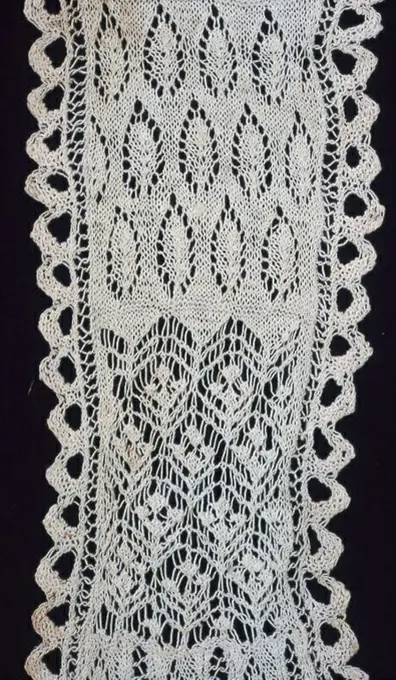
A series of historical fabric lace strips showcasing detailed floral and geometric patterns, highlighting craft techniques from various centuries.

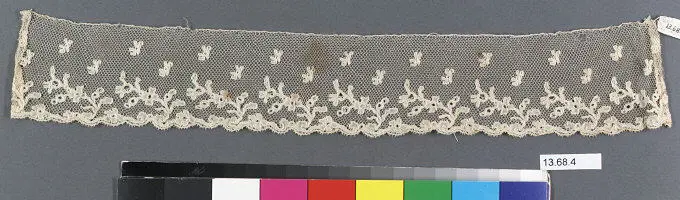
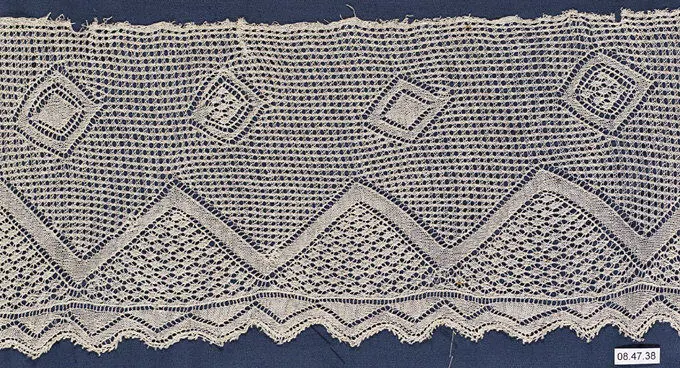
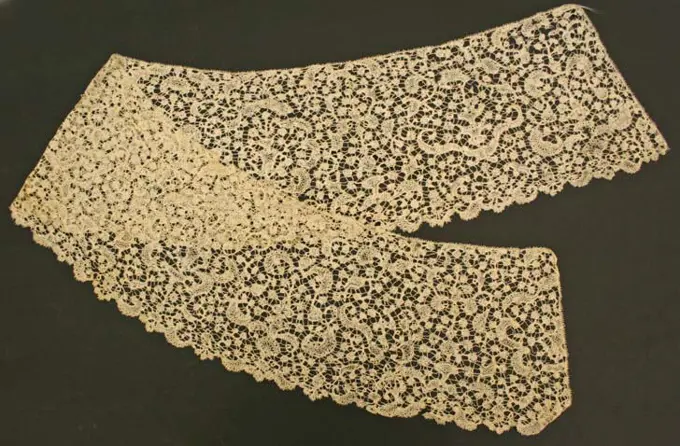
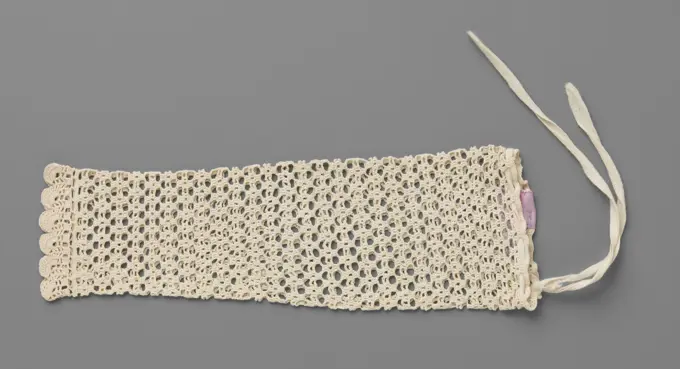
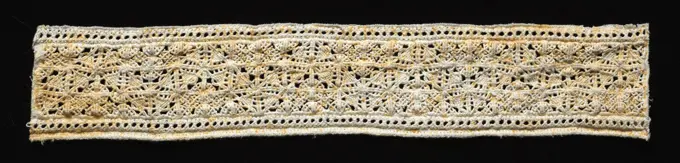
Strip bobbin with four-lobbish rosette above and below a zigzag band, anonymous, c. 1840 - c. 1860 Strip of natural -colored bobbin, blonde. The repeating and continuous pattern consists of a zigzag band, which divided the strip into triangular fields. There is a four -lobe rosette in the center of each field. Along the top and bottom of the strip runs a scallop, which consists of a succession of circles. The scallops are finished with picots. The motifs are connected by a coarse mesh soil, strewn with square moes. The zigzag band, rosettes and circling edges are made in linen stroke, with the rosettes equipped with a contour wire. unknown silk bobbin lace / blonde (lace) Strip of natural -colored bobbin, blonde. The repeating and continuous pattern consists of a zigzag band, which divided the strip into triangular fields. There is a four -lobe rosette in the center of each field. Along the top and bottom of the strip runs a scallop, which consists of a succession of circles. The scall
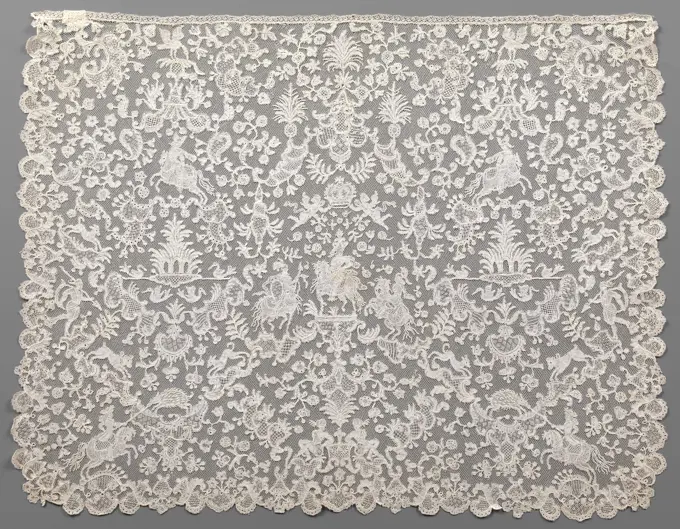
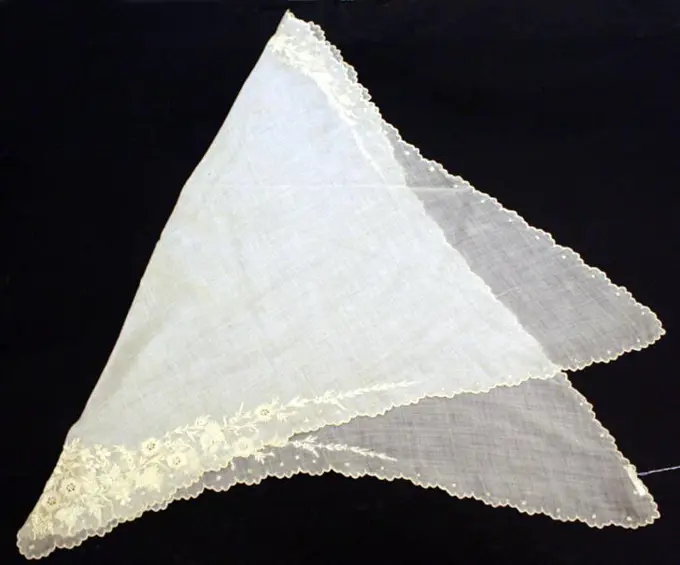
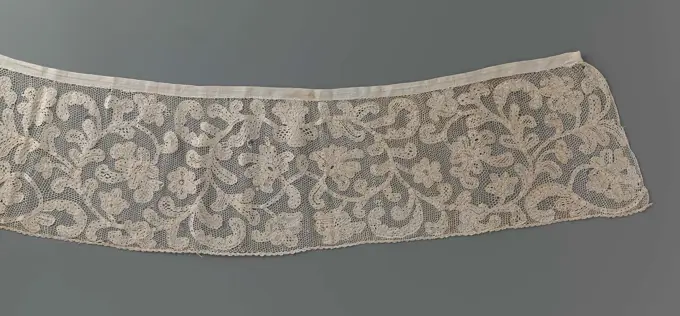
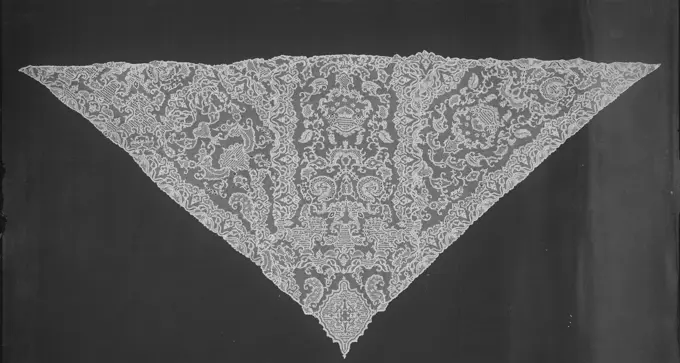
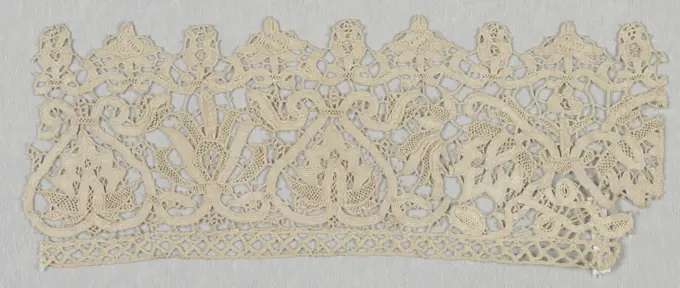
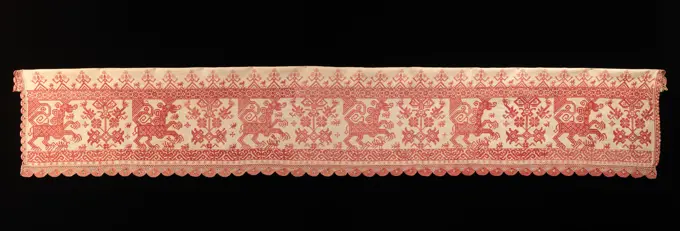
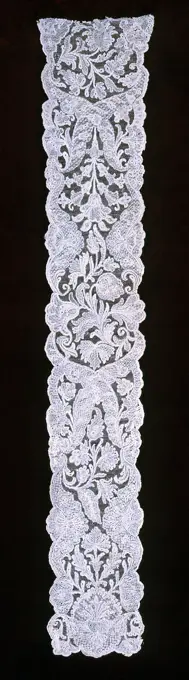
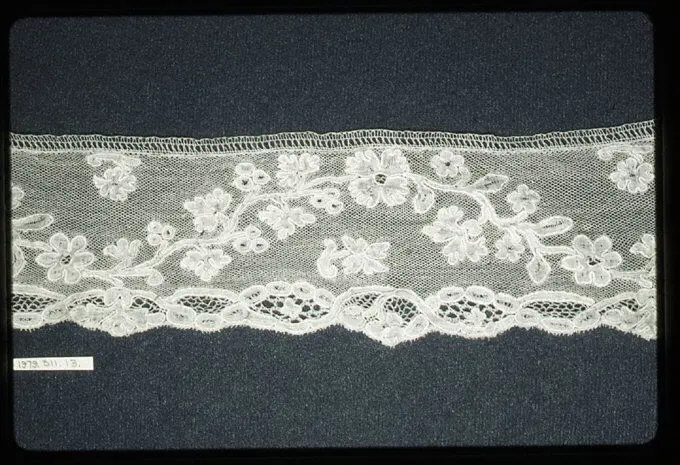
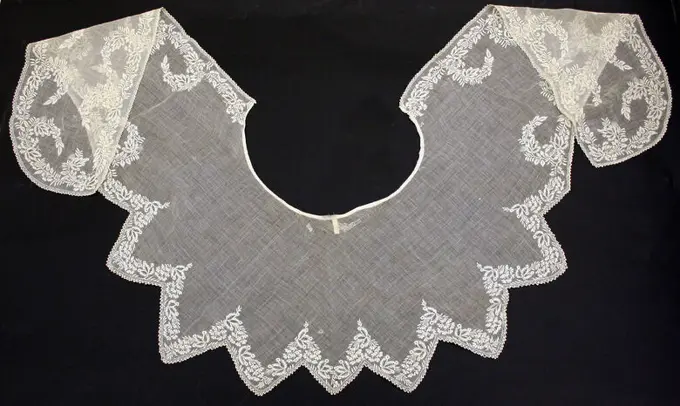
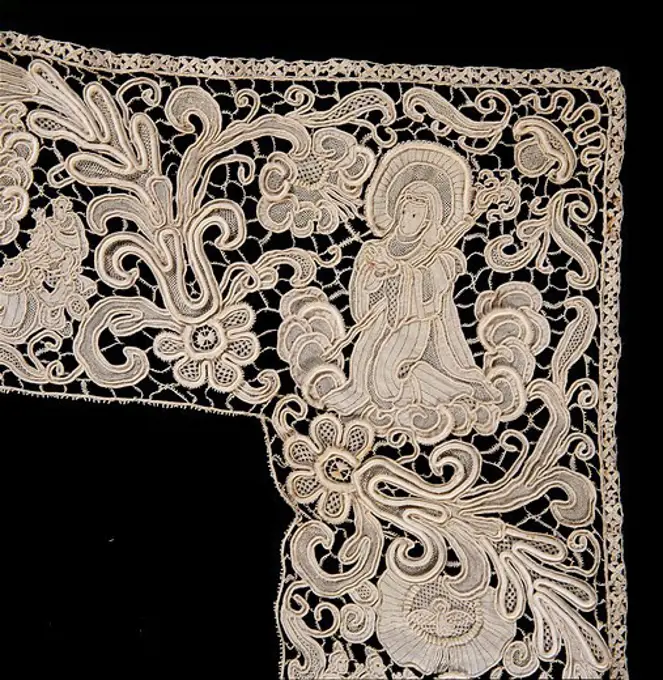
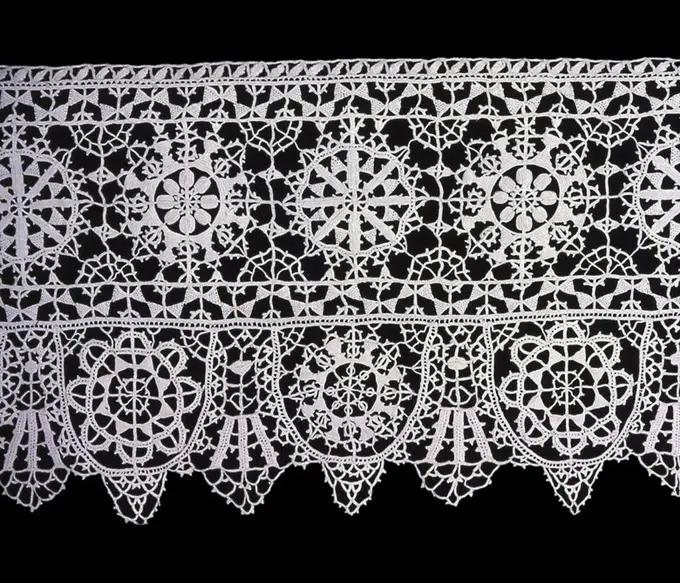
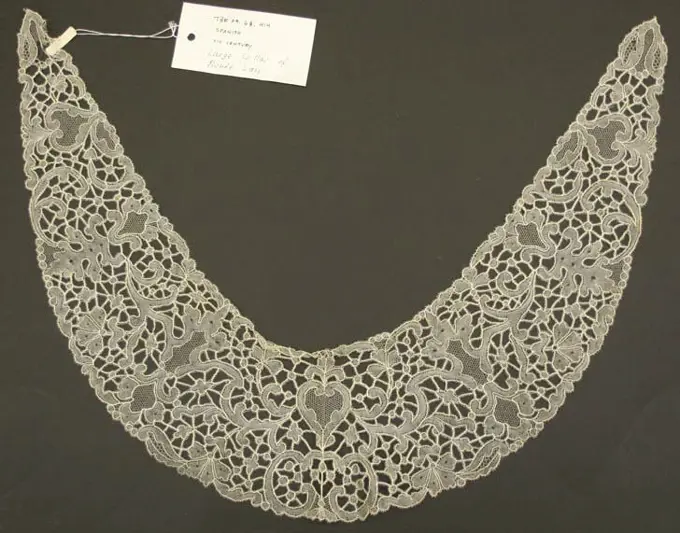
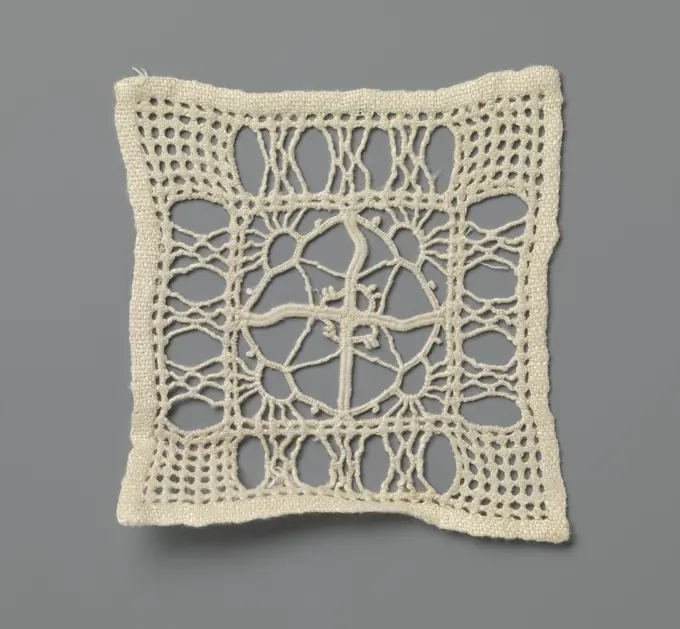
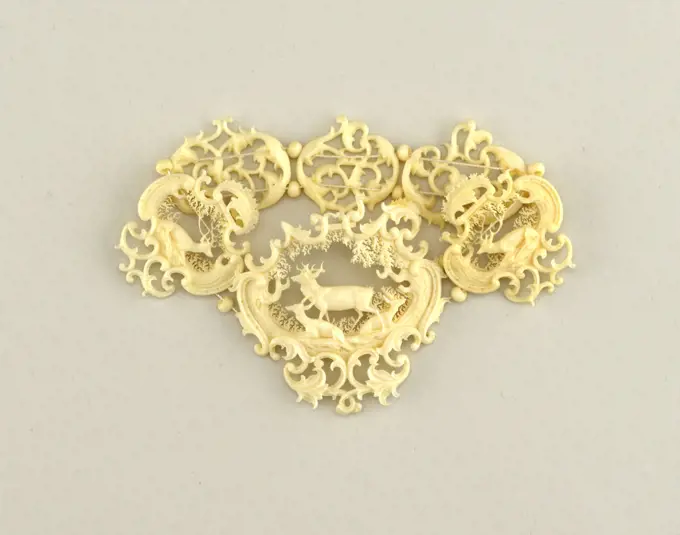
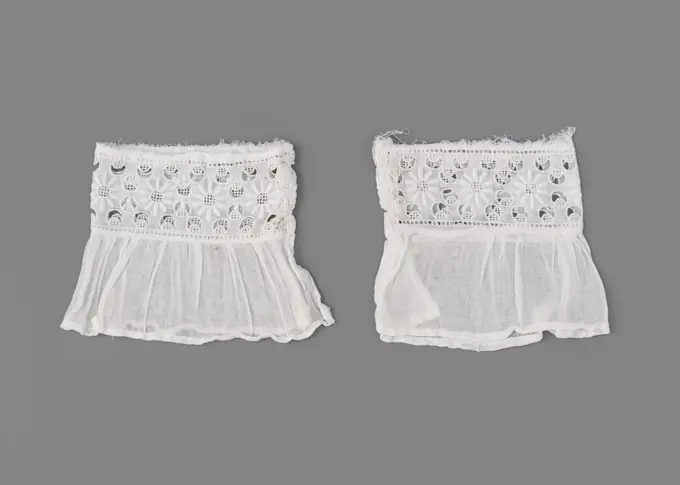
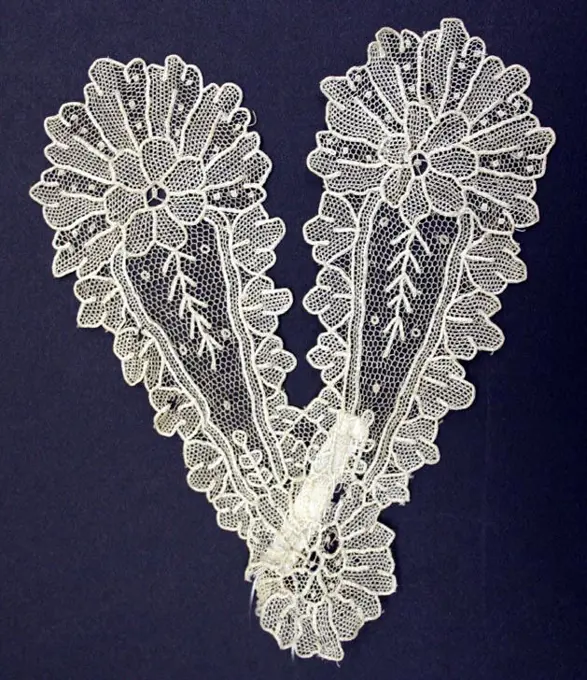
Sampler Made 1857 Vienna. Cotton, knitted . Miss Anna Warner (Maker)Bobbin Lace Insertion without Selvage, mid 16th century. Italy, Venice, mid 16th century. Lace, bobbin; average: 2.9 x 17.8 cm (1 1/8 x 7 in.).Europe, Belgium, Bruges Kantcentrum, famous lace center; sample of handmade lace, detailBorder (France); silkBatist's handkerchief around finished with a dick side with zigzagacolades and a flower branch with three daisies in every corner. Natural batist handkerchief around finished with natural colosside: fine brugs flower work. The batist is cut into brace form along each side, such as the shape of the side. Each clost accolade consists of two zigzag decorative moldings in an elongated faint S-shape. Attached to this is a succession of half oval, bowjes or leaves that form the tube edge. In every corner, overhoeks is placed a flower branch with oval leaves and three daisies that form the slot in the corner. The flower branch releases a C-voltage including a triple flower that is attached to the Batist. The motifs are made in linen stroke with thick contour lines. The veins of (flour) leaves and bows are made with recesses in which crossing couples can be seen. The flowers are connected by a braid soil. The open-worked flower hearts are each decorated with a block between four tanning threadFragment of the lace;  1. PO. 19th century (1801-00-00-1850-00-00);Cap 19th century probably French. Cap 98358Border, 18th century, 38 x 1 7/16 in. (96.52 x 3.66 cm), Cotton, silk; embroidered, India, 18th centuryFragment; linen; Bequest of Marian Hague; 1971-50-205Textile, Medium: cotton on piña cloth (pineapple fiber) Technique: embroidered, Rectangular piece of fabric for the sleeve of a blouse embroidered in a design of a plant in a basket alternating with leaf and scroll motif. One scalloped edge., Philippines, 19th century, embroidery & stitching, TextileFragment British, Buckinghamshire early 19th centuryStrip bobbin with four -leaf in network of braids that forms a semicircular shell, anonymous, c. 1917 Strip of natural-colored bobbin: Cluny side. The repeating pattern consists of a semicircular shell made with an open network of braids, with a cross made of four leaves in a circle in the center in the center. Three half moon -shaped lobes hang under each shell. The top of the strip is straight finished with a strap with a square grille. On the strip is a paper label sewn with the handwritten text: 'Kota Gadang no selling price per el f0.50 wage worker F0.45'. City of Gadang linen (material) bobbin lace / Cluny lace Strip of natural-colored bobbin: Cluny side. The repeating pattern consists of a semicircular shell made with an open network of braids, with a cross made of four leaves in a circle in the center in the center. Three half moon -shaped lobes hang under each shell. The top of the strip is straight finished with a strap with a square grille. On the strip is a paper label sewnOrnament; linen; 1943-17-2-a,bBobbin Lace Edging, 19th century. England, Northhamptonshire, 19th century. Lace, bobbin: linen; average: 14 x 40.7 cm (5 1/2 x 16 in.).Pair of Lappets (Joined) Made 1760-1769 France. Linen, needle lace of a type known as Point d'Argentan with buttonholed mesh ground .Fragment early 18th century Flemish. Fragment 214575Bobbin Lace Insertion with Selvage, mid 16th century. Italy, Venice, mid 16th century. Lace, bobbin; average: 2 x 17.8 cm (13/16 x 7 in.).Fragment (Border). Italy, probably Venice. Date: 1630-1639. Dimensions: 12.0 x 19.3 cm (4 3/4 x 7 5/8 in.). Linen, needle lace. Origin: Venice. Museum: The Chicago Art Institute, Chicago, USA.Heat slips from Binchekant, sewing, anonymous, c. 1750 Hats slips from Binchekant, sewn. The Barbe has a round end, is scooped and equipped with a picot edge. The barbes have a floral motif. South of the Netherlands linen (material) Binche Lace Hats slips from Binchekant, sewn. The Barbe has a round end, is scooped and equipped with a picot edge. The barbes have a floral motif. South of the Netherlands linen (material) Binche LaceCravat end or rabat mid-18th century Flemish, Brussels The quality of workmanship in this cravat end is consistent with its presumed exalted provenance. It is said to have been made for the Austrian empress Maria Theresa; given to her daughter the French queen Marie Antoinette; and then passed to the marquis de Chabert, a French admiral and astronomer, after which it descended in his family. The possibility of this association is supported by the crown at center resembling the Austrian archducal crown, though no further proof of the connection has been discovered. Illustrated are the royal pursuit of hunting on horseback and the eighteenth century interest in exoticism, as personified by the bare-breasted female riders wearing feathered headdresses at the center of the piece and the turbaned men reclining toward the bottom. Brussels bobbin lace, often called point dAngleterre, is worked in parts and joined with a plaited hexagonal mesh called drochel.. Cravat end or rabat 222067Trimming, Medium: silk, Woven heading with loops and tassels., USA, 19th century, trimmings, TrimmingBarbe early 18th century French. Barbe 222555Encaje de bolillos. Museu Català de les Arts i Tradicions Populars.Shawl ca. 1830 American This hand made lace is created in the shape of the shawl, giving it an overall integrity of design and function.. Shawl 157851Fragment of lace unknownStrook naaldkant met dubbele rozetbloem.Strip natural needle side, reticella. A rehaling pattern of one rosette flower with eight petals, with a rosette flower with as many petals in the center. The pattern, so every rosette flower, covers the full width of the strip. Top and bottom are finished with a straight edge.Retro square embroidery cutout lace patternStrook gehaakte kant met waaiervormige reticella schulpen.Strip natural-colored Irish crochet side, inspired by Reticella. Crocheted wire or line with impeller-shaped picoted slot, made up of loops and arcs.Strip bobbin with bow edge in which alternately stand a leaf branch and a round between spokes, anonymous, c. 1900 Strip of black bobbin, cluny side. The repeating pattern consists of an arc edge, where the bows are the sculpts. In each arch there is alternating a branch with five leaves and a round between spokes. The straps that form the arches are made in linen battle. The circles in it are made in mains and the leaves on the twigs are made in shape. The motifs are connected by a braid ground. Along the bottom hang three lobes on each bow, made with braids and finished with a few picots. The top of the strip is straight finished. France (possibly) silk bobbin lace / Cluny lace Strip of black bobbin, cluny side. The repeating pattern consists of an arc edge, where the bows are the sculpts. In each arch there is alternating a branch with five leaves and a round between spokes. The straps that form the arches are made in linen battle. The circles in it are made in mains and the leaves Fragment, Medium: linen Technique: bobbin lace, Mechlin style, Belgium, 18th century, lace, FragmentStrook kloskant met aaneengeschakelde hartvormige composities.Strip natural colosside, blonde. The repeating and connected pattern consists of two symmetrical compositions along the lower half of the strip. One composition is heart-shaped and consists of a fan-shaped motif along the bottom edge, from which two slanted branches displayed, each with five half moon-shaped leaves. The other composition is narrower and forms a heart covered by a triple flower, a connection between the successive heart-forming compositions. No motives come to the upper half. Above the pattern, the strip consists of a fine Maas soil, a tulet. In the pattern, the motifs are connected by an ornamental ground, a rose ground. The motifs are made in linen stroke and scroll with thick shiny contour wires. The top of the strip is straight finished. The slight sloping edge along the underside comes from the pattern and is finished with very fine picots.Kerchief mid-19th century American. Kerchief 119306Lace laceDress of edge embroidery with emerging suns along diamond shape. Square dress of natural-colored edge embroidery, carved work. Pattern with a square made up of four small squares. Each small square is divided by a diagonal line, with a 'rising sun' on the outside and a triangle on the inside. Together this ensures a diamond shape in the large square with a four-pointed star in the middle. To the large square on all sides a border with rectangles, filled with bundles of wires or with a dense grid work with opened diamonds. A finished edge in linen stroke on all sides.Strook gemengde kant voor een superplie met voluutranken.Strip natural-colored mixed side: Mezzo Punto. The strip is intended for a superplie and has a symmetrical pattern of voluntaries, with rosette flowers, impeller-shaped flowers and acanthus leaves on a hexagonal mesh soil (needle side). The contours of the pattern are formed by a split ribbon with holes. Within the contours different needle lace ornamental grounds. The top is wrinkled to a straight linen band sewn. The bottom is trimmed with a straight edge of clamping side with picoted arcs.Fragment of the lace;  beginning of the 18th century (1701-00-00-1710-00-00);Piotr -Klblicki, Alfred (1861-) - collections, Taczanowska, Maria (Flow. Ca 1950) - collection, flower ornaments, purchase (provenance)Fragment; linenSleeve ruffle, Medium: linen Technique: bobbin lace, Brussels style, Sleeve ruffle shape with detached flowering sprays and leaf ornaments., Belgium, late 18th century, lace, Sleeve ruffleEdging early 19th century Italian. Edging 213337Shawl 19th century British. Shawl. British. 19th century. no medium availablePiece early 18th century Flemish, Mechlin. Piece 214499Border, Medium: linen Technique: needle lace, early 17th c. and style, Fragment of border with a symmetrical leaf shape enclosed by an upside down heart that alternates with a symmetrical plant form. Both are topped by alternating flower and sprig shapes., Italy, early 17th century, lace, BorderBatist handkerchief with scrap edge of half oval arches and rosette flower with star -shaped flower heart in the corners, c. 1890 Batist handkerchief all around with bobbins: fine brugs flower arrangements. The bobbin side consists of four narrow and faint wavy lines along the edges of the handkerchief, which partly overlap each other. This contains a succession of open -worked half ovals, arches, which form the sculpy edge. In each corner, Overhoeks is placed on two C-Voluten one large rosette flower, with an open worked around Bloemhart with a star in it. The motifs are made in linen battle with openwork edges and thick contour lines. The veins of the petals are depicted with recesses. The scrap edge is finished with picots. Used cotton (textile). batiste bobbin lace Batist handkerchief all around with bobbins: fine brugs flower arrangements. The bobbin side consists of four narrow and faint wavy lines along the edges of the handkerchief, which partly overlap each other. This containFragment 16th century Italian. Fragment 212312Border fragment 16th century Italian. Border fragment 214952Fragment; linenSampler 19th century German. Sampler 228612Cape Collar Made 1875-1900 Belgium. Cotton, bobbin part lace of a type known as Duchesse de Bruxelles .Bed curtain border early 19th century Russian This object is from the collection of Natalia de Shabelsky (1841-1905), a Russian noblewoman compelled to preserve what she perceived as the vanishing folk art traditions of her native country. Traveling extensively throughout Great Russia, she collected many fine examples of textile art of the wealthy peasant class. From the 1870s until moving to France in 1902, Shabelsky amassed a large collection of intricately embroidered hand-woven household textiles and opulent festival garments with rich decoration and elaborate motifs. The Brooklyn Museum holdings include many fine examples including the majority of the garments. Portions of Shabelsky's collection are also housed at the Museum of Fine Arts, Boston, the Cleveland Art Museum, and the Russian Museum of Ethnography in St. Petersburg.Depictions of the goddess are common in Russian embroidery, traditionally associated with fertility. The figure is commonly depicted with upraised arms and Curtain fragment. Culture: French. Dimensions: L. 51 x W. 35 inches129.5 x 88.9 cm. Date: 18th century. Museum: Metropolitan Museum of Art, New York, USA.Accessory set ca. 1850 British. Accessory set 170347Square, Medium: linen Technique: grid of withdrawn element with needle lace, reticella style, Frame with narrow pointed border., Italy, 16th century, lace, SquareSash of machine side with flowers and leaves, anonymous, c. 1800 - c. 1899 Sash of natural -colored machine side: machine blonde. The sculpting edges along the long sides of the sash are formed by the repeating pattern of a lying flower. The flowers are connected, each on a slightly bent stem with an elongated leaf, where the flower turns her cup with an arc in the stem slanted down. The leaves and the flour form the scallops. In the midfield between the sculpting edges, there are loose smaller flower branches, which are connected to a larger flower between large leaves at the beginning and end of the sash. These large motifs provide the scrap edge on the short sides. The motifs are provided with shiny contour threads and are connected by a machine tulist. In most flower hearts and at the ends of the sash, decorative lands have been used, mainly mechanical rose grounds. The sculpe edges are finished with picots, but these are largely damaged. France (possibly) silk Sash of natural -colPortion of Needlepoint (Drawnwork) Lace Collar (), 17th century. Spain, 17th century (). Lace, needlepoint: linen; average: 14 x 22.6 cm (5 1/2 x 8 7/8 in.).Cap Streamer (Italy); linenBand; natural linen; Bequest of Marian Hague; 1971-50-335Edging 18th century Flemish, Malines The Metropolitan Museum's great lace collection was started when the Museum became the first among American museums to organize a permanent collection of lace with the acceptance of the McCallum Collection in 1879 and the bequests of Mrs. John Jacob Astor, Mrs. Robert L. Stuart, Mrs. Augustus Cleveland, and Mrs. A. W. Winters shortly thereafter. In 1893 a loan collection of antique laces shown at the World's Columbian Exposition in Chicago was assembled by a committee of New York women headed by Catharine Augusta Newbold. About 1900 Miss Newbold arranged and labeled an exhibition of laces and linenworks lent to the Metropolitan Museum by Mrs. James Boorman Johnstone and the Misses Johnstone. "Her scholarly knowledge of lace technique enabled the Museum for the first time to offer a comprehensive display of lace illustrating its historical development," wrote Miss Frances Morris, then curator of the textile department. Miss Newbold's name occurs agaiTulle curtain with tulle, anonymous, c. 1700 - c. 1899 Tulen curtain with embroidered tiflines for a boudoir.  . embroidering Tulen curtain with embroidered tiflines for a boudoir.  . embroideringFlounce 17th century Style of Bartolomeo Danieli This needle lace flounce is in the style of Bartolomeo Danieli, whose lace pattern books were published during the first half of the seventeenth century. The lace displays an extremely high level of technical expertise. Typical of the period is the repeating pattern of vases with symmetrical, stylized floral forms and scrolling stems. The design was emphasized by the use of a thicker thread to create a slightly raised outline around the vases and stems. This piece was most likely the production of a professional or a convent workshop, as evidenced by the high quality of craftsmanship, in addition to the presence of a coat of arms, which indicates a commissioned work. The arms are those of the Pallavicini family.. Flounce. Style of Bartolomeo Danieli (Italian, active Bologna and Siena 1610-1643). Italian. 17th century. Needle lace. Textiles-LacesMedallion, Medium: linen Technique: needle lace, 6-sided reworked grounds, Medallion in a design showing the French royal sun contained within half-domed architectural structure, surrounded by stylized foliated garlands., France, late 17th century, lace, MedallionLength; linen; 1946-48-1-bDouble collar 1875-1900 probably American. Double collar 118959Strip of gold side with hearts and squares, anonymous, c. 1920  Strip bobbin, gold side. The repeating pattern consists of a heart, crowned by a rush -in. There is a triangular configuration of ten squares between the successive hearts. Fan -shaped sculpts between the hearts form the underside of the strip. The squares made in shape are in a mesh ground, a lace-hole stroke-grid. The vertical lines in the hearts are made with flattened filé yarn, where the core is wrapped with looser and wider straps than with the finer filé yarn used for the rest of the lace. The sculptes have a triple thread that makes long loops as on foot. France . bobbin lacePiece ca. 1600 Italian. Piece. Italian. ca. 1600. Needle lace. Textiles-LacesBertha ca. 1700 Belgian. Bertha 98252Beadwork, circa 1890, by Arthur Crum. Gift of Mrs Ruby Carman, 1966.Strip of bobbin with stylized flour between two vertical lines and ovals on a triangular fragment linen batist, anonymous, c. 1600 - c. 1635 Strip of natural -colored bobbin, Old Flemish side or Dutch bobbin side. The strip is attached to a triangular fragment linen batist. The side has a pattern that consists of vertical straight lines, between which a stylized flower stands. On the center line, the flower is flanked on the left and right by a lying rush -hour, which always cuts the vertical line. The motives are made in linen battle with recesses, there is hardly any soil, the motives are connected by very short braids. Up and bottom of the strip are finished with a straight edge. Southern Netherlands (possibly) linen (material) bobbin lace / old Flemish lace Strip of natural -colored bobbin, Old Flemish side or Dutch bobbin side. The strip is attached to a triangular fragment linen batist. The side has a pattern that consists of vertical straight lines, between which a stylized flowFichu. Culture: American. Date: 1830s. Museum: Metropolitan Museum of Art, New York, USA.Lace 18th century Flemish. Lace 120785Laces, 17th century. Needle lace hem for an altar tablecloth with vegetable shoots and Gospel episodes, made for the church of Saint Martin in Burano, cm 12,5 high, approximately 1650.  Detail: figure of a Saint.Cuffs (Belgium); linen; 1898-24-6-a,bBobbin Lace (Mechlin) Edging, mid 18th century. Belgium, Mechelen , mid 18th century. Lace, bobbin: linen; average: 11.5 x 111.8 cm (4 1/2 x 44 in.).Cap crown mid-18th century Flemish This cap crown is unusual for its depiction of a character from classical mythologyOrpheus, playing his lyre to charm the birds and animals around him. This type of bobbin lace is called Mechlin, so named for the town where it was made. It is a straight lace, meaning the motifs are made at the same time as the background mesh (in this case, hexagonal), with a thicker thread of shiny linen defining the motifs. This piece was made in three lengths, each using more than five hundred thread-wound bobbins. The strips are cleverly joined in an irregular path around motifs, avoiding joins in the mesh, which are hard to conceal. Strips of straight lace are only limited in width by the number of bobbins that can fit on a lace pillow.. Cap crown 222448Application side with a row lying flower and leaf motifs, anonymous, c. 1900 Collar of natural -colored application side: Machine tulle on which motifs are applied from batist. Along the edge the pattern has a row of flower and leaf motifs. Europe batiste Collar of natural -colored application side: Machine tulle on which motifs are applied from batist. Along the edge the pattern has a row of flower and leaf motifs. Europe batisteKindermitaine van gehaakte kant.Children's mitaine of natural-colored crochet side. Network of rows of opened circles and narrow straight tracks with cubes and semicircles. Something tapered rectangular model. The mitaine can be captured above by means of a ribbon.Sampler 19th century German. Sampler. German. 19th century. Cotton, crochet. Textiles-LacesBobbin Lace (Bride Ground) Border, 17th century. Italy, Milan, 17th century. Lace, bobbin: linen; overall: 10.5 x 44 cm (4 1/8 x 17 5/16 in.).Border. Italy. Date: 1601-1625. Dimensions: 14.5 x 403.2 cm (5 3/4 x 158 5/8 in.)Repeats: Lower border width: 14.2 cm (5 5/8 in.); Center band width: 10.0 cm (3 7/8 in.)Heading height: 6 cm (1 1/4 in.)Center band: 7.4 cm (2 7/8 in.)Lower band: 6.7 cm (2 5/8 in.). Linen, needle lace worked on a laid and plaited thread grid with detached points (with inserts of later date) Reticello pattern. Origin: Italy. Museum: The Chicago Art Institute, Chicago, USA.Edging 16th century Italian, Venice. Edging 221080Bobbin Lace Insertion, mid 16th century. Italy, Venice, mid 16th century. Lace, bobbin; average: 4.2 x 26.7 cm (1 5/8 x 10 1/2 in.).Round collar of tulle with whitework (plumetis) in the form of leaves and flowers, anonymous, c. 1850 - c. 1875 Collar of tulle with plumetis embroidery. Inside lists of continuous three -leaves runs a slender with three flowers and leaves each. West-Europa . Collar of tulle with plumetis embroidery. Inside lists of continuous three -leaves runs a slender with three flowers and leaves each. West-Europa .Collar ca. 1860 American. Collar 169239Fragment (Italy); linenStrip -Ruffle. France. Date: 1758. Dimensions: 22.2 cm (8 3/4 in.). White taffeta with cut work pattern. Origin: France. Museum: The Chicago Art Institute, Chicago, USA.Collar 19th century Spanish. Collar 102578Border; 1974-52-45Dress of lace pledger with rising suns along diamond shape, anonymous, c. 1900 - c. 1949 Square rug of natural -colored lace bobbins, cut work. Pattern with a square that is made up of four small squares. Each small square is divided by a diagonal line, with a 'rising sun' on the outside and a triangle on the inside. Together this provides a diamond shape with a four -pointed star in the middle in the large square. Around the large square on all sides, a border with rectangles, filled with bundles of wires or with a dense grid with openwork diamonds. A finished edge in linen battle on all sides. unknown cotton (textile) Square rug of natural -colored lace bobbins, cut work. Pattern with a square that is made up of four small squares. Each small square is divided by a diagonal line, with a 'rising sun' on the outside and a triangle on the inside. Together this provides a diamond shape with a four -pointed star in the middle in the large square. Around the large square on all sides, a boNeedlepoint (reticella) Lace Insertion, 16th century. Italy, Venice, 16th century. Lace, needlepoint: linen; average: 5.1 x 28.9 cm (2 x 11 3/8 in.).Cuff made of fabric with a wrinkled strip of Rijsselse side, c. 1880 Cuff consisting of a straight strip of fabric that is trimmed with a wrinkled strip of Rijssel side. The side has a loop pattern at the sculptures. The cuff can be closed by means of two hooks and eyes. Marked with an A. embroidered in the cross stitch West-Europa . Lille lace Cuff consisting of a straight strip of fabric that is trimmed with a wrinkled strip of Rijssel side. The side has a loop pattern at the sculptures. The cuff can be closed by means of two hooks and eyes. Marked with an A. embroidered in the cross stitch West-Europa . Lille laceBracelet, Ivory, elastic/cord, Delicately carved ivory made in both Germany and Switzerland. Two famous workshops at Odenwald Graf von Erbach-Erbach and Swiss towns of Thun and Brienz., Germany or Switzerland, ca. 1850, jewelry, Decorative Arts, BraceletFragment, Medium: silk Technique: bobbin lace, Cluny style, Cluny-type lace in a pattern of oval leaf forms and small flowers with connecting bars in black and white silk., Bayeux, France or Spain, ca. 1850, lace, FragmentCuff with intermediate brush with abstracted floral pattern placed between eight openwork circles, c. 1850 - c. 1920  Cuff with intermediate sling with abstracted floral pattern placed between eight openwork circles. West-Europa Linen (Material). press stud: MetalStrip bobbin with a star in heart -shaped shell and circle, anonymous, c. 1925 - c. 1932  Strip of natural-colored bobbin, cluny side. The original strip was used or intended for furniture, there is a part of the pattern on the short piece that has been delivered. The upper half of this pattern consists of a circle in which with a strap is a diamond -shaped contour with rounded corners, with a star in the center. Under the circle it is contour made of a heart, the curves of which turn into sloping C-volutes. There is also a star made with braids in the center of the heart. Along the bottom of the heart and the C-Voluten has been made a wide tire, which forms the edge of the large lobed and heart-shaped shell. Like the tire of the circle, this band is made with alternating linen and mains. The narrower straps with which, among other things, the window, the heart and the C-Voluten are formed are made in linen battle with openwork edges. The motifs are connected by a braiding ground of doJabot 1860s American. Jabot 118888Laces, 20th century. Venice stitch (Punto Venezia) lace tablecloth with Burano stitches (Punto Burano) medallions.Women's non -circle;  beginning of the 20th century (1901-00-00-1910-00-00);gift (provenance), collarWhite lace doily, plain background, cut-outCollar 19th century British. Collar 102590Two -flowing scholarships. XIXth. GAL1958.68.10