Intricate Lace Strips

A series of historical fabric lace strips showcasing detailed floral and geometric patterns, highlighting craft techniques from various centuries.

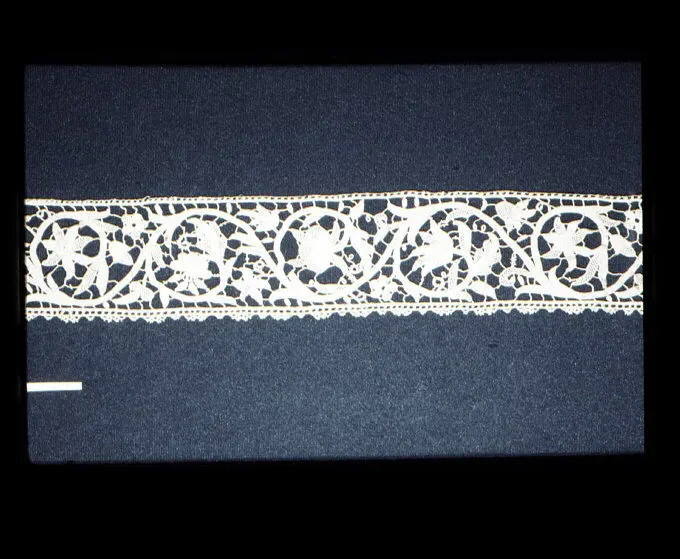
Strip bobbin with four-lobbish rosette above and below a zigzag band, anonymous, c. 1840 - c. 1860 Strip of natural -colored bobbin, blonde. The repeating and continuous pattern consists of a zigzag band, which divided the strip into triangular fields. There is a four -lobe rosette in the center of each field. Along the top and bottom of the strip runs a scallop, which consists of a succession of circles. The scallops are finished with picots. The motifs are connected by a coarse mesh soil, strewn with square moes. The zigzag band, rosettes and circling edges are made in linen stroke, with the rosettes equipped with a contour wire. unknown silk bobbin lace / blonde (lace) Strip of natural -colored bobbin, blonde. The repeating and continuous pattern consists of a zigzag band, which divided the strip into triangular fields. There is a four -lobe rosette in the center of each field. Along the top and bottom of the strip runs a scallop, which consists of a succession of circles. The scall
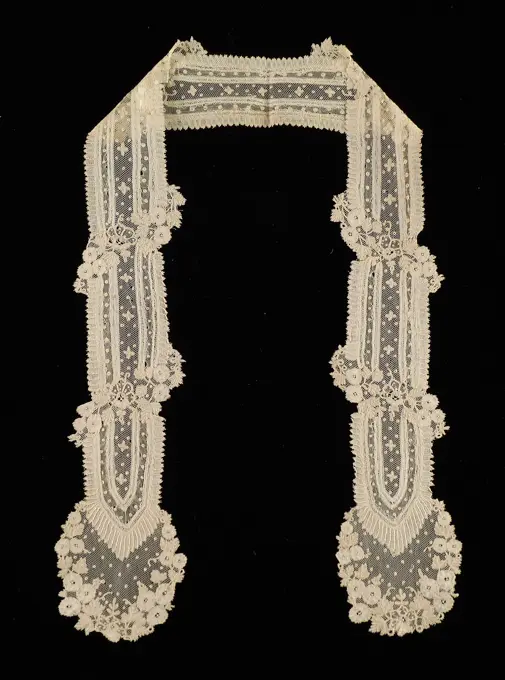
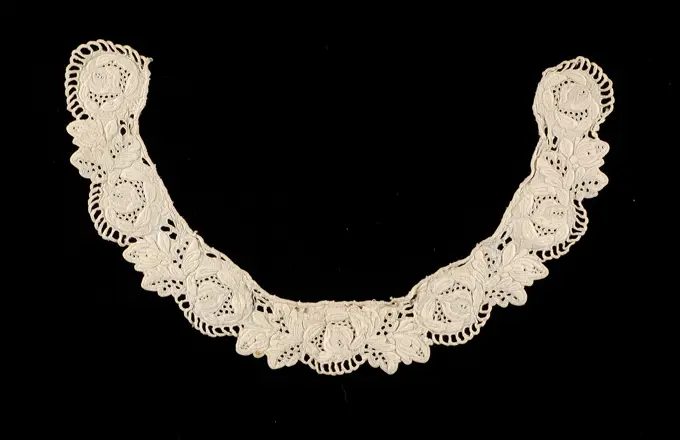
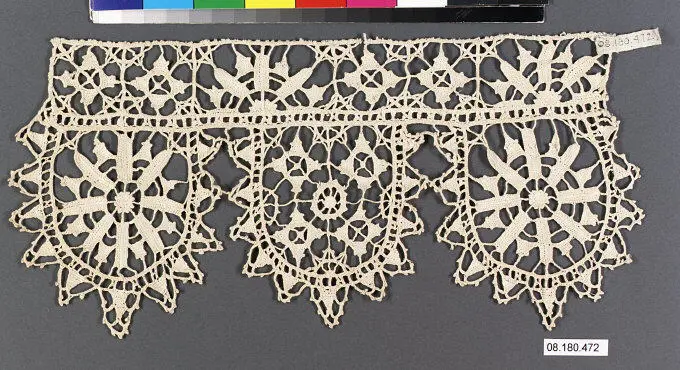
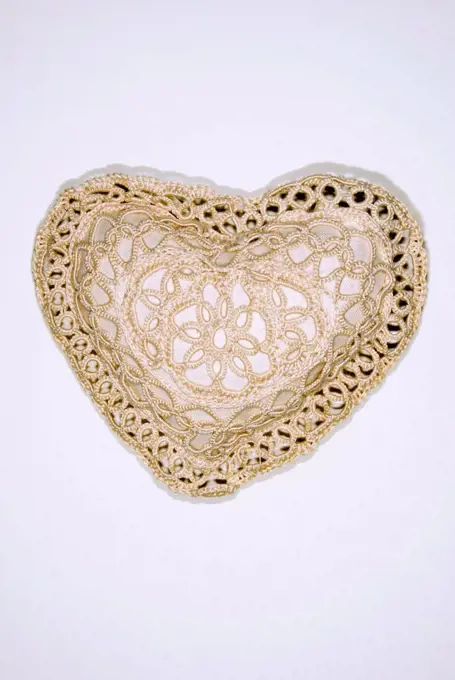
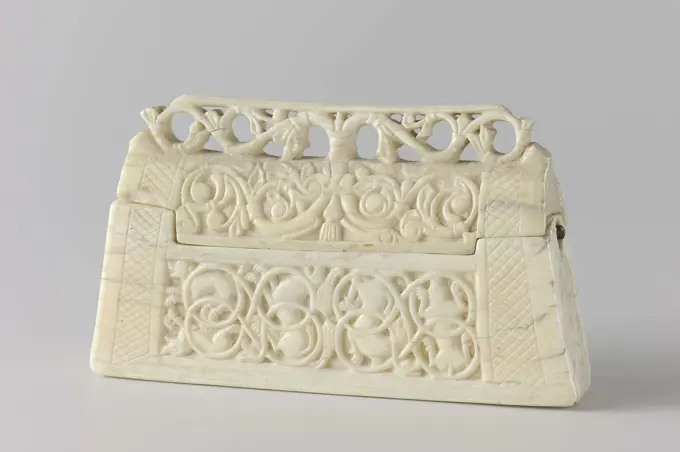
Fringe, Medium: silk Technique: plain weave, Blue fringe with a trellis band and tied skirt threads that form tassels., Spain, 18th century, trimmings, FringeLappet mid-19th century Belgian. Lappet 169327Bliej Kultury unknownCollar ca. 1850 American. Collar 169201Shawl (Mexico); linen, cotton; Warp x Weft: 124 x 124 cm (48 13/16 x 48 13/16 in.)Scarf collar with narrow cover of white nettle cloth decorated with plumetis-boarding trunks with a narrow strip of lace, anonymous, c. 1825 - c. 1835 Scarf collar with a narrow cover of white nettle cloth decorated with plumetis-boarding trunks with a narrow straight strip lace. Switzerland (possibly) whole: Cotton (textile). edge: bobbin lace Scarf collar with a narrow cover of white nettle cloth decorated with plumetis-boarding trunks with a narrow straight strip lace. Switzerland (possibly) whole: Cotton (textile). edge: bobbin laceBonnet Veil Made 1850-1859 France. Silk, bobbin straight lace (made in horizontal strips) .Border 17th century Italian Punto in arialiterally, "stitches in the air"is one of the earliest styles of needle lace, which is itself developed from cutwork of primarily geometric design. When lacemakers transitioned to using a foundation of threads laid out according to a pattern drawn on parchment, they were able to incorporate more fluid lines and curves into their designs.. Border 214823Length of lace laceDress of edge embroidery with emerging suns along diamond shape. Square dress of natural-colored edge embroidery, carved work. Pattern with a square made up of four small squares. Each small square is divided by a diagonal line, with a 'rising sun' on the outside and a triangle on the inside. Together this ensures a diamond shape in the large square with a four-pointed star in the middle. To the large square on all sides a border with rectangles, filled with bundles of wires or with a dense grid work with opened diamonds. A finished edge in linen stroke on all sides.Collar 19th century British. Collar 102582Strip 17th century Italian Punto in arialiterally, "stitches in the air"is one of the earliest styles of needle lace, which is itself developed from cutwork of primarily geometric design. When lacemakers transitioned to using a foundation of threads laid out according to a pattern drawn on parchment, they were able to incorporate more fluid lines and curves into their designs.. Strip 212416Fringe, Medium: silk Technique: plain weave, Red fringe with a heading, looped skirt threads and red tufts., Italy, 16th century, trimmings, FringeBorder ca. 1600 Italian. Border 217996Fragment; linen; 1897-8-306Fragment, Cooper Union Museum Lace Study Card; France; linenPin Cushion, elevated viewMantle;  2. PO. 19th century (1851-00-00-1900-00-00);Tulle sub -sleek with tamered flower vines, anonymous, c. 1860 Under sleeve, balloon -shaped, from tulle with tambouring work. The tambouring work, 'Dentelle de Liere' or Limerick, has a pattern of flower vines. The cuff is unadorned, but can be filled with a ribbon. Ivy (possibly) . Under sleeve, balloon -shaped, from tulle with tambouring work. The tambouring work, 'Dentelle de Liere' or Limerick, has a pattern of flower vines. The cuff is unadorned, but can be filled with a ribbon. Ivy (possibly) .. In the Middle Ages in northwest Europe, an ornamental style featuring complex spirals, plants and animals was very common. The decoration on this portable reliquary matches the carved patterns found in the Romanesque cathedral of Trondheim.Fragment (Italy); linen lace and fabric; Width: 3/8 of an inch; Bequest of Marian Hague; 1971-50-337Medallion, Medium: cotton Technique: needle lace, Circular medallion of a rampant eagle holding arrows in its left talon and an olive branch in the right talon. There is an escutcheon in the center of the eagle's breast and thirteen stars over its head., USA, ca. 1900, lace, MedallionOrnament; linen; 1943-17-1-aLace ca. 1880 American. Lace 120913