Intricate Lace Strips

A variety of delicate bobbin lace strips featuring floral and geometric patterns, showcasing craftsmanship from different historical periods.
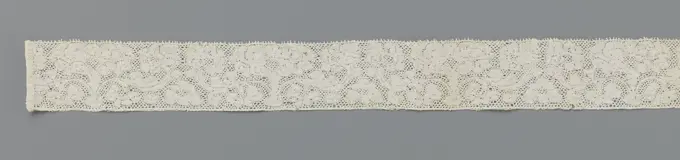
Strip bobbin with peony between two smaller peonies, anonymous, c. 1650 - c. 1660 Strip of natural -colored Dutch bobbin. The pattern consists of a repeating symmetrical motif of a stylized peony with a wavy side branch on the left and right. At the end of each side branch, a smaller peony curls up and focuses on the large central flower. The motifs are connected by a round grid with braid strokes. The motifs are made in linen battle with openwork edges. The top and bottom of the strip are straight finished, with picots on one side. Antwerp (possibly) linen (material) bobbin lace Strip of natural -colored Dutch bobbin. The pattern consists of a repeating symmetrical motif of a stylized peony with a wavy side branch on the left and right. At the end of each side branch, a smaller peony curls up and focuses on the large central flower. The motifs are connected by a round grid with braid strokes. The motifs are made in linen battle with openwork edges. The top and bottom of the strip are
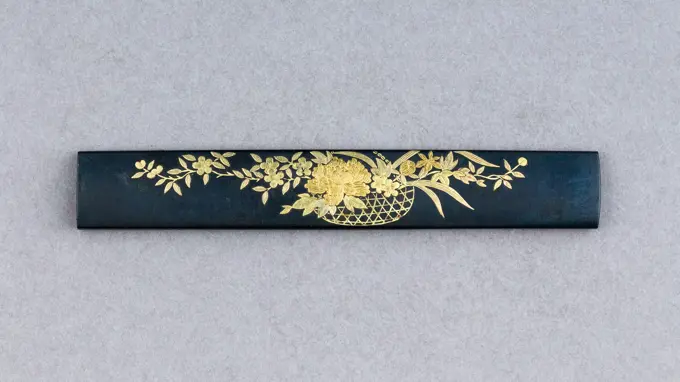
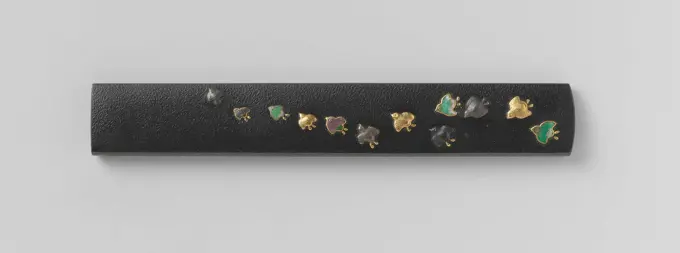
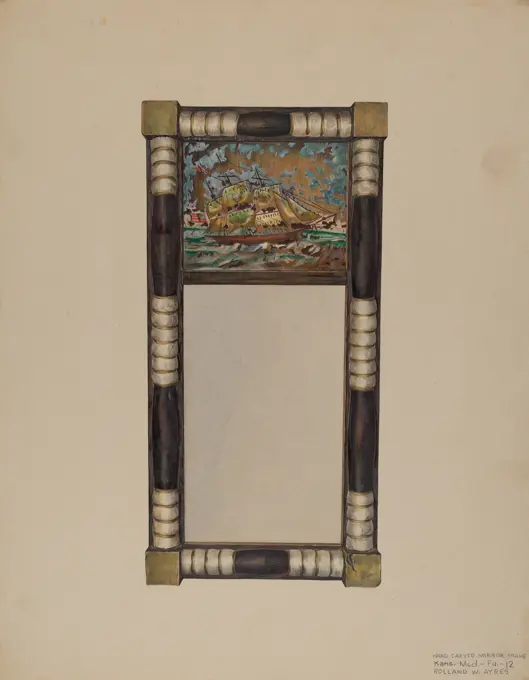
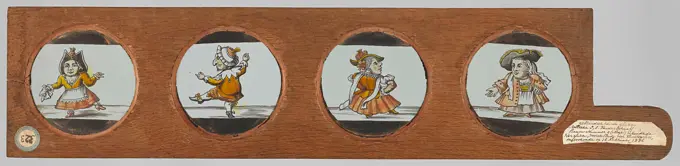
Knife Handle (Kozuka). Culture: Japanese. Dimensions: L. 3 13/16 in. (9.7 cm); W. 9/16 in. (1.4 cm); thickness 5/16 in. (0.8 cm); Wt. 1.5 oz. (42.5 g). Date: ca. 1615-1868. Museum: Metropolitan Museum of Art, New York, USA.Replica of filigree work.Border Made 1701-1800 Italy. Linen, bobbin straight lace; continuous clothwork tapes) .Textile (Japan); silk1/24 Stater fromIonia. Artist: UnknownPiece German 19th centuryKnife Handle (Kozuka) ca. 1615-1868 Japanese A kozuka is a handle of a by-knife that is part of a sword mounting. It is kept in a slot on the reverse of a katana scabbard, often with a matching kōgai (hairdressing tool).. Knife Handle (Kozuka) 34555Fragment Made 1575-1600 Italy. Silk, plain weave with supplementary pile warps forming cut and uncut voided velvet .Fringe (Spain); 1909-12-13Man's Sash, 1965-1970, Maria Ruiz, 113 x 11 3/8in. (287 x 28.9cm), Cotton, wool, Mexico, 20th centuryFringe (Spain); silkFrame with old chains. Metal nautical chain decorative background.. Frame with old chains.Decorated with a formation flying sparrows (suzume) in gold, silver and email (cloisonne).Pair of Embroidery Samples, 20th century, 19 x 4 3/4 in. (48.3 x 12.1 cm) (each), Cotton, embroidery, China, 20th centuryFish slice 1762-63 Edward Aldridge I. Fish slice 192160Trim, 18th-19th century, 33 x 5 1/2 in. (83.82 x 13.97 cm), Passementerie, 18th-19th centuryFringe, Medium: silk Technique: woven, Blue and yellow fringe with a checkerboard heading. Trellis band and skirt threads arranged to form stripes., Italy, 18th century, trimmings, FringeRolland Ayres, Hand Carved Mirror Frame, c 1939 Hand Carved Mirror FrameNecklace 1894 American. Necklace. American. 1894. no medium availableFringe (Spain); 1909-12-11Trimming (France); silkTrimming (France); 1909-2-220Dark blue-ground fragment with white and red geometric pattern, 19th century, Unknown Ryukyuan, 41 3/4 × 6 1/2 in. (106.05 × 16.51 cm) (overall), Cloth: cotton; floating relief warp and weft (Yomitanzan hanaori), tate-yoko gasuri (double ikat), Japan, 19th centuryBorder (possibly France); block-printed, flocked on glazed ground; 74 x 15.5 cm (29 1/8 x 6 1/8 in.)Vier dwergen, waarvan één naar het Dwergentooneel.Four round glasses in wooden mount with handle. The lower left three glasses contain images of dancing dwarfs. Extreme right: a standing female dwarf with hat, one hand in the side, the other extended, made to the dwarling tongue.Five professions, Anonymous, After Jan Luyken, After Caspar Luyken, c. 1700 - c. 1790 Five glasses with deputies of professions in a wooden stress. The appealed profession is also always mentioned on the glass. On the far left: 'Painter', a man paints a women's portrait. To the right of that: 'weaver', a man sitting behind a loom. In the middle: 'Schipper', a man at the helm of a small sailing boat. To the right of that: 'Lijndraijer', a rope butcher working on a Lijnbaan. On the far right: 'Kuijper', a Kuiper applies Hoes to a barrel with a tuber's hammer. Images seem to partly go back to the prints the Menselyk Bedryf of Jan and Caspar Luyken, but are not immediately copied or pulled over. The professions and the composition of the images deviate too much from the original prints for this. Netherlands oak (wood). glass Five glasses with deputies of professions in a wooden stress. The appealed profession is also always mentioned on the glass. On the far left: 'Painter', a man paints aSpine. 1897 - 1888. Coignet, Jean-Roch (1776-1860). bindings (gathered matter components), Book covers. Spencer Collection. BookbindingBronze implement from Charles Townley's Cista Mystica a collection of (Greek and Roman antiquities given to the British Museum in 1805