Intricate Lace Trimmings

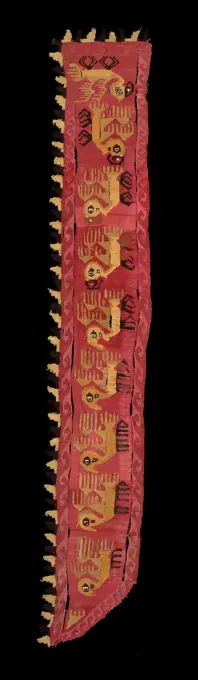
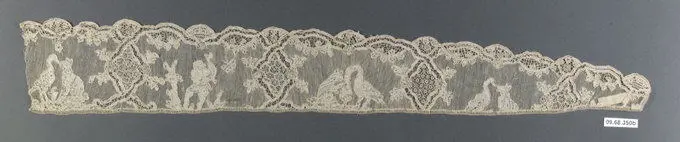
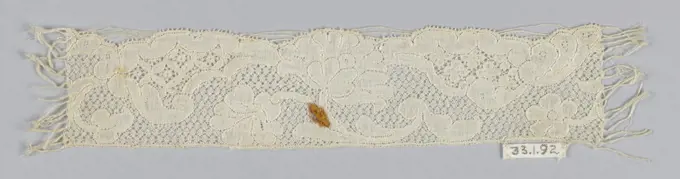
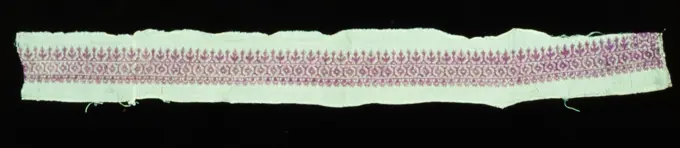
Delicate lace strips featuring floral patterns, with varying textures and materials, showcasing historical craftsmanship in intricate designs.

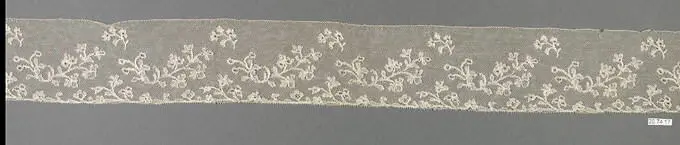
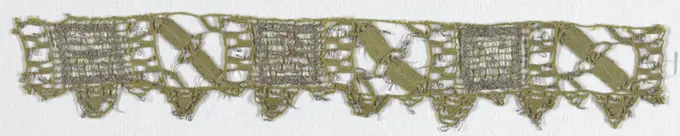
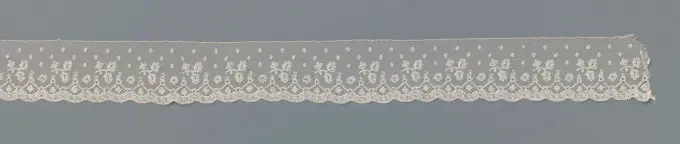
Edge, Medium: straw, silk Technique: bobbin lace, Switzerland, Appenzell , 19th century, lace, Edge
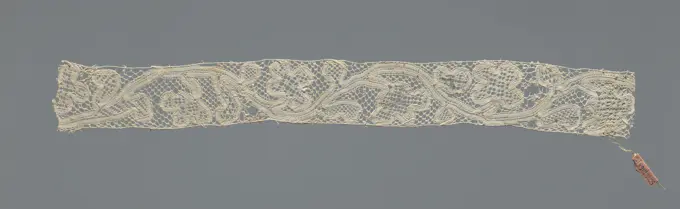
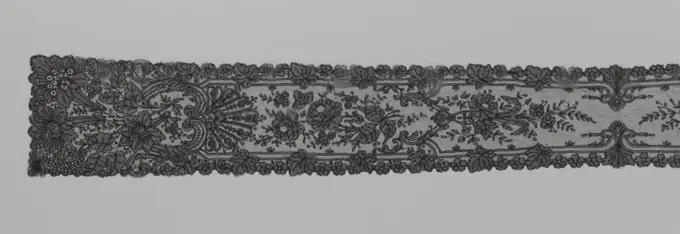
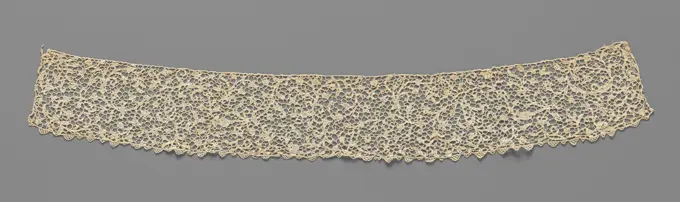
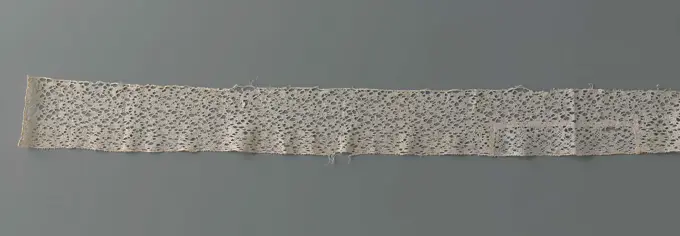
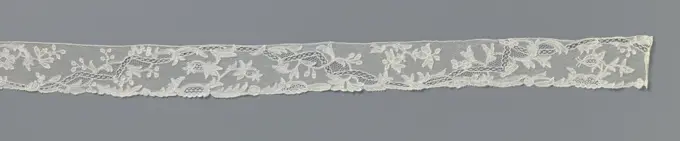
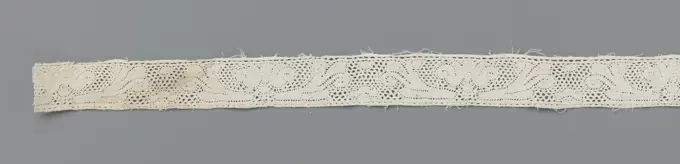
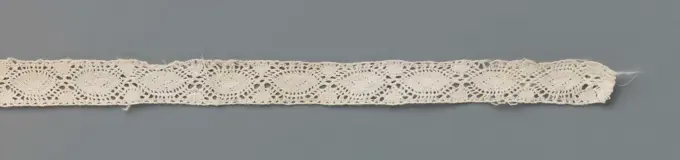
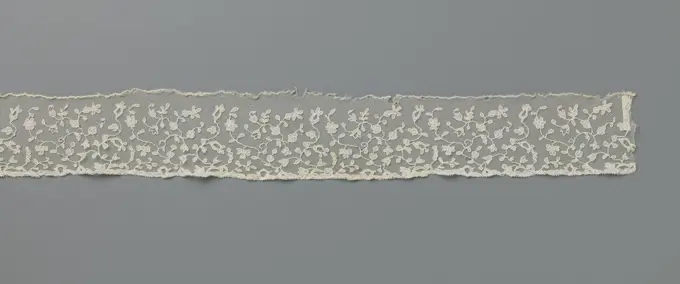
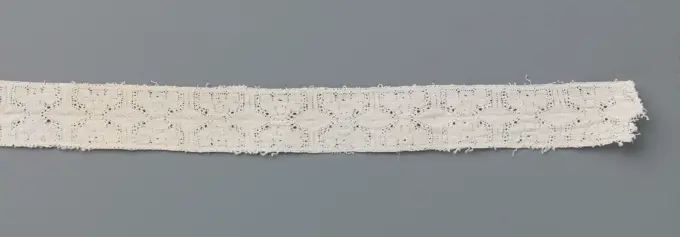
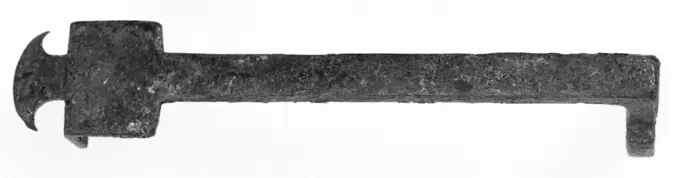
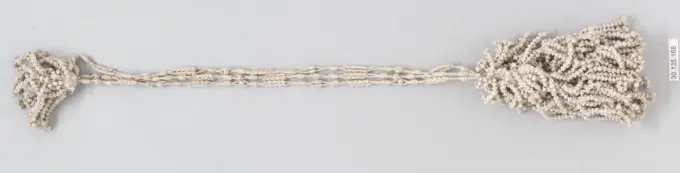
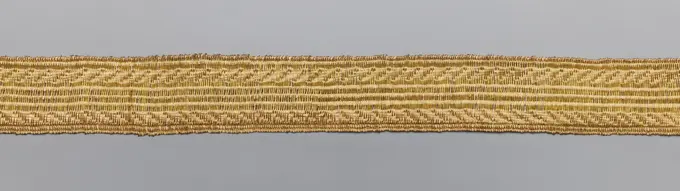
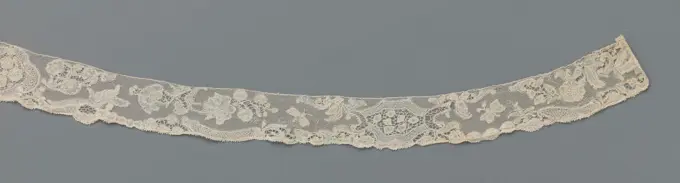
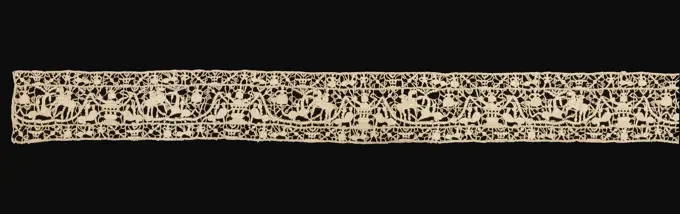
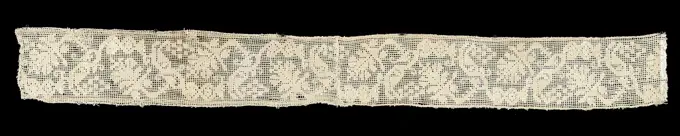
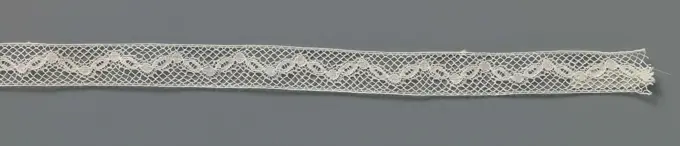
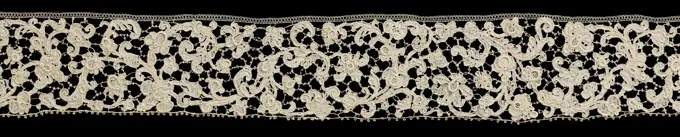
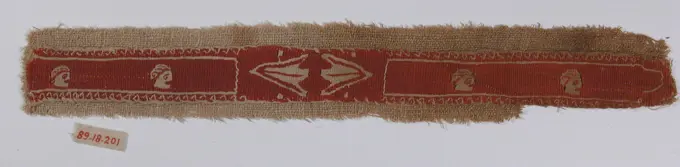
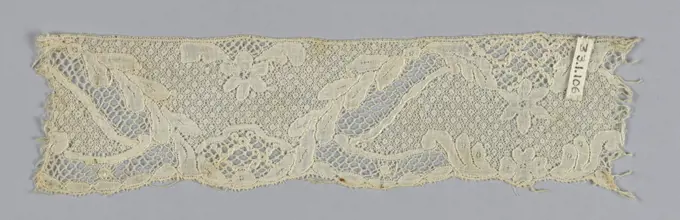
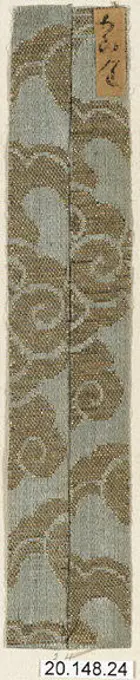
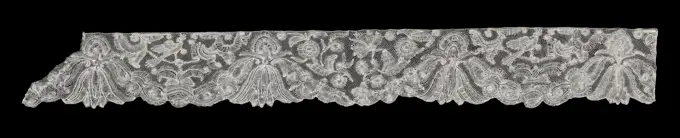
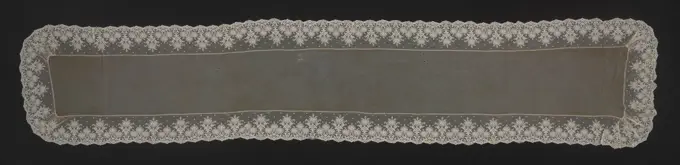
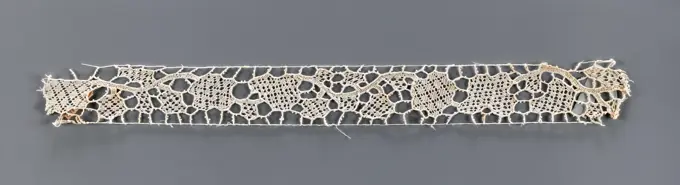
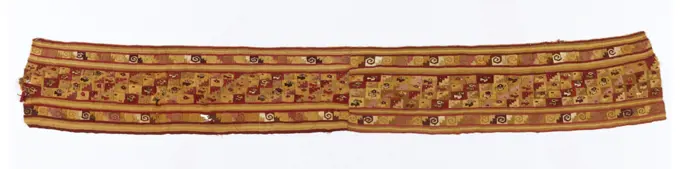
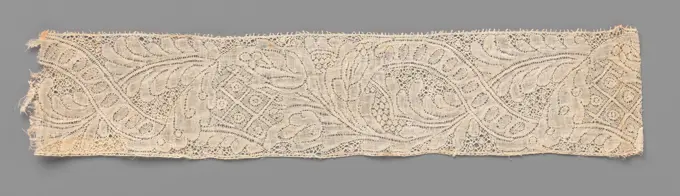
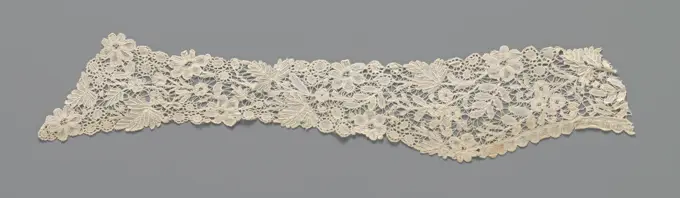
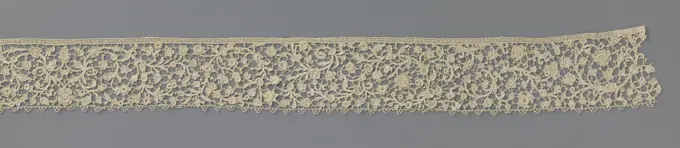
Strip of needle side with multifaceted flowers and leaves, anonymous, c. 1690 - c. 1709 Strip of natural needle side, Venetian rose side. Pattern with tifles on which there are multiple flowers and leaves can be seen, without repetitive motif. Irregular open soil with potented bars. The top is trimmed with a border bobbin. The underside is finished with a straight picot edge with arcs. Venice linen (material) Venetian rose point Strip of natural needle side, Venetian rose side. Pattern with tifles on which there are multiple flowers and leaves can be seen, without repetitive motif. Irregular open soil with potented bars. The top is trimmed with a border bobbin. The underside is finished with a straight picot edge with arcs. Venice linen (material) Venetian rose pointStrook kloskant met symmetrische composities opgebouwd uit kleine florale motiefjes.Strip natural-colored Dutch clamping side. The repeating pattern consists of two accumulating symmetrical compositions in which the motifs are close to each other. One composition consists along the top of the strip from a reverse chali flower or tulip. Including two cloud-shaped leaves closed on the center line with a rosette flower along the bottom of the strip. The other composition consists of two rosette flowers facing each other to curling stalks, including a fan-shaped flower and below a knob-shaped flower between two volute leaves along the underside. The motifs are made in linen stroke with openwork edges. There is no obstruction wherever. The motifs are placed close to each other, sometimes separated by a kind of short thick braids. The top of the strip is straight finished. The underside of the strip has very flat broad tubs that are finished with picots.Band, Medium: cotton Technique: bobbin lace (late Valenciennes ground), Curving stem with leaves and flowers on diamond mesh., 19th century, lace, BandFragment of lace. unknown, authorGallon;  19th century (1801-00-00-1900-00-00);Edge, Medium: straw, silk Technique: bobbin lace, Switzerland, Appenzell , 19th century, lace, EdgeBorder Made 1750-1769 FranceBorder early 18th century French. Border 222749Fragment early 18th century Flemish, Brussels. Fragment 218790Needlepoint Lace Lappet, second half of 18th century. France, Argentan, second half of 18th century. Lace, needlepoint; average: 10.5 x 137.8 cm (4 1/8 x 54 1/4 in.).Border, Medium: linen Technique: bobbin lace, Binche style with snowflake ground, Binche style border with an elaborate ground interspersed by asymmetrically placed floral garland., mid-18th century, lace, BorderGalloon 18th century French. Galloon 213908Tie or hat of chips from Kloskant with three large lilies, anonymous, c. 1850 - c. 1880 Das or barbe of black bobbin: Chantilly side. Stretched rectangular model. Within a two -sided symmetrical frame, asymmetrical bouquets are symmetrically grouped compared to the short center axle. The straight -line frame comes across a horseshoe -shaped medallion at the ends, crowned with a large fan palm with. Below are three giant lilies. The design is most closed at the ends and runs lighter to the center. A barely scalloped edge in turn consists of a large wingerd leaf and two small rosettes. Caen (possibly) silk bobbin lace Das or barbe of black bobbin: Chantilly side. Stretched rectangular model. Within a two -sided symmetrical frame, asymmetrical bouquets are symmetrically grouped compared to the short center axle. The straight -line frame comes across a horseshoe -shaped medallion at the ends, crowned with a large fan palm with. Below are three giant lilies. The design is most closed at theStrip of needle side with richly branched spiral ranks, anonymous, c. 1700 - c. 1709 Strip of natural -colored needle side: flat Venetian side. The repeating pattern consists of richly branched spiral vines with many flowers, buds and leaves. Irregular bar with picots. The top is finished with a straight edge. The underside is finished with a straight picot edge with arcs. Venice linen (material) flat Venetian (needle point) Strip of natural -colored needle side: flat Venetian side. The repeating pattern consists of richly branched spiral vines with many flowers, buds and leaves. Irregular bar with picots. The top is finished with a straight edge. The underside is finished with a straight picot edge with arcs. Venice linen (material) flat Venetian (needle point)Cap Streamer (possibly England); linenBand, Medium: silk, painted silk, metallic thread, metal pailettes Technique: embroidery and appliqué, White satin ribbon band or border probably from the bottom edge of a robe with ornamentation in appliqué of silks, velvet and pailettes. Design of converging S-scrolls, sprays of foliage or petal forms in painted silk in between and leaf shapes in ribbed velvet. Colors are cream and purple with flecks of color on leaf sprays. Remains of metal thread outline on some leaves. Purple and white braid on bottom., France, early 19th century, embroidery & stitching, BandBorder, Medium: linen Technique: bobbin lace, Binche style with Binche ground, 18th century, lace, BorderConciliate belt;  II PO. 18th century (1760-00-00-1799-00-00);Strook kloskant met koraalranken.Strip of natural colosside: Old cravings with braid soil. The repetitive but warrig-looking pattern consists of three rows of continuous coral drinks with S-shaped and C-shaped motifs with a round button to each end. The motifs are made in linselag with openwork edges and are connected to each other by a braid soil, in which the braids are almost regular maasing soil. Upper and bottom of the strip are straight finished, the underside with picots.Piece 16th century Japan. Piece 71081Hats strip Van Kloskant with Zigzag Rivière, Anonymous, c. 1750 - c. 1760 Strip of natural -colored Brussels bobbin. A rivière in Zigzaglijn is crossed by spiral ranks, which enclose fan -shaped medallions. The motives are connected by a drachel soil. A coarser hexagonal soil has been used in the Rivières. On the fields that are bordered by the Rivière, there are twigs on which flowers in the form of pomegranates, pears or winged insects. The strip was probably used or made for a hat. Brussels linen (material) bobbin lace / Brussels bobbin lace Strip of natural -colored Brussels bobbin. A rivière in Zigzaglijn is crossed by spiral ranks, which enclose fan -shaped medallions. The motives are connected by a drachel soil. A coarser hexagonal soil has been used in the Rivières. On the fields that are bordered by the Rivière, there are twigs on which flowers in the form of pomegranates, pears or winged insects. The strip was probably used or made for a hat. Brussels linen (material) bobbin Strip bobbin with sunshine in flower heart and oval -shaped spaces, anonymous, c. 1650 - c. 1699 Strip of natural -colored bobbin: Old Flemish bobbin with braid soil. The repeating pattern consists of a faintly lumped oval flower with a sun as a flower heart. The flower has a strongly curved stem with an oval leaf at the end. Several whimsical, unclearly defined leaves fill the rest of the pattern to the next flower. Striking are the oval -shaped open spaces with different dimensions, but all quite large. The motifs are made in linen battle with openwork edges. Different decorative lands have been applied in and between the leaves. The rays of the sun are made in shape. The bottom and top are straight finished, with picots on one side. Flanders linen (material) bobbin lace / Flemish lace with plaited ground Strip of natural -colored bobbin: Old Flemish bobbin with braid soil. The repeating pattern consists of a faintly lumped oval flower with a sun as a flower heart. The flower has a sFragment Made 1775-1825 Japan. .Fragment early 19th century Belgian. Fragment 220626Silk ribbon or garter with Lancé effect; A green course runs over the entire length of the pink ribbon with a grid pattern in which Margrites are incorporated, Anonymous, c. 1700 - c. 1800 Lint or garter from silk with Lancé effect. A green course runs over the entire length of the pink ribbon with a grid pattern in which Margrites are incorporated. West-Europa whole: Silk Lint or garter from silk with Lancé effect. A green course runs over the entire length of the pink ribbon with a grid pattern in which Margrites are incorporated. West-Europa whole: SilkBobbin Lace Flounce, 18th century. Flanders, 18th century. Lace, bobbin: linen; average: 340.8 x 35.6 cm (134 3/16 x 14 in.).Fringe, Medium: gold foil in a silk core Technique: woven, Gold fringe with a plain-woven heading and a skirt of looped and twisted threads., Italy, 18th century, trimmings, FringeGalloon 17th-18th century Unknown. Galloon 213788Band 17th-18th century. Band. 17th-18th century. Silk, metal thread and linen (); plain weave, brocaded. Attributed to Iran. Textiles-WovenFragment (Border) Made 1701-1800 Iran. Persian silk strip. .Lace fragment. unknown, authorFragment (USA); cottonBliżej Kultury unknownKloskant intermediate mate with flour between elongated volute leaves, anonymous, c. 1650 Intermediate springs of natural -colored Dutch bobbin side. The pattern consists of a repeating symmetrical motif of a flower between elongated volute leaves. The motifs are made in linen battle with openwork edges and are connected by a more or less round grid with braid strokes. The top and bottom are straight. The intermediate brush is sewn on the same strip of bobbin with a few coarse stitches. Antwerp linen (material) bobbin lace Intermediate springs of natural -colored Dutch bobbin side. The pattern consists of a repeating symmetrical motif of a flower between elongated volute leaves. The motifs are made in linen battle with openwork edges and are connected by a more or less round grid with braid strokes. The top and bottom are straight. The intermediate brush is sewn on the same strip of bobbin with a few coarse stitches. Antwerp linen (material) bobbin laceTussenzetsel van kloskant met een middenlijn van spitsovalen.Interesting of natural colosside. The pattern consists of a middle line of spiral travels between the lower and top edge always right above each other a small spouse. The motifs are interconnected by a causative mesh soil applied. The motifs are made in linen battle with recesses and open editors. Upper and bottom of the strip are straight finished. The intermediate site comes from or intended for bedding.Strip 18th century Flemish. Strip 218159Band, 1700s. France , 18th century. Embroidery: linen; overall: 208.3 x 12.7 cm (82 x 5 in.).Wampum belt -Strip Application side with winding thin branches with flowers, anonymous, c. 1800 - c. 1899 Strip of natural -colored application side: batist applicated on mechanical tuler land. The repeating pattern consists of winding thin branches with different types of flowers and a few small leaves. Along the bottom a succession of small motifs. The top of the strip is straight finished, but damaged. The silly scrap edge along the bottom is finished with picots. Netherlands linen (material). batiste Strip of natural -colored application side: batist applicated on mechanical tuler land. The repeating pattern consists of winding thin branches with different types of flowers and a few small leaves. Along the bottom a succession of small motifs. The top of the strip is straight finished, but damaged. The silly scrap edge along the bottom is finished with picots. Netherlands linen (material). batisteStrip of needle side with acanthus leaves, anonymous, c. 1720 - c. 1730 Strip of natural-colored needle side: Régence side, belonging to a hat. Pattern with acanthus leaves and lush flowers, decorated on a mesh soil with square mushes. Fullwork with recesses and multifaceted decorative stitches. Relief contours with feston stitches. France whole: Strip of natural-colored needle side: Régence side, belonging to a hat. Pattern with acanthus leaves and lush flowers, decorated on a mesh soil with square mushes. Fullwork with recesses and multifaceted decorative stitches. Relief contours with feston stitches. France whole:Galloon 18th century French. Galloon 225026Strip bobbin with two stylized mirrored flowers between vertical lines and oval, anonymous, c. 1600 - c. 1624 Strip of natural -colored Dutch bobbin. The pattern consists of a repeating motif with two vertical straight lines, which are cut in the middle by a rush -in. There are two stylized flowers between the vertical lines that are mirrored over the length axis. The motives are made in densely worked linen battle with recesses. There is hardly any soil, the motives are held together by very short braids. Top and bottom of the strip are straight. Netherlands (possibly) linen (material) bobbin lace Strip of natural -colored Dutch bobbin. The pattern consists of a repeating motif with two vertical straight lines, which are cut in the middle by a rush -in. There are two stylized flowers between the vertical lines that are mirrored over the length axis. The motives are made in densely worked linen battle with recesses. There is hardly any soil, the motives are held together by very short Fragment 18th century Italian. Fragment 218669Band early 18th century Flemish. Band 222809Needlepoint (Point Alençon) Lace Edging, 18th century. France, Alençon, 18th century. Lace, needlepoint: linen; average: 8.3 x 171.5 cm (3 1/4 x 67 1/2 in.).Key. UnknownGalloon 18th century French. Galloon. French. 18th century. Silk and cotton. Textiles-TrimmingsPair of tassels 17th century Italian. Pair of tassels 222493Cap Streamers (France); linenNeedlepoint Lace Edging, 18th century. France, Alençon, 18th century. Lace, needlepoint: linen; average: 5.1 x 76.3 cm (2 x 30 1/16 in.).Gallon;  18th century (1701-00-00-1800-00-00);Strook kloskant met bloemtak en insect tussen twee cartouches.Strip natural colored Brussels climbing side. The strip is curved in shape. The repeating pattern consists of a hanging flower branch and a flying insect between two different shapes cartouches. The insects alternately concern a butterfly and insect with four narrow wings. The motifs are connected by a fine Maas soil, a slighten ground. The full work is largely made in linen battle with openwork edges, single recesses and with power stuffs. Different motifs have closted relief contours. Various ornamental grounds have been applied, including snowflakes and picoted braid forces. The top is just finished. The bland scaled underside and the straight short sides are finished with picots.Band 17th century Italian. Band 226110Band; linenBand, 16th century, 28 x 3 1/4 in. (71.12 x 8.26 cm), Linen; buratto; lace, Italy, 16th centuryTussenzetsel van kloskant met zigzaglijn van cirkels en ovalen.Natural collate strip, Valenciennes side. A zigzag line of connected cables and openwork ovals is running over the center line of the strip. The zigzag line is made in a maas basis, a diamond-shaped valenciennes ground. The motifs are made in linen stroke with openwork edges that run outside the thicker contour wires. Contour wires are a-typical of Valenciennes side. The opened center of the ovals caused three holes through crossing couples. The top and bottom of the strip are directly finished.Border (Italy); linenBand Fragment with Mask and Lotus Flowers 5th-7th century. Band Fragment with Mask and Lotus Flowers 443406Strip bobbin with arches along the lower edge, anonymous, c. 1900 - c. 1924  Strip of natural-colored bobbin, Valenciennes side. Along the bottom edge of the strip runs a continuous strap in linen battle, which forms the silly regular sculpts. Above that, the strip consists of a mesh ground, a diamond-shaped Valenciennes ground. The top of the strip is straight finished. The arches along the bottom are finished with picots. Belgium cotton (textile) Bobbi Lace / Valenciennes LaceBorder, Medium: Technique: needle lace, Needle lace edge joined, floral pattern; early 18th century Alencon, early 18th century, lace, BorderRibbon, c. 1890s. France, Late 19th Century. Silk, damask weave; overall: 117.5 x 9.8 cm (46 1/4 x 3 7/8 in.).Band, Medium: silk embroidery, linen foundation Technique: embroidered with deflected element work using wrapping and double running stitches, Repeating pattern of confronted seahorses alternate with creatures on a pedestal. Pattern reserved in white foundation against a red background., Italy, 17th-18th century, embroidery & stitching, BandFragment, Medium: linen Technique: bobbin lace, Mechlin style, Belgium, 18th century, lace, FragmentPiece 14th century Japan. Piece 71022Ceintuur ribbon of side brokaat; On a silver surface, a repeating pattern in dark red, pink and brown is in the shape of a snail house () From which fruits and leaves come, anonymous, c. 1735 Ceintuur ribbon of side brokaat; On a silver surface, a repeating pattern in dark red, pink and brown is in the shape of a snail house () From which fruits and leaves come. The edges are trimmed with silver -colored decorative tape. West-Europa geheel: silk. brocade (textile). silver thread Ceintuur ribbon of side brokaat; On a silver surface, a repeating pattern in dark red, pink and brown is in the shape of a snail house () From which fruits and leaves come. The edges are trimmed with silver -colored decorative tape. West-Europa geheel: silk. brocade (textile). silver threadJohn Greenwell, Shaker Clay Pipe, c 1941 Shaker Clay PipeGalloon 18th century () European. Galloon 224982Brass candy extractor, in the form of tweezers, stoner tweezers tool kit soil finding brass metal, whole (2) and half (1) spice extractor As tweezer curved narrow metal plate archeology Rotterdam rail tunnel food preparation kitchen table stoning food Soil discovery: trajectory Rotterdam rail tunnel.Border, Medium: linen Technique: bobbin lace of discontinuous tape; six bobbins used for connecting bars; the bobbin-made relief decoration with loops was made separately and sewn on using a needle, Border with elaborate scrolling leaves and flowers., Netherlands, 1650-1700, lace, BorderBobbin Lace Edging, 19th century. Flanders, 19th century. Lace, bobbin: linen; average: 15.3 x 113 cm (6 x 44 1/2 in.).Shawl;  XIX/XXW. (1880-00-00-1920-00-00);Piece 17th century Japan. Piece 71142Band (Italy); linenTextile (China); silkFragment of the lace;  19th century (1801-00-00-1900-00-00);Textile swatch, Deerfield Society of Blue and White Needlework, (Deerfield, Massachusetts, USA, 1896-1926), Deerfield, Massachusetts, USA, 1910-20, Textile swatchBorder, Medium: linen, metallic thread Technique: needle lace with filet and needle interlacings, Border of green linen and silver stripes in geometric pattern contained with squares. One side edged by small-scale pendants., Italy, mid 16th - 17th century, lace, BorderNeedlepoint Lace (Point d'Angleterre) Edging, early 18th century. Belgium, Brussels, early 18th century. Lace, needlepoint: linen; average: 7.7 x 147.3 cm (3 1/16 x 58 in.).Fragment of the Bordic;  early xxw (1900-00-00-1910-00-00);Textile, Medium: wool Technique: slit tapestry, Long panel in bright clear colors: many shades of yellow and buff, with pink, cherry and dark red, eggplant, and some white, and a little black for outlining. Horizontal pattern of white central row of small squares arranged on diagonal, either containing a stylized bird in a contrasting color, or divided into two stepped triangles of contrasting colors. Plain bands of buff, yellow and brown separate center from flanking outer rows of angular fretted running-wave pattern. Continuous guard-bands of red, yellow and buff on both edges. Wefts: unspun or weakly Z-spun, very closely packed. Warp: 2-ply tightly S-twisted undyed wool, about 25 per inch. The long sides are loom-endings. Panel made up of two equal lengths, stitched together, indicating tapestry loom about 24.5' wide. All selvages present. Reversible., Peru, 15th century, woven textiles, TextileSleeve Ruffle ; linenStrip bobbin with a bouquet of three flowers between a wavy ribbon with oval and a field with diamonds, anonymous, c. 1750 Strip of natural-colored bobbin, binche side. The repeating pattern consists of a bouquet of three flowers between a wavy ribbon with oval and a field with diamonds. The ribbon crosses a long -filled leaf, which makes an opposite wavy movement and from which flowers spring. The motifs are connected by a decorative land, a fine snowflake land. The motifs are made in linen battle with openwork edges. The ovals in the ribbon and the diamonds are made in netslag. At the top and bottom are straight finished, with the bottom with picots.  linen (material) Bobbi Lace / Binche Lace Strip of natural-colored bobbin, binche side. The repeating pattern consists of a bouquet of three flowers between a wavy ribbon with oval and a field with diamonds. The ribbon crosses a long -filled leaf, which makes an opposite wavy movement and from which flowers spring. The motifs are connecOriental carpet ,, 1850 - 1900 Eastern carpet of knotted wool, carpet format. In midfield there are two medalions with gridwork, rosettes and heart shapes. Around three edges. Hamad wool Eastern carpet of knotted wool, carpet format. In midfield there are two medalions with gridwork, rosettes and heart shapes. Around three edges. Hamad woolPiece 17th century Japan. Piece 71140Strook kloskant met 'oorbelletjes'.The ground ground of the climbing side (Malinois of land or ice soil) is decorated with mates, a row of one-sidedly directed leaf branches and a series of 'earrings', which form the scivels with Campanes. Mechelen side.Textile Band, 20th century, 46 1/2 x 7 3/4 in. (118.11 x 19.69 cm) (approximate)10 1/8 x 49 in. (25.72 x 124.46 cm) (outer frame), Cotton (), Peru, 20th centuryScarf collar (half) from bobbin with oak leaves and roses, anonymous, c. 1880 - c. 1910 Scarf collar (half) of natural -colored bobbin: Bruges flower arrangements. Rectangular model with one sloping lace and a narrowing and widening with a small kink in it. Pattern with different types of flowers and leaves, including oak leaves and roses. The motifs are connected by a braid ground in which the braids were laid in zigzag lines as a grid. The collar has been cut in the middle. Bruges (possibly) cotton (textile) bobbin lace / Bruges flower lace Scarf collar (half) of natural -colored bobbin: Bruges flower arrangements. Rectangular model with one sloping lace and a narrowing and widening with a small kink in it. Pattern with different types of flowers and leaves, including oak leaves and roses. The motifs are connected by a braid ground in which the braids were laid in zigzag lines as a grid. The collar has been cut in the middle. Bruges (possibly) cotton (textile) bobbin lace / Bruges flBelt -Piece (one of three) 18th century French. Piece (one of three) 218295Band, Medium: linen, silk Technique: silk satin stitich embroidery on plain weave, Band of white linen with embroidery in a design of lozenges with flowers in center. Narrow border of conventional ornament on either side. White linen fringe on one edge., Italy, 17th century, embroidery & stitching, BandFragment, Medium: cotton Technique: machine made, Machine net with embroidered pattern of baskets with flowers and small detached motifs above border of scallops with picots., possibly France, ca. 1890, lace, FragmentRailing Fragment 5th century Byzantine. Railing Fragment 468702Trimming, Medium: silk Technique: cut and uncut supplementary warp pile (velvet), Green trimming fragment with a central band in squares of cut and uncut velvet., France, 19th century, trimmings, TrimmingStrip 17th century Italian. Strip 220921Sampler (Germany); cottonFragment, Medium: linen Technique: bobbin lace, Mechlin style, Belgium, 18th century, lace, FragmentGalloon mid-18th century French. Galloon. French. mid-18th century. Cotton. Textiles-TrimmingsPiece 18th century Japan. Piece 71817Band, Medium: silk Technique: appliqué, Narrow band with yellow leaves on red ground., Italy, 17th century, embroidery & stitching, BandPillow border, 19th century, 4 1/2 x 30in. (11.4 x 76.2cm), Embroidered silk on cotton, Morocco, 19th century