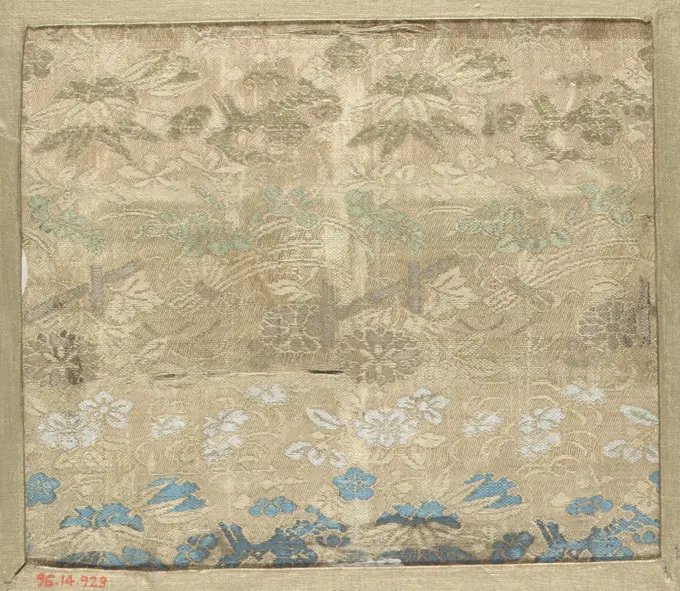
Japanese Textile Fragments

A collection of intricate silk textile fragments featuring floral and ornate designs, showcasing historical craftsmanship from Japan and Germany.
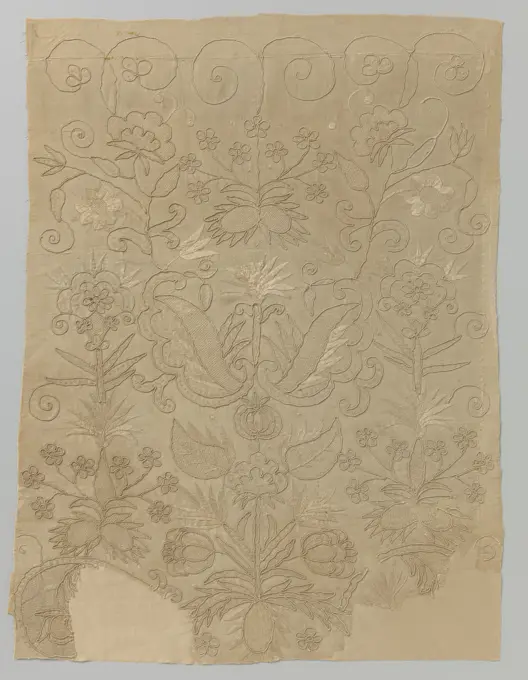
Fragment of a skirt of cream -colored silk embroidered with three -part symmetrical pattern with pomegranates, leaves, tulips, flowers and blossom branches, anonymous, c. 1690 - c. 1700 Fragment of embroidered skirt made of cream -colored silk on ditto taf side. Trading symmetrical pattern: branch with pomegranate, leaves and tulips; Rosette of leaves with branches and flowers; Blossom branch. In the lower corners of volute leaves with palmet on a stem. Above the whole three double spirals. France (possibly) silk. taffeta Fragment of embroidered skirt made of cream -colored silk on ditto taf side. Trading symmetrical pattern: branch with pomegranate, leaves and tulips; Rosette of leaves with branches and flowers; Blossom branch. In the lower corners of volute leaves with palmet on a stem. Above the whole three double spirals. France (possibly) silk. taffeta
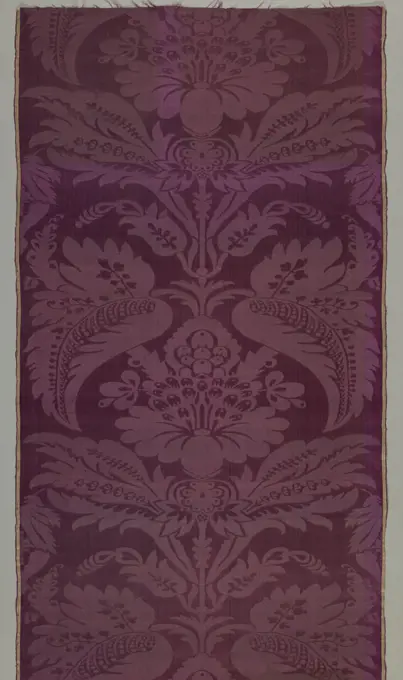
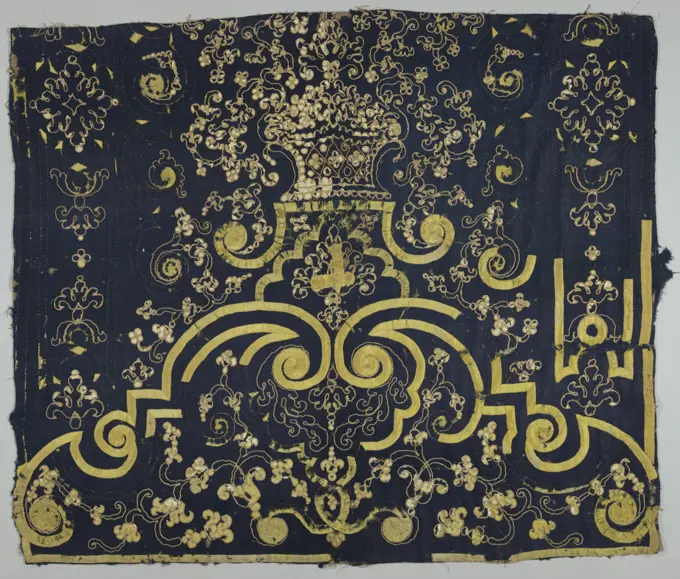
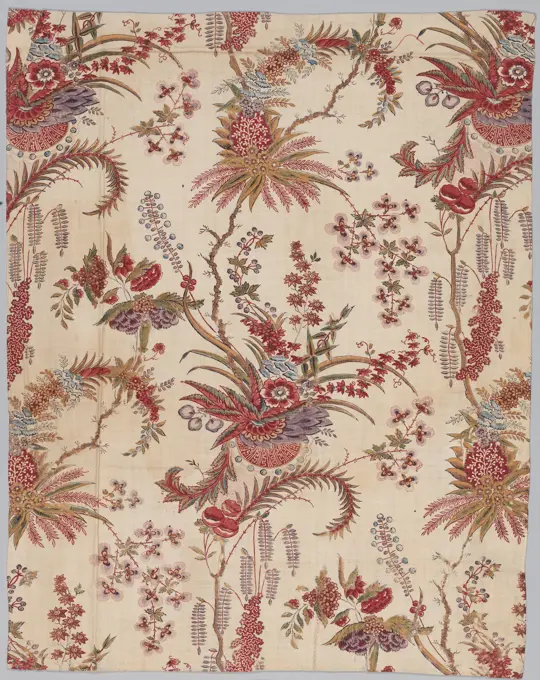
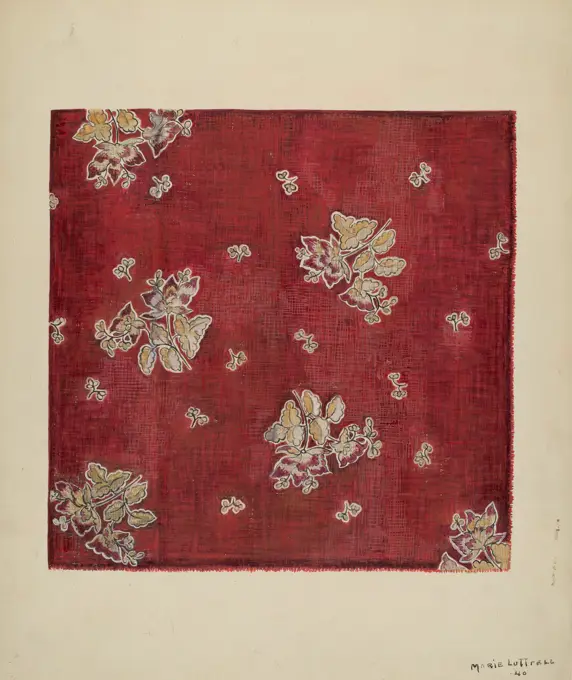
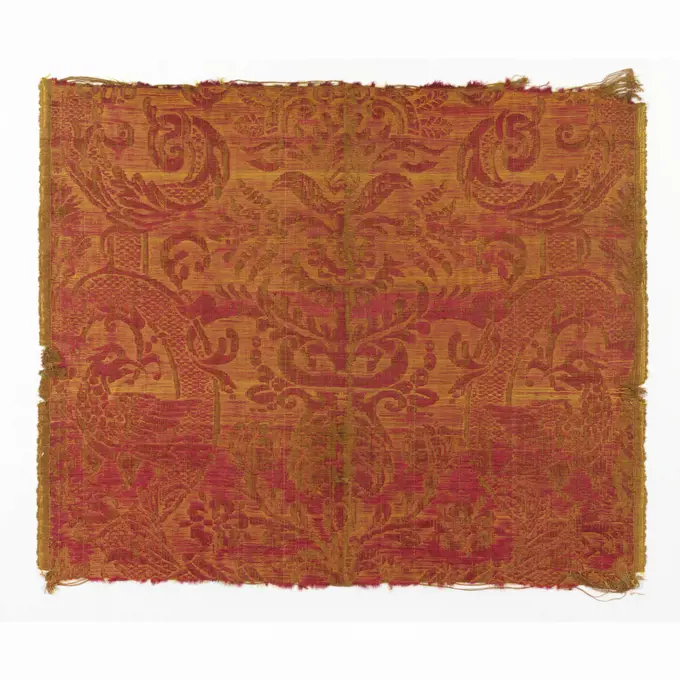
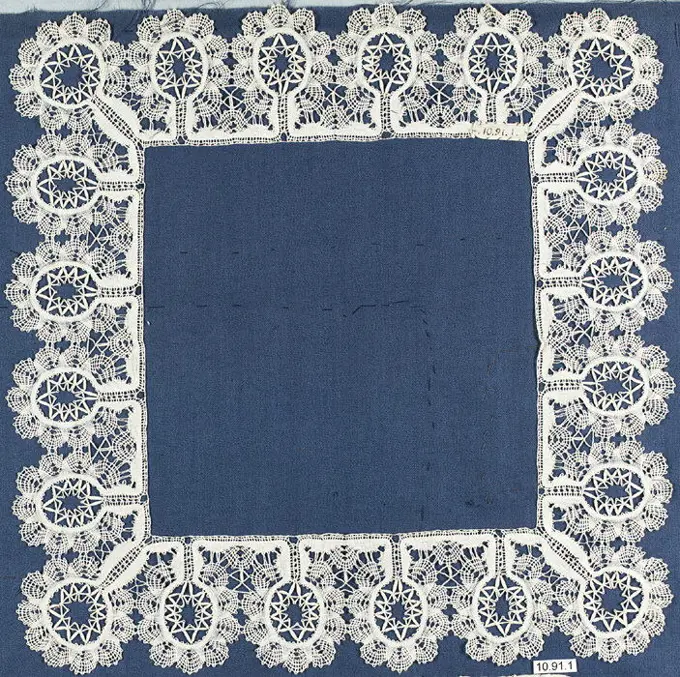
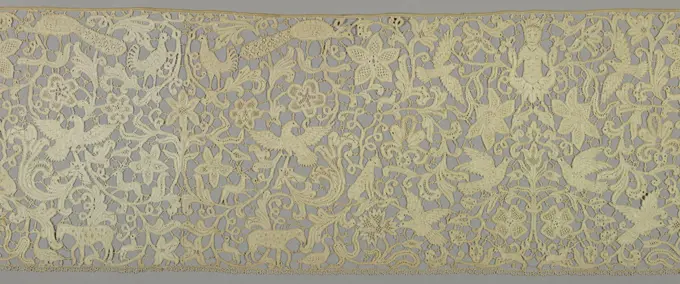
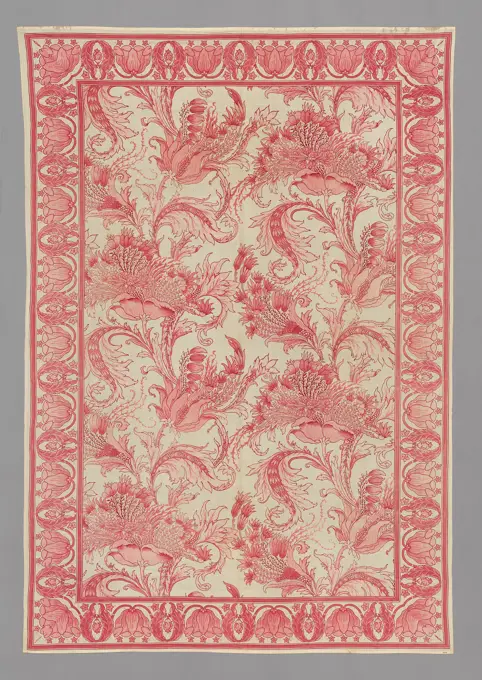
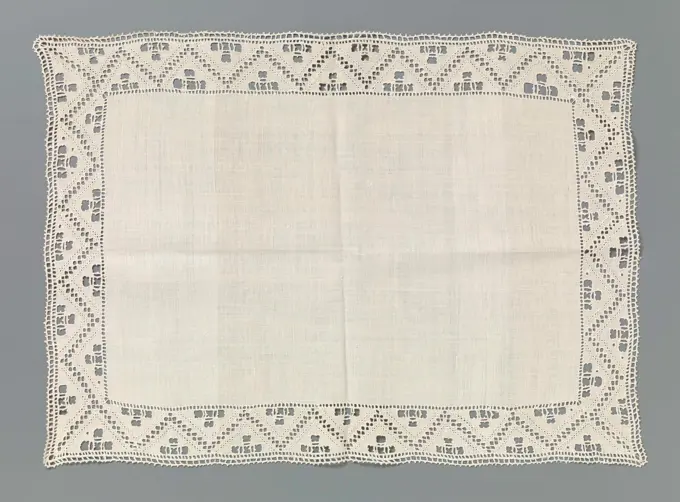
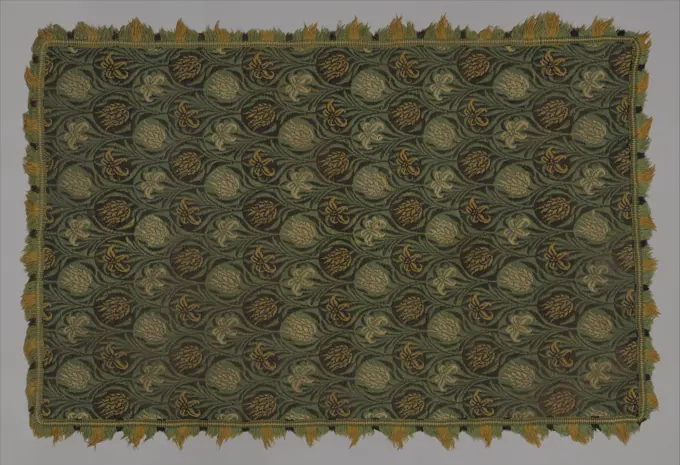
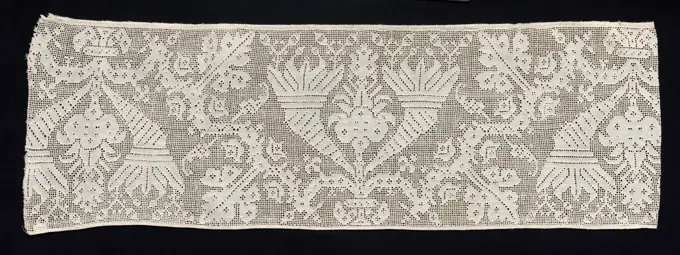
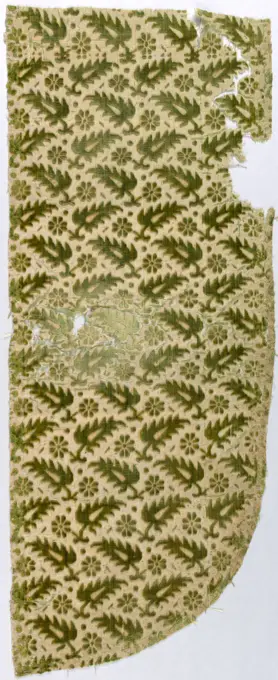
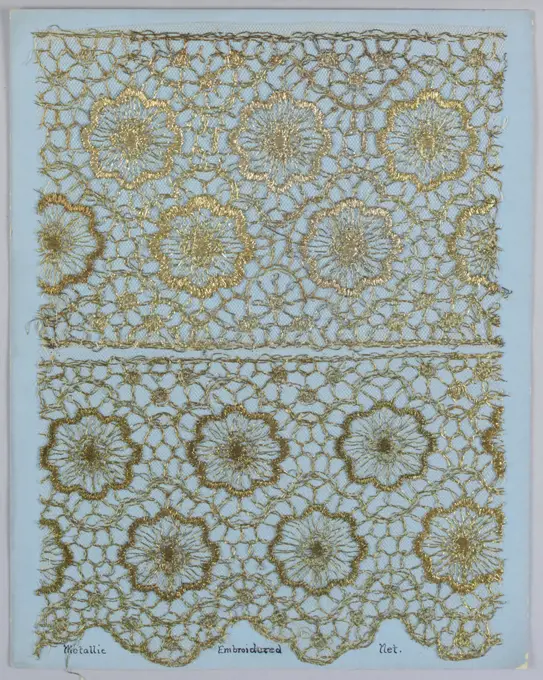
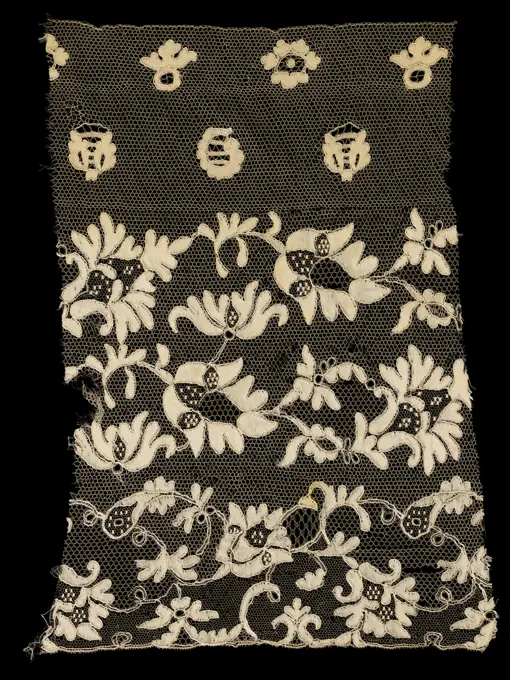
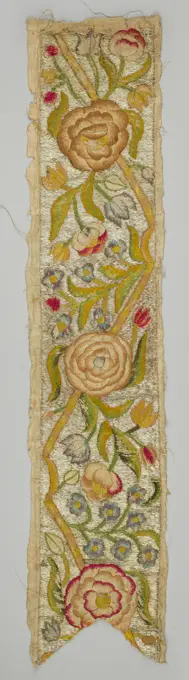
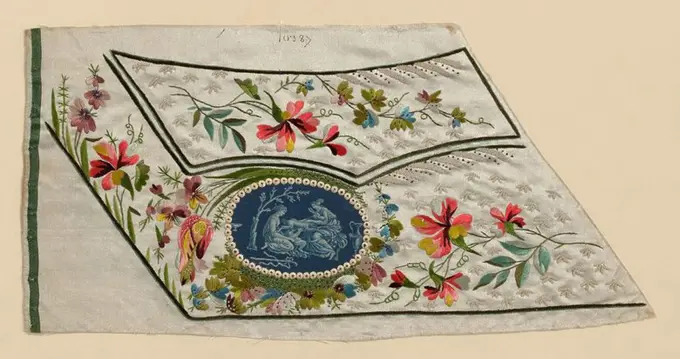
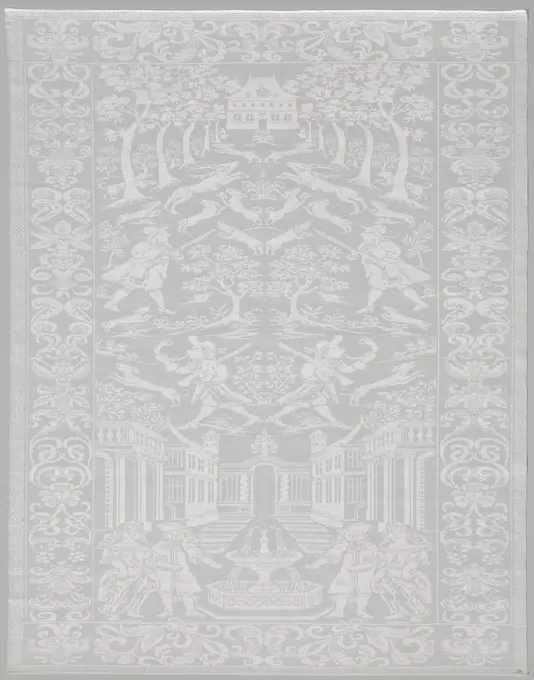
Fragment (Japan)Piece 18th-19th century Japan. Piece. Japan. 18th-19th century. Silk. Textiles-WovenPiece ca. 1790 French. Piece 229354Textile fragment 1700-1899 Russian. Textile fragment 173394Textile (England); cottonSilk fabric  motif of a column with flower forms growing out of it unknownFragment, Medium: silk Technique: 5-harness satin damask damask, Purple damask with a large scale symmetrical floral ornament., Spain, 17th century, woven textiles, FragmentHerman O Stroh, Embroidery, c 1941 EmbroideryBed hangings and bed cover, Medium: silk ribbon and chenille on a wool foundation Technique: embroidered on twill weave, Bed cover and two panels of bed draperies in dark blue twill with an allover geometric design embroidered with yellow taffeta, yellow taffeta ribbons and yellow chenille., Iran, late 17th century, embroidery & stitching, Bed hangings and bed coverPiece 18th-19th century Japan. Piece 66157Piece ca. 1785 French. Piece 221988Fragment of antependium, embroidered  motif of asymmetrical floral twigs unknownSquare first half 19th century Russian. Square 227276Fragment; silk, metal threadSilk Fragment, 18th century. Spain, 18th century. Plain compound satin, brocaded: silk; average: 109.2 x 57.2 cm (43 x 22 1/2 in.).Leaf with flowers and fruits, anonymous, 1700 - 1850 brocade paper Leaf with flowers and fruits. With remnants of two torn labels. Used as a cover.  paper. paint (coating) relief printing ornament derived from plant formsFragment, Medium: wool Technique: block printed on plain weave, Coarse, cream-colored ground printed in reddish-brown. Pattern shows part of a floral spray and at one side, a section of border in a cartouche pattern., Egypt, 16th-17th century, printed, dyed & painted textiles, FragmentMarie Lutrell, Calico, 1940 CalicoOrphrey Band (Italy); silk, linen; Warp x Weft (A, C): 61.3 x 20 cm (24 1/8 x 7 7/8 in.)Cap crown, Medium: linen Technique: needle lace with ground of loop and twist with twist return, Cap crown with a design of large conventionalized leaves, flowers and floral clusters surrounding a central heart-shaped motif., France, 1700-1750, lace, Cap crownTextile; cotton, silver metal strips wound on paired cotton threads, silk in selvage warpsAlice Cosgrove, Quilt  Tulip Pattern, c 1941 Quilt - Tulip PatternSampler, Medium: silk and metal-wrapped silk embroidery on linen foundation Technique: deflected element work, raised work, plaited stitches., Spot sampler embroidered in blues, greens, yellows, gold and silver on a linen ground. Geometric designs in rococo work, deflected element work, plaited braid stitch, chain stitch, running stitch, couching and detached needle looping., England, early 17th century, embroidery & stitching, SamplerDorothy Lacey, Woven Coverlet, c 1936 Woven CoverletEmbroidered shawl unknownFragment Made 1590-1610 Italy. Silk and gold gilt strips, plain weave with supplementary patterning wefts and supplementary pile warps forming cut, uncut, and voided velvet .Piece 18th-19th century Japan. Piece. Japan. 18th-19th century. Silk. Textiles-WovenBand, Medium: silk on linen Technique: cross stitch variation; needle lace edging, Pattern of tulips, pomegranates and Turkish-like floral forms in reserve against a green silk embroidered background., Italy, 17th century, embroidery & stitching, BandFragment, Medium: silk, linen Technique: brocatelle, Coarse brocatelle in red and yellow. Large floral vase, curving bands of arrowhead motif. Two large birds holding twigs., Spain, 17th century, woven textiles, FragmentHandkerchief third quarter 19th century American. Handkerchief 169717Fragment, Medium: silk, metallic Technique: woven, Floral group with three blossoms in the center of an ogive area., 17th century, woven textiles, FragmentPart of Bed Hangings Set - Bedspread, 17th Century. Embroidered in wool on linen. Maker unknown .Fragment of bedvalanceBand 17th century Italian. Band 219845Piece 18th-19th century Japan. Piece 66362Wedding Veil (USA); cotton muslinMachine Lace (Embroidered Net) Fragment, early 19th century (after 1810). Spain, early 19th century. Lace ; average: 26.7 x 40.7 cm (10 1/2 x 16 in.).Sarong  floral motifs unknownHandkerchief border early 19th century Russian. Handkerchief border. Russian. early 19th century. Bobbin lace. Textiles-LacesCushionCoverValances, Medium: cotton Technique: block printed on plain weave, Two shaped valances made of the same fabric. The width differs on each of them but the height is the same. The pattern is a polychrome design of fruits and flowers on a white background. The valances are interlined, lined with linen plain weave and bound with woven green silk tape. The original glaze is on the fabric., Vaucluse, France, late 18th century, printed, dyed & painted textiles, ValancesFragment Made 1575-1600 Italy. Plain compound cloth .Band, Medium: linen Technique: bobbin lace, discontinuous tape, Wide band of bobbin lace with a symmetrical design of foliage, flowers, birds and animals. The repeating design alternates between a flowering plant and a crowned siren with a tail in each hand, each framed by curving foliage and pairs of peacocks, cocks, doves, lambs, geese, dogs, and horses. The solid areas have much interior decoration and are connected by brides., Northern Europe, 18th century, lace, BandFragment 16th-17th century Bohemian or Moravian. Fragment 217809Pieces (2) 17th century Italian. Pieces (2). Italian. 17th century. Silk and metal thread. Textiles-VelvetsRitual Textile (Pua KumbuNabau)Piece of fabric. unknown, authorPiece 17th century Japan. Piece. Japan. 17th century. Silk / Compound weave. Textiles-WovenHandkerchief with a border of golden side with double four pass. Handkerchief with an edge of natural needle lace, Brussels mesh edge. A eighty batters center piece is surrounded by a sides of double four-speed. Herein straight rotating twigs of 'forgetmine beanies' (dump edge). An inner list of circles, four times overcures by an oval, is limited by C-Volutes. Fine golden rain leaves hang down from the same exterior list. In the corners there are three large roses with imposed relief. The edge consists of rosettes and wingerd leaves.Handkerchief French late 19th centuryPall, embroidered  floral motif unknownChalice cover, Medium: silk, metallic thread Technique: embroidered on warp and weft twill weave, Golden yellow ground of warp twill with small symmetrical arabesque pattern in the same color in a weft twill. Arabesques are outlined and embellished with couched silver threads to form a continuous allover pattern. Small cross in the center of silver couched in black. Edged with narrow gold bobbin lace and lined in fine blue ribbed silk., France or Italy, 1700-1750, embroidery & stitching, Chalice coverTapestry. unknown, authorPiece ca. 1733 British or French. Piece. British or French. ca. 1733. Silk. Textiles-WovenCeremonial Shoulder Cloth (Kain songket lepus) Indonesia. Two widths joined silk and silvered-and gilt-metal threads wrapped cotton, plain weave with supplementary patterning and brocading wefts .Fragment multicolor silk tissue with pattern of intersecting ovals, multicolored flowers and so-called lace ties with ditto flowers. Fragment multicolor silk tissue, composed of four pieces set together. On a green-blue ground, white "lace tires" cut each other. The soaked spaces are filled with multicolored flowers. There are multicolored flowers in the side tires here and there.Fragment, Medium: silk Technique: damask, Pommegranates and foliage in a diamond lattice framework., Italy, 17th century, woven textiles, FragmentTapestry. unknown, authorPiece 18th-19th century Japan. Piece. Japan. 18th-19th century. Silk. Textiles-WovenTablecloth or Bedcover probably titled Ragged Poppy Made 1902 London. Cotton, plain weave; block printed . John Scarratt Rigby (Designer)Tablecloths and napkins, decorated with embroidery and lace. In the shop window of the beautiful tablecloths and napkins of flax, decorated with beautiful lace and embroidery. Copyright: xZoonar.com/GalinaxTolochkox 11276348Rug of linen with an edge of edge. Dress from natural linen in which the edge is equipped with edge embroidery: open sewing. The repetitive pattern consists of a zigzag band with in the triangular fields above and there are four open-timed cubes on top of each other, three below and one in the middle on top. The zigzag band consists of a double row of openwork cubes between two narrower lines of every triple row of finer open-worked dots. Around the rug is finished with a scented bow edge, with a picot on each corner.Skirt panel first half 18th century Chinese, for French market. Skirt panel 229694Cap crown, Medium: linen Technique: needle lace with ground of loop and twist with twist return, Cap crown with a pattern of floral and foliated sprays., Italy, mid-18th century, lace, Cap crownTextile, Medium: silk and metallic Technique: woven, Floral motifs within circles. Parts of left and right selvage present., Near East, 16th century, woven textiles, TextileNapkin from white Linnamast, flower branches and rococo ornament, twice the crowned weapon kops and twice the mirror monogram NWK, in the heart Anno 1746, Anonymous, 1746 Napkin from white Linnamast, flower branches and rococo ornament, twice the crowned weapon kops and twice the mirror monogram NWK, in the heart anno 1746; Manufactured for Nicolaas Willem Kops (1719-1778) in the year of his marriage (8 March 1746) to Elisabeth Barnaart (1715-1771). Northern Netherlands linen (material) damask Napkin from white Linnamast, flower branches and rococo ornament, twice the crowned weapon kops and twice the mirror monogram NWK, in the heart anno 1746; Manufactured for Nicolaas Willem Kops (1719-1778) in the year of his marriage (8 March 1746) to Elisabeth Barnaart (1715-1771). Northern Netherlands linen (material) damaskFragment; silk; Bequest of Richard Cranch Greenleaf in memory of his mother, Adeline Emma Greenleaf; 1962-56-88Fragment (Japan)Zakdoek van batist met een rand Oosteuropese kant met smalle slingerende bandjes geklost in een symmetrisch patroon.Batist handkerchief with a border around a border: Oosteuropese side. Square model with rounded corners and a sloping edge. The lace pattern is symmetrical along each side with respect to the length axis. A double filamentary line divides the pattern into an upper and part in which strong winding lines forms standing and lying waves.Textile Swatches Onondaga Silk Company, Inc. (1925-1981). Textile Swatches, 1948-1959. silk; metal, (a) - (d): 9 x 5 in. (22.9 x 12.7 cm).    1948-1959Book Cover, Modelli da ricamo (Embroidery models)Fragment, Medium: silk Technique: supplementary warp forming raised pile (velvet); embossed., Lattice framing four-petaled flowers on red velvet. Wide yellow selvage., 16th-17th century, woven textiles, FragmentCarpet Fragment ca. 17th century. Carpet Fragment. ca. 17th century. Wool. Country of Origin Turkey. Textiles-RugsSamples, Cheney Brothers, (South Manchester, Connecticut, USA), Medium: silk, metal thread Technique: plain compound satin, Reproduction textile samples adopted from a Lucchese design in the collection of the Cooper Union Museum. Samples (b/g) of black, blue, green, purple, and taupe with gold weft with a pattern of serpentine branches with ogive blossoms and Chinese-inspired monsters and senmurvs between serpentines., USA, ca. 1915, woven textiles, SamplesPiece 18th-19th century Japan. Piece. Japan. 18th-19th century. Silk. Textiles-WovenTulip and Lily designed ca. 1875 Designed by William Morris British. Tulip and Lily 230012Handkerchief. unknownNeedlepoint (Drawnwork) Lace Band, 18th-19th century. Italy, Sicily, 18th-19th century. Lace, needlepoint: linen; average: 26.7 x 82.9 cm (10 1/2 x 32 5/8 in.).Fragment; silk woven; Warp x Weft: 31 x 16.3 cm (12 3/16 x 6 7/16 in.)Fragment; silk, metallicMachine-made openwork samples, Medium: cardboard, linen, silk, metallic Technique: linen embroidery with ground cloth dissolved Examples of embroidery on net produced by the Schiffli machine Metallic embroidery on net Machine-made openwork in imitation of hand-embroidered net Mostly floral and a few geometric patterns, some designs described as 'Spanish' Imitation hand-made filet Machine filet Imitation filet crochet Ploven (burnt-out lace) Fancy curtain lace made on the Levers machines Real filet (handmade) next to Machine-made filet Spotted curtain nets, made chiefly at Nottingham, England and Caudry, France., Samples of machine-made openwork and several examples of hand made lace mounted on boards. They imitate hand-embroidered net, crochet, or needlepoint. All are floral patterns plus a few of early 1920's geometric style., 'Embroidered net' produced by the Schiffli Machine., USA, ca. 1910, lace, Machine-made openwork samplesTextile (England); cottonPiece 18th century Japan. Piece 71552Lace sample French 19th centuryFragment (France); silkChasuble orphrey, embroidered unknownSalesman's Sample (Waistcoat Pocket). France, probably Lyon. Date: 1780-1790. Dimensions: 16.6 × 33 cm (6 1/2 × 13 in.). Silk, warp-float faced satin weave; appliquéd with silk, satin weave; embroidered with silk floss and silk yarns in outline, satin, single satin and stem stitches; French knots and paper paillettes; printed. Origin: France. Museum: The Chicago Art Institute, Chicago, USA.Piece 17th century Japan. Piece 71065Panel Made 1820-1840 France. Cotton, plain weave; block printed .Chalice Cover Made 1601-1625 Italy. Linen, square netting; embroidered with silk in cloth, darning and interlocking lace stitches; glass beads .Sampler (Netherlands); silk embroidery on linen foundationCeiling Medallion (USA); block-printedConciliate belt; Royal Manufacture of Jedwabna in Grodno (Grodno; Silk fabric and belt fabric factory; 1768-1780); 1775 (1775-00-00-1775-00-00);Flowers basket (ornament), flower ornaments, plant ornaments, solid belts, Polish belts, Poland (culture), Polish clothingTextile (Netherlands); cotton; Warp x Weft: 81 x 58 cm (31 7/8 x 22 13/16 in.)Napkin with hunting scene, anonymous, c. 1680 - c. 1690 Linnamast napkin with a yacht in a park. Brand Hc. The napkin is part of five napkins (BK-1987-31-A to BK-1987-31-F). Southern Netherlands (possibly) linen (material) damask Linnamast napkin with a yacht in a park. Brand Hc. The napkin is part of five napkins (BK-1987-31-A to BK-1987-31-F). Southern Netherlands (possibly) linen (material) damaskEmbroidery Sample (USA); Made by S.L. Klein, Inc. (New York, NY, USA); wool, imitation pearls, coral beads, gold beads, gold threadSample book page, Medium: cardboard, linen, silk, metallic Technique: linen embroidery with ground cloth dissolved Examples of embroidery on net produced by the Schiffli machine Metallic embroidery on net Machine-made openwork in imitation of hand-embroidered net Mostly floral and a few geometric patterns, some designs described as 'Spanish' Imitation hand-made filet Machine filet Imitation filet crochet Ploven (burnt-out lace) Fancy curtain lace made on the Levers machines Real filet (handmade) next to Machine-made filet Spotted curtain nets, made chiefly at Nottingham, England and Caudry, France., Samples of machine-made openwork and several examples of hand made lace mounted on boards. They imitate hand-embroidered net, crochet, or needlepoint. All are floral patterns plus a few of early 1920's geometric style., 'Embroidered net' produced by the Schiffli Machine., USA, ca. 1910, sample books, Sample book pageGold leather, sheet of so-called lofty gold leather with a faunskop in the center in frontal view. Gold leather, so-called superior gold leather with a faunskop in the center in frontal view and in the corners of midfield four diagonally placed stylized bouquets; The middle manager is framed by a "jewelry edge". Painted in green, red, blue and orange / gold against a squared background.Sample Book (France); cottonTextile (France); Designed by Jean-Baptiste Marie Huet (French, 1745 - 1811); cotton