My Boards
View Pictures
  • My Boards
← Artworks

Japanese Woodblock Landscapes

Depictions of serene Japanese landscapes featuring hills, rivers, and people interacting with nature, in the traditional style of woodblock prints.
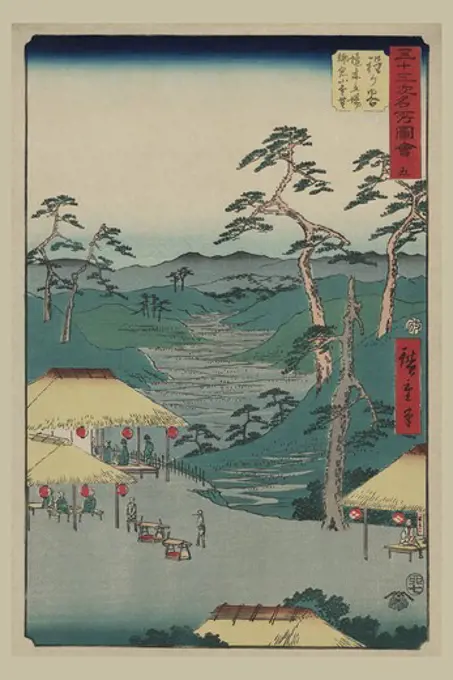
Hodogaya, Japanese Prints - Hiroshige
270 assets in this story
4443-28730283
30, Tōjinbō, Echizen Province, 2nd lunar month 1862, Utagawa Hiroshige II, Japanese, 1826 - 1869, 10 × 7 1/4 in. (25.4 × 18.42 cm) (sheet), Woodblock print (nishiki-e); ink and color on paper, Japan, 19th century
4443-28740162
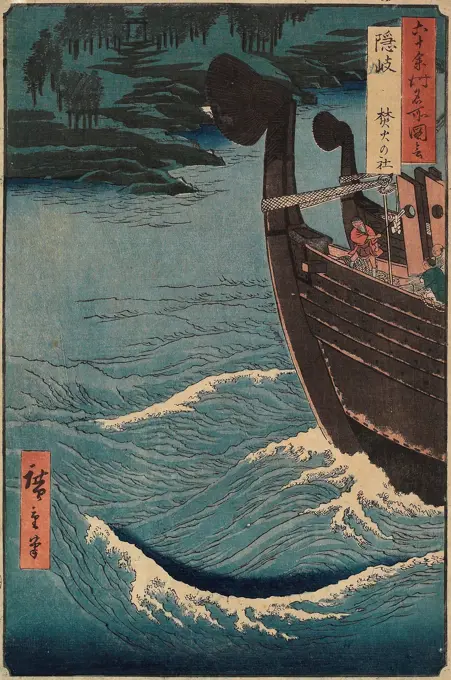
Oki Province: Takuhi Shrine, 1853, 12th month, Utagawa Hiroshige; Publisher: Koshimuraya Heisuke, Japanese, 1797 - 1858, 13 7/16 × 8 7/8 in. (34.1 × 22.5 cm) (image, vertical ōban), Woodblock print (nishiki-e); ink and color on paper, Japan, 19th century
6145-50633701
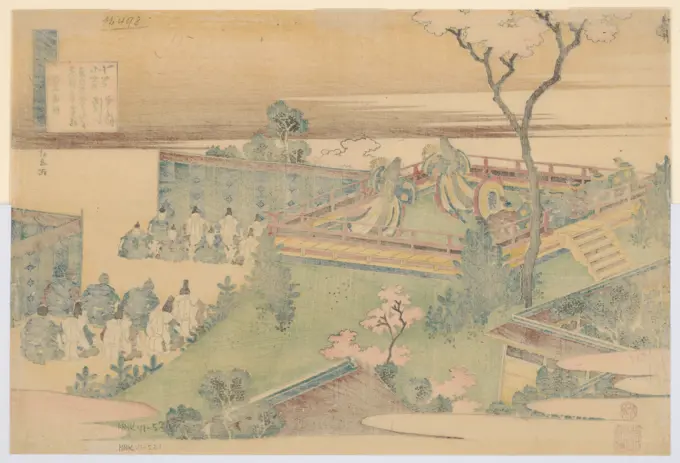
The poem of Sojo Henjo, from the series: One hundred poems painted acccording to the Explanations of the Nurses /Hakunin Isshu Ubaba Etoki Katsushika, hokusai (1760 1849)
4443-19585763
Artist: Utagawa Hiroshige, Japanese, 1797-1858, Night Rain at Koizumi: The Eight Views ofKanazawa, ca.1835-39, Polychrome woodblock print, sheet: 8 3/4 × 14 in. (22.2 × 35.6cm), Japan, Japanese, Edo period(1615-1868), Works on Paper -Prints
6145-45795483
Eight faces on the Sumida River; Sumidagawa Hakkei; Ehon Kojidan. River landscape with four of the eight classic scenery titles in the rectangular cartouches: autumnal moon, evening bokkes, hindly rain and sailing geese. Two pages, stuck to each other, from the Japanese book of the Kodanji.
6145-30187834
Mitsuke Ferryboats on the Tenryu River (Mitsuke, Tenryugawa no funawatashi)No 29, from the series Fifty-three Stations of the Tokaido (Tokaido gojusan tsugi), also known as the Reisho Tokaido 1842-1857 Japan. Color woodblock print; oban . Utagawa Hiroshige
6145-59223726
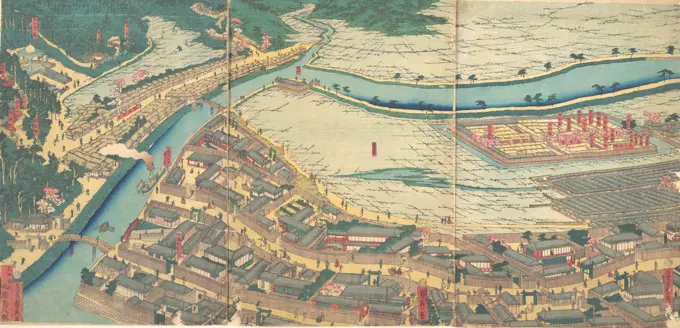
Road map for the famous places in Ise, Nishida Shinshichi, 1900 print View of the city of Isee; In white cartouches the names of the various famous Shinto shrines; In Geel Cartouche below the mutual distances. Whereas paper nishiki-e / color woodcut city-view, and landscape with man-made constructions. sun as celestial body
4409-17563132
Kameyama, from the series "Fifty-three Stations of the Tokaido (Tokaido gojusan tsugi no uchi)," also known as the Gyosho Tokaido. Utagawa Hiroshige  ; Japanese, 1797-1858. Date: 1836-1849. Dimensions: 21 x 33.3 cm (8 1/4 x 13 1/8 in.). Color woodblock print; aiban. Origin: Japan. Museum: The Chicago Art Institute, USA.
6145-29801729
Gion Shrine in Snow 1797-1858 Utagawa Hiroshige Japanese. Gion Shrine in Snow. Utagawa Hiroshige (Japanese, Tokyo (Edo) 1797-1858 Tokyo (Edo)). Japan. 1797-1858. Woodblock print; ink and color on paper. Edo period (1615-1868). Prints
6145-30174017
EjiriNo 19, from the series Fifty-three Stations of the Tokaido (Tokaido gojusan tsugi), also known as the Reisho Tokaido 1842-1857 Japan. Color woodblock print; oban . Utagawa Hiroshige
4443-19534772
Distant View of Kinryuzan Temple from Azuma Bridge (Azuma-bashi, Kinryuzan embo) No.39 From the Series One Hundred Famous views of Edo, Ando Hiroshige, Japanese, 1797-1858, Woodblock print in colored ink on paper, The view of Asakusa, with its famous large pagoda, and Mt. Fuji are divided by the structure of the yellow pleasure boat. Almost hidden on the left side of the boat is discreetly placed a geisha. Typically there would be other guests, such as attendants, another geisha, and one or two other guests. The dusting of falling cherry blossoms suggests they were viewing the blooming pink trees., Japan, 1856, landscapes, Print, Print
6145-59469042
Evening scene on the Edo River, Takahashi Hiroaki, 1910 - 1923 print View of the Edo River (Edogawa) at the full moon; In the foreground two sailing ships and a rowing boat; Houses illuminated on the banks. print maker: Japanpublisher: Tokyo paper color woodcut river. sailing-ship, sailing-boat. full moon
6145-29775793
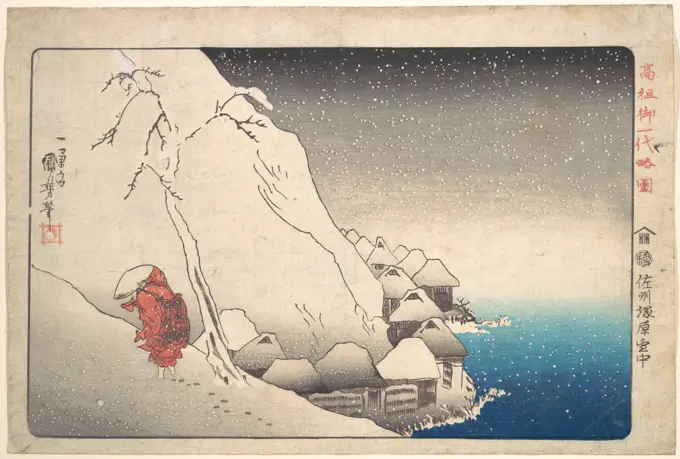
Nichiren in Snow at Tsukahara, Sodo Province ca. 1840 Utagawa Kuniyoshi Japanese. Nichiren in Snow at Tsukahara, Sodo Province 56779
6145-30164337
Minowa, Kanasugi, Mikawashima, from the series One Hundred Famous Views of Edo (Meisho Edo hyakkei)” 1857 Japan. Color woodblock print; oban . Utagawa Hiroshige
6145-29779112
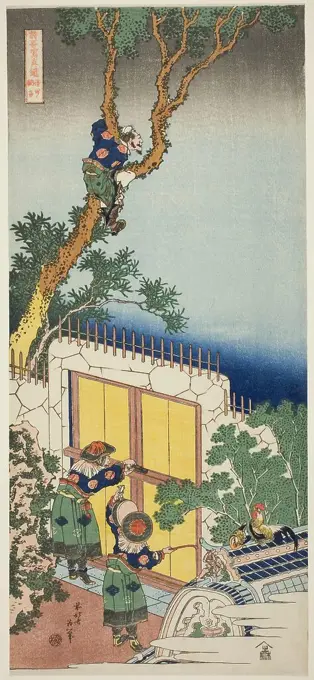
Piece 18th-19th century Japan. Piece 67572
6145-30187597
First Cuckoo of the Year at Tsukuda Island (Tsukudajima, hatsu hototogisu), from the series Famous Views of the Eastern Capital (Toto Meisho) 1826-1836 Japan. Color woodblock print; oban . Utagawa Hiroshige
1899-19136908
Japan: Night Snow at the Ukamuse Restaurant in Masui, from the series 'One Hundred Views of Osaka' (Naniwa hyakkei), Utagawa Yoshitaki (1841-1899), 1860
6145-29134113
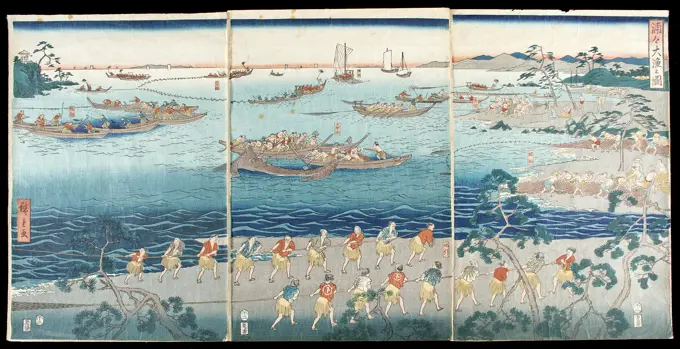
Great Scene of Fishing in the Bay. Utagawa Hiroshige (Japan, Edo, 1797-1858). Japan, 1858, 2nd month. Prints; woodblocks. Triptych; color woodblock prints
4409-17583426
Sei Shonagon, from the series "A True Mirror of Japanese and Chinese Poems (Shiika shashin kyo)". Katsushika Hokusai  ; Japanese, 1760-1849. Date: 1828-1838. Dimensions: 71.2 x 40.6 cm. Color woodblock print; vertical nagaban. Origin: Japan. Museum: The Chicago Art Institute, USA.
4409-17563530
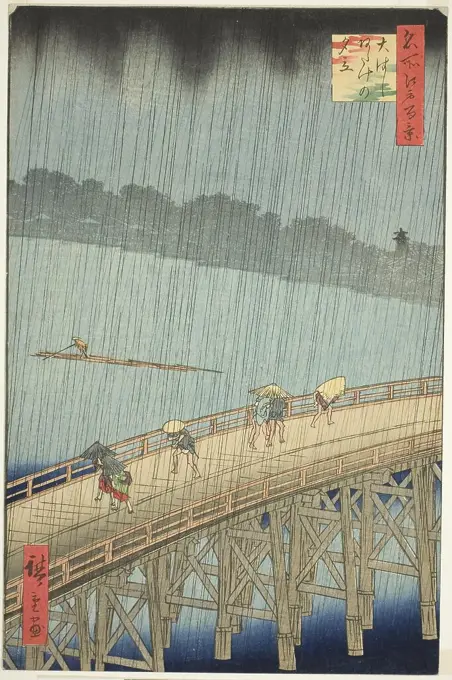
Sudden Shower over Shin Ohashi Bridge and Atake (Ohashi Atake no yudachi), from the series "One Hundred Famous Views of Edo (Meisho Edo hyakkei)". Utagawa Hiroshige  ; Japanese, 1797-1858. Date: 1857. Dimensions: 33.4 x 21.8 cm (13 1/4 x 8 5/8 in.). Color woodblock print; oban. Origin: Japan. Museum: The Chicago Art Institute, USA.
6145-51827422
Kanasugi Bridge and Shibaura, No. 80 from One Hundred Famous Views of Edo Utagawa Hiroshige (Ando) (Japanese, 1797-1858). Kanasugi Bridge and Shibaura, No. 80 from One Hundred Famous Views of Edo, 7th month of 1857. Woodblock print, Sheet: 14 3/16 x 9 1/4 in. (36 x 23.5 cm).  This colorful procession is a group of Nichiren Buddhists crossing the Kanasugi Bridge along the stretch of coast known as Shibaura. The autumn season assigned to the print suggests that it is Oeshiki, the thirteenth day of the Tenth Month, the day Nichiren, the founder of this particular Buddhist sect, died in 1282. Whether the procession is en route to or returning from its destination, the temple where Nichiren died, is unclear. Perhaps what Hiroshige has done is to show the two faces of the pilgrimage: the exuberant setting out under fluttering banners in the foreground, and the exhausted return of the pilgrims in the background, huddled under hats and umbrellas. Asian Art 7th month of 1857
4443-28740137
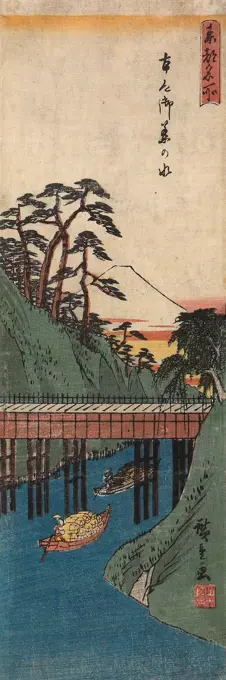
Ochanomizu, c. 1837-1838, Utagawa Hiroshige, Japanese, 1797 - 1858, 13 7/16 × 4 3/8 in. (34.2 × 11.1 cm) (image, chūtanzaku), Woodblock print (nishiki-e); ink and color on paper, Japan, 19th century
1899-18305237
Sudden Shower, Hiroshige, 1857
4443-20306783
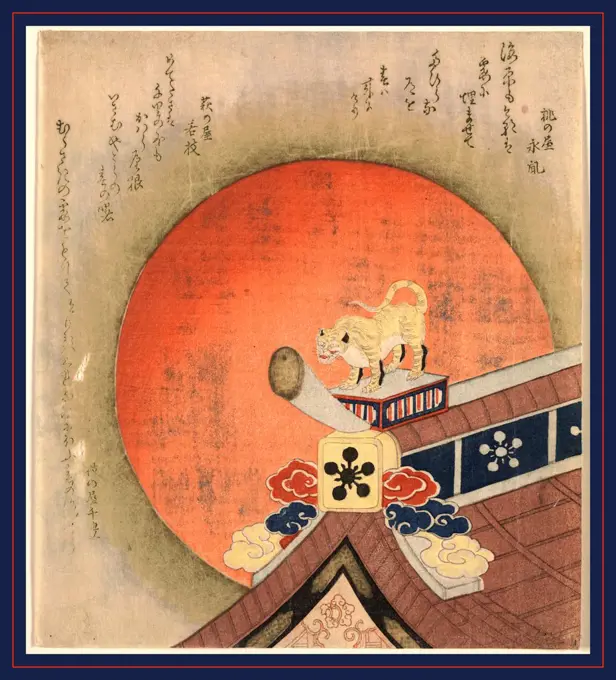
Kawarayane ni tora no okimono, Tiger statue on a tile roof., 1830., 1 print : woodcut, color ; 20.7 x 18.3 cm., Print shows a statue of a tiger mounted at the edge of the peak of a roof.
6145-52850868
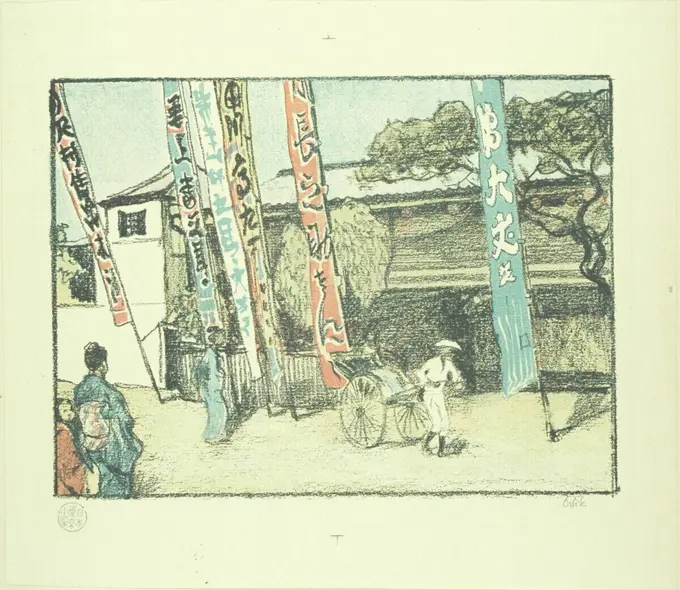
A color print by Emil Orlik from 1901-1903 depicting a Japanese theater building, showing architectural details, stage, and interior structure.
4409-17560653
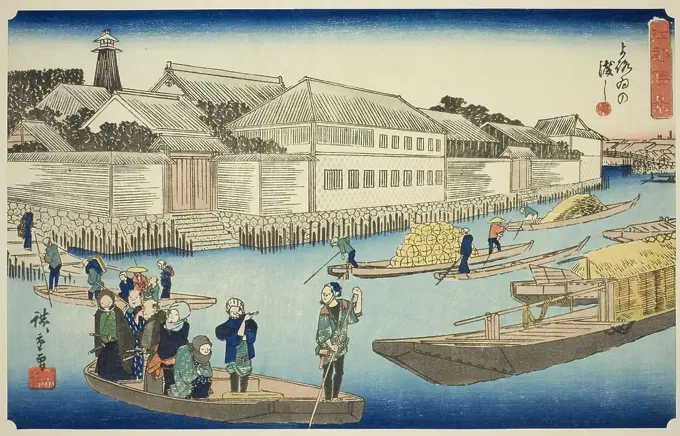
The Yoroi Ferry (Yoroi no watashi), from the series "Exceptional Views of Edo (Koto shokei)". Utagawa Hiroshige  ; Japanese, 1797-1858. Date: 1830-1844. Dimensions: 24.1 x 36.8 cm (9 1/2 x 14 1/2 in.). Color woodblock print; oban. Origin: Japan. Museum: The Chicago Art Institute, USA.
6145-29741409
Revised Yokohama Landscape 2nd month, 1861 Utagawa (Gountei) Sadahide Japanese. Revised Yokohama Landscape 73410
6145-51817491
Minakuchi: Famous Dried Gourd, from the series Fifty-three Stations of the Tōkaidō Road Utagawa Hiroshige (Ando) (Japanese, 1797-1858). Minakuchi: Famous Dried Gourd, from the series Fifty-three Stations of the Tōkaidō Road, ca. 1833-1834. Color woodblock print on paper, Sheet: 9 5/8 x 14 1/16 in. (24.5 x 35.7 cm).   Asian Art ca. 1833-1834
4408-4236
Seba Station, Japanese Prints - Hiroshige
1899-18789133
Hiroshige's One Hundred Famous Views of Edo, actually composed of 118 woodblock landscape and genre scenes of mid-19th century Tokyo, is one of the greatest achievements of Japanese art. The series includes many of Hiroshige's most famous prints. It represents a celebration of the style and world of Japan's finest cultural flowering at the end of the Tokugawa Shogunate. The series opens with spring. Scenes 1 though 42 represent the First to the Third Months, which are considered in Japan to be the spring season. Typically, early spring is marked by the festivities celebrated at the New Year, which begins the season. Blossoming plum trees are associated with the middle of spring, signifying the end of the cold weather and the beginning of the warm season. Utagawa Hiroshige (1797 October 12, 1858) was a Japanese ukiyo-e artist, and one of the last great artists in that tradition. He was also referred to as Andi Hiroshige (an irregular combination of family name and art name) and by the a
1899-18789210
Hiroshige's One Hundred Famous Views of Edo, actually composed of 118 woodblock landscape and genre scenes of mid-19th century Tokyo, is one of the greatest achievements of Japanese art. The series includes many of Hiroshige's most famous prints. It represents a celebration of the style and world of Japan's finest cultural flowering at the end of the Tokugawa Shogunate. The people of Edo marked the autumn season with excursions to scenic attractions and harvest festivals, and viewing fall foliage at its peak. The prints numbered 73 through 98 suggest the activities of this season in Japan, the Seventh, Eighth, and Ninth Months. Utagawa Hiroshige (1797 October 12, 1858) was a Japanese ukiyo-e artist, and one of the last great artists in that tradition. He was also referred to as Andi Hiroshige (an irregular combination of family name and art name) and by the art name of Ichiyusai Hiroshige.
6145-51817763
Ehon Azuma Kagami, Vol. I Kitao Masayoshi (Japanese, 1764-1824). Ehon Azuma Kagami, Vol. I, 1810. Paper, 8 7/8 x 6 1/8 in. (22.5 x 15.6 cm).   Asian Art 1810
6145-30164719
Fukagawa Susaki and Jumantsubo (Fukagawa Susaki Jumantsubo), from the series One Hundred Famous Views of Edo (Meisho Edo hyakkei) 1857 Japan. Color woodblock print; oban . Utagawa Hiroshige
4409-17378933
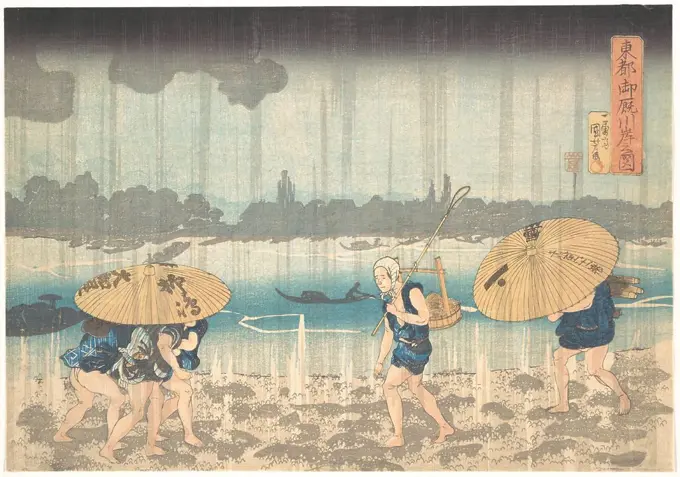
Onmayagashi in Edo. Artist: Utagawa Kuniyoshi (Japanese, 1797-1861). Culture: Japan. Dimensions: H. 10 1/8 in. (25.7 cm); W. 14 9/16 in. (37 cm). Date: 1830-44.This print is a magnificent depiction of heavy rain. Three men huddled beneath an umbrella are about to pass another who, oblivious to the torrential rain, munches on the eels he carries for sale. Behind him is a comic counterpart to the trio--a single figure burdened with three umbrellas in addition to the one that obscures him from sight. Pouring rain falls straight down and splashes up from the muddy ground.The artist was a contemporary of Kunisada; they were the two principal students of Toyokuni, the most influential artist of the Utagawa school. Genre prints with humorous insights into everyday life were his forte. Museum: Metropolitan Museum of Art, New York, USA.
6145-29083931
Miniature Album with Figures and Landscape (Landscape with Hill, House, Boat and Bridge), 1822. Zeng Yandong (Chinese, c. 1751-1827). Album leaf, ink and color on paper; overall: 6.1 x 7.7 cm (2 3/8 x 3 1/16 in.).
4409-17585114
Kameyama, section of sheet no. 13 from the series "Pictures of the Fifty-three Stations of the Tokaido (Tokaido gojusan tsugi zue)". Utagawa Hiroshige  ; Japanese, 1797-1858. Date: 1856. Dimensions: 7 x 11.5 cm. Color woodblock print; section of harimaze sheet. Origin: Japan. Museum: The Chicago Art Institute, USA.
4443-73251413
Tokyo, Watanabe Shozanburo, Japan, Hiroaki, Takahashi, Edogawa, Evening scene on the Edo River, below print - stamped, View of the Edo River (Edogawa) under a full moon; in the foreground two sailing ships and a rowing boat; on the banks illuminated houses., print, prent, prints, Japan (collection), height 176 mm, width 388 mm, 1871 - 1921, print maker, printmaker, 1910 - 1923, first quarter 20st century, first quarter 20th century, paper, colour woodcut, Publication (Event), Publication, publisher
6145-30158848
Returning sails at Takanawa 1830-1840 Japan. Color woodblock print; shikishiban, surimono . Keisai Eisen
4409-17414790
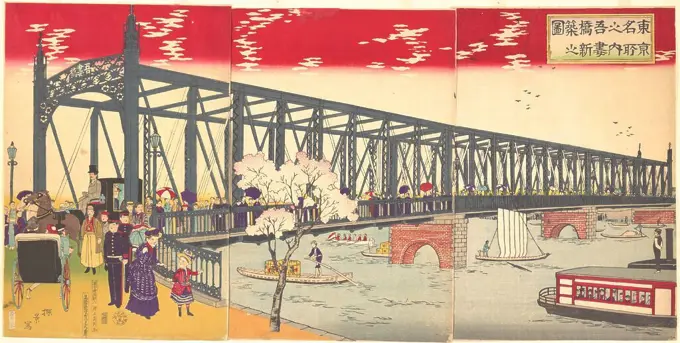
Illustration of the Opening of Azuma Bridge in Tokyo (Tokyo meisho no uchi azuma bashi shinchiku no zu). Artist: Inoue Yasuji (Japanese, 1864-1889). Culture: Japan. Dimensions: 14 1/8 x 28 1/2 in. (35.9 x 72.4 cm). Date: 1887. Museum: Metropolitan Museum of Art, New York, USA.
6145-45427339
MitSuke On the Tenryu Gawa River in The Morning Fog / Mitsuke, Tenryu Gawa Zu, Board 29. From the Series: Fifty Tree Stages of the TOKIDO HIROSHIGE, UTAGAWA (1797 1858)
4443-28729817
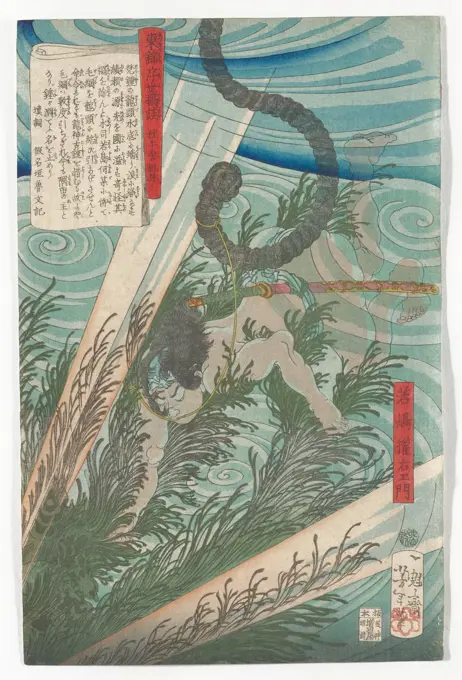
Hōgyūsha Tōrin; Wakashima Gonemon, 1867, 11th lunar month, Tsukioka Yoshitoshi; Author: Nozaki Bunzō; Publisher: Masudaya Ginjirō, Japanese, 1839 - 1892, 14 1/4 × 9 5/16 in. (36.2 × 23.65 cm) (image, sheet, vertical ōban), Woodblock print (nishiki-e); ink and color on paper, Japan, 19th century, Text by Kanagaki Robun.
4409-17585116
Narumi, section of sheet no. 12 from the series "Pictures of the Fifty-three Stations of the Tokaido (Tokaido gojusan tsugi zue)". Utagawa Hiroshige  ; Japanese, 1797-1858. Date: 1856. Dimensions: 14.4 x 11.4 cm. Color woodblock print; section of harimaze sheet. Origin: Japan. Museum: The Chicago Art Institute, USA.
6145-30156178
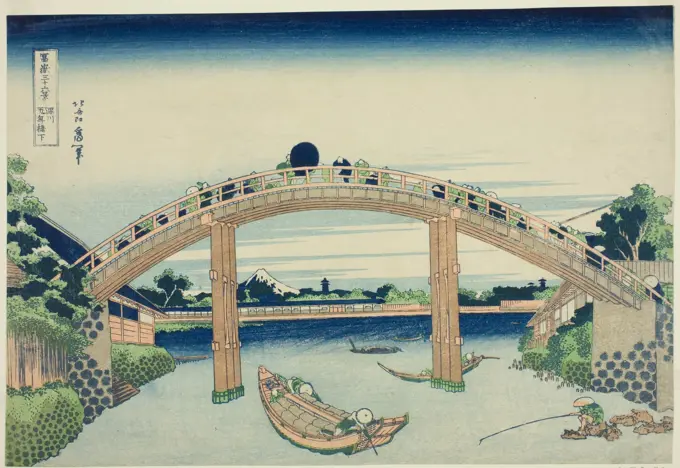
Beneath Mannen Bridge in Fukagawa (Fukagawa Mannenbashi shita) from the series Thirty-six Views of Mount Fuji (Fugaku sanjurokkei) 1825-1838 Japan. Color woodblock print; oban . Katsushika Hokusai
7155-70376462
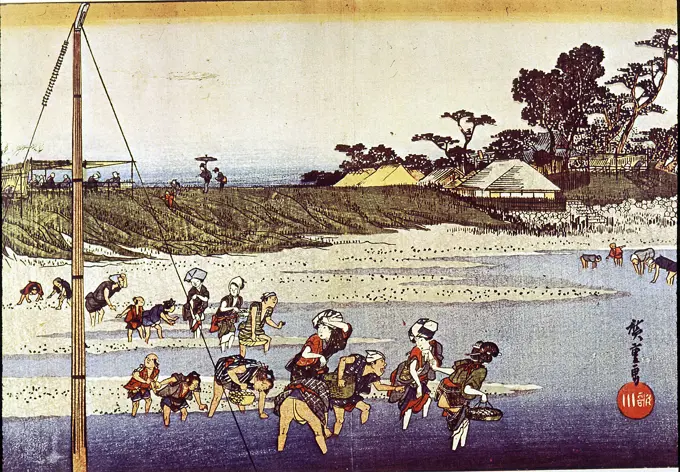
Oyster gatherers at low tide. Hiroshige. 19C.
1899-19137191
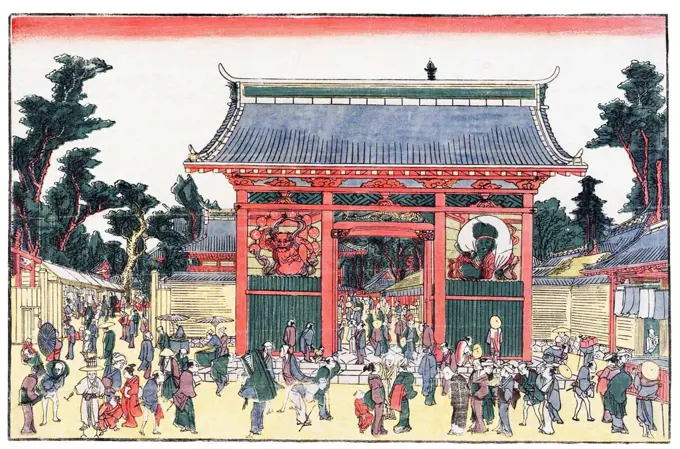
Japan: Gate of the Thunder God Raijin (left) and the Wind God Fujin (right) at Kinryuzan Temple in Asakusa, Katsushika Hokusai  (1760 - 1849), 1790
6145-30164623
Harima Province Maiko Beach (Harima, Maiko no hama), from the series Famous Places in the Sixty-odd Provinces (Rokujuyoshu meisho zue) 1853 Japan. Color woodblock print; oban . Utagawa Hiroshige
4443-73244514
Japan, Soshuya Yohei, Hokusai, Katsushika, Doban Omi hakkei, Engraved Eight Views of Omi Province, Mii no bansho, Evening bells of the Mii temple, below print - stamped, Landscape with temple complex, between which a road with several people; mountains in the background., print, prints, Japan (collection), under print - stamped, height 82 mm, width 111 mm, 1760-10-12 - 1849-05-10, print maker, printmaker, 1809 - 1814, first quarter 19th century, paper, nishiki-e, colour woodcut, colour woodblock, blind stamping, Publication (Event), Publication, Japanese, publisher
4409-17504013
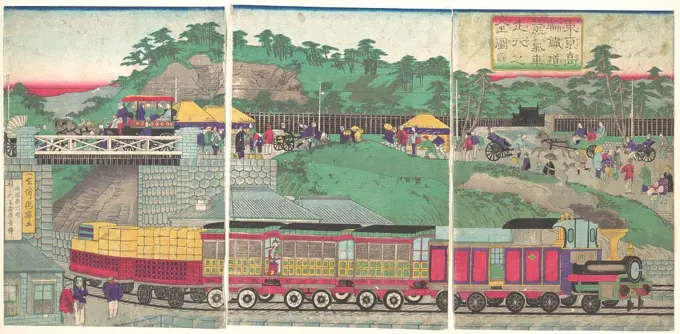
Illustration of a Steam Locomotive Running on the Takanawa Railroad in Tokyo (Tokyo takanawa tetsudo jokisha soko no zu). Artist: Utagawa Kuniteru (Japanese, 1830-1874). Culture: Japan. Dimensions: 14.2 x 29.1 in. (36.1 x 73.9 cm). Date: ca. 1873. Museum: Metropolitan Museum of Art, New York, USA.
4409-17424532
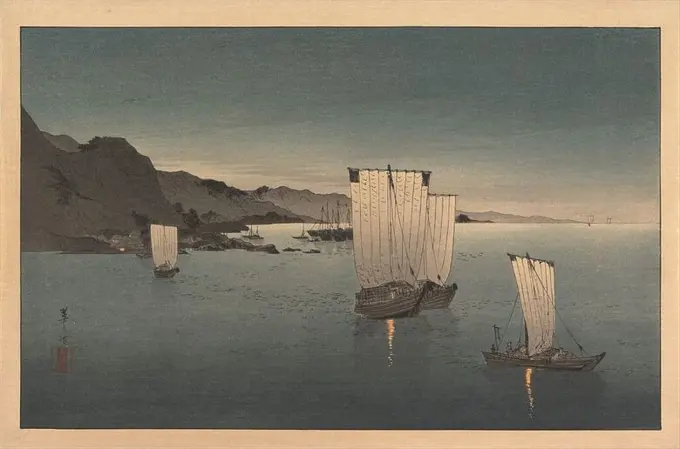
Fishing Boats at Dusk. Artist: Kaho (Japanese, early 20th century). Culture: Japan. Dimensions: 7 x 9 in. (17.8 x 22.9 cm). Date: early 20th century. Museum: Metropolitan Museum of Art, New York, USA.
6145-29742683
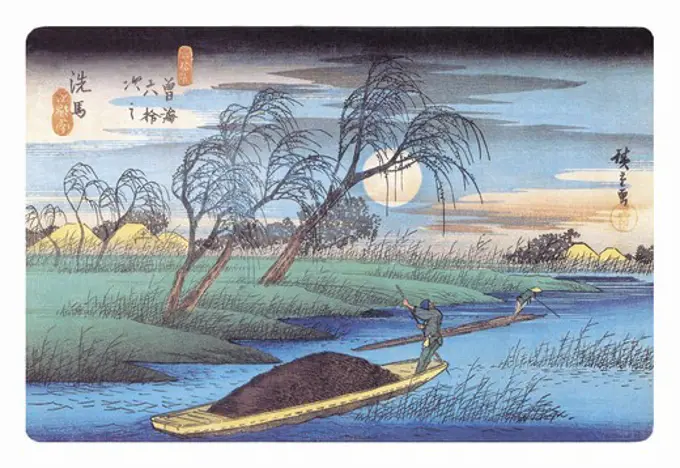
Kuwana ca. 1840 Japan. Kuwana 37237
1899-17834935
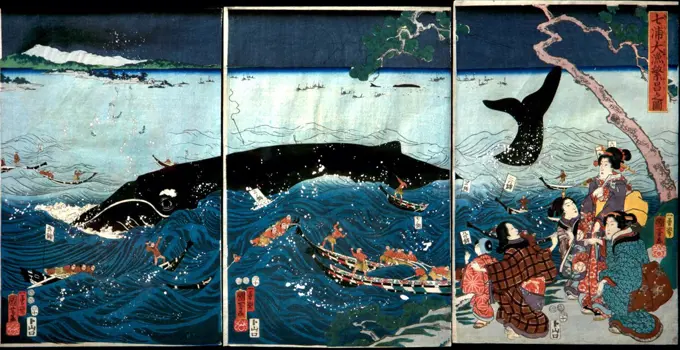
Utagawa Kuniyoshi 1798-1861. The Flourishing of Seven Coasts with  Big Fish (Nana ura tairyo hanjo no zu). 1853. Nishiki-e Oban vertical triptych.
6145-29733044
Illustration of the Front Garden of the Tsukiji Hotel in the Eastern Capital (Tōto Tsukiji hoteru kan niwa mae no zu) ca. 1868-72 Utagawa Hiroshige III Japanese. Illustration of the Front Garden of the Tsukiji Hotel in the Eastern Capital (Tōto Tsukiji hoteru kan niwa mae no zu) 73436
6145-29826236
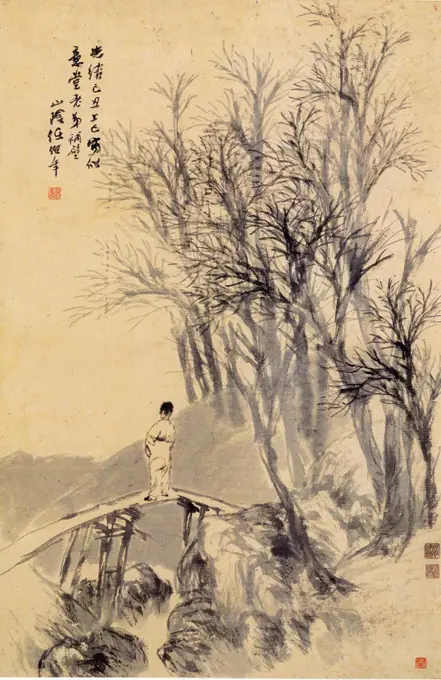
Man on a Bridge dated 1889 Ren Yi (Ren Bonian) Chinese Ren Yi, like his contemporary and friend Xugu (1823-1896), experimented with the realistic rendering of natural scenery instead of producing traditional landscapes composed of conventional compositions and brushstroke formulas. Here, he used irregular patches of wash and hatching to convey the impression of naked branches. Ren approached the picture as a Western artist sketching nature might have, asking "How can I render what I see" rather than attempting to imitate Western art.Photographs, regularly published in newspapers and magazines in Shanghai as early as the 1870s, shattered traditional Chinese concepts of picture making and had more to do with changing attitudes in landscape painting in the late nineteenth century than any direct influence of Western art.. Man on a Bridge 49462
6145-29160676
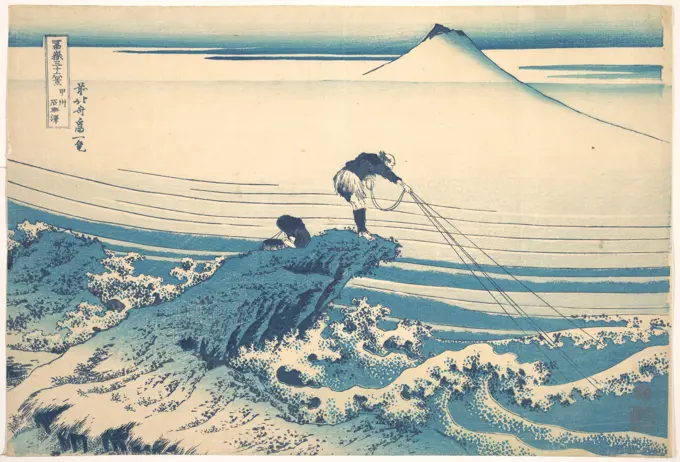
Kajikazawa in Kai Province (Ksh Kajikazawa), from the series Thirty-six Views of Mount Fuji (Fugaku sanjrokkei) ca. 1830-32 Katsushika Hokusai Japanese. Kajikazawa in Kai Province (Ksh Kajikazawa), from the series Thirty-six Views of Mount Fuji (Fugaku sanjrokkei). Katsushika Hokusai (Japanese, Tokyo (Edo) 1760-1849 Tokyo (Edo)). Japan. ca. 1830-32. Woodblock print. Edo period (1615-1868). Prints
7155-70375109
Chinese waterwheels. Chinese version of the Shaduf or Saqiya. 17th cent. CHINA.
6145-29833759
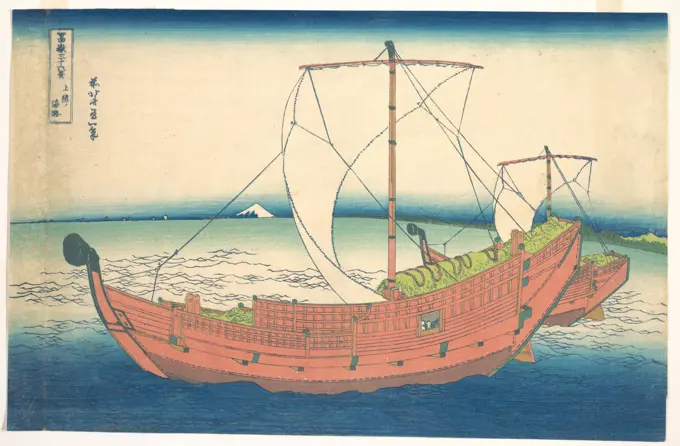
At Sea off Kazusa (Kazusa no kairo), from the series Thirty-six Views of Mount Fuji (Fugaku sanjūrokkei) ca. 1830-32 Katsushika Hokusai Japanese The deep blue hue of the water in the foreground of the print finds a visual counterpoint in the inky blue band that reaches across the horizon and sky. This repetition of color serves to flatten out the scene, bridging the distance between near and far. The mast and sails of the large junk create an interesting play of triangular forms that reflect and frame the form of Fuji in the distance.. At Sea off Kazusa (Kazusa no kairo), from the series Thirty-six Views of Mount Fuji (Fugaku sanjūrokkei) 56238
1746-19658965
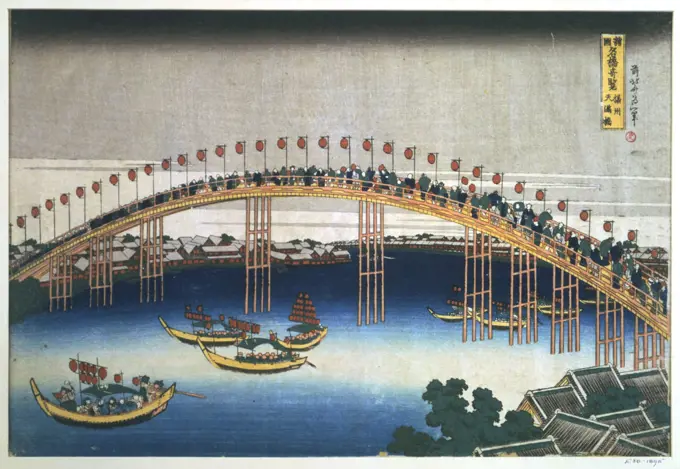
The Temma Bridge at Osaka, c1830. Coloured woodblock print. People crowd on the wooden bridge which is decked with coloured paper lanterns, and look down to the boats below which carry similar lanterns. Hokusai Katsushika (1770-1849) Japanese artist and printmaker.
6145-58942599
Sudden Shower Description: "Sudden Shower Over Shin-Ohashi Bridge and Ataker" by 19th century Japanese artist Utagawa Hiroshige. Date: After 1856 bridge, blue, rot, water, rain, japan, illustration, umbrella, print, boot, artwork, wasser, blau, brücke, regen, zeichnung, 1856, hiroshige, regenschirm, woodblockprint, holzschnitt, shinohashi, kunstdruck, utagawahiroshige, ataker, onehundredfamousviewsofedo, einhundertberühmteansichtenvonedo
4409-17563424
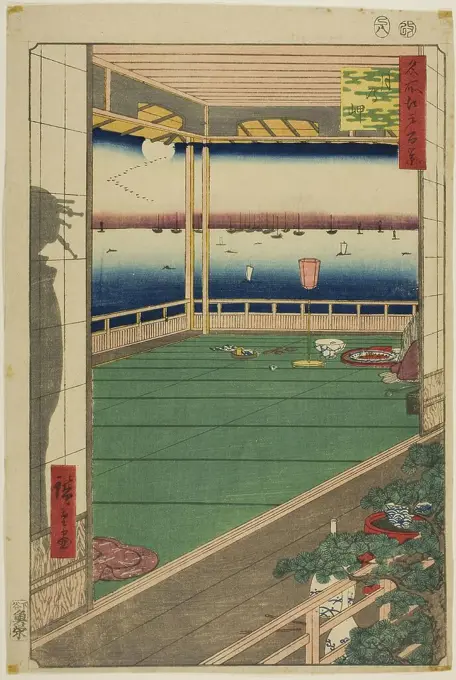
Moon-viewing Point (Tsuki no misaki), from the series "One Hundred Famous Views of Edo (Meisho Edo hyakkei)". Utagawa Hiroshige  ; Japanese, 1797-1858. Date: 1857. Dimensions: 33.8 x 22.3 cm (13 5/16 x 8 3/4 in.). Color woodblock print; oban. Origin: Japan. Museum: The Chicago Art Institute, USA.
4409-17374984
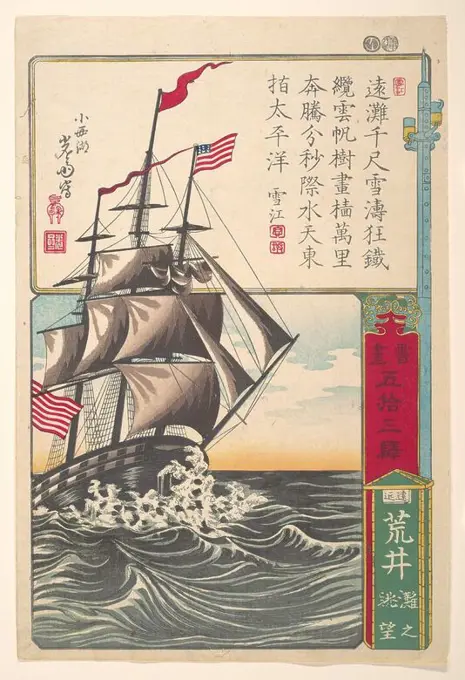
An American Sailing Ship off Arai. Artist: Utagawa Yoshimori (Japanese, 1830-1884). Culture: Japan. Dimensions: Image: 14 1/4 x 9 1/2 in. (36.2 x 24.1 cm). Date: October, 1872. Museum: Metropolitan Museum of Art, New York, USA.
6145-50635269
Mariko, board 21 from the series: Fifty three stages of the Tokaido road , the third version of the so called Reisho Tokaido
6176-67067704
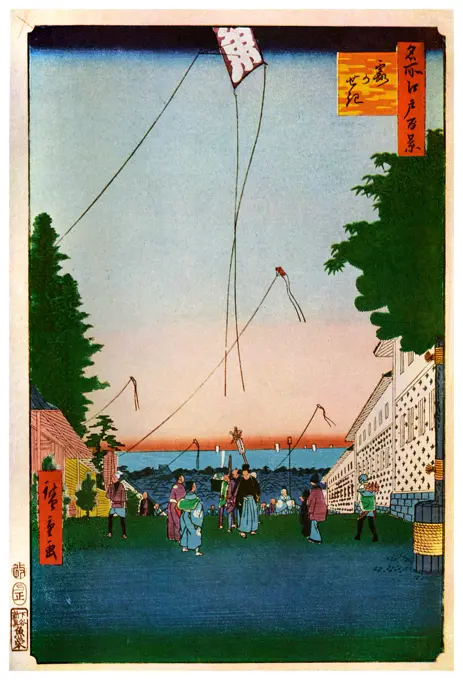
Flying kites, Japan, 19th century (1956). Artist: Unknown
1899-18853798
Thirty-six Views of Mount Fuji (Japanese: ; Fuji Sanju-Rokkei) is the title of two series of woodblock prints by the Japanese ukiyo-e artist Ando Hiroshige, depicting Mount Fuji in differing seasons and weather conditions from a variety of different places and distances. The 1852 series are in landscape orientation; the 1858 series are in portrait orientation. Utagawa Hiroshige ( , 1797 - October 12, 1858) was a Japanese ukiyo-e artist, and one of the last great artists in that tradition. He was also referred to as Ando Hiroshige ( ) (an irregular combination of family name and art name) and by the art name of Ichiyusai Hiroshige ().
1899-18789092
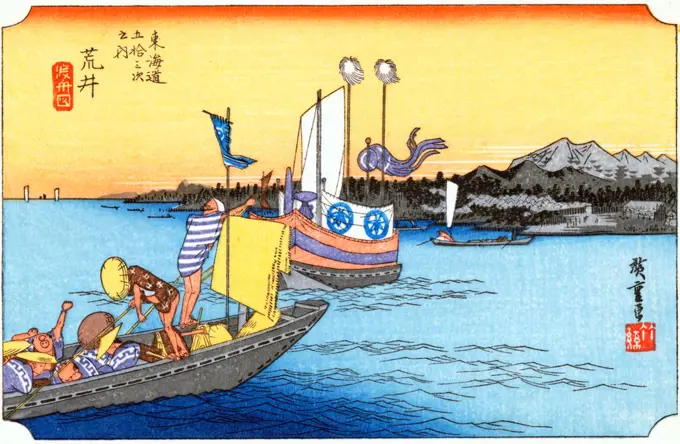
Arai: A large ferry boat, with an awning round it, taking a daimyo across from Maisaka, followed by a smaller boat with his retainers. A high range of hills on the further shore; golden sky. Travellers made the journey from Maisaka to Arai Station by ferryboat. On the shore was a government barrier station for the inspection of travellers. The compound remains largely intact even today. Utagawa Hiroshige (1797 October 12, 1858) was a Japanese ukiyo-e artist, and one of the last great artists in that tradition. He was also referred to as Andi Hiroshige (an irregular combination of family name and art name) and by the art name of Ichiyusai Hiroshige. The Ti kaidi (East Sea Road) was the most important of the Five Routes of the Edo period, connecting Edo (modern-day Tokyo) to Kyoto in Japan. Unlike the inland and less heavily travelled Nakasendi, the Ti kaidi travelled along the sea coast of eastern Honshu, hence the route's name.
4443-20282291
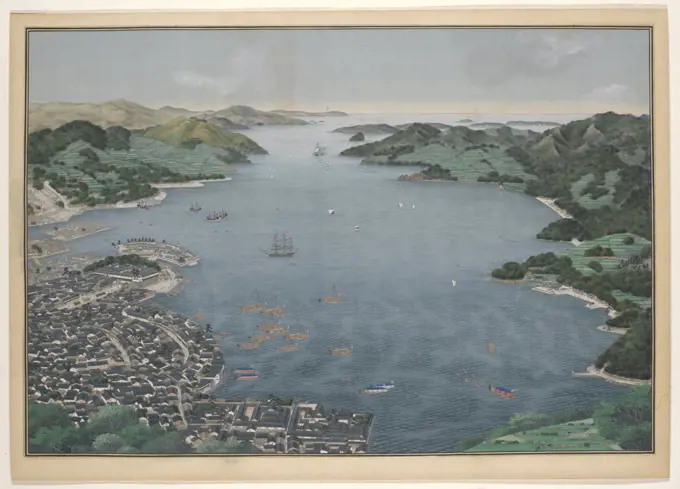
Nagasaki Harbour, Japan, Kawahara Keiga, c. 1800 - c. 1850
6176-67056130
'Saruwaka Cho, Yoru Shibai', 1856 (1925). Artist: Unknown
6145-29125687
Okabe in Snow. Takahashi Hiroaki (Japan, 1871-1945). Japan, circa 1925-1926. Prints; woodblocks. Color woodblock print
1899-18713821
Thirty-six Views of Mount Fuji’ is an ukiyo-e’ series of large, color woodblock prints by the Japanese artist Katsushika Hokusai (1760-1849). The series depicts Mount Fuji in differing seasons and weather conditions from a variety of places and distances. It actually consists of 46 prints created between 1826 and 1833. The first 36 were included in the original publication and, due to their popularity, 10 more were added after the original publication. Mount Fuji is the highest mountain in Japan at 3,776.24 m (12,389 ft). An active stratovolcano that last erupted in 1707-08, Mount Fuji lies about 100 km southwest of Tokyo. Mount Fuji's exceptionally symmetrical cone is a well-known symbol and icon of Japan and is frequently depicted in art and photographs. It is one of Japan's Three Holy Mountains’ along with Mount Tate and Mount Haku. Fuji is nowadays frequently visited by sightseers and climbers. It is thought that the first ascent was in 663 CE by an anonymous monk. The summit ha
1899-18789207
Hiroshige's One Hundred Famous Views of Edo, actually composed of 118 woodblock landscape and genre scenes of mid-19th century Tokyo, is one of the greatest achievements of Japanese art. The series includes many of Hiroshige's most famous prints. It represents a celebration of the style and world of Japan's finest cultural flowering at the end of the Tokugawa Shogunate. The people of Edo marked the autumn season with excursions to scenic attractions and harvest festivals, and viewing fall foliage at its peak. The prints numbered 73 through 98 suggest the activities of this season in Japan, the Seventh, Eighth, and Ninth Months. Utagawa Hiroshige (1797 October 12, 1858) was a Japanese ukiyo-e artist, and one of the last great artists in that tradition. He was also referred to as Andi Hiroshige (an irregular combination of family name and art name) and by the art name of Ichiyusai Hiroshige.
1899-18712718
Exposition poster art in Japan between approximately 1925 and 1941 mirrors the rapid militarisation of society and the growth of militarism, statism and fascism during the Showa Era. In the 1920s expo poster art features elements of modern art and even Art Deco. Themes are whimsical and outward looking, representing Japan's growing importance and influence in the world of international commerce and art. By the 1930s this kind of poster art had grown much more bleak, less concerned with human themes and more directed towards statism and social control. Feminine imagery disappears to be replaced by wheels of industry, with distinct similarities to contemporary Nazi art in Fascist Germany. From the outbreak of full scale hostilities with China through to Pearl Harbour and Japan's entry into World War II, ponderous, heavy machinery, marching soldiers, menacing guns and above all bomber aircraft combine to give the posters a crushing, inhuman, Orwellian aspect. This epitomises Japanese fasc
PREVIOUS
of 3
NEXT
2401 S. Ervay, Suite 206
Dallas, Texas 75215
United States
Get Started
Free ResearchMy BoardsMy Cart
For Creators
How To License Your ContentContributor PortalFrame of Mind
Resources
API accessPricing
Contact
+1 866 236 0087help@viewpictures.co.uk Contact form
©2026 View Pictures. All Rights Reserved. -A
This site is protected by reCAPTCHA and Google Privacy Policy and Terms of Service apply.