Lace and Textile Fragments

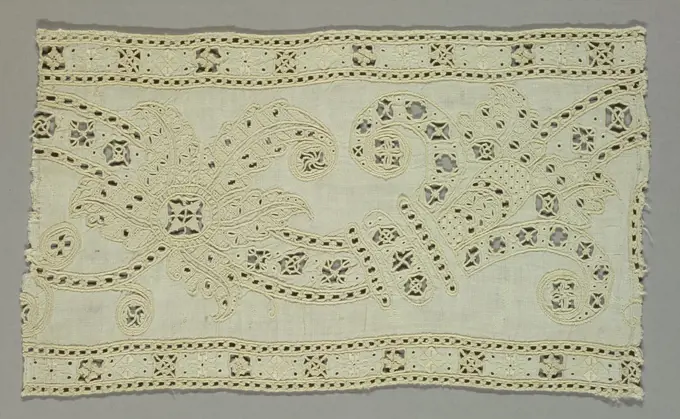
Delicate lace and fabric fragments with intricate designs, showcasing historical textile techniques and aesthetic details from past centuries.

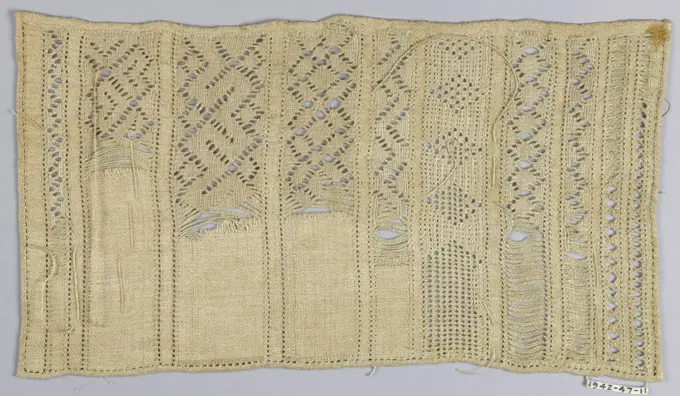
Workpiece in the making of three next to each other placed squares of reticella (lace border) in a strip of cotton, anonymous, c. 1920 Test workpiece of natural -colored lace -up work - Reticella in sliced work technique - consisting of three sides placed next to each other with a pattern of double star flowers in a strip of cotton. Each flower consists of four points around the square center and the outer points consists of eight points. Netherlands cotton (textile). linen (material) Test workpiece of natural -colored lace -up work - Reticella in sliced work technique - consisting of three sides placed next to each other with a pattern of double star flowers in a strip of cotton. Each flower consists of four points around the square center and the outer points consists of eight points. Netherlands cotton (textile). linen (material)
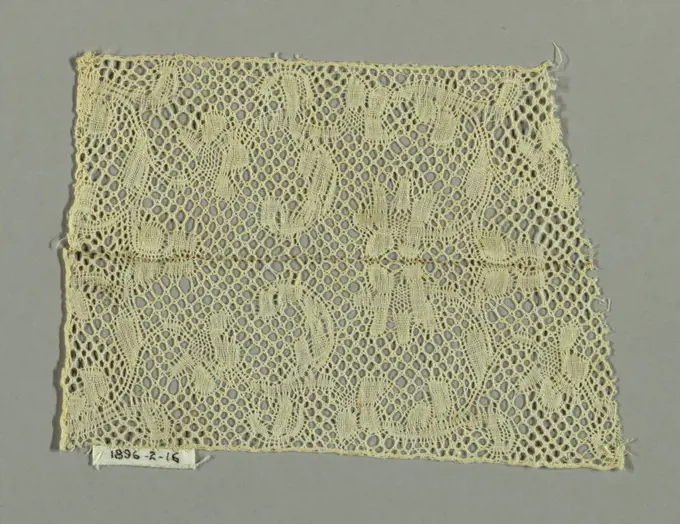
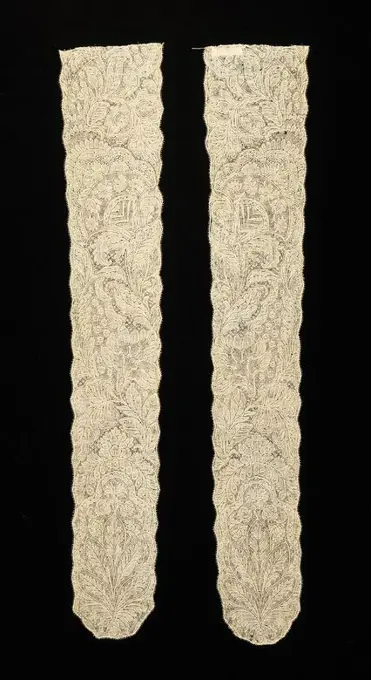
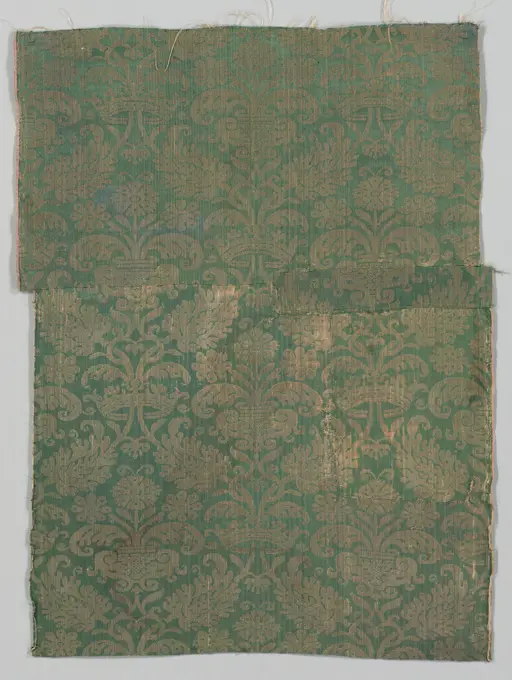
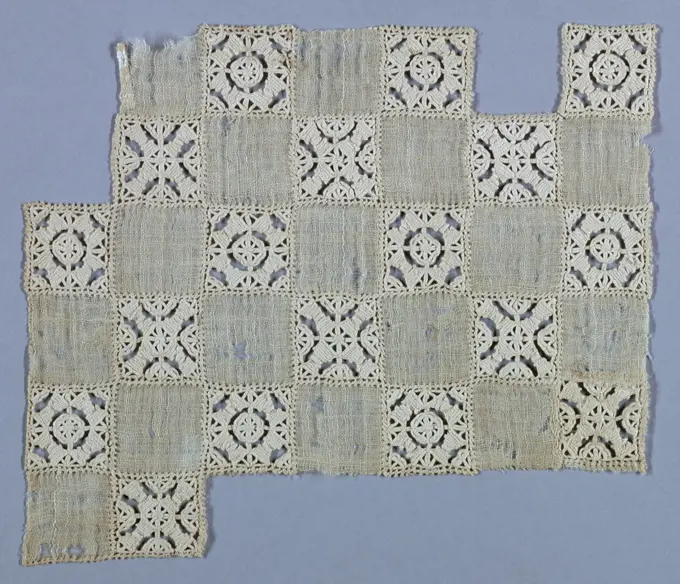
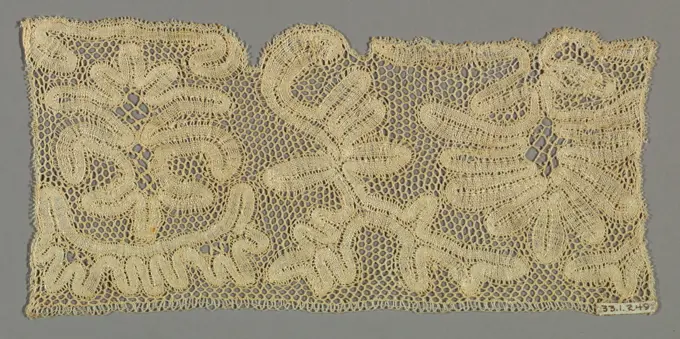
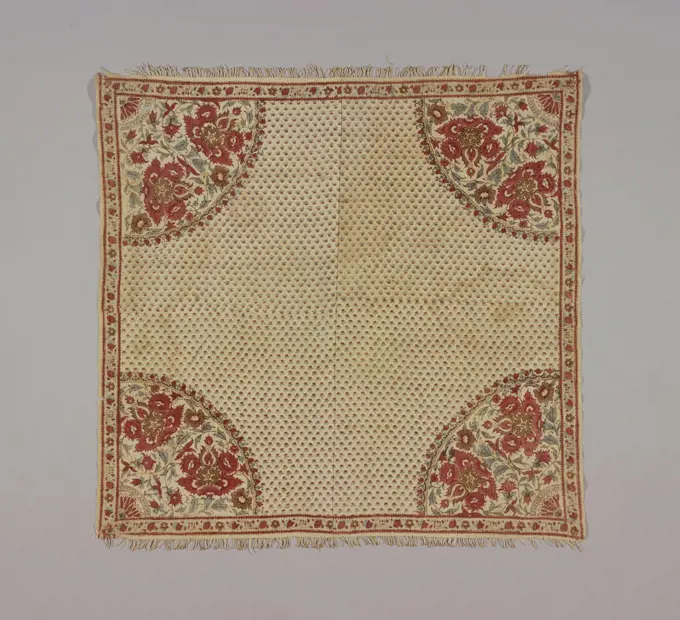
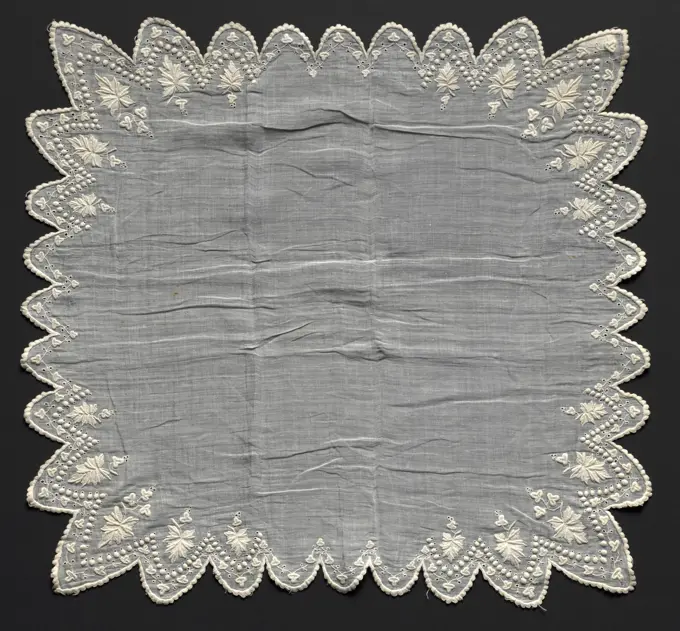
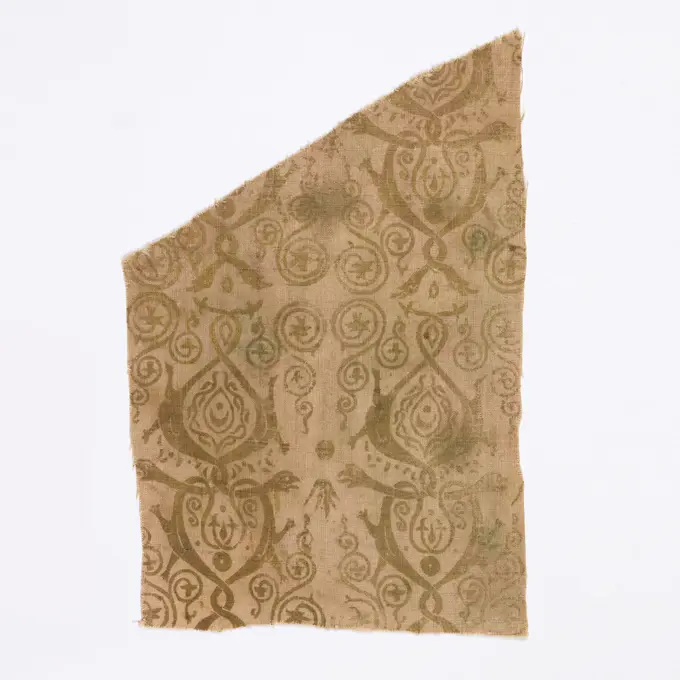
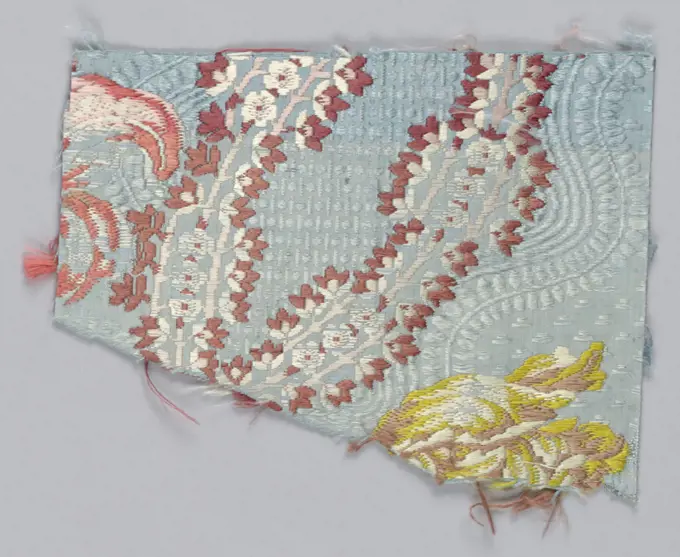
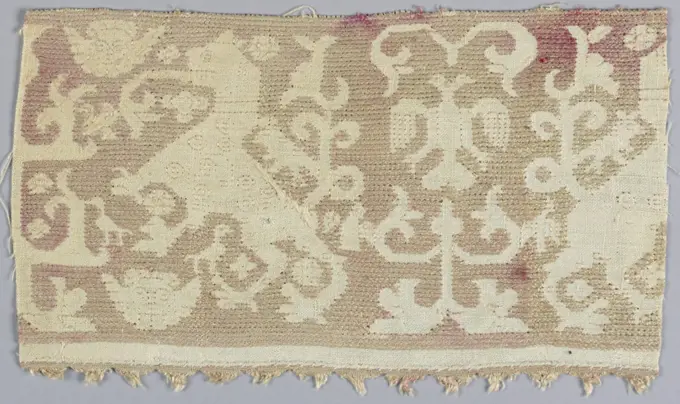
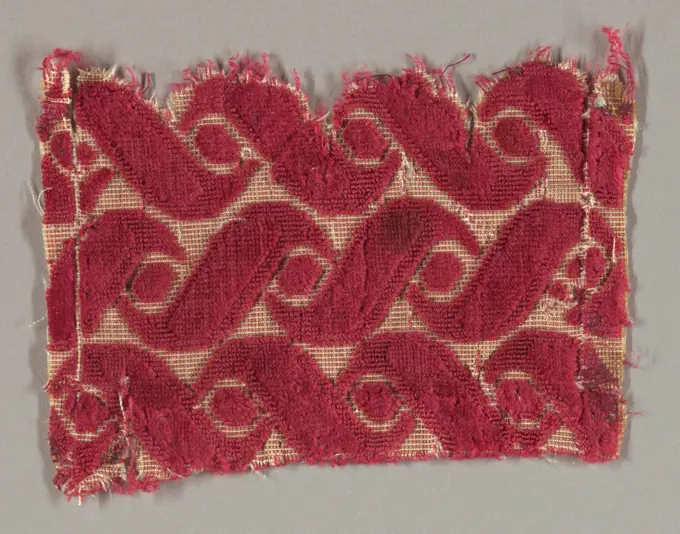
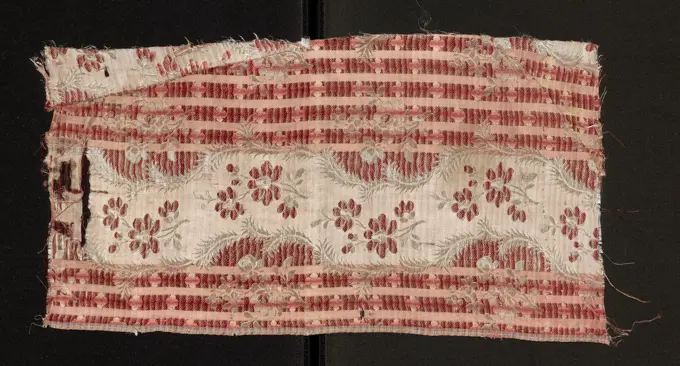
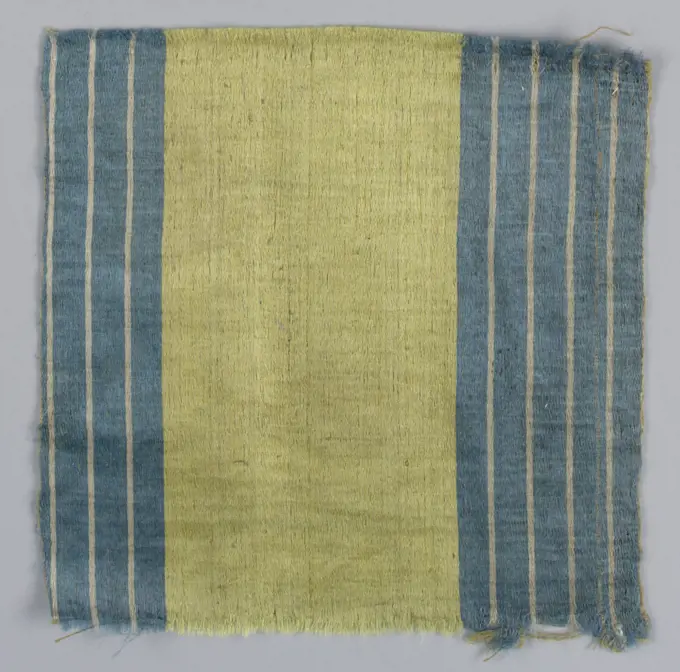
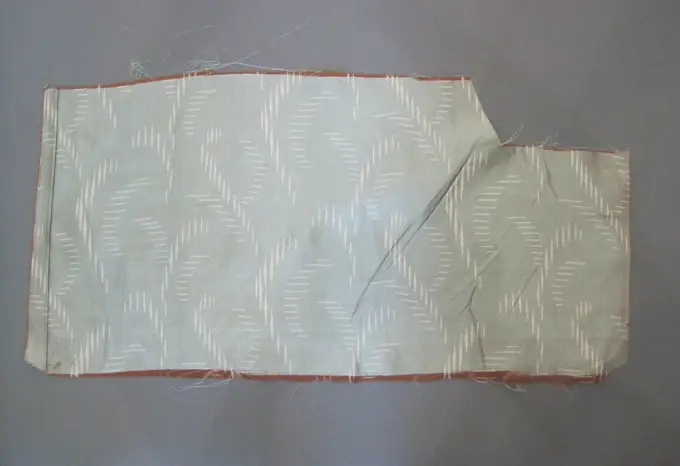
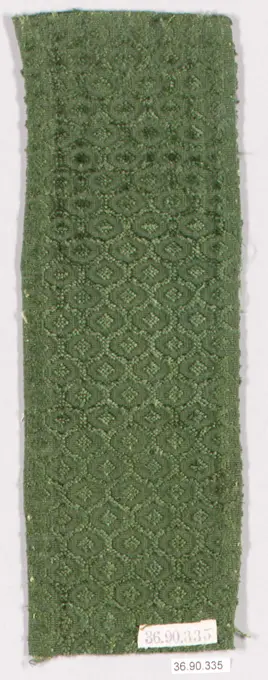
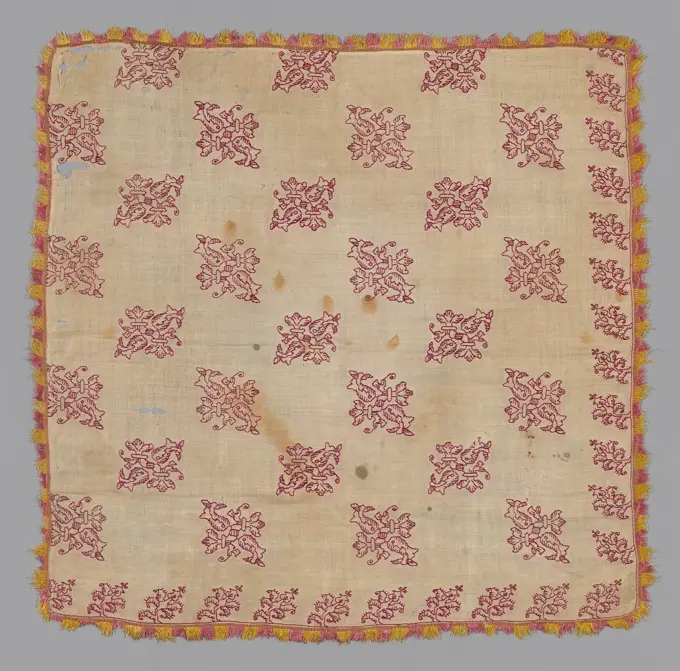
Textile Fragment 17th-18th century. Textile Fragment 454456Collar 1860-70 French. Collar 169674Fragment; 1897-8-326Fragment, Medium: linen Technique: bobbin lace (Binche style with Binche ground), Binche-style fragment with a border design of flowering branches curving up and back from the edge of the piece. Cinq trous ground. Design repeated in reverse direction in the upper half of the piece. Fragment is two pieces stitched together in the middle., Belgium, 17th century, lace, FragmentFragment, Medium: silk Technique: loops of uncut pile in a twill foundation (velvet), Miniature buds arranged in rows on a cream background., 17th century, woven textiles, FragmentLappet. Culture: Flemish. Date: 1730-50. Museum: Metropolitan Museum of Art, New York, USA.Workpiece in the making of three next to each other placed squares of reticella (lace border) in a strip of cotton, anonymous, c. 1920 Test workpiece of natural -colored lace -up work - Reticella in sliced work technique - consisting of three sides placed next to each other with a pattern of double star flowers in a strip of cotton. Each flower consists of four points around the square center and the outer points consists of eight points. Netherlands cotton (textile). linen (material) Test workpiece of natural -colored lace -up work - Reticella in sliced work technique - consisting of three sides placed next to each other with a pattern of double star flowers in a strip of cotton. Each flower consists of four points around the square center and the outer points consists of eight points. Netherlands cotton (textile). linen (material)Two Lengths of Textile, 1500s. Italy or Spain, 16th century. Damask, silk; overall: 75 x 56 cm (29 1/2 x 22 1/16 in.).Fragment Made 1700-1750 Japan. Fancy compound satin, silk and gilt paper; 2 1/2 strips to m.m. .Fragment, Medium: linen Technique: Grid of withdrawn element with needle lace, reticella style, plain weave, Linen ground with surface divided into squares. Square of needle lace alternates with square of plain linen. Each needle lace square encloses four spool-like motifs grouped around small central square., Italy, 16th century, lace, FragmentTissue unknownFragment, Medium: cotton Technique: resist-printed Label: resist printed cotton, Unbleached cotton with overall pattern in faded red. An overall lattice like effect is created as the petals of flower heads elongate and extend to create an interlaced framework. With smaller eight-petaled flowers in the interstices., India, 12th-13th century, printed, dyed & painted textiles, FragmentFichu fourth quarter 18th century probably American. Fichu 110185Fragment, Medium: linen Technique: bobbin lace, Fragment of Valenciennes lace has floral bouquets tied with ribbons. Diamond-shaped mesh., France, late 18th century, lace, FragmentFragment, 17th century; silk, velvetApplication side with vortex tabler or veil. Tableier or veil of natural-colored application side, climbing side on slighten ground. Below an open, sown pattern of 'triangles' are filled edges. The bottom has a landscape motif, sealed by two straight. The upper edge, with standing motifs and wider than the lower edge, overcures the field with pointed, ascending motifs. The lower edge shows rotating tendrils for a core of small oval medallions. The intermediate consists of pair-wise dawbling spirals. The top edge has two alternating candelabre motifs; One stands on two large reed plumes, the other exhibits an X-rank, awarded a smaller plume. The bottom is straight finished with an eye edge the top with a slot for a cord.Overgrain from printed cretonne with swans and lissen. Overgrain from printed cretonne with swans and lissen. Lined and equipped with passing element and metal rings.Fragment, Medium: silk Technique: 5-harness satin damask, Yellow-green damask lattice of circles connected by a bracket. Each circle contains a flowering plant within a foliate wreath with a circle with octagonal points within a floral scroll wreath. Each concave diamond has a medallion with leaves extended into the four points., Spain, 16th century, woven textiles, FragmentPiping Turks., Gebroeders Rath (firm), 1850 - 1899 Finger cloth of white Linnamast, with dessin of piping Turks. Veghel linen (material) damask Finger cloth of white Linnamast, with dessin of piping Turks. Veghel linen (material) damaskTrimming (France); cotton and metal; 1907-30-5Unfinished Sampler, Medium: linen Technique: drawnwork with darning and hem stitches on plain weave, Sampler with ten cross borders., New York, New York, USA, 1917, embroidery & stitching, Unfinished SamplerBatters cover for a pincushion with embroidered initials CG. Deck cover with batist with embroidery - white work - for a pincushion. Rectangular model. The pattern has overhoeks two with flowers decorated letters C and G.Night bag made of fine linen, decorated on the valve with white embroidery with open homs and clover leaves ...Voile met een strook kloskant met 'diamantveren'.Voile deposited on three sides with a strip of natural colosside: Lille side. On a mesh sofond meshes strewn, a row of unilaterally directed curved branches, crowned with a flower and leaves, which are formed as a diamond feathers. The row is accompanied by a wave line of such 'diamond feathers' and raspberries along the straight exterior.Fragment, Medium: linen Technique: bobbin lace, Fragment of Valenciennes lace has tiny powdered branches with flowers and buds. Round mesh., France, late 18th century, lace, FragmentFragment of silk fabric in stripes unknownSampler (Mexico); silk embroidery on linen foundationNapkin of linen with peel pattern and edges all around ,, 1700 - 1799 Napkin made of linen with peel pattern and edges all around. A block of three times three piling, alternately image and counter -image, with a block on the corners of three patterns. On the corners of these figures a giant 'pin cushion'. Brands: Originally Blue Cross Stitch WS and 100. Netherlands (possibly) linen (material) Napkin made of linen with peel pattern and edges all around. A block of three times three piling, alternately image and counter -image, with a block on the corners of three patterns. On the corners of these figures a giant 'pin cushion'. Brands: Originally Blue Cross Stitch WS and 100. Netherlands (possibly) linen (material)Fragment; silkFragment of NeedleworkFragment, Medium: linen Technique: withdrawn element work, Fragment of a border with the Lamb of God or Paschal lamb., Italy, 16th-17th century, lace, FragmentVelvet Fragment, late 1500s - early 1600s. Italy, late 16th - early 17th century. Velvet (cut and uncut); silk; average: 14.6 x 16.5 cm (5 3/4 x 6 1/2 in.).Two strips of 17th-century German lace and a strip of 16th-century Italian side, from the collection of the Kunstwerbemuseum in Dresden, Germany, Anonymous, 1888 photomechanical print This print is part of a cover with 49 prints and a list of images. Dresden paper collotype lace Artificial museumStrip of a fall, batist, for a toilet table, anonymous, c. 1800 - c. 1920 Strip of batist with embroidered flowers and lumped bottom. Belonging to a fall for a toilet table in a boudoir (inv.no. BK 1980-789-f) Netherlands batiste embroidering Strip of batist with embroidered flowers and lumped bottom. Belonging to a fall for a toilet table in a boudoir (inv.no. BK 1980-789-f) Netherlands batiste embroideringFragment 18th century French. Fragment. French. 18th century. Needle lace. Textiles-LacesTablecloth with flower bouquets, anonymous, c. 1700 - c. 1899 Tablecloth from Linnamast with flower bouquets. Midfield: flower pattern of staggered rows with two types of flower bouquets. Standing and lying edges: a flower garland, the corners a flower bouquet. Scissors (possibly) linen (material) damask Tablecloth from Linnamast with flower bouquets. Midfield: flower pattern of staggered rows with two types of flower bouquets. Standing and lying edges: a flower garland, the corners a flower bouquet. Scissors (possibly) linen (material) damaskBrocatelle Textile, 1500s. Italy or Spain, 16th century (). Plain compound satin; silk and silver thread; overall: 81.3 x 29.2 cm (32 x 11 1/2 in.).Bliżej Kultury unknownPillow border, 19th century, 5 x 16 in. (12.7 x 40.6 cm), Embroidered silk on linen, Morocco, 19th centuryFragment; linen; 1933-1-249Table cover, Medium: cotton Technique: block-printed on plain weave, Small square table cover, pieced, of cream-color cotton block-printed in reds, violet, and green. Corner design of large flowers and foliage; small all-over pattern of little buds. Narrow floral border. Green is blue over yellow., India, 19th century, printed, dyed & painted textiles, Table coverHandkerchief, 1800s. France, 19th century. Embroidery; cotton on linen; overall: 45.7 x 43.2 cm (18 x 17 in.).Fragment of womans garment embroidery  dense ornamentation of vertical twigs unknownIndian TradeClothFragment; linen; Bequest of Marian Hague; 1971-50-234Fragments. Date/Period: 14th century. Fragments. Medium: silk, metallic threads. Technique: 2/1 twill patterned with plain weave. Author: UNKNOWN.Embroidered Handkerchief, 1700s. Italy, 18th century. Embroidered linen; overall: 48.3 x 50.8 cm (19 x 20 in.).Fragment (Germany); linenBlue and white striped Linnamast, Anonymous, c. 1880 - c. 1900 Blue and white striped Linnamast. The blue and w itte stripes both have a running pattern of flower vines; The blue in light blue, the white in white. England linen (material) damask Blue and white striped Linnamast. The blue and w itte stripes both have a running pattern of flower vines; The blue in light blue, the white in white. England linen (material) damaskFragment, 1800s. India, 19th century. Brocade; silk and metal; overall: 8.3 x 13.3 cm (3 1/4 x 5 1/4 in.).Fragments, Medium: silk Technique: brocaded, Naturalistic flowers, undulating curves and ribbon-like swags on a light blue ground patterned by small dots and dashes., France, 18th century, woven textiles, FragmentsBand, Medium: silk on linen Technique: embroidered, Band fragment showing a pattern of a fantastic animal and tree in faded red silk on a linen ground., Spain, 16th century, embroidery & stitching, BandAlternate from dick side with diamond-shaped cartouches and baldacches. Alstretch of natural colosside: Flemish Guipure. The symmetrical ornament consists of two staggered rows of diamond-shaped cartouches interspersed with a palm form surrounded by garlandes and covered by baldakine on a surface of flakes. At the scalloped lower edge palmets and C forms.Fragment (Italy); silkCover (Italy); linen; Bequest of Marian Hague; 1971-50-217Tapa Cloth, 19th century, 100 x 67 in. (254 x 170.18 cm) (irregular), Bark, pigment, Society Islands, 19th centuryFragment of the fabric;  2. PO. 18th century (1751-00-00-1800-00-00);Fabrics, purchase (provenance)Embroidered Handkerchief, late 19th century. Switzerland, late 19th century. Embroidery: linen; average: 38.1 x 38.1 cm (15 x 15 in.).Currency cloth, 19th century, 25 3/16 x 24 5/8 in. (64 x 62.5 cm) (overall, without fringe), Plant fibers; printed, Democratic Republic of Congo, 19th centuryFragment early 16th century Italian. Fragment 230113Headdress 19th century Russian. Headdress 173379Fragment, 1800s. India, 19th century. Brocade, "kimkhwab"; silk and gold; overall: 17.2 x 19.1 cm (6 3/4 x 7 1/2 in.).Piece early 18th century China. Piece 69955Fragment, Medium: silk Technique: cut and uncut voided supplementary warp pile (velvet) in a satin foundation, Light brown velvet, cut and uncut, with a cream-colored ground in fan shaped motifs between horizontal zigzag bars., Italy, 16th century, woven textiles, FragmentSilk Fragment, 13th century. Spain, Mudejar, 13th century. Tabby weave: silk; overall: 26.3 x 9.5 cm (10 3/8 x 3 3/4 in.).Cap crown mid-18th century Flemish, Brussels. Cap crown 227545Collar. Culture: American. Date: 1830-40. Museum: Metropolitan Museum of Art, New York, USA.Fragment 17th century Italian. Fragment 230346Scrapbook Of Ikat Fabrics; Collected by Charles F. Iklé; paper, cotton, silkHandkerchief unfinished, 20th century, L.16-3/4 x W.17-1/2 in., cotton; needlework, Switzerland (), 20th centuryTowel (Italy); linen, silk; Bequest of Marian Hague; 1971-50-563Textile Swatch , 1950s to 1960s. Cotton, metallic thread, 20 x 11 3/4 in. (50.8 x 29.8 cm).    1950s to 1960sHiapo (tapa cloth), 1800s, Niue, maker unknown. Gift of Miss Suzanne Duncan, 1987.Trimming (France)Border, Technique: bobbin lace appliqué on machine net, Applique of bobbin lace, floral border; early 19th century Honiton on machine net edge., England, early 19th century, lace, BorderTablecloth, Rath (firm), 1852 - 1889 White linen dams of tablecloth with oak branches and the weapon of the baron Baud. Marked BVH. Veghel linen (material) damask White linen dams of tablecloth with oak branches and the weapon of the baron Baud. Marked BVH. Veghel linen (material) damaskValance (France); silk, metallic threadNapkin, fragment, with a pattern of diamonds with concentric circles ,, c. 1600 - c. 1699 Napkin, fragment, of white linen with a pattern of diamonds with concentric window fillings. Netherlands linen (material) Napkin, fragment, of white linen with a pattern of diamonds with concentric window fillings. Netherlands linen (material)Scarf India late 19th centuryFragment; linenTwo pieces of fabric. unknown, authorBliżej Kultury unknownFragment, Medium: linen Technique: bobbin lace, Fragment of Brussels-type bobbin lace with a carnation design in a star-shaped mesh., Belgium, 18th century, lace, FragmentChemisette of linen batist with a neck strip of binchekant, anonymous, c. 1700 - c. 1725 Chemisette with a neck strip of Binchekant. The shoulder piece of linen batist has a square neck open, and is marked in Red Cross stitch 'MVS'. The pattern of the lace lane consists of palemtten. Southern Netherlands linen (material). Binche Lace Chemisette with a neck strip of Binchekant. The shoulder piece of linen batist has a square neck open, and is marked in Red Cross stitch 'MVS'. The pattern of the lace lane consists of palemtten. Southern Netherlands linen (material). Binche LaceSample, Orinoka Mills, (Philadelphia, Pennsylvania, USA), Yellow, pink and white pattern on a light green /grey ground., USA, ca. 1910, woven textiles, SampleSample Made 1825-1850 France. Silk and straw, plain weave with supplementary patterning warps .Collar 1675-1725 Italian. Collar 110196Piece mid-19th century British. Piece 213354Fragment, Medium: silk Technique: satin weave, Fragment with vertical stripes of yellow and blue., France, early 18th century, woven textiles, FragmentTablecloth, fragment with coat of arms of the Grosett family with arms preaching pro patria aucilio deo, c. 1760 - c. 1780 Tablecloth, fragment, from white Linnamast with lace ombard. On the fragment the coat of arms of the Grosett family, with crest (helmet sign) on either side of the helmet and the weapon "Pro Patria Auxilio Deo". Scotland (Possible) linen (material) damask Tablecloth, fragment, from white Linnamast with lace ombard. On the fragment the coat of arms of the Grosett family, with crest (helmet sign) on either side of the helmet and the weapon "Pro Patria Auxilio Deo". Scotland (Possible) linen (material) damaskPiece French 19th centuryFragment; silkTextile Swatch Textile Swatch, 1950s to 1960s. Silk, 21 x 10 1/2 in. (53.3 x 26.7 cm).    1950s to 1960sPiece 16th-17th century Italian. Piece 223436Textile Swatch Textile Swatch, 1950s to 1960s. Silk, 8 1/4 x 3 1/4 in. (21 x 8.3 cm).    1950s to 1960sCover Made 1601-1700 Italy. .Piece 19th century Japan. Piece 71949Fragments, Medium: linen Technique: reticella needle lace, Wide borders of reticella and embroidery of serpentine ribbons and leaf forms resembling butterflies. Modes: portes, brides., Italy, 16th century, lace, FragmentsTextile Fragment 18th century. Textile Fragment 448206Textile (England); cotton