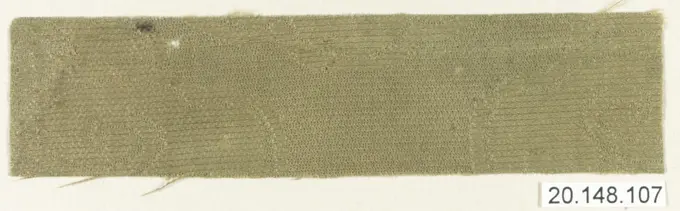
Lace and Trim Textiles

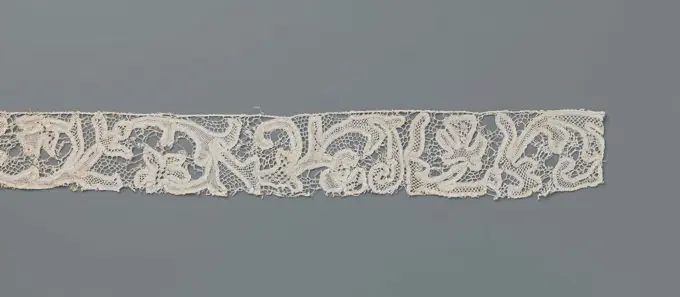
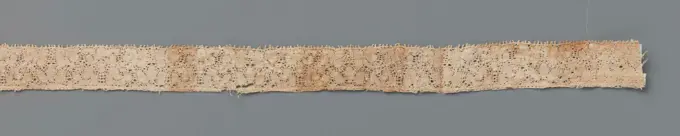
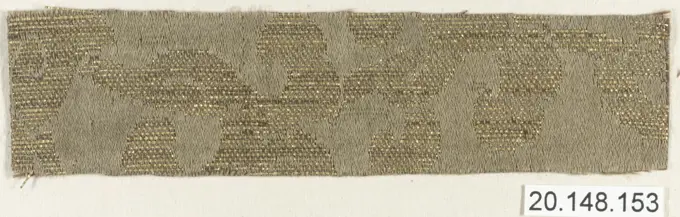
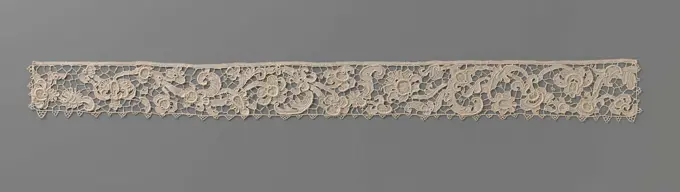
A series of decorative textile trims showcasing intricate lace patterns from the 17th to 18th century, featuring floral and geometric designs.
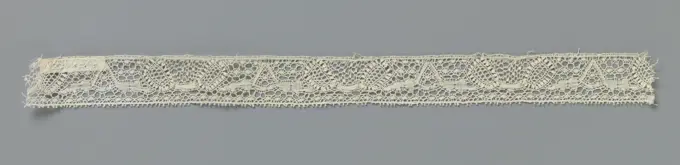
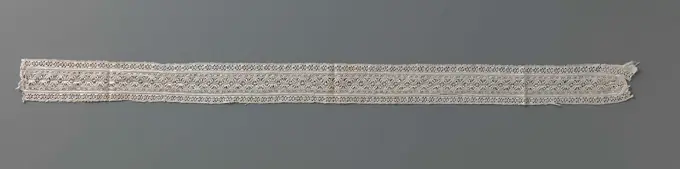
Strip bobbin with triangle and two bragged ovals, anonymous, c. 1900 - c. 1909  Strip of natural-colored bobbin, binche side. The pattern consists of two symmetrical compositions. One composition consists of a triangular motif with a ringed snowflake in the center. The other composition consists of two of each other alternated and schuinge -placed ovals, which are connected to each other on the underside by a slightly bent strap. The triangular motif is connected on the underside to the sluinga -plateed ovals due to a slightly wider strap of three connected round shapes. The straps and contours of the triangle are made in linen battle. The contours of the ovals are made in form. The motifs are connected by a decorative land, a ringed snowflake land. As a decorative land, a Paris soil has been used in the oval and a lace-hole-grid foundation is decorated between the ovals with staging motifs. Top and bottom of the strip are straight finished, with the bottom with picots. Normandy linen
Strip bobbin with triangle and two bragged ovals, anonymous, c. 1900 - c. 1909 Strip of natural-colored bobbin, binche side. The pattern consists of two symmetrical compositions. One composition consists of a triangular motif with a ringed snowflake in the center. The other composition consists of two of each other alternated and schuinge -placed ovals, which are connected to each other on the underside by a slightly bent strap. The triangular motif is connected on the underside to the sluinga -plateed ovals due to a slightly wider strap of three connected round shapes. The straps and contours of the triangle are made in linen battle. The contours of the ovals are made in form. The motifs are connected by a decorative land, a ringed snowflake land. As a decorative land, a Paris soil has been used in the oval and a lace-hole-grid foundation is decorated between the ovals with staging motifs. Top and bottom of the strip are straight finished, with the bottom with picots. Normandy linen
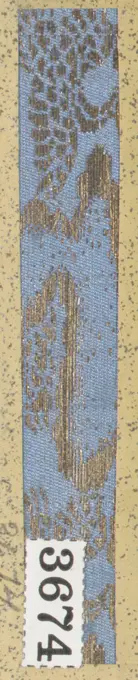
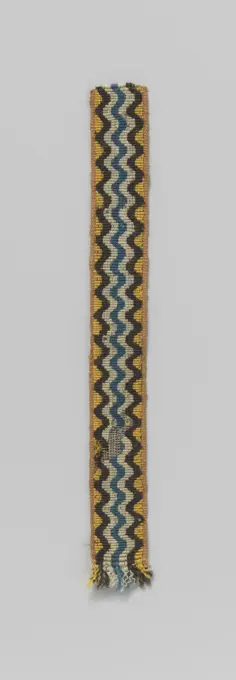
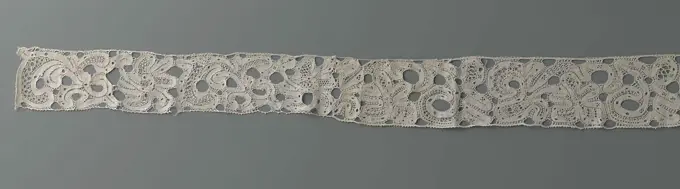
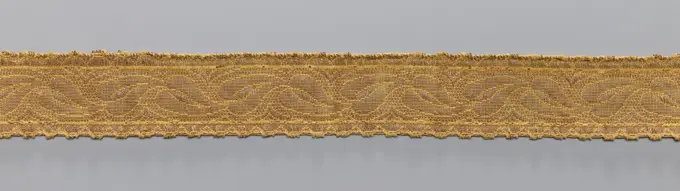
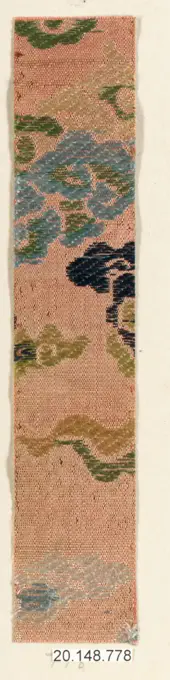
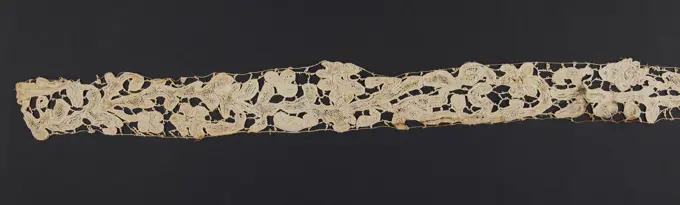
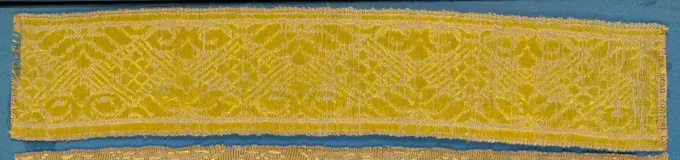
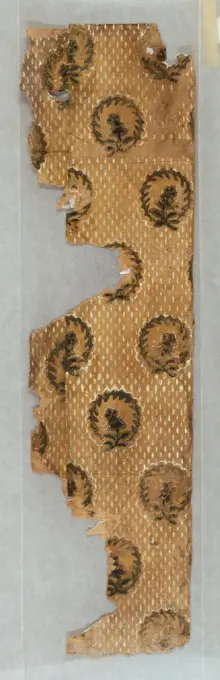
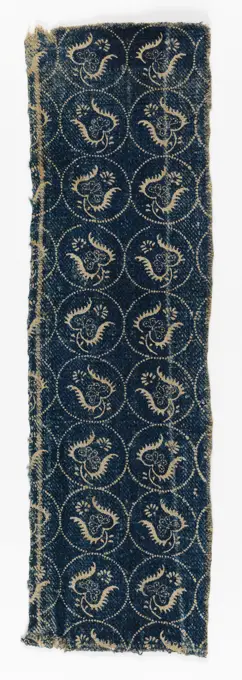
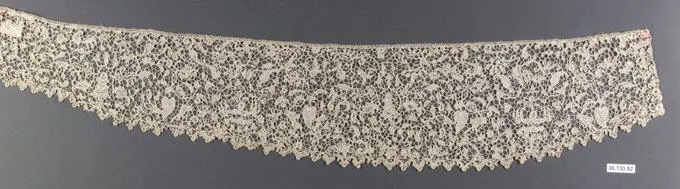
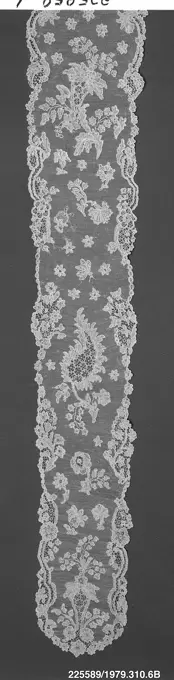
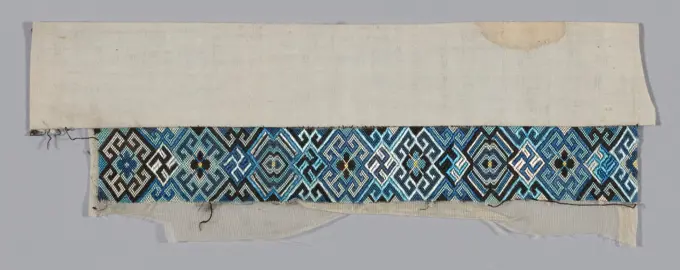
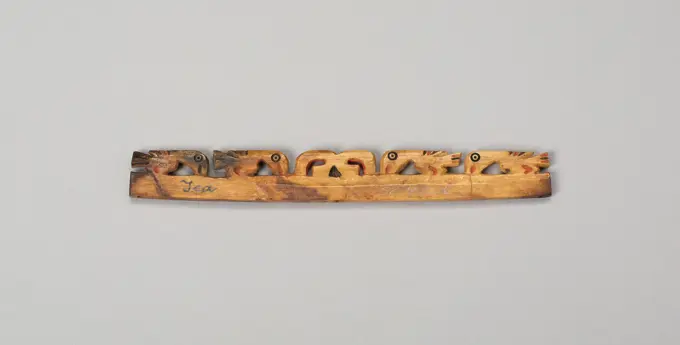
Galloon 18th century French. Galloon 213813Galloon 17th-18th century Unknown. Galloon 213885Kloskant's intermediate base with rush -hour, anonymous, c. 1600 - c. 1699 Intermediate springs of natural -colored Dutch bobbin side. The pattern consists in the longitudinal direction of a double row lying pointed dovals. The ovals were worked alternately in linen battle with openwork edges or through a configuration of four larger and five smaller recesses. The lower and upper row jumps relative to each other. The top and bottom are straight. Netherlands (possibly) linen (material) bobbin lace Intermediate springs of natural -colored Dutch bobbin side. The pattern consists in the longitudinal direction of a double row lying pointed dovals. The ovals were worked alternately in linen battle with openwork edges or through a configuration of four larger and five smaller recesses. The lower and upper row jumps relative to each other. The top and bottom are straight. Netherlands (possibly) linen (material) bobbin laceTussenzetsel van kloskant met geometrisch patroon van dubbele kruizen en ruiten.Inserting natural colosside between two narrower strips of edge embroidery: work with merchanded wires. The intermediate site is probably intended for or used in a bed sheet or pillowcase. The pattern of clamping side is geometric and consists of double crosses and windows.Strip early 18th century Dutch. Strip. Dutch. early 18th century. Bobbin lace, Potten kant. Textiles-LacesGalloon 17th-18th century French or Italian. Galloon 213893Strip bobbin with triangle and two bragged ovals, anonymous, c. 1900 - c. 1909  Strip of natural-colored bobbin, binche side. The pattern consists of two symmetrical compositions. One composition consists of a triangular motif with a ringed snowflake in the center. The other composition consists of two of each other alternated and schuinge -placed ovals, which are connected to each other on the underside by a slightly bent strap. The triangular motif is connected on the underside to the sluinga -plateed ovals due to a slightly wider strap of three connected round shapes. The straps and contours of the triangle are made in linen battle. The contours of the ovals are made in form. The motifs are connected by a decorative land, a ringed snowflake land. As a decorative land, a Paris soil has been used in the oval and a lace-hole-grid foundation is decorated between the ovals with staging motifs. Top and bottom of the strip are straight finished, with the bottom with picots. Normandy linen Sotck exchange. Mid -19th. GAL1994.214.XInsertion ca. 1800 Flemish. Insertion 212849Fragment, Medium: linen Technique: needle lace, Plat point de Venise and inserted sections., possibly Ragusa, Italy, late 17th-early 18th century, lace, FragmentHalf maniple 18th century Spanish. Half maniple 227053Piece early 18th century Dutch. Piece 218217Passement of linen and yellow side in complex window pattern, anonymous, c. 1700 - c. 1899 Passement of linen and yellow side in a complex diamond pattern. Pattern equal to BK-NM-12186-24-B and BK-NM-12186-26. Europe silk. linen (material) Passement of linen and yellow side in a complex diamond pattern. Pattern equal to BK-NM-12186-24-B and BK-NM-12186-26. Europe silk. linen (material)Strip of machine side with hanging chalice of loose S-Voluten, anonymous, c. 1890 - c. 1914 Strip of natural -colored machine side: Machine Flanders side. The repeating pattern consists along the bottom half of the strip of a hanging chalice, flanked and crowned by loose S-volutes. Openwork edges run around the closed motifs. The motifs are connected by a machine soil that suggests a braid ground. Top and bottom of the strip are straight finished, with the bottom with picots. Nottingham (possibly) cotton (textile) Strip of natural -colored machine side: Machine Flanders side. The repeating pattern consists along the bottom half of the strip of a hanging chalice, flanked and crowned by loose S-volutes. Openwork edges run around the closed motifs. The motifs are connected by a machine soil that suggests a braid ground. Top and bottom of the strip are straight finished, with the bottom with picots. Nottingham (possibly) cotton (textile)Edging 16th century Cretan. Edging 212956Bobbin Lace Lappet, 18th century. Belgium, Binche, 18th century. Lace, bobbin: linen; average: 49.9 x 9.3 cm (19 5/8 x 3 11/16 in.).Band, Medium: linen Technique: bobbin lace, Binche style with Binche ground, Loosely worked design of a scrolling vine with large flower blossoms., Belgium, 18th century, lace, BandEdging early 19th century Italian, Venice. Edging 212742Scarf; wool; L x W: 172.7 × 21.9 cm (5 ft. 8 in. × 8 5/8 in.)Strook gemengde kant met drie golftoppen.Strip natural-colored mixed side: Venetian ribbon side or Mezzo Punto. Pattern with a plot rank over the full width of the strip, on a hexagonal mesh soil with twisted feston stitches. On the rank palm mines and leaves, repetitive motif. The contours of the pattern are formed by a woven ribbon. Within the contours different ornamental grounds with feston stitches. Halfway through the strip a seam. The original finish on the top is probably a straight edge, but cannot be seen properly due to damage. The underside is approximately half, until the seam, finished with a straight edge climbing side with arcs, at the other half without bow.Strook kloskant met drieblad geflankeerd door rozetbloemen.Natural collate strip, old lace. With small recesses, a repeating symmetrical pattern can be distinguished with a three-leaf on one long side, which is flanked on both sides by a rosette flower, and along the other long side a stylized French lily, which is flanked on both sides by a butterfly-shaped sheet. There is hardly any floor. The motifs are made in linen stroke with openwork edges. Upper and bottom are straight finished, with picots along one side.Trimming, Medium: silk, silver metallic thread Technique: woven, Design of leaves placed alternately up and down with diagonal bands in between. In yellow and white with silver metallic thread., Italy, 18th century, trimmings, TrimmingTrimming, Medium: linen Technique: needle lace, six-sided reworked grounds, Serpentine floral pattern., France, 18th century, lace, TrimmingFragment (France); silkRafter with geometrical, plant, animal and heraldic motifs. Date/Period: End of 13th century. Painting. Tempera on wood. Height: 78 mm (3.07 in); Width: 3,995 mm (13.10 ft). Author: UNKNOWN.Ribbon of side brokaat in silver and blue; On a light blue surface, a running slender is applied in silver, anonymous, c. 1725 - c. 1750 Ribbon of side brokat, in silver and blue. On a light blue surface is a running slender with a large palm leaf and flower, in turn used to the left and right. The Negries are decorated with a bands of Hanekammen. West-Europa whole: Silk. Completely: brocade (textile). Silver Thread Ribbon of side brokat, in silver and blue. On a light blue surface is a running slender with a large palm leaf and flower, in turn used to the left and right. The Negries are decorated with a bands of Hanekammen. West-Europa whole: Silk. Completely: brocade (textile). Silver ThreadTrimming (France); silk, silver metallic threadPiece 17th century Japan. Piece 71141Strook gehaakte kant met vijfpuntige sterren en bloemen gemaakt met open cirkels.Part of a strip of natural-colored Irish crochet side. The original, repetitive pattern consists of a double row with a total of eight triangular floral motifs made with open circles, interspersed with one five-pointed star with a circle in the middle and a circle of each point. Crocheted irregular mesh soil with picots. Top and bottom are finished with a straight edge.Edging mid-18th century Flemish, Brussels. Edging 222796Wool livreiband, woven in waves in black, white, yellow and blue, anonymous, c. 1700 - c. 1900 Wool livreiband, woven in waves in black, white, yellow and blue. Netherlands loop tissue: wool. Stramien: Linen (Material)   Amsterdam Wool livreiband, woven in waves in black, white, yellow and blue. Netherlands loop tissue: wool. Stramien: Linen (Material)   AmsterdamHebrew ritual lace (one of four) early 18th century Italian, Burano. Hebrew ritual lace (one of four) 226258Strook kloskant met vijflobbig motief tussen organische vormen.Strip natural colosside. The repetitive and strip-filling pattern consists of a five-spinning motif between two organic forms, which are connected above the five-spinning motif. The contours of the motifs are formed by ribbons split into linen stroke with openwork edges and reasonably large recesses that are entered here and there with a grating. Different ornamental grounds have been used within the contours, including a snowflaking soil and power-inchild. Upper and bottom of the strip are straight finished, the underside with picots.Border second half 18th century French. Border 227613Goldsmith's art, 19th century. Enamelled gold bracelet set with precious stones.Galloon late 18th-early 19th century European. Galloon 224959Trimming (Italy); silk, metallic threadGalloon 17th-18th century Unknown. Galloon. Unknown. 17th-18th century. Metal thread. Textiles-TrimmingsStrip of linen mul with linen application embroidery in floral pattern, anonymous, c. 1740 - c. 1749 Strip of natural loosely woven linen 'mul' with poet woven applications of linen with embroidery and open sewing. The poet woven linen is put behind the mesh tissue and then the front of the mesh is bordered. The repeating pattern consists of two symmetrical and merging compositions. These consist of a stretched ribbon arch, including clock flowers, a slender and a wavy ribbon that is cut over by long, serrated leaves, further rosettes with open sewing and windows. The strip has flat, unequal shells. Netherlands (possibly) linen (material). embroidering Strip of natural loosely woven linen 'mul' with poet woven applications of linen with embroidery and open sewing. The poet woven linen is put behind the mesh tissue and then the front of the mesh is bordered. The repeating pattern consists of two symmetrical and merging compositions. These consist of a stretched ribbon arch, including clGallon;  19th century (1801-00-00-1900-00-00);Trimming, Medium: silk, gold and silver metallic thread, metal strips Technique: twill weave, Design in twill weave with gilt stripes toward the center and silver at the outside with flat strips of metal in the center and at borders., Italy, 17th century, trimmings, TrimmingPiece 17th century Japan. Piece 71767Fragment of needlelace unknownStrip embroidered linen with open needle ladies from a bed sheet and composed of different strips.strip Natural-Colored Embroidered Linen With Open Needle Stitches: White Work and English Embroidery. The Broad Strip is composed of Various Narrower Strips from a 17th-century bed sheet. The Strip is finished Along All Sides with a narrow-crochet band.Ceintuur ribbon of crème silk in rip binding decorated with broche work in the form of cows and sheep in a landscape, anonymous, c. 1800 - c. 1900 Ceintuur ribbon of crème silk in ripbinding decorated with broche work in the form of cows and sheep in a landscape. France (possibly) whole: Silk Ceintuur ribbon of crème silk in ripbinding decorated with broche work in the form of cows and sheep in a landscape. France (possibly) whole: SilkEdging And Insertion; medium:Trimming (France); silkSidewall - Fragment (possibly USA); block-printed on handmade paper; 57 x 17 cm (22 7/16 x 6 11/16 in.)Textile (France); bast fiberDress of knotted side with a circle on eight spanning threads in the center, anonymous, c. 1900 Dress of natural -colored knotted side: Frivolité. Round model. Rosette with drop -shaped loops with a circle on eight spanning wires in the center. Around the rosette round loops with picots and around it the scrap edge that consists of arches with picots. Europe linen (material) Dress of natural -colored knotted side: Frivolité. Round model. Rosette with drop -shaped loops with a circle on eight spanning wires in the center. Around the rosette round loops with picots and around it the scrap edge that consists of arches with picots. Europe linen (material)Ribbon, blue, white and silver, anonymous, c. 1750 - c. 1770 Ribbon, possibly for garter tires, with a equal pattern: a ribbon in blue, white and silver. Technology: Fond of Gros de Tours in white with cross stripes of silver ramp. The ornament in partly of browned silverlamé, which is flottant to the overflows, partly of white, blue or salmon -color silk chain, which are also flotant. Pattern: Winding, interlocking classic palmets have silver, inner leaves and outer leaves in the respective and soiling colors, Hanekam self -sides. France (possibly) silk. silver thread Ribbon, possibly for garter tires, with a equal pattern: a ribbon in blue, white and silver. Technology: Fond of Gros de Tours in white with cross stripes of silver ramp. The ornament in partly of browned silverlamé, which is flottant to the overflows, partly of white, blue or salmon -color silk chain, which are also flotant. Pattern: Winding, interlocking classic palmets have silver, inner leaves and outer leaves in theCutslip van Kloskant, Anonymous, c. 1725 - c. 1749 Cutslip from Kloskant. The pattern consists of bouquets and flower branches. The scalloped edge is trimmed with picots. Brussels linen (material). Brussels bobbin lace Cutslip from Kloskant. The pattern consists of bouquets and flower branches. The scalloped edge is trimmed with picots. Brussels linen (material). Brussels bobbin laceAltar Frontal Made 1675-1725 Spain. .Piece 18th century Japan. Piece 72170Trimming, Medium: silk Technique: woven, Yellow trimming in a design of large lozenges connected by smaller ones., France, 19th century, trimmings, TrimmingStrip ca. 1830 British, Buckinghamshire. Strip 212754Strip bobbin with symmetrical pattern and richly worked coarse decorative grounds, anonymous, c. 1730 - c. 1740  Strip or collar of natural -colored Brussels bobbin side. The symmetrical pattern consists of two bending flowers in the middle, which stand directly on top of two slanted and curved pointed soil leaves. In the wide field below, there are two diagonally placed C-Voluten with two flowers underneath that takes up the entire triangular field that takes the C-Voluten forms. Similar shapes are reflected in different compositions in the rest of the strip, with different types of flowers including rosette flowers, daddy rolls and wild tulip -like flowers. The motifs are made in linen battle with openwork edges and recesses. The motifs are connected by richly processed coarse decorative soils with braided grid with bulbs and/or rosette flowers to very fine grid with a diamond pattern formed by fine cubes in form. Part of the motives is equipped with burst relief contours. Charsted rBorder, Medium: linen Technique: bobbin lace, Brussels style, Border with a garland of floral sprays., Belgium, mid-18th century, lace, BorderGold bracelet from Wilhelminaschakels, c. 1900 - c. 1910 Gold bracelet from Wilhelminaschakels with a spring ring.  gold (metal) Gold bracelet from Wilhelminaschakels with a spring ring.  gold (metal)Sotck exchange. XIXth. GAL1994.215.XFragment of Shoulder Band 5th century. Fragment of Shoulder Band 443936Pleated fan and case, Silk leaf gilded and painted with gouache, embroidered with sequins, carved, pierced and painted mother-of-pearl sticks, Silk leaf painted with gouache. Obverse: three rocaille medallions outlined with gilt and colored sequins; central medallion contains landscape figures in Louis XV dress; either wide shows dark landscapes. Reverse: painted at sides with scrollwork. Iridescent yellow mother-of-pearl sticks, pierced carved and painted. Fan case has removable lid, France, ca. 1887, costume & accessories, Pleated fan and caseFragment (Band) Made 1000-1476 Peru. Slit tapestry .Lappet Made 1780-1789 France. Linen, needle lace of a type known as Point d'Argentan with whipped mesh groundHalf of a Tweezer. UnknownKnife Handle (Kozuka) ca. 1615-1868 Japanese A kozuka is a handle of a by-knife that is part of a sword mounting. It is kept in a slot on the reverse of a katana scabbard, often with a matching kōgai (hairdressing tool).. Knife Handle (Kozuka) 34662Border mid-18th century French. Border 218209Fringe, Medium: silk Technique: woven, Brown, white, blue and off-white fringe with a plain-woven heading and a skirt of looped threads arranged to form colored stripes., Spain, 17th century, trimmings, FringeFringe 18th century Italian or Spanish. Fringe 213705Strook naaldkant met een fijn rankornament.Strip natural needle side: point de france. Pattern with a fine rank ornament on a hexagonal bars ground with picots. The top is trimmed with a border clamping side. The underside is finished with a straight picro edge with arcs.Mourning Wimpel On Black Stick With Buttons, Anonymous, 1767 - 1798  Black pennant with short black and white frills. On Broekzijde a white rectangle, with the weapons of Gerrit de Graeff and Christina van Herzeele, together brought together under a helmet in blue with ocher against red praise. Above a crown with five points: three with fleurons, two with pearls, alternating, and above the middle one upright trowel with ocher -colored handle and blue scoop. Singes of the weapons a swan that puts its head in the red praise. All this is on an asymetrical foot with praise. Below a banderole in gold, on which in black classic capitals: Mors, Skeptra, Ligonibus, Aequat. Flight split. Netherlands Black: Wool. White: Linen (Material) painting  North HollandStrook naaldkant met gestrekte S-rank.Strip natural needle side: Venetian relief side. A separate pattern of interrupted voluntaries and palmet flowers stands on a very open bars. Straight finish with triangles, alternately large and small.Oriental carpet ,, 1850 - 1900 Eastern carpet of knotted wool, carpet format. In midfield there are two medalions with gridwork, rosettes and heart shapes. Around three edges. Hamad wool Eastern carpet of knotted wool, carpet format. In midfield there are two medalions with gridwork, rosettes and heart shapes. Around three edges. Hamad woolGalloon 18th century French. Galloon 225016Weaving tool. Dimensions: l. 49.9 cm (19 5/8 in). Dynasty: Dynasty 19-20. Date: ca. 1295-1070 B.C.. Museum: Metropolitan Museum of Art, New York, USA.Trimming, Medium: silk Technique: supplementary warp pile (velvet), Design of a curving stem with leaves and flowers between rope borders. In yellow and red velvet on a white ground., Italy, 17th century, trimmings, TrimmingRibbon, Medium: silk, No catalogue card exists., France, 19th century, trimmings, RibbonSilk Fragment, c. 1279. Spain, Islamic period, 13th century. Plain compound cloth; silk and gold; average: 1.5 x 41 cm (9/16 x 16 1/8 in.).Band with Leaf Motifs, 17th century. Italy, Sardinia, 17th century. Needle lace, filet/lacis (knotted ground and darned in one and two directions); bleached linen (est.); overall: 20.2 x 68.8 cm (7 15/16 x 27 1/16 in.). A scrolling vine with budding vegetation or a tendril motif is a recurring pattern in needle lace. The frequent use of the motif, adapted in lace from different centuries and regions, suggests that it was found in a pattern book. The maker of this piece used thread of different thicknesses to give texture and variety to the design.Cap streamers, Medium: linen Technique: bobbin lace, Brussels style, Brussels-style cap streamers in a symmetrically arranged design of foliage and slightly conventionalized floral motifs., Belgium, early 18th century, lace, Cap streamersPatterns;  19th century (1801-00-00-1900-00-00);Bobińska, Jadwiga (1862 - 1940) - collection, gift (provenance), ribbonsTextile Swatches Onondaga Silk Company, Inc. (1925-1981). , 1948-1959. Silk or synthetic yarns, metal, a: 36 x 11 in. (91.4 x 27.9 cm).    1948-1959Waaierdug made of thick paper covered with green silk with a honeycomb motif in which swastikas, lined with red paper, c. 1800 - c. 1825 Waaierdug made of thick paper covered with a green side with a honeycomb motif in which swastikas, lined with red paper. Sticked on the bottom with yellow paper on which five Chinese characters are written by hand with pen. Originally there were two paper ribbons that connected the lid to the box. Now only leftovers. Canton whole: Paper. upholstery: Silk. lining: Paper Waaierdug made of thick paper covered with a green side with a honeycomb motif in which swastikas, lined with red paper. Sticked on the bottom with yellow paper on which five Chinese characters are written by hand with pen. Originally there were two paper ribbons that connected the lid to the box. Now only leftovers. Canton whole: Paper. upholstery: Silk. lining: PaperSampler, Medium: silk and linen embroidery on linen foundation Technique: embroidered in satin, eyelet, star, and double running stitches with deflected element work and cutwork on plain weave foundation, Bands of alphabet, date, and pattern. White work at bottom., England, 1664, embroidery & stitching, SamplerTapestry Panel Fragment 10th-15th century Peru; central coast (). Tapestry Panel Fragment 307927Galloon 18th century French. Galloon 214048Strip with embroidery, anonymous, 1700 - 1725 Strip with golden embroidery on karmozijnrode, velvet soil. Put on window.  velvet (fabric weave). raam: wood (plant material) Strip with golden embroidery on karmozijnrode, velvet soil. Put on window.  velvet (fabric weave). raam: wood (plant material)BorderGalloon 18th century French. Galloon 213911Funeral wimp to black stick with buttons. Black pennant with short black and white frills. On a white rectangle, with the weapons of Gerrit de Graeff and Christina of Herzeele, gambled under a helmet in blue with ocher against red praise. Above a crown with five points: three with fleurons, two with pearls, alternating, and above the middle upright trowel with ocher-colored handle and blue scoop. Terweer sides of the weapons a swan that states its head in red prainage. All this is on an asymmetrical foot with praise. Below a banderole in gold, on which in black classic capitals: Mors, Skeptra, Ligonibus, Aequat. Flue split.Sleeve ruffle (one of a pair) early 18th century French. Sleeve ruffle (one of a pair). French. early 18th century. Needle lace. Textiles-LacesJoined lappets third quarter 18th century French or Italian, Venice (Burano) The Metropolitan Museum's great lace collection was started when the Museum became the first among American museums to organize a permanent collection of lace with the acceptance of the McCallum Collection in 1879 and the bequests of Mrs. John Jacob Astor, Mrs. Robert L. Stuart, Mrs. Augustus Cleveland, and Mrs. A. W. Winters shortly thereafter. In 1893 a loan collection of antique laces shown at the World's Columbian Exposition in Chicago was assembled by a committee of New York women headed by Catharine Augusta Newbold. About 1900 Miss Newbold arranged and labeled an exhibition of laces and linenworks lent to the Metropolitan Museum by Mrs. James Boorman Johnstone and the Misses Johnstone. "Her scholarly knowledge of lace technique enabled the Museum for the first time to offer a comprehensive display of lace illustrating its historical development," wrote Miss Frances Morris, then curator of the textile depWoman's Sleeve Band Made 1875-1900 China. Stylized floral and geometric pattern primarily blue tones embroidered on gauze. . Han-ChineseBalance-Beam Scale with Cut-Out Birds and Geometric Motifs 500 CE-800 CE Peru. Bone with pigment . NazcaPanel (Democratic Republic of the Congo); raffiaTrimming, Medium: silk, metallic thread Technique: bobbin lace, Gold lace border with one scalloped edge. Above scallops are areas of openwork, and a section with six closely-woven blocks. In yellow silk and metallic thread., Italy, 17th century, lace, TrimmingBorder Irish 19th centuryTextile Sample from Sample Book 19th century Japan. Textile Sample from Sample Book. Japan. 19th century. Silk. Textiles-WovenIron stroker, 1525 - 1575 An iron stroker, beautifully forged branches that connect 5 decorated buttons.  iron (metal) forging An iron stroker, beautifully forged branches that connect 5 decorated buttons.  iron (metal) forgingPiece 17th century Japan. Piece 71101